AISI 410Cb / AISI XM-30 / UNS S41040 Forged Parts | China Leading Manufacturer Jiangsu Liangyi
Jiangsu Liangyi Co., Limited · · ISO 9001:2015 Certified Manufacturer Since 1997
AISI 410Cb (also designated AISI XM-30 and UNS S41040) is a columbium (niobium)-modified 12% chromium martensitic stainless steel. The addition of 0.05–0.30% niobium refines grain structure, raises yield strength to ≥ 550 MPa (vs. ≥ 415 MPa for standard AISI 410), and improves heat treatment stability — making it the preferred forging material for steam turbine blades, gas compressor components, industrial valves and other critical high-temperature, high-pressure applications compliant with GE B50A947, ASTM A276/A479 and NACE MR0175.
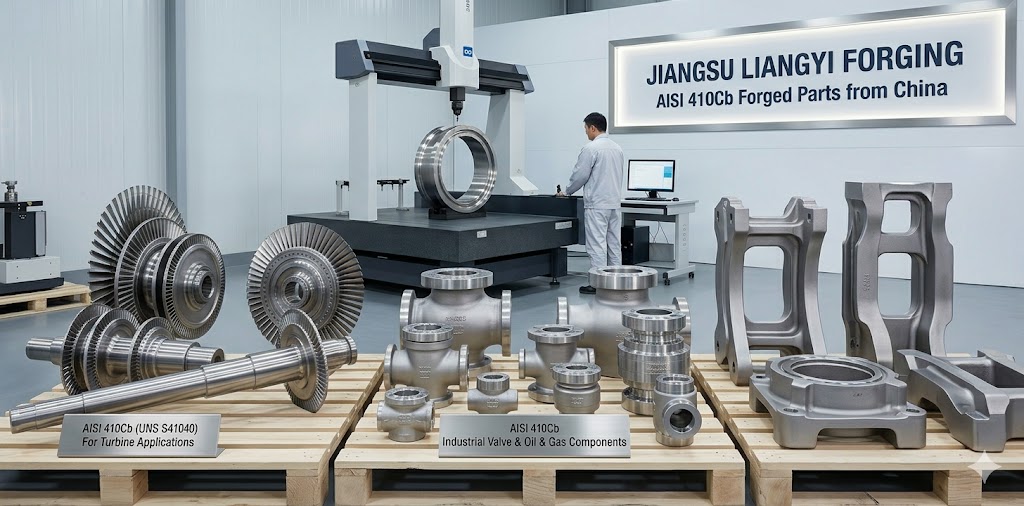
Product Overview & Manufacturer Introduction
Jiangsu Liangyi Co., Limited, established in 1997, is a professional ISO 9001:2015 certified China leading manufacturer of AISI 410Cb (also designated as AISI XM-30, UNS S41040) open die forging parts and seamless rolled steel forged rings. Located in Chengchang Industry Park, Jiangyin City, Jiangsu Province, our 80,000㎡ factory is equipped with 6300-ton hydraulic forging presses, 2000-ton/4000-ton hydraulic presses, 1–9 ton electro-hydraulic forging hammers, 1–5 meter seamless rolling machines, AOD+ESR smelting facilities, full-set heat treatment furnaces and precision inspection equipment (NDT, chemical, mechanical, metallographical). We supply high-quality 410Cb forged steel components from 30 kg to 30 tons single-piece weight, with an annual manufacturing capacity of 120,000 tons. With over 25 years of forging experience, we export our products to more than 50 countries across Europe, North America, the Middle East, Southeast Asia and Australia, serving critical industrial sectors with custom forging solutions from steel melting, forging, heat treatment to final CNC machining. Products are manufactured to meet the technical requirements of ASTM, AMS, AISI, GE, DIN, EN, JIS and other applicable standards as specified per customer order; API 6A and API 6D dimensional and material requirements are available — please consult our sales team regarding API Monogram licensing status for your specific application.
Full Range of AISI 410Cb (XM-30 / UNS S41040) Forging Products
We manufacture a complete portfolio of custom AISI 410Cb / UNS S41040 forging steel products in various shapes and dimensions, tailored to meet the strict requirements of power generation, oil & gas, industrial valve and rotating equipment industries:
AISI 410Cb Forged Bars & Rods
We supply AISI 410Cb forged steel round bars, square bars, flat bars, rectangular bars and step rods, with maximum diameter up to 2 meters and length up to 15 meters. Our 410Cb flat bars are widely used as raw material for gas and steam turbine blades, with strict grain size control (ASTM 5 or finer) and 100% ultrasonic inspection to ensure fatigue resistance in high-speed rotating applications.
AISI XM-30 Seamless Rolled Forged Rings
Our XM-30 seamless rolled rings, contoured rings, guide rings, gear rings, slewing bearing rings and seal rings are manufactured with 1–5 meter seamless rolling machines, with maximum outer diameter up to 6 meters and single-piece weight up to 30 tons. These products are the best choice material for turbine casings, valve bodies, labyrinth seal rings and heavy-duty rotating equipment, and they all meet EN 10228-3 and ASTM forging standards.
UNS S41040 Forged Shafts
We produce UNS S41040 forged step shafts, gear shafts, crank shafts, turbine shafts and rotor shafts, with maximum diameter up to 1800 mm, length up to 15 meters and weight up to 30 tons. All shafts are given 100% UT testing and are supplied with EN 10204 3.1 / 3.2 mill test certificates.They are the best choice material for heavy machinery, transmission systems and power equipment.
UNS S41040 Custom Hollow Forgings
We manufacture UNS S41040 forged hubs, housings, shells, sleeves, bushes, heavy-wall hollow bars, pipes and tubings, with outer diameter up to 3000 mm. Our seamless hollow forgings eliminate weld defects, providing superior structural integrity for high-pressure cylinders, valve bodies and downhole oil & gas applications.
Other Custom AISI 410Cb Forged Parts
We also manufacture a wide range of custom AISI 410Cb forged parts, including but not limited to: forged steel wheels (crane, railway, transfer cart, up to 2 meters diameter), forged crankshafts (30 kg to 30 tons), WYE pieces & piggable wyes (API 6D compliant), tubing hangers & casing hangers (API 6A PSL1–PSL4), valve stems, valve seat rings, valve balls (DN15 to DN1500), tube sheets (up to 4 meters diameter), TBM cutter & cutting rings, gas & steam turbine rotor shafts, and forged discs/plates/flanged blanks (up to 3 meters diameter). All products are fully produced according to client's technical drawings and specifications, with complete traceability for every production batch.
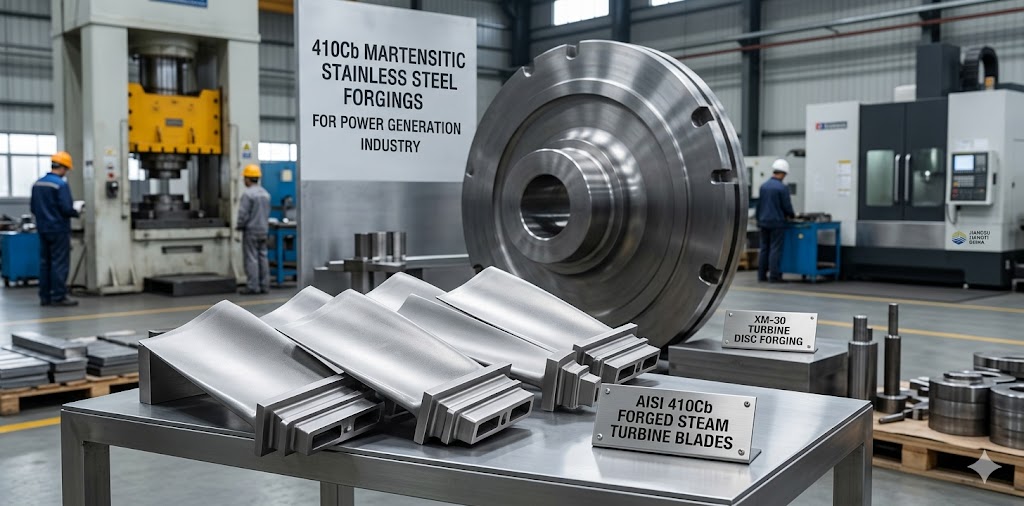
Material Properties & Advantages of AISI 410Cb Martensitic Stainless Steel
AISI 410Cb is a columbium (niobium) modified 12% chromium martensitic stainless steel, melted via AOD + VOD + ESR dual process to guarantee ultra-high material purity and consistent composition. Compared with standard AISI 410 stainless steel, 410Cb has improved performance for important industrial applications:
Main Performance Advantages
- Superior Strength & Toughness Balance: Higher yield strength (min 550 MPa) and impact toughness than standard 410, keeping stable mechanical properties at elevated temperatures up to 600°C, and it is the best choice material for steam turbine and high-temperature valve applications
- Precise Grain Size Control: The addition of 0.05–0.3% columbium (niobium) forms stable niobium carbides, effectively refining grain structure, reducing grain growth during heat treatment, and improving consistency of material performance
- Excellent Heat Treatment Processability: Wider heat treatment window compared with standard 410, reducing quenching deformation and cracking risk, enabling more stable batch production of large-size forgings
- Good Corrosion & Oxidation Resistance: 11–13% chromium content provides excellent resistance to steam oxidation, atmospheric corrosion and mild chemical corrosion, suitable for long-term service in power generation and petrochemical environments
- Outstanding Weldability & Machinability: Improved welding performance compared with standard 410, with reduced post-weld cracking tendency, supporting custom precision machining for complex geometric parts
AISI 410Cb vs Standard AISI 410: Key Performance Comparison
| Performance Index | AISI 410Cb (UNS S41040) | Standard AISI 410 |
|---|---|---|
| Yield Strength (Min, Quenched & Tempered) | ≥ 550 MPa | ≥ 415 MPa |
| Tensile Strength | 760 – 960 MPa | 655 – 825 MPa |
| Elongation (Min, 50 mm Gauge) | ≥ 18% | ≥ 15% |
| Grain Size Control | Stable fine grain (ASTM 5 or finer) | Prone to grain growth during heat treatment |
| Heat Treatment Stability | Wide process window, low deformation risk | Narrow process window, high cracking risk |
| Niobium (Columbium) Addition | 0.05–0.30% | None |
| Primary Application | Turbine blades, compressors, valves, high-pressure fasteners | General corrosion-resistant parts |
Production Standards, Chemical Composition & Mechanical Properties
Compliant Production Standards
Jiangsu Liangyi operates under an ISO 9001:2015 certified quality management system. Our AISI 410Cb forged steel products are made to meet the technical requirements of applicable international and industry-specific standards, including but not limited to: GE B50A947, GE B50A947B, GE B50A790, ASTM A276, ASTM A479, ASTM A388, DOD-F-24669, DRESSER RAND CM-8782, EN 10083-3, EN 10204, PED 2014/68/EU (material and dimensional requirements for pressure equipment components), API 6A, API 6D, NACE MR0175, DIN, JIS and client-specific technical requirements. The applicable standard(s) for each order are confirmed in writing at the quotation stage.
Chemical Composition of AISI 410Cb (UNS S41040)
- Iron (Fe): Balance (84.5% to 89%)
- Chromium (Cr): 11.0% to 13.0%
- Carbon (C): 0.05% to 0.18%
- Niobium (Nb, Columbium): 0.050% to 0.30%
- Nickel (Ni): ≤ 0.75%
- Molybdenum (Mo): ≤ 0.50%
- Manganese (Mn): ≤ 1.0%
- Silicon (Si): ≤ 1.0%
- Phosphorus (P): ≤ 0.040%
- Sulfur (S): ≤ 0.030%
Mechanical Properties (Quenched & Tempered Condition, +20°C)
- Yield Strength (Rp0.2): Min 550 MPa (Tested per EN 10002-1)
- Tensile Strength (Rm): 760 – 960 MPa (Tested per EN 10002-1)
- Elongation (A5): Min 18% (Tested per EN 10002-1)
- Reduction of Area (Z): Min 45% (Tested per EN 10002-1)
- Hardness: 220 – 280 HB (Customizable via heat treatment)
- Impact Toughness (KV): Min 27 J at room temperature
Industry Applications & Global Project Cases (GEO Targeted)
Our AISI 410Cb / AISI XM-30 / UNS S41040 forged parts are widely used in important industrial sectors worldwide. The following are real project cases from extreme working conditions:
Power Generation Industry (Global Thermal & Hydro Power Plants)
- AISI 410Cb forged steam turbine blades, flat rectangular bars, rotor discs, impellers and blisks for thermal power plants
- XM-30 forged turbine guide rings, labyrinth seal rings, packing seal rings and casing rings for gas and steam turbine systems
- GEO Project Case: We supplied over 2,000 tons of AISI 410Cb turbine blade flat bars and discs to multiple 300 MW–600 MW thermal power plants in Southeast Asia (Thailand, Vietnam, Indonesia) and South Korea. They all fully met GE B50A947 standard and passed 100% ultrasonic inspection and grain size testing. They have been working stably for over 8 years.
Oil & Gas and Petrochemical Industry (Middle East & North America)
- UNS S41040 forged centrifugal gas compressor blades, discs and casing parts for upstream oil & gas production
- AISI 410Cb forged valve bodies, valve seats, valve stems and choke parts for high-pressure wellhead and pipeline systems
- GEO Project Case: We made XM-30 seamless rolled seal rings and compressor parts for a large oil & gas project in the Middle East (Saudi Arabia, UAE, Qatar). These parts met DRESSER RAND CM-8782 standard and NACE MR0175 sour service requirements, and they all had excellent corrosion resistance in high H₂S environments.
Industrial Valve & Fastener Industry (Europe & Global)
- AISI 410Cb forged valve seats, valve spindles and closure parts for high-temperature high-pressure power station valves and industrial control valves
- XM-30 forged double-ended studs, bolts and fasteners for turbine, pressure vessel and heavy equipment applications
- GEO Project Case: We have supplied custom UNS S41040 forged valve seats and stems to major European industrial valve makers in Germany, Italy and France. These parts are treated with Stellite® 6 hardfacing to improve wear resistance. They are made to meet the dimensional and material requirements for CE‑marked pressure equipment under PED 2014/68/EU. Our customers, as the official equipment manufacturers, handle the CE marking for the finished valve assemblies.
General Industrial & Heavy Machinery Industry (Australia & Global)
- AISI 410Cb forged shafts, gears, rollers and structural parts for mining, construction and marine machinery
- Custom forged parts for hydraulic equipment, pressure vessels and heat exchanger systems
- GEO Project Case: We supplied AISI 410Cb forged crane wheels and mining machinery parts for Australian mining projects, and all parts were given strict NDT inspection and wear-resistant heat treatment, so that they all had reliable performance in harsh mining environments.
Full-Process Manufacturing & Strict Quality Control
Integrated Manufacturing Process for AISI 410Cb Forgings
We control the whole production chain in-house to guarantee the highest quality of every AISI 410Cb forging:
- Premium Steel Melting: AOD + VOD + ESR dual melting process to ensure ultra-low impurity content and consistent composition, meeting the strict requirements of turbine grade materials
- Precision Open Die Forging: Forged on 2000–6300 ton hydraulic presses and 1–9 ton electro-hydraulic hammers, with 30%+ forging ratio to guarantee full through-hardening and dense internal matrix
- Custom Heat Treatment: Full-set continuous heat treatment furnaces, with precise quenching and tempering process control to achieve the needed mechanical properties and grain size
- Precision Machining: CNC machining center for custom finishing, with dimensional tolerance up to IT6 level, meeting the requirements of complex part drawings
Mandatory Non-Destructive Testing & Quality Inspection
We implement full-process quality control for all AISI 410Cb forged parts, with mandatory non-destructive testing for every production batch:
- 100% dimension test and surface quality inspection for all forged parts.
- 100% ultrasonic inspection (UT) for all bars above 40 mm size, in accordance with EN 10308 Type 1a/1c, ASTM A388 standard; acceptance criteria: ≤200 mm section size — Quality Class 4; >200 mm section size — Quality Class 3.
- Magnetic particle inspection (MT), penetrant inspection (PT) for surface defect detection, compliant with ASTM E165 and ASTM E709 standards.
- Chemical composition analysis via direct-reading spectrometer, mechanical property testing, metallographic matrix and grain size inspection for every heat batch.
- Finished products shall be straight, sound and free from internal and surface defects (cracks, piping, scabs, laps, hairline cracks, etc.); surface defects are only allowed within half of the tolerance limits.
- Mill test certificate (MTC) EN 10204 3.1 is provided as standard for all orders; EN 10204 3.2 (third-party witnessed) available upon request with additional lead time of 7–14 working days; third-party inspection agencies (BV, SGS, TUV, Intertek) is available per request.
Physical & Thermal Properties of AISI 410Cb (UNS S41040)
Besides mechanical strength, the physical and thermal properties of AISI 410Cb directly determine how it performs in rotating parts and high‑temperature pressure systems. The data below shows typical reference values for this grade in the quenched and tempered condition, matching published metallurgical references and standard industry data for 12% chromium martensitic stainless steel. These figures are for engineering reference and early design use only — exact certified values are listed on the EN 10204 3.1 material test certificate for each order.
| Property | Value | Test / Reference Condition |
|---|---|---|
| Density | 7.74 g/cm³ | Room temperature (20°C), quenched & tempered |
| Elastic Modulus (Young's Modulus) | 215 GPa | Room temperature (20°C) |
| Shear Modulus | ~83 GPa | Room temperature (20°C) |
| Poisson's Ratio | 0.28 | Room temperature (20°C) |
| Thermal Conductivity | 25.0 W/(m·K) | At 100°C; decreases to ~22.5 W/(m·K) at 500°C |
| Coefficient of Thermal Expansion (CTE) | 10.5 × 10⁻⁶ /°C | 20–300°C range; 11.2 × 10⁻⁶ /°C at 20–600°C |
| Specific Heat Capacity | 460 J/(kg·K) | Room temperature (20°C) |
| Electrical Resistivity | ~0.60 μΩ·m | Room temperature (20°C) |
| Magnetic Permeability | Ferromagnetic (µr > 700) | Martensitic structure; fully magnetic in all heat-treated conditions |
| Melting Range | 1480 – 1530°C | Solidus to liquidus, composition dependent |
| Continuous Service Temperature (Oxidation) | Up to 700°C (in air) | Short-term; long-term mechanical stability recommended ≤ 600°C |
Engineering Note on CTE: AISI 410Cb has a relatively low thermal expansion rate, much lower than austenitic stainless steels which are around 16–17 × 10⁻⁶ /°C. This keeps its size stable under repeated temperature changes, a main benefit for turbine blade root fits, seal ring groove clearances and valve seat interference fits. When fitting 410Cb parts with different materials such as carbon steel casings, you must calculate the difference in expansion for the real working temperature range. This prevents assembly stress during start‑up and shut‑down cycles.
Heat Treatment Process Parameters for AISI 410Cb Forgings
Heat treatment is the most important step in making sure an AISI 410Cb forging meets its needed mechanical properties. Since adding columbium slightly changes the Ac1 and Ac3 transition temperatures compared to standard 410, the heat treatment ranges below come from Jiangsu Liangyi’s 25 years of production experience and meet the requirements of GE B50A947 and EN 10083-3. These settings apply to forged bars and rings, and must be adjusted for parts with a cross-section thicker than 300 mm.
Annealing (Softening / Stress Relief After Forging)
- Full Annealing Temperature: 830 – 885°C, hold time proportional to section size (minimum 1 hour per 25 mm of effective cross-section thickness)
- Cooling Method: Furnace cool at a controlled rate of ≤ 25°C/hour to below 600°C, then air cool — this controlled rate is essential to avoid temper embrittlement and achieve target hardness below 200 HB for machining
- Purpose: Used after forging to relieve internal stress, reduce hardness for subsequent machining, and homogenize the microstructure before final quench & temper cycle
- Liangyi Practice: All forgings exceeding 150 mm section thickness are given intermediate annealing after rough machining to relieve machining stress before final heat treatment, reducing dimensional distortion during quenching
Hardening (Austenitizing + Quenching)
- Austenitizing Temperature: 1000 – 1050°C (GE B50A947 specifies 1010–1040°C for turbine-grade material); temperature uniformity within the furnace load must be ±10°C
- Hold Time: Minimum 30 minutes after the entire cross-section reaches target temperature; for sections > 200 mm, calculated as 2 minutes per mm of maximum section thickness
- Quench Medium: Oil quench (preferred for sections > 75 mm to control distortion); water quench only for simple geometry sections below 50 mm or where drawing specifies; polymer quench solution available for intermediate sections where oil quench produces insufficient hardness depth
- Critical Note on Grain Size: Austenitizing above 1060°C risks dissolving NbC precipitates and triggering grain growth beyond ASTM 4 — this is the primary reason 410Cb has a tighter upper austenitizing limit than standard 410. Jiangsu Liangyi monitors grain size on every production heat via ASTM E112 metallographic examination
Tempering (Final Mechanical Property Control)
- Standard Tempering Temperature: 620 – 680°C to achieve the standard Q&T property window (Rp0.2 ≥ 550 MPa, Rm 760–960 MPa, hardness 220–280 HB)
- High-Toughness Tempering: 650 – 700°C for applications needing maximum impact toughness (e.g., low-temperature service or sour service per NACE MR0175 ≤ 22 HRC), at the cost of a slight reduction in tensile strength
- High-Strength Tempering: 580 – 620°C for applications needing tensile strength in the upper part of the 760–960 MPa window, where hardness toward 280 HB is required
- Temper Embrittlement Avoidance: Do NOT temper between 370–565°C (the temper embrittlement range for 12% Cr steels). Jiangsu Liangyi's furnace control system includes automated temperature interlocks to prevent accidental tempering in this range
- Cooling After Tempering: Air cool from tempering temperature for standard applications; for sour service or impact-important applications, water quench from tempering temperature removes residual temper embrittlement sensitivity
- Stress Relief (Post-Machining): 550 – 580°C for 2–4 hours, air cool — recommended after heavy CNC machining to relieve residual machining stress before final dimension test
Property Response Table by Tempering Temperature
| Tempering Temperature | Rp0.2 (MPa, Typical) | Rm (MPa, Typical) | Hardness (HB, Typical) | KV Impact at 20°C (J, Typical) | Recommended Application |
|---|---|---|---|---|---|
| 580 – 620°C | 700 – 800 | 880 – 960 | 260 – 280 | 30 – 50 | High-strength bolts, fasteners, valve stems |
| 620 – 660°C | 600 – 720 | 800 – 900 | 235 – 265 | 50 – 80 | Standard turbine blades, compressor discs, valve seats |
| 660 – 700°C | 550 – 650 | 760 – 840 | 220 – 245 | 70 – 120 | NACE sour service, low-temperature impact-critical parts, seal rings |
Note: All values above are typical reference ranges for this grade based on standard metallurgical data for 12% Cr martensitic stainless steel forged bar 80–200 mm diameter. Actual properties depend on section size, quench efficiency and specific heat number. Mill test certificate values govern for each order — please request test data from Jiangsu Liangyi for your specific section size and requirement.
AISI 410Cb vs Alternative Martensitic Stainless Steels: Material Selection Guide
Engineers choosing materials for important rotating and pressure‑holding parts often compare AISI 410Cb with three other martensitic or precipitation‑hardening grades: 17‑4PH (UNS S17400), 13Cr‑4Ni (CA6NM / UNS J91540), and 410NiMo. The comparison below is based on Jiangsu Liangyi’s 25 years of forging experience with all four grades. It is meant to help procurement and design engineers make a well‑informed material choice, not to promote any one grade.
AISI 410Cb vs 17-4PH (UNS S17400 / 1.4542): Strength vs Cost-Efficiency
- Strength & Hardness: 17-4PH in Condition H900 reaches Rp0.2 ≥ 1170 MPa, about twice the yield strength of 410Cb. However, 17-4PH needs precise aging treatment at 480–620°C and is much more easily affected by hydrogen embrittlement. This means it cannot be used in NACE sour service environments unless hardness is strictly controlled. AISI 410Cb provides a better balance between toughness and strength for parts that go through repeated temperature changes.
- Corrosion Resistance: 17-4PH with 3–5% Cu and 0.15–0.45% Nb has marginally better general corrosion resistance in mild chloride environments, but both grades have limited resistance to strong acids or elevated chloride concentrations.
- Forging & Machinability: AISI 410Cb is easier to open-die forge in large sections (above 500 mm diameter) due to its lower alloy content and wider forging temperature window. 17-4PH needs tighter temperature control and has higher risk of surface cracking in large cross-sections, which increases rejection rate and cost for heavy forgings.
- Cost: 17-4PH carries a 25–40% material premium over AISI 410Cb due to copper and additional nickel content. For large forgings (above 500 kg), this premium makes 410Cb the more economical choice where its mechanical property window is sufficient.
- Recommendation: Choose 17-4PH where compact, high-strength components need Rp0.2 above 700 MPa and part weight is important (aerospace, precision instrumentation). Choose AISI 410Cb for large forgings, turbine-grade applications under GE specifications, and wherever NACE MR0175 sour service compliance is needed.
AISI 410Cb vs 13Cr-4Ni (CA6NM / F6NM, UNS J91540): Toughness vs Operating Temperature
- Nickel Content & Low-Temperature Toughness: CA6NM (13Cr-4Ni) contains 3.5–4.5% Ni, which dramatically improves sub-zero impact toughness — typically KV ≥ 60 J at −40°C versus approximately 20–30 J for 410Cb at the same temperature. CA6NM is therefore the preferred grade for hydropower turbine runners, pump impellers and cryogenic valve bodies where low-temperature impact is a design driver.
- High-Temperature Performance: AISI 410Cb retains its strength advantage at elevated temperatures. At 500°C, 410Cb maintains Rp0.2 of about 400–450 MPa, whereas CA6NM, with its higher Ni and lower C, softens faster above 400°C. AISI 410Cb is therefore preferred for steam turbines and high-temperature valve applications above 400°C service temperature.
- Weldability: CA6NM has superior weldability (lower carbon, higher Ni acting as austenite stabilizer) and is specified for welded hydraulic turbine parts per IEC 60193 and ASTM A743. AISI 410Cb needs preheat and PWHT for welded assemblies — the welding section below provides full details.
- Corrosion in Water: CA6NM has better resistance to erosion-corrosion in high-velocity water flow (Francis and Kaplan turbine blades), owing to its Ni-modified microstructure. 410Cb is the best choice in steam environments where the condensate is treated and erosion is a lesser concern than scale-forming oxidation.
- Recommendation: Choose CA6NM / 13Cr-4Ni for hydraulic turbines, pump impellers and any application where service temperature is below 350°C and low-temperature toughness or water erosion resistance is the primary design criterion. Choose AISI 410Cb for steam turbines, gas turbine compressor blades, and high-temperature valve parts above 400°C.
AISI 410Cb vs 410NiMo (UNS S41001): Subtle Differences, Important Consequences
- Alloy Modifier Difference: 410NiMo adds Ni (0.5–1.0%) and Mo (0.5–1.0%) to the 12Cr base for improved toughness and corrosion resistance in mildly corrosive conditions, but does not contain columbium. 410Cb adds columbium (0.05–0.30%) specifically for grain size control and heat treatment stability without adding Ni or Mo.
- Grain Growth Control: This is the important practical difference: under identical austenitizing conditions (1000–1050°C), AISI 410Cb keeps fine grain (ASTM 5 or finer) due to stable NbC precipitates that pin grain boundaries. 410NiMo does not have this pinning mechanism and will show grain growth at the same temperature, increasing variability in mechanical properties — especially in large forgings where heating uniformity is harder to control.
- Standards Compliance: AISI 410Cb is explicitly specified in GE power generation standards (B50A947, B50A790) and DRESSER RAND CM-8782 for turbine-grade applications. 410NiMo does not appear in these specifications. If your project needs GE specification compliance, only 410Cb (XM-30, UNS S41040) is acceptable.
- Corrosion Resistance: 410NiMo has a slight advantage in mild corrosive environments due to Mo content, but both grades are limited to mildly corrosive service — neither is suitable for strong acid or high-chloride environments.
- Recommendation: For GE-standard turbine parts, power generation forgings and any application citing GE B50A947 or DRESSER RAND CM-8782, AISI 410Cb is the correct grade. 410NiMo is used where Mo-enhanced corrosion resistance is needed but grain size control is not a primary requirement.
Quick Selection Summary Table
| Selection Criterion | AISI 410Cb (XM-30) | 17-4PH | 13Cr-4Ni (CA6NM) | 410NiMo |
|---|---|---|---|---|
| Max Yield Strength | ~800 MPa (H-T) | ~1170 MPa (H900) | ~690 MPa | ~760 MPa |
| Low-Temperature Toughness (−40°C) | Moderate | Moderate | Excellent | Good |
| High-Temp Service (>400°C) | Excellent | Poor | Limited | Good |
| Grain Size Control in Large Forgings | Excellent (NbC pinning) | Good | Good | Moderate |
| NACE MR0175 Sour Service | Yes (≤22 HRC) | Limited | Yes (≤22 HRC) | Yes (≤22 HRC) |
| GE B50A947 Compliance | ✅ Yes | ❌ No | ❌ No | ❌ No |
| Forging Cost (Large Sections) | Economical | High | Moderate | Moderate |
Welding & Machining Guidelines for AISI 410Cb Forgings
AISI 410Cb can be welded when pre-weld and post-weld heat treatments are applied. Its 12% chromium martensitic matrix means the weld heat-affected zone (HAZ) will turn into hard, brittle martensite during cooling if not properly controlled. The guidelines below are based on Jiangsu Liangyi's production and field experience, and are for customers who do repair welding or sub-assembly welding on the forgings we supply.
Welding Parameters & Procedure
- Preheat Temperature: 200 – 250°C minimum before arc initiation; maintain interpass temperature within 200–300°C throughout welding. Preheat is mandatory for section thickness above 10 mm — welding without preheat will cause HAZ hydrogen cracking, particularly in forgings with residual hydrogen from the AOD/VOD melt process.
- Recommended Filler Metals:
- Like-to-like weld: AWS E410NiMo (SMAW) or ER410NiMo (GTAW/GMAW) — provides a tougher deposit than matched 410Cb filler while maintaining compatible CTE and good PWHT response
- Where higher toughness is required in the weld deposit: AWS E309L (austenitic buffer layer) followed by E410NiMo fill passes — used for repair welds on turbine parts where impact at root of weld groove is a concern
- Avoid matching 410Cb composition filler without Ni addition — the low-Ni matched weld metal is more susceptible to cold cracking under restraint
- Post-Weld Heat Treatment (PWHT): This treatment must be done within 4 hours after welding to prevent hydrogen cracking during cooling. Temper at 620–680°C for at least 1 hour for every 25 mm of weld thickness, then cool in a furnace or insulating blanket to below 150°C. PWHT brings back impact toughness in the heat-affected zone, relieves internal stress, and softens the newly formed martensite in the weld so its mechanical properties match the base material.
- Do NOT temper weld joints in the 370–565°C range — this is the temper embrittlement range for 12Cr steels and will result in severely degraded Charpy impact values in the HAZ regardless of preheat quality.
- Non-Destructive Examination of Welds: All production welds on pressure-containing forgings must be examined by MT (magnetic particle) after PWHT per ASME Section IX or EN ISO 9606; UT of weld zone per EN ISO 11666 for important pressure containment applications.
CNC Machining Parameters (Jiangsu Liangyi Reference Data)
AISI 410Cb in the quenched and tempered state (220–280 HB) machines in a similar way to alloy tool steel with the same hardness. The cutting values below come from Jiangsu Liangyi’s own CNC machining experience with bar and ring forgings and are meant as basic reference values. You should adjust the actual settings based on your tools, machine stability, and part shape.
- Turning (External/Internal, Roughing): Cutting speed Vc = 80–120 m/min; feed rate f = 0.25–0.45 mm/rev; depth of cut ap = 2.5–5.0 mm; recommended tool material: PVD-coated carbide ISO P25–P35 (e.g., TiAlN-coated); use coolant flood (sulfurized cutting oil or soluble oil emulsion)
- Turning (Finishing): Vc = 120–180 m/min; f = 0.10–0.18 mm/rev; ap = 0.3–0.8 mm; carbide ISO P10–P20 or CBN for final pass on hardened surface; sharp insert geometry recommended to minimize work hardening
- Milling (Face/End Milling, Roughing): Vc = 60–100 m/min; fz (feed per tooth) = 0.08–0.15 mm/tooth; axial depth Ap = 1.0–3.0× diameter; use 4–6 flute end mills, PVD TiAlN coated, positive rake geometry
- Drilling: Vc = 20–35 m/min; f = 0.08–0.15 mm/rev; use through-coolant carbide drills; peck-drill for holes deeper than 3× diameter to clear chips and prevent work hardening of the bore wall
- Work Hardening Note: AISI 410Cb has moderate work hardening tendency — avoid rubbing (interrupted cuts with zero feed), as this hardens the surface and accelerates tool wear on the subsequent pass. Keep consistent chip load throughout the cut.
- Surface Roughness Achievable: Ra 1.6–3.2 µm after turning; Ra 0.8 µm achievable with fine finishing pass and sharp carbide or CBN insert; grinding to Ra 0.4 µm possible for seal faces and precision bore diameters
Packaging, Delivery Condition & Documentation
Jiangsu Liangyi has built a complete set of export packaging and document procedures over 25 years of delivering forged parts to customers in Europe, North America, the Middle East, Southeast Asia and Australia. These rules apply to standard export orders of AISI 410Cb / XM-30 / UNS S41040 forged parts, unless the customer’s order states different requirements.
Standard Delivery Conditions Available
- As-Forged (AF): Supplied with forging scale removed by shot blasting; no heat treatment applied after forging; suitable for customers who perform their own heat treatment and final machining. Dimensional allowances follow ASTM A788 or client-specified forging tolerances.
- Annealed (A): Full annealed at 830–885°C, furnace-cooled; hardness ≤ 200 HB; suitable for customers needing the forgings in a soft condition for heavy machining before their own final heat treatment cycle.
- Quenched & Tempered (QT) — Standard: Heat treated to meet standard mechanical property requirements (Rp0.2 ≥ 550 MPa, Rm 760–960 MPa, hardness 220–280 HB); this is the most common delivery condition for direct-use turbine and valve parts.
- Quenched & Tempered + Rough Machined (QT+RM): Heat-treated to final QT condition, then rough machined to leave 3–8 mm stock on all surfaces; dimensional report and surface condition report provided; reduces customer machining time significantly.
- Quenched & Tempered + Finish Machined (QT+FM): Fully machined to customer's drawing dimensions (tolerance IT6–IT8 standard, IT5 available for precision bores); 100% dimension test report included; ready for assembly upon receipt.
Export Packaging Standard
- Rust Prevention: All machined surfaces and bare metal are coated with VCI (Vapor Corrosion Inhibitor) anti-rust oil or VCI film wrap before packaging — this provides a minimum 24-month corrosion protection period in standard warehouse conditions without refrigeration or special atmosphere control
- Inner Packaging: Each piece individually wrapped in VCI polyethylene film and secured with stretch wrap to prevent contact damage during handling; sharp edges (key ways, threads, precision bores) protected with LDPE foam cushion inserts
- Outer Packaging — Standard (≤ 500 kg/piece): Export-grade plywood wooden case (fumigation-free, ISPM 15 certified for pest-free compliance); internally braced with timber blocking to prevent shifting; maximum gross weight per case: 3,000 kg
- Outer Packaging — Heavy (500 kg – 30,000 kg/piece): Steel frame pallet or flat rack shipping frame; part bolted or banded to pallet; suitable for flat rack container, open-top container or breakbulk vessel shipment; lifting points marked with rated capacity per sling angle
- Marking: Each piece permanently marked (paint stencil or low-stress steel stamp in non-critical zone) with: Heat Number / Part Number / Material Grade (AISI 410Cb / UNS S41040) / Net Weight / Gross Weight / Jiangsu Liangyi order number; marking method per client specification available
Documentation Supplied with Every Order
- Mill Test Certificate (MTC) EN 10204 3.1: Standard — issued and signed by Jiangsu Liangyi's QC department; includes full chemical composition (heat analysis + product analysis), mechanical test results (Rp0.2, Rm, A5, Z, KV, HB), heat treatment records, grain size (ASTM E112), NDT results and dimensional compliance statement
- EN 10204 3.2 Witnessed Certificate: Available upon request — all tests witnessed and co-signed by an approved third-party inspection body (BV, SGS, TUV, Lloyds or customer-nominated inspector); additional lead time of 7–14 working days applies
- Third-Party Inspection Reports: BV / SGS / TUV / Intertek dimension test and visual inspection reports available; coordinate with customer-nominated inspection agency for pre-shipment inspection at Jiangsu Liangyi factory
- Certificate of Origin (CO): Issued by Jiangyin Chamber of Commerce; EUR.1 movement certificate available for applicable preferential tariff arrangements; please confirm with your customs broker for the specific requirements of your import country
- Packing List & Commercial Invoice: Detailed packing list (piece number, dimensions, weight, HS code, unit price) and commercial invoice issued on Jiangsu Liangyi letterhead; documentary letter of credit (LC), TT wire transfer and other standard trade finance terms accepted
- Shipping Terms: EXW (Jiangyin Factory), FOB (Shanghai / Ningbo / Tianjin), CFR or CIF to major world ports; DDP available for major EU destinations via established forwarding partner network
Frequently Asked Questions (FAQ)
Inquiry & Contact Information
Jiangsu Liangyi is your reliable ISO 9001:2015 certified China manufacturer and supplier of high-quality AISI 410Cb, AISI XM-30, UNS S41040 forged steel parts. We welcome your inquiries with custom drawings, material requirements, quantity and technical specifications for a detailed and competitive quotation.
📍 Chengchang Industry Park, Jiangyin City, Jiangsu, China