AISI 348 Forged Parts | UNS S34800 A182 F348 Stainless Steel Forgings
AISI 348 (UNS S34800) — At a Glance
What Is AISI 348 Stainless Steel? Metallurgy & Core Principles
AISI 348 (UNS S34800) is a niobium (Nb) and tantalum (Ta) dual-stabilized austenitic stainless steel belonging to the AISI 300-series family. To understand why Grade 348 exists and what genuinely separates it from every other austenitic grade, it is necessary to go deeper than a specification sheet — into the physical metallurgy that governs its behavior under real industrial service conditions.
The Sensitization Problem: What Makes Unstabilized Grades Fail
In all austenitic stainless steels, the 17–20% chromium content is the primary source of corrosion resistance. Chromium forms a self-repairing, tightly adherent chromium oxide (Cr₂O₃) passive film at the steel surface that blocks further oxidation and corrosive attack. However, when austenitic stainless steel is heated to temperatures between approximately 450°C and 850°C — whether during welding heat-affected zone exposure, stress-relief heat treatment, or elevated-temperature process service — dissolved carbon atoms migrate through the austenite lattice and preferentially diffuse to austenite grain boundaries. There, carbon reacts with the surrounding chromium to precipitate chromium carbide (Cr₃₃C₆) particles at the boundary.
This precipitation process continuously draws chromium from a narrow band of metal on each side of the grain boundary — depleting local chromium from the bulk 17–20% down to as low as 10–12% in the depletion zone. Below 12% chromium, the passive film is no longer effective, and the grain boundary zone becomes anodic relative to the surrounding chromium-rich grain interior. In a corrosive environment, this creates a galvanic cell that rapidly dissolves the depleted zone. Macroscopically, the component appears structurally sound but fails along grain boundaries — a failure mode called intergranular corrosion or sensitization-induced corrosion. In practical terms, a sensitized vessel or pipe may be dimensionally perfect yet fail catastrophically within months of entering corrosive service.
How Niobium and Tantalum Stabilization Prevents Sensitization
AISI 348 solves the sensitization problem through carbide stabilization. Niobium and tantalum both have a dramatically stronger thermodynamic affinity for carbon than chromium does. When Nb and Ta are present in sufficient quantity — ASTM requires Nb+Ta ≥ 10 times the carbon percentage — they preferentially react with dissolved carbon during the solution annealing heat treatment at 1010–1065°C, forming stable NbC and TaC carbides within the austenite grains rather than at grain boundaries. These carbides are thermodynamically far more stable than Cr₃₃C₆ across the entire sensitization temperature range (450–850°C). With carbon already locked in stable carbides, it is no longer available to migrate to grain boundaries and react with chromium when the steel subsequently passes through the sensitization range during welding or service. The chromium content at grain boundaries remains at the full bulk level, the passive film stays intact, and intergranular corrosion does not occur — even without post-weld heat treatment.
In our forge shop, we process AISI 348 billets at forging temperatures of 1100–1200°C — above the NbC dissolution threshold. After each intermediate reheat, we control-cool the billet to prevent excessive grain growth before the next pressing sequence. This thermal management during forging, combined with a final solution anneal at 1040–1060°C with water quench or accelerated forced-air cooling, ensures NbC and TaC carbides are uniformly distributed through the austenite matrix rather than clustered at prior deformation boundaries. Uniform carbide distribution is critical for both corrosion resistance and consistent mechanical properties in the finished forging — a non-uniform distribution can leave carbon-rich zones susceptible to local sensitization even in a notionally “stabilized” grade.
Why Cobalt Is Restricted to ≤0.20% in AISI 348
The second feature that uniquely defines AISI 348 — absent in AISI 347 — is the strict cobalt limit of ≤0.20%. Cobalt is not deliberately added to austenitic stainless steel, but it enters as a natural trace impurity in the nickel and iron raw materials, typically at levels of 0.05–0.50% if not actively controlled at the steelmaking stage. In standard industrial service, trace cobalt is inconsequential. In nuclear reactor environments, however, cobalt becomes a critical radiological safety concern.
The naturally occurring stable isotope cobalt-59 (Co-59), when exposed to neutron flux inside a nuclear reactor, captures a neutron through an (n,γ) reaction and transforms into cobalt-60 (Co-60) — a highly radioactive isotope with a 5.27-year half-life. Co-60 decays by emitting beta particles and high-energy gamma photons at 1.17 MeV and 1.33 MeV, which are highly penetrating and represent a significant occupational radiation dose hazard to nuclear plant maintenance workers. Even microgram quantities of Co-60 dissolved in or deposited from reactor coolant onto piping and component surfaces create radiation fields that require extensive shielding, remote tooling, and radiation dose management programs during outages. Global nuclear regulators and plant operators universally require that all metallic components in contact with reactor coolant systems contain cobalt at or below 0.20% — the threshold established by ASTM for the AISI 348 designation. Achieving this requires deliberate selection and blending of raw materials at the steelmaking stage, with chemical analysis verification at each individual heat before casting.
AISI 348 vs. AISI 347: The Precise Technical Differences
Both grades are Nb+Ta stabilized austenitic stainless steels sharing identical mechanical property minimums. The differences exist only in chemistry control:
AISI 347 (UNS S34700) — Standard Industrial Grade
- Cobalt content: No limit specified in ASTM A182
- Tantalum: Included within the Nb+Ta combined sum without separate cap
- Nuclear qualification: Not applicable — Co content unverified
- Applications: Petrochemical, high-temp. industrial, general stabilized SS service
- Cost premium over 304: Low (~20–30%)
AISI 348 (UNS S34800) — Nuclear-Qualified Variant
- Cobalt content: ≤0.20% maximum (hard limit, verified per heat)
- Tantalum: ≤0.10% maximum, separately specified and measured
- Nuclear qualification: Yes — inherent by grade chemistry specification
- Applications: Nuclear power + all AISI 347 applications
- Cost premium over 347: Small (~5–10%), fully justified by nuclear compliance value
Engineering rule: Every AISI 348 component can substitute for AISI 347 without any performance trade-off or re-qualification. The reverse is not true — AISI 347 cannot substitute for AISI 348 in nuclear-qualified applications without formal material deviation approval from the nuclear safety authority, which is rarely granted.
Chemical Composition of AISI 348 (UNS S34800) per ASTM A182 F348
The chemical limits below are taken from ASTM A182/A182M for Grade F348 forgings. At Jiangsu Liangyi, mill chemistry for every production heat is verified by optical emission spectrometry (OES) calibrated against NIST-traceable standards. Cobalt is independently confirmed by a dedicated cobalt-specific analytical method, with results reported on the EN 10204 3.1 material test certificate supplied with every shipment. We do not rely on the supplier mill certificate alone for cobalt verification — we re-test every incoming heat at our in-house laboratory.
| Element | Symbol | ASTM A182 F348 Limit | Our Typical Heat | Metallurgical Role |
|---|---|---|---|---|
| Iron | Fe | Balance | ~65–67% | FCC austenite matrix; base element |
| Chromium | Cr | 17.0% – 20.0% | 18.5–19.5% | Primary passive film former; corrosion resistance |
| Nickel | Ni | 9.0% – 13.0% | 10.5–12.0% | Austenite stabilizer; cryogenic toughness; SCC resistance |
| Niobium + Tantalum | Nb+Ta | 10×C% min — 1.00% max | 0.65–0.85% | Carbide stabilization; locks C as NbC/TaC; prevents sensitization |
| Manganese | Mn | ≤ 2.0% | ≤ 1.50% | Deoxidizer; secondary austenite stabilizer |
| Silicon | Si | ≤ 1.0% | ≤ 0.75% | Deoxidizer; improves high-temperature oxidation resistance |
| Carbon | C | ≤ 0.080% | ≤ 0.065% | Controlled low: lower C = less carbide demand on Nb budget |
| Cobalt | Co | ≤ 0.20% | ≤ 0.12% | Nuclear safety: limits Co-59 → Co-60 radioactivation in reactor neutron flux |
| Tantalum | Ta | ≤ 0.10% | ≤ 0.08% | Supplemental carbide stabilizer; separately capped for nuclear purity |
| Phosphorus | P | ≤ 0.045% | ≤ 0.030% | Tramp impurity; high P causes hot shortness and weld hot cracking |
| Sulfur | S | ≤ 0.030% | ≤ 0.015% | Tramp impurity; controlled for impact toughness and transverse ductility |
Why We Target the Conservative End of the Composition Window
In our production practice, we target carbon at ≤0.065% (versus the 0.080% maximum) and cobalt at ≤0.12% (versus the 0.20% nuclear limit). This is not a specification requirement — it is deliberate manufacturing conservatism. Lower carbon reduces the quantity of Nb+Ta consumed in carbide formation, leaving surplus Nb in solid solution to contribute to high-temperature strength and grain boundary pinning. The resulting Nb budget is therefore larger relative to the carbon that must be stabilized, providing a wider safety margin against sensitization under atypical service excursions.
The tighter cobalt target (≤0.12%) provides margin against the more stringent Co ≤0.10% project requirements imposed by several major nuclear utility owner specifications — specifications that go beyond the ASTM 0.20% limit and are increasingly common in new nuclear build projects. By producing to a 0.12% cobalt target, we can accommodate these tighter buyer specifications from existing production inventory without re-melting, which eliminates supply chain delays on time-critical nuclear projects.
Mechanical Properties of A182 F348 Forged Parts (Solution Annealed)
All Jiangsu Liangyi AISI 348 forgings are supplied in the solution annealed condition: uniformly heated to 1010–1065°C, held for a minimum of one hour per 25mm of maximum cross-section thickness (practical minimum 2 hours for any piece), then rapidly quenched in water or by accelerated forced-air cooling. This treatment dissolves all Cr₃₃C₆ sensitization products from forging operations, homogenizes the austenite matrix, redistributes NbC/TaC carbides uniformly at sub-grain scale, and achieves a target austenite grain size of ASTM 4–7 that balances strength, toughness, and ultrasonic detectability of any microstructural flaws.
| Property | Test Condition | ASTM A182 Minimum | Our Typical Result | Test Method |
|---|---|---|---|---|
| Tensile Strength (UTS) | 20°C (room temperature) | 515 MPa (75,000 psi) | 620–680 MPa | ASTM E8/E8M |
| Yield Strength (0.2% Proof) | 20°C (room temperature) | 205 MPa (30,000 psi) | 255–290 MPa | ASTM E8/E8M |
| Elongation | 50mm gauge length | 30% minimum | 40–48% | ASTM E8/E8M |
| Reduction of Area | — | Not specified | 55–70% | ASTM E8/E8M |
| Charpy V-Notch Impact | Room temperature (20°C) | ≥ 40 J | 140–180 J | ASTM E23 |
| Charpy V-Notch Impact | −196°C (cryogenic / LNG) | Not specified | 80–120 J | ASTM E23 |
| Brinell Hardness | — | ≤ 201 HB | 140–160 HB | ASTM E10 |
| Rockwell Hardness | — | ≤ 92 HRB | 78–85 HRB | ASTM E18 |
| Tensile Strength at 315°C | Elevated temperature | — | 480–520 MPa | ASTM E21 |
| Tensile Strength at 650°C | Elevated temperature | — | 310–360 MPa | ASTM E21 |
| Elastic Modulus (Young’s) | Room temperature | — | 193–197 GPa | ASTM E111 |
| Poisson’s Ratio | Room temperature | — | 0.27–0.30 | ASTM E132 |
Our Charpy impact values of 140–180 J at room temperature far exceed the ASTM 40 J minimum. This is not accidental — it is the direct result of our mandatory minimum 3:1 forging reduction ratio policy. Forging reduction refines the austenite grain size from the original cast ingot ASTM grain size 1–2 down to ASTM grain size 5–8 in the finished forging. Grain size reduction directly increases crack initiation energy, toughness, and fatigue resistance. It also improves UT flaw detectability: finer grain structure produces less acoustic scattering noise, allowing smaller defect indications to be resolved against the background signal — critical for nuclear components where very small acceptable defect sizes (as low as 3mm FBH equivalent) are routinely specified.
Physical & Thermal Properties of AISI 348 (UNS S34800)
Physical and thermal properties govern heat exchanger performance, thermal stress analysis, flange joint sealing behavior, and compatibility with adjacent materials. The following measured values are consistent with ASTM, ASM Handbook Vol. 2 data, and our internal material qualification testing. Engineers should verify against applicable design code property tables (ASME BPVC Section II Part D) when used in pressure-retaining calculations.
| Property | Unit | 20°C | 100°C | 300°C | 500°C | 700°C |
|---|---|---|---|---|---|---|
| Density | g/cm³ | 7.96 | 7.90 | 7.78 | 7.65 | — |
| Thermal Conductivity | W/m·K | 14.6 | 16.2 | 18.8 | 21.5 | 24.1 |
| Specific Heat Capacity | J/kg·K | 500 | 515 | 540 | 560 | 580 |
| Coefficient of Thermal Expansion | ×10⁻⁶/°C | — | 17.2 | 17.8 | 18.4 | 18.9 |
| Elastic Modulus (E) | GPa | 195 | 191 | 182 | 170 | 155 |
| Electrical Resistivity | μΩ·cm | 72 | 78 | 93 | 106 | 118 |
| Magnetic Permeability | — | ≤ 1.02 (non-magnetic; fully austenitic FCC structure) | ||||
Key engineering implications of these thermal properties for AISI 348 component design:
- Low thermal conductivity (14.6–24.1 W/m·K vs. ~50 W/m·K for carbon steel) means AISI 348 heat exchangers require significantly larger tube surface area for equivalent heat transfer duty. This is an accepted design trade-off for corrosion resistance and temperature capability.
- High thermal expansion (17.2–18.9 ×10⁻⁶/°C vs. ~12 ×10⁻⁶/°C for carbon steel) generates significant differential thermal movement at transitions between AISI 348 and carbon steel components. Expansion loops, bellows joints, or sliding pipe supports are essential in mixed-material piping systems.
- Non-magnetic behavior (permeability ≤1.02) makes AISI 348 compatible with magnetic resonance environments and non-interfering with magnetic flowmeter installations — relevant in nuclear coolant flow measurement instrumentation.
- Decreasing elastic modulus at temperature (195 GPa at 20°C dropping to 155 GPa at 700°C) requires temperature-corrected stiffness values in pressure vessel shell calculations per ASME BPVC Section II Part D allowable stress tables.
AISI 348 vs. 304 / 316L / 321 / 347: Full Grade Comparison
Selecting the correct austenitic grade requires understanding where each performs strongly, where it is marginal, and where it should not be used. The table below provides a direct engineering comparison based on our 25+ years of production experience with all five grades. Ratings reflect relative performance within the austenitic stainless steel family.
| Property / Criterion | AISI 304 / 304L | AISI 316L | AISI 321 | AISI 347 | AISI 348 |
|---|---|---|---|---|---|
| UNS Designation | S30400 / S30403 | S31603 | S32100 | S34700 | S34800 |
| Stabilizing Element | None | None (Mo added) | Ti | Nb+Ta | Nb+Ta |
| Post-Weld Sensitization Risk | High | High | Low | Very Low | Very Low |
| Post-Weld Heat Treatment Required? | Yes (sensitization service) | Yes (sensitization service) | No | No | No |
| Chloride Pitting Resistance | Moderate | Good (Mo benefit) | Moderate | Moderate | Moderate |
| Max Continuous Service Temp. | 870°C | 870°C | 900°C | 815°C | 815°C |
| High-Temp. Creep Strength | Moderate | Moderate | Moderate–Good | Good | Good |
| Cryogenic Toughness (−196°C) | Good | Good | Moderate | Good | Good |
| Nuclear Qualification (Co ≤0.20%) | Not specified | Not specified | Not specified | Not specified | Yes — inherent |
| Knife-Line Attack Resistance | N/A (unstabilized) | N/A (unstabilized) | Moderate (Ti KLA risk) | Good | Good |
| Weld Filler Availability | Excellent (ER308) | Excellent (ER316L) | Good (ER321) | Good (ER347) | Good (ER347 used) |
| Typical Cost vs. 304 Forgings | Baseline | +15–25% | +10–20% | +20–35% | +25–40% |
| Best Application Fit | General fabrication, food, pharma | Marine, bleach, HCl environments | Automotive exhaust, Ti-weld service | Industrial high-temp., petrochemical | Nuclear, critical high-temp., no-PWHT weld |
When to Specify AISI 348: Engineering Selection Decision Tree
From our experience supporting projects across 50+ countries, AISI 348 is the technically correct and commercially justified choice when at least one of the following applies:
- Nuclear qualification is mandatory: Any component contacting reactor coolant, housed within a nuclear safety boundary, or subject to ASME BPVC Section III requirements
- Service temperature exceeds 450°C AND post-weld heat treatment is impractical: Large fabrications, field-erected vessels, complex piping systems where PWHT would cause geometric distortion or surface damage
- Repeated thermal cycling through the sensitization range: Process equipment experiencing regular heat-up / cool-down cycles that cross the 450–850°C sensitization window
- Project specification explicitly requires ASTM A182 F348 / UNS S34800: Material substitution requires formal deviation approval, which is rarely granted for safety-critical service applications
If none of the above apply and chloride pitting resistance is the primary concern, AISI 316L or duplex stainless steel will typically offer better cost-to-performance value for that specific requirement.
Corrosion Resistance of AISI 348 in Specific Industrial Environments
Corrosion resistance in AISI 348 operates through three overlapping mechanisms: the bulk Cr₂O₃ passive film formed by the 17–20% chromium content; the grain boundary chemistry maintained by Nb+Ta stabilization; and the bulk chemistry response to specific corrosive species. Understanding the strengths and limitations in each environment is essential for sound material selection.
Intergranular Corrosion Resistance
AISI 348’s principal design advantage is immunity to intergranular corrosion following welding and elevated-temperature exposure. A properly solution-annealed AISI 348 forging subjected to ASTM A262 Practice E (Strauss test) — a 120-hour immersion in boiling copper sulfate plus sulfuric acid solution — consistently passes without measurable grain boundary attack. We conduct A262 Practice E testing on every production heat of AISI 348 as a self-imposed quality control measure, providing documented test results on the material certificate. While not universally mandated by ASTM A182, we regard this test as mandatory evidence of effective stabilization — particularly for nuclear-destined heats where the material’s sensitization resistance must be demonstrated, not merely assumed from chemistry compliance.
General Aqueous and Atmospheric Corrosion
In ambient-temperature aqueous environments at neutral to mildly acidic pH, AISI 348 performs identically to AISI 304, with negligible general corrosion in dilute acids, neutral brines, and atmospheric exposures. In oxidizing acidic media such as dilute nitric acid (HNO₃, the primary reagent in nuclear fuel reprocessing), the chromium passive film is reinforced by the oxidizing environment, and AISI 348 performs exceptionally well — a key reason for its selection in nuclear fuel reprocessing plant fabrications where nitric acid is the dominant process chemical and intergranular corrosion resistance of welds is a safety requirement.
Pitting and Crevice Corrosion in Chloride Environments
Without molybdenum, AISI 348 has a pitting resistance equivalent number (PREN = %Cr + 3.3×%Mo + 16×%N) of approximately 18–20, equivalent to AISI 304. It is therefore not recommended for sustained service in concentrated chloride solutions (seawater, concentrated brine, hydrochloric acid, bleaching agents) where pitting and crevice corrosion are the primary risk. In valve and wellhead applications in Middle Eastern sour gas fields, AISI 348 is used for pressure-containing body and trim components in contact with produced crude oil or gas — where free chloride concentrations are moderate — rather than in direct seawater or water injection service where super duplex or Inconel alloys are preferred.
Stress Corrosion Cracking (SCC)
All austenitic 300-series stainless steels, including AISI 348, are susceptible to chloride-induced stress corrosion cracking when simultaneously exposed to tensile stress (residual or applied), elevated temperature (typically above 60°C), and aggressive chloride levels. This is an inherent limitation of the 18Cr-10Ni austenitic family. For environments where SCC risk is significant — steam condensate with chloride contamination, offshore splash zone, steam-side of heat exchangers — duplex stainless steels (UNS S31803, S32750) or nickel alloys (Alloy 825, Alloy 625) should be evaluated. AISI 348’s higher nickel content (9–13%) compared to 304 (8–10%) provides marginally better SCC resistance, but this advantage is insufficient for truly aggressive chloride service.
High-Temperature Oxidation Resistance
AISI 348 maintains protective oxidation behavior in dry air and steam up to 815°C (1,500°F). Above this temperature, the Cr₂O₃ oxide scale grows at an increasingly rapid rate, and the material approaches its oxidation limit for continuous service. In intermittent or cyclic service — components that undergo repeated heating and cooling — thermal cycling causes the oxide scale to spall due to differential thermal expansion between scale and metal, exposing fresh metal to re-oxidation at each cycle. The effective cyclic oxidation limit is therefore typically 50–75°C below the continuous service limit.
⚠ Service Environments Where AISI 348 Is Not Recommended
- Concentrated chloride solutions above 60°C under tensile stress: Stress corrosion cracking risk — all austenitic 300-series grades are susceptible. Use duplex stainless steel (2205, 2507) or Alloy 825.
- Concentrated sulfuric acid above 50% at elevated temperature: General corrosion rates become economically unacceptable — use Hastelloy B or high-Si alloy.
- Reducing acids (HCl, HF in concentration): Passive film breakdown under reducing conditions — use Hastelloy C-276 or Inconel 625.
- High-temperature sulfidizing atmospheres above 500°C with H₂S: Chromium sulfide formation degrades the oxidation-resistant layer — use AISI 310 or high-Cr/Ni alloys.
- Polythionic acid during refinery turnarounds: Specific risk for sensitization-susceptible grades; AISI 348’s stabilization provides substantially better resistance than 304/316 but, where risk is confirmed, solution annealing before shutdown is the safest practice.
Global Standards & Compliance for A182 F348 Forgings
Our AISI 348 forged parts are manufactured in full compliance with the following international standards, enabling direct project qualification across all major global industrial markets without additional variance approvals or re-qualification testing at the customer’s end:
Regional Compliance & Market Adaptation
- North America (US & Canada): Fully compliant to ASTM A182, ASTM A965 and ASME Boiler & Pressure Vessel Code (BPVC) Sections II, III and VIII. Material test reports fulfill all documentation requirements for ASME Code stamp applications. Supplemental heat traceability and chemical analysis documentation for nuclear applications is provided to meet nuclear quality assurance program requirements including traceability to individual melt heat numbers.
- European Union & UK: Our manufacturing processes are compatible with PED 2014/68/EU requirements for pressure equipment forgings. EN 10204 3.1 material certificates are issued as standard; EN 10204 3.2 inspection is available upon request through the project-appointed inspection body. For UK pressure equipment projects, relevant documentation can be coordinated through the UK-based equipment manufacturer or Approved Body.
- Middle East (Saudi Arabia, UAE, Kuwait): Material manufactured to meet API 6A 17th edition material requirements for wellhead and Christmas tree forged components. Material qualification packages include Aramco SAMSS, ADNOC AGES, and KOC specification compliance matrices on request. NACE MR0175 / ISO 15156 sour service documentation is available for H₂S-bearing wellhead applications.
- Asia Pacific & Australia: Compliance with ASME, JIS G 4303 and AS/NZS standards. We provide third party inspection services for power generation, LNG and mining project requirements by SGS, TUV Rheinland, Bureau Veritas and Intertek at our Jiangyin facility.
Full Range of Custom AISI 348 Forged Products We Supply
We manufacture a complete portfolio of AISI 348 (UNS S34800) forged steel products in custom sizes and configurations, produced strictly to international standards and customer engineering drawings. Our in-house production spans the full manufacturing chain from EAF+AOD steelmaking through precision CNC machining and final NDT inspection:
Forged Round Bars, Flat Bars & Drive Shafts
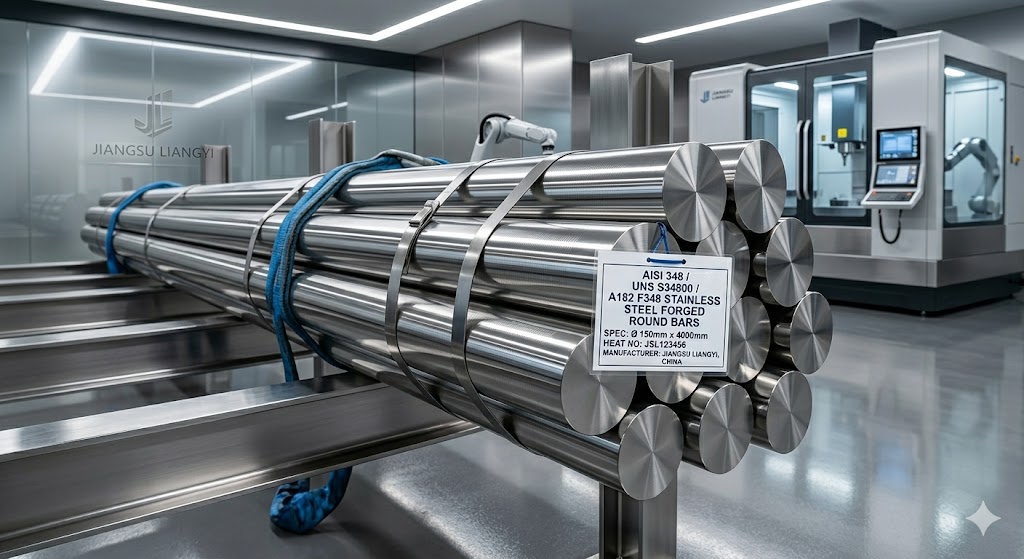
UNS S34800 forged steel round bars, square bars, flat bars, step shafts, gear shafts, and multi-step drive shafts produced to customer drawing. Forging capacity: maximum forged bar diameter Ø2,000mm, maximum length 15,000mm, single-piece weight up to 30 metric tons. All bars are ultrasonically tested per ASTM A388 to detect internal segregation, porosity, and pipe defects with 100% cross-section coverage. Forged bars consistently achieve finer grain structure and superior transverse mechanical properties compared to hot-rolled bar of equivalent chemistry, making them the correct choice for rotating shaft and high-cycle fatigue applications in turbomachinery and wellhead service.
Seamless Rolled Forged Rings
A182 F348 seamless rolled rings in rectangular, contoured, flanged, and gear-tooth cross-sections, including bearing races, valve seat rings, pressure vessel shell rings, and large-diameter flange rings. Our ring rolling capacity covers outer diameters from Ø150mm to Ø6,000mm with wall thicknesses from 30mm to 800mm, and single-piece weight up to 30 tons. A critical metallurgical advantage of seamless rolled rings over welded ring constructions is grain flow direction: the rolling process wraps austenite grain boundaries circumferentially around the ring, placing the highest-strength grain direction against the dominant hoop stress loading. This translates directly to better fatigue life, pressure containment integrity, and resistance to stress corrosion cracking initiation from the ring bore — which is the highest-stress surface in a pressurized ring application.
Seamless Hollow Forgings — Cylinders, Shells & Hubs
AISI 348 seamless hollow forgings including heavy-wall pressure cylinders, vessel shells, hub forgings, sleeves, bushings, and pressure vessel closures, with maximum outer diameter Ø3,000mm. Our mandrel-based hollow forging process eliminates center-line segregation and pipe defects inherent in ingot-cast hollow sections, producing a fully-wrought, homogeneous structure from bore to OD. All hollow forgings undergo bore surface liquid penetrant testing (PT) per ASTM E165 in addition to volumetric UT, providing comprehensive defect coverage for pressure-retaining applications including nuclear containment penetrations and subsea pressure housings.
Forged Discs, Tube Sheets & Pressure Vessel Blanks
Grade 348 forged discs, blind flanges, tube sheets (fixed, floating, full-face, and partition types), baffle plates, and custom near-net-shape blanks for heat exchanger and pressure vessel fabricators. Thickness range: 50mm to 800mm; maximum diameter Ø2,000mm. All tube sheets are produced with minimum 3:1 forging reduction to ensure through-thickness mechanical properties meet ASME Code requirements, and are supplied with full-face UT maps showing the location coordinates of any reportable indications for the Code fabricator’s fitness-for-purpose assessment.
Custom Forged Components to Engineering Drawing
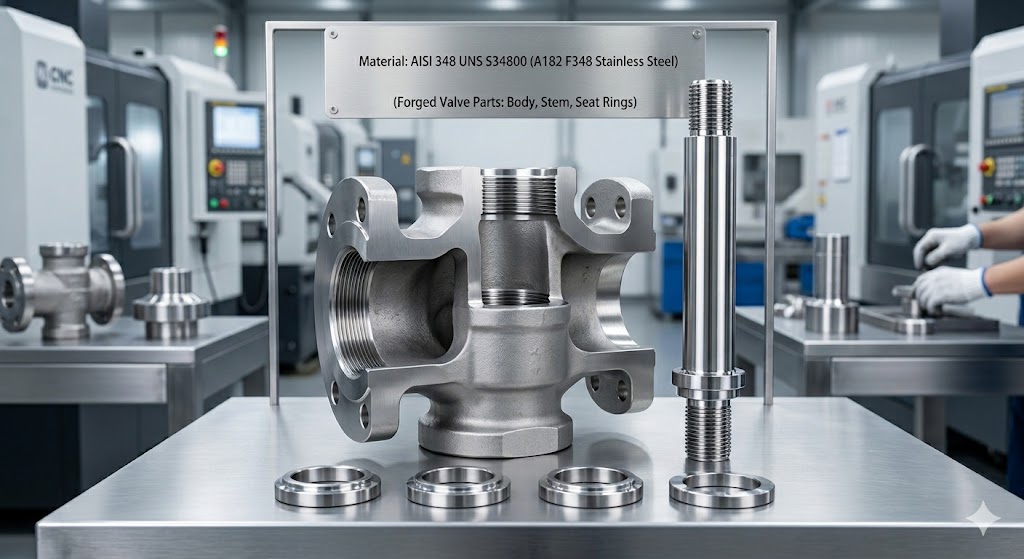
We produce complex custom AISI 348 forgings per customer engineering drawings: valve bodies (gate, globe, ball, butterfly, check types), pump casings, centrifugal compressor impeller blanks, nozzle forgings, tee-body forgings, subsea connector bodies, and flanged manifolds. Our in-house CNC machining center — with turning capacity to Ø3,000mm and milling capacity to 4,000mm × 2,000mm — delivers fully machined, dimensionally certified components to drawing tolerances, eliminating the need to engage a separate machine shop and simplifying project supply chain management.
Welding & Fabrication Guide for AISI 348 / UNS S34800
AISI 348 is one of the more readily weldable grades in the austenitic stainless steel family. Because post-weld heat treatment is not required for sensitization control, large fabrications and field welds can be completed with greater efficiency than non-stabilized grades. The following guidance is based on our in-house welding procedure qualification experience and the requirements of ASME Section IX, AWS D1.6, and EN ISO 14343.
Recommended Welding Processes
- GTAW / TIG (Gas Tungsten Arc Welding): Preferred for root passes and thin-section work. Lowest heat input of all arc processes, highest weld quality, and best control of fusion zone geometry. Use argon shielding gas (99.999% purity) or Ar+He blends. Back-purge the bore/root side of pipes and nozzles with argon during root welding to prevent root oxidation (“sugaring”), which embrittles the root pass and creates sites for crevice corrosion attack on the bore surface.
- SMAW / Stick Electrode: Acceptable for fill and cap passes in all welding positions. Higher heat input than GTAW — limit interpass temperature strictly to 175°C maximum. Remove slag completely between passes using stainless-specific slag chipping tools to prevent slag inclusions in the austenitic weld metal, which are difficult to detect by UT due to the acoustic similarity between slag and metal at the millimeter scale.
- GMAW / MIG: Great for medium to heavy section fill passes. Control heat input and minimize spatter by using pulsed or short-circuit metal transfer mode. For austenitic stainless steel, do not use spray transfer. The high heat input can cause excessive grain growth in the HAZ and the delta ferrite content in the weld metal can increase beyond acceptable limits for some applications.
- SAW (Submerged Arc Welding): Used for large-diameter ring and vessel girth seams where high deposition rate and productivity are priorities. Highest heat input of all listed processes — requires careful parameter control and verified interpass temperature monitoring to prevent excessive HAZ grain growth in the austenitic base metal.
Filler Metal Selection for AISI 348
The standard and universally accepted filler metal for welding AISI 348 is AWS A5.9 ER347 (bare wire for GTAW/GMAW) or AWS A5.4 E347-15 / E347-16 (coated electrode for SMAW). These Nb-bearing filler metals produce weld deposits with stabilized chemistry equivalent to the AISI 347/348 base metal. ER348 filler exists as an AWS classification but is rarely commercially stocked; most welding procedure qualifications (WPQs) for AISI 348 base metal qualify ER347 as an acceptable equivalent filler under ASME Section IX P-number groupings and AWS D1.6 provisions. Ferrite Number (FN) in the weld deposit should be controlled to 3–8 FN for most applications — sufficient to prevent hot cracking without excessive ferrite that could transform to brittle sigma phase in long-duration elevated temperature service.
For nuclear-qualified AISI 348 weld procedures at our facility, we additionally test the finished weld joint (base metal, HAZ, and weld metal) for intergranular corrosion susceptibility using ASTM A262 Practice E. While not universally mandated, this verification provides our nuclear clients with documentary evidence that the entire welded joint — not just the base metal forgings — retains the sensitization resistance that makes AISI 348 the correct material choice for their coolant system application. This additional testing has on two occasions detected non-conforming weld procedures (excessive heat input causing HAZ sensitization) before hardware delivery — preventing what could have been costly field failures or warranty claims.
Preheat, Interpass Temperature & PWHT Guidelines
- Preheat: Generally not required for AISI 348 at thicknesses below 25mm in ambient temperatures above 10°C. Hydrogen cracking (the failure mode that drives preheat in ferritic steels) does not occur in fully austenitic microstructures. A mild preheat of 50–100°C may be applied for heavy sections (above 50mm) to reduce distortion from thermal gradient, not for metallurgical reasons.
- Interpass temperature: 175°C maximum — strictly enforced. Exceeding this limit causes cumulative heat buildup that can locally drive the weld metal into the delta ferrite stability region, and on extended weld runs can begin to sensitize the HAZ through prolonged time in the 450–850°C range.
- Post-weld heat treatment: Not required and generally not recommended for solution-annealed AISI 348 in standard service. If a stress relief is required by the Code for a specific application, it should be performed as a full solution anneal (1010–1065°C water quench) rather than a subcritical stress relief in the sensitization range, which would actually induce the sensitization that the stabilized grade was chosen to prevent.
Advanced Melting, Forging & Heat Treatment Process
Our in-house production capability at Jiangyin City, Jiangsu Province covers the complete AISI 348 manufacturing chain from raw material melting to final inspection. Our advanced production equipment supports over 120,000 metric tons of annual forging capacity across all materials, with dedicated production lines for stainless steel and nickel alloys.
Melting Routes — Three Options Based on Application Criticality
We produce AISI 348 starting material via three melting routes matched to the application’s cleanliness and traceability requirements:
- EAF + AOD + VOD (Standard commercial grade): Electric arc furnace primary melt, followed by argon-oxygen decarburization (AOD) for carbon and sulfur control, then vacuum oxygen decarburization (VOD) for final chemistry refinement. Achieves carbon ≤0.060% and cobalt ≤0.15% as standard. This is our production route for the majority of AISI 348 orders destined for general industrial, oil & gas, and non-nuclear power generation service.
- EAF + AOD + ESR (Electro-Slag Remelting — Nuclear grade): Triple-melt with ESR remelting for the highest cleanliness requirements. The ESR process draws solidifying steel through a molten slag layer that filters oxide inclusions, reducing total oxygen content to ≤20 ppm and hydrogen to ≤1 ppm. It also produces a highly directional, segregation-free ingot structure. Used for ASME BPVC Section III Class 1 nuclear components including reactor coolant pump casings, pressure vessel nozzle forgings, and containment penetration bodies.
- VIM + VAR (Vacuum double-melt — Critical rotating components): Vacuum induction melting followed by vacuum arc remelting for ultra-critical turbomachinery rotating components. This route provides the lowest achievable inclusion content (ASTM E45 Method A: A-type ≤1.0 thin, B-type ≤0.5 thin), essential for centrifugal compressor impellers and high-speed turbine components where even sub-millimeter inclusions can initiate fatigue cracking under high-cycle dynamic loading.
Precision Forging — Equipment and Process Parameters
Our forging capability for AISI 348 spans single-piece weights from 30 kg to 30,000 kg:
- 0.75 Ton to 9 Ton electro-hydraulic forging hammers for small-to-medium components
- 2,000 Ton to 6,000 Ton hydraulic forging presses for large open-die forgings
- 1 Meter to 5 Meter seamless ring rolling machines for rings up to Ø6,000mm
- 10+ PLC-controlled heat treatment furnaces with ±5°C temperature uniformity
AISI 348’s forging temperature window is 1050°C to 1200°C. Below 1050°C, NbC carbides begin precipitating at grain boundaries, sharply increasing flow stress and raising the risk of surface cracking during pressing. Above 1200°C, austenite grains grow excessively and may not fully re-refine during subsequent forging passes or the final solution anneal. Our pyrometer-controlled forging sequence monitors billet surface temperature at every press stroke, automatically signaling the operator when reheating is required — preventing inadvertent forging below the minimum temperature that we have observed produce sub-optimal microstructures in other facilities’ AISI 348 forgings brought to us for rework.
One underspecified requirement we regularly encounter in client RFQs is the minimum forging reduction ratio. ASTM A182 does not mandate a minimum reduction for open-die forgings — but tensile properties measured in the forging axis direction can satisfy the standard at as little as 1.5:1 reduction. This may mask poor transverse ductility and impact toughness caused by retained cast dendritic structure and segregation in the center of the forging. For all AISI 348 production at Jiangsu Liangyi, we apply a self-imposed minimum 3:1 reduction ratio, documented in our forge plan and process route card. When the application warrants it (nuclear, subsea, rotating machinery), we target 4:1 to 6:1 reduction to achieve ASTM grain size 6–8 through the full cross-section. We encourage all clients specifying AISI 348 forgings to explicitly state a minimum reduction ratio in their RFQ — this single specification requirement separates high-quality forgings from low-cost alternatives that pass chemical and tensile requirements but underperform in service.
Solution Annealing — Critical Parameters
The final solution anneal for AISI 348 is the single most critical heat treatment step in our process. Its objectives are to dissolve all Cr₃₃C₆ sensitization products from forging operations, homogenize the austenite chemistry, redistribute NbC/TaC carbides to an optimum fine, uniform dispersion within the grains, and establish the target austenite grain size of ASTM 4–7. Our controlled process parameters:
- Temperature target: 1040–1060°C (within ASTM’s 1010–1065°C range, avoiding the upper limit to control grain growth)
- Hold time: Minimum 1 hour per 25mm of maximum cross-section, practical minimum 2 hours for all parts regardless of section
- Quench method: Water quench for sections >75mm; accelerated forced-air quench for sections <50mm where verified cooling rate exceeds 55°C/min through the 850–450°C sensitization range
- Documentation: Calibrated thermocouple data logger records the complete time-temperature profile for every furnace load, attached to the material certificate as objective evidence of heat treatment compliance
Quality Assurance, Inspection & Certification
Quality at Jiangsu Liangyi is not a final inspection step — it is embedded as a continuous chain of verification from raw material incoming through finished part shipment. Our ISO 9001:2015 quality management system governs every production stage, with documented mandatory hold points that cannot be bypassed without quality department authorization and documented deviation approval.
In-Process Inspection Hold Points
- Raw material incoming verification: OES chemical analysis of all elements including cobalt, compared against supplier mill certificate. Dedicated cobalt-specific re-test for every AISI 348 heat regardless of supplier certificate value. PMI (positive material identification) check of ingot and billet heat number markings against casting records. For ESR/VAR-remelted material, inclusion rating per ASTM E45 is verified against the project specification acceptance criteria before forging commences.
- Pre-forge checkpoint: Visual and surface inspection of incoming ingots/billets. Compare billet weight to forge plan allowance. Verification of the condition, alignment and thermal uniformity of the forging die. Review and sign-off of process route card by forger supervisor.
- Post-forge, pre-heat treatment checkpoint: Visual check, dimensional check to check forging is within rough machining allowance. Forge Log Review demonstrating compliance with forge temperature range and achievement of reduction ratio. (Heat number marking verification) – traceability must be maintained to forging surface or permanently attached tag at all times
- Post-heat treatment final inspection: Brinell hardness (minimum 3 readings per piece per ASTM E10) to confirm solution anneal effectiveness. Full visual inspection for surface cracks, laps, seams, or handling damage. Dimensional inspection against drawing with calibrated instruments. Mechanical coupon cutting, testing and consideration of results against specification minimums. NDT as per relevant standard. Prepare and review documentation packages.
NDT Capabilities for AISI 348 Forgings
- Ultrasonic Testing (UT): Contact UT and immersion UT per ASTM A388, EN 10228-3/4, and customer-specific UT acceptance criteria. Our phased-array UT (PAUT) system provides 100% volumetric coverage for complex-geometry forgings and produces digitally stored C-scan maps with indication location coordinates — enabling precise engineering evaluation of any reported indications against ASME BPVC fitness-for-service acceptance criteria.
- Liquid Penetrant Testing (PT): Per ASTM E165, for all accessible surfaces including bores and complex contour features. Detects surface-connected cracks, laps, cold shuts, seams, and porosity to sub-millimeter depth resolution.
- Intergranular Corrosion Test (IGC): ASTM A262 Practice E (Strauss test) performed on every AISI 348 heat as a self-imposed QC requirement, with results reported on certificate. Available as a contractual hold point for nuclear and critical chemical process customers.
- Ferrite Content Measurement: Ferritescope measurement of weld deposits where weld joints are supplied; target FN 3–8 per WPS.
Every finished AISI 348 forged shipment is accompanied by an inspection certificate package including: heat-specific chemical analysis (both heat analysis and product analysis per ASTM requirements), tensile and hardness test results, Charpy impact test results where specified, NDT reports with indication maps, calibrated heat treatment records with time-temperature charts, and dimensional inspection reports. Certificates are issued per EN 10204 3.1 as standard, with 3.2 (independent third-party inspector) available upon request through SGS, TUV Rheinland, Bureau Veritas, or Intertek.
Verified Global Project Cases: AISI 348 Forgings in Critical Service
AISI 348 forged parts from Jiangsu Liangyi are in active service across five continents in safety-critical and performance-critical applications. The following cases represent verified deliveries with documented performance records, shared to give engineers real-world evidence of material behavior in service conditions that match their own project requirements.
Nuclear Power Plant — Reactor Coolant System Components (United States)
We supplied a comprehensive package of custom A182 F348 nuclear-grade forgings for the primary coolant loop of a Generation III+ pressurized water reactor (PWR) in the eastern United States. The scope included reactor coolant pump casing sections, containment penetration seal housings, reactor pressure vessel instrument nozzle forgings, and primary system expansion joint body rings. All material was produced via the EAF+AOD+ESR triple-melt route, with cobalt content certified at ≤0.10% — more stringent than the ASTM 0.20% limit — to satisfy the utility’s internal nuclear safety specification. Each forging underwent ASME BPVC Section III Level 1 examination including phased-array UT with 100% volume coverage using a 3mm FBH reference standard, ASTM A262 Practice E IGC test per heat, and Level 3 radiographic review of UT scan data by the client’s authorized nuclear inspection authority (AIA). All 147 forgings in the order scope were accepted at first submission with zero deficiency reports. These components have been in continuous PWR reactor service since 2021 with no maintenance interventions or performance deviations recorded.
Wellhead & Christmas Tree Equipment — Sour Gas Service (Saudi Arabia)
For an onshore tight gas development project in the Rub’ al Khali basin, we manufactured over 2,400 individual UNS S34800 forged components for wellhead stacks and production Christmas trees rated to API 6A 10,000 psi (PSL-3, PR2 functional test), with NACE MR0175 Zone 3 sour service qualification for the H₂S-bearing well stream. Component types included spool body forgings (2–1/16” to 11” nominal bore), casing head housing forgings, tubing hanger body forgings, double studded adapter flanges, and integral mud cross flanges. Independent third-party inspection was conducted at our Jiangyin facility covering 100% dimensional verification, hydrostatic pressure test witnessing, and material certificate review across both project phases over 18 months. Zero quality non-conformances were issued during inspection. The client’s engineering team has since placed three additional projects with identical material and inspection specifications, representing our longest-running repeat supply relationship in the Middle East market.
LNG Terminal Cryogenic Valves — Austenitic Valve Components (Germany / EU)
We supply precision AISI 348 forged valve bodies, bonnets, stems, and seat carriers to a tier-one German industrial valve manufacturer serving European LNG import terminal projects. The application covers cryogenic butterfly valves (DN 50 to DN 1200) and cryogenic ball valves (DN 25 to DN 400) installed in LNG regasification trains operating at −162°C service temperature. AISI 348 was specified over AISI 304L because the valve manufacturer requires material traceability to ASTM A182 F348 — a specification that includes explicit Nb+Ta stabilization chemistry verification used as documented evidence of sensitization immunity when welding valve bodies into the piping system during terminal construction. Charpy impact testing at −196°C (34°C below the service temperature, providing conservative safety margin) was conducted per EN ISO 148-1 on transverse specimens from each heat, achieving a minimum of 80 J — confirming retained toughness well below the LNG service condition. All forgings are PED 2014/68/EU requirements with EN 10204 3.2 material inspection certificates per project requirements.
Supercritical Power Plant — Turbomachinery Forgings (Thailand)
For a 660 MW supercritical coal-fired power station, we supplied A182 F348 turbomachinery component forgings including centrifugal compressor impeller blanks (Ø650–Ø850mm, 480–680 kg each), main steam turbine boiler feed pump casing forgings, and feedwater heater shell forgings. The compressor impeller blanks were produced from VIM+VAR double-vacuum-melted material to satisfy the rotating machinery OEM’s internal cleanliness specification: ASTM E45 Method A ratings A ≤1.5 thin, B ≤1.0 thin, C ≤0.5 thin, D ≤1.5 thin. Immersion ultrasonic testing was performed to a 3mm FBH reference standard with 100% volumetric coverage and digital C-scan maps. These components entered service in 2022 under 24/7 base-load operation at turbine inlet temperature of 600°C and have completed four consecutive annual maintenance inspections with no crack indications, dimensional deviation from baseline measurements, or unplanned outage events attributable to material performance.
Natural Gas Processing Plant — Pressure Vessel Components (Western Australia)
We manufactured a batch of UNS S34800 forged tube sheets, floating head covers, pass partition plates, and shell-side nozzle forgings for a natural gas sweetening plant (amine absorber and regenerator service) in the Pilbara region. The sour gas process stream contains H₂S up to 8 mol% and CO₂ up to 15 mol%, with process temperatures ranging from 40°C (absorber) to 140°C (regenerator). AISI 348 was selected over AISI 316L based on the regenerator’s 130–140°C temperature in the presence of combined H₂S and free water, where higher nickel content reduces hydrogen embrittlement susceptibility, and the stabilized chemistry provides microstructural homogeneity that resists hydrogen-induced cracking initiation at micro-scale carbide clusters. NACE MR0175 compliance was documented in the full material certification package. All forgings were delivered fully machined with EN 10204 3.2 certificates issued by the project-appointed inspection authority, alongside HIC resistance test coupons per NACE TM0284 and SSC resistance coupons per NACE TM0177 Method A for the client’s pre-commissioning qualification file — a documentation standard that has since been adopted as the client’s new baseline requirement for all forged stainless steel pressure components.
Chemical Composition Reference — AISI 348 / UNS S34800
| Element | ASTM A182 F348 Limit | Jiangsu Liangyi Typical Heat |
|---|---|---|
| Iron (Fe) | Balance | ~66% |
| Chromium (Cr) | 17.0% – 20.0% | 18.5–19.5% |
| Nickel (Ni) | 9.0% – 13.0% | 10.5–12.0% |
| Niobium + Tantalum (Nb+Ta) | 10×C% min — 1.00% max | 0.65–0.85% |
| Manganese (Mn) | ≤ 2.0% | ≤ 1.50% |
| Silicon (Si) | ≤ 1.0% | ≤ 0.75% |
| Carbon (C) | ≤ 0.080% | ≤ 0.065% |
| Cobalt (Co) | ≤ 0.20% | ≤ 0.12% |
| Tantalum (Ta) | ≤ 0.10% | ≤ 0.08% |
| Phosphorus (P) | ≤ 0.045% | ≤ 0.030% |
| Sulfur (S) | ≤ 0.030% | ≤ 0.015% |
Mechanical Properties Reference — A182 F348 Forgings (Solution Annealed)
| Mechanical Property | ASTM A182 Minimum | Jiangsu Liangyi Typical |
|---|---|---|
| Tensile Strength (UTS) | 515 MPa (75,000 psi) | 620–680 MPa |
| Yield Strength (0.2% Offset) | 205 MPa (30,000 psi) | 255–290 MPa |
| Elongation (50mm Gauge) | 30% | 40–48% |
| Charpy Impact at 20°C | ≥ 40 J | 140–180 J |
| Charpy Impact at −196°C | Not specified | 80–120 J |
| Brinell Hardness | ≤ 201 HB | 140–160 HB |
| Elastic Modulus (20°C) | — | 193–197 GPa |
| Density | — | 7.96 g/cm³ |
Frequently Asked Questions — AISI 348 / UNS S34800 / A182 F348
The following questions and answers are drawn from real engineering inquiries received from our global clients across nuclear, oil & gas, valve manufacturing, and power generation industries. They are written to provide engineering-level answers, not marketing summaries.
AISI 348 (UNS S34800) is a niobium and tantalum dual-stabilized austenitic stainless steel developed in the 1960s specifically for nuclear power reactor applications. It was created because designers of early PWR and BWR reactor primary coolant systems identified that the cobalt impurity present in AISI 347 — then the standard stabilized grade for high-temperature chemical processing — would become a long-term radiological hazard. Cobalt-59 absorbs neutrons and transmutes to radioactive cobalt-60 (5.27-year half-life, 1.17 and 1.33 MeV gamma emitter), creating radiation dose hazards for maintenance workers. By restricting cobalt to ≤0.20%, the 348 grade was created as a nuclear-safe variant of 347 with identical mechanical and corrosion properties but minimal radioactivation potential. Its nuclear-grade documentation and excellent high-temperature stability have since made it the preferred stabilized grade across nuclear, high-temperature petrochemical, oil & gas, and critical valve fabrication applications worldwide.
The primary difference is cobalt content control: AISI 348 limits cobalt to ≤0.20% (nuclear safety requirement) and separately caps tantalum at ≤0.10%. AISI 347 specifies no cobalt limit and includes tantalum within the combined Nb+Ta sum without a separate Ta ceiling. Both grades share identical mechanical property minimums (515 MPa UTS, 205 MPa YS, 30% elongation), the same Nb+Ta stabilization mechanism, and equivalent weldability. In every non-nuclear application, the two grades are interchangeable without any performance trade-off. In nuclear service, AISI 347 cannot substitute for AISI 348 without formal engineering deviation approval because the cobalt content of 347 heats is uncontrolled and unverified — approval is rarely granted by nuclear safety authorities.
AISI 348 is used in: nuclear power reactor coolant system components (pump casings, pressure vessel nozzles, containment penetrations); oil & gas wellhead and Christmas tree equipment (API 6A spool bodies, hangers, flanges); industrial valve bodies and internals (gate, globe, check, ball, butterfly types) in high-temperature stabilized service; cryogenic LNG regasification and liquefaction equipment (down to −196°C); high-temperature pressure vessels and heat exchanger tube sheets (up to 815°C); centrifugal compressor impellers and turbomachinery rotating components; and nitrogen-containing chemical processing equipment where both high temperature and sensitization resistance are simultaneously required.
No. AISI 348 does not require PWHT to maintain intergranular corrosion resistance after welding. The Nb+Ta stabilization (minimum Nb+Ta = 10 times the carbon percentage) binds carbon as stable NbC and TaC carbides throughout the solution-annealed microstructure. During welding, the heat-affected zone passes through the 450–850°C sensitization temperature range, but because free carbon is effectively unavailable — it is already locked in thermodynamically stable carbides — Cr₃₃C₆ cannot form and chromium depletion at grain boundaries does not occur. This eliminates PWHT from the fabrication sequence, which is a significant advantage for large pressure vessels, complex piping systems, and field-erected structures where PWHT would cause distortion, surface damage, or prohibitive cost. For ASME Code Class 1 nuclear components where solution annealing after welding is required by the Code, we coordinate directly with the fabricator’s WPS qualification.
The universally accepted filler metals for welding AISI 348 are AWS A5.9 ER347 (bare wire for GTAW/GMAW) and AWS A5.4 E347-15 / E347-16 (coated electrode for SMAW). These Nb-bearing filler metals produce deposits with stabilized chemistry equivalent to the AISI 347/348 base metal. While ER348 exists as an AWS classification, it is rarely commercially available — ER347 is qualified as an equivalent filler for AISI 348 base metal under ASME Section IX P-number groupings and AWS D1.6 provisions. Key parameters: argon shielding (99.999% purity) for GTAW; maximum interpass temperature 175°C; back-purge pipe root passes with argon to prevent root oxidation. Weld metal ferrite number (FN) should target 3–8 FN for most applications.
AISI 348 has a maximum continuous service temperature of 815°C (1,500°F) in oxidizing atmospheres (air, steam), limited by the Cr₂O₃ oxidation scaling rate above this point. In reducing or sulfidizing gas environments, the practical limit is approximately 650–700°C due to chromium sulfide formation degrading the oxidation-resistant layer. For intermittent or cyclic service (repeated heating and cooling), the effective safe temperature ceiling is typically 50–75°C below the continuous limit because oxide scale spalling at each thermal cycle exposes fresh metal. At the low-temperature extreme, AISI 348’s fully austenitic FCC crystal structure retains excellent ductility and impact toughness to −196°C, making it fully qualified for LNG service (−162°C), liquid CO₂ service, and cryogenic laboratory equipment applications without special testing beyond standard low-temperature Charpy qualification.
The UNS (Unified Numbering System) designation for AISI 348 is UNS S34800. Other designations for the same material: A182 F348 (ASTM forgings for flanges and fittings), A965 F348 (ASTM austenitic steel forgings for pressure service), Alloy 348, Grade 348. The approximate EN equivalent is X6CrNiNb18-10 (material number 1.4550) — however, this is the EN equivalent of AISI 347, not 348; the EN system does not separately define a grade with the AISI 348 cobalt restriction. For nuclear projects in Europe, the AISI 348 / UNS S34800 / ASTM A182 F348 designation must be specified explicitly in purchase orders and material certificates to ensure the cobalt content limit is contractually binding.
AISI 348 and 316L are designed for different corrosion environments and should not be treated as direct substitutes. AISI 316L uses molybdenum (2–3%) to enhance pitting and crevice corrosion resistance in chloride-containing media (seawater, brine, bleaching agents, HCl solutions) — environments where 348 without Mo is decidedly weaker. AISI 348 is superior in high-temperature service (450–815°C) where sensitization is the primary failure mechanism, and in nuclear environments where cobalt content must be verified and controlled. In nitric acid service (nuclear fuel reprocessing, chemical manufacturing), 348 outperforms 316L because Mo can cause instability of the passive film in strongly oxidizing HNO₃ environments. For elevated-temperature petrochemical service without aggressive free chlorides, AISI 348 is typically preferred over 316L for its stabilization and better documented high-temperature behavior.
The primary ASTM standards for AISI 348 forgings are: ASTM A182/A182M — Forged or Rolled Alloy and Stainless Steel Pipe Flanges, Forged Fittings, and Valves (Grade F348); and ASTM A965/A965M — Steel Forgings, Austenitic, for Pressure and High Temperature Components (Grade F348). For nuclear service, ASME BPVC Section III (nuclear pressure components) references A182 and A965. For oil & gas wellhead, API 6A 17th edition accepts AISI 348 chemistry as a stainless steel option. European pressure equipment requires PED 2014/68/EU compliance, documented via EN 10204 3.1 or 3.2 inspection certificates. Sour service applications additionally require NACE MR0175 / ISO 15156 compliance documentation for H₂S-containing process streams.
Knife-line attack (KLA) is a narrow, highly localized form of intergranular corrosion occurring in a thin band immediately adjacent to the weld fusion line in stabilized stainless steels. During high heat input welding, the metal adjacent to the fusion line is momentarily heated above approximately 1,250°C — above the NbC dissolution temperature — which temporarily releases carbon back into solid solution in this narrow zone. If the component subsequently experiences sensitization-range temperatures (450–850°C) in service, Cr₃₃C₆ can re-precipitate in this thin band, producing a visible knife-cut pattern of corrosion attack parallel to the weld. AISI 348 manages KLA better than AISI 321 (Ti-stabilized) because NbC has a higher dissolution temperature than TiC, re-precipitates more readily on cooling, and the Nb+Ta chemistry provides a larger stabilization margin per unit of carbon. For absolutely critical applications subject to repeated thermal cycling — particularly in nuclear service — a post-weld solution anneal at 1010–1065°C provides definitive protection against KLA risk.
AISI 348 retains significant mechanical strength at elevated temperatures. Our measured tensile strength values for solution-annealed A182 F348 forgings: 620–680 MPa at 20°C; 480–520 MPa at 315°C; 380–430 MPa at 540°C; and 310–360 MPa at 650°C. At temperatures in excess of 650°C the controlling design criterion is time-dependent creep behavior — Code-allowable stress values including both yield strength and creep rupture factors at temperatures up to 815°C are presented in ASME BPVC Section II Part D. For temperatures above 815°C, other materials like AISI 310, Alloy 800H or Inconel 625 should be considered as better material choices.
Yes. AISI 348 is resistant to hydrogen embrittlement in general, as all austenitic stainless steels are, due to its face-centered cubic (FCC) crystal structure, which has a much higher hydrogen solubility and lower hydrogen diffusivity than BCC ferritic and martensitic steels. The FCC lattice accommodates dissolved hydrogen atoms in interstitial sites without the lattice distortion that drives hydrogen embrittlement in BCC structures. For high-pressure gaseous hydrogen service (above 200 bar at elevated temperature), the Nelson curves for austenitic stainless steels — published in API RP 941 — define the safe operating envelope, and AISI 348 falls within the same favorable region as 304 and 316. For hydrogen storage at ambient and cryogenic temperatures, AISI 348 has been successfully qualified in multiple API 6A and ASME pressure vessel applications. Ensure chemistry produces a fully stable austenite (sufficient Ni equivalent) to prevent hydrogen-induced martensite transformation under repeated pressure cycling.
For custom AISI 348 open-die forgings and seamless rolled rings, the normal lead time is 8–16 weeks after order confirmation and drawing approval. Actual lead time depends on part design, unit weight and order quantity. This timeline relates to raw material procurement, melting, forging, heat treatment, mechanical testing, NDT inspection and certification documentation.We can also speed up production for emergency orders. When you submit the RFQ please indicate your desired delivery date so we can assess schedule feasibility at the inquiry stage. We maintain a stock of pre-forged AISI 348 ingots for regular customers with a rolling six-month volume forecast, reducing the lead time for repeat orders by 3–5 weeks.
Contact Us for Custom AISI 348 Forging Solutions
Jiangsu Liangyi Co., Limited is a reliable Chinese manufacturer of AISI 348, UNS S34800 and A182 F348 forged parts. With more than 25 years of forging experience and ISO 9001:2015 certification, we support full in-house production covering melting, forging, heat treatment all the way to CNC precision machining. We have steadily supplied qualified forgings to clients in nuclear, oil & gas, power generation and valve industries across over 50 countries worldwide.
To receive a technical and commercial quotation, please send engineering drawings, material specification (ASTM / ASME / API / EN standard), required quantity, dimensional tolerances, NDT requirements, inspection level (EN 10204 3.1 or 3.2), and delivery destination. Our technical sales team — staffed by metallurgical and mechanical engineers with AISI 348-specific forging experience — will review your specifications and respond within 24 hours.
Inquiry Email: sales@jnmtforgedparts.com
Phone / WhatsApp: +86-13585067993
Website: www.jnmtforgedparts.com
Factory Address: Chengchang Industry Park, Jiangyin City, Jiangsu Province, China 214400