AISI 321 Forging Parts | UNS S32100 | Grade 321 | EN 1.4541 | SUS 321 Stainless Steel Forgings
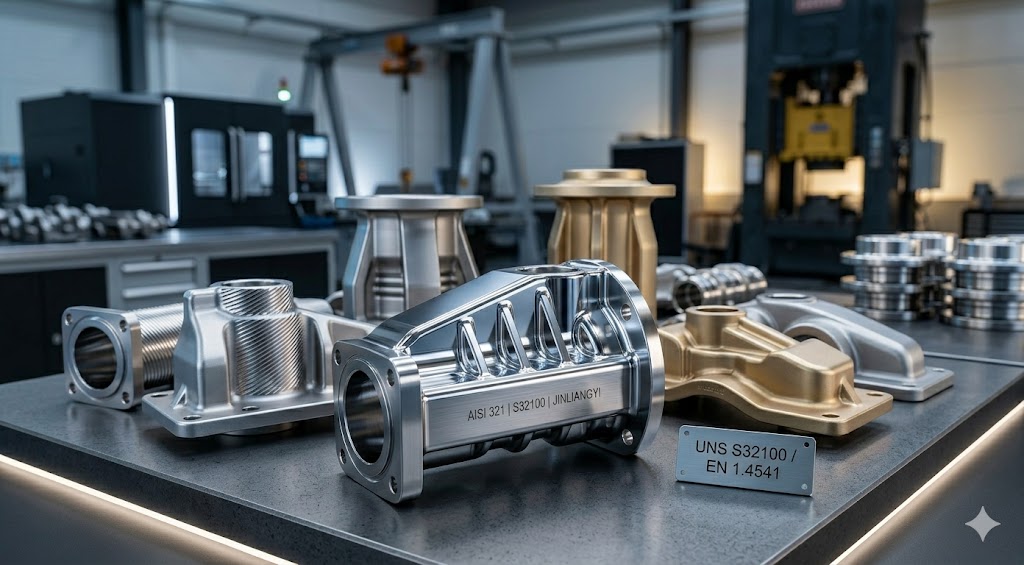
Jiangsu Liangyi Co., Limited is an ISO 9001-certified China manufacturer of AISI 321 (UNS S32100 / EN 1.4541 / DIN X6CrNiTi18-10 / SUS 321 / GB 06Cr18Ni11Ti) open die forging parts and seamless rolled forged rings, with over 25 years of production experience and exports to 50+ countries. This page provides a complete engineering and procurement guide to AISI 321 forgings: material science, equivalent standards, grade selection, chemical composition, mechanical properties, elevated temperature data, manufacturing process, quality assurance, global market compliance, industry applications, buyer's specification guide, common mistakes, procurement checklist, and frequently asked questions — written from 25 years of real forging production experience, not copied from material datasheets.
AISI 321 (UNS S32100) Forgings — Key Technical Facts
What is AISI 321 (UNS S32100) Stainless Steel? — Material Definition, Standards & Equivalents
AISI 321 is an austenitic stainless steel stabilized with titanium, developed specifically to overcome the single most critical limitation of standard 18-8 grades (AISI 304 / 316): susceptibility to intergranular corrosion after welding. The alloy is built around a 17–19% chromium and 9–12% nickel base, with titanium added at a minimum ratio of 5 × (C + N) — a formulation mandated by every major international standard governing this grade.
Understanding the multiple designation systems in use globally is essential when specifying forgings for international projects. The table below maps every major equivalent:
| Standard Body | Designation | Region / Authority | Key Document |
|---|---|---|---|
| AISI / ASTM | AISI 321 / Grade 321 | USA — American Iron and Steel Institute | ASTM A276, ASTM A182, ASTM A336 |
| UNS | UNS S32100 | USA — SAE/ASTM Unified Numbering | SAE HS-1086 / ASTM DS-56 |
| EN (European) | EN 1.4541 | Europe — CEN | EN 10222-5, EN 10250-4 |
| DIN (German) | X6CrNiTi18-10 | Germany — DIN | DIN 17440, DIN 17458 |
| JIS (Japanese) | SUS 321 | Japan — JIS | JIS G4303, JIS G4308 |
| GB (Chinese) | 06Cr18Ni11Ti | China — SAC/GB | GB/T 1220, GB/T 14976 |
| BS (British) | 321 S 31 | United Kingdom — BSI | BS 1449, BS 3605 |
| GOST (Russian) | 08Kh18N10T | Russia — GOST | GOST 5632 |
For global procurement purposes, specifying the UNS number (S32100) alongside the local standard designation eliminates ambiguity. A purchase order referencing only "321 stainless steel" without specifying UNS or EN number can lead to incorrect material supply in markets where the designation convention differs from the buyer's home standard.
The Metallurgy of AISI 321 — How Titanium Stabilization Actually Works
This section explains the fundamental metallurgical principle behind AISI 321 — a topic that most product pages reduce to a single sentence. Understanding this mechanism is essential for engineers specifying forgings for high-temperature or weld-intensive applications.
The Sensitization Problem in Unstabilized Austenitic Steels
In standard AISI 304 and AISI 316 stainless steels, when the material is held at temperatures between 425°C and 870°C — a range that encompasses both post-weld slow cooling and many industrial operating temperatures — carbon migrates to austenite grain boundaries and combines with chromium to form chromium carbide (Cr₂₃C₆). This reaction depletes the chromium concentration in a narrow zone immediately adjacent to each grain boundary, reducing chromium locally from the typical 18% level to below the 10.5% minimum required for passivation. These chromium-depleted zones become highly susceptible to selective corrosive attack in most media — a condition called sensitization. In service, sensitized material fails by intergranular corrosion: the grain boundary zones corrode preferentially while the grain interiors remain unaffected, causing the material to lose structural cohesion and ultimately fail at a fraction of its rated load.
How Titanium Prevents Sensitization
Titanium has a significantly greater affinity for carbon than chromium does at the temperatures involved. When titanium is present in sufficient quantity (at least 5 times the combined carbon + nitrogen content by weight), it reacts with carbon during cooling through the sensitization range to form titanium carbide (TiC) rather than allowing Cr₂₃C₆ to form. Since carbon is consumed by titanium before it can reach grain boundaries and combine with chromium, no chromium-depleted zones develop. The result: the alloy is immune to sensitization regardless of thermal cycling through the 425–870°C range, and no post-weld heat treatment is needed.
The minimum titanium content of 5×(C+N) is not arbitrary. It accounts for both carbon and nitrogen — both of which compete for titanium. Nitrogen forms TiN (titanium nitride) just as readily as TiC, so if nitrogen is ignored in the calculation, insufficient titanium may remain to stabilize the carbon. This is why high-quality AISI 321 melts report both carbon AND nitrogen in the heat analysis, and why our controlled nitrogen ceiling (max 0.08%) is tighter than the ASTM standard's max 0.10% — it ensures every heat provides an adequate stabilization margin, particularly in heavier forgings where homogeneity through section is critical.
Stabilizing Anneal vs Solution Anneal: Choosing the Right Heat Treatment
Most AISI 321 forgings are supplied in the solution-annealed condition (1010–1120°C + water quench), which dissolves all carbides into the austenite matrix and produces optimal corrosion resistance and ductility. However, for applications where subsequent fabrication involves prolonged exposure in the 425–870°C range — such as re-welded assemblies or components that will see service immediately after welding without further heat treatment — a secondary stabilizing anneal at 870–900°C for 2–4 hours is sometimes performed. This promotes complete TiC precipitation throughout the matrix before service, ensuring the alloy enters service with titanium already "committed" to carbon rather than leaving any dissolved carbon free to form Cr₂₃C₆ during service exposure. The trade-off is a modest reduction (typically 3–5%) in room-temperature ductility compared to solution-annealed only material.
Why AISI 321 Forgings Outperform Castings for Critical Applications
The choice of forging or casting for AISI 321 parts is not just a manufacturing preference but has real measurable effects on mechanical performance, inspection reliability and service life in tough environments. This comparison holds especially true in oil & gas, nuclear power and pressure vessel applications where the consequences of failure are severe.
AISI 321 Open Die Forgings
- Wrought grain structure — refined, elongated grains aligned with component geometry
- Forging reduction ratio ≥3:1 closes solidification shrinkage, eliminates porosity
- Homogeneous mechanical properties through full section thickness
- Impact energy (Charpy) typically 100–180 J at 20°C in solution-annealed condition
- 100% volumetric UT inspection possible — no masking by casting porosity echoes
- Tighter dimensional tolerances achievable with CNC machining post-forging
- Required by ASME BPVC Section III for nuclear pressure boundary components
AISI 321 Investment / Sand Castings
- As-cast dendritic grain structure — coarser, less uniform, no preferred orientation
- Solidification shrinkage and micro-porosity inherent to the casting process
- Mechanical properties vary through section; thin sections may differ from thick cores
- Impact energy typically 60–90 J — noticeably lower than forging equivalents
- Radiographic testing (RT) required to detect internal porosity — adds cost and time
- Dimensional repeatability lower; HIPping (hot isostatic pressing) often needed for critical use
- Acceptable for non-pressure-retaining, low-consequence structural applications
Based on our in-house testing comparing forged and cast AISI 321 specimens of identical composition and heat treatment: forged material consistently delivers 25–40% higher Charpy impact energy and 15–25% higher fatigue life in cyclic pressure testing. For pressure-retaining components rated to ASME or PED, forgings are not just preferred — they are frequently mandatory under the applicable design code. When a project specification says "wrought material required," forgings are the correct supply form.
Chemical Composition of AISI 321 (UNS S32100 / EN 1.4541) — Standard Limits & Our Controlled Ranges
Our AISI 321 material is melted in-house using Electric Arc Furnace (EAF) steelmaking followed by Argon Oxygen Decarburization (AOD) or Vacuum Oxygen Decarburization (VOD) refining. This two-step process gives precise control over carbon, nitrogen, and titanium content — the three most critical variables in AISI 321 quality. Our controlled ranges are deliberately narrower than the published standard limits on most elements, providing greater process stability and more consistent properties across heats and section sizes.
| Element | ASTM Limit | EN 1.4541 Limit | Our Controlled Range | Why It Matters for Forgings |
|---|---|---|---|---|
| Carbon (C) | Max 0.08% | Max 0.08% | Max 0.07% | Lower C reduces TiC demand, widening stabilization safety margin in heavy sections |
| Nitrogen (N) | Max 0.10% | Max 0.11% | Max 0.08% | N consumes Ti (forms TiN); tighter N control ensures adequate Ti remains for C stabilization |
| Titanium (Ti) | 5×(C+N) min – 0.70 max | 5×(C+N) min – 0.70 max | 5×(C+N) min – 0.60 max | Upper limit controlled to avoid TiN inclusion formation in heavy ingots during solidification |
| Chromium (Cr) | 17.0 – 19.0% | 17.0 – 19.0% | 17.2 – 18.8% | Minimum margin above 17.2% ensures passivation robustness; tight range aids predictable forgeability |
| Nickel (Ni) | 9.0 – 12.0% | 9.0 – 12.0% | 9.2 – 11.8% | Ni stabilizes austenite; controlled range avoids delta-ferrite formation in large-section forgings |
| Silicon (Si) | Max 1.00% | Max 1.00% | 0.30 – 1.00% | Minimum Si floor aids deoxidation during AOD refining; high Si reduces toughness in heavy forgings |
| Manganese (Mn) | Max 2.00% | Max 2.00% | 0.50 – 2.00% | Mn acts as austenite stabilizer and desulfurizer; keeps sulfide inclusion morphology benign |
| Phosphorus (P) | Max 0.045% | Max 0.045% | Max 0.040% | P segregates to grain boundaries at high P; lower ceiling improves hot ductility during forging |
| Sulfur (S) | Max 0.030% | Max 0.015% | Max 0.025% | S forms MnS inclusions; very low S improves transverse impact properties and surface quality after machining |
Every heat of AISI 321 we produce is verified by our in-house laboratory using optical emission spectrometry (OES) for full elemental analysis, with results reported on the EN 10204 3.1 mill test report. For orders requiring EN 10204 3.2, independent laboratory verification of the heat analysis is performed by the nominated third-party inspection body before forging commences.
Full Range of AISI 321 Forged Products & Manufacturing Capabilities
All AISI 321 forging products are manufactured in-house at our Jiangyin facility, with full traceability from raw material heat number through every production stage to final shipment documentation. We do not subcontract forging or heat treatment operations.
AISI 321 Forged Bars & Shafts
Custom forged bars include round bars, flat bars, step shafts, gear shafts, and hollow spindles. Maximum diameter 2,000 mm, maximum length 15,000 mm, single piece weight up to 30,000 kg. Typical applications: pump shafts, reactor stirrer shafts, turbine rotor shafts, and large-diameter valve stems. Bars larger than 500 mm diameter are typically produced with a minimum 4:1 forging reduction ratio, with full-length UT per ASTM A388 or EN 10228-3 and end-to-end dimensional straightness verified before despatch.
AISI 321 Seamless Rolled Forged Rings
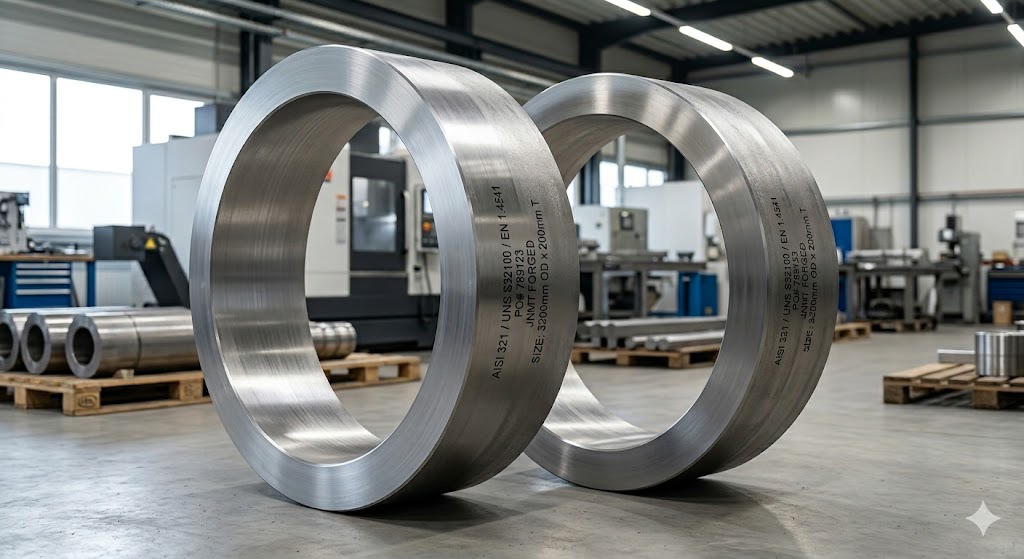
Custom seamless rolled rings are produced on our 4,000-tonne radial-axial ring rolling mill. Maximum outer diameter 6,000 mm, maximum height 1,500 mm, minimum wall thickness approximately 50 mm (geometry-dependent). Rings are supplied in rectangular, contoured (profiled), or near-net-shape cross-sections to reduce customer machining allowances and material waste. Typical applications: large valve flanges, pressure vessel shell rings, bearing rings for rotating machinery, nuclear reactor containment rings, and offshore subsea riser connector flanges.
AISI 321 Hollow Forged Components
Custom seamless hollow forgings including hubs, housings, sleeves, cylinders, pressure vessel shells, and reactor liners. Maximum outer diameter 3,000 mm. Hollow forgings are produced by punch-and-draw or mandrel forging methods, yielding a fully wrought, void-free wall structure. This method produces superior wall-to-wall mechanical property uniformity compared to boring out a solid forging, particularly important for large-diameter nuclear and petrochemical components where ultrasonic inspection access may be limited after final assembly.
AISI 321 Forged Discs, Plates & Custom Near-Net-Shape Components
Custom AISI 321 forged discs, flanges, tube sheets, head blanks, nozzles, and fully custom near-net-shape forgings manufactured strictly per customer 2D/3D drawings. Near-net-shape forging reduces machining allowances and final part cost compared to standard oversize forgings. We provide DFM (Design for Manufacturability) analysis at no charge — including forging die layout recommendations that can reduce raw material consumption by 15–25% on complex shapes without compromising mechanical properties.
Mechanical Properties, Physical Properties & Elevated Temperature Performance
Room Temperature Mechanical Properties — Solution Annealed (per ASTM A182 / EN 10222-5)
| Property | Standard Minimum | Our Typical Values | Test Method |
|---|---|---|---|
| Tensile Strength (Rm) | 515 MPa (75 ksi) | 550 – 610 MPa | ASTM E8 / ISO 6892-1 |
| 0.2% Proof Strength (Rp0.2) | 205 MPa (30 ksi) | 240 – 290 MPa | ASTM E8 / ISO 6892-1 |
| Elongation A50 (min.) | 40% | 45 – 58% | ASTM E8 / ISO 6892-1 |
| Reduction in Area (Z) | — | 55 – 72% | ASTM E8 |
| Brinell Hardness (HBW) | Max 217 HBW | 155 – 200 HBW | ASTM E10 / ISO 6506 |
| Charpy Impact Energy (20°C) | — (typically ≥100 J) | 110 – 185 J | ASTM E23 / ISO 148-1 |
| Charpy Impact Energy (−196°C) | — (cryogenic use) | 60 – 120 J | ASTM E23 / ISO 148-1 |
Key Physical Properties of AISI 321 (UNS S32100 / EN 1.4541)
| Property | Value | Conditions |
|---|---|---|
| Density | 7.90 g/cm³ (0.285 lb/in³) | 20°C |
| Melting Range | 1398 – 1426°C (2550 – 2600°F) | Liquidus / Solidus |
| Elastic Modulus (E) | 193 GPa (28 × 10⁶ psi) | 20°C |
| Elastic Modulus at 500°C | 169 GPa | 500°C |
| Thermal Expansion | 17.2 × 10⁻⁶ /°C | 20 – 100°C |
| Thermal Expansion | 18.6 × 10⁻⁶ /°C | 20 – 500°C |
| Thermal Conductivity | 16.1 W/m·K | 100°C |
| Thermal Conductivity | 21.5 W/m·K | 500°C |
| Specific Heat Capacity | 500 J/kg·K | 20°C |
| Electrical Resistivity | 0.72 × 10⁻⁶ Ω·m | 20°C |
| Magnetic Permeability | <1.02 (non-magnetic) | Solution annealed |
Elevated Temperature Mechanical Properties — The Data Most Pages Don't Show
For engineers designing components that operate at temperatures above 300°C, room-temperature properties are insufficient for stress calculations. The table below provides AISI 321 forging property data at elevated temperatures — the values engineers need for pressure vessel and piping system design per ASME BPVC Section II Part D or EN 13480-2:
| Temperature | 0.2% Proof Strength (Rp0.2) | Tensile Strength (Rm) | Elongation (A%) | Design Relevance |
|---|---|---|---|---|
| 20°C (68°F) | 240 – 290 MPa | 550 – 610 MPa | 45 – 58% | Ambient reference condition |
| 200°C (392°F) | 175 – 210 MPa | 480 – 540 MPa | 38 – 48% | Steam and hot water service |
| 400°C (752°F) | 140 – 170 MPa | 430 – 490 MPa | 35 – 46% | Process piping, heat exchangers |
| 500°C (932°F) | 125 – 155 MPa | 390 – 450 MPa | 33 – 44% | Refinery units, boiler headers |
| 600°C (1112°F) | 110 – 140 MPa | 340 – 400 MPa | 30 – 42% | Gas turbine components, fired heaters |
| 700°C (1292°F) | 85 – 115 MPa | 270 – 330 MPa | 28 – 40% | Upper limit of sustained load design range |
| 800°C (1472°F) | 55 – 80 MPa | 185 – 240 MPa | 28 – 42% | Short-duration / intermittent service only |
At temperatures above approximately 550°C, time-dependent deformation (creep) becomes the governing failure mode rather than short-term tensile or yield strength. For components in sustained service above 550°C, design must be based on creep rupture strength (100,000-hour rupture data) rather than proof strength values from the table above. Contact our engineering team for AISI 321 creep rupture data at your specific service temperature and design life requirement.
AISI 321 Grade Selection Guide — 321 vs 304 vs 316L vs 347 Decision Matrix
Selecting the correct austenitic stainless steel grade for a critical forged component is one of the most consequential decisions in the early engineering phase of any project. The wrong selection leads to premature failure; the overly conservative selection adds unnecessary cost. The following matrix represents our engineering team's 25-year perspective on common selection scenarios:
| Selection Criterion | AISI 304 / 304L | AISI 316L | AISI 321 (UNS S32100) | AISI 347 (UNS S34700) |
|---|---|---|---|---|
| Sensitization resistance after welding | ❌ Poor — PWHT required | ❌ Poor — PWHT required | ✅ Excellent — Ti stabilized | ✅ Excellent — Nb stabilized |
| Max continuous service temp. | ~400°C (corrosive env.) | ~450°C (corrosive env.) | 870°C | 900°C |
| Chloride pitting resistance | Moderate (no Mo) | Good (2–3% Mo) | Moderate (no Mo) | Moderate (no Mo) |
| Polythionic acid SCC resistance | Poor | Poor | Good | Excellent |
| Creep strength at 600°C | Low | Low–Moderate | Good | Good–High |
| PWHT required after welding | Yes (for HT service) | Yes (for HT service) | No | No |
| Relative material cost index | 1.00 (reference) | 1.20 – 1.35 | 1.10 – 1.25 | 1.30 – 1.50 |
| Typical applications | Low-temp, non-critical | Marine, pharmaceutical, chloride environments | Oil & gas, nuclear, power gen, valves | Refinery catalytic crackers, severe PASCC |
When to Specify AISI 321 (UNS S32100) — Our Engineering Guidance
Based on our experience supplying forgings across all four grades to global projects, AISI 321 is the correct choice when all three of the following conditions are simultaneously present: (1) the component will be welded in fabrication or repair, (2) PWHT after welding is impractical, restricted, or prohibited by design code, AND (3) the service temperature exceeds 400°C or the environment is susceptible to sensitization-related corrosion. When only conditions (1) and (2) are present but service temperature is below 400°C, AISI 304L or 316L may be the more economical choice since their lower carbon content (max 0.03%) also provides good weld-zone corrosion resistance at ambient temperatures. When condition (3) applies at temperatures above 850°C with severe polythionic acid exposure, consider upgrading to AISI 347.
When AISI 321 is NOT the Right Choice
- Chloride-bearing marine environments at ambient temperature where pitting is the primary corrosion mode — AISI 316L or duplex grades (e.g., UNS S31803) provide superior pitting resistance due to molybdenum content
- Cryogenic applications below −196°C where impact toughness at extreme cold is paramount — AISI 304L or 316L are preferred for LNG and cryogenic plant
- Components where cost absolutely dominates and operating temperature is below 350°C with no sensitization risk — AISI 304L is adequate at lower cost
- Extremely severe polythionic acid SCC service (catalytic reformer reactor internals) — AISI 347H (high carbon) or Alloy 800H may be more appropriate
Our 8-Stage AISI 321 Forging Manufacturing Process — From Steel to Final Part
Full integration from steelmaking to final machined part is not standard among forging suppliers — most purchase pre-made billet and begin at the forging stage. Our integrated process gives us control over every variable that affects final part quality, including the chemistry, ingot structure, forging sequence, and thermal history of each component. Here is exactly how we produce AISI 321 forgings:
Electric Arc Furnace (EAF) Steelmaking
Raw materials (scrap steel, ferrochromium, ferronickel, titanium sponge) are charged into our 50-tonne EAF. Initial melting achieves a crude melt at approximately 1600°C. Carbon content at this stage is typically 0.3–0.8% — far above the target 0.08% maximum — requiring the subsequent refining step. EAF slag practice is designed to remove phosphorus and silicon to preliminary target levels during this stage.
AOD / VOD Refining — The Critical Chemistry Control Stage
The EAF melt is transferred to an Argon Oxygen Decarburization (AOD) converter or Vacuum Oxygen Decarburization (VOD) unit. This step is the heart of AISI 321 quality: oxygen is blown into the melt under argon cover (AOD) or vacuum (VOD) to burn off carbon to below 0.07%. Critically, because decarburization is performed under partial argon pressure (AOD) or vacuum (VOD) rather than in air, chromium oxidation losses are minimized — allowing us to maintain the 17–19% Cr requirement at far lower cost than would be possible with conventional BOF practice. Titanium and nitrogen are adjusted to final target values at this stage. A finished chemistry sample (optical emission spectrometry) is taken and verified before tapping.
Ingot Casting & Solidification Control
The refined melt is poured into cast iron ingot molds in sizes from 1 tonne to 25 tonnes depending on the target forging weight and required forging reduction ratio. Ingot design — including taper angle, hot top design, and nozzle size — is critical for AISI 321 because titanium-bearing steels are susceptible to TiN (titanium nitride) inclusion flotation during slow ingot solidification. Our ingot geometry and controlled pouring rate are optimized to minimize inclusion clustering and maximize ingot soundness, particularly for large ingots destined for heavy forged rings and bars above 10 tonnes.
Homogenization & Heating to Forging Temperature
Ingots are charged into our walking-beam reheating furnace and brought to a homogenization temperature of 1150–1250°C, held for sufficient time to homogenize the as-cast dendritic segregation and achieve uniform temperature through the full section. For ingots above 10 tonnes, we use finite element thermal modeling to calculate the minimum soak time required to achieve <15°C core-to-surface temperature differential before transfer to the forging press. Transfer time from furnace to first press blow is minimized to limit temperature drop — AISI 321 must be forged while the material is above 900°C to avoid embrittlement from TiC precipitation at warm temperatures and to prevent excessive work hardening.
Open Die Forging — Upsetting, Drawing, & Shaping
AISI 321 is forged on our 5,000-tonne and 10,000-tonne hydraulic forging presses using open dies for bars and custom shapes, or transferred to our ring rolling mill for ring production. For bars and custom shapes, we apply a minimum 3–5 cycles of upsetting and stretching. Upsetting (compressing axially) followed by drawing out (elongating longitudinally) repeatedly reorients the grain structure, breaks up any residual cast dendritic morphology, closes internal shrinkage porosity, and develops a refined, uniform wrought grain structure. The minimum total reduction ratio from ingot to final forging shape is 3:1 for all critical applications; for nuclear and high-pressure vessel components, we target ≥4:1. Final shaping pass parameters (reduction per pass, die contact geometry, strain rate) are controlled to ensure forging finish temperature remains above 900°C to avoid deformation in the sensitization temperature range.
Solution Annealing Heat Treatment
After forging, all AISI 321 components undergo solution annealing at 1010–1120°C in our electric resistance heat treatment furnaces with calibrated thermocouples. Components are held at temperature for a minimum of 30 minutes per 25 mm of section thickness to ensure complete dissolution of any carbides formed during forging. Immediately upon completion of the soak, components are water quenched (rapid cooling) to lock the solution-annealed microstructure in place and prevent carbide re-precipitation during cooling through the 425–870°C sensitization range. Water quench tank temperature, agitation, and load-to-quench-volume ratio are monitored and recorded on the heat treatment chart, which forms part of the EN 10204 documentation package.
Non-Destructive Testing (NDT) & Laboratory Testing
Following heat treatment and rough machining to inspection dimensions, 100% ultrasonic testing (UT) per ASTM A388 or EN 10228-3 is performed by our qualified UT operators (ISO 9712 / ASNT SNT-TC-1A Level 2) using calibrated phased-array or conventional A-scan equipment. Surface examination (PT or MT per ASTM E165 / EN 10228-2) is performed on all machined surfaces. Sample test pieces from each heat treatment batch are destructively tested in our in-house laboratory for full mechanical property verification (Rm, Rp0.2, A%, Z, HBW, Charpy if specified). Chemical analysis by OES is re-verified on a product sample — not just the heat analysis — for EN 10204 3.2 orders. All test results are entered into our quality management system with full traceability to the specific forging's heat number, furnace charge, and heat treatment batch.
Precision CNC Machining, Marking & Final Inspection
After NDT acceptance, components requiring precision machining are transferred to our CNC turning, milling, and boring operations with dimensional verification using CMM (coordinate measuring machine) traceable to national standards. Final identification marking includes heat number, part number, material grade, heat treatment condition, and EN 10204 certificate number — applied by electrochemical etching or low-stress vibro-engraving (never stamp marking on stress-sensitive surfaces). Each component is visually and dimensionally final-inspected against the drawing before packaging and export crating. For third-party inspection (TPI) orders, the nominated inspector witnesses and signs off NDT, dimensional, and documentation review before release.
Industry Applications — Technical Requirements & Why AISI 321 Is Specified
Oil & Gas Onshore & Offshore Projects — H₂S, Polythionic Acid & Weld Criticality
In oil and gas production and processing facilities, AISI 321 forged components occupy a specific niche: applications where the process fluid contains sulfur compounds (H₂S, polythionic acid), where welding is a mandatory fabrication or field-repair step, and where re-heat treatment of the completed assembly after welding is either impractical or code-prohibited. Typical components include wellhead valve bodies and stems for sour gas service (NACE MR0175/ISO 15156 compliant at solution-annealed hardness ≤235 HBW), subsea manifold forged blocks, pipeline riser connector flanges, and heat exchanger channel heads in hydrotreater and catalytic reformer service. Our AISI 321 forgings for Middle East projects (Saudi Aramco, ADNOC, KOC vendor lists) are manufactured to NORSOK M122 Level 3, the most demanding forging qualification in the offshore oil and gas supply chain, requiring independent verification of material traceability, chemical analysis, mechanical testing, and UT acceptance by a NORSOK-accredited third-party inspection body.
Nuclear Power Generation — RCC-M & ASME Section III Requirements
Nuclear power projects represent the highest quality tier in AISI 321 forging applications. Reactor coolant pump (RCP) casings, primary circuit valve bodies, pressure boundary nozzles, and core internals require the most stringent quality assurance conditions: full material traceability to individual heat and heat treatment batch, 100% volumetric UT with calibration records, mechanical testing with retained test specimens, and EN 10204 3.2 certificates from inspection bodies accepted by the project's design organisation. When purchase orders specify RCC-M (Règles de Conception et de Construction des Matériels Mécaniques) M3000 series material requirements, or ASME Boiler and Pressure Vessel Code Section III material requirements, we prepare manufacturing documentation and quality records in accordance with those specifications as stated in the customer's purchase order and quality plan. Nuclear orders require early-stage discussion to confirm qualification requirements — please contact our sales team at the tender stage.
Valve Manufacturing & Fluid Control — Stem Fatigue & Body Integrity
Butterfly valve shafts in large-diameter (DN 600 – DN 1800) industrial valves represent one of the most technically demanding applications for AISI 321 forgings. The shaft must simultaneously provide: high fatigue resistance to cyclic torsional loading from actuator operation (typically 250,000–500,000 cycles design life); corrosion resistance in aggressive process media that may include polythionic acids, caustics, or high-temperature steam; sufficient yield strength to resist torsional overload during emergency shut operation; and weldability for attachment of disc interface components without risk of HAZ cracking. AISI 321's combination of titanium stabilization (no PWHT requirement), minimum 205 MPa yield strength in solution-annealed condition, and predictable fatigue behavior makes it the industry-standard material for these shafts in refineries and petrochemical plants worldwide. We also supply valve bonnets and pressure-retaining body forgings per API 600, API 602, and BS 1414 for gate valves in critical isolation service.
Heat Exchanger, Boiler & Pressure Vessel Industry — TEMA, ASME VIII & EN 13445
Tube sheets for shell-and-tube heat exchangers in high-temperature service are one of our highest-volume AISI 321 forging products. A tube sheet in a medium-large heat exchanger can measure 1,200–2,500 mm in diameter and 80–250 mm in thickness, requiring a single forging that delivers consistent mechanical properties across the full cross-section and absolute soundness (zero internal defects) to allow the thousands of tube holes to be precision drilled and roller-expanded without cracking. Our forging process consistently achieves the UT quality class required by TEMA (Class R) and ASME UHX. For tube sheets destined for high-temperature service above 500°C, we routinely verify elevated temperature proof strength per ASME BPVC Section II Part D — a test not universally performed by all AISI 321 forging suppliers, but which is critical when the tube sheet design is based on elevated temperature allowable stress values.
Petrochemical & Chemical Processing — API 617 Compressors & Reactor Vessels
Centrifugal compressor impeller forgings per API 617 for ethylene and propylene plants represent the intersection of high-speed rotating machinery requirements (tight dimensional tolerances, precise balance, ultrasonic cleanliness) and corrosive high-temperature environments. AISI 321 forged impellers are preferred over cast equivalents in this service because the fully wrought grain structure resists the high-cycle fatigue induced by blade passing frequencies and surge events, while titanium stabilization ensures the impeller weld repair zones (which are needed over the equipment's 25–30 year operating life) do not develop sensitization-related cracking. We produce AISI 321 impeller disk forgings up to 1,200 mm diameter with forging grain flow orientation verified by macro-etch and confirmed by UT C-scan mapping.
AISI 321 Forgings in Sour Service — H₂S, NACE MR0175 & Polythionic Acid Environments
Sour service is a term used across oil and gas, refinery, and petrochemical industries to describe environments containing hydrogen sulfide (H₂S) at concentrations and partial pressures sufficient to cause sulfide stress cracking (SSC) or hydrogen-induced cracking (HIC) in susceptible materials. The international standard governing material selection for sour service is NACE MR0175 / ISO 15156.
AISI 321 austenitic stainless steel forgings are permitted under NACE MR0175/ISO 15156 Part 3 for sour service applications provided the following conditions are met: (1) the material is in the solution-annealed heat treatment condition, (2) hardness does not exceed HRC 22 (approximately 235 HBW), and (3) the component is not cold-worked after heat treatment in a manner that could raise hardness. Solution-annealed AISI 321 forgings from Jiangsu Liangyi routinely achieve hardness in the 155–200 HBW range — well within the NACE MR0175 limit — and we verify hardness on every forging batch by calibrated Brinell testing per ASTM E10, with results reported on the material certificate.
Polythionic Acid Stress Corrosion Cracking (PASCC)
Polythionic acid (H₂SₓO₆, where x = 2–5) forms in refinery equipment containing sulfur-bearing deposits when the equipment is opened to atmosphere during shutdowns, particularly in hydrotreater, hydrocracker, and catalytic reformer units. In sensitized (unstabilized) austenitic stainless steels, polythionic acid attacks the chromium-depleted grain boundary zones created during welding or high-temperature service, causing intergranular stress corrosion cracking that can progress rapidly under residual or applied stress. This failure mode has caused numerous serious incidents in refinery equipment. AISI 321's titanium stabilization eliminates the sensitized grain boundary zones and therefore provides inherent resistance to PASCC — which is why it is specified over AISI 304 and 316 in virtually every refinery high-temperature service application where welding is involved. For the most severe PASCC environments (catalytic reformer reactors with long continuous run times), we recommend additionally performing a post-fabrication stabilizing anneal at 870–900°C after all welding is complete to further ensure complete TiC precipitation before the first operating cycle.
Buyer's Engineering Guide — How to Specify AISI 321 Forgings Correctly
After reviewing hundreds of AISI 321 forging purchase orders over 25 years, we have identified the recurring specification errors that cause the most delivery problems, non-conformances, and costly re-orders. This section is written for procurement engineers and project materials engineers to help them write purchase orders that get the right product the first time.
1. Specifying only "AISI 321" without a product standard. "AISI 321 stainless steel bar, 200 mm diameter" is insufficient. The correct specification includes the governing product standard (e.g., ASTM A276, ASTM A182, EN 10250-4) because each standard specifies different testing requirements, dimensional tolerances, and certification requirements. A supplier can technically deliver "AISI 321 bar" without any mechanical testing if no product standard is named. Always name the product standard.
2. Omitting the heat treatment condition. AISI 321 can be supplied hot-forged (no heat treatment), solution-annealed, or stabilized-annealed. Properties differ significantly. If your design calculations used solution-annealed properties, specify "solution annealed condition per ASTM A276 / EN 10222-5."
3. Not specifying the NDT class or acceptance standard. "UT required" is not a spec. Specify the relevant standard and quality class (e.g. EN 10228-3 Quality Class 3) and acceptance criteria governing (ASTM A388, EN 10228-3). Interpretation can vary between suppliers without it.
4. Requesting EN 10204 3.2 without naming the inspection body. If your project requires a specific TPI body (DNV-GL, BV, Lloyd’s) please specify them in the purchase order. Commercial and contractual problems are created by the substitution of the certifying body after the order has been placed.
5. Omitting dimensional tolerances or referencing "standard tolerances" without specifying the tolerance standard. Open die forging tolerance standards (EN ISO 8062-3, DIN 7168) have multiple precision grades with different actual tolerances. State the tolerance class or provide explicit dimensional limits on a dimensioned drawing.
Complete AISI 321 Forging Purchase Order Specification Checklist
Use this checklist to verify your purchase order is complete before submission to any AISI 321 forging supplier:
- Material standard and grade designation (e.g., ASTM A182 Grade F321 / EN 10222-5 Material No. 1.4541)
- Product form specified (forged bar, seamless rolled ring, disc, hollow forging, or custom shape per drawing)
- Dimensional drawing attached (2D DWG/DXF or 3D STEP/IGES) with tolerances explicitly stated or referenced to EN ISO 8062-3 class
- Heat treatment condition specified (solution annealed / stabilized annealed / stress relieved)
- Required mechanical properties listed (minimum Rm, Rp0.2, A%, HBW; Charpy impact if required with test temperature and minimum energy)
- NDT requirements specified: method (UT/PT/MT/RT), governing standard, quality class, acceptance criteria
- Additional testing required: ASTM A262 intergranular corrosion test, PMI (100% XRF), ferrite content measurement, hardness survey
- Certificate type: EN 10204 3.1 (standard) or EN 10204 3.2 (third-party — name the inspection body)
- International standards compliance references (ASME BPVC, NORSOK M122, API 6A, RCC-M — as specified in the purchase order)
- Special requirements: low-stress marking method, individual piece bagging, nitrogen-purged packaging, ISPM-15 compliant wooden crating for export
- Traceability requirements: heat number marking on each piece, batch records retained for minimum years per project requirement
- Delivery point (EXW Jiangyin / FOB Shanghai / CIF destination port) and required delivery date
Global Market Compliance & GEO-Targeted Forging Solutions
North America — USA & Canada Projects
AISI 321 forgings for North American oil & gas, petrochemical, and power generation projects are manufactured in compliance with customer-specified standards including ASME BPVC Section II Part A (SA-182, SA-336, SA-276), API 6A (wellhead and Christmas tree equipment), and NACE MR0175/ISO 15156. Material test documentation, heat treatment records, and NDT reports are prepared in accordance with ASME Section VIII Division 1 and 2 (pressure vessels) and ASME B31.3 (process piping) requirements as specified in customer purchase orders. Third-party inspection by ABS, Bureau Veritas North America, and Intertek is available at our facility upon customer request.
European Market — EU, UK & Scandinavia
European projects receive AISI 321 (EN 1.4541) forgings manufactured to EN 10222-5 pressure vessel forging standard. For projects requiring PED 2014/68/EU compliance, we supply material with full EN 10204 3.2 certification from EU-recognised inspection bodies (Bureau Veritas, DNV-GL, TÜV, Lloyd's Register), which customers and their CE-marking holders can use as part of their own conformity assessment procedure. For Norwegian offshore projects, we manufacture to the material and testing requirements of NORSOK M122 and NORSOK M123 as specified in customer purchase orders — compliance documentation is prepared to these standards; formal NORSOK qualification status should be confirmed directly with our sales team for your specific project. German engineering projects receive DIN 17440 (X6CrNiTi18-10) documentation on request. For French nuclear projects, we manufacture to customer-specified RCC-M material requirements when formally included in the purchase order quality requirements.
Middle East & Africa — GCC Mega-Projects
AISI 321 forgings for GCC region oil & gas projects are manufactured to the material and documentation requirements of project-specified standards, including Saudi Aramco material specifications (SAES-A-206, SAES-L-133), ADNOC DEP standards, and Kuwait Oil Company (KOC) procurement specifications, when these are formally included in the customer purchase order. We prepare the required material test records, third-party inspection documentation, and compliance statements for these NOC project standards. For projects operated by major international oil companies (Shell, TotalEnergies, BP, ExxonMobil) in the region, NORSOK-compliant documentation can be prepared as specified. Vendor qualification for specific NOC approved vendor lists should be discussed with our sales team prior to tendering.
Asia Pacific — Japan, South Korea, China & Southeast Asia
Japanese engineering projects require SUS 321 forgings to be produced according to JIS G4303 / JIS B 2220 standards and supplied with the required JIS inspection documentation. South Korean FEED and EPC project specifications are accepted, these are typically ASME or EN product standards and we prepare documentation to meet these requirements.For Chinese domestic projects, forgings comply with GB/T 1220 and GB/T 14976 material standards; special equipment registration documentation requirements should be confirmed with our sales team per the specific project. For Southeast Asian power generation and petrochemical projects (Vietnam, Indonesia, Philippines, Malaysia), we supply per IEC and ASME standards as specified by the project engineering consultant.
Quality Assurance System & International Certifications
Non-Destructive Testing Capabilities
| NDT Method | Coverage | Governing Standard | Acceptance Class Available |
|---|---|---|---|
| Ultrasonic Testing (UT) | 100% volumetric | ASTM A388 / EN 10228-3 / NORSOK M122 | Class 3 / Class 4 / NORSOK Level 3 |
| Magnetic Particle Testing (MT) | All accessible surfaces | ASTM E709 / EN 10228-1 | Class 1 – 3 |
| Liquid Penetrant Testing (PT) | All accessible surfaces | ASTM E165 / EN 10228-2 | Class 1 – 3 |
| Radiographic Testing (RT) | Selected welds or critical zones | ASTM E94 / EN ISO 5579 | Per customer requirement |
| Phased Array UT (PAUT) | Complex geometry, weld zones | ASME V Article 4 / ISO 13588 | Per customer requirement |
| Positive Material Identification (PMI) | 100% of all pieces | ASTM E1476 (XRF) | Full element report per piece |
| Intergranular Corrosion Test | Sample per heat | ASTM A262 Practice A / E | Per acceptance criteria |
| Hardness Survey | Multiple points per piece | ASTM E10 / ISO 6506 (HBW) | Per drawing / NACE limits |
Management System Certifications & Quality Capabilities
- ISO 9001:2015 — Quality Management System, certified scope: design, manufacture and inspection of open die forgings and seamless rolled rings
- EN 10204 3.1 — Mill Test Reports issued by our in-house quality department; provided as standard with every order at no additional charge
- EN 10204 3.2 — Third-party inspection certificates available when specified; co-signed by internationally recognised inspection bodies including DNV-GL, Bureau Veritas, Lloyd's Register, TÜV Rheinland, TÜV SÜD, SGS, and Intertek
- NDT Personnel Qualification — Non-destructive testing performed by personnel qualified per ISO 9712 / ASNT SNT-TC-1A at Level 2 (UT, MT, PT)
- ASTM / EN / API Standards Compliance — Material manufactured and documented to customer-specified product standards including ASTM A182, ASTM A336, EN 10222-5, API 6A, and others as stated in the purchase order
- NORSOK M122 / M123 Documentation — Compliance documentation prepared to NORSOK material and testing requirements when specified by the customer; formal NORSOK qualification status should be confirmed with our sales team for your specific project
- Heat Treatment Records — Full furnace temperature records and calibrated thermocouple data provided with every heat treatment batch; furnace calibration maintained per instrument manufacturer requirements
We hold ISO 9001:2015 as our primary certified management system. For other project-specific compliance requirements (PED, NORSOK, ASME Code, API, etc.), we prepare the required documentation and third-party inspection evidence as directed by the customer's purchase order and quality plan — this is how the forging supply chain works in practice. If your project requires specific certifications or qualifications beyond ISO 9001, please contact us early in the inquiry stage so we can confirm applicability and arrange any necessary qualification steps.
Frequently Asked Questions — AISI 321 (UNS S32100) Forging Parts
All six designations — AISI 321, UNS S32100, EN 1.4541, DIN X6CrNiTi18-10, SUS 321, and GB 06Cr18Ni11Ti — refer to the same titanium-stabilized austenitic stainless steel alloy with nominally 17–19% Cr, 9–12% Ni, and titanium ≥ 5×(C+N). The differences are purely in the naming convention of the issuing standards body: AISI 321 and UNS S32100 are American designations (AISI/ASTM/SAE); EN 1.4541 is the European material number under the EN standard system; DIN X6CrNiTi18-10 is the legacy German designation describing the composition; SUS 321 is the Japanese JIS designation; GB 06Cr18Ni11Ti is the Chinese national standard number. When ordering forgings for international projects, we recommend specifying the UNS number (S32100) and the applicable product standard (e.g., ASTM A182 or EN 10222-5) together to unambiguously define the material regardless of the supplier's home standard convention.
Titanium in AISI 321 has a stronger thermodynamic affinity for carbon than chromium does at the sensitization temperature range of 425–870°C. When the alloy is heated or cooled through this range (as happens in any welding operation), titanium preferentially forms TiC (titanium carbide) rather than allowing Cr₂₃C₆ (chromium carbide) to precipitate at grain boundaries. With chromium carbide formation suppressed, there are no chromium-depleted grain boundary zones, and no intergranular corrosion attack occurs. This is fundamentally different from unstabilized AISI 304 and 316, where carbon migrates to grain boundaries during sensitization temperature exposure, depletes chromium in the boundary zone to below the 10.5% minimum for passivation, and creates a highly susceptible microstructure. In 304 and 316, PWHT at 1000°C+ is required to re-dissolve the carbides and restore corrosion resistance. In AISI 321, the titanium handles this permanently without post-weld heat treatment.
AISI 321 (UNS S32100) is rated for continuous service up to 870°C (1600°F) and intermittent service up to 900°C in oxidizing environments. The 870°C continuous limit is defined by two converging factors: above this temperature, titanium stabilization begins to become less thermodynamically effective (titanium carbides become less stable relative to chromium carbides at the grain boundary), and oxidation rates increase to levels where scale spalling becomes a concern for long-term service. Below 870°C, AISI 321 maintains full sensitization resistance and acceptable oxidation rates for most industrial applications. For service above 900°C, AISI 347 (niobium-stabilized) provides better stabilization effectiveness at extreme temperatures. For applications requiring higher oxidation resistance above 1000°C, higher-chromium alloys such as AISI 310S or nickel-base alloys are appropriate. One additional practical limitation: above 550°C, creep (time-dependent deformation) governs design and component lifetime must be assessed using creep rupture data rather than conventional proof strength values.
Jiangsu Liangyi manufactures AISI 321 (UNS S32100) forgings from 30 kg to 30,000 kg per individual piece. By product form: seamless rolled forged rings — maximum outer diameter 6,000 mm (6 meters), maximum height 1,500 mm; forged bars — maximum diameter 2,000 mm, maximum length 15,000 mm; hollow forged components — maximum outer diameter 3,000 mm; forged discs — maximum diameter 2,500 mm; custom near-net-shape forgings — any configuration within the 30–30,000 kg range, per customer drawing. For forgings at the upper end of these size ranges (above 10,000 kg), we use our 10,000-tonne hydraulic forging press and 25-tonne ingot casting capacity. Lead time for very large forgings (above 15,000 kg) is typically 50–70 days from order placement and drawing confirmation.
Yes, EN 10204 3.2 third-party inspection certificates are provided on all orders requiring them. We work regularly with inspection bodies including DNV-GL (Det Norske Veritas / Germanischer Lloyd), Bureau Veritas (BV), Lloyd's Register (LR), TÜV Rheinland, TÜV SÜD, SGS, Intertek, and client-nominated inspectors. EN 10204 3.1 mill test reports — issued by our own quality department — are provided as standard with all orders at no additional charge. The EN 10204 3.2 process involves the nominated independent inspector witnessing and co-signing the chemical analysis results, mechanical test results, heat treatment records, NDT reports, and dimensional inspection reports before the certificate is issued and the order is released for despatch. Inspection witness points and hold points are defined in a pre-agreed Inspection and Test Plan (ITP) submitted to the customer and inspector before production commences.
Yes. We make more than 90% of our AISI 321 production to customer drawings, custom made. We accept 2D drawings in AutoCAD DWG, DXF and PDF format and 3D models in STEP (AP203/AP214), IGES, SOLIDWORKS (SLDPRT) and CATIA formats. At no charge, our engineering team performs a DFM (Design for Manufacturability) review upon receipt, including review of the required forging reduction ratio, achievable tolerances, heat treatment compatibility and NDT accessibility. We provide feedback within 3–5 business days on any drawing requirements that may affect cost, lead time, or inspectability. Our production scope covers the complete manufacturing chain from steel melting through to precision CNC machining (turning, milling, boring, grinding) and final dimensional inspection with CMM. We do not subcontract forging, heat treatment, or NDT operations. Single-piece complex forgings can also be produced as prototypes for qualification testing before serial production contracts.
AISI 321 (UNS S32100) and AISI 347 (UNS S34700) are both stabilized austenitic stainless steels with equivalent room-temperature strength and corrosion resistance. The critical difference is the stabilizing element: AISI 321 uses titanium (Ti), AISI 347 uses niobium/columbium (Nb/Cb) at ≥10×(C+N) minimum. Practical selection guidance: specify AISI 321 for the majority of oil & gas, power generation, nuclear, valve, and general high-temperature applications below 870°C where the no-PWHT benefit and cost-effectiveness are the primary requirements. Specify AISI 347 when: (1) service temperature exceeds 870°C continuously; (2) the application is refinery catalytic cracker or hydrocracker internals where polythionic acid SCC resistance needs to be maximized; (3) the design code specifically requires Nb-stabilized material (some legacy refinery codes from the 1970s–1990s specified 347 by name). Note that AISI 347 is typically 15–25% more expensive than AISI 321 due to niobium's higher cost versus titanium. Both grades are available from Jiangsu Liangyi; we can advise on the more cost-appropriate choice for your specific application if you share the service conditions.
AISI 321 forging parameters are broadly similar to standard 304/316 but require two additional considerations specific to its titanium content. Key parameters: heating temperature 1150–1250°C (same as 304/316); forging temperature range 900–1200°C (same); finish forging temperature minimum 900°C (same); solution annealing 1010–1120°C + water quench (same); minimum forging reduction ratio ≥3:1 (same general requirement). The two AISI 321-specific considerations are: (1) Finish forging must not occur in the 425–870°C range, as this risks sensitizing the billet before final heat treatment. In practice this means reheating is mandatory if the billet temperature drops below 900°C during forging — a discipline more important in large-section AISI 321 forgings than in thin sections where temperature recovery is faster. (2) During ingot casting and slow cooling of large ingots, TiN inclusions can nucleate preferentially at titanium concentrations above ~0.60%. This is why we control our titanium to a maximum of 0.60% (below the standard maximum of 0.70%) — to suppress TiN inclusion clustering in heavy sections above 300 mm diameter or thickness, where ultrasonic echo from inclusions could mask the detection of genuine defects.
Yes. AISI 321 austenitic stainless steel is listed in NACE MR0175 / ISO 15156 Part 3 as an acceptable material for sour service applications, subject to the following conditions: the material must be in the solution-annealed (not cold-worked) condition; hardness must not exceed HRC 22 (approximately 235 HBW) anywhere in the component; and the component must not be subjected to cold deformation after final heat treatment that could raise hardness above this limit. Our solution-annealed AISI 321 forgings routinely measure 155–200 HBW — well below the 235 HBW NACE limit — and we verify and report hardness on the material certificate for all NACE-specified orders. For severely sour environments (high H₂S partial pressure, low pH, elevated temperature), the applicable NACE MR0175/ISO 15156 Part 3 tables should be reviewed with the project materials engineer, as additional chloride concentration and temperature limits may apply for austenitic stainless steels in stress corrosion cracking environments.
Typical production lead times for AISI 321 (UNS S32100) forgings from Jiangsu Liangyi: forged bars and discs (rough machined) 25–40 days; seamless rolled rings 30–50 days; complex hollow forgings 35–55 days; custom near-net-shape forgings with CNC finish machining 45–70 days. Lead times run from receipt of confirmed purchase order, approved drawing, and payment terms agreement. For urgent orders, partial capacity may be available for premium scheduling — contact us to discuss. To receive an accurate, commercially binding quotation we need: (1) material standard and grade (e.g., ASTM A182 F321 or EN 10222-5 1.4541); (2) product form and quantity; (3) dimensional drawing or clear dimensional description; (4) heat treatment condition required; (5) NDT requirements and acceptance class; (6) certificate type (3.1 or 3.2; if 3.2, name of inspection body); (7) delivery port or destination. Providing all seven items in your first inquiry eliminates the back-and-forth questions that add days to quotation response time.
Request a Quote — Custom AISI 321 Forging Solutions
Jiangsu Liangyi is your trusted China manufacturer and global exporter of AISI 321 forging parts (UNS S32100 / EN 1.4541 / Grade 321 / SUS 321 / DIN X6CrNiTi18-10). Full custom solutions from in-house steelmaking through to precision CNC machining, with complete certification and third-party inspection support for any international project standard. Our engineering team responds to technical enquiries within 24 hours and commercial quotations within 48 hours of receiving complete specifications.
- Email: sales@jnmtforgedparts.com
- Phone / WhatsApp: +86-13585067993
- Website: www.jnmtforgedparts.com
- Address: Chengchang Industry Park, Jiangyin City, Jiangsu Province, China 214400