AISI 318LN Forged Parts | Custom Open Die Forgings & Seamless Rolled Rings from China Leading Manufacturer
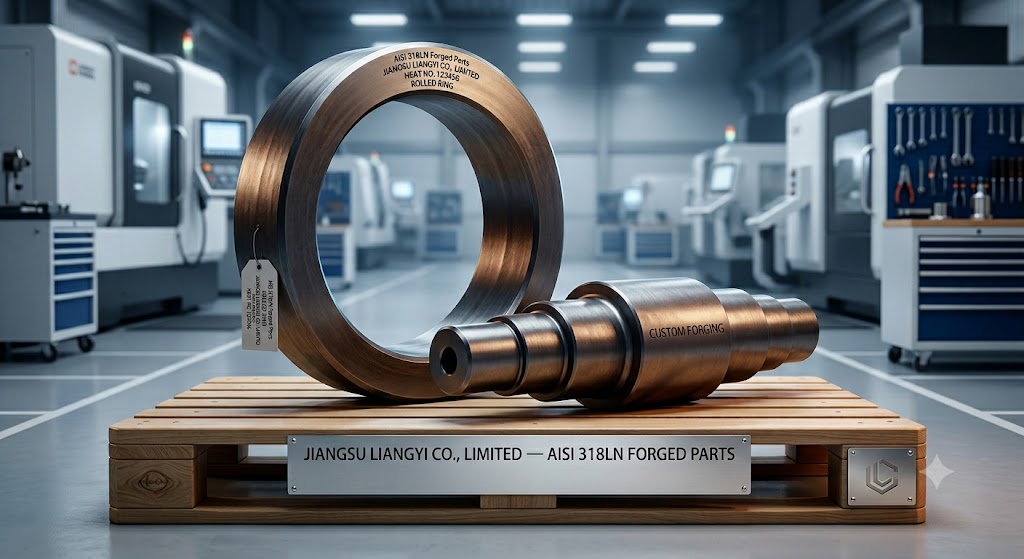
Quick Reference: AISI 318LN Forged Parts by Jiangsu Liangyi Co., Limited
- Material Identity: AISI 318LN — nitrogen-alloyed austenitic-ferritic (duplex) stainless steel. PRE ≥ 34. Ferrite content 35–65%.
- Key Mechanical Data: Yield strength ≥ 450 MPa · Tensile strength 650–880 MPa · Elongation ≥ 25% · Impact energy ≥ 60 J at −196°C · Hardness ≤ 280 HB.
- Heat Treatment: Solution annealed 1,050–1,100°C + water quenched to below 70°C within 3 minutes.
- Product Forms: Open die forgings · Seamless rolled rings (OD up to 6,000 mm) · Forged bars (Ø up to 2,000 mm) · Shafts (length up to 15 m) · Hollow forgings · Valve & pump bodies · Custom per drawing.
- Weight Range: 30 kg – 30 tons per piece.
- Certifications: ISO 9001:2015 · ISO 14001:2015 · EN 10204 3.1 / 3.2 MTR — manufacturing processes designed to meet NORSOK M122, ASME, API, and PED requirements.
- Compliance Standards: ASTM A182 · ASME Section VIII · API 6A / 6D / 17D · EN 10088 / 10228 · PED 2014/68/EU · NACE MR0175/ISO 15156.
- Third-Party Inspection: We regularly coordinate TPI with DNV-GL, Bureau Veritas, Lloyd's Register, ABS, RINA and TÜV upon customer request.
- Markets Served: USA · Canada · UK · Germany · Norway · Netherlands · France · Saudi Arabia · UAE · Qatar · Kuwait · Australia · Japan · South Korea · Singapore · Malaysia · Brazil · Argentina · 35+ more countries.
- Response: Quotation within 24 hours — sales@jnmtforgedparts.com | +86-13585067993
Table of Contents
- AISI 318LN Material Science & Metallurgy
- PRE Number, Corrosion Mechanisms & Material Selection Science
- Chemical Composition & Mechanical Properties
- Full Grade Comparison: 318LN vs 316L vs 2205 vs 904L
- Why Choose Jiangsu Liangyi
- Full Range of AISI 318LN Forged Products
- Manufacturing Process & Quality Control
- Duplex Forging Defects: Root Causes & Our Prevention Methods
- Engineer's Specification Guide for AISI 318LN Forgings
- Total Cost of Ownership: 318LN vs 316L — 10-Year Analysis
- Global Applications & Verified Project Cases
- Global Standards & Regional Market Compliance
- Supplier Evaluation Checklist for AISI 318LN Forgings
- FAQ — 10 Technical Questions Answered
- Request a Quotation
AISI 318LN Material Science & Metallurgy — What Makes It Different
What Is AISI 318LN Stainless Steel? A Metallurgical Definition
AISI 318LN is a nitrogen-alloyed austenitic-ferritic duplex stainless steel belonging to the low-alloy duplex family. Unlike fully austenitic grades (304, 316L) or purely ferritic grades, AISI 318LN is engineered to maintain a roughly equal volume fraction of austenite and ferrite — typically 35–65% ferrite — in its annealed microstructure. This two-phase architecture is not accidental: it is the key to why 318LN outperforms austenitic grades in strength, chloride corrosion resistance, and stress corrosion cracking (SCC) resistance simultaneously.
The "LN" designation is significant. "L" denotes low carbon (≤ 0.03%, and in our tightly controlled specification, ≤ 0.025%), which eliminates the risk of chromium carbide precipitation at grain boundaries during welding — the primary cause of sensitization and intergranular corrosion in standard austenitic grades. "N" denotes deliberate nitrogen addition (0.10–0.22%), which performs three simultaneous functions that no other single alloying element achieves: (1) it stabilizes the austenite phase and maintains the ferrite/austenite balance through thermomechanical processing; (2) it increases the Pitting Resistance Equivalent (PRE) by a factor of 16 per weight percent — more efficiently than molybdenum on a weight basis; (3) it increases yield strength through solid-solution strengthening without reducing ductility or toughness.
The Duplex Microstructure: Why Two Phases Are Better Than One
The fundamental corrosion failure mode of austenitic stainless steels in chloride environments is transgranular stress corrosion cracking (SCC). This occurs when three conditions coincide: chloride ions, tensile stress (residual or applied), and temperatures above approximately 60°C. Pure austenite is inherently susceptible because chloride ions preferentially attack the grain boundaries of the single-phase structure. The ferrite phase in AISI 318LN acts as a physical barrier to crack propagation: cracks that initiate in the austenite are arrested at ferrite grain boundaries, requiring far more energy to continue. This is why duplex stainless steels virtually never fail by SCC under service conditions that routinely destroy 316L components.
The two-phase structure also provides an inherent "fatigue-arresting" effect. In alternating load applications — pump shafts, compressor impellers, valve spindles — the ferrite/austenite interfaces scatter and deflect fatigue crack tips, significantly extending the fatigue life versus austenitic counterparts of the same cross-section.
From our engineering experience: In our 25+ years of manufacturing duplex forgings, we have observed that the most common cause of premature failure in components initially specified in 316L is chloride SCC in service at 70–120°C — a temperature range where AISI 318LN provides essentially unlimited resistance. When customers switch from 316L to AISI 318LN for these applications, maintenance cycles extend from 2–4 years to 10–20+ years.
The Role of Nitrogen: The Alloying Element That Changes Everything
Nitrogen is the defining alloying element that separates 318LN from standard duplex grades. At the atomic level, nitrogen occupies interstitial positions in the austenite lattice, distorting the crystal structure and impeding dislocation movement — the same mechanism that makes ceramics hard, applied to a ductile metal matrix. The result is a yield strength improvement of approximately 10–15 MPa per 0.01 weight percent of nitrogen, without the embrittlement penalty that carbon would cause at the same concentration.
More importantly for corrosion performance, nitrogen segregates preferentially to the austenite/ferrite phase boundaries during solidification. This creates a nitrogen-enriched zone at the boundaries that is highly resistant to pitting initiation — the location where pitting most commonly begins in lower-alloyed grades. This is why 318LN achieves a PRE disproportionately higher than its total Cr + Mo content would suggest.
PRE Number, Corrosion Mechanisms & Material Selection Science
Calculating the PRE Number for AISI 318LN
The Pitting Resistance Equivalent (PRE) is the industry-standard index for ranking stainless steel grades against chloride pitting corrosion. The formula used by most standards bodies (including NORSOK M001 and ISO 21457) is:
PRE = %Cr + 3.3 × %Mo + 16 × %N
Using Jiangsu Liangyi's controlled composition midpoints for AISI 318LN:
PRE = 22.00 + (3.3 × 3.00) + (16 × 0.16) = 22.00 + 9.90 + 2.56 = 34.46
This places AISI 318LN well above the PRE ≥ 32 requirement of NORSOK M001 and most major oil company specifications for offshore seawater and sour service.
PRE Benchmarks Across Service Environments
| Service Environment | Minimum PRE Required | AISI 318LN PRE | 316L PRE | Verdict |
|---|---|---|---|---|
| Potable water, mild service | ≥ 18 | 34–36 | 24–26 | Both adequate |
| Brackish water, coastal industrial | ≥ 22 | Both adequate | ||
| Seawater cooling, ambient temperature | ≥ 26 | 318LN ✓ / 316L borderline | ||
| Seawater at elevated temperature (> 40°C) | ≥ 32 | 318LN ✓ / 316L ✗ | ||
| Sour gas service, NORSOK offshore | ≥ 32 | 318LN ✓ / 316L ✗ | ||
| Subsea pipeline, deepwater | ≥ 35 (super duplex range) | 318LN borderline / 316L ✗ |
Critical Temperature for Pitting: CPT Testing in Our Laboratory
Beyond the PRE index, we evaluate AISI 318LN lots using the Critical Pitting Temperature (CPT) test per ASTM G150. In our internal database accumulated over 25 years, AISI 318LN forgings manufactured to our controlled composition consistently achieve CPT values of 65–75°C in 1 M NaCl solution, compared to 30–40°C for 316L. This 35°C margin translates directly to service safety in environments such as produced water handling, subsea heat exchangers, and coastal chemical plant equipment, where process temperatures fluctuate seasonally.
Chemical Composition & Guaranteed Mechanical Properties
AISI 318LN Standard Chemical Composition — Our Tightly Controlled Specification
We control AISI 318LN composition beyond the minimum standard requirements. Every heat of raw material is verified by optical emission spectroscopy (OES) in our on-site laboratory before forging begins. The following table shows the standard range versus our internal production specification:
| Element | Standard Range | Jiangsu Liangyi Controlled Limit | Technical Reason for Tighter Control |
|---|---|---|---|
| Carbon (C) | ≤ 0.030% | ≤ 0.025% | Reduces sensitization risk during welding; suppresses M₂₃C₆ carbide precipitation at grain boundaries |
| Silicon (Si) | ≤ 1.00% | ≤ 0.80% | Excess Si accelerates sigma-phase formation in the 600–900°C range |
| Manganese (Mn) | ≤ 2.00% | ≤ 1.80% | Controls MnS inclusion density, which are preferential pitting initiation sites |
| Phosphorus (P) | ≤ 0.040% | ≤ 0.035% | Improves impact toughness at sub-zero temperatures; reduces hot-shortness risk during forging |
| Sulfur (S) | ≤ 0.030% | ≤ 0.010% | Low S minimizes MnS inclusions, the primary initiation site for pitting corrosion; also improves transverse impact toughness in forgings |
| Chromium (Cr) | 21.00–23.00% | 21.50–22.50% | Ensures PRE target ≥ 34; tight control avoids ferrite excess at high Cr and austenite loss at low Cr |
| Nickel (Ni) | 4.50–6.50% | 5.00–6.00% | Ni stabilizes austenite; narrow range maintains the 35–65% ferrite target throughout thermomechanical processing |
| Molybdenum (Mo) | 2.50–3.50% | 2.80–3.20% | Mo is the primary pitting/crevice corrosion inhibitor in chloride media; excess Mo promotes sigma-phase |
| Nitrogen (N) | 0.10–0.22% | 0.12–0.20% | N stabilizes austenite, increases PRE, and strengthens the matrix. Low limit ensures no austenite excess; high limit prevents nitrogen porosity in the melt |
Guaranteed Mechanical Properties After Solution Annealing + Water Quench
Every production batch of AISI 318LN forgings is accompanied by a mechanical test certificate. Test specimens are taken from a sacrificial prolongation of the same forging (not a separately cast test bar), heat treated in the same cycle, and tested by our in-house laboratory equipped with calibrated instruments traceable to national measurement standards:
| Property | Our Guaranteed Minimum/Range | Test Method | Typical Achieved Value (from our production data) |
|---|---|---|---|
| Tensile Strength (Rm) | 650–880 MPa | ISO 6892-1 / ASTM E8 | 720–800 MPa |
| 0.2% Proof Strength (Rp0.2) | ≥ 450 MPa | ISO 6892-1 / ASTM E8 | 480–560 MPa |
| Elongation at Break (A5) | ≥ 25% | ISO 6892-1 / ASTM E8 | 28–35% |
| Reduction in Area (Z) | ≥ 40% | ISO 6892-1 / ASTM E8 | 45–55% |
| Charpy V-notch Impact (KV₂) at −40°C | ≥ 60 J | ISO 148-1 / ASTM E23 | 90–140 J |
| Charpy V-notch Impact (KV₂) at −196°C | ≥ 40 J | ISO 148-1 / ASTM E23 | 55–90 J |
| Brinell Hardness (HBW) | ≤ 280 HB (NACE limit) | ISO 6506-1 / ASTM E10 | 210–250 HB |
| Ferrite Content (volume fraction) | 35–65% | ASTM E562 / ASTM A800 | 45–58% |
| Intergranular Corrosion (Strauss test) | Pass — no cracks after bend | ASTM A262 Practice E | Consistently pass |
Production insight from 25 years of data: Our internal production statistics show that AISI 318LN forgings heat-treated in the 1,070–1,085°C sub-range (within the 1,050–1,100°C specification window) achieve the most consistent ferrite readings of 48–54% and the highest Charpy values at cryogenic temperatures. We share our specific heat treatment records with customers upon request — a level of process transparency rarely offered by other manufacturers.
Full Grade Comparison: AISI 318LN vs 316L vs 2205 vs 904L
Selecting the right stainless steel grade for a forged component is a critical engineering decision. Below is an objective comparison across all parameters relevant to forged industrial components, based on our production experience and published material standards:
| Parameter | AISI 318LN (Our Grade) | 316L Austenitic | 2205 Duplex (S31803) | 904L Super Austenitic |
|---|---|---|---|---|
| Microstructure | Duplex (austenite + ferrite) | Fully austenitic | Duplex | Fully austenitic |
| PRE Number (typical) | 34–36 | 24–26 | 34–36 | 32–36 |
| Yield Strength (min) | ≥ 450 MPa | ~170 MPa | ≥ 450 MPa | ~220 MPa |
| Chloride SCC Resistance | Excellent | Poor above 60°C | Very Good | Moderate — austenitic, susceptible at high chloride + temperature |
| NACE MR0175 Compliant | Yes | Limited | Yes | Conditional |
| Cryogenic Toughness (−196°C) | Excellent ≥ 40 J | Good ≥ 40 J | Moderate — ferrite reduces low-temp toughness | Excellent |
| Sigma Phase Risk | Moderate — controlled by our heat treatment protocol | Low | Moderate | Very Low |
| Weldability | Good with correct filler (ER2209 or ER318LN) | Excellent | Good | Good |
| Forgeability | Good — requires narrow temperature window | Very Good | Good | Good |
| Typical Cost vs 316L (raw material) | +25–40% premium | Baseline | +30–50% | +60–90% |
| 10-Year Total Ownership Cost vs 316L in chloride service | −40 to −60% lower | Baseline | −35 to −55% | −20 to −40% |
The comparison shows that AISI 318LN and 2205 duplex offer nearly identical corrosion resistance (similar PRE), but AISI 318LN's tighter nitrogen control and lower carbon content make it a more reliable choice in applications where welding is involved or where cryogenic service is required. 904L offers comparable corrosion resistance but at significantly higher cost and without the strength advantage of the duplex structure.
Why Choose Jiangsu Liangyi for Your AISI 318LN Forgings?
Jiangsu Liangyi Co., Limited has been manufacturing duplex stainless steel forgings since 1999. In 25+ years, we have developed process knowledge and equipment capability that most forging manufacturers do not possess. Here is what specifically differentiates our AISI 318LN forgings:
1. In-House Composition Verification Before Every Forge Heat
We do not rely on the steel mill certificate alone. Every incoming billet and ingot of AISI 318LN is re-verified by our on-site optical emission spectrometer (OES) before it enters the forge bay. If the composition does not meet our internal specification — which is tighter than the standard requirement — the material is rejected. This step alone eliminates a significant source of quality failures that we have seen when auditing other suppliers' processes.
2. Calibrated Forging Temperature Windows with Infrared Monitoring
AISI 318LN has a narrower safe forging temperature window than carbon or low-alloy steels. Forging above 1,200°C risks delta ferrite excess and grain boundary liquation; forging below 950°C risks sigma-phase precipitation and ferrite banding. We monitor billet surface temperature with handheld infrared pyrometers at each press pass and with fixed thermal cameras at the press exit. If the billet surface temperature drops below 980°C during forging, it is returned to the furnace — never forced below temperature to complete a pass.
3. Quench Tank Within 10 Meters of the Heat Treatment Furnace
The critical requirement for AISI 318LN solution annealing is water quench within 3 minutes of exiting the furnace. Our plant layout places the quench tank within 10 meters of the furnace door, and we have documented our average transfer time as 45–90 seconds. This is not achievable in plants where the quench tank is in a separate building or requires crane transfer across the facility.
4. Ferrite Content on Every Batch — Not Just on Request
Many manufacturers measure ferrite content only when customers specifically request it. At Jiangsu Liangyi, ferrite measurement (ASTM E562 point counting method, confirmed by Fischer FERITSCOPE FMP30 instrument) is a mandatory pass/fail criterion on every production batch of AISI 318LN. Results outside 35–65% trigger re-heat-treatment. This is documented in our production quality plan and available for customer review during factory audits.
5. Full Production Capacity Statistics
- Factory Area: 80,000 m² — dedicated forging, heat treatment, and machining bays
- Annual Capacity: 120,000 tons of open die forgings and seamless rolled rings
- Forging Presses: 2,000T / 4,000T / 6,300T hydraulic presses with fully digital stroke and pressure recording
- Ring Rolling: Radial-axial ring rolling mills from 1-meter to 5-meter ring diameter capability
- Heat Treatment Furnaces: 12 furnaces, maximum charge weight 60 tons, ±5°C temperature uniformity verified by calibrated thermocouple survey
- CNC Machining: 15 heavy-duty CNC lathes, boring mills, and machining centers for final dimensional machining
- Single-Piece Weight Range: 30 kg to 30 tons
Full Range of Custom AISI 318LN Forged Products
We manufacture the complete spectrum of AISI 318LN forged shapes, from standard geometric forms to fully custom near-net-shape components machined to drawing. All product forms are available with EN 10204 3.1 or 3.2 certification and full material traceability:
| Product Form | Max Dimensions | Max Weight | Typical Applications |
|---|---|---|---|
| Forged Round Bars & Rods | Ø up to 2,000 mm | 30 tons | Valve stems, spindles, pump shafts, raw material for machining |
| Seamless Rolled Rings | OD up to 6,000 mm | 30 tons | Flanges, gear rings, bearing rings, pressure vessel shells, wind turbine rings |
| Forged Shafts & Step Shafts | Ø up to 1,800 mm × L up to 15 m | 25 tons | Turbine shafts, pump shafts, agitator shafts, propeller shafts |
| Seamless Hollow Forgings | OD up to 3,000 mm | 20 tons | Pressure vessel shells, cylinder liners, pump casings, barrel bodies |
| Forged Discs & Blocks | Ø up to 3,000 mm | 20 tons | Tube sheets, blind flanges, end covers, valve bodies |
| Valve Body Forgings | Bore Ø 1" to 56" | 15 tons | Ball valves, gate valves, globe valves, check valves, butterfly valves (body, bonnet, ball, disc, stem) |
| Pump Casing Forgings | Custom per drawing | 10 tons | Centrifugal pump casings, covers, impellers, wear rings, stuffing boxes |
| Wellhead & BOP Forgings | Custom per API 6A | 12 tons | BOP bodies, casing heads, tubing heads, spools, hangers, Christmas tree components |
| Custom CNC-Machined Forgings | Per customer drawing | 20 tons | Any complex near-net-shape component requiring forged + machined delivery condition |
AISI 318LN Forging Manufacturing Process & Quality Control
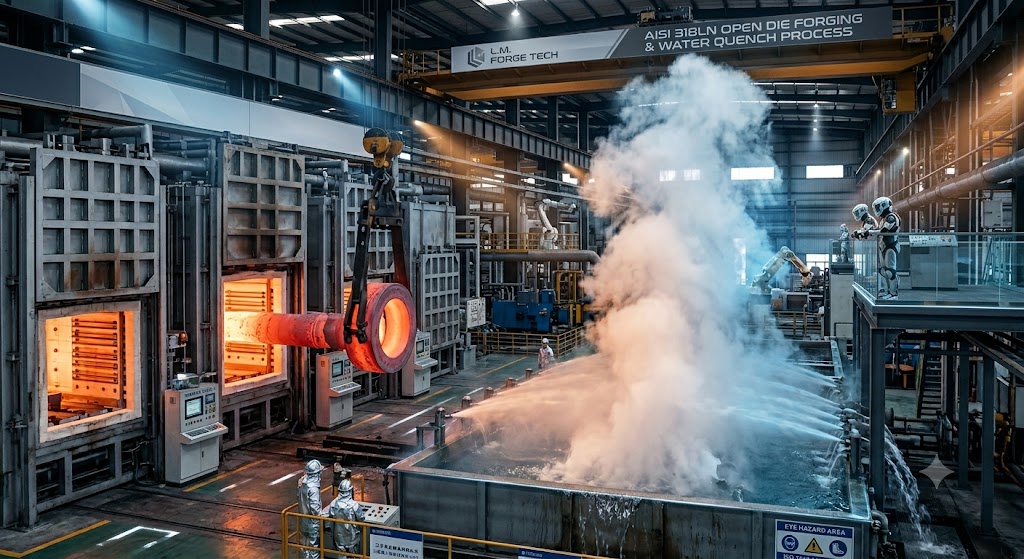
Step 1: Raw Material Sourcing & Pre-Forge Verification
AISI 318LN billets and ingots are sourced exclusively from verified duplex stainless steel specialty mills with full heat traceability. Upon receipt, our incoming inspection team performs: (1) visual and dimensional inspection; (2) full OES chemical re-analysis; (3) comparison against our controlled specification. Only materials meeting all requirements are stamped and released to the forge bay. Non-conforming heats are quarantined and returned — a zero-compromise policy that we document in our supplier quality management records.
Step 2: Ingot Heating & Soaking — Getting the Duplex Structure Right Before Forging
AISI 318LN ingots or billets are charged into our gas-fired furnaces at controlled loading temperature of ≤ 800°C to avoid thermal shock. Then the furnace is heated to the forging temperature range of 1,150–1,180°C with not more than 100°C/hour for ingots over 2 tons. Critical : soaking time at temperature is calculated as a minimum of 1 hour per 100 mm of section thickness, so as to ensure thermal homogeneity from the surface to the center. Calibrated thermocouples in the charge zone check the furnace atmosphere as well as temperature uniformity within the furnace.
Step 3: Open Die Forging — Reduction Ratio Control
The forging process for AISI 318LN is designed around a minimum total forging reduction ratio of 4:1 for standard applications and 6:1 or higher for nuclear, subsea, and other critical applications. This ratio is not merely a specification checkbox — it is the fundamental mechanism by which the cast ingot's dendritic solidification microstructure is broken down into a uniform wrought grain structure with isotropic mechanical properties.
Our forge plan for each AISI 318LN component specifies the sequence of upsetting (compression parallel to the ingot axis), cogging (compression perpendicular to the axis), and drawing operations to achieve: closure of internal voids and porosity; uniform grain refinement throughout the cross-section; and grain flow lines oriented to align with the principal stress direction in service (particularly important for valve bodies, where flow forces act in specific directions).
Step 4: Solution Annealing — The Most Critical Step for Duplex Forgings
After forging, AISI 318LN must be solution annealed before any microstructure or property measurement is meaningful. Our solution annealing protocol:
- Temperature: 1,050–1,100°C (our production optimum: 1,070–1,085°C)
- Soaking time: Minimum 30 minutes plus 15 minutes per 25 mm of section thickness, ensuring temperature uniformity throughout the thickest section
- Quench medium: Still water at 15–30°C
- Transfer time: Maximum 3 minutes from furnace to water surface — our actual average: 60–90 seconds
- Final water temperature: Must not exceed 70°C after quench (confirmed by thermocouple)
- Furnace calibration: Temperature uniformity verified by calibrated thermocouple survey, with records updated every 6 months
Step 5: Comprehensive Quality Inspection & Testing
Every batch of AISI 318LN forgings undergoes the following mandatory inspection sequence before release:
- Chemical Composition Re-Check: OES analysis on the finished forging surface — not just on the ingot — to confirm no contamination during forging
- Mechanical Testing: Tensile test, Charpy impact test at specified temperature(s), hardness survey across the cross-section
- Ferrite Measurement: ASTM E562 point counting and FERITSCOPE instrument check — mandatory pass/fail criterion
- Metallographic Examination: Polished and etched sections examined at 100× and 400× magnification. Murakami's reagent used to reveal sigma phase; Beraha's reagent to reveal ferrite/austenite phase distribution
- Ultrasonic Testing (UT): 100% volumetric scan per ASTM A388 or EN 10228-3, acceptance Level 3 standard (Level 4 for nuclear/subsea), performed by NDT personnel holding ASNT Level II qualifications
- Liquid Penetrant Testing (PT): All accessible surfaces per EN 10228-2 / ASTM E165
- Dimensional Inspection: Full dimensional record to drawing tolerances, with calibrated measurement tools
- Corrosion Test (when specified): ASTM A262 intergranular corrosion test, ASTM G48 ferric chloride pitting test, NACE TM0177 SSC test for sour service certification
Duplex Forging Defects: Root Causes & How We Prevent Them
Forging duplex stainless steel is metallurgically more complex than forging carbon steel or standard austenitic stainless steels. Over 25 years, our engineering team has identified and systematically addressed the five most common failure modes in AISI 318LN forgings. We share this knowledge openly because it is the basis for the confidence customers can place in our product quality:
Defect 1: Sigma Phase Embrittlement
Root cause: Sigma phase (a brittle intermetallic compound of Fe and Cr) precipitates most rapidly in duplex stainless steels between 700–900°C. Time in this range during forging or post-forge cooling is unavoidable, but must be minimized. Sigma phase reduces impact toughness by up to 80% and significantly impairs corrosion resistance by depleting chromium from the matrix.
Our prevention: Mandatory solution annealing at 1,050–1,100°C followed by water quench within 3 minutes re-dissolves sigma phase completely. Metallographic examination with Murakami's reagent confirms absence of sigma phase before release. Our forging temperature control also minimizes time in the 700–900°C range during forging itself.
Defect 2: 475°C Embrittlement (Spinodal Decomposition)
Root cause: The ferrite phase in duplex stainless steels undergoes spinodal decomposition — a nanoscale chemical segregation — when exposed to temperatures between 350–550°C for extended periods. The result is a dramatic increase in hardness and brittleness in the ferrite phase, particularly dangerous because it cannot be detected by standard hardness measurement at room temperature (the embrittled material's room-temperature hardness may still appear within specification).
Our prevention: We strictly prohibit any slow cooling through the 350–550°C range for AISI 318LN components. Our heat treatment records document that water-quenched components pass through this range in under 60 seconds — orders of magnitude faster than the several hours required for embrittlement to begin.
Defect 3: Ferrite/Austenite Phase Imbalance
Root cause: Excessive forging reduction at temperatures below 1,000°C, or insufficient soaking time during solution annealing, can result in ferrite content outside the 35–65% target. Both excess ferrite (>65%) and insufficient ferrite (<35%) degrade the mechanical and corrosion performance that the duplex structure is designed to provide.
Our prevention: Ferrite measurement on every batch (not just on request) as a mandatory pass/fail criterion. Any batch with ferrite outside 35–65% is returned for re-annealing — a rework step that costs us time and money but protects customers from substandard product.
Defect 4: Hydrogen-Induced Cracking (HIC) During Acid Pickling
Root cause: The forge scale and oxide on the forging surface must be removed by acid pickling. If the concentration, temperature or immersion time of the pickling bath is not controlled, then hydrogen absorption into the steel may cause delayed cracking, which may not be apparent until the part is in service or has passed inspection. Duplex grades are more susceptible than austenitic grades with greater hardness.
Our prevention: All acid pickling of AISI 318LN forgings is performed using inhibited mixed-acid solutions (HNO₃ + HF at controlled concentrations), monitored by our process chemist. Immersion time is calculated per forging section thickness and actual bath temperature. Forgings are rinsed and neutralized immediately after pickling and inspected for hydrogen blistering before final acceptance.
Defect 5: Segregation Banding in Large Ingots
Root cause: During solidification of large AISI 318LN ingots, molybdenum and nitrogen segregate between dendrite arms and interdendritic regions. If not fully homogenized by the forging reduction, this produces "banding" — alternating laminae of ferrite-rich and austenite-rich layers that are visible on etched metallographic sections and may create anisotropic corrosion behavior.
Our prevention: We apply a minimum forging reduction ratio of 6:1 for ingots over 5 tons, combined with multiple upsetting-drawing sequences to physically break up the dendritic segregation. For the most critical applications, ESR (electroslag refining) starting material — which has inherently lower segregation — is specified at additional cost.
Engineer's Specification Guide for AISI 318LN Forgings
When preparing a purchase specification or RFQ for AISI 318LN forged components, the following parameters must be clearly defined to ensure you receive a product that meets your service requirements. Based on our 25+ years of engineering reviews, these are the most commonly omitted or ambiguous specification items:
Essential Specification Elements
- Material Standard Reference: Specify the governing material standard (e.g., ASTM A182, EN 10088-3, or your company spec) and the grade designation. "AISI 318LN" alone is insufficient — reference a specific standard that defines composition and property limits.
- Test Certificate Type: EN 10204 3.1 (manufacturer certification) or 3.2 (third-party witness). For offshore and nuclear projects, 3.2 is typically required. Confirm the approved third-party agency.
- Ferrite Content Range: Explicitly specify "35–65% ferrite per ASTM E562" or "ASTM A800" if you require ferrite measurement. Some standards permit ferrite measurement only when specified.
- Minimum Forging Reduction Ratio: Specify the minimum ratio required (typically 4:1 for standard, 6:1 for critical applications). This must appear in the forge plan and quality records.
- Impact Test Temperature: Specify the Charpy test temperature (e.g., −40°C, −196°C) and minimum acceptance value. For LNG service, −196°C is required. For offshore Arctic, consider −60°C or lower.
- NDT Method and Acceptance Level: Specify UT per ASTM A388 or EN 10228-3, and the acceptance level (Level 2, 3, or 4). For forgings larger than 500 mm OD, specify sector-scan or TOFD in addition to standard straight-beam UT.
- NACE Service Requirement: If the component is for sour service, explicitly reference NACE MR0175/ISO 15156, maximum hardness 280 HB, and whether HIC or SSC test coupons are required.
- Heat Treatment Record: Specify that the full heat treatment record (furnace number, charge number, recorded temperature profile, quench time) must be supplied with each batch.
- Corrosion Testing: Specify whether intergranular corrosion testing per ASTM A262 Practice E and/or pitting corrosion testing per ASTM G48 is required. These are not included in the standard certificate unless specified.
- Third-Party Inspection (TPI) Hold Points: Define which inspection steps require TPI witness vs. TPI review only. Typical hold points: chemical re-analysis, mechanical testing, ferrite measurement, final UT, dimensional inspection.
Our offer: Jiangsu Liangyi's engineering team provides free specification review for all RFQs. Send us your purchase specification or project requirements, and we will flag any gaps, ambiguities, or conflicting requirements before you commit to an order — saving both parties time and cost during execution.
Total Cost of Ownership: AISI 318LN vs 316L — A 10-Year Engineering Analysis
Procurement decisions based solely on unit price consistently undervalue corrosion-resistant materials. The following analysis models the total cost of ownership for a representative set of forged valve bodies (DN200, 50 units) in offshore chloride service over a 10-year period. The figures are based on composite data from multiple customer case reports and publicly available maintenance cost benchmarks:
316L Austenitic Forged Valve Bodies
- Initial material cost: Baseline (×1.0)
- Average service life in chloride service: 3–5 years
- Replacement cycles in 10 years: 2–3×
- Total material cost over 10 years: ×2.0–3.0
- Unplanned shutdowns (SCC failure): 2–4 events
- Average shutdown cost per event: $50,000–$500,000
- 10-year maintenance + replacement + downtime cost: HIGH
AISI 318LN Forged Valve Bodies
- Initial material cost: ×1.25–1.40 vs 316L
- Average service life in same chloride service: 15–25 years
- Replacement cycles in 10 years: 0 (design life > 10 years)
- Total material cost over 10 years: ×1.25–1.40
- Unplanned shutdowns: None — SCC not a failure mode
- Average 10-year maintenance cost: Routine inspection only
- 10-year total ownership cost: 40–60% lower than 316L
Key insight: For any application operating in chloride-containing environments above 60°C, selecting AISI 318LN over 316L based on the initial material price differential is a false economy. The break-even point — where the higher initial cost of AISI 318LN is recovered through avoided replacement and downtime — occurs in less than 2 years in most offshore and chemical plant applications. After that, every additional year represents pure cost savings.
Global Industrial Applications & Verified Project Cases
AISI 318LN forged components from Jiangsu Liangyi are operating in critical service conditions across six continents. The following project cases are selected to illustrate the range of engineering challenges our products address — and the specific technical requirements that each project imposed:
Oil & Gas Industry (Onshore & Offshore)
AISI 318LN is specified for oil and gas production equipment wherever the combination of H₂S partial pressure, chloride concentration, and operating temperature exceeds what 316L or carbon steel can handle. The grade's compliance with NACE MR0175/ISO 15156 — verified by in-house mechanical testing and third-party inspection — makes it the benchmark material for wellhead components, BOP systems, and subsea connectors in sour service environments.
Typical AISI 318LN forged components we supply to the oil and gas sector: BOP bodies and bonnets, wellhead Christmas tree bodies, casing heads, tubing heads, casing hangers, tubing hangers, tubing spools, casing spools, spacer spools, drill string components, riser pipe joints, subsea connectors, pipeline flanges, and valve bodies for API 6A service classes up to PSL4.
Project Case: ARAMCO Onshore Sour Oilfield — Wellhead & BOP Forgings
An ARAMCO-approved EPC contractor specified AISI 318LN for BOP bodies, wellhead spools, and valve bodies for a new sour gas field in the Rub' al Khali region. The H₂S partial pressure was 0.35 MPa and the chloride concentration in produced water exceeded 45,000 ppm — conditions that had caused 316L failures within 18 months on an adjacent older field.
We supplied 2,650 individual forgings, ranging from 80 kg valve bodies to 4.2-ton BOP blocks, all forged and heat-treated to API 6A PSL3 requirements. Each piece was 100% UT-tested to API 6A Annex H acceptance criteria, with NACE TM0177 SSC test coupons from each heat. Bureau Veritas witnessed all critical inspection hold points. These components entered service in 2017 and, as of the last customer field report, remain in continuous operation with zero corrosion-related failures after 8 years.
Project Case: Gulf of Mexico Deepwater Subsea — Connectors & Riser Components
A major US independent oil company required AISI 318LN forged subsea connectors and riser pipe joints for a deepwater development in 2,100 meters of water in the Gulf of Mexico. The service conditions were especially demanding: internal pressure to 15,000 psi, seawater exposure at 4°C on the external surface, and an internal H₂S partial pressure that required NACE MR0175 compliance.
Beyond the material challenge, the dimensional tolerances for the connector hubs were ±0.025 mm — a precision level more typical of aerospace components. We achieved this through a combination of precision forging and 5-axis CNC final machining in our facility. DNV-GL witnessed all testing including 100% UT to Level 4 acceptance, and a hydrostatic pressure test to 1.5× rated working pressure. The project required 18 months from order to delivery; we delivered in 16 months.
Nuclear Power Generation Industry
Nuclear applications impose the most stringent quality requirements of any industry: 100% traceability from raw material to final component, mandatory third-party witness at all critical inspection steps, and materials documentation that must remain retrievable for the life of the plant (60+ years). AISI 318LN is selected for nuclear coolant system components because its radiation resistance, combined with high strength and corrosion resistance in high-temperature demineralized water, exceeds what austenitic grades alone can provide.
Project Case: European PWR Nuclear Plant — Reactor Coolant Pump Casings
A German nuclear engineering firm contracted us to manufacture AISI 318LN reactor coolant pump (RCP) casings and containment seal chamber components for a pressurized water reactor upgrade project. The specification included a comprehensive set of requirements beyond standard industrial practice: material manufactured from ESR (electroslag refined) ingots to minimize segregation; minimum 6:1 forging reduction ratio documented in the forge plan; 100% ultrasonic testing to Level 4 acceptance criteria; complete metallographic examination at multiple cross-sections; ferrite measurement at 20 locations per piece; and a complete material dossier with 60-year archival packaging.
All components were manufactured and inspected with TÜV SÜD as third-party witness. The material dossier for each component fills approximately 200 pages. Components entered service in 2019 and are operating within all design parameters.
Marine & Offshore Engineering Industry
Marine applications subject components to the most challenging corrosion environment in industry: warm seawater rich in chlorides, biological fouling that creates local anoxic crevice conditions, and marine atmospheric corrosion of any exposed surfaces. AISI 318LN is specified for marine applications where the PRE requirement (≥32 for seawater service above 30°C) and physical strength requirements eliminate austenitic alternatives.
Project Case: Southeast Asia LNG Terminal — Cryogenic Valve Bodies & Pipeline Flanges
An LNG terminal expansion project in Sabah, Malaysia required cryogenic valve bodies, stems, seat rings, and pipeline flanges for liquefied natural gas service at −162°C to −196°C operating temperature. The project engineering specification required that all forged materials achieve a minimum Charpy impact energy of 41 J at −196°C (the ASME B31.3 minimum for LNG service), with test specimens taken from the quarter-thickness location of the representative forging — the most conservative sampling location.
We supplied 1,850 individual forged components. All achieved Charpy impact energy of 60–105 J at −196°C — significantly exceeding the 41 J minimum. The margin above minimum was not accidental: our AISI 318LN composition control, particularly the nitrogen content at the lower end of the 0.12–0.16% range, consistently produces higher austenite stability and better cryogenic toughness than compositions targeting the upper nitrogen limit. Lloyd's Register witnessed final inspection.
Valve, Pump & Fluid Control Equipment Industry
AISI 318LN forgings for valve and pump applications require a combination of properties that no single alternative grade achieves: adequate machinability for precision bore and seat surfaces; corrosion resistance for the process fluid; sufficient hardness and wear resistance for sliding contact surfaces (stems, seats); and dimensional stability over the full operating temperature range.
We manufacture the complete range of valve and pump forgings in AISI 318LN: bodies, bonnets, stems, balls, seat rings, discs, pump casings, impellers, wear rings, shaft sleeves, and stuffing box components. We maintain standard tooling for common face-to-face dimensions per ASME B16.10 and can deliver machined and ready-to-assemble valve forgings with ±0.05 mm dimensional tolerance on precision bore dimensions.
Chemical, Petrochemical & Pressure Vessel Industry
Chemical process plants handle a wider range of corrosive media than any other industry. AISI 318LN's combination of austenitic and ferritic microstructure provides resistance to both oxidizing and reducing environments — a capability that neither 316L nor ferritic grades alone possess. The grade is particularly valuable in mixed-acid environments (nitric-hydrofluoric, nitric-sulfuric) and in phosphoric acid service where molybdenum content is critical.
Project Case: Australian Mineral Processing — Heat Exchanger Tube Sheets & Slurry Pump Components
A copper-gold processing facility in Western Australia had experienced repeated failures of 316L forged tube sheets in their leach solution heat exchangers. The leach solution contained sulfuric acid at 5–8 g/L and chloride at 8,000–12,000 ppm at 65–80°C — conditions that produce aggressive crevice corrosion under tube-to-tubesheet joints within 14–18 months in 316L. The combined replacement cost (components, downtime, and production loss) was significant.
We manufactured AISI 318LN replacement tube sheets and slurry pump casing halves. The AISI 318LN components were in service for 4 years at the time of the last customer report, with no reported corrosion-related failures. The customer's metallurgist noted during inspection that the tube-to-tubesheet crevice zones — the first failure site in the 316L components — showed no measurable attack. The customer reported substantial savings over the same period compared to the previous 316L replacement cycle.
Project Case: South American Petrochemical Refinery — Reactor Nozzles & Heat Exchanger Components
A large petrochemical refinery operated by Petrobras in the state of São Paulo specified AISI 318LN for reactor nozzle forgings and heat exchanger tube sheets in a catalytic cracking unit. The service conditions combined high temperature (up to 320°C), high pressure (up to 18 MPa), and a process stream containing hydrogen sulfide and chlorides from crude oil. The project specification referenced NORSOK M122, ASME Section VIII Div. 2, and Petrobras internal engineering standards.
We supplied 180 nozzle forgings ranging from 4" to 20" bore diameter, and 12 heat exchanger tube sheets up to 2,400 mm diameter. ABS (American Bureau of Shipping) performed third-party inspection. All components were delivered within the contracted 22-week lead time, with full EN 10204 3.2 documentation.
Power Generation & Turbomachinery Industry
AISI 318LN's high-temperature fatigue resistance and oxidation resistance make it suitable for turbomachinery rotating components. In centrifugal compressors and industrial steam turbines, the combination of high yield strength (reducing disk thickness and therefore centrifugal load), good fatigue life at elevated temperature, and resistance to the wet steam / condensate corrosion environment makes 318LN technically superior to austenitic alternatives for impellers and shaft seals.
We manufacture AISI 318LN forged turbine and compressor components including: labyrinth shaft seals, centrifugal compressor impellers, shrouded impellers, turbine rotor shafts up to 2.5 tons, and supporting structural components. Dynamic balancing is available in-house for rotating components.
AISI 318LN Forging Standards & Global Market Compliance
Our manufacturing system is designed to meet the regulatory, certification, and documentation requirements of every major industrial market. The following summarizes the standards framework applicable in each regional market:
| Market Region | Key Material Standards | Certification / Regulatory Framework | Third-Party Bodies We Work With |
|---|---|---|---|
| North America (USA, Canada) | ASTM A182, ASME B16.5, API 6A/6D, NACE MR0175, ASME Section VIII | ASME Stamps (when required), API Monogram, NACE compliance documentation | Bureau Veritas, ABS, Intertek, SGS |
| Europe (EU, UK, Norway) | EN 10088-3, EN 10228, EN 13445, EN 10204, NORSOK M122/M123 | PED 2014/68/EU (products can be manufactured to PED requirements; CE marking requires a registered Notified Body appointed by the customer), ATEX (when required), UKCA (UK) | TÜV, DNV-GL, Bureau Veritas, Lloyd's Register, RINA |
| Middle East (Saudi Arabia, UAE, Qatar, Kuwait) | ARAMCO SAES standards, ADNOC specifications, API 6A, NACE MR0175, NORSOK M122 | ARAMCO / ADNOC / KOC vendor approval, project-specific ITP compliance | Bureau Veritas, SGS, Applus+, MISTRAS |
| Asia Pacific (Australia, Japan, S. Korea, SE Asia) | AS Standards (Australia), JIS G (Japan), KS (Korea), ASME/API for international projects | Australian WHS compliance, J-PEC (Japan), KGS (Korea) | Lloyd's Register, DNV-GL, Bureau Veritas, SGS |
| South America (Brazil, Argentina, Chile) | Petrobras N series standards, ENAP specifications, ASME/API base standards | Experience supplying to projects governed by Petrobras N standards; ABNT (Brazil), IRAM (Argentina) | ABS, Bureau Veritas, SGS |
Supplier Evaluation Checklist for AISI 318LN Forgings
Before committing to a forging supplier for AISI 318LN components, we recommend verifying the following points. This checklist is based on the most common quality shortfalls we have encountered when customers have tested multiple suppliers and ultimately chose us. We are transparent about this list because we are confident in our position on every point:
- Does the supplier verify AISI 318LN composition in-house before forging? Relying only on the mill certificate is insufficient — check whether they have an OES spectrometer on-site.
- Does the supplier measure ferrite content on every batch as a mandatory pass/fail criterion? Ask to see the ferrite content records for the last 10 production batches. If they are only measured on request, that is a warning sign.
- Can the supplier document the quench transfer time from furnace to water? Ask for their written quench procedure, including the maximum permitted transfer time and the actual average time from their production records.
- Does the supplier have a dedicated heat treatment furnace calibrated to ±5°C, with documented calibration records? Ask for the furnace calibration certificate and the last furnace survey report.
- Does the supplier perform 100% UT on all AISI 318LN forgings as standard — or only when specified? For duplex stainless steel, 100% UT should be mandatory, not optional.
- Can the supplier provide metallographic examination reports, including photos at 100× and 400× magnification, showing the absence of sigma phase? This is the definitive quality check for solution annealing effectiveness.
- Is the supplier's ISO 9001 certification current and from an accredited certification body? Request the certificate and verify the accreditation body against the IAF MLA signatories list.
- What is the supplier's minimum forging reduction ratio for AISI 318LN? If they cannot state a specific ratio and document it in the forge plan, that is a gap.
- Can the supplier produce an AISI 318LN trial forging for qualification testing? Established duplex forging specialists will readily agree to qualification forgings. If a supplier is reluctant, it may indicate limited experience with this grade.
- Does the supplier offer to provide all quality records (heat treatment charts, ferrite records, UT reports, MTR) in a structured digital format? Good documentation practices in manufacturing correlate with good process control.
Jiangsu Liangyi's position on every point above: We answer "yes" to all 10 questions and can provide supporting documentation for all points during a pre-order factory audit or as part of our standard first-article qualification process. We welcome customer audits — they consistently accelerate the decision to qualify us as a preferred supplier.
Frequently Asked Questions — 10 Technical Questions Answered
What is the difference between AISI 318LN and 316L stainless steel?
AISI 318LN is a nitrogen-alloyed duplex stainless steel with a yield strength of ≥450 MPa and a PRE of 34–36. Standard 316L is fully austenitic with a yield strength of approximately 170 MPa and a PRE of 24–26. The differences in practice are significant: in chloride environments above 60°C, 316L components are susceptible to stress corrosion cracking (SCC) within 2–5 years, while AISI 318LN is essentially immune to SCC under the same conditions because the ferrite phase in its microstructure blocks crack propagation. In terms of strength, AISI 318LN's approximately 2.5× higher yield strength allows wall thicknesses to be reduced by 30–40% for the same design pressure, which partially offsets the higher material cost. For applications in chloride service, sour gas, seawater, or elevated temperature environments, AISI 318LN provides dramatically lower total ownership cost than 316L, despite a higher initial unit price.
What is the PRE number of AISI 318LN and why does it matter for material selection?
The pitting resistance equivalent (PRE) is a measure of resistance to chloride pitting corrosion. The classical formula PRE = %Cr + 3.3 %Mo + 16 %N gives the PRE of AISI 318LN with the controlled composition of Jiangsu Liangyi in the range of 34–36. This compares to 24–26 for 316L and 32–36 for standard 2205 duplex. Most offshore and oil & gas company specifications (NORSOK M001, ARAMCO SAES-A-007) require a minimum PRE of 32 for seawater service above 30°C and sour gas service — a threshold that 316L consistently fails to meet. We verify PRE on every production heat through the OES chemical analysis we perform in-house before forging, and the calculated PRE value is included in the EN 10204 3.1 certificate we provide with each delivery.
Is AISI 318LN suitable for sour oil and gas service per NACE MR0175?
Yes. AISI 318LN meets all requirements of NACE MR0175/ISO 15156 for sour (H₂S-containing) oil and gas service. The critical requirements are: maximum hardness of 280 HB (HRC 30) — our AISI 318LN forgings consistently achieve 210–250 HB; resistance to sulfide stress cracking (SSC) — confirmed by NACE TM0177 four-point bend testing, available upon request; and resistance to hydrogen-induced cracking (HIC) — the low ferrite banding in our controlled-composition forgings minimizes the hydrogen trap sites that cause HIC in poorly processed duplex material. We can supply NACE MR0175 compliance documentation including the clause references within the standard that apply to each material and process parameter.
What minimum forging reduction ratio do you apply for AISI 318LN, and why does it matter?
We apply a minimum forging reduction ratio of 4:1 (cross-sectional area reduction from ingot to finished forging) for standard AISI 318LN applications, and 6:1 or higher for nuclear, subsea, and other critical applications. The reduction ratio is the fundamental quality parameter that determines whether the cast ingot microstructure — characterized by columnar dendrites, segregation, and internal porosity — is converted into a uniform wrought microstructure with equiaxed grains, closed porosity, and isotropic mechanical properties. An insufficient reduction ratio results in retained segregation bands (visible on etched metallographic sections), anisotropic toughness and corrosion behavior, and ultrasonic noise that masks genuine defects during UT inspection. The forge plan that documents the reduction ratio calculation for each component is maintained as a quality record and is available to customers on request.
How do you prevent sigma phase formation in AISI 318LN forgings?
Sigma phase is a brittle intermetallic compound (FeCr) that precipitates in duplex stainless steels when held between 700–900°C. It reduces impact toughness by up to 80% and depletes chromium from the surrounding matrix, significantly reducing corrosion resistance. Our three-stage prevention approach: (1) During forging, we maintain billet surface temperature above 950°C throughout the forging sequence and return the billet to the furnace before it drops to the sigma-precipitation range — never forcing a pass below temperature; (2) After forging, mandatory solution annealing at 1,050–1,100°C followed by water quench within 3 minutes completely re-dissolves any sigma phase that formed during the forging operation; (3) Mandatory metallographic examination of each batch using Murakami's reagent (which stains sigma phase selectively) confirms absence before release. Any batch with sigma phase detected is re-annealed at our cost.
What is the recommended heat treatment for AISI 318LN forgings, and why is it so specific?
AISI 318LN forgings require solution annealing at 1,050–1,100°C followed by rapid water quenching to below 70°C within 3 minutes. The temperature window is defined by two constraints: below 1,050°C, the sigma phase does not fully dissolve within practical soaking times; above 1,100°C, excessive grain growth degrades toughness and the ferrite content increases toward levels that impair low-temperature performance. The quench speed constraint is equally critical: between 550°C and 700°C, sigma phase re-nucleates rapidly — a 316L bar can be air-cooled from annealing temperature, but a duplex forging air-cooled through this range will be sigma-contaminated before it reaches room temperature. Our documented production average transfer time from furnace to water surface is 60–90 seconds. Any supplier who cannot state a specific quench transfer time protocol for duplex grades should be questioned carefully.
Can AISI 318LN forgings be used in LNG cryogenic service at −196°C?
Yes. The austenitic phase component of AISI 318LN still has good ductility and impact toughness at cryogenic temperatures. For temperatures lower than −40 °C the impact toughness decreases as the ferrite phase reaches its ductile-brittle transition when the standard duplex grades have a higher level of ferrite (greater than 60%). AISI 318LN's controlled ferrite range of 35–65%, combined with nitrogen content that stabilizes the austenite, maintains Charpy impact energy above 40 J at −196°C — the threshold required by ASME B31.3 and EN 13480 for LNG service. Our production data shows typical values of 55–90 J at −196°C, well above the minimum. We have supplied cryogenic AISI 318LN valve bodies and pipeline flanges for LNG terminals in Malaysia, Qatar, and Australia, with all components tested and certified at −196°C.
What NDT methods do you apply to AISI 318LN forgings as standard?
Our standard NDT package for AISI 318LN forgings includes: (1) 100% volumetric ultrasonic testing (UT) per ASTM A388 or EN 10228-3, acceptance Level 3 as standard (Level 4 for nuclear/subsea applications), performed by qualified NDT personnel; (2) 100% surface liquid penetrant testing (PT) on all accessible surfaces per EN 10228-2 or ASTM E165. For ring forgings, additional straight-beam UT is performed on the bore and both faces. For forgings over 1,000 mm in any dimension, phased array ultrasonic testing (PAUT) with sectorial scanning can be substituted for conventional UT to achieve better coverage of complex geometries. All NDT reports, including scan records, are included in the EN 10204 3.1 documentation package.
What is the maximum size of AISI 318LN forging you can manufacture, and what are the practical limitations?
Our maximum capacities for AISI 318LN forgings: forged bars up to 2,000 mm diameter; seamless rolled rings up to 6,000 mm outer diameter; forged shafts up to 1,800 mm diameter and 15 meters length; hollow forgings up to 3,000 mm outer diameter; single-piece weight up to 30 tons. The practical limitation for very large AISI 318LN forgings is not press capacity but rather heat treatment — specifically, achieving adequate quench penetration rate to prevent sigma phase in the core of very thick sections. Our empirical data shows that sections over 500 mm equivalent thickness require extended soaking time and very aggressive water quench to ensure the core cools through the 900–700°C sigma range in less than 3 minutes. For sections over 800 mm, we recommend ESR starting material and can provide core thermal modeling for each large forging as part of our engineering review service. Contact us for feasibility assessment of any requirement outside our standard size table.
What certifications and documentation do you provide with AISI 318LN forged parts?
EN 10204 3.1 Mill Test Certificate with Chemical Composition (OES), Mechanical Properties (Tensile, Hardness, Charpy Impact), Heat Treatment Record (Furnace Number, Temperature Profile, Quench Time), Ferrite Content Measurement and NDT Results. Available on request at additional cost: EN 10204 3.2 certificate (witnessed by approved third party). Factory certifications held: ISO 9001:2015 and ISO 14001:2015. Our manufacturing processes are designed and documented to meet NORSOK M122, ASME, API, and PED technical requirements. We regularly coordinate third-party inspection with DNV-GL, Bureau Veritas, Lloyd's Register, ABS, RINA, TÜV SÜD, TÜV Rheinland, SGS, Intertek, and Applus+ upon customer request. Customers may appoint any of these agencies for witness inspection at their cost.
Request a Quotation for Custom AISI 318LN Forged Parts
Jiangsu Liangyi Co., Limited is your reliable China manufacturer of high-quality AISI 318LN forged parts. With more than 25 years of duplex stainless steel forging experience, ISO/NORSOK/API certifications and a dedicated engineering team we are ready for projects from single prototype forgings to multi-thousand-piece production runs.
To receive a detailed, no-obligation technical and commercial quotation, send us your requirements including: drawing or sketch (PDF/DWG/STEP), material specification, required standards and certifications, required quantity and delivery schedule, and any project-specific requirements (TPI agency, customer vendor approval, etc.). Our engineering and sales team will respond within 24 hours with a preliminary technical review and indicative lead time and pricing.
Inquiry Email: sales@jnmtforgedparts.com
Phone / WhatsApp: +86-13585067993
Official Website: https://jnmtforgedparts.com
Factory Address: Chengchang Industry Park, Jiangyin City, Jiangsu Province, China 214400
Established: — Over of forging expertise