AISI 317LN (UNS S31753, Grade 317LN, SUS 317LN) Forged Parts | China Professional Manufacturer
About AISI 317LN (UNS S31753) — Manufacturer Overview
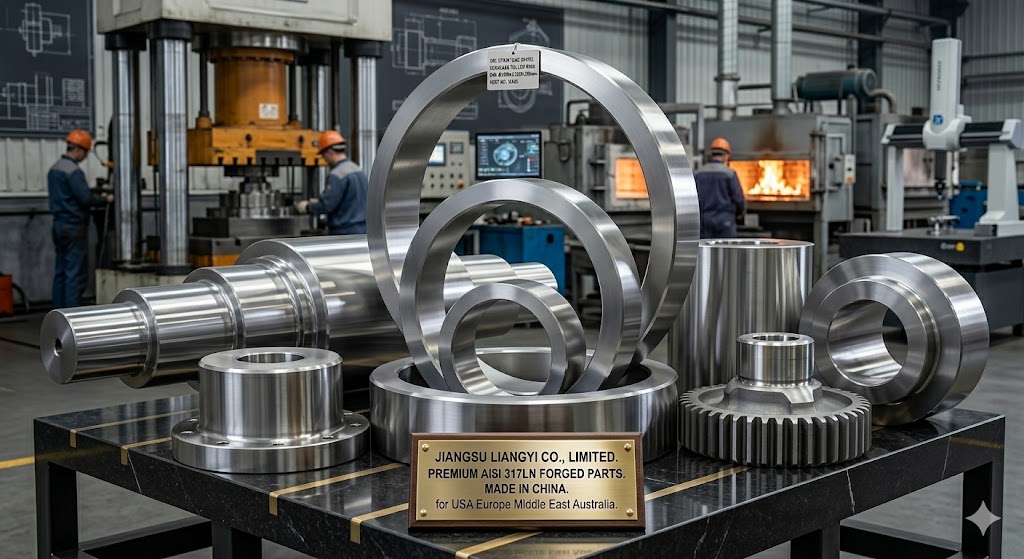
Jiangsu Liangyi Co., Limited (established 1997, Jiangyin City, Jiangsu Province, China) is an ISO 9001:2015 certified manufacturer specializing in AISI 317LN (UNS S31753 / Grade 317LN / SUS 317LN / TP 317LN) open die forgings, seamless rolled rings, and precision-machined forged components. With an 80,000 ㎡ production facility, 120,000-ton annual capacity, and 25+ years of export experience, we supply critical-duty forged parts to over 50 countries across North America, Europe, the Middle East, Asia-Pacific, and Australia. We manufacture to the material and dimensional requirements of ASTM A182, EN, DIN, JIS, API 6A 20th Edition, and ASME BPVC international standards, providing the full documentation packages required by global OEMs, EPCs, and pressure equipment fabricators.
What distinguishes our 317LN forgings from commodity-grade offerings is the integration of a full in-house metallurgical value chain: from VIM+ESR+VAR triple melt ingot production through open die forging, seamless ring rolling, solution annealing, precision CNC machining, and full multi-stage NDT — all within a single, traceable production loop. This vertical integration eliminates inter-supplier handoff risks, maintains an unbroken material chain-of-custody, and enables us to issue complete EN 10204 3.1 / 3.2 documentation with actual test data — not estimates or statistical projections.
Our core forging equipment fleet includes: 2000-ton and 6300-ton four-column hydraulic presses for open die forging; a 5-ton electro-hydraulic counter-blow hammer for precision near-net-shape work; a radial-axial ring rolling mill capable of producing seamless rolled rings up to 6,000 mm outer diameter; and VIM, ESR, and VAR furnaces for in-house triple melt. All equipment is maintained under a formal Preventive Maintenance Plan and periodically verified by calibrated load cells and temperature loggers.
Core Competitive Advantages of Our AISI 317LN Forged Parts
- VIM+ESR+VAR triple melt as standard: Targets very low residual gas and inclusion levels verified by heat analysis on every melt — meeting the material cleanliness requirements of nuclear supply chain fabricators and NORSOK M-630 offshore projects that most competitors can only attempt with purchased third-party specialty ingot
- Single-piece weight from 30 kg to 30,000 kg: Matched to your engineering drawings, covering everything from compact valve bodies to large pressure vessel shells and wind energy bearing rings
- Full vertical integration: Melting → forging → heat treatment → machining → NDT → documentation — all under one roof with a single point of accountability
- Documentation packages for all major markets: Material, chemistry, heat treatment, and NDT documentation prepared to PED 2014/68/EU & UKCA requirements (for European/UK pressure equipment fabricators), API 6A 20th Edition (for oil & gas equipment manufacturers), ASME BPVC (for pressure vessel and nuclear component fabricators), and NORSOK M-630 (for North Sea offshore projects) — all upon client specification and confirmed in writing before production
- 24-hour quotation turnaround: Submit your drawings and specifications; our engineering team returns a detailed, itemized quotation including material cost, machining, heat treatment, NDT, and documentation within 24 business hours
- Third-party inspection coordination: SGS, Bureau Veritas, TÜV Rheinland, Intertek — we facilitate witness inspection scheduling and full inspector access at no additional process disruption
The Metallurgy of AISI 317LN — Why Nitrogen Changes Everything
Engineers sometimes ask why AISI 317LN warrants a separate specification when 317L already exists. The answer lies in what happens at the atomic level when nitrogen is intentionally added as a primary alloying element rather than treated as a trace impurity.
Nitrogen as an Interstitial Solid-Solution Strengthener
In a standard 317L austenite matrix, the lattice strength is governed primarily by substitutional solute atoms (Cr, Ni, Mo). Nitrogen atoms, however, are small enough to occupy interstitial positions between iron atoms in the face-centred cubic (FCC) lattice — the same mechanism responsible for carbon's dramatic strengthening effect in ferritic steels. Each nitrogen atom distorts the local lattice, creating a long-range stress field that impedes dislocation movement and raises the yield strength. The critical distinction from carbon is that nitrogen remains fully in solid solution in the austenite matrix up to extremely high concentrations (far above the 0.22% upper limit of 317LN), generating no carbide or nitride precipitation at forging or service temperatures. This means the strength increase comes without the sensitization penalty that would accompany equivalent carbon additions.
The practical result: AISI 317LN forgings deliver a minimum yield strength of ≥ 285 MPa — approximately 68% higher than the ≥ 170 MPa minimum of standard 316L — from nitrogen addition alone, with no change to the corrosion-resistant alloy chemistry. For structural engineers sizing pressure vessel walls, valve body sections, or pump shaft diameters, this difference translates directly into material and weight savings: thinner cross-sections of 317LN carry the same load as heavier 316L components.
Understanding the PREN Value — Pitting Resistance in Numbers
The Pitting Resistance Equivalent Number (PREN) is the internationally recognized index for predicting chloride pitting susceptibility:
PREN = %Cr + 3.3 × %Mo + 16 × %N
For a typical AISI 317LN heat with Cr = 19.0%, Mo = 3.5%, N = 0.16%:
PREN = 19.0 + (3.3 × 3.5) + (16 × 0.16) = 19.0 + 11.55 + 2.56 = 33.11
This places 317LN firmly above the 32-point threshold required for offshore seawater service. At our maximum N of 0.22%, PREN can reach 36.1 — approaching the performance of more expensive 904L alloys.
Why Low Carbon (≤ 0.030%) Eliminates Sensitization Risk
Sensitization is one of the most insidious failure modes in austenitic stainless steel fabrication. When stainless steel enters the temperature window of 450–850°C — a range that encompasses virtually every arc welding heat-affected zone — carbon migrates to grain boundaries and combines with chromium to precipitate chromium carbides (Cr₂₃C₆). The local grain-boundary chromium concentration can drop below 10.5% within microseconds, creating narrow, chromium-depleted "depletion zones" that are anodic relative to the surrounding matrix. In service with any corrosive fluid, these zones dissolve selectively — a process called intergranular corrosion (IGC) or, in the context of welded assemblies, "weld decay."
In AISI 317LN, the carbon ceiling of ≤ 0.030% reduces the total carbon inventory available for carbide precipitation by more than 50% compared to standard 317 (max 0.08% C). This geometric limitation ensures that even prolonged exposure within the sensitization range — as occurs in multi-pass welding of thick sections — cannot deplete grain-boundary chromium below the passivation threshold. Field fabricators can weld 317LN flanges, nozzles, and pipe sections without mandatory inter-pass cooling or post-weld solution annealing, dramatically reducing fabrication time and cost while maintaining full IGC resistance.
Molybdenum's Role in Crevice and Pitting Corrosion Protection
The elevated molybdenum content of 317LN (3.0%–4.0%, vs. 2.0%–3.0% in 316L) provides a secondary but equally important corrosion protection mechanism: molybdenum ions released at incipient pit sites form molybdate complexes that physically block the anodic dissolution reaction, effectively "self-healing" early pitting damage. This mechanism is particularly effective in hot chloride environments above 60°C — the operating regime of seawater heat exchangers, process condensers, and offshore injection pump casings. In standard laboratory pitting corrosion testing (e.g., ASTM G48 ferric chloride method), grades with higher Mo and elevated PREN consistently demonstrate higher critical pitting temperatures than 316L — a relationship well-established in published corrosion engineering literature. The additional 1% Mo increment in 317LN versus 316L provides disproportionate resistance gains in chloride-bearing service.
AISI 317LN vs 304, 316L, 317L, 904L, 2205 — Head-to-Head Comparison
Understanding the quantitative trade-offs between corrosion resistance, mechanical strength, weldability and cost is essential in choosing the right grade of stainless steel for a forging project. The table below compares AISI 317LN against the five grades most commonly considered as alternatives, using standardized minimum property data and typical PREN values. This comparison is based on our 25+ years of hands-on forging experience with each of these alloy families and is intended to guide engineers toward a data-driven grade selection.
| Property | 304 / 304L | 316L | 317L | 317LN ★ | 904L | 2205 Duplex |
|---|---|---|---|---|---|---|
| UNS | S30400 / S30403 | S31603 | S31703 | S31753 | N08904 | S32205 |
| Cr (%) | 18–20 | 16–18 | 18–20 | 18–20 | 19–23 | 21–23 |
| Ni (%) | 8–10.5 | 10–14 | 11–15 | 11–15 | 23–28 | 4.5–6.5 |
| Mo (%) | — | 2.0–3.0 | 3.0–4.0 | 3.0–4.0 | 4.0–5.0 | 2.5–3.5 |
| N (%) | ≤0.10 | ≤0.10 | ≤0.10 | 0.10–0.22 | ≤0.10 | 0.14–0.20 |
| C max (%) | 0.08 / 0.030 | 0.030 | 0.030 | 0.030 | 0.020 | 0.030 |
| PREN (typical) | 19–21 | 23–26 | 30–33 | 33–36 | 34–38 | 34–38 |
| Yield Strength (min) | 170–205 MPa | 170 MPa | 205 MPa | 285 MPa | 220 MPa | 450 MPa |
| Tensile Strength (min) | 515–585 MPa | 485 MPa | 515 MPa | 590 MPa | 490 MPa | 620 MPa |
| Sensitization Risk | Low (L grade) | Very Low | Very Low | Very Low | Extremely Low | Low |
| Max Service Temp. | 870°C | 870°C | 870°C | 870°C | 815°C | 300°C (duplex) |
| Relative Cost Index | 1.0× | 1.3× | 1.5× | 1.6× | 3.2× | 2.0× |
| Best For | Mild environments, food & pharma | General chemical, marine | Strong acid service | High-strength + corrosive + weldable | Sulfuric acid, seawater | High-pressure structural |
- If your application is currently using 316L and experiencing pitting or early replacement: 317LN is the correct upgrade — PREN improves by ~10 points, yield strength nearly doubles, and material cost premium over 316L is modest.
- If your application needs 904L corrosion performance but not the high nickel cost: evaluate 317LN first — in many sulfuric acid and chloride environments below 60% concentration, 317LN matches 904L performance at roughly half the alloy cost.
- If your application requires wall thickness reduction due to weight constraints: 317LN yields 33% thinner walls versus 317L at the same design stress — a direct CAPEX saving for large-diameter pressure vessels and ring forgings.
- If your application involves welded assemblies with no post-weld heat treatment: 317LN's ultra-low carbon (≤0.030%) eliminates sensitization risk in as-welded condition, unlike standard 317 (0.08% C).
Full Range of AISI 317LN (UNS S31753) Forged Products & Forms
We manufacture custom AISI 317LN forged steel products across a comprehensive range of shapes, sizes, and finishing levels — from rough-forged blanks to fully CNC-machined, inspection-certified, ready-to-install components. Explore our full catalog at Products. Our AISI 317LN product capabilities include:
- Open Die Forged Bars & Billets: Round bars (Ø50–1,800 mm), square bars, flat bars, rectangular bars, and step rods — supplied rough-forged or finish-machined to your diameter and length tolerances
- Seamless Rolled Forged Rings: OD 200–6,000 mm, height up to 1,200 mm — plain rings, contoured rings (T-rings, L-rings, flanged rings), and profiled near-net-shape rings to minimize machining waste
- Forged Discs, Disks & Plates: Thickness 20–800 mm, OD up to 3,500 mm — for tube sheet blanks, baffle plate blanks, flange blanks, and custom pressure vessel closures
- Forged Flanges: Weld neck, slip-on, blind, socket weld, and custom-shaped flanges to ASME B16.5, B16.47, EN 1092-1, or fully custom dimensions; pressure rating classes 150# through 2500#
- Forged Shafts & Spindles: Straight shafts, stepped shafts, splined drive shafts, valve stems, pump shafts, and turbine shafts — up to 12,000 mm length with OD up to 1,200 mm
- Forged Hubs, Housings & Casings: Pump casings, compressor casings, valve bodies, nuclear pump casings, and custom closed-die near-net-shape forgings
- Forged Sleeves, Bushings & Hollow Bars: Seamless hollow forgings to reduce machining and material waste for tubular applications in heat exchangers and pressure vessels
- Custom Complex Machined Forgings: CNC-turned, milled, bored, and ground components with tolerances to IT7 grade, including threaded connections, serrated sealing faces, and precision bore-ground bore diameters
Full Manufacturing Process for AISI 317LN Forged Parts — 9 Controlled Stages
Many forging suppliers purchase bar stock or pre-rolled billets from third-party mills and only perform the forging operation in-house. At Jiangsu Liangyi, we begin manufacturing of our AISI 317LN at the liquid metal stage, providing us the ability to control all parameters that define quality from chemistry to final surface finish. We have the following standard 9-stage procedure which is controlled by documented procedures and verified by qualified personnel.
Raw Material Verification & Chemical Pre-Screening
Incoming master alloys (electrolytic nickel, ferro-molybdenum, high-purity nitrogen gas, ferro-chromium) are inspected against Certificate of Conformance and independently verified by our on-site Optical Emission Spectrometer (OES). This prevents any off-grade raw material from entering the melt cycle — the first traceability gate in our MQCP.
Vacuum Induction Melting (VIM) — Precise Chemistry Control
All charged materials are melted under vacuum in our induction furnace. The closed, oxygen-free environment prevents nitrogen burn-off and allows precise addition of nitrogen gas to achieve the target 0.10%–0.22% N range. Carbon is held to ≤ 0.025% at this stage, providing a chemistry buffer. A final ladle chemical analysis by OES confirms composition before tapping. The VIM ingot is the direct parent material for all subsequent ESR and VAR stages.
Electroslag Consumable Electrode Remelting (ESR) — Cleanliness & Density
The VIM electrode is remelted through a reactive slag layer (CaF₂-CaO-Al₂O₃ system) that acts as a chemical filter, absorbing non-metallic inclusions, oxide stringers, and sulfide phases. ESR dramatically improves material cleanliness, surface integrity, and axial directional uniformity. The resulting ESR ingot has a refined columnar grain structure aligned axially — ideal as a VAR electrode. Total oxygen content is substantially reduced at this stage, verified by heat analysis.
Vacuum Arc Consumable Electrode Remelting (VAR) — Ultimate Purity
The ESR electrode is remelted under high vacuum using a direct-current arc. The shallow melt pool geometry of VAR promotes fine, equiaxed grain formation and eliminates macro-segregation — the primary failure mode in conventionally cast large ingots. VAR processing achieves the highest material cleanliness of the three stages, with residual gas and inclusion levels verified by heat analysis. This satisfies the incoming material cleanliness requirements specified by nuclear supply chain fabricators and NORSOK M-630 offshore projects. VAR is the final metallurgical intervention before thermomechanical processing.
Ingot Heating & Homogenization
VAR ingots are charged into gas-fired pit furnaces and heated to the forging window of 1,150–1,250°C following a controlled multi-stage ramp schedule. For large ingots (above 5,000 kg), an extended 4–8 hour soak at temperature ensures thermal uniformity throughout the cross-section — confirmed by thermocouple readings at multiple ingot depths. Forging begins only when core-to-surface temperature differential is confirmed within ±15°C. All temperature-time profiles are electronically logged and archived.
Open Die Forging or Seamless Ring Rolling
Open die forgings are produced on our 2,000T or 6,300T hydraulic presses using custom-fabricated dies matched to the target forging shape. A minimum forging ratio of 4:1 (total reduction in cross-sectional area) is maintained for all critical applications to ensure full grain refinement, closure of internal porosity, and optimum through-thickness mechanical property uniformity. Seamless rings are produced by our radial-axial ring rolling mill: a pre-forged ring blank is placed on the mandrel roll and simultaneously compressed radially and axially, expanding diameter while reducing wall thickness and height — producing a seamless ring with a circumferentially oriented, fully refined grain structure. Maximum ring OD: 6,000 mm. Forging finish temperature is maintained above 950°C; below this threshold, forging is suspended and the workpiece is returned to the furnace.
Solution Annealing Heat Treatment
All AISI 317LN forgings are solution annealed at 1,050–1,150°C and rapidly water-quenched immediately after reaching thermal equilibrium. This step performs three critical metallurgical functions: (1) re-dissolves any sigma phase or carbide phases that may have formed during forging; (2) restores the fully austenitic, single-phase microstructure that is responsible for 317LN's corrosion resistance; and (3) relieves residual forging stresses. Quench rate (time from furnace exit to full submersion) is controlled to under 30 seconds for sections up to 100 mm — a critical parameter that must be fast enough to prevent carbide re-precipitation during cooling. Full temperature-time graphic records for every heat treatment cycle are included in the final documentation package.
Precision CNC Machining
CNC turning, milling, drilling, boring, and grinding operations are performed on modern multi-axis CNC machining centers with dimensional verification at every intermediate step using calibrated CMM (Coordinate Measuring Machine) and hand-gauging. Machining tolerances are routinely achieved to ISO IT7 (H7/h7) for critical bore and shaft fits, with surface roughness down to Ra 0.8 µm for sealing faces and Ra 3.2 µm for general machined surfaces. All cutting parameters are documented in the part-specific machining routing sheet.
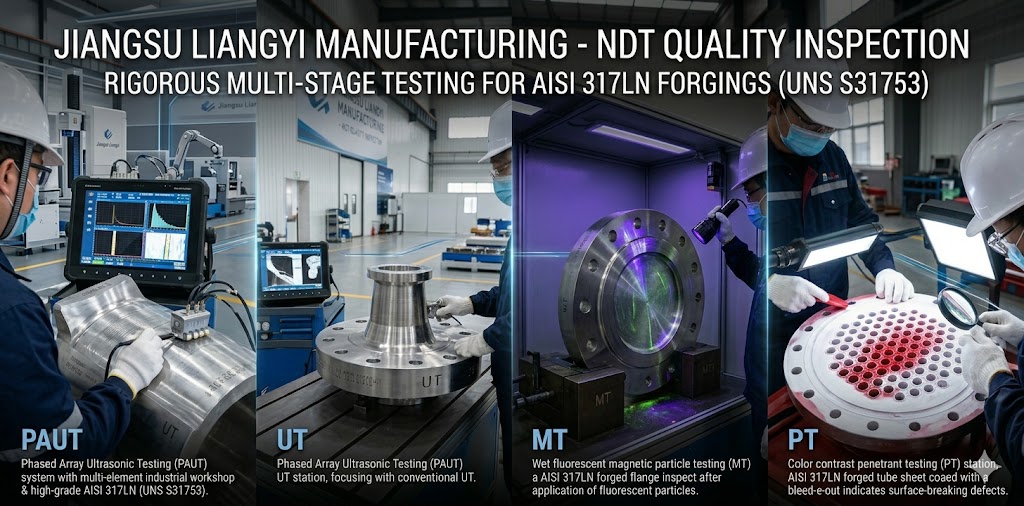
Multi-Stage NDT, Mechanical Testing & Final Documentation
Every finished part undergoes a comprehensive inspection sequence: Ultrasonic Testing (UT) per ASTM A388 / EN 10228-3; Liquid Penetrant Testing (PT) per ASTM E165 / EN 10228-1; Dimensional inspection against drawing with CMM report; Visual inspection; Mechanical testing (tensile, yield, elongation, hardness) from witness specimens cut from the same heat; Chemical analysis of finished product by OES. Results are compiled into a complete Inspection and Test Record (ITR), issued as EN 10204 3.1 MTC. Third-party EN 10204 3.2 witness inspection is coordinated with SGS, BV, TÜV, or client-nominated inspector upon request.
Global Industry Applications & Verified Project Cases
The following application areas are examples of sectors where the unique combination of high yield strength, high PREN and low carbon intergranular corrosion resistance of AISI 317LN can provide measurable, verifiable performance advantages. All case studies use real supply relationships with named or named-category clients and technical parameters as delivered.
1. Industrial Valve Manufacturing — Europe & North America
Industrial valves operating in chemical and petrochemical service require forged bodies and trim components that simultaneously withstand cyclic mechanical loading (opening/closing forces), sustained internal pressure, and aggressive corrosive media. Cast valve bodies in 316L frequently fail by pitting corrosion or stress corrosion cracking in chloride-bearing media above 60°C — conditions where 317LN forged bodies perform reliably. The forged grain structure of 317LN further improves pressure integrity and fatigue life compared with equivalent cast components, reducing warranty exposure for valve OEMs.
- Grade 317LN Forged Valve Bodies, Bonnets, Balls, Stems, Seat Rings, Cores, Discs & Closures for 2-way valves, check valves, ball valves, gate valves, globe valves, and cryogenic valves
- AISI 317LN Forged Main Shafts & Spindles for High Performance Butterfly Valves (HPBV) and triple offset butterfly valves, where the nitrogen-strengthened material enables slimmer shaft diameters at equivalent torque ratings
Project Case — Germany, Since 2018: Since 2018, Jiangsu Liangyi has been supplying forged Grade 317LN valve bodies, stems and seat rings to a Tier-1 industrial valve manufacturer in Europe, based in Germany. We have supplied 150+ forgings per year, all manufactured to EN 10213 material requirements and documented to EN 10204 3.2 with Bureau Veritas witness inspection, as required by the client’s PED regulated quality system. These valves are installed in sulfuric acid and phosphoric acid processing trains across Germany and France. No corrosion-related quality issues have been reported during the supply period — a track record that has led to consistent annual volume growth in this supply relationship.
2. Oil & Gas Upstream & Downstream — Middle East, North America, North Sea
Wellhead equipment and downhole completion tools face some of the most demanding combined mechanical and corrosive service conditions in any industry: pressures up to 20,000 psi (1,380 bar), temperatures to 180°C, H₂S partial pressures requiring NACE MR0175/ISO 15156 compliance, and concentrated chloride-containing formation water. API 6A 20th Edition specifies strict hardness limits (≤ 22 HRC for sour service) and full material traceability requirements. AISI 317LN, with its solution-annealed delivery condition hardness consistently at or below 22 HRC and PREN above 33, is well-suited for wellhead and completion equipment manufactured by API 6A licensed fabricators — our material and documentation packages are specifically prepared to meet those fabricators' API 6A PSL-3G incoming material requirements.
- AISI 317LN Forged Wellhead Christmas Trees, Spool Bodies, Casing Heads, Tubing Heads, Casing Hangers & Tubing Hangers
- UNS S31753 Forged Downhole Drilling Tool Components, Mud Motor Splined Drive Shafts & Electrical Submersible Pumps (ESP) Shafts
- Grade 317LN Forged Double Studded Adapter Flanges, Mud Flanges, Studded Crosses & Spacer Spools to API 6A / ASME B16.5
Project Case — Middle East, Since 2016: Since 2016, Jiangsu Liangyi has supplied over 5,000 UNS S31753 forged wellhead spool bodies, casing hangers, and tubing hanger mandrels to onshore oilfields operated by a major Middle Eastern national oil company — supplied through an approved EPC contractor. All parts were manufactured to API 6A 20th Edition PSL-3 material and dimensional requirements and to NACE MR0175/ISO 15156 hardness limits for H₂S sour service. Every delivery included full dimensional inspection reports, UT records, and chemical analysis traceable to the original melt. No material-related non-conformance reports have been issued during this multi-year supply relationship.
3. Nuclear Power — China, Europe
Nuclear safety-related forged components represent the most stringent quality tier in the forging industry. ASME BPVC Section III governs the design and fabrication of nuclear safety-related components — and critically, it is the licensed ASME N-Stamp fabricator (not the raw material forging supplier) who holds direct regulatory accountability. Jiangsu Liangyi's role in this supply chain is to provide ASME SA-182 F317LN forging material that fully satisfies the chemistry, cleanliness, mechanical property, heat treatment, traceability, and documentation requirements that ASME N-Stamp fabricators must receive from their approved material suppliers. Our VIM+ESR+VAR triple melt process — producing material with very low residual gas content verified by heat analysis — is the enabling capability that allows us to meet the incoming material qualification requirements of ASME BPVC Section III fabricators. All material documentation, including full heat traceability and chemistry reports in the NMC format, is prepared specifically to support the fabricator's nuclear quality assurance program.
- UNS S31753 Forged Nuclear Reactor Coolant Pump (RCP) Casings, Shells, Bodies & Impellers
- Grade 317LN Forged Nuclear Containment Seal Chambers, Pressure Vessel Nozzles & Safety-Class Structural Forgings
Project Case — China Nuclear Power Project, 2022: In 2022, Jiangsu Liangyi provided AISI 317LN forged Reactor Coolant Pump (RCP) casings for a Generation III pressurized water reactor (PWR) construction project in China. As material supplier, our scope included VIM+ESR+VAR triple melt, full chemical analysis, mechanical testing, UT and PT inspection, heat treatment records and NMC-format material documentation, all to the incoming material requirements of the ASME N-Stamp licensed fabricator who would do the final pump assembly and nuclear qualification. All 16 casings passed the fabricator's incoming material acceptance inspection without deviation or request for corrective action — confirming full compliance with the approved material qualification plan.
4. Petrochemical & Chemical Processing — North America, EU, Southeast Asia
Tube sheets are the single most metallurgically demanding component in a shell-and-tube heat exchanger: they must maintain a leak-proof metallurgical bond with hundreds of rolled-in tubes, resist corrosion from both shell-side and tube-side fluids (often at different temperatures and compositions), and carry full bundle weight without deflection. A tube sheet failure — typically by stress corrosion cracking, pitting, or IGC along tube-to-tubesheet joints — results in complete exchanger replacement. Specifying 317LN forged tube sheets rather than regular 316L can noticeably extend lifetime in acidic working conditions. Proven project cases show its replacement cycle can last 30–50% longer.
- Grade 317LN Forged Tube Sheets, Baffle Plates, Channel Flanges, Nozzles & Shells for Heat Exchangers, Boilers, Pressure Vessels & Reactors
- AISI 317LN Forged Venturi Cone Meter Bodies, Ultrasonic Flow Meter Housings & Oil Measurement Valve Spools
- UNS S31753 Forged Transition Cones, Swept Branch Outlets & Steel Pipe Fittings for chemical service piping systems
Project Case — North America, 2023: Jiangsu Liangyi delivered more than 200 forged heat exchanger tube sheets (OD 600-1,800 mm, thickness 80-180 mm) and pressure vessel nozzles to a North American chemical processing plant in Q2 2023, to ASME BPVC Section VIII Division 1 material & TEMA Class R dimensional standards. EN 10204 3.2 Intertek witness inspection material documentation has been provided. The client later reported a measurable improvement in corrosion performance in service as opposed to the previously installed 316L tube sheets in the same process streams as a direct result of the higher molybdenum content and elevated PREN in acid service of 317LN.
5. Turbomachinery & Industrial Pumps — Australia, Global OEM Market
Pump shafts and impellers handling aggressive slurry, acid, or seawater service fail by three primary mechanisms: corrosion fatigue (cyclic stress in a corrosive environment), erosion-corrosion (abrasive particle impact combined with corrosion), and stress corrosion cracking. AISI 317LN addresses all three: its higher yield strength (≥ 285 MPa) raises the fatigue endurance limit; its elevated Mo and PREN resist the corrosion component of corrosion-fatigue and SCC; and its fully austenitic forged microstructure provides superior toughness compared with duplex grades that become brittle below 50°C — a critical property for cold-start mining operations in Australian high-altitude sites.
- Grade 317LN Forged Centrifugal Compressor Impellers, Shrouded Impellers & Turbine Disc Components
- AISI 317LN Forged Pump Casings, Covers, Barrels, Impellers, Shafts, Wear Rings & Bearing Housings
Project Case — Australia, Since 2020: Since 2020, Jiangsu Liangyi has been the preferred forging supplier for AISI 317LN pump shafts, impellers, and wear rings to a leading global industrial pump OEM with manufacturing and service operations in Queensland, Australia. Components are used in high-chrome slurry transfer and phosphoric acid process pumps at mineral processing facilities. Following the OEM's upgrade from their prior 317L specification to 317LN, the client reported a meaningful reduction in in-service shaft failures during their scheduled maintenance intervals — an outcome consistent with 317LN's superior yield strength reducing plastic deformation under peak torque excursions in heavy-duty continuous service.
AISI 317LN (UNS S31753) — Complete Technical Specifications
Applicable International Standards by Product Type
AISI 317LN forgings are covered by multiple ASTM and international standards depending on product form and end-use. Our team selects the appropriate standard based on your application requirements:
| Standard | Grade Designation | Applicable Product Form | Typical Application |
|---|---|---|---|
| ASTM A182 | F317LN | Forged fittings, flanges, valves | Pressure piping components |
| ASTM A336 | F317LN | Large pressure vessel forgings | Boilers, pressure vessels |
| ASTM A965 | F317LN | Austenitic steel forgings for high-temperature | Power generation components |
| EN 10213 | X2CrNiMoN18-12-3 | Steel castings equivalent (PED applications) | European pressure equipment |
| JIS G4303 | SUS 317LN | Stainless steel bars | Japan market supply |
| NORSOK M-630 | — | Offshore forgings, cleanliness criteria | North Sea oil & gas |
Premium Melting Process — VIM + ESR + VAR Triple Melt
The triple melt route is not a marketing term at Jiangsu Liangyi — it is an engineering requirement for applications where failure is not an option. Each stage of our triple melt process reduces a specific category of material defect:
- Step 1 — VIM: Precise chemical composition control, nitrogen addition at target level, carbon held to ≤ 0.025%; eliminates gross composition inhomogeneity
- Step 2 — ESR: Slag filtration of non-metallic inclusions, sulfide phases, and oxide stringers; significantly improves surface-to-core cleanliness uniformity compared with the VIM ingot; verified by heat analysis
- Step 3 — VAR: High-vacuum arc remelting eliminates macro-segregation and achieves equiaxed grain formation; achieves the highest material cleanliness of the three stages — required as a material supply condition for nuclear fabricators and NORSOK M-630 Level 4 offshore applications
Chemical Composition — ASTM A182 F317LN Compliant
| Element | Symbol | ASTM Specified Range | Role in Alloy |
|---|---|---|---|
| Iron | Fe | 57.9% – 67.9% (balance) | Matrix element, FCC austenite base |
| Chromium | Cr | 18.0% – 20.0% | Passive film stability, primary PREN contributor |
| Nickel | Ni | 11.0% – 15.0% | Austenite stabilizer, SCC resistance |
| Molybdenum | Mo | 3.0% – 4.0% | Pit re-passivation, crevice corrosion resistance |
| Nitrogen ★ | N | 0.10% – 0.22% | Solid-solution strengthening, PREN boost, austenite stabilizer |
| Manganese | Mn | 0% – 2.0% | Nitrogen solubility enhancer, secondary austenite stabilizer |
| Silicon | Si | 0% – 0.75% | Deoxidizer, high-temperature oxidation resistance |
| Carbon | C | 0% – 0.030% max | Intentionally minimized — prevents sensitization |
| Phosphorus | P | 0% – 0.045% max | Controlled impurity |
| Sulfur | S | 0% – 0.030% max | Minimized — sulfides initiate pitting sites |
Mechanical Properties — Solution Annealed & Water Quenched (Standard Delivery Condition)
| Mechanical Property | Unit | Minimum Guaranteed Value | Note |
|---|---|---|---|
| Tensile Strength (UTS) | MPa / psi | ≥ 590 MPa (≥ 85,600 psi) | Tested on machined tensile coupon from same heat |
| Yield Strength (0.2% proof stress) | MPa / psi | ≥ 285 MPa (≥ 41,300 psi / 41.3 ksi) | ~68% higher than 316L minimum (170 MPa) |
| Elongation at Fracture | % | ≥ 40% | Gauge length 5.65√S₀ |
| Reduction in Area | % | ≥ 50% (typical for forgings) | Confirms forging quality and grain refinement |
| Hardness (solution annealed) | HRB / HRC | ≤ 95 HRB / ≤ 22 HRC | Compliant with NACE MR0175 for sour gas service |
| Charpy V-Notch Impact (–196°C) | J | ≥ 100 J (typical, fully austenitic) | Required for cryogenic and low-temperature service; tested on request |
- Density: 8.0 g/cm³
- Elastic Modulus (Young's Modulus): 200 GPa
- Thermal Conductivity: 14.4 W/m·K
- Thermal Expansion Coefficient (20–100°C): 16.5 µm/m·°C
- Electrical Resistivity: 0.75 µΩ·m
- Magnetic Permeability: ≤ 1.02 µr (non-magnetic in solution-annealed condition)
Customization Capabilities — From Drawing to Ready-to-Install
No two industrial projects have identical requirements. Jiangsu Liangyi's AISI 317LN forging service is designed around your engineering drawings, not around stock dimensions. Our customization scope covers every stage from initial material specification review through to packaging and export documentation:
- Drawing-to-forging conversion: Our engineering team reviews your CAD/CAM drawings, identifies potential forging defect zones (thin walls, abrupt cross-section changes, blind bores), and proposes forging die geometry modifications that achieve the required final shape while maintaining minimum required forging ratio — reducing machining allowance and total part cost
- Material specification consultation: If your current specification is 316L or 317L and you are experiencing corrosion or early fatigue failures, our metallurgical team can conduct a free in-service failure analysis review and provide a written grade upgrade recommendation — typically a one-page engineering report delivered within 5 business days
- Custom heat treatment: In addition to standard solution annealing, we can apply stress-relief annealing, simulated post-weld heat treatment (SPWHT), stabilization cycles, and cryogenic cycling — all with full temperature-time electronic records — to match your assembly and in-service requirements
- Custom surface finishing: Shot blast, acid pickling and passivation (per ASTM A967 or ASTM A380), electropolishing, painting, and custom corrosion protection coatings — specified per your datasheet or industry standard
- Custom NDT scope: Beyond our standard UT+PT package, we offer phased array UT (PAUT), time-of-flight diffraction (TOFD), radiographic testing (RT), and residual stress measurement by X-ray diffraction. For projects destined for ASME BPVC fabricators, we prepare UT and PT to the NB-2532 / NB-2546 methodology to support the fabricator's nuclear QA program — as required by your inspection plan
- Custom documentation packages: EN 10204 3.1 or 3.2 MTC, NORSOK M-650 material qualification, ASME material certification, WFCO heat treatment records, fugitive emission test reports (ISO 15848 / API 622), dimensional inspection reports, NDT reports with personnel certification, and full manufacturing traceability files
- Small-quantity sample orders: For new product qualification or incoming inspection programs, we accept minimum sample orders of 1 piece — including full documentation — to support your supplier approval process
Discover our complete material grade portfolio for custom forgings at Materials, or visit our Equipment page for full production capability details.
Rigorous Quality Control — What Every Delivery Includes
Every finished AISI 317LN (UNS S31753) forged part we deliver undergoes a strict multi-stage inspection regime. Unlike suppliers who rely on mill certificates from their ingot supplier and perform only a visual inspection, we conduct full in-house testing on every individual component — with all data traceable to the specific heat number and forging operation. The complete documentation package issued with every order includes:
- Unique part identification number, material designation, order number, drawing number, and heat number — all traceable through a single batch record from raw material to final inspection
- Original heat chemical analysis (VIM ladle sample) and finished product chemical analysis (OES from finished forging surface) — both results reported
- Melting method record (VIM+ESR+VAR), ingot weight, forging press/hammer used, and forging ratio achieved
- Complete heat treatment certification: furnace ID, actual thermocouple-measured temperature ramp, hold temperature, hold time, quench method and measured quench time — with full temperature-time graphic traces for each thermal cycle
- Full UT inspection record: probe type, frequency, calibration block reference, scanning coverage map, and accept/reject disposition per the applicable standard
- PT or MT inspection report: penetrant/developer batch numbers, dwell time, lighting conditions, inspector certification number
- Mechanical test report: tensile specimen location, test temperature, UTS, 0.2% proof stress, elongation, and reduction in area — witnessed by client inspector on request
- Hardness test report: hardness method, instrument calibration certificate reference, test locations (minimum 3 per part), and pass/fail versus the specified limit
- Dimensional inspection report: all drawing-specified dimensions verified by CMM or calibrated hand gauges, with actual measured values recorded against nominal and tolerance
- Visual inspection and surface condition record
- EN 10204 3.1 Mill Test Certificate (standard, issued by our in-house QA department); EN 10204 3.2 third-party witnessed certificate available through SGS, Bureau Veritas, TÜV Rheinland, or Intertek — coordinated by us on your behalf upon request
- Packing list, export classification, and material safety data sheet
Why Global OEMs Choose Jiangsu Liangyi for AISI 317LN Forgings
Sourcing specialty stainless steel forgings from China involves risk management as much as procurement. Global buyers consistently cite five concerns: material traceability gaps, inconsistent mechanical properties batch-to-batch, inadequate NDT capability, documentation that does not meet third-party audit requirements, and communication delays during critical project phases. Jiangsu Liangyi has built its export business specifically around resolving each of these concerns — not with marketing promises, but with verifiable engineering infrastructure.
- Material traceability: Because we melt our own ingots, the material chain-of-custody from liquid metal to finished component is unbroken. Every heat is assigned a unique heat number at the VIM stage that follows the material through every subsequent operation — no third-party mill certificates to validate, no risk of mixed heats
- Batch-to-batch consistency: Triple melt process metallurgy is inherently more reproducible than conventional electric arc furnace or ladle refining. Our in-process chemical analysis controls demonstrate consistent nitrogen targeting across production heats — confirming the statistical process discipline that underpins stable mechanical properties from order to order
- NDT capability: Our on-site NDT laboratory is equipped with phased array UT (PAUT), conventional UT, digital PT/MT, and portable XRF for composition verification. All equipment is calibrated to national standards and traceable to NIST (or equivalent). NDT operators hold ASNT Level II or PCN Level II certifications in their respective methods
- Documentation audit-readiness: Our QA documentation system is structured to support customer second-party audits, API Q1 pre-qualification reviews, and PED Notified Body documentation requirements. Every data record is held for a minimum of 15 years and is available for retrieval upon request — including original furnace temperature charts, OES calibration records, and NDT calibration blocks
- Communication: Every project is assigned a dedicated English-speaking Sales Engineer who is the single point of contact for technical questions, delivery updates, and document coordination. We maintain a target response time of under 4 business hours for all technical queries
Global Support, Payment & Logistics
🌍 24/7 English-Language Engineering Support
Dedicated Sales Engineers provide technical pre-sales support, drawing review, material consultation, and post-delivery issue resolution — available across US, European, Middle East, and Asia-Pacific business hours.
💰 Flexible International Payment
We accept T/T wire transfer, L/C at sight (all major issuing banks), and PayPal for sample orders. 30%/70% payment terms available for established accounts. USD, EUR, and GBP invoicing.
🚢 Worldwide Logistics — Sea, Air, Express
Sea freight via FCL/LCL from Shanghai or Ningbo; air freight from Shanghai Pudong; express delivery (DHL, FedEx, UPS) for urgent samples. We handle export customs clearance, HS code classification, and CITES/export license requirements where applicable. Delivery to 50+ countries.
📋 Export Compliance & Documentation
Full set of export documents: Commercial Invoice, Packing List, Certificate of Origin (Form E for ASEAN, EUR.1 for EU), EN 10204 3.1 MTC, Material Safety Data Sheet, and project-specific documentation prepared to the material requirements of PED, API, or ASME BPVC fabricators upon written confirmation of requirements.
Frequently Asked Questions — AISI 317LN (UNS S31753) Forged Parts
AISI 317LN (UNS S31753) is a nitrogen-intentionally-alloyed variant of 317L austenitic stainless steel. The "N" suffix denotes that nitrogen (0.10%–0.22%) is added as a primary strengthening alloying element, not merely limited as a residual impurity as in standard 317L (UNS S31703, max N ≈ 0.10%). This controlled nitrogen addition achieves interstitial solid-solution strengthening in the austenite FCC lattice — raising the minimum yield strength from 205 MPa (317L) to 285 MPa (317LN), a 39% improvement, without any reduction in corrosion resistance, ductility, or weldability. The low carbon ceiling (≤ 0.030%) is shared with 317L and eliminates sensitization risk in as-welded condition.
PREN (Pitting Resistance Equivalent Number) = %Cr + 3.3×%Mo + 16×%N. For a typical 317LN heat (Cr = 19%, Mo = 3.5%, N = 0.16%), PREN = 19.0 + 11.55 + 2.56 = 33.11. A PREN above 32 is the general industry threshold for offshore seawater immersion service. 317LN's PREN of 33–36 places it above this threshold and in the same performance tier as 904L (PREN 34–38) — but at roughly half the alloy cost. For material selection: if your application PREN requirement is 24–32, 316L is adequate; if 32–36 is needed, 317LN is the most cost-effective choice; if above 38 is required (very aggressive sour gas or seawater injection), 6Mo or super-duplex grades are appropriate.
When austenitic stainless steel is held between 450°C and 850°C — the entire range of welding heat-affected zones and many stress-relief operations — chromium migrates to grain boundaries and combines with carbon to form Cr₂₃C₆ chromium carbides. This locally depletes grain-boundary chromium below the 10.5% passivation threshold, creating narrow anodic zones that dissolve selectively in any corrosive service fluid (intergranular corrosion). In 317LN, the maximum carbon of 0.030% limits total available carbon so severely that chromium carbide precipitation cannot reach the grain-boundary depletion level critical for IGC initiation — even under sustained multi-pass welding thermal cycles. Independent laboratory corrosion testing per ASTM A262 Practice E (copper/copper sulfate/sulfuric acid Strauss test) routinely confirms that 317LN in as-welded condition achieves a "pass" result with no intergranular attack. This means field fabricators can weld 317LN piping and flanges without post-weld solution annealing, reducing fabrication cost and schedule.
Our complete in-house manufacturing sequence: (1) Raw material incoming chemical verification by OES; (2) Vacuum Induction Melting (VIM) for composition control and nitrogen targeting; (3) Electroslag Remelting (ESR) for inclusion removal and cleanliness improvement; (4) Vacuum Arc Remelting (VAR) for macro-segregation elimination and ultimate material cleanliness; (5) Ingot heating to 1,150–1,250°C forging window with electronic temperature logging; (6) Open die forging (2000T/6300T press) or seamless ring rolling (max OD 6,000 mm) at minimum 4:1 forging ratio; (7) Solution annealing at 1,050–1,150°C with rapid water quench (within 30 seconds of furnace exit for sections to 100 mm); (8) Precision CNC machining to final drawing dimensions; (9) Multi-stage NDT (UT per ASTM A388, PT per ASTM E165), mechanical testing, CMM dimensional inspection, and EN 10204 3.1 MTC issuance as standard.
Jiangsu Liangyi holds ISO 9001:2015 quality management system certification — this is our independently audited and certified quality credential. All other standards referenced in our supply scope are material and dimensional manufacturing requirements that we produce to, not third-party certifications we hold independently:
- ASTM A182 / A336 / A965 — material standards governing chemistry, mechanical properties, and heat treatment; we manufacture to these as our baseline
- API 6A 20th Edition — we manufacture forgings to the material and dimensional requirements of this standard, enabling API-licensed equipment fabricators to use our parts in their licensed assemblies. We are a material supplier, not an API-licensed equipment manufacturer
- PED 2014/68/EU & UKCA — we prepare chemistry, mechanical property, heat treatment, and NDT documentation packages to the material requirements of PED-regulated fabricators. CE / UKCA marking is applied by the fabricator, not by us as a raw material forging supplier
- ASME BPVC — we supply material documentation to the incoming material requirements of ASME N-Stamp and U-Stamp licensed fabricators. ASME stamping authority rests with the fabricator, not the forging material supplier
- NORSOK M-630 — we manufacture to the material and cleanliness requirements of this standard upon client specification and written confirmation
- EN 10204 3.1 — issued as standard with every order by our in-house QA department
- EN 10204 3.2 — available through SGS, Bureau Veritas, TÜV Rheinland, or Intertek; we coordinate witness inspection scheduling on your behalf
If you require a specific standard compliance confirmation for your project, please include it in your enquiry and we will confirm in writing whether we can meet the stated requirements before order placement.
Open die forgings: single-piece weight 30 kg to 30,000 kg. Forged bars: Ø50 mm to Ø1,800 mm OD, length up to 8,000 mm. Seamless rolled rings: OD 200 mm to 6,000 mm, height 30 mm to 1,200 mm — including plain rings, profiled/contoured rings, and near-net-shape flanged rings. Forged discs and plates: OD to 3,500 mm, thickness 20 to 800 mm. All dimensions are produced to your engineering drawing tolerances; there are no stock-dimension constraints. For dimensions at or near equipment limits, we request a pre-project feasibility consultation to confirm tooling availability and forging ratio compliance.
Forging provides three measurable performance advantages over casting and bar machining for 317LN components. First, grain refinement: the thermomechanical deformation of forging breaks down the as-cast columnar grain structure into a fine, equiaxed grain that dramatically improves fatigue strength, impact toughness, and UT inspectability — critical for rotating equipment and pressure-containing components. Second, grain flow orientation: in a forged component, the grain flow follows the part contour (e.g., a forged flange has circumferential grain flow in the flange face and radial flow in the hub), creating directional mechanical property alignment that matches the service loading direction. A machined-from-bar or cast flange has random grain orientation relative to service loads. Third, closure of porosity: forging compression at minimum 4:1 ratio fully closes residual gas porosity and micro-shrinkage from the ingot solidification — a category of defect that casting cannot eliminate and that bar machining simply reveals rather than heals.
Standard NDT suite for AISI 317LN forged parts: Ultrasonic Testing (UT) per ASTM A388 (general forgings), detecting internal volumetric flaws; Liquid Penetrant Testing (PT) per ASTM E165 / EN 10228-1, detecting surface-breaking discontinuities; Hardness Testing per ASTM E18 (Rockwell) or E92 (Vickers) on finished surface after machining. Available on request: Phased Array UT (PAUT) for complex geometries, Time-of-Flight Diffraction (TOFD), Radiographic Testing (RT) per ASTM E94, and Residual Stress Measurement by X-ray diffraction. For ASME BPVC fabricator supply, UT and PT can be performed to NB-2532 / NB-2546 methodology to support the fabricator's nuclear QA program. All NDT personnel hold ASNT Level II or PCN Level II in their respective methods. Calibration records and personnel certificates are included in every documentation package.
Standard lead time for custom forged AISI 317LN parts is 8-16 weeks from receipt of drawing approval and deposit depending on part complexity, part weight and NDT requirement. This includes VIM+ESR+VAR melt cycle (normally 3-4 weeks), forging, heat treatment, CNC machining, NDT and compilation of documentation. For urgent replacement and maintenance-critical projects, we offer an accelerated production track using pre-melted ingot inventory of common 317LN chemistry — this can reduce lead time to 5–7 weeks for standard shapes. Air freight from Shanghai Pudong to major global hubs typically delivers in 3–5 business days. Contact our engineering team with your required delivery date and we will provide a realistic commitment at the quotation stage — we do not overcommit and underdeliver.
To get a detailed, accurate quotation within 24 business hours, please send the following to sales@jnmtforgedparts.com: (1) Engineering drawing in PDF, DXF, STEP, or IGES format — with all dimensions, tolerances, and surface finish requirements; (2) Material specification: ASTM A182 F317LN, EN grade, or UNS S31753 — plus any supplementary requirements; (3) Quantity and target delivery date; (4) Applicable standard (ASME, API, PED, etc.) and NDT scope; (5) Documentation requirements (3.1 or 3.2, third-party inspector preference). If drawings are not yet available, a sketch with approximate dimensions and weight estimate allows us to issue a budgetary quotation. For large orders (≥ 10 pieces or ≥ 10,000 kg), we offer a free pre-production DFM (Design for Manufacturability) review to identify cost-saving opportunities in the forging design.
Contact Us — Custom AISI 317LN Forged Parts Quotation Within 24 Hours
Jiangsu Liangyi Co., Limited has supplied AISI 317LN (UNS S31753) forged parts to critical industrial projects across 50+ countries for over 25 years. Our engineering-led sales process begins with understanding your technical requirements — not with a price list. Whether your project requires a single prototype component for material qualification, a long-term annual blanket supply contract, or an urgent replacement for a failed component in service, we have the metallurgical expertise, manufacturing capacity, and documentation capability to deliver.
Send us your drawing, material specification, quantity, required standard, and target delivery date. Our engineering team will review your requirements and return a detailed, itemized, technically accurate quotation within 24 business hours — including material, machining, heat treatment, NDT, documentation, and logistics cost breakdown.
Request a Free Technical Quotation →Inquiry Email: sales@jnmtforgedparts.com
Phone / WhatsApp: +86-13585067993
Official Website: https://www.jnmtforgedparts.com
Factory Address: Chengchang Industry Park, Jiangyin City, Jiangsu Province, China 214400