AISI 317 (UNS S31700 / Grade 317 / SUS 317) Forging Parts — Custom Open Die Forgings & Seamless Rolled Rings | China ISO Certified Manufacturer
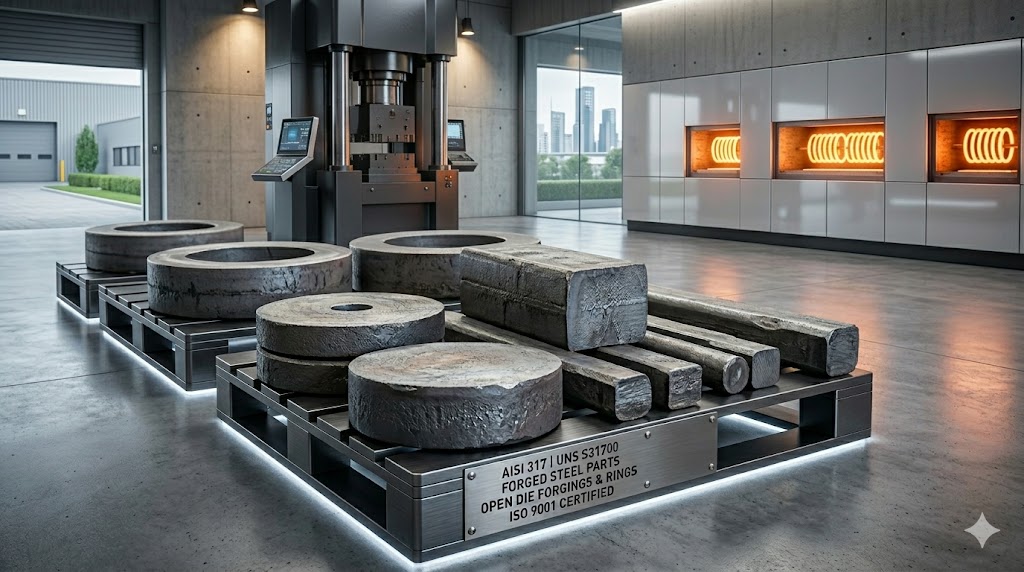
AISI 317 (UNS S31700) Open Die Forgings and Seamless Rolled Rings — Jiangsu Liangyi Co., Limited, Jiangyin, Jiangsu, China
⚡ AISI 317 (UNS S31700) — At-a-Glance Specifications
What Is AISI 317 — Material Definition & Manufacturer Overview
AISI 317 (UNS S31700) is a high-molybdenum austenitic stainless steel belonging to the 300-series family. Its full standardized designation is UNS S31700 in North America, EN 1.4449 / X5CrNiMo17-13 in Europe, and SUS 317 under JIS G4303. In tubular product form, it is referenced as TP317 under ASTM A213. These four designations refer to the same alloy chemistry.
The defining characteristic of Grade 317 is its molybdenum content of 3.00–4.00% — one full percentage point higher than the upper limit of AISI 316 (2.00–3.00%). This seemingly small compositional difference has a disproportionately large effect on corrosion resistance, because molybdenum stabilizes the passive oxide film on the steel surface specifically in the presence of chloride ions, which are the primary driver of pitting corrosion in industrial environments.
Jiangsu Liangyi Co., Limited is an ISO 9001:2015 certified precision forging manufacturer based in Jiangyin, Jiangsu Province, China. Established in 1999, the company has accumulated over 25 years of forging experience and operates one of the most capable large-section stainless steel forging facilities in China, including 2000T–6300T hydraulic presses and 1m–5m seamless ring rolling mills. AISI 317 and 317L account for a significant portion of our export production, serving customers in the oil & gas, petrochemical, power generation and marine industries across more than 50 countries.
Request AISI 317 Forging QuotationMetallurgy: Why Molybdenum Makes the Difference in AISI 317
To understand why engineers specify AISI 317 instead of the more common 316 or 304, it is necessary to understand the electrochemical mechanism of chloride pitting corrosion in austenitic stainless steel.
Stainless steel relies on a self-repairing chromium oxide passivation layer (Cr₂O₃) on its surface to resist corrosion. In the presence of chloride ions (Cl⁻), however, this passive film can break down locally at surface defects or inclusions, creating an active pit. Inside the pit, a concentrated acidic chloride solution develops (pH can drop below 1), and the autocatalytic chemistry of the pit prevents the passive film from re-forming. Once initiated, pitting corrosion can penetrate through the full wall thickness of pressure-containing components relatively quickly.
Molybdenum's role is threefold:
- Passivation film reinforcement: Mo⁴⁺ and Mo⁶⁺ ions are incorporated into the passive film at the metal/oxide interface, significantly increasing the film's stability and resistance to Cl⁻ attack. Research has shown that molybdenum oxides in the passive layer have a much lower solubility rate in acidic chloride environments than chromium oxide alone.
- Pitting initiation threshold increase: The presence of molybdenum raises the critical chloride concentration below which no pitting will initiate, and raises the temperature at which pitting begins — measured as the Critical Pitting Temperature (CPT) — by approximately 5–10°C per 1% increase in Mo content, relative to base compositions.
- Repassivation promotion: When a pit does initiate, molybdenum accelerates the rate at which the passive film re-forms (repassivation), limiting pit growth and reducing the probability of propagation to perforation.
⚙ Jiangsu Liangyi Engineering Insight
In our 25+ years of producing AISI 317 forgings, we have observed that the real-world corrosion benefit of 317 over 316 becomes most evident in thick-section components (wall thickness above 50mm). In thin sections, both alloys may perform similarly because surface renewal limits pit growth. But in heavy-wall valve bodies, flange forgings and tube sheets, the higher Mo content of 317 provides a measurable service life advantage — particularly when chloride concentrations in process fluids are variable or uncertain.
The Austenitic Structure Advantage
AISI 317 has a fully austenitic face-centered cubic (FCC) crystal structure at all temperatures from cryogenic to its operating limit. This structure provides several inherent advantages over ferritic or martensitic stainless steels: it is non-magnetic (or very weakly magnetic after significant cold work), it cannot be hardened by heat treatment (which means hardness is uniform throughout thick sections after solution annealing), and it exhibits excellent toughness at temperatures down to –196°C without a ductile-to-brittle transition — a critical property for cryogenic and liquefied gas applications.
One metallurgical challenge unique to 317 is that it is more susceptible to sigma phase embrittlement than 316, because its higher chromium and molybdenum contents promote sigma phase formation when the alloy is exposed to temperatures between 600°C and 900°C for extended periods. For applications operating continuously in this temperature range (e.g., flue gas scrubbers or certain chemical reactor internals), 317L or a duplex alternative should be evaluated. For most oil & gas pressure components that operate below 500°C, this is not a practical concern.
AISI 317 Chemical Composition — ASTM A182 Standard
The following chemical composition requirements apply to AISI 317 (UNS S31700) per ASTM A182 / ASTM A276. All values are weight percentages verified by Optical Emission Spectrometry (OES) on every heat produced at Jiangsu Liangyi.
| Element | Symbol | ASTM Requirement | Typical Aim (Jiangsu Liangyi) | Metallurgical Role |
|---|---|---|---|---|
| Carbon | C | ≤ 0.08% | 0.04–0.06% | Strength; low carbon reduces sensitization risk |
| Chromium | Cr | 18.00–20.00% | 18.5–19.5% | Primary passivation; main corrosion barrier |
| Nickel | Ni | 11.00–15.00% | 12.0–13.5% | Austenite stabilizer; enhances acid corrosion resistance |
| Molybdenum | Mo | 3.00–4.00% | 3.2–3.8% | Pitting & crevice corrosion resistance; passive film reinforcement |
| Manganese | Mn | ≤ 2.00% | 0.8–1.5% | Austenite stabilizer; deoxidizer during melting |
| Silicon | Si | ≤ 1.00% | 0.3–0.6% | Deoxidizer; high-temperature oxidation resistance |
| Phosphorus | P | ≤ 0.045% | ≤ 0.030% | Impurity; limited to preserve toughness and corrosion resistance |
| Sulfur | S | ≤ 0.030% | ≤ 0.005% | Impurity; MnS inclusions are pitting initiation sites — controlled to minimum |
| Iron | Fe | Balance | Balance | Base metal matrix |
⚙ Sulfur Control — A Key Differentiator
While ASTM A182 permits up to 0.030% sulfur, our standard practice is to control sulfur to ≤0.005% (6× tighter than the specification minimum). Manganese sulfide (MnS) inclusions are the primary pitting initiation sites in austenitic stainless steels. By minimizing MnS inclusion density through tight sulfur control and vacuum degassing, we produce forgings with a measurably lower pitting initiation frequency — an advantage that becomes critical in components exposed to high-velocity chloride-containing fluids.
Mechanical Properties — Forged AISI 317 vs Bar Stock
The minimum mechanical property requirements per ASTM A182 for solution-annealed AISI 317 forgings are listed below. Our actual production values consistently exceed these minima due to our controlled forging practice, which achieves finer grain sizes and more uniform microstructure than rolled bar or plate alternatives.
| Property | ASTM A182 Minimum | Jiangsu Liangyi Typical (Forging) | Test Standard |
|---|---|---|---|
| Tensile Strength | ≥ 620 MPa | 680–750 MPa | ASTM E8 |
| 0.2% Yield Strength | ≥ 275 MPa | 310–380 MPa | ASTM E8 |
| Elongation (50mm GL) | ≥ 45% | 50–60% | ASTM E8 |
| Reduction of Area | ≥ 45% | 55–70% | ASTM E8 |
| Brinell Hardness | ≤ 200 HBW | 150–190 HBW | ASTM E10 |
| Charpy V-Notch @ –20°C | Not specified (available on request) | 70–120 J | ASTM E23 |
| Grain Size (ASTM) | Not specified | ASTM 5–8 (Fine) | ASTM E112 |
* Typical values are based on our standard production conditions. Actual values depend on section size, forge ratio and specific customer requirements. MTR values provided with each shipment.
Physical & Thermal Properties of AISI 317 (UNS S31700)
Physical properties are important for engineering calculations including thermal stress analysis, heat exchanger design, flow simulation and fatigue assessment. The following values are for solution-annealed AISI 317 at room temperature unless otherwise noted.
| Property | Value | Unit | Test Temperature |
|---|---|---|---|
| Density | 8.03 | g/cm³ | 20°C |
| Melting Range | 1375 – 1400 | °C | — |
| Elastic Modulus (Young's) | 193 | GPa | 20°C |
| Poisson's Ratio | 0.27 | — | 20°C |
| Thermal Conductivity | 14.6 | W/(m·K) | 20°C |
| Thermal Conductivity | 18.9 | W/(m·K) | 500°C |
| Specific Heat Capacity | 500 | J/(kg·K) | 20°C |
| Coefficient of Thermal Expansion (CTE) | 16.0 × 10⁻⁶ | K⁻¹ | 20–100°C |
| Coefficient of Thermal Expansion (CTE) | 18.0 × 10⁻⁶ | K⁻¹ | 20–500°C |
| Electrical Resistivity | 0.74 | μΩ·m | 20°C |
| Magnetic Permeability (solution-annealed) | ≤ 1.02 | μ (relative) | 20°C |
| Max Continuous Operating Temperature | 870 | °C | — |
| Min Operating Temperature | –196 (cryogenic) | °C | — |
⚙ Design Note on Thermal Expansion
AISI 317's coefficient of thermal expansion (CTE ≈ 16–18 × 10⁻⁶ K⁻¹) is significantly higher than carbon steel (≈ 12 × 10⁻⁶ K⁻¹). In flanged assemblies or heat exchanger tube-to-tubesheet joints involving both 317 and carbon steel components, this differential thermal expansion must be accounted for in the stress analysis. Our engineering team can provide dimensional calculations for thermally loaded assemblies on request.
Corrosion Resistance Data — PREN, CPT and CCT
Corrosion engineers use three quantitative metrics to compare the localized corrosion resistance of stainless steel grades. Understanding these values is essential for confident material selection in chloride-containing service.
1. Pitting Resistance Equivalent Number (PREN)
The PREN is a single-number index that combines the effects of chromium, molybdenum and nitrogen on pitting resistance. The most widely used formula for austenitic stainless steels is:
PREN = %Cr + 3.3 × %Mo + 16 × %N
For AISI 317 using typical midpoint chemistry (Cr = 19%, Mo = 3.5%, N ≈ 0.04%):
PREN = 19 + (3.3 × 3.5) + (16 × 0.04) = 19 + 11.55 + 0.64 = ≈ 31.2
This places AISI 317 significantly above AISI 316 (PREN ≈ 24–26) and in a performance range that overlaps with lean duplex grades such as 2101 and 2304 — at a substantially lower cost than the super-austenitic grades (6Mo alloys, PREN > 40).
2. Critical Pitting Temperature (CPT)
The CPT is the minimum temperature at which pitting corrosion will initiate in a standard test solution (6% ferric chloride solution per ASTM G48 Method A). It is a more meaningful metric than PREN because it is measured, not calculated.
| Grade | UNS | Mo (%) | PREN (Typical) | CPT (°C, Approximate) | Relative Performance |
|---|---|---|---|---|---|
| AISI 304 | S30400 | — | 18–20 | < 0°C | Baseline / Limited Cl⁻ resistance |
| AISI 316 | S31600 | 2.0–3.0 | 24–26 | 15–20°C | Good — suitable for mild Cl⁻ service |
| AISI 317L | S31703 | 3.0–4.0 | 28–30 | 25–35°C | Better — same Mo as 317, low C |
| AISI 317 | S31700 | 3.0–4.0 | 28–31 | 25–35°C | Better — high Mo, higher tensile strength |
| Alloy 904L | N08904 | 4.0–5.0 | 33–36 | 35–50°C | Excellent — higher Mo & Ni |
| Super Duplex 2507 | S32750 | 3.5–4.5 | 42–43 | > 50°C | Outstanding — but higher cost |
3. Critical Crevice Corrosion Temperature (CCT)
Crevice corrosion (occurring under gaskets, between flanges, or at threaded connections) initiates at lower temperatures than pitting corrosion in the same alloy. The CCT for AISI 317 in 6% FeCl₃ is typically in the range of 0–10°C, compared to –10°C or below for AISI 316. In practical terms, this means AISI 317 flange and fitting forgings can provide reliable crevice corrosion resistance at ambient temperatures in seawater and many process chloride environments where AISI 316 would be borderline or inadequate.
4. Stress Corrosion Cracking (SCC) Resistance
All austenitic stainless steels, including AISI 317, are susceptible to chloride stress corrosion cracking (CSCC) when the three conditions are simultaneously present: tensile stress, temperature above approximately 60°C, and chloride ions. The higher molybdenum and nickel contents of AISI 317 raise the threshold chloride concentration and temperature at which CSCC initiates compared to 316, but do not delete the risk in severe environments. For applications above 100°C in high-chloride service with sustained tensile stress, duplex stainless steels (2205, 2507) or nickel alloys (Alloy 625, Alloy 825) should be evaluated.
Grade Comparison — AISI 317 vs 316 vs 317L vs 904L
The following table provides a comprehensive side-by-side comparison to support material selection decisions. Data is based on ASTM standard requirements and published corrosion testing data.
| Parameter | AISI 316 (S31600) | AISI 316L (S31603) | AISI 317L (S31703) | AISI 317 (S31700) | Alloy 904L (N08904) |
|---|---|---|---|---|---|
| Carbon Max (%) | 0.08 | 0.03 | 0.03 | 0.08 | 0.02 |
| Chromium (%) | 16.0–18.0 | 16.0–18.0 | 18.0–20.0 | 18.0–20.0 | 19.0–23.0 |
| Nickel (%) | 10.0–14.0 | 10.0–14.0 | 11.0–15.0 | 11.0–15.0 | 23.0–28.0 |
| Molybdenum (%) | 2.0–3.0 | 2.0–3.0 | 3.0–4.0 | 3.0–4.0 | 4.0–5.0 |
| PREN (Typical) | 24–26 | 24–26 | 28–30 | 28–31 | 33–36 |
| Tensile Strength Min (MPa) | 515 | 485 | 515 | 620 | 490 |
| Yield Strength Min (MPa) | 205 | 170 | 205 | 275 | 220 |
| Sensitization Risk (Welded) | Moderate | Very Low | Very Low | Moderate | Very Low |
| CPT in 6% FeCl₃ (Approx.) | 15–20°C | 15–20°C | 25–35°C | 25–35°C | 35–50°C |
| Max Continuous Use Temp | 870°C | 870°C | 870°C | 870°C | 870°C |
| Cryogenic Service | Yes (–196°C) | Yes (–196°C) | Yes (–196°C) | Yes (–196°C) | Yes (–196°C) |
| NACE MR0175 Listed | Yes | Yes | Yes | Yes | Yes |
| Relative Material Cost | Reference (1.0×) | 1.05× | 1.25× | 1.20–1.30× | 2.0–2.5× |
| Primary Application Advantage | General corrosion, cost | General + weldability | Aggressive service + welding | Aggressive Cl⁻ + high strength | Severe acid + high Cl⁻ |
Why Forged AISI 317 Outperforms Bar Stock and Castings
The term "forged stainless steel" is often used loosely, but the mechanical and corrosion performance differences between forged, bar-machined and cast AISI 317 components are significant and well-documented. Understanding these differences is critical for engineers specifying critical pressure-containing components.
Forging vs Rolled Bar Stock
AISI 317 round bar is produced by hot rolling continuous cast billets through a series of rolling stands. The reduction ratio through rolling is typically 5:1 to 10:1 in the longitudinal direction, but there is no deformation in the transverse direction — the microstructure is elongated in the rolling direction and compressed radially. When a component is machined from bar stock with a cross-sectional geometry (e.g., a flange or a ring), the grain flow direction does not follow the principal stress direction in service, leading to anisotropic mechanical properties. Transverse tensile strength and toughness can be 10–20% lower than longitudinal values in bar-machined components.
In contrast, open die forging applies multi-directional deformation to the billet. Experienced forging engineers orient the grain flow to match the principal stress direction in the finished component — for example, ensuring that the grain flow is radial in a flange ring, following the direction of pressure loading on the flange face. Seamless ring rolling produces components where the grain flow is circumferential, naturally aligned with the hoop stress in a pressure ring application. This grain flow optimization, combined with the microstructural refinement from forging, gives forged components a measurably higher fatigue life and fracture toughness compared to equivalent bar-machined parts.
Forging vs Casting
Cast AISI 317 components (produced by investment casting, sand casting or centrifugal casting) contain inherent microstructural features that cannot be fully eliminated by heat treatment: large dendritic grain structure, porosity (gas and shrinkage), elemental segregation within individual grains, and non-metallic inclusion clusters at grain boundaries. These features reduce tensile strength and toughness, and create preferential corrosion initiation sites.
Forging's hot-working action breaks down the dendritic cast structure into a fine, equiaxed grain structure, closes and welds any porosity through solid-state diffusion, and distributes inclusions more uniformly. ASTM A182 forged AISI 317 is specified with a minimum tensile strength of 620 MPa compared to approximately 480–520 MPa for equivalent cast CF8M (316 cast equivalent); for AISI 317 castings, cast properties are typically 10–15% lower than the forging specification. For pressure-critical applications in oil & gas and chemical process industries, API 6A and ASME BPVC specifically require forgings rather than castings for certain pressure boundary components.
Forge Ratio and Section Integrity
The forge ratio (the cross-sectional area of the starting billet divided by the cross-sectional area of the finished forging) is a key quality control parameter. Industry experience and ASTM A788 (standard specification for steel forgings, general requirements) guidance indicate that a minimum forge ratio of 3:1 is needed to produce a fully refined, homogeneous microstructure free of remnant cast structure. At Jiangsu Liangyi, our process specifications require a minimum forge ratio of 3.5:1 for all AISI 317 components, and we can provide forge ratio calculations and documentation as part of the material certification package.
Full Range of AISI 317 Forged Products
AISI 317 Open Die Forgings
Open die (free die) forging is the most flexible forging method, capable of producing virtually any shape in single-piece weights from 10 kg to 30 tons. At Jiangsu Liangyi, our AISI 317 open die forging range includes:
- Forged Bars & Shafts: Round bars, flat bars, hexagonal bars, step shafts, pump shafts, compressor shafts, gear shafts, turbine shafts and spindles. Maximum diameter 2000 mm, maximum length 6000 mm, maximum weight 30 tons.
- Forged Discs & Blanks: Valve disc blanks, pump impeller blanks, flange blanks and plate-type components. These are frequently used as near-net-shape blanks for precision finish machining.
- Forged Blocks & Slabs: Rectangular and square sections for tube sheets, heat exchanger baffles, machined manifolds and hydraulic blocks. Maximum section thickness 800 mm.
- Forged Cylinders & Shells: Hollow forgings, pressure vessel shells, thick-wall sleeves and housing forgings. Wall thickness from 30 mm to 300 mm.
- Custom Contour Forgings: Flanges, nozzles, tee forgings, elbow forgings and complex multi-step contour shapes manufactured to customer drawings using shaped dies.
AISI 317 Seamless Rolled Rings
Seamless ring rolling produces near-net-shape ring blanks with circumferential grain flow, optimized for hoop-stressed applications. Following is our ring rolling capability for AISI 317 :
- Flange Rings: Weld neck flange blanks, blind flange blanks, orifice flange blanks and special flange shapes per ASME B16.5 / B16.47 / EN 1092 dimensional standards. Available in all pressure classes: Class 150 through Class 2500.
- Valve Seat & Body Rings: Gate valve body rings, ball valve seat rings, and butterfly valve disc rings for high-pressure API 6A and API 6D service.
- Gear & Bearing Rings: Slewing bearing inner and outer race blanks, spur gear ring blanks and large-diameter bearing housing rings.
- Pressure Vessel Rings: Shell course rings, nozzle reinforcement rings, head forging rings and shell transition rings per ASME BPVC Section VIII Division 1 & 2.
- Large Diameter Industrial Rings: Wind tower flange blanks, subsea structure rings and other large-diameter rings up to 6 meters OD and 30 tons.
AISI 317 Oil & Gas Forged Parts
Our oil & gas specific AISI 317 forgings are manufactured to meet the technical requirements of API 6A (wellhead and Christmas tree equipment), API 6D (pipeline valves) and NACE MR0175 / ISO 15156 material specifications (sour service). Third-party inspection and witness testing can be arranged by the customer's nominated inspector. Product types include:
- Wellhead flange bodies and hanger bodies (API 6A, pressure rated to 15,000 psi / 103.5 MPa)
- Gate valve bodies, bonnet forgings and end connector forgings
- Christmas tree block bodies and adapter flanges
- Tubing head and casing head forgings
- Subsea connector and hub forgings
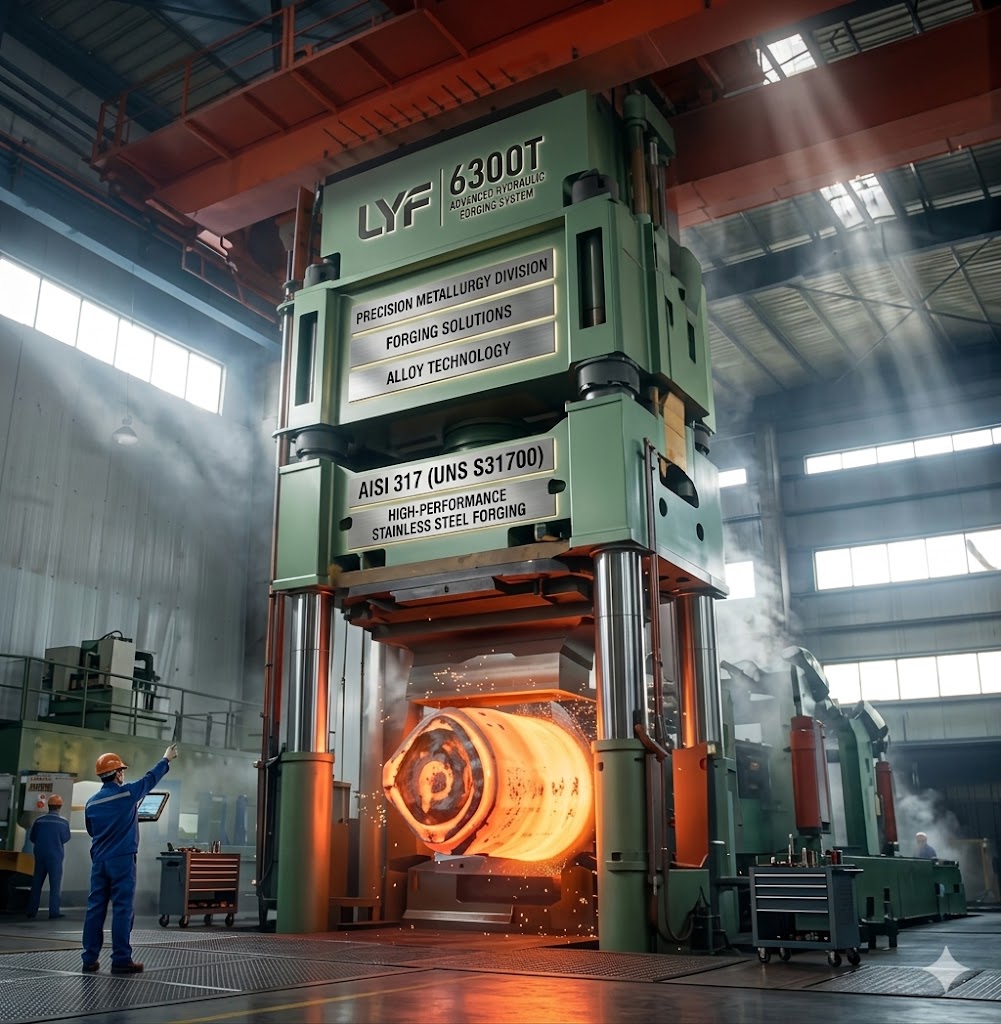
6300T Hydraulic Forging Press (left) and 5m Seamless Ring Rolling Mill (right) — Jiangsu Liangyi Manufacturing Facility, Jiangyin, Jiangsu, China. Both machines are equipped with optical pyrometer temperature monitoring for precise forging temperature control of AISI 317.
Manufacturing Process — AISI 317 Forgings Step by Step
The following describes Jiangsu Liangyi's standard manufacturing workflow for AISI 317 forged components. Each step is documented and traceable, forming the basis of the EN 10204 3.1 or 3.2 material test report issued with every shipment.
Raw Material Procurement & Incoming Chemical Verification
AISI 317 ingots, continuous cast billets or remelted ESR ingots are sourced from qualified steel mills with full heat number traceability. Every incoming heat undergoes OES (Optical Emission Spectrometry) verification of all 9 elements in the ASTM A182 chemistry table before release to production. Materials failing to meet our tighter internal specifications (e.g., S ≤ 0.005%, P ≤ 0.030%) are rejected regardless of mill certification.
Billet Preparation & Heating
Billets are cut to calculated weight for the specific forging, with a flash and trimming allowance. Heating is performed in gas-fired or electric walking-beam furnaces with temperature uniformity of ±15°C. AISI 317 is heated to an initial forging temperature of 1150–1260°C. Excessive heating above 1280°C risks incipient melting of low-melting-point segregates and must be avoided. Minimum finishing temperature is maintained above 950°C to prevent work hardening and cracking.
Hot Forging or Ring Rolling
For open die forgings: the heated billet is worked under our 2000T, 4000T or 6300T hydraulic presses using flat or shaped dies. The forging sequence is designed by our process engineers to achieve a minimum forge ratio of 3.5:1 with complete cross-section coverage, ensuring full breakdown of the as-cast dendrite structure and closure of any residual porosity. For seamless rings: the billet is first forged into a donut shape (pierced disc), then transferred to the ring rolling mill where the OD, ID, height and profile are rolled to near-net dimensions.
Solution Annealing Heat Treatment
All AISI 317 forgings are solution annealed in calibrated furnaces with temperature uniformity ±10°C (verified by calibrated thermocouples and independently checked by NIST/PTB-traceable reference instruments). Annealing temperature: 1040–1100°C. Soak time: minimum 1 hour per 25mm of section thickness, with a minimum total soak of 30 minutes. After the soak, forgings are withdrawn from the furnace and immediately water-quenched. Time between furnace withdrawal and entry into the quench tank is controlled to less than 60 seconds to prevent sensitization during cooling.
Rough Machining & Dimensional Layout
CNC turning, milling or boring to rough dimensions with agreed machining stock (typically 3–6mm per side) for customer's finish machining. Full 3D CMM dimensional inspection against customer drawings with formal reports. Tight tolerances to IT7/IT8 achievable in the machined condition.
Mechanical Testing
Test specimens are taken from a prolongation on the forging to represent the actual material condition. Standard tests: tensile (0.2% YS, UTS, elongation, reduction of area), Brinell hardness (multiple locations across the section face), and Charpy V-notch impact at –20°C or lower temperature if specified. All testing is performed in our in-house testing laboratory using calibrated and certified equipment traceable to national measurement standards.
Non-Destructive Testing (NDT)
Standard NDT package: UT (Ultrasonic Testing) per ASTM A388 / EN 10228-3 (straight beam and angle beam), PT (Liquid Penetrant Testing) per ASTM E165 / EN 10228-2 on all accessible machined surfaces. MT (Magnetic Particle Testing) and RT (Radiographic Testing) available on request. TOFD (Time of Flight Diffraction) and PAUT (Phased Array UT) available for critical components requiring volumetric flaw characterization.
Intergranular Corrosion Testing (IGC)
ASTM A262 Practice E (copper-copper sulfate-sulfuric acid test) is performed on all AISI 317 forgings as standard. This test verifies that the solution annealing heat treatment has been effective in dissolving chromium carbides and that the material is free from sensitization. Absence of "ditching" microstructure on metallographic examination confirms a satisfactory result.
Certification, Marking & Shipping
EN 10204 3.1 Mill Test Report (or 3.2 with third-party countersignature) is compiled, listing all chemical, mechanical, NDT and dimensional results with full heat and lot number traceability. Parts are marked by low-stress vibro-engraving (or paint marking for thin sections) with heat number, material designation, specification, heat treatment and our factory code. Preservation: VCI-film inner wrap, wooden crate outer packaging, with moisture-absorbing silica gel for sea freight. Sea freight (FCL or LCL), air freight and express courier all available.
Heat Treatment & Sensitization Control for AISI 317 Forgings
Heat treatment is arguably the most critical step in manufacturing corrosion-resistant AISI 317 components. An incorrectly performed heat treatment — even on a perfectly forged blank — can produce a part that fails prematurely in corrosive service. This section explains why, and what Jiangsu Liangyi does to prevent it.
The Sensitization Problem
When AISI 317 is exposed to temperatures in the range of 450–850°C — whether during insufficient heat treatment, slow cooling, or post-weld thermal cycles — chromium combines with carbon at grain boundaries to form chromium carbide precipitates (Cr₂₃C₆). This depletes the chromium concentration immediately adjacent to the grain boundary to below the 10.5% minimum needed for passivation, creating a band of chromium-depleted material that is highly susceptible to intergranular corrosion (IGC). In aggressive service environments, sensitized stainless steel can fail by intergranular corrosion or stress corrosion cracking in a fraction of the expected service life.
Solution annealing at 1040–1100°C dissolves these carbides and re-distributes chromium uniformly. The subsequent rapid water quench prevents re-precipitation. The ASTM A262 Practice E IGC test is the standard method to verify that annealing has been effective — a passing result confirms no sensitization is present.
Our Furnace Control Standards
All heat treatment furnaces at Jiangsu Liangyi are equipped with calibrated thermocouples traceable to national metrology standards, with furnace temperature uniformity verified and documented at regular intervals. Temperature uniformity of ±10°C is maintained throughout the working zone. Every heat treatment run is recorded with a time-temperature chart that is retained and made available as part of the traceability documentation package issued with each order.
Stress Relieving — When It Is and Is Not Appropriate
Unlike carbon steels, AISI 317 forgings generally do not require stress relief heat treatment after forging, because the residual stresses from forging are substantially reduced by the solution annealing treatment. Stress relief of austenitic stainless steels at temperatures below the solution anneal range (e.g., 550–650°C) is generally not recommended because it can cause sensitization. If a customer's specification requires post-fabrication stress relief (for example, after welding to reduce distortion), this should be discussed carefully, and the lower-carbon 317L grade should be substituted to minimize sensitization risk.
Welding Considerations for AISI 317 Forged Components
Most AISI 317 forged components (valve bodies, flanges, pressure vessel nozzles) are welded into assemblies during fabrication. Understanding the weldability characteristics of AISI 317 is essential for achieving weld joints that match the base metal's corrosion performance.
Recommended Filler Metals
For welding AISI 317 to itself (317-to-317 joints), the preferred filler metal is ER317L (AWS A5.9 classification) or equivalent electrode E317L per AWS A5.4. The low-carbon ER317L filler prevents sensitization in the weld deposit itself, even though the base metal is standard 317. For dissimilar metal welds (317 to 316, or 317 to carbon steel), consult AWS D1.6 (structural welding of stainless steel) and verify that the mixed weld deposit does not have a ferrite number (FN) below 3 — too-low ferrite increases susceptibility to hot cracking.
Preheating and Post-Weld Heat Treatment (PWHT)
AISI 317 does not require preheating under normal ambient conditions (above +5°C). Preheating can actually be counterproductive, as it increases the time the heat-affected zone (HAZ) spends in the sensitization temperature range. PWHT in the form of stress relief is not recommended for the same reason (see Section 11 above). The preferred approach for thick-section welds is to use a multi-pass welding technique with controlled interpass temperature (maximum 150°C) to limit HAZ time at elevated temperatures, and to perform a full solution annealing cycle on the welded assembly after fabrication if the geometry permits.
Post-Weld Cleaning and Passivation
Weld scale and heat tint on the surface of AISI 317 welds contain a chromium-depleted layer that significantly reduces corrosion resistance in the weld HAZ. Complete removal by mechanical grinding and/or acid pickling (typically a 15–20% HNO₃ + 2–5% HF mixture at 50–60°C) is required before the component is placed in corrosive service. After pickling, chemical passivation per ASTM A380 / A967 is recommended to restore and optimize the passive oxide film. Jiangsu Liangyi can supply forgings in either the as-forged, rough-machined, or fully passivated condition as required.
Surface Finishing Options for AISI 317 Forgings
The surface condition of a stainless steel forging affects both its corrosion initiation resistance and its aesthetic appearance. Jiangsu Liangyi offers the following surface finishing options:
| Finish Type | Method | Surface Roughness (Ra) | Application |
|---|---|---|---|
| As-Forged | None | 12–50 μm | For components with full machining allowance |
| Shot Blasted | Steel grit blasting | 3–10 μm | Removes scale; uniform dull matte finish. Standard for export forgings. |
| Rough Machined | CNC turning/milling | 3.2–6.3 μm (N8–N9) | Near-net shape with customer machining stock. Most common condition for supply. |
| Finish Machined | CNC precision machining | 0.8–1.6 μm (N6–N7) | Complete machining to customer drawing. Available for smaller components. |
| Chemical Pickling | HNO₃ + HF acid treatment per ASTM A380 | — | Removes all scale and restores corrosion resistance on machined or welded surfaces |
| Passivation | Citric acid or nitric acid per ASTM A967 | — | Optimizes passive oxide film; recommended for all corrosive service applications |
| Electropolishing | Electrochemical surface removal in acid electrolyte | 0.1–0.4 μm (N2–N4) | Ultra-smooth surface with enhanced corrosion resistance; used in pharmaceutical, food and semiconductor applications |
Industry Applications & Verified Project Cases
Oil & Gas — Upstream Wellhead & Completion Equipment
Saudi Arabia & UAE Onshore Oilfield Development — Wellhead Component Supply
Jiangsu Liangyi supplied AISI 317 forged wellhead flange bodies, tubing head forgings and casing hanger blanks for a large-scale onshore oil field development in the Arabian Peninsula. The production reservoir fluids contain H₂S concentrations up to 5,000 ppm and chloride concentrations above 100,000 ppm — conditions that eliminate standard AISI 316 as a viable material choice. All AISI 317 forgings were produced to API 6A specification with PSL-3 quality level, including 100% UT, witnessed mechanical testing and NACE MR0175 hardness verification. After more than 6 years of field service, no corrosion-related failures have been reported in the supplied components.
Gulf of Mexico Deepwater Platform — Valve Body & Seat Ring Forgings
For a deepwater subsea production system in the Gulf of Mexico, Jiangsu Liangyi supplied AISI 317 forged valve bodies (Class 1500, 8-inch bore) and valve seat ring forgings.The project required compliance with ASME BPVC Section VIII Division 2 and NACE MR0175 / ISO 15156-3, accompanied by EN 10204 3.2 certification witnessed by Bureau Veritas.
Operating under HPHT high-pressure high-temperature service conditions — 155°C and 1500 bar — together with high-salinity seawater injection service, AISI 317 was selected in preference to 316. Its outstanding pitting corrosion resistance and higher minimum yield strength deliver sufficient corrosion safety margin and reliable pressure bearing capacity to meet the strict operating demands.
Petrochemical & Chemical Processing — Europe
German Chemical Plant — Tube Sheet & Reactor Nozzle Forgings
A major German chemical company specified AISI 317 forged tube sheets (diameter 1,200 mm, thickness 180 mm, weight 3.2 tons each) for a phosphoric acid production heat exchanger. Phosphoric acid at elevated temperatures is highly aggressive to standard 316 stainless steel due to the combination of acidic pH and phosphate anions. The higher molybdenum content of AISI 317 was the decisive selection factor. All forgings were supplied to EN 10204 3.1 certification under PED 2014/68/EU Category III, with full chemical and mechanical traceability and TÜV Rheinland audit of our quality system.
Netherlands Sulfuric Acid Plant — Pump Body & Shaft Forgings
AISI 317 forged pump body forgings and shaft forgings supplied for a sulfuric acid concentration plant in the Netherlands. The service involves dilute to concentrated H₂SO₄ (10–96%) at temperatures up to 80°C. In this application, AISI 317's broad resistance to both dilute and concentrated sulfuric acid — derived from its high chromium and molybdenum contents — provided a single-material solution that simplified the plant's materials management and spare parts inventory. EN 10204 3.2 certification with SGS witness inspection was provided.
Power Generation — Southeast Asia
Indonesia 660MW Thermal Power Plant — Heat Exchanger Component Forgings
Jiangsu Liangyi supplied AISI 317 forged tube sheets, flange rings and nozzle forgings for heat exchangers in a 660MW coal-fired power plant in Indonesia. The plant's cooling water system draws from coastal seawater with high chloride content (approximately 19,000 ppm Cl⁻), making AISI 317 the minimum viable austenitic grade based on localized corrosion resistance calculations. The design engineering team selected AISI 317 over 316 based on a 20-year service life target, calculating that the improved pitting resistance of 317 (CPT approximately 10–15°C higher than 316) would reliably prevent pitting initiation at the expected seawater temperature range of 25–35°C.
Marine & Desalination
Middle East SWRO Desalination Plant — High-Pressure Pump Forgings
For a large-scale seawater reverse osmosis (SWRO) desalination plant in the Middle East, AISI 317 forged high-pressure pump housings, end plates and shaft forgings were supplied. The operating conditions — seawater at 70 bar, ambient temperature — represent one of the most demanding environments for austenitic stainless steels, because even small chloride pitting events in the thin-section pump components can lead to through-wall leakage. Our AISI 317 forgings were supplied with reduced sulfur content (≤0.003%) and 100% PT inspection on all internal surfaces, providing an additional margin of safety against pitting initiation.
Engineering Selection Guide — When to Specify AISI 317 Forgings
Based on 25+ years of supplying AISI 317 forgings to engineers worldwide, Jiangsu Liangyi's application engineering team has developed the following selection guidance. This is intended to help engineers make confident material selection decisions and avoid both under-specification (selecting 316 when 317 is needed) and over-specification (selecting expensive 904L or duplex when 317 is sufficient).
Specify AISI 317 When:
- Chloride concentration exceeds approximately 1,000 ppm at temperatures above 50°C (where 316 approaches its pitting limit)
- The component is a thick-section forging (wall thickness > 50mm) where the higher tensile and yield strength of 317 (vs 317L) provides a mechanical advantage in pressure rating calculations
- Service involves dilute to moderate sulfuric acid (10–60% H₂SO₄) or phosphoric acid environments where molybdenum content is the primary resistance factor
- The environment contains both H₂S and Cl⁻ (sour service), NACE MR0175 compliance is required, and the pressure or temperature conditions are too high for a carbon steel solution
- The component will not be extensively welded after supply (for welded assemblies, 317L is preferred)
- Operating temperature is between –196°C and 870°C (the full operating range of austenitic stainless steel — no ductile-to-brittle transition)
- A lifecycle cost analysis shows that the premium over 316 is recovered within 2–3 years through reduced maintenance and extended component service life
Consider Alternatives When:
- AISI 317L instead of 317 — if the forging will be welded in aggressive corrosive service and post-weld solution anneal is not possible
- Duplex 2205 (UNS S31803) instead of 317 — if the application involves high sustained tensile stress and temperatures above 60°C in high-chloride media (SCC risk is significantly lower for duplex than for austenitic grades at the same PREN)
- Alloy 904L (UNS N08904) instead of 317 — if chloride concentrations exceed 50,000 ppm at temperatures above 70°C, or if concentrated H₂SO₄ service is involved
- Duplex 2507 or Alloy 625 instead of 317 — for highly aggressive environments where PREN > 40 is required (deep offshore subsea production, high-temperature hypersaline brines)
⚙ A Common Engineering Mistake We See Frequently
Many engineers default to AISI 316 for all stainless steel forging applications due to familiarity, and only reconsider when a 316 component fails in service. In our experience, the most common failure mode is chloride pitting in thick-section valve body forgings or heat exchanger tube sheets in coastal or offshore environments. A direct substitution of 316 with 317 — using the same drawing, same heat treatment, same inspection — typically eliminates the failure mode at a cost premium of 20–30% on the forging price, which is trivial compared to the cost of a field replacement including lost production time and emergency logistics. We encourage engineers to challenge AISI 316 specifications whenever the chloride content of the process or utility fluid is above 500 ppm and the operating temperature is above 40°C.
Applicable International Standards & Our Factory Certification
Note: Jiangsu Liangyi Co., Limited holds ISO 9001:2015 factory certification. The standards listed below are the technical specifications our products are manufactured to meet on a per-order basis. Holding ISO 9001 does not automatically confer API Monogram, PED CE marking or other end-use regulatory certifications — these depend on the specific order requirements and third-party inspection arrangements agreed with each customer.
North America — Applicable Standards
- ASTM A182 — Forged or rolled alloy and stainless steel flanges, fittings and valves
- ASTM A276 / A479 — Stainless steel bars and shapes / wire
- ASTM A336 — Alloy steel forgings for pressure vessel components
- ASTM A262 — Practice E intergranular corrosion test
- API 6A / 6D — Technical requirements for wellhead and pipeline valve components (customer-specified; witness inspection arranged by customer)
- NACE MR0175 / ISO 15156 — Material requirements for sour service (hardness limits verified per order)
- ASME BPVC Section II Part A — Ferrous material specifications
- ASME B16.5 / B16.47 — Pipe flanges and flanged fittings
European Union — Applicable Standards
- EN 10204 3.1 — Mill inspection certificate issued by manufacturer (standard with every order)
- EN 10204 3.2 — Third-party countersigned certificate (available when customer arranges a nominated inspector: TÜV, SGS, BV, Lloyd's)
- PED 2014/68/EU — Pressure Equipment Directive technical requirements (applicable when customer's Notified Body is involved in the inspection)
- EN 10250-4 — Open die steel forgings — stainless steel
- EN 1092-1 — Flanges and their joints (PN2.5 to PN400)
- DIN 17440 — Stainless steel bars, hot rolled / forged
- AD 2000 Merkblatt W0 — German pressure vessel code (on request)
Asia & Global — Factory Certification & Standards
- ISO 9001:2015 — Quality management system — factory certified (our only factory-level certification)
- JIS G4303 / G4304 — Japanese stainless steel bars and plate (SUS 317)
- GB/T 1220 — China stainless steel bars
- GB/T 150 — China pressure vessels
- GOST 5632 — Russian stainless steel (on request)
- Third-party inspectors available for customer arrangement: TÜV Rheinland, TÜV SÜD, SGS, Bureau Veritas, Lloyd's Register, Intertek, DNV GL
Quality Control & Inspection — Our Full Procedure
Every AISI 317 forging produced by Jiangsu Liangyi passes through a documented, sequential quality control program. No step is optional or skippable — all results are recorded in our traceability system and compiled into the final Material Test Report before shipment is authorized.
- Incoming material OES verification — Full 9-element chemical analysis on every heat before production. Materials outside our internal composition window are quarantined and rejected.
- Forging process record — Furnace temperature chart, press tonnage record, forge ratio calculation and finish temperature pyrometer log retained for each forging lot.
- Heat treatment record — Furnace calibration certificate, time-temperature anneal chart and quench record for each anneal batch.
- Mechanical testing — Tensile, 0.2% YS, elongation, reduction of area, Brinell hardness (minimum 3 points per piece), Charpy impact (if specified), all from a prolongation on the forging.
- Chemical re-verification — OES re-check of finished forging surface chemistry to confirm no contamination during processing.
- Non-destructive testing — UT per ASTM A388 (straight beam, 100% of volume) and PT per ASTM E165 (all accessible machined surfaces) as standard. MT, RT, TOFD or PAUT on customer request.
- Intergranular corrosion test — ASTM A262 Practice E on solution-annealed coupons from the heat treatment batch. Pass criterion: no ditching microstructure visible at 100× magnification after 24-hour immersion.
- 3D CMM dimensional inspection — Full dimensional report against customer drawing with GD&T callouts verified on calibrated CMM. Report issued before release.
- Hardness survey (NACE compliance) — For API 6A and NACE MR0175 parts: Rockwell hardness conversion verified at maximum HRC 22 (237 HBW) on a minimum of 3 points per component at the accessible inspection surface.
- Final documentation review & MTR issue — Quality Engineer reviews all test data against purchase order requirements before issuing the EN 10204 3.1 (or 3.2) Material Test Report. No shipment is authorized without a signed and dated MTR.
Lifecycle Cost Analysis — AISI 317 vs AISI 316 Forgings
A common objection to specifying AISI 317 over AISI 316 is the higher initial material cost — typically 20–30% on the forging price. However, a lifecycle cost analysis almost always reverses this conclusion when the full cost of ownership is considered. The following framework is based on real scenarios we have discussed with our customers over 25+ years:
Components of Lifecycle Cost for Pressure Forgings in Corrosive Service
- Initial purchase price: AISI 317 forging costs approximately 20–30% more than an equivalent AISI 316 forging due to higher molybdenum content in the raw material. For a typical valve body forging costing USD 5,000 in 316, the 317 equivalent would be approximately USD 6,000–6,500.
- Service life in chloride service: Field data and accelerated corrosion testing consistently show that AISI 317 components outlast AISI 316 by a factor of 2–4× in moderate chloride service environments (500–5,000 ppm Cl⁻, 50–120°C). A component with a 5-year service life in 316 may achieve 10–15 years in 317 under the same conditions.
- Replacement cost: In most process plant and offshore environments, the direct cost of a replacement forging (the hardware cost) represents only 15–30% of the total replacement cost. Labor, plant shutdown time, production loss, crane operations, inspection, hydrotest and documentation typically represent 70–85% of the total. A single avoided replacement cycle therefore saves 3–6× the original purchase price differential.
- Inspection and maintenance cost: Pitting corrosion in AISI 316 components in moderate chloride service often requires monitoring inspection every 1–2 years. AISI 317 components in the same service typically extend inspection intervals to 3–5 years, reducing inspection program costs over the plant lifecycle.
- Total Cost of Ownership (10-year example): For a hypothetical flanged valve body in 5,000 ppm Cl⁻ service at 80°C, a 316 component requiring 2 replacements over 10 years would incur a 10-year cost of approximately 1× (initial) + 2× (replacements including shutdown costs) = 3× the original purchase price. A single 317 component lasting the full 10 years incurs 1.25× the original purchase price, with zero replacement shutdowns. The 10-year saving is approximately 1.75× the original 316 purchase price — far exceeding the initial 25% premium.
⚙ Our Recommendation to Procurement Teams
We encourage procurement engineers reviewing AISI 316 vs 317 decisions to request a 3–5 year maintenance history of the 316 components currently in service before making a sole-source decision on price. In our experience, when maintenance history is examined, the decision to upgrade to 317 virtually always produces a positive business case. We are happy to support this analysis with corrosion engineering calculations and material data on request.
Frequently Asked Questions About AISI 317 Forgings
AISI 317 is an austenitic stainless steel standardized by ASTM International. Its UNS (Unified Numbering System) designation is S31700 — the "S" prefix identifies it as a stainless steel, "317" is the AISI grade number, and "00" indicates the base (non-low-carbon) version. The equivalent European designation is EN 1.4449 (DIN X5CrNiMo17-13-4). In Japan, it is standardized as SUS 317 under JIS G4303. All four designations refer to the same nominal composition: 18–20% Cr, 11–15% Ni, 3–4% Mo, C ≤ 0.08%.
The difference is mainly the molybdenum content. AISI 317 has 3.00-4.00% Mo and AISI 316 has 2.00-3.00% Mo. This means that the Critical Pitting Temperature is about 10–15°C higher in standard ferric chloride testing. This makes PREN of 317 about 4–6 points higher than 316. Practically speaking, AISI 317 is resistant to pitting in chloride environments where 316 would pit. AISI 317 also has a higher minimum tensile strength (620 MPa vs 515 MPa), meaning the same pressure rating can be achieved with a lighter, thinner piece.
Of course, the value of the upgrade depends on the service environment. 316 is sufficient in most cases where chloride concentration is below 200 ppm and temperature is below 40°C. At temperatures greater than 50°C and above 1,000 ppm chloride, AISI 317 is highly recommended. The cost premium of AISI 317 generally pays for itself in reduced maintenance in 2-3 years.
The only difference is carbon content: AISI 317 allows up to 0.08% C, while AISI 317L (UNS S31703) is limited to 0.03% C. The low-carbon 317L was developed to solve the sensitization problem in welded assemblies. When 317 is heated to 450–850°C (as occurs in the heat-affected zone of a weld), chromium carbides precipitate at grain boundaries, depleting chromium locally and creating intergranular corrosion sensitivity. In 317L, the carbon content is so low that insufficient carbon is available to form significant carbide amounts, so the sensitization effect is negligible.
Specify AISI 317 when: the component will not be welded after supply, or where the higher minimum tensile strength (620 MPa vs 515 MPa for 317L) provides a pressure rating or weight advantage. Specify AISI 317L when: the component will be welded and a post-weld solution anneal is not feasible, or when the service environment is so aggressive that even minor sensitization in the weld HAZ could cause premature failure.
Forged AISI 317 components offer three principal advantages over bar-machined parts: (1) Grain flow alignment — forging allows grain flow to be oriented in the direction of principal stress, increasing fatigue life and toughness. Bar stock has a unidirectional grain flow that may be unfavorable in cross-section components like flanges and rings. (2) Section integrity — forging's multi-directional working eliminates the remnant dendritic porosity and segregation that can persist in large-diameter bar stock, particularly at centerline. This is important for pressure-containing components with thick walls. (3) Material efficiency — for complex shapes, forging to near-net shape needs significantly less machining than starting from solid bar, reducing material waste, machining time and lead time. For pressure-critical components in oil & gas service, API 6A and ASME codes mandate forgings, not bar-machined parts, for good engineering reasons.
Yes. AISI 317 (UNS S31700) is listed as an acceptable material for sour service (H₂S-containing environments) in NACE MR0175 / ISO 15156-3, Table A.3, subject to the hardness limitation of HRC 22 maximum (equivalent to 237 HBW or 253 HV). Our solution-annealed AISI 317 forgings consistently get hardness values of 150–190 HBW — well below the NACE material hardness limit. We can provide hardness test records and a material conformance statement for NACE MR0175 material requirements with every applicable shipment. For orders where API specification compliance is needed, third-party witness inspection can be arranged through the customer's nominated inspector.
Our maximum production capabilities for AISI 317 forgings: Single piece weight up to 30 tons Seamless rolled ring outer diameter up to 6,000 mm Forged bar or shaft diameter up to 2,000 mm Disc or plate thickness up to 800 mm Cylinder outer diameter up to 2,500 mm. We have produced AISI 317 seamless ring forgings for pressure vessel shell course applications measuring 4,800 mm OD x 4,200 mm ID x 600 mm height. Please provide detail drawings for an assessment for components at or near these maximum sizes. Thermal management of very large AISI 317 sections require extra process planning.
Normal production delivery time takes 3 to 4 weeks after order and drawing are confirmed. We can also finish urgent orders in 2 weeks if our production schedule allows. The whole process includes buying and checking raw materials in 3 to 5 working days, forging and natural cooling in 1 to 2 days, solution annealing heat treatment and quenching in 1 to 2 days, basic machining work taking 2 to 5 days based on how complex the part is, mechanical, chemical and IGC tests in 3 to 4 days including lab test time, NDT check in 1 to 2 days, size checking and document making in 1 to 2 days, plus export packing and shipping arrangement in 1 to 2 days. For API 6A parts that need on-site check by a third-party inspector chosen by the customer, another 3 to 5 working days will be needed to arrange the inspector and inspection time.
Yes — all our AISI 317 forgings are produced to customer-supplied drawings and specifications. We do not stock standard parts; every component is custom manufactured. We accept drawings in PDF, DWG, DXF, STEP (AP203 and AP214), IGES, Parasolid and SolidWorks native formats. Our engineering team can also generate 3D models from 2D PDF drawings if required for forging process planning. We review drawings for forgeability, tolerancing, and heat treatment access before confirming the quotation, and we flag any concerns (e.g., section changes that may create stress concentration in the forging, or tolerances that need finish machining after heat treatment) before production commences.
The intergranular corrosion (IGC) test — most commonly ASTM A262 Practice E (the Strauss Test, using copper-copper sulfate-sulfuric acid solution) — is a quality verification test that confirms the solution annealing heat treatment has been effective. The test exposes a polished specimen to the boiling copper sulfate-sulfuric acid solution for 24 hours, then bends the specimen and examines the surface at 100× magnification. A passing result ("no ditching") confirms that chromium carbides have been fully dissolved by the anneal and that the alloy is free from sensitization. A failing result ("ditching") indicates sensitization and a need to re-anneal the affected heat. At Jiangsu Liangyi, we perform ASTM A262 Practice E on every batch of AISI 317 forgings as a standard test, not an optional one — and we consider it one of the most important tests in our quality program because it directly verifies the corrosion performance that our customers are relying on in service.
Standard supply condition is shot-blasted and rough-machined with a machining allowance of 3–6mm per side. This allows customers to perform final machining to their exact tolerances in their local machine shop. We also offer finish machining to customer drawing dimensions, including turning, milling, boring, drilling, threading and grinding, for customers who prefer a ready-to-use component. Chemical pickling (ASTM A380) and passivation (ASTM A967) can be applied as a surface treatment. For pharmaceutical, food-grade or semiconductor applications, electropolishing to Ra ≤ 0.4 μm is available. Please specify the required supply condition in your enquiry or purchase order.
Contact Jiangsu Liangyi — AISI 317 Custom Forging Quotation
Jiangsu Liangyi Co., Limited is your trusted manufacturer of forged steel AISI 317 (UNS S31700) parts. Our application engineering team will review your drawings, advise on material specifications and provide formal quotations within 24 hours of receipt of full documentation. We are pleased to be approached by engineering teams, procurement, EPC contractors and trading companies from all over the world.
To obtain a quotation, please provide: your engineering drawing or sketch, the applicable material standard and specification, required quantity and delivery timeline, desired supply condition (as-forged, rough-machined or finish-machined), certification requirements (EN 10204 3.1 or 3.2, API, NACE, PED, etc.) and the name of any third-party inspection body.