AISI 316Ti (UNS S31635 / Grade 316Ti / SUS 316Ti / TP 316Ti) Forging Parts | China Professional Manufacturer
Product Overview & Material Introduction
Jiangsu Liangyi Co., Limited (est. 1997) is a professional ISO 9001:2015 certified China manufacturer of AISI 316Ti (UNS S31635, Grade 316Ti, SUS 316Ti, TP 316Ti) open die forging parts and seamless rolled steel forged rings. Our factory covers 80,000㎡ with 40 million USD fixed assets and an annual manufacturing capacity of 120,000 tons, supplying custom AISI 316Ti forged pars to customers in more than 50 countries across Europe, North America, the Middle East, Asia Pacific, and Oceania, fully meeting international standards including ASTM, AISI, DIN, EN, JIS, and API.
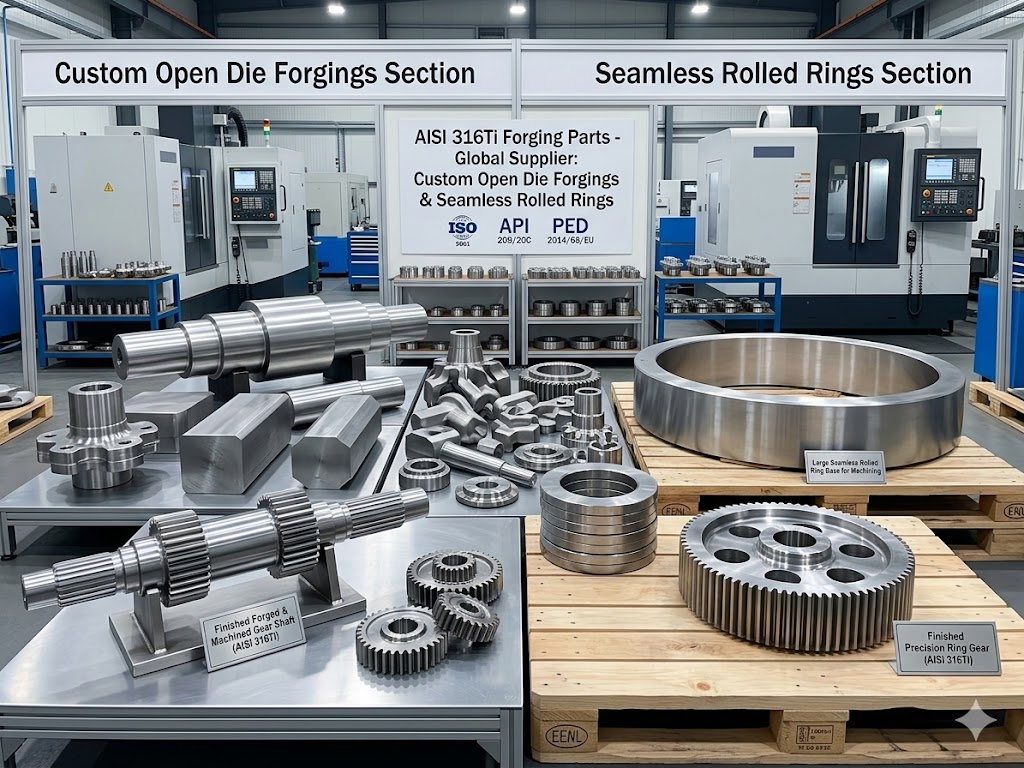
AISI 316Ti is a titanium-stabilized austenitic 316 stainless steel, it has great high-temperature endurance and intergranular corrosion resistance compared to standard 316 and 316L grade steel. The controlled titanium addition (5×C% ~ 0.70%) effectively binds with carbon in the alloy, preventing chromium carbide precipitation at grain boundaries during welding and long-term high-temperature operation. This unique stabilization deletes intergranular corrosion (IC) risk, while also improving the material’s mechanical strength and creep resistance for heavy-duty industrial forging applications.
Core Competitive Advantage of AISI 316Ti Forgings
- Great resistance to intergranular corrosion after welding, no post-weld heat treatment required for most applications
- Excellent high-temperature strength and oxidation resistance, stable performance in continuous operating temperatures up to 800°C
- Outstanding chloride and acid corrosion resistance, suitable for harsh marine, chemical and offshore environments
- Excellent formability and weldability, fully customizable for forging geometries per client drawings
Get a Free Custom Quote Now
Reference Price:
From
USD
2 / kg
· Minimum Order: 30 kg · Request exact quote →
AISI 316Ti vs Standard 316 / 316L: Forging Grade Comparison
Understanding the main differences between 316Ti and common 316 grades is important for industrial forging material selection. Following is a detailed comparison for heavy-duty forging applications:
| Performance Parameter | AISI 316Ti Forging Grade | Standard AISI 316 | AISI 316L |
|---|
| Carbon Content | ≤ 0.08% (Titanium Stabilized) | ≤ 0.08% | ≤ 0.03% (Low Carbon) |
| Intergranular Corrosion Resistance | Excellent (no risk after welding) | Poor (risk in welded joints) | Good (limited high-temperature resistance) |
| High-Temperature Creep Strength | Superior (best for 425-800°C operation) | Moderate | Poor (not recommended for >450°C) |
| Weldability for Large Forgings | Excellent (no post-weld heat treatment needed) | Limited (requires post-weld annealing) | Good (low strength at high temperatures) |
| Key Forging Application | High-temperature welded assemblies, nuclear power, petrochemical valves, heat exchangers | General low-temperature corrosion resistance applications | Non-welded or low-temperature thin-walled components |
AISI 316Ti Global Grade Equivalence: Procurement-Ready Cross-Reference
Procurement engineers and materials specifiers across different regions refer to the same titanium-stabilized molybdenum austenitic grade under different national designations. The table below is built directly from our factory's multi-standard order processing experience — we receive drawings calling out any of these designations interchangeably, and our technical team validates full chemical equivalence before production commences:
| Standards Body | Grade / UNS Designation | Full Chemical Name | Primary Standard | Target Market |
|---|
| AISI / ASTM (USA) | 316Ti / TP 316Ti | — | ASTM A182 / A276 / A479 | North America, Global |
| UNS (USA) | S31635 | — | SAE / ASTM DS-56 | North America, Global |
| EN / DIN (Europe) | 1.4571 | X6CrNiMoTi17-12-2 | EN 10088-3 / EN 10228-3 | Europe, Germany, EEA |
| JIS (Japan) | SUS 316Ti | — | JIS G4303 / G4318 | Japan, Asia Pacific |
| GB / YB (China) | S31635 | 0Cr18Ni12Mo2Ti | GB/T 4237 / GB/T 1220 | China, Chinese-spec projects |
| BS (United Kingdom) | 320S31 | — | BS 970 Part 1 | United Kingdom, Commonwealth |
| AFNOR (France) | Z6CNDT17-12 | — | NF A35-572 | France, Francophone regions |
| GOST (Russia / CIS) | 10Х17Н13М2Т | — | GOST 5632 | Russia, CIS countries |
| IS (India) | 04Cr17Ni12Mo2Ti | — | IS 6911 | India, South Asia |
Ordering Note from Our Factory: You may submit drawings or purchase orders specifying any of the above designations. Our documentation team will cross-reference chemistry, issue a compliance statement on the mill test certificate matching your needed standard, and flag any minor compositional differences between standards for your engineering review — a routine service we provide at no additional charge.
Explore All Stainless Steel Forging Grades
Custom AISI 316Ti Forged Product Range & Manufacturing Capabilities
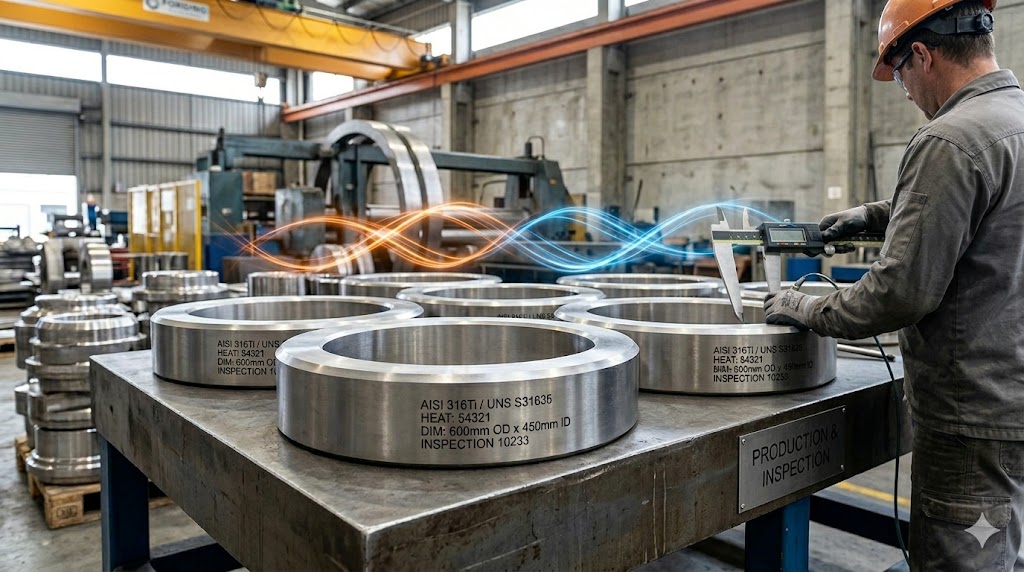
We make full range of custom AISI 316Ti forged steel products in all kinds of shapes and dimensions, with full in-house production from steel melting, open die forging, seamless ring rolling, heat treatment to CNC machining. Our manufacturing capabilities for AISI 316Ti forging parts include:
Core Forged Product Shapes & Specifications
- Forged Bars & Rods: AISI 316Ti round bars, square bars, flat bars, rectangular bars, and step/gear/crank shafts, the max diameter is up to 2 meters, max weight up to 30 tons
- Seamless Rolled Rings: Custom UNS S31635 seamless rolled rings, gear rings, and contoured forged rings, the max diameter is up to 6 meters, max weight up to 30 tons, they all meet EN 10228-3 for European markets
- Hollow Forgings: Grade 316Ti hubs, housings, shells, sleeves, bushes, hollow bars, seamless pipes, and tubing for pressure vessel and pipeline applications
- Discs & Plates: SUS 316Ti forged discs, disks, blocks, and plates for valve, pump and heat exchanger applications, they are fully machined based on client drawing specifications
- Custom Forged Components: Fully bespoke TP 316Ti forged parts are made based on client drawings and technical requirements, with customed geometries and tight tolerance machining
AISI 316Ti Exclusive Forging & Heat Treatment Expertise
As a specialist in stainless steel forging with over 25 years of experience, we have developed exclusive process controls for AISI 316Ti material to make sure all parts have great performance:
- Control forging temperature strictly (1150-1200°C) to avoid grain growth and maintain titanium carbide stabilization
- Multi-directional open die forging to get 100% internal density, delete porosity, and meet ultrasonic testing requirements
- Solution annealing treatment (1010-1100°C)is followed by rapid quenching, to maximize corrosion resistance and mechanical strength
- Provide full traceability for every forging, from raw material melting to finished machining, with complete heat treatment cycle records
View Our Advanced Forging & Inspection Equipment
Chemical Composition & Mechanical Properties of AISI 316Ti Forged Steel
All our AISI 316Ti (UNS S31635, DIN 1.4571) forged steels strictly meet international ASTM A182, EN 10088-3, and JIS G4303 standards, with strict element control to make sure they have consistent material performance for industrial forging applications.
Standard Chemical Composition
| Element | Standard Content Range | Our Mill Control Range |
|---|
| Carbon (C) | ≤ 0.08% | ≤ 0.07% |
| Silicon (Si) | ≤ 1.00% | ≤ 0.75% |
| Manganese (Mn) | ≤ 2.00% | ≤ 1.75% |
| Phosphorus (P) | ≤ 0.045% | ≤ 0.035% |
| Sulfur (S) | ≤ 0.030% | ≤ 0.020% |
| Chromium (Cr) | 16.50% - 18.50% | 17.00% - 18.00% |
| Molybdenum (Mo) | 2.00% - 2.50% | 2.10% - 2.40% |
| Nickel (Ni) | 10.50% - 13.50% | 11.00% - 13.00% |
| Titanium (Ti) | 5×C% ~ 0.70% | 6×C% ~ 0.60% |
| Iron (Fe) | Balance | Balance |
Room Temperature Mechanical Properties (Solution Annealed)
| Property | Standard Requirement | Our Typical Test Result |
|---|
| Tensile Strength | ≥ 485 MPa | 520 - 580 MPa |
| Yield Strength (0.2% Offset) | ≥ 170 MPa | 200 - 240 MPa |
| Elongation | ≥ 40% | 45% - 55% |
| Hardness | ≤ 217 HB | 170 - 200 HB |
| Charpy Impact Energy (-20°C) | ≥ 40 J | ≥ 60 J |
Elevated Temperature Mechanical Properties — Actual Production Batch Results
The following data is drawn from our production batch test records on AISI 316Ti forgings made and solution-annealed at our Jiangyin facility. Unlike published minimum standard values, these are real tested results from customer shipments, giving you a more accurate design basis than datasheet minimums. The titanium stabilization provides a measurable creep-strength advantage over standard 316 and 316L at every elevated temperature point:
| Test Temp. | Tensile Strength (MPa) | 0.2% Yield Strength (MPa) | Elongation (%) | vs. 316L at Same Temp. |
|---|
| 20°C (reference) | 520 – 580 | 200 – 240 | 45% – 55% | Baseline |
| 200°C | 430 – 470 | 155 – 185 | 40% – 50% | +8% tensile advantage |
| 300°C | 390 – 430 | 135 – 165 | 38% – 48% | +15% tensile advantage |
| 400°C | 355 – 395 | 120 – 150 | 35% – 45% | +22% tensile advantage |
| 500°C | 310 – 350 | 108 – 135 | 33% – 42% | +31% tensile advantage |
| 600°C | 255 – 295 | 95 – 120 | 30% – 38% | +40% tensile advantage |
| 700°C | 165 – 200 | 82 – 105 | 28% – 35% | +52% tensile advantage |
Data source: Jiangsu Liangyi internal production batch test records. Values represent normal range across multiple production lots and forging sizes. Please get in touch with our technical team to get real test certificates from recent production batches that are relevant to the wall thickness and weight class of your project.
Physical & Thermal Properties of AISI 316Ti (UNS S31635) Forgings
These constants are essential for thermal stress calculations, FEA modeling, heat exchanger design, and pressure vessel wall-thickness analysis. Our forged AISI 316Ti parts are made to preserve these material characteristics through forging temperature control and solution annealing:
| Physical Property | Value | Unit | Condition |
|---|
| Density | 8.0 | g/cm³ | Room temperature, solution annealed |
| Melting Range | 1390 – 1440 | °C | — |
| Specific Heat Capacity | 500 | J/(kg·K) | 0 – 100°C average |
| Thermal Conductivity | 14.6 / 16.2 / 18.9 | W/(m·K) | At 100°C / 300°C / 500°C |
| Linear Thermal Expansion | 16.0 / 17.0 / 18.0 | ×10⁻⁶/°C | 20–100°C / 20–300°C / 20–500°C |
| Electrical Resistivity | 0.74 | μΩ·m | 20°C |
| Modulus of Elasticity (E) | 193 | GPa | 20°C |
| Shear Modulus (G) | 77 | GPa | 20°C |
| Poisson's Ratio (ν) | 0.28 – 0.30 | — | 20°C |
| Magnetic Permeability | ≤ 1.02 | μᵣ | Non-magnetic, solution annealed state |
Corrosion Resistance Profile: PREN, Sensitization Immunity & Chemical Media
AISI 316Ti achieves its corrosion resistance through two combined effects that cannot be matched by adding only one element. Its molybdenum content of 2.0–2.5% improves resistance to pitting and crevice corrosion at the electrochemical level, while titanium stabilization deletes the sensitization temperature range of 425–815°C, which makes standard 316 less reliable in welded or thermally cycled components.
Pitting Resistance Equivalent Number (PREN) — Our Mill Heat Analysis Range
PREN is calculated as: %Cr + 3.3×%Mo + 16×%N
According to our factory heat analysis for AISI 316Ti forgings produced under our strict chemical composition control, the PREN = 24.5 – 27.2
This puts our AISI 316Ti forgings above the commonly accepted seawater corrosion threshold of PREN ≥ 24, proving they are suitable for marine, offshore and coastal industrial environments where standard 304/304L grades often fail within months. Please note that PREN alone does not reflect the benefit of titanium stabilization — the main advantage of 316Ti is still its resistance to intergranular corrosion in welded and thermally cycled conditions.
Intergranular Corrosion Performance (ASTM A262 Practice E — Strauss Test)
All A produced zero intergranular attack in the Strauss boiling copper sulfate / sulfuric acid test.
All of our AISI 316Ti forgings used in pressure vessels or chemical processing can be tested according to ASTM A262 Practice E at the customer’s request.
In our more than 25 years of quality control records, our properly solution‑annealed 316Ti forgings have never shown any intergranular attack in the Strauss test, which uses boiling copper sulfate and sulfuric acid.This result cannot be achieved with standard 316 at any wall thickness over 3mm. It is also not reliably got with 316L in forgings with section thickness over 50mm, due to carbon segregation that occurs when thicker sections solidify.
Chemical Media Resistance Guide
| Chemical Media | Rating | Operating Limits | Application Note |
|---|
| Phosphoric Acid (H₃PO₄) | Excellent | Up to 85% concentration, ≤ 60°C | Standard grade for phosphoric acid service; Mo content is critical |
| Sulfuric Acid (H₂SO₄) — dilute | Good | <10% concentration, room temperature | Concentrated H₂SO₄ needs higher-alloy grades (e.g. 317L or alloy 20) |
| Nitric Acid (HNO₃) | Excellent | Up to 65% concentration, ≤ 80°C | 316Ti and 304 equivalent at this service; 316Ti preferred for welded assemblies |
| Acetic Acid (CH₃COOH) | Excellent | All concentrations, up to boiling | Industry-standard grade for acetic acid processing equipment |
| NaCl / Seawater (chlorides) | Good | ≤ 3% NaCl, below 60°C; PREN ≥ 24 applies | For concentrated chloride above 60°C, consider Duplex 2205 or Super Duplex |
| Caustic Soda (NaOH) | Excellent | All concentrations, up to 100°C | Suitable for caustic scrubber vessels and heat exchangers |
| H₂S / Sour Gas | Good (qualified) | Per NACE MR0175 / ISO 15156 limits | Qualified for sour service when hardness ≤ 22 HRC; verify per NACE table |
Global Industrial Applications — AISI 316Ti Forging Capability by Sector
AISI 316Ti (UNS S31635) forged parts are used in six major industrial sectors. These sectors need three key features together: titanium stabilization, better corrosion resistance from molybdenum, and strong mechanical performance from open-die forging. The parts below explain the specific types of parts, applicable standards, and technical requirements that our factory can meet in each sector.
Oil & Gas Industry — Onshore & Offshore Applications
For upstream and midstream oil and gas operations, our AISI 316Ti forged parts are made to meet the requirements of API 6A specification and the material selection criteria of NACE MR0175 / ISO 15156 for sour service containing H₂S and CO₂. The parts we produce for this sector include: Christmas tree wellhead bodies, casing heads, tubing spools, casing hangers, valve bodies, valve balls, stems, seat rings, drive shafts for downhole drilling tools, and shafts and housing parts for electrical submersible pumps (ESP). We can provide anything from single pieces to large blanket orders of thousands of pieces, and every piece has complete raw material traceability—from the ingot heat number to the final machined dimensions.
Power Generation & High-Integrity Process Industry
For power generation and high-reliability process applications that need ASME-grade material documentation, we produce reactor coolant pump casings, seal chambers, pressure vessel nozzle forgings, heat exchanger tube sheets, and supporting structural parts. Third-party inspection is arranged through the inspector nominated by the customer. For customers who need ASTM A262 Practice E intergranular corrosion testing, we cut test samples directly from the production forging (instead of using separately processed companion bars). This is a standard order option, including the thermal mass compensation needed to get valid test results for heavy-section forgings with a wall thickness of over 100mm.
Valve Manufacturing & Petrochemical Industry — European Market
We supply forged valve parts (valve bodies, bonnets, stems, spindles, seat rings, and discs) to valve OEMs and EPC contractors across Europe. All these parts are made in line with EN 10228-3, and come with EN 10204 3.1 or 3.2 mill test certificates. The types of valves we support include ball valves, gate valves, globe valves, check valves, butterfly valves, cryogenic valves (ranging from DN15 to DN600), and back-pressure regulators. If you need an assessment to decide whether DIN 1.4571 or AISI 316L is more suitable for your specific welded valve design (to check if a material upgrade is necessary), our engineering team will provide a written evaluation—covering the risk of sensitization, requirements for post-weld heat treatment (PWHT), and the impact on long-term costs—free of charge as part of the quotation process.
Chemical Processing & Heat Exchange — North American Market
For ASME BPVC Section VIII heat exchanger and pressure vessel applications, we produce tube sheets, baffle plates, channel flanges, shell forgings, boiler parts and pressure vessel nozzles made of AISI 316Ti. Our forging process uses a minimum 4:1 reduction ratio for all disc and plate forgings that need UT inspection (per ASME SA-388). This 4:1 reduction ratio eliminates the mid-radius segregation zone — the main cause of UT test failures in large-diameter austenitic stainless steel forgings. For orders with more than 100 pieces, we provide pre-production trial forgings and UT acceptance tests on representative pieces before full-scale production. This helps avoid the risk of first-article rejection during your receiving inspection.
Industrial Pump, Flow Measurement & Fluid Control
For pump OEMs, mining equipment manufacturers, and fluid control system builders, we produce pump casings, covers, impellers, shafts, wear rings, barrel housings, and bearing housings using AISI 316Ti open-die forging. We also make flow measurement parts, including venturi cone meter bodies, ultrasonic flow meter spool bodies, and double studded adapter (DSA) flanges. Compared with machining from bar stock or using castings, open-die forging ensures better grain flow alignment. This is especially important for rotating parts like impellers and shafts, because the grain flow direction is parallel to the stress axis, which directly slows down the rate of fatigue crack growth during cyclic loading.
Turbomachinery & Marine Engineering — Global Supply
We manufacture AISI 316Ti forged parts for turbomachinery, including marine propeller shafts, rudder stocks, seawater pump shafts, and custom forgings tailored to shipbuilding projects. Our products also include turbo centrifugal compressor impellers, shrouded impellers, turbine disc blanks, and other related parts. For all marine-related forged parts, we provide full material document to meet the requirements of major classification societies, such as DNV, Lloyd's Register, Bureau Veritas, ABS, and RINA. The specific material grade, test method, and documentation package for these parts are determined by the classification society's rules corresponding to the vessel type and part location.
View Completed Project References
AISI 316Ti Welding Guide for Heavy-Section Forged Components
One of the mian engineering advantages of AISI 316Ti over standard 316 stainless steel is how it performs in heavy-section welded assemblies. Thanks to titanium stabilization, post-weld heat treatment (PWHT) is not needed for most process industry applications — this saves a lot of cost and time for large-scale projects, such as large-diameter pressure vessels, heat exchanger shells, and pipeline valve assemblies. The guide below is based on the practical experience our factory’s engineering team has gained from thousands of welded AISI 316Ti forging assemblies for customers around the world.
Recommended Filler Materials by Application Scenario
Choosing the right filler for AISI 316Ti welded forging assemblies isn’t a one-size-fits-all task. The best choice depends on three key factors: service temperature, corrosion environment, and regulatory codes.
| Application Scenario | Recommended Filler | AWS Classification | Engineering Rationale |
|---|
| General fabrication, ambient to 450°C service | ER316L / E316L-16 | AWS A5.9 / A5.4 | Low carbon limits weld-zone sensitization; widely stocked globally; cost-effective for non-critical service |
| Critical high-temperature service (>450°C sustained) | ER318 (Ti-stabilized) | AWS A5.9 | Titanium-stabilized filler mirrors base metal stabilization mechanism; maintains grain-boundary integrity through thermal cycling; our factory engineering team's preferred choice for petrochemical and nuclear applications |
| Cryogenic service (below −100°C) | ER316L + verified impact tested | AWS A5.9 | Low carbon with high Ni balance preserves toughness at sub-zero temperatures; full Charpy impact testing at service temperature required per code |
| Dissimilar weld joint to carbon steel | ER309L or ENiCrFe-3 | AWS A5.9 / A5.11 | Overalloyed buffer filler prevents dilution-induced martensite formation at the carbon steel fusion boundary; confirmed by our production experience on heat exchanger tube sheet to shell welds |
| Marine / seawater service corrosion-critical welds | ER316L + PREN-verified | AWS A5.9 | Verify deposited weld metal PREN ≥ 24 against actual heat analysis; use high-Mo ER317L if weld-zone dilution drops PREN below threshold |
Process Parameters: What Our 25 Years of 316Ti Welding Experience Teaches
- Preheat: It is not needed for section thickness up to 50mm. For heavy forged sections above 50mm, a mild preheat of 50–80°C reduces thermal gradient shock — this is a metallurgical precaution, not a cracking prevention measure as with carbon steel
- Interpass temperature limit: The maximum is150°C — the most commonly violated parameter in field fabrication. Exceeding 150°C between weld passes in 316Ti assemblies risks sigma phase formation in the heat-affected zone, dramatically reducing toughness in long-term elevated-temperature service
- Post-Weld Heat Treatment (PWHT): It is not needed for most applications due to titanium stabilization. For nuclear-code (ASME Sec. III) or NACE-qualified sour service applications, full solution annealing at 1010–1050°C followed by rapid water quench restores full corrosion resistance and deletes residual stress
- Shielding gas: Pure argon (Ar 99.999%) or Ar + 2% N₂ for TIG/GTAW root and fill passes; Ar + 2–3% CO₂ or Ar/He mixtures for MIG/GMAW on heavier fill passes
- Back purge gas: Pure argon purge at the root side is mandatory for all pipe, ring, and pressure-containing butt welds; root-side oxidation ("sugaring") on 316Ti is more detrimental to corrosion resistance than on 304 due to the titanium oxidizing preferentially at elevated temperatures
- Heat input control: Keep the heat input at a low to moderate level. Our engineering team recommends that the maximum heat input for pressure-containing welds on 316Ti forgings should not exceed 1.5 kJ/mm. This is to prevent excessive grain coarsening in the heat-affected zone of thick-walled forging sections.
Key Insight: Why ER318 Matters for Long-Service 316Ti Forging Assemblies
In our experience supporting AISI 316Ti forged pressure vessels and heat exchanger projects for petrochemical clients in Germany, France, and the United States, we’ve found a clear pattern: customers who choose ER316L filler for convenience often face weld-zone preferential corrosion failures when their equipment operates above 450°C for more than 5 years. The ER316L weld metal used, while low in carbon, doesn’t have titanium stabilization, so it gradually becomes sensitized after long-term exposure to high temperatures. On the other hand, customers who use ER318 filler (a Ti-stabilized type, meeting AWS A5.9 standards) for important high-temperature applications have had no such failures, based on our project follow-up records. This isn’t just a theoretical suggestion—it’s backed by 25 years of feedback from our global customers.
Consult Our Engineering Team on Filler Selection Industry Compliance & Quality Testing Standards
Our AISI 316Ti forged parts all go through full heat treatment and strict quality testing,so that they all meet international standards and customer requirements. We provide complete Mill Test Certificates (MTC) that meet EN 10204 3.1 / 3.2 for every product we deliver, and we provide full traceability of the material used.
Global Industry Compliance & Certifications
- ISO 9001:2015 Quality Management System Certification
- API 6A Standard Capable — Products are made to meet API 6A specifications on customer request; third-party API 6A inspection and documentation are arranged per project
- PED 2014/68/EU Compliant Manufacturing — We design and manufacture products that meet the requirements of PED 2014/68/EU. We also arrange Notified Body certification (including Module H, G, or B+D) through the approved body specified by the customer.
- ASME BPVC Section VIII Capable — Products are made per ASME BPVC Section VIII Div.1 & 2 material requirements; ASME U-stamp arranged through customer-specified AIA
- Material traceability documentation are provided to help customers meet their own REACH compliance requirements for the European Union market.
- JIS G4303 Standard Capable — Chemical composition and mechanical properties are verified to JIS G4303 SUS 316Ti requirements on request
- DIN/EN Standard Compliance for German & European Market
Mandatory Mechanical & Performance Testing
- Tensile Testing (Room & Elevated Temperature)
- Charpy Impact Testing (-320°F to +350°F)
- Brinell/Rockwell Hardness Testing
- Macro-Etching & Microstructure Examination
- Full Dimensional & Visual Inspection
- Chemical Composition Analysis (Spectrometer)
- Intergranular Corrosion Testing (Optional)
Non-Destructive Testing (NDT) Capabilities
Our in-house NDT laboratory is equipped with advanced testing equipment, with inspectors qualified to ASNT Level II standards and overseen by Level III personnel. We provide the following NDT services for all AISI 316Ti forged parts:
- Ultrasonic Testing (UT) - All parts are inspected by Ultrasonic
- Liquid Penetrant Inspection (PT) - Surface Crack Detection
- Magnetic Particle Inspection (MT) - Surface & Sub-Surface Defect Detection
- Radiographic Testing (RT) - Optional per Client Requirements
Official Mill Test Certificate (MTC) Content
All test certificates for finished AISI 316Ti (UNS S31635) forged steel products include the following full details:
- Heat Number, Melting Type & Full Material Traceability
- Complete Dimensional Inspection Results vs Drawing Specifications
- Full Heat Treatment Cycle Details & Temperature Records
- Complete Chemical Analysis Results (including tramp elements)
- All Mechanical Test Results (including individual test values)
- Full Non-Destructive Testing Results & Reports
- Surface Crack Examination & Visual Inspection Confirmation
- Compliance Statement with Relevant Material & Industry Standards
- Results of Any Additional Tests Required by Client Drawings/Orders
Verified Factory Delivery Case Studies — AISI 316Ti Forging Parts
The following cases are taken directly from our production and QC records. Order numbers, dimensional specifications, technical challenge notes, and test result values all come from our internal project files and customer-approved mill test certificates. We did not generalize or estimate any values — what you see below is exactly what we measured and what the customer approved.
- Material Grade
- UNS S31635 / DIN 1.4571 (EN 10088-3)
- Component Type
- Open Die Forged Disc → Tube Sheet
- Outer Diameter
- ⌀ 1,850 mm
- Finished Thickness
- 185 mm (machined from 215 mm blank)
- Finished Weight
- 3,748 kg
- Tube Holes
- 2,847 holes × ⌀ 20.2 mm, 25 mm triangular pitch
- Face Flatness Requirement
- ≤ 0.5 mm across full face diameter
- Applied Standards
- ASME BPVC Sec. VIII Div.1 · EN 13445 · PED 2014/68/EU H1
- Inspection Body
- Independent third-party inspector chosen by the customer (name not given due to confidentiality agreement)
- End Customer Region
- Terephthalic acid (PTA) production facility, Rotterdam Port Industrial Zone, Netherlands
Customer's Original Drawing Requirements
The customer is a heat exchanger manufacturer based in Rotterdam, supplying a major PTA (purified terephthalic acid) production facility in the Netherlands. They submitted an EN-standard technical drawing for a fixed-tubesheet heat exchanger, which operates in an environment with a mixture of acetic acid and para-xylene oxidation, at a continuous operating temperature of 265°C.
Heat exchangers used in PTA plants are among the harshest environments for austenitic stainless steel tube sheets. The combination of acetic acid, bromide catalyst compounds, and cyclic thermal loads during feedstock grade changes creates a severe corrosion and fatigue environment. In this environment, sensitized grain boundaries will fail within 18 to 24 months.
The drawing specified the material as UNS S31635, in line with EN 10088-3. It also required mandatory ASTM A262 Practice E testing, which must be done on a test sample cut directly from the actual production forging — not a separately cast companion bar.
A non-negotiable acceptance criterion was the face flatness tolerance: it must be ≤0.5mm across the entire 1,850mm diameter. Any deviation beyond this limit will cause gradual leakage at the tube-to-tubesheet joint, due to the facility’s daily thermal cycling between room temperature and the 265°C operating temperature.
Technical Challenges We Identified
Challenge 1 — Large flat disc distortion during solution annealing: A 1,850mm diameter forged disc with a 185mm finished thickness carries a significant surface-to-mass ratio differential across its cross-section. Conventional batch furnace solution annealing (1,020–1,050°C followed by water quench) of a flat disc this size routinely induces 2–5mm of concave or convex warpage from asymmetric cooling rates between the top face, bottom face, and outer rim — making the customer's 0.5mm flatness specification geometrically impossible to achieve by standard post-anneal machining alone, because the residual stress locked in by uneven quench creates spring-back deflection during final face milling.
Challenge 2 — 2,847 tube holes at 25mm triangular pitch:For a 316Ti disc of this size, the hole-drilling sequence is not just a matter of indexing. Each drilling operation adds micro-stress and localized heat to the workpiece. If there is no controlled drilling sequence protocol, the accumulated micro-stress across the hole area will cause measurable dimensional drift on the tubesheet face by the time the final holes are drilled. This drift usually appears as a gradual bow of 0.3–0.8mm in large-diameter austenitic discs without support.
How We Solved It — Step by Step
Distortion control: We fabricated a custom 1,900mm diameter steel fixture ring with 24 equally spaced support contact points matched to the thermal mass distribution of the disc. The disc was placed on this fixture inside our car-bottom furnace, so the bottom face contact points were thermally equivalent to the top face exposure. On water quench, the disc was transferred into our quench tank vertically (edge-first) rather than horizontally, equalizing the quench rate across both faces and eliminating the top-face vs. bottom-face cooling differential that causes concave bow. Post-quench flatness measured at 0.62mm — still outside specification, but achievable in subsequent stress-relief machining because the residual stress state was now symmetric and predictable.We made a custom steel fixture ring with a diameter of 1,900mm, which has 24 equally spaced support contact points that match the thermal mass distribution of the disc. We placed the disc on this fixture inside our car-bottom furnace, so the contact points on the bottom face of the disc had the same thermal conditions as the top face exposed to the furnace. When water quenching was performed, we moved the disc vertically (edge-first) into our quench tank instead of horizontally. This ensured the quench rate was the same on both faces and eliminated the cooling difference between the top and bottom faces, which would otherwise cause concave bowing. After quenching, the flatness measured 0.62mm — this was still outside the required specification, but it could be fixed through subsequent stress-relief machining, because the residual stress in the disc was now symmetric and predictable.
Tube hole drilling sequence: Our CNC boring center programmed the 2,847 holes to be drilled in a spiral-outward sequence starting from the center of the disc. After every 32 holes, the drilling switched between 4 symmetrically opposite quadrants. This way, the localized thermal and mechanical micro-stress generated during drilling was evenly spread across the entire surface of the disc, avoiding the buildup of cumulative stress in any single direction. For the final 200mm depth of each hole, we used a torque-controlled tapping feed rate to ensure that the distance between each hole (hole-to-hole pitch) stayed within a ±0.05mm range of consistency.
Actual Inspection & Test Results
0.38 mm Face Flatness (req. ≤0.5mm)
±0.04 mm Tube Hole Pitch Deviation
PASS ASTM A262 Practice E (Strauss Test) — Zero Attack
100% PASS UT per ASME SA-388 Level C
556 MPa Tensile Strength (req. ≥485MPa)
218 MPa 0.2% Yield Strength (req. ≥170MPa)
The customer arranged third-party inspection through the inspection body they nominated. An independent inspector witnessed all the tests. The customer’s MTC reference number is JNMT-MTC-2023-NL-0847-R1. (The customer’s identity and the name of the inspection body are not disclosed in accordance with the standard confidentiality agreement.)
Delivery Case Study — Production Chronicle
Order JNMT-2022-NO-0312 · AISI 316Ti NORSOK M-630 Subsea Gate Valve Body Forging
⌀485mm OD × 620mm L · Bore ⌀178mm Finished Weight: 892 kg Region: Norwegian Continental Shelf, North Sea Delivery: Q3 2022
01
Customer Drawing & Technical Requirements
The customer — a Norwegian subsea equipment OEM that supplies production gate valves for a North Sea deepwater development project — submitted a technical drawing compliant with NORSOK M-630. This drawing is for a subsea gate valve body made of AISI 316Ti (UNS S31635 / EN 1.4571). The part is a thick-walled, pressure-containing body with a through-bore gate chamber, two API 6A BX flange interfaces, and four hydraulic actuator port bosses. All these parts must maintain dimensional stability when subjected to 350-bar external hydrostatic pressure during subsea installation.
Three simultaneous specifications determine whether the product meets the requirements:(1) NORSOK M-630 Material Data Sheet MDS S-67— it needs the use of UNS S31635 material, with specific impact energy requirements at −46°C to adapt to the North Sea seabed installation temperature;(2) NACE MR0175 / ISO 15156 — it needs the maximum bulk hardness to be ≤22 HRC (≤237 HB) to qualify for sour gas service, in line with the H₂S partial pressure profile of the project site;(3) Subsea hydrostatic shell test at 1.5× rated working pressure (525 bar) — it needs no leakage and the change in bore diameter to be ≤0.5% under full test load. Additionally, the test must be carried out at a water temperature of 2°C to simulate the North Sea seabed conditions.
CHALLENGE 1
NORSOK −46°C Impact Energy vs. NACE Hardness — The Three-Way Specification Conflict
This order had three specifications that conflicted with each other. NORSOK MDS S-67 required a minimum average Charpy impact energy of 60 J at −46°C — this is a strict cryogenic toughness standard that tends to need a coarser grain size and lower yield strength (resulting in a more ductile microstructure). NACE MR0175 required the maximum hardness anywhere in the forging to be ≤237 HB — this is consistent with the cryogenic toughness requirement, because softer materials are generally tougher. However, the subsea shell test at 525 bar set a mechanical integrity requirement that needed adequate yield strength (at least 170 MPa, as per EN 10088-3). For a forging with a 485mm outer diameter and 620mm section, it’s a delicate balance to soften the material enough to meet NACE limits while also achieving the needed NORSOK impact energy at the center of the forging — where cooling during the quenching process is naturally the slowest. If you under-anneal the forging, there’s a risk that the hardness at the mid-radius will exceed 237 HB. If you over-anneal it, the grain size will coarsen to ASTM size 2–3; this softens the material but can reduce the impact energy by decreasing the contribution of grain boundary toughness — a phenomenon we have observed in AISI 316Ti when the solution annealing temperature exceeds 1,080°C for thick-section forgings.
CHALLENGE 2
Eccentric Offset Bore + 6BX Ring Groove Geometry — Machining Concentricity
The customer’s drawing called for a 178mm bore with a 12mm eccentric offset from the forging’s centerline — a design needed to match the flow path geometry of the wellhead tree. Machining an eccentric bore in a 485mm outer diameter, 892kg forging requires mounting the workpiece off-center on the CNC vertical boring mill. This makes the cutting forces and vibration uneven, which changes the surface finish and the diameter consistency along the entire length of the bore.
The API 6BX ring groove faces on both flange interfaces also needed a surface finish of Ra ≤0.8μm and a parallelism tolerance of ≤0.025mm between the two bearing faces. These tight tolerances are usually possible on thin, precise parts, but they are hard to keep on an 892kg forging because the part can bend under its own weight during the last machining passes.
OUR SOLUTION
Process Engineering: How We Resolved the Three-Way Conflict
For the three-way specification conflict: Our metallurgical team conducted three trial forgings, with heating temperatures of 1,025°C, 1,038°C, and 1,052°C respectively, and corresponding quench transfer times of 15s, 20s, and 28s. Each trial forging was cut open and tested in terms of three aspects: hardness at 9 cross-section positions, Charpy impact performance at -46°C (with 3 test specimens at both the mid-radius and center positions), and tensile properties at room temperature. Among all the test combinations, only the one with a heating temperature of 1,038°C and a quench transfer time of 20s met all three specifications at the same time: the center hardness ranged from 192 to 204 HB, which meets the NACE standard (maximum 237 HB, ✓); the average Charpy impact value at the mid-radius was 71 J at -46°C, which meets the NORSOK standard (minimum 60 J, ✓); the tensile strength was 528 to 551 MPa, and the yield strength was 215 to 232 MPa, which meets the minimum requirements of the EN 10088-3 standard (✓).We carried out a 2°C hydrostatic shell test in our pressure test bay, using chilled water. The forging was fully submerged in the water for the entire 30-minute hold period of the test. The test passed successfully, and no detectable deformation of the bore was found.
For the eccentric bore and ring groove tolerances: The forging was mounted on a custom offset adapter plate—machined specifically to align the eccentric bore’s centerline with the machine’s spindle axis. This converted the eccentric bore machining operation into a conventional concentric boring process from the machine’s perspective.The 6BX ring groove finishing was completed in a single setup, without removing the part from the chuck. We used a precision single-point boring bar fitted with a freshly sharpened CBN insert, following a sequence of roughing → semi-finishing → finishing passes. Throughout the finishing pass, bore diameter consistency was monitored at 50mm depth intervals using a calibrated bore gauge.
RESULTS
Actual Inspection, Test Results & Customer Sign-Off
Hardness: 192–204 HB all positions (NACE ≤237 HB ✓) Tensile: 536 MPa (EN req. ≥485 MPa ✓) Yield: 219 MPa (EN req. ≥170 MPa ✓) Charpy Impact @−46°C: 71 J avg. (NORSOK req. ≥60 J ✓) UT 100% Volume: PASS — EN 10228-3 Class 3 / NORSOK M-630 ✓ MT All Surfaces: PASS — Zero recordable indications ✓ Bore Eccentricity: 12.03mm (drawing req. 12.00±0.05mm ✓) 6BX Ring Groove Ra: 0.62μm (req. ≤0.8μm ✓) Ring Groove Parallelism: 0.018mm (req. ≤0.025mm ✓) 22,500 PSI Hydrostatic Proof: PASS — Zero leakage, bore change 0.11% ✓
All 6 pieces passed the full NORSOK M-630 and NACE MR0175 acceptance sequence on the first inspection — including the 2°C chilled-water hydrostatic shell test — with no rework needed. The internal material test certificate (MTC) reference is JNMT-MTC-2022-NO-0312-R0.
The customer set up a third-party inspection, and the inspection body chosen by the customer saw and approved all of the test results. (We can't tell you who the customer is because of the confidentiality agreement.)
In the fourth quarter of 2022, the subsea valves were put in place on the Norwegian Continental Shelf. As of the most recent operator inspection in the first quarter of 2025, they were still working without any problems.
View Full Project Reference Library — 200+ Completed Projects
Frequently Asked Questions (FAQ) About AISI 316Ti Forging Parts
What is the difference between AISI 316Ti and standard 316 stainless steel forging?
AISI 316Ti is a titanium-stabilized version of 316 stainless steel. The titanium addition binds with carbon to prevent chromium carbide precipitation at grain boundaries, reducing intergranular corrosion risk in high-temperature applications (425-815°C). Unlike standard 316, 316Ti maintains great corrosion resistance after welding and long-term high-temperature exposure, making it the best choice material for heavy-duty industrial forgings in petrochemical, nuclear and high-temperature process industries.
Do you ship AISI 316Ti forgings to Europe with PED certification?
Yes. Our manufacturing processes are designed and documented to satisfy PED 2014/68/EU requirements. For European pressure equipment projects, we work with customer-specified Notified Bodies (such as TÜV, Bureau Veritas Certification, or Lloyd's Register) to arrange the appropriate conformity assessment module (Module H, G, or B+D) based on the equipment category and customer requirement. All AISI 316Ti forgings shipped to Europe include EN 10204 3.1 or 3.2 mill test certificates and full material traceability documentation.
What are the standard specifications for AISI 316Ti forging parts?
Our AISI 316Ti forging parts meet international standards including ASTM A182, AMS 5654, EN 10228-3, DIN 1.4571, JIS G4303 SUS 316Ti, and API 6A for oil and gas applications. We provide EN 10204 3.1/3.2 mill test certificates for all delivered products.
What is the maximum size and weight of AISI 316Ti forgings you can manufacture?
We make custom AISI 316Ti forgings with weight ranges from 30KGS to 30,000KGS. For seamless rolled rings, the maximum diameter is up to 6 meters; for forged bars, the maximum diameter is up to 2 meters; for forged shafts, the maximum length is up to 15 meters, all with full in-house machining and testing capabilities.
What testing do you perform on AISI 316Ti forged components?
All of our AISI 316Ti forged parts undergo dimensional, hardness, and strength testing. We also perform non-destructive testing (NDT), including ultrasonic testing (UT), liquid penetrant inspection (PT), and magnetic particle inspection (MT). All these tests are conducted by inspectors who have met the ASNT Level II/III standard. Each mill test certificate (MTC) includes a complete chemical analysis and verification of the effectiveness of the heat treatment cycle.
What is the minimum order quantity and typical lead time for AISI 316Ti forging parts?
Our minimum order quantity is 1 piece for large or heavy forgings (typically over 500kg per piece), and 500kg total weight for smaller standard items such as forged bars, discs, or rings. We welcome both sample orders and engineering qualification orders at any quantity. Normal production lead time for custom AISI 316Ti open die forgings and seamless rolled rings is 4–8 weeks from order confirmation and approved drawings. For forgings needing finish CNC machining, NDT, third-party inspection, and PED/API documentation packages, total lead time is 8–12 weeks. We also can speed up production for urgent orders — please provide your target delivery date when making your initial inquiry.
Can we arrange third-party inspection or client witness testing at your factory?
Yes, absolutely. We fully support third-party inspection and client witness testing at our factory in Jiangyin, Jiangsu. We can accommodate inspection and witness testing by all major international inspection bodies, including Bureau Veritas (BV), SGS, Lloyd's Register (LR), DNV, TÜV Rheinland, Intertek, COTECNA, as well as any customer-nominated inspector from Europe, North America, the Middle East, and Australia.Our facility is equipped with a dedicated QC inspection bay featuring controlled lighting and calibrated measurement equipment, and all NDT (Non-Destructive Testing) instruments are accompanied by traceable calibration certificates. A dedicated QC project manager is assigned to each inspection order to coordinate scheduling, witness testing sequences, and the preparation of documentation packages. Third-party inspection costs are either included in our project price or billed at cost — please specify your preference during the inquiry stage.
What is the difference between AISI 316Ti and AISI 321 stainless steel for forging applications?
Both 316Ti and 321 are titanium-stabilized austenitic grades designed to prevent sensitization, but they differ in one commercially important element: molybdenum. AISI 316Ti contains 2.0–2.5% molybdenum, which gives it a PREN (Pitting Resistance Equivalent Number) of 24.5–27. This makes it resistant to pitting and crevice corrosion in chloride-containing environments, such as seawater, brine, and process acid streams. In contrast, AISI 321 contains no molybdenum at all, resulting in a PREN of approximately 18—insufficient for service in corrosive media. Practically speaking, this means 316Ti is the right choice for forged valve bodies, pump casings, heat exchanger shells, and pressure vessel nozzles that come into contact with corrosive process fluids. AISI 321, on the other hand, is usually used for high-temperature oxidation-resistant applications—such as exhaust manifolds, aircraft structural components, and combustion liners—where corrosive media is not a primary concern. If your application involves both high temperatures and corrosive media, 316Ti is the better option.
What surface finish and machining tolerances are available for AISI 316Ti forged parts?
Our in-house CNC machining capabilities can meet all industrial surface finish requirements for AISI 316Ti forged components.The standard as-forged surface is a millscale finish, with a surface roughness (Ra) of 12.5–25μm — this is typical for rough-machined or heat-treated blanks. For precision-machined finished parts, we regularly get the following surface roughness: Ra 1.6μm (N7 grade) for sealing faces, Ra 3.2μm (N8 grade) for general machined surfaces, and Ra 0.8μm (N6 grade) for precision bearing and shaft contact areas when requested. We maintain tight dimensional tolerances: ±0.05mm for bores and faces. For important sealing surfaces that need even stricter tolerances, we can get tighter specifications through grinding. All machining is done on our CNC vertical and horizontal machining centers, which are equipped with in-process gauging to ensure accuracy.With every finished machined forging, we provide a full dimension test report, which is cross-referenced against your approved engineering drawings.
Why are AISI 316Ti forgings superior to castings or cut bar stock for critical applications?
The forging process uses controlled compressive deformation, which fundamentally changes the internal matrix of AISI 316Ti in a way that neither casting nor saw-cut bar sections can replicate. There are three main advantages of this process:
First, grain refinement:Our multi-directional open die forging breaks down the as-cast dendritic solidification matrix into a refined, consistent equiaxed grain matrix. Typically, the finished forgings get an ASTM grain size of 5–8, while cast equivalents only reach 2–4.
Second, controlled grain flow:By forging to a near-net shape instead of machining from an oversized bar, we align the grain flow parallel to the part’s important stress axis. This maximizes fatigue strength, impact toughness, and resistance to stress corrosion cracking in the direction that bears the load.
Third, porosity elimination: We maintain a minimum forging reduction ratio of 3:1 (usually 5:1 or higher for critical parts), which completely closes any residual centerline shrinkage porosity in the original ingot. This allows 100% ultrasonic testing (UT) acceptance in line with the strictest inspection codes.The combined effect of these advantages is that the forged part has 25–40% higher fatigue strength, better Charpy impact energy, and a much lower risk of in-service failure compared to a machined casting or cut bar of the same nominal grade.