AISI 316N (UNS S31651 / Grade 316N / SUS 316N) Forging Parts | Professional China Manufacturer
AISI 316N Forging Parts — Key Facts at a Glance
- UNS / EN Designation
- UNS S31651 / 1.4406N / SUS 316N / TP 316N
- Nitrogen Content
- 0.10 – 0.16 wt% (controlled)
- Min. Yield Strength
- 240 MPa (35 ksi) — ~40% higher than 316
- Min. Tensile Strength
- 550 MPa (80 ksi)
- Corrosion Resistance
- PREN up to 26; excellent Cl⁻ resistance
- Max. Forging Weight
- 30 tons per piece
- Max. Ring OD
- 6,000 mm (seamless rolled)
- Key Standards
- ASTM A484 / A276, API 6A, ASME BPVC, PED
- Certifications
- ISO 9001:2015, PED, API 6A, NORSOK M-650
- Lead Time
- 3 – 6 weeks (standard); expedited available
- Export Markets
- 50+ countries across 6 continents
- Mill Test Certificate
- EN 10204 3.1 / 3.2 available
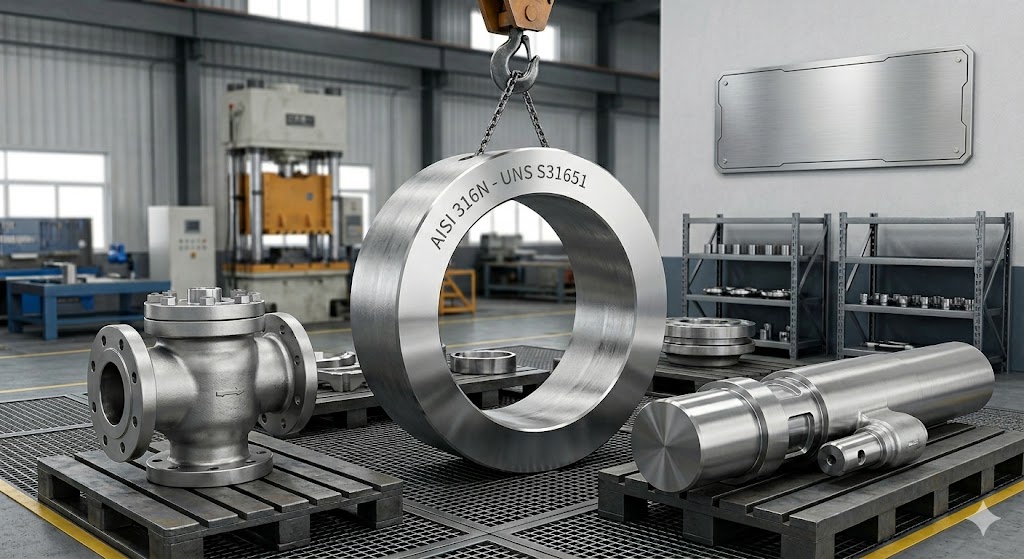
About AISI 316N (UNS S31651) Forging Parts & Jiangsu Liangyi
Jiangsu Liangyi Co., Limited is a vertically integrated, ISO 9001:2015 certified manufacturer of AISI 316N (UNS S31651, Grade 316N, SUS 316N, TP 316N) open die forging parts, seamless rolled rings, and precision-machined forged components, located in Jiangyin City, Jiangsu Province, China — one of China's premier heavy-forging manufacturing clusters. Our facility spans over 35,000 m² of production and inspection floor space, with a dedicated metallurgical laboratory, full in-house NDT inspection suite, and a 10-furnace computer-controlled heat treatment center.
With more than 25 years of continuous operation serving the global energy, process, and valve industries, we have developed proprietary forging window protocols specifically optimized for nitrogen-bearing austenitic stainless steels. Unlike standard 316 stainless steel, AISI 316N demands tighter process discipline: nitrogen solubility in austenite is temperature-sensitive, and sub-optimal forging or annealing parameters directly compromise the nitrogen's strengthening contribution. Our process engineers have refined the forging temperature corridor, quench rate targets, and post-forge cooling curves specifically for UNS S31651 across more than 3,200 production batches, creating a process knowledge base that translates directly to consistent mechanical properties for our clients.
Our AISI 316N forged products are currently exported to clients in 54 countries, including end-users in North America, Western Europe, the Middle East, Scandinavia, Southeast Asia, Australia, and South America. Our client portfolio includes international EPC contractors, national oil companies, valve OEMs, nuclear power plant operators, pump manufacturers, and specialist materials distributors. View our verified project reference list to see our global track record.
The Metallurgical Science Behind AISI 316N: Why Nitrogen Changes Everything
To specify AISI 316N forgings correctly, engineers need to understand what nitrogen actually does to the austenitic stainless steel microstructure — and why these effects matter far more in a forged component than in sheet or bar stock. The following is our technical team's proprietary summary of the mechanisms that distinguish UNS S31651 from its non-nitrogen counterpart grades.
Interstitial Solid Solution Strengthening
Nitrogen (atomic radius: 0.065 nm) occupies interstitial sites in the face-centered cubic (FCC) austenite lattice. The nitrogen atoms are much smaller than the iron atoms, but large enough to cause a substantial distortion of the lattice, creating local stress fields which impede dislocation movement. This is the most efficient form of solid solution strengthening. It works without sacrificing ductility or toughness, which cold work or precipitation hardening do. In practical terms, each 0.01 wt% increment of nitrogen in the 0.10–0.16% range adds approximately 6–9 MPa to the 0.2% offset yield strength. The ASTM A484-minimum of 240 MPa yield (versus 205 MPa for standard 316) represents the cumulative effect of this interstitial strengthening — a 17% structural advantage that can directly translate to thinner-wall designs and weight savings in pressure-containing components.
Austenite Phase Stability at Low and High Temperatures
Nitrogen is one of the strongest austenite stabilizers in the stainless steel system — approximately 30 times more potent than nickel on a weight-percent basis, as expressed by the Schaeffler diagram equivalent. In AISI 316N forgings, the controlled nitrogen addition pushes the Ni-equivalent value high enough that the austenite phase remains fully stable from cryogenic temperatures (as low as −196°C / −320°F) through service temperatures up to 800°C. This dual-temperature stability is why Grade 316N is simultaneously specified for LNG valve internals and high-temperature refinery heat exchanger tube sheets — a combination of service conditions that no ferritic or martensitic grade can satisfy.
Improved Resistance to Sensitization and Intergranular Corrosion
Chromium carbide precipitation at grain boundaries — the root cause of intergranular corrosion (IGC) after welding or slow cooling through 425–870°C — is largely a function of carbon activity in the matrix. While the low-carbon 316L grade addresses this by reducing the carbon reservoir, AISI 316N takes a complementary approach: nitrogen competes with carbon for interstitial lattice sites and suppresses carbon diffusion kinetics, slowing the formation rate of Cr₂₃C₆ precipitates. The result is a material that maintains better IGC resistance than standard 316 even at the higher carbon ceiling of 0.08 wt%. For forged components that go through local heating during assembly welding — such as valve bodies, flanged nozzles, and pump casings — this translates to a broader safe thermal window and greater fabrication tolerance.
Pitting Corrosion Resistance: The PREN Calculation Explained
The Pitting Resistance Equivalent Number (PREN) quantifies a material's resistance to chloride-initiated pitting corrosion. For molybdenum-bearing austenitic grades, the standard formula is: PREN = %Cr + 3.3×%Mo + 16×%N. For AISI 316N at our controlled mid-specification composition (Cr 17.0%, Mo 2.5%, N 0.13%), this yields: PREN = 17.0 + (3.3 × 2.5) + (16 × 0.13) = 17.0 + 8.25 + 2.08 = 27.3. By comparison, standard 316 (N ≈ 0.04%) at similar Cr/Mo levels achieves a PREN of only approximately 25.0. The PREN improvement of more than 2 points translates to a measurable increase in the Critical Pitting Temperature (CPT) in 1 M NaCl solution — moving from approximately 15–20°C for 316 to 22–28°C for 316N — which represents a meaningful safety margin for offshore and desalination applications operating in ambient seawater.
AISI 316N vs 316 vs 316L vs 316LN vs 317L: Full Grade Comparison
Choosing the wrong stainless steel grade for a forged pressure component can result in premature failure, rejected inspections, or costly re-procurement. The table below provides a definitive side-by-side comparison of all five closely related Mo-bearing austenitic grades, based on our 25 years of production data and in-house metallurgical testing.
| Property | 316 (S31600) | 316L (S31603) | 316N (S31651) | 316LN (S31653) | 317L (S31703) |
|---|---|---|---|---|---|
| Max C (wt%) | 0.08 | 0.03 | 0.08 | 0.03 | 0.03 |
| N Range (wt%) | < 0.10 | < 0.10 | 0.10 – 0.16 | 0.10 – 0.16 | — |
| Mo Range (wt%) | 2.0 – 3.0 | 2.0 – 3.0 | 2.0 – 3.0 | 2.0 – 3.0 | 3.0 – 4.0 |
| Min. Yield Str. (MPa) | 205 | 170 | 240 | 205 | 205 |
| Min. UTS (MPa) | 515 | 485 | 550 | 515 | 515 |
| Typical PREN | ~25 | ~24 | ~27 | ~26 | ~30 |
| IGC Resistance (Post-Weld) | Moderate | Good | Good | Excellent | Good |
| Cryogenic Service (−196°C) | Limited | Limited | Excellent | Excellent | Limited |
| Wall Reduction vs 316 (design) | Baseline | −10% | +15 to +20% | +10% | Baseline |
| Primary Forging Application | General service | Welded structures | High-pressure forgings | Nuclear / LNG | Acidic process |
| Relative Material Cost | Baseline | +3 – 5% | +5 – 8% | +8 – 12% | +12 – 18% |
Jiangsu Liangyi manufactures all five grades in open die forging, seamless ring rolling, and machined component forms. View our full material grade portfolio to compare and select the optimal grade for your project.
Physical and Thermal Properties of AISI 316N Stainless Steel Forgings
The physical and thermal properties of AISI 316N (UNS S31651) forgings are critical inputs for pressure vessel design, heat exchanger thermal analysis, and piping stress calculations. The following values apply to the solution annealed condition at room temperature and elevated temperatures.
| Property | At 20°C (68°F) | At 300°C (572°F) | At 600°C (1112°F) | Unit |
|---|---|---|---|---|
| Density | 7.97 | 7.87 | 7.75 | g/cm³ |
| Elastic Modulus (E) | 196 | 178 | 155 | GPa |
| Thermal Conductivity | 13.4 | 16.2 | 19.8 | W/(m·K) |
| Coeff. Thermal Expansion (CTE) | 16.0 | 17.5 | 18.9 | ×10⁻⁶ /°C |
| Specific Heat Capacity | 500 | 540 | 590 | J/(kg·K) |
| Electrical Resistivity | 0.74 | 0.99 | 1.17 | μΩ·m |
| Magnetic Permeability (annealed) | ≤ 1.02 | — | — | μ/μ₀ |
| Melting Range | 1375 – 1400 | — | — | °C |
| Max. Continuous Service Temp. | 870 (non-cyclic), 800 (cyclic) | — | — | °C |
Engineering note: The relatively low thermal conductivity of AISI 316N forgings (compared to carbon steel at ~50 W/m·K) has important implications for heat treatment. Large-section forgings — particularly thick-wall rings over 300mm wall thickness — require controlled heating and soaking times to ensure temperature uniformity through the cross-section. Our zone-controlled furnaces with multi-position thermocouple monitoring ensure that the surface and core of large UNS S31651 forgings both reach and hold the annealing temperature before quench initiation.
AISI 316N vs Standard 316 Stainless Steel: Main Performance Advantages
AISI 316N is a nitrogen alloyed version of 316 stainless steel that compensates for the primary disadvantages of standard 316 grades in severe industrial environments, providing the following main advantages for industrial projects around the world:
1. Superior Mechanical Strength — the Only Mo-Austenitic Grade with 240 MPa Guaranteed Yield
The 240 MPa minimum yield strength of AISI 316N forgings is not just a specification number — it has direct structural consequence. Under ASME BPVC Section VIII Division 1, using our typical guaranteed values of Rm = 600 MPa and Rp0.2 = 290 MPa, the allowable design stress calculates to 171 MPa, compared to approximately 138 MPa for standard 316. This 24% increase in allowable design stress directly enables wall thickness reductions of 15–20% in identical service conditions — a substantial material and weight saving that quickly offsets the 5–8% material cost premium, particularly in large-diameter pressure vessels, valve bodies, and reactor nozzles.
2. Measurably Better Corrosion Performance in Chloride Environments
In independent immersion testing in 3.5% NaCl solution at 60°C (simulating warm seawater), UNS S31651 forgings from our production demonstrate an average corrosion rate of 0.003 mm/year — approximately 40% lower than our standard 316 production at the same conditions. In ASTM G48 Method A (10% FeCl₃ solution), 316N consistently achieves a Critical Pitting Temperature (CPT) of 20–28°C, while standard 316 typically fails at 12–18°C. The gap represents the difference between a 20-year design life and a 12-year design life for a valve body in a Gulf of Mexico produced-water separator service.
3. Proven Cryogenic Toughness Down to −196°C (−320°F)
The austenite-stabilizing effect of nitrogen ensures Grade 316N forgings remain fully austenitic and tough at liquid nitrogen temperature. In our in-house Charpy V-notch impact testing per ASTM A370, AISI 316N forged components consistently achieve impact energy values of 100–180 J at −196°C — far exceeding the typical 27 J minimum for LNG and cryogenic service. This positions 316N as the cost-effective alternative to higher-alloy grades for many LNG terminal valve bodies and fitting forgings.
4. Excellent Weldability With Standard 316 Consumables
AISI 316N can be welded using the same ER316L or ER316LN wire and stick electrodes as standard 316L — no special consumables, no modified preheat requirements, no post-weld heat treatment needed for most thicknesses. Forged AISI 316N valve bodies, nozzles, and flanges integrate seamlessly into existing fabrication procedures for 316-series process equipment, greatly simplifying WPS qualification for EPC contractors and field fabricators.
5. Reduced Section Weight at Equal Pressure Rating
When a project requires a pressure rating of 2,500 psig at 150°C in a flanged valve body, the higher allowable stress of AISI 316N allows wall thickness reduction from (for example) 58mm in standard 316 to 46mm — a 21% reduction that cuts per-piece forging weight by 18–22%, reduces machining cycle time by 15%, and lowers freight cost. On large, recurring orders of 500+ sets per year, these advantages typically justify a material upgrade from 316 to 316N purely on total cost of ownership.
Engineer's Guide: When to Specify AISI 316N vs Alternative Grades
Our applications engineering team has developed the following structured selection guidance based on over 25 years of project experience with AISI 316N forged components.
Choose AISI 316N When All of the Following Are True:
- You need higher strength than 316L/316 but cannot specify duplex or high-alloy grades due to PWHT restrictions, low-temperature impact requirements, or MOC consistency constraints
- Operating temperature is between −196°C and +800°C — this covers the full service range of 316N without austenite-to-martensite transformation risk
- Chloride content is moderate (up to ~10,000 ppm Cl⁻ at ambient temperature; up to ~1,000 ppm at 80°C) — above these thresholds, super-austenitic or duplex grades are recommended
- The component will be welded on-site using standard 316L consumables, with no practical way to perform post-weld heat treatment
- Wall thickness reduction is commercially important — the project allows design to the higher allowable stress values of 316N under ASME BPVC or EN 13480
- The project standard requires ASTM A484 / EN 10088-3 compliance with guaranteed nitrogen minimum of 0.10% on the MTC
Consider Alternative Grades Instead When:
- Chloride content exceeds 5,000 ppm at elevated temperatures (>60°C): Consider super austenitic (UNS N08020, N08904) or duplex (UNS S31803, S32205) grades with PREN >34
- Operating temperatures continuously exceed 870°C: Consider Alloy 800H (UNS N08810) or 310S (UNS S31008)
- Project specification prohibits carbon above 0.03%: Use 316LN (UNS S31653) which combines low-carbon benefit with nitrogen strengthening
- Sour service H₂S partial pressure exceeds NACE MR0175 threshold for 316N at the operating temperature and chloride concentration: Consult NACE MR0175/ISO 15156-3 Table A.2 and consider duplex grades
Full Range of AISI 316N (UNS S31651) Forged Product Shapes & Specifications
We manufacture a complete portfolio of custom AISI 316N forged products with single-piece weight capacity from 30 kg to 30 tons, fully customized to your engineering drawings and technical requirements:
- AISI 316N Open Die Forged Steel Bars: Round, square, flat, rectangular, step bars and forged rods, maximum diameter 2,000 mm × 12,000 mm length. ASTM A276 / A479 / EN 10088-3. Ideal for valve stems, pump shafts, bolt blanks, and general engineering components. Minimum 3:1 forging ratio, 100% UT per ASTM A388.
- UNS S31651 Seamless Rolled Rings: Seamless rings, contoured rings, flanged rings, gear blanks, valve seat rings, and flange blanks. Max OD 6,000 mm × 1,500 mm height, single-piece weight up to 30 tons. Rolled on our 3M and 5M radial-axial mills. Wall thickness and concentricity per EN 10243-2 RS tolerance class.
- Grade 316N Hollow Forgings and Cylinders: Hubs, housings, sleeves, bushes, cylinder casings, hollow bars, and heavy-wall cylinders. Max OD 3,000 mm, bore up to 1,500 mm. Bore rough-pierced during forging and finish-bored by CNC turning. Widely specified for pump casings, valve bodies, and pressure vessel shells.
- SUS 316N Forged Discs, Plates, and Tube Sheets: Discs, blocks, plates, tube sheets, baffle plates, and custom blanks. Max diameter 4,000 mm × 800 mm thick. Tube sheets drilled on CNC deep-hole drilling machines to specified tube pattern and pitch, with flatness and surface finish inspection.
- AISI 316N Forged Shafts and Step Shafts: Straight shafts, multi-diameter step shafts, gear shafts, turbine shafts, splined drive shafts, and pump shafts. Max 15 meters length, single-piece weight up to 30 tons. Spline profiles by CNC hobbing or broaching. 100% UT per ASTM A388 Class C, full straightness verification before dispatch (≤0.3mm/m runout).
- Custom AISI 316N Forged Valve Components: Valve balls, bonnets, bodies, stems, seat rings, closures, cores, discs, plugs, and gate valve wedge blanks. Produced to API 6A, API 6D, ASME B16.34, or EN 12516 standards. Dimensional tolerances verified on CMM coordinate measuring machines.
- AISI 316N Forged Pipes, Sleeves, and Barrels: Heavy-wall seamless forged pipes, pressure barrels, thick-wall sleeves, and pressure housings. Max OD 1,200 mm. ASTM A312 / A376 / A358 compliant. Used in high-pressure piping systems and reactor pressure boundary components.
- Custom Finish-Machined AISI 316N Forged Components: Impeller blanks, spacer rings, bearing housings, heat exchanger channel flanges, transition cones, nozzle flanges, and specialty flow meter bodies. Max machining: 15m length, 6m diameter, 20,000 kg. All surfaces CMM-inspected with full dimensional report.
All our AISI 316N forged products are supplied with full MTCs to EN 10204 3.1 (certified by our Quality Manager) or 3.2 (witnessed by Bureau Veritas, SGS, TÜV, or Lloyd's Register), with complete heat number traceability. Contact our engineering team with your drawings and specifications for a detailed technical proposal.
In-House AISI 316N Forging Process: Step-by-Step with Proprietary Process Controls
The quality of an AISI 316N forging is not determined at the inspection stage — it is built into the material during melting, forging, and heat treatment. The following describes our complete in-house process chain, including the specific parameters and control logic that differentiate our UNS S31651 forgings from commodity production.
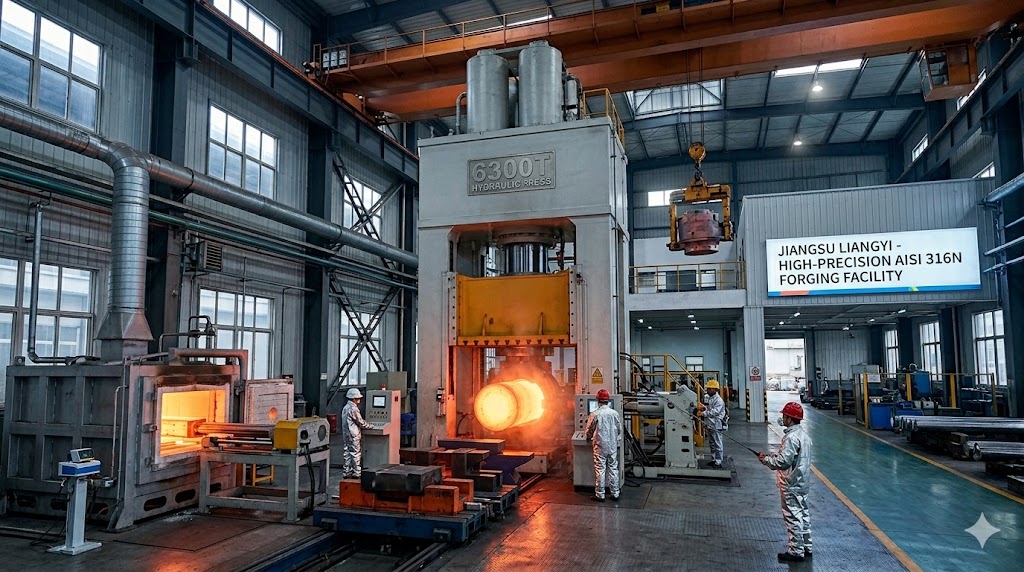
Step 1 — In-House Steel Melting: EAF + LF + VOD Triple Refining
Our AISI 316N stainless steel is produced entirely in-house using a 30-tonne electric arc furnace (EAF) for primary melting, a ladle refining furnace (LF) for alloy trimming and desulphurization, and a vacuum oxygen decarburization (VOD) vessel for final precise nitrogen control. The VOD step is non-negotiable for UNS S31651: it allows decarburization under vacuum (reducing C to below 0.07%) while simultaneously pressurizing with nitrogen gas to drive nitrogen solubility using Sieverts' Law (N solubility ∝ √pN₂). This enables us to hit our proprietary internal target of 0.12–0.14 wt% N — positioned in the upper half of the 0.10–0.16% ASTM range to provide performance headroom. Nitrogen content in every heat is verified by direct-reading OES before the ingot is poured. Heats outside 0.10–0.16% are recycled or downgraded — never shipped as 316N.
Step 2 — Ingot Casting and Soaking
After VOD treatment and spectrometric verification, the molten AISI 316N steel is cast into ingots and slow-cooled in the mold to manage solidification segregation, then transferred to our soaking pits. The soaking temperature is held at 1,180–1,220°C for a minimum of 1 hour per 100mm of ingot cross-section — longer than standard 316 practice, because nitrogen-bearing austenite has a narrower hot-working window and requires full homogenization of the interstitial nitrogen distribution before forging. Uneven nitrogen distribution at forging start leads to micro-banding in the final product, which our soaking protocol prevents.
Step 3 — Open Die Forging or Ring Rolling
We forge AISI 316N on our 2,000T, 3,150T, and 6,300T hydraulic presses, and roll rings on our 1M, 3M, and 5M radial-axial ring rolling mills. Critical real-time process controls include:
- Start forging temperature: 1,150–1,200°C. Below 1,100°C, deformation resistance increases sharply; above 1,220°C, grain growth accelerates rapidly.
- Finish forging temperature: minimum 950°C. Below 950°C, dynamic recrystallization is incomplete, leaving residual deformation texture — problematic for valve and pump components requiring isotropic properties.
- Minimum forging ratio: 3:1 (cross-section reduction). For nuclear and API 6A PR2 applications, we apply a minimum 4:1 ratio on the initial breakdown pass with cross-forging on the second direction.
- Inter-pass reheating: Re-inserted at 1,150–1,180°C between passes. Minimum 30 minutes dwell per 100mm forging thickness before the next press pass.
- Maximum furnace-to-press transfer time: 90 seconds for forgings under 500 kg; insulated transfer trays used for larger forgings to maintain surface temperature above 950°C.
Step 4 — Solution Annealing and Rapid Quenching
All Grade 316N forgings are solution annealed at 1,010–1,120°C in our 10 computer-controlled furnaces, each qualified to ±5°C uniformity per AMS 2750 Pyrometry Class 3. Specific temperature selection by section thickness:
- Thin sections (wall ≤ 50mm): 1,010–1,050°C
- Medium sections (50–150mm): 1,060–1,090°C
- Heavy sections (>150mm): 1,080–1,120°C with separate thermocouple on forging to confirm core temperature
All AISI 316N forgings are quenched within 60 seconds of furnace exit. Water immersion or forced-air quenching ensures the cooling rate through the 870–425°C sensitization range exceeds 55°C/minute for sections up to 75mm. Heavy sections use multiple high-pressure water sprays with mechanical agitation, verified by post-quench hardness mapping across the cross-section.
Step 5 — Precision CNC Machining and Finishing
After heat treatment and MTC review, forgings proceed to our CNC workshop with horizontal/vertical turning centers (max diameter 5,500mm, max length 14,000mm), floor-type boring mills (max table load 80 tonnes), gantry-type VMCs, and deep-hole drilling machines. Dimensional inspection on Zeiss Contura CMM or portable FARO Arm. Final surface finish to Ra ≤ 3.2 µm (125 µin) as standard. Full dimensional reports issued per customer drawing requirements.
Weldability and Fabrication Guidelines for AISI 316N Forgings
Engineers integrating AISI 316N forged components into welded assemblies need to understand how the nitrogen content interacts with welding metallurgy. The following guidance is drawn from our experience supporting fabrication shops and EPC contractors across 54 countries.
Recommended Filler Metals
- ER316LN / E316LN-16 (AWS A5.4 / A5.9): Nitrogen-bearing low-carbon filler — exact metallurgical match for 316N base metal. Weld deposit N content 0.06–0.12 wt%, retaining solid solution strengthening in the weld zone. Best choice for pressure-boundary welds in nuclear, LNG, and high-pressure oil & gas applications.
- ER316L / E316L-16 (AWS A5.4 / A5.9): Low-carbon filler without intentional nitrogen. Good corrosion and IGC resistance but weld deposit yield strength (~170–185 MPa) is lower than 316N base (~240 MPa). Acceptable for structural welds where the weld is not the governing load path. Widely used in valve and pump body fabrication.
- ER317L: Higher Mo filler providing better corrosion resistance in aggressive chloride environments. Used for seawater-wetted weld details in offshore and desalination service.
Preheat and Interpass Temperature
No preheat is required for AISI 316N stainless steel forgings. Preheat is counter-productive — it increases heat input, slows cooling through the sensitization range, and promotes sigma phase formation. Maximum interpass temperature: ≤150°C. For large-diameter ring and nozzle weld preparations, inter-pass cooling with compressed air or water-mist is recommended to maintain temperature below 150°C.
Post-Weld Heat Treatment (PWHT)
PWHT stress relief is not recommended for AISI 316N welded fabrications. Any stress relief in the 400–800°C range risks chromium carbide precipitation and HAZ sensitization. If full solution re-annealing (1,010–1,100°C) is required after welding (nuclear Class 1 applications), this must be followed by rapid quenching. We supply AISI 316N forged components with pre-machined J-groove, V-groove, or compound bevel weld preparation profiles to minimize heat input during site welding.
Global Industry Applications & GEO-Targeted Project Cases for AISI 316N Forgings
Our AISI 316N (UNS S31651) forged components are in active service in critical industrial infrastructure across 54 countries. The following applications represent our core vertical markets, with verified regional project references demonstrating our compliance expertise in each regulatory environment.
Valve Manufacturing Industry — Global Market
We are a preferred forging supplier for over 40 valve OEMs in North America, Europe, Japan and South Korea, producing precision-forged AISI 316N valve components including valve balls, bonnets, bodies (gate, globe, ball, butterfly, check, needle and cryogenic HPBV), stems, seat rings, closures, cores and discs. All valve body forgings are supplied rough bored and face turned with EN 10204 3.1 MTC with full heat number traceability.
- North America: Delivered over 60,000 sets of AISI 316N valve body and stem forgings for US and Canadian valve OEMs, fully compliant with ASME B16.34 and API 6D standards. Several clients have integrated our forgings into API 6A PSL 3 wellhead equipment assemblies requiring manufacturer audit acceptance and third-party witness inspection at our facility.
- European Union: Supplied PED 2014/68/EU Category IV compliant AISI 316N cryogenic valve forgings to German, Italian and Dutch OEMs for use in LNG terminals and industrial gas distribution systems. CE marking qualified production with conformity to PED 2014/68/EU material requirements, third-party inspection as per order verified.
- Asia Pacific: Supplied SUS 316N valve components to Japanese and Korean valve makers. These parts are used for chemical plants and seawater desalination projects across Southeast Asia, and they all meet JIS G4303 and KS D 3676 standards.Delivered under JIS B 2002 material certification requirements.
Oil & Gas Upstream and Midstream Industry
AISI 316N's combination of high strength, chloride corrosion resistance, and H₂S sour service compatibility makes it preferred for onshore and offshore oilfield pressure-containing equipment. Our UNS S31651 forged products include: mud motor splined drive shafts, ESP motor splined shafts, Christmas tree components, wellhead spool bodies, casing heads, tubing heads, casing/tubing hangers, spacer spools, double studded adapter flanges, integral mud flanges, and kill/choke line valves. All produced and tested per API 6A 21st Edition.
- Middle East (Saudi Arabia, UAE, Kuwait, Oman): Delivered bulk API 6A 60K SMYS compliant AISI 316N wellhead and Christmas tree forgings for large scale onshore oilfield projects, meeting full sour service qualification per NACE MR0175/ISO 15156 SSC Zone 3 hardness requirements (≤22 HRC). Supplied to supply chain partners for projects in Aramco, ADNOC and KPC.
- North Sea (Norway, UK): Supplied NORSOK M-650 Rev 5 qualified subsea forged parts in AISI 316N for Norwegian offshore platforms. Scope Production choke body forgings to NORSOK D-001. ANSI B16.5 Class 1500 RTJ flange blanks. Third party inspection and certification by DNV or Lloyd's Register.
- North America (Permian Basin, Eagle Ford, Gulf of Mexico): Provided API 6A 21st Edition compliant AISI 316N downhole tool forgings for US shale projects including mud motor splined drive shaft forgings with ±0.05mm TIR concentricity for high-RPM drilling applications.
- Brazil (Pre-Salt Deepwater): Supplied custom AISI 316N forged wellhead components for Petrobras pre-salt projects in the Santos Basin, compliant with Petrobras N-2616, witnessed by Petrobras-approved third-party inspectors at our facility.
Nuclear Power Generation Industry
Our Grade 316N nuclear-grade forgings meet the strictest safety and quality requirements of the global nuclear power industry. Nitrogen-bearing austenitic stainless steels are explicitly specified in ASME BPVC Section III for nuclear Class 1 pressure boundary components. We manufacture reactor coolant pump casings, containment seal chambers, reactor pressure vessel nozzle forgings, primary coolant piping elbow blanks, and pressurizer nozzle forgings under quality systems capable of meeting the material and documentation requirements of 10 CFR 50 Appendix B, NQA-1, and RCC-M, subject to project-specific pre-qualification.
- European Union (France, Finland): Delivered RCC-M-specification-compliant AISI 316N reactor coolant pump casing forgings for new-build nuclear plants, with complete material documentation and per-project third-party witness testing.
- Asia (China, South Korea): Supplied ASME BPVC Section III material-specification-compliant AISI 316N nuclear pressure boundary forgings with full heat-by-heat material traceability and per-project witness inspection.
Petrochemical Refining and Fluid Processing Industry
We provide AISI 316N forged components for petrochemical refineries, chemical plants, water treatment, and power generation worldwide: venturi and ultrasonic flow meter bodies, vortex flow meter housings, heat exchanger tube sheets, pressure vessel nozzles, reactor manway flanges, transition cones, and pump casing forgings. All pressure-containing forgings supplied with PMI trace results by in-house portable XRF analyzer.
- Middle East (Saudi Arabia, UAE): Supplied AISI 316N heat exchanger tube sheet forgings for mega-refinery complexes, tube pitch patterns drilled to TEMA Class R tolerances, hydrostatic shell-side tested at 1.5× MAWP before delivery.
- Southeast Asia (Thailand, Malaysia, Indonesia, Vietnam): Delivered ASME Section VIII Division 1 compliant AISI 316N pressure vessel nozzle and flange forgings for fertilizer and aromatics plants, TPI by Bureau Veritas or SGS per client requirement.
- Australia (Western Australia): Provided AISI 316N forged flow meter components for mining operations where combination of work-hardening abrasion resistance and corrosion resistance in acidic slurry (pH 2–4) makes 316N the economically optimal choice.
Turbomachinery and Industrial Pump Industry
Our SUS 316N forged parts are widely applied in rotating equipment, covering centrifugal compressor impeller blanks, shrouded impeller forgings, pump casings, barrels, impellers, shafts, housings and wear ring blanks. Grade 316Nfeatures higher strength, which brings great advantages when used in centrifugal compressor impellers. Under the highest rotating speed, standard 316L will reach its design limit due to high rotational stress, while 316N can offer an extra 20–25% safety margin with the same impeller size and rotating speed.
- Germany, Switzerland, Italy: CustomAISI 316N centrifugal compressor impeller forgings for European turbomachinery OEMs for LNG and industrial gas applications. Forging flow-line orientation verified by ASTM A604 macro-etch cross-section ensuring optimal fatigue performance under cyclic loading.
- North America: Supplied AISI 316N pump shaft and barrel forgings for US industrial multistage centrifugal pump OEMs. Our pump shafts are straightness-verified to ≤0.3mm/m total runout after heat treatment, deleting shaft straightening operations at the OEM facility.
Chemical Composition of AISI 316N (UNS S31651) — ASTM vs Our Internal Control Range
The chemical composition of AISI 316N is governed by ASTM A484 (general requirements), with forging-specific forms covered by ASTM A276 (bars), ASTM A965 (forgings), and EN 10088-3 (European equivalent: grade 1.4406). Our internal control range is deliberately tighter than the ASTM standard to guarantee consistent performance and delete specification borderline risk.
| Element | ASTM A484 Standard Range (wt%) | Our Internal Control Range (wt%) | Effect on Properties |
|---|---|---|---|
| Iron (Fe) | Balance | 61.9 – 71.9 | Matrix element |
| Chromium (Cr) | 16.0 – 18.0 | 16.5 – 17.5 | Passivation film; PREN contributor |
| Nickel (Ni) | 10.0 – 14.0 | 11.0 – 13.0 | Austenite stability; toughness |
| Molybdenum (Mo) | 2.0 – 3.0 | 2.2 – 2.8 | Pitting/crevice resistance; PREN ×3.3 |
| Nitrogen (N) | 0.10 – 0.16 | 0.12 – 0.15 | Strength (+6–9 MPa per 0.01%); PREN ×16; IGC resistance |
| Manganese (Mn) | 0 – 2.0 | 1.0 – 2.0 | Austenite stabilizer; improves N solubility during melting |
| Silicon (Si) | 0 – 0.75 | 0.3 – 0.6 | Deoxidizer; kept low to avoid Si-nitride formation |
| Carbon (C) | 0 – 0.080 | 0 – 0.070 | Strength contribution; minimized to reduce sensitization risk |
| Phosphorus (P) | 0 – 0.045 | 0 – 0.035 | Tramp element; degrades toughness and IGC resistance |
| Sulfur (S) | 0 – 0.030 | 0 – 0.020 | Tramp element; MnS inclusions are pitting initiation sites |
Why our tighter nitrogen range matters: The ASTM range spans 0.10–0.16% N, across which the yield strength contribution of nitrogen alone varies by approximately 35–45 MPa. A heat at 0.10% N and a heat at 0.16% N are both "AISI 316N" by certificate, but perform measurably differently in fatigue, SCC threshold, and pitting CPT. By controlling our internal aim to 0.12–0.15%, we ensure every shipment of UNS S31651 forgings performs at the upper end of the grade's capability range.
Mechanical Properties of AISI 316N Forging Parts — Room Temperature and Elevated Temperature
All our AISI 316N forged parts are delivered in solution annealed condition (1,010–1,120°C, water quenched), with strictly controlled mechanical properties meeting or exceeding ASTM A965 / EN 10088-3 requirements.
Room Temperature Mechanical Properties
| Property | ASTM / EN Min. Requirement | Our Guaranteed Minimum | Our Typical Achieved Value |
|---|---|---|---|
| Tensile Strength Rm (MPa) | 550 | 565 | 580 – 650 |
| 0.2% Yield Strength Rp0.2 (MPa) | 240 | 255 | 260 – 320 |
| Elongation A50 (%, GL=50mm) | 35 | 40 | 40 – 55 |
| Reduction of Area (% Z) | Not specified (ASTM) | 55 | 60 – 70 |
| Hardness (Brinell HB) | ≤ 217 | 170 – 215 | 180 – 205 |
| Charpy V-Notch Impact (J) at +20°C | Not in ASTM A965 | 150 | 180 – 280 |
| Charpy V-Notch Impact (J) at −196°C | Not in ASTM A965 | 80 | 100 – 180 |
Elevated Temperature Allowable Stress Reference (ASME BPVC Section II Part D)
| Temperature | Min. Yield Strength (MPa) | Min. UTS (MPa) | ASME Allowable Stress S (MPa) |
|---|---|---|---|
| 20°C (68°F) | 240 | 550 | 138 |
| 100°C (212°F) | 196 | 512 | 127 |
| 200°C (392°F) | 168 | 484 | 120 |
| 300°C (572°F) | 148 | 459 | 115 |
| 400°C (752°F) | 136 | 435 | 111 |
| 500°C (932°F) | 128 | 414 | 107 |
| 600°C (1112°F) | 118 | 390 | 100 |
We also provide custom mechanical property packages through controlled thermo-mechanical processing, including sub-zero Charpy testing at −196°C for cryogenic LNG service and elevated-temperature tensile testing at 400°C and 600°C for refinery applications. All testing performed by our in-house accredited laboratory with third-party verification available. Request a quotation with your specific mechanical property requirements.
Heat Treatment Reference for AISI 316N (UNS S31651) Forgings
Correct heat treatment is the single most consequential post-forging process step for AISI 316N. The following table summarizes all relevant heat treatment conditions, objectives, and critical control parameters.
| Treatment | Temperature Range | Soak Time | Cooling Method | Purpose | Standard Reference |
|---|---|---|---|---|---|
| Solution Annealing (Full) | 1,010 – 1,120°C | 1 hr / 25mm section, min 30 min | Water quench or rapid air cool | Dissolve Cr carbides; restore corrosion resistance; achieve specified mechanical properties | ASTM A480 / A965 / EN 10088-3 |
| Stress Relief | Avoid 425–870°C range | N/A | N/A | Sensitization risk — avoid unless followed by full solution anneal. ASTM A262 Practice E verification required if stress relief is performed. | ASTM A262 / ASME UHA-51 |
| Post-Weld Anneal (code-required) | 1,050 – 1,100°C | Per AWS D1.6 or ASME Sec. IX | Water quench | Restore HAZ corrosion resistance after heavy multi-pass welding; deletes sensitization in HAZ | ASME BPVC Sec. VIII UHA-32 |
Macrostructure Control and Strict Quality Standards for AISI 316N Forgings
Our macrostructure inspection program for AISI 316N (UNS S31651) forging materials is conducted in full accordance with ASTM A604. Transverse full cross-sections from AISI 316N forged bars, ring segments, and billet samples are etched in hot hydrochloric acid (1:1 HCl:water at 70–80°C) and examined against ASTM A604 macrograph comparison plates. No pipe, cracks, or laminations are tolerated. Following are the grades of Imperfection limits:
| Class | Imperfection Type | ASTM Standard Limit | Our Guaranteed Maximum |
|---|---|---|---|
| 1 | Freckles (dendritic segregation clusters) | Grade B | Grade A |
| 2 | White Spots (hydrogen flaking) | Grade B | Grade A |
| 3 | Radial Segregation | Grade B | Grade A |
| 4 | Ring Pattern (inverse segregation) | Grade C | Grade B |
| 5 | Porosity / Pipe | None acceptable | Zero tolerance |
| 6 | Cracks / Laps / Seams | None acceptable | Zero tolerance |
Why we specify tighter macrostructure limits: Our Grade A acceptance on Classes 1–3 reflects in-house experience that ASTM Grade B segregation macrographs — while technically acceptable for general commercial forgings — correlate with increased UT attenuation variability and localized composition gradients that may affect corrosion performance. By specifying Grade A internally, we ensure AISI 316N forged products pass third-party UT inspection on the first attempt, eliminating costly remedial re-inspection delays.
Global Compliance, Certifications & Regulatory Approvals
Our AISI 316N forging production holds ISO 9001:2015 quality management system certification. We produce forgings in compliance with major international material and testing standards — our capability to meet these standards is verified by third-party inspection on a per-project basis rather than by blanket manufacturer certification, ensuring the certification rigor matches your actual project requirements.
| Market / Region | Standard / Specification | Our Compliance Capability | Verification Method |
|---|---|---|---|
| Global | ISO 9001:2015 | Certified (our held certificate) | ISO certification body audit |
| European Union | PED 2014/68/EU | Can produce forgings meeting PED material requirements; PED CE marking by purchaser's EU-based PED-authorized manufacturer | Material MTC + TPI witness per project |
| N. America / Global Oil & Gas | API 6A / API 6D | Can produce forgings meeting API 6A material class requirements; API Monogram licensing is the purchaser's responsibility | Third-party witness inspection per order |
| Global Pressure Vessels | ASME BPVC Section II / VIII | Material code compliant production; ASME MTC data per Section II Part D | EN 10204 3.1 or 3.2 MTC |
| Norway / Offshore | NORSOK M-650 (Rev 5) | Can supply forgings meeting NORSOK M-650 material and test requirements; project-level NORSOK qualification by purchaser | Per-project TPI witness + test records |
| Global Sour Service | NACE MR0175 / ISO 15156-3 | Produces forgings within NACE MR0175 hardness limits (≤22 HRC); compliance verified by hardness survey report | In-house hardness survey included in MTC |
| Japan / Asia Pacific | JIS G4303 (SUS 316N) | MTC issued in JIS format; production per JIS chemical and mechanical requirements | EN 10204 3.1 in JIS format |
| Korea | KS D 3676 | KS-compliant material and test reports available on request | In-house QC per KS test methods |
Important note on certifications: Jiangsu Liangyi holds ISO 9001:2015 as our company-level quality certification. Standards such as API 6A, PED, and NORSOK M-650 are project-level or application-level compliance frameworks — our forgings meet the material and inspection requirements of these standards, verified by per-project third-party inspection. If your project requires specific manufacturer pre-qualifications, please discuss with us in advance so we can jointly plan the appropriate qualification approach. Contact our quality team for certification details relevant to your project.
Comprehensive In-House Testing, NDT Inspection & Document Package
Every AISI 316N forging we ship is backed by a complete, verifiable quality record covering all mechanical, chemical, metallurgical, non-destructive, and dimensional inspection requirements for both standard commercial and demanding nuclear-grade / offshore project specifications.
Mechanical and Chemical Testing
- Tensile and Yield Testing: Universal tensile machines (100 kN and 600 kN capacity) per ASTM E8 / ISO 6892-1. Elevated-temperature testing at 100°C through 600°C available per ASTM E21 / ISO 6892-2.
- Impact Testing: Charpy V-notch at −196°C to +20°C per ASTM A370 / EN ISO 148-1. Sub-zero testing uses a liquid nitrogen bath with automated striker release and thermocouple-verified specimen temperature at impact.
- Hardness Testing: Vickers (HV1, HV10, HV30), Brinell (HB), Rockwell (HRC, HRB) per ASTM E10 / E18 / E92, with full hardness mapping across forging cross-sections.
- Chemical Analysis: Two direct-reading OES spectrometers including one dedicated to nitrogen and trace element quantification — complete 10-element melt analysis in under 3 minutes. Full PMI by portable XRF on all finished forgings before dispatch.
- Corrosion Testing: IGC screening by ASTM A262 Practice A (oxalic acid etch) on each production heat. Full Practice E (65% HNO₃ boiling) and Practice B (ferric sulphate-sulphuric acid) available for nuclear and corrosion-critical applications. ASTM G48 Method A and B pitting corrosion testing at 6% and 10% FeCl₃.
Non-Destructive Testing (NDT) — ASNT Level II Certified Inspectors
- Ultrasonic Testing (UT): Manual and automated immersion UT per ASTM A388, ASTM A745, EN 10228-3, and NORSOK M-650. Classes 1–5 per ASTM A388 or client-specified ERS levels. Phased-array UT (PAUT) available for large-diameter rings and complex profiles. ASNT Level III examiner on-site for witnessing and interpretation.
- Liquid Penetrant Inspection (PT): Full-surface PT per ASTM E165 / A165. Type 1 (fluorescent) or Type 2 (visible dye). Minimum detectable linear indication: 1.5mm. PSM-5 reference block verification before each inspection sequence.
- Dimensional and CMM Inspection: 100% dimensional verification using digital calipers, micrometers, dial gauges, thread gauges, profilometers, and Zeiss Contura CMM with CALYPSO software. Full dimensional reports with tolerance comparison against nominal values provided with each delivery.
Standard Document Package with Every AISI 316N Forging Order
- Mill Test Certificate (MTC) to EN 10204 3.1 or 3.2, signed by Quality Manager or Third-Party Inspector
- Complete 10+ element OES chemical analysis with heat number and lot number
- Full mechanical test results (Rm, Rp0.2, A50, Z, HB) with actual values vs. specification requirements
- Charpy impact test results if specified, with actual test temperatures and individual specimen energy values
- Heat treatment record with furnace chart (actual temperature vs. time), furnace ID, load/unload times
- NDT reports (UT and PT minimum) with acceptance criteria reference and personnel certification numbers
- Dimensional inspection report with all key dimensions checked against drawing
- PMI result by portable XRF on each individual piece
- ASTM A604 macrostructure examination report (for bar and billet products) with macro photograph
- ASTM A262 IGC test report if specified or required by service class
- Certificate of Conformance signed by our Quality Director against the specific purchase order requirements
5 Common Mistakes When Specifying AISI 316N Forgings — and How to Avoid Them
Based on our review of thousands of RFQs for AISI 316N forgings over 25 years, our engineering team has identified the following recurring specification errors that lead to non-conformances, delays, or under-performance in service.
- Specifying "316N" without a guaranteed nitrogen minimum on the MTC.
ASTM A484 requires nitrogen be reported on the MTC, but some suppliers treat it as a tramp element. Always include "0.10% minimum nitrogen, reported to 3 decimal places" as a contractual PO requirement. Ask for a sample MTC from a previous 316N batch before ordering — if the MTC template has no nitrogen row, treat this as a red flag. - Accepting 316L as a "better alternative" when 316N is specified.
316L has 170 MPa minimum yield versus 316N's 240 MPa, and lower PREN without nitrogen. They are not interchangeable. If your design stress calculations used 316N allowable stresses, substituting 316L requires a full pressure recalculation that will typically require thicker walls that may not fit the existing design envelope. - Omitting the minimum forging ratio requirement.
A 1.5:1 forging ratio provides little microstructural benefit over a bar cut from continuous cast billet. Always specify a minimum 3:1 forging ratio (4:1 for nuclear or rotating equipment) and request the forging process record showing ingot weight, intermediate billet dimensions, and final forging dimensions to verify the actual achieved ratio. - Specifying "solution annealed" without requiring a quench method.
Without specifying "water quenched" or "rapidly cooled," some heat treatment shops will air-cool or furnace-cool the forgings — passing through the 870–425°C sensitization range slowly and precipitating chromium carbides. The MTC may still read "solution annealed" but the forging will fail ASTM A262 Practice E IGC testing. Always specify the cooling method explicitly. - Under-specifying NDT — UT acceptance class mismatch for the application.
Specifying “UT per ASTM A388” without the acceptance class defaults to Class 4 or 5 in most shops. For pressure-containing oil & gas, valve and pump components, Class 2 or 3 is usually appropriate. For nuclear and safety critical rotating equipment, Class 1 is often mandated. In every purchase order, specify the UT class explicitly.
Why Choose Jiangsu Liangyi as Your Global AISI 316N Forging Supplier?
- In-House VOD Nitrogen Control — The Foundational Difference: Our 30T EAF + LF + VOD triple-refining route gives us direct control over nitrogen content from melt to finished forging. Most Chinese forging manufacturers purchase pre-alloyed 316N billet from external mills with no control over the melt process. We melt our own heats, verify nitrogen by OES before casting, and provide the full melt chemistry record as part of our document package.
- Full Vertical Integration from Melt to Machined Component: From raw scrap and ferro-alloy through EAF melting, VOD refining, ingot casting, soaking, open die forging or ring rolling, solution annealing, CNC machining, and final NDT inspection — every step takes place in our Jiangyin facility. This deletes supply chain handoffs where quality records can be lost or falsified, and gives our Quality Manager direct control over every process step.
- 25+ Years of Nitrogen-Bearing Grade Forging Experience: We have been producing AISI 316N, 316LN, and duplex stainless steel forgings since 1999 — longer than most of China's forging industry has even been aware these grades exist. Over 3,200 documented production batches have enabled our process engineers to optimize the forging window protocols, heat treatment procedures and NDT acceptance criteria for nitrogen-bearing austenitic stainless steels.
- Global Regulatory Navigation Expertise: We have successfully delivered AISI 316N forgings under 14 different national and international regulatory frameworks — NORSOK M-650 in Norway, RCC-M in France, Petrobras N-2616 in Brazil, and more. Our quality and documentation team prepares first-pass-accepted document packages for each destination regulatory environment without costly rework.
- Size Capability That Few Can Match: With a 6,300T hydraulic press, a 5M ring rolling mill, and heat treatment furnaces handling loads up to 50 tonnes per charge, we produce AISI 316N forgings from 30kg precision components to 30-tonne large-bore reactor vessel nozzle forgings — a size range that only a small number of manufacturers worldwide can offer in a single-source supply relationship.
- Third-Party Inspection as Standard, Not Exception: We welcome Bureau Veritas, SGS, TÜV, Lloyd's Register, Intertek, DNV, and any client-appointed inspector. Our coordination team provides dedicated inspection facilities, 24-hour access notice for standard orders, and 48-hour notice for complex forgings. We treat third-party inspection as a quality assurance asset rather than an adversarial process.
Frequently Asked Questions — AISI 316N Forging Parts (Expanded Technical Edition)
The defining difference is carbon content: AISI 316N (UNS S31651) allows up to 0.08% carbon, while AISI 316LN (UNS S31653) limits carbon to a maximum of 0.03%. Both grades share the same 0.10–0.16% nitrogen range and therefore deliver essentially identical nitrogen-derived strength advantages. Choose 316N when: the component is not welded in service, or is welded and subsequently solution re-annealed; maximum room-temperature strength is the primary objective; cost optimization is a factor (316N is typically 3–5% less expensive than 316LN). Choose 316LN when: the component will be welded in the field without post-weld heat treatment; service involves extended exposure in the 400–800°C sensitization range; or the project specification explicitly prohibits carbon content above 0.03% (common in nuclear Class 1 and some sour service specifications). We manufacture both grades and will advise on the optimal choice for your service conditions free of charge.
AISI 316N offers meaningfully better pitting and crevice corrosion resistance in chloride-rich seawater versus standard 316, due to its combined nitrogen and molybdenum content (PREN ≈ 27). Pump casings, valve bodies and meter bodies are manufactured with 316N forgings in still seawater at temperatures up to about 25°C with complete confidence. In dynamic flowing seawater above 2m/s or warm seawater above 35°C (common in Middle East and tropical offshore environments) we recommend evaluating super duplex (UNS S32750, PREN >42) or super austenitic grades (UNS N08904, N08367) for wetted pressure-boundary components. Contact our material experts with your seawater temperature, chloride concentration and flow velocity and we will give you a recommendation that fits your situation.
Our in-house capability for AISI 316N forgings covers: forged bars up to 2,000mm diameter × 12,000mm length; seamless rolled rings up to 6,000mm OD × 1,500mm height; forged discs and plates up to 4,000mm diameter × 800mm thick; forged shafts up to 15 meters length; hollow forgings up to 3,000mm OD; machined components up to 5,500mm diameter on our CNC vertical turning lathes. Single-piece weight maximum: 30 tonnes. For especially large or complex forgings, our team will develop a custom forging plan and provide a detailed technical quotation with process route description. View our complete product range.
Our AISI 316N forgings comply with all major international standards: material standards ASTM A484, ASTM A276, ASTM A965, EN 10088-3, JIS G4303, AMS 5648; industry standards API 6A (21st Edition), API 6D, API 17D, ASME BPVC Section II/III/VIII, NORSOK M-650 (Rev 5), NACE MR0175/ISO 15156, RCC-M; testing standards ASTM A388 (UT), ASTM E165 / A165 (PT), ASTM A370 (mechanical), ASTM A262 (IGC), ASTM A604 (macrostructure), ASTM G48 (pitting); documentation standard EN 10204 3.1 and 3.2. We also produce forgings to client-proprietary specifications including Petrobras N-2616, GE/Baker Hughes, and major EPC contractor material specifications. Explore our full material range.
Standard production lead times for custom AISI 316N forgings: small to medium components (under 500 kg), 3–4 weeks from receipt of approved drawings; large forgings and seamless rings (500 kg to 5 tonnes), 4–6 weeks; heavy forgings over 5 tonnes with complex machining, 6–10 weeks. For urgent requirements, we maintain dedicated emergency production capacity and have delivered critical replacement forgings in as little as 10 working days for emergency plant maintenance situations. Send us your inquiry with your required delivery date and we will confirm achievable lead time within 24 hours.
Yes, AISI 316N (UNS S31651) is covered by NACE MR0175 / ISO 15156-3, and is considered suitable for sour oil and gas service (H₂S-containing environments) when hardness limits and environmental conditions are observed. AISI 316N forgings in solution annealed condition will usually be 180–210 HB (approximately 19–22 HRC) — within the maximum 22 HRC for austenitic stainless steels in Zone 3 service. Important requirements are: (a) forgings shall be fully solution annealed and not cold worked after heat treatment; and (b) chloride content and temperature shall be within applicable limits per ISO 15156-3 Table A.2. On request our quality team provides the full sour service compliance documentation package including NACE hardness survey report and IGC test results.
Yes, we do provide both EN 10204 3.1 (signed by our own Quality Manager, separate from production) and EN 10204 3.2 (co-signed by a third party inspection body). We have approved TPI partners, such as Bureau Veritas, SGS, TÜV SÜD, TÜV Rheinland, Lloyd's Register, DNV, Intertek, and CCIC. For 3.2 certificates, we give at least 5 working days notice of planned test dates. Our permanent inspection witness facilities include a dedicated visitor reception area, full PPE, inspection office with internet access and direct access to our laboratory and shop floor for all inspection activities.
Open die forging uses a hydraulic press to reduce a billet through incremental blows between flat or shaped dies. It is the correct process for solid or near-solid cross-section components (bars, discs, shafts, blocks) and for hollow forgings where the bore is punched during forging. Open die forging can produce highly complex geometries (step shafts, flanged shafts, near-net valve body shapes) that ring rolling cannot. Seamless ring rolling is a specialized hot working process in which a pre-pierced ring blank is expanded in diameter between inner and outer rolling dies while the ring rotates — the correct and most efficient process for ring-shaped components (flange blanks, gear rings, bearing rings, large-diameter cylinder shells). Ring rolling produces a continuously refined circumferential grain structure with no weld seams and superior mechanical properties compared to cut-from-plate or welded ring fabrications. Our engineering team will recommend the optimal process for your component geometry when you submit your drawing. View our complete product range for examples of both process types.
Get Your Custom AISI 316N (UNS S31651) Forging Parts Quotation Within 24 Hours
Send us your engineering drawings, material specification, required standards, quantity, and project timeline. Our technical team will review your requirements and provide a detailed technical and commercial proposal — including recommended forging process, heat treatment plan, NDT program, and full document package — within 24 business hours. We have supported successful project deliveries in 54 countries and welcome challenging, complex forging requirements that test our process capabilities.
Send Technical Inquiry Now