What Is X21CrMoV12-1 (1.4926)? — Material Definition
- Material Name:
- X21CrMoV12-1 (also written X21CrMoV12.1, X21CrMoV121, X 21 CrMoV 12 1)
- EN Material Number:
- 1.4926
- Material Standard:
- EN 10302 – Creep-Resisting Steels, Nickel and Cobalt Alloys
- Steel Type:
- Martensitic, quenched and tempered, 12% chromium creep-resistant steel
- Maximum Service Temperature:
- 650°C continuous / 700°C short-term
- Primary Applications:
- Gas turbine rotor shafts, steam turbine blades, valve spindles, seamless rolled rings for power generation and oil & gas industries
Jiangsu Liangyi Co., Limited, established in 1997 and certified to ISO 9001:2015, is a professional China manufacturer of X21CrMoV12-1 (1.4926) open die forging parts and seamless rolled rings. This premium grade of creep-resistant, quenched and tempered 12% chromium steel was specifically developed for extreme high-temperature applications in power generation, oil & gas, and chemical industries.
Manufacturer: Jiangsu Liangyi Co., Limited — Jiangyin City, Jiangsu Province, China (founded 1997, ISO 9001:2015)
Product: X21CrMoV12-1 (EN 1.4926) open die forgings and seamless rolled rings
Service Temperature: Up to 650°C continuous; 700°C short-term
Annual Capacity: 120,000 tons | Max Single Piece: 30 tons | Max Length: 15 metres
Export: 50+ countries including Germany, USA, Saudi Arabia, India, Japan, South Korea, Australia, France, Netherlands
Certifications: ISO 9001:2015 | EN 10204 3.1 MTC standard with every shipment | EN 10204 3.2 available (customer-arranged third-party) | Can manufacture to API, ASME, DIN, EN technical requirements per order specification
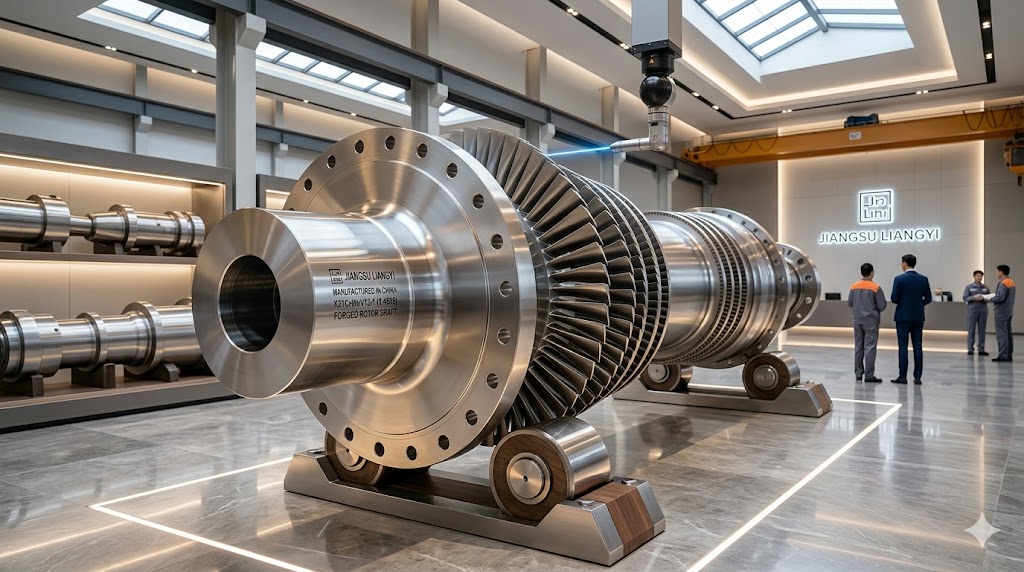
Main Material Advantages of X21CrMoV12-1 (1.4926)
- Approved for long-term continuous service up to +650°C
- Excellent creep rupture strength under prolonged high-temperature stresses
- Excellent toughness and ductility at elevated temperatures
- Good oxidation and corrosion resistance in steam and gas environments
- Superior fatigue resistance for rotating parts
- Martensitic microstructure provides higher strength than austenitic alternatives at lower alloy cost
Compared to conventional low-alloy steels, X21CrMoV12-1 has significantly improved high-temperature performance, so that it is the best choice material for important parts in power generation, oil & gas and chemical processing industries worldwide. Our 1.4926 forgings are exported to more than 50 countries across Europe, North America, Asia, the Middle East, Africa, Oceania and South America.
X21CrMoV12-1 (1.4926) International Equivalent Grades GEO
X21CrMoV12-1 (1.4926) is classified under EN 10302 as a creep-resisting martensitic chromium-molybdenum-vanadium steel. The table below lists the nearest international equivalent designations used in different countries and standards systems. Note: exact chemical compositions may differ slightly between standards.
| Standard System | Country / Region | Designation | Standard |
|---|---|---|---|
| EN / DIN | Europe / Germany | X21CrMoV12-1 / 1.4926 | EN 10302 |
| DIN (old) | Germany | X22CrMoV12-1 | DIN 17175 |
| ASTM / UNS | USA | Grade 422 / S42200 | ASTM A276 / A182 |
| BS | UK | 12CrMoVNb | BS 3604 |
| NF | France | Z20CDV12 | NF A35-573 |
| GOST | Russia | 20Х12ВНМФ | GOST 5632 |
| JIS | Japan | SUS422J1 | JIS G4303 |
| GB | China | 2Cr12NiMoV | GB/T 1220 |
Note: When specifying X21CrMoV12-1 equivalent in non-European standards, always verify the exact chemical composition and heat treatment requirements for your application. Jiangsu Liangyi can manufacture to any of the above designations upon request.
Comprehensive X21CrMoV12-1 Forged Product Capabilities
Our advanced production workshops in Jiangyin, Jiangsu, can make a full line of 1.4926 forged steel parts in many shapes, sizes and styles, to meet strict project needs. We provide a full range of services, from raw material melting and forging, to heat treatment and fine mechanical processing.
Forged Bars & Rods
- Round bars up to 2,000 mm diameter
- Square bars, flat bars and rectangular bars
- Turbine blade steel flat and rectangular bars
- Hollow bars and heavy-wall tubes
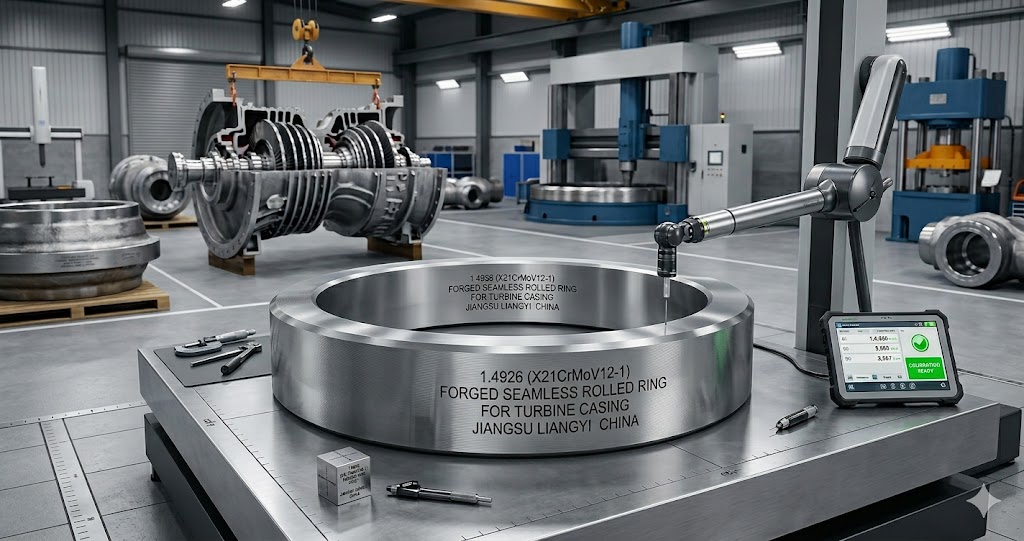
Seamless Rolled Rings
- Seamless rolled rings up to 6,000 mm outside diameter
- Guide rings and casing rings for turbines
- Seal rings, labyrinth rings and packing seal rings
- Diaphragm rings and rotor end rings
Gas & Steam Turbine Parts
- Gas turbine and steam turbine rotor shafts
- High pressure (HP) and intermediate pressure (IP) rotors
- Monobloc rotors, shaft ends and hollow shafts
- Gas compressor turbine blades and vanes
- Valve spindles, stems and rods for turbine valves
Industrial Forged Components
- Hubs, housing shells, sleeves and bushes
- Discs, blocks, plates and flanged blanks
- Pipes, tubes, casings and pressure vessels
- Double-headed studs, fasteners and bolts for high-temperature service
Maximum Production Capacity
| Parameter | Maximum Value | Note |
|---|---|---|
| Single-piece weight | 30 tons | Open die forgings |
| Maximum length | 15 metres | Shafts, bars |
| Max bar / forging diameter | 2,000 mm | Round bars |
| Max ring outside diameter | 6,000 mm | Seamless rolled rings |
| Annual production capacity | 120,000 tons | All forged products |
| Minimum piece weight | 30 kg | Small components |
All our X21CrMoV12.1 forged products are made to the technical requirements of DIN, EN, ASTM and customer-specific specifications as defined in the purchase order. We provide complete mill test certificates (MTC) EN 10204 3.1 as standard with every shipment. EN 10204 3.2 co-signed by an independent third-party inspector is available when arranged by the customer.
X21CrMoV12-1 (1.4926) Global Applications & Project References
Our X21CrMoV12-1 forged parts have been successfully deployed in over 200 important projects worldwide, and they have reliable performance in the most extreme operating conditions. Following are the main application areas and project references:
Power Generation Industry — 65% of Production
Thermal Power Plants
- HP/IP rotors for 600 MW and 1,000 MW thermal power plants in China, India and Southeast Asia
- Steam turbine generator rotor shafts for power stations in Russia and Eastern Europe
- Monobloc rotors for combined-cycle power plants in Germany, France, Italy and Spain
- Turbine blades and vanes for leading European turbine manufacturers
Gas Turbine Applications
- Gas turbine rotor shafts for industrial gas turbines up to 50 MW
- Compressor blades and discs for gas turbine engines
- Combustion chamber parts and exhaust systems
Oil & Gas Industry
- High-temperature valve spindles and stems for oil refineries in Saudi Arabia, UAE and Qatar
- Seal rings and labyrinth seals for offshore platforms in the North Sea and Gulf of Mexico
- High-strength fasteners and studs for subsea equipment operating at up to 600°C
- Pressure vessel parts for LNG processing plants
Chemical & Petrochemical Industry
- Reactor parts and heat exchanger parts for chemical plants in Germany, USA and Japan
- High-temperature piping and tubing for petrochemical refineries
- Furnace parts and catalyst support structures
Other Industrial Applications
- Boiler parts for industrial heating systems
- Shafts and rotors for heavy industrial machinery
- High-temperature furnace parts and heat treatment equipment
Global Reach: Our X21CrMoV12-1 forged parts are now in daily use at power plants and industrial sites in over 50 countries. These regions include Germany, Saudi Arabia, UAE, India, Japan, South Korea, Australia, Brazil, South Africa, Canada, Mexico, France, Italy, Spain and many other global markets.
Chemical Composition of X21CrMoV12-1 (1.4926) per EN 10302
The precise chemical composition of 1.4926 steel is carefully controlled to guarantee optimal high-temperature mechanical properties and corrosion resistance. Our raw materials are sourced from certified steel mills and undergo rigorous chemical analysis before forging. The following composition meets EN 10302.
| Element | Symbol | Minimum (%) | Maximum (%) | Role in Alloy |
|---|---|---|---|---|
| Carbon | C | 0.20 | 0.26 | Hardness & strength |
| Manganese | Mn | 0.30 | 0.80 | Deoxidation, hardenability |
| Silicon | Si | — | 0.20 | Oxidation resistance |
| Phosphorus | P | — | 0.020 | Controlled impurity |
| Sulfur | S | — | 0.007 | Controlled impurity |
| Chromium | Cr | 11.0 | 12.5 | Corrosion & oxidation resistance, creep strength |
| Nickel | Ni | 0.30 | 0.80 | Toughness & ductility |
| Molybdenum | Mo | 0.80 | 1.20 | Creep strength at high temperature |
| Vanadium | V | 0.25 | 0.35 | Precipitation hardening, creep resistance |
We also offer custom chemical composition adjustments to meet specific project requirements, including lower sulfur and phosphorus content (achieved via ESR or VOD refining) for improved toughness, weldability and fatigue performance in critical rotating parts.
Mechanical Properties After Standard Heat Treatment
All X21CrMoV12-1 forged parts go through quenching and tempering (Q+T) heat treatment process to get the needed mechanical properties. We are equipped with ten computerized heat treatment furnaces, enabling consistent heating and cooling across entire workpieces with a tight temperature tolerance of ±5°C.
| Mechanical Property | Symbol | Required Value | Test Standard |
|---|---|---|---|
| Tensile Strength | Rm | 900–1050 MPa | EN ISO 6892-1 |
| Yield Strength (0.2% Offset) | Rp0.2 | > 700 MPa | EN ISO 6892-1 |
| Elongation | A | > 11% | EN ISO 6892-1 |
| Reduction of Area | Z | > 35% | EN ISO 6892-1 |
| Charpy V-Notch Impact Energy (RT) | KV | > 20 J | EN ISO 148-1 |
| Brinell Hardness | HBW | 270–320 HB | EN ISO 6506-1 |
We can also provide custom heat treatment processes to get certain mechanical properties for special uses, such as stress relieving, normalizing and tempering at different temperatures. Our in-house metallurgical laboratory performs full mechanical testing to verify conformance before any forging leaves our facility.
Advanced Manufacturing Process & Rigorous Quality Control
At Jiangsu Liangyi, we follow a strict integrated manufacturing process to make sure that every 1.4926 forged part meets the highest quality standards. We control every step from raw material melting to final inspection.
Steel Melting Process
Our X21CrMoV12-1 raw materials are produced using advanced melting technologies to guarantee superior cleanliness and chemical homogeneity:
- Basic Electric Arc Furnace (EAF) melting for initial charge
- Argon Oxygen Decarburization (AOD) for precise chemical composition control
- Vacuum Oxygen Decarburization (VOD) for ultra-low gas content (O₂, H₂, N₂)
- Electroslag Remelting (ESR) for important applications requiring maximum inclusion cleanliness and homogeneity
Forging Equipment
We use a range of advanced forging equipment to produce high-quality forgings with excellent grain matrix and mechanical properties:
- 2,000 T, 4,000 T and 6,300 T hydraulic forging presses
- 0.75 T to 9 T electro-hydraulic forging hammers
- 1 M and 5 M seamless ring rolling machines
- Computer-controlled forging processes with real-time monitoring for consistent quality
Comprehensive Quality Testing & Non-Destructive Inspection
Every X21CrMoV12-1 (1.4926) forged part is given a rigorous testing and inspection program, ensuring all of them meet specifications:
- Chemical composition analysis using optical emission spectrometry (OES)
- Tangential, axial and radial tensile strength tests
- Notched bar Charpy impact tests at room temperature and elevated temperatures
- 100% Ultrasonic Testing (UT) per ASTM A388 or EN 10228-3
- Magnetic Particle Testing (MT) per ASTM E709 / EN 10228-1
- Liquid Penetrant Testing (PT) per ASTM E165 / EN 10228-2
- Boroscope examination for hollow parts
- Hardness testing and microstructure analysis
- Magnetic induction measurement
- Residual stress measurement
- Precise dimensional inspection using CMM equipment
- Complete QA documentation verification
We welcome third-party inspection by reputable certification bodies including SGS, Bureau Veritas (BV), TÜV, Lloyd's Register, DNV, ABS and many others at our facility.
Quality Certifications & Documentation
- ISO 9001:2015 — Quality Management System certification (our own, independently audited)
- EN 10204 3.1 — Mill Test Certificate issued and validated by Jiangsu Liangyi's quality department; provided as standard with every shipment at no extra cost
- EN 10204 3.2 — MTC co-signed by an independent third-party inspector; available when the customer arranges and funds the inspection body (SGS, BV, TÜV, DNV, Lloyd's Register, ABS etc.)
- We can manufacture to the technical requirements of API, ASME, DIN and EN standards as specified in the customer's purchase order — note: we do not hold API product licences or ASME stamps; customers needing these must arrange their own certified inspection
Frequently Asked Questions — X21CrMoV12-1 (1.4926) Forgings
X21CrMoV12-1 and 1.4926 are two designations for the exact same material. X21CrMoV12-1 is the DIN compositional designation indicating the steel's key alloying elements (Chromium, Molybdenum, Vanadium), while 1.4926 is the European EN numeric material number. Other common written forms include X21CrMoV121, X21CrMoV12.1 and X 21 CrMoV 12 1. All these designations refer to the same creep-resistant martensitic 12% chromium steel standardized under EN 10302.
X21CrMoV12-1 is approved for long-term continuous service up to 650°C. For short-term exposure, it can withstand temperatures up to 700°C without significant loss of mechanical properties. Above 650°C, creep deformation rates increase substantially and the material is no longer recommended for continuous service. This temperature capability makes it ideal for gas and steam turbine components, where competitors such as ferritic low-alloy steels are limited to approximately 550–580°C.
The primary applications of X21CrMoV12-1 (1.4926) include: gas and steam turbine rotor shafts, HP/IP turbine rotors, turbine blades and vanes, valve spindles and stems for high-temperature service, seamless rolled rings for turbine casings and diaphragms, compressor components, and pressure-bearing parts in oil refineries and petrochemical plants. Approximately 65% of Jiangsu Liangyi's 1.4926 production goes to the power generation sector, with the remainder going to oil & gas and chemical industries.
Yes. Jiangsu Liangyi specializes in custom open die forgings according to customer drawings and specifications. We can produce components from 30 kg up to 30 tons in weight and up to 15 metres in length. Seamless rolled rings can be produced up to 6,000 mm in outside diameter. Our engineering team also provides technical support for material selection, forging route design and process optimization.
Jiangsu Liangyi provides complete Mill Test Certificates (MTC) EN 10204 3.1 as standard with every shipment — issued and validated by our own ISO 9001:2015-certified quality department. EN 10204 3.2 certificates, which require co-signature by an independent third-party inspector, are available when the customer arranges and funds the inspection body (SGS, BV, TÜV, DNV, Lloyd's Register, ABS etc.). We can manufacture to the technical requirements of API, ASME, DIN and EN standards as defined in the purchase order. Please note: we do not hold API product licences or ASME stamps; buyers requiring those should confirm requirements with their project team before ordering.
Normal lead time for X21CrMoV12-1 forgings is 4–6 weeks from order confirmation. We can also speed up production for urgent orders, with lead times as short as 2 weeks. A large inventory of certified X21CrMoV12-1 raw material ingots is kept at our facility to support fast delivery requirements.
X21CrMoV12-1 (1.4926) has higher allowable service temperatures (up to 650°C vs ~550°C), better oxidation resistance because it has 12% chromium, and better creep rupture strength than ferritic low-alloy creep steels like 13CrMo4-5 or 10CrMo9-10. It costs less and expands less when heated (which makes it more resistant to fatigue in cycling service) than austenitic stainless steels like 316H. The biggest drawback of this steel compared to austenitic steels is that it can only be used at temperatures up to about 650°C, which is fine for most gas and steam turbine uses.
X21CrMoV12-1 (1.4926) is weldable but requires careful pre-heat and post-weld heat treatment (PWHT) due to its martensitic microstructure and relatively high carbon content (0.20–0.26%). Preheat temperature is typically 200–300°C. Post-weld heat treatment at 700–760°C is required to relieve residual stresses and restore toughness in the heat-affected zone (HAZ). Jiangsu Liangyi can provide weld procedure specifications (WPS) and technical guidance on welding parameters on request.
Physical & Thermal Properties of X21CrMoV12-1 (1.4926)
A comprehensive understanding of the physical and thermal properties of 1.4926 steel across the complete operating temperature spectrum is critical for stress analysis, thermal fatigue evaluation, and long‑term component life prediction. The numbers below are what you would expect from Jiangsu Liangyi's well-processed, quenched, and tempered X21CrMoV12-1 forgings. Unlike published handbook averages, these figures reflect material with low inclusion content achieved through AOD/VOD refining and, where applicable, ESR re-melting.
Density & Melting Behaviour
| Property | Value | Condition / Note |
|---|---|---|
| Density | 7.70 g/cm³ | At 20°C, Q+T condition |
| Solidus Temperature | ~1,400°C | Approximate; varies with exact composition |
| Liquidus Temperature | ~1,480°C | Approximate |
| Magnetic Permeability | Ferromagnetic | Martensitic structure; important for UT inspection |
Elastic Modulus vs. Temperature
The elastic modulus of X21CrMoV12-1 decreases significantly with rising temperature. This reduction must be factored into blade and rotor deflection calculations, particularly for components operating continuously above 550°C. The data below represents average values for forgings in the Q+T condition:
| Temperature (°C) | 20 | 100 | 200 | 300 | 400 | 500 | 600 |
|---|---|---|---|---|---|---|---|
| Elastic Modulus (GPa) | 216 | 210 | 203 | 194 | 182 | 168 | 152 |
Mean Coefficient of Thermal Expansion
X21CrMoV12-1 exhibits a lower thermal expansion coefficient than austenitic stainless steels (which typically run 16–18 ×10⁻⁶ K⁻¹). This lower expansion is a key advantage in cycling service, as it reduces the magnitude of thermal stresses during start-up and shutdown — a primary cause of low-cycle fatigue damage in turbine rotors.
| Temperature Range (°C) | 20–100 | 20–200 | 20–300 | 20–400 | 20–500 | 20–600 |
|---|---|---|---|---|---|---|
| α (×10⁻⁶ K⁻¹) | 11.0 | 11.4 | 11.7 | 11.9 | 12.2 | 12.5 |
Thermal Conductivity & Specific Heat
| Temperature (°C) | 20 | 200 | 400 | 500 | 600 |
|---|---|---|---|---|---|
| Thermal Conductivity λ (W/m·K) | 25.5 | 24.3 | 23.2 | 22.6 | 22.0 |
| Specific Heat Cp (J/kg·K) | 480 | 500 | 525 | 540 | 560 |
| Electrical Resistivity ρ (µΩ·m) | 0.65 | 0.78 | 0.92 | 1.00 | 1.08 |
High-Temperature Creep & Rupture Strength of X21CrMoV12-1 (1.4926)
Creep resistance — the ability to resist slow plastic deformation under sustained stress at elevated temperature — is the defining property of X21CrMoV12-1. In turbine rotor and blade applications, creep rupture life and minimum creep rate determine safe allowable stress levels for design and remaining-life assessment. The data below reflects typical performance of quenched and tempered X21CrMoV12-1 forgings with correct heat treatment.
Creep Rupture Strength (100,000-Hour Basis)
The following table shows the stress level at which X21CrMoV12-1 (1.4926) specimens fracture after 100,000 hours (approximately 11.4 years) of continuous loading at the specified temperature. These values are the engineering basis for design allowable stresses in power generation codes such as EN 13480, ASME Section I, and TRD 301.
| Temperature (°C) | 500 | 530 | 550 | 580 | 600 | 620 | 650 |
|---|---|---|---|---|---|---|---|
| Rupture Strength Rm/100,000h (MPa) | 360 | 305 | 250 | 195 | 160 | 125 | 85 |
Minimum Creep Rate
For design of components where total accumulated strain rather than fracture is the limiting criterion (e.g., turbine rotor bore distortion), the minimum creep rate (also called secondary creep rate) is the key parameter. The values below are at a constant applied stress of 100 MPa:
| Temperature (°C) | 550 | 580 | 600 | 620 | 650 |
|---|---|---|---|---|---|
| Min. Creep Rate (×10⁻⁵ %/h) | 0.008 | 0.03 | 0.08 | 0.25 | 0.85 |
High-Temperature Short-Term Tensile Properties
Beyond standard room-temperature mechanical testing, procurement specifications for turbine components often require elevated temperature tensile testing. The following values are typical for X21CrMoV12-1 (1.4926) tested at temperature after standard Q+T heat treatment:
| Temperature (°C) | RT (20°C) | 300°C | 400°C | 500°C | 600°C | 650°C |
|---|---|---|---|---|---|---|
| Tensile Strength Rm (MPa) | 950–1050 | 880–960 | 830–920 | 750–830 | 590–670 | 480–560 |
| Yield Strength Rp0.2 (MPa) | 700–780 | 640–710 | 610–680 | 580–650 | 460–540 | 370–450 |
| Elongation A (%) | ≥11 | ≥12 | ≥13 | ≥14 | ≥16 | ≥18 |
Heat Treatment Parameters for X21CrMoV12-1 (1.4926) Forgings
Correct heat treatment is the single most important factor determining the final mechanical properties, microstructure and long-term creep resistance of X21CrMoV12-1 forgings. At Jiangsu Liangyi, all heat treatment cycles are performed in computer-controlled, recirculating-atmosphere furnaces with calibrated thermocouples at multiple positions. Temperature uniformity within the load is verified to ±5°C before soaking commences.
Standard Quenching & Tempering (Q+T) Cycle
| Stage | Temperature Range | Hold Time | Cooling Method | Purpose |
|---|---|---|---|---|
| Pre-heat | 600–650°C | 2–4 h | — | Reduce thermal gradient in large cross-sections; minimise risk of quench cracking |
| Austenitizing (Hardening) | 1,020–1,060°C | 2–6 h (1 h per 100 mm cross-section, min 2 h) | Oil quench (sections ≤250 mm) or forced-air quench (sections >250 mm) | Dissolve carbides; create fully austenitic structure for martensitic transformation on cooling |
| Tempering | 720–760°C | 4–10 h (min 1 h per 25 mm cross-section) | Air cool or slow furnace cool to <200°C before air cool | Relieve quench stresses; decompose retained austenite; precipitate fine carbides/nitrides for creep strength |
Optional Heat Treatment Cycles
🔥 Stress Relief Annealing
- Temperature: 680–720°C
- Hold time: 4–8 h
- Cooling: Slow furnace cool to ≤300°C, then air
- Purpose: Reduce residual machining or welding stresses without significantly altering mechanical properties
- Applicable after: rough machining of large forgings, repair welding
⚡ Post-Weld Heat Treatment (PWHT)
- Temperature: 710–750°C
- Hold time: minimum 2 h; 1 h per 25 mm weld thickness
- Preheat (before welding): 200–300°C
- Interpass temperature: max 350°C
- Purpose: Restore HAZ toughness; reduce hardness below 300 HV; relieve weld residual stresses
Metallurgical Microstructure & Property Mechanism
The exceptional high-temperature strength of X21CrMoV12-1 (1.4926) originates from a combination of metallurgical strengthening mechanisms that are activated by the quench and temper process:
- Tempered martensitic matrix: The high chromium content (11–12.5%) suppresses the martensite start temperature to approximately 280–320°C, producing a fine-lath martensitic structure after quenching. This structure provides the base strength and is the template on which other strengthening mechanisms act.
- Carbide precipitation hardening: During tempering, Cr₂₃C₆ and M₂₃C₆ carbides precipitate on prior austenite grain boundaries and lath boundaries. These fine carbides pin dislocation movement, directly contributing to creep resistance. The vanadium content (0.25–0.35%) additionally promotes V(C,N) precipitation, which provides finer and more thermally stable particles than chromium carbides alone.
- Solid solution strengthening: Molybdenum (0.80–1.20%) is highly effective in solid-solution strengthening at elevated temperatures. Mo atoms in the iron lattice significantly retard dislocation climb and glide at temperatures above 500°C.
- Subgrain stabilisation: The combination of Cr, Mo and V precipitates at subgrain boundaries stabilises the martensitic lath structure against coarsening during long-term high-temperature service — maintaining strength over operating lifetimes of 100,000+ hours.
X21CrMoV12-1 vs. Similar Creep-Resistant Steel Grades — Which Should You Choose?
Selecting the right creep-resistant steel grade depends on your operating temperature, mechanical load, environment and applicable code. The four grades most commonly compared with X21CrMoV12-1 (1.4926) in turbine and pressure-vessel engineering are: X20CrMoV12-1 (1.4922), P91 / X10CrMoVNb9-1 (1.4903), F22 / 10CrMo9-10 (1.7380), and X19CrMoNbVN11-1 (1.4913). The comparison below is based on Jiangsu Liangyi's manufacturing experience with all four grades.
| Property / Criterion | X21CrMoV12-1 (1.4926) This Grade | X20CrMoV12-1 (1.4922) | P91 / X10CrMoVNb9-1 (1.4903) | F22 / 10CrMo9-10 (1.7380) | X19CrMoNbVN11-1 (1.4913) |
|---|---|---|---|---|---|
| Cr Content (%) | 11.0–12.5 | 11.0–12.5 | 8.0–9.5 | 2.0–2.5 | 10.0–11.5 |
| Steel Type | Martensitic 12% Cr | Martensitic 12% Cr | Martensitic 9% Cr | Ferritic Low-Alloy | Martensitic 11% Cr + Nb, N |
| Max Continuous Service Temp. | 650°C | 620°C | 620°C | 550°C | 650°C |
| 100,000h Rupture Stress at 600°C | ~160 MPa | ~140 MPa | ~100 MPa | ~55 MPa | ~170 MPa |
| Rm at RT after Q+T (MPa) | 900–1,050 | 780–980 | 585–760 | 520–690 | 780–1,000 |
| Oxidation Resistance | Excellent (12% Cr) | Excellent (12% Cr) | Good (9% Cr) | Limited (2% Cr) | Excellent (11% Cr) |
| Thermal Expansion (20–600°C) | 12.5 ×10⁻⁶ K⁻¹ | 12.3 ×10⁻⁶ K⁻¹ | 12.0 ×10⁻⁶ K⁻¹ | 13.5 ×10⁻⁶ K⁻¹ | 11.8 ×10⁻⁶ K⁻¹ |
| Weldability | Moderate (PWHT needed) | Moderate (PWHT needed) | Moderate (PWHT needed) | Good | Moderate (PWHT needed) |
| Relative Material Cost | Medium-High | Medium-High | Medium | Low-Medium | High |
| Primary Applications | Turbine rotors, HP/IP blades, valve spindles | Turbine blades, valve bodies, discs | Boiler tubes, pressure vessels, headers | Pressure vessels, heat exchangers | Ultra-supercritical turbine rotors |
| Available from Jiangsu Liangyi | ✅ Yes — stock & custom | ✅ Yes | ✅ Yes | ✅ Yes | ✅ Yes |
How to Choose Between X21CrMoV12-1 and Its Alternatives
Choose X21CrMoV12-1 (1.4926) when: your application requires service temperatures up to 650°C, high tensile strength at temperature (Rm >900 MPa at RT), excellent oxidation resistance in steam or combustion gas environments, and the forged component is a rotating or pressure-bearing part where creep deformation must be minimised over 100,000+ hour design life. It is the preferred grade for HP turbine rotors and valve spindles in conventional and combined-cycle power plants operating between 580°C and 650°C steam conditions.
Choose X20CrMoV12-1 (1.4922) when: your application requires slightly lower tensile strength (avoiding stress corrosion risk in some environments), or when weld-repairability is a higher priority and the peak operating temperature does not exceed 620°C. X20 and X21 are compositionally very close; the main practical difference is that X21 carries a slightly higher carbon content (0.20–0.26% vs 0.17–0.23%), giving marginally higher strength and creep resistance in exchange for slightly more demanding welding procedures.
Choose P91 (X10CrMoVNb9-1, 1.4903) when: the primary need is a lower-strength grade for pressure-containing components (pipe headers, collectors, pressure vessels) that does not require the high tensile strength of the 12% Cr grades. P91 is the dominant grade for steam piping in ultra-supercritical plant, where wall thickness can absorb its lower strength, but it is generally unsuitable for turbine rotor applications due to its lower tensile properties.
Supply Conditions & Delivery Specification for X21CrMoV12-1 (1.4926) Forgings
Every X21CrMoV12-1 (1.4926) forging shipped by Jiangsu Liangyi is delivered with a clearly defined set of supply conditions agreed at the time of order. Understanding these conditions avoids misalignment between order specification and delivered product. The following describes our standard and optional supply parameters.
Standard Delivery Condition
All commercial deliveries are made in the Quenched and Tempered (Q+T) condition unless otherwise specified. This means each forging has undergone the full Q+T cycle described in Section 4 above, and mechanical properties have been tested and certified before shipment. Annealed supply (soft condition for subsequent machining and re-heat-treatment by the customer) is available on request with a note that mechanical properties in the annealed condition will not conform to EN 10302 minimum values.
Surface Condition Options
Standard Surface Options
- Black (as-forged/as-rolled): Scale present; suitable for rough dimensions and stock supply
- Shot-blasted: Scale removed; mill finish; standard for ring and disc forgings
- Rough-turned (peeled): Outer diameter turned to remove all scale and decarburised layer; reveals surface condition for UT inspection
- Semi-finish machined: Machined to within 3–10 mm of final drawing dimensions
- Finish machined: Machined to final drawing dimensions including bores, threads and faces
Dimensional Tolerances
- Open die forgings: EN 10243-2 (or customer-specific tolerance table)
- Seamless rolled rings: EN 10243-1 class B (standard), class A (tighter, on request)
- Machined components: ISO 2768-m (general), finer tolerances per drawing
- Straightness: max 1 mm/m for bars and shafts; total max 3 mm
- Ovality of rings: max 0.3% of nominal OD (standard)
- Custom tolerance grades available upon agreement
Standard Test & Inspection Requirements
| Test Type | Standard Applied | Frequency | Reported In MTC |
|---|---|---|---|
| Chemical Composition | EN 10302 / OES | Each heat (melt) | ✅ Yes |
| Tensile Test (RT) | EN ISO 6892-1 | Each piece (or per batch agreement) | ✅ Yes |
| Charpy V-Notch Impact | EN ISO 148-1 | Each piece (3 specimens) | ✅ Yes |
| Brinell Hardness | EN ISO 6506-1 | Each piece (≥3 locations) | ✅ Yes |
| Ultrasonic Testing (UT) | ASTM A388 / EN 10228-3 | 100% of each piece | ✅ Pass/Fail result |
| Magnetic Particle Testing (MT) | EN 10228-1 / ASTM E709 | Accessible surfaces, 100% | ✅ Pass/Fail result |
| Dimensional Inspection | Per drawing / EN 10243 | 100% | ✅ Dimensional report |
| Liquid Penetrant Testing (PT) | EN 10228-2 / ASTM E165 | On request | Optional |
| Elevated Temperature Tensile | EN ISO 6892-2 | On request | Optional |
Documentation & Mill Test Certificate (MTC)
Every shipment of X21CrMoV12-1 forgings is accompanied by a complete Mill Test Certificate (MTC) as per EN 10204. The certificate type is agreed at the time of order:
- EN 10204 Type 2.2 — Test report based on non-specific inspection; issued by manufacturer (suitable for small commercial quantities where end-customer does not require witnessed testing)
- EN 10204 Type 3.1 — Inspection certificate issued and validated by Jiangsu Liangyi's own ISO 9001:2015-certified quality department; provided as standard for all forging orders at no additional cost
- EN 10204 Type 3.2 — Inspection certificate co-signed by an independent third-party inspector; available when the customer arranges and funds the third-party body (SGS, BV, TÜV, DNV, Lloyd's Register, ABS etc.); additional inspection fees apply and must be agreed before order placement
MTC content includes: heat number, chemical analysis, heat treatment record, all mechanical test results, UT/MT/PT results, hardness map, dimension report, and reference to the applicable material standard and customer order number.
Packaging, Export & Global Logistics for X21CrMoV12-1 Forgings
With over 25 years of export experience to 50+ countries, Jiangsu Liangyi has developed standardised yet flexible packaging and logistics procedures that protect X21CrMoV12-1 forgings from corrosion, mechanical damage and handling losses during international sea, air and land transport. All export documentation complies with the import requirements of the destination country.
Standard Packaging Specifications
📦 Small & Medium Forgings (<2 tons)
- Anti-rust oil or VCI (Volatile Corrosion Inhibitor) film applied to all machined surfaces
- Wrapped in moisture-barrier plastic film
- Packed in fumigated wooden cases or crates (ISPM 15 compliant)
- Internal blocking and bracing to prevent movement
- External markings: part number, heat number, weight, dimensions, destination
🏗️ Large & Heavy Forgings (≥2 tons)
- Full surface anti-rust treatment (two-coat rust inhibitor on exposed steel)
- Wrapped in heavy-duty PE film, then woven PP bag
- Placed on ISPM 15-certified fumigated timber skids, blocked and strapped
- Steel banding applied for additional security on rotors >10 tons
- Suitable for open-top container, flat-rack or project cargo as required
- Sling points marked and load-tested for crane handling
Shipping & Trade Terms
| Trade Term (Incoterms 2020) | Description | Availability |
|---|---|---|
| EXW (Ex Works) | Goods available at our Jiangyin factory; buyer arranges all transport | ✅ Available |
| FOB (Free on Board) | Delivered to port of loading (Shanghai / Taicang); ocean freight arranged by buyer | ✅ Standard (most common) |
| CFR / CIF | We arrange ocean freight (CFR) or freight + insurance (CIF) to destination port | ✅ Available |
| DAP (Delivered at Place) | Door-to-door delivery to buyer's facility; we manage all logistics | ✅ Available (select countries) |
Typical Transit Times to Major Destinations
| Destination Region | Departure Port | Approx. Sea Transit | Major Destination Ports |
|---|---|---|---|
| Northwest Europe | Shanghai / Taicang | 25–32 days | Rotterdam, Hamburg, Antwerp, Felixstowe |
| Middle East / Gulf | Shanghai | 18–25 days | Jebel Ali (UAE), Dammam (KSA), Hamad (Qatar) |
| South & Southeast Asia | Shanghai | 8–18 days | Mumbai, Chennai, Singapore, Bangkok, Jakarta |
| East Asia | Taicang | 3–7 days | Tokyo, Busan, Kaohsiung, Ho Chi Minh City |
| North America (East Coast) | Shanghai | 28–35 days | New York, Savannah, Houston |
| North America (West Coast) | Shanghai | 16–22 days | Los Angeles, Seattle |
| Australia / New Zealand | Shanghai | 14–20 days | Sydney, Melbourne, Auckland |
Export Documentation Provided
Jiangsu Liangyi prepares and issues a complete set of export documents for each shipment of X21CrMoV12-1 forgings, ensuring smooth customs clearance in the destination country:
- Commercial Invoice — with full HS Code classification (typically HS 7326.19 or 7205.10 depending on form)
- Packing List — itemised by piece number, weight and dimensions
- Bill of Lading (B/L) — or Air Waybill for air shipments
- Certificate of Origin — China (CCPIT or General Administration of Customs)
- Mill Test Certificate (MTC) — EN 10204 3.1 or 3.2
- Phytosanitary Certificate — for wood packaging (ISPM 15 treatment certificate)
- Insurance Certificate — when shipped under CIF terms
- Third-party inspection report (SGS / BV / TÜV) — when required by customer
Why Choose Jiangsu Liangyi for X21CrMoV12-1 (1.4926) Forgings?
There are dozens of forging companies in China. What separates Jiangsu Liangyi from the competition is not just equipment — it is the integration of metallurgical expertise, process control discipline and a customer-facing quality culture that has been refined across 25+ years and 50+ export markets. The following summarises the specific advantages that matter to engineers specifying X21CrMoV12-1 (1.4926) forgings:
Integrated, Vertically Controlled Production
Steel melting (EAF + AOD/VOD/ESR), forging, heat treatment, NDT and machining are all performed in-house. No external subcontracting means traceable process control from liquid steel to certified forging — a critical advantage for materials like X21CrMoV12-1 where every step influences final creep properties.
Metallurgical Laboratory On-Site
Our in-house lab performs chemical OES analysis, tensile testing, impact testing, hardness mapping, microstructure analysis and SEM-EDS examination. Results are available within 24–48 hours of test sample preparation, enabling rapid feedback into the production process — not just final inspection.
X21CrMoV12-1 Specialist Experience
This is not a grade we process occasionally. X21CrMoV12-1 and its close relatives account for a significant portion of our annual output. Our process engineers have developed internal forging route maps and heat treatment protocols specifically optimised for this grade's narrow tempering window and sensitivity to cooling rate in thick sections.
Large Section Capability
Our 6,300-ton hydraulic press and ESR facility enable production of X21CrMoV12-1 forgings up to 30 tons in a single piece — including large monobloc turbine rotors and heavy valve bodies that many forging shops cannot produce. Through-thickness property uniformity is verified by tangential, axial and radial test specimens.
25+ Years of Export Compliance
We have supplied X21CrMoV12-1 forgings to projects where the end-user's engineering specifications referenced EN, ASME and API technical requirements — including power generation and oil & gas projects in Germany, UK, France, Norway, Saudi Arabia, UAE and Japan. Our MTC documentation format and NDT procedures are routinely accepted by third-party inspection bodies including SGS, Bureau Veritas, TÜV, DNV and Lloyd's Register when engaged by the customer.
Raw Material Inventory for Fast Response
We maintain a standing inventory of certified X21CrMoV12-1 ingots and bar stock. For standard sizes and ring dimensions, this enables a 2–3 week lead time from order to shipping — addressing urgent power plant maintenance and overhaul schedules where downtime cost far exceeds material cost.
Technical Pre-Sales Support
Our bilingual engineering team (English and Chinese) provides complimentary technical consultation before order placement. This includes material selection guidance, forging feasibility review, DFM (design for manufacture) recommendations, and review of customer drawings to flag potential issues before production — saving costly revisions later.
Transparent, Complete Documentation
Every MTC we issue shows actual test results — not minimum values. Heat treatment charts, UT scan records and hardness maps are archived and available for 15 years after delivery. Traceability from final forging back to the original ingot heat number is maintained throughout the production record, supporting both initial certification and future life-extension assessments.
Get a Custom Quotation for X21CrMoV12-1 (1.4926) Forgings
Jiangsu Liangyi Co., Limited is your trusted partner for high-quality X21CrMoV12-1 (1.4926) forging steel parts. With over 25 years of manufacturing experience, advanced production facilities and a commitment to quality, we deliver reliable solutions to power generation, oil & gas and chemical customers worldwide.
We provide custom forging services according to your drawings and technical specifications. Whether you need a single prototype or large-scale serial production, our 120,000-ton annual capacity and 30-ton single-piece capability can meet your requirements.
✉ Request a Free Quotation NowContact Information
📧 Inquiry Email: sales@jnmtforgedparts.com
📞 Phone / WhatsApp: +86-13585067993
🌐 Website: www.jnmtforgedparts.com
📍 Address: Chengchang Industry Park, Jiangyin City, Jiangsu Province 214400, China