Premium X20CrMoWV12-1 Forged Steel Products from Jiangsu Liangyi
Jiangsu Liangyi Co., Limited, established in 1997 and strategically located in Jiangyin City, Jiangsu Province, is a professional ISO 9001:2015 certified manufacturer of 1.4935, X20CrMoWV12-1, X20CrMoWV121, X20CrMoWV12.1 open die forging parts and seamless rolled steel forged rings. As one of China's leading forging suppliers, we specialize in producing high-quality forging steel gas and steam turbine blade steel flat bars, with an annual manufacturing capacity of 120,000 tons and the ability to produce single-piece forgings up to 30 tons.
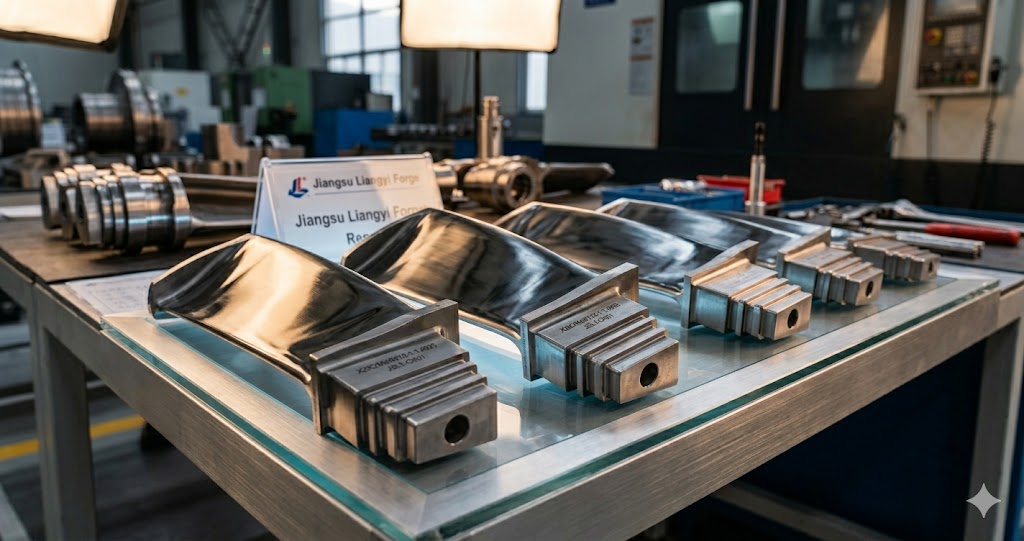
X20CrMoWV12-1 (1.4935) forged gas turbine blades for power generation applications
With over 25 years of specialized manufacturing experience, we have become a trusted strategic partner to customers in more than 50 countries across Asia, Europe, North America, South America, Africa and Oceania. Our X20CrMoWV12-1 (1.4935) forged parts are globally renowned for their exceptional creep resistance, superior high-temperature strength and extended service life in the most demanding industrial environments.
Available Shapes and Custom Forms
We manufacture X20CrMoWV12-1 (1.4935) forging steel materials in a comprehensive range of shapes and sizes:
- Forged steel round bars (up to 2,000 mm diameter), square bars, flat bars, rectangular bars and rods
- Seamless rolled rings (up to 6,000 mm diameter) and custom forged rings
- Hubs, housing shells, sleeves, bushes, bushing cases and hollow bars (up to 3,000 mm OD)
- Discs, disks, blocks and plates (up to 3,000 mm diameter)
- Pipes, tubes, piping shells, casings, case barrels and housings
- Custom forged components according to your precise drawings and specifications (DXF / DWG / STEP accepted)
What Is X20CrMoWV12-1 (1.4935)?
X20CrMoWV12-1 (1.4935) is a martensitic creep-resistant stainless steel standardized under EN 10302-2008 ("Creep-Resisting Steels, Nickel and Cobalt Alloys"). The numeral designation "1.4935" is the identical material expressed as the EN material number. The steel features a tempered martensitic matrix with a fine, uniform distribution of complex M₂₃C₆ and MC carbides — primarily chromium, molybdenum and vanadium carbides — precipitated within the grain boundaries and lath boundaries of the martensitic structure. This carbide dispersion acts as an effective barrier to dislocation movement at elevated temperatures, which is the fundamental mechanism behind the outstanding creep resistance this grade delivers up to 580 °C.
The designation "X20CrMoWV12-1" encodes the alloy chemistry directly: the prefix X denotes a stainless steel (Cr ≥ 10.5%), 20 represents approximately 0.20% nominal carbon, Cr indicates chromium as the primary alloying element at approximately 12%, Mo denotes molybdenum, W denotes tungsten, V denotes vanadium, and the suffix 12-1 indicates the chromium and molybdenum multipliers respectively. This naming convention follows EN ISO 4948-2 and provides a direct window into the alloy's composition to any experienced metallurgist.
The tungsten (W) addition — at 0.4–0.6% — is the single most important differentiating feature of this grade versus the otherwise comparable X22CrMoV12-1 (1.4923). Tungsten substitutes partially for molybdenum in the solid solution and also forms stable WC-type carbides, both of which contribute to higher creep strength and a broader service temperature window. This is why X20CrMoWV12-1 (1.4935) is consistently specified by gas turbine designers when operating temperatures approach or exceed 550 °C, where grades without tungsten begin to lose significant creep strength.
Microstructural Background
In the quenched-and-tempered condition, the microstructure of X20CrMoWV12-1 (1.4935) consists of tempered martensite with prior austenite grain boundaries clearly defined. The prior austenite grain size is controlled during forging by careful management of forging reduction ratio and finish-forging temperature (see Forging Process Parameters below). A finer prior austenite grain (ASTM grain size number ≥ 6) is generally preferred for turbine blade applications because it improves both impact toughness and short-term tensile ductility, while the carbide distribution — not grain size — governs long-term creep performance.
During long-term high-temperature service, X20CrMoWV12-1 undergoes controlled, predictable microstructural evolution: the M₂₃C₆ carbides coarsen gradually, reducing the pinning pressure on sub-grain boundaries. This is the primary metallurgical mechanism of creep acceleration at the end of service life and is the basis for design engineers specifying an economical 100,000-hour design life for this grade in power plant applications.
Chemical Composition of X20CrMoWV12-1 (EN 10302-2008)
All X20CrMoWV12-1 (1.4935) forgings produced by Jiangsu Liangyi conform strictly to the chemical composition limits defined in EN 10302-2008. Our incoming ingot chemistry is verified by optical emission spectrometry (OES) and confirmed on the finished forging prior to shipment. The table below lists the full compositional specification with the metallurgical rationale for each element:
| Element | Symbol | EN 10302-2008 Range (%) | Typical Aim (%) | Metallurgical Role |
|---|
| Carbon | C | 0.17 – 0.24 | 0.20 | Forms M₂₃C₆ and MC carbides; controls martensite hardness and hardenability |
| Chromium | Cr | 11.0 – 12.5 | 11.8 | Primary solid-solution strengthener; provides oxidation and corrosion resistance in steam/gas environments; enters M₂₃C₆ carbides |
| Molybdenum | Mo | 0.8 – 1.2 | 1.0 | Solid-solution strengthener at high temperature; retards carbide coarsening; improves hardenability and temper resistance |
| Manganese | Mn | 0.3 – 0.8 | 0.5 | Deoxidizer during steelmaking; improves hardenability; excessive Mn degrades weldability |
| Nickel | Ni | 0.3 – 0.8 | 0.5 | Stabilizes austenite during austenitizing, offsetting the strong ferrite-forming tendency of high Cr; improves low-temperature toughness of tempered martensite |
| Tungsten | W | 0.4 – 0.6 | 0.50 | Solid-solution strengthener with very low diffusivity at high temperatures; retards M₂₃C₆ coarsening; primary differentiator from 1.4923 — significantly improves creep rupture strength above 530°C |
| Silicon | Si | 0.1 – 0.5 | 0.30 | Deoxidizer; improves oxidation resistance at elevated temperature; excessive Si reduces toughness |
| Vanadium | V | 0.2 – 0.35 | 0.28 | Forms fine MC-type vanadium carbides and nitrides; strong grain refiner; precipitate hardener contributing to creep resistance; synergistic with nitrogen |
| Nitrogen | N | 0.02 – 0.04 | 0.03 | Stabilizes vanadium as V(C,N) nitrocarbides, enhancing their thermal stability and precipitation strengthening contribution |
| Phosphorus | P | ≤ 0.025 | ≤ 0.015 | Controlled impurity; segregates to prior austenite grain boundaries, embrittling the steel if excessive; vacuum degassing keeps P low |
| Sulfur | S | ≤ 0.015 | ≤ 0.005 | Controlled impurity; forms MnS inclusions affecting fatigue and impact toughness; desulfurization in LF refining minimizes S content |
| Iron | Fe | Balance (~83 – 86.7) | Balance | Base metal of the BCC/BCT martensitic matrix |
Note: All heat chemistry verified by OES at Jiangsu Liangyi. ESR (electroslag remelted) grade ingots achieve even tighter compositional homogeneity and reduced inclusion content for the most critical applications.
Room-Temperature Mechanical Properties of 1.4935 Forgings
Our 1.4935 forging steel rings, bars and discs are precision quench-and-tempered to achieve the following room-temperature (20 °C) mechanical properties per EN 10302-2008. Values apply to test specimens machined from the forging body after full heat treatment to the specified delivery condition. Jiangsu Liangyi's internal targets are set conservatively within the specification to provide a meaningful buffer against the lower-bound limits:
| Mechanical Property | Test Method | +QT700 Condition | +QT800 Condition | Typical Jiangsu Liangyi Value |
|---|
| Tensile Strength (Rm) | EN ISO 6892-1 | 700 – 850 MPa | 800 – 950 MPa | 820 / 900 MPa (QT700 / QT800) |
| 0.2% Proof Strength (Rp0.2) | EN ISO 6892-1 | ≥ 500 MPa | ≥ 600 MPa | ~550 / ~660 MPa |
| Elongation at Fracture (A) | EN ISO 6892-1 | 15 – 16% | ≥ 14% | ~17% / ~15% |
| Reduction of Area (Z) | EN ISO 6892-1 | ≥ 40% | ≥ 35% | ~50% / ~45% |
| Impact Toughness (KV, 20°C) | EN ISO 148-1 | ≥ 34 J | ≥ 27 J | ~55 J / ~40 J |
| Hardness (Brinell) | EN ISO 6506-1 | 220 – 260 HBW | 250 – 285 HBW | ~240 / ~270 HBW |
Typical values are indicative references based on Jiangsu Liangyi's production experience and are not contractual. Certified values are provided in the EN 10204 3.1 Mill Test Certificate supplied with each forging.
High-Temperature Mechanical Properties of X20CrMoWV12-1 (1.4935)
For engineering design of components operating at elevated temperatures, room-temperature mechanical properties alone are insufficient. The following short-term high-temperature tensile properties are essential for stress analysis of gas and steam turbine components. Values below are reference indicative data for the +QT800 delivery condition — the condition most commonly specified for gas turbine applications — and represent the range documented in materials literature and our production experience with this grade:
| Test Temperature (°C) | 0.2% Proof Strength Rp0.2 (MPa) | Tensile Strength Rm (MPa) | Elongation A (%) | Reduction of Area Z (%) |
|---|
| 20 (room temp.) | ≥ 600 | 800 – 950 | ≥ 14 | ≥ 35 |
| 300 | ~490 – 510 | ~720 – 780 | ~16 | ~52 |
| 400 | ~440 – 460 | ~660 – 720 | ~17 | ~55 |
| 450 | ~415 – 435 | ~630 – 690 | ~17 | ~56 |
| 500 | ~370 – 395 | ~580 – 640 | ~18 | ~57 |
| 530 | ~345 – 365 | ~555 – 615 | ~18 | ~58 |
| 550 | ~315 – 345 | ~520 – 580 | ~19 | ~59 |
| 580 | ~270 – 305 | ~475 – 535 | ~20 | ~61 |
| 600 | ~230 – 265 | ~430 – 490 | ~21 | ~63 |
Reference indicative values for +QT800 condition, longitudinal test direction, based on EN 10302-2008 and published materials data. Actual certified values vary with specific heat treatment parameters and forging section size. Always request certified elevated-temperature test data for structural calculations.
Engineering Note — Proof Strength Anomaly: Like most martensitic creep-resistant steels, X20CrMoWV12-1 (1.4935) exhibits a proof strength decrease that begins gradually above 250 °C. Designers should not extrapolate room-temperature Rp0.2 linearly to operating temperature. The values above confirm that at 550 °C — a common operating temperature for high-pressure steam turbine blades — Rp0.2 retains approximately 53–57% of the room-temperature value, which is substantially better than carbon and low-alloy steels, and comparable to more expensive austenitic grades for this specific temperature range.
Elastic Modulus vs. Temperature
The elastic modulus of X20CrMoWV12-1 (1.4935) decreases with increasing temperature. This is important for calculating thermal stress and natural frequency in turbine designs:
| Temperature (°C) | 20 | 200 | 300 | 400 | 500 | 550 | 580 |
|---|
| Elastic Modulus E (GPa) | ~216 | ~206 | ~198 | ~190 | ~180 | ~174 | ~169 |
Reference indicative values. E varies slightly with heat treatment condition and exact composition.
Creep & Long-Term Rupture Strength of X20CrMoWV12-1 (1.4935)
Creep rupture strength — the stress that causes fracture after a defined time at a specific temperature — is the most critical design parameter for X20CrMoWV12-1 (1.4935) in turbine applications. Power plant designers typically specify the 100,000-hour (approx. 11.4 years) rupture strength as their primary creep design criterion, allowing components to achieve a 30-year service life with appropriate safety factors.
The tungsten addition in X20CrMoWV12-1 (1.4935) provides a measurable and consistent advantage in 100,000-hour rupture strength compared to tungsten-free 12% Cr grades. Tungsten's very low diffusivity in the iron matrix means it remains in solid solution and in stable tungsten-containing carbides far longer than molybdenum alone, effectively slowing the rate of substructure recovery and carbide coarsening that governs tertiary creep.
100,000-Hour Creep Rupture Strength
| Temperature (°C) | 100,000-h Rupture Strength (MPa) | 1,000-h Rupture Strength (MPa, ref.) | 10,000-h Rupture Strength (MPa, ref.) |
|---|
| 480 | ~190 – 210 | ~280 – 310 | ~230 – 250 |
| 500 | ~155 – 175 | ~240 – 265 | ~195 – 215 |
| 520 | ~120 – 140 | ~200 – 225 | ~160 – 180 |
| 540 | ~88 – 102 | ~160 – 180 | ~125 – 140 |
| 560 | ~62 – 78 | ~125 – 142 | ~93 – 108 |
| 580 | ~45 – 58 | ~95 – 112 | ~68 – 82 |
| 600 | ~30 – 42 | ~68 – 82 | ~48 – 60 |
Reference indicative values for +QT800 condition based on published creep data and Larson-Miller extrapolation. Actual values depend on exact chemistry within specification, heat treatment, section size and forging reduction ratio. Certified long-term creep data from accredited labs can be provided for specific projects upon request.
Practical Design Guidance: At 550 °C — a representative main-steam temperature for modern ultra-supercritical (USC) power plants — the 100,000-hour rupture strength of X20CrMoWV12-1 (1.4935) is approximately 68–80 MPa. Applying a typical safety factor of 1.5, the allowable design stress is approximately 45–53 MPa. For a steam turbine rotor disc operating at this temperature, this equates to a substantial load-carrying capability while remaining well within the safe operating envelope for a full 100,000-hour design life. This is why X20CrMoWV12-1 has remained a trusted specification for power generation OEMs for over four decades without being fully displaced by newer, more expensive grades.
Creep Rate Parameters
For finite element creep analysis, the minimum creep rate of X20CrMoWV12-1 (1.4935) follows the Norton power law: ε̇min = A · σn · exp(−Q/RT), where the stress exponent n is approximately 8–12 at 550–580 °C and the activation energy Q is approximately 350–400 kJ/mol. These parameters are characteristic of dislocation-controlled creep in the martensitic matrix with subgrain boundary precipitation strengthening. Specific Norton law constants calibrated to the required temperature range are available from Jiangsu Liangyi's technical team upon request for FEA projects.
Physical & Thermal Properties of X20CrMoWV12-1 (1.4935)
The following physical and thermal properties are essential for thermal stress analysis, heat conduction modeling, thermal fatigue calculations and vibration/natural frequency analysis of turbine parts that are made from X20CrMoWV12-1 (1.4935). Values are provided as a function of temperature where relevant, since all these properties are temperature-dependent in steels:
Density
| Temperature (°C) | 20 | 200 | 400 | 500 | 580 |
|---|
| Density (g/cm³) | 7.75 | 7.71 | 7.65 | 7.61 | 7.57 |
Thermal Conductivity
X20CrMoWV12-1 (1.4935) has moderate thermal conductivity — significantly lower than plain carbon steel but higher than austenitic stainless steels. This is important for thermal gradient calculations in thick-section forgings during heat treatment and service startup/shutdown cycles:
| Temperature (°C) | 20 | 100 | 200 | 300 | 400 | 500 | 580 |
|---|
| Thermal Conductivity λ (W/m·K) | ~25.0 | ~25.8 | ~26.5 | ~27.0 | ~27.3 | ~27.5 | ~27.2 |
Thermal conductivity of 12% Cr martensitic steels increases slightly with temperature up to approximately 500–550 °C, unlike austenitic grades which show the opposite trend. This behavior benefits thick-section heat treatment by reducing temperature gradients during heating.
Coefficient of Thermal Expansion (CTE)
The CTE of X20CrMoWV12-1 is much lower than that of austenitic steels (about 16–17 × 10⁻⁶/K). This is a big plus when designing bolted flanges and mixed-material assemblies in turbines where differential thermal expansion needs to be kept to a minimum:
| Temperature Range (°C) | 20–100 | 20–200 | 20–300 | 20–400 | 20–500 | 20–580 |
|---|
| Mean CTE α (×10⁻⁶/K) | ~10.3 | ~10.8 | ~11.2 | ~11.5 | ~11.8 | ~12.0 |
Specific Heat Capacity
| Temperature (°C) | 20 | 200 | 300 | 400 | 500 | 580 |
|---|
| Specific Heat cp (J/kg·K) | ~460 | ~490 | ~510 | ~530 | ~560 | ~585 |
Summary of Key Physical Properties at 20 °C
| Property | Symbol | Value at 20 °C | Unit |
|---|
| Density | ρ | 7.75 | g/cm³ |
| Elastic Modulus (Young's Modulus) | E | ~216 | GPa |
| Shear Modulus | G | ~83 | GPa |
| Poisson's Ratio | ν | ~0.30 | — |
| Thermal Conductivity | λ | ~25.0 | W/(m·K) |
| Specific Heat | cp | ~460 | J/(kg·K) |
| Mean CTE (20–500°C) | α | ~11.8 × 10⁻⁶ | K⁻¹ |
| Thermal Diffusivity | a | ~7.0 × 10⁻⁶ | m²/s |
| Electrical Resistivity | ρe | ~0.70 | μΩ·m |
| Magnetic Permeability | μr | Ferromagnetic (martensitic) | — |
All values are reference indicative data. Temperature-dependent property datasets for FEA input can be provided by Jiangsu Liangyi's technical team on request.
Heat Treatment Parameters for X20CrMoWV12-1 (1.4935)
Correct heat treatment is fundamental for X20CrMoWV12-1 (1.4935) forgings to achieve the specified mechanical properties and microstructure. Jiangsu Liangyi has ten dedicated heat treatment furnaces with computer-controlled temperature uniformity of ±10 °C throughout the furnace chamber, ensuring every forging has repeatable and fully traceable heat treatment. The following parameters represent our qualified and validated process routes:
Soft Annealing (Optional Pre-Treatment)
If intermediate machining or forming operations are required before final heat treatment, soft annealing can be applied to improve machinability:
- Temperature: 750 – 800 °C
- Hold time: 2–4 hours minimum, depending on section thickness
- Cooling: Slow furnace cooling at ≤ 20 °C/hour to ≤ 600 °C, then air cooling
- Resulting hardness: Approximately 200–230 HBW
Normalizing (Alternative Pre-Treatment for Grain Refinement)
- Temperature: 1,050 – 1,080 °C
- Hold time: 1 hour per 100 mm of section thickness, minimum 2 hours
- Cooling: Air cooling
- Purpose: Dissolves carbides, refines prior austenite grain before Q+T
Quench and Temper — Standard Final Heat Treatment
01
Austenitizing (Hardening)
Temperature: 1,020–1,070 °C. Hold time: 1 h per 100 mm section thickness (min 2 h). Achieves full carbide dissolution and uniform austenite.
02
Quenching
Medium: Oil quench (preferred) or forced air / polymer for large sections. The martensitic transformation begins at Ms ≈ 280–300 °C and is complete by Mf ≈ 100–130 °C.
03
Intermediate Temper (Optional)
For heavy sections (> 300 mm): temper at 200–250 °C for 2 h immediately after quench to prevent quench cracking before final tempering.
04
Final Tempering
+QT700: 760–800 °C. +QT800: 730–760 °C. Hold 2 h minimum per 100 mm (min 4 h). Air cool. Precipitates M₂₃C₆ and MC carbides, sets final mechanical properties.
Critical Tempering Temperature Rule: The tempering temperature for X20CrMoWV12-1 must always be set at least 30 °C above the maximum anticipated service temperature. For components operating at 580 °C, the minimum tempering temperature is therefore 610 °C. However, since 730 °C is the standard lower bound for the +QT800 condition, this constraint is automatically satisfied for all standard power generation applications.
Heat Treatment Traceability at Jiangsu Liangyi
Every heat treatment cycle is logged by our computerized furnace control system, recording furnace temperature vs. time curves, thermocouple positions relative to the forging, atmosphere conditions and operator identification. These records are retained for a minimum of 15 years and form part of the traceability package provided with EN 10204 3.1 and 3.2 certificates. Third-party witnessed heat treatment is available upon request.
Weldability of X20CrMoWV12-1 (1.4935) — Procedure & Requirements
X20CrMoWV12-1 (1.4935) is weldable, but it is classified as a conditionally weldable steel due to its high carbon content (0.17–0.24%) and strong hardenability. Without proper procedure control, the heat-affected zone (HAZ) can develop brittle untempered martensite and cold cracks from hydrogen-induced cracking (HIC), particularly in thick sections. The following procedure controls are mandatory for sound welds:
Pre-Weld Requirements
- Preheat temperature: 200–300 °C. For sections thicker than 20 mm or high restraint joints, use 250–350 °C. Measured by contact thermometer at 75 mm from the weld edge on both sides.
- Minimum interpass temperature: Equal to preheat temperature (do not allow the joint to cool below preheat between passes).
- Maximum interpass temperature: 350 °C. Exceeding this risks excessive grain growth in the HAZ and reduction in toughness.
- Hydrogen-controlled consumables mandatory: Low-hydrogen or vacuum-dried electrodes and wire must be used. Target weld metal diffusible hydrogen ≤ 5 ml/100 g (HD5 classification per ISO 3690).
Filler Metal Selection
| Joint Type | Recommended Filler Class | AWS / EN Classification (Example) | Notes |
|---|
| X20CrMoWV12-1 to X20CrMoWV12-1 (like-to-like) | Matching martensitic 12% Cr type | AWS E502-XX / EN ISO 14341: G Z 12 2 KN | Best property match; requires full PWHT |
| X20CrMoWV12-1 to X22CrMoV12-1 (similar grade) | Matching or transitional martensitic | AWS E502-XX or ER410NiMo | PWHT mandatory; verify HAZ toughness |
| X20CrMoWV12-1 to austenitic stainless (dissimilar) | Nickel-base alloy 82/182 or 625 | AWS ENiCrFe-3 / ENiCrMo-3 | Butter layer on ferritic side recommended; no PWHT option possible |
| X20CrMoWV12-1 to carbon/low-alloy steel (dissimilar) | Nickel-base or transitional austenitic | AWS ENiCrFe-2 / E309L | Buttering technique; check dilution; PWHT at lower end of range |
Post-Weld Heat Treatment (PWHT)
PWHT is mandatory for all structural welds in X20CrMoWV12-1 (1.4935). Failure to apply PWHT leaves the HAZ in an untempered or partially tempered martensitic condition, which is inherently brittle and susceptible to delayed hydrogen cracking. PWHT parameters:
- PWHT temperature: 730–760 °C (must remain below original tempering temperature to avoid strength reduction)
- Hold time: Minimum 2 hours for sections up to 50 mm; add 1 hour per additional 25 mm of thickness; minimum 4 hours total for any section
- Heating rate: ≤ 80 °C/hour above 300 °C to prevent thermal shock in restrained assemblies
- Cooling rate: ≤ 80 °C/hour to ≤ 400 °C, then air cooling
- Post-PWHT inspection: UT and/or MT on all welds after PWHT and full cool-down
Welding Processes
The following welding processes are qualified for X20CrMoWV12-1 (1.4935) in accordance with EN ISO 15614-1:
- SMAW (111) — Most common for on-site and repair welding; use low-hydrogen electrodes dried at 300–350 °C for 1 hour minimum before use
- TIG/GTAW (141) — Preferred for root passes and precision work; use argon or Ar/He shielding gas; purge backing with argon on pipe welds
- SAW (121) — Used for thick-section butt welds in fabrication shop conditions; high productivity
- FCAW (136) — Applicable with appropriate metal-cored wires; ensure hydrogen content compliance
Forging Process Parameters for X20CrMoWV12-1 (1.4935)
The forging process window for X20CrMoWV12-1 (1.4935) is well-defined but requires strict discipline due to the steel's sensitivity to forming temperature, reduction ratio and post-forging cooling. The following parameters are based on Jiangsu Liangyi's 25+ years of production experience with this specific grade, validated through systematic metallographic examination and mechanical testing of production forgings:
Ingot Preparation & Pre-Heating
- Ingot homogenization (if applicable): 1,150–1,200 °C for 10–20 hours (ESR ingots require less homogenization due to inherently better compositional uniformity)
- Charge temperature for forging furnace: ≤ 650 °C (cold charge) — never charge cold ingots directly into high-temperature furnaces as thermal shock can initiate surface cracks in the high-chromium martensitic structure
- Heating rate: ≤ 80 °C/hour from charge to 750 °C; then free rate to forging temperature. For ESR-grade ingots > 5 tons, maintain ≤ 60 °C/hour below 600 °C
- Forging temperature: 1,100–1,150 °C (optimal window); maximum 1,180 °C (incipient melting boundary for this composition)
- Minimum hold at forging temperature before starting to forge: 1 hour per 100 mm of effective section diameter
Forging Temperature Control
| Parameter | Value | Critical Reason |
|---|
| Maximum forging start temperature | 1,130 °C | Above this, rapid grain growth occurs; grain size ASTM < 4 may develop, degrading toughness irreversibly |
| Optimal forging temperature range | 1,000 – 1,100 °C | Best combination of forgeability (resistance reduction) and grain refinement |
| Minimum finish forging temperature | 950 °C (standard) / 1,000 °C (critical parts) | Below 950 °C, austenite partially transforms to ferrite during forging — delta ferrite bands form, causing anisotropy in mechanical properties |
| Surface temperature monitoring | Pyrometer + operator judgment | Surface cools faster than core; pyrometer reading should be ≥ 1,000 °C before final reduction passes |
| Re-heating during forging | Permitted; max 2–3 re-heats | Each re-heat cycle at austenitizing temperature contributes to grain coarsening; minimize number of re-heats for large-diameter forgings |
Forging Reduction Ratio Requirements
The forging reduction ratio (FRR) — the ratio of original cross-sectional area to final cross-sectional area — directly controls the degree of ingot segregation breakdown, inclusion refinement and mechanical property isotropy in the final forging:
| Application Category | Minimum FRR | Recommended FRR | Jiangsu Liangyi Standard |
|---|
| General industrial components | 3:1 | 4:1 | ≥ 4:1 |
| Power generation turbine components | 4:1 | 5:1 | ≥ 5:1 |
| Gas turbine blade flat bars (critical) | 5:1 | 6:1 – 8:1 | ≥ 6:1 from EAF ingot; ≥ 5:1 from ESR ingot |
| ESR-grade critical forgings | 4:1 | 5:1 | ≥ 5:1 |
ESR ingots start with a significantly cleaner, more homogeneous microstructure than conventional EAF ingots, which is why a lower reduction ratio can achieve equivalent cleanliness and isotropy in the final forging.
Post-Forging Cooling
Critical: X20CrMoWV12-1 (1.4935) must never be air-cooled rapidly or left unprotected after the last forging reduction. The high hardenability of this grade means even moderately rapid air cooling from above the Ar3 temperature (~820–850 °C) can produce hard, brittle, untempered martensite with high residual stresses — leading to quench cracking in thick sections. Post-forging protocol:
- Immediately after final forging pass: transfer to pre-heated furnace at 750–800 °C
- Hold at 750–800 °C for a minimum of 4 hours (slow cool / sub-critical anneal)
- Furnace cool at ≤ 30 °C/hour to ≤ 400 °C
- Air cool to room temperature after 400 °C
- Forgings are then ready for rough machining and dimensional inspection before final Q+T heat treatment
Dimensional Tolerances on As-Forged Parts
Jiangsu Liangyi maintains the following standard as-forged dimensional tolerances for X20CrMoWV12-1 (1.4935) open die forgings, which are consistent with or tighter than DIN EN 10243-1:
- Round bars and shafts: +3% / −1% of nominal diameter for diameters up to 500 mm; +4% / −1% above 500 mm
- Flat bars and plates: +5 mm / −0 mm on thickness; +3% / −0% on width
- Seamless rings: OD +1.5% / −0%; ID −1.5% / +0%; height +10 mm / −0 mm
- Custom profiles: Tolerance negotiated per drawing; typical machining allowance 10–30 mm per side depending on section size
International Equivalent Grades of X20CrMoWV12-1 (1.4935)
Engineers and procurement teams worldwide often search for X20CrMoWV12-1 equivalents by their national standard designation. The following table lists the closest equivalent or directly comparable grades in major international standards systems. Important caveat: no grade in any other standard system is a perfect composition-for-composition match to X20CrMoWV12-1 (1.4935) per EN 10302-2008. The tungsten addition (W 0.4–0.6%) is the unique defining feature of this grade and is not replicated in all national equivalents. Always verify actual chemistry against the EN 10302-2008 specification when substituting.
| Country / Region | Standard | Grade Designation | Composition Match Level | Key Differences vs. EN 1.4935 |
|---|
| 🇩🇪 Germany (EU) | EN 10302-2008 / DIN | X20CrMoWV12-1 / 1.4935 | Identical ✓ | None — this IS the reference standard |
| 🇺🇸 USA | ASTM / UNS | Grade 422 / S42200 | Close — similar intent | S42200 contains 0.75–1.25% W and 0.75–1.25% Mo but C is 0.20–0.25% and Cr is 11.5–13.5%; no N specified; properties similar but not identical |
| 🇷🇺 Russia | GOST 5632 | 20Х12ВНМФ (20Kh12VNMF) | Close equivalent | Cr slightly broader (11.0–13.0%), Mo 0.35–0.60% (lower than EN), W 0.70–1.10% (higher); no N specified; composition engineering is similar but not identical |
| 🇯🇵 Japan | JIS G4311 / G4312 | SUH 616 | Approximate equivalent | SUH 616 is tungsten-bearing 12% Cr heat-resistant steel; C 0.20–0.25%, Cr 11.0–12.5%, Mo 0.75–1.25%, W 0.75–1.25%; generally equivalent for turbine applications but requires chemistry verification |
| 🇨🇳 China | GB/T 1221-2007 | 20Cr12MoWV (approximate) | Approximate equivalent | GB does not have a direct 1:1 equivalent; 20Cr12MoWV is used in domestic power plant practice; always request EN 10302-2008 compliance for export orders from Jiangsu Liangyi |
| 🇬🇧 UK | BS / EN (harmonized) | 1.4935 (EN adopted) | Identical ✓ | UK adopted EN 10302-2008 directly; 1.4935 is the standard designation in British practice |
| 🇫🇷 France | AFNOR / EN (harmonized) | 1.4935 / Z20CDV12 (old AFNOR) | Essentially identical | Old AFNOR Z20CDV12 designation pre-dates EN harmonization; 1.4935 is now the standard French designation |
| 🇸🇪 Sweden | SS / EN (harmonized) | 1.4935 (EN adopted) | Identical ✓ | EN 10302-2008 adopted; old SS 2323 was historically used for similar compositions |
| 🇮🇳 India | IS 6528 | 20Cr12MoWV (similar) | Approximate equivalent | BIS standard follows similar composition philosophy; EN 10302-2008 material certification preferred by Indian power plant engineers for critical forgings |
| International | ISO 4955:2005 | X20CrMoWV12-1 | Identical ✓ | ISO 4955 adopts the EN designation and composition; fully interchangeable |
Note: Jiangsu Liangyi always manufactures to EN 10302-2008 composition specification. Mill test certificates reference EN 10302-2008 as the governing standard. Cross-reference to other national standards is provided for engineering reference only and does not imply material substitutability without independent chemistry verification.
X20CrMoWV12-1 vs. Similar Creep-Resistant Steels — Side-by-Side Comparison
The following comparison helps design engineers and procurement managers make informed material selection decisions. X20CrMoWV12-1 (1.4935) occupies a distinct performance niche: higher temperature capability than X22CrMoV12-1 (1.4923) while remaining more cost-effective than P92 or austenitic grades for applications in the 530–580 °C range:
| Property | X20CrMoWV12-1
1.4935 ★ | X22CrMoV12-1
1.4923 | X19CrMoVNbN11-1
1.4913 | X10CrMoVNb9-1
P91 / 1.7380 | X10CrWMoVNb9-2
P92 / 1.4901 | Austenitic
316L / 1.4404 |
|---|
| Standard | EN 10302-2008 | EN 10302-2008 | EN 10302-2008 | EN 10216-2 | EN 10216-2 | EN 10028-7 |
| Steel Type | Martensitic | Martensitic | Martensitic | Bainitic | Bainitic | Austenitic |
| Chromium (%) | 11.0 – 12.5 | 11.0 – 12.5 | 10.0 – 11.5 | 8.0 – 9.5 | 8.5 – 9.5 | 16.5 – 18.5 |
| Tungsten W (%) | 0.4 – 0.6 | None | None | None | 1.5 – 2.0 | None |
| Max Service Temp. | 580 °C | ~550 °C | ~600 °C | ~600 °C | ~620 °C | ~700 °C |
| Density (g/cm³) | 7.75 | 7.75 | 7.75 | 7.75 | 7.73 | 7.98 |
| Mean CTE (20–500°C, 10⁻⁶/K) | ~11.8 | ~11.8 | ~11.5 | ~11.5 | ~11.2 | ~16.5 |
| Tensile Str. RT (MPa) | 700 – 950 | 700 – 900 | 650 – 850 | 585 – 760 | 620 – 850 | 485 – 690 |
| 100,000 h rupture @ 540°C (MPa) | ~90 – 100 | ~70 – 82 | ~95 – 108 | ~95 – 110 | ~130 – 150 | ~55 – 70 |
| Weldability | Conditional (preheat + PWHT) | Conditional | Conditional | Conditional | Conditional | Good |
| Relative Cost (vs. 1.4935) | Reference (1.0×) | ~0.95× | ~1.05× | ~1.0× | ~1.3–1.5× | ~1.4–1.8× |
| Primary Application | Gas turbine blades, rotor shafts, rings up to 580°C | Turbine blades & discs up to 550°C | Turbine blades, fasteners to 600°C | Steam piping, boiler tubes | USC steam piping, headers | General corrosion resistance |
★ = This material. Relative cost is a general market indication only and varies with global alloy prices, order quantity and specification requirements. The comparison is for engineering reference and does not constitute a recommendation to substitute one grade for another without design engineering review.
Global Applications of X20CrMoWV12-1 (1.4935) Forged Parts
Our X20CrMoWV12-1 (1.4935) forged parts are widely utilized in critical high-temperature applications across multiple strategic industries worldwide. The material's exceptional creep resistance and high-temperature strength make it the ideal choice for components operating in demanding environments up to 580°C.
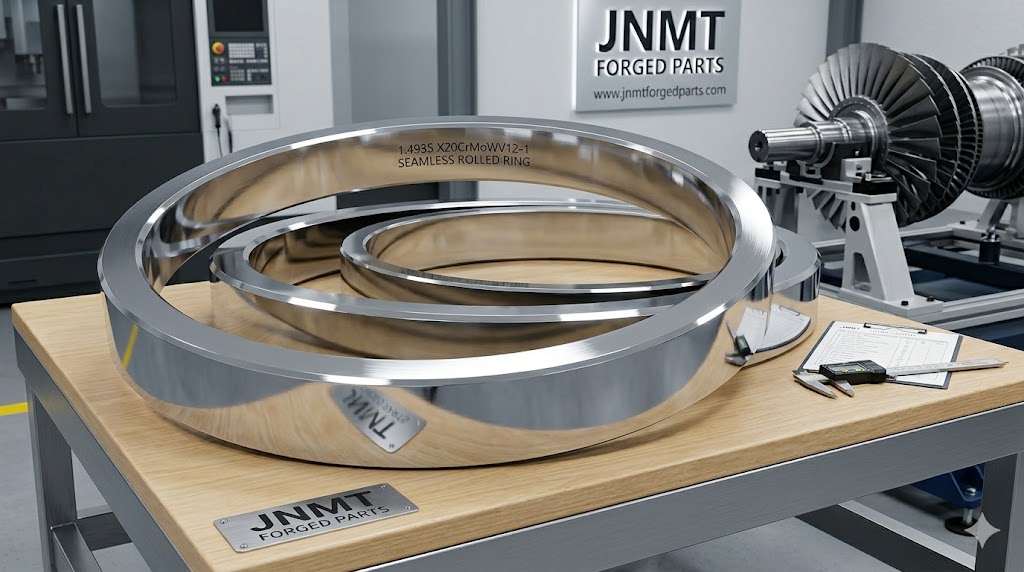
1.4935 (X20CrMoWV12-1) seamless rolled forged steel rings for gas and steam turbines
Power Generation (Gas & Steam Turbines)
This is the dominant application area for 1.4935 forging steel. In both gas and steam turbine systems, this grade is specified for:
- Gas and steam turbine blades and vanes (HP, IP and LP stages)
- Gas and steam turbine rotor shafts and spindles
- Gas compressor turbine blades and discs
- Turbine diaphragms, nozzles and guide vanes
- Guide rings, seal rings, labyrinth rings and packing seals
- Gas turbine wheels, discs, impellers and blisks
- LPT (Low Pressure Turbine) 1st & 2nd stage casings
- Steam turbine shrouds, journals and thrust bearings
- Power plant steam turbine control and reheat valve discs
- MSV/GV/CV/CRV valve seats, valve cores, valve sleeves and spools
- Main steam valve covers, bonnets and sleeves
- Oil guards, nozzle bearing glands and sealing rings
- Inlet guide vane (IGV) control rings and transition ducts
- Inner and outer heat shields
- Double-headed studs, fasteners and bolts for high-temperature service
Oil & Gas Industry
- High-temperature and high-pressure valve components
- Wellhead equipment and Christmas tree parts
- Compressor components for natural gas processing
- Heat exchanger parts and pressure vessel components
Aerospace & Defense
- Aircraft engine components operating up to 580°C
- Gas turbine components for military aircraft
- Missile and rocket engine structural parts
Other Industrial Applications
- Industrial furnace components and conveyor systems
- Heat treatment equipment parts and fixtures
- Chemical processing equipment in high-temperature service
- Marine propulsion systems and naval vessel components
Global Regional Supply References
- Asian Thermal Power Plants: Supplied over 800 sets of X20CrMoWV12-1 turbine blades and rotor shafts for 300MW, 600MW and 1000MW steam turbine units in China, India, Japan and South Korea
- European Combined Cycle Power Stations: Provided 1.4935 forged rings and valve components for Siemens and GE gas turbine systems operating at 550–580°C in Germany, France, Italy and Spain
- North American Power Generation: Delivered custom X20CrMoWV12-1 valve seats and spindles for high-pressure steam control systems in the United States and Canada
- Middle East Oil & Gas Projects: Supplied 1.4935 seamless rolled rings and fasteners for natural gas processing plants and refineries in Saudi Arabia, UAE and Qatar
- Australian Mining & Power: Provided X20CrMoWV12-1 forged discs and shafts for power generation and mining equipment in Australia and New Zealand
- South American Industrial Projects: Delivered custom 1.4935 turbine components for thermal power plants in Brazil, Argentina and Chile
- African Power Development: Supplied X20CrMoWV12-1 forged parts for new power plant construction projects in South Africa, Nigeria and Egypt
- Global Gas Turbine OEMs: Tier 1 supplier to leading gas turbine manufacturers worldwide, providing precision 1.4935 forged components for standard and custom product lines
China X20CrMoWV12-1 Forging Manufacturing Capabilities
At Jiangsu Liangyi, we maintain complete control over the entire production process — from raw material melting to final inspection and precision machining — ensuring the highest quality standards for every X20CrMoWV12-1 (1.4935) forged part we produce. Our state-of-the-art manufacturing facilities in Jiangyin, Jiangsu Province are equipped with the most advanced forging, heat treatment and inspection technology available today.
Advanced Melting & Refining Equipment
Our melting facilities produce ultra-high-quality 1.4935 steel ingots with precise chemical composition control and minimal inclusion content:
- 60 t Electric Arc Furnace (EAF) with 40 MVA power — primary melting
- 2 Ladle Furnaces (LF) for secondary refining, alloying adjustment and temperature homogenization
- 2 Tank Degassing VD-VOD type units for hydrogen removal (target H < 2 ppm) and nitrogen control
- Bottom-pouring pits for superior ingot solidification quality and minimized macrosegregation
- ESR (Electroslag Remelting) Plant — maximum capacity 32 t — for ultra-high quality critical turbine blade and aerospace applications requiring maximum cleanliness, inclusion rating and compositional homogeneity
Forging Equipment
Our forging equipment can produce X20CrMoWV12-1 forgings up to 30 tons with exceptional dimensional precision:
- 2,000 Ton, 4,000 Ton and 6,300 Ton Hydraulic Open Die Forging Presses
- 0.75T, 1T, 3T, 5T and 9T Electro-Hydraulic Forging Hammers
- 1 Meter and 5 Meter Radial-Axial Seamless Ring Rolling Machines (rings up to 6,000 mm OD)
- Ten fully computer-controlled Heat Treatment Furnaces (±10 °C temperature uniformity)
- CNC machining centers for rough and finish machining to tight tolerances
Complete In-House Services
- Custom forging design review, DFM (design for manufacturability) analysis and engineering support
- FEM simulation support for forging process optimization on request
- Full heat treatment services — quenching, tempering, normalizing, annealing, stress relieving
- CNC turning, milling and grinding to finished dimensions
- Comprehensive NDT: UT, MT, PT, VT, hardness testing, OES spectrometry
- Complete mill test certificates (EN 10204 3.1 standard / 3.2 upon request)
- Third-party inspection support — BV, SGS, TUV, DNV, Lloyds and others
- International export packaging and logistics coordination
Rigorous Quality Assurance for 1.4935 Forged Parts
Quality is our absolute top priority at Jiangsu Liangyi. We implement a comprehensive quality management system in strict accordance with ISO 9001:2015 standards, and every X20CrMoWV12-1 forged part undergoes rigorous multi-stage inspection and testing.
Non-Destructive Testing (NDT) Standards Applied
- 100% Visual inspection of all forged surfaces per EN ISO 10228-1
- 100% Ultrasonic testing (UT) per SEP 1923 (D3/D2, dual crystal search unit), ASTM A388 or customer specification. For turbine blade flat bars: SEP 1923 quality class 2b with zero tolerance for EE/VE echoes ≥ 2mm KSR
- Magnetic Particle testing (MT) per EN ISO 17638 / ASTM A275 for surface and near-surface defects
- Liquid Penetrant testing (PT) per EN ISO 3452 / ASTM E165 for surface-open defects
- Hardness testing at minimum 3 locations (Brinell, HBW) per EN ISO 6506-1
- Chemical composition analysis by OES (optical emission spectrometry) on each heat
- Mechanical property testing: tensile (EN ISO 6892-1), Charpy impact (EN ISO 148-1), hardness — from test coupon attached to the forging during heat treatment
- Metallographic examination to verify grain size, microstructure, carbide distribution and absence of delta ferrite bands — available upon request for critical orders
Quality Certifications
- ISO 9001:2015 Quality Management System — full scope covering design, manufacturing and inspection
- EN 10204 3.1 Mill Test Certificate — standard with every delivery
- EN 10204 3.2 Certificate — available with witnessed third-party inspection
- API 6A Certification for oil and gas applications
- CE Marking for European pressure equipment directive (PED) compliance
- Third-party inspection approval: Bureau Veritas (BV), SGS, TUV Rheinland, DNV, Lloyds Register, RINA and others
Frequently Asked Questions (FAQ) about X20CrMoWV12-1 (1.4935)
Q: What is the difference between X20CrMoWV12-1 and 1.4935?
A: X20CrMoWV12-1 and 1.4935 are the same material. X20CrMoWV12-1 is the official compositional DIN designation, while 1.4935 is the EN material number per EN 10302-2008. They have completely identical chemical composition and mechanical property requirements. Both terms are interchangeable and appear on the same EN 10204 3.1 mill test certificate.
Q: What is the maximum operating temperature for X20CrMoWV12-1?
A: The maximum continuous operating temperature for X20CrMoWV12-1 (1.4935) is 580°C. For short-term peak excursions, the steel can withstand up to 600°C without permanent damage to microstructure, provided total cumulative time at peak temperature is limited. Above 580°C in continuous service, the 100,000-hour creep rupture strength drops below practical design allowables for most structural applications, making grades like P91 or P92 more appropriate.
Q: What is the chemical composition of X20CrMoWV12-1?
The X20CrMoWV12-1 (1.4935) has the following elements: C 0.17–0.24%, Cr 11.0–12.5%, Mo 0.8–1.2%, Mn 0.3–0.8%, Ni 0.3–0.8%, W 0.4–0.6% (the most important one), Si 0.1–0.5%, V 0.2–0.35%, N 0.02–0.04%, P ≤0.025%, S ≤0.015%, and Fe balance (~83–86.7%). The addition of tungsten (W) is the most important feature that distinguishes this grade from X22CrMoV12-1 (1.4923).
Q: What are the high-temperature mechanical properties of 1.4935 at 550°C?
A: At 550°C in the +QT800 condition, X20CrMoWV12-1 (1.4935) retains a 0.2% proof strength of approximately 315–345 MPa and tensile strength of approximately 520–580 MPa. Elongation increases to approximately 19% and reduction of area to approximately 59%, reflecting the ductility improvement at elevated temperature. These values are indicative references; certified values are confirmed by elevated-temperature testing on request.
Q: What is the 100,000-hour creep rupture strength of X20CrMoWV12-1?
A: The 100,000-hour creep rupture strength of X20CrMoWV12-1 (1.4935) is approximately: 155–175 MPa at 500°C, 120–140 MPa at 520°C, 88–102 MPa at 540°C, 62–78 MPa at 560°C, and 45–58 MPa at 580°C. These values confirm why this grade is preferred over tungsten-free 12% Cr steels for power plant components operating at or above 530°C.
Q: Is X20CrMoWV12-1 (1.4935) weldable?
A: Yes, X20CrMoWV12-1 (1.4935) is weldable but is classified as conditionally weldable due to its carbon content and high hardenability. Strict procedure controls are required: preheat to 200–300°C, maintain interpass temperature below 350°C, use low-hydrogen consumables (HD5 or better), and always perform post-weld heat treatment (PWHT) at 730–760°C for a minimum of 2–4 hours. Without PWHT, the heat-affected zone develops brittle untempered martensite susceptible to hydrogen cracking.
Q: What are the forging temperature limits for 1.4935?
A: For X20CrMoWV12-1 (1.4935) open die forgings: heat to 1,100–1,150°C; maximum start forging temperature is 1,130°C; minimum finish forging temperature is 950°C (1,000°C for critical turbine parts to prevent delta ferrite formation). Minimum forging reduction ratio: 3:1 for general components, 5:1 for turbine applications, 6:1+ for turbine blade flat bars from EAF ingots. After final forging, transfer immediately to a furnace at 750–800°C — never air-cool rapidly, as the steel will form brittle untempered martensite.
Q: What is the density of X20CrMoWV12-1 (1.4935)?
A: The density of X20CrMoWV12-1 (1.4935) is approximately 7.75 g/cm³ (7,750 kg/m³) at 20°C. This is slightly lower than plain carbon steel (~7.85 g/cm³) due to the substitution of iron atoms by lighter elements in the alloy solid solution. The density decreases slightly with increasing temperature, reaching approximately 7.57 g/cm³ at 580°C service temperature.
Q: What international standards govern X20CrMoWV12-1 / 1.4935?
A: X20CrMoWV12-1 (1.4935) is primarily governed by EN 10302-2008 (Creep-Resisting Steels, Nickel and Cobalt Alloys). Ultrasonic testing follows SEP 1923 or ASTM A388. Mill certificates follow EN 10204 3.1/3.2. Equivalent or comparable grades exist under ASTM S42200 (Grade 422), Russian GOST 20Х12ВНМФ, Japanese JIS SUH 616 and ISO 4955. Jiangsu Liangyi manufactures to EN 10302-2008 as the primary reference standard.
Q: Can you produce custom X20CrMoWV12-1 forgings per drawing?
A: Absolutely. Jiangsu Liangyi specializes in custom open die forgings produced to customer drawings and specifications. We accept DXF, DWG and STEP file formats. Our engineering team provides full design-for-manufacturability (DFM) review, material consultation and first-article inspection. Single-piece forgings up to 30 tons and seamless rolled rings up to 6,000 mm diameter are within our standard production capability.
Q: What is the lead time and what certificates are provided?
A: Standard lead time is 4–6 weeks for raw forgings, 6–8 weeks for rough-machined parts and 8–12 weeks for fully machined and NDT-certified components. Every X20CrMoWV12-1 forging is supplied with an EN 10204 3.1 Mill Test Certificate covering heat chemistry, mechanical test results, heat treatment records and NDT report. EN 10204 3.2 certificates with independent third-party witnessed inspection (BV, SGS, TUV, DNV, etc.) are available on request.
Contact Jiangsu Liangyi for X20CrMoWV12-1 Forging Solutions
Jiangsu Liangyi Co., Limited is your reliable China-based partner for high-quality X20CrMoWV12-1 (1.4935) forging and forged steel parts. With our advanced manufacturing facilities, experienced engineering team and unwavering commitment to quality, we provide customized solutions precisely tailored to your specific project requirements and applicable international standards.
Whether you need standard 1.4935 forged bars and rings or complex custom turbine components with ESR-grade material traceability and EN 10204 3.2 certification, we have the capabilities and technical expertise to meet your requirements. We respond to all technical enquiries within 24 hours and provide detailed quotations within 48 hours of receiving your drawings or specifications.
Contact Information
Company: Jiangsu Liangyi Co., Limited
📧 Inquiry Email: sales@jnmtforgedparts.com
📞 Phone / WhatsApp: +86-13585067993
🌐 Website: https://www.jnmtforgedparts.com
📍 Address: Chengchang Industry Park, Jiangyin City, Jiangsu Province, China 214400
📠 Fax: +86-510-86107550
|
Founded |
ISO 9001:2015 Certified | Annual capacity: 120,000 tons