X18CrMnMoNbVN12 (1.4916) Forging Steel | Jiangyin China Manufacturer — Jiangsu Liangyi
Jiangsu Liangyi Co., Limited is an ISO 9001:2015 certified manufacturer of X18CrMnMoNbVN12 (1.4916) open die forgings and forged steel turbine components, located in Jiangyin City, Jiangsu Province — the heart of China's forging industry. With over 25 years of specialized metallurgical expertise, we supply high-integrity 1.4916 forgings to power generation, oil & gas, and petrochemical customers across more than 50 countries.
Our Jiangyin Manufacturing Advantage: Located 100 km from Shanghai Port, we provide fast, cost-efficient global shipping. Our 80,000 m² facility houses 2,000–6,300-ton hydraulic presses, ten computer-controlled heat treatment furnaces, and a fully equipped in-house metallurgical laboratory — all under one roof for zero supply-chain delay.
From EAF/LF/VOD steel melting through precision forging, controlled heat treatment and CNC finish machining, every X18CrMnMoNbVN12 component is manufactured and documented in-house. All products ship with EN 10204 3.1 mill test certificates issued in-house; EN 10204 3.2 co-signed by appointed third-party inspector is available on request.
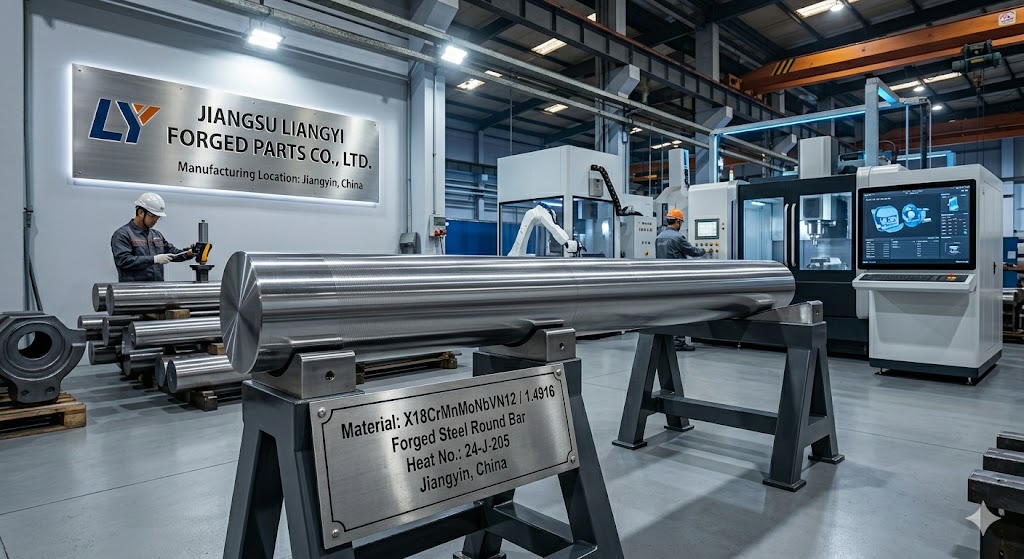
X18CrMnMoNbVN12 (1.4916): Material Overview & Key Advantages
X18CrMnMoNbVN12 (material number 1.4916) is a precipitation-strengthened martensitic stainless steel in the 12% chromium family. Its alloy design combines three synergistic strengthening mechanisms that set it apart from conventional Cr-Mo steels:
Niobium (Nb) Microalloying
Niobium forms fine NbC and NbCN precipitates that pin grain boundaries during forging and heat treatment. This carbide pinning effect delivers a consistently fine austenitic grain size (ASTM 5–7), which translates directly into superior room-temperature impact toughness and resistance to fatigue crack initiation — properties that generic 12Cr steels cannot match.
Vanadium (V) Strengthening
Vanadium contributes thermally stable V(C,N) precipitates that remain coherent with the martensitic matrix up to 620°C. Unlike simple solid-solution strengtheners, these nano-scale precipitates resist coarsening under prolonged service, providing the material's excellent long-term creep resistance and preventing the softening that limits lower-alloyed grades at elevated temperatures.
Nitrogen (N) Solid-Solution Hardening
Interstitial nitrogen in solid solution raises the martensite-start (Ms) temperature and significantly increases the room-temperature yield strength without reducing ductility. Nitrogen also stabilizes the Cr-rich passive layer, enhancing oxidation resistance in steam and flue gas environments up to 650°C — a critical advantage for steam turbine applications where surface oxidation causes material loss and particle contamination.
Balanced Chromium Content (~12%)
At approximately 12% Cr, X18CrMnMoNbVN12 delivers genuine stainless-grade corrosion resistance against steam oxidation, condensate corrosion and mild chloride environments. Grades with lower Cr (such as P91 at ~9%) require external coating or controlled water chemistry to prevent similar oxidation damage — an ongoing operational cost that 1.4916 avoids by design.
Comparative Performance vs. Competing Grades
Engineers selecting materials for high-temperature rotating equipment frequently compare X18CrMnMoNbVN12 (1.4916) against X20Cr13 (1.4021), P91/F91 (9Cr-1Mo-V), and the advanced grade X12CrMoWVNbN10-1-1 (1.4935, P92-type). The table below reflects our in-house comparative testing and publicly documented alloy data, presented from a forging manufacturer's operational perspective.
| Property / Criterion | X18CrMnMoNbVN12 (1.4916) ★ | X20Cr13 (1.4021) | P91 / F91 (9Cr-1Mo-V) | X12CrMoWVNbN10-1-1 (1.4935 / P92-type) |
|---|---|---|---|---|
| Cr Content (%) | 10.0–13.0 | 12.0–14.0 | 8.0–9.5 | 9.0–11.0 |
| Max. Continuous Service Temp. | 600°C | 500°C | 620°C | 650°C |
| Creep Rupture Strength (100,000 h / 550°C) | ≥ 120 MPa | ~60 MPa | ~130 MPa | ~170 MPa |
| Steam Oxidation Resistance | Excellent | Very Good | Moderate | Good |
| Room-Temperature Impact Toughness | Very Good (≥ 47 J) | Moderate | Good (≥ 40 J) | Good (≥ 40 J) |
| Weldability (preheat required) | Good (200–250°C) | Fair (200–300°C) | Good (200–250°C) | Good (200–250°C) |
| Corrosion in Condensate / Chloride | Good | Very Good | Fair — prone to pitting | Fair |
| Best Suited For | Turbine blades, disks, shafts 450–600°C; corrosive steam | Valve spindles, shafts < 500°C; mild corrosion | Ultra-SC boiler tubes & headers > 580°C | USC boiler components > 620°C |
Manufacturer's insight: In our experience supplying forgings to European power utilities, X18CrMnMoNbVN12 is the preferred specification when the service temperature falls between 450°C and 600°C and the steam environment contains trace chlorides or condensate — conditions where P91 shows accelerated pitting and X20Cr13 lacks sufficient creep strength. Above 600°C, P92-type grades become more appropriate.
Available X18CrMnMoNbVN12 (1.4916) Forged Product Shapes & Size Range
Our production capabilities span single-piece weights of 30 kg to 30,000 kg. All standard dimensions are achievable in as-forged, rough-machined (+ machining allowance per EN 10243) or finish-machined condition to your engineering drawings.
Bars & Rods
- Round bars: Ø 50 mm – 2,000 mm
- Square bars: 50 mm – 1,500 mm
- Flat bars: Thk 20 mm – 800 mm
- Rectangular bars: any aspect ratio
- Hollow bars: OD up to 3,000 mm
Rings & Seals
- Seamless rolled rings: OD up to 6,000 mm
- Guide rings & casing rings
- Seal rings & labyrinth rings
- Packing seal & diaphragm rings
- Rotor end rings & contour rings
Turbine Components
- Gas turbine blades & vanes
- Steam turbine disks & blisks
- Turbine rotor shafts up to 15 m
- Valve spindles, stems & rods
- High-temperature fasteners & studs
Other Components
- Discs, plates & blocks
- Hubs, housings & shells
- Sleeves, bushes & casings
- Pipes, tubes & piping shells
- Custom near-net-shape forgings
X18CrMnMoNbVN12 (1.4916) Chemical Composition — EN Standard
The chemical composition below reflects the EN specification limits. At Jiangsu Liangyi, our aim-chemistry targets the center of each range to provide the most balanced combination of creep strength, toughness and weldability. Heat analysis is carried out by optical emission spectrometry (OES) at our in-house metallurgical lab and is reported in every EN 10204 3.1/3.2 MTC.
| Element | Min. (%) | Max. (%) | Role in Alloy Performance |
|---|---|---|---|
| Carbon (C) | 0.15 | 0.20 | Controls martensite hardness and creep strength; too high reduces toughness and weldability |
| Manganese (Mn) | 0.50 | 1.00 | Austenite stabilizer; improves hardenability and hot workability during forging |
| Silicon (Si) | — | 0.50 | Deoxidizer; excessive Si reduces toughness and is limited accordingly |
| Phosphorus (P) | — | 0.04 | Residual tramp element; controlled low to prevent temper embrittlement |
| Sulfur (S) | — | 0.03 | Residual tramp element; low S ensures good transverse impact toughness |
| Chromium (Cr) | 10.0 | 13.0 | Primary corrosion and oxidation resistance; also contributes to solid-solution strengthening |
| Nickel (Ni) | — | 0.60 | Residual; enhances toughness at lower temperatures; kept low to maintain martensite stability |
| Molybdenum (Mo) | 0.30 | 0.90 | Strong solid-solution strengthener at high temperatures; suppresses temper embrittlement |
| Vanadium (V) | 0.10 | 0.40 | Forms stable V(C,N) precipitates that resist coarsening up to 620°C; key to long-term creep strength |
| Niobium (Nb) | 0.20 | 0.60 | Refines austenite grain size via NbC pinning; enhances fatigue resistance and impact toughness |
| Nitrogen (N) | 0.05 | 0.10 | Solid-solution hardener; stabilizes Cr-oxide passive layer; raises yield strength without embrittlement |
X18CrMnMoNbVN12 (1.4916) Room-Temperature Mechanical Properties
All mechanical properties listed below are measured after the full quench-and-temper heat treatment cycle on forged round bars and are guaranteed minimum values per EN 10269. Tests follow EN ISO 6892-1 (tensile) and EN ISO 148-1 (Charpy impact). For cross-sections exceeding 200 cm², properties are verified at both the center and the 1/4-radius position; the permissible variation between positions is ≤ 7.5% for strength values.
| Property | Symbol | Minimum Value | Test Standard |
|---|---|---|---|
| Tensile Strength | Rm | 800 MPa | EN ISO 6892-1 / ASTM E8M |
| 0.2% Proof Strength | Rp0.2 | 550 MPa | EN ISO 6892-1 / ASTM E8M |
| Elongation after fracture | A5 | 20 % | EN ISO 6892-1 / ASTM E8M |
| Reduction of Area | Z | 55 % | EN ISO 6892-1 |
| Charpy V-Notch Impact Energy (longitudinal) | KV | ≥ 47 J (avg 3 specimens) | EN ISO 148-1 at +20°C |
| Brinell Hardness | HB | ≤ 250 HB | EN ISO 6506-1 |
X18CrMnMoNbVN12 (1.4916) High-Temperature Mechanical Properties
For rotating machinery and pressure-bearing components operating at elevated temperatures, room-temperature data alone is insufficient for component design. The tables below present the short-term tensile properties at service temperatures and — critically — the long-term creep rupture data that governs the actual life of turbine disks, rotor shafts and high-pressure valve spindles. All data is derived from standardized testing per EN ISO 6892-2 (elevated temperature tensile) and EN ISO 204 (creep rupture).
Short-Term Tensile Properties at Elevated Temperature
Properties are measured on standard cylindrical specimens machined from the center of forged bars in the quenched-and-tempered condition. Values represent representative minimum expectations for properly heat-treated 1.4916 forgings.
| Test Temperature | Tensile Strength Rm (MPa) | Proof Strength Rp0.2 (MPa) | Elongation A5 (%) | Elastic Modulus E (GPa) |
|---|---|---|---|---|
| Room Temp. (20°C) | ≥ 800 | ≥ 550 | ≥ 20 | ~215 |
| 300°C | ~710 | ~490 | ~17 | ~205 |
| 400°C | ~680 | ~470 | ~17 | ~198 |
| 500°C | ~630 | ~480 | ~16 | ~190 |
| 550°C | ~580 | ~440 | ~14 | ~182 |
| 600°C (max. continuous service) | ~500 | ~380 | ~13 | ~175 |
| 650°C (short-term limit) | ~410 | ~310 | ~13 | ~167 |
Long-Term Creep Rupture Strength
Creep rupture strength is the critical design parameter for turbine components that must sustain stress over the plant lifetime (typically 100,000–200,000 hours). The values below represent the average stress causing rupture at the stated time and temperature, tested in accordance with EN ISO 204. These figures reflect the alloy's exceptional resistance to time-dependent deformation — the primary reason X18CrMnMoNbVN12 commands premium status in the 450–600°C service band.
| Temperature | 10,000 h Creep Rupture Strength (MPa) | 100,000 h Creep Rupture Strength (MPa) | Min. Creep Rate at 100 MPa (% / 1,000 h) |
|---|---|---|---|
| 500°C | ~230 | ~175 | < 0.01 |
| 550°C | ~160 | ~120 | < 0.03 |
| 600°C | ~100 | ~70 | < 0.08 |
| 620°C | ~75 | ~52 | < 0.15 |
Design note: Most turbine OEM specifications for 1.4916 turbine disk forging apply a safety factor of 1.5 to the 100,000-hour creep rupture strength. At 550°C this yields a permissible stress of approximately 80 MPa — comfortably above the typical hoop stress in large-diameter disk forgings operating at that temperature. Our application engineers can assist with creep-life calculations for specific component geometries.
X18CrMnMoNbVN12 (1.4916) Physical & Thermal Properties
Accurate physical property data is essential for thermal stress analysis (FEA), heat transfer modelling, and the design of cooling and sealing systems in turbine assemblies. The following properties are measured on specimens extracted from our production forgings and represent the expected values across commercially produced heat lots.
| Property | Value at 20°C | Value at 300°C | Value at 500°C | Value at 600°C | Unit |
|---|---|---|---|---|---|
| Density (ρ) | 7.75 | 7.72 | 7.67 | 7.63 | g/cm³ |
| Elastic Modulus (E) | 215 | 206 | 190 | 175 | GPa |
| Thermal Conductivity (λ) | 24.0 | 25.5 | 27.0 | 27.5 | W/(m·K) |
| Specific Heat Capacity (cp) | 480 | 510 | 560 | 600 | J/(kg·K) |
| Electrical Resistivity (ρe) | 0.60 | 0.80 | 0.98 | 1.06 | µΩ·m |
| Poisson's Ratio (ν) | 0.28 | 0.29 | 0.30 | 0.31 | — |
Coefficient of Thermal Expansion (CTE)
Thermal expansion data is critical when X18CrMnMoNbVN12 components are assembled with dissimilar materials (e.g., austenitic stainless steel casings, nickel-alloy seals). The values below are mean linear CTE measured between 20°C and the stated temperature.
| Temperature Range | Mean CTE (×10⁻⁶ / K) | Engineering Application Note |
|---|---|---|
| 20°C – 100°C | 10.5 | Fit tolerance calculation at assembly temperature |
| 20°C – 200°C | 11.0 | Low-temperature warm-up stress analysis |
| 20°C – 300°C | 11.4 | Startup/shutdown thermal cycling loads |
| 20°C – 400°C | 11.8 | Intermediate temperature zone calculations |
| 20°C – 500°C | 12.3 | HP turbine blade root thermal stress |
| 20°C – 600°C | 12.8 | Full design temperature — disk and shaft sizing |
X18CrMnMoNbVN12 (1.4916) Heat Treatment Parameters & Procedures
Heat treatment is the most critical step in X18CrMnMoNbVN12 production. The combination of austenitizing temperature, quench rate and temper temperature determines the final phase balance — fully lath martensite with fine carbide/nitride precipitates — that gives the alloy its combination of strength, toughness and creep resistance. Jiangsu Liangyi operates ten computer-controlled batch furnaces with verified ±5°C temperature uniformity to ensure batch-to-batch consistency.
| Treatment Stage | Temperature Range | Hold Time | Cooling Method | Purpose |
|---|---|---|---|---|
| Soft Annealing (if required) | 780 – 830°C | 2–4 h (min. 1 h/100 mm section) | Slow furnace cool ≤ 20°C/h to 600°C, then air | Reduce hardness for heavy machining prior to final Q+T; relieves forging stresses |
| Austenitizing (Hardening) | 1,020 – 1,080°C | Min. 1 h/100 mm effective section | Oil quench (preferred) or forced-air quench for sections > Ø500 mm | Complete dissolution of carbides into austenite; achieves uniform martensitic transformation on cooling |
| Sub-zero Treatment (optional) | –60 to –80°C | 2–4 h | Return to room temperature slowly | Transforms any retained austenite for large-section, highly alloyed heats where Ms is suppressed; improves dimensional stability |
| Tempering | 680 – 750°C | Min. 2 h; min. 1 h/25 mm section; typically 4–8 h for large forgings | Air cool to room temperature; do not water quench after temper | Converts brittle as-quenched martensite to tempered martensite; precipitates V(C,N) and NbC; achieves final strength/toughness balance |
| Stress Relieving (post-weld or post-machining) | 620 – 680°C | Min. 1 h/25 mm section; max. 10 h | Furnace cool to 300°C at ≤ 50°C/h, then air | Relieves residual stresses from welding or heavy machining; must stay ≥ 30°C below the original temper temperature to avoid over-tempering |
Temper embrittlement caution: X18CrMnMoNbVN12 is susceptible to reversible temper embrittlement if slowly cooled through the 350–550°C range after high-temperature tempering. Our furnaces are programmed to cool rapidly (≥ 100°C/h by forced air) through this critical temperature window. All production forgings are Charpy impact tested at +20°C to confirm the required minimum toughness has been achieved before dispatch.
X18CrMnMoNbVN12 (1.4916) International Standards Cross-Reference
X18CrMnMoNbVN12 (1.4916) appears under different designations across international standards bodies. Procurement engineers and end-users working across jurisdictions need to confirm that an alternative designation covers the same alloy composition and mechanical requirements before substituting materials. The table below maps the primary references we encounter in our global order book.
| Standard Body | Document / Designation | Grade Name / Number | Scope & Applicable Product Forms |
|---|---|---|---|
| European (CEN) | EN 10269 | X18CrMnMoNbVN12 / 1.4916 | Steels and nickel alloys for fasteners and bolting with specified elevated and/or low temperature properties — bars, rods, wire |
| European (CEN) | EN 10228-3 / EN 10228-4 | 1.4916 | Nondestructive testing of steel forgings — specifies UT and MT acceptance criteria applicable to 1.4916 open die forgings |
| German (VdTÜV) | VdTÜV Werkstoffblatt 511 | X18CrMnMoNbVN12 | Pressure vessel and turbine component steels qualified for elevated-temperature service under TÜV approval — the primary German utility specification |
| German (DIN) | DIN 17240 | X18CrMnMoNbVN12 | Steels for high-temperature bolts and fasteners — valves, flanges, manifold studs |
| American (ASTM) | ASTM A182 Grade F6a (Class 4) | F6a | Forged or rolled alloy and stainless steel pipe flanges, fittings, valves and parts for high-temperature service — chemically similar to 1.4916; verify creep property requirements case by case |
| American (ASME) | ASME SA-182 Grade F6a | F6a | ASME Boiler & Pressure Vessel Code equivalent of ASTM A182 F6a; required for ASME-stamped pressure vessels and nuclear components |
| British (BS) | BS 970 Part 1 (withdrawn, legacy) | 410S21 | Legacy UK specification; superseded by EN standards for new designs but referenced in older utility maintenance specifications |
| Jiangsu Liangyi can supply forgings to any of the above standards upon request. We can also produce to customer-proprietary specifications (OEM drawing + material spec) with full documentation. Contact us with your applicable standard and we will confirm compliance. | |||
X18CrMnMoNbVN12 (1.4916) Welding Guidelines
X18CrMnMoNbVN12 is weldable using standard fusion welding processes (GTAW/TIG, SMAW/MMA, SAW), but its martensitic microstructure demands strict thermal control to avoid cold cracking and to restore post-weld toughness. The guidelines below reflect our in-house welding procedure qualifications (WPS/PQR per EN ISO 15614-1) and represent best practice for structural welds in high-temperature service applications.
Preheat & Interpass Temperature
- Minimum preheat: 200°C for sections < 25 mm; 250°C for sections ≥ 25 mm
- Maximum interpass temperature: 300°C (higher temperatures risk delta-ferrite formation in the HAZ)
- Preheat must extend ≥ 75 mm from the weld centerline on both sides
- Monitor temperature with contact thermocouples, not infrared — martensitic steels have low IR emissivity when polished
- Do not allow the joint to cool below preheat temperature between passes
Recommended Filler Materials
- GTAW (TIG): AWS ER410NiMo or matching-composition wire with 0.12–0.18% C, 11–13% Cr
- SMAW (MMA): AWS E410NiMo-15 (low-hydrogen type H4 or better); bake electrodes at 300–350°C for 1 h before use
- SAW: F9P2-EM12K or equivalent low-basicity flux with Cr-bearing wire to maintain corrosion resistance in the weld bead
- Avoid austenitic fillers (e.g., 309L) unless dissimilar metal joint design requires it — property mismatch accelerates fatigue at the fusion boundary in cycling service
Post-Weld Heat Treatment (PWHT)
- PWHT is mandatory for all structural welds in service above 350°C
- Temperature: 720 – 750°C (must be ≥ 30°C below the original temper temperature)
- Hold time: minimum 1 h per 25 mm of section thickness; minimum 2 h total
- Heat and cool at ≤ 100°C/h above 400°C to avoid thermal shock in thick sections
- After PWHT, cool rapidly through 550–350°C range (≥ 80°C/h by forced air) to avoid temper embrittlement
- Perform Charpy impact testing on weld procedure qualification specimens at the PWHT condition
Post-Weld Inspection
- Magnetic particle testing (MT) immediately after welding before PWHT — checks for hydrogen-induced cold cracking
- Ultrasonic testing (UT) after PWHT — detects sub-surface lack of fusion and slag inclusions
- MT repeat after PWHT — checks for any PWHT-induced or delayed cracking
- Hardness survey (Vickers HV10) across weld, HAZ and base metal per EN ISO 9015-2; maximum HAZ hardness typically 350 HV10 after PWHT
- Dimensional check after PWHT — martensitic transformation volume change (typically 0.2–0.4% linear) must be accounted for in machining allowance
Complete X18CrMnMoNbVN12 Manufacturing Process at Our Jiangyin Factory
Jiangsu Liangyi manages all production stages in-house at our Jiangyin facility. This integrated production model eliminates cross-supplier handovers, which commonly cause composition deviation, document discrepancies and hidden quality risks. This advantage is especially critical for high-reliability turbine forgings, where complete material traceability is an indispensable requirement.
1. Steel Melting & Refining
30-ton Electric Arc Furnace (EAF) → Ladle Furnace refining (LF) → Vacuum Oxygen Decarburization (VOD). This triple-refining route gets H ≤ 2 ppm, N as-specified (0.05–0.10%), S ≤ 0.005% and cleanliness level per EN 10247 ≤ K3 — standards that generic billet suppliers cannot consistently meet.
2. Ingot Casting & Homogenization
Steel is cast into bottom-poured ingots (1–30 tonnes) with hot-top insulation to minimize primary pipe and segregation. Ingots are homogenized at 1,180–1,220°C for 24–48 hours to dissolve macro-segregation before forging — This step is frequently skipped by lower-cost suppliers but it is important for consistent mechanical properties across the entire forged cross-section.
3. Open Die Forging
2,000–6,300-ton hydraulic presses apply a minimum total reduction ratio of 4:1 (cross-sectional area) to ensure full closure of any residual porosity and complete breakdown of the as-cast dendritic matrix. A refined, consistent grain matrix that meets ASTM grain size 5–7 is created by heating and forging the metal multiple times while controlling the forging temperature (start: 1,100–1,150°C; finish: ≥ 900°C) and strain rate.
4. Heat Treatment
Performed in our ten computer-controlled atmosphere furnaces with verified ±5°C temperature uniformity. Each heat treatment cycle — austenitize, quench, temper — is recorded on a chart recorder and forms part of the MTC documentation. No outsourced heat treatment: full traceability from furnace to certificate.
5. CNC Precision Machining
Our multi-axis CNC turning and machining centers machine forgings to engineering drawings with dimensional tolerances to ISO 286 and surface finish Ra ≤ 3.2 µm as standard (Ra ≤ 1.6 µm available). CMM inspection with full dimensional report is provided for all finish-machined components.
6. Quality Inspection & Certification
Every X18CrMnMoNbVN12 component undergoes UT (per EN 10228-3, SEP 1921 or ASTM A388), MT (EN 10228-1), OES chemical analysis, full mechanical testing, hardness survey and dimensional inspection before a complete quality dossier is compiled and the piece released for dispatch. EN 10204 3.1 MTC issued in-house with every order; EN 10204 3.2 co-signed by appointed third-party inspector on request.
X18CrMnMoNbVN12 (1.4916) Industrial Applications & Representative Supply Experience
X18CrMnMoNbVN12 (1.4916) is the material of choice for critical high-temperature components in power generation, oil & gas, petrochemical and heavy industries. The following examples illustrate the types of applications and operating environments our customers routinely address with 1.4916 forgings. Specific customer details are kept confidential as standard commercial practice.
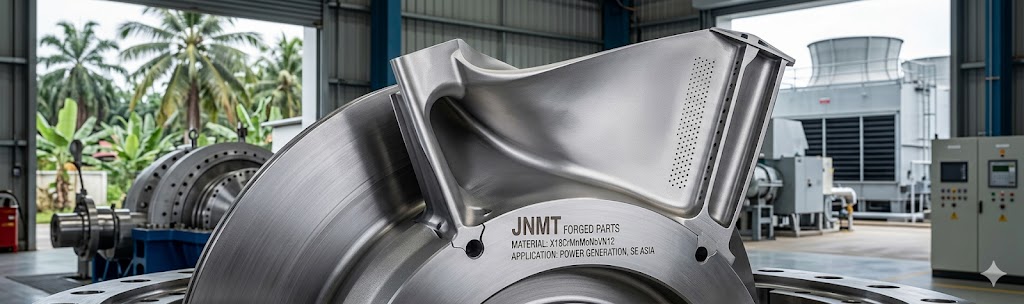
Gas Turbine Blades for Combined-Cycle Power Plants
We have supplied X18CrMnMoNbVN12 gas turbine blade forgings to combined-cycle power generation projects in Asia. These components operate at continuous service temperatures up to 550°C and are specified for their combination of creep resistance and steam oxidation performance, which extends inspection intervals compared to lower-alloyed alternatives.
Steam Turbine Rotor Shafts for Power Utilities
Our 1.4916 forged steam turbine rotor shafts — up to 12 metres long, manufactured to meet VdTÜV Werkstoffblatt 511 material specification requirements — have been supplied to power generation customers in Europe. These shafts are ultrasonically tested to SEP 1921 acceptance levels and supplied with full EN 10204 3.1 documentation covering chemical, mechanical and NDT results.
High-Pressure Valve Spindles for Sour-Gas Service
X18CrMnMoNbVN12 is a technically appropriate choice for high-pressure valve spindles in H₂S-containing sour-gas environments, where its combination of hardness control (achievable ≤ 22 HRC after tempering) and 12% chromium corrosion resistance is valued. We supply these forgings with hardness certification per customer specification; NACE MR0175 / ISO 15156 hardness compliance is confirmed by test report on every piece.
Seamless Rolled Rings for Petrochemical Applications
Our 1.4916 seamless rolled rings — available up to 6,000 mm outer diameter — are used as guide rings, casing rings and seal rings in refinery and petrochemical process equipment. Customers specify 1.4916 over lower-alloyed 12Cr grades in applications where cyclic thermal loading at 450–550°C demands improved long-term creep strength without sacrificing the corrosion resistance needed in condensate and steam environments.
Turbine Disks for Industrial Gas Turbines in Harsh Environments
X18CrMnMoNbVN12 turbine disks are specified for industrial gas turbines operating in environments with high particulate levels, rapid thermal cycling and vibration — conditions found in mining, cement, and heavy process industries. The fine-grained forged microstructure and niobium-enhanced fatigue resistance make 1.4916 the preferred disk material for operators seeking long inspection intervals in non-aviation industrial turbine service.
Quality Assurance & Inspection Facilities
Quality assurance at Jiangsu Liangyi is not a downstream gate — it is integrated into every production stage. Our ISO 9001:2015-certified quality management system requires documented hold points at steel melting, post-forging, post-heat treatment and final inspection. No product proceeds past a hold point without passing the defined acceptance criteria and completing the required documentation.
Nondestructive Testing (NDT)
- Automated ultrasonic testing (AUT) with full data acquisition and A/B/C-scan output
- Manual phased-array UT for complex geometries (blades, disks)
- Magnetic particle inspection (wet fluorescent, AC/DC)
- Dye penetrant testing (visible and fluorescent)
- NDT operations performed by qualified and experienced personnel; operator qualification records available on request
Material Analysis
- Multi-channel Optical Emission Spectrometer (OES) — full composition including N, Nb, V
- LECO combustion analysis for C, S verification
- Optical metallurgical microscope (grain size, inclusion rating per EN 10247)
- Scanning Electron Microscope (SEM) with EDS for precipitate identification
- Hydrogen determination by hot extraction
Mechanical Testing
- 500 kN servo-hydraulic universal testing machine (tensile, elevated-temperature)
- Charpy impact testing at temperatures from –60°C to +300°C
- Creep testing frames (constant-load, 12-specimen capacity)
- Brinell, Rockwell and Vickers hardness testers
- 3D CMM dimensional inspection — accuracy ±0.005 mm
Frequently Asked Questions About X18CrMnMoNbVN12 (1.4916)
X18CrMnMoNbVN12 can operate continuously at temperatures up to 600°C with excellent creep resistance and mechanical property retention. For short-term excursions, it can withstand up to 650°C. Its 100,000-hour creep rupture strength at 550°C is ≥ 120 MPa, making it the preferred specification for HP turbine disks and shafts operating in the 450–600°C band.
The two grades serve overlapping but distinct service windows. X18CrMnMoNbVN12 at ~12% Cr provides superior steam oxidation resistance, corrosion resistance in chloride-bearing condensate, and higher impact toughness — advantages that matter greatly in LP turbine environments and in plants that cycle frequently. P91 (9Cr-1Mo-V) has higher creep rupture strength above 580°C and is preferred for ultra-supercritical (USC) boiler headers and main steam pipework operating at 600–620°C where oxidation can be managed by steam chemistry. For service in the 480–580°C range in corrosive steam, 1.4916 is typically the more cost-effective and operationally reliable choice.
Our X18CrMnMoNbVN12 forgings are manufactured to meet the chemical and mechanical requirements of EN 10269, EN 10228-3/4, VdTÜV Werkstoffblatt 511 material specification, DIN 17240, ASTM A182 Grade F6a and ASME SA-182 Grade F6a. We issue EN 10204 3.1 mill test certificates in-house. EN 10204 3.2 co-signed certificates are arranged through appointed third-party inspection agencies (BV, SGS, TÜV Rheinland, Lloyds Register or the customer's own inspector) upon request.
A preheat of 200°C is required for sections below 25 mm and 250°C for heavier sections. Maximum interpass temperature is 300°C. Post-weld heat treatment (PWHT) at 720–750°C — with a hold time of at least 1 hour per 25 mm of section — is mandatory for all structural welds intended for elevated-temperature service. Cooling after PWHT must pass rapidly through 550–350°C to avoid temper embrittlement. See our detailed Welding Guidelines section for filler material recommendations and inspection requirements.
For standard round bars in stock sizes , the lead time is 2–3 weeks. For standard round bars that need melting, the lead time is 4–6 weeks. For custom open die forgings (basic shapes without finish machining), the lead time is 6–8 weeks. For complex forgings with machining, heat treatment documentation and third-party inspection, the lead time is 10–14 weeks .The actual lead time depends on section size and complex shape and quantity of parts. We provide a binding production schedule with order confirmation, with weekly progress updates available for large contracts.
Density is approximately 7.75 g/cm³ at room temperature. The mean coefficient of thermal expansion (CTE) is 10.5 × 10⁻⁶/K (20–100°C), rising to 12.3 × 10⁻⁶/K (20–500°C) and 12.8 × 10⁻⁶/K (20–600°C). Thermal conductivity is ~24 W/(m·K) at 20°C, increasing to ~27 W/(m·K) at 500°C. Elastic modulus is ~215 GPa at room temperature, reducing to ~175 GPa at 600°C. Our full physical property table is available in the Physical & Thermal Properties section above, or in PDF format on request.
Yes. Our standard delivery condition is quenched and tempered (Q+T) to the EN 10269 requirements. We can also supply in soft-annealed condition for customers who perform their own final heat treatment, or to a customer-specified temper temperature where a different Rm/Rp0.2 balance is required for a particular application. All heat treatment cycles are computer-controlled, chart-recorded and included in the quality documentation package.
There is no fixed minimum order quantity. We routinely supply single-piece custom forgings for development projects as well as multi-tonne production orders. For standard round bars, economic minimum order is approximately 500 kg per diameter. For seamless rolled rings and complex forged components, single-piece enquiries are always welcome — we quote on a case-by-case basis with no obligation.
Every heat of X18CrMnMoNbVN12 carries a unique heat number stamped or engraved on every piece from ingot onward. The traceability record links: EAF/LF/VOD melt report → OES certificate → forging traveller (press loads, temperatures, reduction ratios) → heat treatment chart recorder trace → mechanical test report → NDT reports → CMM dimensional report → EN 10204 3.1 MTC. This complete quality dossier is archived for a minimum of 10 years and is delivered electronically with every order.
Absolutely. Factory visits are welcomed and encouraged — most of our long-term customers have conducted at least one audit of our Jiangyin facility. We also offer structured remote video audits covering our forge shop, heat treatment area, metallurgical laboratory and quality documentation systems. Remote audits typically require 4 hours and can be conducted via video conference with our quality and technical team. Contact us at sales@jnmtforgedparts.com to schedule either option at your convenience.
How to Order X18CrMnMoNbVN12 (1.4916) Forgings from Jiangsu Liangyi
Our quotation and ordering process is straightforward and transparent. We provide detailed technical feedback with every quotation — not just a price. Most customers receive a full quotation, including production schedule and technical compliance statement, within 48 working hours of submitting their enquiry.
Submit Enquiry
Email your drawing (PDF or DWG), material specification (EN, ASTM, VdTÜV or OEM spec), quantity, required delivery date and any special inspection requirements to sales@jnmtforgedparts.com
Technical Review
Our metallurgical and engineering team reviews your specification, confirms standard compliance and — if applicable — identifies any material or dimensional risks with recommendations to optimize the design for forging production.
Quotation Issued
You will get a detailed quotation covering unit price (EXW Jiangyin), estimated FOB Shanghai or CIF destination price, lead time, MTC type, NDT scope and any agreed hold-point inspection provisions — all in a single document.
Order Confirmation & Production
When we get a Purchase Order and agree on payment terms (T/T or L/C), we send an Order Acknowledgement with a set production schedule. Within five business days, you will get a material heat number allocation. This means that steel has been set aside or ordered.
Inspection & Release
All inspection hold points are completed per the agreed inspection test plan (ITP). If third-party inspection is required, we coordinate attendance directly with your appointed agency. No piece is released without a signed inspection release note.
Shipping & Documentation
Components are put in custom wooden crates or steel pallets with VCI film that stops rust. We handle export customs clearance from Shanghai Port and send you all the shipping documents you need, including a commercial invoice, packing list, bill of lading, COO, MTC, and inspection reports, all electronically before the ship leaves.
What to Include in Your Enquiry
Please send us the following information so that we can give you the most accurate quote:
- Engineering drawing (PDF preferred; DWG/DXF for complex shapes) — or simply the forging dimensions (Ø, length, or OD × ID × H for rings)
- Material specification: EN 10269 / VdTÜV 511 / ASTM A182 / customer OEM spec
- Required delivery condition: as-forged / rough-machined (+3 mm stock) / finish-machined to drawing
- Heat treatment condition: Q+T (standard) / soft-annealed / specified hardness range
- MTC type: EN 10204 3.1 (works) or 3.2 (third-party co-signed)
- NDT scope: UT class (EN 10228-3 Class 3 or 4) / MT class / acceptance level
- Quantity and required delivery date (or project milestone)
- Destination port / Incoterms preference (EXW, FOB, CIF)
Contact Us for X18CrMnMoNbVN12 (1.4916) Forging Quotation
Jiangsu Liangyi is your trusted partner for high-quality X18CrMnMoNbVN12 (1.4916) forged steel parts. As a top manufacturer in Jiangyin, China, we offer competitive prices, fast delivery times and professional technical support to customers around the world.
Whether you need standard X18CrMnMoNbVN12 round bars, custom forged turbine parts or complete turnkey manufacturing solutions, we are here to help. Send us your drawings, material specifications and quantity requirements for a detailed quotation — we respond within 48 working hours.
sales@jnmtforgedparts.com
+86-13585067993
www.jnmtforgedparts.com
Chengchang Industry Park,
Jiangyin City, Jiangsu Province, China