X12CrNiMoV12-3 (1.4938) Forging Parts | China Leading Martensitic Heat Resistant Steel Forging Manufacturer
X12CrNiMoV12-3 (1.4938) Material Overview & Core Advantages
X12CrNiMoV12-3 (EN material number 1.4938, also written as X12CrNiMoV12.3 or X 12 CrNiMoV 12-3) is a premium high-alloy chromium-nickel-molybdenum martensitic steel with controlled vanadium and nitrogen additions, standardized under EN 10302-2008 for creep-resisting steels and nickel alloys. The metallurgical logic behind its design is straightforward but precise: the 12% chromium creates a fully martensitic matrix with inherent oxidation resistance; nickel at 2–3% raises the martensite start (Ms) temperature and dramatically improves impact toughness at both sub-zero and elevated temperatures; molybdenum at 1.5–2% pins grain boundaries and retards dislocation climb to deliver long-term creep resistance; vanadium at 0.25–0.4% precipitates fine MC-type carbides that act as barriers to dislocation movement under sustained load. The combined result is a steel that maintains structural integrity under continuous mechanical stress at temperatures where ordinary alloy steels begin to deform irreversibly.
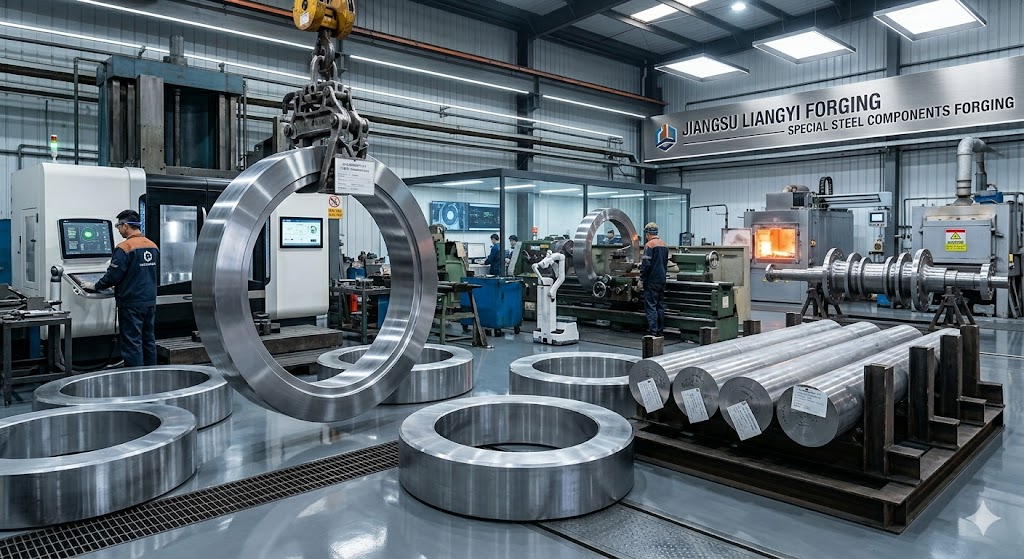
Headquartered in Jiangyin City, Jiangsu Province – the core advanced manufacturing hub of China's Yangtze River Delta, Jiangsu Liangyi Co., Limited is a professional ISO-certified China X12CrNiMoV12-3 manufacturer with over 25 years of export experience in custom production of X12CrNiMoV12-3 forging parts and seamless rolled rings. We supply our premium 1.4938 forged components to clients in more than 50 countries across Europe, the Middle East, Asia Pacific, North America and Australia, serving the power generation, aerospace, oil & gas, petrochemical and heavy machinery industries.
Core Material Advantages of X12CrNiMoV12-3 (1.4938) Steel
- Excellent high-temperature mechanical stability, with sustained creep resistance and strength retention at continuous operating temperatures up to 650°C — a threshold that eliminates many competing grades
- Optimized vanadium-nitrogen precipitation hardening mechanism delivers uniform martensitic structure and consistent mechanical properties throughout large cross-section forgings after quenching and tempering
- Superior oxidation and corrosion resistance in high-temperature steam and H₂S-containing industrial environments, significantly extending component service life compared to standard 9–10% Cr steels
- Excellent forgeability and machinability, supporting custom production of complex-shaped components with strict dimensional tolerance requirements down to ±0.1 mm
- Full compliance with EN 10302-2008 standard, meeting the strictest requirements of global power generation, oil & gas and aerospace equipment manufacturing standards
X12CrNiMoV12-3 (1.4938) Global Equivalent Grades & Cross-Reference Table
New: Equivalent Grade ReferenceOne of the most common challenges for global engineers and procurement teams is identifying whether their existing project specification — written under ASTM, DIN, GOST or GB/T — corresponds to X12CrNiMoV12-3 (1.4938). This grade is a specifically European development under EN 10302-2008, and unlike many commodity stainless steels, it does not have a direct, fully equivalent counterpart in every national standard. The following cross-reference table is based on our 25+ years of technical exchange with global engineering clients, and reflects composition-based comparison rather than simple code lookup.
| Standard System | Country / Region | Grade Designation | Equivalence Level | Key Composition Difference |
|---|---|---|---|---|
| EN 10302-2008 | Europe (Reference) | X12CrNiMoV12-3 / 1.4938 | Reference Standard | — |
| BS EN 10302 | United Kingdom | X12CrNiMoV12-3 / 1.4938 | Direct Equivalent | UK directly adopts EN 10302-2008; fully identical |
| DIN (historical) | Germany | Formerly under DIN 17240 scope; now superseded by EN 10302 | Harmonized | German DIN standard harmonized into EN; 1.4938 number retained |
| ASTM / UNS | United States | S42200 (Type 422) — closest reference only | Closest, not direct | S42200 has lower Ni (0.5% max vs 2–3%), no N addition; lower toughness at elevated temperature |
| ASTM / UNS | United States | No direct UNS equivalent assigned | No direct equivalent | The Ni-Mo-V-N combination of 1.4938 is not captured in any single UNS designation |
| GOST | Russia / CIS | 15Kh12VNMF (15Х12ВНМФ) — closest reference | Closest, not direct | Lower Ni (≤0.6%), higher W content, different V range; creep properties differ |
| GB/T 8732 | China | 12Cr12Mo — closest reference | Closest, not direct | Lower Ni (≤0.6%), no V addition; inferior high-temperature toughness |
| JIS G4311 | Japan | No direct JIS equivalent | No direct equivalent | SUS403 or SUH11 are 12Cr grades but lack Ni-Mo-V-N system of 1.4938 |
| NF EN | France | X12CrNiMoV12-3 / 1.4938 | Direct Equivalent | France adopts EN 10302-2008 directly; identical |
| UNI EN | Italy | X12CrNiMoV12-3 / 1.4938 | Direct Equivalent | Italy adopts EN 10302-2008 directly; identical |
Chemical Composition of X12CrNiMoV12-3 (1.4938) Steel (EN 10302-2008)
The chemical composition of our X12CrNiMoV12-3 (1.4938) forged steel strictly complies with EN 10302-2008, with precise control of each alloy element to ensure consistent and reliable material performance. The element ranges (by weight percentage) are as follows:
| Chemical Element | Standard Range (wt%) | Liangyi Typical Aim | Core Function in Material |
|---|---|---|---|
| C (Carbon) | 0.08 – 0.15 | 0.11 – 0.13 | Controls martensitic hardness and strength; controls hardenability in large-section forgings. Too high → brittle; too low → insufficient strength after QT |
| Si (Silicon) | Max 0.50 | 0.20 – 0.35 | Deoxidizer during EAF/AOD melting; improves oxidation resistance at high temperature; controlled below 0.5% to avoid ferrite phase formation |
| Mn (Manganese) | 0.40 – 0.90 | 0.55 – 0.75 | Enhances hardenability and toughness; combines with S to prevent hot-shortness during forging; optimizes martensitic transformation range |
| Ni (Nickel) | 2.00 – 3.00 | 2.40 – 2.80 | Key toughness enhancer; raises martensite start (Ms) temperature to allow full martensitic transformation in heavy sections; significantly improves impact energy at both room and elevated temperature |
| P (Phosphorus) | Max 0.025 | Max 0.015 | Controlled well below the standard limit; P segregates to grain boundaries and causes temper embrittlement — ultra-low P is critical for long-term creep service reliability |
| S (Sulfur) | Max 0.015 | Max 0.008 | Ultra-low content ensures high material cleanliness and forging soundness; our VD-VOD vacuum degassing routinely achieves S ≤ 0.005% in premium heats |
| Cr (Chromium) | 11.00 – 12.50 | 11.50 – 12.20 | Core element establishing the martensitic matrix; provides continuous oxidation protection through Cr₂O₃ scale at ≥600°C; controls high-temperature corrosion resistance in steam and H₂S environments |
| Mo (Molybdenum) | 1.50 – 2.00 | 1.65 – 1.85 | Solid-solution strengthener; retards carbide coarsening and grain boundary sliding at elevated temperature; primary element controlling long-term creep rupture strength at 550–650°C |
| V (Vanadium) | 0.25 – 0.40 | 0.28 – 0.35 | Grain refiner; forms thermally stable V(C,N) precipitates that pin dislocations under sustained load — this is the key element responsible for superior creep strength over 100,000 hours at 600°C |
| N (Nitrogen) | 0.020 – 0.040 | 0.025 – 0.035 | Works synergistically with V to form fine VN precipitates; stabilizes the martensitic structure at elevated temperature; improves strength without reducing room-temperature ductility — a critical distinction from older 12Cr grades without N control |
Room-Temperature Mechanical Properties of X12CrNiMoV12-3 (1.4938) — +QT Condition
After standard quenching and tempering (+QT) heat treatment with precise temperature control, our 1.4938 X12CrNiMoV12-3 forging steel delivers the following guaranteed room-temperature mechanical properties per EN 10302-2008. These values apply to separately forged test pieces taken from the same heat as the production forgings:
| Mechanical Property | Symbol | Guaranteed Min/Range (EN 10302) | Liangyi Typical Achieved |
|---|---|---|---|
| Tensile Strength | Rm | 930 – 1130 MPa | 970 – 1080 MPa |
| 0.2% Proof Yield Strength | Rp0.2 | Min 760 MPa | 810 – 900 MPa |
| Elongation at Fracture | A | Min 14% | 17 – 21% |
| Reduction of Cross Section | Z | Min 40% | 55 – 68% |
| Charpy Impact Energy at +20°C | KV | Min 40 J | 70 – 110 J |
| Hardness (Brinell) | HBW | Typically 275 – 340 | 285 – 320 HBW |
Physical & Thermal Properties of X12CrNiMoV12-3 (1.4938) Steel
New: Physical Properties DataPhysical properties are essential for thermal stress analysis, finite element simulation (FEA), and thermal fatigue life prediction of X12CrNiMoV12-3 (1.4938) components. They are also critical input parameters for forging process simulation software such as DEFORM and FORGE. The values below are representative of the +QT condition and vary with temperature as shown. Engineers performing FEA on turbine rotors or high-pressure valve housings should note that the thermal expansion mismatch between 1.4938 and adjacent austenitic components must be carefully managed in multi-material assemblies.
| Physical Property | 20°C | 200°C | 400°C | 500°C | 600°C | Unit |
|---|---|---|---|---|---|---|
| Density (ρ) | 7.75 | 7.70 | 7.63 | 7.59 | 7.54 | g/cm³ |
| Elastic Modulus (E) | 215 | 207 | 196 | 189 | 178 | GPa |
| Thermal Expansion Coeff. (α, mean from 20°C) | — | 10.8 | 11.5 | 11.8 | 12.1 | × 10⁻⁶ /K |
| Thermal Conductivity (λ) | 22.0 | 22.8 | 23.9 | 24.5 | 25.1 | W/(m·K) |
| Specific Heat Capacity (cp) | 460 | 495 | 530 | 548 | 568 | J/(kg·K) |
| Electrical Resistivity (ρₑ) | 0.72 | 0.85 | 1.01 | 1.09 | 1.18 | μΩ·m |
| Magnetic Permeability | Ferromagnetic in martensitic condition (μᵣ > 100); relevant for MPI inspection planning | — | ||||
High-Temperature Mechanical Properties of X12CrNiMoV12-3 (1.4938) — Up to 650°C
New: High-Temperature DataThis is the section that matters most for turbine rotor, valve spindle and high-pressure fastener engineers. Room-temperature strength numbers tell only part of the story. The true engineering value of X12CrNiMoV12-3 (1.4938) lies in how it retains strength, ductility and long-term creep resistance as temperature rises. Unlike many low-alloy steels that begin to lose strength rapidly above 400°C, the vanadium-nitrogen precipitation system in 1.4938 provides a thermally stable microstructure that resists softening through to 650°C — which is why it remains the preferred choice in 600MW+ supercritical steam turbine applications.
Short-Term High-Temperature Tensile Properties (Representative Values, +QT Condition)
The following representative high-temperature tensile properties reflect the behavior of our forged 1.4938 steel at operating temperatures from 200°C to 650°C. These are typical values for guidance; guaranteed values are defined in individual test reports per EN 10302-2008. Actual measured values from our mill test reports consistently meet or exceed these figures.
| Test Temperature | 0.2% Yield Strength Rp0.2 (MPa) | Tensile Strength Rm (MPa) | Elongation A (%) | Reduction of Area Z (%) |
|---|---|---|---|---|
| 20°C (Room Temp) | ≥ 760 | 930 – 1130 | ≥ 14 | ≥ 40 |
| 200°C | ~700 | ~880 | ≥ 14 | ≥ 42 |
| 300°C | ~670 | ~850 | ≥ 14 | ≥ 42 |
| 400°C | ~630 | ~800 | ≥ 15 | ≥ 42 |
| 500°C | ~570 | ~730 | ≥ 15 | ≥ 45 |
| 550°C | ~530 | ~685 | ≥ 15 | ≥ 47 |
| 600°C | ~470 | ~625 | ≥ 16 | ≥ 50 |
| 650°C | ~395 | ~555 | ≥ 17 | ≥ 52 |
Long-Term Creep Rupture Strength (Representative Values, +QT Condition)
For components in continuous high-temperature service — particularly steam turbine rotors and blades — the critical design parameter is not short-term tensile strength but creep rupture strength: the stress level that causes fracture after 100,000 hours (approximately 11.4 years) of continuous operation. The vanadium carbonitride precipitation system in X12CrNiMoV12-3 (1.4938) is specifically optimized to maximize 100,000-hour rupture strength at the 550–650°C range, outperforming plain 12Cr steels without V-N additions by 25–40% at equivalent temperatures.
| Temperature | Creep Rupture Strength — 10,000 h (MPa) | Creep Rupture Strength — 100,000 h (MPa) | Design Significance |
|---|---|---|---|
| 500°C | ~390 | ~310 | High safety margin; conservative operating range for this grade |
| 550°C | ~280 | ~220 | Primary design temperature for supercritical turbine fasteners and valve spindles |
| 600°C | ~185 | ~140 | Applicable for turbine rotor discs in 600°C class power plants |
| 620°C | ~145 | ~105 | Approaching the upper limit; requires careful stress analysis and in-service monitoring |
| 650°C | ~100 | ~68 | Maximum rated temperature; recommend ESR grade material for this service condition |
Full Range of Custom X12CrNiMoV12-3 (1.4938) Forged Product Forms
As a top China 1.4938 forging steel specialist, we have the complete capability to produce a full portfolio of custom X12CrNiMoV12-3 forged steel products in all kinds of shapes, dimensions and technical specifications:
X12CrNiMoV12-3 Forged Bars & Rods
We supply precision forged 1.4938 round bars, square bars, flat bars, rectangular bars and step rods, with maximum forging diameter up to 2 meters and single-piece weight capacity up to 30 tons. All bars undergo 100% ultrasonic testing and customized heat treatment. Explore our full forged bars product range.
1.4938 Seamless Rolled Forged Rings
Our custom X12CrNiMoV12-3 seamless rolled rings, contoured rings, gear rings and seal rings are available with maximum outer diameter up to 6 meters and single-piece weight up to 30 tons. Ideal for critical rotating and pressure-containing applications in turbines, valves and heavy industrial equipment, with full EN 10204 3.1 material test certificate provided as standard for every delivery.
X12CrNiMoV12-3 Hollow Forged Parts
We manufacture heavy-duty 1.4938 forged hubs, housings, shells, sleeves, bushes, casings, heavy-wall hollow bars and seamless tubes with the maximum outer diameter up to 3000 mm. Our hollow forgings eliminate welding risks, and have superior structural integrity and fatigue resistance for high-pressure and high-temperature service.
1.4938 Forged Discs, Plates & Blocks
Our X12CrNiMoV12-3 forged steel discs, blocks, plates and flanged blanks are available with maximum diameter up to 3 meters and single-piece weight up to 20 tons. Widely used in pressure vessels, turbine disks, valve bodies and heavy industrial equipment, with full NDT to ensure internal soundness.
X12CrNiMoV12-3 Turbine & Power Generation Components
We specialize in custom production of 1.4938 forged gas and steam turbine rotors, main shafts, moving blades, stationary blades, impellers, turbine disks, blisks, guide rings, labyrinth seal rings and high-strength turbine bolts. All components are manufactured to meet the strict requirements of global power generation industry, with comprehensive high-temperature performance verification.
1.4938 Valve & Industrial Forgings
We provide precision X12CrNiMoV12-3 forged valve seats, valve spindles, valve bodies, bonnets, pump components, gear blanks and other critical parts for high-pressure, high-temperature industrial valve systems. We also offer custom Stellite 6/21 hardfacing and specialized surface treatment.
Melting Process & Advanced Manufacturing Capability
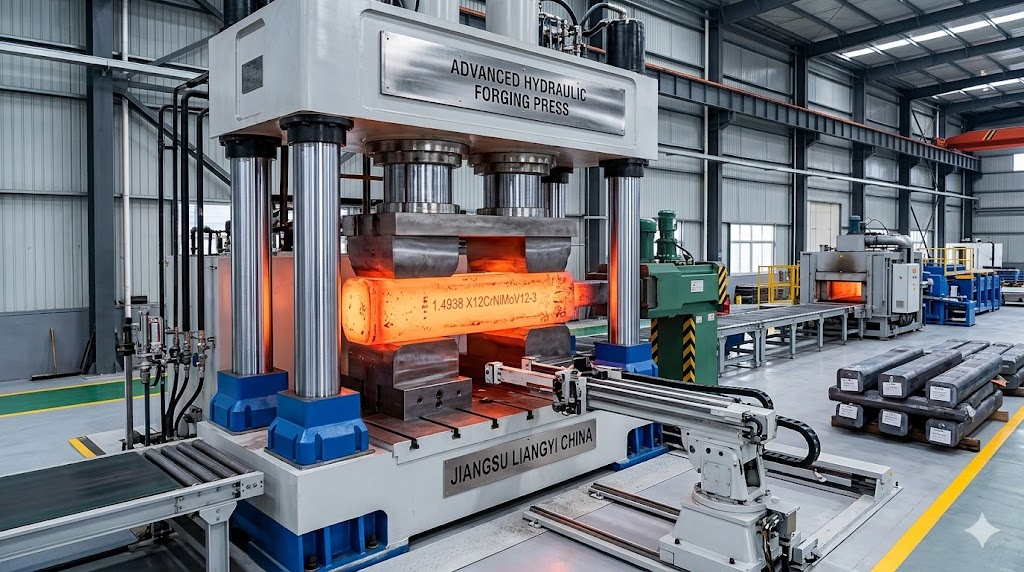
Our X12CrNiMoV12-3 (1.4938) forged steel parts are manufactured via industry-leading EAF + AOD + VOD refining, with optional Electroslag Remelting (ESR). View our full manufacturing equipment list.
- 60 t Electric Arc Furnace (EAF) with 40 MVA power, 30 t intermediate frequency induction furnaces
- 2 sets of Ladle Furnace (LF) for precise composition and temperature control
- 2 sets of VD-VOD type vacuum degassing equipment for ultra-low gas content and high material cleanliness
- Professional bottom pouring pits for ingot casting, and ESR plant with maximum single-piece weight up to 32 t
- 2000T, 4000T and 6300T hydraulic forging presses; 1T to 9T electro-hydraulic forging hammers for open die forging
- 1m and 5m seamless ring rolling machines for large-diameter ring production
- Ten continuous heat treatment furnaces for precise quenching, tempering, normalizing and annealing
- Full set of advanced inspection equipment including UT, MT, PT, RT, chemical analysis, mechanical and metallographical testing, and high-temperature creep testing
Forging Process Parameters for X12CrNiMoV12-3 (1.4938) — Practical Manufacturing Guide
New: Forging Process GuideForging X12CrNiMoV12-3 (1.4938) correctly is not simply a matter of applying force at high temperature. The vanadium-nitrogen microalloying system is sensitive to both forging temperature and deformation history. Incorrect forging practice — too high a temperature, too low a finish temperature, or insufficient total reduction — will result in coarse grain structure, non-uniform V(C,N) precipitation, and ultimately inferior creep properties in the finished forging, even if room-temperature tensile properties appear acceptable. The parameters below reflect our in-house process standards developed and refined through 25+ years of production experience with this grade.
Ingot Pre-Heating Before Forging
| Ingot / Billet Diameter | Initial Charge Temperature | Pre-Heat Holding Temperature | Pre-Heat Holding Time | Final Forging Temperature |
|---|---|---|---|---|
| < 600 mm | ≤ 400°C cold charge | 800 – 850°C | 1.5 – 2.5 h | 1100 – 1160°C |
| 600 – 1200 mm | ≤ 300°C cold charge | 820 – 850°C | 3 – 5 h | 1100 – 1150°C |
| > 1200 mm (heavy ingot) | Hot delivery preferred ≥ 200°C | 820 – 850°C | 5 – 8 h | 1080 – 1140°C |
Key Forging Temperature & Deformation Parameters
| Parameter | Recommended Value | Engineering Rationale |
|---|---|---|
| Maximum Soaking Temperature | 1160°C (EAF grade) / 1140°C (ESR grade) | Above 1180°C, excessive grain growth occurs and V(C,N) precipitates dissolve — both are detrimental to final creep strength |
| Recommended Start Forging Temperature | 1080 – 1150°C | Ensures adequate hot ductility and flow stress for large section working without surface cracking |
| Minimum Finish Forging Temperature | ≥ 900°C (bars); ≥ 920°C (rings) | Below 880°C the delta-ferrite → austenite transformation reversal causes sharp drop in ductility; working below this limit creates forging laps and internal cracks in high-Cr martensitic steels |
| Minimum Total Reduction Ratio | ≥ 4:1 for bars and discs; ≥ 3:1 for rolled rings | Minimum reduction ensures full breakdown of as-cast dendritic structure; below 3:1 reduction, center segregation from the ingot is not eliminated and will show as UT indications |
| Maximum Single-Pass Reduction | ≤ 25% per pass (open die); ≤ 20% per pass (ring rolling) | Excessive single-pass reduction in a hard martensitic grade creates adiabatic shear zones and internal cracks; controlled pass reduction ensures uniform deformation through the cross-section |
| Post-Forging Cooling | Slow cool in furnace to ≤ 300°C, then air cool | Fast cooling from forging temperature causes thermal stress cracking in heavy sections; furnace cooling to below the martensite finish temperature (Mf ≈ 200–250°C) before air cooling prevents quench cracking |
| Intermediate Annealing (for complex shapes) | 750 – 800°C / 2–4 h, furnace cool to ≤ 300°C | Required for multi-heat complex forgings to relieve work-hardening between operations and prevent cracking during reheating |
Heat Treatment Parameters for X12CrNiMoV12-3 (1.4938) Forgings
New: Heat Treatment GuideHeat treatment of 1.4938 forgings requires precise temperature control and well-designed component fixturing to achieve uniform properties across large cross-sections while avoiding distortion. Our ten continuous heat treatment furnaces are equipped with multi-zone temperature control achieving ±5°C uniformity throughout the working chamber — critical for achieving consistent mechanical properties in heavy forgings up to 30 tons.
| Heat Treatment Stage | Temperature Range | Holding Time | Cooling Method | Purpose |
|---|---|---|---|---|
| Soft Annealing (+A) | 750 – 800°C | 2 – 6 h depending on section size | Furnace cool to ≤ 300°C, then air | Intermediate stress relief between forging operations; enables machining of complex pre-forms |
| Normalizing (+N) | 980 – 1030°C | 1 h per 100 mm section | Air cool or forced air | Grain refinement; sometimes used as pre-QT treatment for very large ingot-derived forgings |
| Austenitizing / Quenching (+QT, Step 1) | 1020 – 1070°C | 1 h per 100 mm section (min 2 h) | Oil quench or forced air; water quench for thin sections only | Dissolves carbides and establishes fully martensitic structure; temperature must exceed Ac3 to achieve complete austenitization without dissolving all V(C,N) |
| Tempering (+QT, Step 2) | 680 – 750°C | 2 h per 100 mm section (min 4 h) | Air cool from tempering temperature; do NOT water quench | Tempers martensite to achieve target Rp0.2 and toughness combination; re-precipitates fine V(C,N) for creep strength; must be above 650°C to avoid tempered martensite embrittlement |
| Stress Relief (post-machining) | 620 – 650°C | 1 – 3 h depending on section and machining depth | Furnace cool to ≤ 300°C, then air | Relieves machining residual stresses without significantly altering bulk mechanical properties; temperature must be kept ≥ 30°C below tempering temperature |
Welding Guidelines for X12CrNiMoV12-3 (1.4938) — Precautions & Recommended Practice
New: Welding GuideX12CrNiMoV12-3 (1.4938) isn't meant to be used for welding. This type of engineering steel is used to make forged parts that are strong and work together as one piece. Still, sometimes repair welding is needed on forged goods, surface hardening cladding, and connecting welds to nearby pipes or structural parts. Our engineering team has put together some easy-to-follow welding tips for 1.4938 in this section. All advice comes from years of working on real sites in many different industries, fixing things and making parts.
Recommended Welding Processes
- GTAW / TIG (Gas Tungsten Arc Welding): Best for root passes and thin-section repair welds. Gives you the best control over how much heat goes in and keeps the weld metal very clean.
- SMAW / MMA (Shielded Metal Arc Welding): Acceptable for multi-pass repair welds and structural attachments. Must use low-hydrogen electrodes (H4 or better); electrodes must be dried at 350–400°C for 2 hours before use and stored in a heated quiver at 150°C during welding.
- SAW (Submerged Arc Welding): Suitable for large-volume weld overlay (e.g., Stellite hardfacing on valve seats) and heavy-section butt welds under controlled shop conditions. Requires careful flux management and interpass temperature monitoring.
- Laser Welding / Electron Beam Welding: Acceptable for precision repair of aerospace and turbine components requiring minimum heat input and distortion. Requires PWHT immediately after welding.
Critical Welding Parameters for X12CrNiMoV12-3 (1.4938)
| Welding Parameter | Requirement | Engineering Reason |
|---|---|---|
| Pre-Heat Temperature | 200 – 300°C (min 250°C for section > 50 mm) | High Cr content and hardenability mean rapid cooling from welding temperature will produce untempered martensite in the HAZ; pre-heating slows the cooling rate and prevents hydrogen-induced cold cracking |
| Interpass Temperature | 200 – 350°C (must not fall below 200°C, must not exceed 350°C) | Below 200°C: cold cracking risk; above 350°C: carbide precipitation in HAZ reduces local toughness and corrosion resistance; use IR thermometer between every pass |
| Heat Input | 0.5 – 2.0 kJ/mm (strictly controlled) | Low heat input limits HAZ width and carbide coarsening; high heat input (exceeding 2.5 kJ/mm) causes delta ferrite formation in the fusion zone which persists through PWHT and reduces fatigue life |
| Post-Weld Hydrogen Bake-Out | 300 – 350°C / 2–4 h immediately after welding before cooling to room temperature | Must be performed before the weld assembly cools below 100°C; allows dissolved hydrogen to diffuse out before the martensitic transformation is complete and the microstructure becomes susceptible to hydrogen embrittlement |
| Post-Weld Heat Treatment (PWHT) | 700 – 730°C / 1 h per 25 mm wall thickness (min 1 h, max 4 h) | Tempers the as-welded martensite HAZ to reduce hardness to ≤ 350 HV (required for sour service per NACE MR0175); restores toughness; must be performed before any NDT other than VT and dimensional inspection |
| Filler Material (same-grade repair) | Modified 12Cr-Ni filler, e.g., AWS E/ER 410NiMo or custom matching composition filler qualified per WPS | Standard E410 without Ni has insufficient toughness for critical applications; 410NiMo or higher-Ni modified filler provides better HAZ toughness and matches thermal expansion more closely than austenitic fillers |
| Filler Material (dissimilar weld to austenitic) | Nickel-base filler: ENiCrFe-3 (Alloy 182) or ERNiCrMo-3 (Alloy 625) — consult engineer | Butter layer of Ni-base alloy on the 1.4938 side accommodates differential thermal expansion and prevents carbon migration across the fusion line in service |
| NDT After PWHT | 100% MT + PT on weld surface; UT on full weld volume per applicable code | MT is highly effective on this ferromagnetic material; UT must be performed after PWHT, not before, to detect hydrogen-delayed cracking which may initiate up to 72 h after welding |
Global Standard Compliance & Quality Assurance
All our X12CrNiMoV12-3 (1.4938) forged steel products are made with a strict full-process quality management system, and they all meet global mainstream industrial standards:
- Quality Management System: ISO 9001:2015 certified — our entire production workflow, from raw material incoming inspection through final dispatch, operates under a documented ISO 9001:2015 quality management system audited by an accredited third-party certification body
- Material Standard Compliance: All X12CrNiMoV12-3 (1.4938) forgings are produced based on EN 10302-2008. We can also make parts based on ASTM, DIN and other international material standards upon client request. and we can keep track of all the documentation.
- Mill Test Certificate: Full EN 10204 3.1 material test certificate is provided as standard with every delivery, which include chemical composition, mechanical properties and heat treatment records. EN 10204 3.2 third-party witness inspection is available upon client request — clients may nominate their preferred inspection body (DNV-GL, Bureau Veritas, Lloyd's Register, SGS, Intertek, etc.) and we will coordinate access to our facility
- Full In-House Inspection Capability: 100% ultrasonic testing (UT) for all forged products; magnetic particle testing (MT), penetrant testing (PT) and radiographic testing (RT) available as required; full in-house chemical composition analysis, room-temperature mechanical property testing, metallographical analysis and hardness testing
Verified Industrial Applications & Global Project Cases
Thanks to its outstanding high-temperature performance, long-term creep resistance, high strength and excellent toughness, X12CrNiMoV12-3 (1.4938) forging steel is the preferred material for critical components in global high-end industrial sectors:
Thermal Power Generation Steam Turbine Components (Asia Pacific Market)
We have supplied a full range of X12CrNiMoV12-3 (1.4938) forged turbine blades, rotor shafts, guide rings and labyrinth seal rings for multiple 600MW+ supercritical thermal power plants in Southeast Asia and China. These components are designed for long-term continuous service at temperatures up to 650°C, solving creep deformation and oxidation failure under high-temperature steam conditions. All products have passed strict dynamic balancing and high-temperature performance testing, with a proven continuous service life of over 8 years in harsh operating conditions.
Aerospace Propulsion & Transmission Components (European Market)
We have made precision X12CrNiMoV12-3 forged propeller parts, heavily loaded transmission gears, and structural coupling parts for leading European aerospace OEMs. All of the products are made from ESR refined material, which is very clean, and they all meet the strict material purity and size requirements for aerospace use. They have excellent fatigue resistance and dimensional stability under extreme dynamic load conditions, with full EN 10204 3.1 material certification and customer-nominated third-party inspection available.
Oil & Gas High-Pressure Valve Components (Middle East Market)
We supply X12CrNiMoV12-3 forged valve seats, valve spindles and valve bodies for onshore and offshore oil and gas projects across the Middle East. These custom parts are made with optimized heat treatment and Stellite hardfacing, so that they can withstand wear and corrosion under high-pressure, high-temperature sour working conditions. All parts meet customer specified standards including API 6A on dimension and material rules. Full EN 10204 3.1 material certificates are provided as standard, and third-party witnessed inspection is available on request.
Power Industry High-Strength Fasteners (Global Market)
We produce large-batch 1.4938 forged high-strength turbine bolts, stud bolts and fasteners for thermal power, nuclear power and renewable energy projects across Europe, North America and Asia. All fasteners are given 100% UT and full mechanical property inspection to meet EN 10302 and ISO 898-1. They all have excellent relaxation resistance and sustained preload performance.
Mining & Heavy Machinery Transmission Components (Australian Market)
We have made custom 1.4938 forged ball screws, heavy-duty transmission gears, and shaft parts for big mining mill projects in Australia. These products have great tensile strength, impact toughness, and wear resistance. They last 30% longer than standard alloy steel parts in the same working conditions.
Custom Forging Capabilities & China Supply Chain Advantages
As a professional China X12CrNiMoV12-3 (1.4938) forging manufacturer with over 25 years of export experience, we provide a full range of services from material melting, forging, heat treatment to precision CNC machining:
- Full in-house production control, no outsourcing, ensuring stable quality and short lead time (standard lead time 25–35 days for custom orders)
- Located in Jiangyin City, Jiangsu Province, adjacent to Shanghai Port and Ningbo Port, with convenient sea freight logistics for global export
- Flexible order quantity support, from 30kg small-batch prototype production to 30-ton large-scale heavy forgings
- Professional technical team with 20+ years of experience in high-temperature alloy forging, providing free material selection and technical support
- Competitive factory-direct pricing, with no middleman markup, delivering premium quality at cost-effective prices for global clients
Frequently Asked Questions: X12CrNiMoV12-3 (1.4938) Forging Parts
X12CrNiMoV12-3 (EN material number 1.4938) is a high-alloy chromium-nickel-molybdenum-vanadium martensitic heat resistant steel standardized under EN 10302-2008. It is engineered for long-term service at elevated temperatures up to 650°C, with tensile strength Rm 930–1130 MPa, yield strength Rp0.2 ≥760 MPa, and 100,000-hour creep rupture strength of approximately 140 MPa at 600°C. Primary applications include steam turbine rotors and blades, high-pressure valve components, aerospace transmission parts, power generation fasteners, and oil & gas components in sour service environments.
There is no direct ASTM/UNS equivalent for X12CrNiMoV12-3 (1.4938). The closest ASTM reference is S42200 (Type 422), which is also a 12Cr martensitic steel with Mo and V additions, but S42200 has significantly lower nickel content (max 0.50% vs 2.00–3.00% in 1.4938) and no controlled nitrogen addition. This means S42200 has inferior impact toughness and lower creep strength at elevated temperatures. If your project specification requires ASTM compliance, we recommend requesting a material equivalency assessment — our technical team can prepare EN-to-ASTM equivalency documentation for third-party review.
The minimum finish forging temperature for X12CrNiMoV12-3 (1.4938) is 900°C for open die forged bars and discs, and 920°C for seamless rolled rings. Working below 880°C causes the austenite-to-martensite transformation to overlap with the forging zone, resulting in a sharp loss of ductility and a high risk of forging laps and internal cracking. Our forging presses use real-time infrared temperature monitoring to enforce this limit throughout the forging sequence. The recommended start forging temperature is 1080–1150°C, with soaking at 1100–1160°C depending on section size and ingot source.
Welding X12CrNiMoV12-3 (1.4938) requires a pre-heat temperature of 200–300°C (minimum 250°C for sections exceeding 50mm wall thickness). Interpass temperature must be maintained between 200°C and 350°C throughout welding. After the weld is completed, a hydrogen bake-out at 300–350°C for 2–4 hours must be performed immediately, before the assembly cools to room temperature, to prevent hydrogen-induced cold cracking. Post-weld heat treatment (PWHT) at 700–730°C is mandatory for all structural and pressure-containing welds. Low-hydrogen electrodes (H4 or better) must be used for SMAW, dried at 350–400°C for 2 hours before use.
At room temperature (20°C), X12CrNiMoV12-3 (1.4938) has a density of approximately 7.75 g/cm³ and an elastic modulus (Young's modulus) of approximately 215 GPa. The elastic modulus decreases with temperature: approximately 207 GPa at 200°C, 196 GPa at 400°C, and 178 GPa at 600°C. The mean thermal expansion coefficient from 20°C to 600°C is approximately 12.1 × 10⁻⁶ /K. These values are essential input parameters for FEA of turbine components and thermal stress calculations in dissimilar-metal joint design.
X12CrNiMoV12-3 (1.4938) forgings are standardly supplied in the quenched and tempered (+QT) condition per EN 10302-2008. Austenitizing (quenching) is performed at 1020–1070°C, holding for 1 hour per 100mm section thickness (minimum 2 hours), followed by oil quench or forced air cooling. Tempering is then performed at 680–750°C, holding for 2 hours per 100mm section thickness (minimum 4 hours), followed by air cooling. The tempering temperature must be maintained above 650°C to avoid the tempered martensite embrittlement zone and must remain ≥30°C below the austenitizing temperature to prevent partial re-austenitization. Our heat treatment furnaces maintain ±5°C temperature uniformity throughout the working chamber.
The representative 100,000-hour creep rupture strength of X12CrNiMoV12-3 (1.4938) in the +QT condition is approximately 140 MPa at 600°C, and approximately 220 MPa at 550°C. At 650°C (the maximum rated temperature for this grade), the 100,000-hour rupture strength is approximately 68 MPa — at this temperature, ESR-grade material with tighter composition control is recommended for critical rotating components. These values represent the performance of our standard production material; heat-specific Larson-Miller creep data from our in-house testing laboratory is available for high-criticality applications such as turbine rotor design.
Contact Us for Custom X12CrNiMoV12-3 (1.4938) Forging Solutions
Jiangsu Liangyi Co., Limited is a leading China manufacturer of open die forgings and seamless rolled rings, specializing in custom production of high-quality X12CrNiMoV12-3 (1.4938) forging parts for global clients. Whether you need standard forged bars and rings, or custom complex-shaped components with strict technical requirements, we can provide you with a tailored solution that meets your project needs.
Welcome to send your detailed drawings, material specifications, quantity requirements and technical standards to us for a detailed and competitive quotation. Our professional sales and technical team will respond to you within 24 hours. View our global project references or full material grade list.
Inquiry Email: sales@jnmtforgedparts.com
Phone/WhatsApp: +86-13585067993
Official Website: https://www.jnmtforgedparts.com
Factory Address: Chengchang Industry Park, Jiangyin City, Jiangsu Province, China
© 2026 Jiangsu Liangyi Co., Limited. All rights reserved. | ISO 9001:2015 Certified | www.jnmtforgedparts.com