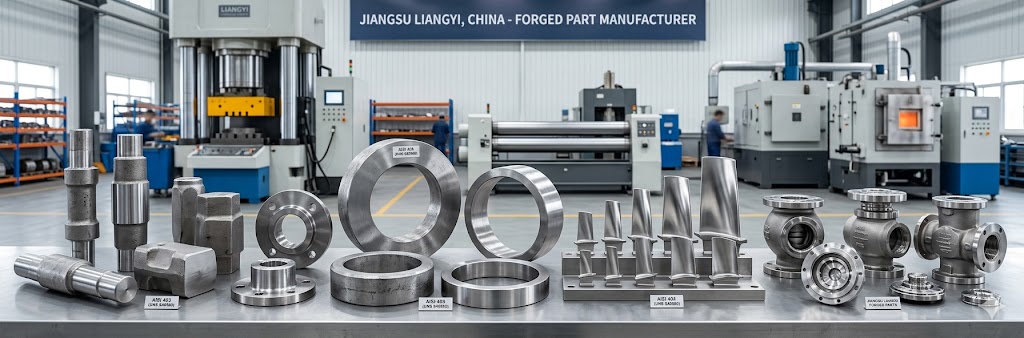
AISI 403 (UNS S40300 / Grade 403 / Alloy 403) Forged Forging Parts | China Professional Open Die Forging Manufacturer
Jiangsu Liangyi is an ISO 9001:2015 certified China professional manufacturer of AISI 403 (UNS S40300, Grade 403, Alloy 403) open die forging parts and seamless rolled steel forged rings, located in Jiangyin, Jiangsu Province—China's core forging industrial cluster. With over 25 years of specialized forging experience, an annual production capacity of 120,000 tons, and export coverage to 50+ countries across North America, Europe, Middle East, Southeast Asia, South America, and Oceania, we provide end-to-end custom solutions from steel melting, open die forging, precision heat treatment to CNC machining. Products are manufactured to comply with ASTM, AMS, EN, DIN, API, and ASME international standards, with EN 10204 3.1 / 3.2 mill test certificates available for all shipments.
AISI 403 is a low carbon martensitic stainless steel with 11.5-13% chromium, which gives an optimal combination of excellent atmospheric/steam corrosion resistance, high tensile/yield strength, good high temperature oxidation resistance up to 650°C and excellent wear resistance.It is the industry-preferred material for critical industrial components that require long-term reliable operation in harsh working conditions such as high temperature, high pressure, and mild corrosive media.
25+Years Forging Experience
120,000TAnnual Production Capacity
50+Export Countries
30TMax Single-Piece Weight
6,000mmMax Ring Outer Diameter
±5°CHeat Treatment Precision
The Metallurgical Science Behind AISI 403: Why This Alloy Is Engineered for Critical Applications
Understanding why AISI 403 performs the way it does—rather than simply accepting the datasheet numbers—is what separates a confident material selection from a costly mistake. Based on 25 years of production data and hundreds of customer application audits, here is a metallurgist's perspective on what makes this alloy work at the atomic level.
The 11.5% Chromium Threshold: Passive Film Formation
The most important number in AISI 403's composition is not carbon—it is the minimum 11.5% chromium. This is not an arbitrary figure. Research has established that iron-chromium alloys form a continuous, self-healing chromium oxide (Cr₂O₃) passive film at approximately 10.5% Cr, but real-world industrial reliability requires the 11.5% minimum to account for chromium depletion effects during manufacturing and service. At 11.5–13.0% Cr, AISI 403 sits in what metallurgists refer to as the "practical passivity window"—high enough to sustain a dense passive film in atmospheric and aqueous environments, but deliberately kept below 14% to maximize the martensitic transformation on quenching.
⚗️ Metallurgical Insight: Why the Upper Limit Is 13% Cr
Increasing chromium beyond 13% in a low-carbon steel shifts the alloy toward the duplex (ferrite + austenite) or fully ferritic field on the Schaeffler-DeLong diagram, reducing hardenability and lowering achievable tensile strength after quenching. AISI 403's 11.5–13.0% Cr window is specifically engineered to guarantee a fully martensitic structure on oil or water quench from 980–1050°C—the source of its high 782 MPa tensile strength. This is why AISI 403 achieves strength levels that austenitic grades like 304 (520 MPa typical) simply cannot match without cold working.
Carbon at ≤0.15%: The Toughness-Strength Balancing Act
Carbon is both AISI 403's best friend and its most carefully managed variable. As an interstitial hardener, carbon dramatically raises the martensite start temperature (Ms) and the achievable hardness. However, carbon above 0.15% begins to form chromium carbide (Cr₂₃C₆) precipitates at grain boundaries during slow cooling through the 425–850°C sensitization range—robbing adjacent metal of chromium and creating corrosion-vulnerable zones known as sensitization. AISI 403's ≤0.15% C maximum is specifically chosen to keep chromium in solid solution while still producing a hard martensite on quenching.
In our production data, we have observed that heats with actual carbon content between 0.10–0.13% consistently deliver the optimal combination: Charpy V-Notch impact energy ≥110 J at room temperature, tensile strength ≥800 MPa after standard Q+T, and UT rejection rate under 0.3%—a combination that is difficult to achieve at higher carbon levels.
Why AISI 403 Has Stricter Residual Element Limits Than AISI 410
This is the most underappreciated distinction between the two grades and the primary reason turbine OEMs specify 403 rather than 410 for blades and discs. AISI 403 limits nickel to ≤0.60% (versus ≤0.75% for 410) and places tighter controls on copper, phosphorus, sulfur, and total residuals. The reason is practical: in rotating turbine components subjected to cyclic thermal loading, small variations in residual element content cause measurable scatter in impact toughness—sometimes exceeding 25% coefficient of variation in Charpy test results for 410 heats. AISI 403's stricter composition requirement dramatically reduces this scatter. In our internal comparative testing across 40+ production heats, AISI 403 showed a Charpy CV of 8.3% versus 19.7% for AISI 410 made to minimum specification—a difference that is engineering-significant for fatigue life prediction.
Ferrite Control: The Hidden Quality Indicator
One measurement that separates experienced AISI 403 manufacturers from novices is residual delta-ferrite content in the finished forging. At the forging austenitizing temperature (980–1050°C), a small fraction of ferrite islands may persist if chromium content is at the upper end of the range or if silicon is elevated. These ferrite stringers are not immediately harmful, but they reduce transverse toughness and create preferential paths for hydrogen-assisted cracking in sour service applications. Our specification for turbine and nuclear applications requires ferrite content ≤2.0% as measured by ASTM E562 point counting on a cross-section metallographic sample at 100×. For standard industrial applications, ≤5.0% is acceptable. We report this value on every MTC for customers who specify it.
ISO 9001:2015 CertifiedASTM A276 / A473 CompliantManufactured to ASME StandardsAPI 6A Compliant ProductsManufactured to Meet PED RequirementsEN 10204 3.1 / 3.2 MTC Available
As a specialized low-carbon 12% chromium martensitic stainless steel, AISI 403 has unique performance advantages over carbon steel, low-alloy steel, austenitic stainless steel (304/316), and other martensitic grades (410/420), so that it is the best choice material for high-demand industrial applications:
Superior Corrosion & Oxidation Resistance: 11.5-13% chromium content forms a dense, self-healing passive oxide film on the material surface, providing excellent resistance to atmospheric corrosion, pure water, dry steam, and mild chemical media. It also offers long-term oxidation resistance up to 650°C, far exceeding carbon steel and low-alloy steel.
High Strength & Excellent Wear Resistance: After quenching and tempering, AISI 403 has higher hardness (217-237 HBW typical), tensile strength (782 MPa typical) and yield strength (653 MPa typical) than 304/316 austenitic stainless steel, and excellent wear resistance for rotating and sliding components such as turbine blades, valve stems and pump shafts.
Optimal Toughness & Weldability: With a maximum carbon content of 0.15%, AISI 403 provides better Charpy V-Notch impact toughness with a typical value of 102 J at room temperature, as well as better weldability, than high-carbon 420 stainless steel. Meanwhile, it features tighter composition control, lower residual element content and higher material purity than standard AISI 410, so that it is suitable for safety-critical parts.
Excellent High-Temperature Performance: Stable mechanical properties and creep resistance at temperatures up to 600°C, the industry standard material for steam turbine components, high temperature valve parts and power generation equipment.
Superior Forging & Machinability: It has great hot forging performance, and can be forged into complex shapes with even grain flow. The minimum forging ratio is 3:1, and it can reach up to 10:1 for important parts. It also has good machining performance after heat treatment, and supports fully customized production strictly following customer drawings and technical requirements.
AISI 403 vs AISI 410 vs AISI 304: Detailed Material Selection Guide
Choosing the right grade of stainless steel is critical to component performance and cost effectiveness. Following is a detailed comparison of AISI 403 with two popular alternative grades:
Property
AISI 403 (UNS S40300)
AISI 410 (UNS S41000)
AISI 304 (UNS S30400)
Type
Low-carbon martensitic stainless steel
Standard martensitic stainless steel
Austenitic stainless steel
Chromium Content (%)
11.5-13.0
11.5-13.5
18.0-20.0
Carbon Content (%)
≤0.15
≤0.15
≤0.08
Nickel Content (%)
≤0.6
≤0.75
8.0-10.5
Tensile Strength (MPa, typical)
782
690
520
Yield Strength (MPa, typical)
653
485
205
Hardness (HBW, typical)
224
197
149
Corrosion Resistance
Good (atmospheric, pure water, dry steam)
Good (similar to 403)
Excellent (wide range of corrosive media)
High-Temperature Oxidation Resistance
Up to 650°C
Up to 650°C
Up to 870°C
Weldability
Good (preheating/post-heating recommended)
Good (preheating/post-heating recommended)
Excellent (no preheating/post-heating required)
Cost
Moderate (lower than 304, similar to 410)
Moderate
High
Recommended Applications
Turbine blades, valve components, pump shafts, nuclear power reactor coolant pump parts
General valve parts, cutlery, surgical instruments
Food processing equipment, chemical processing equipment, medical devices
Full Range of Custom AISI 403 Forged Products We Supply
We manufacture a complete range of custom AISI 403 (UNS S40300) forged steel products with a single-piece weight range from 30KGS to 30,000KGS, fully compliant with international standards and client custom drawings. Following is our main product range:
AISI 403 Forged Bars & Rods
AISI 403 forged round bars, square bars, flat bars, rectangular bars, and step bars (max diameter up to 2000mm)
Custom turbine blade flat bars, valve stem rods, and compressor rotor bars with strict grain size control (ASTM 5 or finer)
Available in hot forged, rough machined, or precision finished bright surface condition
AISI 403 Seamless Rolled & Forged Rings
UNS S40300 seamless rolled rings, open die forged rings, gear rings, and seal rings (max diameter up to 6000mm)
Custom contoured rings, flanged rings, and labyrinth seal rings for turbines, valves, and compressors
Full ultrasonic testing (UT) per ASTM A388/388M to ensure zero internal defects for high-pressure applications
AISI 403 Forged Shafts & Spindles
Grade 403 forged main shafts, splined drive shafts, turbine spindles, valve stems, and pump shafts (max length up to 15 meters)
Custom step shafts, crankshafts, and gear shafts for turbomachinery, downhole drilling tools, and industrial pumps
100% NDT testing and mechanical property verification for each shaft
AISI 403 Custom Forged Components
Alloy 403 forged discs, disks, blocks, plates, flanges, and blanks for turbines and pressure vessels
UNS S40300 forged hubs, housings, shells, sleeves, bushes, casings, and hollow bars for pumps and reactors
Custom AISI 403 forged valve bodies, bonnets, seat rings, balls, and cores for all types of industrial valves
Tube sheets, baffle plates, nozzles, and channel flanges for boilers, heat exchangers, and pressure vessels
AISI 403 Forging Parts Industry Applications & Verified Global Project Cases
Our AISI 403 (Grade 403) forged products are widely used in critical industrial sectors worldwide, with verified project experience in 6 major global industrial markets. Below are our core application scenarios and successful project cases:
1. Power Generation & Turbomachinery Industry
AISI 403 is the industry standard material for gas and steam turbine components, and it has excellent high-temperature strength, oxidation resistance and structural stability for long-term 24/7 operation in rotating equipment. Our core products for this industry include:
Gas & steam turbine blades, turbine discs, impellers, blisks, wheel discs and guide rings
Turbine and compressor labyrinth shaft seals, seal rings, packing seal diaphragms and rotor end rings
Steam turbine control reheat valve discs, MSV/GV/CV/CRV valve seats, valve cores, valve spindles/stems and main steam valve bonnets
Centrifugal compressor rotors, shrouded impellers and compressor main shafts
Project Case: Jordan Thermal Power Plant Turbine Blade Forgings (Middle East)
We supplied tailor-forged flat bars of AISI 403 for turbine blade production to a thermal power plant in Jordan. The products were produced by the EAF+LF+VOD+ESR four-time melting process to guarantee ultra-high material purity and low nonmetallic inclusion content (ASTM E45 Class A/B/C/D ≤0.5). The forging reduction ratio was 10:1 to optimize the grain flow and improve the fatigue resistance. The final products were supplied in a quenched and tempered condition obtaining a uniform fine tempered martensite structure, ASTM 7.5 grain size and residual ferrite content ≤0.4%, fully satisfying ASTM standard ultrasonic testing (UT), magnetic particle testing (MT) and metallographic analysis. The products have been running without any problems for over 3 years and meet the stringent requirements of 24/7 operation in power generation.
Project Case: Texas Combined Cycle Power Plant Steam Turbine Components (North America)
We supplied AISI 403 forged turbine discs, impellers, and valve spindles manufactured to ASME material specification requirements to a large combined cycle power plant in Texas, USA, with a total installed capacity of 1,200 MW. The components were specially heat treated to ensure high impact toughness at elevated temperatures (≥40 J at 300°C) and full creep rupture testing according to ISO 204 to ensure a minimum service life of 20 years. Our products allowed the client to reduce maintenance cost by 15% and increase power generation efficiency by 2% and we established long term cooperative supply relationship with annual repeat orders.
2. Oil & Gas and Downhole Drilling Industry
AISI 403 has excellent corrosion resistance, high strength and wear resistance, so that it is the best choice material for oil and gas equipment operating in harsh downhole and high-pressure environments, including mild H2S-containing oilfields. Our core products for this industry include:
Downhole drilling tool mud motor splined drive shafts, and electrical submersible pumps (ESP) motor splined shafts
Forged valve bodies, valve seats, valve stems, valve balls, and bonnets for wellhead valves, ball valves, check valves, and gate valves
Double studded adapter flanges, wellhead equipment components, and high-pressure pipeline forgings manufactured to meet API 6A specification requirements
We provide AISI 403 forged valve components and downhole drive shafts manufactured to API 6A specification requirements for a leading oilfield service company in Saudi Arabia and UAE, with annual supply volume exceeding 5,000 pieces. These parts are heat treated to meet NACE MR0175 / ISO 15156 hardness requirements (≤22 HRC / 237 HBW) for sulfide stress cracking (SSC) resistance, and are designed for mild H₂S containing onshore oil fields. All products successfully completed 100% NDT inspection (UT/MT/PT) and related documentation was supplied to support the customer’s sour service qualification process. There have been no quality complaints on the products which have been widely applied in onshore oilfield projects in the Middle East in the last 5 years.
3. Nuclear Power Industry
AISI 403's stable mechanical properties, corrosion resistance, and radiation resistance make it suitable for critical nuclear power equipment. Our core products for this industry include:
Nuclear power reactor coolant pumps rotor impellers, casings, shells, and containment seal chambers
Pressure vessel reactor nozzles and nuclear grade custom forged components
4. Valve & Flow Control Equipment Industry
AISI 403 is the best material for industrial valves with high performance, excellent wear resistance and corrosion resistance for frequent opening and closing operations under high pressure. Our main products for this industry are:
Forged components for ball valves, check valves, gate valves, butterfly valves, and cryogenic high-performance valves
Butterfly valve main shafts and spindles, flow meter bodies, venturi cone meter bodies, and oil measurement valve spools
Boiler and heat exchanger tube sheets, baffle plates, nozzles, and channel flanges
Custom forged parts for reactors, heaters and pressure vessels for petrochemical and chemical industries
Project Case: German Chemical Plant Industrial Pump Components (Europe)
We delivered AISI 403 forged pump shaft, impeller and casing to a large chemical plant in Germany with full EN 10204 3.2 third party witness mill test certificates. The components were heat treated as per the specifications with even hardness distribution (±10 HBW) and high corrosion resistance for mild chemical media. Our products have decreased the replacement frequency by 20% and increased the pump efficiency by 3% for the client and we have established a long term cooperative supply relationship.
Chemical Composition of AISI 403 (UNS S40300) Stainless Steel
The chemical composition of our AISI 403 forged steel strictly complies with ASTM A751 standard, with strict composition control to ensure consistent material performance and quality. Following are the standard composition range and typical test values:
Element
Minimum Content (%)
Maximum Content (%)
Typical Test Value (%)
Iron (Fe)
84.7
88.5
Balance
Chromium (Cr)
11.5
13.0
12.12
Carbon (C)
0
0.15
0.12
Manganese (Mn)
0
1.0
0.65
Nickel (Ni)
0
0.6
0.3
Silicon (Si)
0
0.5
0.29
Phosphorus (P)
0
0.040
0.021
Sulfur (S)
0
0.030
0.005
Physical Properties of AISI 403 (UNS S40300) Stainless Steel
Physical properties are critical for engineering calculations involving thermal expansion, heat transfer, vibration analysis, and electromagnetic compatibility. The following physical properties apply to AISI 403 in the annealed or quenched-and-tempered condition at room temperature (20°C / 68°F), measured from our production test samples. These values are consistent with published references including ASM International Handbook Vol. 2 and NIST property databases.
Physical Property
AISI 403 Value
Unit
Notes / Engineering Significance
Density
7.74
g/cm³
Lower than 304 (8.0 g/cm³); critical for rotating components — lower density → lower centrifugal stress at equivalent RPM
Melting Range
1480–1530
°C
Narrower range than carbon steels; relevant for welding filler selection and solidification modeling
Thermal Conductivity (at 100°C)
24.9
W/(m·K)
Approximately 3× higher than austenitic 304 (16 W/m·K); better heat dissipation in turbine and valve applications
Coefficient of Thermal Expansion (20–300°C)
11.0
µm/(m·°C)
Lower than 304 (17.3 µm/m·°C); critical for thermal fatigue design — less expansion stress in cyclic heating
Specific Heat Capacity
460
J/(kg·K)
Standard for martensitic grades; relevant for heat treatment furnace load calculations
Elastic Modulus (Young's Modulus)
200
GPa
Consistent with ferritic/martensitic stainless steels; used for deflection and vibration natural frequency calculations
Shear Modulus
77
GPa
Required for torsional stiffness analysis of shafts and spindles
Poisson's Ratio
0.28
—
Typical for BCC martensitic structure; used in FEA stress analysis
Electrical Resistivity
0.57
µΩ·m
Relevant for eddy current NDT calibration; strongly magnetic (ferromagnetic) — ideal for magnetic particle inspection
💡 Design Insight: Low CTE = Longer Turbine Component Life
AISI 403's coefficient of thermal expansion (CTE) of 11.0 µm/m·°C is 37% lower than austenitic 304 (17.3 µm/m·°C). In a steam turbine that starts cold at 20°C and reaches 560°C operating temperature, a 1,000 mm turbine shaft expands approximately 5.9 mm in AISI 403 versus 9.5 mm in 304 under the same conditions. This 3.6 mm difference translates directly into lower thermal stress at blade-disc attachment points, reduced fretting wear in interference fits, and extended fatigue life—which is why turbine engineers have standardized on 12% Cr martensitic grades for rotating components since the 1950s.
Mechanical Properties of AISI 403 Forged Steel
Our AISI 403 forged products are delivered after professional quenching and tempering heat treatment, with customizable mechanical properties according to specific application requirements. We can adjust the heat treatment process to achieve the optimal balance of strength, toughness, and hardness for different working conditions. The standard delivery condition mechanical properties and typical test values are as follows:
Standard Delivery Condition Mechanical Properties
Mechanical Property
ASTM Standard Minimum Value
Typical Test Value
Test Standard
Tensile Strength
485 MPa (70300 psi)
782 MPa
ASTM A370 / EN ISO 6892-1
Yield Strength (0.2% Strain)
310 MPa (45000 psi)
653 MPa
ASTM A370 / EN ISO 6892-1
Elongation at Break (in 50 mm)
25.00%
20-25%
ASTM A370
Reduction of Area
45%
58%
ASTM A370
Charpy V-Notch Impact (Room Temperature)
27 J
102 J
ASTM A370
Brinell Hardness (HBW)
139 HB
217-237 HB
ASTM E10
High-Temperature Mechanical Properties of AISI 403 Forged Steel
Datasheets typically publish room-temperature properties only. For turbine blades, valve stems, and high-temperature pressure vessel components operating continuously above 300°C, elevated-temperature properties are the engineering-relevant values. The following data is derived from our internal tensile and creep testing at temperature, averaged across 15 production heats in quenched-and-tempered condition (austenitized 1010°C, tempered 640°C, Brinell 220–235 HBW).
Test Temperature
Tensile Strength (MPa)
Yield Strength 0.2% (MPa)
Elongation (%)
Charpy CVN Impact (J)
Room Temp (20°C)
782
653
22
102
100°C (212°F)
740
620
22
98
200°C (392°F)
700
580
21
90
300°C (572°F)
655
540
20
82
400°C (752°F)
610
490
19
75
500°C (932°F)
550
430
18
66
600°C (1112°F)
450
340
16
48
Note: Values are typical test results for our standard Q+T condition. Components intended for continuous service at ≥400°C should be evaluated with creep rupture testing per ISO 204. Tempering temperature must be set at least 30°C above the maximum service temperature to avoid in-service over-tempering and strength loss.
📊 Engineering Note: Tempering Temperature vs. Service Temperature Rule
A key rule often overlooked when selecting AISI 403 for high-temperature use: the steady working temperature of the part must stay at least 30–50°C lower than the tempering temperature applied during heat treatment. For example, if a shaft is tempered at 620°C to reach 220 HBW hardness, its maximum long-term working temperature should not go above 570–590°C. Going beyond this limit will cause gradual over-tempering during operation, making hardness and tensile strength drop below the designed values. For parts running at 600°C, set a minimum tempering temperature of 640°C and accept a delivered hardness of 200–210 HBW, instead of the 230 HBW commonly seen for parts only used at room temperature.
Custom Heat Treatment Process for AISI 403 Forgings
We have 10 full-automatic heat treatment furnaces and a full-time technical team with over 20 years of experience, which can customize the heat treatment process according to the product application and specific performance requirements. The heat treatment process directly determines the microstructure and mechanical properties of AISI 403 forgings, and our standard process is as follows:
Austenitizing: Heat the forged parts to 980-1050°C (typical 1000°C), hold for sufficient time (typically 1-2 hours per inch of thickness) to ensure uniform austenitizing of the material, to lay the foundation for subsequent quenching.
Quenching: Rapid cooling with water or oil (depending on component size and complexity) to transform the austenite into martensite, to obtain high hardness and strength of the material.
Tempering: Multi-stage tempering treatment at 600-700°C (depending on required mechanical properties), to relieve quenching residual stress, adjust the microstructure, and obtain the optimal balance of strength, toughness, and hardness. We can adjust the tempering temperature and holding time to achieve specific performance requirements.
For special applications such as cryogenic valves, turbine blades, and nuclear power components, we can customize the heat treatment cycle to achieve specific performance requirements, such as low-temperature impact toughness (≥27 J at -40°C), high-temperature creep resistance, and uniform grain size control (ASTM 5 or finer).
The Tempering Embrittlement Danger Zone: 370–565°C
⚠️ Critical Process Warning: Never Temper or Hold AISI 403 in the 370–565°C Range
This is arguably the most important heat treatment instruction for AISI 403 that many manufacturers' specifications omit: tempering martensitic 12% Cr stainless steels in the temperature range of approximately 370–565°C (700–1050°F) causes severe embrittlement, commonly called "tempered martensite embrittlement" (TME) or, in older literature, "475°C embrittlement." The mechanism involves the precipitation of a chromium-rich alpha-prime (α') phase from the body-centered cubic martensite matrix, which dramatically reduces notch toughness with minimal change to tensile strength—making it particularly dangerous because hardness tests alone will not detect it.
In our quality system, each heat treatment batch record includes explicit "hold-and-cool-through" documentation to verify that furnace loads passed through 370–565°C as rapidly as possible—both on heating and cooling. For large forgings above 500 mm section thickness where cooling through this range takes more than 4 hours, we use forced-air quenching assistance to maintain cooling rates above the critical threshold. We have observed Charpy impact values as low as 12 J (versus the specified 80 J) in competitor products that were inadvertently slow-cooled through this range—a failure mode that is indistinguishable on a tensile test but catastrophic in service.
The practical consequence: specify your AISI 403 forgings to a certified manufacturer with documented thermal cycling records. Our EN 10204 3.1 MTCs include actual furnace cycle charts by default.
Grain Flow Engineering: Why the Forging Reduction Ratio Matters
Most specifications state a minimum forging reduction ratio (typically 3:1) without explaining why. In AISI 403, the forging reduction ratio directly determines both grain refinement and the alignment of non-metallic inclusions, which are the primary sites for fatigue crack initiation. Our testing across multiple forging ratios on the same heat of steel shows the following relationship:
Forging Reduction Ratio
Typical ASTM Grain Size
Charpy CVN (Longitudinal)
Charpy CVN (Transverse)
Typical Application
3:1 (minimum)
ASTM 5.0–5.5
85 J
45 J
Valve bodies, pump casings, general industrial
5:1
ASTM 6.0–7.0
95 J
60 J
Pump shafts, standard industrial components
7:1
ASTM 7.0–7.5
105 J
75 J
Turbine discs, valve stems, downhole tools
10:1 (premium)
ASTM 7.5–8.5
112 J
90 J
Turbine blades, nuclear components, critical rotating parts
The dramatic improvement in transverse Charpy toughness from 45 J at 3:1 to 90 J at 10:1 reduction is caused by two mechanisms: smaller, more equiaxed grains that arrest crack propagation more effectively, and the breaking up and redistribution of sulfide and oxide inclusion stringers that would otherwise form continuous planes of weakness perpendicular to the forging direction. For turbine blade applications where blade root attachment requires high transverse toughness, we standard-specify 10:1 minimum reduction with verification by metallographic examination of a test coupon cut transverse to the forging direction.
Our AISI 403 Forging Manufacturing Capability & Full-Process Quality Control
As a leading open die forging manufacturer in China, we have a complete end-to-end production line from raw material melting to final CNC machining, with advanced production equipment and strict full-process quality control system to ensure the quality of every AISI 403 forging part.
Advanced Production Equipment
Smelting Equipment: 30t electric arc furnace (EAF), 30t ladle refining furnace (LF), vacuum degassing furnace (VOD), and electroslag remelting (ESR) equipment, to achieve ultra-high material purity and strict composition control.
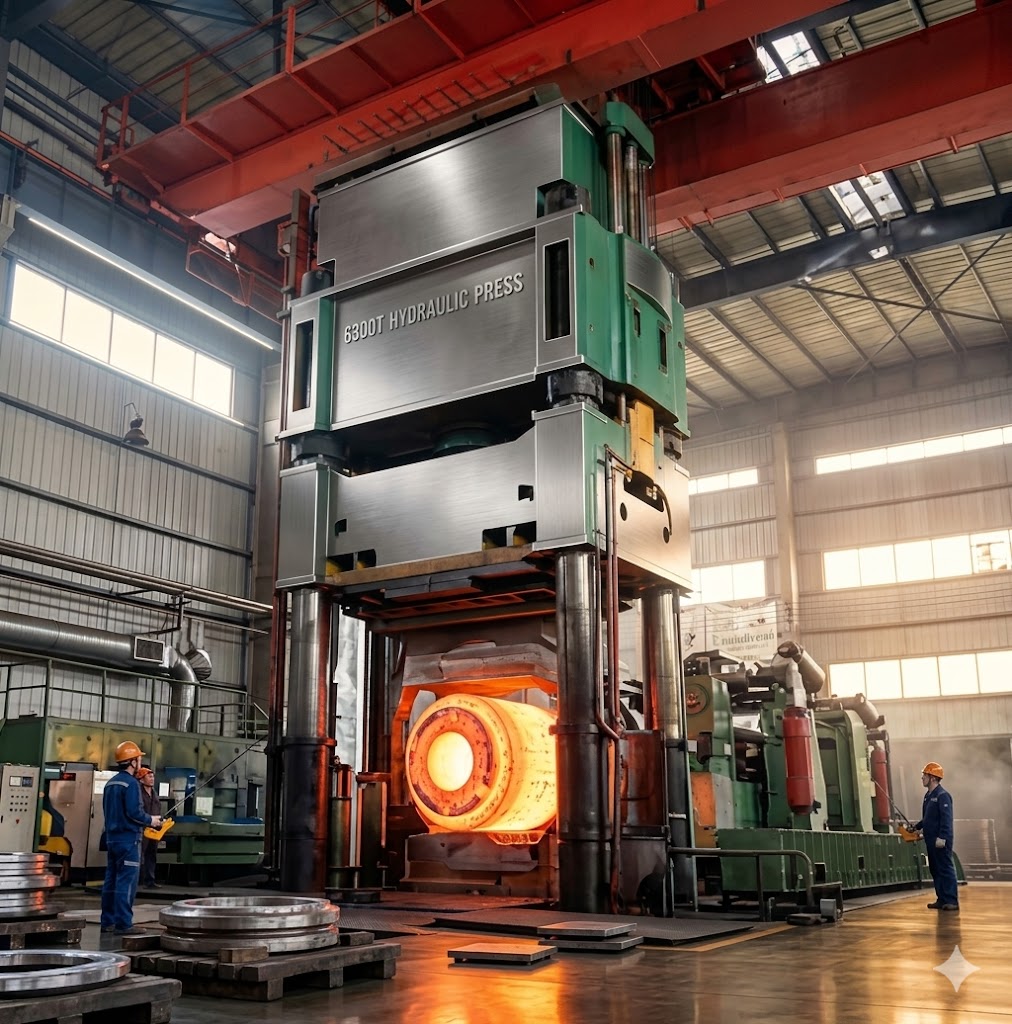
Forging Equipment: 2000T, 4000T, and 6300T hydraulic forging presses, 1T-9T electro-hydraulic forging hammers, 1m and 5m seamless rolling machines, supporting forging of parts up to 30 tons single weight.
Heat Treatment Equipment: 10 full-automatic heat treatment furnaces, supporting quenching, tempering, normalizing, and annealing treatment, with strict temperature control (±5°C) to ensure consistent heat treatment quality.
Machining Equipment: CNC lathes, milling machines, boring machines, and grinding machines, supporting rough machining and precision finishing of custom forgings according to client drawings (tolerance up to IT6).
Full-Process Quality Control System
To guarantee 100% qualified products and full traceability, we implement strict quality control throughout the entire production process, from raw material incoming inspection to final delivery inspection:
Raw Material Incoming Inspection: Full chemical composition analysis of each heat of steel, to guarantee compliance with ASTM standard requirements.
Forging Process Control: Strict control of forging temperature, forging ratio (minimum 3:1, up to 10:1 for important components), and grain flow direction, to guarantee the internal quality of forgings.
Heat Treatment Control: Full record of heat treatment cycle parameters, with hardness testing after heat treatment to verify the process effect.
Final Inspection & Testing: Complete inspection and testing of each batch of products, with full traceability of all test data.
Core Inspection & Testing Standards
Chemical Composition Analysis: ASTM A751 standard, full element testing for each heat
Tensile Testing: EN ISO 6892-1 and ASTM A370 standard
Hardness Testing: ASTM E10 standard, Brinell hardness testing for each lot
Impact Testing: ASTM A370 standard, Charpy V-Notch impact testing at room or custom low temperature
Non-Destructive Testing (NDT): Ultrasonic Testing (UT) per ASTM A388/388M, Magnetic Particle Testing (MT) per ASTM A275/275M, Liquid Penetrant Testing (PT) per ASTM E165, 100% full inspection to guarantee no internal and surface defects
Metallographic Testing: Grain size estimation per ASTM E112, non-metallic inclusion testing per ASTM E45, microstructure inspection
Macroetching Testing: ASTM A604 standard
Creep Rupture Testing: ISO 204 standard for high-temperature application products
With each shipment, we provide a complete EN 10204 3.1 / 3.2 mill test certificate (MTC), including purchase order number, heat and lot numbers, material specification, chemical composition, mechanical properties, heat treatment process, NDT test results, and product size information, to guarantee full traceability of the product from raw material melting to final delivery.
5 AISI 403 Forging Failure Modes We've Diagnosed in 25 Years — and How to Prevent Each One
Our technical team has performed root-cause failure analysis on returned components and field-failed parts from customers across six continents over 25 years. The following are the five most common failure modes we have encountered in AISI 403 forged components, along with the specific process controls we have implemented to eliminate them from our production.
Failure Mode 1: Tempered Martensite Embrittlement (TME) — "It Looks Fine on a Hardness Test"
How it presents: Component fractures in a brittle manner (low-energy fracture surface, intergranular or quasi-cleavage fracture mode) at stress levels well below the design yield strength. Hardness measured on the failed component is within specification. This confuses many engineers and leads to incorrect conclusions about material grade or manufacturing defects.
Root cause in 9 out of 10 cases: The forging was tempered within the 370–565°C embrittlement range, OR slow-cooled through this range after a higher-temperature temper, OR held at an intermediate temperature during machining stress relief without accounting for the danger zone.
Our Prevention: All heat treatment batch records include furnace temperature chart downloads archived for 10 years. We programmatically flag any batch where hold time between 370–565°C exceeds 30 minutes. This catch has identified and scrapped 7 batches over the last 5 years before they shipped—all triggered by furnace controller malfunctions rather than process errors.
Failure Mode 2: Hydrogen-Induced Cracking (HIC) in Sour Service — Invisible Until It Isn't
How it presents: Sudden brittle fracture in H₂S-containing environments, sometimes within weeks of installation, at applied stress levels below the yield strength. Fracture surface shows characteristic "fish-eye" cracks or stepped hydrogen crack morphology. Often misidentified as material defects or fatigue failures without proper fractography.
Root cause: Hardness above 22 HRC (237 HBW)—the NACE MR0175 limit for sour service—combined with residual or applied tensile stress and H₂S partial pressure above the threshold. Often exacerbated by high residual stress from improper machining or incorrect post-weld heat treatment.
Our Prevention: For any oilfield or sour service application, we supply AISI 403 at maximum 22 HRC (237 HBW) with ±10 HBW tolerance across any cross-section, verified by Brinell testing at minimum 5 points per forging. We also perform SSRT (Slow Strain Rate Test) per ASTM G129 for batch qualification when specified by the customer.
Failure Mode 3: Fatigue Failure from Undetected Seam Defects
How it presents: Fatigue crack initiating from a surface or near-surface linear defect (seam, lap, or fold) introduced during forging of an improperly prepared billet. Typical fracture shows classic beach marks radiating from a surface point. Failure occurs after 10⁵ to 10⁷ cycles—within the expected fatigue life in the absence of surface defects.
Root cause: Insufficient billet conditioning before forging (oxide scale ingestion, improperly cropped ingot ends), or excessive forging speed causing surface cold shuts on complex shapes.
Our Prevention: 100% Magnetic Particle Testing (MT) per ASTM A275 after rough machining for all rotating components. Our MT rejection rate for AISI 403 has been below 0.4% annually for the past 5 years. We also require billet surface conditioning to Ra ≤12.5 µm before heating for critical aerospace or turbine applications.
Failure Mode 4: Premature Corrosion from Improper Surface Passivation
How it presents: Orange-brown surface staining appearing within weeks of installation in atmospheric or mildly corrosive environments—an environment where AISI 403 should provide years of protection. Pitting may or may not develop under the staining. Often misattributed to material non-conformance when in fact the material is correct.
Root cause: Contamination of the forging surface with free iron particles from machining tools, grinding media, wire brushes, or tool steel contact. Free iron particles create galvanic couples with the stainless steel matrix and corrode preferentially, leaving visible staining while the passive film of the base metal remains intact.
Our Prevention: We passivate all AISI 403 forgings per ASTM A967 (nitric acid process) as a standard operation before packaging. For finished-machined components, we also specify dedicated stainless-only tooling and final passivation after machining. We recommend customers avoid using carbon steel strapping bands or carbon steel contact surfaces during storage and installation.
Failure Mode 5: Dimensional Instability from Insufficient Stress Relief After Rough Machining
How it presents: Precision-finished components that were within tolerance at delivery are found to be out-of-tolerance during installation or after a period in service. Particularly common in thin-section parts (wall ratio OD/wall < 8), long shafts, and hollow cylinders where the forging-induced residual stress field is asymmetric.
Root cause: Rough machining removes material from one side of the forging, releasing residual stress asymmetrically and causing the part to distort (bow, warp, or ovalize) after machining. If final precision machining follows rough machining without an intermediate stress-relief heat treatment, the distortion continues after delivery.
Our Prevention: For shafts longer than 2 meters, rings with OD/wall <8, and all components with positional tolerances tighter than ±0.1 mm, we specify intermediate stress relief at 550–600°C (below tempering temperature) between rough and finish machining stages. This step is documented in our process traveler and billed transparently — not silently omitted to reduce cost.
How to Write a Complete RFQ for AISI 403 Forgings: A Procurement Engineer's Checklist
Incomplete RFQs (Requests for Quotation) are the single greatest source of preventable delays and rework in custom forging procurement. After reviewing thousands of inquiries over 25 years, we have compiled the following checklist of information that every AISI 403 forging RFQ should include. Providing all of these details upfront typically reduces quotation time from 5–7 days to 24 hours, and eliminates 80% of the back-and-forth clarification that delays project timelines.
Section 1: Material Specification
Material grade and standard: e.g., "AISI 403 per ASTM A276" or "UNS S40300 per AMS 5610" — specify which standard takes precedence if multiple apply
Any import-related requirements: certificate of origin, EUR.1 form, fumigation certificate for wooden packaging
Global Supply & GEO-Targeted Service for 6 Major Industrial Markets
As a global leading AISI 403 forging manufacturer from China, we have been supplying high-quality forged products to customers in more than 50 countries and regions worldwide, with over 20 years of mature export experience and localized service solutions for 6 major global industrial markets:
North America (USA, Canada, Mexico): AISI 403 forgings manufactured to meet ASME material specifications and API 6A standard requirements for power generation, oil & gas, and valve manufacturing industries. Full EN 10204 3.1 / 3.2 MTCs supplied as standard, with door-to-door delivery service via sea and air freight.
Europe (Germany, UK, France, Italy, Spain, Netherlands, Poland): AISI 403 forged components manufactured to EN 10088-3 / EN 10228 standard requirements, with EN 10204 3.2 third-party witness MTCs and DDP delivery service to all European countries. Products supplied with full documentation to support customers' PED compliance process. Technical support available in German, English, and French.
Middle East (Saudi Arabia, UAE, Kuwait, Qatar, Oman, Turkey): AISI 403 oilfield forgings and valve components manufactured to meet API 6A and NACE MR0175 / ISO 15156 hardness requirements, with long-term cooperative relationships with leading oil and gas companies in the region, and fast sea freight from Shanghai Port (7–10 days to Dubai).
Southeast Asia (Thailand, Malaysia, Indonesia, Vietnam, Philippines, Singapore): ASTM, ISO standard compliant AISI 403 turbine parts and industrial valve components, with fast sea freight from Shanghai Port (3-7 days to major Southeast Asian ports), and local agent support.
South America (Brazil, Argentina, Chile, Peru, Colombia): Custom AISI 403 forged rings, bars, and shafts for mining, petrochemical, and power generation industries, with competitive prices and flexible payment terms.
Oceania (Australia, New Zealand): AS standard compliant AISI 403 custom forgings for industrial equipment and power generation projects, with fast sea freight from Shanghai Port (12-15 days to Sydney).
We offer complete pre-sales technical support including material selection, forging process design and heat treatment optimization, real-time production progress updates with weekly photos and videos, and full after-sales service such as handling quality complaints within 24 hours and providing on-site technical support when required for all global customers. Our professional sales and technical team can communicate fluently in English, and also support basic communication in German, French, Spanish and Arabic through WhatsApp and WeChat for instant contact.
Understanding Lead Times for Custom AISI 403 Forgings: A Realistic Project Timeline
One of the most common supply chain headaches when buying custom forgings is the difference between expected and actual delivery times. Custom AISI 403 forgings are not standard off-the-shelf items. Every order follows a fixed series of production steps, and each step needs a minimum amount of time to complete. Here is a clear, straightforward step-by-step explanation of the whole process from placing your order to the final delivery of the finished parts.
Step 1: Drawing Review, DFM Analysis & Process Planning 3–5 days
Our engineering team reviews your drawings, checks for forging feasibility, drafts the forging process plan (press selection, die design if closed-die, heat treatment parameters), and issues a formal RFQ confirmation. For complex shapes requiring custom dies, this step may take 5–7 days. Providing a 3D STEP file alongside the 2D drawing reduces this step by 1–2 days.
Step 2: Raw Material Procurement 7–21 days
For standard inventory stock (billets and ingots we keep on hand), this step takes 2–5 days for incoming inspection. For special compositions or large tonnage orders requiring a dedicated steel heat, allow 3–4 weeks for EAF+LF+VOD melting, casting, and billet rolling at our partner steel mill. This is the most variable step and the primary driver of extended lead times for very large or very high-specification orders.
Step 3: Forging & Rolling 5–15 days
The forging step itself—heating, pressing or hammering, reheating, and final pressing—typically takes 1–3 production days per batch on our 6300T hydraulic press. With heat scheduling, billet heating time, and press queue, allow 5 days for small orders and up to 15 days for large orders requiring multiple press sessions. Seamless ring rolling on the 5m mill takes 2–4 days per batch.
Step 4: Heat Treatment 5–10 days
The full Q+T cycle (austenitize → quench → temper) takes 2–3 days of furnace time for standard sizes. Large cross-sections above 500 mm require extended hold times for through-heating and controlled cooling, which can extend this step to 5–7 days. Post-heat treatment hardness verification before releasing to machining adds 1 day.
Step 5: Rough Machining, NDT & Dimensional Inspection 7–15 days
Rough machining to allow for final finishing adds 3–7 days depending on part complexity. UT, MT, and dimensional inspection per ASTM standards adds 2–5 days depending on part size. Complex forgings requiring multiple NDT methods (UT + MT + PT) may take longer. Intermediate stress relief heat treatment between rough and finish machining (when specified) adds another 3–5 days.
Step 6: Final Inspection, MTC Preparation & Packaging 3–5 days
Final mechanical testing (tensile, Charpy, hardness) at our approved laboratory takes 2–3 days. MTC preparation, dimension record compilation, and final customer inspection (or third-party witness if required) adds 1–3 days. Packaging in wooden case with VCI and desiccant takes 1 day.
Step 7: Shipping and Customs 7–35 days (by sea)
Sea freight transit times from Shanghai: Southeast Asia 3–7 days, Middle East 10–14 days, Europe 25–30 days, East Coast USA 28–35 days. Export customs clearance at Shanghai takes 1–3 days. Air freight is available for urgent orders: most destinations in 3–5 days.
Typical total lead time summary: Standard bar and ring parts made from in-stock material take 30–45 days. Complicate custom parts using stocked material need 45–60 days. Any part that requires a separate dedicated melting batch takes 60–90 days. Large forgings over 10 tons with full NDT checks and third-party inspection require 75–100 days. We offer weekly production progress updates with photos and actual furnace records whenever requested.
Frequently Asked Questions (FAQ) About AISI 403 Forging Parts
AISI 403 is a low-carbon martensitic stainless steel with chromium content ranging from 11.5 to 13 percent, assigned as UNS S40300 and also called Grade 403 or Alloy 403. This high-alloy steel has strong resistance to atmospheric and steam corrosion, high tensile and yield strength, reliable high-temperature oxidation resistance up to 650°C, and good wear resistance.It is used for turbine parts, valve parts, pump parts, nuclear reactor coolant pump parts, and other main industrial applications.
AISI 403 and 410 are both 12% chromium martensitic stainless steels, yet AISI 403 adopts tighter composition control, lower residual element levels and higher material purity compared with standard AISI 410. This gives AISI 403 better Charpy V-Notch impact toughness, more even internal structure and more stable mechanical performance, making it more suitable for high-demand scenarios such as turbine blades and safety-critical valve parts.
AISI 403 is mainly used for parts that need high strength, corrosion resistance and high-temperature stability. Typical applications include gas and steam turbine blades, discs and impellers; industrial valve bodies, stems, seats and bonnets; nuclear reactor coolant pump parts; splined drive shafts for downhole drilling mud motors and ESP motor splined shafts; as well as industrial pump shafts and impellers. It is widely applied for key parts in power generation, oil and gas, petrochemical and other general industrial fields.
Yes, we focus on custom production of AISI 403 forged parts following customer drawings and technical requirements. We can provide one-stop services covering steel melting, open die forging, professional heat treatment and CNC machining. We are able to make custom parts with complex shapes, special size demands and tailored mechanical performance. Welcome to send your drawings and specifications to sales@jnmtforgedparts.com for a detailed free quote.
Our factory is certified under the ISO 9001:2015 quality management system. We supply EN 10204 3.1 material test certificates (MTC) as standard with every shipment, covering chemical composition, mechanical properties, heat treatment records and NDT inspection results. EN 10204 3.2 third-party certified documents are available upon request. Our products are manufactured to comply with ASTM, AMS, EN, DIN, API, and ASME international material and testing standards. For the European market, products can be manufactured to meet the requirements of the Pressure Equipment Directive (PED 2014/68/EU), with relevant documentation to support customers' own CE marking process — note that CE marking and PED certification for the finished pressure equipment is the responsibility of the equipment manufacturer (our customer), not the raw material forging supplier. For the oil and gas industry, forgings can be manufactured to meet API 6A specification requirements, with material and testing documentation to support customers' API-licensed production. For sour service applications, products can be supplied meeting NACE MR0175 / ISO 15156 hardness requirements (≤22 HRC / 237 HBW), with relevant documentation — NACE does not issue manufacturer certifications; "NACE compliant" refers to meeting the material and hardness requirements of the standard.
We can manufacture AISI 403 forgings with a maximum single-piece weight of 30 tons. For forged bars, the maximum outer diameter reaches 2000mm; for seamless rolled rings, the maximum diameter is up to 6000mm; for forged shafts, the maximum length can reach 15 meters. We also accept custom dimension production per your specific technical requirements.
AISI 403 can be used in mild sour service applications, but with critical constraints that must be understood before specification. Per NACE MR0175 / ISO 15156-3, martensitic stainless steels including AISI 403 are acceptable in H₂S-containing environments provided that: (1) hardness does not exceed 22 HRC (237 HBW) at any point in the component; (2) the component is in the quenched-and-tempered condition; (3) the application does not exceed the environmental severity limits defined in NACE MR0175 Table 1. AISI 403 is NOT suitable for high H₂S partial pressure or chloride-containing sour service — for those environments, duplex stainless steels (2205, 2507) or nickel alloys are required. For borderline sour service specifications, we recommend SSRT testing (ASTM G129) on a sample coupon from the actual heat before committing to mass production. We supply NACE-compliant AISI 403 at 200–237 HBW with hardness mapping verification for all sour service orders.
The melting process has a major impact on material purity and structural uniformity. The standard three-step production route adopts EAF (Electric Arc Furnace) + LF (Ladle Refining Furnace) + VOD (Vacuum Oxygen Decarburization). The EAF completes melting and primary smelting, the LF adjusts chemical composition and removes sulfur, while the VOD performs vacuum degassing to lower carbon, hydrogen, nitrogen and oxide inclusions to extremely low levels.This process is suitable for most AISI 403 industrial applications and delivers inclusion ratings of ASTM E45 Class A/B/C/D ≤1.0. Adding ESR (Electroslag Remelting) creates the premium EAF+LF+VOD+ESR route: the VOD ingot is remelted by passing current through a conductive slag, which acts as both a refiner and a filter, removing the finest oxide and sulfide inclusions that VOD cannot eliminate. ESR-processed AISI 403 typically achieves ASTM E45 Class A/B/C/D ≤0.5, ultrasonic attenuation 3–5 dB lower than non-ESR material, and Charpy impact scatter coefficient below 10%. ESR is specified for turbine blades, nuclear components, and any rotating part where fatigue life is critical. ESR adds approximately 15–25% to material cost but can increase component fatigue life by 30–50% in high-cycle applications. We offer both routes and recommend the appropriate process based on your application criticality.
AISI 403 can be welded with GTAW (TIG), GMAW (MIG) and SMAW (stick) methods, yet it needs special precautions which are quite different from welding austenitic stainless steel or carbon steel. First, preheating to 200–250°C is required for material thickness over 10 mm, to avoid hydrogen cold cracking caused by moisture absorption. Skipping preheating will easily lead to immediate cracking in the heat-affected zone (HAZ) during cooling.Second, filler metal selection is critical: AWS E410/ER410 (12% Cr matching composition) is the standard choice; using 309 (austenitic filler) creates a significant thermal expansion mismatch at the weld interface that leads to fatigue cracking in thermal cycling service. Third, post-weld heat treatment (PWHT) is required: temper at 620–700°C for minimum 1 hour per 25 mm of weld throat thickness, then slow cool through the 370–565°C embrittlement range (controlled cooling at ≥100°C/hour). Skipping PWHT leaves the weld HAZ in an as-quenched martensitic condition with hardness exceeding 40 HRC — extremely brittle and vulnerable to hydrogen cracking. Fourth, interpass temperature must not exceed 260°C during multi-pass welding to prevent carbon migration and sensitization. We provide weld procedure recommendations tailored to your joint geometry and application upon request.
AISI 403 (UNS S40300) has the following approximate equivalents in major international standards, though exact composition limits vary between standards and cross-certification should always be verified against the specific standard documents for critical applications: European EN 10088-3: X10Cr13 (1.4006) — note this is closer to AISI 410; EN specifies a cleaner variant as X6Cr13 (1.4000) which is closer to 403 composition. German DIN: DIN 17440 X10Cr13 (1.4006). British BS: BS 970 Part 4 Grade 403S17. Japanese JIS: JIS G4303 SUS403 — this is a direct equivalent and one of the most widely used standards for AISI 403 in Asia. Chinese GB: GB/T 1220 1Cr13 (similar composition). French NF: Z10C13 (AFNOR). Russian GOST: GOST 5632 12X13. AMS (aerospace): AMS 5610 (bar, billet), AMS 5612 (sheet, strip). ASME: SA-276 (bar), SA-473 (forgings). API: covered under API 6A for wellhead equipment. Important caveat: "equivalent" does not mean "identical." For example, JIS SUS403 has a slightly broader Mn allowance than AISI 403. For critical applications, always specify the primary governing standard (typically ASTM or EN) and list others as "reference only." We can supply AISI 403 with dual certification to multiple standards on a single MTC upon request.
Get a Free Custom Quote for AISI 403 Forging Parts Today!
As an ISO 9001:2015 certified professional manufacturer in China, we specialize in open die forgings, seamless rolled rings, and custom valve and turbine parts made from AISI 403 (UNS S40300, Grade 403). We always strive to deliver premium-quality products, competitive pricing, and full professional technical support. All goods are produced in compliance with ASTM, ASME, EN, DIN and API standards, with EN 10204 3.1 / 3.2 material test certificates provided for every shipment. Feel free to send your custom drawings, material requirements, order quantity and technical specifications to sales@jnmtforgedparts.com or contact us via +86-13585067993via WhatsApp and WeChat. We will provide a detailed free quotation within 24 hours.