ISO 9001:2015
Quality Certified
25+ Years
Manufacturing Experience
50+ Countries
Global Delivery
30 Tons
Max Single Piece
120,000 Tons
Annual Capacity
⚙️ Jiangsu Liangyi Engineering Team · Chief Forging Engineers, 25+ yrs A286 experience
What is A286 (UNS S66286) Alloy?
A286 (UNS S66286, AMS 5731/5732, ASTM B637) is an iron-nickel-chromium precipitation-hardening superalloy containing about 55% iron, 24–27% nickel, and 13.5–16% chromium, further strengthened by titanium (1.9–2.35%) and boron additions. As the highest-strength iron-based superalloy commercially available, it keeps a minimum tensile strength of 900 N/mm² (130 ksi) and excellent creep resistance up to 704°C (1300°F) under high-stress conditions. Fully austenitic and non‑magnetic, A286 offers exceptional cryogenic toughness down to −253°C (−423°F). It outperforms standard austenitic stainless steels significantly, while costing 40–60% less per kilogram than nickel‑base superalloys such as Inconel 718.
A286 Alloy Forging Capabilities from Jiangsu China
As a top A286 forging manufacturer based in Jiangyin, Jiangsu, China, Jiangsu Liangyi specializes in custom A286 (UNS S66286) forged parts produced via advanced open‑die forging and seamless ring rolling technologies.
Our factory has 2000–6300 ton hydraulic presses, 1–5 meter seamless ring rolling mills, and ten heat treatment furnaces. We manufacture A286 forgings ranging from 30 kg up to 30,000 kg, with an annual production capacity of 120,000 tons.
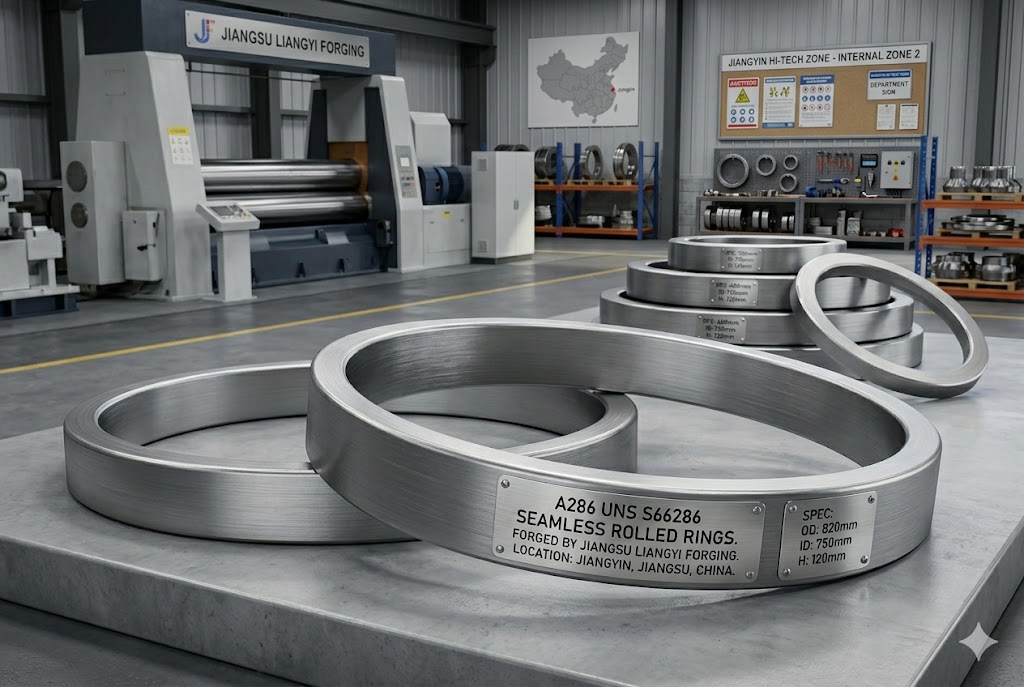
All A286 superalloy forgings are shipped from our facility with full Mill Test Certificates (MTC) 3.1/3.2, and they all meet ASTM, AMS, DIN, EN, and JIS standards. We can also produce parts to customer-specified requirements, including API 6A material specifications, upon request. Third-party inspection by SGS, Bureau Veritas, TÜV, or Intertek is available as needed.
Jiangsu Liangyi A286 Forging Dimensional Capability Matrix
Unlike many suppliers that list capability ranges without proven experience, the table below reflects our actual production and delivery history from our Jiangyin facility.We also welcome inquiries outside these ranges — please contact us to discuss technical feasibility.
swipe to scroll
Jiangsu Liangyi A286 Forging Capability — based on equipment: 2000–6300t hydraulic press, 1–5m ring rolling mill
| Product Form | Typical Size Range | Max Single Piece | Delivery Condition |
|---|
| Seamless Rolled Rings | OD 300–6,000 mm; H up to 1,500 mm | 30,000 kg | As-forged, rough turned, finish machined |
| Round Bars & Billets | Ø 50–2,000 mm; L up to 6,000 mm | 20,000 kg | As-forged, turned/peeled, centre-drilled |
| Forged Shafts | Ø 80–800 mm; L up to 15,000 mm | 15,000 kg | Rough turned, stepped, fully machined |
| Discs & Plates | Ø 200–3,000 mm; T 50–600 mm | 18,000 kg | As-forged, faced, fully machined |
| Hollow Bars & Sleeves | OD up to 3,000 mm; ID from 200 mm | 15,000 kg | As-forged or machined to drawing |
| Pipes & Tubings (forged) | OD 100–1,200 mm; WT 20–200 mm | 10,000 kg | As-forged, bored, honed |
| Custom Open-Die Shapes | Per customer drawing | 30,000 kg | All conditions available |
Available A286 Forged Shapes & Dimensions
- Forged Bars: Round bars, square bars, flat bars, rectangular bars, and rods up to 2 meters in diameter
- Seamless Rolled Rings: Custom forged rings, gear rings, slewing bearing rings, and contoured rolled rings up to 6 meters in diameter and 30 tons in weight
- Forged Shafts: Step shafts, gear shafts, turbine shafts, crankshafts, and eccentric shafts up to 15 meters in length
- Hollow Components: Hubs, housings, shells, sleeves, bushes, cases, and hollow bars up to 3,000 mm OD
- Disks & Plates: Forged discs, disks, blocks, and plates for turbine and pressure vessel applications
- Pipes & Tubes: Seamless forged pipes, tubes, tubings, shells, casings, and barrels for high-pressure applications
We also offer complete in-house CNC machining, heat treatment, and non-destructive testing (NDT) services — a one-stop solution from billet to finished part.
A286 (UNS S66286) Material Properties & Key Advantages
A286 is an iron‑nickel‑chromium precipitation‑hardening superalloy. It is recognized because it has high tensile strength, excellent oxidation, corrosion resistance and reliable creep resistance at elevated temperatures.Its versatile performance covers applications from cryogenic service up to nearly 1000°C, making it one of the most suitable superalloys for industrial conditions.
Key Advantages of A286 Superalloy Over Stainless Steel
- Tensile strength is about 3 times that of 316 SS at room temperature; retains advantage at 500°C where 316 SS has lost over 40% of its room-temperature strength
- Great oxidation and corrosion resistance in H₂S, CO₂, chloride, it can work well in high-temperature steam environments
- Excellent creep resistance up to 704°C (1300°F) — important for long-term bolted joint integrity in turbine and valve applications
- Outstanding cryogenic toughness to −253°C (−423°F) with no brittle fracture risk — unlike ferritic or martensitic steels
- Fully austenitic, permanently non-magnetic — essential for subsea electromagnetic measurement tools and MRI-related equipment
- Good weldability with matching AMS 5804 filler metal compared to higher-nickel Inconel grades
- Cost-effective: 40–60% less per kilogram than Inconel 718 for applications not needing the highest-end nickel-base performance
Chemical Composition (wt%) — A286 / UNS S66286 / AMS 5731
A286 (UNS S66286) Chemical Composition per ASTM B637 / AMS 5731 (SAE International)
| Element | Range (wt%) | Element | Range (wt%) |
|---|
| Carbon (C) | 0.08 max | Nickel (Ni) | 24.00 – 27.00 |
| Manganese (Mn) | 2.00 max | Molybdenum (Mo) | 1.00 – 1.50 |
| Phosphorus (P) | 0.025 max | Titanium (Ti) | 1.90 – 2.35 |
| Sulfur (S) | 0.025 max | Vanadium (V) | 0.10 – 0.50 |
| Silicon (Si) | 1.00 max | Aluminum (Al) | 0.35 max |
| Chromium (Cr) | 13.50 – 16.00 | Boron (B) | 0.003 – 0.010 |
| Iron (Fe) | Balance (~55%) |
Room-Temperature Mechanical Properties (Solution Treated + Aged)
A286 (UNS S66286) Minimum Mechanical Properties per AMS 5731 — solution treated 982°C / aged 718°C
| Property | Metric | Imperial |
|---|
| 0.2% Proof Stress (min) | 590 N/mm² | 85 ksi |
| Tensile Strength (min) | 900 N/mm² | 130 ksi |
| Elongation A₅ (min) | 13–15% | 13–15% |
| Reduction of Area (typical) | 25–40% | 25–40% |
| Hardness (typical) | 248–302 HB | 248–302 HB |
| Charpy Impact (typical, RT) | ≥ 50 J | ≥ 37 ft·lb |
A286 Elevated Temperature Mechanical Properties
This data is important for engineers designing parts for gas turbines, power generation, and oil and gas service. The values below are typical for solution-treated and aged A286 bar per AMS 5731 and represent the performance engineers can reliably design to — not peak laboratory values.
🔧 Forger's Note — Jiangsu Liangyi Engineering Team
In our production process, the grain size developed during forging has a significant influence on high-temperature performance.For A286, we target an ASTM grain size of 5–8: coarser grains improve creep resistance, while finer grains improve fatigue life.
For turbine disk applications, we carefully control forging reduction ratios and finishing temperatures to get consistent grain size across the entire cross-section. This level of control cannot be guaranteed by standard off-the-shelf bar suppliers, which is why procurement engineers on power generation projects specify forged A286 rather than rolled A286 for rotating parts.
A286 (UNS S66286) Typical Tensile Properties at Elevated Temperature — solution treated + aged per AMS 5731. Values are typical minimums; verify with material certification for critical design.
| Test Temperature | 0.2% Proof Stress (MPa) | Tensile Strength (MPa) | Elongation (%) | Reduction of Area (%) |
|---|
| Room Temp (20°C / 68°F) | ≥ 590 | ≥ 900 | ≥ 13 | ≥ 25 |
| 300°C (572°F) | ≥ 540 | ≥ 870 | ≥ 14 | ≥ 28 |
| 500°C (932°F) | ≥ 510 | ≥ 840 | ≥ 14 | ≥ 30 |
| 600°C (1112°F) | ≥ 490 | ≥ 790 | ≥ 15 | ≥ 32 |
| 650°C (1202°F) | ≥ 450 | ≥ 740 | ≥ 16 | ≥ 35 |
| 700°C (1292°F) | ≥ 380 | ≥ 650 | ≥ 18 | ≥ 38 |
📊 Why A286 Retains Strength at Temperature: The Gamma-Prime Mechanism
A286’s high-temperature strength is derived from the precipitation of coherent γ' (gamma‑prime) intermetallic particles — mainly Ni₃(Ti, Al) — within the austenitic matrix during aging. These fine precipitates restrict dislocation motion. At Jiangsu Liangyi, we strictly control the aging cycle: 720°C ±10°C for a minimum of 16 hours, to improve the γ' volume fraction and particle size. This directly improves both room‑temperature strength and high‑temperature creep performance. Even a 50°C deviation from the target — either over‑aging or under‑aging — results in a measurable reduction in creep rupture life. For this reason, our heat treatment personnel hold Level II qualifications, and our furnaces are calibrated monthly to an accuracy of ±5°C.
A286 Creep Rupture Data
For important rotating and pressure‑retaining parts, creep rupture life is often the design‑limiting factor, rather than short‑term tensile strength.
Representative values below apply to aged A286 bar produced per AMS 5731:
A286 Typical Creep Rupture Stress (MPa) — stress to cause rupture in given time at temperature. Source: published alloy data per AMS 5731 / ASTM B637. For design use, consult primary standard.
| Temperature | 100 hours | 1,000 hours | 10,000 hours |
|---|
| 538°C (1000°F) | ~690 MPa | ~590 MPa | ~490 MPa |
| 593°C (1100°F) | ~480 MPa | ~380 MPa | ~290 MPa |
| 649°C (1200°F) | ~280 MPa | ~200 MPa | ~140 MPa |
| 704°C (1300°F) | ~145 MPa | ~95 MPa | ~60 MPa |
A286 Corrosion & Oxidation Resistance in Industrial Environments
A286 contains 13.5–16% chromium, which forms a stable, self‑repairing chromium oxide (Cr₂O₃) passive layer, having excellent corrosion resistance across many harsh environments. This is important for oil and gas and nuclear applications, where corrosion failure can lead to catastrophic consequences.
The table below summarizes A286 performance in typical industrial media, based on published data and our customers’ field service experience.
A286 (UNS S66286) Corrosion Resistance by Environment — compared to 316L SS and Inconel 718
| Corrosive Environment | A286 Rating | 316L SS Rating | Inconel 718 Rating |
|---|
| Oxidizing atmosphere to 700°C | Excellent | Good | Excellent |
| Steam (high-pressure, >300°C) | Excellent | Good | Excellent |
| Seawater / chloride solution | Good | Limited (pit risk) | Excellent |
| Sour gas (H₂S + CO₂, NACE MR0175) | Good — confirm with application-specific testing | Not qualified | Excellent |
| Dilute sulfuric acid (H₂SO₄ <10%) | Good | Good | Excellent |
| Dilute hydrochloric acid (HCl <5%) | Limited | Poor | Good |
| Nitric acid (HNO₃) | Excellent | Excellent | Good |
| Liquid nitrogen / cryogenic service | Excellent (non-brittle) | Good | Excellent |
Rating key: Excellent = minimal corrosion, long service life; Good = suitable with standard design margins; Limited = use with caution, periodic inspection advised; Poor = not recommended. Ratings are based on published alloy data and general industry experience. Always conduct application-specific testing and consult a materials engineer for critical service environments.
🔧 Forger's Note — Jiangsu Liangyi Engineering Team · Oil & Gas Valve Bodies
Based on our experience supplying A286 valve bodies and seats to Middle East oilfield operators, the most frequent failure mode returned for analysis is not general corrosion, but crevice corrosion at threaded interfaces exposed to high-chloride produced water.
The solution our customers have implemented is specifying fully machined seating surfaces with Ra ≤ 0.8 µm, which we manufacture in‑house to minimize crevice formation. To our knowledge, no other forging supplier addresses this practical field issue in their product literature, yet it represents an important service consideration worth reviewing with your materials engineer.
A286 vs Inconel 718 vs 17-4PH vs 316SS — Which Alloy to Choose?
This is the most common question our sales engineers receive.After 25 years of quoting and supplying forged parts, we’ve developed a simple, practical decision framework that we share openly. Helping you specify correctly reduces downstream issues and supports a long-term partnership.
Head-to-Head Alloy Comparison: A286 vs Inconel 718 vs 17-4PH vs 316L SS — forged components perspective
| Property / Criterion | A286 (UNS S66286) | Inconel 718 (N07718) | 17-4PH (S17400) | 316L SS (S31603) |
|---|
| Alloy Base | Iron-Ni-Cr (~55% Fe) | Nickel-base (~50–55% Ni) | Iron-Cr-Ni-Cu (martensitic) | Iron-Cr-Ni-Mo (austenitic) |
| RT Tensile Strength | 900–1,100 MPa | 1,240–1,380 MPa | 930–1,310 MPa (H900–H1150) | 515–620 MPa |
| Max Service Temp (high stress) | 704°C (1300°F) | 704°C (with better strength) | 316°C (600°F) | 450°C (842°F) creep limit |
| Cryogenic Service | Excellent to −253°C | Excellent to −253°C | Not recommended (<−40°C) | Good to −196°C |
| Magnetic Properties | Non-magnetic | Non-magnetic | Magnetic | Non-magnetic |
| Corrosion Resistance | Good – Excellent | Excellent | Good (chloride sensitive) | Good |
| Machinability | Moderate (~20–25% vs free-cut) | Difficult (~15–20%) | Good (~40–50%) | Moderate (~35–45%) |
| Weldability | Good (AMS 5804 filler) | Difficult (hot-cracking risk) | Good (pre/post heat needed) | Excellent |
| Relative Cost Index (forged) | 1.0× (baseline) | 1.8–2.5× | 0.8–1.1× | 0.3–0.5× |
| Common Forging Standards | ASTM B637, AMS 5731, AMS 5732 | AMS 5662, AMS 5664, ASTM B637 | AMS 5643, ASTM A564 | ASTM A182, EN 10250 |
| Best Fit Application | Turbines, oil & gas valves, nuclear, cryogenics — temp 400–704°C | Aerospace engine critical parts, highest temp/stress applications | Pump shafts, oil & gas hardware — max ~316°C | General chemical, food, moderate temp up to ~400°C |
When Should You Specify A286 Over the Alternatives?
✓ Choose A286 A286 is Your Best Choice When:
- Service temperature is 400–704°C and creep or stress relaxation is a concern
- The part must be non-magnetic (electromagnetic flow meters, MRI-adjacent, subsea sensors)
- Cryogenic service below −100°C is needed
- Budget is constrained vs. Inconel 718 but performance exceeds stainless steel capability
- Fasteners, springs, or bolting must retain preload at elevated temperature
- Sour gas / H₂S environments — confirm suitability with application-specific NACE MR0175 testing
Consider Inconel 718 Instead When: Upgrade to Inconel 718 If:
- Needed tensile strength exceeds 1,100 MPa at operating temperature
- Service conditions are extremely demanding — aerospace combustion zone, nuclear reactor internals
- Creep rupture life beyond 10,000 hours at above 650°C is required
- Customer specification explicitly mandates nickel-base alloy classification
- Budget allows premium materials (1.8–2.5× A286 cost)
Downgrade to Stainless If: 316L / 17-4PH May Suffice When:
- Service temperature is below 400°C with no significant creep requirement
- Non-rotating, low-stress structural component
- Budget is the primary constraint and performance is not critical
- For 17-4PH: room-temperature strength is important but no elevated temp service
- Standard industrial corrosion resistance is adequate
How to Machine and Weld A286 Superalloy Forgings
A286 is classified as a difficult-to-machine material, with a machinability rating of only about 20–25% compared to free-cutting carbon steel.Understanding its work-hardening behavior is important to get tight dimensional accuracy and good surface finish, while avoiding excessive tool wear or part rejection. Below we share practical insights gained from more than 25 years of in-house A286 machining experience.
A286 Machining Guide — Recommended Parameters
Recommended A286 (UNS S66286) CNC Machining Parameters — in-house practice at Jiangsu Liangyi
| Operation | Tooling | Cutting Speed | Feed Rate | Key Notes |
|---|
| Rough Turning | Coated carbide (TiAlN), grade P20–P30 | 20–35 m/min | 0.3–0.5 mm/rev | High feed reduces work-hardening per pass; do not dwell |
| Finish Turning | PVD-coated carbide or CBN for aged condition | 25–40 m/min | 0.1–0.2 mm/rev | Sharp tool edge critical; coolant flood essential |
| Milling (face/end) | TiAlN-coated carbide, positive rake geometry | 15–30 m/min surface | 0.05–0.12 mm/tooth | Climb milling preferred; avoid re-cutting chips |
| Drilling | Solid carbide or TiAlN-coated HSS-Co | 8–15 m/min | 0.05–0.12 mm/rev | Peck cycle to clear chips; flood coolant through spindle |
| Grinding | Aluminium oxide wheel (46–60 grit) | 25–30 m/s wheel | 0.005–0.015 mm depth | Light cuts; avoid burning — check with temperature-sensitive crayons |
| Condition to Machine | Prefer solution-annealed (soft) for rough machining, then age. Aged condition (~300 HB) significantly accelerates tool wear — reserve for final finishing only. |
🔧 Forger's Note — Jiangsu Liangyi Engineering Team · The Work-Hardening Trap
The most frequent cause of scrap in A286 machining is dwelling — when the cutting tool rubs instead of shearing the material, caused by dull edges, insufficient feed, or interrupted cuts. This leads to rapid local work hardening, reaching 40–50 HRC on the surface, and subsequent passes will then chip carbide inserts and tear the workpiece surface. We learned this lesson through costly early experience, so our current standard process is to replace inserts at fixed intervals, not just when they appear worn, and maintain a minimum 0.3 mm depth of cut in roughing passes, even when the drawing does not need material removal to ensure we always cut below any work-hardened surface layer.
A286 Welding Guide
A286 has good weldability relative to higher-nickel superalloys. The main risks to manage are heat-affected zone (HAZ) liquation cracking and strain-age cracking if postweld heat treatment is not performed correctly.
- Preferred Process: TIG (GTAW) or plasma arc welding; MIG is acceptable for non-critical joints
- Filler Metal: AMS 5804 (A286 matching wire) or AMS 5798 (Inconel 625 overmatching wire for dissimilar joints)
- Preheat: 150–200°C minimum; interpass temperature is not to exceed 200°C
- Heat Input: Keep low — use stringer beads, not weave; maximum 1.0 kJ/mm is recommended
- Post-Weld Heat Treatment (PWHT): Solution anneal at 980°C for ≥ 1 hour, air cool, then re-age at 720°C for ≥ 16 hours — this is mandatory for pressure-retaining and rotating parts; skipping PWHT risks HAZ cracking in service
- Inspection After Welding: Liquid Penetrant Testing (PT) on all weld surfaces; UT volumetric inspection for thicknesses > 25 mm
A286 Forging Surface Finish, Delivery Conditions & Export Packaging
Specifying the correct delivery condition on your purchase order avoids costly misunderstandings. Below is a full breakdown of what each condition means at Jiangsu Liangyi, along with the expected surface finish and dimensional tolerances.
A286 Forging Delivery Conditions — Jiangsu Liangyi definition and typical surface finish
| Delivery Condition | Description | Typical Surface Finish | Dimensional Tolerance |
|---|
| As-Forged | Forged + heat treated, scale removed by shot blast; no machining | Ra 12.5–25 µm (rough scale) | Per EN 10243 / ASTM tolerances + 5–15mm machining allowance |
| Rough Machined | Light turning/facing to remove scale and verify outer geometry; retains 2–5 mm finish allowance | Ra 6.3–12.5 µm | ±1–3 mm per dimension |
| Semi-Finish Machined | Machined to within 0.5–1.0 mm of final dimension on all critical features | Ra 3.2–6.3 µm | ±0.3–1.0 mm per dimension |
| Fully Machined (to drawing) | Machined to customer drawing final dimensions; all features complete | Ra 0.8–3.2 µm (standard); Ra 0.4 µm achievable on request | Per drawing; typically IT8–IT10 (±0.05–0.2 mm) standard |
| Solution Annealed | Heat treated to 980°C + air/water quench; soft condition for customer re-aging or machining | Per forging condition above | Per forging condition above |
| Solution Annealed + Aged | Full two-stage heat treatment per AMS 5731 / ASTM B637 — final mechanical properties achieved | Per forging condition above | Per forging condition above |
Export Packaging Specification
A286 forgings exported from our Jiangyin facility are packaged per the following standard protocol, which has resulted in zero corrosion-related claims in our export history. Non-standard packaging (e.g. open crate for domestic China delivery) is also available.
- Anti-Rust Treatment: All machined surfaces are coated with VCI (Volatile Corrosion Inhibitor) anti-rust oil; bare as-forged surfaces shot-blasted and primed with red oxide primer on request
- Inner Wrap: VCI polyethylene film wrap is used for individual pieces; desiccant bags (silica gel) placed inside for sea freight
- Wooden Cases: ISPM-15 fumigated and heat-treated wooden cases are used for all air and sea freight exports — accepted by customs in all 50+ countries we export to
- Weight per Case: Maximum 5,000 kg per case for standard handling; heavier single pieces shipped on open fumigated timber skids with steel banding
- Marking: Each piece is stamped with heat/lot number, material grade (A286 / UNS S66286), weight, and purchase order reference; matching MTCs accompany shipment
- Shipping Modes: Sea freight (FCL/LCL), air freight (for urgent orders), DHL/FedEx express are used for small samples and test pieces
A286 Forging Manufacturing Process & Quality Control in Jiangsu China
At our Jiangyin facility, we follow strict quality control throughout the entire A286 production cycle. We offer both double melt (VIM + VAR) and triple melt (VIM + ESR + VAR) material options for the most demanding aerospace, nuclear, and oil and gas requirements.
Complete In-House Manufacturing Process
- Raw Material Inspection: All incoming A286 ingots are tested for chemical composition and internal defects using advanced inspection equipment
- Open Die Forging: Use 2000–6300 ton hydraulic presses to shape material and refine grain matrix for optimal mechanical properties
- Seamless Ring Rolling: Use 1–5 meter rolling machines to produce high-integrity seamless rings up to 6 m diameter
- Heat Treatment: Solution at 980°C ± 10°C for ≥ 1 hour, then precipitation aging at 720°C ± 10°C for ≥ 16 hours in our calibrated (monthly ±5°C) furnaces
- CNC Machining: Include in-house turning, milling, drilling, and grinding to final dimensional requirements
- Quality Testing: Provide full NDT and mechanical property testing in our dedicated QC laboratory
- Final Inspection & Packaging: Perform thorough final inspection, MTC 3.1/3.2 issuance, VCI packaging, worldwide shipping
Standard Heat Treatment Process for A286
- Solution Heat Treatment: 980°C ± 10°C for > 1 hour, air cool (BS) — or 1800°F ± 25°F (982°C ± 14°C) for 1 hour, water/oil quench (AMS)
- Precipitation Aging: 720°C ± 10°C for > 16 hours, air cool (BS) — or 1300–1400°F (704–760°C) for ≥ 16 hours, air cool (AMS)
Comprehensive Quality Control Standards
- Chemical analysis: ASTM E354, ASTM E1473 and ASTM E2465
- Mechanical property testing: ASTM E8, ASTM E21 and ASTM E10
- Metallographic examination and grain size: ASTM E112
- NDT: Ultrasonic Testing (UT), Magnetic Particle Testing (MT) and Liquid Penetrant Testing (PT)
- Dimension test using CMM
A286 Forging Parts Application Cases by Industry
A286 superalloy forgings are used in high temperatures, high pressures, and corrosive environments. As a top China A286 forging supplier, we have supplied thousands of high-quality A286 parts around the world for the following important applications:
Oil & Gas Industry
- Bodies, rams, and annulars for Blowout Preventers (BOPs) are made to API 6A material standards
- Drilling pipes, drill rods, and drilling collars are all used in downhole work.
- High-pressure valves have bodies, bonnets, stems, seats, and balls.
- Wellhead equipment includes casing heads, tubing heads, hangers, and spools.
- Drive shafts for downhole mud motors and ESP motors
- Risers, connectors, joints and flanges are used for subsea conditions.
Project Example: Supplied more than 500 A286 valve parts for a major Middle East oilfield project
Power Generation
- Gas and steam turbine disks, impellers, blisks, and blades
- Turbine valve spindles, stems, seats, and guide rings
- Compressor rotors, impellers, and labyrinth shaft seals
- Nuclear reactor coolant pump casings, rotors, and impellers
- Pressure vessel nozzles, flanges, and tube sheets
- Heat exchanger parts for high-temperature applications
Project Example: Supplied A286 turbine disks for multiple Asian thermal power plants
Aerospace Industry
- Jet engine components including turbine disks and shafts
- High-temperature fasteners, bolts, and springs (meeting AMS 5731 / AMS 5732 material specifications)
- Exhaust system parts and nozzles
- Non-magnetic cryogenic equipment for aerospace applications
- Turbine casings, diaphragms, and seal rings
- Aircraft landing gear parts
Project Example: Supplied A286 fasteners for European aerospace manufacturers
Industrial Applications
- Copper and aluminum extrusion dies and die cases
- Extrusion press container liners and intermediate liners
- Electromagnetic stirring rolls for continuous casting machines
- Railway locomotive traction motor components and retaining rings
- Ultrasonic flow meter bodies and oil measurement valve spools
- Chemical processing equipment and pressure vessels
Project Example: Supplied A286 extrusion dies for a major Chinese aluminum manufacturer
Why Choose Jiangsu Liangyi as Your China A286 Forging Partner
We have been in business for over 25 years, with advanced manufacturing capabilities, and have delivered high-quality goods to many clients around the world. We are one of the best A286 forging manufacturers in Jiangyin, Jiangsu China, and we offer:
- Complete In-House Capabilities: From steel melting and forging to heat treatment and machining — all processes are performed at our Jiangsu China facility
- Advanced Manufacturing Equipment: 2000–6300 ton hydraulic presses, 1–5 meter seamless rolling machines, full testing facilities
- Strict Quality Control: ISO 9001:2015 certified with full NDT and material testing in our dedicated QC lab
- China Manufacturing Advantages: Competitive pricing, fast lead times, complete industrial supply chain in Jiangsu Province
- Custom Solutions: Provide custom A286 forgings based on your exact drawings and technical specifications
- Global Delivery: Exported to more than 50 countries with reliable on-time delivery to North America, Europe, Middle East, and Asia Pacific
- Technical Expertise: Experienced engineers provide technical support and material recommendations for your specific application
- Comprehensive Standards Compliance: We produce A286 forgings to ASTM, AMS, DIN, EN, and JIS standards, with API 6A material requirements available upon request — all backed by MTC 3.1/3.2 documentation
Global A286 Forging Supply from Jiangsu China
From Chengchang Industry Park, Jiangyin City, Jiangsu Province, China, we supply A286 forged parts to customers around the world. We have extensive export experience and handle all shipping arrangements including sea freight, air freight, and express delivery:
North America
United States, Canada, Mexico
Europe
Germany, UK, France, Italy, Spain, Netherlands, Belgium
Middle East
Saudi Arabia, UAE, Qatar, Kuwait, Oman, Bahrain
Asia Pacific
Australia, Japan, South Korea, Singapore, India, Indonesia
Our experienced logistics team handles all shipping arrangements, customs clearance, and real-time tracking to ensure your A286 forgings arrive on time and in perfect condition.
Frequently Asked Questions About A286 Forgings
What is A286 alloy used for?
A286 alloy is mainly used in extreme conditions requiring high strength, excellent corrosion resistance, and reliable creep resistance at temperatures up to 704°C (1300°F). Typical uses include gas turbine parts, oil and gas wellhead equipment, aerospace fasteners and engine parts, nuclear reactor parts, and cryogenic systems.
What is the difference between A286 and Inconel 718?
A286 (UNS S66286) is an iron‑base superalloy (≈55% Fe), whereas Inconel 718 (UNS N07718) is a nickel‑base superalloy (≈50–55% Ni).
Inconel 718 has higher tensile strength (≈1,240 MPa vs. 900 MPa for A286) and slightly superior performance at extreme temperatures.However, A286 costs 40–60% less per kilogram, with better machinability and weldability.
A286 is the best choice material when its mechanical properties meet your application requirements and cost efficiency is a priority.
What is the difference between A286 and stainless steel?
A286 contains 24–27% nickel, compared to just 10–14% in 316 stainless steel. It also includes titanium (1.9–2.35%) and boron to enable precipitation hardening.
This gives A286 roughly three times the tensile strength of 316 SS at room temperature — and it keeps that strength advantage at high temperatures. Above 500°C, 316 SS loses more than 40% of its room-temperature strength, while A286 remains stable.
A286 is also non‑magnetic.
What is the maximum operating temperature of A286?
A286 retains useful creep strength up to 704°C (1300°F) under high-stress service conditions. For lower-stress applications it can operate to 982°C (1800°F). It also performs excellently at cryogenic temperatures down to −253°C (−423°F) without brittle fracture risk.
What standards do your A286 forgings meet?
Our A286 forgings are made per ASTM B637, AMS 5731, AMS 5732, DIN, EN, and JIS. We can also make products based on customer-specified requirements including API 6A material requirements upon request. We provide Mill Test Certificates (MTC) 3.1/3.2 with every shipment ,and third-party inspection (SGS, Bureau Veritas, TÜV, Intertek) is also available upon request.
What is the lead time for A286 forged parts?
Standard lead time is 4–6 weeks from order and drawing approval. But we can speed up the production for urgent orders. Contact us for specific project timelines.
Can A286 forgings be welded?
A286 has good weldability using TIG (GTAW) with AMS 5804 matching filler wire. Recommended welding parameters include preheating to 150–200°C, keeping interpass temperature below 200°C, and using low heat input. Post-weld heat treatment is mandatory for pressure-retaining and rotating parts: solution anneal at 980°C and aging at 720°C for ≥16 hours. This restores full mechanical properties and eliminates the risk of HAZ cracking.
How do you machine A286 superalloy forgings?
A286 is about 20–25% as easy to machine as free-cutting steel. Use TiAlN-coated carbide tools, set cutting speeds at 20–40 m/min for turning, and use high feed rates of 0.3–0.5 mm/rev for roughing to reduce work hardening. Keep flood coolant running at all times. When possible, do rough machining while the material is in the solution-annealed state before aging, because aged A286 (around 300 HB) wears out tools much faster.
Do you provide machining services for A286 forgings?
Yes. We offer full in-house CNC machining that includes turning, milling, drilling, grinding, and gear cutting . and we also supply A286 forgings in rough machined, semi-finished, or fully machined condition to Ra 0.8–3.2 µm (Ra 0.4 µm achievable on request) per your drawing requirements.
What is the minimum order quantity for A286 forgings?
We do not have a strict minimum order quantity. We support both single-piece prototype orders and large-volume production . For small orders of 1 to 5 pieces, we use A286 bar or billet stock and forge them according to your drawing.For larger repeat orders of 10 or more pieces, we can use optimized forging processes to offer a lower unit price.Contact us with your order quantity and drawing, and we will provide a customized quote.
Can you supply A286 forgings with dual certification (ASTM + AMS)?
Yes. Dual or multi-standard MTCs are available upon request.We can provide one single certificate that shows the material meets both ASTM B637 and AMS 5731 at the same time, as long as the material satisfies all requirements of both standards — which properly processed A286 normally does.Please list your needed standards when placing your order so we can set up the inspection plan accordingly.
How is A286 different from Modified A286?
Modified A286 means special material formulas made by certain OEMs, with adjusted levels of titanium, aluminum or other small elements.These are designed to improve creep life or weldability beyond standard AMS 5731 / ASTM B637 limits and are not covered by public standards.If your specification calls for A286 Mod with an OEM code, send us the full chemical requirements and we will check feasibility and provide a quote.
About the Technical Authors
⚙️
Jiangsu Liangyi Engineering Team
Chief Forging Engineers — Superalloy Division
Our engineering team has over 25 years of hands-on experience producing iron-nickel superalloy open die forgings, seamless rolled rings, and heat treatment at our factory in Jiangyin, Jiangsu. All the technical data, machining settings, and field experience shown on this page come straight from our own production records and real customer projects — not from other reference materials.
A286 / UNS S66286 Inconel 718 / 625 Open Die Forging Seamless Ring Rolling Superalloy Heat Treatment NDT / QC
📍 Chengchang Industry Park, Jiangyin, Jiangsu, China · Est. 1997 · ISO 9001:2015 · Contact our engineers