A182-F6NM (UNS S41500, AISI 415) Forged Parts — China Manufacturer
Jiangsu Liangyi, a trusted A182-F6NM forged parts manufacturer in Chengchang Industry Park, Jiangyin, Jiangsu, China, specializes in high-quality UNS S41500 seamless rolled rings, round bars, shafts, and custom open die forgings for global industrial applications.
✓ Experienced Forging Manufacturer✓ Products per NACE MR-0175✓ Global Export Experience✓ EN 10204 3.1/3.2 MTC
What Is A182-F6NM (UNS S41500, AISI 415) Martensitic Stainless Steel?
A182-F6NM, also designated as UNS S41500 and AISI 415, is a premium modified martensitic stainless steel alloy specified under ASTM A182/A182M. This chromium-nickel-molybdenum grade is air-hardened and typically supplied in the quenched and tempered (Q&T) condition, delivering exceptional corrosion resistance, superior notch ductility, and excellent weldability — making it ideal for the most demanding industrial environments.
A182-F6NM at a Glance
A182-F6NM is a low-carbon (≤ 0.05 % C), nickel-molybdenum modified version of Type 410 martensitic stainless steel. Its nominal composition — 12–14 % Cr, 3.5–5.5 % Ni, 0.5–1.0 % Mo — provides a unique balance of high strength (≥ 655 MPa tensile), good corrosion resistance in both sweet and sour environments, and weldability without mandatory post-weld heat treatment for thin sections. It is the wrought equivalent of CA6NM per ASTM A743/A744, corresponds to European designation 1.4313 (X3CrNiMo13-4) per EN 10088, and is approved for sour service under NACE MR-0175/ISO 15156 when hardness does not exceed 23 HRC.
The "NM" suffix in A182-F6NM stands for "Nickel-Molybdenum," distinguishing this grade from the standard A182-F6 (Type 410, UNS S41000). The addition of nickel and molybdenum, combined with a drastically reduced carbon ceiling, transforms the metallurgical character of the alloy: it shifts the martensite start (Ms) and finish (Mf) temperatures, suppresses delta ferrite formation at typical forging temperatures, and enables the formation of thermally stable reversed austenite during double tempering — the key phase responsible for F6NM's exceptional impact toughness down to cryogenic temperatures.
As an experienced forging manufacturer, Jiangsu Liangyi, located in Chengchang Industry Park, Jiangyin, Jiangsu, China, produces custom A182-F6NM forged components that meet the strictest international standards, including ASTM A182/A182M, NACE MR-0175/ISO 15156, ASTM A276/A276M, ASTM A479/A479M, and European standard EN 10250-4.
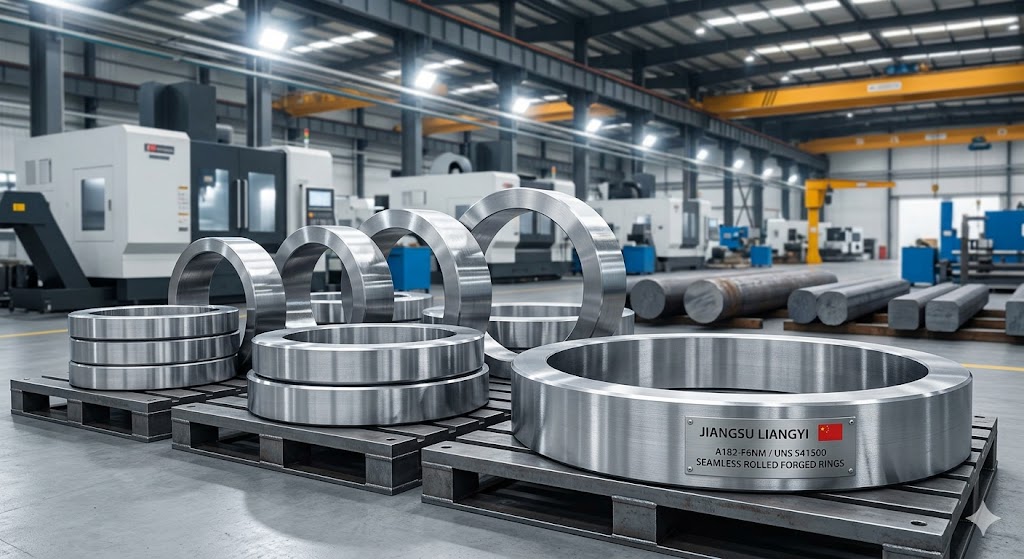
A182-F6NM seamless rolled forged rings produced at our Jiangyin, Jiangsu, China facility
Key Advantages of A182-F6NM Over Standard 410 Stainless Steel
A182-F6NM offers significant improvements over standard 410 stainless steel in every major engineering criterion. Its lower carbon content (≤ 0.05 % vs. ≤ 0.15 % for 410) dramatically enhances weldability and virtually eliminates the risk of untempered martensite cracking in the HAZ. The addition of 3.50–5.50 % nickel stabilizes the martensitic structure, dramatically improves low-temperature notch ductility (typically > 100 J at −40 °C vs. ~30 J for 410), and raises the corrosion potential in chloride-bearing media. The 0.50–1.00 % molybdenum boosts resistance to pitting, crevice corrosion, and general corrosion in H₂S/CO₂ sour environments — enabling NACE MR-0175 approval that standard 410 cannot achieve.
A182-F6NM vs. Standard 410 Stainless Steel — Property Comparison
Property
A182-F6NM (UNS S41500)
Standard 410 (UNS S41000)
Carbon Content
≤ 0.05 %
≤ 0.15 %
Nickel Content
3.50–5.50 %
None specified
Molybdenum Content
0.50–1.00 %
None specified
Tensile Strength (min)
655 MPa (95 ksi)
450 MPa (65 ksi)
Yield Strength (min)
517 MPa (75 ksi)
205 MPa (30 ksi)
Charpy Impact @ −40 °C
> 100 J (typical)
~30 J (typical)
Hardness (Q&T)
≤ 23 HRC
Up to 40 HRC
Weldability
Excellent (low C, often no PWHT needed for thin sections)
Fair (mandatory PWHT, high preheat)
Sour Service (NACE MR-0175)
Approved (≤ 23 HRC)
Restricted / Not listed
Cavitation Erosion Resistance
Excellent (selected for hydro turbine runners)
Moderate
Primary Applications
Oil & gas valves, hydro turbines, nuclear pumps, subsea
General-purpose industrial components
Metallurgy & Microstructure of A182-F6NM
Understanding the metallurgy of A182-F6NM is essential for engineers specifying this grade for important applications. Unlike conventional 12 % Cr martensitic steels, the balanced Cr-Ni-Mo composition of F6NM creates a sophisticated multi-phase microstructure after proper heat treatment — one that delivers an unusual combination of high strength and high toughness simultaneously.
Phase Transformations During Cooling
When A182-F6NM is heated above the Ac₃ temperature (approximately 780–830 °C, depending on exact composition) and into the fully austenitic region (typically above 1000 °C), the alloy transforms completely to face-centered cubic (FCC) austenite. Upon cooling — even in still air — the austenite transforms to body-centered tetragonal (BCT) martensite due to the high hardenability imparted by the combined Cr, Ni, and Mo additions. The martensite start (Ms) temperature for F6NM is typically in the range of 260–300 °C, and the martensite finish (Mf) temperature is approximately 100–150 °C. This means that after air cooling to room temperature, the microstructure consists of essentially 100 % fresh (untempered) martensite with a very small volume fraction (< 5 %) of retained austenite trapped between martensite laths.
The Role of Nickel in Microstructural Control
The 3.5–5.5 % nickel addition in F6NM serves three critical metallurgical functions. First, nickel is a potent austenite stabilizer: it lowers the Ac₁ and Ac₃ transformation temperatures, expanding the austenite phase field and suppressing the formation of delta ferrite during solidification and high-temperature forging. Delta ferrite, if present in excess of ~5 vol%, is detrimental because it reduces impact toughness, creates preferential corrosion paths, and acts as a hydrogen trap that promotes hydrogen-induced cracking in sour service. Second, nickel lowers the Ms temperature, which refines the martensite lath structure and increases dislocation density — both contributing to higher strength. Third, and most importantly, nickel enables the formation of thermally stable reversed austenite during tempering, which is the defining metallurgical feature of the F6NM alloy system.
Reversed Austenite — The Key to Exceptional Toughness
During double tempering at 580–620 °C, a portion of the tempered martensite retransforms to austenite via a diffusion-controlled shear mechanism. This "reversed austenite" nucleates as thin films (typically 50–200 nm thick) along prior austenite grain boundaries and between martensite laths. In a properly heat-treated F6NM forging, the reversed austenite volume fraction typically ranges from 5 % to 20 %, depending on tempering temperature and time.
This finely dispersed reversed austenite is the primary reason why F6NM achieves Charpy V-notch impact energies exceeding 100 J at −40 °C and > 60 J at −60 °C — values that are 3–5 times higher than standard 410 stainless steel at the same test temperatures. The mechanism is analogous to TRIP (Transformation-Induced Plasticity) steels: when a crack tip approaches a reversed austenite film, the high local stress transforms it to martensite, absorbing energy and blunting the crack. The nickel enrichment in the reversed austenite (typically 8–15 % Ni locally, compared to the bulk 3.5–5.5 %) stabilizes this phase so it does not transform prematurely during cooling but is available to transform at the crack tip when needed.
Delta Ferrite Control in A182-F6NM Forgings
Delta ferrite content must be carefully controlled during the melting, forging, and heat treatment of A182-F6NM. The Schaeffler-DeLong diagram and Cr/Ni equivalent calculations are used during steelmaking to ensure that the composition falls within the fully martensitic field. At Jiangsu Liangyi, we work closely with our steelmaking partners to target the optimal Cr equivalent (Cr + Mo + 1.5Si + 0.5Nb) and Ni equivalent (Ni + 30C + 0.5Mn) balance. For critical applications (nuclear, sour service), we can guarantee delta ferrite content ≤ 1 % by volume, verified by quantitative metallography per ASTM E562 or magnetic methods per AWS A4.2.
Grain Matrix & the Effect of Forging
Open die forging plays an important role in the final microstructure quality of A182-F6NM parts. The as-cast ingot matrix contains coarse columnar dendrites, segregation bands, and porosity — all of which are detrimental to mechanical properties and NDT results. During forging, the high compressive forces and elevated temperature enable dynamic recrystallization of the austenite grains, breaking up the dendritic matrix and healing porosity through mechanical bonding. The forging ratio — defined as the ratio of initial to final cross-sectional area — must be at least 3:1 (and preferably 4:1 or higher for important applications) to achieve adequate grain refinement. At Jiangsu Liangyi, our standard practice for F6NM forgings targets a minimum forging ratio of 3.5:1, with 5:1 or higher for nuclear-grade and deep-sour-service components. The result is a uniform, equiaxed prior austenite grain size of ASTM No. 5 or finer (per ASTM E112), which directly translates to higher toughness and better ultrasonic testability.
Corrosion Behavior & Resistance Mechanisms of A182-F6NM
A182-F6NM is a unique corrosion-resistant alloy that is much better at resisting corrosion than standard 410 or 420 martensitic grades, but it is also much cheaper than duplex (2205/2507) or nickel-based alloys (625/825). Engineers can choose the right materials more easily if they know how it corrodes.
General Corrosion & Passivation
Like all stainless steels, A182-F6NM derives its corrosion resistance from a self-healing chromium oxide (Cr₂O₃) passive film that forms spontaneously in oxidizing environments. The 11.5–14.0 % chromium content exceeds the critical threshold (~10.5 %) required for stainless behavior. Adding molybdenum makes this passive film even stronger, especially in acidic environments and solutions with chloride in them. When exposed to the air, properly passivated F6NM has corrosion rates of less than 0.025 mm/year, which is similar to Type 304 austenitic stainless steel.
Pitting & Crevice Corrosion Resistance
Pitting resistance is commonly evaluated using the Pitting Resistance Equivalent Number (PREN), calculated as PREN = %Cr + 3.3 × %Mo + 16 × %N. For A182-F6NM (using mid-range compositions: 12.75 % Cr, 0.75 % Mo), the PREN is approximately 15.2 — higher than standard 410 (~12.5) but lower than duplex 2205 (~35) or 316L (~25). This means F6NM provides adequate pitting resistance in low-to-moderate chloride environments (up to approximately 200 ppm Cl⁻ at ambient temperature) but requires careful evaluation for high-chloride service such as seawater cooling systems or concentrated brine.
Stress Corrosion Cracking (SCC) Resistance
SCC is one of the most dangerous failure modes for pressurized components because it occurs without visible warning. A182-F6NM demonstrates good SCC resistance in chloride environments, provided that the hardness is maintained at or below 23 HRC. The low carbon content minimizes sensitization (chromium carbide precipitation at grain boundaries), and the reversed austenite phase acts as a crack-arrest mechanism — analogous to its role in improving impact toughness. However, in high-strength conditions (hardness above 26 HRC), SCC susceptibility increases significantly, which is why strict hardness control during heat treatment is critical.
Sour Service Performance (H₂S / CO₂ Environments)
A182-F6NM's qualification under NACE MR-0175/ISO 15156 for sour service is one of its most commercially important attributes. In oil and gas production fluids containing hydrogen sulfide (H₂S) and carbon dioxide (CO₂), F6NM resists sulfide stress cracking (SSC) and hydrogen-induced cracking (HIC) when the following conditions are met: hardness ≤ 23 HRC (237 HBW), double tempered condition, and absence of cold work exceeding 5 % strain. The molybdenum addition enhances CO₂ corrosion resistance, reducing the general corrosion rate in sweet (CO₂-dominant) production environments by approximately 40–60 % compared to standard 13Cr grades.
Cavitation Erosion Resistance
A182-F6NM has outstanding resistance to cavitation erosion — the damage caused by the repeated implosion of vapor bubbles in high-velocity liquid flow. This property is the primary reason F6NM (and its cast equivalent CA6NM) has been the material of choice for hydraulic turbine runners worldwide for over 40 years. The cavitation resistance mechanism has two parts: the martensitic matrix makes the surface very hard, which stops plastic deformation from bubble collapse, and the dispersed reversed austenite absorbs impact energy through stress-induced phase transformation (TRIP effect), which stops cracks from forming and spreading. In laboratory cavitation erosion tests (ASTM G32 vibratory method), F6NM typically shows weight loss rates 2–4 times lower than austenitic 304 stainless steel and comparable to cobalt-based hard-facing alloys (e.g., CoCr alloy 6).
A182-F6NM Equivalent & Cross-Reference Standards
A182-F6NM (UNS S41500) is specified across multiple international standards bodies. The table below provides a comprehensive cross-reference for engineers and procurement professionals sourcing this material worldwide. Jiangsu Liangyi can manufacture and certify A182-F6NM forgings to any of these equivalent specifications.
Standard Body
Standard
Grade Designation
Product Form
ASTM (USA)
ASTM A182/A182M
F6NM
Forged fittings, flanges, valves
ASTM (USA)
ASTM A276/A276M
UNS S41500
Bars & shapes
ASTM (USA)
ASTM A479/A479M
UNS S41500
Bars for boiler & pressure vessel
ASTM (USA)
ASTM A743/A744
CA6NM (cast equiv.)
Castings
ASTM (USA)
ASTM A336/A336M
F6NM
Alloy steel forgings for pressure & high-temp
ASME (USA)
ASME SA-182
F6NM
Boiler & pressure vessel code
EN (Europe)
EN 10088-1
1.4313 (X3CrNiMo13-4)
Wrought stainless steel
EN (Europe)
EN 10250-4
1.4313
Open die forgings
EN (Europe)
EN 10222-5
1.4313
Forgings for pressure purposes
DIN (Germany)
DIN 1.4313
X3CrNiMo13-4
All product forms
AFNOR (France)
NF EN 10088
Z4CND13.4M
All product forms
JIS (Japan)
JIS G4303
SUS415
Bars
GB (China)
GB/T 1220
06Cr13Ni4Mo
Bars
GB (China)
GB/T 1221
06Cr13Ni4Mo
Forgings
GOST (Russia)
GOST 5632
06Kh13N4M (approx.)
Corrosion-resistant steel
NACE
MR-0175/ISO 15156
UNS S41500 (≤ 23 HRC)
Sour service qualification
A182-F6NM vs. Competing Grades — Comprehensive Material Selection Guide
When engineers choose materials for needed forged parts, they often evaluate A182-F6NM against several competing grades. The table below provides a side-by-side comparison across the main performance criteria, helping procurement and engineering teams make data-driven material choices. All values represent typical minimum or nominal properties in the quenched-and-tempered condition.
Criterion
A182-F6NM (UNS S41500)
A182-F6 (UNS S41000)
A182-F51 (2205 Duplex)
A182-F316L (UNS S31603)
A182-F22 (2¼Cr-1Mo)
Alloy Type
Martensitic SS
Martensitic SS
Duplex SS
Austenitic SS
Low-alloy CrMo
Tensile Strength (min MPa)
655
450
620
485
515
Yield Strength (min MPa)
517
205
450
170
310
Elongation (min %)
18
20
25
30
20
Hardness (HRC max)
23
~28 typ
~28 typ
~20 typ
~22 typ
Impact @ −46 °C (J typ.)
> 100
~30
> 45
> 100
> 40
PREN (approx.)
~15
~12.5
~35
~25
N/A
NACE MR-0175 Sour
Yes (≤ 23 HRC)
Restricted
Yes
Yes
Yes (≤ 22 HRC)
Weldability
Good
Fair
Good (special filler)
Excellent
Good (PWHT req'd)
Cavitation Resistance
Excellent
Good
Good
Fair
Poor
Relative Raw Material Cost
1.0×
0.7×
1.8×
1.5×
0.6×
Machinability Rating
Good
Good
Fair
Fair
Good
Max Service Temp (°C)
~400
~650
~300
~550
~600
When to Choose A182-F6NM Over Other Grades
Choose F6NM over F6 (410) when the application requires sour service qualification, welding without complex PWHT procedures, or superior low-temperature toughness. F6NM is the standard upgrade path from 410 in oil & gas valve and pump applications.
Choose F6NM over F51 (2205 Duplex) when cost optimization is a priority and the chloride concentration is moderate (< 200 ppm).F6NM works just as well for gate and globe valve bodies in sweet or mildly sour oil and gas service, but it costs 40–50% less in raw materials. Duplex is only better when the level of chloride is higher than about 1000 ppm or when pitting or crevice conditions are very bad.
Choose F6NM over F316L when higher strength is needed without increasing wall thickness. F6NM's yield strength (517 MPa) is three times higher than F316L (170 MPa), enabling significant weight and cost savings in pressure-containing parts.F316L is better for highly oxidizing chemical process environments where the austenitic structure provides better general corrosion resistance.
Choose F6NM over F22 (2¼Cr-1Mo) when corrosion resistance (rather than creep resistance) is the dominant design criterion. F22 is limited to reducing environments and needs internal lining or cladding for any corrosive media, while F6NM can serve directly in wet CO₂ and mild H₂S environments.
Complete Range of A182-F6NM Forged Products from Jiangsu Liangyi
Our 80,000 ㎡ manufacturing facility in Chengchang Industry Park, Jiangyin, Jiangsu, China, produces a full range of A182-F6NM forged steel products. We can make parts from 30 kg to 30,000 kg in single-piece weight, and they all meet your drawings and specifications.
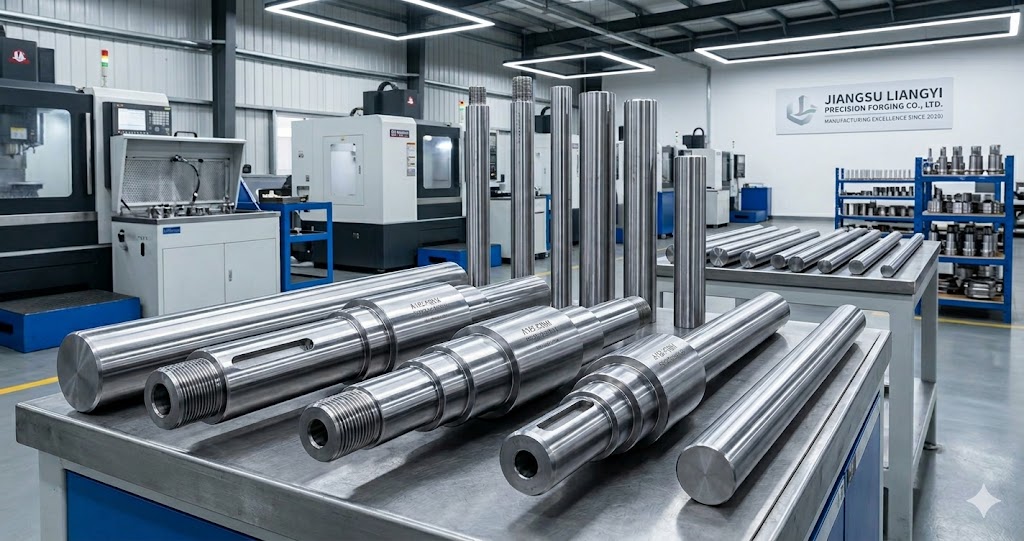
Precision machined A182-F6NM forged shafts and round bars from Jiangsu Liangyi
Custom A182-F6NM Forging Process at Jiangsu Liangyi
Our A182-F6NM forging process in Chengchang Industry Park, Jiangyin, Jiangsu, China, follows strict quality control protocols at every stage:
Raw Material Choice & Verification: We source only certified A182-F6NM (UNS S41500) steel ingots or electroslag remelted (ESR) billets from reputable mills with full melt-shop traceability. Each heat is verified by independent spectrometric analysis against ASTM A182 chemical composition limits before forging. For nuclear and deep-sour service, we can procure vacuum-arc remelted (VAR) or vacuum-induction melted (VIM) material for ultra-clean steel with sulfur levels ≤ 0.005 %.
Ingot Heating & Soaking: Heat ingots in gas-fired furnaces to 1150–1200 °C and hold it at temperature for a minimum of 1 hour per 25 mm of maximum cross-section to guarantee consistent through-thickness temperature. Heating rates are controlled to ≤ 80 °C/hour above 600 °C to prevent thermal stress cracking in large cross-sections.
Open Die Forging: We shape the material with our 2000T, 4000T, and 6300T hydraulic forging presses by upsetting, cogging, drawing, punching, and mandrel expansion.Forging takes place at a temperature range of 850 to 1180 °C.When the temperature drops below 850 °C, the alloy enters the duplex (austenite + ferrite) region. Here, too much delta ferrite can form and the material becomes less ductile, which can lead to forging cracks.To make sure that full recrystallization happens and the as-cast dendritic matrix is gone, we use a minimum forging ratio of 3.5:1.
Seamless Ring Rolling: For ring products, we use our 1 m and 5 m diameter seamless ring rolling machines to produce high-integrity rings with continuous circumferential grain flow. The ring rolling process gets an additional effective reduction ratio of 2:1–3:1 in the tangential direction, which further refines the grain matrix and densify the microstructure.
Preliminary Heat Treatment (Normalizing): Large or complicated F6NM forgings may get a normalizing cycle (air-cool from 1000–1050 °C) prior to final Q&T heat treatment to refine the prior austenite grain size and homogenize the microstructure.
Final Heat Treatment (Q&T): Quenching from 1010–1060 °C followed by double tempering at 595–620 °C and 565–595 °C to get the target tempered martensite + reversed austenite microstructure with ≤ 23 HRC hardness.
Machining: We have modern equipment, such as CNC lathes, vertical lathes, deep-hole boring machines, and CNC boring mills, and we can provide rough or finish machining to your exact tolerances.
Quality Inspection: Every part is given full-body ultrasonic testing (UT), surface NDT (MT or PT), mechanical testing, chemical analysis, and dimension test before shipment, and we also provide complete documentation per EN 10204 3.1/3.2.
Heat Treatment of A182-F6NM (UNS S41500)
The right heat treatment is the most important factor to get the target mechanical properties, microstructure, and corrosion resistance for A182-F6NM forgings. This grade is given a specific quench-and-double-temper cycle that produces a tempered martensite matrix with controlled amounts of reversed austenite — the defining microstructural feature that sets F6NM apart from conventional martensitic stainless steels.
Standard Heat Treatment Cycle
Stage
Temperature
Hold Time
Cooling
Purpose
Austenitizing
1010–1060 °C (1850–1940 °F)
1 hr / 25 mm, min 2 hr
Air or Oil Quench
Full austenite transformation; carbide dissolution; homogenization
Stabilize reversed austenite; optimize toughness/hardness balance; ensure ≤ 23 HRC
Why Double Tempering Is Essential for F6NM
The double tempering cycle is not optional for A182-F6NM — it is metallurgically essential. The first temper at 595–620 °C converts fresh martensite into tempered martensite and nucleates 5–15 vol% of finely dispersed reversed austenite along prior austenite grain boundaries and martensite lath boundaries. Upon cooling, a portion of this reversed austenite may retransform to fresh martensite (since its local composition has not yet reached equilibrium nickel enrichment). The second temper at a slightly lower temperature (565–595 °C) performs two critical functions: it tempers any fresh martensite that formed during cooling from the first temper, and it drives further nickel partitioning into the reversed austenite, enriching it from ~6–8 % Ni to ~10–15 % Ni locally. This enrichment lowers the Ms temperature of the reversed austenite below room temperature, stabilizing it to cryogenic conditions. The result is a final microstructure of tempered martensite + thermally stable reversed austenite that delivers Charpy impact values typically exceeding 100 J at −40 °C.
Tempering Embrittlement Considerations
A182-F6NM is susceptible to temper embrittlement (also called "475 °C embrittlement" or "885 °F embrittlement") if held for extended periods in the 350–525 °C temperature range. This embrittlement is caused by the precipitation of a chromium-rich alpha-prime (α') phase, which drastically reduces impact toughness. To avoid this, the double tempering cycle must be performed above 565 °C, and cooling through the 350–525 °C range must be at a rate of at least 30 °C/hour. At Jiangsu Liangyi, all our heat treatment furnaces are equipped with programmable controllers and chart recorders that monitor and document the entire heating-holding-cooling cycle to ensure embrittlement-free results.
Sub-Zero Treatment (When Required)
For certain cryogenic applications (LNG equipment, polar-class offshore), customers may specify sub-zero treatment at −70 °C to −80 °C after quenching and before tempering. This optional step transforms any retained austenite (not reversed austenite) to martensite, ensuring dimensional stability during service at sub-zero temperatures. However, sub-zero treatment is not standard for F6NM and should only be applied when specifically required, as it can reduce toughness if not followed by the proper double tempering cycle.
Welding Guidelines for A182-F6NM (UNS S41500)
One of the primary advantages of A182-F6NM over conventional 410 stainless steel is its significantly improved weldability. The low carbon content (≤ 0.05 %) reduces hardness in the heat-affected zone (HAZ) and virtually eliminates the risk of hydrogen-induced cold cracking that plagues standard 12 %Cr martensitic grades.
Recommended Welding Parameters
Parameter
Recommendation
Matching Filler Metal
AWS ER410NiMo (GTAW/GMAW) or E410NiMo-XX (SMAW)
Dissimilar / Overlay Filler
ERNiCrMo-3 (Inconel 625) or ER309L/ER309LMo for transition to carbon steel
Preheat Temperature
100–150 °C (212–302 °F) for sections > 25 mm; 150–200 °C for sections > 75 mm
Interpass Temperature
Maintain 100–250 °C (do not allow weldment to cool below preheat between passes)
Maximum Heat Input
1.0–2.5 kJ/mm (to avoid excessive delta ferrite in the weld metal)
PWHT
580–620 °C, hold 1 hr / 25 mm (min 2 hr), air cool. Mandatory for sour service.
Shielding Gas (GTAW)
99.99 % Ar; or 98 % Ar + 2 % N₂ for enhanced toughness
Max Hardness after PWHT
≤ 23 HRC at all locations (base metal, HAZ, weld metal) per NACE MR-0175
Repair Welding of F6NM Forgings
Repair welding of A182-F6NM forgings to remove forging defects detected during NDT inspection is a common practice, provided it is performed under a qualified Welding Procedure Specification (WPS) with matching filler metal. The critical requirement is that the repaired area must receive full PWHT (double temper at 580–620 °C / 565–595 °C) to restore the base metal microstructure and ensure hardness compliance. Please contact our engineering team to discuss repair welding requirements for your specific project.
Dissimilar Metal Welding
In many applications, A182-F6NM components must be welded to carbon steel (e.g., ASTM A105) or austenitic stainless steel (e.g., 316L) piping. For F6NM-to-carbon steel joints, ERNiCrMo-3 (Inconel 625) filler is preferred to prevent carbon migration and the formation of a hard, brittle martensite zone at the fusion line. For F6NM-to-austenitic stainless joints, ER309LMo filler provides a fully austenitic weld deposit that accommodates the thermal expansion mismatch between the two base metals. In both cases, PWHT of the F6NM side should be performed to restore the tempered condition in the HAZ.
Machining Guidelines for A182-F6NM
A182-F6NM in the quenched and double tempered condition (≤ 23 HRC / ≤ 253 HBW) is considered to have "good" machinability — approximately 50–55 % of the free-machining rating of AISI 1212 carbon steel. While not as free-cutting as austenitic 303 or ferritic 430F, F6NM machines significantly better than duplex 2205 or super duplex 2507 grades, which makes it a cost-effective choice where both corrosion resistance and machining complexity must be balanced.
Recommended Cutting Parameters
Operation
Tool Material
Cutting Speed (m/min)
Feed (mm/rev)
Depth of Cut (mm)
Rough Turning
Coated Carbide (CVD TiCN-Al₂O₃)
80–120
0.30–0.60
3.0–8.0
Finish Turning
Coated Carbide or Cermet
120–180
0.10–0.25
0.5–2.0
Face Milling
Coated Carbide Insert
80–140
0.15–0.30 / tooth
2.0–5.0
Drilling (Twist Drill)
HSS-Co / Coated Carbide
20–40
0.10–0.25
—
Deep Hole Boring (BTA)
Brazed Carbide
60–100
0.05–0.15
—
Threading (Single Point)
Coated Carbide
40–80
Per thread pitch
—
Coolant: Soluble oil emulsion (6–10 % concentration) is recommended for all operations. F6NM is prone to work hardening at the surface if the tool dwells or rubs without cutting — use positive rake geometry tools and maintain steady feed to avoid built-up edge formation. For finish machining to Ra ≤ 1.6 µm, CBN (cubic boron nitride) inserts at cutting speeds of 150–250 m/min with no coolant (dry machining) can produce excellent results.
Key Industrial Applications of A182-F6NM Forged Parts
A182-F6NM forged steel is the material of choice for applications requiring a unique combination of weldability, corrosion resistance, mechanical strength, and cavitation erosion resistance. Our F6NM components are exported to customers across the Americas, Europe, Middle East, Asia-Pacific, and other regions worldwide.
Oil & Gas Industry
A182-F6NM is listed in NACE MR-0175/ISO 15156 for sour service environments (H₂S and CO₂), making it the standard material for upstream, midstream, and downstream pressure-containing equipment in sweet and mildly sour production.
Christmas trees and wellhead equipment — bodies, flanges, hangers, and mandrels
Casing heads, tubing heads, and casing/tubing hangers for onshore and offshore wells
Blowout preventer (BOP) RAM blocks, annular bodies, and bonnets
Frac pump fluid end bodies, plungers, and modules — where F6NM's fatigue and corrosion resistance extend service life in high-cycle, abrasive fracturing service
Downhole drilling tools, mud motor rotor shafts, end caps, and bearing housings
Subsea X-tree components, manifold bodies, and high-pressure elbows
Gate, globe, ball, and check valve bodies, stems, balls, seat rings, and bonnets for upstream and midstream service
Pipeline repair clamps and hot-tap fittings for in-service pipeline repair
Hydroelectric & Power Generation Industry
A182-F6NM (and its cast equivalent CA6NM) has been the global standard material for hydraulic turbine runners since the 1970s, replacing previously used carbon steel and austenitic stainless grades. Its unparalleled cavitation erosion resistance — driven by the TRIP mechanism of reversed austenite — dramatically reduces runner maintenance intervals and extends operational lifetimes from 5–10 years (carbon steel) to 25–40+ years.
Francis turbine runners, crown plates, band plates, and stay vanes — the single largest application of F6NM/CA6NM globally
Pelton turbine buckets and needle valve nozzles
Kaplan turbine blades and hub components
Wicket gates, guide vanes, and pivot shafts
Gas and steam turbine disks, impellers, and bladed disks (blisks)
Turbine seal rings, labyrinth seals, and guide rings
Boiler feed pump impellers and diffuser rings
Pressure vessel nozzles, channel flanges, and tube sheet forgings for heat exchangers
Nuclear Power Industry
A182-F6NM is widely used in nuclear power plant applications in both PWR (Pressurized Water Reactor) and BWR (Boiling Water Reactor) designs, owing to its high toughness margin over minimum requirements, SCC resistance in primary water chemistry, and low cobalt content (reducing neutron activation and radiation dose rates during maintenance).
Reactor coolant pump (RCP) casings, impellers, wear rings, and shafts
Nuclear power trunnion and structural support parts
Containment penetration sleeves and pressure boundary parts
Emergency core cooling system (ECCS) valve parts
Marine & Offshore Industry
A182-F6NM has saltwater corrosion resistance and superior mechanical properties, so that it is widely used for marine and offshore applications.
Marine propeller shafts, stern tubes, and rudder stocks
Offshore platform structural nodes and pile connectors
Subsea pipeline equipment — pig launchers/receivers, wye pieces, and tee connectors
Shipboard fire pump and ballast pump parts
Seawater desalination high-pressure pump parts
Water Infrastructure & Wastewater
A182-F6NM has excellent corrosion resistance, cavitation erosion resistance and weldability , so that it is the best choice material for water infrastructure parts subjected to high-velocity flow and long design lifetimes (50–100 years).
Large water supply pump impellers, wearing rings, and volute casings
Butterfly valve discs and gate valve wedges for dam spillway control
Dam gate parts, penstock fittings, and ring gates
Wastewater treatment screw press shafts and pump parts.
Pulp & Paper and Chemical Process
In the pulp and paper industry, A182-F6NM components are used in stock pump impellers and refiners where moderate chemical corrosion and high erosion wear occur simultaneously. The alloy also finds application in select chemical process equipment handling mildly corrosive organic acids.
A182-F6NM (UNS S41500, AISI 415) Material Specifications
Chemical Composition (wt%) per ASTM A182
Element
Content Range
Element
Content Range
Carbon (C)
0.05 Max
Silicon (Si)
0.60 Max
Phosphorus (P)
0.030 Max
Sulfur (S)
0.030 Max
Chromium (Cr)
11.5 – 14.0
Manganese (Mn)
0.50 – 1.00
Nickel (Ni)
3.50 – 5.50
Molybdenum (Mo)
0.50 – 1.00
Mechanical Properties (Minimum Values, Q&T Condition) per ASTM A182
Property
Minimum Value
Unit
0.2 % Yield Strength
75,000 (517)
PSI (MPa)
Tensile Strength
95,000 (655)
PSI (MPa)
Elongation
18
%
Reduction of Area
35
%
Hardness
23 Max
HRC
Charpy V-Notch @ −60 °C
42 / 34 (avg / min)
Joules
Physical Properties
Property
Value
Unit
Density
7.70
g/cm³
Elastic Modulus (20 °C)
200
GPa
Poisson's Ratio
0.28
—
Thermal Conductivity (100 °C)
23.9
W/(m·K)
Coefficient of Thermal Expansion (20–100 °C)
10.8 × 10⁻⁶
1/°C
Coefficient of Thermal Expansion (20–400 °C)
11.6 × 10⁻⁶
1/°C
Specific Heat Capacity
460
J/(kg·K)
Electrical Resistivity (20 °C)
0.78
μΩ·m
Magnetic Permeability
Ferromagnetic
—
Melting Range
1450–1510
°C
Elevated Temperature Properties (Typical Values)
Temperature (°C)
0.2% Yield (MPa)
Tensile (MPa)
Elastic Modulus (GPa)
20 (RT)
550–650
700–850
200
100
520–610
680–830
195
200
490–580
660–810
190
300
460–550
640–790
183
400
430–510
610–750
175
Note: A182-F6NM is not recommended for continuous service above 400 °C due to the risk of 475 °C temper embrittlement and the potential destabilization of reversed austenite. For high-temperature service (> 400 °C), consider grades such as A182-F22, F91, or F92.
Fatigue Properties (Typical Values)
The fatigue limit (endurance limit at 10⁷ cycles, R = −1, unnotched, rotating beam) for A182-F6NM in the Q&T condition is typically 330–380 MPa, corresponding to approximately 50 % of the ultimate tensile strength. In notched conditions (Kt = 2.5), the fatigue limit drops to approximately 200–240 MPa. Because of these values , F6NM is suitable for cyclic loading applications such as turbine shafts, pump impellers, and frac pump parts. The reversed austenite phase contributes positively to fatigue life by absorbing crack-tip energy and retarding fatigue crack growth rates in the Paris regime.
NACE MR-0175 / ISO 15156 Compliance for A182-F6NM
Compliance with NACE MR-0175/ISO 15156 is a mandatory requirement for A182-F6NM forgings destined for oil and gas sour service. This international standard specifies the materials and metallurgical conditions that are acceptable for equipment in contact with production fluids containing hydrogen sulfide (H₂S) at concentrations sufficient to cause sulfide stress cracking (SSC), hydrogen-induced cracking (HIC), or stress-oriented hydrogen-induced cracking (SOHIC).
A182-F6NM (UNS S41500) Listing Under NACE MR-0175
UNS S41500 is listed in NACE MR-0175/ISO 15156-3, Annex A, Table A.3 under "Martensitic stainless steels."Following are the acceptance conditions :
The material must be in the quenched and tempered condition (double tempered)
Maximum hardness: 23 HRC (237 HBW / 253 HV) — this limit applies to the hardest point on the forging, including mid-wall locations
Tempering temperature must be at least 565 °C
The material may be used in any sour environment defined by the ISO 15156-3 regional diagram for CRA (Corrosion Resistant Alloy) materials
Welded F6NM must receive PWHT to meet the hardness limit in the HAZ and weld metal
How Jiangsu Liangyi Ensures NACE Compliance
For every A182-F6NM forging order designated for sour service, we implement the following quality assurance measures:
Hardness Survey: We perform hardness measurements per ASTM E18 (Rockwell C) at a minimum of 4 locations on the forging surface, plus mid-wall measurements on a test coupon from the same heat. All readings must be ≤ 23 HRC.
Heat Treatment Documentation: Complete time-temperature charts from our programmable furnaces are included in the documentation package, confirming the double-temper cycle parameters.
Chemical Analysis: Product analysis is performed on each forging to check if it meets UNS S41500 composition limits.
Mechanical Testing: Full mechanical testing (tensile, impact, hardness) per ASTM A370 on test specimens taken from the prolongation or sacrificial area of each heat/heat-treatment lot.
NACE Compliance Statement: Each sour-service order is supplied with a manufacturer’s compliance statement.This statement confirms that the material grade (UNS S41500), heat treatment condition (quenched and double tempered), and measured hardness (≤ 23 HRC) all comply with the requirements of NACE MR0175 / ISO 15156-3, Annex A, Table A.3. This is a manufacturer’s declaration based on recorded test results, not a third-party certification.
Dimensional Tolerances & Surface Finish for A182-F6NM Forgings
Jiangsu Liangyi provides A182-F6NM forgings in three delivery conditions: as-forged (black), rough machined, and finish machined. The achievable tolerances depend on the delivery condition and product form.
Standard Dimensional Tolerances
Delivery Condition
Diameter / Width Tolerance
Length Tolerance
Ovality (OD − ID)
Surface Finish (Ra)
As-Forged (Black)
+10 / −0 mm per 100 mm dia.
+50 / −0 mm
≤ 3 % of OD
N/A (scale surface)
Rough Machined
± 1.0–2.0 mm
± 5.0 mm
≤ 0.5 mm
Ra 6.3–12.5 µm
Finish Machined
± 0.05–0.10 mm
± 0.5 mm
≤ 0.05 mm
Ra 0.8–3.2 µm
For tighter tolerances (e.g., Ra ≤ 0.4 µm, diameter tolerance ≤ 0.02 mm), we can provide grinding, honing, or superfinishing as additional operations. Geometric tolerancing per ISO 1101 (GD&T) can be applied upon customer request.
Quality Control & Testing for A182-F6NM Forged Parts
At Jiangsu Liangyi, quality is our top priority. We strictly control the whole production process, from raw material inspection to final packaging. All our A182-F6NM forged parts come with complete mill test certificates (MTC) per EN 10204 3.1/3.2.
Non-Destructive Testing (NDT)
Ultrasonic Testing (UT): Full-body UT per ASTM A388/A388M or EN 10228-3, with acceptance criteria per SA-388 Class 3 (or customer-specified class). For nuclear-grade parts, straight beam and angle beam UT per ASME Section V, Article 5.
Magnetic Particle Testing (MT): Surface and near-surface defect detection per ASTM E709 / EN 10228-1, with acceptance per ASTM A788 Supplementary Requirement S9 or customer specification.
Liquid Penetrant Testing (PT): Per ASTM E165 / EN 10228-2, available upon customer request for non-ferromagnetic surfaces or as a complement to MT.
Hardness Testing: Brinell per ASTM E10, Rockwell per ASTM E18, and/or Vickers per ASTM E92. Portable hardness testing (Leeb / UCI) for on-site verification.
Mechanical & Chemical Testing
Tensile testing per ASTM A370 — yield, tensile, elongation, reduction of area
Charpy V-notch impact testing per ASTM E23, including sub-zero temperatures (−20, −40, −46, −60 °C as specified)
Chemical composition analysis by optical emission spectrometry (OES) and X-ray fluorescence (XRF)
Metallographic examination for microstructure, grain size (ASTM E112), delta ferrite content (ASTM E562), and inclusion rating (ASTM E45)
Intergranular corrosion testing per ASTM A262 Practice E (Strauss test) when required
Hydrogen-induced cracking (HIC) testing per NACE TM0284 when specified for sour service plate/ring applications
Third-party witness inspection by SGS, Bureau Veritas, or other customer-appointed agencies can be arranged upon request
Packaging & Global Logistics for A182-F6NM Forgings
We send A182-F6NM forged parts to customers all over the world. The Americas, Europe, the Middle East, Southeast Asia, and Oceania are our main export markets. Our logistics team guarantees safe delivery of even the heaviest and most complicated forgings.
Surface Protection: All machined surfaces are coated with anti-rust oil (Tectyl or equivalent) and wrapped in VCI (Volatile Corrosion Inhibitor) film. Bare forged surfaces get a rust-preventive primer coat.
Packaging: Individual parts are secured on custom wooden pallets or steel saddles with steel banding. Rings are packed vertically or horizontally depending on size. Export packaging meets ISPM-15 phytosanitary requirements.
Shipping Terms: We offer FOB Shanghai/Zhangjiagang, CIF, CFR, DDP, and other Incoterms 2020 arrangements. Our facility is located approximately 180 km from Shanghai Port and 30 km from Zhangjiagang Port, enabling efficient ocean freight access.
Documentation: Full export documentation including commercial invoice, packing list, bill of lading, certificate of origin, fumigation certificate, MTC (EN 10204 3.1/3.2), NDT reports, and NACE compliance statement (when applicable).
Heavy Lifting: Our facility is equipped with overhead cranes capable of handling large single-piece forgings for flat-bed truck or flat-rack container shipment.
A182-F6NM Forging Project Case Studies
The three case studies below document representative A182-F6NM (UNS S41500 / AISI 415) forging projects delivered by Jiangsu Liangyi between 2023 and 2025 across three different application domains: subsea oil & gas production, hydropower refurbishment, and thermal power generation. Each project illustrates a different combination of metallurgical, dimensional, and process-control challenges that are typical of large-section martensitic stainless steel forgings, and the specific engineering solutions our team applied to deliver first-time-right quality. End-client identities are withheld under confidentiality agreements; technical specifications, forging routes, heat-treatment schedules, and inspection results are documented as executed. Internal project reference codes (format LYF-YYYY-XXX-NNN) are provided so returning customers can reference prior qualification packages.
Case Study 1: A182-F6NM Subsea Gate Valve Bodies for a North Sea Deepwater Tieback Project
Project Ref: LYF-2023-SGV-017Industry: Offshore Oil & Gas — Subsea ProductionClient Region: North Sea (Norwegian & UK sectors, operator name confidential)Delivery Year: 2023 (two shipments, Q2 + Q4)Inspection: Customer QA witness at our Jiangyin works; EN 10204 3.1 certification; full MPQR qualification
Project Background & Scope
The end user was a Tier-1 operator developing a subsea tieback to an existing FPSO in the northern North Sea at water depth approximately 1,620 m. Production fluid chemistry returned by their integrity management model was 450 ppm H₂S partial pressure, 7.2 bar CO₂ partial pressure and chloride content of 38,000 mg/L — squarely inside the NACE MR-0175 Region 3 sour envelope. The operator's material choice report (MSR) said that wrought A182-F6NM in the quenched-and-double-tempered (Q+2T) condition should be used as the reference grade for Class 900 gate valve bodies. This is because the valves will be permanently installed on a deep subsea manifold and there are no plans to change them over the 25-year design life.
Jiangsu Liangyi was awarded supply of 24 forged valve body blanks in Q1 2023 following a competitive MPQR (Manufacturing Procedure Qualification Record) process that included coupon destructive testing, inter-granular corrosion testing per ASTM A262 Practice E, and a Method-A SSC test per NACE TM0177 Solution A. Delivery was split into a Phase-1 qualification batch (6 pieces) and a Phase-2 production batch (18 pieces) to align with the valve manufacturer's assembly milestones.
Technical Requirements & Dimensions
Material
A182-F6NM (UNS S41500) — ESR-remelted ingot; S ≤ 0.005 %, P ≤ 0.012 %, controlled Cr/Ni equivalent
Quantity
24 pieces (6 + 18, split delivery)
Overall Envelope
Ø 520 mm OD × 680 mm overall height (including integral flange bosses)
Through-Bore
Ø 180 mm (Class 900, 10-inch nominal)
Maximum Wall Thickness
170 mm at mid-section
Weight per Piece
~ 2,800 kg rough-machined (forging blank ~ 3,450 kg)
Delivery Condition
Q+2T, 100 % rough-machined with 6 mm allowance on sealing surfaces
Forging Ratio
≥ 4:1 overall; ≥ 5:1 in the transverse direction (verified by macro etch of prolongation)
Hardness
≤ 22 HRC at surface, mid-wall, and prolongation (12-point hardness map per piece)
Charpy V-Notch
≥ 45 J individual and ≥ 60 J average at −46 °C in both longitudinal and transverse orientation
Delta Ferrite
≤ 2 vol% per ASTM E562 (target < 1.0 vol%)
UT
100 % per ASTM A388, Class C, Ø 3 mm flat-bottom-hole acceptance
MT
100 % per ASTM E709, no linear indications; ASME BPVC Sec VIII Div 1 Appendix 6 acceptance
Corrosion Testing
IGC per ASTM A262-E on sample; SSC per NACE TM0177 Method A (720 h, Solution A) on sacrificial coupons
Compliance
ASTM A182, NACE MR-0175/ISO 15156-3 Table A.3, EN 10204 3.1 (mill test certificate issued by Jiangsu Liangyi QA authority)
Engineering Challenges
Challenge 1 — Through-thickness hardness control at ≤ 22 HRC: A 170 mm wall drives a low mid-wall cooling rate during quench — typically below 15 °C/min — which risks retained bainite + fresh martensite pockets that elevate post-temper mid-wall hardness above the 22 HRC NACE ceiling. Standard single-temper practice was inadequate; any rejectable mid-wall reading would fail the full 100 % hardness survey.
Challenge 2 — Sub-zero Charpy at −46 °C in both L and T orientation: The specified 45 J individual / 60 J average at −46 °C is 15 °C colder than typical F6NM sour-service specifications. At that temperature, any residual delta ferrite (δ-Fe) longer than ~ 20 µm acts as a preferred cleavage-initiation site, dropping transverse Charpy values into single-digit joules. Controlling δ-ferrite requires intervention at the melting stage, not just the forging stage.
Challenge 3 — UT shadow zones at the flange-boss / gate-pocket junction: The integral flange-boss geometry creates beam-path shadowing for straight-beam UT at the gate pocket region. Phased-array scanning from the outside would be blocked by the flange profile; full 100 % volumetric coverage at Class C sensitivity was not achievable without geometry-aware inspection planning.
Our Engineering Solution
Solution 1 — Dual-medium quench + extended double temper: We engineered a programmed air-oil dual-medium quench after 1,010 °C austenitize. The quench starts in still air for 4 minutes (to control surface-core temperature differential and prevent quench cracking), then transfers to oil at 60 °C with agitation. This raised mid-wall cooling rate to ~ 22 °C/min — fast enough to suppress bainite. A two-stage temper was then applied: T1 at 625 °C / 4 h to nucleate reversed austenite, T2 at 605 °C / 2 h to stabilize it at room temperature. A sacrificial prolongation boss was integrated into each forging for destructive mid-wall hardness verification.
Solution 2 — ESR melting + delta-ferrite control: Every ingot was electroslag-remelted with a tightened chemistry window (Cr 12.0–12.8 %, Ni 4.5–5.0 %, Mo 0.55–0.80 %, N ≤ 0.03 %) chosen to give a calculated Schoefer / Speidel Creq/Nieq ratio below 1.45, which suppresses δ-ferrite formation. Quantitative metallography per ASTM E562 verified δ-Fe content at 0.4–0.9 vol% across all heats. Forging route was 3× upsetting-drawing to 5:1 transverse ratio, with final upset done at 1,050 °C to refine prior austenite grain size to ASTM 5–6. Witness-sample Charpy tests at −60 °C (14 °C colder than spec) still returned 60–80 J, providing a temperature margin against production scatter.
Solution 3 — FEA preform + geometry-aware UT procedure: The forging preform was redesigned in Deform-3D to add a 25 mm "UT boss" extension on the inspection face, eliminating the shadow zone. Rough machining was performed before final UT (rather than after) so that inspection could be done at 0°, 45°, and 70° angle-beam orientations per ASTM A388 Class 3 coverage rules. A written UT procedure was submitted to the customer's technical authority for review and approved as the qualified baseline.
Delivered Results & Customer Outcome
All 24 pieces accepted on first presentation — zero rejections, zero rework.
Hardness survey: 18.5–21.5 HRC across 288 measurement points (12 pts × 24 pieces); all below the 22 HRC ceiling with ≥ 0.5 HRC margin.
Charpy impact at −46 °C: average 95 J transverse / 118 J longitudinal — more than 2× the 45 J minimum.
Delta ferrite: 0.4–0.9 vol% on all heats, verified by ASTM E562 point count.
UT: zero indications ≥ Ø 1.2 mm equivalent reflector across all 24 pieces.
SSC test (NACE TM0177 Method A, 720 h): no cracking on sacrificial coupons.
The customer's QA representative attended the MPQR qualification hold-points on site at our Jiangyin works (chemistry verification, heat-treatment chart review, mechanical test witness, UT and MT witness, final dimensional acceptance) and signed off the inspection package; the end operator issued a repeat PO for the Phase-2 campaign of the same field in 2024.
Each piece shipped with a full EN 10204 3.1 mill test certificate signed by our QA authority — independent of the production department — covering chemistry, mechanical, heat-treatment, hardness survey, NDT, and dimensional reports.
The full qualification package (forging procedure, heat-treatment chart, UT procedure, chemistry control plan) is retained as a referenced MPQR for future sour-service subsea valve orders.
Case Study 2: A182-F6NM Seamless Rolled Crown Rings for a 4 × 175 MW Francis Turbine Refurbishment
Project Ref: LYF-2024-FTR-009Industry: Hydroelectric Power — Francis Turbine RefurbishmentClient Region: Southeast Asia (state-owned hydropower utility, NDA)Delivery Year: 2024 (single shipment Q3)Station Rating: 700 MW (4 × 175 MW Francis units)Inspection: Customer chief metallurgist witness at our Jiangyin works; EN 10204 3.1 certification
At a glance — OD Ø 3,800 mm · radial wall 450 mm · unit weight ~13.5 t · 6 seamless rolled rings · A182-F6NM VIM+ESR ingot · Q+2T heat treatment · target microstructure: tempered martensite + 8–12 vol% reversed austenite · hardness window 19–22 HRC · delivered 2024 with EN 10204 3.1 certification witnessed by the customer's chief metallurgist at our Jiangyin works.
This project was a hydroelectric refurbishment rather than a new-build installation, and that shaped every engineering decision. The customer operates a 700 MW run-of-river hydropower station whose four Francis turbines had accumulated 32 years of service under a head fluctuation of 58–82 m. Inspection during the last major overhaul found cavitation erosion craters up to 8 mm deep at the band-to-blade weld junction of the original CA6NM cast runners, with incipient stress-corrosion cracking visible in the same region. Repeated weld build-up repair had already shortened the between-overhaul interval from 12 years originally to 8 years; the station asset team decided to replace the runners with new forged-and-welded assemblies using wrought A182-F6NM crown rings, aiming to restore the 12-year interval and potentially extend it to 15 years.
Jiangsu Liangyi was awarded supply of 6 seamless rolled A182-F6NM crown rings — one per new runner for all four units plus two station spares — following a bidder-short-list evaluation that included sample ring trials, destructive macro-etch verification, and a reversed-austenite quantification capability audit. Each ring becomes the structural hub of the fabricated runner onto which 13 machined stainless-steel blades are welded.
Specification Summary
Material grade
A182-F6NM (UNS S41500), VIM + ESR double-melted ingot, per ASTM A182 + Supplementary S1 (sub-zero impact)
OD Ø 3,800 mm × ID Ø 2,900 mm × Height 580 mm × Radial wall 450 mm
Weight per ring
~13,500 kg rough-machined (ring-rolled blank ~16,800 kg)
Microstructure target
Tempered martensite + 8–12 vol% reversed austenite, quantified per heat (certified on MTC)
Hardness band
19–22 HRC — tight 3-HRC window for optimal cavitation-erosion resistance
Through-thickness uniformity
≤ 2 HRC scatter across OD / mid-wall / ID sampling locations
Charpy V-notch
≥ 50 J at −20 °C in both transverse and axial orientation
NDT coverage
100 % UT per ASTM A388 Class 2, Ø 2.4 mm FBH equivalent; full circumferential phased-array scan after rough machining; 100 % dry-particle MT per ASTM E709
Out-of-roundness
≤ 4 mm on final OD and ID (tight tolerance for a 3.8 m martensitic forging)
Reference standards
ASTM A182, ASTM A788 Supplementary, EN 10204 3.1 (MTC issued by Jiangsu Liangyi QA authority), IEC 60193 weldability compatibility
Project Phase Walkthrough
The project ran across four engineering phases. Each had a distinct control problem and an associated customer hold-point.
Phase A — Melting and Metallurgical Qualification
Cavitation-erosion performance of F6NM is governed by the reversed-austenite content available at the erosion surface, which absorbs impact energy through in-situ TRIP transformation to hard martensite and work-hardens the damaged zone. To reach the 8–12 vol% target consistently, chemistry has to be tightly bounded at the ingot stage, not just at the heat-treatment stage. Every ingot was melted via VIM and then electroslag-remelted with a Cr window of 12.2–12.8 %, Ni 4.5–5.0 %, Mo 0.55–0.80 %, C ≤ 0.04 %, and S ≤ 0.005 %. The Schoefer / Speidel Creq/Nieq ratio was calculated for each heat and held below 1.45 to suppress delta-ferrite formation — δ-ferrite would act as a preferential erosion-initiation site and also interfere with the reversed-austenite balance. This phase closed with a chemistry-review hold-point attended by the customer's chief metallurgist.
Phase B — Ring Rolling and Sub-A₁ Hot Sizing
A 3.8 m OD ring at 450 mm wall posed two competing geometric problems. F6NM has a narrower hot-forging window (1,080–900 °C) than carbon steels, and the austenite-to-martensite transformation during cooling causes non-uniform volumetric contraction that typically produces out-of-round exceeding 8 mm on a ring this size. In carbon steel this could be corrected by cold sizing, but cold sizing in martensitic stainless induces surface cracking at the rolled OD. The solution was a pierced-then-rolled route with intentional oversize finish: the mother ring was upset-forged and punch-pierced on our 6,300 T hydraulic press with a contoured punch, then ring-rolled in multiple passes to a circumferential reduction ratio of 3.5:1, deliberately finished 6 mm oversize on OD. The ring was then hot-calibrated on a sizing mandrel at 850 °C — below A₁ (no re-austenitization) but above Ms (still ductile, no transformation cracking) — to lock in geometry before the final quench. Out-of-roundness achieved across the 6 rings ranged 1.8–2.4 mm, comfortably inside the 4 mm tolerance.
Phase C — Double-Temper Targeting the 19–22 HRC / 8–12 % Window
Standard F6NM double-temper practice produces 4–6 HRC scatter, well wider than the specified 3-HRC hardness window. Hitting 19–22 HRC consistently across 6 rings at 450 mm radial wall required process redesign, not just process control. We developed a two-stage temper cycle targeted specifically at peak reversed-austenite content: T1 at 635 °C × 5 h — above Ac1' for F6NM, where fresh austenite nucleates at lath boundaries — followed by air cool, then T2 at 590 °C × 4 h — below Ac1' — to stabilize the reversed austenite so it does not re-transform to fresh brittle martensite during final cool-down. Tempering was performed in our purpose-built car-bottom furnace with 9-zone temperature control and ±3 °C chart-recorded uniformity. Test coupons extracted from three through-thickness locations on each ring (OD, mid-wall, ID) verified hardness inside the 20.5–21.8 HRC band with through-thickness scatter ≤ 1.3 HRC.
Phase D — Reversed-Austenite Measurement and Customer Witness Release
ASTM A182 does not prescribe a production-QC method for measuring reversed austenite on 13.5-ton forgings, and XRD — the most accurate technique — is impractical at production scale. We developed a calibrated Feritscope protocol using two bespoke in-house reference standards: a "100 % martensite" reference (the same F6NM chemistry, quenched-only, no temper) and an approximately-fully-austenitic 304 reference. The working curve was cross-verified by XRD / Rietveld refinement on one sample per heat at a partner university lab, and the full protocol was submitted to the customer's technical authority and approved as a qualified production-QC method. The customer's chief metallurgist and designated witness inspector attended the final hold-points at our Jiangyin works — chemistry verification, hardness survey, reversed-austenite measurement demonstration, UT review, and final dimensional release — and signed off the inspection package.
What the Customer Got
All 6 rings were accepted on first presentation at our Jiangyin works with zero rejections. Phased-array UT returned zero recordable indications on any ring. Measured hardness landed in 20.5–21.8 HRC (comfortably inside the 19–22 HRC window with room in both directions). Reversed austenite measured 9.5–11.2 vol% per ring, cross-verified by XRD. Charpy V-notch averaged 89 J transverse and 84 J axial at −20 °C — 68–78 % margin over the 50 J minimum. Out-of-roundness landed at 1.8–2.4 mm, less than 60 % of the 4 mm tolerance. Each ring shipped with a full EN 10204 3.1 mill test certificate signed by our QA authority (independent of the production department), carrying a quantified reversed-austenite value, hardness map, and phased-array UT report.
Headline delivered results (all 6 rings): Hardness 20.5–21.8 HRC · Reversed austenite 9.5–11.2 vol% (XRD-verified) · Charpy 89 J transverse / 84 J axial @ −20 °C · Out-of-round 1.8–2.4 mm · UT zero indications · Certificate EN 10204 3.1
Commercially, the first runner was commissioned within the station's planned outage window, and first-year operation was reported by the customer as meeting efficiency targets with no cavitation indicators observed during scheduled inspection-port visualization. The two strategic spares remain in station stock. A follow-on enquiry was issued for an additional spare band ring and adjacent face plate, extending the scope of the forging-supply relationship into the second phase of the refurbishment program.
Case Study 3: A182-F6NM High-Pressure Boiler Feed Pump Shafts for a 1,260 MW CCGT Plant Retrofit
Project Ref: LYF-2025-BFP-042Industry: Combined-Cycle Gas Turbine (CCGT) Power GenerationClient Region: Middle East (independent power producer, NDA)Delivery Year: 2025 (staged Q1 and Q2 delivery)Plant Rating: 1,260 MW CCGT (2 × F-class GT + 1 × ST)Inspection: Customer reliability engineer witness at our Jiangyin works; EN 10204 3.1 certification
The Failure Mode That Triggered the Upgrade
Before describing what we manufactured, it helps to describe what had failed — because the failure-mode analysis defined the entire material-upgrade brief, the specification, the engineering priorities, and the commercial justification.
The plant's three high-pressure boiler feed pumps (BFPs) had been installed with OEM-standard AISI 4140 alloy-steel shafts. The service envelope: demineralized water with residual dissolved oxygen at 5–8 ppb, alkaline AVT-O chemistry at pH 9.4, 180 °C discharge temperature, and 220 bar discharge pressure. Two-shift plant dispatch imposed cyclic thermal and mechanical loading on the rotor. Two shafts had failed in service at approximately 14,000 operating hours against a 60,000 hour design target — roughly 23 % of expected life. Failure mode was identified by the plant reliability team as circumferential rupture initiating at the seventh-stage impeller step radius.
Metallographic examination of one failure surface confirmed corrosion-fatigue: transverse beach marks radiating outward from a sub-surface initiation site at the step radius, with evidence of chloride-assisted crack opening. The root-cause conclusion was that 4140's margin against the combination of chloride, trace oxygen, and cyclic loading was inadequate for the duty. The reliability and engineering teams jointly sanctioned an upgrade to 12 % Cr martensitic stainless — A182-F6NM in the quenched-and-double-tempered condition — under an Emergency Fleet Reliability Program covering the failed operating shafts plus strategic fleet spares.
The Contract Brief
Scope: Supply 6 forged stepped shafts in A182-F6NM (UNS S41500) — 2 operating replacements + 4 strategic spares covering the 3-BFP fleet and future expansion. Geometry: Overall length 3,850 mm; 7 distinct step diameters ranging Ø 220 mm (coupling stub) to Ø 420 mm (bearing journal); largest step-to-step change 90 mm radial over 45 mm axial; weight ~2,100 kg rough-machined per shaft; forged from a single 14-ton ESR ingot. Mechanical targets: Yield ≥ 550 MPa; Tensile ≥ 700 MPa; Elongation ≥ 18 %; Reduction of area ≥ 50 %; Hardness 22–26 HRC (higher band permitted — non-sour service); Charpy V ≥ 55 J @ 0 °C tangential. Dimensional targets: Straightness ≤ 0.05 mm/m over the full 3.85 m length; journal concentricity TIR ≤ 0.05 mm on all 9 precision surfaces (7 impeller seats + 2 bearing journals). NDT coverage: 100 % UT per ASTM A388 Class 2 / ISO 11971 Level 2, Ø 2 mm FBH equivalent acceptance at journal surfaces; 100 % wet-fluorescent MT per ASTM E709 on all machined surfaces, with special attention to step radii. Forging ratio: ≥ 4:1 at the smallest cross-section; grain flow required to follow stepped contour (macro-etch verification on first-article prolongation). Certification: EN 10204 3.1 mill test certificate issued by Jiangsu Liangyi QA authority; customer reliability engineer on-site witness at our Jiangyin works for hold-points. Reference standards: ASTM A182, EN 10204 3.1, API-610 material class I-2 equivalent.
Three Constraints That Shaped the Engineering Approach
Constraint 1 — Grain flow had to follow the stepped contour, not be cut across by it.
Root-cause analysis of the failed 4140 shafts had identified crack initiation at the seventh-stage step radius, where conventional machining cut across longitudinal grain boundaries. The upgraded F6NM shafts had to be forged so that fibre flow followed each step transition rather than being interrupted — this is the classical "fibre-flow" problem for stepped shafts and it is genuinely hard on a 3.85 m long geometry with 7 steps and a largest step-to-step change of 90 mm radial.
How we approached it: A multi-step cogging sequence was engineered in Deform-3D, with three intermediate reheats to keep metal temperature above 950 °C throughout (F6NM loses ductility sharply below 900 °C). The preform was first upset to 1.6 × starting Ø to increase the forging ratio. It was then progressively drawn to each step diameter using saddle dies whose contour was specifically designed to push metal axially along each step transition rather than pinching it radially.
How we proved it: The first production shaft was made with a 200 mm sacrificial longitudinal-section prolongation at the smallest-Ø end. After full heat treatment, this prolongation was split longitudinally and macro-etched with Oberhoffer's reagent. The macro confirmed favourable longitudinal grain flow following every step radius. That pattern was then frozen as the qualified production route for the remaining 5 shafts.
Constraint 2 — Straightness had to come from hot work, not cold work.
0.05 mm/m straightness over 3.85 m is tight for any martensitic stainless forging. The conventional route — cold press-straightening — would have introduced residual tensile stress at the OD, exactly where corrosion-fatigue cracks had initiated on the 4140 predecessors. Residual tensile stress on the critical step radii would have chemically and mechanically negated the entire metallurgical benefit of the F6NM upgrade.
How we approached it: Instead of cold straightening, we used controlled hot-straightening on a precision roller stand at 380–400 °C — below the previous tempering temperature, so no hardness drop; and well below the 475 °C embrittlement range of martensitic stainless, so no ductility penalty. This was followed by a stress-relief temper at 520 °C × 4 h, deliberately selected outside the 475 °C embrittlement band and below the previous tempering temperature, to relieve any residual stress without reducing hardness.
How we proved it: Final straightness measured 0.02–0.03 mm/m on all 6 shafts — 40–60 % of the specified 0.05 mm/m tolerance. Journal concentricity TIR measured 0.02–0.04 mm on all 9 precision surfaces per shaft, inside the 0.05 mm ceiling.
Constraint 3 — Manufacturing had to be first-time-right, or the LCC case collapsed.
F6NM raw-material cost is approximately 2.3 × that of 4140. The customer's reliability and finance teams had jointly approved the upgrade on a life-cycle-cost (LCC) basis that assumed first-time-right manufacturing — zero rework, zero scrap allowance, delivered on schedule. Any schedule slip or scrap would have pushed delivered cost outside the sanctioned LCC envelope and forced the program back to a 4140 replacement cycle of ~4 years between failures.
How we approached it: All 6 shafts were forged from a single 14-ton ESR ingot, with billeting nested to minimize per-shaft material consumption. Forging allowance on step diameters was tightened from the conventional 25 mm on radius to 15 mm on radius — only possible because the Deform-3D-simulated cogging route gave predictable forged-shape control.
How we proved it: Zero UT rejections, zero MT rejections, zero dimensional rework on all 6 shafts. Delivered cost landed at a 35 % premium over the 4140 baseline — comfortably inside the customer's sanctioned LCC threshold and protecting the business case for the material upgrade.
Before vs. After: AISI 4140 Baseline vs A182-F6NM Delivered
Shaft attribute
Previous AISI 4140 shafts
A182-F6NM delivered (LYF-2025-BFP-042)
Chromium content
~1.0 %
12.0–12.8 %
Nickel content
~0.3 % (residual)
4.5–5.0 % (for reversed austenite)
Observed service life
~14,000 hours to failure
Target 60,000 h; first-year monitoring on track
Failure mode observed
Corrosion-fatigue initiation at step radius
No initiation at scheduled boroscope inspection
Grain flow at step radius
Cut by machining
Follows step contour (macro-etch verified)
Post-HT straightening route
Cold press-straighten
Hot straighten + 520 °C stress relief
Final straightness
Typical 0.05–0.08 mm/m
0.02–0.03 mm/m measured
Charpy V @ 0 °C, tangential
Typical 30–50 J
95–140 J measured (≥ 2× the 55 J min.)
Residual stress at OD
Tensile (from cold straightening)
Low / balanced (hot straighten + stress relief)
Chloride SCC resistance margin
Low
Significant (12 % Cr matrix)
Raw material cost (normalized)
1.0 ×
2.3 × (raw); 1.35 × (delivered, after yield optimization)
Certification
EN 10204 3.1
EN 10204 3.1 + customer reliability-engineer witness at our Jiangyin works
Life-Cycle Outcome
Technically, the upgrade delivered what the root-cause analysis had predicted: the metallurgical mechanism that had driven 4140 to fail early was removed, and the first year of in-service monitoring on the two operating shafts confirmed stable vibration signatures within the baseline envelope, with no corrosion-fatigue indications on scheduled boroscope inspection at the stage-7 step radius. Mechanically, the delivered shafts outperformed the specification: actual yield 620–680 MPa, tensile 790–840 MPa, elongation 22–24 %, reduction of area 62–68 %, Charpy 95–140 J at 0 °C — roughly 2× the 55 J minimum.
Commercially, the single-heat ingot strategy, nesting-optimized billeting, and zero-rework execution kept delivered cost at a 35 % premium over the 4140 baseline rather than the 2.3 × raw-material premium. This sat comfortably inside the LCC envelope the customer had sanctioned for the upgrade. Within a year of the first upgraded shaft entering service, the customer standardized A182-F6NM as the BFP shaft material for its subsequent 3 × CCGT fleet program and adopted it as the reference material for the long-term BFP rotor spares pool.
Frequently Asked Questions About A182-F6NM Forgings
What is the difference between A182-F6NM and A182-F6?
A182-F6NM is a modified version of A182-F6. The "NM" stands for "Nickel-Molybdenum," which are added to improve corrosion resistance and toughness. F6NM contains 3.5–5.5 % Ni and 0.5–1.0 % Mo, and has a much lower carbon content (≤ 0.05 % vs. ≤ 0.15 %), which significantly enhances weldability compared to standard F6. The addition of nickel also enables the formation of reversed austenite during double tempering, giving F6NM impact toughness values 3–5 times higher than F6.
Can A182-F6NM be used in sour service environments?
Yes, NACE MR-0175/ISO 15156-3, Annex A, Table A.3 lists A182-F6NM (UNS S41500) as approved for use in sour service environments with H₂S and CO₂, as long as it is in the quenched and double tempered state and has a maximum hardness of 23 HRC (237 HBW).All our F6NM forgings for sour service are manufactured and heat treated to meet these requirements, with documented hardness surveys included in the MTC.
What is the maximum size of A182-F6NM forgings you can produce?
We can produce A182-F6NM forgings up to 30 tons (30,000 kg) in single-piece weight. Our seamless rolled rings can be up to 6 meters in outside diameter. Forged round bars can be up to 2 meters in diameter and 15 meters in length. Our 6300T hydraulic press and 5 m ring rolling machine enable these capabilities.
Do you provide custom A182-F6NM forgings according to drawings?
Yes, we specialize in custom open die forgings manufactured to your exact drawings and specifications. Our engineering team can also perform forging simulation (FEA) to optimize your design for forging manufacturability, material utilization, and grain flow orientation. We routinely work with complex stepped shafts, contoured rings, and near-net-shape forgings that minimize machining allowance and reduce your overall project cost.
What is your typical lead time for A182-F6NM forged parts?
Our normal lead time for A182-F6NM forged parts is 4–6 weeks from order confirmation, and the actual lead time depends on the drawings, size, and quantity of the part. This includes raw material procurement (if not in stock), forging, heat treatment, machining (if required), NDT, and mechanical testing. We can speed up production for urgent orders— please contact us to discuss your timeline.
What is the relationship between A182-F6NM and CA6NM?
A182-F6NM (UNS S41500) is the wrought (forged) equivalent of CA6NM (UNS J91540), which is the cast version specified under ASTM A743/A744. Both grades share essentially the same chemical composition (12–14 % Cr, 3.5–4.5 % Ni, 0.4–1.0 % Mo, ≤ 0.06 % C). The forged F6NM version generally has superior mechanical properties, finer grain matrix and better NDT testability due to the grain refinement and porosity healing achieved during the forging process. In Europe, both grades correspond to DIN 1.4313 (X3CrNiMo13-4). Historically, CA6NM castings have dominated the hydraulic turbine runner market, while F6NM forgings are used for turbine shafts, wicket gates, valve bodies, and pump components.
What certifications do your A182-F6NM forgings come with?
All our A182-F6NM forgings are supplied with mill test certificates (MTC) per EN 10204 3.1 (manufacturer's inspection certificate) or 3.2 (with third-party witness). The MTC includes: complete chemical composition (ladle and product analysis), full mechanical test results (tensile, impact, hardness), heat treatment records with time-temperature charts, NDT reports (UT, MT/PT), and dimensional inspection reports. We can also give you a NACE MR-0175/ISO 15156 compliance statement that says the material meets the standard's sour service requirements. You can ask for a third-party witness inspection by an independent agency like SGS or Bureau Veritas.
How does A182-F6NM compare to duplex stainless steel (F51/2205) for valve applications?
Both A182-F6NM and F51 (UNS S31803 / 2205 duplex) are NACE MR-0175 approved for sour service. F6NM has significant advantages in cost (40–50 % lower raw material cost), machinability (easier to machine than duplex), and hardness tolerance for wear-resistant seats and trim parts. Duplex F51 provides superior pitting and crevice corrosion resistance (PREN ~35 vs. ~15 for F6NM) in chloride-rich environments and higher design stress due to its higher yield strength. The general guideline: choose F6NM for sweet and mildly sour oil & gas service with moderate chloride (< 200 ppm Cl⁻ at ambient); choose duplex 2205 for high-chloride seawater injection, subsea, and topside applications exposed to marine splash zones.
What is "reversed austenite" in F6NM and why does it matter?
Reversed austenite is a finely dispersed FCC (face-centered cubic) phase that forms during double tempering of A182-F6NM at 565–620 °C. It nucleates as thin films (50–200 nm) along prior austenite grain boundaries and martensite lath boundaries. During tempering, nickel preferentially partitions into these austenite films, enriching them to ~10–15 % Ni locally and stabilizing them so they remain austenitic down to cryogenic temperatures. This reversed austenite is critically important because it absorbs energy at advancing crack tips through stress-induced martensitic transformation (the TRIP effect), dramatically increasing fracture toughness and Charpy impact values. A properly heat-treated F6NM forging contains 5–15 vol% reversed austenite and achieves impact toughness 3–5× higher than conventional 410 stainless steel. This is the metallurgical feature that makes F6NM the preferred material for hydraulic turbine runners, nuclear pump components, and other critical rotating machinery where fracture toughness is paramount.
Can you supply A182-F6NM forgings with third-party inspection?
Yes. We welcome third-party inspectors at our Jiangyin facility, including customer-appointed inspectors and independent inspection agencies such as SGS, Bureau Veritas, or other agencies of your choice. Our inspection coordination team handles scheduling and logistics. Inspection witness points can be customized per your Inspection and Test Plan (ITP) — common hold points include raw material verification, heat treatment chart review, mechanical testing witness, NDT witness, and final dimensional inspection.
Is A182-F6NM magnetic?
Yes, A182-F6NM is ferromagnetic because its primary phase is body-centered tetragonal (BCT) martensite. This means it is attracted to magnets and can be inspected by magnetic particle testing (MT). The reversed austenite phase (5–15 vol%) is non-magnetic (FCC structure), but the overall alloy behavior is dominated by the martensitic matrix. If a non-magnetic stainless steel is required, consider austenitic grades such as F316L or F304L, or non-magnetic nickel alloys such as Inconel 625 or 718.
What information should I include in my RFQ (Request for Quotation)?
To provide you with the most accurate and competitive quotation, please include: (1) engineering drawing or sketch with dimensions, tolerances, and surface finish requirements; (2) material specification (e.g., ASTM A182 F6NM, or EN 10250-4 1.4313); (3) heat treatment condition and any supplementary requirements (NACE, impact test temperature, etc.); (4) delivery condition (as-forged, rough machined, or finish machined); (5) NDT requirements and acceptance criteria; (6) quantity and required delivery date; (7) inspection certificate type (EN 10204 3.1 or 3.2); (8) any class society or third-party inspection requirements. Email your RFQ to sales@jnmtforgedparts.com and we will respond within 24 hours.
References & Applicable Standards
ASTM A182/A182M — Standard Specification for Forged or Rolled Alloy and Stainless Steel Pipe Flanges, Forged Fittings, and Valves and Parts for High-Temperature Service. astm.org
NACE MR-0175/ISO 15156 — Petroleum and Natural Gas Industries — Materials for Use in H₂S-Containing Environments in Oil and Gas Production. nace.org
ASTM A370 — Standard Test Methods and Definitions for Mechanical Testing of Steel Products.
ASTM A388/A388M — Standard Practice for Ultrasonic Examination of Steel Forgings.
ASTM A743/A744 — Standard Specification for Castings, Iron-Chromium, Iron-Chromium-Nickel, Corrosion Resistant (CA6NM).
EN 10088-1 — Stainless Steels — List of Stainless Steels (1.4313 / X3CrNiMo13-4).
EN 10204 — Metallic Products — Types of Inspection Documents (3.1/3.2).
EN 10250-4 — Open Die Steel Forgings for General Engineering Purposes — Stainless Steels.
EN 10222-5 — Steel Forgings for Pressure Purposes — Martensitic, Austenitic, and Austenitic-Ferritic Stainless Steels.
ASTM A336/A336M — Standard Specification for Alloy Steel Forgings for Pressure and High-Temperature Parts.
ASTM E23 — Standard Test Methods for Notched Bar Impact Testing of Metallic Materials.
ASTM E112 — Standard Test Methods for Determining Average Grain Size.
ASTM E562 — Standard Test Method for Determining Volume Fraction by Systematic Manual Point Count (for delta ferrite quantification).
ASTM G32 — Standard Test Method for Cavitation Erosion Using Vibratory Apparatus.
Contact Jiangsu Liangyi for A182-F6NM Forged Parts
As a leading A182-F6NM forged parts manufacturer in Chengchang Industry Park, Jiangyin, Jiangsu, China, Jiangsu Liangyi is committed to providing high-quality products, competitive prices, and excellent customer service to our global customers.
📍Address: Chengchang Industry Park, Jiangyin City, Jiangsu Province, China 214400
Contact us today to get a detailed quotation for your A182-F6NM forging project. Please send us your drawings, material specifications, and quantity requirements, and we will respond within 24 hours.