904L UNS N08904 Forged Forging Parts | Professional Jiangyin Jiangsu China Manufacturer
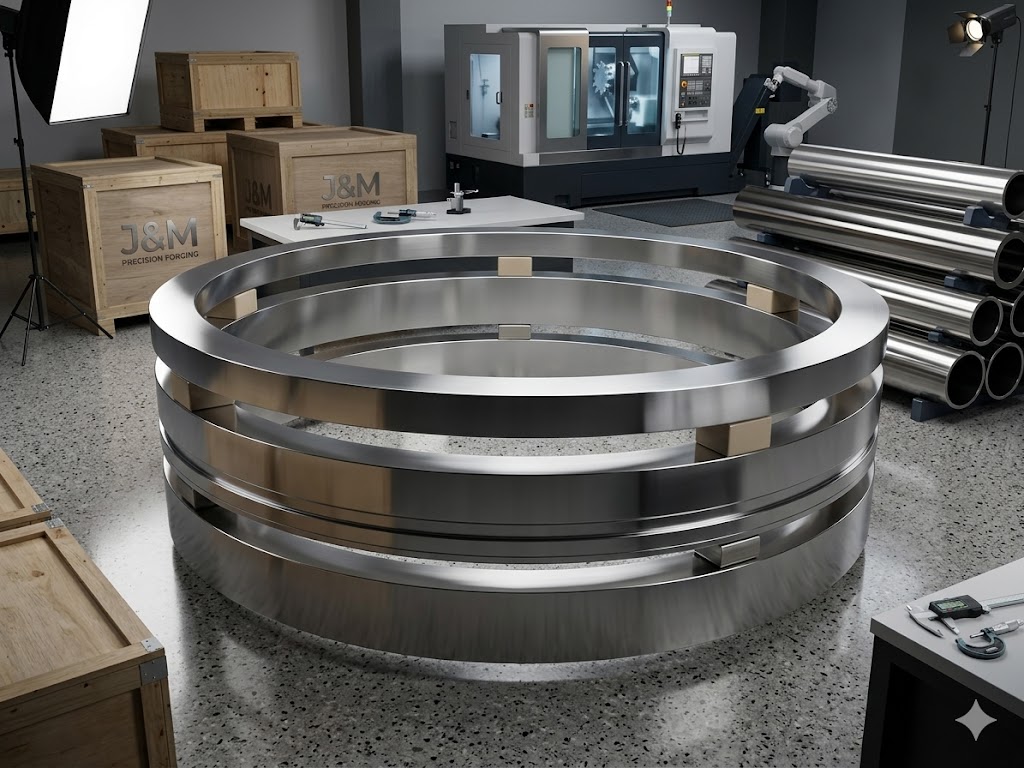
Jiangsu Liangyi Co., Limited is an ISO 9001:2015 certified manufacturer of 904L (UNS N08904) forged forging parts located in Jiangyin City, Jiangsu Province, China. With more than 25 years of experience, we supply custom 904L open die forgings, seamless rolled rings, forged bars and valve parts to clients in more than 50 countries. Our products weight from 30 kg to 30 tons per piece. All goods are exported via Shanghai Port (150 km), with full EN10204 3.1/3.2 mill test certificates included with every shipment.
✓ ISO 9001:2015 Certified
✓ 25+ Years Experience
✓ 50+ Export Countries
✓ 120,000 T/Year Capacity
✓ EN10204 3.1/3.2 MTC
✓ PED / DNV Compatible Supply
Product Overview: 904L UNS N08904 Forgings from Jiangyin, China
Jiangsu Liangyi Co., Limited is an ISO 9001:2015 certified professional manufacturer specializing in open die forgings and seamless rolled forged rings made of 904L (UNS N08904, AISI 904L, Alloy 904L).We are located in Chengchang Industry Park, Jiangyin City, Jiangsu Province, China — a leading industrial center for high-quality forging production. With over 25 years of specialized experience, we provide custom 904L forged parts to customers in more than 50 countries around the world.We control the full production process, from steel melting, forging and heat treatment to CNC machining, strictly following international standards including ASTM, AMS, API, DIN, EN and JIS, as well as customer drawings.
Our Jiangyin factory covers 80,000 square meters and is equipped with advanced Jiangyin China forging equipment and 2000T–6300T hydraulic forging presses.Our annual production capacity reaches 120,000 tons, supporting both small-batch custom orders and large-volume mass production of 904L UNS N08904 forged parts.
With our facility based in Jiangyin, we offer efficient logistics and global export services through Shanghai Port, only 150 kilometers away.
Why Choose 904L UNS N08904 Stainless Steel Forgings from Jiangsu Liangyi?
904L is a low-carbon, super austenitic stainless steel that is used specifically for highly corrosive environments.It has better performance than common austenitic stainless steels such as 304 and 316L under medium to high corrosion conditions.As a top 904L forging manufacturer based in Jiangyin, Jiangsu, China, we highlight its main benefits for industrial use:
- Superior Corrosion Resistance: Its ultra-low carbon content (≤0.02%) prevents intergranular corrosion after welding, and the 1–2% copper content greatly improves resistance to strong reducing acids, especially sulfuric acid at concentrations from 0 to 98%. It can strongly resist to stress corrosion cracking, crevice corrosion and pitting corrosion in environments with high levels of chloride .
- Excellent Mechanical Performance: It has non-magnetic in full annealed condition.Due to its outstanding formability, toughness and weldability, it is suitable for custom forging shapes and custom machining requirements at our Jiangyin factory.
- Long Service Life: Reduces maintenance and replacement costs in harsh industrial environments, with a lifetime 3–5 times longer than 316L stainless steel in corrosive acid and offshore conditions.
- Jiangyin Manufacturing Excellence: Our Jiangsu China factory provide products with strict quality control, competitive pricing and efficient global delivery.
904L vs 316L Stainless Steel: Key Performance Comparison
← Scroll to see full table →Comparison of 904L UNS N08904 vs 316L Stainless Steel Key Properties
| Performance Index | 904L UNS N08904 | 316L Stainless Steel |
|---|
| Nickel Content | 23–28% | 10–14% |
| Chromium Content | 19–23% | 16–18.5% |
| Molybdenum Content | 4–5% | 2–3% |
| Copper Addition | 1–2% | None |
| Sulfuric Acid Resistance | Excellent (full concentration range) | Limited (only low concentration) |
| Stress Corrosion Cracking Resistance | Superior | Moderate |
| Manufacturer Location | Jiangyin, Jiangsu, China | Global |
Full Range of 904L UNS N08904 Forged Product Forms from Jiangyin Factory
We make a full range of custom 904L stainless steel forging products in all kinds of shapes and specifications at our Jiangyin, Jiangsu China facility, with weight ranging from 30 kg to 30 tons per piece. All products fully meet international standards. Our main product forms include:
904L Forged Bars & Shafts
We produce 904L forged steel round bars, square bars, flat bars, rectangular bars, step shafts, gear shafts and turbine shafts, with maximum forging diameter up to 2 meters and maximum length up to 15 meters. All forged bars come with full EN10204 3.1/3.2 mill test certificates, with 100% UT inspection before delivery from our Jiangyin factory. View our full range of Jiangyin China forged bars capabilities.
904L Seamless Rolled Forged Rings
We produce alloy 904L seamless rolled rings, gear rings, slewing bearing rings and shaped forged rings ,with maximum out diameter up to 6 meters and weight up to 30 tons per piece.They are the best choice material for important rotating and pressure-retaining parts used in oil & gas, power generation and chemical processing.Learn more about our Jiangyin seamless rolled forged rings manufacturing capabilities.
904L Hollow Forgings & Sleeves
We produce UNS N08904 forged hubs, housings, shells, sleeves, bushes, seamless hollow bars, heavy wall cylinders, pipes and tubings, with outer diameter up to 3000 mm. Our seamless hollow forgings delete weld defects, delivering great pressure resistance and corrosion performance for high-pressure pipeline and vessel applications, manufactured at our Jiangsu China factory.
904L Forged Discs, Blocks & Plates
AISI 904L forged discs, disks, blocks, plates, tube sheets and baffle plates can be fully customized based on your project drawings and specifications. They are made with consistent forging deformation to make sure the material matrix and mechanical properties are consistent across the full cross-section at our Jiangyin facility.
904L Valve & Pump Forged Components
We produce 904L forged valve balls, valve bonnets, valve bodies, valve stems, valve seat rings, valve cores, pump casings, pump impellers, pump shafts, pump wear rings and other custom fluid control parts. They are used for ball valves, check valves, gate valves, butterfly valves and industrial pumps that work in corrosive chemical and offshore environments.
Industrial Applications & Global Project Cases of Jiangyin 904L Forgings
904L (UNS N08904) forged parts from our Jiangyin, Jiangsu China factory are used in industries where the requirements of corrosion resistance is strict . As a top China 904L forging manufacturer, our custom 904L forgings have been successfully used in many main projects around the world, with detailed application scenarios and verified cases as follows:
Oil & Gas Onshore & Offshore Industry
Our Jiangyin-manufactured 904L forged parts are used for sour gas and oil extraction, including wellhead Christmas trees, casing heads, tubing heads, casing hangers, tubing spools, drilling tools, risers, connectors, flanges and gaskets. The material's resistance to H₂S, CO₂ and brine corrosion makes it the best choice material for harsh oilfield environments.
Project Case: Middle East Sour Gas Field Project We supplied custom 904L UNS N08904 forged wellhead parts, casing heads, tubing spools, and double studded adapter flanges from our factory in Jiangyin, Jiangsu, China for a large sour gas field project in the Middle East.The project needed materials that could handle highly corrosive conditions with 15% H₂S and 8% CO₂, where standard 316L stainless steel developed corrosion leaks within 6 months.Our 904L forgings made in Jiangyin have worked reliably on site with no issues for more than 5 years.All dimensional, material, and testing requirements were completed according to API 6A standards, with third‑party inspection carried out by the client’s chosen inspection company.
Petrochemical & Chemical Processing Industry
We supply 904L forged pipes, tubes, shells, pressure vessels, reactor nozzles, channel flanges, heat exchanger parts, transition cones and Venturi cone meter bodies from our factory in Jiangsu, China.These are used in sulfuric acid production, phosphoric acid processing and other strong reducing acid systems.This is the biggest application area for 904L, making full use of its excellent acid resistance improved by copper.
Project Case: Southeast Asia Sulfuric Acid Plant Project We supplied a full set of 904L forged parts from our Jiangyin factory, including heat exchanger shells, pressure vessel nozzles, channel flanges, and baffle plates, for a 600,000 tons per year sulfuric acid plant in Southeast Asia.The copper-containing 904L has excellent resistance to 93% concentrated sulfuric acid at high temperatures, solving the frequent corrosion and replacement problems of the original 316L equipment.The plant has running stably for more than 4 years using our forged parts made in Jiangyin.
Nuclear & Thermal Power Generation Industry
Our UNS N08904 forged parts made in Jiangyin, China are used for nuclear power, thermal power and renewable energy projects.These include nuclear reactor coolant pump casings, impellers, seal chambers, tie rods for gas and steam turbines, turbo centrifugal compressor impellers, and boiler pressure parts.They have high purity and stable mechanical properties of the material and meet the strict safety requirements of power generation systems.
Project Case: China Nuclear Power Plant Project Our 904L stainless steel forged reactor coolant pump casings, impellers, and containment seal chambers produced at our Jiangsu factory were used in a 1000 MW domestic nuclear power plant project in China.These parts were made using a high-grade triple melting process at our Jiangyin facility, fully meeting the customer’s nuclear project material standards.All chemical, mechanical, and NDT tests were performed by the third-party inspection agency appointed by the customer.In actual operation, these forgings have excellent resistance to coolant corrosion and stable long-term performance under high temperature and high pressure.
Valve & Pump Manufacturing Industry
Our Jiangyin factory make high-accuracy 904L forged parts for industrial valves and pumps, such as valve bodies, stems, balls, seat rings, pump casings, impellers, shafts and wear-resistant parts. These parts are used for corrosive chemical transfer systems, seawater desalination plants and offshore fluid control systems, with excellent dimensional accuracy and mechanical stability.
Project Case: Domestic Chemical Pump & Valve OEM Project We mass-produce 904L forged pump bodies, impellers, shafts, valve balls, valve stems and seat rings at our factory in Jiangyin, Jiangsu, China for a leading Chinese chemical pump and valve manufacturer, with an annual supply of over 200 tons.These parts are used for chemical processing systems with highly corrosive media such as sulfuric acid, hydrochloric acid and chloride solutions.These forged parts have excellent formability, weldability and stable quality, reducing the customer’s assembly defect rate by 85% compared to the cast parts they used before.
Marine & Offshore Engineering Industry
Alloy 904L forged parts from our Jiangyin, China factory are the best choice material for marine and offshore use.They have excellent resistance to seawater corrosion, and are used for parts such as marine valve parts riser connectors, flexible joints, seals, propeller shafts, and main parts of shipbuilding .The material resists biofouling and crevice corrosion in still seawater, which is a common failure issue for standard stainless steels.
Project Case: European Offshore Marine Engineering Project Our UNS N08904 forged valve bodies, riser connectors, joints and seal parts from our Jiangsu factory were used in a European North Sea offshore wind farm and oil platform project.Our 904L forgings made in Jiangyin provide excellent resistance to seawater corrosion, stress corrosion cracking and crevice corrosion in the harsh North Sea environment. All material testing, dimensional checks and paperwork were finished according to project requirements, with third‑party inspection by the client’s chosen agency to meet the project’s PED and DNV documentation standards.
Advanced Manufacturing & Melting Process at Jiangyin Factory
All our 904L forged parts are made under strict full-process quality control at our factory in Jiangyin, Jiangsu, China, to make sure all parts have stable material quality and mechanical properties.As a professional forging manufacturer in China with our own steelmaking capability, we control every step from raw material to finished product:
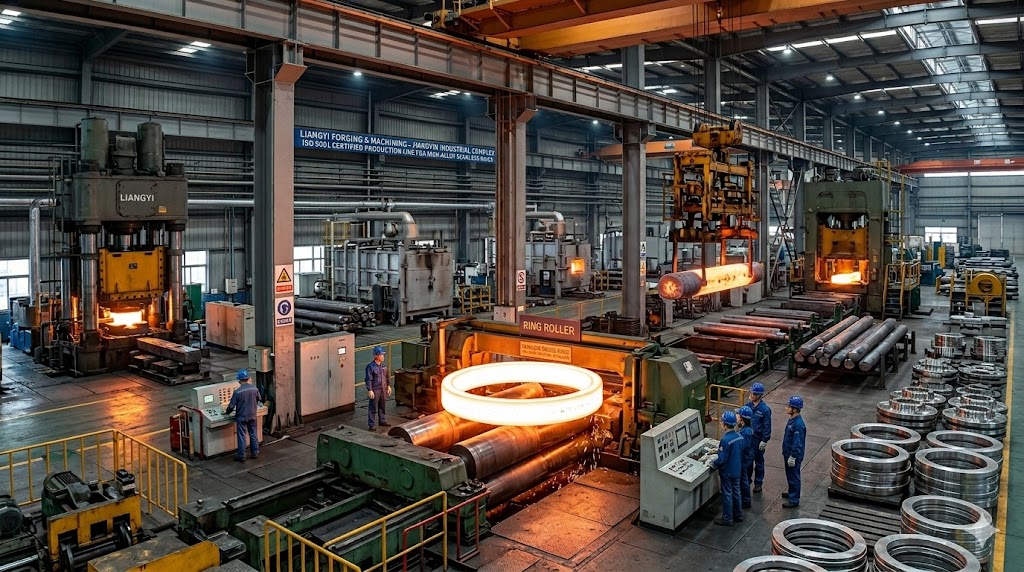
Premium Triple Melt Process
All 904L raw material is produced by a premium triple melt process at our Jiangyin facility, consisting of:
- Vacuum Induction Melting (VIM): Guarantees strict control of chemical composition and initial material purity.
- Electroslag Consumable Electrode Remelting (ESR): Refines the material matrix, eliminates inclusions and segregation.
- Vacuum Arc Consumable Electrode Remelting (VAR): Achieves ultra-high material purity, uniform microstructure, and stable mechanical properties, that is important for demanding high-pressure and high-cleanliness industrial applications.
Precision Forging & Heat Treatment at Jiangyin Factory
We use hydraulic forging presses at our Jiangsu factory that can handle 2000T to 6300T of pressure. This keeps the forging ratio at least 3:1. This makes sure that the material is completely forged and that there are no holes in it. We send all of our 904L forged parts from the Jiangyin plant after solution annealing, which means we carefully control the temperature to make sure they are as strong and resistant to corrosion as possible.
Chemical Composition of 904L UNS N08904 Forged Steel (Jiangyin Production)
The chemical composition of our 904L (UNS N08904) forged steel made at Jiangyin, Jiangsu China strictly meets ASTM A403, ASTM A182 and UNS N08904 standards, with 100% chemical analysis performed before forging. Detailed element limits are as follows:
← Scroll to see full table →Chemical Composition of 904L UNS N08904 Stainless Steel per ASTM A182 / A403
| Element | Minimum Content | Maximum Content |
|---|
| Carbon (C) | — | 0.02% |
| Manganese (Mn) | — | 2.00% |
| Nickel (Ni) | 23.00% | 28.00% |
| Chromium (Cr) | 19.00% | 23.00% |
| Molybdenum (Mo) | 4.00% | 5.00% |
| Copper (Cu) | 1.00% | 2.00% |
| Nitrogen (N) | — | 0.10% |
| Silicon (Si) | — | 0.70% |
| Phosphorus (P) | — | 0.030% |
| Sulfur (S) | — | 0.030% |
Mechanical Properties of 904L Forging Material (Jiangyin Tested)
All our 904L forged parts are delivered in solution annealed condition from our Jiangyin, Jiangsu China factory, with mechanical properties tested and verified per batch at our in-house laboratory, strictly meeting ASTM A182 and EN 10088-3 standards:
- Tensile Strength (Rm): Minimum 490 MPa (71 ksi)
- 0.2% Offset Yield Strength: Minimum 220 MPa (32 ksi)
- Elongation (2" or 4D gauge length): Minimum 35%
- Hardness: ≤187 HB (annealed condition)
Quality Control & Inspection Standards at Jiangyin Factory
We carry out full-process quality control for all 904L forged parts at our factory in Jiangyin, Jiangsu, China, from raw material melting to final shipment. We have advanced equipment, including non-destructive testing (NDT), chemical composition analysis, mechanical property testing and metallographic testing. All inspections are carried out based on international standards.
- ASTM E8: Tension Testing of Metallic Materials
- ASTM E38: Chemical Analysis of Nickel-Chromium and Nickel-Chromium Iron Alloys
- ASTM E112: Estimating the Average Grain Size of Metals
- ASTM E139: Conducting Creep, Creep-Rupture and Stress Rupture Tests of Metallic Materials
- ASTM A370: Mechanical Testing of Steel Products
- SEP 1923: Ultrasonic Testing of Forged Steel Products
Mandatory Nondestructive Testing (NDT) at Jiangyin
We test every batch of 904L forged parts by NDT after all heat treatments at our Jiangsu China factory, including:
- 100% Visual Inspection (VT) of all forged surfaces
- 100% Ultrasonic Testing (UT) of all forged bars, rings and blocks, per SEP 1923 quality class 2b, with dual crystal search unit covering 100% of the material volume
- Magnetic Particle Testing (MT) / Penetrant Testing (PT) for surface defect inspection
- Optional Radiographic Testing (RT) for custom shapes as per customer requirements
Any defects that go beyond the allowed limits are marked and removed from delivery batches, making sure no defective products are delivered to our customers.Every shipment from our Jiangyin factory includes a full EN 10204 3.1/3.2 Mill Test Certificate (MTC) with complete chemical and mechanical test results.
Quality System, Standards Capability & Third-Party Inspection (Jiangyin Factory)
Jiangsu Liangyi holds ISO 9001:2015 Quality Management System Certification as our core quality credential. We have extensive experience manufacturing 904L forged parts to the material, dimensional and testing requirements of major international standards, and fully support third-party inspection by client-appointed agencies:
- ISO 9001:2015 QMS Certification — Our valid, audited quality certification. Certificate available on request.
- Material Standards Capability: ASTM A182 / A403, ASME material standards, AMS, DIN, EN 10088-3, JIS — All parts are made and tested based on these standards.
- API 6A Material & Dimensional Requirements: We produce forged parts based on API 6A material specifications and dimensional requirements. Clients needing API monogram stamping arrange this through their API-licensed fabricator; we supply certified forged material with full MTCs.
- PED 2014/68/EU Compatible Supply: We regularly supply European clients whose projects must meet PED requirements.CE marking and PED compliance checks are done by the client’s EU Notified Body on the finished equipment.We provide EN 10204 3.2 MTCs and support all documentation needed for the PED process.
- DNV / ABS / Lloyd's Register Compatible Supply: We support marine and offshore projects needing classification society approval. Class society surveys are conducted by the client's appointed surveyor; we cooperate fully with all inspection and documentation requirements.
- Third-Party Inspection Welcome: BV, SGS, TUV, Lloyd's Register, Intertek and any client-appointed agency are welcome at our Jiangyin factory. All lab access, production records and documentation are made available during inspection.
We believe in transparent communication about our qualification scope. If your project has specific certification requirements, please share the project specification with our Jiangyin team — we will advise honestly on how we can support the documentation and inspection process.
Global Export & Customization Service from Jiangyin, China
As a top 904L forging factory in Jiangyin, Jiangsu, China, we provide one-stop custom forging solutions for all clients from more than 50 countries, including Europe, North America, Middle East, Southeast Asia, Australia and South America. Our custom service includes:
- Provide full custom manufacturing based on your CAD/CAM drawings and technical specifications at our Jiangyin facility
- Provide material customization within the standard range of 904L UNS N08904
- Support both one piece sample orders and large-scale mass production orders
- Perform In-house heat treatment, CNC machining and NDT inspection at our Jiangsu China factory
- Provide professional export service, including door-to-door delivery, customs clearance and full documentation support, with efficient shipping via Shanghai Port (150 km from Jiangyin)
- Provide 24/7 technical support and after-sales service for all clients around the world.
Explore our full range of Jiangyin China forging material grades for other stainless steel, nickel alloy and alloy steel options.
904L Forging Heat Treatment: Jiangyin Factory's Full-Cycle Thermal Control Protocol
After 25 years of manufacturing 904L (UNS N08904) forgings at our Jiangyin plant, we have developed our own proprietary heat treatment process, which is far more advanced than standard solution annealing.The corrosion resistance of 904L depends not only on its chemical makeup — it also relies heavily on the precise heat cycle applied after forging.What follows describes our actual production process, not textbook guidelines.
Why Heat Treatment Is Non-Negotiable for 904L Forgings
904L’s maximum carbon content of 0.02% is its main safeguard against sensitization, but this protection only works if the forging does not stay in the 425–870 °C critical temperature range during cooling.
In the early years at our Jiangyin factory, we faced a specific problem: large hollow forgings with wall thickness over 200 mm passed all chemical composition tests but still developed local intergranular corrosion in use. This happened because slow air cooling allowed trace Cr₂₃C₆ to precipitate at grain boundaries in the core.
As a result, we need water quenching for all sections thicker than 80 mm — even though many standards still allow air cooling.
Our Solution Annealing Parameters (Jiangyin In-House Standard)
← Scroll to see full table →904L UNS N08904 Forging Heat Treatment Parameters — Jiangsu Liangyi Jiangyin In-House Standard
| Parameter | Jiangyin Factory Standard | Basis / Rationale |
|---|
| Solution Annealing Temperature | 1100–1150 °C | Fully dissolves carbides and sigma phase; lower end used for thin-wall sections to limit grain growth |
| Hold Time (per 25 mm section) | Minimum 1 hour; proportionally extended for heavy sections | Ensures temperature uniformity through the full cross-section, verified by thermocouple at center mass |
| Maximum Hold Time | ≤4 hours at peak temperature | Prevents excessive austenite grain growth (target: ASTM grain size 4–7); grain size verified per ASTM E112 after treatment |
| Cooling Method — Section ≤80 mm | Forced air cooling (fan-assisted) through 870 °C in <3 minutes | Avoids sensitization window; suitable for smaller cross-sections with lower thermal mass |
| Cooling Method — Section 80–300 mm | Immediate water quench from furnace exit | Our Jiangyin factory standard exceeds ASTM minimum; eliminates any risk of Cr₂₃C₆ precipitation in heavy sections |
| Cooling Method — Section >300 mm | Staged water quench with intermediate surface temperature monitoring | Controls thermal gradient to prevent quench cracking in very heavy hollow forgings; center temperature verified by immersion thermocouple before transfer |
| Post-Quench Straightening (if required) | Cold straightening only; no reheat permitted | Reheating above 300 °C after quench is prohibited at our Jiangyin facility to preserve the solution-annealed microstructure |
| Verification Test after Heat Treatment | Huey Test (ASTM A262 Practice C) for critical applications; IGC sensitization test per ASTM A262 Practice E on request | Provides direct corrosion performance confirmation, not just a process compliance check |
Stress Relief: What Our Jiangyin Engineers Do Not Recommend for 904L
Clients often ask us: “Can you stress-relieve our 904L forgings before delivery?” Our answer is always no — and here is why.
For austenitic stainless steels such as 904L, conventional stress relief in the 400–900 °C temperature range carries a high risk of sensitization or sigma phase precipitation. Both conditions seriously reduce corrosion resistance.
The correct method is to account for residual stress during the forging process itself, using controlled forging ratios and die design. The only heat treatment we apply is solution annealing plus rapid quenching.
Our Jiangyin factory has declined many client requests for low-temperature stress relief on 904L parts used in sulfuric acid service. We prioritize long-term operational reliability over short-term commercial convenience. Without exception, those same clients later thanked us for standing firm.
904L Corrosion Resistance: Quantitative Data from Jiangyin Laboratory Testing
Most suppliers only use words like “excellent,” “superior,” or “outstanding” to describe 904L’s corrosion resistance.At Jiangsu Liangyi’s Jiangyin laboratory, we use actual test data.The figures below come from our internal corrosion tests performed on production forgings from our Jiangyin plant, as well as verified field performance data collected from our customers’ operating equipment over more than 20 years.We share these because engineers need measurable data, not marketing phrases.
Pitting Resistance Equivalent Number (PREN): What It Means for 904L
PREN is a single‑value index calculated from chromium, molybdenum and nitrogen content:PREN = %Cr + 3.3 × %Mo + 16 × %N. It predicts resistance to pitting and crevice corrosion in chloride environments — the higher the value, the better the protection.For 904L produced at our Jiangyin factory, actual measured PREN values from production heats consistently range from 36.0 to 40.5, depending on the exact chemistry within the UNS N08904 specification. For comparison: 316L typically gets only 23–28 .The common threshold for “super austenitic” performance is PREN ≥ 40 .For critical projects, we select raw material heats targeted toward the upper end of this range. An important point our Jiangyin engineers always clarify to clients:PREN indicates pitting resistance in chloride conditions but does not reflect performance in reducing acids. — one of 904L’s biggest advantages. The copper content (1–2%) that gives 904L its excellent sulfuric acid resistance is not included in the PREN formula. For this reason, simply comparing “PREN = 36” with alloys like 254SMO can be misleading in acid service. The two alloys are designed to resist different types of corrosion, as explained in our material selection guide.
Critical Pitting Temperature (CPT) and Crevice Corrosion Temperature (CCT)
← Scroll to see full table →904L UNS N08904 Critical Pitting Temperature and Crevice Corrosion Temperature Test Data — Jiangsu Liangyi Jiangyin Laboratory
| Test Parameter | 904L (Jiangyin Lab, avg. of 5 heats) | 316L (Reference) | Test Method |
|---|
| Critical Pitting Temperature (CPT) | ≥ 55 °C in 6% FeCl₃ solution | ~15–25 °C | ASTM G48 Method C |
| Critical Crevice Corrosion Temperature (CCT) | ≥ 35 °C in 6% FeCl₃ solution | ~0–10 °C | ASTM G48 Method D |
| Mass Loss in Boiling 65% HNO₃ (Huey Test) | < 0.5 g/m²·h (5-cycle avg.) | ~1.0–1.5 g/m²·h | ASTM A262 Practice C |
| Corrosion Rate in 50% H₂SO₄ at 60 °C | < 0.05 mm/year | > 5 mm/year (effectively unusable) | Jiangyin in-house immersion test, 72h |
| Corrosion Rate in 10% HCl at 25 °C | ~0.3–0.8 mm/year | ~3–8 mm/year | Jiangyin in-house immersion test, 72h |
| Stress Corrosion Cracking (SCC) Threshold in MgCl₂ boiling at 154 °C | No cracking observed at 250 MPa applied stress (200h) | Cracks typically initiate within 10–30h | ASTM G36 (modified for applied stress) |
Sulfuric Acid Isocorrosion Curve: The Copper Effect Explained
The 1–2% copper content in 904L forms a passive surface film that remains highly stable in sulfuric acid across wide ranges of temperature and concentration. In practical use, our Jiangyin‑made 904L forgings perform reliably in sulfuric acid service from dilute concentrations (5%) up to 98% concentrated acid, at temperatures up to around 60 °C, with corrosion rates well below 0.1 mm/year — a service range no standard austenitic stainless steel can match. The 0.1 mm/year isocorrosion curve for 904L in H₂SO₄ covers a broad window of about 10–98% H₂SO₄ at room temperature, narrowing above 60 °C in concentrated acid, where nickel alloys such as Alloy C‑276 become required. This data informs our recommendation to clients: for sulfuric acid service above 60 °C or above 98% concentration, we will proactively recommend upgrading to a nickel-base alloy rather than overselling 904L beyond its validated range.
904L Welding Guide: Filler Metals, Procedures & Post-Weld Requirements
Compared with most super austenitic and duplex stainless steels, 904L (UNS N08904) has excellent weldability. It needs no preheating, forms a stable fully austenitic weld zone, and resists hot cracking under normal welding conditions.
But “excellent weldability” does not mean it can be welded carelessly.With over 25 years supplying forged parts that customers later weld into pressure vessels, heat exchangers and piping systems, our Jiangyin engineering team has put together this practical welding guide.
Recommended Filler Metals for 904L Welding
The standard approach is to use an overalloyed filler metal that slightly exceeds the base metal's corrosion resistance, compensating for dilution effects in the weld zone. Our Jiangyin engineers recommend the following, in order of preference by application:
← Scroll to see full table →Recommended Filler Metals for Welding 904L UNS N08904 Forgings
| Filler Metal | AWS Classification | Best For | Our Jiangyin Note |
|---|
| Alloy 625 filler | ERNiCrMo-3 | High-corrosion critical welds, dissimilar metal joints (904L to carbon steel or nickel alloy), high-cleanliness critical service applications | Our first choice for any joint where weld-zone corrosion resistance must match or exceed the forged base metal. Slightly overalloyed but provides significant safety margin. |
| Matching 904L filler | ER385 (AWS A5.9) | Like-to-like 904L joints in moderate corrosion service; pressure vessels; heat exchanger shells | Directly matches base metal chemistry. Suitable when dilution is controlled (e.g., GTAW root pass). Confirm copper content ≥1% in filler certificate before use. |
| Alloy 825 filler | ERNiFeCr-1 | Dissimilar joints 904L to Alloy 825 or Incoloy 825; offshore pipeline overlays | Good option where both base materials are nickel-iron alloys. Not our preference for aggressive acid service — ERNiCrMo-3 remains stronger in this role. |
Welding Process Parameters Our Jiangyin Team Specifies
- Pre-heat temperature: It is not needed for base metal temperatures above 10 °C. Below 10 °C ambient, warm the joint area to ≥15 °C with a hot-air gun before starting — not to prevent cracking, but to prevent condensation-related porosity.
- Interpass temperature limit: It is ≤150 °C, strictly enforced. This is the single most commonly violated parameter we see on customer weld procedure submittals. High interpass temperatures are the primary cause of sensitization in the weld heat-affected zone of 904L, even at 0.02% carbon. Use a contact thermometer, not a color judgment.
- Heat input: Keep below 1.5 kJ/mm for GTAW; below 2.0 kJ/mm for SMAW and FCAW. Higher heat input extends the time the HAZ spends in the sensitization window and promotes grain growth in a material that already has a coarse-grained HAZ tendency.
- Shielding gas: Argon + 2–3% nitrogen for GTAW (the nitrogen addition stabilizes the austenite phase and compensates for nitrogen burn-off in the weld pool). Pure argon is acceptable but not optimal. CO₂-containing mixtures are not recommended for 904L.
- Back-purge for piping and hollow forgings: Mandatory for root passes in piping and hollow forging joints. Oxygen content in the purge zone must be verified below 50 ppm before welding begins. We supply our forged pipe spools and hollow sections with purge port provisions machined in as standard, not as an extra.
- Post-weld heat treatment: Not needed under normal conditions — and in fact contraindicated unless a full solution anneal + quench cycle is performed (1100–1150 °C, water quench). Partial stress relief in the 400–900 °C range will harm corrosion resistance. Do not perform PWHT on 904L weldments unless the full thermal cycle can be executed.
- Post-weld cleaning: Mandatory pickling with HNO₃/HF mixture (typically 10–15% HNO₃ + 1–3% HF at room temperature, 20–30 minutes) or electropolishing to remove heat tint and restore the passive oxide layer. Heat tint left in place on 904L welds reduces CPT by up to 30 °C in our lab testing — an unacceptable performance reduction for corrosion-critical service.
Field Observation from Our Jiangyin Engineers: The Interpass Temperature Problem in Sulfuric Acid Plants In 2019, a Southeast Asian customer reported unexpected local corrosion in the weld heat-affected zone (HAZ) of a 904L heat exchanger shell we forged and supplied. During the investigation, our Jiangyin technical team found that the customer’s on-site welding contractor had let interpass temperatures rise to 200–220 °C between passes due to a rushed installation schedule. Even though we delivered properly solution‑annealed shells with certified chemistry, the contractor’s poor temperature control caused sensitization at grain boundaries in the HAZ. After this incident, we updated our standard delivery documents to include a mandatory recommended Welding Procedure Specification (WPS) for all 904L forged parts. This document is now included with every shipment at no extra cost. This kind of proactive engineering support helps reduce customer risk — and is something pure trading companies simply cannot provide.
904L vs 254SMO vs Alloy 20 vs 317L: Jiangyin Engineer's Material Selection Guide
Our Jiangyin sales and engineering team often gets this question from clients worldwide:“We’re designing new equipment for acid service / offshore use / chemical reactors — should we choose 904L, or is 254SMO / Alloy 20 / 317L better?”The honest answer is that every alloy is suited for a specific corrosion environment. The best choice is always the most economical material that can perform reliably long-term.
We have produced forgings in all four alloys at our Jiangyin facility, and the guidance below comes from real project experience and client results — not just theoretical material comparisons.
← Scroll to see full table →Material Selection Comparison: 904L vs 254SMO vs Alloy 20 vs 317L Forgings — Jiangsu Liangyi Jiangyin Engineer's Guide
| Criteria | 904L (UNS N08904) | 254SMO (UNS S31254) | Alloy 20 (UNS N08020) | 317L (UNS S31703) |
|---|
| Ni / Cr / Mo (nominal) | 25% Ni / 21% Cr / 4.5% Mo + 1.5% Cu | 18% Ni / 20% Cr / 6.1% Mo + 0.2% N | 34% Ni / 20% Cr / 2.5% Mo + 3.5% Cu + Nb | 13% Ni / 19% Cr / 3.5% Mo |
| PREN (typical) | 36–40 | 42–46 | 28–32 | 28–33 |
| Sulfuric Acid Resistance (all concentrations) | ★★★★★ (industry benchmark) | ★★★ (performs well, but copper-free) | ★★★★★ (Nb stabilization adds HNO₃ resistance) | ★★ (limited to dilute concentrations) |
| Seawater / Chloride Pitting Resistance | ★★★★ (CPT ≥55 °C) | ★★★★★ (CPT ≥75 °C, the best in this group) | ★★★ (adequate for moderate chloride) | ★★★ (better than 316L, not super-austenitic level) |
| Stress Corrosion Cracking Resistance | ★★★★★ (high Ni gives outstanding SCC resistance) | ★★★★ (good, but lower Ni than 904L) | ★★★★★ (highest Ni content — best SCC resistance) | ★★ (susceptible at elevated temperatures) |
| Yield Strength (annealed, min.) | 220 MPa | 300 MPa | 210 MPa | 205 MPa |
| Relative Raw Material Cost | Baseline (reference) | 1.4–1.7× vs 904L | 1.2–1.5× vs 904L | 0.65–0.75× vs 904L |
| Forging Difficulty (Jiangyin experience) | Moderate — excellent hot workability | High — narrow forging window, requires tight temperature control | Moderate — similar to 904L | Low — most straightforward of the group |
| Jiangyin Availability (lead time) | Standard stock material — 3–5 day ingot procurement | On-order material — 15–25 day ingot lead time | On-order material — 10–20 day ingot lead time | Standard stock — 3–5 day ingot procurement |
Our Jiangyin Engineers' Decision Framework: When to Choose Each Alloy
Choose 904L when: When the main corrosion threat is sulfuric acid (any concentration), phosphoric acid, or mixed acids with moderate chloride levels — 904L is the best choice. It is also the most cost-effective solution when stress corrosion cracking (SCC) in hot chloride environments is a concern, but the budget cannot support high‑nickel alloys. For most chemical processing, oil and gas and nuclear applications involving combined acid and chloride environments, 904L has the best value‑to‑performance ratio among stainless steels.This is why it has been our highest‑volume specialty stainless steel grade at our Jiangyin factory for more than 20 years.
Choose 254SMO when: For applications involving seawater at elevated temperatures, offshore equipment exposed to stagnant seawater (with high crevice corrosion risk), or any environment where chloride pitting resistance is the main requirement and acid resistance is secondary — 254SMO is the best choice.
With its higher PREN value and higher nitrogen content, 254SMO has a clear advantage in pure chloride environments.We produce 254SMO (UNS S31254) forgings at our Jiangyin facility and recommend this material upgrade when client operating data shows consistent temperatures above 50 °C in seawater or NaCl-dominated brines.
Choose Alloy 20 when: When equipment handles hot sulfuric acid + nitric acid together, Alloy 20 is the better choice.Its niobium stabilization provides extra protection in HNO₃‑containing acid streams where 904L can corrode faster.Normal uses include sulfuric acid concentrators, mixed acid pickling lines, and fertilizer plant parts exposed to both H₂SO₄ and HNO₃.Alloy 20’s high nickel content (34%) also makes it the top pick for maximum SCC resistance in hot chloride environments above 100 °C.
Choose 317L when: When budget is the main concern and the environment is only moderately corrosive — where 316L falls just short — 317L becomes a practical choice. For dilute sulfuric acid (<10%) at low temperatures, weak organic acids, or pulp and paper applications, 317L has clear improvements over 316L, at a price increase much lower than 904L. Our Jiangyin factory does not recommend 317L for sulfuric acid above 30% concentration, chloride levels over 500 ppm at temperatures above 60 °C, or any application where stress corrosion cracking (SCC) is a critical risk.
Real Project: When Our Jiangyin Team Recommended Downgrading from 904L to 317L — and Why It Was the Right Call A European OEM originally specified 904L for a set of pump casings handling 8% dilute acetic acid at 35 °C, with no chloride present. After analyzing the actual operating conditions in our technical review meeting in Jiangyin, our engineers recommended switching to 317L instead. This cut the client’s material cost by about 28% with no loss in performance. The acetic acid concentration and temperature were well within 317L’s safe corrosion limit, and the lack of chlorides meant 904L’s higher alloy content provided no real benefit. The client valued our honesty — and later placed a larger order for 904L on another project where the conditions truly needed it.This is the kind of engineering partnership we build from our Jiangyin facility with customers around the world.
Frequently Asked Questions (FAQ) | 904L UNS N08904 Forgings from Jiangyin
Compared with 316L, 904L contains higher nickel (23–28% vs. 10–14%), chromium and molybdenum, plus a 1–2% copper addition.This gives it far better corrosion resistance — especially against strong reducing acids such as sulfuric acid — and higher resistance to stress corrosion cracking. It also has better weldability, and in aggressive corrosive environments, its service life is 3–5 times longer than 316L. Our factory in Jiangyin, Jiangsu, China specializes in producing high-quality 904L forgings.
Our factory in Jiangyin, Jiangsu, China can make 904L forged parts from 30 kg to 30 tons per piece. We can make forged bars up to 2 meters in diameter and 15 meters long, seamless rolled rings up to 6 meters in diameter, and hollow forgings with an outer diameter of up to 3000 mm.
904L is a fully austenitic stainless steel, which is non-magnetic in the fully annealed condition. Minor magnetic permeability may occur after cold working, but this does not affect its corrosion resistance or mechanical performance. All our 904L forgings from Jiangyin are delivered in fully annealed condition.
We make and test our 904L forged parts at our factory in Jiangyin, Jiangsu, China, following standards like ASTM A182, ASTM A403, UNS N08904, EN 10088-3, DIN and JIS. We can also make them according to API 6A material and size requirements if you need. Every shipment comes with full EN10204 3.1 or 3.2 Mill Test Certificates, which include all chemical and mechanical test results.
Standard lead time for custom 904L forged parts is 20–35 days for small to medium batches, and 35–50 days for large-scale or custom shaped parts. We can also speed up production at our Jiangyin factory for urgent orders, with lead time as short as 15 days.
Yes — all 904L forged parts are heat-treated in our own factory in Jiangyin before delivery. The right heat treatment process is full solution annealing at 1100–1150 °C, followed by quick water quenching. For parts with a thickness of more than 80 mm, we need water quenching. This prevents carbide precipitation in the temperature range of 425–870 °C (called the sensitization window). At our Jiangyin factory, we do not perform stress relief for 904L in this temperature range. Doing so would cause sensitization, which reduces corrosion resistance. Every batch of parts is checked by grain size testing according to ASTM E112. For important uses, we also do intergranular corrosion testing following ASTM A262.
Our Jiangyin engineering team recommends ERNiCrMo-3 (Alloy 625 filler) as the first choice for important joints or dissimilar-metal joints. For common like-to-like joints, we recommend ER385 filler (AWS A5.9 standard, matching 904L material). Main welding parameters: When the ambient temperature is above 10 °C, no pre-heating is needed. The interpass temperature must be strictly controlled below 150 °C. After welding, it is mandatory to use HNO₃/HF solution for pickling to restore the passive film on the surface. Jiangsu Liangyi provides a free welding procedure specification (WPS) with every 904L forging shipment.
We produce 904L at our Jiangyin factory, and its Pitting Resistance Equivalent Number (PREN) is 36 to 40.5, depending on the chemical composition of the production batch. 254SMO (UNS S31254) has a higher PREN of 42 to 46, making it more suitable for pure chloride environments like seawater or brine. Alloy 20 (UNS N08020) has a PREN of 28 to 32, which is lower than 904L, but it works well in mixed acid environments. 317L has the lowest PREN (20 to 24) and is only recommended for mild corrosion scenarios with no high chloride or acid exposure.
317L is a cost-effective option for mild to moderate corrosive environments: it works well with dilute sulfuric acid (below 10% concentration) at low temperatures, weak organic acids, or in pulp and paper applications where 316L is just not good enough. If your equipment handles sulfuric acid above 30% concentration, chloride levels over 500 ppm at temperatures above 60 °C, or any environment where stress corrosion cracking (SCC) is a concern, our Jiangyin engineers will recommend 904L instead. We always proactively suggest 317L over 904L for clients when the service conditions don’t need the higher alloy content of 904L — we value engineering honesty more than pushing more expensive materials.
Jiangsu Liangyi Co., Limited is your trusted Jiangyin-based China manufacturer of high-quality 904L UNS N08904 forged forging parts. We are glad to provide the most competitive price and the highest quality products for all clients around the world. Welcome to send your custom drawings, material requirements, order quantity and project details for a detailed, no-obligation quotation!