50CrMo4 (1.7228) Forging Parts | Professional China Manufacturer & Supplier
Established in 1997 in Jiangyin City, Jiangsu Province, China, Jiangsu Liangyi Co.,Limited is an ISO 9001:2015 certified professional manufacturer specializing in custom 50CrMo4 (1.7228 / 50 CrMo 4) open die forging parts and seamless rolled steel rings. Operating from an 80,000㎡ production facility with an annual output capacity exceeding 120,000 metric tons, we deliver a fully integrated one-stop manufacturing solution — from controlled raw steel melting through precision forging, closely regulated heat treatment, to final CNC machining and dimensional inspection — each stage executed entirely in-house under our direct quality control.
What sets 50CrMo4 apart from the more common 42CrMo4 is its significantly elevated carbon content (0.46–0.54% vs 0.38–0.45%). This critical difference produces a higher as-quenched martensitic hardness and a steeper hardness gradient from surface to core after quenching and tempering, making 50CrMo4 the preferred specification wherever maximum surface wear resistance and bulk strength must coexist — conditions routinely encountered in cement mill pinion shafts, sugar mill gear drives, mining crusher eccentrics, and wind turbine ring gears. After a standard quench-and-temper cycle (oil quench from 820–850°C, temper at 540–680°C), 50CrMo4 consistently achieves tensile strengths from 800 to 1,300 MPa and a Brinell hardness range of 240–380 HB depending on section size and target property class — performance levels that make it one of the most broadly specified medium-carbon CrMo grades in heavy industrial forging worldwide.
As an ISO 9001:2015 certified operation with a 27-year track record of exporting to clients in more than 50 countries across Europe, North America, Southeast Asia, the Middle East, and Africa, Jiangsu Liangyi combines deep metallurgical knowledge with proven large-scale production discipline. Every 50CrMo4 forging we ship is accompanied by a full EN 10204 3.1 or 3.2 Mill Test Certificate, giving procurement engineers and quality managers complete traceability from melt heat to finished component.
Custom 50CrMo4 (1.7228) Forged Shapes, Components & Dimensional Capabilities
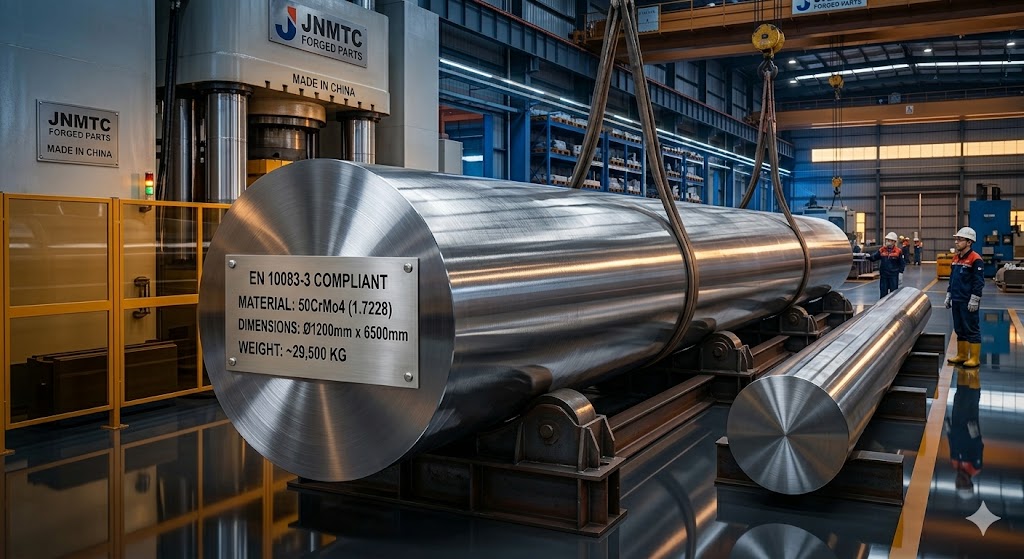
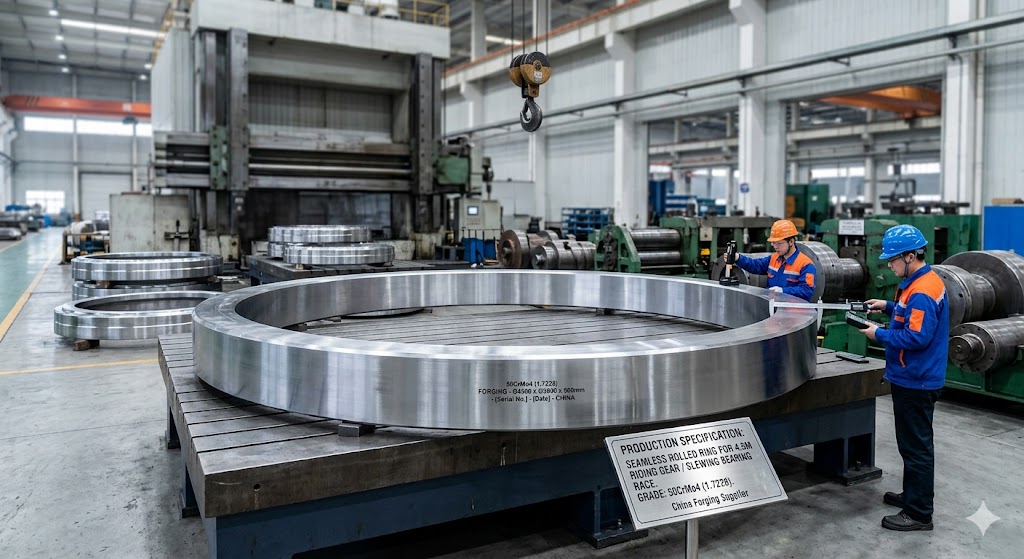
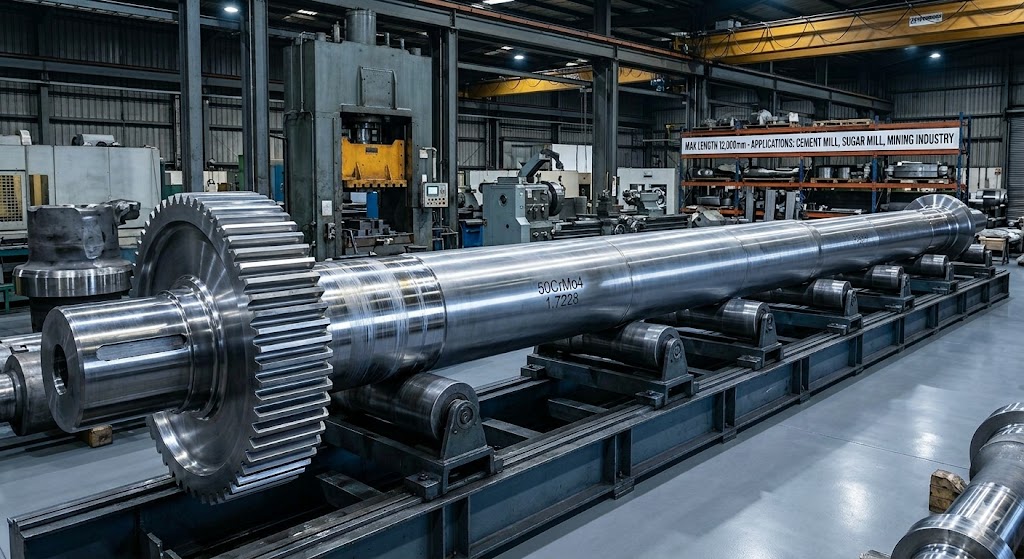
Our forging and ring-rolling equipment handles a comprehensive range of 50CrMo4 forged shapes, from the simplest round bar to multi-stepped shafts with integrated flanges and contoured rolled rings with profiled cross-sections. All shapes are produced from EN 10083-3 compliant 50CrMo4 steel, with forge ratios controlled to a minimum of 3:1 to ensure full structural refinement and consistent mechanical properties throughout the cross-section — a requirement that distinguishes open die forgings from rolled or cast alternatives in critical load-bearing applications.
Available Forged Shapes & Key Dimensional Ranges
| Forged Shape / Component Type | Key Dimensions | Max Single Weight | Typical Applications |
|---|---|---|---|
| Forged Round Bars & Step Bars | Ø 50 – Ø 1,200 mm; L up to 8,000 mm | 30,000 KG | Shaft blanks, roller shafts, spindles, axles |
| Seamless Rolled Rings (Flat-Face) | OD Ø 300 – Ø 5,000 mm; Wall 50–500 mm; H up to 1,500 mm | 30,000 KG | Bearing races, ring gears, flanges, coupling rings |
| Contoured / Profiled Rolled Rings | OD Ø 500 – Ø 3,500 mm; custom cross-section per drawing | 20,000 KG | Riding gear rings, slewing rings, riding tyre blanks |
| Forged Gear Shafts & Pinion Shafts | Ø 100 – Ø 800 mm; L up to 12,000 mm; multi-step OK | 25,000 KG | Cement mill drives, sugar mill drives, wind gearboxes |
| Forged Discs, Flanges & Plates | Ø 200 – Ø 3,000 mm; T 50–1,000 mm | 30,000 KG | Tube sheets, pressure vessel heads, backing flanges |
| Hollow Bars, Sleeves & Cylinders | OD Ø 200 – Ø 1,200 mm; ID per drawing; L up to 5,000 mm | 15,000 KG | Hydraulic cylinders, bushings, barrel bodies |
| Forged Blocks & Custom Shapes | Max section 1,200 × 1,200 mm; L up to 5,000 mm | 30,000 KG | Die blocks, eccentric forgings, custom structural parts |
All dimensional data represents our standard production envelope. Intermediate or non-standard sizes are also available. Contact our engineering team with your specific drawings for feasibility confirmation and a detailed quotation.
Our in-house CNC machining division complements the forging operation, eliminating the need for customers to coordinate multiple suppliers. After forging and heat treatment, components are processed on our large-envelope turning centers (swing up to Ø 3,200 mm, length up to 10,000 mm between centers), horizontal boring mills (table size up to 5,000 × 4,000 mm), and CNC drilling/tapping centers. We routinely achieve turned surface finishes of Ra 1.6–3.2 µm and dimensional tolerances of IT7–IT8 grade on shaft journals as standard, with IT6 available on critical bearing contact surfaces upon request. For gear cutting, rough gear hobbing is available in-house; final precision gear grinding can be coordinated through our qualified machining partners under our quality oversight.
Have specific 50CrMo4 (1.7228) forging drawings or dimensional requirements? Share your specs for a precise technical evaluation and quotation within 24 hours.
Request a QuoteIndustry Applications & Proven Engineering Use Cases of 50CrMo4 (1.7228) Forgings
The combination of elevated carbon, chromium, and molybdenum in 50CrMo4 (1.7228) creates a metallurgical profile that simultaneously satisfies high surface hardness, deep hardenability, good core toughness, and excellent resistance to cyclic fatigue and torsional stress — properties demanded in the most mechanically severe industrial environments on the planet. Over 27 years of export production, our 50CrMo4 forged components have accumulated millions of operating hours across six continents.
Cement & Mineral Processing Equipment
Cement production imposes some of the most punishing mechanical demands on rotating equipment. The main and auxiliary pinion shafts in ball mill and vertical roller mill drives operate continuously under combined bending and torsional loads, often in the range of 500–3,000 kNm torque, while being subjected to high Hertzian contact stresses at gear flanks that demand surface hardnesses above 300 HB. Our 50CrMo4 forged pinion shaft blanks are produced with a minimum forge ratio of 4:1 and a Jominy J40 hardenability value controlled to ≥40 HRC, ensuring consistent through-hardening in large cross-sections after quench-and-temper treatment. Riding gear rings for rotary kilns and dryers — with outer diameters commonly ranging from Ø 2,500 mm to Ø 4,800 mm and individual weights of 8,000–28,000 KG — represent one of our highest-volume seamless ring rolling products. We also supply pull torque rods and flanged shaft couplings for the mineral processing industry.
Sugar Mill Machinery
The sugar industry's crushing and milling trains require components that withstand shock loading from cane feed variations, high ambient humidity, and moderate corrosive conditions from sugar juice contact. Our 50CrMo4 gear shafts and pinion shafts for sugar mill main drives are manufactured with carefully controlled sulfur content (typically ≤0.020% vs the EN maximum of 0.035%) to enhance transverse toughness and reduce anisotropy. Roller shafts for sugar mills are produced as step forgings with integral journal shoulders, eliminating shrink-fit joint interfaces that are potential fretting fatigue initiation sites in continuous-duty rotating applications.
Wind Energy & Renewable Power Systems
Wind turbine gearboxes operate in one of the most fatigue-critical environments in mechanical engineering — millions of load cycles at variable amplitude from stochastic wind loading, with essentially zero tolerance for unplanned downtime at remote installation sites. Our 50CrMo4 seamless rolled ring forgings for wind gearbox ring gears are processed through our EAF + LF + VD melting route followed by controlled forging and normalizing, achieving inclusion ratings ≤1.5 per EN 10247 as standard. For hydro turbine main shafts, our large-diameter 50CrMo4 forged shaft blanks are produced with measured grain size verification at multiple cross-section positions (target: ASTM 5–7 or finer) to confirm uniform microstructural refinement throughout the heavy section.
Mining, Crushing & Bulk Materials Handling
Gyratory and cone crusher eccentric shafts experience multi-axis stress states with large dynamic stress amplitudes from rock fragmentation impulses. Our 50CrMo4 eccentric shaft forgings are designed with forge ratios exceeding 5:1 and ultrasonic tested to acceptance level FBH Ø3mm per EN 10228-3 to ensure freedom from internal discontinuities. Slewing bearing inner and outer races for mining excavators and crane pedestals are among our largest ring rolling products; a typical excavator bearing race in 50CrMo4 can measure Ø 3,500–Ø 4,200 mm OD, requiring precise rolling parameter control to achieve the ovality tolerances (typically ≤3 mm across diameter for pre-machining state) demanded by the bearing system geometry.
Oil & Gas — Onshore & Offshore Applications
Our 50CrMo4 (1.7228) forgings for downhole and wellhead applications are produced with tightly restricted phosphorus (≤0.015%) and sulfur (≤0.010%) to minimize susceptibility to hydrogen-induced cracking (HIC) in sour service conditions. Gear shafts and pinion shafts for rotary table drives, mud pump crankshafts, and power tong gear bodies are common 50CrMo4 applications in oilfield surface equipment. For subsea wellhead components, we supply 50CrMo4 forged material with additional impact testing at -46°C and NACE MR0175 traceability documentation upon request.
Power Generation — Thermal & Hydro Turbine Components
50CrMo4 remains widely specified for auxiliary shafts, coupling flanges, journal bearing sleeves, governor valve spindles, and pump shafts within the turbine hall and auxiliary systems of power plants. We regularly produce 50CrMo4 forged shafts to ≤12,000 mm length with in-process ultrasonic testing at multiple stages and final certification to EN 10228-3 acceptance class U4 or better. For hydro turbine generator shafts, our production experience spans shafts from 200 KG to over 15,000 KG, covering both horizontal and vertical shaft configurations.
Railway & Heavy Transport Equipment
Locomotive traction motor housings (end shields) in 50CrMo4 are produced as complex-shaped disc forgings with multiple internal bores and flanges, then rough-machined to within 8–12 mm of final profile to minimize material removal in the customer's precision machining operations. Transmission shafts for heavy freight locomotive bogies are produced with datum features controlled to within 0.1 mm of nominal to facilitate downstream machining setup — a detail that reduces our customers' cycle time on large machining centers by up to 30% compared with less precisely controlled forging blanks.
General Heavy Industrial Machinery
Crankshafts for large reciprocating gas compressors (bore up to Ø 600 mm, stroke up to 800 mm) are produced as multi-throw forgings with careful grain flow orientation through each throw to maximize fatigue life. Coiler mandrel shafts for hot and cold rolling mills, gear coupling hubs for mill train drives, planet gear shafts for construction machinery final drives, and press ram guide columns are all products we supply from 50CrMo4 in ongoing production programs to equipment manufacturers worldwide.
50CrMo4 (1.7228) Material Technical Specifications & Metallurgical Data
50CrMo4 belongs to the EN 10083-3 family of alloy steels for quenching and tempering, grouped with the related grades 25CrMo4, 34CrMo4, and 42CrMo4 in a progressively higher-carbon series sharing the same chromium-molybdenum alloying philosophy. The grade's material number under the EN numerical designation system is 1.7228. The molybdenum addition (0.15–0.30%) serves two primary functions: it raises the hardenability significantly beyond what the chromium content alone would provide (critical for achieving consistent properties in large cross-sections), and it suppresses temper embrittlement sensitivity — allowing safe tempering in the 540–620°C range where some Mo-free chromium steels would exhibit reduced toughness.
Chemical Composition — EN 10083-3 Specification (Heat Analysis)
| Element | Symbol | EN 10083-3 Range (wt%) | Role in Steel Performance |
|---|---|---|---|
| Carbon | C | 0.46 – 0.54 | Primary hardness contributor; controls as-quenched martensitic hardness and strength level |
| Silicon | Si | ≤ 0.40 | Deoxidizer; moderate solid-solution strengthener; controlled to limit decarbonization tendency |
| Manganese | Mn | 0.50 – 0.80 | Increases hardenability; improves hot workability; combines with sulfur to form MnS inclusions |
| Phosphorus | P | ≤ 0.025 | Residual; excess causes temper embrittlement and reduces low-temperature toughness |
| Sulfur | S | ≤ 0.035 | Residual; controlled to minimize elongated MnS inclusion bands that reduce transverse ductility |
| Chromium | Cr | 0.90 – 1.20 | Significantly improves hardenability; forms stable carbides; improves corrosion and oxidation resistance |
| Molybdenum | Mo | 0.15 – 0.30 | Strongly increases hardenability; prevents temper embrittlement; improves high-temperature strength and creep resistance |
For critical applications (sour service, nuclear-adjacent), we apply tighter internal control targets beyond EN minimums: P ≤0.015%, S ≤0.010%, and controlled residual element packages. Please specify at enquiry stage.
Mechanical Properties — Quenched & Tempered (QT) Condition, EN 10083-3
| Ruling Section (mm) | Tensile Strength Rm (MPa) | Min. Yield Strength Re (MPa) | Min. Elongation A5 (%) | Min. Reduction of Area Z (%) | Charpy KV (J) at 20°C | Hardness HB |
|---|---|---|---|---|---|---|
| ≤ 16 | 1,100 – 1,300 | 900 | 9 | 40 | ≥ 35 | 331 – 380 |
| 16 – 40 | 1,000 – 1,200 | 780 | 12 | 45 | ≥ 45 | 298 – 359 |
| 40 – 100 | 900 – 1,100 | 700 | 13 | 50 | ≥ 50 | 271 – 331 |
| 100 – 160 | 850 – 1,000 | 650 | 13 | 50 | ≥ 50 | 253 – 298 |
| 160 – 250 | 800 – 950 | 550 | 13 | 50 | ≥ 50 | 240 – 286 |
Above values reference EN 10083-3 Table 7. Charpy values are not EN standard requirements but are routinely achieved and certified by our production. Sub-zero impact testing (down to -46°C) is available upon request. Final properties depend on heat treatment parameters and section geometry.
Physical Properties of 50CrMo4 (Approximate, at Room Temperature)
| Physical Property | Value | Unit |
|---|---|---|
| Density | 7.85 | g/cm³ |
| Elastic Modulus (Young's Modulus) | 205 – 210 | GPa |
| Poisson's Ratio | 0.29 | — |
| Thermal Conductivity (at 20°C) | 42 | W/(m·K) |
| Coefficient of Thermal Expansion (20–200°C) | 11.5 × 10⁻⁶ | K⁻¹ |
| Specific Heat Capacity | 460 | J/(kg·K) |
| Electrical Resistivity (at 20°C) | 0.22 × 10⁻⁶ | Ω·m |
50CrMo4 (1.7228) International Grade Equivalents & Comparison with Similar Grades
Understanding how 50CrMo4 (1.7228) relates to steel grades specified under other national standards is essential for global procurement engineers and designers working across multiple standards environments. The table below provides the closest internationally recognized equivalents and their key compositional differences.
International Equivalent Grades
| Standard | Grade Designation | C (wt%) | Cr (wt%) | Mo (wt%) | Equivalence Level |
|---|---|---|---|---|---|
| EN (European) | 50CrMo4 / 1.7228 | 0.46 – 0.54 | 0.90 – 1.20 | 0.15 – 0.30 | Reference Grade |
| AISI / SAE (USA) | AISI 4150 | 0.48 – 0.53 | 0.80 – 1.10 | 0.15 – 0.25 | Very Close Equivalent |
| DIN (Germany) | 50 CrMo 4 | 0.46 – 0.54 | 0.90 – 1.20 | 0.15 – 0.30 | Identical (historical origin) |
| BS (United Kingdom) | En19C (approximate) | 0.45 – 0.55 | 0.90 – 1.20 | 0.20 – 0.35 | Close (Mo upper limit differs) |
| JIS (Japan) | SCM451 / SCM445 (approx.) | 0.43 – 0.52 | 0.90 – 1.20 | 0.15 – 0.30 | Close Equivalent |
| GOST (Russia) | 50KhM / 50ХМ | 0.46 – 0.54 | 0.90 – 1.20 | 0.15 – 0.25 | Very Close Equivalent |
| GB (China) | 50CrMo (GB/T 3077) | 0.46 – 0.54 | 0.90 – 1.20 | 0.15 – 0.30 | Very Close Equivalent |
50CrMo4 vs. Related CrMo Alloy Grades — Engineering Selection Guide
| Grade (EN) | C Content | Max Tensile (QT, small section) | Typical Use Case | vs. 50CrMo4 |
|---|---|---|---|---|
| 25CrMo4 (1.7218) | 0.22 – 0.29% | 700 – 900 MPa | Case-hardened shafts, bolts, light structural | Lower strength; better weldability and toughness |
| 34CrMo4 (1.7220) | 0.30 – 0.37% | 900 – 1,100 MPa | High-pressure cylinders, crank pins, fasteners | Lower strength; superior cold-forming ductility |
| 42CrMo4 (1.7225) | 0.38 – 0.45% | 1,000 – 1,200 MPa | Gears, shafts, general structural — very widely used | Slightly lower hardness/strength; marginally better weldability |
| 50CrMo4 (1.7228) | 0.46 – 0.54% | 1,100 – 1,300 MPa | Heavy gear shafts, crusher eccentrics, rolling mill components | Reference grade on this page |
| 51CrV4 (1.8159) | 0.47 – 0.55% | 1,100 – 1,300 MPa | Springs, torsion bars, valve springs | Similar C; vanadium instead of Mo; excellent spring performance; lower hardenability in large sections |
The key engineering conclusion is straightforward: when 42CrMo4 cannot deliver the required strength or surface hardness in a given section size — typically above approximately 100 mm ruling section for through-hardening — 50CrMo4 provides a direct upgrade within the same CrMo alloy family, without the cost and procurement complexity of higher-alloy tool steels or nickel-containing grades.
50CrMo4 (1.7228) Heat Treatment: Full Parameter Guide & Delivery Condition Options
Heat treatment is arguably the most performance-critical step in the 50CrMo4 forging production process. Jiangsu Liangyi operates a dedicated heat treatment facility with multiple independently controlled car-bottom furnaces and a sealed-quench furnace, all equipped with calibrated temperature control and continuous data logging traceable to certified reference thermocouples. We treat in-house what we forge in-house, allowing our engineering team to optimise temperature cycles, soak times, and quench transfer times for each specific component geometry rather than applying generic values.
Heat Treatment Options & Standard Parameters
| Treatment Type | Austenitizing Temp. | Cooling Method | Tempering Temp. | Resulting Condition | Typical Application |
|---|---|---|---|---|---|
| Soft Annealing | 680 – 720°C | Furnace cool ≤10°C/hr to 600°C, then air | — | Annealed (A) — max 241 HB | Delivered for customer's own QT; improves machinability for preliminary operations |
| Normalizing | 840 – 880°C | Still air or gentle forced air | Optional: 550–650°C | Normalized (N) — 220–280 HB typical | Uniform fine-grain microstructure; stress relief after forging; preparation for subsequent QT |
| Quenching & Tempering (QT) | 820 – 850°C (1.5–3 hr soak) | Oil quench or polymer quench; water quench for thin sections | 540 – 680°C (2–4 hr soak, air cool) | QT — 240–380 HB; Rm 800–1,300 MPa depending on section | Primary delivery condition for service components; balances high strength with good toughness |
| Stress Relieving | — | — | 550 – 650°C (2–4 hr, slow furnace cool) | Reduced residual stress; properties minimally affected | After heavy machining, welding repair, or straightening operations |
Practical Notes on 50CrMo4 Heat Treatment for Large Forgings
Section Size Effect on Achievable Properties: In forgings with ruling sections above approximately 160 mm, even high-severity oil quenching produces a mixed martensitic-bainitic core microstructure with EN-standard-compliant but reduced core properties (as shown in the mechanical properties table above). For applications where uniform core properties are critical across heavy sections, we recommend our EAF + LF + VD or EAF + ESR melting route, which delivers improved hardenability through tighter alloy control and lower residual element content.
Quench Distortion Management: The higher carbon content of 50CrMo4 increases its sensitivity to quench cracking and distortion, particularly in components with abrupt section changes. Our heat treatment engineers design soak time extensions for thick-to-thin transition regions, use press quenching fixtures for long thin-walled rings, and where appropriate recommend polymer quench media (typically 10–15% polymer concentration) as a controlled-severity alternative to straight oil that reduces distortion while maintaining adequate quench severity for the specified section size.
Tempering Range Selection: Tempering at 540–580°C produces the high-strength end of the property range (Rm ~1,100–1,300 MPa, HB ~330–380 for small sections); tempering at 640–680°C yields the high-toughness end (Rm ~800–950 MPa, HB ~240–280, with significantly improved Charpy impact values). Our engineering team will recommend the best tempering band for your service requirements, section size and specific property class shown on your drawing or purchase order.
Need a specific HB hardness range or property class for your 50CrMo4 forgings? Share your technical requirements — we will recommend the optimal heat treatment cycle and confirm achievability before production.
Discuss Your RequirementsProduction Capability: Equipment, Process Control & Manufacturing Limits
Our production capability for 50CrMo4 (1.7228) forgings is defined by both the mechanical limits of our equipment and the disciplined process controls our engineering and quality teams have built over 27+ years. The figures below represent verified, regularly achieved production parameters — not theoretical maximums.
Core Production Equipment
| Equipment Category | Specification | Key Capability |
|---|---|---|
| Hydraulic Open Die Forging Presses | 2,000 / 3,150 / 5,000 / 6,300 ton capacity | Free forging of bars, shafts, discs up to 30,000 KG; min. forge ratio ≥3:1 guaranteed |
| Radial-Axial Ring Rolling Machines | 1 m / 2 m / 3 m / 5 m outer diameter range models | Seamless rolled rings OD Ø 300–5,000 mm; flat-face and profiled cross-section rings |
| Electric Arc Furnaces (EAF) | 20 T / 50 T / 80 T capacity | Primary steel melting from scrap + alloying additions |
| Ladle Furnace (LF) + Vacuum Degassing (VD/VOD) | 50 T / 80 T ladle | Alloy trimming, inclusion modification, hydrogen removal ≤ 2 ppm |
| Electro Slag Remelting (ESR) | Electrode up to Ø 1,200 mm; ingot up to Ø 1,500 mm | Superior inclusion cleanliness; reduced chemical segregation for premium-grade forgings |
| Car-Bottom Heat Treatment Furnaces | Multiple units; large-capacity; calibrated temperature control | Annealing, normalizing, quenching & tempering, stress relieving |
| CNC Heavy Turning Centers | Swing Ø 3,200 mm; between-centers length up to 10,000 mm | Rough and finish turning of shafts, rings, and disc forgings |
| CNC Horizontal Boring Mills | Table 5,000 × 4,000 mm; spindle Ø 160 mm | Bore machining, facing, contouring of large block and housing forgings |
Why Forge Ratio Matters: The Structural Case for Open Die Forgings
A forge ratio of 3:1 means the starting ingot cross-section area is reduced to one-third during forging. This controlled plastic deformation breaks down the as-cast dendritic segregation, closes micro-porosity and pipe cavities from solidification, refines austenite grain size (typically achieving ASTM 5–7 after forging), and re-orients the primary and secondary carbide distribution into a fibrous grain flow pattern aligned with the principal stress direction in the component. The result is measurably superior fatigue life, impact toughness, and stress corrosion resistance compared with as-cast or rolled bar material of the same chemical composition. For heavy gear shafts, crusher eccentrics, and turbine shafts where in-service failure consequences are catastrophic, the forge ratio is not merely a process parameter — it is a fundamental safety variable.
Production Standards, Compliance Framework & Melting Process Options
Primary Compliance Standards
Every 50CrMo4 (1.7228) forging we produce is certified against internationally recognized standards. Our quality system documentation maps each production step to the relevant standard clause, creating an unbroken compliance chain from steelmaking to delivery.
- EN 10083-3:2006 — Steels for quenching and tempering: Technical delivery conditions for alloy steels. Governs chemical composition, mechanical property requirements, heat treatment conditions, and inspection scope for 50CrMo4 / 1.7228 in all delivery conditions (annealed, normalized, QT).
- EN 10250-3:2000 — Open steel die forgings for general engineering purposes: Alloy special steels. Defines forging-specific requirements including dimensional tolerances, surface quality, and sampling locations for mechanical testing.
- EN 10228-3 — Non-destructive testing of steel forgings: Ultrasonic testing of ferritic and martensitic steel forgings. We supply UT reports to acceptance classes U3 and U4 as standard; U1/U2 available upon request.
- ASTM A288 / A291 / A469 / A470 — For customers operating within ASME or ASTM frameworks, we produce 50CrMo4 equivalent (AISI 4150) forgings certified against the applicable ASTM standard. Chemical analysis is reported to both EN and ASTM notation on a single MTC.
- DIN 17200 — Legacy DIN standard for heat-treatable steels, accepted by many European OEMs with older drawing sets that predate EN harmonisation.
- Custom Specifications — We have manufactured 50CrMo4 forgings to customer-specific proprietary material specifications for major European, North American, and Asian heavy equipment OEMs, subject to review and approval prior to production.
Melting Route Options & Their Impact on Forging Quality
| Melting Route | Process Steps | Key Quality Benefit | Typical Application |
|---|---|---|---|
| EAF | Electric Arc Furnace only | Cost-effective; standard chemistry control | General engineering forgings, normalized condition bars |
| EAF + LF + VD | EAF → Ladle Furnace refining → Vacuum Degassing | Hydrogen ≤2 ppm; improved inclusion morphology; tighter alloy control | QT forgings, wind energy components, demanding structural applications |
| EAF + ESR | EAF → Electro Slag Remelting | Excellent transverse toughness; reduced macro-segregation; K2 or better cleanliness | Gear shafts, pinion shafts, crusher eccentrics requiring premium NDT acceptance |
| EAF + PESR | EAF → Protective-atmosphere ESR | Minimal reoxidation during remelting; lowest sulfide inclusion level | High-value components where UT acceptance class U1/U2 is mandatory |
| VIM + PESR | Vacuum Induction Melting → Protective-atmosphere ESR | Highest purity; precise elemental control; hydrogen <1 ppm; lowest inclusion rating | Aerospace-grade or nuclear-adjacent forgings with extreme cleanliness requirements |
Our engineering team will recommend the most appropriate melting route based on your component's size, criticality, NDT acceptance class, and budget. EAF+LF+VD adds typically 5–8 working days compared with EAF alone; ESR adds 10–15 working days. We do not up-sell melting route upgrades unless genuinely required by your component's technical specification.
For customers with diverse alloy requirements, we also manufacture a wide range of other alloy steel, stainless steel and nickel-based superalloy forgings. For detailed information about our full equipment list, visit our production equipment page.
Quality Inspection System: Equipment, Scope & Acceptance Criteria
Our quality assurance system for 50CrMo4 (1.7228) forgings is structured around three principles: prevention at the process stage, verification through systematic inspection, and full documentation traceability. Every batch is assigned a unique heat number from steelmaking through to final dispatch; every inspection result is recorded in our internal ERP quality module and archived for a minimum of ten years.
In-House Inspection Equipment
| Inspection Equipment | Model / Specification | Standard / Parameter Tested |
|---|---|---|
| Optical Emission Spectrometer (OES) | Multi-element simultaneous analysis spectrometer | Full chemical composition per EN 10083-3; heat and product analysis |
| Phased Array Ultrasonic Testing (PAUT) | Multi-channel phased array UT system with sector scan capability | Internal flaw detection per EN 10228-3; acceptance classes U1–U4 |
| Magnetic Particle Inspection (MPI) | Stationary MPI bench + portable yoke units (AC/DC) | Surface and near-surface flaw detection per EN 10228-1 |
| Universal Tensile Testing Machine | 600 kN servo-hydraulic UTM; extensometer-equipped | Rm, Re, A5, Z per EN ISO 6892-1; covers all EN 10083-3 property classes |
| Charpy Impact Testing Machine | 450 J capacity; temperature-controlled bath (-80°C to RT) | KV impact energy per EN ISO 148-1; sub-zero testing to -46°C |
| Brinell Hardness Tester | 3,000 kgf / 10 mm ball; surface and cross-section mapping | HB per EN ISO 6506-1; core vs. surface gradient verification |
| Metallographic Microscope + Image Analyzer | 200× – 1000× optical; ASTM grain size and inclusion rating | Grain size per ASTM E112; inclusion rating per EN 10247 / ASTM E45 |
| Jominy End-Quench Apparatus | Standardized per ISO 642 / ASTM A255 | Hardenability profile (J3 to J40); confirms through-hardening capacity for large sections |
| 3D Coordinate Measuring Machine (CMM) | Touch-probe CMM; table 2,000 × 1,500 mm | Dimensional inspection of machined features; GD&T verification |
Standard Inspection Scope by Delivery Condition
For Normalized (N) or Annealed (A) Condition
- Full heat analysis chemical composition (OES) — all 7 principal elements + residual package
- Product analysis from forging extremities when required by standard or customer specification
- Jominy end-quench hardenability test (J3, J11, J25, J40 positions) — confirms QT potential for customer's own heat treatment operations
- Steel cleanliness rating per EN 10247: fine oxides, coarse oxides, sulfides, silicates — acceptance typically K ≤2.0 as standard, K ≤1.5 for ESR route
- Delivery condition Brinell hardness (minimum 3 readings per piece per EN 10250-3)
- Visual and dimensional inspection with measurement report
- EN 10204 3.1 Mill Test Certificate issued and countersigned by our Quality Manager
For Quenched & Tempered (QT) Condition
- All items from the normalized/annealed scope above, plus:
- Tensile test (Rm, Re, A5, Z) per EN ISO 6892-1 — longitudinal specimens from agreed sampling location per EN 10250-3
- Charpy impact test at specified temperature — 3 specimens per test position; individual minimum and mean average reported
- Delivery condition Brinell hardness map — surface and, for large forgings, exposed cross-section core after sectioning a process test piece
- Ultrasonic testing per EN 10228-3 to agreed acceptance class (U3 standard, U1/U2 by agreement)
- Magnetic particle inspection per EN 10228-1 for surface-critical forging zones — by agreement
- Full dimensional inspection with traceable calibrated tooling; report with actual vs. nominal comparison
- EN 10204 3.1 MTC as standard; 3.2 (third-party witness) available — we work with Bureau Veritas, SGS, TÜV, Lloyd's, Intertek and other internationally recognized inspection bodies
Export Packing, Shipping & Delivery Documentation for 50CrMo4 Forgings
Getting precision forged components from our factory in Jiangyin to your facility anywhere in the world without damage or customs delays requires the same attention to detail as the manufacturing process itself. Our logistics and documentation team has handled over 27 years of international shipments to customers in Europe, North America, the Middle East, Southeast Asia, and Australasia, and has developed packing and shipping procedures specifically for heavy forged components.
Standard Packing Methods
- Bare / Oiled: Rust-preventive oil coat + plastic stretch-wrap for short transit; suitable for components that will enter production immediately upon receipt. Minimum packing used when customer specifies to minimise packing cost and waste.
- Wooden Case Packing: Custom-dimensioned export-grade wooden crates (ISPM 15 heat-treated timber with fumigation mark) for medium and large forgings. Components are bolted or timber-chocked inside the case with VCI (volatile corrosion inhibitor) poly bags and silica gel desiccant for 12–24 month corrosion protection during sea transit and outdoor storage.
- Flat Rack / Open-Top Container: Oversized forgings exceeding standard container loading limits (e.g. rings OD >2,000 mm, shafts L >6,000 mm) are shipped on flat-rack or in open-top containers with custom timber cradle fabricated to match the component geometry, to prevent movement during the vessel transit.
- Bulk Pallet Shipment: Small and medium forgings (typically ≤500 KG per piece) produced in batch quantities are loaded on export pallets with stretch-wrap and steel banding for LCL or full FCL container loading.
Export Documentation Package
A full set of standard export documents includes: Commercial Invoice (with applicable HS Code 7326.19 or 7228.30), Packing List showing single piece weight and dimensions, China Certificate of Origin, EN 10204 3.1 or 3.2 material test certificate, UT and other NDT inspection reports, and fumigation certificate for wooden packaging. For shipments under letter of credit, we issue all documents in line with UCP 600 banking rules. We regularly accept pre-shipment third-party inspection from customer appointed organizations such as SGS, BV, TÜV and Intertek, provided we receive at least 5 working days advance notice.
Shipping Terms & Lead Times
We quote and supply on standard Incoterms 2020 (FOB Xinsha Port / Shanghai Port, CIF, CFR, DAP, or EXW — as agreed). Standard production lead time is 15–30 working days from order confirmation and receipt of approved drawings; expedited production is discussed case by case. Jiangyin City is approximately 130 km from Shanghai, with regular truck services to Shanghai Yangshan Deepwater Port and direct rail connection to the national freight network. Sea transit time to major European ports is typically 28–35 days; to the US East Coast 30–38 days; to Southeast Asia 8–14 days.
Why Choose Jiangsu Liangyi for 50CrMo4 Forgings: Specific Evidence, Not Slogans
In the heavy forging industry, every manufacturer claims "high quality" and "rich experience." The difference becomes visible only when problems arise. The following section presents the specific, verifiable reasons why Jiangsu Liangyi earns repeat orders from demanding industrial customers worldwide.
🏭 27 Years of Unbroken Production — Since 1997
Founded in 1997, we have maintained continuous heavy forging production through multiple global economic cycles. When your engineering team asks about expected QT response in a 600 mm ruling-section shaft, we draw on verified production records — not textbook values — to provide accurate commitments.
🔬 Full Vertical Integration: Melt to Machined Surface
We operate our own steelmaking, forging, heat treatment, and machining operations under one factory roof, one quality management system, and one production schedule. When we issue a 3.1 MTC, every value was generated by our own calibrated equipment under our quality manager's direct oversight.
📐 Engineering Pre-Production Review — Included at No Cost
Before a production order is released, our production engineering team conducts a formal Design for Manufacturability (DfM) review of your drawing, identifying dimensional features, tolerance stack-ups, or heat treatment specifications that could create quality risk or cost inefficiency. We frequently identify opportunities to revise forging allowances or machining datum placements that save customers meaningful machining cost.
🌎 50+ Countries Served — Documented Export Track Record
We have actively exported to customers in Germany, France, Netherlands, UK, Italy, Poland, USA, Canada, Brazil, India, Australia, Japan, South Korea, Thailand, Indonesia, Saudi Arabia, UAE, Egypt, and South Africa. Our export administration team handles dual-use screening, commercial invoice preparation, and documentation authentication without burdening your procurement team.
⚡ Prototype-to-Production Flexibility: 1 Piece to 1,000 Tonnes
We have no minimum order quantity requirement. For R&D projects, qualification testing and spare part replacement needs, we can produce one-piece prototype forged parts with exactly the same strict process standards and complete material test documents as in mass production. This flexible approach shows our belief that long-term cooperation starts with customer trust built on a single trial part.
📋 Third-Party Inspection: Unrestricted Access
We have never refused access to a legitimate third-party inspection agency. Our facility is open to inspectors from Bureau Veritas, SGS, TÜV, Lloyd's Register, Intertek, and other internationally recognized inspection bodies, who visit our factory on behalf of customers as part of pre-shipment inspection arrangements. Our factory layout accommodates inspector access at all production stages without disrupting flow for other active orders.
Frequently Asked Questions (FAQs) — 50CrMo4 (1.7228) Forging Parts
50CrMo4 (material number 1.7228 under the EN numerical designation system) is a European standard chromium-molybdenum alloy steel for quenching and tempering, specified in EN 10083-3. It contains 0.46–0.54% carbon, 0.90–1.20% chromium, and 0.15–0.30% molybdenum. The closely related 42CrMo4 (1.7225) contains only 0.38–0.45% carbon with similar Cr and Mo levels. The higher carbon content in 50CrMo4 produces a higher as-quenched martensitic hardness and allows higher achievable strength levels after quenching and tempering — typically 1,100–1,300 MPa tensile strength vs. 1,000–1,200 MPa for 42CrMo4 in small sections. This makes 50CrMo4 the preferred choice for heavy components where maximum surface hardness, fatigue resistance, and wear resistance must coexist, such as cement mill pinion shafts, crusher eccentric shafts, and wind turbine gear ring forgings. The trade-off is marginally higher susceptibility to quench cracking in rapid quench conditions and slightly more care required in welding — though welding is rarely required on heavy structural forgings of this type.
The closest AISI/SAE equivalent grade to 50CrMo4 (1.7228) is AISI 4150. Both grades share a carbon content of approximately 0.46–0.54%, chromium of 0.80–1.20%, and molybdenum of 0.15–0.30%. AISI 4150 is specified under ASTM standards (ASTM A288, A291 etc.) and is widely used in North American markets for the same types of applications — heavy gear shafts, power transmission components, and structural forgings. For customers who require dual-standard certification (both EN 10083-3 and ASTM documentation on the same Mill Test Certificate), we routinely provide this service, reporting chemical composition results in both element-range systems on a single 3.1 MTC.
Our production envelope for 50CrMo4 (1.7228) forgings covers single-piece weights from 30 KG up to 30,000 KG. For specific shape types: forged round bars are produced to a maximum diameter of Ø 1,200 mm; seamless rolled rings are available up to Ø 5,000 mm outer diameter; and forged shafts (including multi-step designs) can be produced up to 12,000 mm in length. Components close to or outside these limits are best addressed through early consultation with our engineering team to assess feasibility and suggest design modifications that will bring the component into our standard production envelope without compromising functionality.
Our 50CrMo4 (1.7228) forgings are primarily produced to EN 10083-3 (chemical and mechanical requirements) and EN 10250-3 (open die forging specific requirements). We also supply to ASTM A288/A291/A469/A470 (for AISI 4150 equivalent certification), DIN 17200, and customer-specific proprietary specifications. Every delivery is accompanied by an EN 10204 Type 3.1 Mill Test Certificate as standard — covering heat analysis, mechanical test results, heat treatment records, and UT test report summary. EN 10204 Type 3.2 certificates (countersigned by an independent third-party such as BV, SGS, TÜV, or Lloyd's) are available with advance notice. Inspection by customer-nominated third parties at our factory prior to shipment is welcome and routinely accommodated.
Standard production lead time for custom 50CrMo4 (1.7228) forgings is 15–30 working days from confirmed order and approved final drawings. This range reflects the variation in complexity: a simple round bar forging in normalized condition will typically be completed in 15–18 working days; a large multi-step shaft requiring EAF+LF+VD melting, open die forging, quench-and-temper treatment, rough machining, UT testing, and final dimensional inspection may require 28–35 working days. For urgent replacement parts or project-critical items, we offer expedited production scheduling. We do not promise lead times we cannot meet.
For gear shaft and pinion shaft forgings in 50CrMo4 (1.7228) that will undergo precision gear cutting after delivery, we typically recommend supplying in the normalized condition (N) or rough-machined in annealed/normalized condition (typically 220–280 HB). This provides a consistent, machinable hardness for the customer's gear cutting operation and a uniform fine-grain microstructure (ASTM 5–7) as the starting condition for the customer's own final quench-and-temper cycle after gear cutting. If the shaft is to be delivered in the final QT condition, we can supply at the agreed hardness range (e.g. 280–320 HB) and confirm through-hardening to the core with a cross-section hardness traverse result on the MTC.
Yes — complete one-stop production is our standard offering. Our in-house service scope for 50CrMo4 forgings includes: raw steel melting (EAF with LF+VD, ESR, or PESR as required), ingot casting, open die forging or seamless ring rolling, all heat treatment types (annealing, normalizing, quenching & tempering, stress relieving), rough machining on heavy CNC turning centers and horizontal boring mills, finish machining on CNC machining centers, non-destructive testing (UT, MPI), dimensional inspection (including CMM), and full documentation preparation. We can deliver components in any condition from as-forged + heat-treated through to fully finished dimensions, ready for direct assembly or gear cutting.
We operate without a formal minimum order quantity for 50CrMo4 (1.7228) forgings. Single-piece orders for prototype or spare part production are accepted and processed with the same documentation rigor (full MTC, UT report, dimensional inspection report) as volume production runs. We apply a minimum order value rather than a minimum piece count for administrative efficiency, but this threshold is low enough that it does not affect the vast majority of industrial enquiries. For ongoing programs with regular call-off requirements, we are experienced in setting up blanket order or frame contract arrangements with scheduled production releases, allowing customers to secure raw material pricing while maintaining delivery schedule flexibility.
Get Your Custom 50CrMo4 (1.7228) Forging Solution Today
With 27+ years of specialized experience in custom open die forgings and seamless rolled rings, Jiangsu Liangyi is positioned to handle your 50CrMo4 forging requirements with technical precision, process integrity, and reliable delivery to anywhere in the world. Whether you have a single prototype drawing or an ongoing production program, send us your technical drawings, material specification, quantity, and required delivery date — our engineering and sales team will respond within 24 hours with a detailed technical evaluation and competitive quotation.