34CrMoS4 (1.7226) Forging Parts | Custom Alloy Steel Forged Components
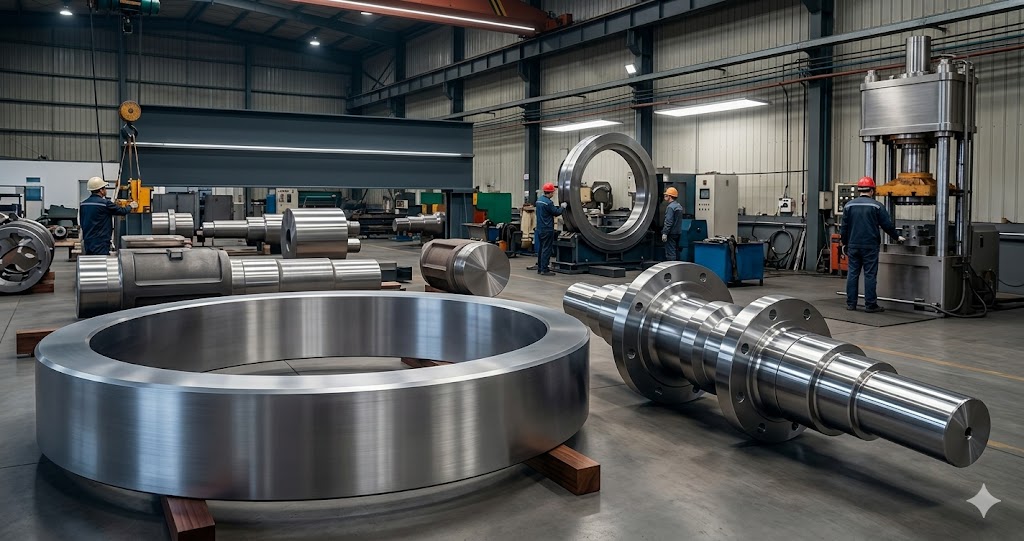
Since 1997, Jiangsu Liangyi Co.,Limited has specialized in the open die forging and seamless ring rolling of high-performance alloy steels. Among the dozens of grades we process, 34CrMoS4 (material number 1.7226) is one of our most requested — and for good reason. This chromium-molybdenum alloy occupies a precise engineering niche: it delivers the strength and hardenability of a genuine CrMo alloy while the deliberate sulfur addition of 0.02–0.04% transforms its machinability into something genuinely different from standard 34CrMo4. The result is a material that satisfies both the structural engineer demanding ≥800 MPa yield strength and the production machinist demanding consistent tool life across long runs of gear shafts or valve bodies.
Our ISO 9001:2015 certified facility in Jiangyin, Jiangsu Province operates across 80,000 m² with an annual forging capacity of 120,000 metric tons. Every 34CrMoS4 (1.7226) forged component we ship — whether a 150 kg pinion shaft for a gearbox manufacturer in Germany or a 22,000 kg mill head for a mining company in Australia — passes through the same steel-melting traceability, forging-ratio verification, heat-treatment certification, and non-destructive testing protocol before an EN 10204 3.1 or 3.2 mill test certificate is issued. We currently serve procurement teams, design engineers, and MRO buyers in more than 50 countries across Europe, North America, the Middle East, Southeast Asia, and Oceania.
- Single-piece weight range: 30 kg to 30,000 kg — fully covered by our own press capacity
- EN 10083-3: 2006 compliant; quality class MQ per ISO 6336-5 / DIN 3990-5
- Complete in-house chain: EAF melting → LF+VOD refining → forging → Q&T → machining
- EN 10204 Type 3.1 or 3.2 mill test certificates issued for every delivery
- NDT: UT per EN 10228-3 · MT per EN 10228-1 · PT available on request
- Flexible Incoterms: EXW, FOB, CFR, CIF — regular container and break-bulk shipments
- 26+ years of CrMo alloy forging experience; dedicated metallurgical engineering team
Why Engineers Specify 34CrMoS4 (1.7226): A Metallurgical Perspective
The designation "34CrMoS4" encodes the alloy's identity precisely. The leading "34" indicates a nominal carbon content of 0.34% — high enough for strong martensite formation after quenching, low enough to remain weldable with pre-heat. "CrMo" signals the dual hardening agents: chromium at 0.90–1.20% to improve hardenability and surface hardness after heat treatment, and molybdenum at 0.15–0.30% to suppress temper brittleness and maintain toughness at elevated temperatures. The trailing "S4" is the defining feature that sets this grade apart from its near-twin 34CrMo4: it specifies a controlled sulfur band of 0.020–0.040% (compared to a maximum of 0.035% in the unsulfurized version). That controlled sulfur level precipitates fine manganese sulfide (MnS) inclusions that act as chip-breakers during machining, dramatically reducing cutting forces and improving surface finish on CNC lathes and gear-hobbing machines.
For forged components, the practical implication is significant. A procurement engineer ordering pre-machined gear shaft blanks in 34CrMoS4 will typically see 15–25% longer insert life compared to equivalent blanks in non-resulfurized CrMo grades. On high-volume gear-hobbing or thread-whirling operations, this translates directly into lower cost per part and tighter dimensional repeatability. Importantly, the sulfur addition does not meaningfully compromise tensile strength, yield strength, or Charpy impact toughness in the transverse direction at working section sizes typical for forged components — the forgeable condition and controlled grain refinement achievable through proper austenitizing and quench rate easily dominate over any minor anisotropy from MnS inclusions.
The material also demonstrates particularly strong through-hardening in sections up to approximately 63 mm equivalent diameter under oil quench, achieving the full EN 10083-3 property specification. For larger sections — which are the norm in heavy open die forgings — our metallurgical team adjusts the quench severity and tempering cycle to ensure that the critical load-bearing volume of the component meets yield and impact requirements, with the specific parameters recorded and certified in the heat treatment chart attached to every MTC.
34CrMoS4 vs 34CrMo4: What Procurement Engineers Need to Know
These two grades are frequently confused in RFQs. Understanding the difference prevents costly specification errors and helps engineers choose the right grade for their production environment. The comparison below is drawn from EN 10083-3 requirements and our 26 years of practical forging and machining experience with both grades.
| Comparison Criteria | 34CrMoS4 (1.7226) | 34CrMo4 (1.7220) |
|---|---|---|
| Sulfur content (S) | 0.020 – 0.040% (controlled) | ≤ 0.035% (max, uncontrolled) |
| Carbon (C) | 0.30 – 0.37% | 0.30 – 0.37% |
| Chromium (Cr) | 0.90 – 1.20% | 0.90 – 1.20% |
| Molybdenum (Mo) | 0.15 – 0.30% | 0.15 – 0.30% |
| Tensile strength (Rm) | 1000 – 1200 MPa | 1000 – 1200 MPa |
| Yield strength (Rp0.2) | ≥ 800 MPa | ≥ 800 MPa |
| Machinability (relative) | Excellent — tool life improved 15–25% | Good — standard CrMo machinability |
| Chip breaking behavior | Short, clean chips — superior for CNC turning | Longer continuous chips — standard behavior |
| Surface finish after turning | Consistently finer Ra values at same feed rate | Good but slightly inferior to 34CrMoS4 |
| Weldability | Good with pre-heat; sulfur slightly increases hot-crack sensitivity | Marginally better hot-crack resistance |
| Minimum service temperature | -40°C | -40°C |
| EN material number | 1.7226 | 1.7220 |
| Best suited for | Gear shafts, pinion shafts, machined valve bodies — high machining volume | Structural forgings, welded assemblies, less critical machining |
Our recommendation: If the finished component requires extensive CNC turning, gear hobbing, thread whirling, or deep-hole drilling, specify 34CrMoS4 (1.7226). If the component will be welded after forging or requires maximum transverse impact toughness in extreme cross-sections, 34CrMo4 (1.7220) may be preferable. When in doubt, contact our technical team — we will review your drawing and application and recommend the most cost-effective grade for your production environment.
Key Technical Advantages of Our 34CrMoS4 (1.7226) Forgings
Verified Mechanical Performance — Not Just Nominal Values
Every batch of 34CrMoS4 forgings is tested on specimens cut from the actual forged part — not from separately forged test bars. Yield strength ≥800 MPa, tensile strength 1000–1200 MPa, elongation ≥11%, reduction of area ≥45%, and Charpy KV ≥40 J at room temperature are guaranteed values backed by our own laboratory test reports, not just nominal catalogue claims.
Machinability That Cuts Your Cost Per Part
The controlled sulfur band of 0.020–0.040% produces fine, evenly distributed MnS inclusions throughout the forged microstructure. These act as natural chip breakers, reducing cutting force by an estimated 10–15%, improving insert life by 15–25%, and enabling higher feed rates on gear-hobbing and ID/OD turning operations. For high-volume machined components, this difference is measurable in your per-piece cost.
Wide Temperature Range: -40°C to Elevated Service
After our standard quench-and-temper cycle, 34CrMoS4 forgings pass the EN 10083-3 Charpy impact test at room temperature. With a controlled tempering temperature above 550°C and validated impact testing, components can be certified for minimum service temperatures down to -40°C — qualifying for offshore wind turbine gearboxes, sub-arctic mining equipment, and cold-climate hydraulic valve applications.
Deep Hardenability for Large Section Sizes
The 1.00% chromium and 0.20% molybdenum combination gives 34CrMoS4 a Jominy hardenability band that extends full martensite transformation to approximately 35–40 mm from the quenched face. For large open die forgings exceeding 200 mm section, our metallurgical team adjusts quench media and agitation to ensure the critical volume meets the required hardness and impact properties — documented in the heat treatment record attached to every certificate.
Controlled Grain Structure Through Forging Ratio
We enforce a minimum forging ratio of 3:1 for all 34CrMoS4 open die forgings. This breaks down the as-cast dendritic structure, closes internal porosity and shrinkage voids, and refines the austenite grain size before heat treatment. The result is a homogeneous microstructure with consistent mechanical properties across the full cross-section. Our forging logs record the actual reduction ratio for each forging as part of the traceability documentation.
Full EN 10228 Non-Destructive Testing Compliance
Our in-house NDT laboratory is equipped with digital ultrasonic flaw detectors and magnetic particle testing equipment calibrated to current EN standards. Ultrasonic inspection per EN 10228-3 detects internal defects, inclusions, and laminations. Magnetic particle inspection per EN 10228-1 confirms surface and near-surface crack freedom. Both are performed by our ASNT/PCN Level II qualified inspectors, with results attached to every MTC as binding quality records.
Our 34CrMoS4 Forging Process: From Ingot to Certified Component
Many forging suppliers offer 34CrMoS4 forgings. What distinguishes our process is full vertical integration — we control every step from liquid steel to finished and tested component, within our own 80,000 m² facility. This eliminates supply chain gaps, prevents material substitution, and allows us to respond rapidly to drawing changes or urgent orders.
Step 1 — Raw Material Selection & Steel Melting
We source low-sulfur pig iron and clean scrap from approved sources, blended to achieve the precise chemistry required for EN 10083-3 grade 34CrMoS4. Primary melting in our 30-ton electric arc furnace (EAF) is followed by ladle furnace (LF) refining for precise alloy addition and slag chemistry control, then vacuum oxygen degassing (VOD) to reduce hydrogen to below 2 ppm and oxygen to below 20 ppm. The targeted sulfur level of 0.025–0.035% is achieved through controlled desulfurization and controlled re-sulfurization in the ladle — not by chance. Every heat is sampled for optical emission spectrometry (OES) analysis before tapping, and the ladle chemistry report forms the foundation of the EN 10204 MTC.
Step 2 — Ingot Casting & Soaking
Steel is poured into bottom-poured ingot molds sized to the forging's weight and required forging ratio. After solidification, ingots are stripped and transferred directly to our soaking pit furnaces, where they are brought to a uniform 1200–1250°C through temperature to eliminate chemical segregation and ensure uniform hot workability. Soaking time is calculated based on ingot cross-section and is recorded in the process log.
Step 3 — Open Die Forging & Ring Rolling
Our forging shop operates hydraulic presses from 800 tons to 8,000 tons, supported by 10-ton and 25-ton forge manipulators for precise positioning during multi-step forging sequences. For 34CrMoS4 shafts, discs, and blocks, calibrated multi-step reduction sequences achieve the minimum 3:1 forging ratio while controlling the final forging temperature above 800°C to prevent surface cracking. Seamless rolled rings are produced on our radial-axial ring rolling mill, supporting finished ring ODs from 300 mm to 5,000 mm in continuous grain-flow geometry.
Step 4 — Heat Treatment (Quench & Temper)
All 34CrMoS4 forgings are supplied in the quenched and tempered (Q+T) condition unless otherwise specified. Austenitizing is performed at 850–880°C in our calibrated furnaces, with a soak time calculated at a minimum of 1 minute per millimeter of ruling section. Quenching is performed in oil or water-polymer solutions depending on section size and hardenability requirements, with controlled agitation to achieve a uniform quench rate. Tempering is performed at 550–680°C. Our furnaces are calibrated to ±5°C accuracy and fully instrumented with chart recorders. Every heat treatment load is documented with a time-temperature record that becomes part of the MTC package.
Step 5 — Rough Machining (Optional)
After heat treatment, many customers require rough-machined blanks to drawing dimensions with an agreed machining allowance. Our CNC turning centers, boring mills, and vertical lathes cover diameter up to 3,500 mm and length up to 12,000 mm. We machine 34CrMoS4 at the cutting parameters matched to its post-Q&T hardness range of 298–359 HB, with insert grades specifically selected for sulfur-enhanced CrMo alloys to optimize surface finish and dimensional accuracy.
Step 6 — Final Inspection & Certification
Every 34CrMoS4 forging undergoes a structured final inspection sequence: dimensional verification against the approved drawing, hardness survey across the full surface, mechanical property testing on tensile and Charpy samples, ultrasonic scanning per EN 10228-3, and magnetic particle inspection per EN 10228-1. The complete inspection record is compiled into the EN 10204 Type 3.1 or 3.2 MTC, which includes the heat number, chemistry report, heat treatment record, mechanical test results, and NDT acceptance statement, before the part is cleared for packing and shipment.
Heat Treatment Options for 34CrMoS4 (1.7226) Forgings
The standard delivery condition for 34CrMoS4 forgings is quenched and tempered (+QT). However, we also support the following alternative conditions where the application or downstream processing requires it:
Quenched & Tempered (+QT) — Standard Delivery
Austenitize at 850–880°C, oil or polymer quench, temper at 550–680°C. Achieves full EN 10083-3 property specification: Rm 1000–1200 MPa, Rp0.2 ≥800 MPa, HB 298–359. This is the condition specified by the vast majority of our customers and is what all MTC mechanical test values are based on.
Normalized (+N) — For Re-heat Treatment by Customer
Austenitize at 860–890°C, air cool to room temperature. Produces a fine pearlitic/ferritic microstructure with Rm approximately 750–900 MPa and improved machinability. Typically specified when the customer will perform final quench-and-temper after machining in their own facility.
Soft Annealed (+A) — For Deep Machining or Cold Working
Slow furnace cool from 680–710°C. Produces the lowest hardness state (typically 180–220 HB), maximizing machinability for components requiring deep boring, extensive drilling, or cold straightening. Final heat treatment by the customer is required for load-bearing applications.
Stress Relieved (+SR) — After Rough Machining
Applied to Q+T forgings after rough machining, typically at 530–560°C for 2–4 hours, to relieve residual machining stresses before precision finish machining. Particularly recommended for long shafts, thin-walled rings, and precision gear blanks where dimensional stability is critical. Does not significantly alter hardness or tensile properties.
If your application requires a specific hardness band, minimum impact energy at sub-zero temperature, or a custom tempering range to balance hardness and ductility, please share your technical requirement with our engineering team. We routinely develop application-specific heat treatment procedures for customers with unusually demanding specifications.
Customization Capabilities for 34CrMoS4 (1.7226) Forgings
We do not stock standard sections or bar lengths in 34CrMoS4 — every forging we produce is made to your drawing, your dimension, and your specification. The parameters below define the outer envelope of what our equipment and process can achieve:
We accept orders from single prototype pieces to annual blanket contracts of several hundred tons. For customers requiring regular supply of a fixed part number, we offer scheduled production programs with prioritized capacity allocation and consistent heat-to-heat chemistry control. For urgent replacement or breakdown orders, we maintain a fast-track production lane with target lead times of 7–12 working days for simpler forging geometries. Contact us with your drawing and quantity requirement to discuss the best delivery program for your project.
Our complete equipment list covers the full production sequence from our 8,000-ton press to precision CNC machining and calibrated heat treatment furnaces.
Full Range of 34CrMoS4 (1.7226) Forged Products We Supply
The following product categories represent our standard scope of supply in 34CrMoS4. If your required part type is not listed, contact us — the list below is not exhaustive, and our engineering team regularly takes on non-standard geometries.
34CrMoS4 Forged Bars, Discs & Structural Blanks
The most fundamental forged form. We produce 34CrMoS4 forged round bars from 80 mm to 1,200 mm diameter, square bars, rectangular flats, and custom-profiled structural blanks — all with a minimum 3:1 forging ratio from our own melt. Typical applications are gear blank stock, valve body blanks, piston rod material, and tooling steel preforms where the customer performs subsequent machining in-house. Supplied in Q+T or normalized condition with OES chemistry + full mechanical properties on the MTC.
34CrMoS4 Seamless Rolled Rings & Gear Ring Blanks
Seamless ring rolling produces a continuous circumferential grain flow that gives rings dramatically superior fatigue life compared to flame-cut plate rings. Our 34CrMoS4 seamless rolled rings cover OD from 300 mm to 5,000 mm, heights from 50 mm to 1,500 mm, and wall thicknesses from 50 mm upward. We supply plain rectangular-section rings, contoured rings with rough-machined profiles, bearing outer races, slewing ring blanks, riding gear rings for rotary kilns and dryers, and ring gear blanks for gearbox assembly.
34CrMoS4 Forged Gear Shafts, Pinion Shafts & Transmission Components
This is arguably the application that best exploits the 34CrMoS4 grade's combination of strength and machinability. We forge and rough-machine gear shafts, pinion shafts, step shafts, splined shafts, main shafts, intermediate shafts, and output shafts for industrial gearboxes. Single-piece weights from a few hundred kilograms for wind turbine planetary carrier shafts up to 15,000 kg for large mill drive shafts. We also supply forged spur and helical gear wheel blanks, ring gear blanks, and bevel gear preforms — all rough-machined to drawing before shipment.
34CrMoS4 Hollow Forgings, Sleeves, Cylinders & Bushings
We produce seamless forged cylinders, thick-walled tubes, bushings, and hollow bars in 34CrMoS4 through core-punching and mandrel expansion on our hydraulic presses. Wall thickness from 40 mm to 400 mm, OD from 200 mm to 2,500 mm, lengths to 4,000 mm. Key applications include hydraulic cylinder barrels, piston rod housings, mill roll sleeves, inner and outer race blanks for large bearings, and worm gear casings.
34CrMoS4 Forged Valve Bodies, Bonnets & Pressure Components
Valve bodies, gate valve bodies, check valve bodies, valve bonnets, valve stems, seat rings, flanged nozzles, and forged pressure vessel components in 34CrMoS4. Produced in accordance with EN 10083-3 and ASTM equivalent specifications. Rough machining of bore diameters, end-face flatness, and bolt hole circles available before shipment. Hydrogen bake-out available for sour service applications (NACE MR0175 compliance review available on request).
34CrMoS4 Forged Flanges, Couplings & Structural Connectors
Custom flanges, reducing flanges, blind flanges, forged coupling halves, gear couplings, jaw couplings, flange rings with bolt-hole patterns, and structural weld-end connectors. Available in Q+T condition with dimensional inspection per your drawing and hydrostatic test certification available for pressure-rated applications. We routinely supply to drilling equipment manufacturers, subsea connector suppliers, and heavy machinery OEMs worldwide.
Industry Applications of 34CrMoS4 (1.7226) Forged Components
Over 26 years, our 34CrMoS4 forgings have found their way into demanding applications across nearly every major heavy industry sector. Below we describe not just what we supply, but why 34CrMoS4 is the right material choice for each application environment.
Wind Energy: Onshore & Offshore Gearbox Components
The drive train of a modern multi-megawatt wind turbine represents one of the most demanding environments for alloy steel forgings. A gearbox pinion shaft must endure billion-cycle fatigue loading from variable wind torque, operate in ambient temperatures as low as -40°C for Arctic or sub-Arctic installations, and maintain dimensional stability through years of continuous operation without replacement. 34CrMoS4 is the grade most commonly specified for planetary carrier shafts, high-speed pinion shafts, intermediate shaft stage components, and ring gear blanks in IEC-compliant wind gearboxes. We have supplied 34CrMoS4 forged gear shafts and ring gear blanks to gearbox manufacturers in Germany, Denmark, Spain, and China, verified against the gear quality and material requirements of GL/DNV, AGMA 6006, and IEC 61400 series standards. Low-temperature Charpy impact testing at -40°C is performed as part of our standard MTC package for all wind energy orders.
Mining & Mineral Processing: Crusher, Mill & Conveyor Drivetrain Parts
In open-pit and underground mining, the failure of a single drivetrain component can halt an entire processing circuit. The forgings in these applications must absorb shock loads from rock impact, survive abrasive dust environments, and maintain structural integrity at remote sites far from maintenance workshops. We supply 34CrMoS4 forged eccentric shafts for jaw and gyratory crushers, main shafts for cone crushers, pinion shaft assemblies for SAG and ball mills, conveyor pulley shaft blanks, and slewing ring bearing races for large excavators and stackers. Australian iron ore and copper producers, South American copper mine equipment suppliers, and African gold mine operators have all sourced 34CrMoS4 forgings from our facility. The material's combination of ≥800 MPa yield strength and verified Charpy toughness means that even in large sections — 500 mm diameter eccentric shaft forgings, for example — core mechanical properties remain above the minimum EN 10083-3 specification after our validated heat treatment cycle.
Oil & Gas Upstream & Midstream: High-Pressure Forged Equipment
34CrMoS4 is well-suited to the high-pressure, moderately corrosive environments found in upstream oil and gas applications where the working fluid is not severely sour and operating temperatures remain below approximately 400°C. We supply forged gate valve bodies, check valve bodies, ball valve balls, mud pump fluid end modules, wellhead cross members, choke body forgings, and BOP connector subs in this grade. For Middle Eastern gas compression projects, we have supplied 34CrMoS4 forged crankshaft blanks for reciprocating compressors and connecting rod blanks. For North Sea subsea projects, forged flange connectors and pig launcher end closures. Our oil and gas forgings are certified to EN 10083-3, with supplementary compliance reviews against ASME B16.34, API 6A, and NACE MR0175 requirements available through our technical team.
Cement & Mineral Processing: Kiln & Mill Drive Components
Rotary kilns and ball mills in cement, lime, and minerals processing run 24 hours a day, 350+ days a year. The riding gear rings, pinion shafts, and trunnion shafts in these drives must deliver years of continuous service without fatigue failure. We forge 34CrMoS4 riding gear rings up to 5,000 mm OD as seamless rolled rings with continuous circumferential grain flow — a significant structural advantage over flame-cut plate rings in fatigue-critical rotating applications. Pinion shafts, pull torque rods, and kiln feed chute shafts in 34CrMoS4 are standard deliveries to cement plant equipment suppliers globally.
Rail & Heavy Transport: Traction & Transmission Forgings
Railway locomotive transmission shafts, traction motor end shields, final drive gear housings, and wheel set axle blanks all impose demanding fatigue and impact requirements. Our 34CrMoS4 forgings for railway applications are produced with enhanced Charpy impact testing at -20°C as a minimum, and with ultrasonic scanning to EN 10228-3 Class 3 acceptance criteria for highest-integrity traction components. We also supply forged planetary gear components and ring gears for heavy truck automatic transmission development programs and heavy construction vehicle final drives.
Power Generation: Turbine & Generator Shaft Components
In gas turbines, steam turbines, and hydro turbines operating at sub-critical temperatures (below 400°C), 34CrMoS4 forgings serve as compressor stub shafts, coupling flanges, generator bearing housings, and auxiliary shaft components. The grade's combination of strength, machinability, and dimensional stability under thermal cycling makes it a practical and cost-effective alternative to higher-alloy shaft steels in moderate-duty turbine applications. We supply to turbine OEMs and EPC contractors in Europe, India, and the Middle East.
To see specific project references and case studies from our global supply history, visit our Project References page.
34CrMoS4 (1.7226) Material Standards & Technical Data
All of our 34CrMoS4 forgings are produced under EN 10083-3: 2006 — the definitive European standard for quenched and tempered alloy steels. The tables below reproduce the key technical data from this standard, combined with our own in-house production requirements where these are more stringent than the standard minimum.
Applicable Standards & Certifications
- Primary material standard: EN 10083-3: 2006 — Steels for quenching and tempering, Technical delivery conditions for alloy steels
- Gear material quality class: MQ minimum per ISO 6336-5 and DIN 3990-5 (ME class available on request)
- Ultrasonic testing: EN 10228-3 — Non-destructive testing of steel forgings, Ultrasonic testing
- Magnetic particle testing: EN 10228-1 — Non-destructive testing of steel forgings, Magnetic particle inspection
- Mill test certificate: EN 10204 Type 3.1 (standard) or Type 3.2 (third-party witness) — both available
- Steelmaking: EAF + LF + VOD route; non-radioactive material certification available
- Additional standards: ASTM A788 (forging process), EN 10243, customer-specific DIN/ISO/API reference standards accepted
Chemical Composition per EN 10083-3 (Mass Fraction, %)
| Element | Symbol | EN 10083-3 Limit | Role in Alloy |
|---|---|---|---|
| Carbon | C | 0.30 – 0.37% | Primary hardening element; controls strength after quench |
| Silicon | Si | ≤ 0.40% | Deoxidizer; minor solid solution strengthener |
| Manganese | Mn | 0.60 – 0.90% | Improves hardenability; combines with S to form MnS inclusions |
| Phosphorus | P | ≤ 0.025% | Controlled as low as possible; excess causes temper embrittlement |
| Sulfur | S | 0.020 – 0.040% | Controlled addition; forms MnS for machinability improvement |
| Chromium | Cr | 0.90 – 1.20% | Major hardenability element; improves surface hardness and wear resistance |
| Molybdenum | Mo | 0.15 – 0.30% | Suppresses temper brittleness; maintains toughness at elevated temperature |
Mechanical Properties After Standard Quench & Temper (+QT) per EN 10083-3
| Mechanical Property | Symbol | EN 10083-3 Minimum Requirement |
|---|---|---|
| Tensile Strength | Rm | 1000 – 1200 MPa |
| Yield Strength (0.2% proof) | Rp0.2 | ≥ 800 MPa |
| Elongation after fracture | A | ≥ 11% |
| Reduction of area | Z | ≥ 45% |
| Charpy V-notch impact energy (room temp) | KV | ≥ 40 J |
| Brinell hardness (informative) | HBW | 298 – 359 HB |
| Minimum service temperature | T min | -40°C |
Approximate Physical Properties (Reference Values at Room Temperature)
| Physical Property | Value |
|---|---|
| Density | 7.85 g/cm³ |
| Elastic modulus (Young's modulus) | ~210 GPa |
| Thermal conductivity (at 20°C) | ~42 W/(m·K) |
| Coefficient of thermal expansion (20–300°C) | ~12.5 × 10⁻⁶ /K |
| Specific heat capacity | ~460 J/(kg·K) |
Global Grade Equivalents for 34CrMoS4 (1.7226)
| Country / Region | Standard | Equivalent Grade | Key Difference |
|---|---|---|---|
| Europe (EN) | EN 10083-3 | 34CrMoS4 / 1.7226 | The primary standard |
| USA (AISI/SAE) | AISI/SAE | ~4135 (resulfurized: 4135RH) | Similar Cr-Mo; US 4135 has slightly higher Mo upper limit |
| Germany (DIN) | DIN 17200 | 34CrMoS4 | Predecessor to EN standard; essentially identical |
| Japan (JIS) | JIS G4105 | ~SCM435 (close, not identical) | JIS SCM435 has lower C ceiling; no controlled S in standard grade |
| China (GB) | GB/T 3077 | ~35CrMo | 35CrMo has no controlled S; machinability inferior |
| France (AFNOR) | NF A35-552 | 34CD4S | Nearly equivalent; minor compositional tolerance differences |
Note: Grade equivalents are approximate. For critical applications, always verify chemistry and mechanical property requirements against the applicable standard rather than relying solely on grade name equivalence. Our technical team can assist with cross-referencing and confirming material compliance for your specific specification.
Full-Process Quality Control & Inspection for 34CrMoS4 Forgings
Our quality management system is certified to ISO 9001:2015 and covers the complete production chain from raw material receipt through final shipment. For 34CrMoS4 forgings specifically, quality control is executed at six distinct stages, each generating records compiled into the final MTC package.
Stage 1 — Incoming Raw Material Inspection
All incoming alloy additions (ferrochromium, ferromolybdenum, sulfur additions) and purchased semi-finished steel are inspected and certified against our approved supplier qualification criteria before being released to production. Scrap and pig iron are verified for radioactive contamination using our portal monitors before entering the melt shop.
Stage 2 — Liquid Steel Chemistry Verification
Every heat is sampled and analyzed using our in-house Optical Emission Spectrometer (OES) before tapping. The carbon, sulfur, phosphorus, chromium, and molybdenum contents are confirmed against EN 10083-3 specification limits. If the sulfur content falls outside the 0.020–0.040% target band, the heat is adjusted before tapping rather than being released out-of-specification.
Stage 3 — Forging Process Monitoring
Forging temperature is measured by contact or optical pyrometers at the start of each reduction pass, with a minimum finish forging temperature of 800°C enforced. The actual forging sequence — reduction ratio, number of passes, total reduction — is recorded against the production traveler for each forging. Our forge masters review this record against the approved forging procedure before releasing the forging to heat treatment.
Stage 4 — Heat Treatment Certification
All furnaces used for austenitizing and tempering of 34CrMoS4 forgings are calibrated to ±5°C accuracy. Every heat treatment load is equipped with calibrated thermocouples, and the time-temperature record is produced as a continuous chart that becomes a required attachment to the MTC. Quench medium temperature, agitation rate, and transfer time from furnace to quench tank are also recorded.
Stage 5 — Mechanical Property Testing
Tensile specimens (at least one longitudinal) and Charpy V-notch specimens (minimum 3 transverse specimens per EN 10083-3) are machined from a test coupon heat treated in the same furnace charge as the forgings it represents. Testing is performed on our calibrated universal tensile testing machine and Charpy pendulum. Hardness surveys are performed on each individual forging using a calibrated Brinell hardness tester.
Stage 6 — Non-Destructive Testing
Our NDT inspection team holds ASNT Level II qualifications (or equivalent PCN) in both ultrasonic testing (UT) and magnetic particle testing (MT). Ultrasonic inspection is performed per EN 10228-3, capable of detecting reflectors smaller than 3 mm FBH equivalent at any depth. Magnetic particle inspection per EN 10228-1 is performed using wet fluorescent magnetic particles under UV illumination for maximum sensitivity. Penetrant testing (PT) is available as a supplementary inspection for non-magnetic or complex-geometry surfaces. Third-party inspection by your nominated surveyor (SGS, Bureau Veritas, Intertek, Lloyd's Register, TÜV, etc.) is welcome and can be arranged through our quality department.
Why Global Buyers Choose Jiangsu Liangyi for 34CrMoS4 Forgings
There is no shortage of forging suppliers in China. The question for a procurement engineer outside China is not "Can I find a cheaper price?" — it is "Can I trust the quality, the documentation, and the delivery consistency month after month, project after project?" Here is what distinguishes us from a transactional export forging trader:
We Make What We Sell — No Subcontracting
We are not a trading company and we do not subcontract forging to outside suppliers. Every 34CrMoS4 forging on your order is produced in our own facility, with our own press capacity, our own furnaces, and our own certified inspectors. The MTC we issue reflects the actual steel we made and the actual tests we performed — not a paper transferred from an unknown subcontractor.
26 Years of CrMo Alloy Forging Experience
We founded our forging business in 1997 and have grown continuously since. The engineers who supervise our 34CrMoS4 production understand the material's metallurgical sensitivities — quench crack risk in large sections, sulfur segregation in oversized ingots, temper embrittlement avoidance. This experience lives in our process parameters and our forge masters' accumulated judgment — not just in a quality manual.
Transparent Communication & Technical Support
Our English-speaking sales and technical team can read and interpret your engineering drawings, discuss your heat treatment specification, review your NDT acceptance criteria, and identify potential specification conflicts before production begins — not after. We issue weekly production status updates on active orders. If a quality issue arises during production, we tell you immediately rather than shipping a non-conforming part.
Documented Supply to 50+ Countries
Our customer base includes gear manufacturers in Germany, mining equipment OEMs in Australia, valve manufacturers in the United States, oil field equipment suppliers in the UAE, and power generation equipment builders in India. This diversity of end applications has given us exposure to dozens of national standards, specification interpretations, and engineering cultures — making us better equipped to understand and meet your specific requirements.
Global Shipping & Supply Chain Reliability
Our Jiangyin facility is located approximately 35 km from Jiangyin Port (on the Yangtze River), 80 km from Shanghai Port, and 90 km from Nanjing International Airport — giving us direct access to all major international freight routes. We ship 34CrMoS4 forgings by sea freight (FCL, LCL, or break-bulk for oversized pieces), by air freight for urgent small parts, and by multimodal truck-and-sea for European door-to-door deliveries.
- Incoterms supported: EXW (Jiangyin factory), FOB (Shanghai or Nanjing port), CFR, CIF, DAP — we can quote under any Incoterm you specify
- Export documentation: Commercial invoice, packing list, certificate of origin (CCPIT or Chamber of Commerce), fumigation certificate where required, and full MTC package — all provided as standard
- Oversized and overweight cargo: We have regular experience shipping forgings up to 30 tons per piece as project cargo / break-bulk, with specialist heavy-lift freight forwarding available on request
- Import compliance support: We provide HS codes, MTCs in English and Chinese, and third-party inspection certificates from globally recognized bodies (SGS, BV, TÜV, Intertek, Lloyd's Register) to facilitate customs clearance in any destination country
- Payment terms: T/T, letter of credit (L/C at sight or 30/60/90 days), and for established customers, open account arrangements — flexible based on your procurement policy
Our repeat customer rate — the majority of our customers have been ordering from us for more than five years — is the most honest measure of the reliability we deliver in practice.
34CrMoS4 (1.7226) Steel Making: Our EAF + LF + VOD Route
Our 34CrMoS4 forged parts begin with precisely controlled steelmaking — the foundation of chemistry and inclusion control that determines everything downstream. Our three-step steelmaking route for 34CrMoS4 consists of:
- Primary melting in our 30-ton electric arc furnace (EAF): raw materials are selected and charged to achieve target carbon and residual element levels. EAF provides the flexibility to control tramp elements (tin, antimony, arsenic) that can degrade toughness if inherited from low-quality scrap.
- Ladle furnace refining (LF): alloy additions for Cr, Mo, Mn, and Si are made with precision in the ladle, alongside slag chemistry management for desulfurization — and then controlled re-sulfurization to the target S band of 0.020–0.040%. This is the critical step that separates 34CrMoS4 production from standard 34CrMo4, and it requires active chemistry management throughout the refining process.
- Vacuum oxygen degassing (VOD): reduces dissolved hydrogen to below 2 ppm (preventing hydrogen flaking in large section forgings), dissolved oxygen to below 20 ppm (improving cleanliness and ductility), and allows final fine adjustment of chemistry before ingot casting. Non-radioactive material is guaranteed; a declaration is available on request for nuclear or medical-adjacent applications.
Get Custom 34CrMoS4 Forging Solutions Within 24 Hours
Share your drawing, material specification (EN 10083-3 or equivalent), required quantity, and delivery timeline. Our engineering team will review your requirements and respond within 24 hours with a technical assessment and detailed factory quotation. No intermediaries — direct from manufacturer to your inbox.
Send Your Inquiry NowFrequently Asked Questions About 34CrMoS4 (1.7226) Forgings
34CrMoS4 (material number 1.7226) is a chromium-molybdenum alloy structural steel standardized under EN 10083-3. The designation breaks down as follows: "34" = nominal 0.34% carbon, "Cr" = 0.90–1.20% chromium, "Mo" = 0.15–0.30% molybdenum, "S4" = controlled sulfur of 0.020–0.040%. After standard quenching and tempering, it delivers tensile strength of 1000–1200 MPa, yield strength ≥800 MPa, and Charpy impact energy ≥40 J at room temperature, with a minimum service temperature of -40°C. What sets it apart from 34CrMo4 (1.7220) — its closest relative — is the controlled sulfur band: this produces manganese sulfide (MnS) inclusions that act as chip-breakers during CNC machining, improving tool life by approximately 15–25% and enabling finer surface finishes. The mechanical properties of both grades are essentially identical; the difference is practical machinability in downstream manufacturing.
The primary governing standard is EN 10083-3: 2006, which defines the chemical composition limits, mechanical property requirements (in Q+T condition), and delivery conditions for 34CrMoS4. For gear applications, we additionally confirm compliance with quality class MQ under ISO 6336-5 or DIN 3990-5 as a minimum; quality class ME is available for highest-reliability applications on request. All forgings are supplied with an EN 10204 Type 3.1 Mill Test Certificate as standard. Type 3.2 (countersigned by an independent third-party inspector such as TÜV, Bureau Veritas, SGS, or Lloyd's Register) is available when specified on the purchase order. The MTC includes the heat number, full OES chemistry analysis, heat treatment record, mechanical test results (tensile + Charpy + hardness survey), dimensional inspection summary, and NDT acceptance statement.
The only compositional difference is sulfur content: 34CrMoS4 has a controlled band of 0.020–0.040%, while 34CrMo4 has a maximum of 0.035% with no lower bound — meaning the sulfur level could be near zero. This controlled sulfur in 34CrMoS4 creates fine manganese sulfide inclusions that act as natural chip-breakers during machining, improving insert life and surface finish in CNC turning, gear hobbing, and boring operations. Mechanical properties (strength, elongation, toughness, hardenability) are essentially identical between the two grades. Specify 34CrMoS4 when the finished component requires significant machining operations. Consider 34CrMo4 when the component will be welded after forging (the sulfur in 34CrMoS4 very slightly increases hot-crack sensitivity) or when maximum transverse notch toughness is the overriding concern.
After standard quenching and tempering per EN 10083-3, our 34CrMoS4 forgings meet the following guaranteed minimum values: tensile strength (Rm) 1000–1200 MPa, 0.2% proof strength (Rp0.2) ≥800 MPa, elongation (A) ≥11%, reduction of area (Z) ≥45%, Charpy V-notch impact energy (KV) ≥40 J at room temperature, and Brinell hardness in the informative range of 298–359 HB. These values are verified by actual destructive testing on specimens from the same heat treatment charge as the delivered forgings. Where your application requires sub-zero impact testing (e.g., -20°C or -40°C Charpy data), this can be added to the test scope at the enquiry stage.
Yes — all our 34CrMoS4 forgings are made to customer drawings and specifications. We do not maintain stock. Minimum order quantity is flexible: for development and prototype orders we regularly accept single-piece orders; for production supply, typical minimum order quantities are 1–5 tons depending on part complexity and lead time. Single-piece forging weights range from 30 kg to 30,000 kg. We cover all standard shapes — round bars, discs, blocks, seamless rings (OD up to 5,000 mm), shafts (length up to 12,000 mm), and hollow forgings — as well as complex stepped and profiled geometries. Please send your drawing, required quantity, delivery requirement, and applicable standard to sales@jnmtforgedparts.com for a quotation within 24 hours.
Standard lead time for custom 34CrMoS4 forgings is 15–30 working days from receipt of confirmed purchase order and approved drawing. This covers steelmaking, ingot casting, soaking, forging, heat treatment (Q+T), basic dimensional inspection, and mechanical + NDT testing. If rough machining is included, add 5–10 working days depending on complexity. For urgent breakdown or MRO orders, we maintain a fast-track production channel with target lead times of 7–12 working days for simpler forging geometries — please advise at the enquiry stage that the order is urgent and we will confirm the realistic accelerated schedule.
Our standard NDT scope for 34CrMoS4 forgings includes: (1) Ultrasonic testing (UT) per EN 10228-3, performed by ASNT Level II qualified inspectors using calibrated A-scan ultrasonic instruments. For large or critical forgings, phased-array UT equipment enables volumetric scanning with higher sensitivity and full image documentation. (2) Magnetic particle inspection (MT) per EN 10228-1 using wet fluorescent magnetic particles under UV illumination for maximum surface and near-surface defect sensitivity. (3) Dimensional inspection against your approved drawing. All NDT reports are signed by the qualified inspector and included as attachments to the EN 10204 MTC. Third-party witness inspection by your nominated body is welcome.
The closest AISI/SAE equivalent to 34CrMoS4 (1.7226) is AISI 4135 — a chromium-molybdenum steel with broadly similar carbon (0.33–0.38%), chromium (0.80–1.10%), and molybdenum (0.15–0.25%) contents. However, there is no standard AISI grade with a controlled sulfur band equivalent to the "S" addition in EN 34CrMoS4. Other approximate global equivalents include JIS SCM435 (Japan), GB/T 3077 35CrMo (China — no controlled S), and NF A35-552 34CD4S (France). Always verify the actual chemistry and mechanical property requirements before treating grade equivalents as interchangeable in a critical specification. Our technical team can assist with formal grade equivalence confirmation.
34CrMoS4 (1.7226) is weldable with proper precautions, but is not considered a freely weldable structural steel. Its carbon equivalent (CE ≈ 0.56–0.65% using the IIW formula) places it firmly in the category requiring pre-heat. Recommended practices: (1) Pre-heat to 200–300°C before welding and maintain interpass temperature within the same range. (2) Use low-hydrogen welding consumables and ensure dry storage. (3) Perform post-weld stress relief at 580–620°C where possible. (4) Note that the sulfur content of 34CrMoS4 very slightly increases sensitivity to hot cracking in fully restrained welds. For components where welding is a primary joining process, consider specifying 34CrMo4 (1.7220) instead. Always develop and qualify a welding procedure specification (WPS) per EN ISO 15614-1 for production welding on load-bearing components.
34CrMoS4 (1.7226) is a through-hardening grade and is not designed for gas carburizing or carbonitriding. However, induction hardening of selected surfaces (gear tooth flanks, journal diameters, bearing seats) is fully compatible with 34CrMoS4 in the Q+T condition. The carbon content of 0.30–0.37% provides sufficient hardenability for surface hardening to 52–58 HRC in the induction-hardened zone, while the Q+T core retains its toughness. This makes 34CrMoS4 an attractive option for gear shafts or spindles where the surface requires maximum wear resistance but the core must resist shock loads. If you require induction hardening as part of the forging supply scope, please advise at the enquiry stage.
Have a technical question not covered above? Our engineering team reads every inquiry personally. Send your question to sales@jnmtforgedparts.com and we will respond with a direct technical answer — not a template reply.
As a dedicated 34CrMoS4 forging manufacturer in China with 26 years of production history, Jiangsu Liangyi operates a complete, vertically integrated forging and machining facility — from our own EAF steelmaking through forging, heat treatment, NDT, and rough machining. Every 34CrMoS4 (1.7226) forged component we supply is traceable to a single verified heat of steel, produced and tested in our own facility, documented with an EN 10204-compliant MTC, and shipped with the full quality record that modern engineering procurement requires.
Beyond 34CrMoS4, we process a wide range of alloy steel grades including 42CrMo4, 18CrNiMo7-6, 16MnCr5, 30CrNiMo8, 4140, 4340, and P20, as well as carbon steels, stainless steels, and selected nickel alloys in the open die forging and ring rolling process. Visit our complete material grades page to find the right alloy for your application, or contact our engineering team directly with your specification and we will confirm availability, lead time, and pricing.
Ready to Start Your 34CrMoS4 Forging Project?
Send your drawing, material specification and required quantity to our sales team, and we will get back to you with a detailed quotation and technical solution within 24 hours.