About 34CrMo4 (1.7220) Forged Alloy Steel
34CrMo4 (1.7220) — Key Facts at a Glance
Established in 1997, Jiangsu Liangyi Co.,Limited is an ISO 9001:2015 certified professional manufacturer of 34CrMo4 (1.7220) open die forgings and seamless rolled rings in China. With over 25 years of focused experience in Cr-Mo alloy steel forging, we supply certified 34CrMo4 components to OEMs and engineering contractors in Europe, North America, Australia, the Middle East, and more than 50 countries globally. Our 80,000 m² factory operates with 120,000 tons annual production capacity and an in-house material testing laboratory, offering complete traceability from heat number to finished component.
34CrMo4 (material number 1.7220, sometimes written 34 CrMo 4 or 34CrMo 4) is a chromium-molybdenum structural alloy steel formally specified in EN 10083-3:2006 for quenching and tempering applications. The designation itself encodes the composition: "34" is the nominal carbon content in hundredths of a percent (0.34%), "Cr" denotes chromium, and "Mo" denotes molybdenum, with the numeral "4" indicating approximately 1% chromium. This precise alloy formulation was developed to achieve a specific balance of properties that no single-element alloy steel can match: the depth of hardenability produced by chromium combined with the temper-embrittlement resistance and elevated-temperature strength retention contributed by molybdenum.
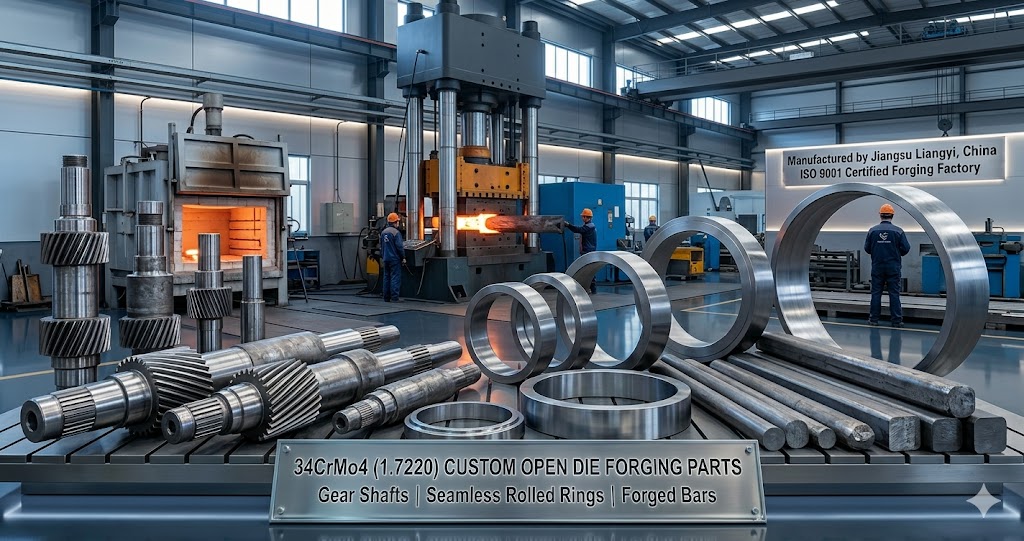
In practical terms, 34CrMo4 occupies a critical engineering niche — it is strong enough for demanding structural and power transmission duties, yet tough enough to survive shock loading that would fracture higher-carbon grades. Its surface can be hardened to 52–57 HRC by induction or flame hardening for wear resistance, while the core retains the toughness of a tempered martensite or lower bainite microstructure. We provide a full one-stop manufacturing service from steel melting through forging, heat treatment, and precision CNC machining, strictly following your drawings, specifications, and applicable standards. Every batch is accompanied by a complete EN 3.1 Mill Test Certificate.
Why 34CrMo4 Performs the Way It Does — A Metallurgical Perspective
Understanding why 34CrMo4 behaves as it does in service helps engineers make better design decisions and helps procurement teams specify it correctly. The outstanding performance of this grade is not accidental — it is the result of carefully balanced alloying elements that interact in the solid state during heat treatment.
The Role of Chromium (Cr: 0.90 – 1.20%)
Chromium is the primary hardenability-enhancing element in 34CrMo4. It achieves this by slowing the transformation of austenite to pearlite and bainite during cooling, which means the steel can be through-hardened in larger cross-sections and with slower quench media (oil rather than water) without sacrificing core hardness. In practical terms, a 34CrMo4 forging quenched in oil achieves a substantially deeper hardened zone than a plain carbon steel of identical carbon content quenched in water. Chromium also dissolves in the iron matrix to form chromium carbides during tempering, which resist over-tempering and help maintain hardness at temperatures up to approximately 400°C — relevant for components in proximity to heat sources such as compressor housings and engine components. Additionally, chromium marginally improves corrosion resistance in mildly aggressive environments, though 34CrMo4 should not be considered a stainless or corrosion-resistant steel without protective surface coatings in wet or chemically active service.
The Role of Molybdenum (Mo: 0.15 – 0.30%)
Despite being present in a relatively small amount, molybdenum performs a critical function that distinguishes 34CrMo4 from simpler chromium-only grades: it suppresses temper embrittlement. In Cr-only steels (such as 34Cr4), holding or slowly cooling through the 375–575°C temperature range during post-quench tempering leads to grain boundary segregation of impurities (particularly phosphorus and tin), which causes catastrophic embrittlement. Molybdenum, by preferentially scavenging grain boundary sites and altering the precipitation kinetics, almost entirely eliminates this vulnerability. The practical consequence for forging engineers is that 34CrMo4 can be safely tempered in a wide temperature range and can undergo slow cooling after tempering without brittle fracture risk — a critical advantage for large-section forgings where cooling rates are inherently slow. Molybdenum also enhances creep resistance and strengthens the solid solution at elevated temperatures, extending the useful service range of the alloy.
Carbon Content and the Strength-Toughness Balance
The carbon range of 0.30–0.37% is deliberately set below that of 42CrMo4 (0.38–0.45%) to shift the hardness-toughness balance toward toughness. Each 0.01% increase in carbon raises achievable hardness by approximately 0.5 HRC after full hardening but simultaneously reduces impact energy by roughly 3–5 J at ambient temperature. For components subject to shock loading — mining crusher shafts, wind turbine gearbox ring gears, rail axles — the lower carbon of 34CrMo4 provides a significantly better safety margin against brittle crack initiation under impact. For applications where maximum static strength is paramount and impact loading is minimal, 42CrMo4 or 50CrMo4 may be more appropriate alternatives.
Manufacturer's Engineering Note
In our 25+ years of producing 34CrMo4 forgings for global projects, the most common specification error we encounter is requesting tempering temperatures below 500°C to achieve higher hardness without accounting for the resulting loss of impact energy. For most rotating and dynamically loaded applications, we recommend a minimum tempering temperature of 540°C to keep Charpy impact values comfortably above 40 J at ambient temperature. We always discuss the hardness-toughness trade-off with clients before finalizing heat treatment parameters.
Why Forged 34CrMo4 Outperforms Hot-Rolled Bar or Casting
Many engineers first encounter 34CrMo4 as a hot-rolled or cold-drawn bar product and assume the same material in a forging is simply a shape change. This underestimates the fundamental improvement that the forging process applies to the steel's internal structure — an improvement that is directly measurable in mechanical performance and service life.
Grain Flow and Fibrous Microstructure
When we forge 34CrMo4 at temperatures between 1,100°C and 1,250°C and reduce the cross-section by a minimum forging ratio of 3:1 (typically 4:1 to 6:1 for critical parts), the working action elongates the austenite grains and forces dendritic segregation bands to align with the forging direction. Upon cooling and subsequent heat treatment, these aligned bands become the "fibrous" or "flow-line" microstructure characteristic of properly forged steel. The fibrous structure has dramatically superior transverse toughness and fatigue crack resistance compared to the as-rolled or as-cast microstructure, because cracks propagating across fiber boundaries must break through a far more tortuous path than cracks propagating in a random structure.
For a gear shaft forged from a 34CrMo4 billet with an appropriate forging ratio, the transverse Charpy impact energy typically runs 20–35% higher than the longitudinal impact energy of an equivalent hot-rolled bar — and both values significantly exceed those of cast material. This matters in real service: a gear shaft forged with the grain flow running parallel to the axis will resist fatigue cracking at tooth roots and fillets far longer than one machined from bar stock with interrupted or misaligned grain flow.
Elimination of Casting Defects
Hot-rolled bar and particularly cast 34CrMo4 can contain residual porosity, micro-shrinkage cavities, oxide inclusions, and interdendritic segregation from the solidification process. The hot-working energy of open die forging applies compressive stress that closes and welds these internal defects, provided the forging temperature and reduction ratio are correctly managed. Our quality control includes mandatory ultrasonic testing (UT) per EN 10228-3 or client-specified equivalent standards for all forging deliveries to critical applications, confirming internal soundness before dispatch.
Quantified Property Improvements
| Property | As-Cast 34CrMo4 | Hot-Rolled Bar (Q+T) | Open Die Forging (Q+T) |
|---|---|---|---|
| Tensile Strength Rm (N/mm²) | 750 – 900 | 900 – 1,100 | 900 – 1,100 |
| Yield Strength Rp0.2 (N/mm²) | 550 – 700 | 650 – 900 | 650 – 950 |
| Charpy Impact Energy KV (J, ambient) | 20 – 35 | 40 – 60 | 50 – 80+ |
| Reduction of Area Z (%) | 25 – 40 | 45 – 60 | 50 – 65 |
| Fatigue Endurance Limit (MPa, R=-1) | ~280 | ~390 | ~420 – 460 |
| Internal Soundness | Porosity / shrinkage risk | Good, some segregation | Excellent, UT verified |
* Values are indicative ranges for 40–100 mm section size, Q+T condition. Actual results vary by cross-section, forging ratio, and heat treatment cycle. All forging values from our in-house test records.
Grade Selection Guide: 34CrMo4 vs 42CrMo4 vs AISI 4140 vs SCM435
One of the most frequent questions we receive from design engineers is: "Should I use 34CrMo4 or 42CrMo4 for this component?" The answer depends on the specific combination of strength, toughness, section size, and heat treatment that your application requires. This guide draws on our direct production and testing experience across thousands of forging orders.
Comprehensive Grade Comparison Table
| Parameter | 34CrMo4 (1.7220) | 42CrMo4 (1.7225) | AISI 4140 | AISI 4135 | SCM435 (JIS) |
|---|---|---|---|---|---|
| C Content (%) | 0.30 – 0.37 | 0.38 – 0.45 | 0.38 – 0.43 | 0.33 – 0.38 | 0.33 – 0.38 |
| Cr Content (%) | 0.90 – 1.20 | 0.90 – 1.20 | 0.80 – 1.10 | 0.80 – 1.05 | 0.90 – 1.20 |
| Mo Content (%) | 0.15 – 0.30 | 0.15 – 0.30 | 0.15 – 0.25 | 0.15 – 0.25 | 0.15 – 0.30 |
| Max Rm (small section) | 1,000 – 1,200 N/mm² | 1,100 – 1,300 N/mm² | 1,050 – 1,250 N/mm² | 980 – 1,180 N/mm² | 980 – 1,180 N/mm² |
| Toughness (Impact) | ★★★★★ Excellent | ★★★★ Very Good | ★★★★ Very Good | ★★★★★ Excellent | ★★★★★ Excellent |
| Weldability | ★★★★ Good (preheat req.) | ★★★ Moderate | ★★★ Moderate | ★★★★ Good | ★★★★ Good |
| Machinability (annealed) | ★★★★★ Excellent | ★★★★ Very Good | ★★★★ Very Good | ★★★★★ Excellent | ★★★★★ Excellent |
| Max surface hardness (induction) | 52 – 57 HRC | 54 – 60 HRC | 54 – 60 HRC | 52 – 57 HRC | 52 – 57 HRC |
| Governing Standard | EN 10083-3 | EN 10083-3 | ASTM A29 | ASTM A29 | JIS G4105 |
| Best for large sections (>150 mm) | Yes — superior core toughness | Yes — higher strength | Good | Yes — excellent toughness | Yes |
Practical Decision Guide: Which Grade to Choose
Choose 34CrMo4 (1.7220) when: your component is subject to impact or shock loading; when toughness at sub-zero temperatures is required (mining equipment, offshore structures); when welding is part of the fabrication process; when the section size is large (above 100 mm) and through-hardening core toughness is more critical than maximum achievable hardness; or when the governing standard explicitly calls for EN 10083-3 material.
Choose 42CrMo4 (1.7225) when: static tensile or yield strength is the primary design driver; when maximum surface hardness above 57 HRC is required for wear-critical applications; when the section size is moderate (below 80 mm) where the carbon difference has less influence on core toughness; or for gears operating under heavy contact stress where hardened case depth and hardness are prioritized over impact energy.
Note on AISI 4140 vs EN 42CrMo4: Although often treated as interchangeable, AISI 4140 has slightly lower Cr and Mo minimum limits than EN 42CrMo4. For European-standard projects (PED, ATEX, wind certification), explicitly specifying 42CrMo4 per EN 10083-3 ensures compliance; substituting AISI 4140 without documented equivalence may require additional material qualification review.
From Our Engineering Team
For wind turbine gearbox ring gears and planet carrier shafts, we almost exclusively supply 34CrMo4 rather than 42CrMo4. The fatigue loading profile of wind turbine drivetrains — characterized by variable amplitude, bidirectional torsion, and intermittent shock loads from gusts — demands maximum toughness rather than maximum hardness. The 34CrMo4 grade consistently outperforms higher-carbon alternatives in fatigue life testing under this type of loading spectrum, which is why major European wind OEMs specify it preferentially.
Why Choose Jiangsu Liangyi for Your 34CrMo4 Forgings
Full In-House Vertical Integration
From electric arc furnace steel melting and vacuum degassing, through open die forging on presses up to 5,000 tons, controlled-atmosphere heat treatment in 10 furnaces, to CNC precision machining and NDT inspection — every step happens under one roof with zero hand-off uncertainty between suppliers.
Unrestricted Custom Geometry
Single piece weight 30 kg to 30,000 kg. Seamless rolled rings up to 5,000 mm outer diameter. Forged bars and shafts up to 12,000 mm long. We work from your 2D drawings, 3D STEP/IGES files, or joint DFM (Design for Manufacturability) reviews to optimize your design for forging.
Certified & Fully Traceable Quality
ISO 9001:2015 certified quality system. Every forging carries a unique heat number linked to spectrometer chemical analysis, tensile/impact test results, hardness records, heat treatment charts, and UT/MT inspection reports. Full traceability from steel ladle to shipped component.
Global Export Experience
25+ years supplying 34CrMo4 forgings to engineering projects in Germany, the UK, the Netherlands, Norway, the US, Canada, Australia, UAE, India, and 40+ other countries. Our team is fluent in international technical standards, export documentation, and logistics requirements.
Free DFM Review & Engineering Support
Our metallurgical and forging engineers review every RFQ before quoting. If your drawing contains features that are difficult or uneconomical to forge, or if a geometry change would improve material properties, we proactively communicate this — at no charge — before order placement.
Fast Response, Competitive Lead Times
Written quotation within 24 hours. Typical production lead time 15–30 days. Our production scheduling team maintains buffer material stock for common 34CrMo4 billet sizes to enable expedited delivery when your project demands it.
Custom 34CrMo4 (1.7220) Forging Shapes & Solutions
We offer fully customized 34CrMo4 forging solutions. Unlike trading companies that source opportunistically, every shape below is produced in our own facility, allowing us to guarantee dimensional accuracy, heat treatment consistency, and material traceability from the same billet for all pieces in a batch.
Forged Bars & Solid Rods
34CrMo4 forged round bars, square bars, flat bars, hexagonal bars, and solid rods produced by open die forging with controlled forging ratios for consistent grain flow. Available in normalized, annealed, or quenched-and-tempered condition. Particularly suited for subsequent CNC machining into shafts, pins, spindles, and structural members where the superior mechanical properties of a forged cross-section are required over rolled bar. We maintain close tolerance on straightness (max 1 mm/m for precision shafts) and can supply in lengths from 500 mm to 12,000 mm.
Seamless Rolled Rings & Hollow Components
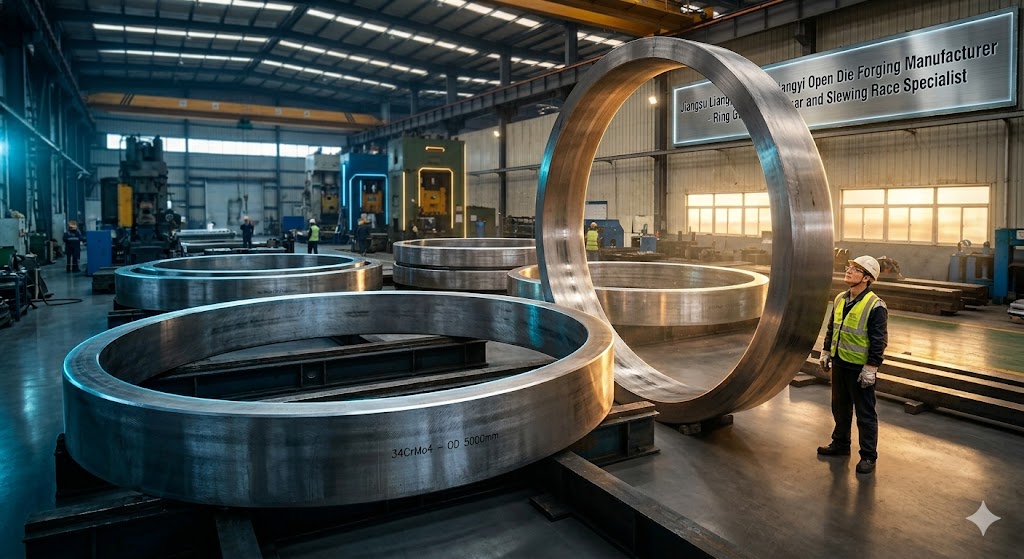
Our ring rolling mill produces 34CrMo4 seamless forged rings from 200 mm to 5,000 mm outer diameter, with wall thickness from 50 mm to 1,000 mm. Products include flat-face rings, contoured rings with tapered or stepped cross-sections, large-bore flanges, slewing ring blanks, and gear ring blanks. The seamless ring rolling process produces optimal hoop-direction grain flow — the critical orientation for rotating rings under centrifugal and radial loading — without any weld seam or parting line that could be a site of stress concentration or leakage. We also produce hollow bars, bushes, and thick-wall cylinder blanks for hydraulic and pressure vessel applications.
Forged Shafts & Gear Components
Precision 34CrMo4 open die forged shafts are a core product of our facility. We produce stepped shafts, pinion shafts, hollow shafts, gear shafts, spindles, crankshafts, and cam shafts with diameter steps up to a ratio of 3:1 within a single forging. Gear blanks and ring gear blanks in 34CrMo4 for subsequent gear hobbing or grinding are another speciality — we can forge the near-net shape profile to minimize machining stock while ensuring adequate forging reduction ratio throughout the cross-section. All shaft forgings can be supplied rough-turned on ID and OD with machining allowance defined per agreement, or fully finished to final print dimensions.
Forged Discs, Plates & Structural Blocks
Heavy forged discs, rotor discs, turbine discs, thick-wall flanges, coupling discs, and rectangular forged blocks for subsequent machining into housings, frames, and structural components. We produce discs up to 2,500 mm diameter and 800 mm thickness in a single forging. For particularly large structural blocks, we can forge pancake shapes and then cut to size, providing a more economical alternative to full machined-from-solid approaches while retaining the superior properties of a forged material.
Custom Special-Shaped & Near-Net Forgings
Our tooling library and die-sinking capability allow us to produce custom near-net shape forgings that reduce machining costs significantly compared to forging simple square blocks. This includes forged valve bodies, T-pieces, yoke forgings, hook bodies, clevis ends, press ram bodies, hydraulic cylinder barrels, and other irregular profiles. Send us your drawings and we will assess the near-net forging feasibility and provide a die cost and piece price comparison against conventional forging approaches.
34CrMo4 Forging Applications — Industry Deep Dive & Regional Cases
The versatility of 34CrMo4 (1.7220) stems from its exceptional combination of strength, toughness, and hardenability. Below we describe its role in each major industry with engineering context that goes beyond simple product lists — because understanding why this grade is specified helps you evaluate alternatives intelligently and specify it correctly for new applications.
Wind Power Gearboxes (Europe, China, North America, offshore globally)
Modern wind turbines impose one of the most demanding fatigue loading regimes of any rotating machinery. A 3 MW wind turbine gearbox ring gear experiences approximately 108–109 load cycles over a 20-year design life, with variable amplitude torque that can reverse direction during grid fault recovery and include impact spikes during gust events. This loading profile is what makes 34CrMo4 the preferred choice over higher-carbon grades: the combination of high fatigue endurance limit (typically 420–460 MPa for forged, induction-hardened 34CrMo4), excellent notch sensitivity resistance, and Charpy impact values of 50–80 J at ambient temperature provides the widest safety margin for unpredictable dynamic loading.
Oil & Gas — Wellheads, Pressure Vessels & Drilling Equipment (North America, Middle East, North Sea)
Forgings for oil and gas service must simultaneously resist high internal pressure, external corrosion, hydrogen-induced stress cracking (HISC) in sour gas environments, and the fatigue loading imposed by vibrating pipelines and rotating drilling equipment. 34CrMo4 forgings for NACE MR0175 (ISO 15156) sour service compliance require special controls on hardness (maximum 22 HRC core after heat treatment), sulfur content (maximum 0.010% for sour service versus the standard 0.035%), and post-forge inspection. We routinely produce 34CrMo4 forgings to these enhanced NACE requirements for clients supplying wellhead equipment to US Gulf of Mexico, Middle East, and North Sea projects.
Mining & Heavy Construction (Australia, Chile, South Africa, Canada)
Open-cut mining equipment — gyratory and cone crushers, SAG mill pinion shafts, rope shovel drive shafts, dragline crowd arms — represents one of the most severe forging applications for 34CrMo4. The impact and shock loading imposed by rock fragmenting against crusher liners can generate instantaneous stress spikes many times the steady-state load, making toughness the overriding design criterion. 34CrMo4 forgings for mining applications are typically specified at the lower end of the hardness range (26–30 HRC after Q+T) to maximise impact energy, accepting slightly reduced wear resistance in favor of catastrophic fracture prevention.
Cement, Sugar & Heavy Process Industry (Global)
Rotary kiln trunnion shafts, riding gear pinion shafts, and grinding mill shafts in cement, lime, and sugar refining plants operate under high sustained bending loads with slow continuous rotation — a fatigue regime dominated by very-high-cycle (108+) low-amplitude loading rather than impact. For these applications, 34CrMo4 is specified for its excellent fatigue endurance limit and dimensional stability after heat treatment, not primarily for impact toughness. The relative ease of induction hardening the journal surfaces to 50–54 HRC significantly extends wear life on riding surfaces in contact with tyre rings without requiring a change to a more expensive high-alloy grade.
Power Generation — Gas Turbines, Steam Turbines & Hydro Equipment
Turbine shafts, couplings, and impeller hubs in land-based gas and steam turbines operate at elevated temperatures (up to 350–400°C for steam turbines) and must maintain adequate yield strength and creep resistance over design lives of 30+ years. The molybdenum content in 34CrMo4 provides measurably better strength retention at 300–400°C compared to plain carbon or Cr-only steels, making it a cost-effective choice for the lower-temperature sections of turbine shafts where higher alloy grades (such as 30CrMoV9) would be over-specification. We have supplied 34CrMo4 coupling discs and shaft sections for hydroelectric generators in projects across Central Asia and South America.
General Mechanical Engineering & Power Transmission
34CrMo4 (1.7220) forgings are the standard specification for precision gearbox shafts, speed reducer input/output shafts, hydraulic cylinder barrel forgings, crane hook bodies, and high-pressure vessel flanges across general mechanical engineering. Its machinability in the annealed state (approximately 80–85% of free-cutting steel reference) and predictable response to induction hardening make it the material of first choice for machine tool builders, gearbox manufacturers, and hydraulic equipment OEMs when designing components that require a balance of high strength, toughness, and surface hardness with good machinability.
Railway, Shipbuilding & Other Applications
Forged 34CrMo4 axles for freight and passenger rail vehicles are produced to EN 13261 (solid axles) and EN 13262 (wheel seats) standards, where the grade's toughness at temperatures down to -20°C ensures safety in cold-climate rail service. In shipbuilding, 34CrMo4 forged rudder stocks, propeller shaft couplings, and deck equipment housings benefit from both the material's strength and its resistance to stress corrosion cracking in marine environments when properly protected. Explore our full range of alloy steel forging materials for your specific project.
34CrMo4 (1.7220) Material Specifications & Standards
Chemical Composition per EN 10083-3 (Mass Fraction, %)
The chemical composition limits in EN 10083-3 are tight enough to guarantee consistent hardenability and mechanical performance, yet wide enough to permit efficient steel making. Our spectrometer analysis results for every heat are recorded on the MTC, and we routinely achieve chemistry near the middle of the specified ranges to provide consistent, reproducible heat treatment response:
| Chemical Element | Symbol | EN 10083-3 Range | Our Typical Aim | Function in Alloy |
|---|---|---|---|---|
| Carbon | C | 0.30 – 0.37 % | 0.33 – 0.35 % | Primary hardness & strength; kept low to preserve toughness |
| Silicon | Si | ≤ 0.40 % | 0.20 – 0.30 % | Deoxidation; solution strengthening; controlled to limit embrittlement risk |
| Manganese | Mn | 0.60 – 0.90 % | 0.70 – 0.80 % | Hardenability support; sulfide morphology control; deoxidation |
| Phosphorus | P | ≤ 0.025 % | ≤ 0.015 % | Harmful — grain boundary embrittlement; minimized in our melt practice |
| Sulfur | S | ≤ 0.035 % | ≤ 0.015 % | Machinability (slight benefit); harmful to toughness in excess — controlled via Ca treatment |
| Chromium | Cr | 0.90 – 1.20 % | 1.00 – 1.10 % | Hardenability; oxidation resistance; carbide formation during tempering |
| Molybdenum | Mo | 0.15 – 0.30 % | 0.20 – 0.25 % | Temper embrittlement prevention; elevated temperature strength; enhanced hardenability |
Mechanical Properties in Quenched & Tempered Condition (EN 10083-3)
The following table shows the minimum guaranteed mechanical properties for 34CrMo4 forgings in the Q+T condition, segmented by ruling section size. Note that properties decrease with section size due to the inherent hardenability limit of the grade — for sections above 160 mm, we discuss this explicitly with clients to ensure the specified core properties are achievable with the chosen quench medium and section geometry:
| Section Size (mm) | Rp0.2 Min (N/mm²) | Rm (N/mm²) | A5 Min (%) | Z Min (%) | KV Min (J) at +20°C | Approx. Hardness (HB) |
|---|---|---|---|---|---|---|
| < 16 | 800 | 1,000 – 1,200 | 11 | 45 | 35 | 300 – 360 |
| 16 – 40 | 650 | 900 – 1,100 | 12 | 50 | 40 | 268 – 330 |
| 40 – 100 | 550 | 800 – 950 | 14 | 55 | 45 | 238 – 285 |
| 100 – 160 | 500 | 750 – 900 | 15 | 55 | 45 | 223 – 270 |
| 160 – 250 | 450 | 700 – 850 | 15 | 60 | 45 | 209 – 255 |
Surface Hardening Capability — Induction Hardening Depth Guide
Induction hardening is one of the most powerful tools for optimizing 34CrMo4 forgings for wear-critical applications while retaining a tough core. The relationship between induction frequency, power density, and case depth is approximately as follows, based on our in-house induction hardening trials on 34CrMo4 forged bar:
| Induction Frequency | Typical Case Depth Range | Surface Hardness (HRC) | Recommended Application |
|---|---|---|---|
| High frequency (200–500 kHz) | 0.5 – 2.0 mm | 54 – 57 HRC | Small diameter shafts, gear teeth, precision pins |
| Medium frequency (3–10 kHz) | 2.0 – 5.0 mm | 52 – 57 HRC | Gear shafts, camshafts, large diameter pins |
| Low frequency (0.5–3 kHz) | 4.0 – 10.0 mm | 50 – 55 HRC | Heavy shafts, large ring bores, crane hooks |
| Flame hardening | 1.5 – 6.0 mm | 50 – 55 HRC | Large surfaces, complex profiles, on-site repair |
* Case depth values are indicative. Actual depth depends on equipment power, traverse speed, quench intensity, and specific geometry. Our induction hardening team will specify parameters to achieve your required effective case depth (ECD) at the specified hardness threshold, typically 400 HV or 42 HRC.
34CrMo4 Heat Treatment — Process Science & Our Practice
Heat treatment transforms the forged microstructure of 34CrMo4 from its as-forged state (a mixture of ferrite, pearlite, and possibly bainite) into the optimized tempered martensite structure that gives the grade its superior mechanical performance. Getting heat treatment right is not simply a matter of reaching a temperature — it requires precise control of soaking time, quench medium, quench rate, tempering temperature, and cooling path after tempering.
Our Heat Treatment Facility
Our heat treatment workshop operates 10 controlled-atmosphere furnaces with capacities from 2 tonnes to 40 tonnes, equipped with programmable temperature controllers (accuracy ±5°C), thermocouple verification, and automatic data logging. Temperature uniformity across all furnace zones is verified regularly using calibrated thermocouples. All heat treatment records are stored digitally and printed on the MTC, enabling full retrospective traceability of thermal cycle for every piece.
Step-by-Step Heat Treatment for 34CrMo4 Forgings
Charge & Pre-Heat (Stress Relief after Forging)
Large 34CrMo4 forgings are charged into the furnace at ≤ 300°C and heated slowly at a controlled rate (≤ 100°C/hour for sections above 200 mm) to avoid thermal shock cracking. A pre-heat hold at 400–500°C for 1 hour per 100 mm of section allows temperature equalization before further heating.
Austenitizing (Hardening Temperature)
The forging is heated to 830–870°C (austenitizing temperature for 34CrMo4) and held for a minimum of 1 hour per 25 mm of cross-section after reaching temperature uniformity. This soaking dissolves chromium carbides into the austenite, loading the austenite with the carbon and alloying elements needed for the subsequent hardening transformation. Too short a soak produces incompletely dissolved carbides and lower-than-expected hardness; too long causes grain coarsening.
Quenching
For sections below 80 mm, oil quenching (50–80°C oil temperature, forced circulation) transforms the austenite to martensite or upper bainite throughout the cross-section. For larger sections or when distortion control is critical, polymer quenching (PAG solution, concentration 10–20%) offers a more uniform quench rate between oil and water. We discuss quench medium selection with clients for sections above 100 mm to ensure the expected core hardness is achievable. After quenching, the forging is transferred to the tempering furnace within 30 minutes to prevent quench crack formation.
Tempering
The as-quenched martensite in 34CrMo4 is extremely hard (typically 55–58 HRC) but brittle. Tempering at 540–680°C converts this to tempered martensite with the specified combination of strength and toughness. The tempering temperature is selected based on the client's required hardness or strength specification: 540°C → Rm ≈ 1,000–1,100 N/mm² / KV ≈ 40–55 J; 600°C → Rm ≈ 900–1,000 N/mm² / KV ≈ 55–75 J; 650°C → Rm ≈ 800–900 N/mm² / KV ≈ 70–90 J. We avoid tempering in the 300–500°C range to prevent tempered martensite embrittlement.
Post-Temper Cooling & Verification
After tempering, the forging is cooled in still air (not water or oil, to avoid thermal shock and residual stress). Hardness is checked on each end face and mid-length using a calibrated Brinell or Rockwell hardness tester. If hardness is within the specified range, the piece proceeds to mechanical test sampling and NDT inspection. If outside range, the cause is investigated and the piece may be re-tempered (within limits) or subjected to full metallurgical review.
Other Heat Treatment Options for 34CrMo4
- Normalizing (850–880°C, air cool): Used when the design requires a uniform microstructure with moderate mechanical properties and good machinability — common for large forging blanks that will be machined and subsequently re-heat-treated in the finished component form. Typical result: Rm 700–850 N/mm², KV 50–70 J.
- Annealing (680–720°C, furnace cool): Produces the softest condition for maximum machinability — hardness typically 170–210 HB. Used for complex machined parts where dimensional accuracy during machining is critical and final heat treatment is performed by the end user.
- Sub-critical annealing (630–680°C, air cool): Stress-relief anneal for already rough-machined forgings before finish machining, to release machining-induced residual stresses without significantly changing hardness.
Our 34CrMo4 Forging Manufacturing Process — From Melt to Dispatch
Transparency about our manufacturing process is part of how we build trust with clients who are placing critical-component orders from 10,000 km away. Here is an honest, detailed description of what happens between your purchase order and the arrival of 34CrMo4 forgings at your facility.
Step 1 — Steelmaking: EAF + LF + VD
34CrMo4 steel is melted in our 30-tonne electric arc furnace (EAF) from selected scrap and ferroalloys. After EAF tapping, the heat is transferred to the ladle refining furnace (LF) where precise alloy additions are made, slag is conditioned for desulfurization, and the temperature is adjusted for optimum castability. The final critical step is vacuum degassing (VD): the ladle is placed under vacuum (pressure < 67 Pa) for a minimum of 15 minutes with argon stirring to remove dissolved hydrogen (to < 1.5 ppm), reduce oxygen inclusions, and homogenize the alloy additions. This VD step is what distinguishes our ingot quality from ordinary EAF steel: the ultra-low hydrogen level eliminates hydrogen-induced flake cracking in large forgings, while the clean oxide inclusion content improves transverse toughness and fatigue performance.
Step 2 — Ingot Casting & Inspection
Vacuum-degassed steel is bottom-poured into cast iron ingot moulds ranging from 500 kg to 25,000 kg, selected to match the forging weight and achieve an appropriate ingot-to-billet forging ratio. The ingot top head (feeder) is sized to compensate for solidification shrinkage. After solidification and stripping, ingots are inspected for surface defects and marked with heat number and ingot position for full traceability. They are then transferred directly to preheating furnaces for hot working — we do not cold-store ingots, as thermal cycling can introduce cracking in large sections.
Step 3 — Open Die Forging
We operate open die hydraulic presses of 800 tons, 2,000 tons, and 5,000 tons capacity. The preheated 34CrMo4 ingot is forged at 1,050–1,250°C through a sequence of upsetting (height reduction to break down the ingot structure and close porosity) and drawing-down (length extension to align grain flow). Our certified forging engineers define the pass schedule — the sequence of anvil passes, reductions, and rotations — to achieve the required forging ratio throughout the cross-section. Infrared thermometers monitor forging temperature to ensure the material never falls below the finish forging temperature of 900°C, which would result in cold work and cracking. If the forging cools excessively, it is returned to the furnace for reheating before further work.
Step 4 — Heat Treatment
Described in detail in the section above. After heat treatment, every piece receives a hardness survey (minimum 4 readings per piece for routine orders, more for critical or large sections) and the results are recorded for the MTC.
Step 5 — Rough Machining (Optional)
Most clients receive 34CrMo4 forgings in rough-machined condition: OD turned to machining allowance (typically 3–8 mm per side for diameters, 5–15 mm per side for faces), bores rough-bored if applicable, ends faced. This removes the forging scale and decarburized surface layer, exposing clean base metal for subsequent NDT and final machining. Our CNC lathes accommodate components up to 2,800 mm swing diameter and 12,000 mm between centres.
Step 6 — Inspection & Testing
Every 34CrMo4 forging delivery includes, as standard: spectrometer chemical analysis report; tensile test (Rm, Rp0.2, A5, Z) and Charpy impact test (KV at +20°C, or sub-zero per agreement); hardness test; dimensional inspection report. Additional tests available on request: grain size per ASTM E112; non-metallic inclusion rating per DIN 50602 or ASTM E45; ultrasonic testing per EN 10228-3 or ASTM A388; magnetic particle testing per EN 10228-1; dye penetrant testing; hardness depth survey after induction hardening.
Step 7 — Packing & Export Shipping
Forgings are protected against corrosion with VCI (Volatile Corrosion Inhibitor) film, then secured in custom-built wooden crates or steel pallets rated for the piece weight. Export markings (heat number, piece number, weight, dimensions) are stencilled on each piece and crate. We prepare all required export documentation: commercial invoice, packing list, certificate of origin, MTC, and inspection certificates. We coordinate FCL container loading at our factory gate for door-to-port shipment, or work with your nominated freight forwarder for other arrangements.
Production Process & Quality Control Standards
Steel Making — Purity Controls Beyond Standard Requirements
While EN 10083-3 sets minimum chemical composition requirements, achieving consistently excellent mechanical properties in 34CrMo4 forgings requires tighter internal controls than the standard mandates. Our standard practice includes:
- Vacuum degassing (VD) on every heat of 34CrMo4 — not optional — reducing dissolved hydrogen to < 1.5 ppm and oxygen activity to < 15 ppm, eliminating flaking and reducing inclusion density
- Calcium wire injection treatment during LF refining to modify sulfide inclusions from elongated MnS stringers to spherical CaS — improving transverse toughness by approximately 25–30% compared to non-calcium-treated material
- Aimed sulfur content ≤ 0.015% (versus standard ≤ 0.035%) and phosphorus ≤ 0.015% (versus standard ≤ 0.025%) for all critical applications
- Bottom-poured ingot practice with oversized hot-top feeder head, completely cropped before forging, to eliminate pipe and macro-segregation from the usable material
- Compliance with ISO 6336-5 / DIN 3990-5 Quality Class MQ (minimum) or ME for gear-quality material on request
- Non-radioactive raw material with documented source traceability — critical for nuclear-adjacent and medical-adjacent applications
Compliance with International Production Standards
Our 34CrMo4 forgings are manufactured in strict accordance with the following standards (and to any additional project-specific requirements you specify):
- EN 10083-3:2006 — Steels for quenching and tempering: Technical delivery conditions for alloy steels (primary governing standard)
- EN 10250-3:2000 — Open steel die forgings for general engineering purposes: Alloy special steels
- EN 10132-3:2000 — Cold rolled narrow steel strip for heat treatment: Technical delivery conditions for quenching and tempering steels
- EN 10263-4:2001 — Steel rod, bars and wire for cold heading and cold extrusion: Quenching and tempering steels
- ASTM A788 — Standard Specification for Steel Forgings, General Requirements (for US-standard projects)
- DIN, JIS, ISO, and other material/forging standards per client specification; for regulatory frameworks requiring Notified Body or classification society approval (e.g. PED, AD 2000, ship classification), the client's applicable TPI agency witnesses and certifies compliance at our facility
Inspection Programme — What We Test and Why
We implement a multi-stage inspection programme for every 34CrMo4 forging order. Our in-house laboratory is equipped with an optical emission spectrometer for chemistry analysis, a universal testing machine for tensile properties, a Charpy impact tester calibrated to EN ISO 148-1, Brinell and Rockwell hardness testers calibrated to EN ISO 6506/6508, and a digital ultrasonic flaw detector:
- Chemical composition (spectrometer): Every heat — verifies compliance with EN 10083-3 and any project-specific enhanced limits for P, S, or residual elements
- Mechanical tensile test (ASTM A370 / ISO 6892-1): Yield strength, tensile strength, elongation, reduction of area from test specimens cut from an integral extension or a sacrifice piece of the same heat and thermal cycle
- Charpy impact test (ISO 148-1): Minimum 3 specimens per test condition; sub-zero temperature testing (-20°C, -40°C) available on agreement
- Hardness survey (EN ISO 6506 Brinell): Minimum 4 readings per forging, location per agreed map; hardness depth profile for induction-hardened components
- Grain size (ASTM E112): On request or when specified in the material standard; our target is ASTM grain size number ≥ 5 for quenched-and-tempered 34CrMo4
- Ultrasonic testing (EN 10228-3 / ASTM A388): Standard for all forgings above 500 kg; Quality Class 3 (EN) or Level C (ASTM) as default for critical applications; results reviewed by Level II or Level III certified NDT personnel
- Magnetic particle testing (EN 10228-1): Surface crack detection on all rough-machined surfaces for critical applications; performed by trained NDT personnel
- Dimensional inspection: 100% dimensional check against drawing for every piece; CMM (Coordinate Measuring Machine) available for complex geometries
How to Order 34CrMo4 Forgings — Complete RFQ Guide
Preparing a complete Request for Quotation saves time for both parties and ensures the quotation we provide is accurate and executable. Below is what our engineering team needs to provide you with a precise quotation — and what we do if you do not have all of it yet.
1. Geometry Information
- 2D drawing (PDF) or 3D model (STEP/IGES)
- Critical dimensions with tolerances
- Machining allowance required (or "as-forged")
- Surface finish requirements (Ra value)
- Quantity per order and annual volume estimate
2. Material Specification
- Grade: 34CrMo4 / 1.7220 and governing standard (EN 10083-3, ASTM, etc.)
- Delivery condition: annealed / normalized / Q+T / as-forged
- Required hardness or Rm/Rp0.2 range
- Any enhanced chemistry limits (P, S, H₂, etc.)
- Gear quality class if applicable (MQ, ME per ISO 6336-5)
3. Testing & Certification
- Required MTC type: EN 3.1 or EN 3.2 (third-party)
- NDT requirements: UT class, MT class
- Test temperatures for Charpy impact
- Third-party inspection agency (if any)
- Any project-specific inspection plan or ITP
4. Commercial & Logistics
- Required delivery date or lead time
- Destination port / city / Incoterms
- Any packaging requirements (crating, VCI, etc.)
- Payment terms preference
- Any embargo or restricted country compliance notes
Don't have everything yet? That's fine.
If you are in an early design stage and do not have complete drawings, send us the available information — nominal dimensions, weight estimate, material grade, and application description. Our engineering team will perform a preliminary DFM review, identify any forgeability or heat treatment concerns, and provide a budgetary price estimate so you can advance your project planning. No drawing is wasted, and no inquiry is too early to be useful. Contact us at sales@jnmtforgedparts.com — we typically respond within 4 working hours.
Common Specification Mistakes to Avoid
Drawing on our experience reviewing thousands of 34CrMo4 forging RFQs, here are the most common specification errors we encounter — and how to avoid them:
- Specifying hardness without section size context: "32 HRC" is achievable in a 50 mm shaft but may not be achievable through-section in a 300 mm diameter disc. Always specify the measurement location (surface or core) and discuss achievability for your section size with us before committing the spec to your drawing.
- Requesting sub-500°C tempering for maximum hardness: Tempering below 500°C increases the risk of tempered martensite embrittlement (TME), significantly reducing toughness. If you need hardness above 32 HRC with good impact properties, consider switching to a case-hardening approach (carburizing grade) or specifying induction hardening of the surface only.
- Using "AISI 4140" when the project requires EN 10083-3: European pressure equipment, wind certification, and rail standards require materials certified to EN standards. AISI 4140 certified to ASTM A29 is not a direct substitute for EN 42CrMo4 under PED or EN 13261 requirements without additional qualification. Similarly, for 34CrMo4 applications under EN standards, specify EN 10083-3 explicitly rather than AISI 4135.
- Omitting the minimum impact temperature from the spec: If your equipment will be deployed in cold climates (below -10°C), specify Charpy impact testing at the lowest anticipated service temperature. 34CrMo4 forgings at 28–32 HRC (high hardness end) may not meet adequate KV values at -40°C without special heat treatment optimization — we would discuss this and possibly recommend a lower hardness target or additional cooling with the tempering.
- Assuming all China forging suppliers follow the same quality process: Not all manufacturers operate EAF+LF+VD steelmaking, and not all perform ultrasonic testing as a standard. When requesting quotes, explicitly specify VD-melted material, MTC requirement, and UT class — and ask your supplier to confirm these are standard, not optional. We are happy to provide our standard production and inspection flowchart for any inquiry.
Frequently Asked Questions About 34CrMo4 (1.7220) Forgings
What is 34CrMo4 (1.7220) steel and what makes it different from similar grades?
34CrMo4 (material number 1.7220) is a European standard chromium-molybdenum alloy quenched and tempered steel, defined in EN 10083-3:2006. The "34" indicates nominal 0.34% carbon, the "Cr" chromium at 0.90–1.20%, and "Mo" molybdenum at 0.15–0.30%.
What distinguishes it from simpler grades is the specific function of each alloying element: chromium improves hardenability and allows oil quenching of larger cross-sections without water, while molybdenum eliminates temper embrittlement — the grain-boundary segregation that makes Cr-only steels brittle after slow post-temper cooling. This combination gives 34CrMo4 an exceptional balance of deep hardenability, good toughness, resistance to temper embrittlement, and elevated-temperature strength that makes it ideal for heavy-duty forged components across wind power, oil & gas, mining, and mechanical engineering industries.
What are the international equivalent grades of 34CrMo4?
The closest international equivalents are: AISI 4135 (US/ASTM A29, C: 0.33–0.38%, Cr: 0.80–1.05%, Mo: 0.15–0.25%); SCM435 (Japanese JIS G4105, C: 0.33–0.38%, Cr: 0.90–1.20%, Mo: 0.15–0.30%); and the identical German DIN designation 34CrMo4 (DIN EN 10083-3).
Important note: AISI 4140 and 42CrMo4 (1.7225) are NOT equivalent to 34CrMo4 — they contain 0.38–0.43% carbon, which gives higher maximum hardness but lower toughness. For most applications the difference matters significantly. Always confirm the exact carbon range and governing standard with your metallurgical team before treating these as interchangeable.
What is the maximum size of 34CrMo4 forgings you can produce?
Our equipment capabilities for 34CrMo4 forgings: single piece weight from 30 kg to 30,000 kg; seamless rolled rings from 200 mm to 5,000 mm outer diameter; forged bars and shafts up to 12,000 mm length; discs and flanges up to 2,500 mm diameter.
For forgings above 250 mm in ruling section size, we proactively discuss the hardenability limitation of 34CrMo4 with the client. At very large cross-sections, the cooling rate at the core during quenching may be insufficient to fully transform to martensite, meaning the core properties will be lower than EN 10083-3 table values (which are referenced to specific section sizes). Where this is a concern, we may recommend a higher-hardenability alternative such as 34CrNiMo6 (1.6582), or agree on realistic achievable core properties for the specific geometry.
Can you provide full machining service for 34CrMo4 forgings?
Yes. Our in-house CNC machining workshop operates horizontal and vertical turning centres, boring mills, and a grinding section. We can supply 34CrMo4 forgings in rough-machined (machining allowance on all surfaces), semi-finished (all non-critical dimensions finished, critical surfaces with allowance), or fully finished to drawing dimensions. Dimensional tolerances we routinely hold: IT7–IT8 for turned diameters, IT6 for precision bearing journals, ±0.05 mm for thread-adjacent diameters, Ra 0.8 µm for ground journal surfaces.
For complex components requiring gear cutting, keyway broaching, or thread grinding, we work with verified specialist subcontractors and maintain quality oversight throughout. All final inspection is performed in our facility before dispatch.
What certificates can you provide for 34CrMo4 forgings?
Standard supply includes EN 3.1 Mill Test Certificate (MTC) covering: heat number, chemical composition (spectrometer), mechanical test results (tensile, Charpy, hardness), heat treatment record (temperature, soaking time, quench medium, tempering temperature), NDT results, and dimensional inspection summary. The MTC is signed by our Quality Manager.
EN 3.2 dual certification is available on request: the client nominates their preferred independent inspection agency (such as SGS, Bureau Veritas, Intertek, or similar), who witnesses inspection and co-signs the MTC at our facility. For ASME applications we can prepare a Certified Material Test Report (CMTR) format. For project-specific inspection plans (ITP), please share your requirements and we will confirm compliance. We welcome client factory audits and pre-shipment inspections at any stage.
What is the typical lead time for 34CrMo4 forging orders?
Standard lead time for custom 34CrMo4 forgings is 15–30 working days from receipt of signed order and approved drawings, covering: raw material preparation and melting (3–5 days), forging (1–3 days depending on complexity and piece weight), heat treatment including soaking time (3–7 days), rough machining (3–7 days), testing and inspection (3–5 days), documentation and packaging (1–2 days).
For large or very heavy pieces requiring extended heat treatment soaking (sections above 250 mm), or for orders requiring third-party witness inspection, allow 35–45 days. Expedited production with priority scheduling is possible for urgent project requirements — contact us with your required delivery date and we will confirm feasibility and any premium involved before order placement.
What hardness and strength does 34CrMo4 achieve after heat treatment?
After quenching and tempering, 34CrMo4 properties depend on section size and tempering temperature:
For sections 40–100 mm: Rm 800–950 N/mm², Rp0.2 ≥ 550 N/mm², A5 ≥ 14%, KV ≥ 45 J at +20°C, approx. 238–285 HB (24–29 HRC).
Tempering at lower temperatures (540–580°C) pushes Rm toward the upper range and hardness to approximately 30–34 HRC at the cost of some impact energy. Tempering at 640–680°C brings Rm to 750–850 N/mm² with Charpy values typically 65–90 J — optimal for shock-loaded applications.
After induction or flame surface hardening: surface hardness 52–57 HRC to an effective case depth of 1.5–5 mm (frequency-dependent), while the core retains its Q+T tempered martensite properties. This combination makes 34CrMo4 ideal for components requiring a hard, wear-resistant surface and a tough, fatigue-resistant core — the classic "hard outside, tough inside" profile demanded by gear shafts and cam followers.
Is 34CrMo4 weldable, and what welding procedure should be used?
34CrMo4 has moderate weldability. Its carbon equivalent (CE = C + Mn/6 + (Cr+Mo+V)/5 + (Ni+Cu)/15) is approximately 0.55–0.65, which classifies it as a steel requiring preheating and controlled procedures to prevent cold cracking.
Recommended welding procedure: Preheat 200–300°C minimum (use temperature-indicating crayons or contact thermocouple to verify); low-hydrogen electrodes (E7018 for AWS, equivalent ≥ 5018-G for EN; maximum hydrogen content H5 or H4); maintain interpass temperature ≤ 350°C; post-weld heat treatment (PWHT) at 580–650°C for minimum 1 hour per 25 mm of weld thickness; slow cool from PWHT in still air or insulated condition. Welding in the annealed condition (170–210 HB) is preferred over the Q+T condition. If welding an already heat-treated 34CrMo4 component is unavoidable, the PWHT temperature must be below the original tempering temperature to avoid over-tempering and strength loss.
Our engineering team can provide a formal Welding Procedure Specification (WPS) recommendation for your specific joint configuration and service conditions upon request.
When should I choose 34CrMo4 instead of 42CrMo4 (1.7225)?
The choice between 34CrMo4 and 42CrMo4 is fundamentally a toughness vs. maximum strength trade-off, driven by your specific loading type and section size:
Choose 34CrMo4 when: the component is subject to significant impact or shock loading; when service temperatures are sub-zero and Charpy values at -20°C or below are specified; when the ruling section is large (> 100 mm) and you want better core toughness; when welding is part of the process (lower carbon = easier welding); when EN 10083-3 34CrMo4 is explicitly called out in the design standard (e.g., wind turbine gearbox standards, EN 13261 axle standard).
Choose 42CrMo4 when: maximum tensile or yield strength is the governing design criterion; when section size is moderate (< 80 mm) and higher carbon is not a concern for through-hardening; when maximum induction-hardened surface hardness above 58 HRC is required; for heavily loaded gears where contact stress exceeds the capacity of 34CrMo4 at the same hardness. In practice, many gear applications that might seem to call for 42CrMo4 on hardness grounds are better served by 34CrMo4 combined with a deeper case depth from induction hardening, which delivers equivalent surface durability with superior fatigue life.
How does open die forging improve 34CrMo4 properties vs hot-rolled bar?
Open die forging of 34CrMo4 at 1,100–1,250°C with a minimum forging ratio of 3:1 produces fundamental improvements in the steel's microstructure that persist through all subsequent heat treatment and machining. The forging deformation:
1. Closes internal porosity and micro-shrinkage left over from the ingot solidification, which cannot be eliminated by rolling but can be welded shut by the three-dimensional compressive stress state of open die forging at high temperature. Our standard UT inspection to EN 10228-3 confirms internal soundness after forging.
2. Creates aligned grain flow — the fibrous microstructure where inclusions and carbide bands are aligned parallel to the major stress direction. Transverse toughness (perpendicular to grain flow) in a forged 34CrMo4 component is typically 25–40% higher than in a hot-rolled bar of the same grade and heat treatment, and fatigue endurance limit improves by 10–20%.
3. Refines the initial coarse as-cast grain size of the ingot to a fine, uniform austenite grain size (ASTM 5–8) before heat treatment, which responds more uniformly to quenching and produces better combined strength and toughness in the final product.
For rotating shafts, gear rings, and other components where failure by fatigue crack propagation or impact fracture is the primary failure mode, the property advantage of a forged 34CrMo4 component over machined bar is real and quantifiable — and is why standards for critical components such as rail axles (EN 13261) and pressure vessel flanges (PED) mandate forging rather than bar as the material form.
Get a Free, No-Obligation Quote for 34CrMo4 Forgings
Jiangsu Liangyi is your technically capable and reliable OEM forging partner in China. We specialize in custom high-quality 34CrMo4 (1.7220) forgings for the world's most demanding industrial applications. Send us your drawings, material specification, and quantity — our engineering team will review your requirements, raise any technical questions, and deliver a precise, competitive quotation within 24 hours. No generic quotes, no minimum order quantity for prototypes.
📧 Inquiry Email: sales@jnmtforgedparts.com
📞 Phone / WhatsApp: +86-13585067993
🌐 Official Website: https://www.jnmtforgedparts.com
📍 Factory Address: Chengchang Industry Park, Jiangyin City, Jiangsu Province, CN
Page last updated: · Sitemap · Send us your technical drawings · Explore all alloy steel grades