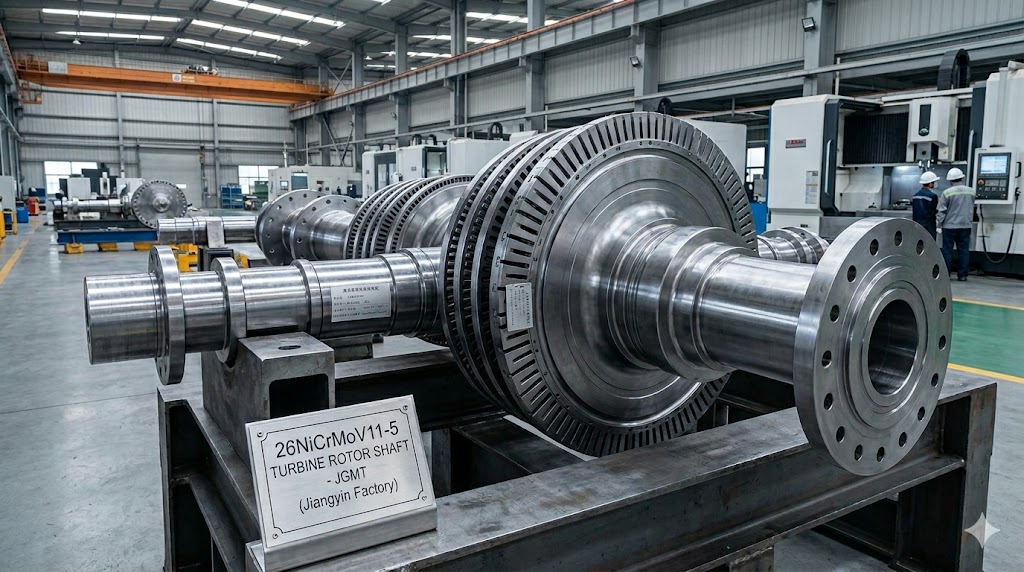
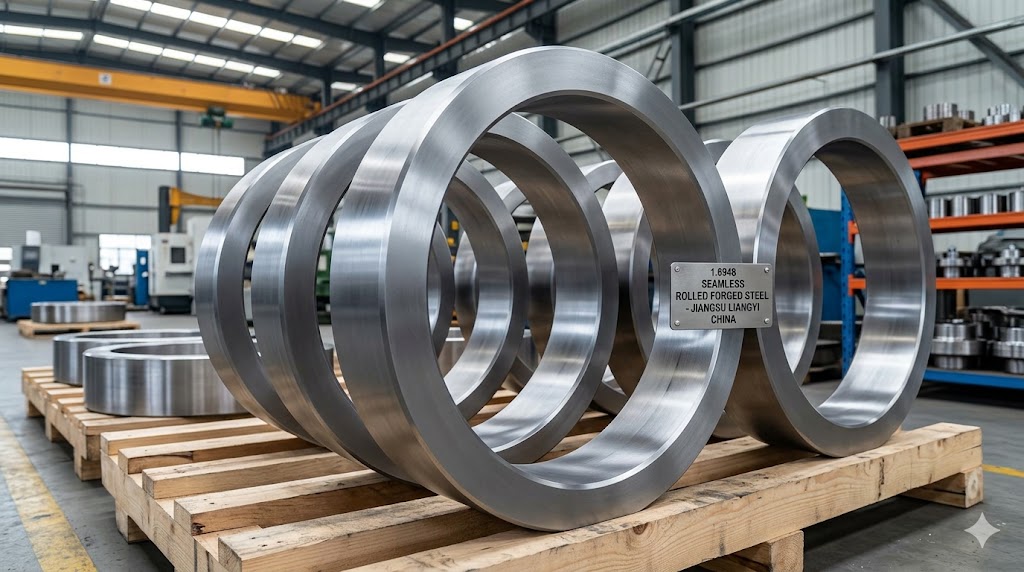
We have modern equipment in our factory, such as cutting-edge forging, machining and heat treatment equipment so that we can produce large-scale 26NiCrMoV11-5 (1.6948) forged parts with excellent precision, consistent quality and reliable performance:
- Maximum single-piece forging weight: Up to 30 tons per individual forging
- Maximum length capacity: Up to 15 meters for turbine rotor shafts
- Maximum diameter capacity: Up to 2 meters for shafts and 6 meters for seamless rolled rings
- Annual production capacity: 120,000 tons of premium forged steel products
- Facility size: 80,000 square meters of modern manufacturing space
- Fixed asset investment: Over 40 million USD in specialized equipment
Raw Material Production Process
We keep complete control over the entire production value chain from initial steel melting to final inspection and packaging, guaranteeing the highest quality standards for our 26NiCrMoV11-5 products. Our premium raw material is produced using state-of-the-art melting and refining processes:
- Basic Electric Arc Furnace (EAF) primary melting
- Ladle Furnace (LF) secondary refining
- Argon Oxygen Decarburization (AOD) for stainless grades
- Vacuum Oxygen Decarburization (VOD) for ultra-low carbon grades
- Vacuum Degassing (VD) for hydrogen removal
- Electroslag Remelting (ESR) - available upon client request for ultra-high purity critical applications
26NiCrMoV11-5 Heat Treatment Process — Full Engineering Detail
Heat treatment serves as the decisive process in defining the final mechanical properties of 26NiCrMoV11-5 forged parts. Unlike conventional low-alloy steels, this grade needs highly precise thermal cycling owing to its elevated nickel content. The alloy’s high nickel composition alters the martensite start (Ms) temperature, necessitating controlled cooling rates to prevent retained austenite formation and mitigate temper embrittlement risks. Outlined below is the complete heat treatment sequence implemented at Jiangsu Liangyi, refined through over 25 years of practical production expertise with this specialized steel grade.
Step 1 — Preliminary Soft Annealing (Optional, Pre-Machining)
For large-section forgings scheduled for rough machining before final heat treatment, a soft annealing process is performed to lower hardness and improve machinability. The treatment is carried out at 650–710°C with a soaking hold of 4 to 6 hours, followed by slow furnace cooling at a maximum rate of 20°C/h until the temperature drops below 300°C. This preliminary step is unnecessary for parts supplied in the quenched and tempered (Q+T) delivery condition.
Step 2 — Preliminary Normalizing (Grain Refinement)
Large-section forgings with a diameter over 500 mm or a weight exceeding 5 tons undergo a normalizing process prior to final quenching and tempering (Q+T). This step eliminates banded microstructures induced by forging, establishing a uniform, fine-grained austenitic base structure.Process parameters: heating temperature 870–920°C (typical at 890°C), with a minimum soaking time of 1 hour per 100 mm of important section thickness, followed by air cooling to ambient temperature.
Step 3 — Austenitizing / Hardening
This represents the most important stage of the process. The forging is heated to the austenitizing temperature to fully dissolve carbides and form a homogeneous austenite matrix. For 26NiCrMoV11-5, the optimal austenitizing range is 840–880°C, with 860°C adopted as our standard target temperature for turbine rotor shafts. Excessively high austenitizing temperatures will coarsen prior austenite grains and degrade impact toughness. This risk needs strict control, as the steel features a low maximum silicon content of 0.15%, which inherently restricts its resistance to high-temperature grain growth.
Holding time guideline: Minimum 1 hour per 25mm of effective cross-section thickness, with an absolute minimum of 3 hours for sections above 500mm. For a 1,000mm diameter rotor shaft this typically means 10–12 hours at temperature before quenching commences.
Step 4 — Quenching
Quenching medium is chosen based on section size to get adequate through-hardening while controlling the risk of quench cracking — a genuine concern for large Ni-Cr-Mo-V forgings:
- Sections ≤ 250mm diameter: Oil quenching (60–80°C bath temperature). Fastest cooling, maximum hardness gradient, suitable for smaller parts.
- Sections 250–600mm diameter: Accelerated oil quenching or water-polymer solution (5–8% polymer concentration). Balances hardening depth with thermal stress management.
- Sections > 600mm diameter (turbine rotors): Water-polymer spray quenching or controlled water immersion.The high Ni content (2.40–3.10%) of 26NiCrMoV11-5 makes it very hardenable, so it can be hardened all the way through even in sections that are 1,000mm or more thick.
Immediately after quenching, the forging surface temperature is monitored and the part must be transferred to the tempering furnace while still warm (above 80°C) to avoid cold cracking caused by high transformation stresses in the martensitic structure.
Step 5 — Double Tempering (Standard Practice for Turbine Rotors)
Single tempering is adopted as standard for general engineering parts. For turbine rotor shafts and other important-duty parts, however, Jiangsu Liangyi implements double tempering as a mandatory standard procedure. The first tempering cycle tempers as-quenched martensite and relieves high residual transformation stresses. The second cycle further tempers any fresh martensite generated during cooling after the first tempering step, yielding a fully stabilized, uniformly tempered martensite microstructure across the full cross‑section of the forging.
- First Tempering: 580–650°C, hold 2h per 25mm of effective section (minimum 6 hours for rotors), furnace cool to below 300°C
- Second Tempering: Same temperature as first tempering ±10°C, same holding time, air or furnace cool
Tempering temperature serves as the main parameter governing the final balance of strength and toughness. Elevated tempering temperatures (630–650°C) marginally lower tensile strength while delivering substantial improvements in Charpy impact properties and minimizing the risk of temper embrittlement. This control is especially vital for 26NiCrMoV11-5, as the material is prone to reversible temper embrittlement (RTE) when slowly cooled through the important temperature range of 375–575°C after tempering.
Step 6 — Post-Machining Stress Relieving
After rough machining, a stress‑relief annealing treatment at 550–600°C , held for 4–8 hours according to section thickness, is recommended to delete residual machining stresses prior to final precision machining. This effective measure prevents dimensional distortion during finishing operations and removes localized stress concentrations that may initiate fatigue cracking under service conditions. Crucially, the stress‑relief temperature must be maintained at least 30 °C below the final tempering temperature, so as to avoid unintended softening and degradation of the base material’s mechanical properties.
26NiCrMoV11-5 Heat Treatment Parameters — Quick Reference
| Stage | Temperature (°C) | Holding Time | Cooling Method | Purpose |
|---|
| Soft Annealing | 650–710 | 4–6 hours | Furnace cool ≤20°C/h | Improve machinability |
| Normalizing | 870–920 | 1h per 100mm section | Air cool | Grain refinement |
| Austenitizing | 840–880 (typ. 860) | 1h per 25mm, min 3h | Quench immediately | Homogenize austenite |
| Quenching | — | Until surface <80°C | Oil / polymer / water | Martensite formation |
| 1st Tempering | 580–650 | 2h per 25mm, min 6h | Furnace/air cool | Temper martensite |
| 2nd Tempering | 580–650 (±10°C) | Same as 1st | Furnace/air cool | Eliminate fresh martensite |
| Stress Relieving | 550–600 | 4–8 hours | Furnace cool to 300°C | Post-machining stability |