2.4975 (2.4662 / NiFeCr12Mo) Forging Parts | China Super Alloy Forging Manufacturer
Jiangsu Liangyi is a professional ISO 9001:2015 certified China manufacturer specialising in high-quality 2.4975 (also designated 2.4662, NiFeCr12Mo or UNS N09902) open die forging parts and seamless rolled rings. Established in 1997 and located in Jiangyin City, Jiangsu Province, China, we have over 25 years of experience producing custom NiFeCr12Mo super alloy components that meet the most demanding industrial requirements worldwide. Request a quote today!
2.4975 / NiFeCr12Mo — Key Facts at a Glance
Our 80,000 m² advanced manufacturing facility is equipped with state-of-the-art forging equipment including 2,000–6,300 ton hydraulic presses, 1–5 ton electro-hydraulic hammers, and 1–5 metre seamless rolling machines. With an annual production capacity of 120,000 tons, we can manufacture 2.4975 forged parts ranging from 30 kg to 30,000 kg, delivering complete solutions from steel melting and forging through heat treatment to precision machining.
2.4975 International Equivalents, Trade Names & Standards
The alloy designated 2.4975 (or 2.4662) is a precipitation-hardening nickel-iron-chromium-molybdenum super alloy recognised under multiple international systems. Understanding these equivalents is essential when sourcing material to a specification written under a different standard. The table below lists all common cross-references.
| System / Standard | Designation | Notes |
|---|---|---|
| DIN (Germany — primary) | 2.4975 | Primary EN/DIN material number |
| DIN (Germany — alternate) | 2.4662 | Alternative DIN designation; identical alloy |
| UNS (USA) | N09902 | Unified Numbering System |
| Trade Name | Alloy 902 | Generic trade name widely used |
| Trade Name (Carpenter) | Pyromet 860 | Carpenter Technology trade name |
| Trade Name (VDM Metals) | Nicrofer 4722 Mo | VDM Metals / ThyssenKrupp trade name |
| DIN Standard — Bar/Rod | DIN 17754 | Ni-alloy bars and rods |
| DIN Standard — Plate | DIN 17742 | Ni-alloy plates and sheets |
| DIN Standard — Tube | DIN 17744 | Ni-alloy seamless tubes |
| EN Standard — Fasteners | EN 10269 | Steels & Ni-alloys for fasteners at elevated temperature |
Trademark Notice: Pyromet® 860 is a registered trademark of Carpenter Technology Corporation. Nicrofer® 4722 Mo is a registered trademark of VDM Metals GmbH. Inconel® is a registered trademark of Special Metals Corporation. Waspaloy® is a registered trademark of Pratt & Whitney (RTX). These names are referenced solely for material cross-identification purposes. Jiangsu Liangyi Co., Limited has no affiliation with or endorsement from any of these trademark owners.
Available 2.4975 (NiFeCr12Mo) Forged Product Shapes & Dimensions
Our advanced manufacturing capabilities allow us to produce a comprehensive range of 2.4975 (2.4662) forging shapes according to international standards (ASTM, DIN, EN, JIS) and customer drawings:
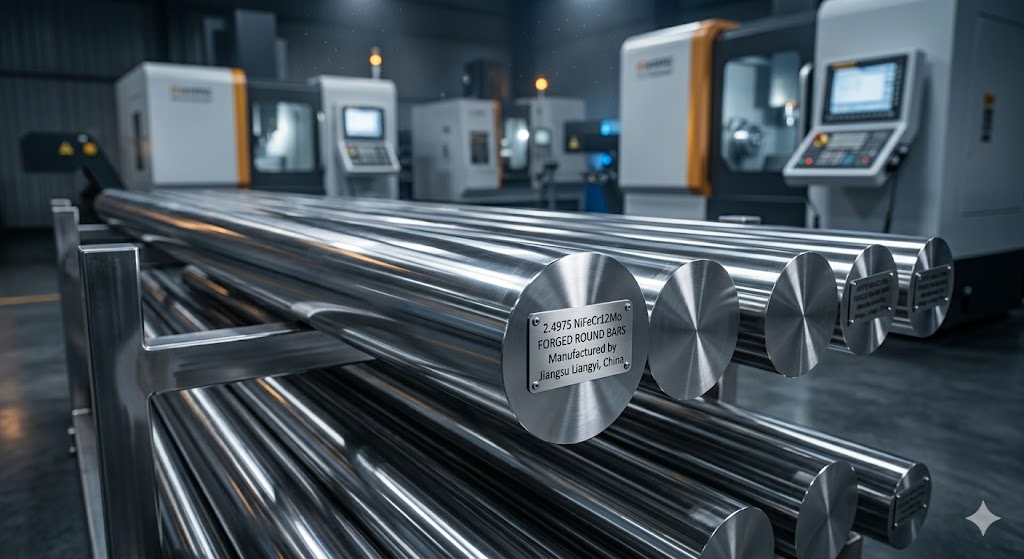
Forged Bars & Rods
- Round bars: up to 2 metres in diameter
- Square bars, flat bars and rectangular bars
- Step shafts, turbine shafts and valve spindles
- Available in lengths up to 15 metres
- Materials: alloy steel, carbon steel, nickel alloy, stainless steel
Seamless Rolled Rings
- Custom forged rings up to 6 metres in diameter
- Contoured rolled rings, gear rings and seal rings
- Single-piece weight up to 30 tonnes
- Ideal for turbine casings and pressure vessels
- EN 10204 3.1 MTC standard; 3.2 with TPI available on request
Hollow Forged Components
- Hubs, housing shells and casings
- Sleeves, bushes and bushing cases
- Hollow bars and heavy-wall cylinders up to 3,000 mm OD
- Pipes, tubes and piping shells for high-pressure applications
- Materials available: carbon steel, alloy steel, stainless steel, titanium
Flat & Block Products
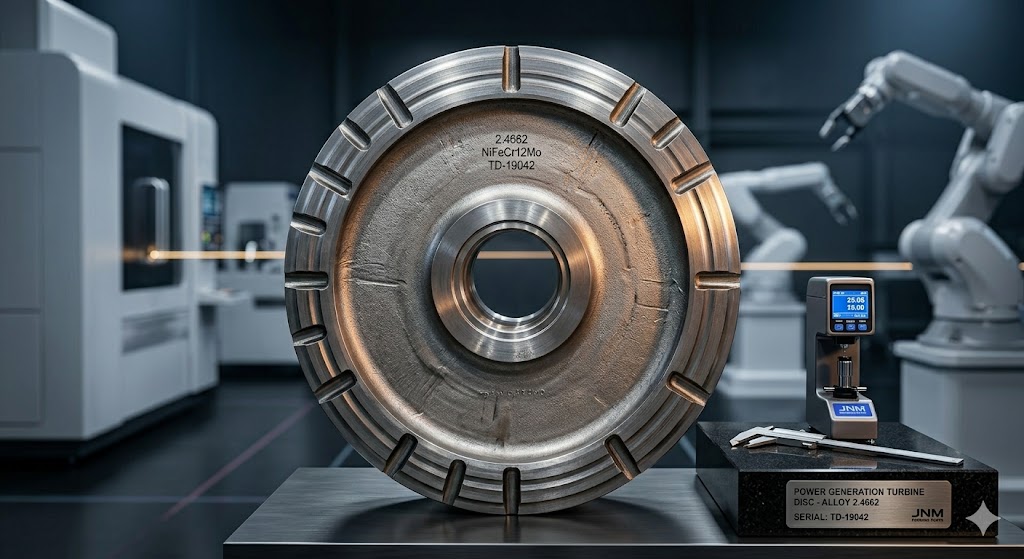
- Discs and turbine discs up to 3 metres in diameter
- Blocks, plates and flanged blanks
- Single-piece weight up to 20 tonnes
- Precision machined to customer specifications
- Heat treatment and NDT available upon request
Industrial Applications & Project References of 2.4662 (NiFeCr12Mo) Forgings
2.4975 (NiFeCr12Mo) is a high-performance nickel-iron-chromium super alloy widely used in critical applications where exceptional strength and creep resistance at elevated temperatures up to 600 °C are required. Our 2.4662 forged components have been successfully deployed in projects across more than 50 countries worldwide, including Asian thermal power plants in China, India and Southeast Asia.
Gas & Steam Turbine Industry Applications
Our 2.4975 turbine forgings are extensively used in both industrial and power-generation gas and steam turbine systems:
Power Generation Turbine Components
- Gas compressor and turbine blades (supplied to major power plants across Asia)
- Gas and steam turbine disks, impellers and blisks
- Power plant steam turbine control and reheat valve discs
- Gas turbine LPT 1st & 2nd stage turbine casings
- Turbine diaphragms and diaphragm nozzles
Turbine Fasteners & Structural Components
- Double-headed studs, fasteners and bolts for turbine assemblies
- Guide rings, seal rings, labyrinth rings and rotor end rings
- Packing seal diaphragms and casing rings
- Bearing housings and stator end caps
Valve Components for Turbine Systems
- 2.4975 valve spindles, stems and rods for MSV/GV/CV/CRV systems
- NiFeCr12Mo valve seats, valve cores and valve sleeves
- Valve spools and main steam valve covers/bonnets
- All components tested for high-pressure and high-temperature service
Nuclear Power Industry Applications
Jiangsu Liangyi supplies critical 2.4975 nuclear power forgings that meet the strictest safety and quality standards required for nuclear power plant applications:
- Flow limiters and Venturi forgings for steam generators
- Forged tubes for pressuriser surge lines
- Reactor nozzles and primary pump flywheels
- Divider plates for steam generators
- Latch housings, rod travel housings and funnel extensions
- End rings and rotor stack plate forgings
- Containment plates, rings and closure heads
- Waste flasks and mounting skirts
- RPV upper shells and HSG shells
- Shell strakes and transition cones
- Pressure components, lifting pin tools and trunnions
- Pressuriser upper heads and upper shells
- Steam drumheads and lifting pintles
Quality Assurance: All nuclear-grade 2.4975 forgings undergo rigorous testing including 100% ultrasonic testing (UT), magnetic particle testing (MT), and complete material traceability from melting to final delivery. We provide EN 10204 3.1 mill test certificates as standard with every shipment; EN 10204 3.2 with third-party witness inspection is available when the customer appoints an approved inspection body. Contact us for certification details.
Chemical Composition & Heat Treatment of 2.4975 (2.4662 / NiFeCr12Mo)
2.4975 (also known as 2.4662 / NiFeCr12Mo) is a precipitation-hardening nickel‑iron‑chromium superalloy with significant additions of molybdenum, titanium and aluminium.This composition gives the alloy excellent mechanical properties at elevated temperatures while maintaining good forgeability.Due to its high iron content, the alloy combines high strength with outstanding forging performance. At our Jiangyin manufacturing facility, we use advanced melting processes including vacuum induction melting (VIM), vacuum arc remelting (VAR) and electroslag remelting (ESR) to produce the highest-quality NiFeCr12Mo ingots. This makes sure all our forged products have superior cleanliness, consistent internal matrix and mechanical properties.
Chemical Composition of NiFeCr12Mo (2.4975)
| Element | Content Range (%) | Element | Content Range (%) |
|---|---|---|---|
| Carbon (C) | ≤ 0.10 | Molybdenum (Mo) | 5.00 – 7.00 |
| Silicon (Si) | ≤ 0.60 | Nickel (Ni) | 40.0 – 45.0 |
| Manganese (Mn) | ≤ 2.00 | Titanium (Ti) | 2.35 – 3.10 |
| Phosphorus (P) | ≤ 0.02 | Aluminium (Al) | ≤ 0.35 |
| Sulfur (S) | ≤ 0.01 | Cobalt (Co) | ≤ 1.00 |
| Chromium (Cr) | 11.0 – 14.0 | Iron (Fe) | Remainder (balance) |
Heat Treatment Process
All 2.4975 (NiFeCr12Mo) forged parts undergo a precise three-stage heat treatment process to achieve the required mechanical properties:
- Solution Treatment: 3 hours at 1090 °C (1994 °F) followed by rapid water quenching (WQ) — dissolves precipitates and creates a homogeneous microstructure.
- First Age-Hardening: 4 hours at 775 °C (1427 °F) followed by air cooling (AC) — forms initial strengthening precipitates.
- Second Age-Hardening: 24 hours at 705–720 °C (1301–1328 °F) followed by air cooling (AC) — further refines precipitates and maximises strength.
Mechanical Properties of 2.4975 (NiFeCr12Mo) — Room Temperature & Elevated Temperature
One of the defining characteristics of 2.4975 (NiFeCr12Mo) is its outstanding ability to maintain high strength at operating temperatures where conventional alloy steels would suffer severe softening.The data below represents the minimum guaranteed values for precipitation‑hardened forgings manufactured and tested at Jiangsu Liangyi’s Jiangyin facility, covering both room‑temperature and elevated‑temperature conditions.
Engineers specifying this alloy for turbine or nuclear applications should note that property retention — not just room-temperature strength — is the primary design criterion.
Room Temperature Mechanical Properties
| Property | Symbol | Minimum Value | Typical Value |
|---|---|---|---|
| Tensile Strength | Rm | 1180 MPa | 1210 – 1260 MPa |
| 0.2% Proof Strength | Rp0.2 | 835 MPa | 870 – 920 MPa |
| Elongation at Fracture | A | 15% | 18 – 22% |
| Reduction of Area | Z | — | 20 – 30% |
| Brinell Hardness | HB | — | 330 – 375 HB |
Elevated Temperature Mechanical Properties
The table below presents representative tensile data at elevated temperatures for fully precipitation-hardened 2.4975 bar forgings tested in the longitudinal direction. Values shown are typical reference ranges based on published alloy data and Jiangsu Liangyi production experience; they are not guaranteed minimum values unless explicitly stated in a signed material test certificate. Actual certified values are provided per EN 10204 3.1 MTC with each shipment. These values illustrate why this alloy is preferred over conventional Cr-Mo steels in applications above 400 °C — its age-hardened γ′ precipitates remain stable well into the 600 °C range, giving engineers reliable, predictable design margins without the dramatic fall-off seen in other alloy families.
| Test Temperature | Rm (MPa) — typical | Rp0.2 (MPa) — typical | Elongation A (%) | Strength Retention vs RT |
|---|---|---|---|---|
| Room Temp (20 °C) | 1210 – 1260 | 870 – 920 | 18 – 22 | 100% (baseline) |
| 300 °C (572 °F) | 1130 – 1190 | 820 – 870 | 17 – 21 | ~93 – 94% |
| 400 °C (752 °F) | 1060 – 1120 | 790 – 840 | 16 – 20 | ~87 – 89% |
| 500 °C (932 °F) | 990 – 1055 | 745 – 800 | 15 – 19 | ~81 – 84% |
| 550 °C (1022 °F) | 935 – 1000 | 710 – 760 | 14 – 18 | ~76 – 79% |
| 600 °C (1112 °F) | 870 – 940 | 680 – 730 | 13 – 17 | ~71 – 74% |
Design Note: The gradual, predictable strength reduction of 2.4975 across this temperature range — retaining approximately 71–74% of room-temperature tensile strength at 600 °C — is a direct result of the alloy's stable γ′ (Ni₃(Ti,Al)) precipitate structure. Competing alloys with higher nickel content such as Waspaloy achieve higher absolute strength at 600 °C but carry a significant cost premium and reduced forgeability. For applications in the 450–600 °C window, 2.4975 represents an engineering optimum between performance, forgeability and economy.
Creep & Stress-Rupture Behaviour
In long-duration service — the operating reality for steam turbine rotors, valve spindles and nuclear structural components — creep behaviour is as critical as short-term tensile strength. 2.4975 (NiFeCr12Mo) demonstrates a creep threshold governed by the coherency stress between the γ matrix and γ′ precipitates. At 600 °C, components designed to DIN 17754 creep allowables can sustain sustained stresses of approximately 400–450 MPa for 100,000-hour service life without exceeding 1% total creep strain — a design parameter routinely specified in European power plant procurement documents.
Physical Properties of 2.4975 (NiFeCr12Mo / UNS N09902)
Physical properties govern how 2.4975 forgings behave under thermal cycling, differential expansion constraints and dynamic loading in assembled turbine systems. The values below reflect the characteristic behaviour of the fully heat-treated condition and should be used as reference data during initial engineering design. Customer-specific test certificates reporting measured values for each forging batch are available on request from Jiangsu Liangyi.
2.4975 (NiFeCr12Mo) vs Other Super Alloys — Selection Guide
Procurement engineers and design teams frequently ask how 2.4975 stacks up against the other super alloys competing for the same turbine and nuclear power applications. Rather than reproduce generic marketing claims, the comparison below is built from Jiangsu Liangyi's first-hand experience forging all four alloys in large production volumes — giving us a practical perspective that extends beyond published data sheets.
The four alloys compared are the ones most commonly specified as alternatives in European, Indian and Southeast Asian power plant tenders:
| Selection Criterion | 2.4975 / NiFeCr12Mo (This Page) | Inconel 718 (UNS N07718) | A-286 (UNS S66286) | Waspaloy (UNS N07001) |
|---|---|---|---|---|
| Alloy Family | Ni-Fe-Cr-Mo | Ni-Cr-Fe-Mo-Nb | Fe-Ni-Cr (iron-base) | Ni-Cr-Co-Mo |
| Ni Content | 40 – 45% | 50 – 55% | 24 – 27% | 57 – 60% |
| Max Continuous Service Temp. | 600 °C | 650 °C | 590 °C | 760 °C |
| RT Tensile Strength (typical) | 1210 – 1260 MPa | 1280 – 1380 MPa | 930 – 1000 MPa | 1275 – 1380 MPa |
| Forgeability | ★★★★★ Excellent High Fe content aids hot working | ★★★★ Good Narrow forging window | ★★★★★ Excellent Iron-base; easy to forge | ★★★ Moderate Prone to hot cracking |
| Weldability | ★★★★ Good Preheat & post-weld age required | ★★★★ Good Strain-age cracking risk | ★★★★★ Excellent Most weldable in this group | ★★★ Moderate High cracking susceptibility |
| Raw Material Cost Index | ★ Low – Medium | ★★★ Medium – High | ★ Low – Medium | ★★★★★ Very High |
| Machinability | ★★★★ Good | ★★★ Moderate | ★★★★★ Excellent | ★★ Difficult |
| Primary Standard | DIN 17754 / EN 10269 | AMS 5663 / ASTM B637 | AMS 5737 / ASTM A638 | AMS 5704 / AMS 5706 |
| Typical Applications | Gas / steam turbines, nuclear structural, valve spindles | Aerospace turbines, cryogenic fasteners, oil & gas | Jet engines, land turbine fasteners, shaft couplings | Aerospace hot section, military gas turbines |
| Jiangsu Liangyi Availability | ✔ Standard stock programme | ✔ Available | ✔ Available | ✔ On enquiry |
Our Recommendation: For European power-plant and nuclear specifications operating in the 450–600 °C band, 2.4975 is the most cost-effective and forging-friendly choice. Inconel 718 earns its premium in applications above 620 °C or where size and weight constraints demand its higher room-temperature strength. A-286 is preferred for fastener-dominated assemblies. Waspaloy is reserved for the most extreme aerospace and military turbine environments where budget is secondary to performance.
Corrosion & Oxidation Resistance of 2.4975 (NiFeCr12Mo)
The corrosion and oxidation behaviour of 2.4975 (NiFeCr12Mo) is a direct consequence of its carefully balanced composition. Three elements drive the alloy's protective mechanisms, and understanding each one is essential for engineers assessing suitability for specific environments:
🛡️ Chromium (11–14%) — The First Line of Defence
The 11–14% chromium content in 2.4975 is sufficient to form a continuous, adherent Cr₂O₃ scale on the alloy surface when exposed to air or steam at temperatures up to 600 °C. This chromia scale acts as a diffusion barrier, dramatically slowing further oxidation. In clean steam environments — the primary medium in steam turbines — the oxidation rate of 2.4975 components is typically below 0.05 mm/year at 550 °C, a performance level that supports 100,000-hour design lifetimes without meaningful section loss.
🔵 Molybdenum (5–7%) — Corrosion Depth Control
The significant molybdenum addition in 2.4975 serves a dual purpose rarely discussed in data sheets. First, it contributes to solid-solution strengthening of the γ matrix at elevated temperature. Second — and critically for environments containing chloride ions or sulphur-containing combustion products — molybdenum stabilises the passive film against localised pitting attack. In geothermal steam environments and industrial gas turbines burning sulphur-bearing fuels, 2.4975 demonstrates measurably superior pitting resistance compared to lower-Mo chromium-nickel alloys used in the same temperature band.
⚠️ Limitations: Hot Corrosion Awareness
Like all chromia-forming alloys, 2.4975 is susceptible to Type II hot corrosion (sulphate-induced attack) when alkali metal sulphates deposit on the surface at temperatures between 650–750 °C. This is seldom encountered in the alloy's normal operating envelope (≤600 °C) but should be considered if components are momentarily exposed to excursion temperatures during start-up or shutdown. In gas turbines burning contaminated fuel, protective coatings or stricter fuel-sulphur limits are advisable. For steam turbine and nuclear applications — which represent the overwhelming majority of 2.4975 usage — hot corrosion is not a design-limiting concern.
Aqueous Corrosion Resistance (Room Temperature)
At ambient and near-ambient temperatures, 2.4975 forgings in the machined condition show excellent resistance to mild acids, alkaline solutions and dilute salt environments. Specific observations from long-term component service include:
- Fresh water and demineralised water: No measurable corrosion; suitable for water-cooled nuclear component applications
- Steam condensate: Excellent resistance even with trace CO₂ and oxygen contamination at pressures up to 200 bar
- Dilute HCl and H₂SO₄: Passive behaviour at concentrations below 5%; increased attack above 10%
- Alkali (NaOH up to 30%): Fully resistant at room temperature; some attack above 80 °C in concentrated solutions
- Seawater: Good general resistance; crevice corrosion risk in stagnant marine environments requires design attention
Weldability & Machinability of 2.4975 (NiFeCr12Mo)
Weldability
2.4975 (NiFeCr12Mo) is considered weldable by most standard fusion processes when proper procedure controls are followed. The alloy's relatively high iron content — significantly greater than in pure nickel-base super alloys — moderates the hot-cracking tendency that makes alloys like Waspaloy difficult to repair-weld in service. That said, it is a precipitation-hardening alloy, which introduces specific process discipline requirements that differ from welding ordinary austenitic stainless steel.
Jiangsu Liangyi routinely supplies 2.4975 forgings with customer-specified weld-preparation surfaces — either rough-machined for post-delivery welding or with weld-prep geometry finish-machined — so that the end-user's fabrication team can proceed directly to qualified welding procedures. Our technical team can advise on compatible consumable designations, preheat requirements and post-weld heat treatment (PWHT) parameters based on the specific joint geometry and service requirement.
Recommended Welding Process Parameters
🔧 Preferred Welding Processes
- GTAW / TIG: First choice for all critical joints — best arc control and lowest heat input per pass
- GMAW / MIG (short circuit): Suitable for structural welds; avoid spray transfer to limit heat input
- SMAW / MMA: Acceptable for repair welds using matching AWS ENiCrFe-series electrodes
- Electron beam welding: Suitable for narrow-gap joints in highly restrained assemblies
⚙️ Preheat & PWHT Requirements
- Preheat: 150–200 °C for sections > 25 mm; ambient for thin sections
- Interpass temperature: Maximum 200 °C; control is critical to avoid grain boundary liquation
- Post-weld solution treatment: Required for full property restoration — same three-stage cycle as the base material
- Stress relief only (no re-solution): 720 °C / 8 h / air cool; acceptable for minor repairs where full heat treatment is impractical
⚠️ Welding Precautions
- Avoid slow cooling through the 650–800 °C range (grain boundary sensitisation risk)
- Shielding gas: argon or argon-helium blend; avoid CO₂-rich mixtures
- Joint preparation: machine to bright metal; solvent degrease; no wire-brushing with carbon steel tools
- All welds in nuclear applications require WPS/PQR qualification to applicable code (ASME, RCC-M or PNAE)
Machinability
Compared to pure nickel-base super alloys such as Inconel 625 or Waspaloy, 2.4975 (NiFeCr12Mo) is significantly easier to machine — a direct benefit of its iron-bearing matrix and lower cobalt content. Engineers and CNC programmers transitioning from stainless steel should be aware that work-hardening rate is higher than 316L, but the cutting forces are substantially lower than those encountered with IN718 or Waspaloy.
Machinability Performance Ratings
Relative to free-cutting steel (AISI 1215 = 100%). Higher = easier to machine. These are approximate industry-reference values; actual machinability varies with exact heat treatment condition, cutting tool geometry and coolant strategy.
Recommended Machining Parameters (Starting Reference)
| Operation | Cutting Speed (m/min) | Feed Rate (mm/rev) | Depth of Cut (mm) | Tool Recommendation |
|---|---|---|---|---|
| Rough turning | 18 – 28 | 0.25 – 0.50 | 2.0 – 4.0 | Coated carbide (TiAlN); sharp geometry |
| Finish turning | 30 – 45 | 0.10 – 0.20 | 0.3 – 0.8 | Coated carbide or CBN for final pass |
| Milling (face) | 22 – 35 | 0.08 – 0.15 per tooth | 1.0 – 2.5 | TiAlN-coated end mill; positive rake |
| Drilling | 8 – 15 | 0.05 – 0.12 | Full diameter | Cobalt HSS or solid carbide; flood coolant |
| Grinding | 25 – 35 (wheel surface) | 0.01 – 0.02 infeed | 0.005 – 0.02 | White aluminium oxide wheel; abundant coolant |
Key machining tips from our production floor: Use fresh, sharp tooling from the first cut — dull tools accelerate work-hardening and can cause tool breakage in the hardened condition. Flood coolant is mandatory for all operations; dry or mist cooling is not acceptable for 2.4975. Climb milling rather than conventional milling reduces work-hardening depth. For critical-surface components (valve spindles, seal faces), a final grinding step is preferable to turning for Ra < 0.8 µm.
Lead Time, Minimum Order Quantity (MOQ) & Ordering Guide
One of the most common complaints from procurement teams that buy 2.4975 (NiFeCr12Mo) forgings from China is that delivery dates are unclear or not trustworthy. We use a build-to-order model at Jiangsu Liangyi, which means that lead times are set in the quote and backed by our delivery terms. They will not be extended after the order is placed.
Typical Lead Time & Capacity Reference
Minimum Order Quantities
We understand that many projects require trial quantities before committing to production volumes. Our MOQ policy for 2.4975 / NiFeCr12Mo forgings is structured to support both development procurement and large-scale industrial programmes:
| Product Type | MOQ (per order) | Notes |
|---|---|---|
| Forged round bars / flat bars | 500 kg per size | Multiple sizes can be combined to meet minimum heat charge weight |
| Seamless rolled rings | 1 piece | No minimum quantity — single large rings accepted |
| Turbine discs & custom blanks | 1 piece | Custom open-die forgings to drawing; single-piece orders welcome |
| Step shafts & valve bodies | 2 – 5 pieces | Depends on piece weight; minimum heat charge applies |
| Repeat orders (approved supplier) | No minimum | Once a drawing is approved in our system, any quantity is accepted |
What to Provide for an Accurate Quotation
To allow Jiangsu Liangyi to respond with a firm, fully-costed quotation rather than a broad budget estimate, please include the following in your enquiry:
- Material specification: DIN designation (2.4975 / 2.4662), UNS (N09902) or customer standard
- Forging drawing or rough dimensions (OD × ID × length for rings; OD × length for bars)
- Required weight or quantity
- Heat treatment condition: Solution-treated only, or fully precipitation-hardened
- Certification requirement: EN 10204 3.1 or 3.2; any project-specific quality plan
- Inspection requirements: UT class, MT class, third-party inspector name if applicable
- Required delivery port and Incoterms
Comprehensive Quality Control & Testing Procedures
At Jiangsu Liangyi, we implement strict quality control measures throughout the entire manufacturing process to ensure all 2.4662 (NiFeCr12Mo) forged parts meet or exceed international standards and customer specifications. Our advanced inspection equipment includes non-destructive testing, chemical composition testing, mechanical property testing and metallographical testing equipment.
Test Sample Removal Guidelines
- Longitudinal: For sections that can be inscribed in a circle with diameter < 100 mm
- Transverse: For sections that can be inscribed in a circle with diameter ≥ 100 mm
- Tangential: For forged rings or disks
Mandatory Testing Requirements
- Chemical analysis: 1 test per heat batch using advanced spectrometers
- HB hardness testing: 2 tests per bar (one on each end)
- Macrographic examination: 2 tests per bar (one on each end)
- Grain size analysis: both ends of 1 bar from each production lot
- Room temperature tensile strength: 1 test per lot
- High temperature tensile strength: 1 test per temperature and lot (on mixed un-notched and notched specimens)
- Non-destructive testing: 100% ultrasonic testing (UT) and magnetic particle testing (MT) as required
Certified ✓
3.1 / 3.2 MTC
Available on request
Standards
Reference available
Standards
Reference available
Frequently Asked Questions About 2.4975 (NiFeCr12Mo) Forgings
A: The materials 2.4975 and 2.4662 are basically the same, but they have different numbers. Both of these names refer to the nickel-iron-chromium super alloy NiFeCr12Mo. The main EN/DIN number is 2.4975, and 2.4662 is an alternative number used in some European standards. The chemical makeup and mechanical properties of both materials are the same.
A: The 2.4975 alloy is known by several international designations: DIN/EN material numbers 2.4975 and 2.4662, UNS number N09902, and trade names including Alloy 902 (generic), Pyromet 860 (Carpenter Technology) and Nicrofer 4722 Mo (VDM Metals). Applicable standards include DIN 17754, DIN 17742, DIN 17744 and EN 10269.
A: 2.4975 (NiFeCr12Mo) can work well at temperatures up to about 600 °C (1112 °F).It still keeps excellent yield strength and creep resistance within this temperature range, making it the best choice material for gas and steam turbine applications.For short-term exposures, it can withstand slightly higher temperatures.
A: 2.4975 / NiFeCr12Mo meets the requirements of DIN 17754 (nickel alloy bars), DIN 17742 (plates), DIN 17744 (seamless tubes) and EN 10269 (steels and nickel alloys for high-temperature fasteners).These standards specify the needed chemical composition and mechanical properties.
A: Yes, we specialize in custom open die forgings and can produce 2.4975 parts in any shape and size according to your drawings and technical specifications. Our engineering team will work closely with you to ensure all parts fully meet your requirements.Send us your drawings today for a detailed quotation. Send us your drawings today for a detailed quotation.
A: We provide a full EN 10204 3.1 material test certificate as standard with all shipments.EN 10204 3.2 certificates, which require countersignature by an accredited third-party inspection body, are available upon request, with the customer arranging their preferred TPI agency.Our quality management system is certified to ISO 9001:2015.We can also supply certificates of origin, material traceability documents, and any other project-specific documentation needed for your project.
A: NiFeCr12Mo (2.4975) has several main advantages, such as excellent creep resistance at temperatures up to 600 °C, high yield strength (≥835 MPa) and tensile strength (≥1180 MPa), good forgeability due to its significant iron content, and excellent stability during long-term service. so that it is the best choice material for gas turbine parts steam turbine parts and nuclear power applications where reliability and performance are important.
A: Common trade names and designations for 2.4975 / NiFeCr12Mo include Alloy 902, Pyromet 860 (Carpenter Technology), and Nicrofer 4722 Mo (VDM Metals / ThyssenKrupp).The corresponding UNS designation is N09902.All these designations refer to the same precipitation‑hardening nickel‑iron‑chromium‑molybdenum superalloy specified in DIN 17754 and EN 10269.
A: For turbine disc applications up to 600 °C, both 2.4975 and Inconel 718 are suitable options, but with distinct trade-offs.Inconel 718 provides a slightly higher maximum service temperature (up to 650 °C) and marginally greater room-temperature tensile strength.However, 2.4975 features significantly better forgeability — essential for large-diameter discs — lower raw material costs due to its lower nickel content, and a wider forging temperature range.For European power plant turbines operating between 500–600 °C, 2.4975 is the more economical yet equally reliable choice.Above 620 °C, Inconel 718 becomes the preferred material.
A: For standard forged bars and seamless rolled rings in 2.4975 (NiFeCr12Mo), the typical lead time from order confirmation to shipment is 8–12 weeks.Intricate custom shapes, large single-piece forgings over 5 tonnes, or orders needing third-party witness inspection generally take 12–20 weeks.Quotations are provided within 24 hours of receiving complete drawings and specifications.Lead times are contractually confirmed at the quotation stage and will not be revised after order placement.
A: Yes, 2.4975 (NiFeCr12Mo) is weldable using GTAW (TIG), GMAW (MIG) and SMAW processes.Thanks to its higher iron content, it is significantly easier to weld than alloys such as Waspaloy, with lower susceptibility to hot cracking. To restore full mechanical properties after welding, a complete three-stage post-weld heat treatment is needed: solution treatment at 1090 °C followed by double age-hardening.For minor repairs where full solution treatment is not practical, stress-relief annealing at 720 °C for 8 hours with air cooling can achieve partial property recovery.A preheat of 150–200 °C is recommended for sections thicker than 25 mm.
Request a Custom Quote for 2.4975 (2.4662 / NiFeCr12Mo) Forged Parts
Jiangsu Liangyi is your trusted China manufacturer and supplier for high-quality 2.4975 (NiFeCr12Mo) open die forgings and seamless rolled rings. With over 25 years of experience and advanced manufacturing facilities in Jiangyin, Jiangsu Province, China, we deliver reliable, cost-effective solutions for your most important industrial applications.
We welcome you to send your custom drawings, material specifications, quantity requirements and delivery deadlines for a detailed, competitive quotation. Our experienced sales and engineering team will respond to your inquiry within 24 hours. Whether you need 2.4975 turbine blades, 2.4662 turbine discs, or custom NiFeCr12Mo valve parts, we have the expertise and capabilities to meet your needs.
📧 Inquiry Email: sales@jnmtforgedparts.com
📞 Phone / WhatsApp: +86-13585067993
🌐 Website: https://www.jnmtforgedparts.com
📍 Address: Chengchang Industry Park, Jiangyin City, Jiangsu Province, China