Jiangsu Liangyi is an ISO 9001:2015 certified manufacturer of 2.4951 (2.4630, NiCr20Ti) open die forgings and seamless rolled rings, located in Jiangyin, Jiangsu Province, China. With over 25 years of focused experience in nickel alloy forging, we produce custom components from 30 kg to 30,000 kg for gas turbine, nuclear power, industrial furnace and petrochemical applications worldwide. This page provides a complete technical reference for 2.4951 — covering alloy metallurgy, full property data across the temperature range, heat treatment, welding, machining, international standards equivalents and a practical selection guide.
📋 2.4951 / 2.4630 / NiCr20Ti — Key Facts at a Glance
📑 Contents of This Page
- 2.4951 vs 2.4630: Designation Explained
- Chemical Composition
- Room-Temperature Mechanical Properties
- High-Temperature Mechanical Properties
- Physical & Thermal Properties
- Heat Treatment Guide
- Welding Guide
- Machining Guide
- International Standards Cross-Reference
- Alloy Comparison vs Inconel 600, 310S & Alloy 800
- How to Choose: 2.4951 vs Alternatives
- Industrial Applications
- Available Shapes & Sizes
- Manufacturing Process
- Quality Control & Testing
- Global Project References
- Why Choose Jiangsu Liangyi
- FAQs
1. 2.4951 vs 2.4630: Understanding the Alloy Designations
Procurement engineers frequently ask whether they can substitute 2.4951 for 2.4630 — or vice versa — on a material certificate. The straightforward answer is yes, because both numbers describe the same alloy.
The NiCr20Ti alloy was developed in the mid-20th century as the demand for reliable high-temperature materials in turbine engineering grew rapidly. European metallurgical standards bodies catalogued this composition under two different reference codes during successive revision cycles, which is why both 2.4951 and 2.4630 appear in EN 10095:1999. Neither designation signals a tighter or looser tolerance band — the element ranges, heat treatment conditions and acceptance criteria listed in the standard are identical for both. Modern purchase orders, MTC headers and material traceability documents may carry either or both numbers interchangeably, and this practice is widely recognised across the industry — engineering standards bodies, inspection agencies and project approval authorities routinely accept both designations on material documentation.
| Attribute | 2.4951 | 2.4630 |
|---|---|---|
| Common Name | NiCr20Ti | NiCr20Ti |
| Governing Standard | EN 10095:1999 | EN 10095:1999 |
| Chemical Composition | Identical | |
| Mechanical Properties | Identical | |
| Interchangeable? | Yes | Yes |
| Usage Trend | More common in current specs | Common in legacy / older projects |
| UNS Equivalent | N06075 | |
2. Chemical Composition (EN 10095:1999)
The defining character of 2.4951 is its deliberate balance between nickel, chromium and titanium. Nickel forms the austenitic matrix that gives the alloy its toughness and ductility across the full temperature range. Chromium, at 18–21%, ensures the formation of a dense, self-healing Cr₂O₃ surface film at high temperatures that is the primary barrier against oxidation and hot corrosion. Titanium at 0.2–0.6% stabilises carbon as TiC, preventing the precipitation of chromium carbides at grain boundaries — a mechanism that could otherwise deplete the Cr content in the HAZ during welding and lead to sensitisation-related corrosion. Carbon is intentionally kept in the range 0.080–0.15 wt% to contribute solid-solution strengthening without creating excessive carbide phases.
| Element | Min (wt%) | Max (wt%) | Role in Alloy |
|---|---|---|---|
| Nickel (Ni) | 65.4 | 81.7 | Austenitic matrix, toughness, corrosion base |
| Chromium (Cr) | 18.0 | 21.0 | Cr₂O₃ oxide scale, oxidation & hot corrosion resistance |
| Iron (Fe) | — | 5.0 | Cost control; balance element |
| Cobalt (Co) | — | 5.0 | Solid-solution strengthener |
| Titanium (Ti) | 0.2 | 0.6 | Carbon stabilisation; prevents sensitisation |
| Carbon (C) | 0.080 | 0.15 | Solid-solution strengthening |
| Manganese (Mn) | — | 1.0 | Deoxidiser; minor solid-solution effect |
| Silicon (Si) | — | 1.0 | Deoxidiser; minor oxidation resistance contribution |
| Copper (Cu) | — | 0.5 | Controlled impurity |
| Aluminum (Al) | — | 0.3 | Deoxidiser in melting |
| Phosphorus (P) | — | 0.020 | Controlled impurity (hot-shortness risk) |
| Sulfur (S) | — | 0.015 | Controlled impurity (hot-shortness risk) |
3. Room-Temperature Mechanical Properties (+AT Condition)
The values below are the minimum acceptable standards set by EN 10095:1999 for parts supplied in the +AT (solution-annealed) condition. In actual production, the forgings we make at our Jiangyin factory regularly perform better than these minimum levels, thanks to our strict forming control and precise heat treatment process.
| Property | Symbol | EN 10095 Minimum | Typical Achieved (Jiangsu Liangyi) |
|---|---|---|---|
| Tensile Strength | Rm | 650–850 MPa | 680–820 MPa |
| 0.2% Proof Strength | Rp0.2 | ≥ 240 MPa | 260–320 MPa |
| Elongation at Fracture | A | ≥ 30% | 35–45% |
| Reduction of Area | Z | — | ≥ 55% |
| Brinell Hardness | HB | ≤ 230 | 160–200 |
| Charpy Impact (20°C) | KV | — | ≥ 100 J |
4. High-Temperature Mechanical Properties
Understanding how 2.4951 behaves at operating temperature is critical for turbine and furnace design. The alloy maintains substantially more strength than austenitic stainless steels at elevated temperatures, which is the primary reason it was selected for turbine guide rings, valve seats and furnace fixtures across a wide temperature range. The data below represents typical measured values from solution-annealed bar material; actual values may vary with product form, thickness and heat-to-heat variation.
| Test Temp. (°C) | Rm (MPa) | Rp0.2 (MPa) | A (%) |
|---|---|---|---|
| 20 (RT) | 680–820 | 260–320 | 35–45 |
| 200 | 640–780 | 200–260 | 36–44 |
| 400 | 590–680 | 185–240 | 35–42 |
| 600 | 490–580 | 170–220 | 33–40 |
| 700 | 400–480 | 160–200 | 32–38 |
| 800 | 300–380 | 145–185 | 30–38 |
| 900 | 190–260 | 130–170 | 28–36 |
| 1000 | 110–160 | 100–140 | 25–35 |
Creep & Stress-Rupture Behaviour
For long-term loading at high temperatures, creep resistance is the governing design parameter rather than short-term tensile strength. 2.4951 is not a precipitation-hardened alloy, so its creep resistance depends entirely on the solid-solution strengthening contributed by nickel, chromium and carbon in the austenitic matrix. The indicative stress-rupture life data below reflects typical results from 25 mm bar specimens in the +AT condition. Engineers designing for continuous loading above 700°C should consult material-specific creep data sheets and apply appropriate safety factors.
| Temperature (°C) | Stress for 100 h Rupture (MPa) | Stress for 1,000 h Rupture (MPa) |
|---|---|---|
| 700 | ~260 | ~190 |
| 800 | ~140 | ~95 |
| 900 | ~65 | ~42 |
| 1000 | ~28 | ~18 |
5. Physical & Thermal Properties
The thermal and physical properties of 2.4951 directly affect part design for thermal cycling uses, heat exchanger sizing, and furnace fixture dimensions. It has a nickel-rich matrix, so it has a higher density and lower thermal expansion than stainless steels, which is helpful in turbine parts where differences in expansion must be strictly controlled.
| Property | Value | Temperature / Condition |
|---|---|---|
| Density | 8.36 g/cm³ | 20°C |
| Elastic Modulus (E) | 220 GPa | 20°C |
| Elastic Modulus (E) | 180 GPa | 800°C |
| Poisson's Ratio (ν) | 0.31 | 20°C |
| Shear Modulus (G) | 84 GPa | 20°C |
| Mean Thermal Expansion Coeff. (α) | 13.0 × 10⁻⁶ /K | 20–100°C |
| Mean Thermal Expansion Coeff. (α) | 14.2 × 10⁻⁶ /K | 20–500°C |
| Mean Thermal Expansion Coeff. (α) | 15.3 × 10⁻⁶ /K | 20–900°C |
| Thermal Conductivity (λ) | 11.5 W/(m·K) | 20°C |
| Thermal Conductivity (λ) | 20.1 W/(m·K) | 600°C |
| Specific Heat Capacity (cp) | 450 J/(kg·K) | 20°C |
| Specific Heat Capacity (cp) | 530 J/(kg·K) | 600°C |
| Electrical Resistivity (ρ) | 1.11 μΩ·m | 20°C |
| Melting Range | 1350–1390°C | — |
| Magnetic Properties | Non-magnetic (austenitic) | All temperatures |
Practical Implication of Low Thermal Conductivity: At 11.5 W/(m·K), 2.4951 conducts heat less effectively than carbon steel (~50 W/(m·K)) or even austenitic 304 stainless (~16 W/(m·K)). During forging, this means heat loss from the surface outpaces conduction from the core, so large sections require longer soak times before press work to ensure uniform temperature — a factor our Jiangyin engineers account for in every heat treatment and forging schedule.
6. Heat Treatment Guide for 2.4951 (NiCr20Ti) Forgings
Heat treatment of 2.4951 differs meaningfully from carbon steel practice and requires precise temperature and time control to achieve the correct microstructure. Unlike tool steels or precipitation-hardened superalloys, there is only one productive heat treatment route for this alloy in standard forging service: solution annealing.
6.1 Solution Annealing (+AT)
Solution annealing dissolves chromium carbides and titanium carbides that precipitate during forging and slow cooling, restores a homogeneous solid-solution microstructure, relieves residual stresses from forging, and re-establishes maximum oxidation resistance and ductility. It is the delivery condition required by EN 10095:1999 for forged products.
Solution Annealing Parameters for 2.4951 Forgings
6.2 Why Rapid Cooling Is Essential
The sensitisation temperature window for NiCr20Ti sits between approximately 600°C and 900°C. Slow cooling through this range allows titanium carbides to partially dissolve and reform as chromium carbides at grain boundaries. This depletes the chromium content in the grain-boundary region and reduces intergranular corrosion resistance — the very mechanism that titanium additions are designed to prevent. Our Jiangyin facility uses water quenching systems calibrated to achieve >10°C/s cooling rates through the critical window for all sections above 25 mm, ensuring the anneal-state microstructure is locked in and documented in every MTC.
6.3 Stress Relief (In-Service Components)
Where full re-annealing of an assembled component is impractical, a limited stress relief at 850–950°C for 2–4 hours followed by air cooling can reduce residual stresses by 40–60% without significant microstructural degradation. This is sometimes applied to welded fabrications before final machining. Note: temperatures above 950°C will begin to dissolve strengthening carbides and should not be used unless followed by a full solution anneal.
7. Welding Guide for 2.4951 / NiCr20Ti
2.4951 is considered one of the more weldable nickel alloys — its austenitic microstructure, absence of gamma-prime or delta-phase hardening precipitates, and titanium stabilisation of carbon make it tolerant of arc welding processes that would cause cracking or sensitisation in unstabilised alloys. The precautions below are drawn from Jiangsu Liangyi's in-house welding qualification records for this alloy family.
7.1 Preferred Welding Processes
TIG (GTAW) — First Choice for Critical Joints
MIG (GMAW) — Production Welding of Thick Sections
SMAW (Coated Electrode) — Field Repairs
7.2 Post-Weld Heat Treatment (PWHT)
For non-critical structural welds in benign environments, PWHT is not mandatory. However, for components operating in corrosive service (e.g. wet SO₂, chloride-containing atmospheres, nuclear primary circuit) or where stress corrosion cracking risk exists, a full post-weld solution anneal at 1050–1100°C followed by rapid cooling is strongly recommended. This re-dissolves any carbides precipitated in the HAZ and homogenises the weld microstructure. For large fabrications where furnace treatment is not practical, a partial localised PWHT at 850–950°C for 2 hours can reduce weld residual stresses, though full corrosion resistance is only restored by solution annealing.
Key Welding Principle for NiCr20Ti: Keep heat input low and interpass temperatures below 150°C. High cumulative heat exposure in the 600–900°C range during multi-pass welding is the primary source of HAZ sensitisation. Use stringer beads, not weave passes, and allow adequate inter-pass cooling. Jiangsu Liangyi's welding engineers are available to review weld procedure specifications (WPS) for customers who require support.
8. Machining Guide for 2.4951 / NiCr20Ti
NiCr20Ti belongs to the category of difficult-to-machine nickel alloys. Its machinability challenges arise from three interrelated phenomena: rapid work hardening during cutting, low thermal conductivity that concentrates heat at the tool tip, and a tendency to adhesively bond to cutting tool surfaces (built-up edge formation). Understanding these mechanisms is the starting point for a productive machining strategy.
8.1 Turning Parameters
Rough Turning
Finish Turning
8.2 Drilling Parameters
Drilling
8.3 Critical Machining Rules
- Never allow dwell: Pausing the tool in the cut causes work hardening of the surface beneath it, making the next pass harder and accelerating tool wear. Always maintain a continuous feed rate through the cut.
- Engage below the work-hardened layer: Start each new pass at a depth that cuts into un-hardened material below the surface left by the previous pass. A minimum depth of 0.5 mm in finish turning is typically sufficient.
- Rigid setup is non-negotiable: Vibration causes chatter, which causes interrupted cutting, which causes work hardening. Maximise clamping force, minimise overhang and use steady rests for long shafts above 400 mm in length.
- Flood coolant at all times: The low thermal conductivity of NiCr20Ti means cutting heat cannot dissipate through the workpiece — all of it concentrates at the cutting edge. Interrupting coolant supply, even briefly, accelerates tool wear dramatically and can cause thermal cracking.
- Change worn tools promptly: A worn edge needs higher cutting forces, which deforms the surface ahead of the cut and increases work hardening. Tool wear should be monitored and tools replaced at or before the wear limit rather than run to failure.
9. International Standards Cross-Reference
Engineers and procurement teams working with different national standards often need to find the right equivalent names when ordering NiCr20Ti forgings. The table below shows the closest equivalents in major standard systems. Please note that these equivalents are approximate: even though the alloys have similar chemical makeup and performance ranges, each standard may set slightly different composition limits, testing requirements or acceptance rules. Always confirm the exact standard you need with your project quality plan before placing an order.
| Standards System | Designation / Grade | Standard / Specification | Notes |
|---|---|---|---|
| European (EN) | 2.4951 / 2.4630 / NiCr20Ti | EN 10095:1999 | Primary reference for forged products |
| US (UNS) | N06075 | ASTM B564 / AMS 5665 | Very close; verify Ti range |
| German (DIN) | NiCr20Ti (W.Nr. 2.4951) | DIN 17742 / DIN 17751 | Legacy designation; superseded by EN |
| British (BS) | NA 14 | BS 3072–3076 | Nickel alloy bar & billet |
| Japanese (JIS) | NCF 600 (approx.) | JIS G 4901 | Not exact; verify Ti and C limits |
| Russian (GOST) | ХН78Т (KhN78T) | GOST 5632 | Very close equivalent |
| French (AFNOR) | NiCr20Ti | NF A49-770 | Legacy; now harmonised to EN |
| ISO | NW 6075 | ISO 9723 / ISO 9724 | Bar and plate forms |
10. Alloy Comparison: NiCr20Ti vs Inconel® 600, 310S & Alloy 800
No single alloy is optimal for every high-temperature application. The comparison below is designed to help engineers select the right material based on operating conditions, budget and fabrication constraints — not to simply promote 2.4951. In some scenarios, a competing alloy will genuinely be the better choice, and our team will tell you so.
| Property / Factor | NiCr20Ti (2.4951) | Inconel® 600 (2.4816) | 310S Stainless | Alloy 800 (1.4876) |
|---|---|---|---|---|
| Ni Content | ≥72% | ≥72% | 19–22% | 30–35% |
| Cr Content | 18–21% | 14–17% | 24–26% | 19–23% |
| Key Alloying Element | Ti (stabiliser) | None (pure solid-solution) | High Cr + Ni | Ti + Al (γ' precursors) |
| Max Continuous Temp. (Oxidizing) | 1100°C | 1175°C | 1050°C | 1100°C |
| RT Tensile Strength | 650–850 MPa | 550–750 MPa | 600–850 MPa | 450–650 MPa |
| Oxidation Resistance | Excellent | Excellent | Good | Good |
| Creep Resistance (>900°C) | Moderate | Good | Limited | Moderate |
| Sulfidation Resistance | Moderate | Good | Low–Moderate | Moderate |
| Weldability | Excellent | Good | Good | Excellent |
| Machinability (relative) | Moderate (work-hardens) | Moderate | Better than Ni alloys | Moderate |
| Relative Alloy Cost | Medium | High | Low–Medium | Medium–High |
| Best For | Turbines, nuclear, general furnaces | Aerospace, chemical, high-temp creep | Furnace parts, budget applications | Petrochemical, carburising atmospheres |
11. How to Choose: Should You Use 2.4951 or an Alternative?
Use this decision guide to quickly map your requirements to the correct alloy. If your situation matches the conditions described, 2.4951 is likely the right choice. Where it is not, we will tell you and we can still supply the appropriate alternative.
🔍 2.4951 (NiCr20Ti) Selection Guide
Scenario A: Gas / Steam Turbine Components
✓ Use 2.4951Guide rings, seal rings, valve seats, diaphragm nozzles operating at 700–1000°C in oxidizing combustion gas — this is the core use case for 2.4951. It offers the right balance of high-temperature strength, oxidation resistance and forgeability at competitive cost.
Scenario B: Industrial Furnace Fixtures ≤ 1100°C
✓ Use 2.4951For radiant tubes, muffles, conveyor fixtures and heat treatment baskets in air atmospheres up to 1100°C, 2.4951 is cost-effective and proven. Above 1100°C or where thermal cycling is severe, consider higher-nickel alloys.
Scenario C: Nuclear Power Internal Components
✓ Use 2.4951NiCr20Ti has an established track record in nuclear-related applications including steam generator components, pressuriser parts and reactor nozzles, owing to its low cobalt content and stable austenitic microstructure. Note: nuclear projects require customer-specified quality programs and documentation — please contact us to discuss your project requirements before ordering.
Scenario D: Sustained Creep Loading Above 1000°C
→ Consider Inconel 600If your component must resist deformation under sustained mechanical load above 1000°C for thousands of hours (e.g. turbine blade under centrifugal stress), Inconel 600 or precipitation-hardened superalloys offer better long-term creep resistance. The higher cost is justified in this specific scenario.
Scenario E: Sulphidizing / Mixed Oxidising-Reducing Atmosphere
→ Consider Alloy 800 or Inconel 600In atmospheres containing H₂S, SO₂ or alternating oxidising/reducing conditions (e.g. some petrochemical fired heaters), 2.4951's sulfidation resistance is only moderate. Alloy 800 (1.4876) or Inconel 601 may be more appropriate depending on the exact gas composition and temperature.
Scenario F: Budget-Constrained Furnace Parts ≤ 900°C
→ Consider 310S FirstFor non-critical furnace furniture at temperatures comfortably below 950°C in clean oxidising atmospheres, AISI 310S stainless steel is cheaper and adequately capable. Use 2.4951 where temperatures exceed 950°C, thermal cycling is severe, or component life requirements justify the premium.
12. Industrial Applications of 2.4951 (2.4630, NiCr20Ti) Forged Parts
Our 2.4951 forged components operate in some of the most demanding environments in global industry — from 1000°C turbine casings in combined-cycle power plants to the pressurised primary circuits of nuclear reactors. The applications below represent actual product categories we have supplied from our Jiangyin facility.
Gas & Steam Turbine Applications
- 2.4951 Forged Gas Compressor Turbine Blades
- 2.4630 Forged Gas & Steam Turbine Disks, Impellers & Blisks
- 2.4951 Forged Turbine Studs, Fasteners & Bolts
- NiCr20Ti Forged Guide Rings, Seal Rings & Labyrinth Rings
- NiCr20Ti Forged Turbine Diaphragms & Diaphragm Nozzles
- 2.4630 Forged LPT 1st & 2nd Stage Turbine Casings
- 2.4951 Forged Steam Turbine Control & Reheat Valve Discs
- 2.4951 Forged Turbine Valve Spindles, Stems & Rods
- 2.4951 Forged MSV/GV/CV/CRV Valve Seats, Cores & Sleeves
- 2.4951 Forged Main Steam Valve Covers, Bonnets & Sleeves
Nuclear Power Applications
- Flow Limiter Venturi Forgings for Steam Generators
- Forged Tubes for Pressurizer Surge Lines
- Reactor Nozzles & Primary Pump Fly Wheels
- Divider Plates for Steam Generators
- Latch Housings, Rod Travel Housings & Funnel Extensions
- End Ring & Rotor Stack Plate Forgings
- Bearing Housings, Stator End Caps & Closure Ring Forgings
- Containment Plates, Rings & Closure Heads
- Waste Flasks & Mounting Skirts
- RPV Upper Shell, HSG Shell, Shell Strakes & Transition Cones
- Pressuriser Upper Head & Upper Shell
- Steam Drumhead & Lifting Pintles
Industrial Thermal Processing
- Furnace Components & Heat-Treatment Equipment
- Industrial Thermal Processing Fixtures
- High-Temperature Conveyor Systems
- Heat Exchanger Components
- Combustion Chamber Parts & Radiant Tubes
- Muffles, Retorts and Vacuum Furnace Internals
13. Available Shapes & Sizes
Our Jiangyin facility can produce 2.4951 forgings in the following standard shapes. All dimensions are achievable with our in-house equipment — no sub-contracting, no hidden lead time delays.
Forged Bars & Rods
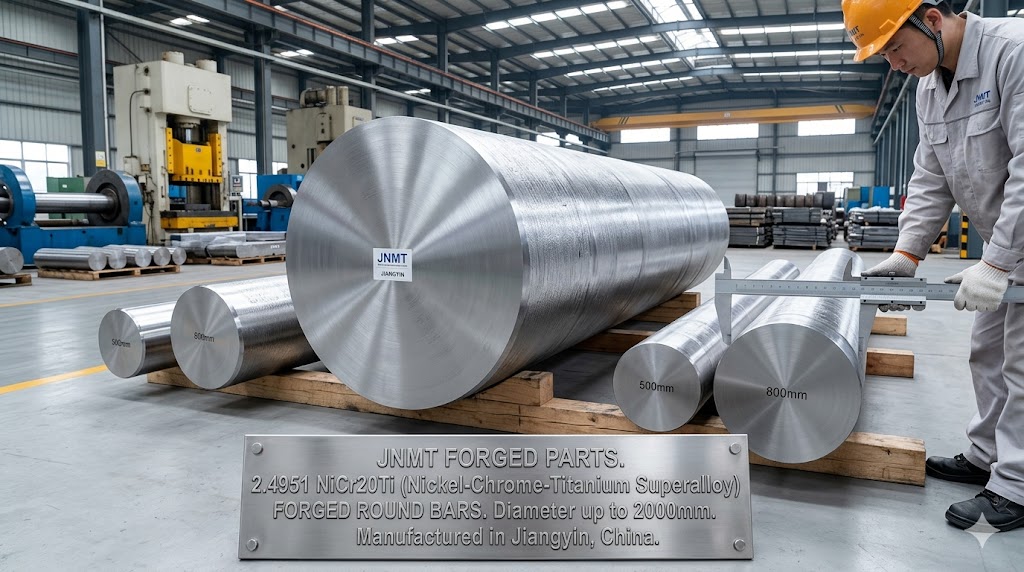
- Round Bars: up to 2,000 mm diameter
- Square Bars, Flat Bars & Rectangular Bars
- Stepped Shafts: up to 15 metres length
Seamless Rolled Rings
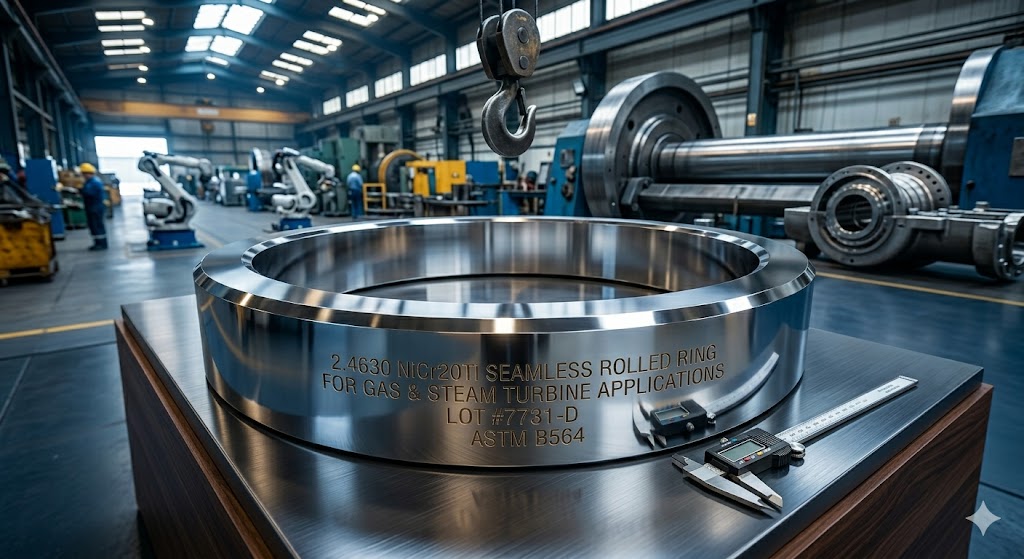
- Seamless Rolled Rings: up to 6,000 mm OD
- Contoured Rings (T-section, L-section and custom profiles)
- Rings with weights up to 30 tonnes
Hollow Forgings & Cylinders
- Hollow Bars: up to 3,000 mm OD
- Thick-Wall Pipes, Tubes & Tubings
- Casings, Case Barrels, Hubs & Housings
- Sleeves, Bushings & Bushing Cases
Discs, Plates & Blocks
- Forged Discs & Disks: up to 3,000 mm diameter
- Forged Blocks & Plates
- Flanged Blanks & Valve Components
Related Products & Pages
14. Manufacturing Process at Jiangsu Liangyi
All 2.4951 forgings are produced entirely in-house at our Jiangyin facility — from alloy melting through final inspection. This closed manufacturing chain is not just a selling point; it is the structural reason we can guarantee consistent quality and traceability for every kilogram of material we ship.
- Raw Material Inspection
Incoming NiCr20Ti ingots are quarantined and sampled for full chemical analysis by optical emission spectrometry (OES) before any production begins. Ingots that fall outside EN 10095:1999 limits are rejected and returned.
- Melting & Refining (EAF + LF + VOD)
Our 30t electric arc furnace (EAF) melts the charge; ladle refining furnace (LF) fine-tunes chemistry and removes inclusions; vacuum oxygen decarburization (VOD) achieves the required carbon control and removes dissolved gases. This three-step route is essential for producing ingots with the low sulphur and phosphorus content needed for crack-free forging.
- Ingot Preheating
Ingots are heated in programmable gas furnaces using calculated heat-up rates to avoid thermal shock and ensure temperature uniformity through the full cross-section before forging begins.
- Open Die Forging (2000T–6300T Presses)
Multiple forging passes with controlled reduction ratios break down the cast ingot structure, refine grain size and close porosity throughout the cross-section. Press forging produces more consistent deformation and lower residual stress than hammer forging for large cross-sections.
- Seamless Ring Rolling
Ring blanks pierced and preformed on the press are transferred hot to our 5-metre ring rolling mill. Simultaneous radial and axial rolling produces seamless rings with a fully wrought, circumferentially oriented grain structure — superior to cut or welded rings for turbine and pressure-vessel applications.
- Heat Treatment: Solution Annealing (+AT)
Forgings are loaded into controlled-atmosphere furnaces, heated to 1050–1150°C, soaked for the required duration (calculated per section thickness), then water-quenched or rapidly air-cooled as appropriate. Thermocouple records and cooling logs are retained as QC evidence.
- Rough Machining
CNC turning, milling and boring removes forging scale and excess stock, bringing each piece to within 5–10 mm of final dimensions for NDT access.
- Non-Destructive Testing (NDT)
100% ultrasonic testing (UT) for internal integrity; magnetic particle testing (MT) and/or liquid penetrant testing (PT) for surface and near-surface conditions. Acceptance criteria per customer specification or ASTM / EN NDT standards.
- Finish Machining
Precision CNC machining to final drawing dimensions, tolerances and surface finish. All critical dimensions are logged and reported in the dimensional inspection record.
- Final Inspection & Certification
Comprehensive chemical, mechanical and dimensional report compiled. EN 10204 3.1 MTC issued by our QC department; EN 10204 3.2 witnessed inspection is available — customers may arrange their own accredited third-party inspector (e.g. SGS, Bureau Veritas or TÜV Rheinland) to witness testing at our Jiangyin facility.
15. Quality Control & Testing
Quality at Jiangsu Liangyi is not a final inspection step — it is built into every stage of the manufacturing process described above. Our Jiangyin inspection laboratory is equipped with optical emission spectrometers, servo-hydraulic mechanical test frames, hardness testers, metallurgical microscopes and a full suite of NDT equipment. All equipment is calibrated on traceable schedules.
Test Sample Removal per EN 10095:1999
- Longitudinal specimens: sections where the inscribed circle diameter is < 100 mm
- Transverse specimens: sections where the inscribed circle diameter is ≥ 100 mm
- Tangential specimens: forged rings and disks
Standard Test Programme (Per Heat / Per Lot)
| Test | Frequency | Method |
|---|---|---|
| Chemical analysis | 1 per heat | OES (optical emission spectrometry) |
| Brinell hardness | 2 per bar (each end) | HBW 10/3000 |
| Macrographic examination | 2 per bar (each end) | Cross-section etch |
| Grain size | Both ends, 1 bar per lot | ASTM E112 / EN ISO 643 |
| Room-temperature tensile | 1 per lot | EN ISO 6892-1 |
| High-temperature tensile | 1 per temp. per lot | EN ISO 6892-2 (notched & un-notched) |
| Ultrasonic Testing (UT) | 100% of volume | ASTM A388 / EN 10228-3 |
| Magnetic Particle Testing (MT) | 100% of surfaces | ASTM E709 / EN ISO 9934 |
| Penetrant Testing (PT) | On request / as specified | ASTM E165 / EN ISO 3452 |
| Dimensional inspection | 100% | CMM + manual gauging |
16. Global Project References
Over 25 years, Jiangsu Liangyi's 2.4951 forged components have been installed in power generation and process industry facilities across five continents:
- China & India: Turbine blades and discs for multiple combined-cycle and conventional thermal power plants across the region, including large-volume NiCr20Ti forging orders
- Germany & Italy: NiCr20Ti valve components and furnace fixtures for industrial heat treatment equipment manufacturers
- Saudi Arabia & UAE: Seamless rolled rings for petrochemical reactor internals and fired heater components
- United States: Custom 2.4951 stepped shafts and discs for aerospace heat treatment furnace manufacturers
- Vietnam & Indonesia: Forged components supplied to customers serving nuclear power projects — documentation requirements discussed per project
We maintain consistently high on-time delivery performance across all export orders, and our quality non-conformance rate is exceptionally low — contact us for references from existing customers.
More References
17. Why Choose Jiangsu Liangyi for 2.4951 Forgings
- 25+ Years of Nickel Alloy Forging Experience: Established in with a focused specialisation in nickel and high-alloy steel forgings — not a generalist mill that occasionally forges nickel
- Complete In-House Chain: Melting → forging → heat treatment → machining → NDT under one roof in Jiangyin, eliminating sub-contractor risk and maintaining unbroken traceability
- Advanced Equipment: 2000T–6300T hydraulic presses, 1–5T electro-hydraulic hammers, 5-metre seamless ring rolling machines, EAF + LF + VOD melting train
- ISO 9001:2015 Certified: Full quality management system with documented procedures, calibrated equipment and mandatory personnel qualification
- Flexible Certification: EN 10204 3.1 standard; 3.2 witnessed inspection available when customer arranges accredited third-party inspector at our facility; special documentation discussed on a per-project basis
- Competitive Pricing: Direct manufacturer pricing — no trading company margin, no distributor markup
- 50+ Export Countries: Proven logistics, customs documentation and packing for worldwide shipping from Jiangsu Province seaports
- Engineering Support: Our technical team can review your drawings, advise on forging feasibility and suggest specification alternatives — at no charge before order placement
18. Frequently Asked Questions
They are the same alloy. Both 2.4951 and 2.4630 describe the NiCr20Ti composition in EN 10095:1999 — an 80/20 Ni-Cr alloy with 0.2–0.6 wt% titanium. The two numbers are legacy codes from different rounds of European standards harmonisation. Chemical composition, mechanical properties and application suitability are identical for both designations. Either can be specified on a purchase order, and both will appear on the MTC from our factory.
2.4951 retains useful strength well above room temperature. Typical tensile strength values are: 640–780 MPa at 200°C, 590–680 MPa at 400°C, 490–580 MPa at 600°C, 300–380 MPa at 800°C, and approximately 110–160 MPa at 1000°C. The alloy is rated for continuous use up to 1100°C in oxidising atmospheres. Please see Table 4 on this page for the full temperature-property dataset, and Table 5 for indicative creep/stress-rupture data.
Solution annealing at 1050–1150°C, holding for 1 minute per millimetre of section thickness (minimum 30 minutes), then water quenching (sections above 25 mm) or rapid air cooling. The cooling rate through 900–600°C must exceed 10°C/s to prevent carbide precipitation at grain boundaries. Precipitation hardening is not applicable to this alloy. Full details are in Section 6 of this page.
2.4951 is readily weldable by TIG (GTAW), MIG (GMAW) and SMAW. Use ERNiCr-3 filler for TIG/MIG or ENiCrFe-3 electrodes for SMAW. Keep heat input below 1.5 kJ/mm, interpass temperature below 150°C, and prefer stringer beads over weave passes. No preheating is required for sections under 25 mm. For critical corrosive service, follow with a post-weld solution anneal at 1050–1100°C and rapid cool. Full welding details are in Section 7.
The closest UNS designation is N06075. It also appears as ERNiCr-3 filler reference in AWS A5.14. For bar and billet product forms, ASTM B564 covers similar nickel alloy compositions. The Russian GOST equivalent is ХН78Т (KhN78T), and the British equivalent is BS NA 14. Always verify exact composition limits with your project specification before treating these as fully interchangeable.
The key rules are: use sharp PVD-coated carbide tools (TiAlN coating), never allow dwell (the alloy work-hardens rapidly when the tool rests in the cut), maintain continuous flood coolant, keep cuts engaged at or below the depth of the previous work-hardened layer, and change tools at the wear limit rather than running to failure. Recommended rough turning parameters: vc 25–45 m/min, feed 0.20–0.35 mm/rev, depth 2–5 mm. Full details in Section 8.
We can produce: forged round bars up to 2,000 mm diameter; seamless rolled rings up to 6,000 mm OD; single-piece forgings up to 30,000 kg; and stepped shafts up to 15 metres in length. Contact us with your specific dimensions and we will confirm feasibility before you commit to an order.
All shipments include an EN 10204 3.1 mill test certificate covering chemical composition, mechanical properties, hardness and NDT results. EN 10204 3.2 witnessed inspection is available — the customer nominates and arranges an accredited third-party inspector (such as SGS, Bureau Veritas or TÜV Rheinland) to witness testing at our Jiangyin facility. Our factory holds ISO 9001:2015 certification. For projects with special documentation requirements, please contact us to discuss scope.
Choose 2.4951 when your operating temperature is below 1100°C in oxidising service and cost-effectiveness is a priority — it delivers comparable oxidation resistance at a meaningfully lower alloy cost. Choose Inconel 600 when you need better creep resistance under sustained load above 900°C, superior resistance to sulphidizing atmospheres, or when the application demands the composition precision and qualification history of Inconel 600 specifically. For a more detailed comparison, see Table 8 and Section 11 on this page.
Standard shapes (bars, rings, discs) typically deliver within 4–6 weeks from order confirmation. Complex custom geometries or large single-piece forgings above 5,000 kg require 8–12 weeks. Lead time is confirmed at the order stage after reviewing drawings and raw material availability. Rush scheduling is sometimes possible — contact us to discuss your deadline.
Get a Quote for 2.4951 (NiCr20Ti) Forged Parts
Send us your drawings, material specification and quantity. Our engineering team will review your requirements and respond with a detailed quotation — typically within 24 business hours. We supply from 30 kg prototype pieces to 30-tonne production forgings, with EN 10204 3.1 mill test certification (3.2 witnessed inspection on customer arrangement) and delivery to your door anywhere in the world.