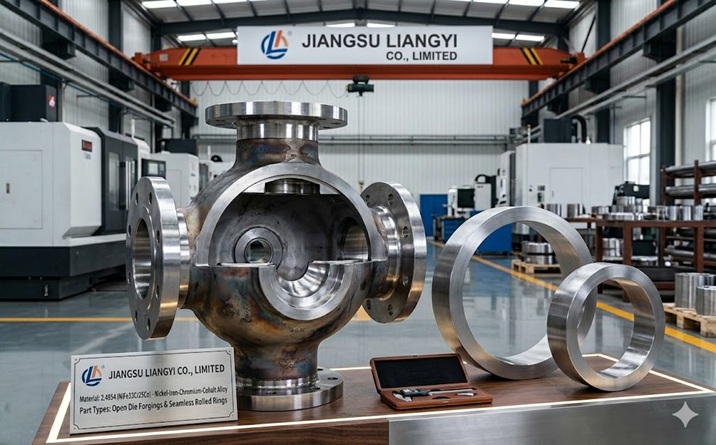
2.4854 (NiFe33Cr25Co) Forging Parts | Heat Resistant Alloy Forgings Manufacturer
Professional 2.4854 (NiFe33Cr25Co) Forging Parts Manufacturer in China
Jiangsu Liangyi Co., Limited is anISO 9001:2015 certified professional manufacturer of 2.4854 (NiFe33Cr25Co) open die forging parts and seamless rolled forged rings, located in Jiangyin, Jiangsu Province, China.With over 25 years of forging experience since 1997, we supply high-performance 2.4854 alloy forgings to customers in more than 50 countries, including the EU, Middle East, Southeast Asia, Australia and South America. Our full production line includes high-grade alloy melting, precision forging, standardized heat treatment and CNC machining. We strictly follow EN, ASTM, ASME, API and DIN international standards, as well as your custom drawings and technical requirements.We can produce custom 2.4854 forged parts weighing from 30kg up to 30 tons per piece, and they are used for the toughest high-temperature, high-pressure and highly corrosive industrial uses.
Full Range of 2.4854 (NiFe33Cr25Co) Forged Product Forms
We produce a complete portfolio of NiFe33Cr25Co forging products with full dimensional customization, including but not limited to:
The max forging diameter is up to 2000mm, the max length is up to 15 meters, single-piece weight is up to 30 tons
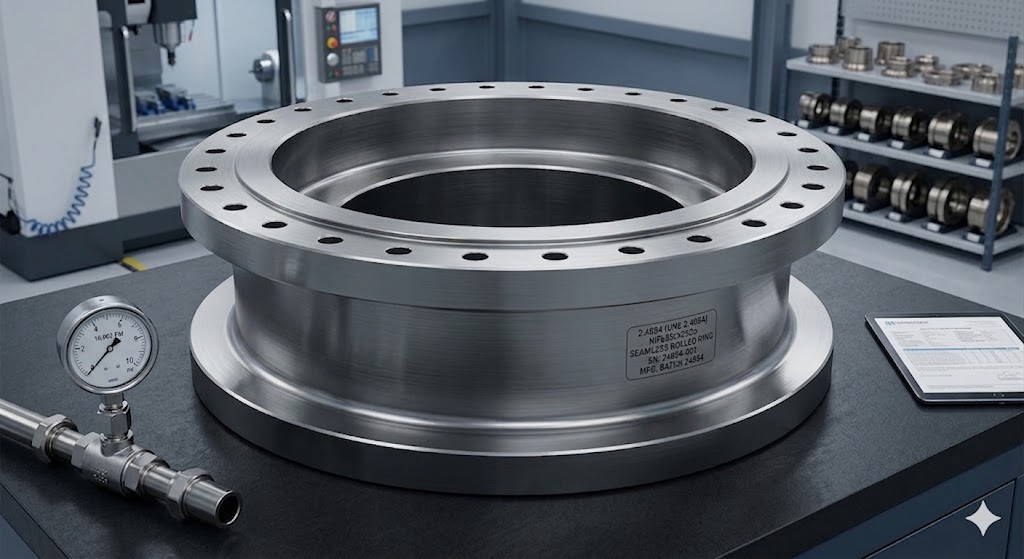
2.4854 Seamless Rolled & Forged Rings
NiFe33Cr25Co seamless rolled rings, contoured rings, bearing races, seal rings and valve seat rings
2.4854 forged rings for turbine, bearing, valve and pressure vessel applications, the max diameter is up to 6 meters
EN 10204 3.1B material test certificate is supplied as standard; EN 10204 3.2 third-party inspection is available on customer request (at additional cost, subject to scheduling with approved TPI body)
2.4854 forged discs, blocks, plates, tube sheets, baffles, flanges and pressure vessel parts
2.4854 (NiFe33Cr25Co) custom forged parts fully machined to customer drawings, with 100% non-destructive testing
Core Performance & Advantages of 2.4854 (NiFe33Cr25Co) Heat Resistant Alloy
2.4854 (NiFe33Cr25Co) is a solid solution reinforced Fe-Ni-Cr heat resistant super alloy that is used for extreme high-temperature, carburizing and sulfidizing environments. Its main advantages include:
Exceptional High-Temperature Strength: Significantly higher creep and rupture strength than common Fe-Ni-Cr alloys (Alloy 330, Alloy 800H) at temperatures up to 1095°C (2000°F), even outperforming many Ni-Cr alloys in long-term high-temperature service
Superior Corrosion Resistance: Excellent resistance to combined carburizing and sulfidizing environments, suitable for harsh petrochemical, refining and waste incineration scenarios; oxidation resistance comparable to premium high-temperature alloys
Excellent Structural Stability: Stable mechanical properties and metallographic matrix under long-term high-temperature operation, no brittle phase precipitation, guaranteeing long lifetime
Good Fabrication Performance: Excellent forging, welding and machining performance, suitable for manufacturing complex shaped parts for various industrial applications
Performance Comparison with Common High-Temperature Alloys
Alloy Grade
Max Service Temperature
High-Temperature Strength
Carburization & Sulfidation Resistance
2.4854 (NiFe33Cr25Co)
1095°C
Excellent
Superior
Alloy 800H
900°C
Moderate
Fair
Alloy 330
1040°C
Fair
Good
Inconel 600
1095°C
Good
Moderate
Industrial Applications & Global Project Cases of 2.4854 Forging Parts
2.4854 (NiFe33Cr25Co) forging parts are widely used in extreme industrial scenarios that need high-temperature strength, corrosion resistance and long-term reliability. Our proven global project cases cover the following main industries:
Thermal Power Generation & Turbine Industry
Application: 2.4854 gas and steam turbine guide rings, seal rings, labyrinth rings, rotor end rings, casing rings and turbine shafts
Project Case: We supplied 2.4854 turbine parts for a 660MW thermal power plant in Southeast Asia. These parts operate continuously at 1095°C and have kept stable performance with no material failures for more than 4 years.
Standards: Material properties meet the alloy requirements listed in ASME standards for high-temperature power generation equipment. Compliance with ASME codes at the equipment level is certified by the equipment manufacturer.
Petrochemical & Refining Industry
Application: NiFe33Cr25Co forged valve bodies, valve seat rings, valve trim, pump casings, impellers, pressure vessel shells and heat exchanger parts
Project Case: We provided 2.4854 valve and pump parts for a large refinery project in Saudi Arabia, Middle East. Designed for harsh environments with both carburization and sulfidation, all products passed the pressure tests required by the customer. The 2.4854 alloy meets the hardness and composition requirements of NACE MR0175 / ISO 15156-3 for sour service; NACE compliance certification for the assembled equipment is issued by the equipment manufacturer.
Standards: Material chemical composition and mechanical properties meet the alloy requirements referenced in API 6A. API 6A product certification (monogram licence) is held by the end equipment manufacturer, not the material supplier.
Nuclear Power Industry
Application: 2.4854 flow limiter Venturi forgings for steam generators, pressurizer surge line tubes, reactor nozzles, primary pump flywheels and containment parts
Project Case: We supplied 2.4854 forgings for a domestic power equipment project that needed full material traceability for nuclear‑adjacent applications. All parts were produced with complete heat‑to‑forging traceability and strict documentation. Note: Jiangsu Liangyi does not hold nuclear quality assurance certifications such as NQA‑1 or ISO 19443. The suitability of these materials for nuclear safety‑related service must be verified independently by the end user.
Standards: Manufactured per EN and GB/T material standards applicable to the project specification. Nuclear safety classification is the responsibility of the end-user and their licensed nuclear quality authority.
Waste Incineration & Chemical Processing
Application: 2.4854 (NiFe33Cr25Co) thermocouple protection tubes, radiant tubes, retorts, recuperators and chemical reactor parts
Project Case: We provided 2.4854 thermocouple protection tubes for several waste incineration plants in Germany, EU. These products show excellent corrosion resistance in harsh flue gas environments, and their lifetime is three times longer than conventional alloy materials.
Standards: Material manufactured per EN 10302 / EN 10095 standards applicable for high-temperature alloy parts in the EU market
Heat Treatment & Industrial Furnace Industry
Application: 2.4854 heat treating baskets, furnace belts, radiant tubes, muffle parts and heat treating fixtures
Project Case: We manufactured 2.4854 furnace parts for a leading automotive heat treatment factory in North America. These forgings keep excellent oxidation resistance and high-temperature strength even at high temperature up to 1100°C.
Standards: Material chemistry and mechanical properties meet applicable ASTM standard requirements for heat-resistant alloy forgings in the North American industrial market.
Bearing & Heavy Rotating Equipment
Application: NiFe33Cr25Co forged bearing races, bearing rings, gear rings and heavy-duty rotating parts
Project Case: For mining machinery projects in Australia, we made custom 2.4854 bearing rings. These rings worked well in heavy loads and high-temperature conditions, and their lifetime was twice as long as standard alloy bearings.
Standards: Compliant with Australian mining industry standards
Melting, Forging & Heat Treatment Specifications
All our 2.4854 (NiFe33Cr25Co) forging parts are made with strict process control, using advanced forging and inspection equipment to guarantee consistent high quality.
Premium Melting Process
2.4854 alloy steel is produced by double vacuum melting process: vacuum induction melting + electro-slag re-melting (VIM/ESR) or vacuum induction melting + vacuum arc re-melting (VIM/VAR) as default. This process guarantees ultra-high material purity, consistent chemical composition, low gas content and minimal non-metallic inclusions, which is important for the alloy's high-temperature performance and corrosion resistance.
Precision Forging Process
We use 2000T-6300T hydraulic forging presses and 1-5M seamless rolling machines for open die forging, with strict forging ratio control (≥3:1 for general parts, ≥6:1 for important parts) to break down the cast matrix, refine grain size and guarantee optimal internal matrix and mechanical properties. All finished forgings are 100% inspected to be free from cracks, flakes, seams, segregation and other harmful defects.
Standardized Heat Treatment
All 2.4854 forged parts are supplied in solution annealed condition by default, unless otherwise specified. The standard heat treatment process is: solution annealing at 1175°C to 1230°C (2150°F to 2250°F), holding for sufficient time according to section thickness, followed by rapid water quenching or air cooling to guarantee improved mechanical properties, corrosion resistance and structural stability.
Chemical Composition of 2.4854 (NiFe33Cr25Co) Alloy
Element
Standard Content Range (%)
Nickel (Ni)
33.0 - 37.0
Chromium (Cr)
24.0 - 26.0
Iron (Fe)
Balance
Cobalt (Co)
≤ 2.5
Molybdenum (Mo)
2.0 - 3.0
Tungsten (W)
2.0 - 3.0
Columbium + Tantalum (Nb + Ta)
0.20 - 0.60
Manganese (Mn)
1.0 - 2.0
Silicon (Si)
0.50 - 1.50
Carbon (C)
0.05 - 0.10
Phosphorus (P)
≤ 0.030
Sulfur (S)
≤ 0.015
Mechanical Properties of 2.4854 Forged Round Bars (Solution Annealed)
We apply full-process quality control from raw material incoming inspection to final product delivery. All finished 2.4854 (NiFe33Cr25Co) forging parts are accompanied by a EN 10204 3.1B inspection certificate in triplicate by default, with EN 10204 3.2 third-party certified certificate available on request. The certificate includes:
Material code, purchase order number and material designation
Heat number, heat analysis report and melting process details
Mechanical test results, hardness range and heat treatment records
Non-destructive testing (NDT) results and material purity grade report
Dimension test report and material identification confirmation
Compliance Standards
Our production and testing fully meet these international standards: EN ISO 9001, EN 10002-1, ASTM E8/E8M, EN 10045, EN 10021, EN ISO 6506-1, ASTM E112, DIN 50602, ASTM E45, SEP 1923, EN 10204, ASTM A370, ASME, and API material requirements.The 2.4854 (NiFe33Cr25Co) alloy chemistry and solution‑annealed hardness (180–220 HB) meet the material requirements from NACE MR0175 / ISO 15156-3 for sour service applications. We can also produce parts to meet EN material standards for the EU market and JIS composition requirements for Japanese project specifications.
Physical & Thermal Properties of 2.4854 (NiFe33Cr25Co) Alloy
The mechanical strength, thermal and physical properties of 2.4854 (NiFe33Cr25Co) decide how well it works in repeated high-temperature conditions, heat exchanger designs, and structural size calculations for high-temperature process equipment. The values below apply to solution‑annealed forged material and are for engineering reference only; official certified test data will be provided with every order.
Property
Condition / Temperature
Typical Value
Unit
Density
Room temperature (21°C)
8.00
g/cm³
Solidus Temperature
—
~1310
°C (2390°F)
Liquidus Temperature
—
~1355
°C (2470°F)
Modulus of Elasticity
21°C (70°F)
200
GPa (29.0 × 10⁶ psi)
Modulus of Elasticity
815°C (1500°F)
155
GPa (22.5 × 10⁶ psi)
Mean Thermal Expansion Coefficient
21–100°C (70–212°F)
13.9
µm/m·°C
Mean Thermal Expansion Coefficient
21–500°C (70–930°F)
15.2
µm/m·°C
Mean Thermal Expansion Coefficient
21–800°C (70–1470°F)
16.7
µm/m·°C
Mean Thermal Expansion Coefficient
21–1000°C (70–1830°F)
17.5
µm/m·°C
Thermal Conductivity
100°C (212°F)
11.7
W/m·K
Thermal Conductivity
500°C (930°F)
16.3
W/m·K
Thermal Conductivity
800°C (1470°F)
21.4
W/m·K
Specific Heat Capacity
21°C (70°F)
490
J/kg·K
Electrical Resistivity
21°C (70°F)
1.14
µΩ·m
Note: All values are typical for solution-annealed forged material. Minor variation may occur across heats due to composition tolerance within the specified range. Actual certified values are reported in the material test certificate (MTC) supplied with each shipment.
Elevated-Temperature Tensile Properties of 2.4854 Forged Round Bar (Solution Annealed)
The main advantage of 2.4854 (NiFe33Cr25Co) over common Fe-Ni-Cr alloys is that it keeps its tensile and yield strength at temperatures much higher than 800°C. This comes from solid solution hardening (adding Mo, W, Nb) and controlled carbide precipitation at grain boundaries. The table below shows typical short-term tensile data at high temperatures, tested lengthwise on forged bar stock according to ASTM E21. Engineers designing parts for continuous or cyclic use above 700°C should also ask our technical team for long-term creep-rupture data, because short-term tensile values do not fully show time-dependent deformation under the highest service temperatures.
Test Temperature
Ultimate Tensile Strength (Rm)
0.2% Proof Strength (Rp0.2)
Elongation (A5)
Reduction of Area (Z)
21°C (70°F) — Room Temperature
735 MPa (106.5 ksi)
375 MPa (54.4 ksi)
50%
65%
538°C (1000°F)
~630 MPa (91.4 ksi)
~310 MPa (45.0 ksi)
~45%
~62%
649°C (1200°F)
~590 MPa (85.6 ksi)
~280 MPa (40.6 ksi)
~42%
~60%
760°C (1400°F)
~510 MPa (74.0 ksi)
~240 MPa (34.8 ksi)
~40%
~57%
871°C (1600°F)
~390 MPa (56.6 ksi)
~195 MPa (28.3 ksi)
~42%
~58%
982°C (1800°F)
~235 MPa (34.1 ksi)
~145 MPa (21.0 ksi)
~50%
~60%
Values prefixed with "~" are representative typical data for engineering reference. Certified heat-specific data issued per EN 10204 3.1B with each order. For important applications, Jiangsu Liangyi can arrange third-party elevated-temperature testing per ASTM E21 or equivalent.
Practical Interpretation for Component Design
The data above shows a main feature that sets 2.4854 apart from Alloy 800H and similar materials: this alloy keeps over 53% of its room-temperature yield strength at 760°C, and still keeps a proof strength of around 145 MPa even at 982°C. In this temperature range, many other Fe-Ni-Cr alloys soften badly.So that 2.4854 forgings are the best choice material for uses including turbine seal rings, petrochemical reactor internal parts, and industrial furnace fixtures. In these applications, load-bearing strength must be guaranteed over wide temperature cycles without part distortion or size changes caused by creep.
2.4854 Alloy International Grade Equivalency & Cross-Reference Table
2.4854 (NiFe33Cr25Co) is classified under several international standard systems. When purchasing, specifying or cross-referencing this alloy in different countries and engineering documents, the following equivalence list helps you identify the material correctly. Note that although these designations cover nearly the same alloy chemistry, testing requirements, allowed heat treatment types and documentation rules may differ slightly between standards. Always check the applicable standard before finalizing your specification.
Standards System
Designation / Grade
Issuing Body / Region
Notes
EN (European)
2.4854 / NiFe33Cr25Co
CEN — European Committee for Standardization
Primary designation used in this document; covers forgings, bars, rings
ASME (Pressure Vessels)
ASME SB-408, SB-564, SB-166
ASME — USA / Global
Referenced under EN 2.4854 / NiFe33Cr25Co designation for bar, forgings and rod respectively
ISO
NiFe33Cr25CoMoW
International Organization for Standardization
ISO compositional designation reflecting the Mo and W additions
API (Oil & Gas)
Referenced under EN 2.4854 / NiFe33Cr25Co composition for pressure vessel components
American Petroleum Institute
Used in API 6A, API 6D valve and wellhead equipment specifications; specify 2.4854 composition
NACE MR0175 / ISO 15156
Listed by alloy composition (NiFe33Cr25Co) for sour service compliance
NACE International / ISO
Acceptable for sour service (H₂S-containing environments) per NACE MR0175
GB/T (China)
GH3128 (partial compositional similarity)
SAC — China National Standard
Chinese domestic alloy with similar Fe-Ni-Cr-Mo-W composition; not a direct equivalent — specification differences apply
JIS (Japan)
No direct JIS designation
JSA — Japan
Japanese projects typically specify EN 2.4854 or NiFe33Cr25Co composition directly; JIS NCF equivalents cover related but not identical compositions
Trademark notice: HAYNES® and HR-120® are registered trademarks of Haynes International, Inc. TÜV® is a registered trademark of TÜV associations. SGS® is a registered trademark of SGS SA. Bureau Veritas® is a registered trademark of Bureau Veritas SA. All third-party trademarks are the property of their respective owners. Jiangsu Liangyi Co., Limited is not affiliated with, endorsed by, or sponsored by any of the above trademark holders. References are made solely for material identification and standards cross-reference purposes.
Jiangsu Liangyi can produce 2.4854 forged parts in line with any of the above designation systems. When sending an inquiry, please specify your needed standard (for example, EN 2.4854 according to EN 10302, or NiFe33Cr25Co according to EN 10095), so that we can make sure the chemical composition, mechanical testing, heat treatment condition and documentation fully meet your requirement.
Welding Guidelines for 2.4854 (NiFe33Cr25Co) Forged Components
2.4854 (NiFe33Cr25Co) has good weldability compared to many precipitation-hardened superalloys. However, its high chromium, nickel, molybdenum and tungsten content needs strict control of heat input, interpass temperature and joint preparation. This helps avoid hot cracking, grain boundary sensitization, and reduced corrosion resistance in the weld heat-affected zone (HAZ). The guidelines below are based on Jiangsu Liangyi’s workshop experience in welding 2.4854 forged parts for nuclear, petrochemical and power generation customers.
Recommended Filler Materials
Welding Process
Recommended Filler Classification
AWS / ASME Specification
Remarks
GTAW (TIG)
ERNiCrFe-5 or matching composition Ni-Cr-Fe-Mo-W filler wire
AWS/ASME SFA-5.14
Preferred process for root passes and precision welds; ensures maximum dilution control
GMAW (MIG)
ERNiCrFe-5 or equivalent Ni-Cr-Fe filler wire
AWS/ASME SFA-5.14
Suitable for larger section welds; spray transfer mode preferred
SMAW (MMA)
ENiCrFe-2 or ENiCrFe-3 coated electrode
AWS/ASME SFA-5.11
For field repair or heavy section welds where GTAW is impractical
SAW (Submerged Arc)
Matching Ni-Cr-Fe-Mo-W wire + neutral flux
AWS/ASME SFA-5.14
For heavy weld overlay or cladding applications; heat input must be carefully controlled
Key Welding Parameters & Precautions
Preheat: It is not needed for base material sections ≤50 mm in a clean, dry environment above 10°C. For sections exceeding 50 mm or in cold/humid ambient conditions, preheat to 100–150°C is advisable to minimize hydrogen pickup risk.
Interpass Temperature: Must be held to ≤150°C (302°F) maximum to prevent excessive grain growth in the HAZ and to control distortion in multi-pass welds. Monitor continuously with contact thermometer.
Heat Input: Use low-to-moderate heat input settings (typically 0.5–1.5 kJ/mm for GTAW). Excessive heat input promotes grain boundary carbide precipitation and can degrade corrosion resistance in the HAZ. Stringer bead technique is preferred over wide weave.
Shielding Gas (GTAW/GMAW): Pure argon (Ar ≥99.99%) or Ar/He mixture (75% Ar + 25% He) for improved penetration on thick sections. Avoid CO₂-containing mixtures which can cause carbon pickup.
Joint Preparation: Full penetration V-groove (60°–70°) or U-groove butt joints are preferred for pressure-retaining welds. Back gouging and re-welding of the root pass is recommended for critical joints requiring 100% radiographic quality.
Cleanliness: Weld area must be free of oil, grease, paint, marking ink, sulphur-containing materials and halides (chlorides) before welding. Use dedicated stainless steel wire brushes; do not share carbon steel tooling.
Post-Weld Heat Treatment (PWHT): It is not needed for most structural and pressure vessel applications. When service conditions need maximum corrosion resistance or stress relief, a full solution anneal at 1175–1230°C followed by rapid water quench or forced air quench is recommended. Partial stress relief at intermediate temperatures is not advised, as it may lead to sensitization.
NDT after Welding: 100% visual inspection + PT (liquid penetrant testing) on accessible surfaces as minimum. RT (radiographic testing) or UT (ultrasonic testing) is needed for pressure-retaining welds per applicable code (ASME IX, EN ISO 15614-1).
Jiangsu Liangyi provides 2.4854 forged parts in the solution‑annealed state, ready for on‑site welding. If your project needs pre‑machined weld-end preparation (such as beveling, bore machining, or stub‑end fitting), our CNC machining team can supply weld‑ready forged parts with dimensional tolerances of ±0.1 mm.
Why Global Engineers Choose Jiangsu Liangyi for 2.4854 Forging Parts
In a market full of general alloy suppliers, choosing a professional forging manufacturer for 2.4854 (NiFe33Cr25Co) parts is critical. This alloy costs much more than standard stainless steel, so price alone should not be the only consideration. Below is a straightforward explanation of what makes Jiangsu Liangyi’s 2.4854 forging capability stand out from other suppliers.
Full-Traceability Melting Control
We do not source 2.4854 alloy from open‑market bar stock with unknown origins. Every heat starts with certified virgin raw materials (Ni, Cr, Fe, Mo, W, Nb) purchased from qualified smelters, processed through our contracted dual‑vacuum melting routes — either VIM/ESR or VIM/VAR — with full chemical analysis at each melting stage. The result is an ingot with confirmed macro‑cleanliness (meeting SEP 1927 K2 standard or higher) before any forging is performed. This full traceability from raw elements to finished forgings is what our nuclear and aerospace customers demand — and we provide it as standard for all 2.4854 orders.
Controlled Forging Ratio — Not Just Met, Engineered
The minimum forging ratio for 2.4854 (NiFe33Cr25Co) is not just a formality — it is a main target for controlling the material microstructure.Our forging engineers calculate the required reduction ratio (≥4:1 for standard parts, ≥6:1 for critical rotating or pressure-retaining parts) based on the original grain size of the ingot, the target grain size of the finished forging (usually ASTM grain size 3–6), and the expected stress direction in service. Pressures from our 6300‑ton hydraulic forging press are programmed to get consistent deformation across the whole section, not just surface reduction. This is what distinguishes forgings with consistent through‑thickness properties from those with only a hard outer layer and a soft inner core.
In-House NDT — No Outsourcing Delays
All non-destructive testing (NDT) is carried out in-house at Jiangsu Liangyi’s dedicated inspection center, rather than outsourced to third-party labs with unpredictable lead times.Our 2.4854 forgings receive 100% ultrasonic testing (UT) to EN 10228-3 or ASTM A388 as standard. Magnetic particle testing (MT to ASTM E709) and liquid penetrant testing (PT to ASTM E165) are also available depending on part geometry.Phased-array ultrasonic testing (PAUT) is provided for complex-shaped parts and large forged rings where conventional UT has limited angle coverage.The result: your full inspection report is ready before shipment, not three weeks afterward.
Dimensional Accuracy That Reduces Downstream Machining
We use computer-aided die design and finite-element forging simulation (Deform® software) to predict metal flow, die filling, and final forging dimensions before heating the first ingot. For 2.4854 open-die forgings, our standard dimensional tolerance for diameter is ±1.5% (or ±3 mm, whichever is larger), with tighter tolerances available for near-net-shape parts. For seamless rolled rings, roundness deviation is controlled to ≤0.5% of the outer diameter. This precision reduces the material allowance your machining team needs to remove, cutting cycle time and tool wear on this highly work-hardening alloy.
Flexible Delivery: Sample in Weeks, Full Run in Months
We know that a new 2.4854 forging project usually requires qualification samples before full production.Our standard lead time for 2.4854 forging samples is 4–8 weeks from receipt of approved drawings and purchase order (depending on alloy stock availability).Full production lead time is 10–16 weeks for most open‑die forgings, and 12–20 weeks for large seamless rolled rings with outer diameter over 3 meters. We keep a consignment stock of 2.4854 alloy ingots to support repeat orders, shortening lead times for regular customers by up to 30%.
Documentation Package That Clears Customs First Time
Exports for regulated industries including nuclear, pressure vessels and defense need more than just a standard commercial invoice.Jiangsu Liangyi’s complete documentation package for 2.4854 forgings includes:EN 10204 3.1B MTC (or 3.2 third-party inspection certificate), forging process records, heat treatment charts with actual temperature and time traces, NDT reports with operator qualification records, dimension test reports with calibrated equipment certificates, and Certificate of Origin (Form A / EUR.1 for preferential tariffs). All documents are provided in English and can be apostilled or notarized upon request to meet regulated market requirements such as EU PED and international industrial quality standards.
Frequently Asked Questions (FAQ) About 2.4854 (NiFe33Cr25Co) Forging Parts
2.4854(also called NiFe33Cr25Co)is a solid‑solution‑strengthened Fe‑Ni‑Cr heat‑resistant superalloy. It is used for extreme high‑temperature applications up to 1095°C, and it has excellent high‑temperature strength, resistance to combined carburizing and sulfidizing environments, and good oxidation resistance. It is widely used for power generation, petrochemical, nuclear power, and heat treatment industries.
2.4854 (NiFe33Cr25Co) is much stronger than Alloy 800H at high temperatures, especially above 900°C. It also resists carburization and sulfidation better, and its highest service temperature is 1095°C, which is 195°C higher than Alloy 800H.so that it is the best material to use in harsh, hot, and corrosive places where Alloy 800H can't keep up with performance standards.
We have a flexible minimum order quantity (MOQ) for 2.4854 forged parts.For small custom parts, the MOQ can be 1 piece for prototype and trial orders. We have low prices for orders of any size for mass production.We can customize small batches and provide continuous supply on a large scale to customers all over the world.
Yes. An EN 10204 3.1B Material Test Certificate, signed by our authorized quality representative, is included free of charge as standard with every 2.4854 forging shipment.An EN 10204 3.2 certificate — needing countersignature by an independent third-party inspector (such as TÜV, SGS or Bureau Veritas) — is available upon request.Please indicate this requirement during the quotation phase so we can arrange the third-party inspection and include the related cost in your quote. We also support customer-nominated third-party witness inspections at our facility during forging, heat treatment and NDT.
We can make seamless rolled rings with a maximum outer diameter of 6 meters, a maximum height of 1.5 meters, and a weight of up to 30 tons. We can make custom contoured rings and special-shaped rings based on customer drawings, and we can change the size of the rings to fit your needs.
Yes, we offer a full range of services, from forging and heat treatment to CNC machining.We have high-tech CNC machining centers, lathes, milling machines, and grinding tools that let us machine 2.4854 forgings to your exact drawing specifications with an accuracy of up to IT6 grade.We sell both rough forgings and finished parts that are ready to be put together.
Lead time depends on part drawings and order quantity. For qualification samples or prototype forgings (single or small quantities), the typical lead time is 4–8 weeks. For serial production of standard open-die forgings such as bars, discs, blocks and flanges, lead time is 10–16 weeks. Large seamless rolled rings with an outer diameter over 3 meters require 12–20 weeks because of the longer ring-rolling process and post-forging heat treatment. For customers with regular demand, we can talk about consignment stocking to reduce repeat-order lead time by up to 30%. All lead times start from the date we receive your signed purchase order and approved drawing. We suggest sending in your technical inquiries early to reserve production capacity.
Our standard NDT process for 2.4854 forgings includes 100% Ultrasonic Testing (UT) following EN 10228-3 Class 3 or ASTM A388 as the main way to check inside the parts, finding internal problems like small holes, foreign materials and layers. Liquid Penetrant Testing (PT) following ASTM E165 / EN ISO 3452 is used on all easy-to-reach surfaces to find defects that break through the surface. Magnetic Particle Testing (MT) following ASTM E709 / EN ISO 17638 is available for parts where the shape allows magnetization. For parts with complex shapes and large ring forgings (OD >2 m) where regular UT can’t cover all areas because of the beam angle, we provide Phased-Array Ultrasonic Testing (PAUT) with sectorial scanning to make sure the entire inside of the parts is checked. We do 100% visual and dimensional checks on all finished parts using calibrated tools that meet national standards. All NDT operators have ASNT Level II (or equivalent EN ISO 9712) certifications for their specific testing method.
Yes, with important qualifications. 2.4854 (NiFe33Cr25Co) is listed in NACE MR0175 / ISO 15156-3 as a suitable alloy for sour service (H₂S-containing environments), as long as it meets the hardness limit required by the standard (usually ≤35 HRC for nickel alloys). In its solution-annealed condition, 2.4854 easily meets this requirement at 180–220 HB, or about 19–22 HRC. The high nickel and chromium content of the alloy gives excellent resistance to chloride stress corrosion cracking (SCC) and hydrogen-induced cracking (HIC) at its designed working temperatures. For high-pressure hydrogen service (pure H₂, not H₂S), suitability depends on hydrogen partial pressure, temperature and part geometry — our engineering team can check your specific service conditions and confirm if it can be used. We can provide 2.4854 forgings with NACE MR0175 compliance stated in the material test certificate upon request.
2.4854 forgings are supplied in one of three surface and dimensional conditions:(1) (1) As-forged (black surface): with scale and oxide left on, tolerances following EN 10243-1 Class D or ASTM A788 where applicable, meant for customers who will machine the whole forging.(2) Rough-machined: scale removed, outer dimensions turned to 3–5 mm larger than final drawing sizes, and inner diameters rough-machined. This is the most common condition for international orders, as it removes scale, makes final machining easier, and cuts shipping weight.(3) Finish-machined (ready-for-assembly): fully CNC machined to final drawing sizes, with tolerances up to IT6 grade (for example ±0.01–0.05 mm on diameters based on size), and surface finish Ra 0.8–3.2 µm as required. All finish-machined parts get 100% dimensional inspection using a coordinate measuring machine (CMM) and come with a complete dimensional report.Please state your required supply condition when asking for a quotation.
Inquire About 2.4854 (NiFe33Cr25Co) Forging Parts
As a top Chinese manufacturer of 2.4854 (NiFe33Cr25Co) forging parts with over 25 years of experience, Jiangsu Liangyi is dedicated to providing you with high-quality, high-performance custom forgings at competitive prices, supported by worldwide delivery and full technical support. Feel free to send us your custom drawings, material specifications, order quantity and application details to receive a detailed quotation within 24 hours!