2.4819 (NiMo16Cr15W) Forging Parts | China Professional Manufacturer & Supplier
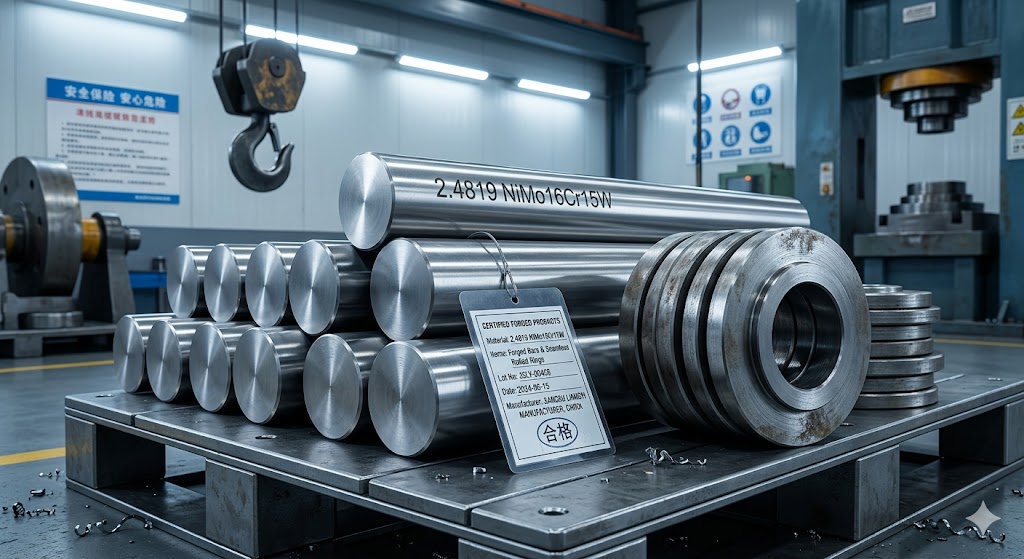
2.4819 (NiMo16Cr15W) Alloy: Material Overview & International Standard Compliance
Jiangsu Liangyi Co., Limited is a professional ISO 9001:2015 certified manufacturer of 2.4819 (NiMo16Cr15W) open die forging parts and seamless rolled steel forged rings, located in Chengchang Industry Park, Jiangyin City, Jiangsu Province — the core hub of China’s forging industry cluster. With over 25 years of nickel alloy forging experience, we supply high-quality 2.4819 NiMo16Cr15W forged components to customers in more than 50 countries worldwide, fully compliant with international standards including ASTM, EN, DIN, API, ASME and NACE.
2.4819 is the European EN/DIN designation for the NiMo16Cr15W nickel-chromium-molybdenum alloy with tungsten addition. It is a premium superalloy engineered for extreme corrosive environments, delivering exceptional resistance across a wide range of corrosive aqueous media — both strong oxidising and reducing acids — along with outstanding resistance against chloride-induced crevice corrosion, pitting corrosion, and stress corrosion cracking (SCC). These properties make it an irreplaceable material for critical components in harsh industrial service conditions where other alloys fail prematurely.
Entity: 2.4819 NiMo16Cr15W | UNS: N10276 | Trade Name Equiv.: C-276 type (UNS N10276) | Manufacturer: Jiangsu Liangyi Co., Limited | Location: Jiangyin, Jiangsu, China | Est.: 1997 | Certification: ISO 9001:2015, EN 10204 3.1/3.2 | Export: 50+ Countries
2.4819 NiMo16Cr15W: International Standard Cross-Reference Table
One of the most common sources of confusion when procuring this alloy internationally is navigating the different designation systems used across regions. The table below provides a complete cross-reference of all equivalent designations for 2.4819 NiMo16Cr15W. All designations in this table refer to essentially the same alloy. Jiangsu Liangyi can manufacture forgings certified to any of the standards listed below — please specify your required standard on your inquiry.
| Standard System | Designation / Grade | Standard No. | Applicable Product Form | Primary Market |
|---|---|---|---|---|
| EN / DIN (European) | 2.4819 / NiMo16Cr15W | EN 10095 / DIN 17744 | All wrought forms | Europe, Global |
| UNS (USA) | N10276 | ASTM / SAE UNS | All wrought forms | USA, Global |
| ASTM — Forgings | ASTM B564 Gr.N10276 | ASTM B564 | Forged fittings, flanges, components | USA, Middle East |
| ASTM — Bar / Rod | ASTM B574 Gr.N10276 | ASTM B574 | Bar, rod, wire | USA, Global |
| ASTM — Plate / Sheet | ASTM B575 Gr.N10276 | ASTM B575 | Plate, sheet, strip | USA, Global |
| ASTM — Pipe / Tube | ASTM B622 Gr.N10276 | ASTM B622 | Seamless pipe and tube | USA, Global |
| AWS — Welding Wire | ERNiCrMo-4 | AWS A5.14 | Filler metal / welding wire | Global |
| ISO | NW 0276 | ISO 9723 / ISO 6207 | Bar, rod | Global |
| Trade Name (Haynes International) | Hastelloy C-276 | Proprietary | All forms | Global |
| Russian GOST | ХН65МВУ | GOST 5632 | All wrought forms | Russia, CIS |
| British BS | NA 21 | BS 3072–3076 | Wrought forms | UK, Commonwealth |
Procurement Tip from Our Engineering Team: When ordering forged parts for ASME pressure vessel applications, specify ASTM B564 UNS N10276 with EN 10204 3.1 certificate. For European PED-certified equipment, specify EN 2.4819 / NiMo16Cr15W with EN 10204 3.1 or 3.2. If your project requires dual-certification (both ASTM and EN simultaneously), we accommodate this at no extra charge — simply state this in your inquiry. This is one detail that many traders and small forges cannot offer, but is standard practice at our Jiangyin factory.
2.4819 NiMo16Cr15W Chemical Composition & Why Each Element Matters
Our 2.4819 NiMo16Cr15W forged materials strictly comply with EN standard chemical composition requirements, with precise element control in our in-house vacuum melting workshop. Understanding why each element is present — and what happens when it goes out of range — is something we consider essential for engineers specifying this alloy in critical service:
| Element | Standard Range | Role in Alloy Performance (Manufacturer’s Perspective) |
|---|---|---|
| Nickel (Ni) | Balance (~57%) | Matrix element providing base corrosion resistance, ductility and toughness. Enables all other alloying elements to remain in solid solution. |
| Molybdenum (Mo) | 15–17% | Primary corrosion resistance driver. Dramatically improves resistance to pitting, crevice corrosion and reducing acids (HCl, H₂SO₄). The highest Mo of any common CRA — this is what makes 2.4819 exceptional in reducing environments. |
| Chromium (Cr) | 14.5–16.5% | Builds the passive oxide film. Provides resistance to oxidising environments and high-temperature surface oxidation. Works synergistically with Mo for broad-spectrum corrosion protection. |
| Tungsten (W) | 3–4% | The key differentiator vs. the original Hastelloy C. Enhances resistance to pitting and crevice corrosion, and improves performance in mixed-acid environments. Also solid-solution strengthens the matrix — giving 2.4819 better elevated-temperature strength than older C alloys. |
| Iron (Fe) | 4–7% | Controlled addition that allows cost optimisation without property penalty. Stabilises microstructure during hot working at our forging temperatures. |
| Manganese (Mn) | 1.0% Max | Strictly controlled to avoid MnS inclusions, which are preferential pitting initiation sites in chloride environments. Critical for high-purity sour service applications. |
| Cobalt (Co) | 1.50% Max | Controlled for nuclear power applications where Co activation under neutron radiation creates Co-60 (a gamma emitter) that must be minimised. For nuclear project requirements, low-cobalt heats with Co<0.10% can be produced on request, with cobalt content fully documented on the material certificate. |
| Carbon (C) | 0.020% Max | Strictly minimised to prevent sensitisation via M₆C carbide precipitation at grain boundaries during slow cooling or thermal exposure. Low C is the critical guarantee of weld HAZ corrosion resistance. Our VIM melting typically achieves C<0.010%. |
| Silicon (Si) | 0.08% Max | Ultra-low Si prevents sigma phase formation and reduces hot cracking risk during forging. In our 25+ years of forging 2.4819, heats at the upper Si limit consistently require higher forging force and show higher surface crack risk below the minimum forging temperature. Our typical Si is <0.04%. |
| Phosphorus (P) | 0.025% Max | Strictly minimised to prevent grain boundary embrittlement and improve high-temperature ductility throughout the 950–1180°C forging window. |
From Our Forge Floor: The ultra-low C (≤0.020%) and ultra-low Si (≤0.08%) in 2.4819 are not just standard numbers — they directly determine how the alloy behaves on our forging press. In 25+ years of processing this material, we have observed that heats at the upper Si limit show measurably higher forging resistance and a narrower safe temperature window. This is why our in-house VIM-melted heats target C<0.010% and Si<0.04% — significantly cleaner than the standard requires — for all critical-service forgings.
Mechanical Properties of 2.4819 Forgings (Delivery Condition: Solution Annealed)
We only recommend delivering our 2.4819 NiMo16Cr15W forging parts in the solution annealed (SA) condition. This is the standard delivery condition for this alloy. The table below shows the guaranteed minimums and the typical values we get, as shown on the EN 10204 3.1 certificate that comes with each delivery:
| Property | Symbol | Guaranteed Minimum | Typical Achieved Value* | Test Standard |
|---|---|---|---|---|
| Yield Strength | Rp0.2 | ≥ 310 MPa | 340–380 MPa | ASTM E8 / EN ISO 6892-1 |
| Tensile Strength | Rm | ≥ 750 MPa | 780–840 MPa | ASTM E8 / EN ISO 6892-1 |
| Elongation | A5 | ≥ 30% | 40–50% | ASTM E8 / EN ISO 6892-1 |
| Hardness | HRB / HB | ≤ 100 HRB / ≤ 240 HB | 85–95 HRB | ASTM E18 / E10 |
| Charpy Impact Energy (V-notch, RT) | KV | ≥ 100 J | 150–200 J | ASTM E23 / EN ISO 148-1 |
* Typical values based on our production records. Individual certificate values will vary by heat and section size.
Why the Gap Between Minimum and Typical Values Matters: The substantial margin between our guaranteed minimums and typical achieved values reflects the quality of our VIM+ESR+VAR triple-melted, precisely forged and solution-annealed products. When reviewing competing suppliers’ test certificates, check not just whether the minimum is met, but how consistently values exceed it. Typical values barely above the minimum often indicate suboptimal melting, forging ratio or heat treatment practices — and may indicate that a portion of production batches fall below the limit and are rejected before shipping.
Physical & Thermal Properties of 2.4819 NiMo16Cr15W — Complete Design Reference
The physical and thermal properties of 2.4819 NiMo16Cr15W are critical inputs for equipment designers, structural analysts and thermal engineers. Unlike mechanical properties, physical properties are essentially fixed by the alloy composition and do not change with heat treatment condition. The values below apply to solution annealed forged products:
| Property | Value | Unit | Practical Engineering Implication |
|---|---|---|---|
| Density | 8.89 | g/cm³ | ~13% heavier than 316L SS (7.98 g/cm³). Important for rotating component balance calculations, bearing load design, and sea freight weight estimation. |
| Melting Range | 1323–1371 | °C | Wide solidification range demands careful upper forging temperature limit control to avoid incipient melting. Our furnace control is ±5°C, with infrared pyrometer backup on each press. |
| Modulus of Elasticity (Young’s Modulus) | 205 | GPa | Nearly identical to 316L SS (200 GPa). Use for deflection calculations, spring-back prediction, FEA structural analysis without special material correction. |
| Shear Modulus | 79 | GPa | Relevant for shaft torsion, spline, key and fastener torque calculations. |
| Poisson’s Ratio | 0.31 | — | Standard input for FEA stress analysis and elastic buckling calculations. |
| Thermal Conductivity | 10.2 (at 100°C) / 13.4 (at 300°C) | W/m·K | ~40% lower than 316L SS (16–17 W/m·K). Critical for heat exchanger tube sheet design — the higher thermal resistance means a steeper temperature gradient than austenitic steels, affecting tube-to-shell differential stress calculations. |
| Thermal Expansion Coefficient | 11.2 (20–100°C) / 12.6 (20–300°C) | μm/m·°C | Close to carbon steel (~12 μm/m·°C). Significantly lower than 316L SS (~16 μm/m·°C). See design note below. |
| Specific Heat Capacity | 427 | J/kg·K | Relevant for thermal transient analysis, process upset temperature calculations, and quench cooling rate modelling. |
| Electrical Resistivity | 1.26 | μΩ·m | High resistivity. Relevant for eddy-current NDT parameter calibration and electromagnetic compatibility assessment in instrument housings. |
| Magnetic Permeability | ~1.0002 | μ/μ₀ | Essentially non-magnetic in all conditions. Suitable for MRI-adjacent equipment, subsea non-magnetic requirements, and magnetic flow meter applications where SS duplex alloys are unsuitable. |
| Max Recommended Service Temperature (aqueous environments) | ~370 | °C | Above this temperature, susceptibility to stress corrosion cracking may increase in specific high-chloride environments. For higher-temperature service, consult our engineering team with your full service environment details. |
Designer’s Thermal Expansion Advantage: The thermal expansion of 2.4819 (11.2–12.6 μm/m·°C) is dramatically lower than 316L austenitic stainless steel (16 μm/m·°C) and almost identical to carbon steel. This matters enormously in practice: when a 2.4819 forged nozzle or flange is welded or bolted to a carbon steel pressure vessel shell, the differential thermal movement during temperature cycling is minimal — reducing thermal fatigue risk at the dissimilar metal joint. This is one reason 2.4819 is specified for nozzles and agitator shaft sleeves in carbon steel chemical reactors, where a 316L component would generate significant differential stress over repeated heat-up and cool-down cycles.
Heat Treatment Specification for 2.4819 Forgings — A Forger’s Perspective
Heat treatment is arguably the most critical step in 2.4819 forging production because this alloy’s exceptional corrosion resistance is only fully realised in the properly solution annealed condition. A poorly executed heat treatment — even just 20°C too low or 5 minutes too short — can cause carbide and intermetallic precipitation that permanently degrades corrosion resistance while leaving mechanical properties apparently unchanged. This is what makes 2.4819 more demanding than most other forgeable alloys.
| Parameter | Specification | Manufacturer’s Notes |
|---|---|---|
| Solution Anneal Temperature | 1066°C – 1121°C | Lower end for maximum grain size control; upper end ensures complete dissolution of any precipitates. Our furnaces run to calibrated temperature uniformity standards. |
| Minimum Hold Time at Temperature | 1 min/mm minimum section, min. 30 min total | Insufficient soak time is the most common cause of failed corrosion tests on competitor products. Our hold time calculation is conservative, based on worst-case thermal lag at section centre. |
| Cooling Method | Rapid water quench (preferred); forced air for thin sections <25mm | Quench must start within 60 seconds of door opening. Delay is the No.1 on-site field failure mode for 2.4819 heat treatment. Our quench tanks are adjacent to each furnace door. |
| Sensitisation Range — AVOID | 425°C – 870°C | Prolonged exposure in this range causes M₆C carbide and μ-phase precipitation. Slow air cooling of heavy sections through this range is strictly prohibited. Never use this temperature range for stress relief. |
| Post-Weld Stress Relief | NOT RECOMMENDED | Unlike most carbon and low-alloy steels, 2.4819 must NOT receive a conventional PWSR at 550–700°C. This causes embrittlement and sensitisation without improving corrosion resistance. This is the most common field mistake we encounter from customers’ fabrication shops. |
| Temperature Uniformity Requirement | ±10°C throughout cross-section | Our computer-controlled furnaces achieve temperature uniformity within ±5°C across the working zone, verified by periodic furnace survey and continuous data-logger recording. Every furnace load has a batch-specific temperature-time chart referenced on the EN 10204 3.1 certificate. |
Critical Field Warning — Post-Weld Heat Treatment: In field repair welding of 2.4819 components, many contractors mistakenly apply a stress relief anneal at 600–700°C to reduce weld residual stress. This is directly counter-productive — it causes sensitisation and can cause the repaired component to fail corrosion inspection or, worse, to fail in service months later in a location remote from the weld. The correct post-weld treatment for 2.4819 is either a full solution anneal at 1066–1121°C with water quench, or no heat treatment at all. Jiangsu Liangyi provides written welding procedure support documentation for all customers’ fabrication and field repair teams on request.
Weldability of 2.4819 NiMo16Cr15W Forged Components — Practical Guide
2.4819 NiMo16Cr15W has good inherent weldability — one reason it is widely used for complex assemblies where field welding is unavoidable. However, because of its high Mo content, specific precautions are required to preserve full corrosion performance in the weld area and heat-affected zone (HAZ).
| Parameter | Recommendation & Rationale |
|---|---|
| Filler Metal | ERNiCrMo-4 (AWS A5.14) — same alloy composition as base metal. Do NOT use ERNiCrMo-3 (Inconel 625 filler), which has significantly lower Mo and reduced reducing-acid corrosion resistance. |
| Welding Processes | GTAW (TIG), GMAW (MIG), SMAW (Stick), SAW — all suitable. GTAW preferred for root passes and thin sections for maximum purity control. Use low heat input settings throughout. |
| Preheat | None required. 2.4819 is not hardenable and has no hydrogen embrittlement susceptibility. Preheat may actually be detrimental by extending time in the sensitisation range. |
| Interpass Temperature | Maximum 100°C (212°F). Controlling interpass temperature is critical to prevent heat build-up and precipitation in the 425–870°C sensitisation range during multi-pass welding. |
| Post-Weld Heat Treatment (PWHT) | NOT RECOMMENDED. Full solution anneal at 1066–1121°C plus water quench is acceptable if mandated by code, but sensitising temperatures (400–800°C) must be strictly avoided. |
| Shielding Gas | 100% Argon or Ar/He mix (GTAW). No CO₂. Back-purging with argon is required for pipe and tube root welds to prevent inner-surface oxidation and heat tint, which reduces corrosion resistance. |
| Joint Preparation | Machine or grind to bright metal before welding. Acid clean or pickle the weld area after welding to remove heat tint and restore HAZ corrosion resistance before placing in service. |
| Dissimilar Metal Welding | When joining 2.4819 to carbon steel, low-alloy steel or stainless steel, always use ERNiCrMo-4 filler. Control dilution from lower-alloy base metal into root pass by using low-amperage GTAW process. |
Jiangsu Liangyi supplies 2.4819 forged components with weld-end preparations to simplify fabrication: machined bevel preparations per ASME B16.25, weld-neck flanges (WN), socket-weld and butt-weld end fittings, and dissimilar-metal transition joints. These are manufactured to your drawing and delivered solution annealed, ready for immediate installation.
Custom 2.4819 NiMo16Cr15W Forged Product Range & Dimensional Capability
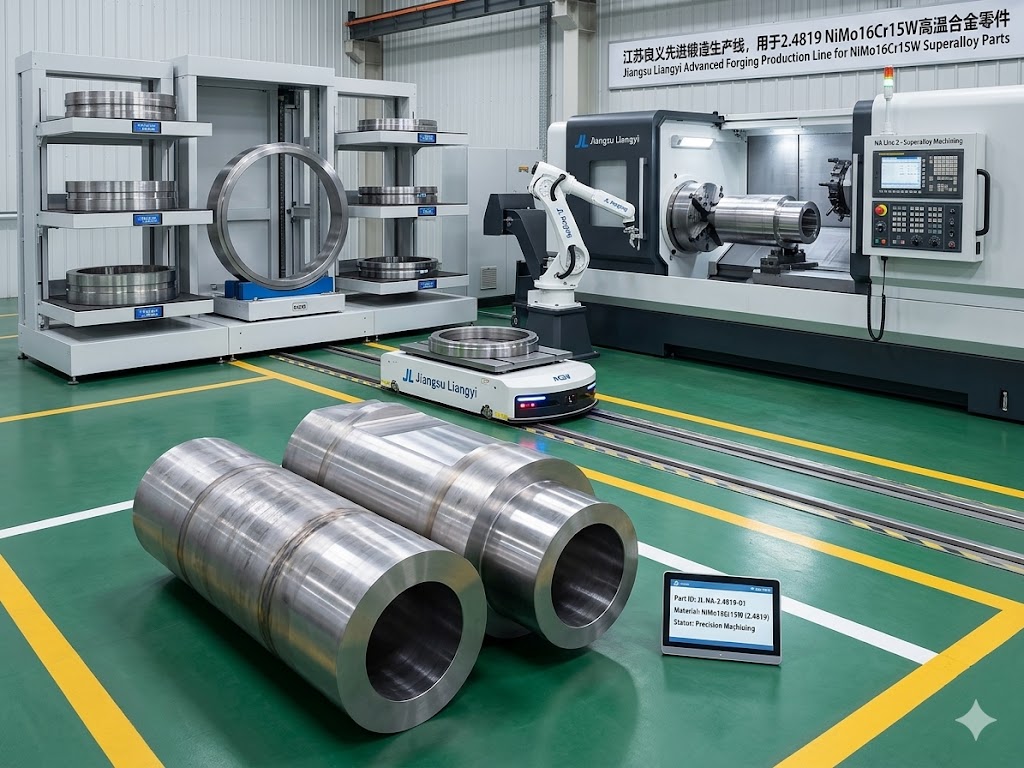
We manufacture custom 2.4819 NiMo16Cr15W forged parts in a full range of shapes and dimensions, from 30 kg to 30 metric tons per piece, fully compliant with customer drawings and technical specifications. Our in-house production chain covers forging, heat treatment, CNC machining and inspection, enabling one-stop custom solutions for global clients.
| Product Form | Max Diameter / OD | Max Length / Height | Max Weight | Typical Applications |
|---|---|---|---|---|
| Forged Round Bars & Shafts | 2,000 mm | 15,000 mm | 30 MT | Pump shafts, drive shafts, downhole tools, agitator shafts, valve stems |
| Seamless Rolled Rings | 6,000 mm | 1,500 mm face | 30 MT | Pressure vessel flanges, slewing rings, heat exchanger shell rings, turbine casings |
| Contoured / Profiled Rings | 5,000 mm | 1,200 mm | 20 MT | Gear rings, grooved rings, flanged rings, T-section rings |
| Hollow Forgings (Cylinders, Sleeves) | 3,000 mm OD | 5,000 mm | 20 MT | Reactor vessels, valve bodies, heavy-wall pipe, pump casings, casing heads |
| Discs, Plates & Blocks | 3,000 mm dia. | 1,000 mm thick | 20 MT | Tube sheets, baffle plates, flange blanks, valve gate discs |
| Square / Flat / Rectangular Bars | 1,000 × 1,000 mm | 5,000 mm | 15 MT | Valve seats, machined blocks, special fittings |
| Step Shafts & Splined Shafts | 800 mm max step dia. | 8,000 mm | 15 MT | ESP motor shafts, mud motor drives, turbomachinery shafts |
| Complete Valve Components | 1,500 mm | 2,000 mm | 10 MT | Valve bodies, bonnets, balls, gate plates, stems, seats, spools |
| Custom CNC-Machined Forgings | Per drawing | Per drawing | 20 MT | Any complex final shape — machined from forged blanks to final dimensions |
On Our Ring Rolling Capability: The 6-metre seamless rolled ring capability listed above reflects our 5-metre rolling machine working at its designed capacity for 2.4819 alloy. This machine is one of the largest in the Jiangyin region and enables us to roll rings that most domestic and international competitors cannot. For unusually large or heavy components beyond the ranges in the table, contact our technical team — we have produced components exceeding these dimensions in specific projects and can discuss feasibility without obligation.
Advanced Manufacturing Process for 2.4819 NiMo16Cr15W Forgings
NiMo16Cr15W alloy has a narrow hot working temperature window (950–1180°C, just 230°C total range) and extremely sensitive precipitation kinetics. A brief excursion below the minimum forging temperature can result in adiabatic shear bands or surface tearing, while exceeding the maximum risks incipient melting. This demands professional forging experience and real-time precise process control that is simply not achievable without dedicated equipment and trained operators.
In-House Vacuum Melting — VIM + ESR + VAR (Triple Melt)
For critical applications (nuclear, sour oil & gas), all 2.4819 heats are triple-melted: Vacuum Induction Melting (VIM) for composition precision, then Electro Slag Remelting (ESR) to remove oxide inclusions and sulfides, then Vacuum Arc Remelting (VAR) for solidification structure control. This process eliminates macro-segregation and inclusion clusters — the primary failure initiators in corrosion-critical nickel alloy forgings. VIM+VAR double-melting is available for standard industrial applications.
Ingot Conditioning & Controlled Pre-Heating
Ingots are surface-ground to remove cast skin defects before forging. Pre-heating in computer-controlled gas furnaces at a maximum ramp rate of 150°C/hour to avoid thermal shock in large cross-sections. Ingots are soaked at forging temperature for a minimum calculated hold time based on cross-section diameter and furnace loading, with continuous thermocouple recording adjacent to each ingot stack.
Open Die Forging or Ring Rolling — 950°C to 1180°C, Min. 3:1 Ratio
Open die forging on 2000T, 4000T and 6300T hydraulic presses for bars, shafts, discs and hollow forgings. Seamless ring rolling on 1M–5M rolling machines. Minimum 3:1 forging ratio strictly enforced to ensure full breakdown of as-cast dendritic structure, closure of internal voids, and refined equiaxed grain throughout the cross-section. Extended multi-heat forging sequences available for grain size finer than ASTM No.5.
Solution Heat Treatment — 1066°C to 1121°C + Rapid Water Quench
All 2.4819 forgings undergo solution annealing in computer-controlled furnaces (±5°C uniformity, computer-logged). Parts are loaded to avoid thermal shadows. Soak time is calculated per section thickness (min. 1 min/mm). Quench is executed within 60 seconds of door opening. Quench tank temperature is monitored and recorded. Full temperature-time chart for every batch is archived and referenced on the EN 10204 3.1 certificate.
CNC Machining (If Required)
In-house 5-axis CNC machining to final dimensions per customer drawings. ISO 2768-m/k standard tolerance; tighter ISO 2768-f available. All cutting parameters optimised for nickel alloy work-hardening characteristics to prevent surface smearing or built-up edge. Flood coolant with corrosion inhibitor throughout machining.
Full NDT Inspection & EN 10204 3.1 Certification
100% visual inspection, dimensional inspection, ultrasonic testing (UT) per ASTM A388 / EN 10228-3. Additional PT/MT, chemical analysis (OES+ICP dual verification), mechanical testing and metallographic examination as required. EN 10204 3.1 inspection certificate issued before release for every delivery.
Corrosion Performance of 2.4819 NiMo16Cr15W — Environment-by-Environment Guide
This section provides a detailed, environment-specific corrosion performance guide that goes beyond generic statements. The data below is based on published corrosion test results and our customer feedback from field applications across 25+ years of supply. All values are for solution annealed condition at the stated conditions:
| Environment | Conditions | Rating | Typical Corrosion Rate | Key Notes |
|---|---|---|---|---|
| Hydrochloric Acid (HCl) | All concentrations, up to 60°C | Excellent | <0.1 mm/yr | Best-in-class CRA for HCl. Outperforms 316L, 904L, Alloy 28 across all HCl concentrations. Above 60°C consult for specific concentration. |
| Sulfuric Acid (H₂SO₄) | Up to 60% at RT; up to 80% below 50°C | Excellent | <0.25 mm/yr | Exceptional in reducing H₂SO₄. Above 80% (oleum range) corrosion rate increases rapidly — contact our team for specific concentration/temperature combinations. |
| Phosphoric Acid (H₃PO₄) | All concentrations, up to 120°C | Excellent | <0.1 mm/yr | The standard material for contaminated (wet-process) phosphoric acid containing fluorides and chlorides where 316L fails. One of the most widely used applications for our 2.4819 forgings. |
| Acetic Acid (CH₃COOH) | All concentrations, boiling | Excellent | <0.05 mm/yr | Primary application: reaction vessels, distillation columns, heat exchangers in acetic acid production and purification plants. |
| Formic Acid (HCOOH) | All concentrations, up to 100°C | Very Good | <0.5 mm/yr | Very good performance. For boiling formic acid >50% concentration, Alloy C-2000 (2.4602) offers marginally better performance. |
| Nitric Acid (HNO₃) | <30% at ambient temp. | Moderate | 1–5 mm/yr at 30% | 2.4819 is NOT optimal for pure nitric acid. For oxidising acid service, 2.4610 (C-22) or 310S are better choices. See alloy selection section below. |
| Chloride Solutions (NaCl, MgCl₂, CaCl₂) | Any concentration, up to 150°C | Excellent | <0.01 mm/yr | No pitting or crevice corrosion in ASTM G48 Method A (6% FeCl₃, 22°C) — passes where 316L, duplex and even 6Mo stainless steels fail. |
| Seawater / Offshore | Full salinity, stagnant or flowing, up to 80°C | Excellent | Not measurable | PREN >65, far exceeding the PREN 40 minimum for offshore CRA applications. Completely immune to pitting and crevice corrosion in seawater under all normal service conditions. |
| Sour Gas (H₂S + CO₂ + Cl⁻) | NACE MR0175 / ISO 15156 environments | Excellent | Not measurable | Fully qualified under NACE MR0175 / ISO 15156-3 without restriction. No SSC, SCC or hydrogen-induced cracking in standard sour service tests. |
| Wet Flue Gas (SO₂, HCl, HF) | FGD absorber conditions, <80°C | Excellent | <0.05 mm/yr | Standard material for FGD absorber agitator shafts and impellers in coal-fired power plant FGD systems. We have supplied multiple FGD projects across Southeast Asia and Europe. |
Key Corrosion Parameters vs. Common Stainless Steels
| Parameter | 2.4819 (NiMo16Cr15W) | 316L SS | Duplex 2205 | Super Duplex 2507 |
|---|---|---|---|---|
| PREN (Pitting Resistance Equivalent) | > 65 | 23–28 | 35–38 | 40–43 |
| Critical Pitting Temp. (ASTM G150) | > 85°C | ~15°C | ~35°C | ~50°C |
| Critical Crevice Temp. (ASTM G48-C) | > 70°C | <0°C | ~10°C | ~30°C |
| SCC Resistance (Chloride) | Immune in most environments | Susceptible >60°C | Resistant to ~150°C | Resistant to ~200°C |
| NACE MR0175 Qualification | Yes — all grades, no restriction | Limited (SSC Zone 0 only) | Restricted conditions | Restricted conditions |
Alloy Selection Guide: When to Choose 2.4819 vs. Alternatives
This is the section that most supplier pages omit — an honest assessment of when 2.4819 NiMo16Cr15W is the right choice, and when a different alloy may be more appropriate. Jiangsu Liangyi manufactures forgings in all major corrosion-resistant alloys; our goal is to help you select the right material for your application, not to oversell one grade.
| Alloy (EN / UNS) | Mo% | Cr% | Reducing Acids | Oxidising Acids | Mixed / Unknown | Chloride Pitting | Relative Price | Best Application |
|---|---|---|---|---|---|---|---|---|
| 2.4819 (C-276) ← This Page | 15–17 | 14.5–16.5 | ★★★★★ | ★★★ | ★★★★ | ★★★★★ | $$$$ | HCl, H₂SO₄, H₃PO₄, mixed acids, sour gas, FGD, pulp bleaching |
| 2.4610 (C-22) / N06022 | 12–14 | 20–22.5 | ★★★★ | ★★★★★ | ★★★★★ | ★★★★★ | $$$$$ | Mixed oxidising/reducing, nuclear waste, chemical streams with HNO₃ present |
| 2.4602 (C-2000) / N06200 | 15–17 | 22–24 | ★★★★★ | ★★★★★ | ★★★★★ | ★★★★★ | $$$$$+ | Broadest resistance — unknown or highly variable service; premium cost justified by performance certainty |
| 2.4856 (Inconel 625) / N06625 | 8–10 | 20–23 | ★★★ | ★★★ | ★★★ | ★★★★ | $$$ | High-strength applications, seawater, aerospace — not for aggressive acid service |
| 1.4539 (904L) / N08904 | 4–5 | 19–23 | ★★ | ★★ | ★★ | ★★★ | $$ | Dilute H₂SO₄, dilute H₃PO₄ at ambient — budget option only; avoid in HCl or concentrated acids |
Reducing Acid Service
Your service is primarily HCl, dilute-to-medium H₂SO₄, formic acid, acetic acid, or phosphoric acid. 2.4819’s high Mo makes it the benchmark alloy in these conditions globally.
Sour Oil & Gas NACE MR0175
NACE MR0175 / ISO 15156-3 compliance is required. 2.4819 is fully qualified without restriction in all sour service zones — no temperature, hardness or strength restrictions apply.
Mixed or Uncharacterised Acids
Your process stream composition is variable or not fully characterised. 2.4819’s broad-spectrum performance provides an excellent safety margin across both oxidising and reducing conditions.
Oxidising Acids Dominate
Significant HNO₃, HClO₄ or hexavalent chromium is present. C-22’s higher Cr content provides better oxidising-acid resistance. We supply C-22 forgings to the same dimensions and certifications.
Pure Nitric Acid Service
Concentrated HNO₃ or fuming nitric acid. 2.4819 is adequate in dilute HNO₃ but 310S or 2.4610 are better suited for pure nitric acid reactors and storage tanks.
High-Temperature Oxidising Gas
Above ~500°C in oxidising gas atmospheres, consider Inconel 601 (2.4851) or 617 (2.4663) which are specifically designed for high-temperature gas-phase oxidation resistance.
Global Industry Applications and GEO Project Case Studies of 2.4819 Forgings
Our 2.4819 NiMo16Cr15W forging parts are widely used in demanding industrial sectors worldwide, with proven project performance in harsh corrosive, high-pressure and high-temperature environments.
Oil & Gas Industry (Middle East, North America, Southeast Asia)
We have sent 2.4819 NiMo16Cr15W forged parts to Saudi Arabia, the UAE, Kuwait, the USA, and Malaysia for sour oil and gas projects on land and at sea. They are produced based on the material and dimensional requirements of API 6A and meet NACE MR0175 corrosion resistance criteria. Our products include wellhead equipment (casing heads, tubing heads, casing hangers, tubing spools, spacer spools), downhole drilling tools (mud motor splined drive shafts, ESP motor splined shafts, drill collars), drilling pipes, risers, connectors, flanges, gaskets, and critical valve components, delivering exceptional corrosion resistance in chloride-rich and acidic well environments.
Nuclear Power Generation (Asia, Europe)
Our NiMo16Cr15W forged parts are used in nuclear power plants in China, South Korea and France. We supply reactor coolant pump casings, impellers, rotors, containment seal chambers, and valve components for primary coolant loops, with material properties meeting the requirements of RCC-M and ASME nuclear material specifications where applicable. Customers requiring formal nuclear supplier qualification (N-stamp, EDF approval) should confirm their specific qualification requirements with our team. For nuclear applications, we offer low-cobalt heats (Co<0.10%) with full isotope control documentation on request.
Chemical & Petrochemical Processing (Europe, North America, South America)
We manufacture custom 2.4819 forgings for chemical and petrochemical facilities in Germany, USA, Brazil and Argentina, including reactors for acetic acid production, sulfuric acid coolers, MDI manufacturing equipment, and contaminated phosphoric acid components. Full material documentation to support PED 2014/68/EU compliance by the equipment manufacturer can be provided for European market delivery. Note: PED CE marking is the responsibility of the equipment manufacturer and their Notified Body; Jiangsu Liangyi provides the required EN 10204 3.1/3.2 material certification as part of this documentation package.
Pulp & Paper and Flue Gas Desulfurization (FGD) Systems (Europe, Southeast Asia)
We supply forged agitator shafts, digestion tank components, bleaching equipment and wet scrubber components for pulp and paper mills and coal-fired FGD systems in Finland, Sweden, Thailand and Indonesia. Superior resistance to the corrosive chloride-rich wet environments found in pulp bleaching and flue gas desulfurization processes.
Power Generation & Turbomachinery (Asia, Middle East)
We provide 2.4819 forged parts for gas and steam turbine systems in thermal and combined-cycle power plants in China, Saudi Arabia and UAE, including turbine MSV/GV/CV/CRV valve seats, valve cores, sleeves, bonnets, and compressor rotors, impellers and shafts.
Delivery Conditions, Packaging & Export Logistics
As a manufacturer with 25+ years of direct export experience to 50+ countries, Jiangsu Liangyi has developed a comprehensive export service capability that goes well beyond forging production.
| Delivery Condition | Description | Typical Use Case |
|---|---|---|
| Solution Annealed (SA) — Standard | Fully solution annealed + water quenched, pickling/grit blast scale removal. EN 10204 3.1 issued. | Standard delivery for all applications. Ensures full corrosion resistance before shipment. |
| Solution Annealed + Rough Machined (SA+RM) | SA condition + rough machining to customer-defined allowances | Reduces incoming material removal at customer facility. Popular for large bars and rings. |
| Solution Annealed + Finish Machined (SA+FM) | SA + full CNC machining to customer drawing, with dimensional inspection report | Ready-to-install components. Eliminates customer machining. Most common for valve and pump components. |
| Solution Annealed + Surface Treatment | SA + electropolishing, passivation or special surface finish per specification | Pharmaceutical, food processing, semiconductor applications requiring ultra-clean surfaces |
Export Packaging & Protection
- Anti-Rust Treatment: All 2.4819 forged surfaces coated with water-soluble VCI (Vapour Corrosion Inhibitor) anti-rust oil before packaging — compatible with all standard cleaning processes, no residue after removal
- Precision Surface Protection: Machined surfaces wrapped in VCI-impregnated polyethylene film, then padded with foam to prevent contact damage in transit
- Part Identification: Every piece individually labeled with serial number, heat number, weight and drawing number on a stainless steel or aluminum tag that does not react with the 2.4819 surface
- Export Crating: Heat-treated solid wood export crates conforming to ISPM 15 phytosanitary requirements for international sea freight, engineered to withstand standard sea freight handling
- Documentation: Complete packing list showing individual piece weights, crate dimensions, gross weight and net weight for customs clearance
Trade Terms & Logistics
- Supported Incoterms: FOB Shanghai / Ningbo (standard), CFR, CIF, DDP for select countries — specify your preferred Incoterm on inquiry
- Ports of Loading: Shanghai Port (CNSHA) or Ningbo-Zhoushan Port (CNNGB), both within 3 hours of our Jiangyin factory
- Third-Party Inspection: We coordinate regularly with SGS, Bureau Veritas (BV), TUV Rheinland, Lloyd's, DNV, Intertek and other agencies for EN 10204 3.2 witnessed inspection
- Export Documentation: Commercial Invoice, Packing List, Bill of Lading, Certificate of Origin, Material Test Report (EN 10204 3.1), ISPM 15 Fumigation Certificate. Additional documents (EUR.1, Form E, Form A) are available on request
- HS Code & ECCN: We provide correct HS code and ECCN classification for your customs declaration with every shipment
Strict Quality Control & International Certification for 2.4819 Forgings
We implement zero-defect quality control for every piece of 2.4819 NiMo16Cr15W forging part. Our inspection standards that fully meet international specifications include:
- ASTM E8: Tension Testing of Metallic Materials
- ASTM E38: Chemical Analysis of Nickel-Chromium and Nickel-Chromium Iron Alloys
- ASTM E112: Estimating the Average Grain Size of Metals
- ASTM E139: Conducting Creep, Creep-Rupture and Stress Rupture Tests of Metallic Materials
- ASTM A370: Mechanical Testing of Steel Products
- ASTM A388 / EN 10228-3: Ultrasonic Testing of Heavy Steel Forgings
- EN 10204: Inspection Certificate Standards for Metallic Products
Full Inspection Services for Every 2.4819 Forged Part
- Non-Destructive Testing (NDT): 100% visual inspection, dimensional inspection, ultrasonic testing (UT), dye penetrant testing (PT), and magnetic particle testing (MT) as required by standard and customer specification
- Material & Mechanical Testing: Full chemical composition analysis (OES + ICP dual verification), metallographic examination (grain size per ASTM E112, microstructure), tensile testing, hardness testing, impact testing (Charpy V), high-temperature creep testing on request
- Supplementary Corrosion Testing (on request): ASTM G28 intergranular corrosion test, ASTM G48 Method A pitting corrosion test, ASTM G48 Method B crevice corrosion test for critical applications
- Full Traceability: Complete heat number, batch number and production process tracking for every component, from raw material melting to final delivery
We provide an official EN 10204 3.1 Inspection Certificate for every delivery, with EN 10204 3.2 third-party witnessed inspection available on request. The certificate includes complete chemical analysis, mechanical test results, heat treatment records (with full temperature-time charts), NDT reports, dimensional inspection report and certificate of compliance with all applicable standards.
Why Choose Jiangsu Liangyi as Your China 2.4819 Forging Supplier
- 25+ Years of Nickel Alloy Forging Expertise: Established in 1997, we have focused on high-performance alloy forging for over 25 years, with comprehensive experience in processing 2.4819 NiMo16Cr15W and other nickel superalloys — our engineers have encountered and solved essentially every forging and metallurgical challenge this alloy presents
- Full In-House Production Chain — Zero Outsourcing: 80,000 m² manufacturing facility in Jiangyin Jiangsu, 120,000 MT annual capacity, covering melting, forging, heat treatment, CNC machining and inspection entirely in-house. No subcontracting. Complete quality control throughout the full production chain.
- Advanced Equipment & Precise Process Control: 2000T, 4000T and 6300T hydraulic forging presses; 1M to 5M seamless ring rolling machines; 10+ computer-controlled heat treatment furnaces (±5°C uniformity, computer-logged); fully equipped in-house NDT and mechanical testing laboratory
- Strict Quality Assurance & Full Certification: ISO 9001:2015 certified. Full compliance with ASTM, EN, API, ASME, NACE standards. EN 10204 3.1/3.2 certification available for every delivery.
- Global Export & GEO Service Experience: Supplied to more than 50 countries across Europe, North America, Middle East, Southeast Asia, Australia and South America, with full sea freight logistics, customs documentation and third-party inspection coordination
- Competitive Price & Reliable Lead Time: Located in China’s core forging industry cluster in Jiangyin, we offer competitive pricing with no compromise on quality, with lead times from 2 weeks (standard) to 4–6 weeks (custom complex components)
- Technical Support & Engineering Collaboration: Material selection guidance, drawing review, welding procedure recommendations and heat treatment advisory provided as a free service to all qualified buyers. We are a manufacturing partner, not just a component supplier.
Frequently Asked Questions — 2.4819 NiMo16Cr15W Forging Parts
What is 2.4819 (NiMo16Cr15W) alloy and what is it used for?
2.4819 is the European EN designation for the NiMo16Cr15W nickel-chromium-molybdenum-tungsten superalloy, also known by the C-276 trade name (UNS N10276). Note: Hastelloy® is a registered trademark of Haynes International, Inc. — Jiangsu Liangyi is not affiliated with Haynes International. It delivers exceptional resistance to both oxidising and reducing acids, chloride pitting, crevice corrosion and SCC. Major applications: sour oil & gas (NACE MR0175), chemical processing (HCl, H₂SO₄, H₃PO₄, acetic acid), nuclear power, pulp & paper bleaching, FGD systems and turbomachinery.
Is 2.4819 NiMo16Cr15W the same as Hastelloy C-276?
Yes, they refer to the same alloy composition. 2.4819, NiMo16Cr15W, and UNS N10276 all designate the same nickel-chromium-molybdenum-tungsten alloy by different standard systems. Hastelloy® C-276 is a registered trade name of Haynes International, Inc., for their proprietary product in this alloy family — Jiangsu Liangyi is not affiliated with Haynes International and does not produce Hastelloy® branded products. Jiangsu Liangyi manufactures forgings to EN 2.4819 / UNS N10276 / ASTM B564 specifications, which are technically equivalent in composition and properties. The ASTM forging standard is B564 Grade N10276.
What are the mechanical and physical properties of 2.4819 forgings?
Solution annealed 2.4819: Yield Strength (Rp0.2) ≥ 310 MPa, Tensile Strength (Rm) ≥ 750 MPa, Elongation (A5) ≥ 30%. Physical: Density 8.89 g/cm³; Modulus 205 GPa; Thermal Conductivity 10.2 W/m·K at 100°C; Thermal Expansion 11.2 μm/m·°C (20–100°C); essentially non-magnetic (μ ≈ 1.0002). Complete data tables are on this page and on our EN 10204 3.1 certificates.
Can 2.4819 NiMo16Cr15W forgings be welded?
Yes, 2.4819 has good weldability. Correct filler metal: ERNiCrMo-4 (AWS A5.14). No preheat required. Maximum interpass temperature: 100°C. Post-weld stress relief at 400–800°C is NOT recommended — it causes sensitisation. If PWHT is mandatory by code, a full solution anneal at 1066–1121°C plus water quench is required. We provide welding procedure support documentation with all forged component deliveries.
What is the difference between 2.4819 (C-276) and 2.4610 (C-22)?
2.4819 (C-276): Higher Mo (15–17%), optimised for reducing acids (HCl, H₂SO₄, H₃PO₄). Best for sour gas and FGD. 2.4610 (C-22): Higher Cr (20–22.5%), optimised for oxidising acids (HNO₃, mixed acids with Cr⁶+). For unknown or variable service, 2.4819 is the more conservative choice. Jiangsu Liangyi supplies forgings in both grades to the same dimensions, certifications and lead times.
What quality certifications are provided with 2.4819 forgings from Jiangsu Liangyi?
Standard delivery includes EN 10204 3.1 Material Test Certificate with full chemical analysis (OES + ICP dual verification), mechanical test results (tensile, hardness, Charpy impact), heat treatment records with temperature-time charts, UT/PT/MT NDT reports, and dimensional inspection report. EN 10204 3.2 third-party witnessed inspection (SGS, BV, TUV, DNV, Lloyd's, Intertek) available on request. Factory is ISO 9001:2015 certified. Products can be manufactured to meet the material requirements of ASTM, EN, API and ASME material standards. NACE MR0175 / ISO 15156-3 compliance is self-declarable based on composition and hardness, both of which 2.4819 meets. PED 2014/68/EU and nuclear project requirements (RCC-M etc.) are evaluated project-by-project and are supported by provision of required material documentation.
What is the lead time for custom 2.4819 NiMo16Cr15W forgings?
Standard bar and ring products: from 2 weeks. Custom complex 2.4819 forgings including CNC machining: typically 4–6 weeks from order confirmation. All production is in-house at our Jiangyin factory — melting, forging, heat treatment, machining and inspection — with no outsourcing, ensuring reliable delivery schedules. Rush orders can be discussed for urgent project requirements.
Which countries does Jiangsu Liangyi export 2.4819 forgings to?
Jiangsu Liangyi exports to 50+ countries including Germany, France, Finland, Sweden, Netherlands, Italy (Europe); USA, Canada (North America); Saudi Arabia, UAE, Kuwait, Qatar, Oman (Middle East); Malaysia, Indonesia, Thailand, Singapore (Southeast Asia); Australia; Brazil, Argentina, Chile (South America). Full customs documentation, ISPM 15 wood packaging certification, FOB/CIF/DDP trade terms and third-party inspection coordination provided for every export order.
2.4819 Forgings Under Industry-Specific Standards — What Each Code Actually Requires
Most material pages list “compliant with API / NACE / ASME” without explaining what that actually means in practice. As a manufacturer who has shipped 2.4819 forgings into nuclear plants, sour oil & gas wellheads and European PED pressure vessels, we know that each industry code adds specific requirements on top of the base material standard. The table below summarises what each major code demands beyond simply buying “2.4819 material”:
| Industry / Code | Key Standard | What It Adds Beyond Base Material Spec | Jiangsu Liangyi Capability |
|---|---|---|---|
| Sour Oil & Gas | NACE MR0175 / ISO 15156-3 | For 2.4819 wrought products: max hardness 35 HRC in solution annealed condition; no cold work >10% after final anneal; Co max 2% (standard 2.4819 meets all limits). Certificate must explicitly state “compliant with NACE MR0175 / ISO 15156-3 Table A.3” — chemical compliance alone is insufficient. | Full compliance. NACE MR0175 compliance statement included on EN 10204 3.1 certificate as standard for all oil & gas orders. |
| Offshore / Subsea | DNV-ST-F101, API 6A, ASME B31.3 | DNV requires impact testing at −46°C; CTOD fracture toughness for heavy wall components; magnetic permeability test (μ<1.01 for non-magnetic rating). WPS/PQR qualification must use same heat of filler as production. | Charpy impact at −46°C on request. Magnetic permeability measurement available. WPS/PQR documentation provided. |
| Nuclear Power | ASME Section III, RCC-M, KTA 3201 | Material from VIM+VAR nuclear-grade melting. Co content documented <0.10% (low-Co heat). Charpy impact at +20°C and −10°C. Full N-certificate (USA) or M-certificate (Europe). Complete chain-of-custody traceability from each ingot to each forging. | Available with advance notice. Low-Co heats (Co<0.10%) with isotope documentation, N-certificate / M-certificate traceability. Contact our nuclear team for project-specific requirements. |
| European Pressure Vessels | PED 2014/68/EU, EN 13445 | Material must be covered by European Material Standard or Particular Material Appraisal (PMA) from a Notified Body. EN 10095 covers 2.4819 bar. For forgings, PMA from TUV/Lloyd's/DNV required where no harmonised EN forging standard exists. Category III components require EN 10204 3.2 minimum. | EN 10204 3.1 standard; EN 10204 3.2 third-party witnessed inspection available on request (SGS, BV, TUV, DNV, Lloyd's, Intertek). Welding procedure qualification documentation (WPS/PQR) available. PMA support documentation can be arranged through our European Notified Body contacts on a project basis. |
| Food & Pharmaceutical | FDA 21 CFR Part 177, EC 1935/2004, EHEDG | Direct food contact: surface roughness Ra ≤ 0.8 μm; electropolishing preferred over pickling. No surface contamination from cutting fluids. Material certificate must confirm freedom from restricted substances. 100% PMI-XRF required. | Electropolishing to Ra ≤ 0.4 μm available. 100% PMI-XRF available. Food contact compliance statement on certificate. |
| ASME Boiler & Pressure Vessel | ASME Section VIII Div. 1 / Div. 2 | ASTM B564 UNS N10276 must be used as material designation (not EN 2.4819). ASME design stress values from Section II Part D must be used, not EN values. Supplementary requirements S1–S5 may be invoked by code-stamped fabricator. | ASTM B564 UNS N10276 certification available. ASME Section II Part D design stress values documented on request. Coordination with ASME authorized inspectors supported. |
From Our Application Engineering Team: The most common documentation mistake on imported 2.4819 forgings is suppliers issuing a certificate saying “complies with EN 2.4819” when the buyer actually needs “ASTM B564 UNS N10276” for their ASME code-stamped vessel, or a certificate that does not explicitly state NACE MR0175 compliance. Both errors can delay a project for weeks while re-certification is arranged. We review the actual code requirements for every order before issuing any certificate, and flag potential compliance gaps before production starts — not after delivery.
Galvanic Compatibility, Gasket & Fastener Selection Guide for 2.4819 Assemblies
A 2.4819 flange or nozzle does not exist in isolation — it must be assembled with gaskets and fasteners that are compatible both chemically and electrochemically. Incorrect material selection for adjacent components is a surprisingly common cause of field failures on 2.4819 assemblies. This section provides guidance developed over 25 years of supplying 2.4819 components into finished equipment:
Galvanic Corrosion Risk with Common Mating Materials
| Mating Material | Galvanic Position vs. 2.4819 | Risk Level | Recommendation |
|---|---|---|---|
| Carbon Steel / Low-Alloy Steel | Much more anodic (active) | High risk to carbon steel | Carbon steel corrodes preferentially and rapidly. Electrical isolation kits required, or use a transition piece material. |
| 316L Stainless Steel | Slightly more anodic | Low concern in mild service | Small potential difference. Acceptable in fresh water or mild service. In seawater or acid environments, upgrade fasteners to 2.4819 or Inconel 625. |
| Duplex 2205 / Super Duplex 2507 | Similar position | Low risk | Close galvanic potential. Generally compatible. Preferred for mixed-alloy assemblies where both materials are specified by design. |
| Titanium Grade 2 / Grade 5 | Slightly more cathodic (noble) | Very low risk | 2.4819 may be very slightly anodic but potential difference and kinetics are both small. Ti/2.4819 assemblies are routinely used in chemical plants without issue. |
| Inconel 625 (2.4856) | Similar position | Negligible | Highly compatible. Commonly used as fastener material for 2.4819 flanges. Essentially zero galvanic risk. |
| 2.4819 (same alloy) | Identical | None | Zero galvanic risk. Preferred for all critical assemblies. |
| Copper Alloys (Bronze, Brass) | More cathodic (noble) | Moderate risk to 2.4819 | Copper alloys are significantly more noble in most electrolytes. Avoid direct metal-to-metal contact. Electrical isolation required. |
| Graphite Gaskets | Highly cathodic (noble) | Moderate concern | Graphite can accelerate corrosion at the gasket contact ring in aggressive environments. Use PTFE or spiral-wound gaskets with 2.4819 inner ring for critical service. |
Fastener Material Selection for 2.4819 Flanges
| Service Severity | Recommended Fastener Material | ASTM Designation | Notes |
|---|---|---|---|
| Mild (fresh water, mild chemicals) | 316L Stainless Steel | ASTM A193 B8M / A194 8M | Cost-effective for non-aggressive environments. Not recommended for seawater or acid splash. |
| Moderate (seawater, saline cooling water) | Super Duplex 2507 or 6Mo (1.4547) | Specify by UNS | Good PREN match. Commonly used in offshore applications where full nickel alloy cost is not justified. |
| Severe (aggressive acid, sour gas, offshore splash) | Inconel 625 (2.4856 / N06625) | ASTM B446 / B564 | Best galvanic match. High strength, excellent corrosion resistance. Standard recommendation for critical chemical plant and offshore applications. |
| Maximum (concentrated acid, nuclear, ultra-critical) | 2.4819 / NiMo16Cr15W (same alloy) | ASTM B574 / B564 | Zero galvanic risk. Total material compatibility. We supply matching 2.4819 stud bolts and nuts machined from our own forged bars. |
Surface Finish & Post-Forging Treatment Guide for 2.4819 Forgings
The surface condition of a 2.4819 forging directly affects its corrosion performance in service — a fact almost universally overlooked in supplier data sheets. Scale, heat tint or machined surface left on a forging after heat treatment significantly influences actual corrosion rate in the field, particularly for crevice and pitting corrosion initiation. This section explains what surface conditions are available and which application requires which treatment:
| Surface Condition | Ra (Typical) | How Achieved | Effect on Corrosion Resistance | Recommended For |
|---|---|---|---|---|
| As-Forged Scale | N/A (rough oxide) | No surface treatment after heat treatment | Worst. Scale and heat tint are Cr-depleted zones that initiate pitting. Not suitable for corrosive service. | Non-corrosive atmospheric service only, or when customer will remove scale in-house |
| Grit Blast | Ra 3.2–12.5 μm | Aluminum oxide or stainless steel grit blast after heat treatment | Better. Removes oxide and heat tint. Surface re-passivates in service. Adequate for most standard industrial applications. | Standard industrial chemical, oil & gas, power generation. Most common delivery condition from our factory. |
| Acid Pickling | Ra 1.6–6.3 μm | Mixed HNO₃/HF acid pickling removes scale and restores Cr-rich passive film | Excellent. Fully removes heat tint and oxide. Restores the natural Cr-rich passive film to the same level as the bulk alloy. Dramatically better pitting resistance than grit blast. | Any corrosive liquid service. Preferred for chemical plant, offshore and marine environments. Recommended when surface PREN must match bulk alloy PREN. |
| CNC Machined Surface | Ra 0.8–3.2 μm | CNC turning or milling after solution anneal | Good. No heat tint. Fresh Ni-alloy surface re-passivates rapidly in air. Consistent surface eliminates scale-related initiation sites. | Sealing surfaces, flanges, valve seats, pump wearing rings. Any surface requiring close dimensional tolerance. |
| Electropolishing | Ra 0.1–0.4 μm | Electrochemical surface removal in phosphoric/sulfuric acid electrolyte | Best possible. Removes surface cold work and embedded particles. Produces Ni/Cr-enriched ultra-passive surface with minimal surface energy for bacterial adhesion. Pitting resistance measurably higher than pickled surface. | Pharmaceutical, food processing, semiconductor, ultra-pure chemical service. Any application where crevice corrosion risk must be minimised at the surface level. |
| Passivation (Nitric Acid) | Same as machined Ra | Dilute HNO₃ immersion per ASTM A967 removes iron contamination and builds passive film | Good. Removes iron contamination from tooling. Required for FDA / food contact applications. Often combined with electropolishing as the final step. | Post-machining treatment for pharmaceutical and food contact applications. |
Critical Note on Grit Blast Media: Never blast 2.4819 surfaces with iron or carbon steel grit. Iron particles embedded in the nickel alloy surface will rust in service, creating pitting initiation sites — a failure mode that is easy to prevent and impossible to repair once it has occurred. Always specify aluminum oxide or stainless steel grit blast media only. All of our blast cabinets are dedicated exclusively to nickel alloys and are never used for carbon steel components. This is one of the simplest quality control requirements that many low-cost suppliers skip.
Total Cost of Ownership: Why 2.4819 Forgings Are Often the Most Economical Choice
The unit price of a 2.4819 NiMo16Cr15W forging is typically 8–15x higher than a comparable 316L stainless steel forging, creating significant initial purchase cost pressure, especially in competitive project bidding. However, our customers with the longest experience in corrosive service environments consistently report that 2.4819 is frequently the lowest total-cost solution when the full lifecycle is considered:
| Cost Factor | 316L Stainless Steel | Duplex 2205 | 2.4819 NiMo16Cr15W |
|---|---|---|---|
| Initial Component Purchase | $8,000 | $14,000 | $55,000 |
| Expected Service Life in 30% HCl | 3–6 months | 6–18 months | 10+ years |
| Replacements Needed Over 10 Years | 20–40 | 7–20 | 0–1 |
| Total Component Replacement Cost (10 Years) | $160,000–$320,000 | $98,000–$280,000 | $0–$55,000 |
| Plant Shutdown Cost Per Replacement* | $25,000–$50,000 | $25,000–$50,000 | $25,000–$50,000 |
| Total Downtime Cost (10 Years) | $500,000–$2,000,000 | $175,000–$1,000,000 | $0–$50,000 |
| Estimated Total 10-Year Cost | $668,000–$2,320,000 | $273,000–$1,280,000 | $55,000–$105,000 |
| Safety & Environmental Risk Level | High (frequent maintenance shutdowns) | Medium | Low (no planned corrosion maintenance) |
* Illustrative figures based on customer feedback from chemical plant operations. Plant shutdown cost estimated at $5,000–$10,000/hour for a medium-scale chemical processing plant, based on customer-reported data.
Real Customer Outcome: One of our European customers — a major acetic acid producer — switched from replacing 316L agitator shafts every 8–12 months to our 2.4819 shafts in 2009. Their last reported shaft replacement was in 2016, caused by mechanical impact damage from a process incident, not corrosion. Over a 15-year period, they estimate the switch from 316L to 2.4819 saved approximately €2.3 million in combined shaft replacement and planned shutdown costs. The initial 2.4819 price premium paid back in under 14 months in their specific application.
When the 2.4819 Price Premium Is NOT Justified
In the interest of honest advice: the 2.4819 cost premium is not always justified. Consider a less expensive alloy when:
- Service life is inherently short by design: If the component is replaced on a scheduled basis regardless of material condition, the corrosion life advantage of 2.4819 cannot be fully realised.
- The environment is truly mild: Fresh water, neutral pH solutions, or low-chloride environments at ambient temperature do not require 2.4819. 316L or duplex 2205 will last indefinitely in these conditions.
- Budget constraints are absolute: If 2.4819 is not affordable, specify the highest-grade practical alternative (904L or duplex 2205) with a clearly documented planned maintenance schedule. We can provide lifetime estimation for any alloy in your specific environment.
How to Qualify a 2.4819 Forging Supplier: 12 Technical Questions to Ask Before Ordering
2.4819 NiMo16Cr15W is one of the most technically demanding forgeable alloys. A low price from an unqualified supplier can result in forgings that appear correct on the certificate but fail in service within months due to suboptimal melting, forging or heat treatment. We share this qualification guide because we believe it raises the standard across the entire market — and because Jiangsu Liangyi passes every item on this list without exception:
| # | Question to Ask | Why It Matters | Red Flag Answer |
|---|---|---|---|
| 1 | Do you melt your own 2.4819 ingots, or buy ingots from a third party? | Own melting controls composition, inclusion content and traceability. Bought ingots from unknown sources may lack proper VIM/VAR history. | “We source from qualified suppliers” without naming the melter. |
| 2 | What is your melting process: VIM only, VIM+VAR, or VIM+ESR+VAR? | VIM-only melting risks macro-segregation in heavy sections. Critical service requires at minimum VIM+VAR double melt. | “Electric arc furnace” or “conventional melting” — EAF is not suitable for 2.4819 superalloy. |
| 3 | What is your minimum forging ratio for 2.4819 bars and rings? | Minimum 3:1 ratio required to break down as-cast dendritic structure. Lower ratios leave residual segregation and porosity. | Cannot answer, or states a ratio below 3:1. |
| 4 | What is your solution annealing temperature range and furnace temperature uniformity? | Solution anneal must be 1066–1121°C with ±10°C uniformity minimum. Larger variation means some parts of a batch may be under-annealed. | “We anneal at 1000–1100°C” (too low); cannot state a uniformity figure; no AMS 2750 survey. |
| 5 | Can you provide the heat treatment chart (temperature-time data logger record) for our batch? | A data logger chart is proof that heat treatment was properly executed. A certificate number without the chart cannot be verified. | “We issue a standard heat treatment certificate without individual batch charts.” |
| 6 | How quickly do you quench 2.4819 after removal from the anneal furnace? | Quench must start within 60 seconds. Any longer allows precipitation in the 425–870°C sensitisation range. | “We quench within a few minutes” — this is too long for heavy sections and will cause sensitisation. |
| 7 | What NDT do you perform on every 2.4819 forging? Do you have in-house UT capability? | 100% volumetric UT should be in-house on every piece. Outsourced UT creates a chain-of-custody gap. | “UT on request only” or “we outsource NDT.” |
| 8 | Do you perform in-house chemical analysis (OES or ICP) on every heat? | Own analysis verifies each heat before forging. Relying solely on the ingot supplier’s certificate is insufficient for safety-critical applications. | “We rely on the material mill certificate from the ingot supplier.” |
| 9 | Can you provide grain size test results (ASTM E112) for our order? | Grain size is the direct measurable result of proper forging and heat treatment. ASTM No.5 or finer expected. Coarser grain indicates insufficient forging ratio or improper anneal. | “We don’t typically do grain size testing.” |
| 10 | Can you arrange ASTM G48 pitting corrosion testing on samples from our batch? | G48 is the definitive proof of adequate corrosion resistance. A properly annealed 2.4819 forging will pass with virtually zero corrosion rate. An under-annealed forging can fail even with correct composition. | “We don’t offer corrosion testing” without any alternative explanation. |
| 11 | What grit blast media do you use for surface cleaning? | Iron or carbon steel grit embedded in 2.4819 surface causes field pitting. Only aluminum oxide or stainless steel grit is acceptable. | Cannot answer specifically, or “we use mixed grit.” |
| 12 | Can we visit your factory and see the forging press, heat treatment furnaces and testing laboratory? | Any legitimate 2.4819 forging manufacturer welcomes factory visits by serious buyers. Resistance to a visit is a significant red flag. | “We can send you a factory brochure” or any substitute for an actual in-person visit. |
Jiangsu Liangyi’s Standing Invitation: We welcome factory visits by any serious buyer at any time, with 24 hours’ notice. You will see our VIM+ESR+VAR melting workshop, forging presses (2000T, 4000T, 6300T), computer-controlled heat treatment furnaces with data loggers, in-house OES and ICP chemical analysis laboratory, mechanical testing room, and NDT laboratory — all in a single integrated facility in Jiangyin, Jiangsu. No subcontracting. No outsourcing. No hidden supply chain. We pass every question on the checklist above.
Common Mistakes When Specifying 2.4819 NiMo16Cr15W Forgings — and How to Avoid Them
After processing hundreds of inquiries and orders from customers worldwide, our application engineering team has compiled the most frequently encountered specification mistakes for 2.4819 forgings. None of these are obvious to buyers unfamiliar with this alloy — and most are never raised by suppliers who would rather quote without complications. We raise them here because catching a specification error before production costs nothing; catching it after delivery costs everyone:
Mistake 1: Specifying the Wrong Delivery Condition
The error: Requesting “as-forged” or “stress-relieved” delivery for 2.4819 to save heat treatment cost.
Why it matters: As-forged 2.4819 retains work-hardened zones, residual stress, and most critically — precipitation from the forging cool-down that will not be resolved without proper solution annealing. As-forged 2.4819 can fail ASTM G28 or G48 corrosion tests even though the composition is completely correct. This is a common trap for buyers accustomed to carbon steel or stainless steel forgings, where as-forged delivery is sometimes acceptable.
Correct approach: Always specify “Solution Annealed + Water Quenched” as the delivery condition. This is non-negotiable for any corrosion-critical application of 2.4819.
Mistake 2: Using EN 2.4819 Design Values for ASME Code Pressure Vessels
The error: A European engineering team designs a pressure vessel to ASME Section VIII but references EN material properties for 2.4819 in their stress calculations.
Why it matters: ASME Section II Part D contains specific allowable stress values for UNS N10276 that differ from EN design values. Using the wrong values can result in an over-conservative (over-engineered, costly) or under-conservative (non-code-compliant) design. The ASME Authorized Inspector reviewing the pressure vessel data report will flag the discrepancy.
Correct approach: For ASME-code vessels, use ASTM B564 UNS N10276 as the material designation and ASME Section II Part D allowable stresses. For EN-code vessels, use EN 2.4819 and EN 13445 design data. For projects requiring both codes simultaneously, contact our team for specific guidance.
Mistake 3: Ordering to Composition Only Without Specifying Mechanical Testing
The error: The purchase order specifies only “2.4819 composition per EN” without mechanical property testing requirements.
Why it matters: A 2.4819 forging can pass composition requirements even if improperly forged or heat treated. Elongation (≥30%) and impact energy (≥100J) are particularly sensitive indirect indicators of proper processing. Without specifying mechanical testing, there is no contractual right to receive certificate values for these critical properties.
Correct approach: Always specify the full applicable standard (“ASTM B564 UNS N10276” or “EN 2.4819 NiMo16Cr15W per EN 10095”), which includes mechanical testing requirements. Jiangsu Liangyi performs full mechanical testing on every delivery by default, but the reference standard should always be in the PO to create a clear contractual requirement.
Mistake 4: Specifying Grain Size Without Defining Test Location
The error: A buyer specifies “grain size ASTM No.5 or finer” without specifying the test method or the section location for testing.
Why it matters: For large forgings (>300mm cross-section), grain size at the surface can be several ASTM numbers finer than at the centre due to dynamic recrystallisation gradients. If the test location is not specified, a supplier could report near-surface grain size that passes specification while the centre section is significantly coarser — affecting ultrasonic inspectability and fatigue performance.
Correct approach: Specify “Grain size per ASTM E112, tested at mid-radius from the largest cross-section of the forging, ASTM No.5 or finer.” For nuclear applications, also specify whether testing is in the longitudinal or transverse direction relative to the forging axis.
Mistake 5: Assuming All “2.4819 Certificates” Represent Equal Quality
The error: Selecting the lowest-price supplier because all suppliers present EN 10204 3.1 certificates showing composition within the 2.4819 standard range.
Why it matters: Correct composition is a necessary but not sufficient condition for adequate performance. The melting method, forging ratio, heat treatment execution and surface condition all determine whether the forging will perform correctly in corrosive service. Two forgings with identical composition certificates but different processing histories can have dramatically different field performance — and this difference will not appear on the standard mechanical test certificate.
Correct approach: For first-time or unknown suppliers, request ASTM G28 Method A intergranular corrosion test results and / or ASTM G48 Method A pitting test results on samples from the same heat as your order. A properly solution annealed 2.4819 forging will pass with virtually no measurable corrosion rate. This is the one test that cannot be faked by selecting favourable compositions at the boundary of the standard range.
Contact Us for Custom 2.4819 NiMo16Cr15W Forging Quotation
Jiangsu Liangyi Co., Limited is your trusted China manufacturer of high-quality 2.4819 (NiMo16Cr15W) forging parts, with full custom manufacturing capabilities from 30 kg to 30 metric tons. We welcome global customers to send your drawings, material specifications, quantity and technical requirements for a detailed, competitive quotation — typically within 24 hours on business days.
Inquiry Email: sales@jnmtforgedparts.com
Phone / WhatsApp: +86-13585067993
Official Website: https://www.jnmtforgedparts.com
Factory Address: Chengchang Industry Park, Jiangyin City, Jiangsu Province, China 214400
© 2025 Jiangsu Liangyi Co., Limited • Sitemap • www.jnmtforgedparts.com