2.4816 (NiCr15Fe, NiCr15Fe8) Forging Parts | China Jiangsu Leading Manufacturer
Jiangsu Liangyi, a professional ISO 9001:2015 certified forging factory in Jiangyin, China, specializes in manufacturing high-quality 2.4816 (NiCr15Fe, NiCr15Fe8) open die forgings and seamless rolled rings. With over 25 years of experience and advanced triple melt technology (VIM + ESR + VAR), we deliver custom superalloy forgings that meet the strictest international standards for nuclear power, oil & gas, and chemical industries worldwide. All products are made in China and exported from Jiangsu with competitive USD pricing.
Get Free Quote in 24 Hours2.4816 / NiCr15Fe / NiCr15Fe8 — Key Facts at a Glance
2.4816 (NiCr15Fe, NiCr15Fe8) Forging Product Range from Jiangsu China
As a top NiCr15Fe8 forging supplier in China, we manufacture a full range of custom forgings in all kinds of shapes and sizes to meet your specific project requirements. All our products are produced in-house from raw material melting to final machining, guaranteeing full quality control and competitive pricing. Explore our full range of nickel alloy forgings.
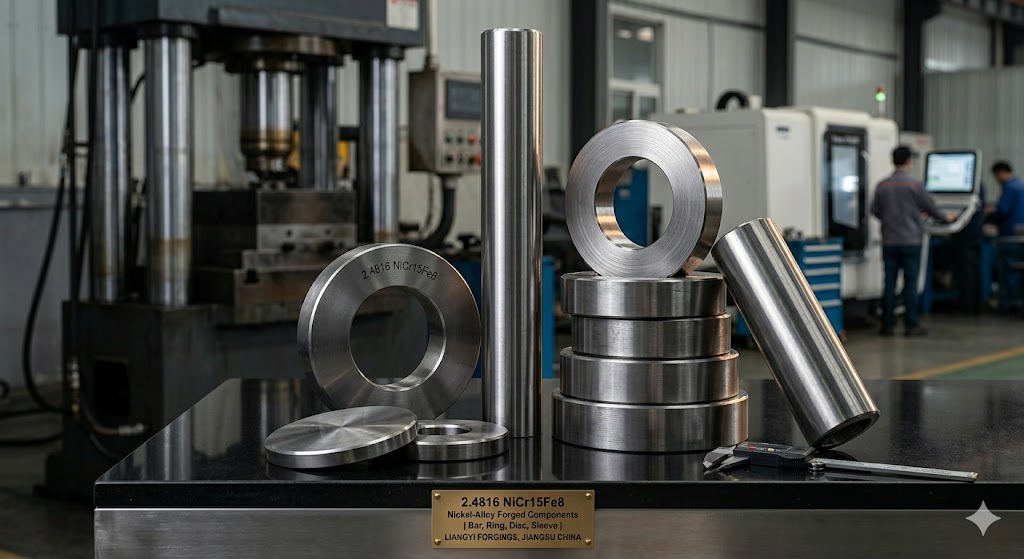
Forged Bars & Rods
- Round bars: up to 2000mm diameter, 30 tons weight
- Square bars, flat bars and rectangular bars
- Step shafts, gear shafts and turbine shafts
- Custom forged rods for high-temperature applications
Seamless Rolled Rings
- Seamless rolled rings up to 6000mm diameter
- Contoured rings and gear rings
- Pressure vessel rings and flange blanks
- Heavy-duty rings for rotating equipment
Hollow Forged Components
- Hubs, housing shells and casings
- Sleeves, bushes and hollow bars
- Seamless forged pipes and tubes up to 3000mm OD
- Heavy wall cylinders for pressure applications
Discs, Plates & Blocks
- Forged discs and disks up to 3000mm diameter
- Plates, blocks and flanged blanks
- Tube sheets for heat exchangers up to 4000mm
- Custom forged blanks for machining
Available Supply Specifications — Jiangsu Liangyi Standard Capability
The table below reflects our standard production capability for 2.4816 / NiCr15Fe / NiCr15Fe8 forgings. Non-standard dimensions outside these ranges can be quoted on request. All dimensions are in the as-forged or rough-turned (RT) condition unless otherwise specified.
| Product Form | OD / Width Range (mm) | Wall / Height Range (mm) | Length / Max Weight | Surface Condition | Typical Tolerance |
|---|---|---|---|---|---|
| Seamless Rolled Ring | 300 – 6,000 | 50 – 1,500 | ≤ 30,000 kg | As-forged / RT | DIN EN ISO 3346 / Drawing |
| Round Bar / Billet | 80 – 2,000 | — | L ≤ 6,000 mm / ≤ 15,000 kg | As-forged / RT / Turned | +5 mm / -0 mm (RT) |
| Disc / Plate / Block | 200 – 3,000 | 30 – 800 | ≤ 20,000 kg | As-forged / RT | ±3 mm (machined face) |
| Tube Sheet | 400 – 4,000 | 30 – 500 | ≤ 25,000 kg | RT / Finish Machined | Per drawing / TEMA std |
| Hollow Bar / Sleeve | OD 150 – 1,500 | Wall 30 – 300 | L ≤ 4,000 mm | As-forged / RT | ±5 mm OD; ±3 mm wall |
| Step Shaft / Spindle | Max Ø 800 | — | L ≤ 8,000 mm / ≤ 8,000 kg | RT / Semi-machined | Per drawing |
RT = rough turned. All forgings are produced from triple melt (VIM+ESR+VAR) ingots. Custom sizes outside the above range can be arranged on enquiry. Tolerances quoted are standard; tighter tolerances available for machined parts.
Complete Material Data for 2.4816 (NiCr15Fe, NiCr15Fe8) Nickel-Chromium-Iron Superalloy
2.4816 (also known as NiCr15Fe or NiCr15Fe8) is a solid-solution strengthened nickel-chromium-iron superalloy renowned for excellent performance in extreme high-temperature and corrosive environments. It combines creep resistance, oxidation resistance and strong mechanical properties at temperatures up to 1000°C. The alloy is equivalent to Inconel® 600 (UNS N06600) under the American ASTM/AWS system and NA14 under the British BS standard.
Key Advantages of 2.4816 Superalloy
- Outstanding creep and rupture strength at elevated temperatures
- Excellent resistance to oxidation and carburization up to 1000°C
- Superior corrosion resistance to hot acids, alkalis and other chemicals
- Good weldability and fabricability without post-weld cracking risk
- Stable microstructure under long-term high-temperature exposure
- Resistant to stress corrosion cracking (SCC) in chloride environments — a key advantage over austenitic stainless steels
Chemical Composition (wt%)
| Element | Min | Max | Typical (Liangyi VIM Heat) |
|---|---|---|---|
| Nickel (Ni) | 72.0 | — | 73.5–76.0 |
| Chromium (Cr) | 14.0 | 17.0 | 14.5–16.5 |
| Iron (Fe) | 6.0 | 10.0 | 7.0–9.5 |
| Carbon (C) | — | 0.10 | 0.04–0.08 |
| Silicon (Si) | — | 0.50 | 0.10–0.30 |
| Manganese (Mn) | — | 1.00 | 0.20–0.50 |
| Copper (Cu) | — | 0.50 | ≤ 0.15 |
| Sulfur (S) | — | 0.015 | ≤ 0.005 |
"Typical (Liangyi VIM Heat)" values represent actual production data from our recent heats. Individual heat chemistry will be provided on the Mill Test Certificate.
Mechanical Properties at Room Temperature (Delivery Condition — Annealed)
| Property | Test Condition | Min Value | Typical Range | Test Standard |
|---|---|---|---|---|
| Tensile Strength (Rm) | 23°C | 550 MPa | 585–830 MPa | ASTM E8 |
| 0.2% Yield Strength (Rp0.2) | 23°C | 205 MPa | 240–620 MPa | ASTM E8 |
| Elongation (A50) | 23°C | 30% | 30–50% | ASTM E8 |
| Reduction of Area | 23°C | — | 55–70% | ASTM E8 |
| Hardness | 23°C | — | 75–95 HRB | ASTM E18 |
| Impact Energy (CVN) | 23°C | — | ≥ 100 J | ASTM E23 |
High-Temperature Mechanical Properties
The data below represents tensile properties at elevated temperatures for annealed 2.4816 forgings. These values are critical for engineering calculations in heat exchanger tube sheet design, pressure vessel code compliance and nuclear component qualification. All data verified by our in-house testing laboratory at ±2°C temperature accuracy.
| Temperature | Tensile Strength (MPa) | 0.2% Yield (MPa) | Elongation (%) | Typical Application |
|---|---|---|---|---|
| 200°C | ≥ 510 | ≥ 170 | ≥ 30 | Heat exchanger channel flanges |
| 400°C | ≥ 470 | ≥ 150 | ≥ 30 | Pressure vessel nozzles |
| 600°C | ≥ 400 | ≥ 135 | ≥ 32 | Steam generator forgings |
| 650°C | ≥ 350 | ≥ 125 | ≥ 35 | Nuclear reactor components |
| 800°C | ≥ 200 | ≥ 100 | ≥ 40 | Furnace fixtures, retorts |
| 1000°C | ≥ 70 | ≥ 40 | ≥ 50 | Upper service temperature limit |
Creep & Stress Rupture Properties — Critical Data for Long-Term Service
For parts that operate under sustained load at high temperature — such as nuclear containment rings, steam generator tube sheets and furnace retorts — creep and stress rupture strength govern the design life far more than tensile strength. The following rupture data is based on published literature for annealed NiCr15Fe (Inconel® 600-equivalent) material and is representative of the property range achievable from triple melt forgings in the annealed condition. Values should be confirmed against your applicable design code before use in engineering calculations.
| Temperature | Stress for 100h Rupture (MPa) | Stress for 1,000h Rupture (MPa) | Creep Rate at 100 MPa (%/1000h) |
|---|---|---|---|
| 538°C (1000°F) | ≥ 310 | ≥ 230 | < 0.1 |
| 650°C (1200°F) | ≥ 170 | ≥ 120 | < 0.3 |
| 760°C (1400°F) | ≥ 90 | ≥ 60 | < 1.0 |
| 870°C (1600°F) | ≥ 45 | ≥ 28 | < 3.0 |
Physical & Thermal Properties
These properties are essential for thermal stress calculations, heat exchanger design, finite element analysis (FEA) and process equipment engineering. All values are for annealed condition unless stated.
| Property | Value at 20°C | Value at 500°C | Value at 800°C | Unit |
|---|---|---|---|---|
| Density | 8.47 | 8.30 | 8.10 | g/cm³ |
| Melting Range | 1354–1413°C (2469–2575°F) | — | ||
| Thermal Conductivity | 14.8 | 18.6 | 23.4 | W/(m·K) |
| Specific Heat Capacity | 444 | 510 | 560 | J/(kg·K) |
| Mean Thermal Expansion (20°C to T) | — | 13.3 × 10⁻⁶ | 14.8 × 10⁻⁶ | /K |
| Young's Modulus (E) | 214 | 186 | 165 | GPa |
| Shear Modulus (G) | 76 | 66 | — | GPa |
| Poisson's Ratio | 0.29 | — | — | — |
| Electrical Resistivity | 1.03 | 1.17 | 1.28 | μΩ·m |
| Magnetic Permeability | < 1.01 (non-magnetic) | — | ||
Corrosion Performance in Common Industrial Media
Unlike generic "good corrosion resistance" claims found on most datasheets, the table below provides environment-specific performance ratings based on our customers' long-term field feedback across 20+ years of 2.4816 forging supply. Ratings reflect typical behaviour at moderate concentrations and temperatures; always confirm with your corrosion engineer for specific process conditions.
| Corrosive Medium | Concentration / Temp | 2.4816 Performance | Corrosion Rate (mm/year) | Notes |
|---|---|---|---|---|
| Caustic (NaOH) | 50%, up to 120°C | ■ Excellent | < 0.025 | Superior to 316L in hot caustic; preferred in paper mill digesters |
| Nitric Acid (HNO₃) | 10–50%, 60°C | ■ Excellent | < 0.05 | Ni content provides strong resistance; suitable for pickling tanks |
| Hydrochloric Acid (HCl) | < 5%, < 60°C | ● Good | 0.1–0.5 | Reducing acid limits performance above 5% or >80°C; consider Hastelloy® C-276 for severe HCl |
| Sulfuric Acid (H₂SO₄) | < 10%, < 50°C | ● Good | 0.1–0.8 | Only recommended at low concentration; Alloy 20 or 2.4856 preferred for concentrated H₂SO₄ |
| Seawater / Chloride brine | 3.5% NaCl, ambient | ● Good | < 0.025 | Resistant to SCC which makes it superior to 304/316 SS in chloride service |
| Hydrogen Sulfide (H₂S / sour gas) | Up to 200 ppm, 80°C | ■ Excellent | < 0.01 | NACE MR0175 / ISO 15156 compliant; ideal for wellhead and Christmas tree parts |
| Oxidizing atmosphere | Air/O₂, up to 1000°C | ■ Excellent | < 0.02 mg/cm²·h | Chromium oxide layer provides sustained protection; continuous use limit 1000°C |
| Carburizing atmosphere | CO/CH₄, 900°C | ■ Excellent | Negligible | One of the primary selection reasons for furnace fixtures and retorts |
| Organic acids (acetic, formic) | Dilute, < 80°C | ■ Excellent | < 0.05 | Common in food processing and pharmaceutical equipment |
| Phosphoric Acid (H₃PO₄) | Up to 85%, ambient | ● Good | 0.1–0.3 | Adequate for non-contaminated phosphoric acid; Mo-containing alloys preferred with Cl⁻ present |
| Hydrofluoric Acid (HF) | Any concentration | ✕ Poor | > 1.0 | HF attacks nickel alloys aggressively; use Monel 400 (2.4360) instead |
Rating key: ■ Excellent (<0.1 mm/y) | ● Good (0.1–0.5 mm/y) | ◑ Limited (0.5–1.0 mm/y) | ✕ Poor (>1.0 mm/y). Data reflects annealed condition. Sensitized, cold-worked or heavily stressed material may perform differently.
2.4816 vs Related Nickel Superalloys — Engineering Selection Guide
| Designation | Ni (%) | Cr (%) | Mo (%) | Max Temp (°C) | Tensile (MPa) | Best For | Relative Cost |
|---|---|---|---|---|---|---|---|
| 2.4816 / NiCr15Fe (Inconel® 600) | ≥72 | 14–17 | — | 1000 | 585–830 | Nuclear, caustic, oxidizing HT | $ |
| 2.4856 / NiCr22Mo9Nb (Inconel® 625) | ≥58 | 20–23 | 8–10 | 980 | 690–960 | Aerospace, seawater, subsea | $$$ |
| 2.4819 / NiMo16Cr15W (Hastelloy® C-276) | ≥57 | 14–16.5 | 15–17 | 1040 | 690–930 | Severe acid/chloride corrosion | $$$$ |
| 2.4668 / NiCr19Fe19Nb5Mo3 (Inconel® 718) | ≥50 | 17–21 | 2.8–3.3 | 650 | 1240–1380 | High-strength aerospace/oil & gas | $$$ |
| 1.4539 / X1NiCrMoCu25-20-5 (Alloy 904L) | 23–28 | 19–23 | 4–5 | 400 | 490–690 | Sulfuric acid, phosphoric acid | $$ |
Welding & Fabrication Guide for 2.4816 NiCr15Fe NiCr15Fe8 Forgings
One of the practical advantages of 2.4816 over many precipitation-hardened nickel alloys is its excellent weldability. It does not need pre-weld heat treatment in most applications, and the risk of heat-affected zone (HAZ) cracking is low when correct procedures are followed. The guidance below is based on our engineering team's accumulated experience supporting customers through weld qualification of 2.4816 forgings.
Recommended Welding Consumables
| Welding Process | Filler Metal / Electrode | AWS / EN Classification | Notes |
|---|---|---|---|
| TIG / GTAW | ERNiCr-3 | AWS A5.14 | Most common; excellent for precision root passes and thin-wall tube sheets |
| MIG / GMAW | ERNiCr-3 | AWS A5.14 | Suitable for thick-section weld filling; use spray or pulsed transfer mode |
| SMAW (Stick) | ENiCrFe-3 | AWS A5.11 | For site welding and repair; lower deposition quality than TIG — confirm with EPC/owner for nuclear apps |
| SAW (Submerged Arc) | ERNiCr-3 wire + matching flux | AWS A5.14 | Used for heavy-section tube sheet cladding and weld overlay; confirm flux composition is NiCr-compatible |
| Dissimilar joint to carbon steel | ERNiCrMo-3 (Alloy 625-type) | AWS A5.14 | Higher Mo content buffers dilution effects at the fusion line; preferred over ERNiCr-3 for CS/NiCr15Fe joints |
Preheat, Interpass Temperature & Post-Weld Treatment
- Preheat: Not needed for section thickness ≤ 25 mm at ambient temperature above 10°C. For sections > 25 mm or temperatures below 5°C, preheat to 50–80°C to prevent moisture-induced porosity.
- Maximum Interpass Temperature: 150°C. Exceeding this may cause grain boundary carbide precipitation (sensitization) which reduces corrosion resistance in aggressive media.
- Post-Weld Annealing (PWHT): It is generally not needed for structural joints. For nuclear-specification applications and for joints that will see hot caustic or high-temperature oxidizing service, post-weld annealing at 900–980°C followed by rapid air or water quench is recommended to restore full corrosion resistance.
- Stress Relief: Stress relief at sub-sensitizing temperatures (400–600°C) is not recommended — it can trigger carbide precipitation without fully relieving weld stresses. Either full anneal or leave as-welded.
When to Choose 2.4816 vs Alternative Alloys — Engineering Decision Guide
Choosing the wrong nickel alloy for a forging project is one of the most expensive mistakes in process equipment engineering — either through premature failure or unnecessary overspend on a premium alloy when 2.4816 was perfectly adequate. Based on thousands of enquiries we have processed over 25 years, the following guide reflects the most common decision scenarios we see in the field.
Temperature Range vs Alloy Selection
- If environment is non-oxidizing and chloride-free, austenitic SS may be sufficient
- Cost advantage: 316L is 4–6× cheaper than 2.4816
- Switch to 2.4816 if: SCC risk is present, caustic concentration > 30%, or high cyclic thermal loading
- Optimal balance of oxidation resistance, creep strength and cost
- Superior to 304/316 which suffers sigma phase embrittlement above 500°C
- Better SCC resistance than duplex SS in this range
- Nuclear parts, heat exchangers, valve bodies: first choice
- Above 800°C, grain growth in 2.4816 accelerates under cyclic loading
- For sustained >900°C: consider Inconel® 625 (2.4856) or Alloy 602CA (2.4633)
- Exception: furnace fixtures under non-stress-bearing loads can use 2.4816 up to 1000°C
Corrosive Environment vs Alloy Selection
- Hot caustic (NaOH) > 30%, any temperature
- Oxidizing/carburizing atmosphere < 1000°C
- Sour gas (H₂S/CO₂) — NACE MR0175 service
- Dilute acids at moderate temperatures
- Nuclear radiation environment
- Chloride SCC risk (replaces 304/316 SS)
- Seawater immersion with high flow velocity (erosion-corrosion)
- Subsea or offshore environments > 3 years service
- High-strength requirement (>690 MPa Rm) at moderate temperature
- Mixed acid environments with variable Cl⁻ content
- Concentrated HCl (>5%) at any temperature
- Hot concentrated H₂SO₄ or mixed acid environments
- Wet chlorine or chlorinated solvents
- Strong reducing acids with oxidizing impurities
Advanced Triple Melt Manufacturing Process for 2.4816 NiCr15Fe NiCr15Fe8 Forgings in China
At our Jiangyin factory, we use state-of-the-art manufacturing processes to produce high-quality 2.4816 forged parts that exceed industry standards. Our full in-house production chain allows us to control every step from raw material to finished product.
Premium Triple Melt Process
All our NiCr15Fe forgings are produced in a rigorous triple melt process. That guarantees great material purity and homogeneity, which is important for nuclear power and aerospace applications:
- Vacuum Induction Melting (VIM): Removes impurities and controls chemical composition precisely to ±0.1% on all major elements
- Electroslag Remelting (ESR): Refines the grain matrix, removes sulfide and oxide inclusions, and improves mechanical properties
- Vacuum Arc Remelting (VAR): Deletes macro-segregation and internal shrinkage porosity; ensures the ingot cross-section has < 5 mm maximum inclusion size, verifiable by ultrasonic billet inspection
Precision Forging & Heat Treatment
We use 2000-6300 ton hydraulic presses and 1-5 meter seamless rolling machines to forge 2.4816 parts to near-net shape, reducing material waste and machining costs. Our heat treatment process is carefully controlled to achieve the desired mechanical properties, compliant with ASTM A370 standards:
- Annealing: 871–982°C (1600–1800°F) for 10–15 minutes per 25 mm of section thickness (minimum 30 minutes)
- Cooling: Water quenching preferred for maximum grain boundary cleanliness; air cooling acceptable for non-corrosive service applications
- All heat treatment furnaces are equipped with calibrated thermocouples and temperature recorders; furnace temperature uniformity records are available as part of our standard production file
- Custom heat treatment available to meet specific project requirements, including customer-witnessed thermal cycles
CNC Machining & Finishing
We offer complete in-house CNC machining services to deliver finished parts ready for assembly. We can turn up to 6,000 mm in diameter, mill, drill, gun-drill (deep holes), grind, and treat surfaces. The roughness of the surface can be anywhere from Ra 0.8 to 6.3 µm, depending on the type of machining.
Comprehensive Quality Control & Testing for 2.4816 Forgings
Quality is our top priority at Jiangsu Liangyi. We implement a strict quality management system based on ISO 9001:2015 and perform comprehensive testing on all 2.4816 forging parts to ensure they meet your specifications.
Full In-House Testing Capabilities
- Chemical Composition Analysis: Optical emission spectrometer (OES) analysis for every heat — results included in MTC
- Mechanical Testing: Room temperature and elevated temperature tensile tests, hardness (Brinell, Rockwell, Vickers), Charpy CVN impact testing
- Nondestructive Testing (NDT): 100% ultrasonic inspection (UT) per ASTM A388 / EN 10228-3; magnetic particle testing (MT); penetrant testing (PT)
- Metallurgical Analysis: Macro and microstructure examination, grain size analysis per ASTM E112, inclusion rating per ASTM E45
- Dimension Inspection: Precision dimensional measurement; CMM available for complex geometries upon request
- Intergranular Corrosion Testing (IGC): Per ASTM A262 Practice C — available upon request via our partner accredited laboratory, for nuclear and chemical applications
Certifications & Documentation
- ISO 9001:2015 — Our only held quality management system certification. Certificate available for download upon request.
- EN10204 3.1 Mill Test Certificates — Issued as standard with every order: full chemical composition, mechanical test results and NDT results signed by our QC Manager.
- EN10204 3.2 Mill Test Certificates — Available upon request when customer arranges a third-party inspector (BV, SGS, TUV, Intertek, CCIC or customer-nominated body) to witness testing. We coordinate inspection scheduling at no extra charge.
- Third-party inspection — BV, SGS, TUV, Intertek, CCIC and customer-nominated inspectors welcome at any stage of production.
- Nuclear-code documentation support — We can prepare material traceability packages and production records in formats suitable for customer submission to RCC-M, ASME NQA-1 or HAF 604 qualification audits. Note: formal nuclear code qualification status must be granted by the nuclear plant owner or EPC — Jiangsu Liangyi does not hold independent nuclear code certification. Customers requiring nuclear-qualified suppliers should confirm specific qualification requirements with their project engineer.
- Full material traceability — From raw material heat to finished forging: heat number, spectrometer certificates, heat treatment records and NDT reports are retained for a minimum of 10 years.
Industrial Applications & Typical Project Examples of 2.4816 NiCr15Fe NiCr15Fe8 Forgings
NiCr15Fe8 forgings from Jiangsu China are widely used in industries that require components to withstand high temperatures, high pressures and corrosive environments. The project examples below are illustrative of the type of work we regularly undertake — they represent the typical specifications, challenges and solutions encountered in our daily production. For reference to specific completed projects, please visit our Reference page or contact our sales team.
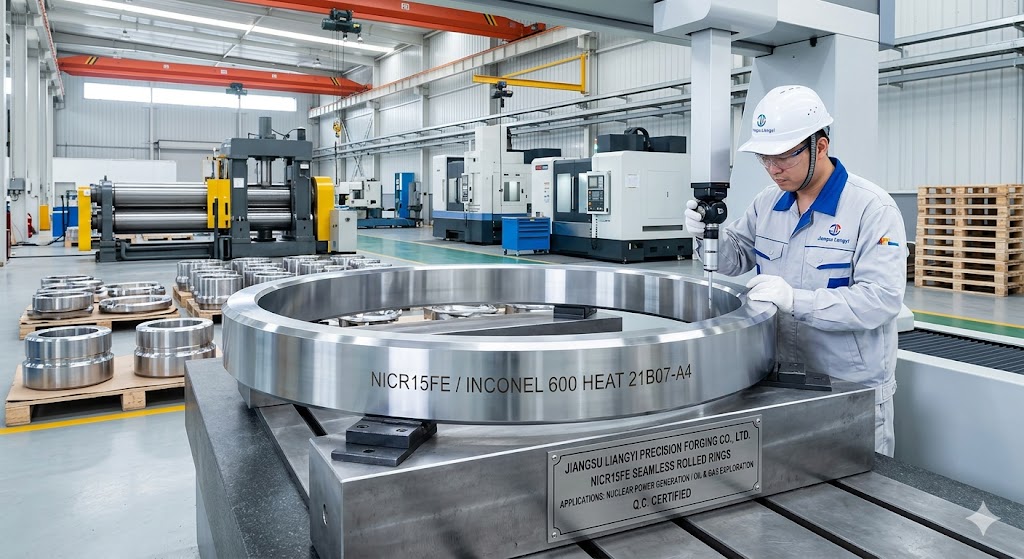
Steam Generator Component Rings — PWR Plant Specification Example
Nuclear steam generator parts frequently require tight UT acceptance criteria (tighter than standard commercial ASTM A388 levels), confirmed chemical composition by OES on every heat, and EN10204 3.2 MTCs witnessed by a customer-nominated or owner-approved third-party inspector. Dimensional tolerances are typically ±0.5–1.0 mm on rough-turned OD/ID and face.
For nuclear-specification enquiries, we recommend customers specify all acceptance criteria explicitly in their RFQ — UT acceptance level (FBH equivalent size), MTC level (3.1 or 3.2), TPI body preference, and any project-specific documentation requirements. We then confirm compliance item by item in our technical quotation so there are no surprises at inspection. Customers should note that formal nuclear code qualification (RCC-M, ASME NQA-1, HAF 604) is granted by the nuclear plant owner or EPC — not by the forging supplier — and we encourage customers to confirm their specific qualification chain requirements.
Wellhead & Christmas Tree Valve Body Forgings — Sour Service Specification
Carbon steel and austenitic stainless steels (304/316) are susceptible to sulfide stress cracking (SSC) and CO₂ corrosion in environments containing H₂S. 2.4816 (NiCr15Fe8) with its ≥72% nickel content is highly resistant to SSC and complies with NACE MR0175 / ISO 15156 hardness requirements (typically 78–90 HRB in the annealed condition, well within the ≤ 35 HRC limit). This makes it a cost-effective upgrade for wellhead parts in sour gas fields compared to more expensive Alloy 625 (2.4856), provided the application does not require the higher strength or pitting resistance that molybdenum provides.
API 6A orders typically include: EN10204 3.1 MTC with full chemistry and mechanical results; 100% UT per API 6A Appendix D; hardness mapping (minimum 3 locations per part); dimensional report; and a material compliance statement referencing NACE MR0175. PSL-2 and PSL-3 documentation packages available upon specification.
Heat Exchanger Tube Sheets — Hot Caustic (NaOH) Service
Nickel is one of the few structural metals with inherent resistance to all concentrations of hot sodium hydroxide (NaOH). Titanium — often considered a corrosion-resistant alternative — is in fact susceptible to pitting and SCC in hot concentrated caustic above 80°C. Duplex and austenitic stainless steels suffer SCC in NaOH above approximately 50% concentration. 2.4816's ≥72% nickel base makes it the industry-standard choice for chlor-alkali plants, paper mill digesters and chemical evaporators in hot caustic service.
For tube sheet applications, customers should specify: final OD and thickness with tolerances; tube hole pattern and positional tolerance (we supply rough blanks; tube drilling is typically done by the heat exchanger fabricator); surface condition required (as-forged face, rough-turned or machined); and whether IGC testing (ASTM A262 Practice C) is required after final machining. We can arrange IGC testing via accredited partner laboratory — please include this in your RFQ.
Additional Application Areas
Valve & Pump Manufacturing
- Valve bodies, bonnets, stems and closures for high-temperature service
- Valve seat rings, cores and discs for high-temperature valves
- Butterfly valve main shafts and spindles
- Pump casings, impellers, shafts and wear rings
Other Industrial Applications
- Heat treatment furnace parts and vacuum furnace fixtures (continuous service to 1000°C)
- Thermocouple sheathing in aggressive atmospheres
- Gas compressor turbine blades and afterburner parts
- Paper mill alkaline digesters and chemical evaporators
- Vinyl chloride monomer production equipment
Common Pain Points Solved by Our 2.4816 NiCr15Fe NiCr15Fe8 Forgings
As a leading 2.4816 forging manufacturer in Jiangsu China, we understand the common pain points of industrial buyers and have designed our products and services to address them:
- Pain Point 1: Material Purity Issues – Solved by our premium triple melt process (VIM + ESR + VAR)
- Pain Point 2: Long Lead Times – Solved by our 120,000 tons annual production capacity and efficient production planning
- Pain Point 3: High Machining Costs – Solved by our near-net shape forging technology
- Pain Point 4: Quality Uncertainty – Solved by our ISO 9001:2015 certified quality system and 100% inspection before shipment
- Pain Point 5: Complex Custom Requirements – Solved by our expert technical team and in-house design optimization services
- Pain Point 6: Incomplete Documentation for Nuclear / PED – Addressed by our EN10204 3.1/3.2 MTC capability, full material traceability packages, and third-party inspection coordination. Note: nuclear code qualification (RCC-M, NQA-1, HAF 604) must be confirmed with your project EPC
- Pain Point 7: Sensitization Risk from Welding – Solved by our standard welding procedure document and post-weld annealing guidelines supplied with every order
Why Choose Jiangsu Liangyi as Your 2.4816 Forging Partner in China?
As a leading 2.4816 forging manufacturer in Jiangsu, China, we offer unmatched advantages that make us the preferred choice for global customers:
Unmatched Manufacturing Capabilities
- 25+ years of experience in superalloy forging
- 80,000㎡ modern factory with 120,000 tons annual production capacity
- Advanced equipment: 2000-6300 ton hydraulic presses, 5m seamless rolling machines
- Full in-house production: from melting to final machining
Superior Quality & Reliability
- ISO 9001:2015 certified quality management system
- Premium triple melt process for maximum material purity
- Comprehensive in-house testing facilities including high-temperature tensile lab
- 100% inspection before shipment with full digital traceability
Competitive Pricing & Fast Global Delivery
- Competitive USD pricing due to economies of scale and efficient production
- Fast lead times: 4–6 weeks for standard parts, 6–8 weeks for machined parts
- Global shipping to over 50 countries; FOB Tianjin/Shanghai, CIF and DDP terms available
- Flexible payment terms for regular customers; T/T, L/C accepted
Custom Solutions & Expert Technical Support
- Custom forgings manufactured to your exact drawings and specifications
- Expert technical support from our team of metallurgical engineers
- Material selection assistance, DFM (design for manufacturability) review and design optimization
- Prototype development and small batch production available (minimum 1 piece)
How to Order 2.4816 (NiCr15Fe, NiCr15Fe8) Forgings from Jiangsu Liangyi
Our procurement process is designed to be as straightforward as possible for international buyers. From your first enquiry to parts delivered at your facility, here is what to expect:
Packaging & Export Shipping
- Standard packaging: Export-grade wooden crate or steel frame, anti-rust paper + VCI film wrap, desiccant bags inside crate. All thread/bore openings protected with plastic plugs or wooden covers.
- Marking: Each piece laser or paint-stencil marked with heat number, part number, material designation, our factory name and net weight — fully traceable back to MTC.
- Shipping terms: FOB Tianjin / Shanghai, CIF to major world ports, or DDP door-to-door. Incoterms 2020.
- Freight partners: We work with COSCO, Hapag-Lloyd and Maersk for sea freight; DHL/FedEx for urgent air freight of documents or small samples.
- Export documentation: Commercial invoice, packing list, certificate of origin (CO), bill of lading, MTC, form E or RCEP certificate of origin for preferential tariff countries upon request.
MOQ & Pricing Notes
- Minimum Order Quantity: 1 piece for custom forgings. No minimum for repeat orders of standard sizes.
- Trial / Sample Orders: We accept single-piece trial orders for qualification purposes — at the same quality standard as production orders, with full MTC documentation.
- Price validity: Quotations are valid for 30 days. Nickel is an LME-traded commodity; prices beyond 30 days are subject to nickel price adjustment.
- Volume discounts: Available for orders > 5 tons or long-term blanket orders. Contact our sales team for framework agreement pricing.
2.4816 Forging Specification Checklist — What to Include in Your RFQ
To get an accurate quotation with no surprises, please include the following information in your enquiry. Missing items will delay the quotation or require follow-up questions:
- Forging drawing (PDF or DWG) with all dimensions, tolerances and surface finish requirements
- Material designation: confirm whether 2.4816, NiCr15Fe, NiCr15Fe8, UNS N06600 or Inconel® 600 is acceptable
- Applicable material standard (ASTM B564 / DIN 17742 / EN 10095 / customer-specific)
- Melting process required: triple melt (VIM+ESR+VAR) or standard (specify)
- Delivery condition: as-forged, annealed, rough-turned, semi-machined or fully machined
- NDT requirements: UT acceptance level (e.g., ASTM A388 Level 1 or 2), MT/PT required?
- MTC level required: EN10204 2.2, 3.1 or 3.2?
- Third-party inspection: yes/no, which TPI body?
- Special requirements: e.g. NACE MR0175, API 6A PSL level, nuclear documentation requirements (please note: nuclear code qualification such as RCC-M / NQA-1 / HAF 604 must be confirmed separately with your EPC)
- Required quantity and target delivery date
- Shipping terms: FOB / CIF / DDP, destination port
Frequently Asked Questions (FAQ) About 2.4816 NiCr15Fe NiCr15Fe8 Forgings
Request a Free Custom Quote for 2.4816 (NiCr15Fe, NiCr15Fe8) Forging Parts
Jiangsu Liangyi is your trusted 2.4816 forging supplier in China. We provide high-quality custom NiCr15Fe and NiCr15Fe8 forgings at competitive USD prices with fast global delivery and complete documentation packages.
Please send us your drawings, material requirements, quantity and delivery schedule. Our technical team will review your specification and provide a detailed quotation within 24 hours.
Contact Us Now