2.4665 (NiCr21Fe18Mo9) Forging Parts | China Leading Nickel Alloy Forging Manufacturer & Supplier
- Material Standard: W.Nr. 2.4665 / NiCr21Fe18Mo9 — EN 10095, DIN 17744
- Max Service Temperature: 1150°C continuous; 1200°C intermittent
- Tensile Strength: Min. 690 MPa (solution annealed, +AT condition)
- Key Alloying Elements: Ni (balance), Cr 20.5–23.0%, Fe 17–20%, Mo 8–10%
- Available Product Forms: Forged bars, rings, discs, pipes, shafts, custom shaped forgings
- Single-Piece Weight Range: 30 kg – 30 tons
- Quality Certification: ISO 9001:2015 (certified); products manufactured to API 6A, ASME VIII, NACE MR0175 requirements on request, with third-party inspection support (SGS / BV / TUV)
- Manufacturer: Jiangsu Liangyi Co., Limited — Jiangyin, Jiangsu, China (Est. 25+ years)
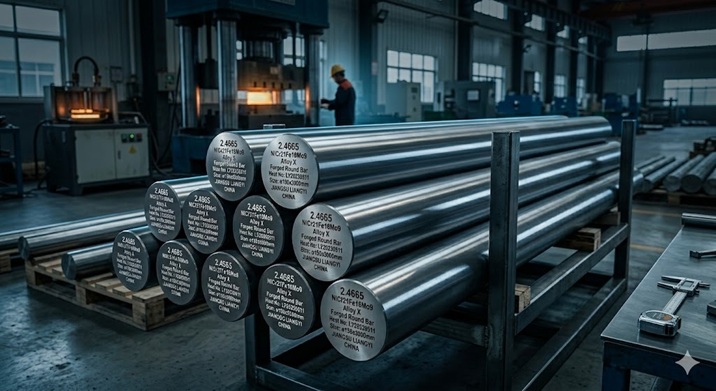
About 2.4665 (NiCr21Fe18Mo9) Nickel Alloy Forging Material
Jiangsu Liangyi Co., Limited, based in Jiangyin City, Jiangsu Province, China, is a professional manufacturer of 2.4665 (NiCr21Fe18Mo9) open die forging parts and seamless rolled forged rings, certified to ISO 9001:2015. With over 25 years of specialized forging experience, we supply high-performance 2.4665 NiCr21Fe18Mo9 forged parts to customers in more than 50 countries and regions, including Germany, the United States, the United Arab Emirates, Saudi Arabia, Singapore, and South Korea. Our products can be produced to meet customers’ international standards including DIN, EN, ASTM, AMS, and ASME material and inspection requirements. 2.4665 (NiCr21Fe18Mo9) is a top-grade precipitation-strengthened nickel-chromium-iron-molybdenum heat-resistant alloy. It has excellent high-temperature strength, oxidation resistance up to 1200°C, and excellent corrosion resistance in harsh industrial environments. The carefully adjusted molybdenum content provides superior structural stability and high strength in the solid solution alloy matrix, so that it is the best choice material for extreme working conditions involving high temperatures, high pressures, and strong corrosion.This high-performance nickel alloy is widely used for important aircraft parts, such as jet engine tailpipes, afterburners, turbine blades and vanes. Because of its excellent high-temperature mechanical properties and oxidation resistance, it is also widely used in industrial furnace equipment and fluid flow control systems that need better corrosion resistance, heat resistance and structural strength.
Material Standard & Grade Equivalence of 2.4665 (NiCr21Fe18Mo9)
Our 2.4665 NiCr21Fe18Mo9 forging material fully meets all important global industrial standards, with clear material grade equivalents to fit the purchasing needs of customers from different regions around the world.
- European Standard: W.Nr. 2.4665, NiCr21Fe18Mo9, fully meeting EN 10095 (Heat Resistant Nickel and Nickel Alloys)
- German Standard: DIN 17744 (Nickel Alloy Semi-Finished Products)
- Custom Grade Compliance: We can produce 2.4665 alloy forgings according to customer-specific technical standards and material specifications
All our 2.4665 forging parts are supplied with full EN 10204 3.1 / 3.2 Mill Test Certificates (MTC), and they are fully traceable from initial melting to finished products.
Full Range of Custom 2.4665 NiCr21Fe18Mo9 Forged Product Forms
We produce custom 2.4665 NiCr21Fe18Mo9 forging parts in many different shapes and sizes. Each part can weigh from 30kg up to 30 tons, to meet your specific project needs. Our product types match our main product range , including:
- 2.4665 Forged Steel Round Bars, Square Bars, Flat Bars, Rectangular Bars and Solid Rods (maximum diameter up to 2000mm)
- 2.4665 Forged Seamless Rolled Rings, Contoured Rings, Seal Rings and Custom Forging Rings (maximum diameter up to 6000mm)
- 2.4665 Forged Hubs, Housings, Shells, Sleeves, Bushes, Cases and Seamless Hollow Bars (maximum OD up to 3000mm)
- NiCr21Fe18Mo9 Forged Discs, Disks, Blocks, Plates, Flanged Blanks and Die Blocks (maximum diameter up to 3000mm)
- NiCr21Fe18Mo9 Forged Pipes, Tubes, Tubings, Piping Shells, Casings, Barrels and High-Pressure Vessel Shells
- Custom 2.4665 Forged Shafts, Valve Stems, Valve Seats, Turbine Blades, Fasteners and Intricate Shaped Forgings manufactured according to customer drawings
Industrial Applications & Verified Project Cases of 2.4665 NiCr21Fe18Mo9 Forging Parts
Our 2.4665 NiCr21Fe18Mo9 forged parts are widely used in important industrial sectors worldwide, with verified project cases and full meeting of industry-specific standards. Below are our core application scenarios and successful project references:
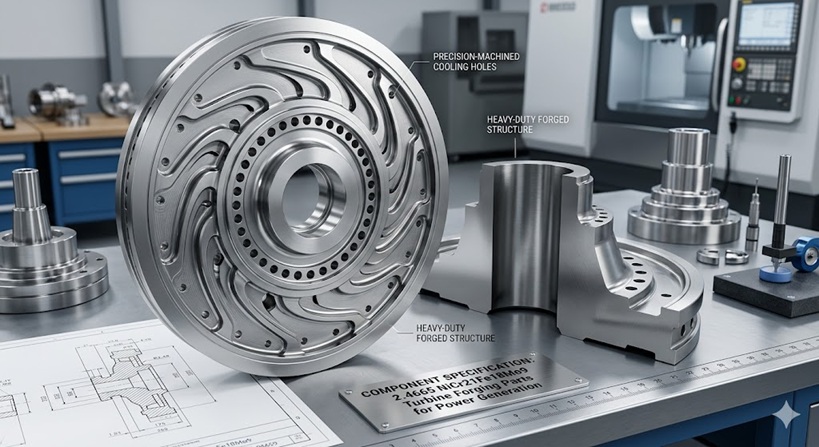
Aerospace & Aviation Industry
We have supplied custom 2.4665 NiCr21Fe18Mo9 forged parts to leading European aerospace companies, including jet engine tailpipes, afterburner parts, turbine blades, nozzle vanes and structural fasteners. These parts are produced to meet strict aviation material standards.They have stable long-term performance under extreme high-temperature (up to 1150°C) and high-load conditions. We support both small-batch prototype development and mass production for commercial aerospace projects.
Power Generation (Gas & Steam Turbines)
Our 2.4665 forging parts are widely used in thermal power plants and combined-cycle power stations across Southeast Asia and the Middle East. Typical applications include gas compressor turbine blades, nozzle vanes, gas and steam turbine disks, turbine impellers, turbine blisks, turbine guide rings, labyrinth seal rings and rotor end rings. We also make important turbine valve parts such as MSV/GV/CV/CRV valve seats, valve cores, valve sleeves, valve spindles/stems/rods, main steam valve covers and bonnets, as well as steam turbine control reheat valve discs for power plants. In addition, we supply high-strength turbine fasteners including double-headed studs, bolts and bolting for high-temperature turbine systems.
Oil & Gas, Petrochemical & Pressure Vessel Industry
For Middle East oil and gas upstream projects and petrochemical facilities worldwide, we provide NiCr21Fe18Mo9 forged pipes, tubes, shells, tubing barrels, tube sheets, baffle plates, nozzles, and channel flanges for boilers, heat exchangers, pressure vessels, reactors and heaters. These parts are used for high-pressure, high-temperature and highly corrosive oil and gas working environments. Our 2.4665 forgings can be produced to meet API 6A material requirements for wellhead equipment, ASME Section VIII material and NDE requirements for pressure vessels, as well as the chemical composition and hardness requirements of NACE MR0175 / ISO 15156 for H₂S sour service — all in line with customer project specifications and third-party inspection arrangements. We have supplied more than 200 batches of 2.4665 alloy forgings for wellhead equipment and pipeline projects in Saudi Arabia, the UAE and Kuwait.
Nuclear Power Industry
We manufacture nuclear-grade 2.4665 NiCr21Fe18Mo9 forged parts for domestic and international nuclear power projects, including flow limiter venturi forgings for steam generators, forged tubes for pressurizer surge lines, reactor nozzles and primary pump flywheels, divider plates for steam generators, latch housings, rod travel housings, containment plates, rings and closure heads, as well as other important pressure-bearing forgings for nuclear power systems. All nuclear-grade forgings are produced under strict quality control systems, with full traceability and third-party inspection support available.
Industrial Heat Treatment & General Engineering
Our 2.4665 alloy forgings are widely used in industrial furnace equipment by heat treatment manufacturers in Southeast Asia and Europe, including furnace rolls, hearth rolls, hot working dies, tooling, die blocks and moulds. The alloy’s excellent high-temperature creep resistance and oxidation resistance make its lifetime 30% longer than conventional heat-resistant steels, even under continuous operating temperatures up to 1100°C.
Chemical Composition of 2.4665 (NiCr21Fe18Mo9) Forging Material
The chemical composition of our 2.4665 NiCr21Fe18Mo9 forging material is strictly tested in our in-house chemical analysis laboratory, with full meeting of the standard content range as follows:
| Chemical Element | Standard Content Range (Weight %) |
|---|---|
| Carbon (C) | 0.05 - 0.15 |
| Chromium (Cr) | 20.5 - 23.0 |
| Cobalt (Co) | 0.5 - 2.5 |
| Iron (Fe) | 17.0 - 20.0 |
| Manganese (Mn) | 1.0 Max. |
| Molybdenum (Mo) | 8.0 - 10.0 |
| Nickel (Ni) | Balance |
| Silicon (Si) | 1.0 Max. |
| Tungsten (W) | 0.2 - 1.0 |
| Phosphorus (P) | 0.04 Max. |
| Sulfur (S) | 0.03 Max. |
Mechanical Properties & High Temperature Performance of 2.4665 NiCr21Fe18Mo9
Our 2.4665 NiCr21Fe18Mo9 forged round bars are strictly tested in our in-house mechanical testing laboratory, they all have stable mechanical properties in the +AT (solution annealed) condition. Main performance indicators are as follows:
- Tensile Strength (Rm): Minimum 690 MPa
- 0.2% Proof Strength (Rp0.2): Minimum 270 MPa
- Minimum Elongation at Fracture (A): Minimum 30%
- Hardness (HB): 180-220 HB (solution annealed condition)
High Temperature Stress-Rupture Performance
The stress-rupture data below shows the average rupture life strength of NiCr21Fe18Mo9 forging material at given temperatures and test durations, which is the main reference for high-temperature equipment design:
| Test Temperature | Test Duration | Average Rupture Strength |
|---|---|---|
| 1065°C | 10 hours | 26 MPa |
| 1065°C | 100 hours | 13 MPa |
| 1065°C | 1000 hours | 7 MPa |
| 1150°C | 10 hours | 12 MPa |
| 1150°C | 100 hours | 5 MPa |
| 1150°C | 1000 hours | 2 MPa |
Custom Forging Process & Heat Treatment Capability for 2.4665 Alloy
We provide a full range of service from steel melting, forging, heat treatment to machining and testing, with advanced forging and testing equipment to guarantee the highest quality of every 2.4665 NiCr21Fe18Mo9 forging part. Our main process capabilities include:
Full In-House Melting & Forging Process
- Melting: 30t Electric Arc Furnace (EAF) + 30t Ladle Refining Furnace (LF) + 30t Vacuum Degassing Furnace (VOD) + Intermediate Frequency Induction Furnace (IM), guaranteeing ultra-pure material quality and precise chemical composition control
- Forging Equipment: 6300 tons semi-automatic hydraulic forging press, 4000 tons hydraulic press, 2000 tons fast forging hydraulic press, 1-9 tons electro-hydraulic forging hammers,1m and 5m seamless ring rolling machines
- Forging Process: Strictly controlled forging temperature range (1150°C - 950°C) for 2.4665 alloy, with a minimum forging ratio of 4:1 to guarantee consistent internal matrix and eliminates casting defects
- Handling Equipment: 70 tons, 36 tons, 24 tons and 12 tons heavy-duty manipulators, supporting single-piece forging weight up to 35 tons
Specialized Heat Treatment for 2.4665 NiCr21Fe18Mo9
- Heat Treatment Equipment: 10+ industrial heat treatment furnaces with loading capacity from 20t to 80t, maximum length up to 16m, equipped with fully automatic temperature control system and heat treatment cycle recording system
- Core Process: Solution annealing treatment at 1150°C - 1200°C, with precise temperature control (±5°C) and rapid cooling process, to fully dissolve the alloy elements and ensure optimal mechanical properties and corrosion resistance
- Quenching Facilities: 4 sets of large quenching tanks (110m³ - 200m³) with automatic cooling system, supporting water quenching and polymer solution quenching according to material requirements
Quality Assurance & Certifications for 2.4665 Alloy Forgings
To make sure our 2.4665 NiCr21Fe18Mo9 forging parts meet the highest quality and standard requirements, we have set up a strict full-process quality control system, along with complete certifications and full testing abilities.
Held Certifications
- ISO 9001:2015 — Quality Management System Certification (certificate held; available for customer verification upon request)
Standards Our Products Can Be Manufactured To (On Customer Request)
While our held certification is ISO 9001:2015, our production process and quality control capabilities allow us to manufacture 2.4665 NiCr21Fe18Mo9 forging parts to meet the material and inspection requirements of the following industry standards — subject to customer-specified project requirements and third-party inspection:
- ISO 3834-2: Welding quality requirements — comprehensive; our welding procedures and welder qualifications are maintained to equivalent standards, with documentation available
- PED 2014/68/EU: Products can be manufactured to meet the essential safety requirements of the EU Pressure Equipment Directive; CE marking requires customer's Notified Body involvement
- API 6A: Forgings can be manufactured to meet API 6A material and dimensional requirements for wellhead equipment; customers with API Monogram licenses may specify API 6A as the governing product standard
- ASME Section VIII: Pressure-retaining forgings can be manufactured to ASME Section VIII material and NDE requirements; ASME U stamp is the customer's pressure vessel manufacturer's responsibility
- NACE MR0175 / ISO 15156: Our 2.4665 NiCr21Fe18Mo9 forgings meet the chemical composition and hardness requirements specified in NACE MR0175 for sour service (H₂S-containing) environments
Full-Process Testing & Inspection Capabilities
- Chemical Analysis: In-house direct-reading spectrometer, guaranteeing strict control of each element content
- Mechanical Testing: Universal mechanical testing machine, high-temperature tensile testing machine, high-temperature creep testing machine, impact testing machine, hardness tester
- Non-Destructive Testing (NDT): 100% Ultrasonic Testing (UT) according to ASTM A388, Magnetic Particle Testing (MT) according to ASTM A275, Penetrant Testing (PT) according to ASTM A165, with certified NDT inspectors
- Metallographic Testing: Metallographic microscope, grain size testing, inclusion rating and microstructure analysis
- Third-Party Inspection: Support SGS, BV, TUV and other international third-party inspection services according to customer requirements
Global Grade Equivalents of 2.4665 NiCr21Fe18Mo9: ASTM, UNS, AMS, ASME & International Cross-Reference
One of the most practical challenges our international customers face is matching the European material number W.Nr. 2.4665 / NiCr21Fe18Mo9 to their own national purchasing standards. With over 25 years of supplying this alloy to industrial buyers in North America, the Middle East, Europe, and Asia-Pacific, we have put together a complete and verified cross-reference table that covers all active material standards used in real global purchasing projects. 2.4665 (NiCr21Fe18Mo9) is the European name for the alloy widely known globally asAlloy X or Hastelloy® X, with the unified UNS designation N06002. The alloy is the same across all systems, confirmed by its chemical makeup: Ni (balance), Cr 20.5–23.0 wt%, Fe 17.0–20.0 wt%, Mo 8.0–10.0 wt%, Co 0.5–2.5 wt%, W 0.2–1.0 wt%, C 0.05–0.15 wt% — this exact composition clearly matches all the standards listed below.
Trademark Notice: Hastelloy® is a registered trademark of Haynes International, Inc. Jiangsu Liangyi Co., Limited manufactures generic 2.4665 / UNS N06002 alloy forgings conforming to equivalent chemistry and mechanical property requirements, and is not affiliated with or endorsed by Haynes International, Inc.
Complete 2.4665 / NiCr21Fe18Mo9 International Grade Cross-Reference Table
| Standard System | Designation / Grade | Standard Title / Application Scope |
|---|---|---|
| European (EN) | W.Nr. 2.4665 / NiCr21Fe18Mo9 | EN 10095: Heat Resistant Nickel and Nickel Alloys — strips, sheets, plates, bars, wires, forgings |
| German (DIN) | NiCr21Fe18Mo9 / 2.4665 | DIN 17744: Nickel Alloys — chemical composition and delivery condition |
| UNS (USA) | UNS N06002 | Unified Numbering System — master alloy designation used across ASTM, ASME, AMS systems |
| ASTM B435 | UNS N06002 | Standard Specification for Ni-Cr-Mo-Fe Alloys — Plate, Sheet, and Strip |
| ASTM B572 | UNS N06002 | Standard Specification for UNS N06002 — Rod (forged / hot-rolled bar) |
| ASTM B619 | UNS N06002 | Standard Specification for Welded Nickel and Nickel-Cobalt Alloy Pipe |
| ASTM B622 | UNS N06002 | Standard Specification for Seamless Nickel and Nickel-Cobalt Alloy Pipe and Tube |
| ASTM B626 | UNS N06002 | Standard Specification for Welded Nickel and Nickel-Cobalt Alloy Tube |
| ASME SB-435 | UNS N06002 | ASME Boiler & Pressure Vessel Code Section II Part B — Plate, Sheet and Strip (pressure vessel use) |
| ASME SB-572 | UNS N06002 | ASME Section II Part B — Rod for pressure-retaining components |
| ASME SB-622 | UNS N06002 | ASME Section II Part B — Seamless Pipe and Tube for high-temperature pressure systems |
| AMS 5536 | UNS N06002 | SAE Aerospace Material Specification — Sheet, Strip, and Plate (solution annealed condition) |
| AMS 5754 | UNS N06002 | SAE AMS — Sheet, Strip, and Plate (annealed, for aerospace structural applications) |
| AMS 5390 | UNS N06002 | SAE AMS — Bar, Rod, and Wire (solution heat-treated, for aerospace rotating components) |
| AMS 5798 | UNS N06002 | SAE AMS — Welding Wire (ERNiCrMo-2 filler wire for TIG/MIG welding of 2.4665/Alloy X components) |
| British Standard | HR3 (Alloy X) | BS 3076: Specification for Nickel and Nickel Alloys — bar and billet for heat-resisting applications |
| Trade Name | Hastelloy® X / Alloy X | Widely used commercial designation; Hastelloy® is a registered trademark of Haynes International. Jiangsu Liangyi produces generic 2.4665 / UNS N06002 conforming to equivalent chemistry and properties. |
Procurement Note from Our Engineering Team: If your order refers to AMS 5390 or ASTM B572, please check your project specifications to see whether a specific heat treatment condition (+AT solution annealed or cold-worked) is required, as this will decide the acceptable mechanical property standards. Our technical sales team will meet your exact standard requirements — just provide your standard number, and we will confirm compliance and issue the MTC accordingly.
Physical Properties of 2.4665 (NiCr21Fe18Mo9) — Density, Thermal Expansion, Conductivity & Elastic Modulus
Physical properties are engineering constants that control how a forged part performs in use — they affect thermal fatigue life, interference fit sizes, and structural bending under load. For 2.4665 NiCr21Fe18Mo9, these values change with temperature: they differ greatly between room temperature and operating temperature. That is why our engineering team always provides data at different temperatures instead of single fixed values. The table below shows standard reference values for UNS N06002 in the solution annealed (+AT) condition, compiled from industry technical documents and ASM material handbooks.
Ambient Temperature Physical Properties
| Physical Property | Value | Engineering Significance |
|---|---|---|
| Density | 8.22 g/cm³ (20°C) | Used for weight calculation of finished forgings; slightly higher than 316L stainless (8.00 g/cm³) after accounting for Mo and Ni addition |
| Melting Range | 1260°C – 1355°C | Determines the safe upper limit for our forging temperature window (950°C – 1150°C) and solution annealing temperature (1150°C – 1200°C) |
| Electrical Resistivity | 1.16 μΩ·m (20°C) | Relevant for resistance heating applications and eddy current NDT calibration during incoming inspection |
| Magnetic Permeability | ~1.002 μr (essentially non-magnetic) | Important for MRI equipment, nuclear instrumentation, and applications requiring non-magnetic forgings. 2.4665 remains non-magnetic even after cold working. |
| Specific Heat Capacity | 486 J/(kg·K) at 21°C | Determines heat energy stored in the forging during heat treatment — our furnace engineers factor this into soak time calculations for heavy cross-section forgings above 500mm diameter |
| Thermal Conductivity | 9.1 W/(m·K) at 20°C | Relatively low vs steel — means slower heat penetration during quenching; for heavy section forgings we use agitated quenching tanks to compensate |
| Modulus of Elasticity (E) | 205 GPa at 20°C | Structural stiffness reference for room temperature component design; decreases significantly at elevated temperatures — see high-temperature table below |
Temperature-Dependent Physical Properties of 2.4665 NiCr21Fe18Mo9
The following data is essential for thermal stress analysis, interference fit calculations at operating temperature, and creep-fatigue design. Values shown reflect the annealed (+AT) material condition used in our standard forging deliveries.
| Temperature | Mean Thermal Expansion Coefficient (μm/m·K, from 21°C) | Thermal Conductivity (W/m·K) | Modulus of Elasticity (GPa) |
|---|---|---|---|
| 93°C | 13.3 | 10.4 | 202 |
| 205°C | 13.9 | 11.7 | 198 |
| 315°C | 14.4 | 13.1 | 194 |
| 425°C | 14.8 | 14.4 | 189 |
| 540°C | 15.1 | 15.7 | 185 |
| 650°C | 15.5 | 17.0 | 180 |
| 760°C | 16.2 | 18.3 | 165 |
| 870°C | 16.5 | 19.4 | 157 |
| 980°C | 16.9 | 20.6 | 148 |
Manufacturer's Note on Thermal Expansion in Forged Components: When designing shrink-fit assemblies or calculating bore sizes for turbine disc forgings at operating temperature, keep in mind that the average thermal expansion coefficient at 760°C (16.2 μm/m·K) is about 22% higher than its room-temperature value. Procurement teams using only single-value data sheets often overlook this difference. Our applications engineering team offers free thermal expansion calculation support for intricate assemblies upon request.
2.4665 NiCr21Fe18Mo9 vs. Other High-Temperature Nickel Alloys: Manufacturer's Material Selection Guide
In over 25 years of producing forgings from different nickel alloy grades, our engineering team has seen a consistent pattern: engineers usually shortlist 2.4665 along with three to five other alloys before making a final choice. The decision is rarely simple — each alloy performs best within its own range, and the wrong pick either wastes costs or causes parts to fail early. The comparison below comes from real production and usage experience, not just standard data sheets. We produce all five alloys discussed here, so we have no business reason to recommend one over another.
| Alloy (EN / UNS) | Key Composition Difference vs 2.4665 | Max Service Temp. | Strongest Advantage over 2.4665 | Weakest Point vs 2.4665 | Best-Fit Application |
|---|---|---|---|---|---|
| 2.4665 NiCr21Fe18Mo9 (UNS N06002 / Alloy X) | — | 1150°C (continuous) | Best balance of oxidation resistance + fabricability + cost in the 1000–1150°C range | Not optimal for strongly reducing aqueous environments or very high creep loads above 900°C | Jet engine combustors, furnace rolls, gas turbine transition ducts, industrial heat treatment equipment |
| 2.4856 NiCr22Mo9Nb (UNS N06625 / Inconel 625) | +3.15–4.15 wt% Nb, no Fe (min), lower service temperature ceiling | ~980°C (continuous) | Exceptional resistance to seawater, chloride pitting, crevice corrosion; excellent weldability without PWHT | Significantly more expensive; oxidation resistance drops off above 980°C; lower thermal stability in cyclic high-temperature service | Offshore risers, subsea connectors, marine exhaust, low-temperature corrosion-critical applications |
| 2.4663 NiCr23Co12Mo (UNS N06617 / Inconel 617) | +10–15 wt% Co, +Al 0.8–1.5 wt%, less Fe | 1100°C (continuous) | Great creep rupture strength above 900°C due to γ' precipitation strengthening from Al addition; ASME Code Case 2097 approved for high-temperature pressure vessels | It costs more because of its high cobalt content; it is harder to forge and requires stricter temperature control during the process; the cobalt content also causes supply chain concerns for certain nuclear applications. | Ultra-supercritical steam turbine casings, industrial gas turbine blades, high-temperature pressure vessel internals above 900°C |
| 2.4819 NiMo16Cr15W (UNS N10276 / Hastelloy C-276) | Mo raised to 15–17 wt%, W 3–4.5 wt%, lower Cr 14.5–16.5 wt%, minimal Fe | ~650°C (aqueous); ~1000°C (dry oxidizing) | Unmatched resistance to reducing acids (HCl, H₂SO₄, HF) and mixed acid environments; best-in-class pitting and crevice corrosion resistance at ambient to moderate temperature | Not designed for high-temperature dry oxidizing service; oxidation resistance is substantially inferior to 2.4665 above 700°C; significantly higher cost | Chemical reactor vessels, HCl/H₂SO₄ process equipment, FGD scrubbers, pharmaceutical process equipment |
| 1.4958 NiCr21Ti (UNS N08810 / Incoloy 800H) | Fe-based alloy (Ni only 30–35 wt%), +Ti 0.15–0.60 wt%, no Mo | ~900°C (continuous) | Substantially lower material cost — typically 40–60% cheaper than 2.4665 in forged form; good oxidation resistance to 900°C; widely ASME code approved | Its oxidation resistance drops quickly above 950°C; without molybdenum, it performs poorly in reducing and sulfide-containing environments; it also has lower strength at high temperatures. | Lower-temperature furnace components (≤900°C), heat exchanger tubes, carburizing furnace internals where budget is constrained |
When to Choose 2.4665 NiCr21Fe18Mo9 Over Alternatives — Decision Framework
Based on our project experience with aerospace, power generation, and petrochemical customers, 2.4665 is clearly the best choice when all three of the following conditions apply at the same time: (1) operating temperature ranges from 900°C to 1150°C under repeated or constant high heat; (2) the working environment is oxidizing or mixed (air, flue gas, combustion gases); and (3) the part needs to be forged to control grain structure, instead of being cast or made from wrought plate. If your operating temperature is mostly below 800°C, and the main issue is water-based corrosion rather than high-temperature oxidation, Inconel 625 (2.4856) or Hastelloy C-276 (2.4819) will usually give longer service life for the cost than 2.4665.
Corrosion & Oxidation Resistance of 2.4665 NiCr21Fe18Mo9 — Mechanisms, Performance Data & Environmental Limits
The corrosion and oxidation resistance of 2.4665 NiCr21Fe18Mo9 is not just one single feature — it comes from three separate protective effects, each activated by a different element in the alloy. Knowing which mechanism protects against which environment will help you decide if 2.4665 is the right material for your use. Our technical team has summarized the following based on direct metallurgical tests of returned parts, plus reference data and real production experience.
Mechanism 1 — High-Temperature Oxidation Resistance (Chromium-Driven)
At temperatures above 600°C in oxidizing environments (air, oxygen, flue gas), 2.4665 mainly uses its chromium content (20.5–23.0 wt%) to form a continuous, tightly bonded Cr₂O₃ (chromia) layer on the part surface. This layer can repair itself during repeated temperature changes: if the oxide layer cracks from heat shock, new chromium moves from inside the alloy to cover the exposed metal again. Laboratory cyclic oxidation tests at 1090°C (1000 hours of steady and cycling heat) show a weight gain of less than 2 mg/cm² for 2.4665 — much lower than 310S stainless steel at the same temperature. This makes 2.4665 ideal for parts with frequent heat cycling, such as jet engine afterburner sections and industrial annealing furnace doors.
Mechanism 2 — Reducing Atmosphere and Sulfidation Resistance (Molybdenum-Driven)
The high molybdenum content (8.0–10.0 wt%) in 2.4665 gives it corrosion resistance in chemically reducing environments, especially in hydrogen-containing atmospheres, partially burned fuel gas, and petrochemical process flows with H₂S. Molybdenum increases the alloy’s critical passivation potential, reduces hydrogen formation on the metal surface, and helps prevent the passive layer from failing in moderately reducing acid conditions. In industrial furnace settings that are sometimes exposed to reducing burner atmospheres, 2.4665 furnace rolls keep their oxide layer intact longer than NiCr-only alloys (such as 2.4851 NiCr23Fe), because molybdenum slows down the loss of chromium at the metal-scale boundary. However, it is important to note that for strong reducing acid use (concentrated HCl, HF) at room temperature, Hastelloy C-276 (2.4819) performs much better due to its higher molybdenum content. 2.4665 is not designed for water-based reducing acid service below 300°C.
Mechanism 3 — Hot Corrosion Resistance (Nickel + Iron Matrix Stability)
In combustion environments where sodium sulfate (Na₂SO₄) deposits form on part surfaces — a failure mode known as Type I Hot Corrosion, occurring between 750°C and 950°C — the high Nickel content (balance, typically 45–50 wt%) and Iron (17–20 wt%) of 2.4665 provide resistance to catastrophic sulfidation attack. The alloy is rated as resistant to Type I Hot Corrosion in gas turbine combustor environments up to approximately 900°C, making it widely used for combustion hardware in industrial gas turbines. For Type II Hot Corrosion (low-temperature sulfate attack, 600°C–750°C), 2.4665 performance is acceptable but not outstanding — alloys with higher Cr content such as Inconel 617 offer better resistance in this specific sub-range.
Oxidation Performance Reference: Cyclic Weight Change at 1090°C vs Common Alloys
Note: Values below are indicative reference data compiled from published industry technical literature and standard material handbooks. They represent typical performance ranges, not guaranteed specifications. Actual performance may vary depending on specific atmosphere composition, thermal cycle parameters, and material heat.
| Alloy | Test Condition | Specific Mass Change (mg/cm²) | Assessment |
|---|---|---|---|
| 2.4665 NiCr21Fe18Mo9 | 1090°C cyclic, 1000h | <2.0 mg/cm² (mass gain) | Excellent — recommended |
| 2.4851 NiCr23Fe (Alloy 601) | 1090°C cyclic, 1000h | ~1.5 mg/cm² | Excellent — alternative for dry oxidation only |
| 310S Stainless (1.4845) | 1090°C cyclic, 1000h | ~6–12 mg/cm² | Marginal — spalling occurs in cyclic conditions |
| 304 / 316 Stainless | 1090°C cyclic, 1000h | >30 mg/cm² (severe loss) | Not suitable above 900°C |
Limits of Corrosion Resistance — Critical Engineering Warning: 2.4665 NiCr21Fe18Mo9 is not recommended for long-term use in high-concentration chloride solutions at high temperatures (above 150°C), strongly alkaline environments (pH > 13) with halide contamination, or molten salt environments containing alkali halides. In these conditions, other alloys with higher nickel and molybdenum contents such as 2.4819 (C-276) or 2.4605 (C-2000) are more suitable. If your application involves any of these conditions, please consult our technical team before selecting 2.4665 forgings.
Welding, Machining & Fabrication of 2.4665 NiCr21Fe18Mo9 Forging Parts — Practical Guide from the Forge
One common misunderstanding about 2.4665 NiCr21Fe18Mo9 is how easy it is to fabricate. Engineers who only know this material for its high-temperature performance often think it is hard to weld and machine. In fact, 2.4665 is one of the easier nickel alloys to work with, as long as a few main rules are strictly followed. The advice below comes directly from our worldwide customers’ fabrication shops and our own in-house experience machining and welding 2.4665 parts.
Welding of 2.4665 NiCr21Fe18Mo9
Weldability Rating: Good — 2.4665 can be welded using all common fusion welding methods, including GTAW/TIG, GMAW/MIG, PAW, and SMAW. At normal workshop temperatures above 15°C, the alloy does not need preheating before welding. This makes production much simpler compared to some nickel alloys that easily develop strain-age cracking.
Recommended Filler Metals for 2.4665 Welding
- Primary Filler (TIG / MIG): The standard matching filler for Alloy X / 2.4665 / UNS N06002 is ERNiCrMo-2 (AWS A5.14 / ASME SFA-5.14). It is used with both TIG and MIG welding. Has the same chemistry, oxidation resistance, and weld metal strength as the base material.
- Alternative Filler (higher Mo): ERNiCrMo-3 (Inconel 625 filler) — acceptable for over-alloyed welds where extra corrosion resistance is needed; results in weld metal with slightly lower ductility than ERNiCrMo-2 at elevated temperature.
- SMAW Electrode: ENiCrMo-2 covered electrode for positional welding where TIG is not practical.
Critical Pre-Weld Cleaning Requirements
The most common cause of weld cracking and porosity in 2.4665 parts is surface contamination — especially sulfur, phosphorus, and low‑melting metals such as lead, zinc, and copper. These elements lower the grain-boundary melting point and cause hot cracking in the heat-affected zone. Before welding any 2.4665 forging parts, the following cleaning steps must be strictly followed:
- Degrease the weld zone with acetone or an approved non-halogenated solvent. Chlorinated solvents (trichloroethylene) must not be used — residual chlorine attacks the weld at temperature.
- Remove all marking inks, paint, lubricants, and forming compounds within a minimum of 50mm either side of the intended weld line.
- Do not use zinc-coated (galvanized) fixtures or copper backing bars in contact with the weld zone.
- Use dedicated stainless steel wire brushes for surface preparation — never carbon steel brushes that leave iron contamination.
Post-Weld Heat Treatment (PWHT) Requirements
For most structural fabrications using 2.4665, post-weld heat treatment is not mandatory if the base material was supplied in solution annealed (+AT) condition and the welding procedure was correctly executed with low heat input. However, in the following circumstances, a full solution anneal at 1175°C ± 15°C with rapid quench (water or forced air) is recommended after welding:
- Parts intended for nuclear service, where full material property restoration and residual stress relief are required by code
- Heavy cross-section welds (weld prep depth exceeding 50mm) where multi-pass welding has introduced significant residual stress
- Parts that will experience sustained loading in the 650°C–900°C range, where sensitization in the HAZ could promote intergranular attack
Machining of 2.4665 NiCr21Fe18Mo9 Forging Parts
2.4665 work-hardens at a medium rate — faster than austenitic stainless steels but slower than Inconel 718. The most important rule in machining is to keep the cutting tool engaged with new, unhardened material at all times. Pausing or rubbing a stationary tool against the surface creates a hardened layer that shortens tool life sharply. Our in-house CNC machining team uses the guidelines below, which we can share with your machining staff upon request:
- Tooling: Carbide inserts (ISO P25 or M25 grade for roughing; ISO M10/M15 for finishing) or ceramic inserts for high-speed finishing passes. High-speed steel (HSS) tooling is not recommended for 2.4665 except for very small diameter drilling operations.
- Cutting Speed: 20–45 m/min for roughing with carbide; up to 100 m/min for finishing with sharp carbide inserts. Reduce speed by 20% for interrupted cuts.
- Feed Rate: Keep feed rates positive and consistent — 0.15–0.40 mm/rev for turning. Avoid light intermittent cuts that graze the surface without removing material.
- Coolant: Flood coolant (water-soluble oil, concentration 8–12%) is mandatory. Dry machining causes rapid work hardening and built-up edge on the tool. Ensure coolant reaches the cutting zone directly, not just the chip stream.
- Depth of Cut: Always cut deeper than the layer hardened by the previous cut. To get through the work‑hardened surface, finishing passes should be at least 0.5mm deep.
- Drilling: Use short-series carbide drills with through-tool coolant where possible. Peck drilling (10–15% of drill diameter per peck) prevents chip packing in deep holes. Reduce feed rate by 30% compared to turning recommendations.
Cold Working & Forming Considerations
2.4665 can be cold formed, such as roll forming, press forming and ring rolling, but it work-hardens much faster than carbon steel. Its yield strength can rise by 30–50% after moderate cold deformation.For formed parts that need later machining or tight dimensional accuracy, intermediate solution annealing at 1175°C with rapid quenching may be needed after heavy cold working over 15% area reduction. This restores ductility and dimensional stability before final machining.In our ring rolling process for 2.4665 seamless rings, we apply intermediate reheating for parts with over 40% total reduction. This guarantees consistent grain matrix and mechanical properties around the full ring circumference.
Frequently Asked Questions (FAQ) About 2.4665 (NiCr21Fe18Mo9) Forgings
2.4665 (NiCr21Fe18Mo9) alloy can operate continuously at temperatures up to 1150°C, and it has excellent oxidation resistance up to 1200°C under intermittent service.It has excellent high-temperature strength and structural stability ,so that it is the best choice material for long-term high-temperature industrial applications.
For standard forged bars and rings, the typical lead time is 15-20 working days. For custom shaped forgings with precision machining requirements, the lead time is 30-45 working days. We can also speed up production for urgent orders, with lead time as short as 10-15 working days, which depends on the specific requirements.
Yes, we provide full-process services from forging, heat treatment to precision CNC machining. We can produce finished 2.4665 forging parts according to your 2D/3D drawings, with strict dimensional tolerance control and surface finish requirements. Our in-house machining center guarantees high precision and quality consistency.
We accept flexible order sizes to meet different customer needs. For prototype and small-batch projects, the MOQ is 1 piece. For mass production orders, we offer more competitive prices based on order volume. Our production system can efficiently handle both small and large orders.
Compared with conventional nickel‑chromium alloys, 2.4665 NiCr21Fe18Mo9 contains more molybdenum, so that it has higher high‑temperature strength, better oxidation resistance at ultra‑high temperatures, and stronger corrosion resistance in reducing environments. For long‑term high‑temperature applications, it also offers an excellent cost‑performance ratio compared with alloys containing rare metals.
Inquiry for Custom 2.4665 NiCr21Fe18Mo9 Forging Parts
Jiangsu Liangyi Co., Limited is your trusted Chinese manufacturer and supplier of high-quality 2.4665 (NiCr21Fe18Mo9) forged parts.As a professional nickel alloy forging factory with over 25 years of specialized experience, we provide custom forging solutions based on your drawings and technical specifications, backed by competitive pricing, strict quality control, and guaranteed on-time delivery.Feel free to send us your custom drawings, material requirements, order quantity, and project details for a detailed quotation!Our experienced sales team will respond to you within 24 working hours.
Inquiry Email: sales@jnmtforgedparts.com
Phone/WhatsApp: +86-13585067993
Official Website: https://www.jnmtforgedparts.com
Factory Address: Chengchang Industry Park, Jiangyin City, Jiangsu Province, China