2.4663 NiCr23Co12Mo Forging Parts | China Professional Manufacturer
Key Specifications at a Glance
Material Overview: 2.4663 NiCr23Co12Mo Alloy
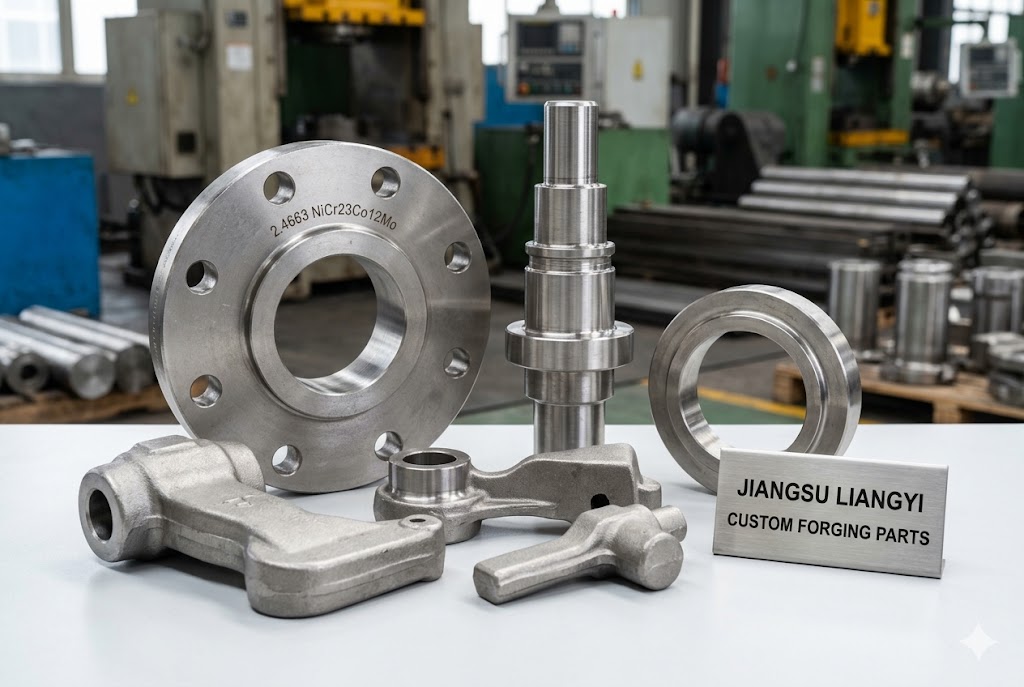
Jiangsu Liangyi Co., Ltd., a top professional manufacturer of open die forging parts and seamless rolled rings located in Jiangyin, Jiangsu Province, China, specializes in producing 2.4663 NiCr23Co12Mo forged parts.This alloy is a solid‑solution‑strengthened nickel‑chromium‑cobalt‑molybdenum superalloy, and it has excellent metallurgical stability, ultra‑high‑temperature oxidation resistance up to 1,100 °C, and excellent corrosion resistance in extreme industrial environments.
Why Choose 2.4663 NiCr23Co12Mo? This alloy occupies a unique performance range that few alternatives can equal:it combines the oxidation protection of an aluminum-doped chromia layer (a dual-scale structure of Cr₂O₃ + Al₂O₃), the creep strength from cobalt solid-solution hardening, and the sulfidation resistance of molybdenum — all at the same time. No single element can deliver all three properties; only the engineered Ni-Cr-Co-Mo balance in 2.4663 makes this possible.That is why it remains the preferred material for gas turbine combustors, nuclear steam generator nozzles, and high-temperature valve internals throughout Europe, North America, and Asia.
With over 25 years of forging experience, ISO 9001:2015 certification, we have exported products to more than 50 countries — including the USA, Germany, UAE, Saudi Arabia, Australia, Singapore, UK, France, Japan, and South Korea. We provide a full range of service for custom 2.4663 forging from steel melting, open die forging, and heat treatment to CNC machining.All products meet ASTM, EN, and DIN international material standards.
Main Performance Advantages of 2.4663 NiCr23Co12Mo Alloy
- Ultra-high-temperature oxidation resistance up to 1,100 °C — improved by 20–23 wt% Cr (forms Cr₂O₃ barrier) and 0.7–1.4 wt% Al (forms inner Al₂O₃ sub-layer), creating a self-healing dual-oxide scale that resists spallation during thermal cycling
- Excellent resistance to a wide range of corrosive media — including strong oxidising acids, reducing environments, H₂S/CO₂ sour service, and stress corrosion cracking (SCC), enabled by the high Ni base (≥44%) and Cr content
- Great high-temperature creep and fatigue strength — 11–14 wt% Co and 8.5–10 wt% Mo provide solid-solution hardening that maintains dislocation resistance at grain boundaries above 800 °C, far beyond the capability of lower-cobalt alloys
- Excellent metallurgical stability over 100,000+ service hours — no detrimental σ (sigma), μ (mu), or Laves phase precipitation, ensuring mechanical properties remain within specification throughout the design life of the component
- Excellent weldability and formability — no pre-heat needed under 50 mm wall thickness; compatible with GTAW, GMAW, and SAW processes using matching ERNiCrCoMo-1 filler
Global Standard Equivalents of 2.4663 NiCr23Co12Mo
Engineers and procurement teams from different countries and industries use different designation systems for the same alloy. The table below is the definitive cross-reference for 2.4663 NiCr23Co12Mo — all designations listed refer to the identical chemical composition and alloy system:
| Standard System | Country / Region | Designation / Grade | Applicable Product Standard |
|---|---|---|---|
| EN (European Norm) | Europe / Global | 2.4663 / NiCr23Co12Mo | EN 10302 (forgings & semi-finished products) |
| ASTM / UNS (American) | USA / Global | N06617 | ASTM B564 (forgings), B168 (plate/sheet), B166 (rod/bar) |
| Commercial Brand | USA (Haynes International) | Haynes® 617 | — |
| DIN (German) | Germany | NiCr22Co12Mo | DIN 17742 |
| AMS (Aerospace) | USA (Aerospace) | AMS 5888 | Sheet, strip, plate; AMS 5664 (bar, forgings) — reference standard only |
| ISO | International | NC22Co12Mo (ISO 9722) | ISO 9722 |
| ASME | USA (Pressure Vessels) | N06617 | ASME Section II Part B, SB-564 (forgings) |
| GB / China National | China | GH617 | GB/T 14992 |
A common sourcing error we encounter: buyers from China or India occasionally enquire for "2.4816" or "2.4858" when they actually need 2.4663. These are entirely different alloys (Inconel® 600 and Incoloy 825, respectively). Always confirm the 2.4663 / NiCr23Co12Mo designation or share your drawing's chemical composition table to avoid costly material mix-ups before production begins.
Physical and Thermal Properties of 2.4663 NiCr23Co12Mo
These physical properties are essential for engineering calculations including thermal stress analysis, heat exchanger design, creep modelling, and weight estimation for large-section 2.4663 forgings. Values are for solution-annealed condition unless otherwise noted.
| Property | Value at 20 °C (RT) | Value at 400 °C | Value at 700 °C | Value at 900 °C | Unit |
|---|---|---|---|---|---|
| Density | 8.36 | 8.20 | 8.03 | 7.89 | g/cm³ |
| Melting Range | 1,332 – 1,380 °C (solidus to liquidus) | °C | |||
| Elastic Modulus (Young's) | 211 | 196 | 172 | 148 | GPa |
| Coefficient of Thermal Expansion (CTE) | 12.7 | 13.5 | 14.8 | 15.6 | µm/(m·°C) |
| Thermal Conductivity | 13.4 | 17.5 | 22.8 | 27.5 | W/(m·K) |
| Specific Heat Capacity | 419 | 460 | 502 | 535 | J/(kg·K) |
| Electrical Resistivity | 1.22 | 1.26 | 1.30 | 1.33 | µΩ·m |
| Thermal Diffusivity | 3.81 | 4.62 | 5.67 | 6.52 | mm²/s |
| Magnetic Permeability | ≈ 1.001 (essentially non-magnetic) | — | |||
The relatively low thermal conductivity of 2.4663 — 13.4 W/m·K at room temperature, versus about 50 W/m·K for carbon steel — directly affects forging die design and cooling strategy.Heat dissipates far more slowly through the workpiece, meaning the core of a heavy section forging can remain hot long after the surface has cooled.In our 6,300-ton press operations, we compensate by extending die contact time and monitoring core temperature using embedded thermocouples during heavy-section forging — a practice most conventional forging shops do not apply to nickel alloys.
Full Range of 2.4663 NiCr23Co12Mo Forged Product Forms
We manufacture custom 2.4663 NiCr23Co12Mo forging parts strictly according to customer drawings and technical specifications, and they all meet EN 10204 3.1 certification requirements (EN 10204 3.2 available upon customer arrangement with an approved third-party inspector). Visit our Products Page for further details.
2.4663 Forged Bars and Rods
Round bars, square bars, flat bars, rectangular bars, step shafts, and valve spindles. The maximum forging diameter is up to 2,000 mm, the maximum length is up to 15,000 mm. and they are widely used for turbine blades, fasteners, valve stems, compressor shafts, and critical structural parts. All parts are tested by UT and can be traced.
NiCr23Co12Mo Seamless Rolled Forged Rings
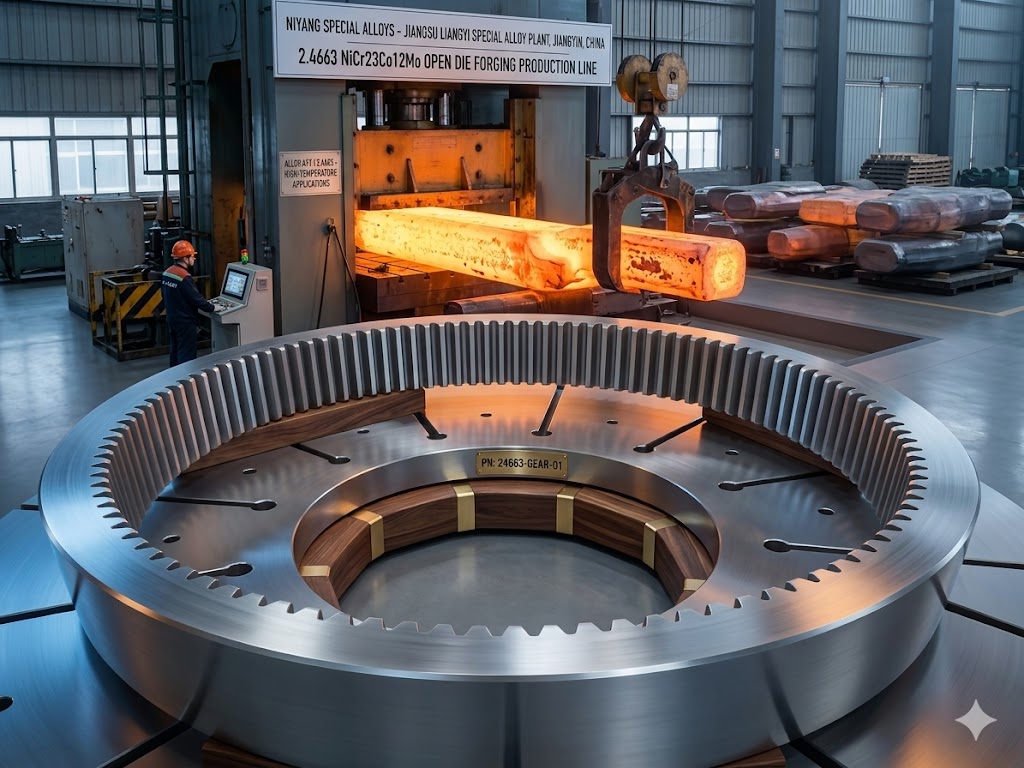
Custom seamless rolled rings, contoured forged rings, and open die forged rings up to 6,000 mm OD and 30 tonnes in weight. They are the best choice material for turbine guide rings, seal rings, labyrinth rings, valve seat rings, gear rings, and pressure vessel flanges. All parts are produced on our advanced 5-metre radial-axial ring rolling mill — see our Equipment Page.
2.4663 Hollow Forgings, Sleeves and Pipes
Forged sleeves, bushes, bushings, hollow bars, heavy-wall cylinders, seamless pipes, tubes, and casings with outer diameter up to 3,000 mm. They are the best choice material for pump casings, valve bodies, reactor nozzles, bore protectors, and heat exchanger shells — deleting weld seams and their associated integrity risks in high-pressure corrosive environments.
NiCr23Co12Mo Forged Discs, Plates and Blocks
Forged discs, disks, blanks, plates, blocks, and flanged blanks with maximum outside diameter up to 3,000 mm and single-piece weight up to 20 tonnes. They are used for gas and steam turbine discs, impellers, blisks, valve discs, tube sheets, and pressure vessel parts.
Dimensional Capability Summary
The table below consolidates the dimensional ranges we can get per product form for 2.4663 NiCr23Co12Mo. All values represent our in-house capability without sub-contracting:
| Product Form | Max Outer Diameter / Width | Max Length / Height | Max Single-Piece Weight | Wall / Thickness Range | Delivery Surface |
|---|---|---|---|---|---|
| Forged Round Bar | Ø 2,000 mm | 15,000 mm | 30 t | Solid / stepped | As-forged / machined |
| Seamless Rolled Ring | Ø 6,000 mm OD | 1,500 mm height | 30 t | 50 – 600 mm wall | As-rolled / machined |
| Open Die Forged Ring | Ø 4,000 mm OD | 2,000 mm height | 25 t | 80 – 800 mm wall | As-forged / machined |
| Hollow Forging / Sleeve | Ø 3,000 mm OD | 5,000 mm | 20 t | 50 – 500 mm wall | As-forged / machined |
| Forged Disc / Plate | Ø 3,000 mm | 1,200 mm thick | 20 t | 100 mm min thickness | As-forged / machined |
| Forged Block / Slab | 2,000 × 1,500 mm | 3,000 mm | 25 t | 150 mm min thickness | As-forged / machined |
Industry Applications and Verified Project Cases
2.4663 NiCr23Co12Mo forging parts are the best choice material for important industrial sectors needing long-term stable performance in extreme high-temperature, high-pressure, and highly corrosive environments. Our verified project cases cover global mainstream markets, with full compliance with local industry standards:
Nuclear Power Industry (Asia and Europe Market)
Project Case: Nuclear Reactor Coolant Pump Forgings for Asian Nuclear Power Plants
Customer Pain Point: Nuclear-grade parts need ultra-high material purity, excellent impact toughness, and 100% defect-free performance in radioactive coolant environments, and all parts must meet nuclear-industry safety standards.
Our Solution: We supplied custom 2.4663 NiCr23Co12Mo forged reactor coolant pump casings, rotor impellers, containment seal chambers, and pump shafts. All parts were produced via vacuum melting + ESR to control impurity content, with 100% volumetric UT, MT, and PT inspection, plus full raw-material-to-finished-product traceability.
Project Value: Our 2.4663 forgings have been working stably for over 8 years, and they all meet strict safety requirements. We have become a long-term qualified supplier for 3 big Asian nuclear power groups.
Power Generation Turbine Industry (Global Market)
Project Case: High-Temperature Turbine Parts for 660 MW Thermal Power Plants
Customer Pain Point: Main steam valves and turbine parts work at high pressure and 650 °C for long periods of time. To avoid unplanned shutdowns, they must strongly resist creep, oxidation, and thermal fatigue.
Our Solution: We delivered custom 2.4663 forged turbine discs, impellers, blades, MSV/GV/CV/CRV valve seats, valve spindles, control reheat valve discs, and diaphragm nozzles. We improved heat-treatment parameters to guarantee stable high-temperature mechanical properties, with full high-temperature tensile and creep tests performed per batch.
Project Value: Our parts extended the power plant maintenance cycle from 12 to 24 months. They have been applied in more than 20 thermal power projects across Asia, Europe, and the Middle East.
Oil and Gas Valve Industry (Middle East and North America Market)
Project Case: High-Pressure Corrosion-Resistant Valve Forgings for Middle East Oilfield Wellhead Projects
Customer Pain Point: Oilfield wellhead valves work in high-pressure H₂S and CO₂ corrosive environments, they must have excellent sour-service resistance, high strength, and long lifetime, with reference to API 6A material and dimensional requirements.
Our Solution: We manufactured NiCr23Co12Mo forged valve bodies, bonnets, stems, seat rings, valve cores, valve balls, and valve discs for ball, gate, check, and back-pressure valves. All products are manufactured based on API 6A dimensional and material requirements; NACE MR0175 sour-service version available. Cobalt-based hardfacing alloy applied to sealing surfaces for enhanced wear resistance.
Project Value: They all used in oilfield projects for clients in the Middle East and North America, with verified lifetime significantly exceeding conventional alloy-steel valve alternatives.
Petrochemical and Heat Exchanger Industry (Europe & Southeast Asia Market)
Project Case: Heat Exchanger andPressure Vessel Forgings for European Petrochemical Plants
Customer Pain Point: Petrochemical reactors and heat exchangers face prolonged exposure to strong oxidising and reducing chemical media, needing excellent uniform corrosion resistance and structural stability.
Our Solution: We provided 2.4663 forged tube sheets, baffle plates, pressure vessel reactor nozzles, seamless pipes, shells, and channel flanges. We strictly control the chemical composition and heat-treatment to guarantee consistent corrosion resistance of the whole part, with hydrostatic and intergranular corrosion testing per product.
Project Value: They have been working steadily for more than six years in harsh chemical environments without any failures. and many European petrochemical companies have recognized them.
Turbomachinery and Compressor Industry (Global Market)
Project Case: Centrifugal Compressor Impeller Forgings for Global Gas Compression Systems
Customer Pain Point: High-speed centrifugal compressor impellers require exceptional metallurgical stability, high fatigue strength, and consistent internal matrix to prevent fracture failure at 10,000+ rpm.
Our Solution: We supplied 2.4663 NiCr23Co12Mo forged centrifugal compressor impellers, shrouded impellers, labyrinth shaft seals, pump casings, and shafts. Multi-directional forging guarantees consistent grain matrix; 100% UT and high-speed dynamic balancing performed.
Project Value: Applied in more than 50 gas compression systems worldwide, stable at 12,000 rpm. Qualified supplier for international top-tier turbomachinery OEMs.
Smelting and Forging Production Process
The production of our 2.4663 NiCr23Co12Mo forged parts follows internationally advanced standards, with full in-house capability from raw-material smelting to finished-product inspection:
Step 1 — Premium Alloy Smelting
To guarantee ultra-high purity and consistent chemical composition of 2.4663 alloy, we use industry-leading processes:
- EAF + LF + VD — primary smelting for standard-grade parts; gets O < 20 ppm, N < 80 ppm
- VIM + ESR (double melt) — for nuclear-grade and aerospace-grade parts needing O < 10 ppm, N < 30 ppm, and certified total inclusion cleanliness
- AOD (Argon-Oxygen Decarburisation) — strict carbon control within the specified 0.05–0.10 wt% window, critical because too-low carbon reduces high-temperature strength while too-high carbon risks sensitisation
Unlike stainless steels, where low carbon is always preferred to avoid sensitization, 2.4663 needs a minimum carbon content of 0.05%.This is because M₂₃C₆ carbides formed at grain boundaries effectively improve creep resistance at 750–900 °C — they pin grain boundaries and slow down creep deformation.Our AOD melting process maintains carbon within a tight tolerance of ±0.01%, a level of control that standard EAF-only smelters cannot consistently achieve.This directly determines the long-term creep performance of gas turbine discs and nuclear steam generator parts.
Step 2 — Open Die Forging and Seamless Ring Rolling
We use 2,000–6,300 T hydraulic forging presses and 1–9 T electro-hydraulic hammers for open die forging. Key parameters for 2.4663:
- Forging temperature window: 1,050–1,175 °C. Above 1,175 °C, incipient melting of low-melting-point grain boundary phases can occur. Below 1,050 °C, forging resistance increases sharply and cracking risk rises.
- Minimum forging ratio: 4:1 to break down the cast dendrite structure, close internal porosity, and refine grain size to the EN ISO 643 Grade 1 requirement.
- Multi-heat forging for large sections — sections above 500 mm require multiple reheating cycles. We monitor each reheat with calibrated pyrometers accurate to ±10 °C.
Step 3 — Solution Annealing and Optional Ageing
After forging, all 2.4663 parts are given solution annealing at 1,150–1,200 °C, with a holding time of at least1 hour per 25 mm of maximum section thickness, followed by rapid water quenching within 60 seconds of leaving the furnace.This dissolves any secondary carbides formed during forging and restores a uniform austenitic matrix. An optional stabilization treatment at 980–1,010 °C is available for applications requiring controlled carbide distribution to meet specific creep performance requirements. All heat treatment is performed in our fully automatic, temperature-controlled continuous and batch furnaces equipped with multi-point thermocouple monitoring, traceable to NIST/PTB calibration standards. Full heat treatment charts are included with each delivery.
Step 4 — CNC Machining and Dimension Test
CNC turning, milling, drilling, boring, and grinding to customer drawings. Dimension test by CMM (coordinate measuring machine) and laser scanning. We keep machining tolerances to IT8 as standard, with IT6 available for critical-fit parts such as turbine disc bore diameters.
Welding and Machining Guidelines for 2.4663 NiCr23Co12Mo
The following guidelines are drawn from our 25 years of hands-on experience welding and machining 2.4663 NiCr23Co12Mo forgings, and from interactions with customers who undertake site welding of our components. This information is not replicated from any generic datasheet — it reflects what we have learned from real production problems and failures.
Welding
- Recommended processes: GTAW (TIG) is preferred for root passes and thin-wall parts. GMAW (MIG) is suitable for fill passes on heavy sections. SAW (submerged arc) can be used for large flat joint surfaces such as tube-sheet-to-shell welds.
- Filler metal: ERNiCrCoMo-1 (AWS A5.14) for GTAW/GMAW — this is a matching-composition filler that preserves the high-temperature strength advantage of the 2.4663 base metal. Do not substitute Inconel® 625 filler (ERNiCrMo-3), as it significantly underperforms above 750 °C due to the absence of cobalt.
- Preheat: Not needed for wall thickness ≤ 50 mm at ambient temperature above 10 °C. For heavy sections ≥ 100 mm, preheat to 100–150 °C is recommended to reduce thermal gradient.
- Interpass temperature: Maximum 150 °C. Exceeding this risks hot-cracking in the heat-affected zone due to cobalt-rich low-melting-point films at grain boundaries.
- Post-weld heat treatment (PWHT): Generally not needed for 2.4663 unlike ferritic or martensitic steels. However, for nuclear-grade parts, a stress-relief anneal at 980 °C / 2 h may be specified by the customer's design code. Avoid temperatures above 1,050 °C post-weld, as this approaches the solution annealing range and will fully alter the mechanical properties of the weld zone.
- Joint cleanliness: 2.4663 is highly sensitive to sulphur and lead contamination. Ensure all marking inks, paints, and lubricants are verified sulphur-free and lead-free before welding. Even minor sulphur (>0.005%) in the weld zone causes hot-cracking.
Machining
- Cutting speed: 20–40 m/min for turning with uncoated carbide inserts (ISO K or M grade). Reduce to 15–25 m/min for heavy interrupted cuts.
- Feed rate: 0.1–0.25 mm/rev. Light, consistent cuts prevent work hardening. Dwelling (stopping the feed without stopping the tool) is the most common cause of tool breakage in 2.4663 machining.
- Coolant: Flood cooling with water-soluble coolant at full flow rate is essential. 2.4663 generates significant cutting heat. Never dry-machine this alloy.
- Work hardening awareness: 2.4663 work-hardens approximately 2 times faster than 316L stainless steel. Each pass must cut below the previously work-hardened layer, or the insert will rub rather than cut, accelerating tool wear exponentially.
Some low-cost suppliers supply 2.4663 forgings in the as-forged condition without solution annealing, claiming they “meet hardness requirements”. This is an incorrect practice. Without proper solution annealing at 1,150–1,200 °C, the grain boundary carbide networks formed during forging remain, resulting in a severe loss of ductility — elongation can drop from ≥30% to below 15% — and unpredictable high-temperature creep performance. Always verify that the heat treatment chart is included with the material test certificate (MTC), and that the solution temperature and holding time are clearly specified.
Corrosion & Oxidation Resistance of 2.4663 NiCr23Co12Mo — In Depth
The corrosion resistance of 2.4663 NiCr23Co12Mo operates through fundamentally different mechanisms depending on the environment. Understanding these mechanisms allows engineers to confirm whether 2.4663 is the right alloy — or whether a different material should be specified.
High-Temperature Oxidation (Air / Combustion Gases)
The primary oxidation protection mechanism involves two simultaneous oxide scale layers:
- Outer Cr₂O₃ layer — formed by the 20–23% chromium content; provides the bulk diffusion barrier against oxygen ingress and is the first defence in cyclic oxidation. Begins forming above 600 °C.
- Inner Al₂O₃ sub-layer — formed by the 0.7–1.4% aluminium content; far more thermodynamically stable than Cr₂O₃ at temperatures above 950 °C, and critically important when the chromia layer is disrupted by thermal cycling or mechanical spallation. This is what separates 2.4663 from Cr-only alloys above 950 °C.
In cyclic oxidation testing (1,000 °C, 1,000 cycles, air), 2.4663 NiCr23Co12Mo exhibits a weight change of less than ±3 mg/cm² — comparable to oxide dispersion-strengthened alloys costing 5–10× more.
Sulphidation Resistance (H₂S / SO₂ Environments)
2.4663 performs well in mixed oxidising/sulphidising gas streams up to 900 °C, primarily due to the Cr₂O₃ scale acting as a barrier to sulphur diffusion. However, in pure reducing sulphidising environments (very low pO₂), the chromia scale is destabilised and 2.4663 is not the optimal choice — Hastelloy® C-276 or Inconel® 625 would be preferred. For sour-service oil and gas applications with predominantly H₂S/CO₂ in liquid-phase environments (below 200 °C), the selection criterion shifts to NACE MR0175 compliance rather than high-temperature oxidation.
Aqueous Corrosion & SCC Resistance
- Sulphuric acid (H₂SO₄): Good resistance at concentrations < 10% and temperatures < 70 °C. Above 15% concentration or 80 °C, corrosion rate increases and alternative materials should be evaluated.
- Hydrochloric acid (HCl): Limited resistance; 2.4663 is not recommended for continuous service in HCl above 0.1% concentration at elevated temperature. For chloride-rich environments, Hastelloy® C-276 (2.4819) is superior.
- Stress Corrosion Cracking (SCC): 2.4663 shows no SCC in chloride environments at temperatures up to 100 °C under typical service stresses. At above 150 °C in high-chloride environments, risk assessment should be performed case by case.
- Nitric acid (HNO₃): Excellent resistance at all concentrations up to 65% and temperatures up to the boiling point. One of the few alloys suitable for concentrated HNO₃ service.
- Phosphoric acid (H₃PO₄): Good resistance at all concentrations at room temperature; evaluate at elevated temperatures on a case-by-case basis.
Carburisation Resistance
In carburizing atmospheres (high CO, hydrocarbon-rich), the dual Cr₂O₃/Al₂O₃ oxide layer acts as an effective barrier against carbon diffusion.2.4663 exhibits outstanding carburization resistance up to 1,000 °C, outperforming Alloy 800H and most austenitic stainless steels.This makes it the preferred forging material for petrochemical reformer tube fittings and radiant tube hangers.
Chemical Composition of 2.4663 NiCr23Co12Mo Alloy
The chemical composition of our 2.4663 NiCr23Co12Mo forgings strictly meet EN 10302 and ASTM B564. Every heat is spectrographically analysed on incoming billet and on the finished forging, with results recorded in the MTC.
| Element | Content Range (wt%) | Element | Content Range (wt%) |
|---|---|---|---|
| Nickel (Ni) | Remainder (base element, ≥ 44%) | Carbon (C) | 0.05 – 0.10% |
| Chromium (Cr) | 20.0 – 23.0% | Titanium (Ti) | 0.2 – 0.6% |
| Cobalt (Co) | 11.0 – 14.0% | Iron (Fe) | Max 2.0% |
| Molybdenum (Mo) | 8.5 – 10.0% | Silicon (Si) | Max 0.2% |
| Aluminium (Al) | 0.7 – 1.4% | Manganese (Mn) | Max 0.2% |
| Phosphorus (P) | Max 0.01% | Sulfur (S) | Max 0.01% |
| Copper (Cu) | Max 0.5% | Boron (B) | Max 0.006% |
Although boron is only present in trace amounts (max. 0.006%), its effect is extremely significant.It segregates at grain boundaries and enhances boundary cohesion, improving creep ductility by roughly 15–20% compared to boron-free melts.However, if boron content exceeds 0.008%, it forms low-melting-point borides such as Ni₃B (melting point ~1,080 °C), which can lead to incipient melting during forging reheating and hot cracking during welding.Our spectroscopic analysis controls boron within 0.003–0.005%, placing it firmly in the optimal performance range.
Mechanical Properties, High-Temperature Data and Creep Strength
Mechanical properties are tested on samples cut from tangential test rings in the delivery condition, per EN ISO 6892-1 & -2. Tests are performed at our in-house laboratory with calibration traceable to national measurement standards.
Room-Temperature & Elevated-Temperature Tensile Properties
| Test Temperature | Yield Strength Rp0.2 (MPa) | Tensile Strength Rm (MPa) | Elongation A (%) | Reduction of Area Z (%) | Impact Energy KV (J) | Hardness (HBW) |
|---|---|---|---|---|---|---|
| 20 °C (RT, minimum guaranteed) | ≥ 270 | ≥ 630 | ≥ 30 | ≥ 50 | ≥ 100 (avg. 3 specimens) | 130 – 220 |
| 400 °C | ≈ 230 | ≈ 590 | ≈ 34 | ≈ 55 | — | — |
| 650 °C (minimum guaranteed) | ≥ 187 | ≈ 510 | ≈ 38 | ≈ 60 | — | — |
| 750 °C | ≈ 165 | ≈ 470 | ≈ 40 | ≈ 62 | — | — |
| 850 °C | ≈ 140 | ≈ 390 | ≈ 45 | ≈ 65 | — | — |
| 1,000 °C | ≈ 85 | ≈ 200 | ≈ 55 | ≈ 70 | — | — |
Note: Values at 400 °C–1,000 °C are typical reference data for solution-annealed condition. EN 10302 mandates verification at 20 °C and 650 °C only. Testing at additional temperatures can be specified at order stage.
Creep Rupture Strength — The Engineering Design Critical Parameter
For gas turbine, nuclear, and high-temperature pressure vessel applications, creep rupture strength is the primary design parameter — not room-temperature yield strength. The following data allows structural engineers to validate whether 2.4663 meets the needed design stress at the intended operating temperature and lifetime:
| Temperature | Rupture Stress at 1,000 h (MPa) | Rupture Stress at 10,000 h (MPa) | Rupture Stress at 100,000 h (MPa) | 1% Creep Strain Stress at 10,000 h (MPa) |
|---|---|---|---|---|
| 650 °C | ≈ 370 | ≈ 285 | ≈ 210 | ≈ 195 |
| 700 °C | ≈ 310 | ≈ 225 | ≈ 160 | ≈ 140 |
| 750 °C | ≈ 240 | ≈ 160 | ≈ 108 | ≈ 90 |
| 800 °C | ≈ 170 | ≈ 105 | ≈ 65 | ≈ 52 |
| 850 °C | ≈ 110 | ≈ 65 | ≈ 38 | ≈ 28 |
| 900 °C | ≈ 65 | ≈ 36 | ≈ 20 | ≈ 14 |
| 950 °C | ≈ 35 | ≈ 18 | ≈ 9 | — |
These are representative values for solution-annealed 2.4663 NiCr23Co12Mo bar and forging. Heat-to-heat variation applies. For design-critical applications, we can perform creep testing on specimens from the actual production forging heat at specified conditions — please discuss at enquiry stage.
Alloy Selection Guide: 2.4663 vs Competing High-Temperature Alloys
The table below reflects decisions we have helped customers navigate across hundreds of projects. It is not a marketing comparison — it honestly identifies where 2.4663 is the right choice and where other alloys are better suited. Use this as a starting point for your material selection review:
| Performance Criterion | 2.4663 NiCr23Co12Mo | Inconel® 625 (2.4856) | Inconel® 718 (2.4668) | Hastelloy® X (2.4665) | Alloy 800H (1.4958) |
|---|---|---|---|---|---|
| Max Continuous Use Temp. | 1,100 °C | 980 °C | 700 °C | 1,200 °C | 900 °C |
| Creep Strength (> 800 °C) | Excellent | Limited | Limited | Moderate | Moderate |
| Oxidation Resistance | Excellent | Good | Moderate | Excellent | Good |
| Aqueous Corrosion Resistance | Good | Excellent | Moderate | Excellent | Limited |
| RT Yield Strength | ≥ 270 MPa | ≥ 275 MPa | ≥ 1,034 MPa (aged) | ≥ 275 MPa | ≥ 170 MPa |
| Weldability | Excellent | Excellent | Moderate (strain-age cracking risk) | Excellent | Good |
| Sulphidation Resistance (< 900 °C) | Good | Moderate | Limited | Excellent | Moderate |
| Carburisation Resistance | Excellent | Moderate | Limited | Good | Good |
| Relative Material Cost | High | High | High | Very High | Moderate |
| Best Fit Applications | Gas turbines, nuclear, high-T valves | Offshore, seawater, cryogenic | Aerospace, aerospace fasteners | Combustor liners, radiant tubes | Reformers, petrochemical furnaces |
If your operating temperature is consistently above 800 °C and creep or oxidation is your main failure concern, 2.4663 (NiCr23Co12Mo) is almost always the right choice over Inconel® 625 or Alloy 800H. If your service temperature is below 700 °C and seawater, chloride, or acidic aqueous corrosion is the priority, Inconel® 625 (2.4856) or Hastelloy® C-276 (2.4819) will perform better than 2.4663 at a lower cost. We offer free, no-obligation material selection support. For detailed advice, contact our technical team at: sales@jnmtforgedparts.com.
Quality Control and Non-Destructive Testing (NDT)
We implement a full-process quality control system for all 2.4663 NiCr23Co12Mo forging parts, from raw-material incoming inspection to finished-product delivery, with 100% inspection coverage for all important process steps:
Microstructure & Grain Size Inspection
The microstructure of our 2.4663 forged discs and rings must be consistent, free from excessive segregation, inclusions, and other structural inhomogeneities.Grain size is evaluated in accordance with EN ISO 643, with a target grain size of Grade 1 for all rings; only random larger grains within a 0–1 class deviation are permitted.We verify the optimized microstructure using a high-precision metallurgical microscope.
100% Non-Destructive Testing (NDT)
Full-coverage NDT on all 2.4663 forged parts, strictly meeting EN 13018 and EN ISO 9712:
- Ultrasonic Testing (UT): 100% volumetric UT inspection with 1–4 MHz frequency (preferably 2 MHz), minimum signal-to-noise ratio 6 dB. Vertical and 45° angled transducers for full-direction scanning. Permissible defect ≤ 5 mm FBH; reporting limit ≤ 3 mm diameter; defect frequency ≤ 4 per metre.
- Magnetic Particle Testing (MT) & Penetrant Testing (PT): Full surface inspection for surface and near-surface defects. No cracks, porosity, or harmful defects on product surface.
Compliance & Certification
All 2.4663 NiCr23Co12Mo forging parts manufactured in our ISO 9001:2015 certified facility, fully meeting EN 10204, EN 10302, and ASTM. EN 10204 3.1 MTC is provided as standard; EN 10204 3.2 is available upon customer arrangement with an approved third-party inspector. Explore our full material range on our Materials Page.
Packaging, Documentation & Export Information
For international buyers, the completeness of shipping documentation and the quality of sea-freight packaging are as important as the forging itself. Here is what every Jiangsu Liangyi 2.4663 NiCr23Co12Mo forging delivery includes:
Packaging
- Seaworthy wooden case or steel crate — designed to ISPM 15 phytosanitary standard for heat-treated timber, accepted at all global ports
- Anti-rust treatment — all machined surfaces are coated with rust-preventive oil (VCI film wrapping for precision-machined components). Salt spray resistance ≥ 6 months
- Marking — heat number, part number, material designation, weight, and Jiangsu Liangyi order reference marked on each piece and on the crate exterior
- Dimension protection — all bore diameters and precision-machined faces are protected with wooden plugs or foam padding to prevent damage during transit
Standard Documentation per Shipment
- EN 10204 3.1 Mill Test Certificate — chemical composition, mechanical test results, heat treatment records, NDT results, hardness, and dimensional inspection (EN 10204 3.2 available upon customer arrangement with approved third-party inspector)
- Heat treatment chart (furnace temperature strip chart per component)
- NDT reports (UT, MT, PT) with operator qualification certificates (EN ISO 9712)
- Dimensional inspection report with actual measurements vs. drawing tolerances
- Packing list with net weight, gross weight, and crate dimensions
- Commercial invoice and Certificate of Origin (CO)
- Third-party inspection report (SGS / BV / TUV) — upon customer request
Trade Terms and Payment
- Incoterms: FOB Tianjin / Shanghai / Ningbo, CIF destination port, EXW Jiangyin factory — customer's preference
- Payment terms: T/T (Telegraphic Transfer), L/C (Letter of Credit at sight)
- Currency: USD (preferred), EUR, CNY
Frequently Asked Questions about 2.4663 NiCr23Co12Mo Forgings
For GTAW and GMAW welding of 2.4663, the standard filler metal is ERNiCrCoMo-1 (AWS A5.14), a matching composition filler that retains high‑temperature creep performance.
Inconel® 625 filler (ERNiCrMo-3) should not be substituted for high‑temperature service — the lack of cobalt in 625‑type filler drastically reduces creep strength in the weld zone above 750 °C.
Interpass temperature must be kept below 150 °C to avoid hot cracking in the heat‑affected zone (HAZ).
The main difference is their chemical makeup and how they perform. 2.4663 NiCr23Co12Mo has 11–14% Co and 0.7–1.4% Al, which gives it better creep strength and resistance to oxidation above 800 °C — perfect for gas turbines and nuclear parts. Inconel® 625 (2.4856) has no cobalt and gets its strength from 3.15–4.15% Nb, providing better resistance to corrosion in water (seawater, chlorides, acids) below 700 °C. Choosing between them is easy: if you mainly need it to work above 800 °C, 2.4663 NiCr23Co12Mo is better; if you need protection against seawater corrosion or toughness in very cold temperatures, 2.4856 is better.
Related High-Temperature & Corrosion-Resistant Alloy Forgings
If 2.4663 NiCr23Co12Mo does not precisely match your application's requirements, we manufacture forging parts in the following closely related high-performance alloys. Our Materials Page lists our complete material capabilities:
Request a Quote | China 2.4663 NiCr23Co12Mo Forging Expert
Jiangsu Liangyi Co., Limited is a top professional manufacturer of 2.4663 NiCr23Co12Mo open die forging parts and seamless rolled rings in Jiangsu Province, China. With over 25 years of forging experience, advanced production and inspection equipment, and a dedicated technical team, we provide high-quality, cost-effective custom forging solutions for global customers in nuclear power, power generation, oil and gas, petrochemical, and turbomachinery industries. Send us your drawings, material requirements, quantity, and application details to get a detailed quotation and technical solution. Our sales engineering team responds within 24 hours.
✉ Request a Quote TodayInquiry Email: sales@jnmtforgedparts.com
Phone / WhatsApp: +86-13585067993
Official Website: www.jnmtforgedparts.com
Sitemap: www.jnmtforgedparts.com/sitemap.xml
Factory Address: Chengchang Industry Park, Jiangyin City, Jiangsu Province, China