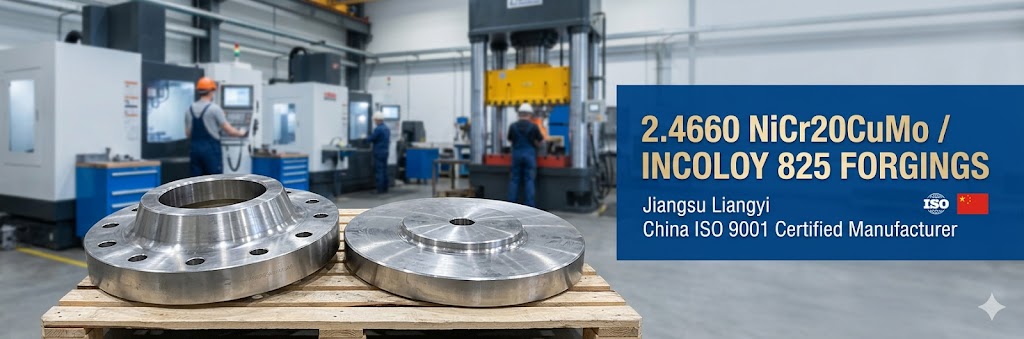
2.4660 (NiCr20CuMo) Forged Parts | China Leading Manufacturer
📌 Quick Answer: What is 2.4660 (NiCr20CuMo)?
2.4660, also known as NiCr20CuMo (W.Nr. 2.4660), is an alloy made of nickel, iron, chromium and 2–3% molybdenum and 3–4% copper.Jiangsu Liangyi Co., Ltd. makes it in Jiangyin, Jiangsu Province, China. The company makes forged parts and has been certified by ISO 9001:2015 since 1997. This alloy doesn't corrode easily in environments with sulfuric acid, phosphoric acid, or chloride. It can work at temperatures up to 450°C and has a tensile strength of at least 550 N/mm². Many industries such as chemical processing, oil and gas, nuclear power, pharmaceuticals and valve manufacturing, use it a lot. We can make custom forgings that weigh anywhere from 30 to 30,000 kilograms. They will be delivered in 25 to 45 days.
ISO 9001:2015 CertifiedEN 10204 3.1/3.2 CompliantASTM/ASME StandardAPI 6A Project Supply CapablePED 2014/68/EU Project ExperienceNACE MR0175 Material Requirements Met
About 2.4660 (NiCr20CuMo) Forging Material
2.4660 (also known as NiCr20CuMo, W.Nr. 2.4660) is an alloy made of nickel, iron, chromium, and 2–3% molybdenum and 3–4% copper. This good nickel-based forging material, manufactured by Jiangsu Liangyi — China Leading Forging Manufacturer in Jiangyin City, Jiangsu Province, is engineered for great corrosion resistance in harsh industrial environments.
It has great performance in reducing and oxidizing acids, especially sulfuric acid, phosphoric acid, nitric acid, and chloride-containing media that causes pitting and crevice corrosion in standard stainless steels.With balanced chemical composition and stable metallurgical structure, 2.4660 (NiCr20CuMo) maintains excellent mechanical properties at low temperatures up to 450°C and moderate high temperatures, making it the preferred material for critical industrial components.
It is widely used in many industries such as chemical processing, oil & gas upstream and midstream, nuclear power, pharmaceutical manufacturing, food production, power generation and plastics processing, especially for high-demand parts like valves, pumps, pressure vessels, heat exchangers and wellhead equipment.
Custom 2.4660 (NiCr20CuMo) Forged Products We Supply
Jiangsu Liangyi is a professional manufacturer of custom seamless rolled rings and open die forging parts, with over 25 years of industry experience and has passed the ISO 9001:2015 certification. We strictly follow the international standards and customer drawings to provide one-stop customized forging solutions from steelmaking, forging, heat treatment to precision CNC machining. Our full range of forged products covers single piece weights from 30 kilograms to 30,000 kilograms and offers full-size customization support.
Our Full Range of 2.4660 (NiCr20CuMo) Forged Products
2.4660 Forged Steel Bars: Round bars, square bars, flat bars, rectangular bars and bar materials, with a maximum diameter of up to 2 meters and a maximum length of up to 15 meters, in compliance with ASTM, EN and DIN standards
NiCr20CuMo Seamless Rolled Rings: Seamless rolled rings, special-shaped rings, gear rings, flanges, with a maximum outer diameter of up to 6 meters and a single piece weight of up to 30 tons, are ideal choices for pressure and rotary applications
2.4660 Forged Hollow Components: Hubs, housings, shells, sleeves, bushing, cases, thick-walled hollow bar, seamless tube, tubes and tube shells, outer diameter up to 3000 mm, wall thickness and length can be fully customized
NiCr20CuMo Forged Discs & Plates: Forged discs, disks, blocks, plates, tube sheets, baffle plates, with a maximum thickness of up to 800 mm, fully covered by ultrasonic testing
2.4660 Forged Shafts: Stepped shafts, gear shafts, valve stems, pump shafts, butterfly valve main shafts, main shafts, turbine shafts, with a maximum diameter of up to 1800 mm and a maximum length of up to 15 meters
NiCr20CuMo Custom Forged Parts: Nozzles, channel flanges, flange protrusions, transition cones, flowmeter bodies, valve parts, pump parts and other custom forged parts processed according to customer drawings
Key Industrial Applications & Global Project Cases of 2.4660 Forgings
2.4660 (NiCr20CuMo) forging parts are widely specified in high-demand industrial sectors worldwide, thanks to their exceptional corrosion resistance, stable mechanical properties, and long service life in harsh environments. Jiangsu Liangyi — Forging Parts Supplier Serving Global Clients from Jiangyin, China has supplied custom 2.4660 forged components to clients in over 50 countries, with successful project references in Europe, North America, the Middle East, Southeast Asia, Australia, and other regions. Below are our core application scenarios and verified project cases:
Chemical Processing Industry
2.4660 forged steel pipes, seamless tubes, pressure vessel shells, tube sheets, baffle plates, reactor nozzles, channel flanges and process components for boilers, heat exchangers, pressure vessels, reactors, heaters, and flue gas desulfurization (FGD) systems. The material's exceptional resistance to sulfuric acid, phosphoric acid, and chloride-induced corrosion makes it the industry standard for wet process phosphoric acid production, organic acid processing, and chemical wastewater treatment systems.
GEO Project Case — Chemical Plant in Southeast Asia
We provided more than 200 sets of 2.4660 (NiCr20CuMo) seamless forged tubes, tube sheets, baffle plates and reactor nozzles for a 600,000-ton/year wet-process phosphoric acid production line in Thailand. All parts are manufactured in accordance with ASTM B564 standard and have undergone complete non-destructive testing and got EN 10204 3.2 certification. The great corrosion resistance of our company's 2.4660 forgings has extended the service life of equipment from the original two years to over five years, reducing the maintenance cost for customers by 45% annually
GEO Project Case — European Chemical Industry
We custom-manufactured 2.4660 forged tube sheets and heat exchanger shells for a specialty chemical plant in Germany, manufactured to the material documentation requirements of the client's PED 2014/68/EU and AD 2000 certified pressure equipment project. This component is used in nitric acid recovery systems with high chloride content and has been operating stably for more than six years without any corrosion failure.
Oil & Gas Upstream & Midstream Industry
NiCr20CuMo forged drilling tools, risers, connectors, flexible joints, seals, flanges, gaskets, wellhead Christmas tree bodies, casing hangers, tubing heads, and oil measurement valve parts. Our 2.4660 forgings comply with API 6A material and size requirements,and meet the chemical composition and hardness standards of NACE MR0175 / ISO 15156. They can resist corrosion caused by sulfur-containing gases and H2S, CO2 and chlorides in oil fields, and are ideal choices for onshore and offshore oil and gas production systems.
GEO Project Case — Middle East Oilfield
We supplied custom NiCr20CuMo wellhead components, Christmas tree bodies, double studded adapter flanges, and valve parts for a major sour gas field development project in Saudi Arabia. All 2.4660 forged parts were manufactured to API 6A 17th edition material and dimensional requirements, and meet NACE MR0175 chemical composition and hardness criteria, with 100% UT/MT/PT testing and third-party BV inspection. These components have been in stable service in high-pressure, high-H2S downhole environments for over 5 years with zero quality complaints.
Valve Manufacturing Industry
2.4660 forged valve balls, valve bonnets, valve bodies, valve stems, valve closures, valve seat rings, valve cores and valve discs for 2-way valves, one-way back pressure valves, ball valves, check valves, gate valves, globe valves, and cryogenic high-performance butterfly valves. Our 2.4660 forged valve components maintain excellent dimensional stability, sealing performance, and corrosion resistance in cryogenic, high-pressure, and strong corrosive working conditions, widely specified by global top valve manufacturers.
GEO Project Case —Valve Manufacturer In North America
We provided 2.4660 (NiCr20CuMo) valve bodies, balls, stems and bonnets for a leading industrial valve manufacturer in the USA. All the parts met the standards set by ASME B16.34 and ASTM A182. In chemical plants' pipeline systems, they are used to make ball valves.In the eight years we've worked together, we've delivered more than 10,000 sets of qualified forgings, and 99.8% of them were delivered on time.
Nuclear Power & Power Generation Industry
NiCr20CuMo forged nuclear reactor coolant pump rotors, impellers, casings, containment seal chambers, pressure vessel nozzles, heat exchanger components for thermal power plants, nuclear power plants and renewable energy systems. Our nuclear-grade 2.4660 forgings are made with strict quality control and can be traced all the way from melting the raw materials to the final inspection. This meets the strict safety standards of the nuclear power industry.
GEO Project Case — Asian Nuclear Power Plant
We provided NiCr20CuMo nuclear reactor coolant pump casings, impellers, rotors and containment seal chambers for a 1000 MW nuclear power plant project in South Korea. All 2.4660 forging parts are produced with VIM+ESR double melting process, with strict nuclear-grade mechanical property verification and full nondestructive testing, ensuring the long-term safe and stable operation of the nuclear power unit.
The Pharmaceutical & Food Production Industry
2.4660 sanitary grade forged pipes, process equipment components, nozzles, valve components and heat exchanger components meet the strict hygiene and corrosion resistance requirements of pharmaceutical raw material production, biopharmaceutical systems and food and beverage processing production lines. Our 2.4660 forgings have excellent resistance to nitric acid, organic acids, and cleaning agents, with no harmful substance precipitation. FDA and EU food contact material compliance documentation is available upon request based on specific application requirements.
GEO Project Case — European Pharmaceutical Industry
We supplied hygienic-grade 2.4660 forged piping, nozzles and process equipment components for a large pharmaceutical enterprise in Switzerland. All components are machined to Ra ≤ 0.8 μm surface finish, with passivation treatment, meeting GMP production requirements. The products have been in stable use in the client's API production line for over 4 years.
Pump & General Industrial Equipment
NiCr20CuMo forged pump casings, pump covers, pump barrels, pump impellers, pump shafts, pump wear rings, transition cones, ultrasonic flow meter bodies, venturi cone meter bodies, and other custom industrial components for chemical pumps, centrifugal pumps, metering pumps, and industrial process equipment.Our 2.4660 forged pumps have good resistance to corrosion in fluid system so it can extend the pump's service life and reduce the downtime.
2.4660 (NiCr20CuMo) vs Inconel® 625: Which One to Choose?
Both 2.4660 (also called NiCr20CuMo) and Inconel®625 (registered trademarks of Special Metals) are good nickel-based alloys, but they are made up of different materials, work differently, and are used for different things:
Main Differences
Composition: 2.4660 has more iron (Fe) and copper (Cu), while Inconel 625 has more molybdenum (Mo) and niobium (Nb)
Corrosion Resistance: 2.4660 offers better resistance to sulfuric acid and phosphoric acid, while Inconel 625 offers better resistance to high-temperature oxidation and chloride-induced stress corrosion cracking (SCC) in extreme conditions
Mechanical Properties: Inconel 625 maintains better mechanical properties at temperatures above 550°C, while 2.4660 is sufficient to meet the temperature requirements of 450°C
Cost: 2.4660 is generally more cost-effective than Inconel 625
Suggestion
Applications that choose 2.4660 (NiCr20CuMo) involve sulfuric acid, phosphoric acid, or moderate chloride concentrations at temperatures up to 450°C.
If you need to use a material that can handle very high temperatures and severe chloride-induced SCC at temperatures above 550°C, choose Inconel 625.
Advanced Melting Process of 2.4660 (NiCr20CuMo) Forged Parts
To get the good purity, uniform structure and stable performance of our 2.4660 (NiCr20CuMo) forged parts, we use advanced and standardized melting processes in our in-house steelmaking workshop located at Chengchang Industry Park, Jiangyin, with optional premium remelting processes for high-demand critical uses. All melting processes are strictly accordance with ASTM, EN, and DIN material standards, and we will provide full batch traceability.
Standard Commercial Grade Melting Route
Step 1: The first step is to melt the metal in a basic electric arc furnace (EF)
Step 2: Argon Oxygen Decarburization (AOD),Vacuum Oxygen Decarburization (VOD), or Vacuum Degassing (VD) to control the composition and lower the gas content
Step 3: Optional Electroslag Remelting (ESR) or Vacuum Arc Remelting (VAR) to make the material cleaner and more uniform in structure
High-quality And High-demand Grade smelting Routes
Step 1: Vacuum induction melting (VIM) is used for primary melting of ultra-high purity and is an ideal choice for nuclear-grade, aerospace and acidic service applications
Step 2: Electroslag remelting (ESR)/vacuum arc remelting (VAR) further refines, reduces inclusions, and enhances the material's density and fatigue resistance
Optional Step 3: Secondary Vacuum Arc Remelting (VAR) for extreme working conditions and nuclear safety class applications
Our 2.4660 (NiCr20CuMo) material undergoes rigorous chemical composition testing after each melting step to ensure that all elements are within the standard range and that the content of residual elements and gases (H, O, N) is precisely controlled to guarantee the best corrosion resistance and mechanical properties.
2.4660 Forging Process & Heat Treatment Parameters Guide
Open Die Forging Process Control
Our 2.4660 (NiCr20CuMo) forgings are produced using hydraulic presses ranging from 2000T to 6300T and electro-hydraulic forging hammers from 1T to 9T. Strict forging process control ensures the optimization of material structure and performance:
Controlled forging temperature range: The range is between 950°C – 1200°C. This keeps the temperature from getting too hot or too cold, which can cause the grains to crack and become coarse
All products must have a minimum forging ratio of 3:1, and critical parts must have a minimum forging ratio of 5:1. This will ensure that the cast structure is completely broken, the grain size is even, and the internal density is high
Multi-directional forging for parts with complex shapes, making sure that the deformation is even and the mechanical properties are the same in all directions
There is a strict cooling process after forging to stop quenching cracks and residual stress. The cooling rate is based on the thickness and structure of the part
Standard 2.4660 Heat Treatment Parameters
To get the best mix of corrosion resistance and mechanical properties, all of our 2.4660 (NiCr20CuMo) forgings go through standardized solution heat treatment, which is in line with ASTM B564 and EN 10204 standards:
Solution Annealing Temperature: The temperature for the solution annealing should be from 920°C and 980°C.(We suggest 940°C to 960°C for most uses)
Holding Time: For every 25 mm of thickness, the holding time must be at least 30 minutes (for example, 60 minutes for 50 mm of thickness and 120 minutes for 100 mm of thickness)
Cooling Method: Quickly cooling in water or a polymer solution after holding to make sure all of the precipitates dissolve and to avoid intergranular precipitation, in this case the material will be more resistant to corrosion
Optional Stabilization Treatment: 850°C – 900°C for 2–4 hours, followed by air cooling.This is done to make parts used in high-temperature settings more stable and less likely to become sensitive
Testing After Heat Treatment: Test the full hardness and mechanical properties after heat treatment and make the record for each batch of heat treatment
2.4660 (NiCr20CuMo) Forging Steel's Chemical Composition
Our 2.4660 (NiCr20CuMo) forging steel has a chemical composition that strictly follows EN 2.4660, ASTM B564, and other standards. We control each element carefully to make sure all parts have best corrosion resistance, mechanical properties and structural stability. We impose stricter internal control limits on main elements such as carbon, sulfur and phosphorus than the standards to ensure the great performance of the materials.
Table 1: Chemical Composition of 2.4660 (NiCr20CuMo)
Element
Standard Range (EN 2.4660 / ASTM B564)
Our Internal Control Limit
Carbon (C)
0.070% Max
0.050% Max
Manganese (Mn)
2.00% Max
1.00% Max
Copper (Cu)
3.00% – 4.00%
3.20% – 3.80%
Chromium (Cr)
19.00% – 21.00%
19.50% – 20.50%
Nickel (Ni)
32.50% – 38.00%
35.00% – 37.00%
Molybdenum (Mo)
2.00% – 3.00%
2.20% – 2.80%
Sulfur (S)
0.035% Max
0.010% Max
Columbium + Tantalum (Nb+Ta)
8 × C% Min – 1.00% Max
0.30% – 0.80%
Phosphorus (P)
0.035% Max
0.020% Max
Iron (Fe)
Balance
Balance
Mechanical Properties of 2.4660 (NiCr20CuMo) Forging Material
Our 2.4660 (NiCr20CuMo) forging material undergoes standardized solution heat treatment to ensure stable and consistent mechanical properties in delivery condition. All mechanical properties are tested in accordance with ASTM E8 / E8M and EN ISO 6892-1 standards, with test coupons taken from the ¼ T position of the thickest section of the forging, to represent the actual performance of the finished product.
2.4660 (NiCr20CuMo) maintains reliable mechanical strength over a wide temperature range and is suitable for high-temperature process equipment. The following high-temperature mechanical performance data are based on our production batch test records under solution annealing conditions and tested in accordance with ASTM E21 and EN ISO 6892-2 standards. These values provide engineering reference data for design engineers.
Note: For structural design, values above 450°C are not recommended because they could cause sensitization and lower corrosion resistance. If you're using something above 450°C, please ask our engineering team for help picking the right material.
Physical Properties of 2.4660 (NiCr20CuMo) Forging Material
The physical properties of 2.4660 (NiCr20CuMo) are important for thermal design, piping stress analysis, and process equipment engineering. The following data represents typical values for solution annealed 2.4660 forgings at room and elevated temperatures, consistent with published EN and ASTM material data sheets.
Table 4: Physical Properties of 2.4660 (NiCr20CuMo) — Typical Values
Physical Property
Value at 20°C
Value at 200°C
Value at 400°C
Unit
Density
8.14
8.10
8.02
g/cm³
Thermal Conductivity
11.1
13.0
15.9
W/(m·K)
Mean Coefficient of Thermal Expansion (20°C–T)
—
13.9
14.6
10⁻⁶/K
Specific Heat Capacity
440
480
510
J/(kg·K)
Electrical Resistivity
1.13
1.21
1.28
µΩ·m
Modulus of Elasticity (E)
196
186
175
GPa
Magnetic Permeability
Non-magnetic (µ ≈ 1.005)
—
Melting Range
1370°C – 1400°C
°C
2.4660 (NiCr20CuMo) Corrosion Resistance Data & PREN Value
The outstanding corrosion resistance of 2.4660 (NiCr20CuMo) is its defining engineering advantage. Its resistance stems from the synergistic effect of high nickel (≥35%), chromium (19.5–20.5%), molybdenum (2.2–2.8%), and copper (3.2–3.8%) content. The following quantitative data provides design engineers with a reliable reference for material selection in corrosive environments.
Pitting Resistance Equivalent Number (PREN)
The PREN of 2.4660 (NiCr20CuMo) is calculated by the formula: PREN = %Cr + 3.3 × %Mo + 16 × %N. Based on our internal control composition (Cr: 19.5–20.5%, Mo: 2.2–2.8%, N: ≤0.03%), the typical PREN of our 2.4660 forgings is 26.8 – 29.8, significantly higher than 316L stainless steel (PREN ≈ 23–26), demonstrating superior resistance to pitting and crevice corrosion in chloride-containing environments.For sour NACE MR0175 uses, this PREN can make the parts work well in H2S + chloride co-existing environments.
Corrosion Rate in Common Process Media
Table 5: 2.4660 (NiCr20CuMo) Typical Corrosion Rates in Common Industrial Media
Corrosive Medium
Concentration
Temperature
Corrosion Rate (mm/year)
Performance Rating
Sulfuric Acid (H₂SO₄)
10%
60°C
< 0.13
✅ Excellent
Sulfuric Acid (H₂SO₄)
50%
25°C
< 0.25
✅ Excellent
Phosphoric Acid (H₃PO₄)
85%
60°C
< 0.10
✅ Excellent
Nitric Acid (HNO₃)
65%
Boiling
< 0.30
✅ Good
Hydrofluoric Acid (HF)
20%
25°C
< 0.50
⚠️ Moderate
Seawater / Chloride (Cl⁻ < 5000 ppm)
—
50°C
< 0.05
✅ Excellent
Sour Gas (H₂S + CO₂ + Cl⁻)
NACE MR0175
Up to 150°C
< 0.02
✅ Excellent
Caustic Soda (NaOH)
50%
80°C
< 0.10
✅ Excellent
Acetic Acid (CH₃COOH)
99%
Boiling
< 0.05
✅ Excellent
Note: Corrosion rate data above is based on standard immersion test conditions. The actual corrosion performance in service is influenced by medium concentration, temperature, flow velocity, and other environmental factors. Contact our engineering team for application-specific corrosion assessment.
2.4660 (NiCr20CuMo) has excellent weldability and can be welded by most standard arc welding processes without preheating. However, due to its nickel alloy composition, a specific welding process is required to maintain the best corrosion resistance and mechanical properties of the welded zone and the heat-affected zone (HAZ).
Recommended Welding Methods
Gas Tungsten Arc Welding (GTAW / TIG): It is the best way to do precision welding, thin-wall welding, and root welding. It can give you the best welding quality with the least amount of dilution and good fusion. It is Suitable to make pressure vessel nozzles, heat exchanger tubes and medical-grade parts.
Gas Metal Arc Welding (GMAW / MIG):It is best for thicker pieces and need to deposit a lot of material quickly. Use with 100% Argon or Ar + He shielding gas mixture. Not recommended for chloride-containing service without post-weld solution annealing.
Shielded Metal Arc Welding (SMAW / Stick): It can be used for structural welding and on-site repair. Use the matching covering electrode. Post-weld cleaning is indispensable to remove slag and restore corrosion resistance.
Submerged Arc Welding (SAW): It is suitable for large cross-section and high-productivity production welding of pressure vessel shells and forgings. Use low-basicity flux to minimize carbon pickup.
superalloy filler; It is best to have the greatest corrosion resistance in the heat-affected zone
GTAW (TIG) Wire
ERNiFeCr-1
S Ni 8065
Matching packing; It is suitable for general 2.4660 to 2.4660 welds
SMAW (ROD) Electrode
ENiCrMo-3
E Ni 6625
superalloy; It is suitable for on-site welding in corrosive environments
SMAW (Bar) Electrode
ENiFeCr-1
E Ni 8065
general structural weld matching electrode
GMAW (MIG) Welding wire
ERNiCrMo-3
S Ni 6625
suitable for MIG welding with heavier cross-sections
Key Welding Precautions
No Preheat Required: 2.4660 does not need preheating under normal circumstances. Preheat only if base metal temperature is below 10°C to avoid condensation.
Inter-channel temperature control: The maximum inter-channel temperature must not exceed 150°C to prevent sensitization and maintain corrosion resistance within the HAZ.
Post-Weld Heat Treatment (PWHT): Post-weld heat treatment (PWHT) : PWHT is not mandatory, but it is strongly recommended to perform water quenching after annealing in a solution at 920°C - 980°C to fully restore corrosiveness (especially in H₂SO₄, Cl - rich media).
Back Blowing: The TIG root welds of pipes and hollow components are backblown with 100% argon gas to prevent oxidation of the inner surface.
Avoid direct welding with carbon steel, and do not apply a grease layer of stainless steel or nickel alloy to prevent iron dilution and galvanic corrosion.
Post-Weld Cleaning: Use a stainless steel brush to remove all spatter, hot color and oxide scale from the weld seam, and then perform pickling and passivation to restore the passivation film.
2.4660 (NiCr20CuMo) Machinability & Available Surface Finishes
Machinability of 2.4660 NiCr20CuMo
2.4660 (NiCr20CuMo) has moderate machinability. It gets a score of about 20–25% compared to free-cutting steel (AISI 1212 = 100%). Because it tends to work harden and is very tough, you need to be careful about which tools you use and how you set the cutting parameters to get good results from CNC machining. All our 2.4660 forgings are precision-machined in our in-house CNC workshop to client drawing dimensions and tolerances.
Table 7: Recommended CNC Machining Parameters for 2.4660 (NiCr20CuMo)
Operation
Tool Material
Cutting Speed (m/min)
Feed Rate (mm/rev)
Depth of Cut (mm)
Rough Turning
Carbide (P25–P35)
25 – 40
0.20 – 0.40
2.0 – 5.0
Finish Turning
Carbide (P10–P20)
35 – 55
0.10 – 0.20
0.5 – 2.0
Rough Milling
Carbide End Mill (TiAlN coated)
20 – 35
0.08 – 0.15/tooth
2.0 – 4.0
Finish Milling
Carbide End Mill (TiAlN coated)
30 – 50
0.05 – 0.10/tooth
0.3 – 1.0
Drilling
Carbide Drill (TiAlN coated)
15 – 25
0.05 – 0.12
Full diameter
Boring
Carbide (P10)
30 – 50
0.08 – 0.15
0.5 – 2.0
Threading
HSS or Carbide Tap
3 – 6
Per pitch
—
Main machining tips: Use flood coolant (water-soluble cutting fluid) at all times to control work hardening and extend tool life. Don't make cuts that are interrupted or stay in the cut for too long.Always keep the chip load the same to stop the surface from hardening. Use sharp tools and replace them when the first sign of chatter or accumulation edge (BUE) appears.
Available Surface Finishes for 2.4660 Forgings
We provide the following standard and custom surface finish options for all 2.4660 (NiCr20CuMo) forged parts, to meet the requirements of different industries and applications:
Table 8: Available Surface Finishes for 2.4660 (NiCr20CuMo) Forgings
Chemical, marine, and corrosive media applications requiring restored passive film
Electropolished
Ra ≤ 0.2
GMP / FDA pharmaceutical and biotech components
2.4660 (NiCr20CuMo) Applicable Standards by Product Form
Different product forms of 2.4660 (NiCr20CuMo) forgings are governed by specific ASTM, ASME, EN, and DIN standards.The cross-reference table below makes it easy for engineers and procurement teams to find the right standard for each product form.This makes sure that the project meets all of its specifications and passes all inspections.
Table 9: 2.4660 (NiCr20CuMo) Standards That Apply to Different Product Forms
Product Forms
ASTM Standard
ASME Standard
EN / DIN Standard
Remarks
Forgings (General)
ASTM B564
ASME SB-564
EN 10269 / DIN 17751
Covers flanges, fittings, valves, and other general forged parts
Forged Bars & Rods
ASTM B425
ASME SB-425
EN 10272
standards for forged bars and rods. These are round, square, and flat bars that are used to make machined parts.
Seamless Rolled Rings
ASTM B564
ASME SB-564
EN 10269
The ring's outside diameter can be up to 6 m, and the ring is rolled from forged billets
Plates, Sheets & Strips
ASTM B424
ASME SB-424
EN 10095
Hot-rolled or forged plate that is up to 150 mm thick
Seamless Pipe & Tube
ASTM B163 / B423
ASME SB-163 / SB-423
EN 10216-5
standards for seamless pipe and tube. They are used for heat exchanger tubes, pressure tubing and pipe systems
Welded Pipe
ASTM B705
ASME SB-705
EN 10217-7
For lower-pressure piping and structural uses
Weld Fittings (Elbows, Tees)
ASTM B366
ASME SB-366
EN 10253-4
Wrought or forged nickel alloy piping fittings
Flanges
ASTM B564 + ASME B16.5 / B16.47
ASME SB-564
EN 1092-1 (PN 6–PN 400)
Weld neck, slip-on, blind, socket weld, and threaded flanges
Pressure Vessel Parts
ASTM B564 + ASME VIII Div.1 / Div.2
ASME SB-564
PED 2014/68/EU + EN 13445
These include nozzles, shells, tube sheets and heads
Parts for Wellhead & Valve
ASTM B564 + API 6A
—
NACE MR0175 / ISO 15156
For sour service uses in oil & gas
Standards for Quality Inspection & Global Compliance Certification
System for Material Qualification Test Coupons (QTC)
We strictly follow a standardized QTC system that meets international standards to check and make sure that each batch of 2.4660 (NiCr20CuMo) forgings has the right mechanical properties.
QTC is used to test the actual mechanical properties of each individual forging product
One QTC is needed for each heat number or heat-treat lot
The QTC comes from the ¼ T envelope location of the thickest part of the forging or from a sacrificial forging from the same heat and heat treatment batch, cut into the right segments for test coupons
The Mill Test Certificate (MTC) has complete records of all test results, and it is possible to trace the raw materials all the way to the finished product
A Full Inspection System & Standards
All of our 2.4660 (NiCr20CuMo) forged steel products undergo strict multi-stage inspection throughout the production process and are 100% size and non-destructive tested before delivery. Our inspection standards include:
Chemical Composition Analysis: ASTM E354, EN 10204, with advanced spectrometer testing for each heat
Tensile & Mechanical Testing: ASTM E8 / E8M, EN ISO 6892-1, including room temperature and high temperature testing
Hardness Testing: ASTM E10, EN ISO 6506, Brinell hardness testing for each product
Notch Tension Testing: ASTM E292, for critical safety components
Non-Destructive Testing (NDT):
Ultrasonic Testing (UT): ASTM A388, EN 10228-3, 100% coverage for all forgings
Magnetic Particle Testing (MT): ASTM E165, EN 10228-1, for surface defect detection
Penetrant Testing (PT): ASTM E1417, EN 10228-2, for non-magnetic material surface defect detection
Optional Phased Array UT, Radiographic Testing (RT) for high-demand components
Global Compliance Certification
Our 2.4660 (NiCr20CuMo) forging production system and products fully comply with global industrial standards and certification requirements, including:
ISO 9001:2015 Certification For A Quality Management System
Experience with PED 2014/68/EU Project Supply: We have provided forged parts for pressure equipment projects in Europe that follow PED rules. PED certification is held by the equipment manufacturer; we provide full material documentation (EN 10204 3.1/3.2 MTC) required for their PED compliance process.
API 6A Project Supply Capability: We manufacture forged components to API 6A material and dimensional requirements for oil & gas wellhead projects. API 6A product certification is held by the equipment manufacturer; we serve as a qualified forging supplier to their licensed production.
NACE MR0175 / ISO 15156 Material Requirements Met: Our 2.4660 (NiCr20CuMo) forgings meet the chemical composition, hardness, and microstructure requirements of NACE MR0175 / ISO 15156 for sour service applications involving H2S environments.
Mill Test Certificates of EN 10204 3.1/3.2 for all products
Third-party inspection support from global authoritative institutions such as SGS, BV, TUV, and Lloyd's Register
Why choose Jiangsu Liangyi as your 2.4660 forging partner
Jiangsu Liangyi Co., Ltd. was established in 1997 and is a leading domestic manufacturer of open die forgings and seamless rolling rings. Our local forging factory in Chengchang Industry Park, Jiangyin covers an area of 80,000 ㎡ with fixed assets up to 40 million USD, and an annual manufacturing capacity of 120,000 tons.We have supplied high-quality forged steel products to clients in more than 50 countries across Europe, North America, the Middle East, Asia Pacific and Australia. we have rich experience in global industrial project supporting.
Full In-House Production Chain: We provide one-stop service from raw material melting, forging, heat treatment to precision CNC machining, all completed in our factory, with full quality control and traceability. We can customize 2.4660 forgings strictly in accordance with your drawings and technical requirements.
Advanced Forging & Equipped with 2000T, 4000T and 6300T hydraulic presses, 1T to 9T electro-hydraulic forging hammers, 1M to 5M seamless ring rolling machines, ten heat treatment furnaces, and a full set of advanced inspection equipment including chemical analysis, mechanical testing, metallographic inspection and non-destructive testing. View our complete list of devices here.
Strict Quality Control System: We implement a full-process quality control system from raw material incoming inspection to finished product shipment, with 100% inspection of each product. We provide complete factory Test Certificate (MTC) EN 10204 3.1/3.2 for all parts, which will record the complete thermal number and production batch traceability.
Rich Material Grade Expertise: Except 2.4660 (NiCr20CuMo), we also produce forgings in carbon steel, alloy steel, stainless steel, other nickel alloys, duplex steel and custom material grades, they all meet the material and size requirements of ASTM, AMS, DIN, EN, JIS, API 6A and other international standards. View our full material grade list here.
Global Customer Service & Support: We offer one-on-one service to each customer, and our engineering team provides professional technical support. We support different minimum order quantities, ranging from 30 kilograms of sample parts to large-scale production, we also provide stable delivery time (25-45 days for standard products). as well as global logistics support such as sea, air and door-to-door delivery. Besides, we also provide comprehensive customs clearance document support.
Frequently Asked Questions About 2.4660 (NiCr20CuMo) Forgings
2.4660 NiCr20CuMo is the European EN standard grade (W.Nr. 2.4660), the global equivalent grade is NF NC21FeDu. All our 2.4660 forgings fully comply with the material requirements of these equivalent grades, with interchangeable performance and dimensions.
We can produce 2.4660 (NiCr20CuMo) forgings with single-piece weight from 30 KGS to 30,000 KGS. For forged bars, maximum diameter up to 2 meters, maximum length up to 15 meters. For seamless rolled rings, maximum outer diameter up to 6 meters. For hollow parts, the outer diameter can be as big as 3000 mm. We can also make parts in the sizes and shapes you want based on your drawings.
2.4660 (NiCr20CuMo) is much more resistant to corrosion than 316L stainless steel, especially when it comes to acids like sulfuric acid and phosphoric acid, chloride-containing media, and acidic environments with H2S and CO2. The high content of nickel, molybdenum and copper endows 2.4660 with excellent resistance to pitting corrosion, crevice corrosion and stress corrosion cracking, while 316L will fail rapidly in these aspects. It is the best material for environments that are very corrosive and where regular stainless steel won't work.
The standard heat treatment is solution annealing at 920°C - 980°C (940°C - 960°C is best), with each 25mm of cross-sectional thickness held for at least 30 minutes, and then quickly cooling with water or polymer. An optional stabilization treatment at 850°C–900°C for 2–4 hours with air cooling is available for high-temperature service components. All parameters comply with ASTM B564 and EN 10204 standards.
The lead time for standard 2.4660 forged bars and rings is 25–35 days. The lead time for custom complex-shaped forgings with machining is 35 to 45 days. If you need something urgent, we can speed up the production and shorten the lead time. Please get in touch with our sales team for more information.
Yes. You can arrange a third party to do the inspection, such as SGS, BV, TUV and Lloyd's Register. During the production and testing, we also accept inspection by witnesses. All inspection reports will be provided along with the Mill Test Certificate for each order.
2.4660 (NiCr20CuMo) has higher iron and copper content, offering superior resistance to sulfuric acid, phosphoric acid, and moderate chloride concentrations at temperatures up to 450°C at a lower cost. Inconel 625 has more molybdenum and niobium, which makes it work better at temperatures above 550°C and in very high-chloride SCC environments. For most chemical processing and oil & gas applications, 2.4660 is the cost-effective preferred choice. Inconel 625 is specified for extreme high-temperature or severe SCC conditions.
Contact Us for Custom 2.4660 (NiCr20CuMo) Forging Quotation
We are committed to providing high-quality 2.4660 (NiCr20CuMo) forgings to global customers at competitive prices, with strict quality control and on-time delivery. Welcome to send your custom drawings, material requirements, quantities, technical specifications and other detailed information so that we can receive a detailed and timely quotation within 24 hours!