Precision-Forged 2.4634 Components Delivered Worldwide from Jiangyin, China
2.4634 (NiCo20Cr15MoAlTi) — Quick-Reference Data Sheet
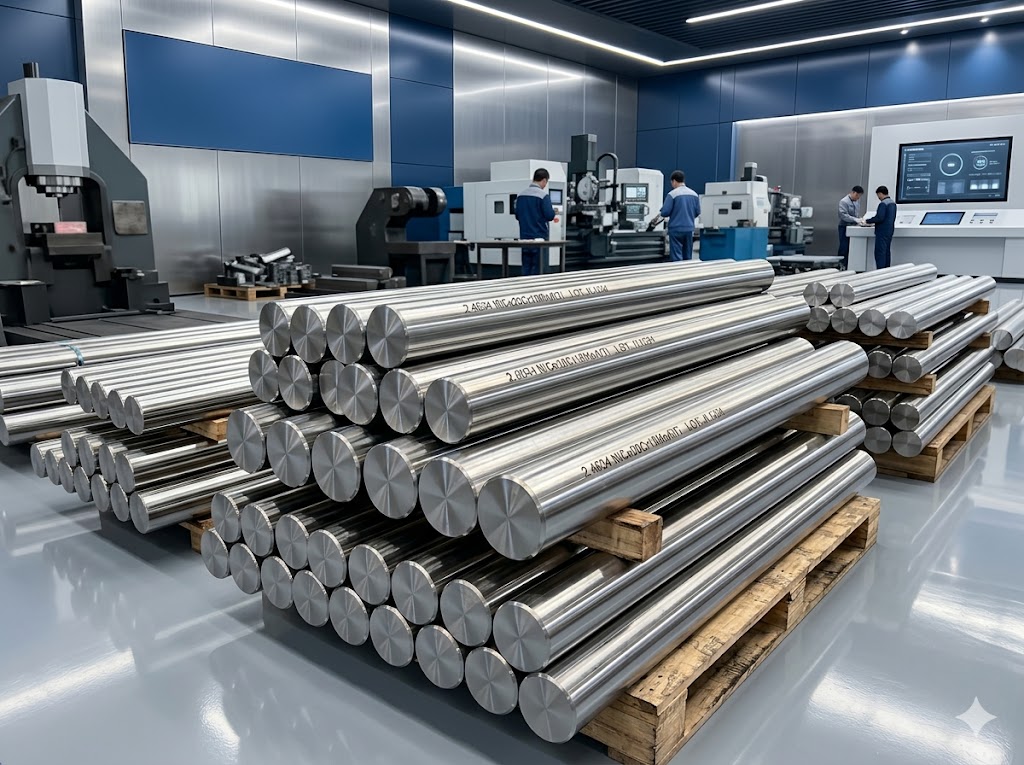
Operating out of a purpose-built campus in the Chengchang Industry Park of Jiangyin City, Jiangsu Province, Jiangsu Liangyi Co., Limited has spent more than a quarter-century perfecting the art of shaping superalloy billets into mission-ready forgings. Since our founding in 1997 we have grown into an ISO 9001 : 2015 certified operation that ships 2.4634 (NiCo20Cr15MoAlTi) open-die forgings and seamless rolled rings to power utilities, oil-field operators, aerospace OEMs and heavy-industrial end users in upwards of 50 countries.
Understanding Alloy 2.4634 (NiCo20Cr15MoAlTi)
Registered under Werkstoff number W.Nr. 2.4634 in the European EN/DIN system, this wrought superalloy sits in the nickel-cobalt-chromium family. It derives its strength from a controlled dispersion of γ′ (gamma-prime) precipitates — an ordered Ni₃(Al,Ti) phase that forms during age-hardening. Generous additions of cobalt (18–22 %) push the γ′ solvus higher, which is why the alloy retains useful load-bearing capacity at temperatures where many competing grades have already softened. The result is an engineering material rated for continuous duty at 950 °C and capable of tolerating brief excursions to 1000 °C.
What Sets 2.4634 Apart: Most age-hardenable nickel alloys sacrifice creep life for tensile strength — or vice versa. Alloy 2.4634 breaks that trade-off. Its dual-ageing heat treatment produces a bimodal γ′ population (coarse particles for creep resistance, fine particles for tensile strength), while boron and zirconium micro-additions pin grain boundaries against sliding. The net effect is an alloy that holds dimensional tolerances under sustained thermal-mechanical load far longer than single-aged alternatives, making it a go-to choice when turbine-grade reliability and structural longevity are both non-negotiable.
Every stage of production — from vacuum-refined ingot melting to final coordinate-measuring-machine (CMM) inspection — takes place within our own walls. The forging bay houses hydraulic presses rated at 2 000, 4 000 and 6 300 tonnes, complemented by 1- to 5-tonne electro-hydraulic hammers and ring-rolling mills spanning 1 m to 5 m in mandrel reach. That breadth of capacity lets us tackle everything from a 30 kg valve stem to a 30 000 kg turbine casing without sub-contracting a single heat.
Equivalent Designations & International Standard Cross-Reference for 2.4634
Because this alloy is specified on projects governed by European, American and Asian codes alike, engineers often encounter it under several names. The table below maps each designation to its originating standards body so that purchasing departments can write unambiguous material call-outs.
| Standards Framework | Designation | Context |
|---|---|---|
| EN / DIN Werkstoff Nr. | 2.4634 | Numeric material number used across Europe |
| EN Chemical Short-Name | NiCo20Cr15MoAlTi | Composition-based shorthand under EN naming rules |
| UNS (USA) | N13021 | Unified Numbering System identifier |
| Alloy Category | Ni-Co-Cr precipitation-hardened superalloy | Strengthened by γ′ (gamma-prime) precipitates |
| Applicable Specifications | ASTM · AMS · DIN · EN · JIS · API 6A (on request) | Multiple regional and industry-specific standards |
Whether your drawing calls out 2.4634, NiCo20Cr15MoAlTi or UNS N13021, the chemistry and acceptance criteria are identical. Our metallurgists review every incoming enquiry to confirm that the correct specification revision is referenced, and we flag any ambiguity before production begins.
Full Spectrum of 2.4634 (NiCo20Cr15MoAlTi) Forging Shapes & Sizes
Our workshop turns NiCo20Cr15MoAlTi billets into an extensive catalogue of near-net and rough-machined geometries. Individual forgings range from compact 30 kg plugs to monolithic 30 000 kg shells, and our rolling and pressing lines collectively output around 120 000 tonnes per year.
Forging Forms We Routinely Produce
- Solid Bars — Round, square, flat and rectangular cross-sections up to Ø 2 000 mm
- Seamless Rolled Rings — Contoured or rectangular-section rings up to Ø 6 000 mm and 30 t unit weight
- Hollow Bodies — Hubs, housings, shells, sleeves, bushings, cases and seamless hollow bars
- Disc-Type Forgings — Pancakes, blocks, blanks and flanged discs up to Ø 3 000 mm
- Tubular Forgings — Thick-wall pipes, cylinders, case barrels and casing segments
- Stepped Shafts — Turbine rotors, valve spindles and multi-diameter shafts up to 15 m in length
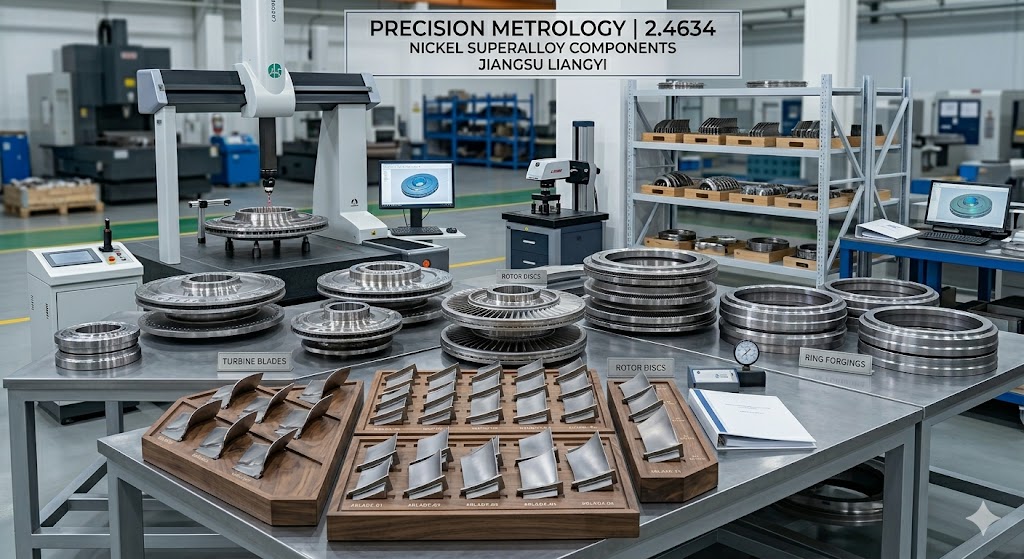
Every item leaves the plant with full material traceability. Depending on your project tier, we issue EN 10204 Type 3.1 mill certificates as standard or Type 3.2 certificates co-signed by an accredited third-party inspector. Product acceptance testing follows ASTM, AMS, AISI, DIN, EN or JIS protocols, as well as API 6A requirements when specified by the customer — or a bespoke combination drawn from your own technical-purchasing specification.
Where 2.4634 (NiCo20Cr15MoAlTi) Forgings Serve — Industry-by-Industry Breakdown
Any environment that marries high temperature with sustained mechanical loading is a potential home for alloy 2.4634. Below we outline the sectors where our forgings are most heavily deployed — and the specific component types within each.
Thermal Power & Gas-Turbine Generation
Power generation remains the single largest consumer of our 2.4634 output. Components are installed in simple-cycle gas turbines, combined-cycle gas-and-steam plants (CCPP), and conventional steam-turbine stations:
- Rotating and stationary gas-turbine blades, buckets and vanes
- Steam-turbine discs, impellers, bladed-disc assemblies (blisks) and turbine wheels
- Guide rings, labyrinth-seal rings, packing rings and inter-stage seals
- Low-pressure turbine (LPT) 1st- and 2nd-stage inner casings and outer shells
- Main-steam control-valve discs, reheat-valve internals and throttle bodies
- Diaphragms, nozzle rings and diaphragm-nozzle assemblies
- Rotor-end coupling rings, casing flange rings and contour rings
Upstream & Downstream Oil, Gas & Petrochemicals
For equipment operating under HPHT (high-pressure, high-temperature) regimes across the hydrocarbon value chain:
- Main stop valve (MSV), governor valve (GV), control valve (CV) and combined reheat valve (CRV) sub-assemblies
- Valve seats, spools, cages, cores and sleeve inserts rated for sour-gas and high-temperature service
- Heavy-duty valve stems, spindles and actuator rods
- Bonnet forgings, body shells and cover-plate blanks for mainline valves
- Gas-compressor rotor discs, impellers and inducer blades
- Refinery heater tubes, transfer-line fittings and catalytic-cracker internals
- Subsea and topside HPHT production-tree components
Aerospace & Defence
- Aero-engine combustion-chamber liners and transition pieces
- Turbine-section blades and nozzle guide vanes (NGVs)
- Afterburner flame-holders and exhaust-duct components
- Structural hot-section hardware for rocket motors and guided munitions
General High-Temperature Industrial Uses
- High-strength studs, cap screws and nut blanks for flange assemblies above 700 °C
- Furnace rollers, muffles, retorts and radiant-tube hangers
- Glass-press plungers, blow moulds and feeder-channel components
- Chemical-reactor internals, catalyst grids and high-temperature vessel nozzles
Proven Track Record: To date our 2.4634 forgings have been installed in combined-cycle power stations across Southeast Asia, high-pressure wellhead assemblies for Middle-Eastern oil-field operators, and flight-critical aero-engine sub-assemblies for tier-one European aerospace primes. Manufacturing everything under one roof in Jiangyin allows us to maintain a direct cost structure — translating into competitive unit pricing, consistent lot-to-lot quality and dependable delivery windows for repeat and new customers alike.
Melting Routes & Raw-Material Production for 2.4634 Alloy
Mechanical performance in a finished forging is largely determined by the cleanliness and homogeneity of the starting ingot. We source 2.4634 stock from qualified melt shops and offer three progressively higher purity routes, allowing you to balance material cost against the criticality of the end application.
| Route | Process Outline | Best Suited For | Cleanliness Tier |
|---|---|---|---|
| Route A — AM / VR | Air induction melt followed by vacuum degassing and refining | General industrial hardware with moderate thermal duty | Standard — most economical option |
| Route B — VIM / VAR | Full vacuum-induction melt plus vacuum-arc remelting — double-vacuum process | Aerospace-critical rotating parts, highest-stress turbine blades | Premium — lowest inclusion content |
| Route C — AM / VAR | Air melt then single vacuum-arc remelt for improved macro-segregation | Majority of power-generation and oil-gas valve components | High — preferred for most projects |
Incoming billets are quarantined until our laboratory confirms that the heat-analysis chemistry, macro-etch appearance and ultrasonic soundness conform to the purchase specification. Only after sign-off does material move to the forge bay — a gating step that prevents off-grade metal from ever entering the production stream.
Chemical Composition of 2.4634 (NiCo20Cr15MoAlTi) — Element-by-Element
Each constituent element in 2.4634 serves a specific metallurgical role. The ranges below are drawn from the governing EN specification and reflect the compositional window within which all incoming heats must fall.
| Element | Range (wt %) | Element | Range (wt %) |
|---|---|---|---|
| Nickel (Ni) | Balance (≈ 51) | Titanium (Ti) | 0.90 – 1.50 |
| Cobalt (Co) | 18.0 – 22.0 | Copper (Cu) | ≤ 0.20 |
| Chromium (Cr) | 14.0 – 15.7 | Zirconium (Zr) | ≤ 0.15 |
| Molybdenum (Mo) | 4.50 – 5.50 | Carbon (C) | ≤ 0.12 |
| Aluminium (Al) | 4.50 – 4.90 | Sulphur (S) | ≤ 0.010 |
| Iron (Fe) | ≤ 1.0 | Boron (B) | 0.003 – 0.010 |
| Manganese (Mn) | ≤ 1.0 | Silicon (Si) | ≤ 1.0 |
How Each Element Contributes: Cobalt (18–22 %) elevates the γ′ solvus, letting the strengthening phase survive to higher operating temperatures. Chromium (14–15.7 %) forms a tenacious Cr₂O₃ scale that shields the surface from oxidation and hot-corrosion attack. Molybdenum (4.5–5.5 %) solid-solution hardens the nickel matrix and slows diffusion-controlled creep. Aluminium (4.5–4.9 %) and titanium (0.9–1.5 %) combine with nickel to nucleate the Ni₃(Al,Ti) γ′ precipitates that are the primary source of strength. Micro-amounts of boron and zirconium segregate to grain boundaries, dramatically improving rupture ductility and extending creep life at temperature.
Our in-house optical-emission spectrometer and combustion-type carbon / sulphur analyser independently verify the composition of every melt before forging begins. Digital records are retained indefinitely, giving full traceability from finished part back to raw ingot.
Three-Stage Precipitation-Hardening Heat Treatment for 2.4634 Forgings
Achieving the target microstructure in alloy 2.4634 demands precise thermal control at each step. The cycle below represents our standard route for turbine-blade and high-creep-strength applications; we tailor temperatures and hold times when a customer's service envelope calls for it.
- Step 1 — Solution Treatment: Hold at 1 149 °C (2 100 °F) for 4 hours, then air-cool. This dissolves all pre-existing precipitates and carbide networks, producing a clean, single-phase γ matrix as the starting point for controlled re-precipitation.
- Step 2 — Primary Age: Hold at 1 056 °C (1 925 °F) for 16 hours, then air-cool. Relatively coarse γ′ particles nucleate and grow during this step; their large size and wide spacing confer resistance to diffusion-controlled creep deformation.
- Step 3 — Secondary Age: Hold at 849 °C (1 560 °F) for 16 hours, then air-cool. A second, finer generation of γ′ particles fills the channels between the coarse particles, raising the alloy's short-term tensile and yield strength without sacrificing the creep resistance established in Step 2.
Why the Bimodal γ′ Architecture Matters
The two-step ageing strategy produces a bimodal precipitate distribution — coarse primary γ′ particles (typically 200–500 nm) interspersed with fine secondary γ′ particles (20–50 nm). During high-temperature service, dislocations must either climb over the coarse particles (an energy-intensive, creep-rate-limiting process) or shear through the fine particles (which demands a high applied stress). By placing both obstacles in the dislocation path simultaneously, the alloy achieves a strength–ductility–creep envelope that is difficult to match with a single-step age.
All thermal cycles run in one of ten atmosphere-controlled furnaces fitted with multi-zone PID controllers holding the working zone to within ±5 °C of set-point. Furnace temperature-uniformity surveys are repeated quarterly, and every load is accompanied by an automatically logged time-temperature chart that ships with the final documentation pack.
Specified Minimum Mechanical Properties of Heat-Treated 2.4634
After completing the three-stage ageing cycle, every production lot is sampled and destructively tested to confirm that it meets or exceeds the property floor shown below. Values apply to room-temperature testing of separately forged and heat-treated test coupons.
| Property | Specified Minimum | Unit |
|---|---|---|
| Ultimate Tensile Strength | 167 000 | psi (1 150 MPa) |
| 0.2 % Offset Yield Strength | 112 000 | psi (770 MPa) |
| Elongation (GL = 4D or 50.8 mm) | 25 | % |
| Reduction of Area | 30 | % |
Beyond room-temperature tensiles, we routinely conduct stress-rupture and creep testing at 815 °C and 950 °C to validate long-term performance under realistic operating loads. These elevated-temperature results accompany the mill certificate whenever the project specification requires them.
Inspection & Quality-Assurance Programme for 2.4634 Forging Parts
Our quality management system — certified to ISO 9001 : 2015 — enforces hold-points at every transition from one production stage to the next. No forging advances until the preceding checkpoint has been signed off by an authorised inspector.
Surface & Internal Soundness Requirements
Finished 2.4634 forgings must be entirely free of cracks, laps, folds, blistering, slag stringers and any other discontinuity that could compromise structural integrity under service loads. External surfaces are to be smooth, oxide-free and dimensionally within drawing tolerance.
Non-Destructive Examination (NDE) Scope
- Ultrasonic Testing (UT) — 100 % volumetric scan of every bar, ring and contour forging to detect sub-surface defects
- Magnetic Particle Inspection (MT) — Surface and near-surface flaw detection on ferromagnetic zones
- Liquid Penetrant Inspection (PT) — Surface-breaking crack detection across all accessible areas
- Positive Material Identification (PMI) — Handheld XRF verification of alloy grade on every heat lot
UT Accept / Reject Criteria (Standard Practice)
Cause for rejection:
- Any crack indication, regardless of echo height
- Flat-bottom-hole (FBH) equivalent > Ø 3 mm
- FBH equivalent ≥ Ø 1.5 mm with a linear extent ≥ 30 mm
Recordable but not rejectable:
- FBH equivalent ≥ Ø 2 mm (single, isolated)
- FBH equivalent ≥ Ø 1.5 mm with any measurable length
Destructive Test Programme
Six sacrificial samples are drawn from each production heat, representing six different press-reduction ratios at the same nominal cross-section. After receiving the identical solution-and-age cycle applied to the production forgings, these coupons undergo:
- Room-temperature tensile testing (UTS, YS, elongation, reduction of area)
- Stress-rupture testing at 815 °C and 950 °C against specified life and elongation limits
- Brinell and / or Rockwell C hardness surveys to confirm correct response to heat treatment
- Optical metallography at 100 × and 500 × for grain-size measurement and precipitate morphology assessment
- Check chemical analysis to cross-validate the melt certificate
Complete test packages — including EN 10204 3.1 / 3.2 mill certificates — accompany every shipment. Third-party witness inspection by internationally recognised inspection agencies can be arranged at the customer's request.
Reasons to Partner with Jiangsu Liangyi for 2.4634 (NiCo20Cr15MoAlTi) Forgings
Choosing a forging supplier is a long-term decision. Here is a transparent look at the capabilities and economics behind our offer.
| Capability | What It Means for You |
|---|---|
| 25 + Years of Superalloy Focus | Deep process know-how accumulated since 1997 — fewer first-article iterations, lower scrap risk, faster time-to-delivery on new part numbers |
| Vertically Integrated Facility | Melting, forging, ring-rolling, heat treatment, machining and testing all under one roof eliminates inter-vendor delays and quality hand-off gaps |
| Heavy-Tonnage Press Capacity | 6 300-tonne main press and 5-metre ring mill let us form parts that many competitors must outsource, keeping lead times predictable |
| Rigorous QMS (ISO 9001 : 2015) | Systematic hold-points, calibrated instruments and documented procedures give you confidence in batch-to-batch repeatability |
| China-Cost Economics | Jiangyin's lower overhead structure translates directly into more competitive per-kilogram pricing — without cutting corners on material or process |
| 120 000 t / yr Throughput | Ample capacity means your order is not competing for press time; schedules are met even when volumes scale up unexpectedly |
| Design-for-Manufacture Support | Our engineers review customer drawings and propose grain-flow optimisations, preform simplifications and near-net approaches that trim metal waste and machining hours |
| Proven Export Logistics | Decades of shipping to 50 + countries means we handle customs documentation, crating and freight routing as a matter of routine — not a special project |
Whether you need a single prototype disc or a multi-year blanket order for serial turbine components, our commercial and technical teams are structured to support both. Reach out for a capabilities presentation tailored to your sector.
Frequently Asked Questions About 2.4634 (NiCo20Cr15MoAlTi) Forgings
2.4634 is the Werkstoff number (W.Nr.) assigned to this nickel-cobalt-chromium superalloy under the European EN/DIN numbering system. NiCo20Cr15MoAlTi is simply the chemical short-name for the same alloy under the EN naming convention, while UNS N13021 is the equivalent identifier used in North America. All three labels point to an identical chemistry and identical property requirements — which one appears on your paperwork depends only on the specifying standard.
The alloy is engineered for steady-state service at up to 950 °C (1 742 °F). Short-duration thermal excursions — such as turbine start-up overshoots — can reach roughly 1 000 °C (1 832 °F) without causing meaningful property loss. Throughout this envelope, 2.4634 retains useful tensile strength, resists time-dependent creep and maintains a protective oxide scale.
Custom work is the backbone of what we do. Send us your 2-D drawings or 3-D models together with the governing material specification, and our process-engineering team will develop a forging plan — including preform design, die layout (where applicable) and grain-flow simulation. Where a small geometry change can lower weight, improve metal yield or simplify subsequent machining, we will flag it before quoting. Piece weights from 30 kg to 30 000 kg are within our working range.
As a baseline, every consignment carries an EN 10204 Type 3.1 mill test certificate covering chemical analysis, mechanical test results and heat-treatment parameters. If your project or end-user mandates Type 3.2 certification — where test data is independently verified by an accredited inspection agency — we organise that seamlessly. Supplementary documentation such as UT scan plots, MT / PT reports, dimensional-inspection records, metallographic micrographs and furnace time-temperature logs can be bundled in on request.
Under normal loading conditions our standard ex-works lead time is four to six weeks from receipt of a confirmed purchase order. The main variables are part complexity, finished weight and lot size. For genuinely urgent situations we can compress the schedule by overlapping heat-treatment shifts and prioritising CNC machine time — contact our commercial desk at sales@jnmtforgedparts.com for a binding commitment date.
Three factors converge. First, the alloy's unusually high cobalt content lifts the γ′ solvus well above 900 °C, preserving precipitation strengthening at temperatures where many rival compositions have already lost significant hardness. Second, the two-step ageing cycle creates a bimodal γ′ population — large particles that throttle creep and fine particles that resist dislocation shearing — delivering both long rupture life and high short-term strength simultaneously. Third, grain-boundary boron and zirconium suppress boundary decohesion under sustained stress, a failure mode that limits the useful life of alloys without these micro-additions.
Yes — and it is one of our most requested value-adds. We operate multi-axis CNC lathes, horizontal and vertical machining centres, and large-bore boring mills capable of handling workpieces up to several metres in diameter. Customers can order parts in whichever condition best fits their own downstream workflow: black-forged with scale, rough-turned to an envelope dimension, semi-finished with reference surfaces, or fully machined to final print tolerance. Surface treatments and protective coatings are arranged through qualified sub-tier partners when specified.
The nickel matrix (balance, approximately 51 %) hosts cobalt at 18.0–22.0 %, chromium at 14.0–15.7 %, molybdenum at 4.50–5.50 %, aluminium at 4.50–4.90 % and titanium at 0.90–1.50 %. Residual and tramp elements are tightly capped: iron, manganese and silicon each ≤ 1.0 %; carbon ≤ 0.12 %; copper ≤ 0.20 %; zirconium ≤ 0.15 %; sulphur ≤ 0.010 %. Boron is deliberately added at 0.003–0.010 % for grain-boundary strengthening.
Our baseline route is a three-stage precipitation-hardening sequence: solution treat at 1 149 °C / 4 h / air cool → first age at 1 056 °C / 16 h / air cool → second age at 849 °C / 16 h / air cool. The dual ageing builds the bimodal γ′ microstructure that underpins the alloy's combined creep-and-strength capability. Where a customer's application or code demands an alternative thermal path — for example a modified solution temperature or a single-step age — our metallurgy group will design and qualify a bespoke cycle.
After completion of the standard three-step age-hardening cycle, the specified minimums at ambient temperature are: ultimate tensile strength ≥ 1 150 MPa (167 ksi), 0.2 % proof stress ≥ 770 MPa (112 ksi), elongation ≥ 25 % and reduction of area ≥ 30 %. We additionally run stress-rupture bars at 815 °C and 950 °C on a per-heat basis, confirming that creep performance under sustained loading meets or surpasses the design data used by turbine and pressure-equipment engineers.
About Jiangsu Liangyi — Background & Credentials
Who We Are
Jiangsu Liangyi Co., Limited was founded in 1997 in the industrial heartland of the Yangtze River Delta — Jiangyin City, Jiangsu Province. Over the past quarter-century we have evolved from a regional forge shop into an internationally recognised manufacturer of open-die forgings and seamless rolled rings in nickel alloys, cobalt alloys, titanium alloys, duplex and super-duplex stainless steels, and high-alloy tool steels.
Today the plant operates hydraulic presses up to 6 300 tonnes, ring-rolling equipment with mandrel reaches of 1 m and 5 m, ten programmable heat-treatment furnaces, and a fully equipped metallurgical and mechanical-testing laboratory. Annual throughput stands at approximately 120 000 tonnes, serving OEMs, EPCs and end users across the power generation, oil & gas, aerospace, petrochemical, marine and mining industries in more than 50 countries.
Our quality management system has been continuously certified to ISO 9001 since 2003, most recently upgraded to the 2015 revision. Every member of the technical staff participates in an ongoing professional-development programme covering new alloy grades, emerging NDE methods and evolving international codes.
Request a Quotation for 2.4634 (NiCo20Cr15MoAlTi) Forging Parts
We appreciate your interest in working with Jiangsu Liangyi for your next 2.4634 forging project. To receive a competitive, no-obligation quotation, please forward your engineering drawings (PDF or DWG), material specification and call-out, target quantities and any special inspection or documentation requirements. Our application-engineering team will return a detailed proposal — including pricing, lead time and delivery terms — within 24 to 48 business hours.
📧 Email: sales@jnmtforgedparts.com
📞 Phone / WhatsApp: +86-135-8506-7993
🌐 Web: www.jnmtforgedparts.com
📍 Facility: Chengchang Industry Park, Jiangyin City, Jiangsu Province 214400, China