2.4632 (2.4969, NiCr20Co18Ti) Forged Parts – China Manufacturer & Supplier
Jiangsu Liangyi Co., Limited, located in Chengchang Industry Park, Jiangyin City, Jiangsu Province, China, is a leading professional manufacturer of 2.4632 (2.4969, NiCr20Co18Ti) open die forging parts and seamless rolled steel forged rings. With over 25 years of specialized experience in high-temperature alloy forging, we produce precision-engineered 2.4632 alloy components — also widely known as Nimonic® Alloy 90 — that deliver exceptional performance in extreme operating conditions up to 920°C.
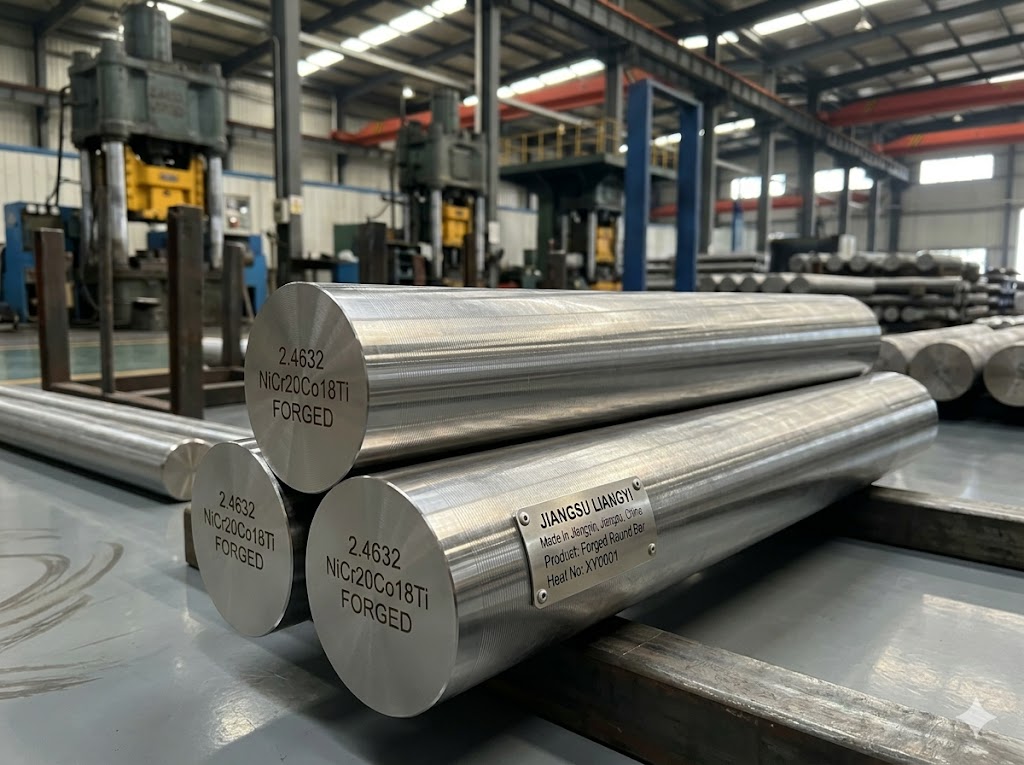
As an ISO 9001:2015 certified Chinese forging factory, we offer complete end-to-end manufacturing solutions from steel melting and forging to heat treatment and precision machining. Our 80,000㎡ production facility in Jiangyin is equipped with advanced 2000–6300 ton hydraulic presses and 1–5 meter ring rolling machines, enabling us to produce 2.4632 forgings ranging from 30 kg to 30,000 kg with an annual capacity of 120,000 tons.
Comprehensive Range of 2.4632 (NiCr20Co18Ti) Forging Products
We manufacture a full spectrum of 2.4632 forging steel products in custom sizes and shapes to meet your exact specifications:
- Forged Bars: Round bars, square bars, flat bars, rectangular bars and solid rods
- Seamless Rolled Rings: Custom seamless rolled rings up to 6 meters in diameter
- Hollow Components: Hubs, housing shells, sleeves, bushes, cases and thick-walled hollow bars
- Flat Products: Discs, disks, blocks, plates and flanged blanks up to 3 meters diameter
- Tubular Products: Pipes, tubes, tubings, piping shells, casings and barrels
- Custom Components: Turbine blades, valve seats, valve spindles, fasteners and die blocks
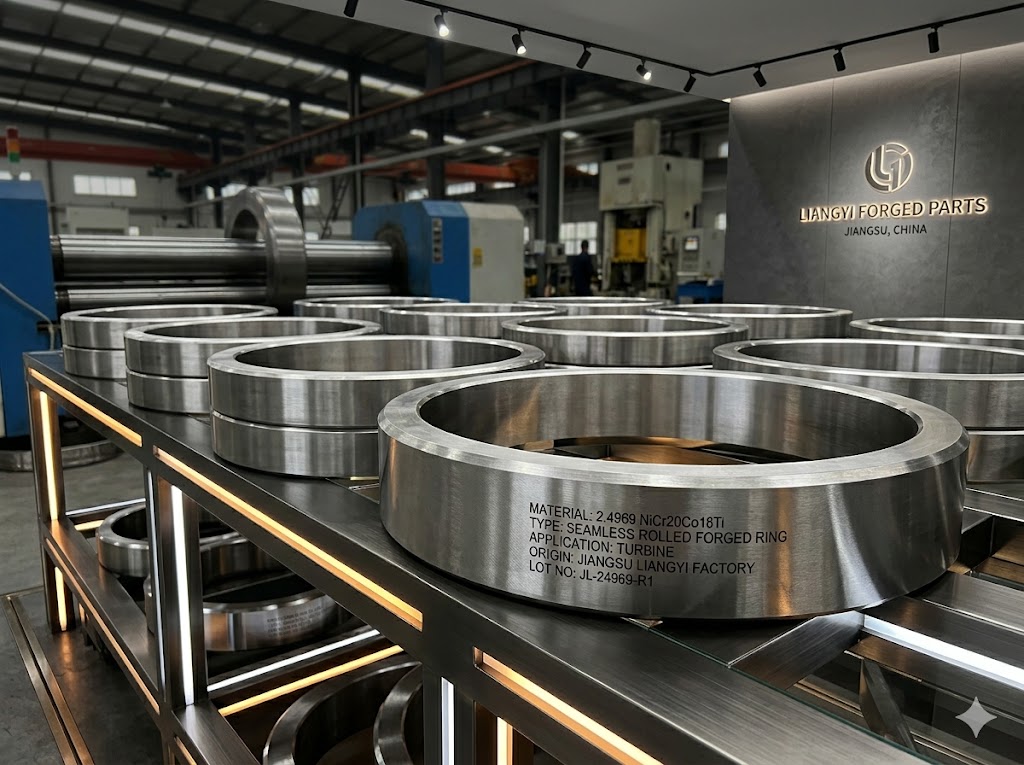
Alloy Cross-Reference & Equivalent Designations
2.4632 is known by several international designations. The following table helps engineers identify the correct equivalent across global standards:
| Standard | Designation |
|---|---|
| EN / DIN (Germany) | 2.4632 / 2.4969 |
| Chemical Formula | NiCr20Co18Ti |
| Trade Name | Nimonic® Alloy 90 / Nimonic® 90 |
| UNS (USA) | N07090 |
| BS (UK) | HR401 |
| AFNOR (France) | NC20K14 |
| ISO | NiCr20Co18Ti (ISO 9723) |
| AMS (Material Equivalent) | AMS 5829 / AMS 5830 |
Superior Material Properties of 2.4632 (NiCr20Co18Ti)
2.4632 (also known as 2.4969, NiCr20Co18Ti, or Nimonic® Alloy 90) is a precipitation hardenable nickel-chromium-cobalt superalloy strengthened by the addition of Titanium and Aluminium. This advanced alloy offers:
- Exceptional high stress-rupture strength at temperatures up to 920°C
- Excellent creep resistance under prolonged high-temperature loading
- Good oxidation and corrosion resistance in aggressive environments
- Superior fatigue resistance in cyclic temperature conditions
- Excellent mechanical properties at elevated temperatures
Physical Properties & Density of 2.4632 (NiCr20Co18Ti)
Understanding the physical properties of 2.4632 is essential for engineering calculations, component design, and thermal management. The following data applies to the precipitation hardened condition:
| Property | Value | Unit |
|---|---|---|
| Density | 8.18 | g/cm³ |
| Melting Range | 1310 – 1370 | °C |
| Specific Heat Capacity (20°C) | 397 | J/(kg·K) |
| Thermal Conductivity (20°C) | 11.47 | W/(m·K) |
| Thermal Conductivity (500°C) | 18.99 | W/(m·K) |
| Thermal Conductivity (900°C) | 27.21 | W/(m·K) |
| Mean Coefficient of Thermal Expansion (20–100°C) | 12.7 × 10⁻⁶ | K⁻¹ |
| Mean Coefficient of Thermal Expansion (20–500°C) | 13.6 × 10⁻⁶ | K⁻¹ |
| Mean Coefficient of Thermal Expansion (20–900°C) | 16.2 × 10⁻⁶ | K⁻¹ |
| Electrical Resistivity (20°C) | 1.154 | μΩ·m |
| Modulus of Elasticity (20°C) | 213 | GPa |
| Modulus of Elasticity (500°C) | 189 | GPa |
| Modulus of Elasticity (800°C) | 154 | GPa |
| Poisson's Ratio | 0.30 | — |
| Magnetic Permeability | Non-magnetic | — |
The relatively low thermal conductivity of 2.4632 is characteristic of nickel-based superalloys and should be factored into heat transfer calculations. The alloy's non-magnetic nature makes it suitable for applications where magnetic interference must be avoided.
Industrial Applications & Success Cases
Our 2.4632 forged parts are widely used across multiple important industries worldwide:
Power Generation Industry (Largest Application)
- Gas & Steam Turbine Parts: Turbine blades, turbine discs, turbine impellers and turbine blisks
- Turbine Hardware: Guide rings, seal rings, labyrinth rings, packing seal diaphragms and rotor end rings
- Valve Systems: Control reheat valve discs, valve spindles/stems/rods, valve seats, valve cores and valve sleeves
- Fasteners: Double-headed studs, bolts and bolting for high-temperature turbine assemblies
Aerospace & Aviation Industry
- Aircraft engine exhaust valves and spindles
- Turbine case parts for commercial and military gas turbine engines
- High-temperature springs and exhaust reheaters
- Combustion chamber parts
Automotive & Transportation Industry
- High-performance automobile exhaust valves for diesel and gasoline engines
- Turbocharger parts operating at extreme temperatures
- Racing engine parts needing excellent heat resistance
Tool & Die Industry
- Hot working dies, tooling and die blocks for metal forming
- Die casting inserts and cores for aluminum and magnesium casting
- Molds for high-temperature plastic forming processes
- Extrusion dies and tooling
Oil & Gas Industry
- High-temperature valve parts for refinery applications
- Downhole tools for high-pressure, high-temperature (HPHT) wells
- Compressor parts for natural gas processing
Chemical Composition of 2.4632 (EN 10302:2008 Standard)
All our 2.4632 forgings strictly adhere to EN 10302:2008 standard for creep resisting steels, nickel and cobalt alloys. Following is the full chemical composition range:
| Element | Minimum % | Maximum % |
|---|---|---|
| Nickel (Ni) | 49 | 64 |
| Chromium (Cr) | 18 | 21 |
| Cobalt (Co) | 15 | 21 |
| Titanium (Ti) | 2.0 | 3.0 |
| Aluminum (Al) | 1.0 | 2.0 |
| Iron (Fe) | - | 1.5 |
| Manganese (Mn) | - | 1.0 |
| Silicon (Si) | - | 1.0 |
| Copper (Cu) | - | 0.2 |
| Zirconium (Zr) | - | 0.15 |
| Carbon (C) | - | 0.13 |
| Phosphorus (P) | - | 0.020 |
| Boron (B) | - | 0.020 |
| Sulfur (S) | - | 0.015 |
Mechanical Properties of Precipitation Hardened 2.4632
All our 2.4632 forged products undergo rigorous mechanical testing to ensure consistent quality and performance:
| Property | Condition | Minimum Value |
|---|---|---|
| Tensile Strength (Rm) | Precipitation Hardened (+P) | 1100 MPa |
| 0.2% Proof Strength (Rp0.2) | Precipitation Hardened (+P) | 700 MPa |
| Elongation at Fracture (A) | Precipitation Hardened (+P) | 15% |
High-Temperature Mechanical Properties of 2.4632
One of the defining characteristics of 2.4632 (Nimonic 90) is its ability to retain strength at elevated service temperatures. The following data represents typical values for precipitation hardened material:
| Test Temperature | Tensile Strength (MPa) | 0.2% Proof Stress (MPa) | Elongation (%) |
|---|---|---|---|
| 20°C (Room Temp) | 1250 | 830 | 22 |
| 400°C | 1180 | 790 | 20 |
| 500°C | 1140 | 770 | 18 |
| 600°C | 1100 | 740 | 17 |
| 700°C | 1020 | 700 | 16 |
| 750°C | 940 | 660 | 16 |
| 800°C | 820 | 600 | 18 |
| 850°C | 650 | 490 | 22 |
| 900°C | 440 | 340 | 30 |
Stress Rupture Properties (1000-Hour Life)
The stress-rupture data is critical for designers working on parts with long service lives under constant load at elevated temperatures:
| Temperature (°C) | Stress for 1000h Rupture (MPa) | Stress for 0.1% Creep in 1000h (MPa) |
|---|---|---|
| 700 | 400 | 270 |
| 750 | 280 | 180 |
| 800 | 180 | 110 |
| 850 | 105 | 60 |
| 900 | 55 | 30 |
These stress-rupture and creep values demonstrate why 2.4632 is the preferred material for gas turbine blades and discs in the 700–850°C temperature range, where it has an improved combination of strength, creep resistance, and ductility.
Heat Treatment Specifications for 2.4632
Proper heat treatment is essential to achieve the required mechanical properties of 2.4632 forged parts. At our Jiangyin factory, we perform all heat treatments in computer-controlled atmosphere furnaces with calibrated thermocouples for precise temperature uniformity.
Solution Treatment (Annealing)
Heat to 1080°C ± 10°C and hold for a minimum of 8 hours (dependent on section thickness). Cool in air. This step dissolves the gamma-prime (γ') precipitates and produces a uniform, supersaturated solid solution microstructure.
Precipitation Hardening (Aging)
After solution treatment, the alloy is given a two-step aging process to improve the γ' precipitate size and distribution:
- Primary Aging: Heat to 700°C ± 10°C, hold for 16 hours, then air cool
- Stabilization (Optional): For long-term high-temperature service, an additional treatment at 750°C for 4–8 hours can be applied to coarsen γ' for improved creep resistance
Stress Relief Treatment
We offer a stress-relief treatment at 900°C for 2–4 hours, followed by controlled cooling, for parts that need to stay stable after machining.This is commonly applied before final finishing operations.
Forging Temperature & Hot Working Guidelines for 2.4632
During forging, 2.4632 needs to be kept at the right temperature to get the right microstructure and mechanical properties. Our forging engineers follow these rules:
| Parameter | Value |
|---|---|
| Maximum Forging Temperature (Start) | 1140°C |
| Minimum Forging Temperature (Finish) | 950°C |
| Optimal Forging Range | 1060–1120°C |
| Reheating Temperature | 1100–1140°C |
| Minimum Reduction Ratio | 3:1 (typical 4:1 to 6:1) |
| Maximum Deformation Per Pass | 15–20% |
| Post-Forging Cooling | Air cool (avoid water quench) |
Forging below 950°C can lead to cracking because the material becomes less flexible. Forging above 1140°C may cause partial melting at grain boundaries. Our hydraulic presses (2000–6300 ton) let us control the speed and pressure very accurately, which is key to getting an even grain structure across the whole part. For complex shapes or large thickness reductions, we may need several reheating steps.The forging reduction ratio directly affects the final grain size and strength. A minimum ratio of 3:1 from the original ingot is needed to fully improve the cast matrix. For important rotating parts such as turbine discs, we usually use a ratio of 4:1 or higher to ensure a fine, even grain matrix (ASTM 5 or finer).
Test Sample Removal Procedures
Unless otherwise specified on customer drawings or technical specifications:
- Longitudinal samples for sections inscribed in a circle < 100 mm diameter
- Transverse samples for sections inscribed in a circle ≥ 100 mm diameter
- Tangential samples for forged rings or disks
Machinability & Welding Guidelines for 2.4632
Machinability
2.4632 is classified as a difficult-to-machine material due to its high strength, work-hardening tendency, and abrasive γ' precipitates. Successful machining requires:
- Tooling: Carbide inserts (C2/C3 grade) or ceramic tools are recommended. High-speed steel (HSS) is not suitable for production machining
- Cutting Speed: 15–30 m/min for turning, 8–15 m/min for milling (significantly lower than austenitic stainless steels)
- Feed Rate: Use positive, constant feed rates; avoid dwelling or rubbing, which accelerates work hardening
- Coolant: High-pressure flood coolant is essential. Water-soluble cutting fluids at 6–8% concentration are recommended
- Condition: Machining in the solution-treated (softer) condition is preferred whenever possible; final aging is then performed after machining
At Jiangsu Liangyi, we do CNC machining in-house with operators who have been trained to work with superalloy materials. Our tool management system makes sure that the surface finish is always the same quality (Ra 1.6 μm or better).
Welding
2.4632 can be welded using TIG (GTAW) and electron beam welding processes, though careful procedures are needed:
- Pre-heat: Not required, but parts should be at room temperature minimum (above 15°C)
- Filler Material: Matching composition filler wire (NiCr20Co18Ti) or Nimonic 263 filler for dissimilar joints
- Shielding Gas: Pure argon (99.99%) for TIG welding, with argon back-purge on the root side
- Post-Weld Heat Treatment (PWHT): Full solution treatment + aging cycle is strongly recommended to restore the γ' precipitation and relieve residual stresses
- Interpass Temperature: Maximum 150°C to prevent hot cracking
2.4632 vs. Similar Superalloys — How Does Nimonic 90 Compare?
Engineers often need to choose between several nickel-based superalloys for high-temperature applications. The following comparison helps position 2.4632 (Nimonic 90) relative to common alternatives:
| Property | 2.4632 (Nimonic 90) | 2.4631 (Nimonic 80A) | 2.4654 (Waspaloy) | 2.4668 (Inconel 718) |
|---|---|---|---|---|
| Max Service Temp | 920°C | 815°C | 870°C | 650°C |
| Tensile Strength (RT) | ≥1100 MPa | ≥1000 MPa | ≥1280 MPa | ≥1240 MPa |
| Cobalt Content | 15–21% | ≤2% | 12–15% | ≤1% |
| Creep Resistance | Excellent | Good | Excellent | Moderate |
| Weldability | Fair | Fair | Fair | Good |
| Relative Cost | Medium-High | Medium | High | Medium |
| Primary Applications | Turbine blades, exhaust valves | Exhaust valves, springs | Turbine discs, casings | Turbine discs (≤650°C) |
When to choose 2.4632 over alternatives: Choose 2.4632 (Nimonic 90) when your part needs to run continuously above 750°C with strong resistance to creep and stress-rupture.It works better than Nimonic 80A and Inconel 718 between 750°C and 920°C.For uses below 650°C where good welding ability is most important, Inconel 718 often costs less.For the highest stress levels above 870°C, Waspaloy has higher tensile strength, but it is more expensive and harder to forge.
Our metallurgical engineers can help you choose the best grade for your needs and the conditions in which you will be using it. View our full materials list.
Comprehensive Quality Control & Testing
We strictly control every stage of the whole production, from raw material inspection to final product testing, to make sure all parts have the highest quality.
Raw Material Testing
- Chemical composition analysis using advanced spectrometers
- Ultrasonic testing for internal defects
- Grain size and inclusion content analysis
In-Process Testing
- Dimension test at each manufacturing stage
- Hardness testing
- Visual inspection for surface defects
Final Product Testing
- ASTM E10-12: Brinell hardness testing
- ASTM A370-12: Mechanical testing of steel products
- ASTM E23-07a: Notched bar impact testing
- AMS 2315G: Delta ferrite content determination
- ASTM E45-05: Inclusion content determination
- ASTM E112-10: Average grain size determination
- ASTM E837: Residual stress measurement by hole-drilling strain-gage method
- 100% Ultrasonic Testing (UT) and Magnetic Particle Testing (MT)
All products are supplied with complete Mill Test Certificates (MTC) EN 10204 3.1 or 3.2 as required.
Our Manufacturing Process for 2.4632 Forgings
- Raw Material Selection: Premium quality 2.4632 alloy ingots from certified suppliers
- Steel Melting & Refining: 30t electric arc furnace (EAF) + ladle refining furnace (LF) + vacuum degassing (VOD)
- Forging: Open die forging using 2000–6300 ton hydraulic presses
- Heat Treatment: Solution treatment + precipitation hardening in controlled atmosphere furnaces
- Machining: Precision CNC machining to customer drawings
- Quality Inspection: Comprehensive testing and dimensional verification
- Packaging & Shipping: Secure packaging and worldwide delivery
Why Choose Jiangsu Liangyi as Your 2.4632 Forging Partner?
- 25+ Years Specialized Experience: We have extensive experience in producing high-temperature nickel alloy forging since 2001
- Complete In-House Manufacturing: We provide a full range of services from steel melting to final machining
- Advanced Production Equipment: We have 2000–6300 ton hydraulic presses and 1–5 meter ring rolling machines
- Comprehensive Testing Facilities: In-house chemical, mechanical and metallurgical testing
- ISO 9001:2015 Certified: Rigorous quality management system
- Global Delivery: Exported to over 50 countries in Europe, North America, Middle East and Asia-Pacific
- Competitive Pricing: Cost-effective solutions without compromising quality
- Fast Lead Times: Efficient production processes ensure timely delivery (4–8 weeks)
- Custom Solutions: Manufactured to your exact drawings and specifications
- Technical Support: Experienced engineering team provides full technical assistance
Frequently Asked Questions (FAQ)
The only difference between alloys 2.4632 and 2.4969 is their names. Both of them refer to Nimonic Alloy 90, which is also known as NiCr20Co18Ti and has the UNS number N07090. Jiangsu Liangyi makes forged parts under both names, and they all meet the same EN 10302:2008 standard.
2.4632 keeps excellent mechanical properties and high stress‑rupture strength up to 920°C (1688°F).So that it is the best choice material for gas turbines, exhaust valves, and other high‑temperature uses in power generation and aerospace industries.
Our factory in Jiangyin usually needs 4–6 weeks to produce standard products, and 6–8 weeks for intricate custom parts. We ship from ports in Shanghai, Ningbo or Qingdao to locations all over the world.
Yes, we provide a full range of CNC machining services at our Jiangyin, Jiangsu factory to supply finished parts ready for direct assembly. Our services include turning, milling, drilling and grinding, achieving tight tolerances according to your drawings.
Yes, we welcome and regularly arrange third‑party inspections by well‑known international agencies such as SGS, Bureau Veritas (BV), TÜV and Lloyd's Register at the customer’s request.All inspections take place at our factory in Jiangyin, Jiangsu.
Our 2.4632 forgings are produced to EN 10302:2008, and the material is equivalent to AMS 5829 / AMS 5830.We carry out tests in line with ASTM A370, ASTM E23, ASTM E45 and ASTM E112.All products include Mill Test Certificates (MTC) meeting EN 10204 Type 3.1 or 3.2.Our factory is ISO 9001:2015 certified.
Our ring rolling equipment can produce 2.4632 seamless rolled rings with an outer diameter of up to 6 meters (around 20 feet).Ring weights range from 30 kg to 30,000 kg, depending on cross‑section and diameter requirements.
We export our 2.4632 forged parts to more than 50 countries around the world, including Germany, the United Kingdom, France, Italy, Canada, India, South Korea, Saudi Arabia, UAE, Australia, Brazil and others.We ship through Shanghai, Ningbo and Qingdao ports.
2.4632 uses a two‑stage heat treatment process. First, solution treatment at 1080°C ± 10°C for at least 8 hours, then air cooling. Second, precipitation hardening (aging) at 700°C ± 10°C for 16 hours, then air cooling.This process creates an optimized gamma‑prime (γ') precipitate structure, giving the alloy outstanding high‑temperature strength. Our Jiangyin factory uses computer‑controlled atmosphere furnaces to ensure accurate and consistent temperature control.
It is best to forge 2.4632 between 1060 and 1120 °C, but it can be forged between 950 and 1140 °C.Forging at temperatures below 950°C may cause cracking because the metal is less ductile. Temperatures above 1140°C can cause partial melting at grain boundaries. For important rotating parts like turbine discs, a minimum forging reduction ratio of 3:1 is needed, and a ratio of 4:1 or higher is better.
Yes, 2.4632 can be welded using TIG (GTAW) or electron beam welding. The main things to watch for are welding it after solution treatment but not aging to prevent cracking from strain aging, using NiCr20Co18Ti filler wire that matches the base material, shielding with 99.99% pure argon gas, keeping the temperature between weld passes under 150°C, and carrying out a full heat treatment after welding including solution treatment and aging to bring back its original mechanical properties.
2.4632 (Nimonic 90) has a density of 8.18 g/cm³ and a melting range of 1310–1370°C. At room temperature, the modulus of elasticity is 213 GPa. It drops to about 154 GPa at 800°C. The alloy doesn't have any magnetic properties, and at room temperature, it can conduct heat at a rate of 11.47 W/(m·K).
Shipping & Delivery Information
- Production Lead Time: 4–8 weeks depending on complexity and quantity
- Shipping Ports: Shanghai, Ningbo, Qingdao (China)
- Shipping Methods: Sea freight, air freight, express delivery (DHL, FedEx, UPS)
- Packaging: Wooden crates with anti-rust protection, seaworthy packing
- Export Experience: Over 25 years exporting to 50+ countries worldwide
- Trade Terms: FOB, CIF, CFR, EXW, DDP available
Contact Us for 2.4632 (NiCr20Co18Ti) Forged Parts
Jiangsu Liangyi Co., Limited is your trusted partner for high-quality 2.4632 (2.4969, NiCr20Co18Ti) forged parts. We provide products with competitive pricing and high quality to global clients in the power generation, aerospace, automotive and oil & gas industries.
Inquiry Email: sales@jnmtforgedparts.com
Phone/WhatsApp: +86-13585067993
Website: www.jnmtforgedparts.com
Address: Chengchang Industry Park, Jiangyin City, Jiangsu Province, China