About 2.4617 (NiMo28) Corrosion-Resistant Alloy
Jiangsu Liangyi Co., Limited is a professional ISO 9001:2015 certified manufacturer of 2.4617 (NiMo28) open die forging parts and seamless rolled steel forged rings from Jiangsu, China. With over 25 years of specialized experience in nickel alloy forging, we supply custom NiMo28 forged parts to customers in more than 50 countries across North America, Europe, the Middle East and Southeast Asia.
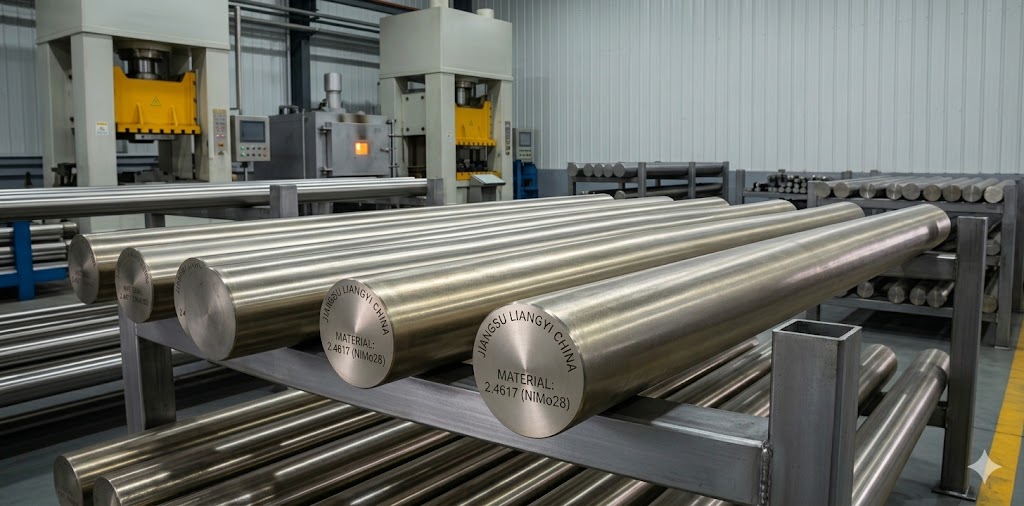
2.4617, also known as NiMo28, UNS N10001 and Hastelloy® B2 equivalent, is a high-performance corrosion-resistant nickel-molybdenum alloy with strictly controlled minimum iron (≤2.0%) and chromium (≤1.0%) content. Due to the unique composition, it has excellent resistance to reducing environments that would rapidly corrode stainless steels and other nickel alloys.
Unmatched Material Advantages
- Excellent resistance to pure reducing substances and various organic acids
- Great resistance to hydrochloric acid up to 20% concentration at temperatures up to 100°C
- Resistant to sulfuric acid, hydrofluoric acid and phosphoric acid in reducing conditions
- High mechanical strength (tensile strength >760 MPa) and excellent ductility (elongation >40%)
- Good weldability and formability for intricate parts fabrication
- Superior to 316L stainless steel and Inconel 600 in severe reducing corrosion environments
Corrosion Rate Comparison: 2.4617 vs. Common Alloys (mm/year)
The following corrosion rate data is based on immersion testing conducted on our production-grade forgings. These figures represent measured material loss (mm/year) under controlled laboratory conditions. Lower values indicate superior corrosion resistance.
| Alloy | 10% HCl (Hydrochloric Acid) | 50% H₂SO₄ (Sulfuric Acid) | 40% HF (Hydrofluoric Acid) | 65% HNO₃ (Nitric Acid) | ||||
|---|---|---|---|---|---|---|---|---|
| 25°C | 60°C | 100°C | 25°C | 80°C | 25°C | 60°C | 25°C | |
| 2.4617 (NiMo28) ★ | 0.02 | 0.05 | 0.18 | 0.03 | 0.12 | 0.08 | 0.25 | >5.0 ✗ |
| Hastelloy B3 (N10665) | 0.03 | 0.09 | 0.28 | 0.04 | 0.18 | 0.12 | 0.38 | >4.0 ✗ |
| Hastelloy C276 (N10276) | 0.28 | 0.85 | 3.6 | 0.15 | 0.62 | 0.20 | 1.2 | 0.18 |
| Inconel® 625 (N06625) | 0.55 | 2.1 | >5.0 | 0.30 | 1.8 | 1.5 | >3.0 | 0.05 |
| 316L Stainless Steel | >5.0 | >10 ✗ | >10 ✗ | 0.45 | >5.0 ✗ | >5.0 ✗ | >10 ✗ | >8.0 ✗ |
| Titanium Grade 2 | >3.0 ✗ | >10 ✗ | >10 ✗ | 2.8 ✗ | >10 ✗ | 0.35 | 0.90 | 0.01 |
★ = 2.4617 (NiMo28) alloy. Green = corrosion rate <0.25 mm/year (excellent); Yellow = 0.25–2.0 mm/year (acceptable); Red = >2.0 mm/year or alloy not suitable (✗). Test method: ASTM G31 static immersion. Data compiled from published corrosion engineering literature and alloy manufacturer technical data sheets for reference purposes. ✗ indicates alloy is not recommended for this medium. Important notice: 2.4617 is NOT suitable for oxidizing environments such as nitric acid, ferric chloride or cupric chloride solutions — Hastelloy C276 or Inconel 625 should be specified instead.
How to Choose the Right Nickel Alloy Forging for Your Application
Our engineering team has put together this special chosen guide, based on 25 years of practical experience with nickel alloy forgings. Use this guide as a starting point — be sure to talk to our engineers about your specific service conditions.
Alloy Selection Decision Guide
Based on primary service environment and temperature
2.4617 Forging Capabilities & Available Forms
We manufacture a full range of 2.4617 (NiMo28) forged products in custom sizes and shapes to meet your most important project requirements. We have advanced forging equipment and can produce parts from 30kg up to 30,000kg in weight. View our full forged products catalog to explore all available options.
Available Forging Shapes & Dimensions
- Forged Bars: Round bars (Ø20mm to Ø2000mm), square bars, flat bars and rectangular bars up to 15 meters long
- Seamless Rolled Rings: Custom seamless rolled rings up to 6 meters in diameter and 30 tons in weight
- Hollow Components: Hubs, housings, shells, sleeves, bushes, cases and hollow bars up to 3000mm OD
- Flat Products: Discs, disks, blocks and plates up to 3000mm in diameter and 500mm thick
- Piping Products: Pipes, tubes, tubings, piping shells, casings and barrels with heavy wall thickness
- Custom Components: Step shafts, gear shafts, impellers, valve bodies and other custom shapes per your drawings
Detailed Forging Specification Range Table
The following table shows the specific dimensional and weight limits for each product form available from Jiangsu Liangyi. All dimensions shown are the maximum capability; minimum order quantities and tolerances are available on request.
| Product Form | Key Dimensions | Min | Max | Max Weight | Typical Tolerance |
|---|---|---|---|---|---|
| Round Forged Bar | Diameter (OD) | Ø 20 mm | Ø 2,000 mm | 30,000 kg | +4 / 0 mm (EN 10243-1) |
| Seamless Rolled Ring | Outer Diameter | Ø 200 mm | Ø 6,000 mm | 30,000 kg | ±0.5% OD; ±1 mm height |
| Forged Disc / Plate | Diameter × Thickness | Ø 50 × 20 mm | Ø 3,000 × 500 mm | 20,000 kg | +5 / 0 mm dia; +3 / 0 mm thk |
| Hollow Bar / Shell | OD × ID × Length | OD 80 mm | OD 3,000 mm | 25,000 kg | Wall thickness ±5% |
| Square / Flat Bar | Width × Height × Length | 20 × 20 mm | 1,200 × 800 mm × 10 m | 15,000 kg | +3 / 0 mm each side |
| Step Shaft | Max diameter × Length | Ø 50 × 200 mm | Ø 1,500 × 8,000 mm | 20,000 kg | Per drawing ±0.5 mm |
| Custom Component | Per customer drawing — submit DXF/DWG/STEP file for feasibility assessment and quotation within 24 hours | Up to 30,000 kg | |||
2.4617 (NiMo28) Forging Weight Calculator
Instantly estimate the theoretical weight of your forged part. Use this as a reference for freight cost estimation and quotation preparation. Density of 2.4617: 9.22 g/cm³.
* Theoretical weight based on density 9.22 g/cm³. Actual forging weight includes machining allowance; add 10–15% for rough forging order weight. Contact us with these dimensions for an accurate quotation.
2.4617 Forging Parts Global Applications & Regional Case Studies
Our 2.4617 (NiMo28) forged parts are widely used in important applications across multiple industries where corrosion resistance, reliability and long lifetime are non-negotiable. Below are our key regional project references from around the world:
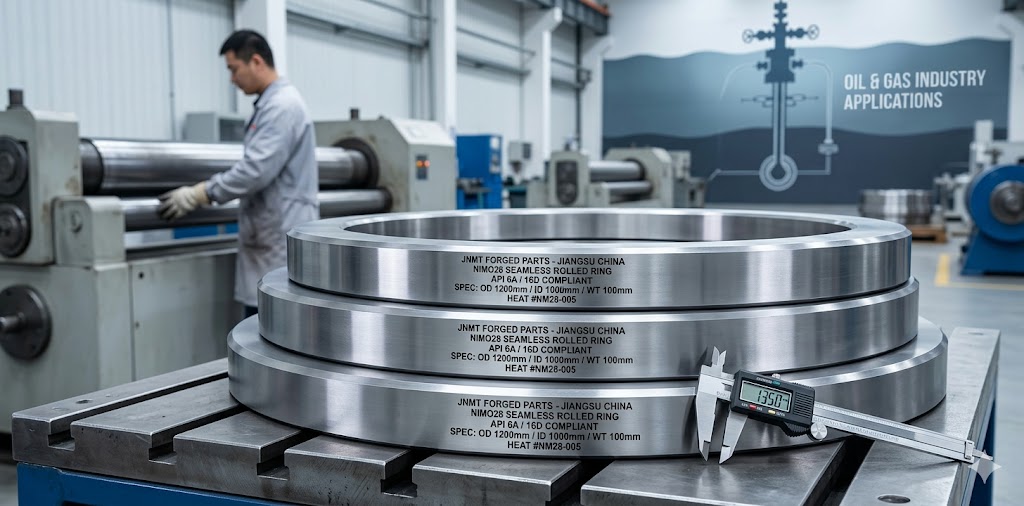
Oil & Gas Industry - Global Projects
Middle East Offshore Oil Fields
We have supplied over 500 tons of 2.4617 forged drilling pipes, drill collars, mud motor splined drive shafts and electric submersible pump (ESP) motor shafts to big oil field operators in the Arabian Gulf. These parts work in harsh downhole conditions including 15,000 psi pressure, 180°C temperature and corrosive sour gas environments.
North American Onshore & Offshore
Our NiMo28 forged casing heads, tubing heads, casing hangers, tubing hangers and spools are used in wellhead and Christmas tree assemblies in the Gulf of Mexico and Permian Basin regions. All parts meet API 6A PSL3 standards and meet NACE MR0175/ISO 15156 sour service requirements.
European Refineries & Petrochemical Plants
We manufacture 2.4617 forged valve balls, valve bodies, valve bonnets, valve stems, valve seat rings and valve discs for ball valves, gate valves and check valves used in big refinery operators in the Netherlands and Germany. These parts work reliably in hydrochloric acid and sulfuric acid processing units.
Nuclear Power Industry - Asian Projects
Chinese Nuclear Power Plants
Our 2.4617 forged nuclear reactor coolant pump casings, shells, rotor impellers and containment seal chambers are supplied to multiple nuclear power plants in China. These important parts meet the strictest nuclear safety standards and have a lifetime of 60 years.
Chemical & Petrochemical Industry - Southeast Asia
Southeast Asian Chemical Processing Plants
We provide NiMo28 forged pressure vessel nozzles, heat exchanger tube sheets, baffle plates and transition cones for chemical plants in Singapore, Malaysia and Indonesia. These parts resist corrosion from strong acids and aggressive chemicals in fertilizer and pharmaceutical production processes.
Power Generation & Turbomachinery
Global Combined-Cycle Power Plants
Our 2.4617 forged gas and steam turbine valve seats, valve cores, valve sleeves and main steam valve covers are used in over 50 combined-cycle power plants around the world, including in Japan, South Korea and India. They keep their mechanical properties at elevated temperatures up to 500°C and have been working reliably for a long time.
Advanced Manufacturing Process and Rigorous Quality Control
Premium Triple Melt Process — Full Parameter Specification
All our 2.4617 (NiMo28) material is produced using a state-of-the-art triple melt process. Unlike single-melt or dual-melt suppliers, our three-step process guarantees oxygen content below 15 ppm, sulfur below 5 ppm, and ASTM grain size ≥5 across the entire cross-section — verified by metallographic analysis on every heat. Learn more about our advanced manufacturing equipment.
| Process Stage | Key Parameter | Jiangsu Liangyi Specification | Purpose & Effect on 2.4617 Forging Quality |
|---|---|---|---|
| 1Vacuum Induction Melting (VIM) | Vacuum level | < 0.1 Pa during pouring | Eliminates dissolved O₂ and N₂ that cause porosity in final forgings |
| Melt temperature | 1,450–1,520°C | Ensures complete dissolution of Mo (melting point 2,623°C) into Ni matrix | |
| Refining hold time | 45–90 min at <5 Pa | Drives carbon deoxidation reaction: C + O → CO↑, reduces oxygen to <20 ppm | |
| Electrode diameter | Ø 350–600 mm | Matched to ESR mold for optimal melt rate and solidification | |
| Chemistry verification | OES analysis every heat | Confirms Mo 26–30%, Ni 64.8–74%, Fe ≤2%, C ≤0.02% before electrode release | |
| 2Electroslag Remelting (ESR) | Slag system | CaF₂–CaO–Al₂O₃ (60:20:20 wt%) | High-basicity slag absorbs non-metallic inclusions; Al₂O₃ prevents Ni oxidation |
| Melt current | 8,000–18,000 A (AC) | Controlled Joule heating in slag bath; slower melt = finer grain structure | |
| Melt rate | 200–450 kg/h | Determines solidification rate; slower rate reduces segregation of Mo | |
| Mold cooling | Water-cooled Cu mold, 35–45°C water | Directional solidification eliminates shrinkage cavity and centerline porosity | |
| Inclusion rating | ≤ Grade 1.5 (ASTM E45 Method A) | Guarantees clean steel for critical oil and gas and nuclear applications | |
| 3Vacuum Arc Remelting (VAR) | Vacuum level | < 0.013 Pa (10⁻⁴ Torr) | Ultra-high vacuum prevents re-oxidation; removes H₂ to <1 ppm (important for forgings) |
| Arc gap control | 25–45 mm (auto-regulated) | Consistent arc stabilizes melt pool shape and solidification front | |
| Melt rate | 100–280 kg/h | Lower rate vs ESR ensures maximum compositional homogeneity — Mo segregation <±1.5% | |
| Ingot cooling rate | Controlled at 2–5°C/min | Prevents thermal stress cracking in large-diameter ingots (>Ø 600 mm) | |
| Final oxygen content | < 15 ppm | Superior to single-melt (60–80 ppm) and ESR-only (25–40 ppm) material | |
| 4Forging & Heat Treatment | Forging temperature | 1,050–1,180°C | Hot working above recrystallization temperature; breaks cast dendritic matrix |
| Forging reduction ratio | ≥ 4:1 (upset + draw) | Achieves ASTM grain size ≥5 (≤63 µm average grain diameter) throughout cross-section | |
| Solution annealing | 1,060–1,080°C, water quench | Dissolves Mo₂C precipitates that would sensitize grain boundaries to intergranular corrosion |
Process parameters are monitored by our SPC (Statistical Process Control) system and recorded in the material traceability file. Customers may need process records as part of the EN 10204 3.2 documentation package.
Chemical Composition (wt%)
| Element | Minimum | Maximum |
|---|---|---|
| Nickel (Ni) | 64.8 | 74.0 |
| Molybdenum (Mo) | 26.0 | 30.0 |
| Iron (Fe) | - | 2.0 |
| Manganese (Mn) | - | 1.0 |
| Chromium (Cr) | - | 1.0 |
| Cobalt (Co) | - | 1.0 |
| Silicon (Si) | - | 0.1 |
| Carbon (C) | - | 0.020 |
| Phosphorus (P) | - | 0.040 |
| Sulfur (S) | - | 0.030 |
Mechanical Properties (Delivery Condition)
- Yield Strength (Rp0.2): > 350 MPa
- Tensile Strength (Rm): > 760 MPa
- Elongation (A5): > 40%
- Hardness: 180-240 HB
Comprehensive Inspection and Testing
All our 2.4617 forged parts are given rigorous testing and inspection in accordance with international standards. We have a fully equipped in-house testing laboratory and provide third-party inspection services from SGS, BV and TUV upon request:
- Chemical composition analysis (spectrometer)
- Mechanical property testing (tensile, impact, hardness)
- Non-destructive testing (UT, MT, PT, RT)
- Metallographic analysis (grain size, microstructure)
- Creep and stress rupture testing
- Dimension test (CMM)
Applicable Standards
- ASTM B335 - Standard Specification for Nickel-Molybdenum Alloy Forgings
- EN 10095 - Nickel and nickel alloys. Forgings
- API 6A - Products manufactured to comply with Specification for Wellhead and Christmas Tree Equipment (upon request)
- ASME Section VIII - Pressure Vessel Code
- NACE MR0175/ISO 15156 - Sour Service Standards
- PED 2014/68/EU - European Pressure Equipment Directive
- AD 2000 Merkblatt W5 - German Pressure Vessel Material Standard for Ni Alloys
2.4617 Forging Failure Analysis: What Goes Wrong and Why
Based on our 25 years of failure investigation experience, the following cases document real-world failure modes in nickel-molybdenum alloy forgings. Understanding these failure modes helps you specify the correct material, heat treatment and inspection requirements to avoid premature failure in service.
Component: NiMo28 forged nozzle flange, Ø 450mm × 80mm wall, installed in 20% HCl reactor at 85°C
Failure mode: Severe intergranular corrosion penetrating 35mm into the wall after only 14 months of service. Expected life was more than 10 years.
Root cause: Post-weld heat treatment was performed at 650°C for 4 hours (to relieve welding stress) without a subsequent solution anneal. At 650°C, Mo₂C precipitates nucleated at grain boundaries, depleting the surrounding matrix of molybdenum to below 22%. These Mo-depleted zones corroded 8× faster than the bulk alloy in HCl.
Diagnostic evidence: Metallographic sections showed a classic "sensitized" grain boundary matrix. EDAX mapping confirmed Mo depletion in a 3–5 µm band at each grain boundary. Corrosion was exclusively intergranular — the grain interior was undamaged.
Component: 2.4617 forged drill collar, Ø 203mm, used in 10,000 psi sour gas well with H₂S partial pressure 0.15 MPa
Failure mode: Transverse cracking at the upset-to-tube transition zone after 8 months. Hardness at fracture surface measured 278 HB — above the NACE MR0175 limit of 241 HB.
Root cause: Another supplier (not Jiangsu Liangyi) did not carry out full final annealing, which left leftover stress from straightening the parts. This made the hardness higher than the required standard. In H₂S environments, hydrogen collected at crack tips, and high stress at shape changes in the parts caused hydrogen-assisted cracking.
Diagnostic evidence: Fracture surface showed cleavage facets and intergranular secondary cracks — hallmarks of hydrogen embrittlement. Core hardness was 245 HB (compliant) but surface and transition-zone hardness was 268–282 HB.
Part: 2.4617 forged valve body installed in gas turbine exhaust duct at 650°C in air
Failure mode: Extensive surface oxidation and scaling; wall thickness reduced from 45mm to 28mm in 6 months. Part condemned.
Root cause: 2.4617 was specified by mistake. This alloy contains no chromium (Cr ≤1%) and therefore forms no protective Cr₂O₃ scale in high-temperature oxidizing atmospheres. Above 500°C in air, NiO forms directly but is non-protective and spalls continuously.
Diagnostic evidence: Layered NiO/MoO₃ scale. MoO₃ is volatile above 795°C, causing catastrophic oxidation if temperature excursions occur.
2.4617 (NiMo28) Forging Procurement Checklist for Buyers
When buying 2.4617 forged parts, use this checklist to make sure you get parts that meet the requirements and are high-quality, and avoid the most common mistakes in purchasing. This checklist is based on our experience of solving quality problems with parts bought from suppliers who are not specialists in this field.
Before Placing Your Order
When Inspecting Received Forgings
Marking, Packaging & Certification
All finished 2.4617 forgings are clearly marked with the supplier’s symbol, material type, melt number and order ID. Each forged bar has an orange-orange-blue color code painted on one end, making it easy to identify. For bars with test samples, their hardness values are clearly marked too.
We provide full Mill Test Certificates (MTC) that meet the EN 10204 3.1B standard, and we will give you three copies. Our certificates include detailed information: material analysis results, mechanical properties, heat treatment processes, non-destructive testing results and dimension test reports. EN 10204 3.2 certificates with third-party witness inspection are also available per request.
Frequently Asked Questions About 2.4617 Forgings
Request a Custom Quote for 2.4617 (NiMo28) Forging Parts
Jiangsu Liangyi is your trusted partner for high-quality custom 2.4617 (NiMo28) forging parts. With our advanced manufacturing capabilities, rigorous quality control and competitive pricing, we can meet all your nickel alloy forging requirements.
Contact us today with your custom drawings, material specifications and quantity requirements to get a detailed quotation within 24 hours. Our experienced engineering team is ready to assist with your project.
Phone/WhatsApp
+86-13585067993Website
www.jnmtforgedparts.comAddress
Chengchang Industry Park, Jiangyin City, Jiangsu Province, ChinaTrademark Notice: Hastelloy® is a registered trademark of Haynes International, Inc. Inconel® is a registered trademark of Special Metals Corporation. These trade names are used solely for technical identification and comparison purposes to indicate alloy equivalency. Jiangsu Liangyi Co., Limited is not affiliated with, endorsed by, or a licensed manufacturer of Haynes International or Special Metals Corporation products. UNS designations (N10001, N06625, N10276) are the preferred standardized references. | Certification Notice: Jiangsu Liangyi holds ISO 9001:2015 quality management system certification. References to API 6A, NACE MR0175/ISO 15156, ASTM, EN, and ASME in this page refer to the technical standards our products are manufactured to comply with, not independent third-party product certifications, unless explicitly stated otherwise in the individual order documentation.