2.4610 (NiMo16Cr16Ti) Forging Parts | Jiangyin China Factory
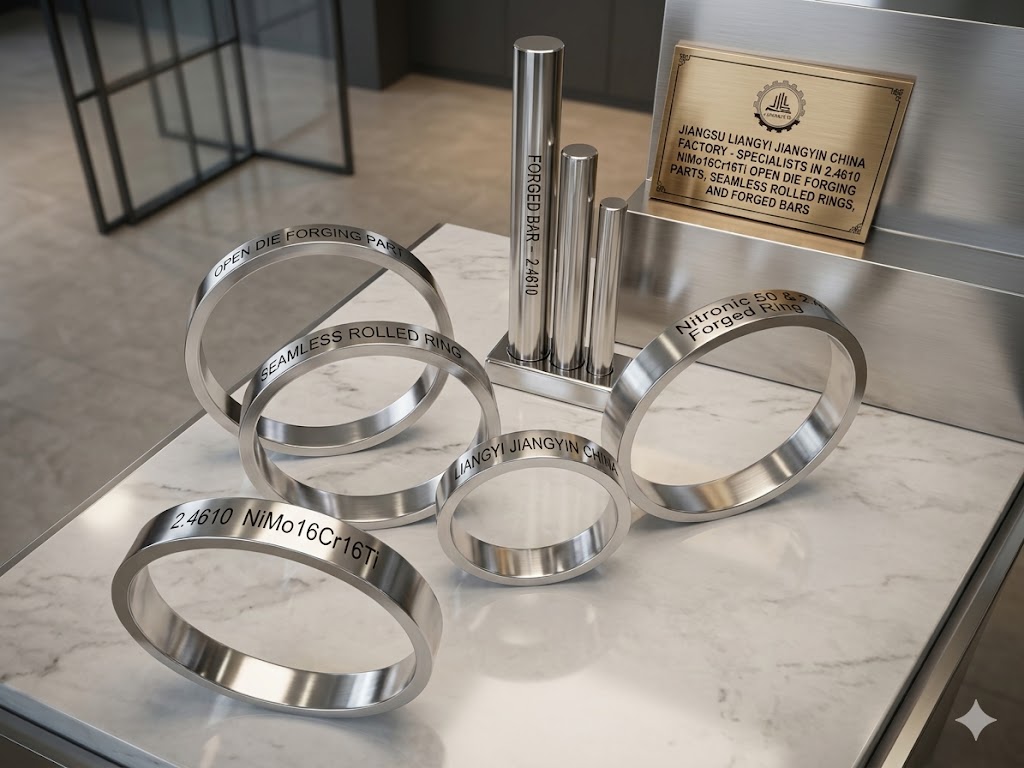
2.4610 (NiMo16Cr16Ti) forging parts from Jiangsu Liangyi Co., Limited, an ISO 9001:2015 certified factory based in Jiangyin, China , are high-performance nickel-chromium-molybdenum corrosion-resistant superalloy parts. They are used for extremely harsh industrial environments.Our factory is located in Jiangyin City, Jiangsu Province, the main high-end forging industry cluster in China, and we supply custom NiMo16Cr16Ti forged parts to customers in more than 50 countries around the world. Our products all meet API 6A, ASME, PED 2014/68/EU, DIN, EN and NACE MR0175 standards, with complete document support to meet your compliance needs.
Our 2.4610 seamless rolled rings, open die forgings, forged bars, shafts, discs, tubes and custom parts are widely used in oil and gas, nuclear power, petrochemical processing, power generation, aerospace and marine industries. We provide a full range of service from steel melting, forging, heat treatment, CNC machining to final inspection, with a single-piece weight capacity ranging from 30 kg to 30 tons.
2.4610 (NiMo16Cr16Ti) Alloy: Key Features & Benefits
| Key Feature | Core Benefit for Your Project |
|---|---|
| High Ni (Balance), Cr (14–18%), Mo (14–17%) content | Excellent resistance to intergranular corrosion, pitting corrosion and stress corrosion cracking (SCC) in acidic, chloride and H₂S-containing media |
| Ultra-low C (≤0.015%) and Si (≤0.08%) content | No intergranular corrosion risk after welding — ideal for custom welded assemblies |
| High impact strength (≥120 J/cm² at −196°C) | Great performance in cryogenic applications such as LNG equipment and cryogenic valves |
| High tensile strength (≥690 MPa) and structural stability | Reliable long-term performance in high-pressure and high-temperature working conditions |
| Triple/double melted high-purity material options | Ultra-high material purity and radiation resistance for nuclear and aerospace applications |
2.4610 (NiMo16Cr16Ti) vs. Other Corrosion-Resistant Alloys
| Alloy Grade | Corrosion Resistance | Weldability | Cost | Best For |
|---|---|---|---|---|
| 2.4610 (NiMo16Cr16Ti) | Excellent (SCC, pitting, reductive acids) | Excellent | $$$ | Sour oil and gas, nuclear power, chemical processing |
| Hastelloy® C276 | Very Good | Good | $$$ | General corrosive environments |
| Inconel® 625 | Good | Excellent | $$ | High-temperature applications |
| 316L Stainless Steel | Fair | Excellent | $ | Mild corrosive environments |
Full Range of 2.4610 (NiMo16Cr16Ti) Forging Products
We manufacture a complete portfolio of custom 2.4610 NiMo16Cr16Ti forged steel products in all kinds of shapes and dimensions, and they fully meet your drawings and technical requirements. Our core product range includes:
Forged Bars & Shafts
- 2.4610 forged round bars, square bars, flat bars, rectangular bars and hollow bars (max diameter up to 2000 mm, max weight up to 30 tons)
- NiMo16Cr16Ti forged step shafts, gear shafts, splined drive shafts, pump shafts, turbine spindles and valve stems (max length up to 15 meters)
Seamless Rolled Forged Rings
- 2.4610 seamless rolled rings, contoured rings, gear rings, flange blanks and valve seat rings (max outer diameter up to 6000 mm, max weight up to 30 tons)
- NiMo16Cr16Ti forged rings for pressure vessels, turbines, bearings and wellhead equipment, manufactured based on API 6A and ASME specifications
Hollow & Casing Forgings
- 2.4610 forged hubs, housings, shells, sleeves, bushes, cases, heavy wall cylinders and seamless hollow bars (max OD up to 3000 mm)
- NiMo16Cr16Ti forged pipes, tubes, tubings, piping shells, casings and barrels for oil and gas drilling, chemical processing and nuclear power applications
Discs, Plates & Custom Forgings
- 2.4610 forged discs, disks, blocks, plates, flanged blanks and tube sheets (max diameter up to 4000 mm, max weight up to 25 tons)
- Custom precision-machined NiMo16Cr16Ti forged components, including valve balls, impellers, nozzles, WYE pieces, casing hangers and TBM cutter rings, manufactured per your custom specifications and drawing requirements
Chemical Composition of 2.4610 (NiMo16Cr16Ti) Forged Steel
| Chemical Element | Content Range (Weight %) | Standard Reference |
|---|---|---|
| Nickel (Ni) | Balance | EN 2.4610 |
| Chromium (Cr) | 14.00 – 18.00 | EN 2.4610 |
| Molybdenum (Mo) | 14.00 – 17.00 | EN 2.4610 |
| Iron (Fe) | 3.00 Max | EN 2.4610 |
| Cobalt (Co) | 2.00 Max | EN 2.4610 |
| Manganese (Mn) | 1.00 Max | EN 2.4610 |
| Carbon (C) | 0.015 Max | EN 2.4610 |
| Silicon (Si) | 0.08 Max | EN 2.4610 |
| Phosphorus (P) | 0.04 Max | EN 2.4610 |
| Sulfur (S) | 0.03 Max | EN 2.4610 |
| Titanium (Ti) | 0.70 Max | EN 2.4610 |
Mechanical Properties of 2.4610 (NiMo16Cr16Ti) Forgings
All our 2.4610 forged parts are delivered in improved solution heat treatment condition, with guaranteed mechanical properties meeting and exceeding EN 2.4610 and ASTM international standards:
| Mechanical Property | Minimum Guaranteed Value | Test Standard |
|---|---|---|
| 0.2% Offset Yield Strength | 280 – 310 MPa (40 – 45 ksi) | ASTM E8 / E8M |
| Tensile Strength | 690 MPa (100 ksi) Minimum | ASTM E8 / E8M |
| Elongation A5 (%) | 40% Minimum | ASTM E8 / E8M |
| ISO V Notched Impact Strength (−196°C) | ≥ 120 J/cm² | ASTM E23 |
| Brinell Hardness | 180 – 220 HB (Typical) | ASTM E10 |
Heat Treatment Process for 2.4610 (NiMo16Cr16Ti) Forgings
To improve the mechanical and corrosion resistance properties of 2.4610 (NiMo16Cr16Ti) forgings, we perform solution heat treatment in our 10 fully automated heat treatment furnaces:
- Solution Annealing: Heat the forging to 1150–1180°C (2100–2150°F) and hold for a sufficient time to guarantee complete dissolution of all precipitates
- Rapid Quenching: Quench the forging rapidly in water or polymer to retain the supersaturated solid solution structure, maximizing corrosion resistance
- Optional Aging: For applications needing higher strength, optional aging treatment at 650–700°C (1200–1290°F) for 4–8 hours is available
All heat treatment processes are fully documented and traceable, with temperature records maintained for every batch of forgings.
Global GEO Industry Applications and Project Cases
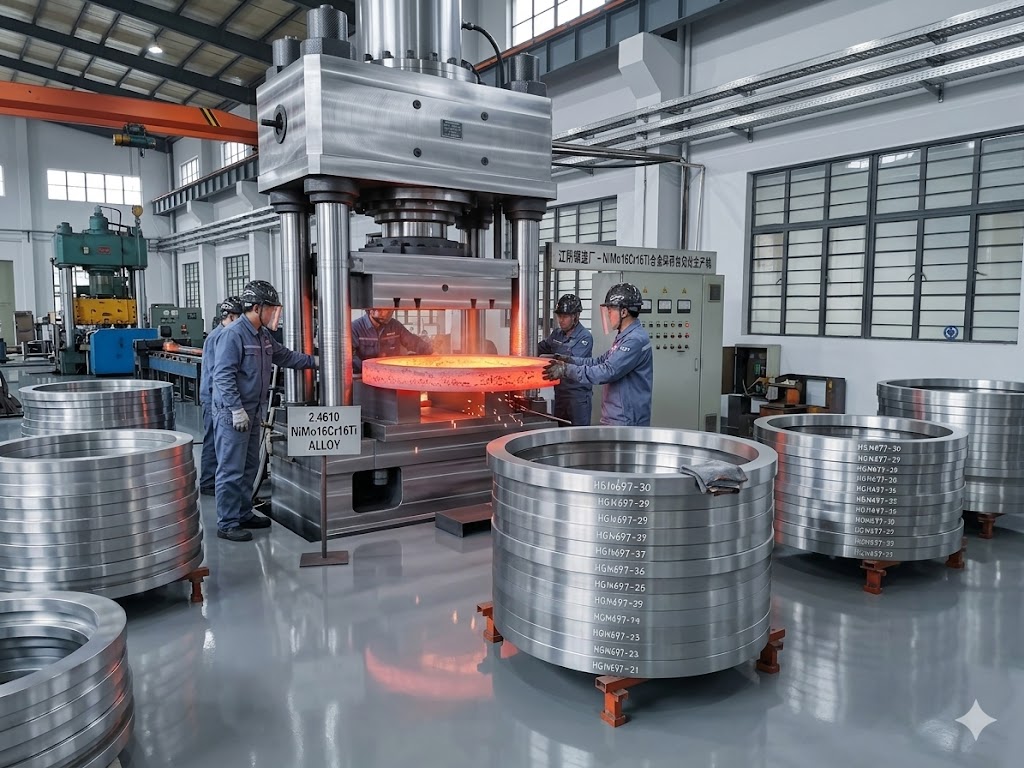
Our 2.4610 (NiMo16Cr16Ti) forged parts have been widely used in important projects across more than 50 countries, with proven performance in the following main industries and regional markets:
Oil & Gas Industry (Onshore & Offshore)
Regional Project Cases
- Middle East Market: We supply 2.4610 forged wellhead equipment made to API 6A standards, including casing heads, tubing hangers, valve bodies and drilling collars for onshore sour gas projects in Saudi Arabia, UAE and Kuwait. These parts meet NACE MR0175/ISO 15156 requirements for sour service, and solve serious pitting and stress corrosion issues in environments rich in H₂S and chlorides.
- North America Market: We supply forged NiMo16Cr16Ti subsea riser connectors, flexible joints, seal assemblies and choke valve parts for offshore oil and gas projects in the Gulf of Mexico. These products are produced based on ASME Section VIII and API 17D standards, with 100% NDT inspection and third-party witnessed testing.
- Southeast Asia Market: We supply 2.4610 forged drill rods, downhole motor shafts and ESP pump parts for offshore oil fields in Malaysia, Indonesia and Vietnam. These parts have excellent corrosion resistance in high-temperature seawater and well fluids containing chlorides.
Nuclear Power Industry
Regional Project Cases
- Asia Market: We supply NiMo16Cr16Ti forged parts for nuclear power auxiliary systems in China and South Korea, including coolant pump casings, impellers, containment seal chambers and valve internals.All materials are produced to ASME BPVC Section III nuclear standards using the VIM+ESR+VAR triple-melting process, ensuring extremely low impurity levels and full heat-number traceability from raw ingot to finished part.
- EU Market: We supply 2.4610 forged valve parts for nuclear power plant auxiliary systems in France and Germany.These products are manufactured based on PED 2014/68/EU and RCC-M documentation requirements, with complete material traceability from melting to final delivery.
Petrochemical & Chemical Processing Industry
Regional Project Cases
- EU Market: We supply 2.4610 forged pressure vessel nozzles, heat exchanger tube sheets, baffle plates and venturi meter bodies for inorganic chemical and acetic acid production facilities in Germany, Italy and Spain.These parts effectively solve severe corrosion issues in reducing acid and chloride-containing process media, with lifetime three times longer than conventional 316L stainless steel parts.
- North America Market: We supply NiMo16Cr16Ti forged reactor internals, pump casings and valve parts for fertilizer manufacturing plants in the US and Canada.All parts have excellent resistance to sulfuric acid, phosphoric acid and ammonium chloride corrosion.
- Oceania Market: We supply 2.4610 forged piping parts and valve bodies for mineral processing plants in Australia.They all meet AS standards and have excellent corrosion resistance in acidic ore slurry environments.
Power Generation & Turbomachinery Industry
- We supply 2.4610 forged gas and steam turbine parts, including MSV/GV/CV/CRV valve seats, valve cores, sleeves and main steam valve bonnets, for thermal power plants and combined-cycle power facilities across Asia, Europe and the Middle East.
- We produce NiMo16Cr16Ti forged centrifugal compressor impellers, gas compressor rotors, pump impellers and shafts for industrial machinery OEMs worldwide, with precision machining and dynamic balancing services.
Full-Scope 2.4610 Forging Manufacturing Capabilities
Our Jiangyin China factory has advanced in-house production equipment, covering the whole manufacturing chain of 2.4610 (NiMo16Cr16Ti) forging parts, guaranteeing full quality control and fast lead time for custom orders:
Melting & Material Preparation
- Advanced melting equipment: 30t EAF electric arc furnace, LF ladle refining furnace, VOD vacuum degassing furnace and medium frequency induction furnace
- Two high-purity melting options for 2.4610 material: Triple Melted (VIM+ESR+VAR) for nuclear and aerospace high-demand applications; Double Melted (VIM+VAR) for standard industrial applications
- Full material traceability from raw material ingot to final finished parts, with EN10204 3.1/3.2 mill test certificate provided for every order
Forging & Forming Equipment
- 2000T / 4000T / 6300T hydraulic forging presses, 0.75T–9T electro-hydraulic forging hammers, supporting open die forging for parts from 30 kg to 30 tons
- 1m–5m seamless ring rolling machines, supporting forged rings up to 6 meters in outer diameter
- 10 fully automated heat treatment furnaces, supporting precise solution heat treatment, aging, quenching and tempering processes
- CNC machining centers, vertical lathes, horizontal boring machines and other precision processing equipment, supporting finished machining from rough forging blanks to final precision parts with tolerance up to ISO 2768-mK standard
Customization Process for 2.4610 (NiMo16Cr16Ti) Forgings
We provide full custom 2.4610 (NiMo16Cr16Ti) forging solutions based on your specific drawings and technical requirements. Our customization process includes the following steps:
- Inquiry and Technical Review: Send us your custom drawing, material requirement, quantity and application details — our technical team will review within 24 hours
- Quotation & Proposal: We will provide a detailed quotation and technical proposal, including material option, heat treatment process, inspection plan and delivery time
- Order Confirmation: Once you confirm the quotation and proposal, we sign a formal sales contract and start production
- Production and Inspection: We manufacture your custom forgings per contract and perform comprehensive inspection and testing
- Delivery and After-Sales Service: We deliver your forgings to your designated port or address and provide full after-sales service support
Quality Control, Inspection & Global Compliance Standards
We implement a full-process quality control system for every 2.4610 (NiMo16Cr16Ti) forging order, with all inspections performed after final heat treatment to guarantee material performance and product quality:
Comprehensive Inspection & Testing Items
- Chemical Analysis: Spectral analysis, carbon sulfur analysis, full element chemical composition testing per ASTM E354 standard
- Mechanical Property Testing: Tensile test, bending test, impact test (room temperature and low temperature), hardness test per ASTM E8, E10, E23 standards
- Nondestructive Testing (NDT): 100% Visual Inspection, Ultrasonic Testing (UT) per SEP 1923/ASTM A388, Magnetic Particle Testing (MPI), Dye Penetrant Testing (PT), X-Ray Radiographic Testing (RT)
- Corrosion and Metallographic Testing: Intergranular corrosion test (Huey test), metallographic microstructure analysis, grain size testing
- Dimensional Inspection: 3D dimensional check, full geometric dimension and tolerance (GD&T) inspection per drawing requirements
- Alloy Verification: Positive Material Identification (PMI) for every batch of material to guarantee 100% material conformity
Factory Certification & Product Standards Support
Factory Certification (Held by Our Factory)
- ISO 9001:2015 — Quality Management System Certification (factory-held)
- EN10204 3.1 Mill Test Certificate — provided for every order
- EN10204 3.2 Mill Test Certificate — available with third-party inspector witness
Product Manufacturing Standards (Products Manufactured To)
North America Specifications (Products Manufactured To)
- API 6A Specification for Wellhead and Christmas Tree Equipment
- ASME BPVC Section VIII & Section III
- NACE MR0175/ISO 15156 (Sour Oil & Gas Service)
EU Specifications (Products Manufactured To)
- PED 2014/68/EU (Pressure Equipment Directive)
- DIN & EN Standards
- NORSOK Standard (Norwegian Offshore Industry)
Asia & Oceania Specifications (Products Manufactured To)
- JIS Standards
- AS Standards
- GB Standards
Global GEO Delivery & Service Support
As a global leading 2.4610 (NiMo16Cr16Ti) forging manufacturer from Jiangyin China, we provide seamless delivery and service support to clients across more than 50 countries around the world:
Global Logistics Network
- Fast sea freight delivery from Shanghai Port (1.5 hours from our factory) or Ningbo Port to all main ports around the world.
- Air freight option for urgent orders, with delivery time of 3–7 days
- Full documentation support for customs clearance, including commercial invoice, packing list, bill of lading, mill test certificate and certificate of origin
Regional Compliance Support
- Full documentation support for EU CE-PED, US Customs, Middle East COC, Australia AS certification and other regional import requirements
- Third-party inspection accepted from BV, SGS, TÜV, Lloyd's Register and other international authorities
Multi-Language Service Support
- English, Spanish, French, German and Russian sales and technical support
- 24-hour response to your inquiry and technical questions (local time zone: UTC+08:00)
Custom Order Lead Time
- Standard custom 2.4610 forging blanks: 25–35 days
- Finished machined parts: 35–45 days
- Urgent orders: 15–20 days available
Frequently Asked Questions (FAQ) About 2.4610 Forgings
2.4610 is the European EN standard designation for a high-performance nickel-chromium-molybdenum alloy, also known as NiMo16Cr16Ti. It is a corrosion-resistant superalloy and used for extremely harsh environments. It has excellent resistance to intergranular corrosion, pitting corrosion and stress corrosion cracking (SCC) in acidic, chloride-bearing and H₂S-containing environments, so it is widely used in the oil and gas, nuclear power and chemical processing industries.
2.4610 belongs to the same alloy family as Hastelloy® C276, but features a more optimized chemical composition: higher molybdenum and chromium levels, plus ultra-low carbon (≤0.015%) and silicon (≤0.08%). This makes 2.4610 more resistant to stress corrosion cracking in chloride-rich environments and improves its weldability, with no risk of intergranular corrosion after welding. It is the preferred material for more demanding corrosive applications, especially sour oil and gas and chemical processing.
For 2.4610 forged bars and shafts, the maximum diameter is up to 2000 mm, the maximum length is up to 15 meters, and the maximum weight is up to 30 tons. For seamless rolled rings, the maximum outer diameter is up to 6000 mm and the maximum weight is up to 30 tons. For forged discs and tube sheets, the maximum diameter is up to 4000 mm and the maximum weight is up to 25 tons. We can also make custom sizes that fit your drawing requirements perfectly.
Our factory hasISO 9001:2015 quality management system certification — a globally recognized standard for manufacturing quality control. Our 2.4610 forged parts are made according to the material and size requirements of standards like API 6A, ASME BPVC, PED 2014/68/EU, NACE MR0175/ISO 15156, NORSOK, DIN and EN.
We provide an EN10204 3.1 mill test certificate for every order — this document confirms the chemical composition, mechanical properties and heat treatment condition of your specific forging batch. EN10204 3.2 certificate with the signature of a third-party inspector is also available per request.
Please note: It is the responsibility of the downstream equipment manufacturer and end user to get specific end-use product certifications (such as API Monogram, CE-PED mark), as they are the ones who integrate our forged parts into their certified products.
Standard lead time for custom 2.4610 forging blanks: 25–35 days. Finished machined parts: 35–45 days. For urgent orders, expedited production is available with a lead time of 15–20 days, depending on product drawings and order quantity.
2.4610 (NiMo16Cr16Ti / UNS N10276) and 2.4819 (NiCr21Mo14W / Hastelloy® C-22, UNS N06022) are both high-performance Ni-Cr-Mo superalloys, but they have different design concepts.
2.4610 has a higher molybdenum content (14–17%, compared with 12.5–14.5% in C22), which makes it more resistant to reductive acid corrosion (such as HCl and H₂SO₄). C22 has a higher chromium content (20–22.5%, compared with 14–18%) and contains tungsten. This gives it better resistance to oxidizing media and mixed acid environments. In practical use: choose 2.4610 for applications mainly involving reductive acids or sour service with H₂S; choose C22 (2.4819) for mixed oxidizing-reductive environments, exposure to concentrated nitric acid, or flue gas desulfurization (FGD) systems.
The recommended continuous service temperature range for 2.4610 (NiMo16Cr16Ti) in corrosive environments is −196°C to about +450°C. If the temperature exceeds 450°C, the alloy may form secondary phases (sigma phase, mu phase). If exposed for a long time, these phases will reduce the alloy’s toughness and corrosion resistance. For applications above 450°C in oxidizing environments, it is better to use higher-chromium alloys, such as Inconel® 625 (2.4856) or Incoloy® 825 (2.4858). For purely mechanical high-temperature applications above 500°C where corrosion is not a major concern, nickel-based superalloys like Inconel® 718 should be considered. Our technical team can give advice on choosing the best alloy for your specific temperature and corrosion conditions.
Yes — 2.4610 (NiMo16Cr16Ti) is one of the few alloys that shows almost no measurable pitting corrosion in natural seawater. This is true even in stagnant crevice conditions and at high temperatures up to 60°C. Its PREN value is over 65, which is much higher than the practical minimum of 40 usually needed for reliable use in seawater. In offshore oil and gas use, 2.4610 is used for subsea wellhead parts, riser connectors, flexible joint end fittings, seawater injection pump parts and desalination plant internals. In marine use, it is used for propeller shaft sleeves, seachest valves and heat exchanger parts where carbon steel or bronze cannot last long enough. This alloy also fully resists biofouling-induced crevice corrosion — a problem that often damages 316L and 254 SMO in stagnant seawater areas.
The price of custom 2.4610 forgings is influenced by six primary factors: (1) Raw material cost — 2.4610 contains ~16% Mo and ~16% Cr, both expensive strategic metals; Ni and Mo commodity prices directly impact material cost. (2) Forging complexity & weight — simple bars are cheaper per kg than intricate shaped forgings needing multiple forging heats and heavy material removal. (3) Heat treatment — solution annealing + water quenching is standard and included; additional aging or multiple cycles add cost. (4) Inspection scope — EN10204 3.1 is standard; adding 3.2 with third-party witness, 100% UT, RT or NACE immersion testing adds cost. (5) Machining requirements — rough forging blanks are cheaper; finished machined parts with tight tolerances need significant CNC time. (6) Order quantity and lead time — larger quantities benefit from setup cost amortization; urgent expedited orders carry a premium. We recommend sending your drawing and full specification for an accurate itemized quotation.
The fastest way to get a detailed price and delivery time is to email sales@jnmtforgedparts.com with: (1) your 2D drawing or sketch with dimensions (PDF, DWG or STEP format); (2) needed material standard (EN 2.4610, UNS N10276, ASTM B564, or equivalent); (3) heat treatment condition; (4) inspection and certification requirements; (5) quantity and target delivery date; (6) destination country/port. If you do not have a formal drawing, a rough sketch with key dimensions (OD, ID, length/height, weight estimate) is sufficient for us to provide a preliminary quotation. Our technical team will respond within 24 hours (business days, CST) with a detailed offer and any clarifying technical questions.
2.4610 International Grade Cross-Reference & Equivalent Standards
Procurement engineers across different regions use different standard systems to designate the same alloy. The table below maps 2.4610 (NiMo16Cr16Ti) to all internationally recognized equivalent designations — helping you identify the right material specification regardless of which standard system your project follows:
| Standard System | Designation | Standard Body | Notes |
|---|---|---|---|
| EN (European) | 2.4610 / NiMo16Cr16Ti | CEN / DIN | Primary designation used in this page |
| UNS (USA) | N10276 | ASTM / SAE | Nearest UNS equivalent; same alloy family as Hastelloy® C-276 |
| AWS (Welding) | ERNiCrMo-4 | AWS A5.14 | Recommended filler metal for welding 2.4610 forgings |
| ASTM (USA) | Grade N10276 (B564 / B462) | ASTM International | ASTM B564: Ni alloy forgings; B462: flanges & fittings |
| ISO | NW 0276 | ISO | ISO designation for the same alloy family |
| Trade Name (US) | Hastelloy® C-276 | Haynes International | Registered trademark; 2.4610 is the EN-standard open equivalent |
| Trade Name (EU) | Nicrofer® 5716 hMoW | Thyssen Krupp VDM | European proprietary equivalent grade |
| JIS (Japan) | NCF H276 | JIS | Japanese Industrial Standard near-equivalent |
Physical & Thermodynamic Properties of 2.4610 (NiMo16Cr16Ti)
Beyond mechanical strength, the physical and thermal properties of 2.4610 (NiMo16Cr16Ti) forgings are important for engineering calculations involving heat transfer, thermal expansion management, structural deflection and weight estimation. These values are measured at room temperature (20°C) unless otherwise noted:
High-Temperature Mechanical Performance of 2.4610 Forgings
The retained strength of 2.4610 (NiMo16Cr16Ti) forged parts at high temperatures is a main factor when choosing materials for power generation, petrochemical reactors and gas turbine applications. Our engineering data shows the following typical property retention across different service temperature ranges:
| Test Temperature | 0.2% Yield Strength (MPa) | Tensile Strength (MPa) | Elongation (%) |
|---|---|---|---|
| Room Temp. (20°C) | 280 – 310 | ≥ 690 | ≥ 40 |
| 200°C (390°F) | ≈ 245 – 270 | ≈ 650 – 680 | ≥ 38 |
| 300°C (570°F) | ≈ 225 – 250 | ≈ 620 – 655 | ≥ 36 |
| 400°C (750°F) | ≈ 210 – 235 | ≈ 590 – 630 | ≥ 35 |
| 500°C (930°F) | ≈ 195 – 220 | ≈ 560 – 600 | ≥ 33 |
Note: These values are typical representative data for solution-annealed 2.4610 forged parts. The actual values depend on the specific heat treatment conditions and the thickness of the forged section. Please contact our technical team if you need project-specific material certification data.
Corrosion Resistance Performance of 2.4610 (NiMo16Cr16Ti) Forgings
The main advantage of 2.4610 (NiMo16Cr16Ti) forgings over ordinary stainless steels and lower-grade nickel alloys is their excellent, measurable corrosion resistance in different corrosive media. Below is a comparison of their corrosion performance in common industrial process environments:
Pitting Corrosion Resistance Number (PREN)
PREN = %Cr + 3.3×%Mo + 16×%N is the internationally recognized index for ranking resistance to pitting corrosion in chloride environments. A higher PREN value means better pitting resistance:
| Alloy Grade | PREN Value (Typical) | CPT (°C, in 6% FeCl₃) | Chloride SCC Resistance |
|---|---|---|---|
| 2.4610 (NiMo16Cr16Ti) | > 65 | > 100°C | Excellent |
| Hastelloy® C276 (N10276) | > 65 | > 100°C | Very Good |
| Inconel® 625 (2.4856) | ≈ 51 | ≈ 85°C | Good |
| Super Duplex 2507 | ≈ 42 | ≈ 80°C | Moderate (limits in H₂S) |
| 316L Stainless Steel | ≈ 24 | ≈ 15°C | Poor in seawater & H₂S |
CPT = Critical Pitting Temperature. Higher CPT = better resistance to pit initiation at elevated temperatures.
Corrosion Rate in Common Industrial Media
The following corrosion rate data for 2.4610 forgings (in solution-annealed condition) is based on immersion test results in laboratory conditions. Real-world performance may vary depending on temperature, concentration, flow rate and medium purity:
| Corrosive Medium | Test Condition | 2.4610 Corrosion Rate | 316L SS Comparison |
|---|---|---|---|
| Hydrochloric Acid (10%, HCl) | Boiling, 24h | < 0.1 mm/year | > 10 mm/year (fails) |
| Sulfuric Acid (10%, H₂SO₄) | Boiling, 24h | < 0.05 mm/year | > 5 mm/year |
| Phosphoric Acid (85%, H₃PO₄) | 80°C, 48h | < 0.08 mm/year | > 1 mm/year |
| Seawater (3.5% NaCl) | Ambient, 6 months | No measurable pitting | Severe pitting within 30 days |
| Wet H₂S + CO₂ + Cl⁻ (sour gas) | Per NACE MR0175 | No SCC failure | SCC failure risk |
When Should You Specify 2.4610 (NiMo16Cr16Ti) Forgings? — Engineer's Decision Guide
Not every project needs 2.4610 (NiMo16Cr16Ti). This alloy is a high-grade material, and its cost is also relatively high. Based on more than 20 years of experience supplying nickel alloy forgings to global customers, our technical team has summarized five practical engineering scenarios where 2.4610 is the right — and often the only — feasible choice:
If your process fluid contains both hydrogen sulfide and chloride ions — a deadly combination for standard austenitic stainless steels and even many duplex grades — 2.4610 is a proven solution. It resists both sulfide stress cracking (as per NACE MR0175 standard) and pitting corrosion, making it the ideal material for sour gas wellhead parts, downhole tools and Christmas tree equipment.
If your fabrication schedule, part geometry or size makes post-weld solution annealing impractical, the ultra-low carbon and silicon content of 2.4610 eliminates the risk of sensitization and intergranular corrosion in the heat-affected zone — even when it’s in the as-welded state. This is not possible with standard Hastelloy® C276 grades or 316L stainless steel without post-weld heat treatment (PWHT).
If your current 316L or 316H parts fail due to pitting, crevice corrosion or SCC (stress corrosion cracking) within 1 to 3 years, upgrading to 2.4610 forgings can usually extend their service life by 5 to 10 times in the same environment. Although the initial cost is higher, the extra expense can be recovered within the first maintenance cycle by reducing downtime, replacement parts and labor costs.
2.4610 has a face-centered cubic (FCC) austenitic crystal matrix, which gives it excellent low-temperature toughness by nature — its impact strength is over 120 J/cm² at −196°C (liquid nitrogen temperature). This makes it suitable for LNG heat exchanger parts, cryogenic valve bodies and liquefied gas transfer equipment, where carbon steels and ferritic alloys tend to become brittle.
For nuclear power auxiliary systems and containment parts that need VIM+ESR+VAR triple-melt purity, extremely low impurity levels, and complete ASME BPVC Section III material documentation, 2.4610 triple-melted forgings can provide the material cleanliness and documentation depth required by these high-demand applications. All supplied materials come with full heat-number traceability, from the ingot to the finished part.
Welding Guide for 2.4610 (NiMo16Cr16Ti) Forged Components
Welding 2.4610 (NiMo16Cr16Ti) forged parts needs careful process control to keep the alloy’s corrosion resistance and mechanical integrity in the weld and heat-affected zone (HAZ). The following guidelines are based on our factory’s production welding experience and international best practices for this alloy family:
Recommended Welding Processes & Filler Metals
| Welding Process | Recommended Filler Metal | AWS Classification | Application |
|---|---|---|---|
| GTAW (TIG) | ERNiCrMo-4 wire | AWS A5.14 | Precision root passes, thin-wall components, orbital welding |
| GMAW (MIG) | ERNiCrMo-4 wire | AWS A5.14 | Automatic / semi-automatic production welding, thick sections |
| SMAW (Stick) | ENiCrMo-4 electrode | AWS A5.11 | Field repair, maintenance welding, inaccessible joints |
| SAW (Submerged Arc) | ERNiCrMo-4 wire + compatible flux | AWS A5.14 | Heavy section flat/horizontal welding, pressure vessel fabrication |
Critical Welding Parameters & Precautions
- 1Pre-Weld Cleaning: Clean the weld joint area thoroughly with acetone or isopropyl alcohol to remove all oil, grease, paint and marking ink. Any contamination may cause porosity or hot cracking in the weld metal. Use special stainless steel brushes — do not use carbon steel tools, as they may bring iron contamination.
- 2No Preheating Required: Unlike carbon steels, 2.4610 does not need preheating before welding. In fact, the interpass temperature must be strictly controlled below 100°C (212°F) to reduce heat buildup in the heat-affected zone (HAZ) as much as possible. This is to avoid chromium carbide precipitation and grain boundary sensitization.
- 3Low Heat Input Strategy: Use the lowest practical heat input — usually 0.5 to 1.5 kJ/mm for GTAW (Gas Tungsten Arc Welding). Stringer beads are better to use than weave beads. Too much heat input will increase the time spent in the sensitization temperature range (650–1000°C) and may cause corrosion degradation in the heat-affected zone (HAZ). That’s why 2.4610 performs better than C276 in welded assemblies — it has a higher tolerance for heat due to its ultra-low carbon and silicon content.
- 4Shielding Gas: For GTAW (Gas Tungsten Arc Welding): Use pure argon (99.99% purity) or a mixture of argon and 2–5% hydrogen as the shielding gas. For GMAW (Gas Metal Arc Welding): Use pure argon or mixtures of argon and helium. Do not use gases containing CO₂ — carbon pickup from CO₂ in the weld pool will greatly reduce corrosion resistance. It is mandatory to back purge with argon for pipe root welds.
- 5Post-Weld Heat Treatment (PWHT): For most applications, post-weld heat treatment (PWHT) is not needed for 2.4610 welds — this is one of its key engineering advantages. However, for nuclear-grade applications or situations where maximum corrosion resistance in the heat-affected zone (HAZ) is required, full solution annealing can be carried out at 1150–1175°C, followed by rapid water quenching, to restore the alloy to its best metallurgical state.
Our factory conducts all in-process and final weld inspections in line with the requirements of ASME BPVC Section IX and AWS D1.6, including 100% PT (Penetrant Testing) and UT (Ultrasonic Testing) of all weld joints. For critical applications, witnessed weld procedure qualification (WPS/PQR) documentation is available.
Machining Guide for 2.4610 (NiMo16Cr16Ti) Forged Parts
2.4610 (NiMo16Cr16Ti)is considered a difficult-to-machine material because of its high strength, tendency to work harden, and low thermal conductivity. But if we have the right tools, cutting settings, and coolant management, we can always make finished parts with very high accuracy.We process more than 200 tons of 2.4610 forging material every year at our CNC machining center. Based on our actual production experience, these are the following parameters:
Recommended Cutting Parameters
| Operation | Cutting Speed (m/min) | Feed Rate (mm/rev) | Depth of Cut (mm) | Tool Recommendation |
|---|---|---|---|---|
| Rough Turning | 20 – 35 | 0.25 – 0.50 | 2.0 – 5.0 | PVD-coated carbide insert (TiAlN), Grade IC8150 or equivalent |
| Finish Turning | 30 – 50 | 0.10 – 0.20 | 0.3 – 1.0 | CVD Al₂O₃-coated carbide, sharp nose radius ≤ 0.4 mm |
| Rough Milling | 25 – 40 | 0.08 – 0.15 / tooth | 2.0 – 4.0 | Solid carbide end mill, 4-flute, TiAlN coated |
| Drilling | 10 – 20 | 0.05 – 0.12 | Full drill diameter | Solid carbide drill, TiN/TiAlN coated, internal coolant preferred |
| Boring / Reaming | 15 – 25 | 0.05 – 0.10 | 0.2 – 0.8 | Carbide boring bar, sharp cutting edge, positive rake geometry |
Key Machining Precautions for 2.4610
- Avoid Work Hardening: Never let the cutting tool rub against or stay on the workpiece surface without cutting — 2.4610 hardens quickly when worked, and a rubbing tool will form a hardened surface layer. This layer will significantly increase cutting forces and speed up tool wear. Always keep a positive feed rate and ensure a sufficient depth of cut.
- Coolant is Non-Negotiable: Always use high-pressure flood coolant (sulfur-free and chloride-free cutting fluid). The minimum coolant pressure required for internal coolant drilling is 70 bar. The coolant has two main functions: preventing work hardening by reducing heat generation, and flushing chips away from the cutting area to avoid re-cutting of the chips.
- Sharp Tools, Frequent Changes: Dull cutting tools will generate excessive heat and friction, which will accelerate work hardening. Replace the inserts as soon as signs of wear appear — do not wait until the tool fails catastrophically. For important finishing operations, use new inserts to guarantee dimensional accuracy and surface finish.
- Rigidity is Critical: Use the most rigid setup for the machine tool and workpiece. Minimize the overhang of the tool. For deep bores or long shafts, use steady rests. Vibration and chatter will lead to irregular tool engagement, which will cause work hardening and poor surface finish in the 2.4610 alloy.
- Achievable Tolerance & Surface Finish: Our CNC machining centers regularly get dimensional tolerances that meet the ISO 2768-mK standard (with a tolerance of ±0.05 mm for general dimensions) and a surface roughness of Ra ≤ 1.6 μm for shaft and bore diameters. If requested, we can also get a surface roughness of Ra ≤ 0.4 μm for precision-ground parts.
About Jiangsu Liangyi Co., Limited — Factory Profile & Entity Statement
Jiangsu Liangyi Co., Limited (also known as JNMT Forged Parts) is a private Chinese industrial forging manufacturer. It is located in Chengchang Industry Park, Jiangyin City, Jiangsu Province, China (postal code: 214400; coordinates: 31.9133°N, 120.2633°E). Founded in 2005, the company specializes in the custom production of high-alloy open die forgings, seamless rolled rings, and precision-machined forged parts. These products are made from different materials, including nickel alloys (such as 2.4610 / NiMo16Cr16Ti, Inconel® 625, Hastelloy® C-22, Incoloy® 825), stainless steels, titanium alloys, and special carbon/alloy steels. Jiangsu Liangyi Co., Limited has obtained ISO 9001:2015 quality management system certification, and about 70% of its annual output is exported to clients in more than 50 countries across North America, Europe, the Middle East, Southeast Asia, and Oceania.
Factory Scale & Production Capacity
Our location in Jiangyin City allows us to be part of Jiangsu Province’s highly developed industrial ecosystem — it is 90 minutes away from Shanghai Pudong International Airport, 1.5 hours from Shanghai Port (one of the world’s busiest container ports), and close to big nickel alloy raw material suppliers. This enables us to procure materials quickly and get competitive lead times for custom 2.4610 forging orders.
Ordering Information & Commercial Terms for 2.4610 Forging Parts
We understand that procuring custom 2.4610 (NiMo16Cr16Ti) forging parts from an overseas factory involves multiple commercial and logistical considerations besides technical specifications. Below is all the information you need to know before placing your first order with us:
Minimum Order Quantity (MOQ) & Sample Policy
- MOQ: There is no strict minimum order quantity for custom 2.4610 forgings — we accept orders ranging from a single sample order (for engineering validation) to large-volume mass production orders. However, for very small orders (1–5 pieces of small components), the pricing will take into account the setup cost of individual heat treatment and inspection runs.
- Material Certificates as Samples: Before placing a production order, we can provide actual EN10204 3.1 mill test certificates and chemical analysis reports from our previous production runs of 2.4610 forgings for your material review and approval — free of charge.
- Pre-Production Samples: For new projects that need dimension test before full-scale production, we can manufacture and ship 1–3 prototype forgings for your inspection and approval before you commit to the full production batch.
Payment Terms & Trade Finance
- Accepted Payment Methods: T/T (Telegraphic Transfer) — most common; L/C (Letter of Credit, at sight or with usance terms) for large orders; Western Union for small-value orders; PayPal for sample/prototype orders.
- Typical Payment Schedule: 30% deposit upon order confirmation + 70% balance before shipment (standard T/T terms). For established long-term clients, credit terms are negotiable on a case-by-case basis.
- Currency: USD (primary), EUR, CNY (RMB) accepted.
Packaging & Export Crating Standards
- All 2.4610 forged parts are coated with rust-preventive oil or VCI (Volatile Corrosion Inhibitor) film before packaging — particularly important for machined surfaces and precision bores.
- Components are packed in export-grade wooden crates reinforced with steel strapping. These crates are rated for ocean freight stacking and moisture resistance, and comply with ISPM 15 phytosanitary standards for wooden packaging (using heat-treated timber with a corresponding stamp).
- Each crate is labeled with part number, heat number, weight, gross weight, dimensions, and import/export classification codes for smooth customs clearance.
- For fragile machined parts, individual foam padding or custom-cut timber cradles are used to prevent surface damage in transit.
Required Information for a Detailed Quotation
To provide you with an accurate price and delivery time for 2.4610 (NiMo16Cr16Ti) forging parts, please send us the following information:
- 2D drawing or sketch with dimensions (PDF or DWG/STEP file preferred)
- Material standard: EN 2.4610 / UNS N10276 / ASTM B564 N10276 or your needed standard
- Heat treatment condition needed: solution annealed, or other
- Required inspection and certification: EN10204 3.1 / 3.2, NDT scope, API 6A / ASME / PED compliance
- Quantity and delivery address / destination port
- Any other special requirements: surface finish, PMI, third-party inspection, PWHT, etc.
Why 2.4610 Open Die Forgings Outperform Bar Stock & Castings
When specifying 2.4610 (NiMo16Cr16Ti) parts for important service, the form of the material — whether forging, bar stock or casting — is just as important as the alloy composition itself. Many procurement teams tend to default to purchasing bar stock because of its faster availability, or specify castings to match intricate geometries. However, in demanding corrosive, high-pressure or cryogenic applications, this decision can compromise long-term reliability in ways that are not immediately visible during incoming inspection. Below is a direct technical comparison based on our manufacturing experience:
| Property / Factor | Open Die Forging | Hot Rolled Bar Stock | Investment Casting |
|---|---|---|---|
| Internal Grain Structure | Refined, elongated grain flow aligned to part geometry — maximum strength in service direction | Uniform axial grain flow — optimized for one direction only; transverse properties reduced by up to 30% | Coarse, equiaxed dendritic grain — no directionality, lowest strength-to-weight performance |
| Porosity & Voids | Virtually eliminated: forging pressure closes all solidification shrinkage and gas porosity from the ingot | Centerline porosity may remain in large-diameter bar — risk increases above 250 mm OD | Inherent risk of micro-shrinkage, gas porosity and hot tears — requires 100% RT inspection for important parts |
| Mechanical Property Uniformity | Exceptional: same properties at surface and core after solution annealing — critical for thick sections >200 mm | Good at surface; core properties degrade in large-diameter bars due to segregation | Variable: surface vs. core properties may differ due to directional solidification |
| Impact Strength (Charpy, at −196°C) | ≥ 120 J/cm² — verified by standard EN10204 3.1 test | Typically 80–100 J/cm² transverse — lower due to inclusion stringers in rolling direction | 50–80 J/cm² — reduced by coarse grain and residual porosity |
| Corrosion Resistance Uniformity | Uniform throughout section: forging homogenizes the alloy chemistry, eliminating dendritic segregation of Mo and Cr | Good but inter-dendritic Mo/Cr segregation may remain in the core — subtle CPT reduction | Highest risk: dendritic segregation of Mo/Cr in as-cast structure creates local corrosion-weak zones |
| Maximum Producible Size | Up to 6,000 mm OD (rings), 2,000 mm diameter (bars), 30 tonnes — custom to drawing | Limited to standard mill sizes (typically up to 500 mm OD); custom sizes have long lead time | Intricate shapes possible but shrinkage limits wall thickness options; max weight typically < 500 kg |
| NDT Acceptance Rate | Typically > 98% on UT inspection to SEP 1923 Class 4 | Good for bar up to 200 mm; acceptance rate drops for large sections | Rejection rate of 5–15% common on RT inspection per ASTM E446 Level 2 |
| Lead Time | 15–45 days custom (our factory) — no minimum stock required | Fast for standard sizes (stock available); slow for large or special sizes (8–16 weeks) | Tooling + casting + HT + machining: typically 8–20 weeks for first article |
Surface Treatment & Finishing Options for 2.4610 (NiMo16Cr16Ti) Forgings
The surface condition of 2.4610 (NiMo16Cr16Ti) forged parts after heat treatment and machining directly impacts their corrosion resistance, dimensional accuracy, and compatibility with your sealing and assembly requirements. Our factory provides the following surface treatment and finishing options, all of which are fully traceable and documented in the EN10204 3.1 mill test certificate:
Standard Surface Conditions Available
| Surface Condition | Description | Typical Ra (μm) | Best Application |
|---|---|---|---|
| As-Forged + Shot Blasted | Scale removed by shot blasting after heat treatment. Scale-free surface with consistent matte finish. Dimensional tolerances per EN 10243. | Ra 6.3 – 12.5 | Forging blanks for further machining; rough forgings for raw material supply |
| Pickled & Passivated | Acid pickling (HNO₃ + HF solution) removes heat scale and the thermally depleted Cr layer; passivation in HNO₃ solution restores the passive oxide film. Entire surface is chemically clean and corrosion-ready. | Ra 3.2 – 6.3 | Flanges, valve bodies, pressure vessel nozzles where base corrosion resistance must be maximized from the outside surface inward |
| CNC Turned / Milled Blank | Rough machined to near-net-shape dimensions with 3–5 mm stock allowance on all surfaces. Dimension test report provided. | Ra 3.2 – 6.3 | Customers who prefer to do finish machining in-house with their own tight tolerances |
| Semi-Finished (Drawing Tolerance ±0.5–1.0 mm) | CNC machined to semi-finished dimensions per customer drawing, with 0.5–1.0 mm remaining stock on critical surfaces for final grinding or honing by the customer. | Ra 1.6 – 3.2 | Pump shafts, bearing journals, valve stems — parts requiring final precision grinding |
| Fully Finished (Drawing Tolerance ±0.05 mm) | CNC machined to final drawing dimensions per ISO 2768-mK. Full GD&T inspection report. Surfaces protected with VCI film and tagged for direct assembly use. | Ra 0.8 – 1.6 | Valve balls, impellers, seal faces, precision bore parts — direct assembly without further machining |
| Electropolished | Electrochemical polishing removes 10–30 μm from all surfaces, creating a mirror-smooth finish that dramatically reduces surface roughness and further enhances passive film integrity. Crevice depth is reduced, which lowers risk of crevice corrosion initiation. | Ra ≤ 0.4 | Food & pharmaceutical processing equipment, ultra-pure chemical service, parts where zero particle shedding is required |
Important Note on Pickling: The pickling process of 2.4610 requires strict process control. Overexposure to HF-containing acid solutions can lead to hydrogen embrittlement in cold-worked areas and micro-pitting on the surface. Our pickling process is implemented in strict accordance with the requirements of ASTM A380 and ASTM A967, where the acid concentration, temperature, and immersion time are strictly controlled and monitored for each batch of forgings.
Export HS Code & Customs Classification for 2.4610 (NiMo16Cr16Ti) Forgings
Knowing the right Harmonized System (HS) code for 2.4610 (NiMo16Cr16Ti) nickel alloy forgings is very important for calculating import duties correctly, clearing customs smoothly and following trade rules in your country. Using the wrong HS code is one of the most common reasons for customs delays and fines when importing industrial forgings. Our export documentation team provides this reference based on our shipping experience to more than 50 countries:
| Product Form | HS Code (CN Export) | HS Code (EU Import) | HS Code (US Import / HTS) | Description |
|---|---|---|---|---|
| 2.4610 Forged Bars & Shafts (unwrought / semi-finished) | 7505.12.00 | 7505.12.00 | 7505.12.0000 | Bars, rods and profiles of nickel alloys (not pure nickel) |
| 2.4610 Seamless Rolled Rings & Discs (forging blanks) | 8462.91.00 | 8462.91.00 | 8462.91.0075 | Forging machines (including presses) and parts — forged blanks / semi-finished forgings of nickel alloy |
| 2.4610 Precision-Machined Finished Parts (valve, pump components) | 8481.90.00 / 8413.91.00 | 8481.90.00 / 8413.91.00 | 8481.90.9020 / 8413.91.9080 | Parts for valves / parts for pumps — classified by end use application |
| 2.4610 Forged Flanges (pressure vessel / piping) | 7307.99.90 | 7307.99.90 | 7307.99.5060 | Tube or pipe fittings of nickel alloy (flanges, elbows, couplings) |
| 2.4610 Forged Hollow Cylinders & Shells | 7505.22.00 | 7505.22.00 | 7505.22.0000 | Tubes and pipes of nickel alloys (not pure nickel) — seamless |
More Technical Questions About 2.4610 Forgings
Yes — 2.4610 (NiMo16Cr16Ti) is one of the best nickel alloys for seawater and marine use. Its PREN value is over 65, meaning it is classed as “immune to pitting in seawater” under ASTM G48 standards. In lab tests lasting 6 months at room temperature in 3.5% NaCl solution (simulated seawater), 2.4610 forgings showed no measurable pitting, crevice corrosion or weight loss. By contrast, 316L stainless steel developed serious pitting within 30 days under the same conditions.
In marine projects, 2.4610 forged parts are used for subsea wellhead connectors, seawater injection valve bodies, offshore riser clamps, desalination pump impellers and marine heat exchanger tube sheets — all places where standard stainless steels or duplex alloys suffer fast chloride pitting or crevice corrosion. But for parts fully under seawater with little to no flow, designers should check crevice corrosion risks at joint areas. Even 2.4610 has a crevice corrosion temperature limit of around 85°C in natural seawater. Above this temperature, cathodic protection or design changes should be considered.
The highest safe continuous working temperature for 2.4610 (NiMo16Cr16Ti) forgings depends on how the part is used. For use in corrosive environments (the main use of this alloy), the highest recommended temperature is about 450°C (840°F). Above this temperature, two types of damage can occur: (1) embrittlement caused by sigma phase and mu phase forming at 650–1000°C, which lowers flexibility and strength; (2) faster oxidation when heated over 1000°C in air.
For structural use without strong corrosive conditions, 2.4610 can keep good mechanical properties up to about 600°C, but it is not designed to resist creep at high temperatures. For extreme high-temperature use above 600°C, Inconel® 617, Haynes® 230 or other hardened superalloys are better choices.
At low temperatures, 2.4610 does not become brittle at low temperatures because of its FCC crystal structure. It works well for cryogenic use down to −196°C (liquid nitrogen temperature) without losing flexibility. This mix of excellent low-temperature toughness and good high-temperature performance from −196°C to 450°C makes 2.4610 one of the most flexible corrosion-resistant alloys used in industry.
To generate an accurate price and delivery time for custom 2.4610 (NiMo16Cr16Ti) forging parts, our team needs the following information — the more complete your inquiry, the more precise our quotation will be:
- Drawing or Sketch: 2D PDF drawing with all dimensions, tolerances, surface finish callouts and GD&T requirements. STEP or DWG/DXF CAD files are also accepted. Even a rough sketch with key dimensions is sufficient to start a preliminary quote.
- Material Standard: Specify EN 2.4610 / NiMo16Cr16Ti, UNS N10276, ASTM B564 N10276, or your specific customer material specification. If you are unsure, our team can recommend the right standard for your application.
- Heat Treatment Condition: Solution annealed + quenched (most common), or any additional aging/tempering treatment required by your design.
- Inspection & Certification Requirements: EN10204 3.1 (standard) or 3.2 with third-party witness; NDT scope (UT, PT, MT, RT, PMI); compliance standard (API 6A, ASME BPVC, PED, NACE MR0175, etc.); third-party inspection agency name if applicable (BV, SGS, TÜV, DNV, etc.).
- Quantity & Delivery: Quantity per order, needed delivery date, destination port or address.
- Application Context: The service environment (media, temperature, pressure, H₂S/Cl⁻ content) helps us flag any special material or process requirements you may not have specified — at no extra charge.
Send your drawing and requirements to sales@jnmtforgedparts.com or WhatsApp +86-13585067993. Our technical team will review your inquiry and respond with a detailed quotation within 24 hours on business days.
Recommended Forging Products & Materials
Seamless Rolled Forged Rings
Custom seamless rolled rings up to 6 meters in diameter for pressure vessels, turbines and wellhead equipment.
Nickel Alloy Forging Materials
Full range of nickel alloy forging materials, including Hastelloy®, Inconel®, Incoloy® and Monel®.