2.4608 (NiCr26MoW) Forging Parts | China Professional Nickel Alloy Open Die Forging Manufacturer
Jiangsu Liangyi Co., Limited is a professional ISO 9001:2015 certified manufacturer of high-performance 2.4608 (NiCr26MoW) open die forging parts and seamless rolled forged rings, based in Jiangyin City, Jiangsu Province, China. Founded in 2000 and backed by more than 25 years of continuous investment in nickel alloy forging technology, we have evolved into one of China's most technically capable specialty superalloy forging houses — not a trading company, not a brokerage, but a vertically integrated manufacturer with full in-house control from ingot melting through finish machining and third-party inspection release.
We supply custom 2.4608 NiCr26MoW forged components to engineering procurement teams across more than 50 countries, with established long-term relationships in the United States, United Kingdom, Australia, United Arab Emirates, and Singapore. Our products serve the most demanding service environments in critical industrial sectors: sour oil and gas extraction, nuclear reactor coolant systems, petrochemical furnace internals, thermal power generation, precision industrial valves, and shell-and-tube heat exchangers. Explore our full forged product range or browse our complete nickel alloy material grades.
25+ Years of nickel alloy forging experience
50+ Countries supplied globally
30T Maximum single-piece forging weight
6,000mm Maximum seamless ring outer diameter
5 Melting route options (EAF to VIM+PESR)
100% NDT inspection before delivery
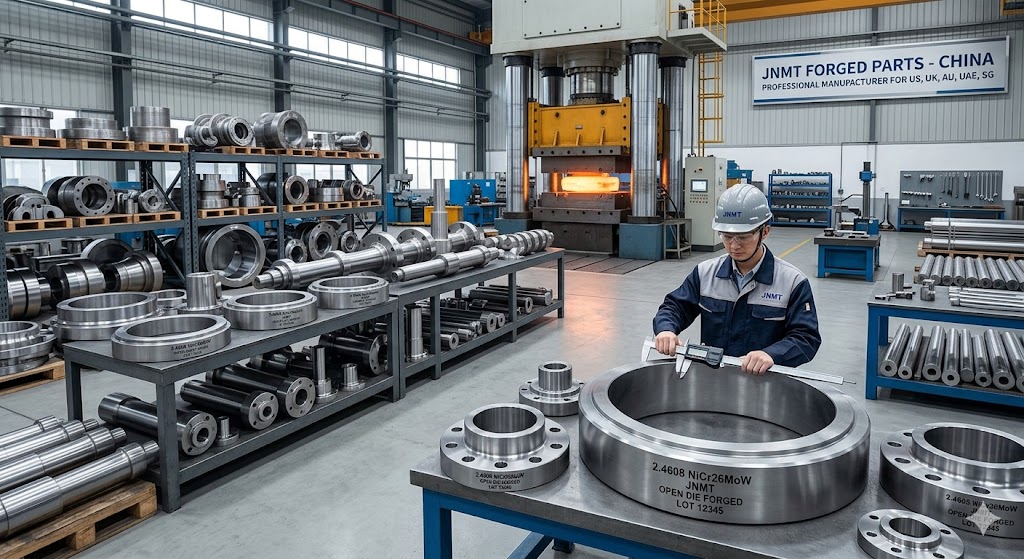
2.4608 NiCr26MoW Open Die Forgings — Custom bars, discs, and blocks
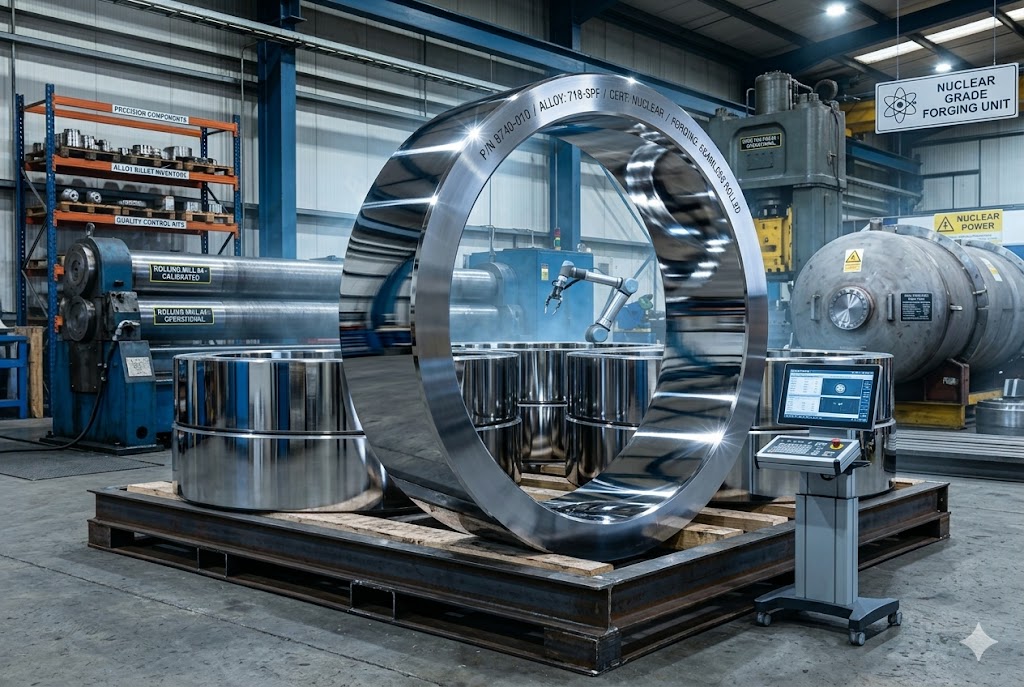
2.4608 NiCr26MoW Seamless Rolled Rings — OD up to 6,000 mm
What is 2.4608 (NiCr26MoW) Alloy? Metallurgy & Core Performance Advantages
2.4608, standardized as NiCr26MoW under DIN 17744 and referenced under equivalent designations in international alloy databases, is an austenitic nickel-chromium-iron superalloy engineered specifically for service conditions where standard stainless steels and conventional nickel alloys reach their performance limits. Its nominal composition — approximately 44–47% Ni, 24–26% Cr, with deliberate additions of Mo (2.5–4.0%), W (2.5–4.0%), Co (2.5–4.0%), and Si (0.7–1.5%) — creates a multi-mechanism defense against the three most common failure modes in high-temperature industrial equipment: oxidation, carburization, and hot corrosion.
The alloy's austenitic face-centered cubic (FCC) crystal structure is inherently stable at elevated temperatures, avoiding the ductile-to-brittle transition seen in ferritic and martensitic steels. The high nickel content (the austenite stabilizer) combined with 24–26% chromium (a level deliberately chosen to maximize chromia scale formation without triggering sigma-phase embrittlement in normal service) is the foundation of the alloy's oxidation and corrosion resistance. This is not a coincidence — the DIN alloy design committee selected Cr content just below the sigma-phase threshold for this alloy's intended service temperature range, a nuance that is often overlooked when substituting other high-Cr grades.
What Each Alloying Element Does — The Engineering Logic Behind NiCr26MoW
Understanding why each element is present — not just what the ranges are — is essential for engineering teams selecting 2.4608 for critical applications. The table below explains the metallurgical role of each element in the 2.4608 forging alloy:
| Element | Range (wt%) | Primary Metallurgical Role | Engineering Benefit |
|---|
| Nickel (Ni) | 44 – 47 | Austenite stabilizer; base matrix for FCC phase stability | Eliminates ductile-to-brittle transition; maintains toughness from cryogenic to 1200°C; provides resistance to stress-corrosion cracking in chloride environments |
| Chromium (Cr) | 24 – 26 | Forms dense, self-healing Cr₂O₃ protective oxide layer | Exceptional oxidation resistance up to 1200°C; resists hot corrosion, sulfidation, and attack by H₂S, SO₂, and acid gases |
| Molybdenum (Mo) | 2.5 – 4.0 | Solid-solution strengthener; pitting and crevice corrosion inhibitor | Significantly improves creep resistance at 700–900°C; enhances resistance to chloride pitting and reducing acid media; raises recrystallization temperature |
| Tungsten (W) | 2.5 – 4.0 | Solid-solution strengthener; slower diffuser than Mo in the matrix | Synergistic with Mo — W has a larger atomic radius, causing greater lattice distortion and stronger high-temperature strengthening; improves creep rupture life at T > 800°C |
| Cobalt (Co) | 2.5 – 4.0 | Reduces stacking fault energy; improves high-temperature creep | Slows dislocation movement at elevated temperatures, improving creep ductility and rupture life; stabilizes austenite against sigma-phase precipitation during long-term service |
| Silicon (Si) | 0.7 – 1.5 | Forms SiO₂ sublayer beneath Cr₂O₃ oxide scale | Critical for anti-carburization performance — the SiO₂ interlayer acts as a carbon diffusion barrier in carburizing furnace atmospheres; also improves oxidation resistance at >1000°C |
| Iron (Fe) | Remainder | Matrix filler; reduces alloy cost vs pure Ni-base grades | Balances cost-performance ratio compared with Cr-Mo nickel alloys; maintains forgeability and weldability of the matrix |
| Carbon (C) | 0.03 – 0.08 | Grain boundary strengthener (at low levels) | Controlled at low levels to prevent sensitization and intergranular corrosion; upper limit set to avoid carbide precipitation during slow cooling |
| Manganese (Mn) | Max 2.0 | Austenite stabilizer; sulfur scavenger | Prevents hot-shortness from sulfur during forging; secondary austenite stabilizer supporting Ni |
Engineering Insight from our metallurgical team: The Mo+W dual strengthening approach in 2.4608 is particularly effective because tungsten diffuses significantly more slowly than molybdenum at grain boundaries — meaning that under prolonged high-temperature service (10,000+ hours), W contributes disproportionately to creep life compared with equivalent Mo additions. For components requiring >5-year service life at 700–900°C, this is a critical selection advantage over single-Mo alloys.
Key Performance Benchmarks of 2.4608 Alloy
- Maximum continuous service temperature (air): 1,150°C — among the highest in the non-cobalt, non-refractory nickel alloy family
- Maximum intermittent/cyclic service temperature: Up to 1,200°C for thermal cycling applications where the oxide scale can reform between cycles
- Carburization resistance: Demonstrated mass gain of <1.5 mg/cm² after 200-hour exposure in H₂/CH₄ atmosphere at 1,050°C — attributed primarily to the Si-enriched sublayer
- Sulfidation resistance: Superior performance in mixed oxidizing-sulfidizing environments (SO₂, H₂S) compared with standard Inconel 600 due to higher Cr+Si combined content
- Aqueous corrosion: Excellent resistance to stress-corrosion cracking in hot chloride solutions at concentrations up to 1,000 ppm Cl⁻ at 150°C
- Cryogenic performance: Retains full toughness to -196°C (liquid nitrogen temperature) with no ductile-to-brittle transition — usable for cryogenic valve and pump applications
Full Range of 2.4608 (NiCr26MoW) Forged Products & Dimensional Capabilities
We manufacture a complete portfolio of 2.4608 (NiCr26MoW) forged products — from raw forged stock to finish-machined ready-to-install components — all produced in-house with no outsourcing of any critical manufacturing step. Every product is manufactured in strict compliance with customer drawings, international standards, and agreed inspection plans. Our in-house production chain covers steel melting → ingot casting → open die forging → seamless ring rolling → heat treatment → NDT → rough machining → finish machining → final inspection → packaging and export. View our full equipment list to understand our production capacity in detail.
2.4608 (NiCr26MoW) Forged Bars, Rods & Shafts
We supply custom 2.4608 forged round bars, step shafts, splined shafts, square bars, flat bars, and rectangular bars. Unlike mill-rolled bar which often suffers from centerline porosity and banded microstructure, our open die forged bars are produced with controlled multi-directional deformation that closes any residual solidification porosity and creates a wrought, homogeneous grain structure throughout the entire cross-section — critical for large-diameter bars where ultrasonic testability is required to ASTM A388 Level 2 or better.
- Maximum diameter: 2,000 mm (as-forged); up to 1,800 mm after rough turning
- Maximum length: 15,000 mm per piece
- Maximum single-piece weight: 30,000 KG
- Delivery conditions: As-forged (AF), rough-turned (RT, Ra ≤ 12.5 μm), semi-finish turned (Ra ≤ 3.2 μm), or finish machined to drawing
- Dimensional tolerance (RT): Diameter ±1.5 mm / Length ±10 mm per DIN 7527 Grade F
- Applications: Pump and agitator shafts, valve stems, downhole drilling tool mandrels, heat exchanger center rods, furnace roller shafts
2.4608 (NiCr26MoW) Seamless Rolled Forged Rings & Flanges
Our NiCr26MoW seamless rolled rings are produced on our 5-meter vertical ring rolling mill — one of the largest dedicated ring rolling facilities for nickel alloys in China. The ring rolling process ensures circumferential grain flow aligned with the ring geometry, which maximizes hoop strength and fatigue resistance compared with machining rings from forged discs (which cuts across the grain flow). This is particularly significant for large valve seat rings, reactor flanges, and rotating equipment components where fatigue under cyclic pressure loading is the primary failure mode.
- Maximum outer diameter: 6,000 mm
- Maximum height: 2,000 mm
- Minimum wall thickness: Approximately OD × 0.08 (process-dependent)
- Maximum single-piece weight: 30,000 KG
- Profile types: Rectangular cross-section, contoured/profiled rings (L-shape, T-shape, or customer profile) to reduce machining allowance
- Applications: Valve seat rings, weld neck flanges, pressure vessel nozzle rings, gear ring blanks, casing hanger bodies, reactor containment flanges
2.4608 (NiCr26MoW) Hollow Forgings, Sleeves & Pressure Vessels
We manufacture 2.4608 seamless hollow forgings including sleeves, bushes, heavy-wall pressure cylinders, barrels, casings, and liner tubes. Our hollow forging process uses a mandrel and top-bottom die system to forge a pre-pierced billet over a mandrel, achieving seamless, porosity-free hollow sections with wall thickness uniformity significantly better than cast pipe — and without the weld seam of welded pipe, which is prohibited in most API 6A and nuclear pressure boundary applications.
- Maximum outer diameter: 3,000 mm
- Wall thickness range: 30 mm minimum to 600 mm maximum (design-dependent)
- Length: Up to 5,000 mm for hollow sections
- Inner bore tolerance: H8–H10 as-bored; H7 after CNC boring with our in-house boring machines
- Applications: ESP (electric submersible pump) motor housings, high-pressure valve bodies, pressure vessel shells, heat exchanger channel heads, downhole tool housings
2.4608 (NiCr26MoW) Forged Discs, Plates, Tube Sheets & Blind Flanges
We supply NiCr26MoW forged discs and flat forgings for tube sheets, baffle plates, impeller blanks, and block material. For tube sheets specifically — a critical application in NiCr26MoW due to the alloy's combination of corrosion resistance and mechanical strength — we apply a specific multi-pass pancake forging technique that ensures uniform thickness tolerance across the entire face (±2 mm across any diameter up to 2,000 mm). This eliminates the risk of differential thermal expansion stress concentration seen in tube sheets with non-uniform thickness.
- Maximum diameter: 4,000 mm (disc)
- Maximum thickness: 800 mm
- Minimum thickness: 30 mm (flat forgings)
- Flatness tolerance: ≤ 1.5 mm/m on finish-machined faces
- Applications: Shell-and-tube heat exchanger tube sheets, pressure vessel end caps, pump impeller blanks, blind flanges, thermowell support plates
2.4608 (NiCr26MoW) Valve Bodies, Balls & Pump Components
We are a specialist supplier of precision-forged 2.4608 valve and pump components to global valve OEMs and EPC contractors. Our value proposition in this segment goes beyond the forging itself: because we maintain the complete manufacturing chain in-house, we can deliver near-net-shape forgings with significantly reduced machining allowance (typically 5–8 mm per face for rough-turned valve bodies, versus industry-standard 15–20 mm), reducing our customers' machining cost, material waste, and total lead time. We supply forged valve balls, bonnet bodies, valve body forgings, stems, seat ring blanks, valve discs, plug bodies, pump casings, impellers, wear rings, and diffuser plates.
- Valve body size range: DN25 to DN1200 (1" to 48" nominal bore)
- Pressure class range: ANSI Class 150 to Class 2500 (PN20 to PN420)
- Near-net-shape capability: Profiled die forgings to reduce machining allowance ≤ 8 mm on critical faces
- Applicable valve types: Ball valves, gate valves, globe valves, check valves, butterfly valves, plug valves, safety relief valve bodies
- Applications by end-use: API 6A wellhead and Christmas tree valves, ASME Class 600–2500 pipeline isolation valves, PED-compliant steam isolation valves
Global Industrial Applications & GEO-Targeted Project Cases of 2.4608 Forging Parts
The following application descriptions and project case summaries are drawn directly from our production records and post-delivery technical feedback from our customers. Unlike generalized marketing content, each case reflects a real engineering problem, a specific material and process solution, and a documented outcome. We share this level of detail because we believe procurement engineers deserve to make decisions based on comparable real-world evidence — not just material data sheets.
Oil & Gas Industry — Sour Service, High Pressure, HPHT Environments (UAE, USA, Saudi Arabia)
In oil and gas applications, 2.4608 (NiCr26MoW) forged components are specified primarily for sour service conditions — environments containing H₂S at partial pressures sufficient to cause sulfide stress cracking (SSC) in lower-alloy materials, and CO₂ that drives general corrosion. The nickel-rich matrix of 2.4608 is inherently immune to SSC per NACE MR0175 / ISO 15156-3, making it suitable for wellhead Christmas tree bodies, casing hanger assemblies, tubing heads, surface safety valves, and downhole mud motor components in HPHT (High Pressure High Temperature) wells where temperature and pressure preclude lower-cost alternatives.
Additional applications include API 6A Class 2 and Class 3 valve bodies, subsea connector hubs, riser connector flanges, gas injection valve bonnets, choke body forgings, and mandrel bodies for coiled tubing equipment. In all of these, the alloy's combination of high yield strength (≥ 240 MPa minimum, typically 280–340 MPa in practice from optimized forging practice), excellent elongation (≥ 30%), and SSC immunity makes it the preferred alternative to duplex and super-duplex stainless steels when temperature exceeds 150°C or H₂S partial pressure exceeds 0.01 MPa.
Verified Project Case — UAE Sour Gas Field: 200+ Wellhead Forged Bodies (ADNOC Supply Chain)
Engineering challenge: Wellhead assembly forgings (casing heads, tubing heads, valve bodies) were required for the development of a sour gas field in Abu Dhabi for a long service life at 95°C, 70 MPa wellhead pressure, H2S partial pressure of 0.08 MPa and CO2 partial pressure of 2.1 MPa. The original material specification for the EPC contractor was Super Duplex (UNS S32760), but thermal aging tests showed borderline SSC performance at 95°C – a known risk zone for SDSS. The engineering team changed the specification to 2.4608 (NiCr26MoW) according to NACE MR0175/ISO 15156-3 Table A.2.
Our solution: We produced 217 forged wellhead components (total weight ~180 tonnes) with minimal segregation and homogeneous Cr and Mo distribution, critical for uniform SSC resistance across large forging cross-sections, using EAF+PESR melting. Forging was done in three heats. Individual solution anneals at 1,130°C ± 10°C and water quench of each piece. All pieces passed EN10204 3.2 certification with full hardness mapping, 100% UT per ASTM A388 Level B, and third-party SSC testing per NACE TM0177 Method A at 0.1 MPa H₂S. Result: Zero SSC failures across 217 pieces; the customer reported 3+ years of incident-free field operation.
Nuclear Power & Thermal Power Generation — Coolant Systems, Turbines, Heat Exchangers (Germany, UK, Singapore)
The nuclear power industry's use of 2.4608 is driven by a different set of constraints than oil and gas. Here, the primary concerns are high-temperature water corrosion resistance (reactor coolant is pressurized water at 315–330°C and 15.5 MPa in PWR reactors), radiation stability of the microstructure, low cobalt content in materials adjacent to the coolant (to minimize Co-60 activation), and long service life without unplanned maintenance (typically 40-year plant design life). 2.4608's austenitic matrix is inherently radiation-stable with no phase transformations induced by neutron fluence in typical PWR environments, and its corrosion performance in high-temperature pressurized water is well-documented. The Co content (2.5–4.0%) requires careful management in coolant-wetted components — our technical team can discuss low-Co heat options where specified.
For thermal power generation, 2.4608 forgings serve in steam turbine components (diaphragm rings, balance discs, shaft sleeves), boiler superheater header flanges operating at 580–620°C, and shell-and-tube heat exchanger tube sheets in feedwater heaters where both thermal cycling resistance and corrosion protection are needed simultaneously. The Mo+W strengthening in 2.4608 provides a material with better creep resistance at 600–800°C than Inconel 600, while remaining more readily forgeable in large cross-sections than fully refractory superalloys.
Verified Project Case — Germany PWR Nuclear Plant: Reactor Coolant Pump Forged Casings
Engineering challenge: A German nuclear power operator (operating under KTA 3211 and PED 2014/68/EU) required replacement reactor coolant pump (RCP) casings and main flanges for a pressurized water reactor. The original casings had completed their 25-year design life, and the operator required material certification traceable to a single ingot heat with statistical mechanical property testing (6 test positions per forging) and EN10204 3.2 third-party certification. The weight of each casing was approximately 8.5 tonnes; four casings were required for the two-loop RCP system.
Our solution: We produced four forged casings using VIM+PESR melting. Each casing was open-die forged, solution annealed at 1,140°C/4-hour soak/water quench, and machined to net-shape profile. Mechanical testing was performed at 6 longitudinal and transverse positions per forging. NDT included 100% UT per EN 10228-3 Class 4 and 100% PT per EN 10228-2. Third-party inspection and EN10204 3.2 certification was completed by an internationally accredited inspection authority under a 14-month production and inspection schedule. All four casings were accepted on first inspection with zero rejections.
Petrochemical & Industrial Furnace — Carburizing, Reforming, Gasification (USA, Canada, South Korea)
The petrochemical and industrial furnace sector is arguably where 2.4608 (NiCr26MoW) forgings deliver their most unique value. In ethylene cracking furnaces, steam methane reformers (SMR), and direct reduced iron (DRI) processes, the operating environment combines high temperatures (900–1,100°C), reducing atmospheres containing CO, CH₄, and H₂, and cyclic thermal loading from process startup and shutdown. Standard austenitic stainless steels (304H, 310S) fail rapidly in these environments due to carburization — carbon atoms diffuse into the steel matrix, forming carbides that cause metal dusting and severe embrittlement. 2.4608's silicon-enriched oxide sublayer provides a measurable carburization barrier that can extend component life 3–5× compared with Si-free grades.
Specific applications include forged radiant tube support hangers, carburizing basket mandrels, retort body forgings, calciner shell flanges, gas turbine combustion liner supports, and thermowell forgings for process temperature measurement at 1,000°C+. We also supply forged components for sulfur recovery unit (SRU) Claus reactors, where the combined H₂S + SO₂ + elemental sulfur environment demands a grade with both oxidation and sulfidation resistance — a combination that 2.4608 handles more reliably than lower-Cr grades.
Verified Project Case — USA Steam Methane Reformer: Forged Tube Sheet & Collector Box Flanges
Engineering challenge: A hydrogen plant operator in Texas was experiencing accelerated carburization on their SMR collector box inlet flanges after 18 months of service — well below the expected 5-year replacement interval. The original material was 310S (UNS S31008). Metallographic examination after removal from service showed a penetration of carburization of 6 mm causing severe embrittlement. The operator sought a replacement material with a known resistance to carburization in H2/CH4/CO atmosphere at 980°C.
Our solution: We proposed 2.4608 based on its higher Si content (0.7–1.5% vs. 310S's typical 0.5–0.8%) and higher Cr content (24–26% vs. 310S's 24–26%, but with the crucial Mo+W addition improving oxide scale adhesion under cyclic conditions). We produced 8 forged tube sheet blanks and 16 collector box flanges using EAF+ESR melting. The forging process was specifically designed to maximize surface finish uniformity (Ra ≤ 6.3 μm on all oxide-forming surfaces) to promote uniform oxide scale growth. Post-installation performance monitoring at the 24-month mark showed carburization penetration of <0.5 mm — a 12× improvement over the 310S baseline. The operator has extended the projected replacement interval to 8+ years and has specified 2.4608 for all future SMR expansion units.
Industrial Valves & General Machinery — Valve OEMs, Mining, Cryogenics (Australia, Japan, South Korea)
Beyond the heavy process industries, 2.4608 forged valve and pump components serve a growing market in general industrial machinery — particularly in applications where the combination of corrosion resistance, high strength, and cryogenic toughness is required simultaneously. Cryogenic butterfly valve discs, LNG (liquefied natural gas) pump impellers, mineral acid pipeline isolation valve bodies, and subsea chemical injection valve bonnet forgings all benefit from 2.4608's unique combination of properties that no single alternative grade can fully replicate at competitive material cost.
In the Australian mining sector specifically, we have supplied forged pump shafts and wear ring blanks for mineral slurry pumps handling acidic ore slurry at pH 2–4 combined with abrasive solid content — a service condition that consumes lower-grade pump materials rapidly. The combination of 2.4608's corrosion resistance with the grain refinement achievable through controlled forging (versus casting, which is more commonly used in pump components) produces measurably longer wear life in this application.
Verified Project Case — Australia Mining Sector: Forged Pump Shafts & Valve Body Blanks for Acidic Slurry Service
Engineering challenge: A large gold and copper mine in Western Australia was replacing corrosion-failed pump shafts in their thickener overflow pumps every 9–12 months. The slurry pH was 2.8–3.5 with 15–20% solids. Previous materials included 316L, duplex 2205, and Super Duplex 2507 — all failed within 12 months due to combined corrosion-erosion. A mining engineer specified 2.4608 based on its superior performance in acidic oxidizing environments and the additional Mo+W corrosion inhibition contribution.
Our solution: We forged 24 pump shafts (diameter 180 mm × 2,400 mm length, weight approximately 140 KG each) and 12 valve body blanks using EAF+LF+VD melting. The shaft forgings were produced with a controlled grain elongation ratio (≥ 3:1 length-to-diameter reduction) to maximize axial tensile and fatigue properties, then rough-turned to Ra ≤ 6.3 μm for improved corrosion resistance at the surface. Post-installation tracking by the mining operator showed a service life of 28–32 months before first replacement — a 2.5–3× improvement over Super Duplex 2507 at comparable total installed cost when amortized over the longer replacement interval.
Frequently Asked Questions (FAQ) — 2.4608 (NiCr26MoW) Forging Parts
What is 2.4608 (NiCr26MoW) alloy and what makes it unique compared to other nickel alloys?
2.4608 (NiCr26MoW) is an austenitic nickel-chromium-iron superalloy standardized under DIN 17744. Its distinguishing feature is the simultaneous addition of four solid-solution strengthening and corrosion-inhibiting elements — molybdenum (2.5–4.0%), tungsten (2.5–4.0%), cobalt (2.5–4.0%), and silicon (0.7–1.5%) — to a 44–47% Ni, 24–26% Cr base matrix. No other commonly available nickel alloy in this nominal composition range combines high-temperature oxidation resistance (up to 1,200°C), silicon-enhanced carburization resistance, tungsten-molybdenum dual solid-solution strengthening for creep resistance, and nickel matrix immunity to stress-corrosion cracking in a single forgeable alloy. This combination makes it the preferred material for applications where two or more of these failure modes are active simultaneously.
What international standards and specifications does 2.4608 comply with?
Our 2.4608 forgings are produced and certified to the following standards: DIN 17744 (primary material specification for NiCr26MoW chemistry and mechanical properties), EN 10095 (heat-resistant nickel alloys), ASTM B564 (nickel alloy forgings), ASME SB-564 (ASME Boiler and Pressure Vessel Code equivalent), API 6A (for wellhead applications), ASME BPVC Section VIII Division 1 and 2 (pressure vessel design), PED 2014/68/EU (European Pressure Equipment Directive — Category III and IV require involvement of a customer-designated Notified Body, which we can support), and NACE MR0175/ISO 15156-3 (sour service materials qualification). We can also produce to customer-specific internal standards from major oil and gas operators, utilities, and defense contractors — provide your internal specification number and our technical team will confirm applicability before order placement.
How does 2.4608 compare with Incoloy 825, Hastelloy C-276, and Inconel 600?
The alloys are used in different primary application niches: Incoloy 825 (DIN 2.4858) is optimized for aqueous corrosion resistance below 540 °C in acidic and seawater environments - it has poor high temperature oxidation resistance and is not suitable for service above 600 °C.Hastelloy C-276 (DIN 2.4819) excels in severely reducing acid environments (HCl, H₂SO₄, mixed acids) at moderate temperatures — its weakness is oxidizing high-temperature service above 900°C where the oxide scale spalls under thermal cycling. Inconel 600 (DIN 2.4816) shares 2.4608's good high-temperature oxidation resistance but lacks the Mo+W solid-solution strengthening for creep resistance and the Si enhancement for carburization resistance. 2.4608 is the optimal choice when your application simultaneously requires high-temperature service (>800°C) AND corrosion resistance AND carburization resistance — a combination that none of the three alternatives can deliver in a single grade. Our technical team provides free alloy selection guidance for specific service conditions.
What is the maximum size and weight of 2.4608 forgings you can produce?
Our maximum 2.4608 forging capabilities are: Round bars — maximum diameter 2,000 mm, maximum length 15,000 mm, maximum weight 30,000 KG per piece. Seamless rolled rings — maximum outer diameter 6,000 mm, maximum height 2,000 mm, maximum weight 30,000 KG per piece. Hollow forgings/sleeves — maximum outer diameter 3,000 mm. Discs/plates — maximum diameter 4,000 mm, maximum thickness 800 mm. These are not theoretical maximums — they have all been demonstrated in production. For projects requiring sections beyond these limits, contact us to discuss feasibility; we occasionally collaborate with partner forge shops under our quality management supervision for extreme requirements.
Which melting route should I specify for my 2.4608 forging project?
The right melting route depends on your application severity and inspection requirements. As a general guide: EAF is suitable for non-critical general industrial applications with EN10204 3.1 certification. EAF+LF+VD is recommended for pressure vessel components, PED Category III/IV, or any forging with finished section >300 mm diameter where hydrogen-induced cracking is a concern. EAF+ESR is recommended for API 6A sour service forgings, any component requiring NACE MR0175 SSC resistance qualification, EN10204 3.2 certification, or UT acceptance to ASTM A388 Level B or EN10228-3 Class 3+. EAF+PESR is specified for components adjacent to nuclear systems (non-NSSS), high-integrity valve bonnets, and applications where tungsten burn-off during conventional ESR is a documented concern. VIM+PESR is required for nuclear safety system pressure boundaries (NSSS), nuclear-grade material certificates, or aerospace-quality purity requirements. If you are unsure, tell us your application, service conditions, and applicable inspection standard — and we will recommend the most cost-effective route that meets the requirement.
Do you provide third-party inspection and EN10204 3.2 certification for 2.4608 forgings?
Yes. We fully support third-party inspection and EN10204 3.2 certification for all 2.4608 forging orders. We accept internationally recognized inspection agencies like TÜV, SGS, Bureau Veritas (BV), Lloyd's Register, DNV and customer nominated inspectors. Please confirm your required agency with us before order placement. EN10204 3.2 orders have an agreed inspection plan prior to production, hold points and witness points are well defined and the 3.2 certifying inspector signs all test reports and the final MTC.All our in-house testing equipment is calibrated to traceable national standards. We have maintained ISO 9001:2015 certification without major non-conformance findings for 6 consecutive years.
What dimensional tolerances and surface finishes can you achieve on 2.4608 forgings?
For as-forged (AF) parts: tolerances per DIN 7527 Grade E or F depending on section. For rough-turned (RT) bars: diameter tolerance ±1.5 mm, length ±10 mm, surface finish Ra ≤ 12.5 μm. For semi-finish turned surfaces: Ra ≤ 3.2 μm, diameter tolerance ±0.5 mm. For CNC finish machined components to drawing: dimensional tolerances per your drawing (we routinely hold ±0.05 mm on machined bores and ±0.1 mm on OD diameters), surface finish Ra ≤ 1.6 μm on critical sealing faces. For seamless rings: radial wall thickness tolerance ±3% on rough-machined ID/OD; ±0.3 mm on finish-machined faces. For tube sheets: face flatness ≤ 1.5 mm/m on finish-machined surface, hole pattern accuracy ±0.1 mm center-to-center on CNC drilled tube sheets. If your drawing calls for tolerances not listed here, send it to us for a DFM review and we will confirm achievability before quoting.
How do you control grain size in 2.4608 forgings, and what grain size can you achieve?
We control grain size through three mechanisms: (1) Forging temperature — maintaining the workpiece within the 1,150°C–950°C working window throughout the forging sequence, verified by infrared pyrometer; (2) Reduction ratio — minimum 4:1 total reduction from ingot to final forging, with multi-directional passes to maximize grain refinement uniformity; (3) Solution annealing — calibrated to section size (1,120–1,160°C, 1 hr/100 mm minimum soak, water quench). Under these parameters, our standard 2.4608 forgings consistently achieve ASTM grain size number 3–5 (coarse grain, suitable for most UT-inspected structural applications). Fine grain (ASTM No. 5–7) is achievable on request for sections up to approximately 300 mm diameter, using a modified multi-pass forging with controlled finish deformation in the lower temperature range followed by standard solution annealing. Every production run includes a metallographic grain size verification test from a coupon heat-treated with the production pieces.
Can you produce 2.4608 forgings to our proprietary drawings and specifications?
Yes — all our 2.4608 production is to customer-specific orders. We accept drawings in DXF, DWG, STEP, IGES, and PDF format. Before order placement, our engineering team provides a free Design for Manufacturing (DFM) review to identify any features that would be difficult or expensive to produce by forging and suggest alternative geometries that achieve the same function at lower cost. Proprietary specifications are accepted under NDA — we regularly work with oil and gas operator specifications, valve manufacturer internal standards, and nuclear utility procurement specifications that cannot be publicly disclosed. All proprietary technical information is stored in our document control system with restricted access limited to the specific project team members who need it.
What documentation package is included with each 2.4608 forging order?
Our standard documentation package includes: EN10204 3.1 (or 3.2 if specified) Mill Test Certificate with full heat chemical analysis, mechanical test results, heat treatment records, and UT/PT results; dimensional inspection report with as-measured values against drawing tolerances; hardness test map (100% of pieces for orders >500 KG individual piece weight); heat treatment temperature-time chart (furnace recorder trace); packing list with individual piece weight, marking, and heat number; and country of origin certificate. Additional documents available on request include: PMI (XRF) records for 100% of pieces; grain size measurement per ASTM E112; inclusion rating per ASTM E45; ISIR (Initial Sample Inspection Report) for first-off production; impact test results at specified temperatures; PPAP documentation for repeat-order programs; SSC test certification per NACE TM0177; and customs clearance documents for the destination country.
What is the typical lead time for 2.4608 forging orders, and can you handle urgent requirements?
Typical lead times depend on melting route: EAF grade, 6–10 weeks; EAF+ESR, 8–14 weeks; EAF+PESR, 12–18 weeks; VIM+PESR nuclear grade, 16–24 weeks. These times run from purchase order and drawing approval to ready-for-shipment, including all heat treatment, NDT, and inspection. For urgent requirements, we maintain a pre-melted 2.4608 EAF-grade ingot inventory for sizes 500–5,000 KG that can reduce lead time by 3–4 weeks. Rush production scheduling for critical path project items (plant shutdown maintenance, equipment replacement) available with a production surcharge — call us immediately to discuss your timeline, as early notice greatly increases the options available.
How should I submit an RFQ for 2.4608 forgings, and what information do you need?
Please send your RFQ to sales@jnmtforgedparts.com or WhatsApp/phone +86-13585067993. For an accurate quote, please provide: (1) Material specification — DIN 2.4608, NiCr26MoW or equivalent; (2) Product form — bar, ring, hollow, disc or special shape; (3) All dimensions with tolerances, or a drawing file. (4) Quantity (number of pieces and estimated gross weight); (5) Delivery condition as forged, rough turned or machined; (6) Requirement on melting route; (7) Applicable standard and inspection level; (8) Any special testing requirements; (9) Required delivery date; (10) Delivery destination and preferred Incoterms. All complete RFQs are responded to within 3 business days. On complicated projects with multiple part numbers we are happy to arrange a technical pre-bid meeting (video call) to clarify requirements prior to a formal quotation.