1. About 23CrNiMo7-4-7 (1.6749) Alloy Steel
23CrNiMo7-4-7 — identified by DIN material number 1.6749 — is a low-alloy, high-strength chromium-nickel-molybdenum-vanadium engineering steel standardised primarily under DIN EN 10222-5 (pressure vessel forgings) and EN 10083-3 (steels for quenching and tempering). Its carefully balanced alloying system — chromium for hardenability, nickel for toughness, molybdenum to suppress temper embrittlement, and vanadium for grain refinement — makes it uniquely suited to massive, high-stress rotating and pressure-containing components where through-thickness uniformity is non-negotiable.
Jiangsu Liangyi Co., Limited has been forging this grade since 1997. Over more than 25 years and hundreds of completed projects, our engineering team has developed process refinements — particularly in press-forging reduction ratios and multi-stage tempering — that measurably improve the homogeneity of mechanical properties in cross-sections exceeding 500 mm, which is where 23CrNiMo7-4-7 most clearly outperforms simpler grades such as 42CrMo4.
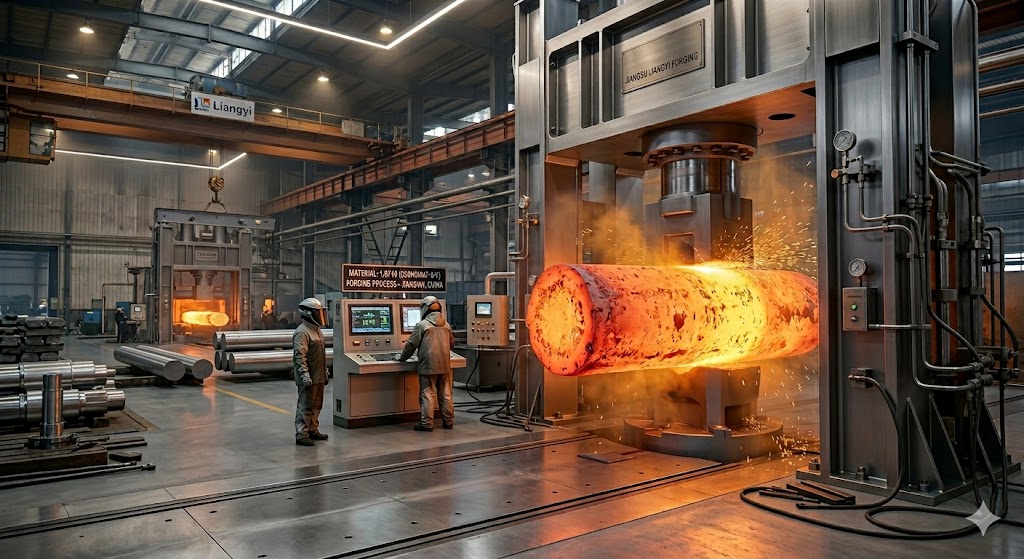
Key Advantages of 23CrNiMo7-4-7 (1.6749) Steel
High Tensile Strength
Minimum tensile strength of 850 MPa and yield strength 750–900 MPa after quench-and-temper, enabling reliable performance under heavy static and dynamic loads.
Exceptional Toughness
Charpy V-notch impact energy ≥ 34 J at room temperature in the transverse direction — well above the threshold for critical rotating components in power generation.
Deep Hardenability
The Cr-Ni-Mo triad suppresses pearlite formation during quenching, allowing full martensitic transformation in sections up to and beyond 400 mm ruling section — a key differentiator from 42CrMo4.
Excellent Fatigue Resistance
Endurance limit (R = −1) approximately 430–470 MPa; outstanding resistance to cyclic loading extending turbine shaft service life by 30–50% versus plain Cr-Mo grades in comparable applications.
Vanadium Grain Refinement
0.05–0.15% vanadium forms fine carbide and nitride precipitates that pin austenite grain boundaries during heating, resulting in a finer as-quenched microstructure and more consistent post-temper properties.
Temper Embrittlement Resistance
Molybdenum content of 0.6–0.8% strongly suppresses intergranular embrittlement during slow cooling from temper, critical for components that operate for decades at elevated temperatures.
2. International Standards & Equivalent Grades
23CrNiMo7-4-7 is a European DIN/EN designation. Engineers specifying this grade from different regions often need to cross-reference against national standards. The table below is based on our engineering team's direct comparison of chemical composition ranges and mechanical property requirements — not a simple renaming exercise. Differences in carbon range, impurity limits and delivery condition mean that grade equivalence should always be confirmed against the specific standard revision applicable to your project.
International Standards Cross-Reference for 23CrNiMo7-4-7 / 1.6749
| Standard System | Designation / Grade | Standard Reference | Similarity Level | Key Difference |
|---|
| DIN / EN (Europe) | 23CrNiMo7-4-7 · 1.6749 | EN 10222-5, EN 10083-3 | Primary | Definitive standard; all others are approximations |
| ASTM / AISI (USA) | Modified 4340 / Custom grade | ASTM A668 Cl. F/G (forging) | Approximate | AISI 4340 has no V; P & S limits differ; Ni range wider in 4340 |
| BS (UK) | No direct equivalent | BS EN 10222-5 (adopted) | EN adopted | UK now uses EN standard directly |
| JIS (Japan) | No direct equivalent | JIS G 4053 (closest: SNCM630) | Approximate | SNCM630 has higher Ni (2.5–3.5%), different C and Mo ranges |
| GB / YB (China) | No direct national equivalent | GB/T 3077 (closest: 20CrNiMoA) | Approximate | 20CrNiMoA has lower Cr and no V; primarily for case-hardening |
| GOST (Russia) | No direct equivalent | GOST 4543 (closest: 20КНМ or 25Х2НМФА) | Partial | Different Ni/Mo balance and heat treatment requirements |
⚠️ Engineering note: Grade cross-references are indicative only. When substituting 23CrNiMo7-4-7 / 1.6749 with a non-EN grade, the responsible engineer must verify all composition limits, mechanical property minimums, NDE acceptance criteria and applicable test certificate format against the procurement specification. Jiangsu Liangyi can supply material to EN, ASTM and other standards upon request.
3. Chemical Composition of 23CrNiMo7-4-7 (1.6749)
Chemical composition per EN 10083-3 / EN 10222-5, all values in weight percent (wt%). Heat analysis values shown; product analysis tolerances apply per standard.
Chemical Composition – 23CrNiMo7-4-7 / 1.6749 (wt%, Heat Analysis)
| Element | Symbol | Range (wt%) | Metallurgical Role |
|---|
| Carbon | C | 0.20 – 0.26 | Controls base strength; upper limit balances strength vs. toughness and weldability |
| Silicon | Si | ≤ 0.30 | Deoxidiser; kept low to maintain toughness |
| Manganese | Mn | 0.50 – 0.80 | Improves hardenability and desulfurisation; moderate range minimises segregation risk in large ingots |
| Chromium | Cr | 1.70 – 2.00 | Primary hardenability element; forms carbides that improve wear and elevated-temperature strength |
| Nickel | Ni | 0.90 – 1.20 | Markedly improves low-temperature toughness and hardenability without significantly reducing ductility |
| Molybdenum | Mo | 0.60 – 0.80 | Suppresses temper embrittlement; boosts creep resistance and hardenability in thick sections |
| Vanadium | V | 0.05 – 0.15 | Grain refinement via VC/VN precipitates; secondary hardening contribution; key differentiator from 4340 |
| Phosphorus | P | ≤ 0.010 | Controlled to very low levels to prevent grain boundary embrittlement |
| Sulfur | S | ≤ 0.007 | Minimised to improve transverse ductility and notch toughness in forgings |
| Iron | Fe | Balance | Base matrix element |
Process note from Jiangsu Liangyi: Our 23CrNiMo7-4-7 heats are produced by EAF + AOD/VOD refining. For critical turbine shafts we routinely achieve P ≤ 0.007% and S ≤ 0.003% — substantially below the EN maximum — using ladle desulfurisation and vacuum degassing. ESR (Electroslag Remelting) is available for applications with the most demanding inclusion cleanliness requirements, such as high-cycle fatigue components and aerospace-adjacent structures.
4. Mechanical Properties of 23CrNiMo7-4-7 After Heat Treatment
Minimum mechanical properties per EN 10222-5 for forgings in the quenched and tempered (QT) condition. Properties are measured on test specimens taken from the most representative position in the forging as agreed with the purchaser.
Mechanical Properties – 23CrNiMo7-4-7 / 1.6749 (Minimum Values, QT Condition)
| Property | Symbol | Min. Value | Direction / Condition |
|---|
| Tensile Strength | Rm | 850 MPa | Longitudinal |
| 0.2% Proof Strength (Yield) | Rp0.2 | 750 – 900 MPa | Transverse, 20 °C |
| Elongation at Break | A | 15 % | Transverse, 20 °C (L₀ = 5d) |
| Reduction of Area | Z (long.) | 42 % | Longitudinal |
| Reduction of Area | Z (trans.) | 40 % | Transverse, 20 °C |
| Charpy V-Notch Impact | KV | 34 J | Room temperature (average of 3 specimens) |
| Brinell Hardness | HBW | 248 – 302 | After QT; on actual forging surface |
Effect of Tempering Temperature on Mechanical Properties
The following guidance is based on Jiangsu Liangyi's internal process validation data for sections in the 200–400 mm diameter range. Actual values depend on section thickness, quench severity and chemical composition within the specified range.
Indicative Mechanical Properties vs. Tempering Temperature (Section ≈ 300 mm dia.)
| Tempering Temp. (°C) | Rm (MPa) | Rp0.2 (MPa) | A (%) | KV (J) | HBW | Typical Application |
|---|
| 540 – 560 | 950 – 1050 | 850 – 950 | 13 – 15 | 35 – 50 | 285 – 310 | High-strength shafts, valve spindles |
| 580 – 620 | 880 – 960 | 780 – 870 | 15 – 17 | 50 – 80 | 262 – 290 | Turbine rotor shafts (standard) |
| 630 – 680 | 820 – 900 | 720 – 800 | 17 – 20 | 80 – 120 | 248 – 270 | High-toughness rings, pressure vessels |
5. Physical & Thermal Properties of 1.6749 Steel
Physical properties are largely composition-independent for steels of this type and change primarily as a function of temperature. The values below apply to the quenched and tempered condition at the temperatures stated. These properties are essential for FEA modelling of turbine components, thermal stress analysis and design of heat treatment tooling.
Physical & Thermal Properties – 23CrNiMo7-4-7 / 1.6749
| Property | Value | Unit | Temperature |
|---|
| Density | 7.84 – 7.86 | g/cm³ | 20 °C |
| Elastic Modulus (Young's) | 210 | GPa | 20 °C |
| Elastic Modulus | 195 | GPa | 300 °C |
| Elastic Modulus | 175 | GPa | 500 °C |
| Shear Modulus | 81 | GPa | 20 °C |
| Poisson's Ratio | 0.28 – 0.30 | — | 20 °C |
| Coefficient of Thermal Expansion | 11.8 – 12.2 | ×10⁻⁶ / °C | 20 – 200 °C |
| Coefficient of Thermal Expansion | 12.5 – 13.0 | ×10⁻⁶ / °C | 20 – 400 °C |
| Thermal Conductivity | 36 – 40 | W / (m·K) | 20 °C |
| Thermal Conductivity | 30 – 34 | W / (m·K) | 400 °C |
| Specific Heat Capacity | 460 – 480 | J / (kg·K) | 20 °C |
| Electrical Resistivity | 0.30 – 0.38 | μΩ·m | 20 °C |
| Magnetic Permeability | Ferromagnetic | — | Below Curie point (~770 °C) |
| Ac1 Temperature (lower critical) | 720 – 740 | °C | Heating |
| Ac3 Temperature (upper critical) | 800 – 820 | °C | Heating |
Design insight: The relatively low thermal conductivity of 1.6749 (compared to copper or aluminium) means that very large turbine shafts must be heated and cooled slowly and uniformly during heat treatment to avoid thermal gradients that cause quench cracking or residual stress. Jiangsu Liangyi's ten programmable furnaces allow us to implement stepped heating and controlled cooling profiles precisely matched to section size.
6. Heat Treatment Parameters for 23CrNiMo7-4-7 (1.6749)
The following heat treatment parameters are based on EN 10222-5 recommendations and refined through Jiangsu Liangyi's 25+ years of production experience. Exact temperatures, hold times and cooling rates are adjusted by our metallurgists for each order based on section size, required mechanical properties and customer specification.
1
Forging Reduction & Controlled Finish Temperature
Forging is completed at a finish temperature of 900–950 °C minimum to avoid forging into the two-phase (α+γ) region which causes excessive deformation resistance and surface cracking. A minimum total forging reduction ratio of 4:1 is maintained from billet to final shape to break down the as-cast dendritic structure and achieve uniform, fine-grained wrought microstructure. For turbine shafts requiring premium properties, we target a reduction ratio of 5:1 to 7:1.
2
Normalizing (Optional Pre-Treatment) — 860–900 °C
Normalizing at 860–900 °C followed by still-air cooling is applied as a preliminary treatment for very large forgings to homogenise the as-forged microstructure, reduce segregation and relieve forging stresses before the final QT cycle. Hold time: 1 hour per 25 mm of maximum cross-section, minimum 3 hours. This step is important for shafts with a diameter over 500 mm. Without proper handling, chemical segregation during ingot solidification will lead to uneven performance across the finished part.
3
Austenitizing / Quenching — 840–870 °C
The forging is austenitized at 840–870 °C, which is well above the Ac₃ critical temperature. This ensures that all carbides dissolve and the austenite matrix becomes fully homogeneous. Hold time: 1 hour per 25 mm of maximum cross-section, minimum 4 hours. Quenching medium: oil or polymer quenchant (water quench is not recommended for sections above 150 mm due to quench crack risk). For sections below 80 mm, accelerated gas quench in a sealed furnace is an alternative that minimises distortion on precision-machined areas.
Hardness after quench (as-quenched, before tempering): typically 42–52 HRC depending on section and quench severity.
4
Tempering — 540–680 °C
The as-quenched forging is tempered at 540–680 °C (temperature selected by our metallurgists to achieve the target property level — see Section 4 table). Hold time: 2 hours for every 25 mm of maximum cross-section, with a minimum of 4 hours to ensure that the temperature reaches all parts of large sections evenly. Cooling after tempering: furnace cool to below 300 °C, then air cool. Do not cool too rapidly from the tempering temperature, as this can reintroduce thermal stresses and cause temper embrittlement.
A second tempering cycle at the same or slightly lower temperature is applied if hardness checking reveals insufficient uniformity — a quality step unique to our large-section process protocol.
5
Stress-Relief Anneal (Post-Machining, Optional) — 550–650 °C
Following rough machining, a stress-relief anneal at 550–650 °C (below the tempering temperature to avoid property degradation) is recommended for parts with complex geometry or tight dimensional tolerances. Hold time: minimum 2 hours; cooling rate ≤ 50 °C/h down to 300 °C. This step is standard practice for turbine shafts that need finish grinding to tight runout tolerances after final heat treatment.
⚠️ Important: The temperature for tempering must be at least 30°C higher than the part's maximum working temperature while it is in use. This avoids in‑service tempering effects, which would slowly lower hardness and cause dimensional changes over long-term use. For turbine parts running at 450–550°C, please consult our engineering team before finalizing your purchasing technical requirements.
7. Grade Comparison: 23CrNiMo7-4-7 vs Similar Alloy Steels
Selecting the right grade for large, critical forgings requires a clear understanding of how 23CrNiMo7-4-7 compares to its closest competitors. The table below is based on our engineering team's analysis of published standard composition and property data combined with practical production experience.
Comparative Analysis: 23CrNiMo7-4-7 vs 42CrMo4, 34CrNiMo6, 30CrNiMo8, AISI 4340
| Property / Feature | 23CrNiMo7-4-7
1.6749 | 42CrMo4
1.7225 | 34CrNiMo6
1.6582 | 30CrNiMo8
1.6580 | AISI 4340
UNS G43400 |
|---|
| Carbon (wt%) | 0.20 – 0.26 | 0.38 – 0.45 | 0.30 – 0.38 | 0.26 – 0.34 | 0.38 – 0.43 |
| Nickel (wt%) | 0.90 – 1.20 | None | 1.30 – 1.70 | 1.80 – 2.20 | 1.65 – 2.00 |
| Vanadium | 0.05 – 0.15% | None | None | None | None |
| Min. Tensile Strength | 850 MPa | 900 – 1100 MPa | 900 – 1100 MPa | 1000 – 1200 MPa | 965 – 1170 MPa |
| Hardenability (large section) | Excellent | Moderate | Good | Excellent | Good |
| Low-temp. Toughness | Excellent | Limited | Good | Excellent | Good |
| Temper Embrittlement Resistance | Excellent (Mo) | Good (Mo) | Moderate | Moderate | Moderate |
| Grain Refinement | Excellent (V) | Moderate | Moderate | Moderate | Moderate |
| Relative Material Cost | Medium | Lower | Medium | Medium-High | Medium |
| Preferred Application | Turbine shafts > 150 mm ruling section; valve spindles | General engineering shafts < 150 mm | Gearbox shafts, crankshafts | Very large rings, heavily loaded shafts > 400 mm | Aerospace & defence, general high-strength |
Jiangsu Liangyi recommendation: For turbine rotor shafts and rings with a ruling section between 150 mm and 500 mm, 23CrNiMo7-4-7 is typically the optimum grade — it offers better through-thickness property uniformity than 42CrMo4 or 34CrNiMo6 at a lower cost than 30CrNiMo8. For sections exceeding 600 mm where maximum toughness is needed, consider 30CrNiMo8. For smaller, high-strength fasteners and bolts, 42CrMo4 remains the most economical choice. Our technical team is happy to advise on grade choice for your specific application.
8. Weldability & Machinability of 23CrNiMo7-4-7
8.1 Weldability
The carbon equivalent (CEIIW) of 23CrNiMo7-4-7 is about 0.58–0.72, depending on the actual heat composition. This means it needs to be preheated. Welding is feasible but must follow a carefully controlled procedure. The following guidance is based on general industry practice and should be supplemented with a qualified welding procedure specification (WPS) for any production welding application.
Welding Parameters for 23CrNiMo7-4-7 (1.6749)
| Parameter | Requirement / Recommendation | Notes |
|---|
| Carbon Equivalent (CEIIW) | 0.58 – 0.72 (typical) | CE = C + Mn/6 + (Cr+Mo+V)/5 + (Ni+Cu)/15 |
| Preheat Temperature | 200 – 300 °C minimum | Higher preheat for thicker sections and higher-carbon heats. Preheat must be maintained throughout welding. |
| Interpass Temperature | Maximum 300 °C | Exceeding this risks grain coarsening in the HAZ and reduced toughness. |
| Heat Input | Low to medium (0.5 – 2.0 kJ/mm) | Excessive heat input coarsens HAZ grain structure; insufficient input leaves cold cracking risk. |
| Recommended Filler (SMAW) | AWS A5.5 E9018-D1 or similar low-hydrogen | Hydrogen content ≤ 5 ml/100 g deposited weld metal. Bake electrodes at 350 °C × 1 h before use. |
| Recommended Filler (GTAW/GMAW) | AWS A5.28 ER90S-G or matching composition wire | Shielding gas: Ar + 2–5% O₂ or Ar + 15–25% CO₂ for GMAW. |
| Post-Weld Hydrogen Bake | 250 – 300 °C × 2–4 h immediately after welding | Mandatory before any cooling to room temperature for sections > 50 mm. |
| Post-Weld Heat Treatment (PWHT) | 580 – 650 °C × 1 h per 25 mm, slow cool | PWHT is strongly recommended and often mandatory per design code. Temperature must be ≥ 30 °C below original tempering temperature to preserve base metal properties. |
8.2 Machinability
In the normalised and tempered condition (hardness ~262–302 HBW), 23CrNiMo7-4-7 has machinability approximately 50–60% of AISI 1212 free-machining steel (the common reference baseline). The relatively high hardenability and alloy content produce a tough, work-hardening chip that requires rigid machine setups and sharp tooling. The following parameters are starting points for carbide tooling; final parameters should be optimised per specific machine, tooling and depth of cut.
Indicative Machining Parameters for 23CrNiMo7-4-7 / 1.6749 (Carbide Tooling, Hardness ~280 HBW)
| Operation | Cutting Speed (m/min) | Feed Rate (mm/rev) | Depth of Cut (mm) | Coolant |
|---|
| Rough Turning | 120 – 180 | 0.25 – 0.50 | 3.0 – 8.0 | Water-soluble, flood |
| Finish Turning | 150 – 220 | 0.08 – 0.18 | 0.5 – 2.0 | Water-soluble, flood |
| Rough Milling | 100 – 150 | 0.10 – 0.20 per tooth | 3.0 – 6.0 | Water-soluble, flood |
| Drilling (HSS-Co) | 12 – 20 | 0.08 – 0.15 | — | Water-soluble, flood |
| Drilling (Carbide) | 50 – 80 | 0.05 – 0.12 | — | Through-tool coolant preferred |
| Cylindrical Grinding | 20 – 30 m/s (wheel) | 0.005 – 0.020 | 0.005 – 0.015 | Grinding fluid, flood, avoid burn |
⚠️ Machining note: When machining fully hardened (HBW > 300) 23CrNiMo7-4-7 — for example, after final heat treatment on rough-forged turbine shafts — use CBN (cubic boron nitride) insert grades for finish turning and reduce depth of cut to ≤ 0.5 mm. Avoid interrupted cuts with CBN tooling. At Jiangsu Liangyi we provide rough-machined forgings with stock allowance for customers to finish-machine in the hardened condition, or can deliver fully machined components from our CNC turning centres.
9. Product Range & Available Specifications
We manufacture a comprehensive range of 23CrNiMo7-4-7 (1.6749) forged steel products in various shapes, sizes and supply conditions. The specification table below shows our standard supply range; dimensions outside these ranges may be possible — contact our sales team to discuss your specific requirement.
Available 23CrNiMo7-4-7 (1.6749) Forged Product Specifications — Jiangsu Liangyi
| Product Type | Dimension Range | Max Single Weight | Supply Condition | Surface |
|---|
| Round Forged Bar / Shaft Popular | ⌀80 mm – ⌀2,000 mm
L: up to 15,000 mm | 30 t | As-forged, N, N+T, QT, SR | As-forged / Rough-turned / Finish-turned |
| Turbine Rotor Shaft Specialty | ⌀300 – ⌀2,000 mm
L: 1,000 – 15,000 mm | 30 t | QT (mandatory) | Rough-turned with journal diameter control |
| Seamless Rolled Ring Popular | OD: ⌀300 – ⌀6,000 mm
Height: 50 – 2,000 mm
Wall thickness: ≥ 40 mm | 20 t | As-forged, N, N+T, QT, SR | As-rolled / Rough-turned / Profile-machined |
| Open Die Forged Ring | OD: ⌀200 – ⌀3,000 mm
Height: 30 – 1,500 mm | 15 t | As-forged, N, N+T, QT | As-forged / Rough-turned |
| Forged Disc / Cake | ⌀200 – ⌀2,500 mm
Thickness: 30 – 600 mm | 20 t | As-forged, N+T, QT | As-forged / Rough-turned / Faced |
| Valve Spindle / Stem | ⌀30 – ⌀300 mm
L: 200 – 3,000 mm | 2 t | QT (standard) | Rough-turned / Finish-turned / Ground |
| Square / Flat Bar | Side: 50 – 800 mm
L: up to 6,000 mm | 10 t | As-forged, N, N+T, QT | As-forged / Rough-milled |
| Custom Shape (per drawing) | As per customer drawing | 30 t | As agreed | As agreed |
Supply condition codes: N = Normalised; N+T = Normalised & Tempered; QT = Quenched & Tempered; SR = Stress-Relieved
Documentation Provided with Every Order
- EN10204 3.1 Material Test Report (chemical analysis + mechanical test results) — included with every order
- Dimensional inspection report (measurements per agreed drawing)
- NDE reports (UT per EN 10228-3 or ASTM A388; MT/PT per agreement)
- Heat treatment record (furnace chart, holding times, temperatures)
- EN10204 3.2 third-party witness certificate — available on request; customer nominates inspection body (TÜV, BV, DNV, ABS, Lloyd's Register, etc.)
- Packing list and country of origin declaration
10. Advanced Manufacturing Capabilities in Jiangyin, China
Our production base is located in Chengchang Industry Park, Jiangyin City, a well‑known concentrated forging hub in China. It enjoys direct road links to Yangtze River ports, enabling convenient shipping for heavy cargo. Our factory spans more than 80,000 m². We complete every production step from raw steel processing to finished and fully inspected forged parts entirely in-house. This avoids reliance on external subcontractors and guarantees full quality traceability at all stages.
Main Equipment
Jiangsu Liangyi Manufacturing Equipment Summary
| Equipment Category | Specification | Quantity | Application |
|---|
| Hydraulic Forging Press | 6,300 T | 1 | Heavy turbine shafts, large ingots |
| Hydraulic Forging Press | 4,000 T | 1 | Medium shafts, bars, rings |
| Hydraulic Forging Press | 2,000 T | 2 | Small-medium bars, valve components |
| Electro-Hydraulic Forging Hammer | 5 T | 2 | Small precision forgings |
| Electro-Hydraulic Forging Hammer | 3 T | 2 | Small forgings, custom shapes |
| Ring Rolling Mill | D51-630 / D51-1600 | 4 | Seamless rings up to ⌀6 m |
| Heat Treatment Furnace | Programmable, up to 100 t capacity | 10 | Normalising, QT, stress relief |
| CNC Heavy Turning Lathe | Max swing ⌀2 m, between centres 16 m | 6 | Turbine shaft rough and finish turning |
| Ultrasonic Testing (UT) Unit | Phased array UT (PAUT) | 4 | 100% volumetric inspection of all forgings |
| Magnetic Particle Testing (MT) | AC/DC yoke & bench units | 6 | Surface and near-surface defect detection |
| Spectro Optical Emission Spectrometer | Full elemental analysis | 2 | Incoming & outgoing chemical analysis |
| Mechanical Test Laboratory | Universal tensile tester, impact tester, hardness tester | Dedicated lab | Tensile, Charpy, Brinell, Rockwell |
Production Capacity at a Glance
- Annual output: 120,000 tonnes of forged steel products across all grades
- Maximum single forging weight: 30 tonnes
- Maximum turbine shaft length: 15 metres
- Maximum bar / shaft diameter: 2 metres
- Maximum seamless rolled ring outer diameter: 6 metres
- Minimum order quantity: 1 piece (we cater to both prototype and production volumes)
12. Rigorous Quality Assurance & International Certifications
At Jiangsu Liangyi, quality control starts when the steel is bought and ends when the forging passes the final release inspection. Our quality system — certified to ISO 9001:2015 — documents every operation with full traceability from heat number to final certificate.
Stage-by-Stage Quality Control
1
Incoming Material Inspection
Every ingot or billet is subjected to optical emission spectrometry (OES) to verify chemical composition against the heat certificate before entering production. Out-of-specification material is quarantined and returned — regardless of schedule pressure.
2
In-Process Forging Inspection
Dimensional checks and visual inspection are performed at each heating and pressing stage. Surface temperature is monitored by contact and infrared pyrometry to prevent under-temperature forging which produces poor grain flow.
3
Heat Treatment Monitoring
All ten heat treatment furnaces are equipped with calibrated thermocouples at multiple zones. Temperature uniformity is verified quarterly per AMS 2750 / NADCAP guidance. Furnace charts are recorded and retained as part of the quality dossier for each order.
4
Mechanical Testing
Test specimens are machined from a test coupon attached to or cut from the forging at the least-favourable position (typically the last point to cool during quenching). Tests include tensile, elongation, reduction of area, Charpy V-notch impact (average and minimum of 3 specimens), and Brinell hardness survey on the forging surface.
5
Non-Destructive Testing
100% volumetric UT per EN 10228-3 (forgings) acceptance class S2 standard, or ASTM A388 as required. Phased-array UT (PAUT) is available for complex geometries. MT per EN 10228-1 on accessible surfaces. PT for non-ferromagnetic areas. RT available on request for specific configurations.
6
Final Dimensional & Surface Inspection
Full dimension test against customer drawing using CMM (coordinate measuring machine) for complex profiles, standard gauging for simple geometries. Surface roughness measured by profilometer where specified. Hardness survey on final forging surface per agreed pattern.
Certifications and Approvals
- ISO 9001:2015 — Quality Management System (certificate available on request)
- EN10204 3.1 — Mill test report issued by our Quality Manager; included with every delivery as standard
- EN10204 3.2 — Third-party witness inspection certificate available on request; we welcome inspection by TÜV, BV (Bureau Veritas), DNV, ABS, Lloyd's Register or any other body nominated by the customer
- Customer witness inspections at our Jiangyin factory are always welcome and can be arranged in advance
- Compliance with ASTM, DIN, EN, JIS, ASME and other international material standards
- Customer-specific quality plans and ITPs (Inspection and Test Plans) executed on request
13. Frequently Asked Questions About 23CrNiMo7-4-7 (1.6749) Forgings
What is 23CrNiMo7-4-7 (1.6749) steel?
23CrNiMo7-4-7 (DIN material number 1.6749) is a low-alloy, high-strength chromium-nickel-molybdenum-vanadium engineering steel standardised under DIN EN 10222-5 and EN 10083-3. It offers tensile strength ≥ 850 MPa, yield strength 750–900 MPa and excellent Charpy impact toughness, making it the preferred material for large gas and steam turbine rotor shafts, high-pressure valve spindles and seamless rolled rings in power generation, oil & gas and marine applications.
What is the ASTM equivalent of 23CrNiMo7-4-7?
No exact matching ASTM grade exists for this alloy. The closest alternative is AISI/SAE 4340 (UNS G43400), which has a base made of chromium, nickel, and molybdenum that is similar to this one. 4340 does not have any vanadium, but it does have a wider range of nickel (1.65–2.00% compared to 0.90–1.20%) and a higher carbon content (0.38–0.43% compared to 0.20–0.26%).When thinking about directly replacing a grade in technical specs, always check the chemical limits, mechanical property requirements, and required certificate formats ahead of time. Jiangsu Liangyi supplies 23CrNiMo7-4-7 fully compliant with EN standards, and can provide ASTM‑style documents to meet ASME and ASTM design code needs.
What is the standard heat treatment for 1.6749?
The standard quench-and-temper heat treatment for 23CrNiMo7-4-7 consists of: (1) Austenitizing at 840–870 °C, hold 1 hour per 25 mm section, then oil or polymer quench; (2) Tempering at 540–680 °C, hold 2 hours per 25 mm section minimum, then furnace cool to 300 °C then air cool. The tempering temperature is selected to achieve the required strength level — lower temperatures yield higher strength, higher temperatures improve toughness. A preliminary normalising step at 860–900 °C is recommended for very large sections.
How does 23CrNiMo7-4-7 compare to 42CrMo4?
23CrNiMo7-4-7 has significantly better hardenability and impact toughness in large cross-sections compared to 42CrMo4, primarily due to its nickel content (0.90–1.20%) and vanadium addition — elements absent in 42CrMo4. For sections above 150 mm ruling section, 23CrNiMo7-4-7 consistently delivers more uniform through-thickness properties. 42CrMo4 has a higher carbon range (0.38–0.45%) that gives it higher achievable strength at smaller sections, but at the cost of reduced toughness and weldability. For turbine shafts and large rings, 23CrNiMo7-4-7 is the preferred choice; for smaller general-engineering shafts and gears, 42CrMo4 is typically more cost-effective.
What is the maximum size you can forge in 23CrNiMo7-4-7?
Jiangsu Liangyi can produce 23CrNiMo7-4-7 forgings up to 30 tonnes single-piece weight. Maximum turbine shaft length is 15 metres; maximum bar or shaft diameter is 2 metres. Maximum seamless rolled ring outer diameter is 6 metres. These dimensions can be confirmed for your specific project — contact our technical team with your drawing or weight estimate.
What are the weld preheat requirements for 23CrNiMo7-4-7?
The carbon equivalent (CE_IIW) of 23CrNiMo7-4-7 is typically 0.58–0.72, needing a minimum preheat of 200–300 °C for welding. The interpass temperature should not exceed 300 °C. A post-weld hydrogen bake at 250–300 °C for 2–4 hours immediately after welding is mandatory before any cooling, followed by post-weld heat treatment (PWHT) at 580–650 °C with slow cooling. Low-hydrogen filler metals (H5 or better) must be used. Full welding procedure qualification per ISO 15614-1 or ASME IX is recommended.
What lead time can I expect for 23CrNiMo7-4-7 forgings?
For standard bars and rings (non-critical dimensions), the lead time is 4–6 weeks from order confirmation. For custom turbine shafts and complex parts needing multiple heat treatment cycles and full NDE, the lead time is 8–12 weeks. Very large single-piece forgings (over 20 t) or parts needing ESR melting: 10–16 weeks. These are typical lead times based on standard production schedules — contact us with your specific requirement for a firm schedule commitment.
What certifications does Jiangsu Liangyi hold?
Jiangsu Liangyi is certified to ISO 9001:2015 for its quality management system. Every delivery includes an EN10204 3.1 mill test certificate issued by our Quality Manager. EN10204 3.2 third-party witness inspection is available on request — customers may nominate any internationally recognised body such as TÜV, BV (Bureau Veritas), DNV, ABS or Lloyd's Register to attend and countersign the test reports. We do not hold standing factory approval certificates from these classification societies; the EN10204 3.2 inspection is carried out on a per-order basis at the customer's request.