About 21CrMoNiV4-7 (1.6981) High-Temperature Creep-Resistant Forging Steel
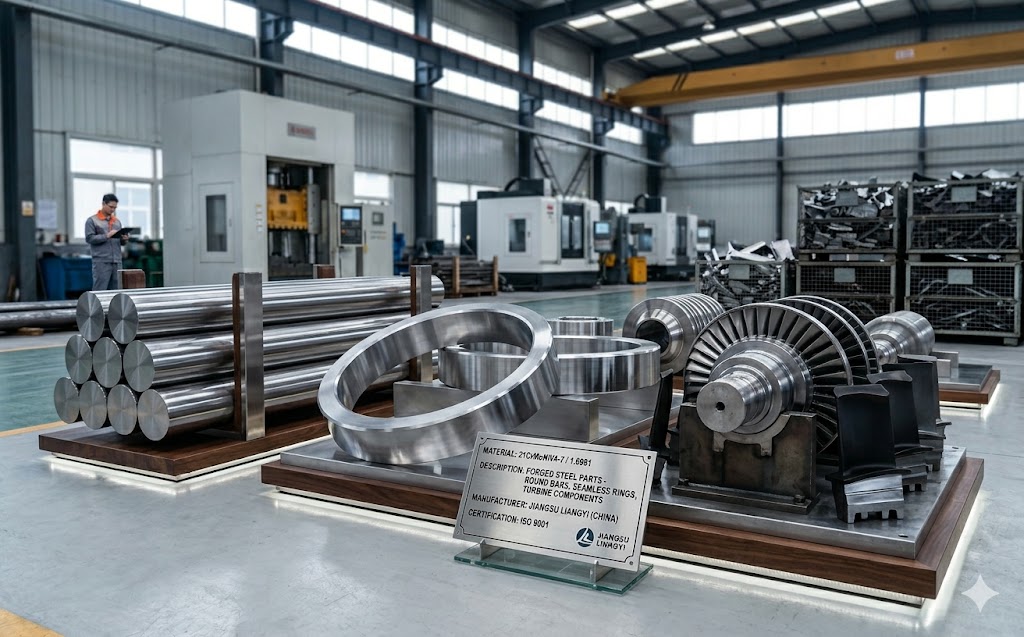
- EN Number:
- 1.6981
- Also written as:
- 21CrMoNiV4.7 · 21 CrMoNiV 4-7
- Steel family:
- Low-alloy, creep-resistant, heat-resistant
- Max. service temp:
- 560°C (continuous)
- Yield strength RT:
- 550–700 N/mm²
- Yield strength 560°C:
- >290 MPa
- Primary standards:
- EN 10222-2 · DIN 17240 · VdTÜV 401
- MTC:
- EN 10204 3.1 / 3.2
- Density:
- 7.82 g/cm³
Jiangsu Liangyi Co., Limited, established in 1997, is a leading ISO 9001:2015 certified manufacturer of 21CrMoNiV4-7 (1.6981) open die forging parts and forged steel gas and steam turbine generator rotor shafts from China. Our 80,000 m² state-of-the-art production facility in Jiangyin, Jiangsu, is equipped with a 6,300-ton hydraulic press, 5-metre seamless rolling machine, and 10 computer-controlled heat treatment furnaces, and we can produce forgings from 30 kg to 30,000 kg with an annual capacity of 120,000 tonnes.
21CrMoNiV4-7 (EN 1.6981) is a low-alloy, high-strength, creep-resistant steel grade specifically engineered for continuous operation at temperatures up to 560°C. Its carefully balanced chemical composition — including chromium, molybdenum, nickel, and vanadium, giving it excellent high-temperature tensile and yield strength, excellent toughness and ductility, superior fatigue resistance, and long-term microstructural stability. These characteristics make it the best choice material for important parts in power generation and heavy industrial equipment where elevated temperature strength and dimensional stability under sustained load are non-negotiable.
Why Choose Jiangsu Liangyi for Your 21CrMoNiV4-7 Forging Requirements?
- Complete in-house production chain from steel melting (30 t EAF + LF + VOD) to final CNC machining and NDE testing — no subcontracting, full traceability
- Advanced metallographic, mechanical, and high-temperature creep testing laboratories on-site
- Single-piece forging capacity up to 30 tonnes; seamless rolled rings up to 6 metres in diameter
- Full NDE package (UT, MT, PT, PMI/XRF) and EN 10204 3.1/3.2 MTC certification as standard
- Competitive pricing, reliable 4–8 week lead times, and English-speaking engineering support
Our Comprehensive 21CrMoNiV4-7 (1.6981) Forging Capabilities
At our Jiangyin, Jiangsu factory we manufacture a complete range of 21CrMoNiV4-7 (1.6981) forged steel products in all kinds of shapes, sizes, and configurations to meet your most demanding project specifications. All forgings are produced to meet the requirements of international standards including EN, DIN, and ASTM, and can be manufactured to customer-specific technical specifications and project requirements.
Standard 21CrMoNiV4-7 Forged Shapes & Dimensions
- Forged Bars: Round, square, flat, and rectangular bars up to 2 m in diameter and 15 m in length
- Seamless Rolled Rings: Custom contoured and flat forged rings up to 6 m in diameter and 30 t in weight
- Hollow Components: Hubs, housings, shells, sleeves, bushes, and heavy-wall hollow bars up to 3,000 mm OD
- Plates & Discs: Forged discs, blocks, plates, and flanged blanks up to 3 m in diameter and 25 t
- Pipes & Tubes: Seamless forged pipes, tubes, casings, and pressure vessel shells
Specialised 21CrMoNiV4-7 Turbine & Industrial Parts
- Gas and steam turbine rotor shafts and generator shafts up to 15 m in length
- Gas compressor turbine blades, vanes, and guide rings
- Turbine seal rings, labyrinth rings, and packing seal diaphragms
- Rotor end rings, casing rings, and custom contoured rings
- Gas and steam turbine valve spindles, stems, and rods
- High-strength double-headed studs, fasteners, and bolts
Explore our full range of forged steel products to find the right solution for your application.
21CrMoNiV4-7 (1.6981) International Equivalent Grades — Full Cross-Reference
One of the most common engineering challenges when sourcing 21CrMoNiV4-7 (1.6981) internationally is identifying which grade in another country's standard system is equivalent, comparable, or a viable substitute. The table below is compiled from our 29 years of cross-border project experience and reflects the practical equivalency we work with daily — not just a theoretical composition match. Note that no international grade is a perfect chemical or mechanical clone of 1.6981; the closest grades for specific applications are highlighted with our engineering team's notes.
⚠️ Important Procurement Note
21CrMoNiV4-7 (1.6981) has no direct ASTM or JIS equivalent. For projects governed by ASME or ASTM codes, Jiangsu Liangyi can supply 1.6981 forgings with supplementary ASTM-format mechanical test documentation to support your engineering team's alternative materials evaluation. Formal acceptance under ASME codes needs review and sign-off by a qualified Registered Professional Engineer on the customer's side.
| Standard System | Grade / Designation | Equivalency Level | Key Difference vs. 1.6981 |
|---|---|---|---|
| EN (Europe) | 1.6981 / 21CrMoNiV4-7 | ✅ Identical | — Reference grade |
| DIN (Germany) | 21 CrMoNiV 4 7 per DIN 17240 | ✅ Direct — same composition | Older DIN designation superseded by EN; same material |
| VdTÜV (Germany) | VdTÜV Werkstoffblatt 401 | ✅ Direct — same grade, German pressure equipment approval | Adds specific creep rupture and long-term heat resistance testing requirements |
| ASTM (USA) | A182 F22 (2¼Cr-1Mo) | ⚠️ Comparable — similar service temperature range | No Ni or V; lower creep rupture strength; maximum service temperature ~560°C similar but with lower elevated-temperature yield |
| ASTM (USA) | A182 F91 (9Cr-1Mo-V) | ⚠️ Higher-alloy alternative — for >560°C applications | 9% Cr vs. 1% Cr; rated to ~620°C; demands stricter PWHT; significantly higher alloy cost |
| BS (UK) | BS 1503-625 (historical) | ⚠️ Broadly comparable for forgings | Replaced by EN; narrower Cr range in BS version; confirm per project specification |
| JIS (Japan) | SFVCM F22A per JIS G3203 | ⚠️ Closest JIS forging grade — no exact match | 2¼Cr-1Mo-V; different V and Ni limits; check creep data for your temperature range |
| ГОСТ (Russia) | 20КХМФЛс / 20KhMFBs | ⚠️ Broadly comparable composition | Different casting vs. forging practice; Russian standards differ on testing frequency and report format |
| GB/T (China) | No direct GB/T grade | ℹ️ Manufactured to EN 1.6981 specification in China | Chinese mills including Jiangsu Liangyi produce to EN 10222-2 / DIN 17240 composition and testing requirements as the recognised standard |
🔧 Engineering Insight — Jiangsu Liangyi
In our experience supplying projects in Germany, the Netherlands, and Scandinavia, specifying engineers often need forgings that satisfy both EN 10222-2 and VdTÜV Werkstoffblatt 401 simultaneously for pressure-retaining turbine parts. We manufacture to the chemical composition and mechanical property requirements of both documents and can issue a single EN 10204 3.1 test certificate referencing both standards — eliminating the administrative overhead of reconciling two separate test reports before equipment handover.
Applicable Standards & Specifications for 21CrMoNiV4-7 (1.6981) Forgings
Specifying the correct standard is an important first step in any procurement of 1.6981 forged steel for pressure vessels, turbines, or high-temperature industrial equipment. Jiangsu Liangyi manufactures and inspects to the following recognised standards, and can produce forgings to customer-specific standards or project technical specifications upon request.
Primary Material Standards
- EN 10222-2 Steel forgings for pressure purposes — Part 2: Ferritic and martensitic steels with specified elevated temperature properties. This is the primary EN standard governing 21CrMoNiV4-7 pressure vessel forgings. It defines the chemical composition limits, heat treatment requirements, guaranteed room-temperature and elevated-temperature mechanical properties, and inspection class requirements for 1.6981.
- DIN 17240 Heat-resisting steels and alloys — Technical delivery conditions. The predecessor German standard to EN 10222-2. Frequently still referenced in legacy project specifications and older equipment OEM manuals, particularly from German turbine manufacturers. Jiangsu Liangyi can certify to DIN 17240 upon request.
- VdTÜV Werkstoffblatt 401 German pressure equipment material approval sheet for 21CrMoNiV4-7. Issued by the German Technical Inspection Association (VdTÜV). Required for parts subject to the German Pressure Equipment Ordinance (DruckbehV) and for many European power generation projects. Specifies long-term creep rupture strength values and additional inspection requirements beyond EN 10222-2. We manufacture to the chemical composition and mechanical property requirements of VdTÜV 401 and can supply supporting creep data from our in-house testing laboratory upon request.
- EN 10083-3 Steels for quenching and tempering — Part 3: Technical delivery conditions for alloy steels. Referenced for general alloy steel technical delivery conditions where EN 10222-2 is not project-mandatory.
Inspection & Testing Standards
- EN 10228-3 Non-destructive testing of steel forgings — Part 3: Ultrasonic testing of ferritic and martensitic steel forgings. All 21CrMoNiV4-7 forgings from Jiangsu Liangyi are UT-inspected per EN 10228-3 as standard. Acceptance classes (Type 1 through Type 3) are assigned by part shape as detailed in our Quality Assurance section.
- EN 10228-1 Magnetic particle testing of steel forgings (upon request).
- EN 10228-2 Penetrant testing of steel forgings (upon request).
- EN 10308 Ultrasonic testing of steel bars — applied to bar-shaped forgings per customer request.
- EN ISO 6892-1 Tensile testing at room temperature (all forgings).
- EN 10002-5 Tensile testing at elevated temperature — applied when elevated-temperature proof stress is specified.
- EN ISO 148-1 Charpy V-notch impact testing at room temperature (all forgings).
- EN ISO 6506-1 Brinell hardness testing (all forgings as standard).
- EN 10204 3.1 / 3.2 Mill Test Certificate format. All deliveries include 3.1 as standard; 3.2 (third-party witnessed) available from SGS, BV, TÜV, DNV.
💡 Procurement Tip
If your project specifications call for both EN 10222-2 and VdTÜV Werkstoffblatt 401, you may request one combined dual-standard material test certificate from your forging supplier. Jiangsu Liangyi provides a unified EN 10204 3.1 certificate that references both standards together. This removes extra administrative work and avoids the need to cross-check two separate test reports prior to equipment delivery.
21CrMoNiV4-7 (1.6981) Material Advantages & Technical Comparison
21CrMoNiV4-7 steel has a unique chemical matrix and a heat treatment process that has been improved to give it clear performance advantages over regular alloy steels, making it the best choice material for high-temperature, high-pressure working conditions:
Main Material Properties
- Excellent Creep Resistance: Maintains structural integrity and dimensional stability under long-term high-temperature and high-pressure cyclic loading. Creep rupture strength at 500°C over 100,000 hours is about 250 MPa — which is more than 2 times that of 42CrMo4.
- Superior High-Temperature Strength: Because stable carbide and vanadium carbonitride precipitation happens during tempering, it retains its high tensile and yield strength even when operating at temperatures up to 560°C.
- Excellent Toughness & Ductility: Nickel enhances low-temperature and ambient toughness, reducing the risk of brittle fracture during cold start-up cycles in steam turbines.
- Good Weldability: Lower Cr content (1% vs. 9% for P91) means simpler preheat requirements and less susceptibility to cold cracking. Preheat of 200–300°C is adequate for most section thicknesses.
- Excellent Machinability: Superior machinability in the normalised and tempered condition reduces finish-machining cycle times and tooling costs versus fully martensitic grades.
- Long Service Life: Over 25+ years of documented field experience in coal-fired and combined-cycle power plants across Europe and Asia confirms stable microstructure with no significant creep cavitation up to 560°C.
Technical Comparison: 21CrMoNiV4-7 vs. Other Alloy Steels
| Property | 21CrMoNiV4-7 (1.6981) | 42CrMo4 (1.7225) | 34CrNiMo6 (1.6582) | P91 / X10CrMoVNb9-1 |
|---|---|---|---|---|
| Max. Continuous Service Temperature | 560°C | 400°C | 450°C | 620°C |
| Yield Strength (Room Temp) | 550–700 N/mm² | 500–700 N/mm² | 700–900 N/mm² | 585 N/mm² min. |
| Yield Strength at 560°C | >290 MPa | ~150 MPa | ~200 MPa | ~380 MPa |
| Creep Rupture (100,000 h at 500°C) | ~250 MPa | ~100 MPa | ~150 MPa | ~300 MPa |
| Preheat for Welding | 200–300°C (manageable) | 150–250°C | 200–300°C | 200–300°C (very strict) |
| PWHT Requirement | 680–720°C (standard) | Optional for thin sections | 600–650°C | 730–780°C (mandatory, strict window) |
| Relative Material Cost | Medium | Low | Low–Medium | High |
| Primary Application | Steam/gas turbines, pressure vessels to 560°C | General engineering, gears | Heavy gears, crankshafts | Ultra-supercritical steam systems |
🔧 Engineering Insight — When to Choose 21CrMoNiV4-7 Over P91
From our project experience across Southeast Asia and Europe: for turbine parts operating between 500°C and 560°C, 21CrMoNiV4-7 (1.6981) consistently has a better value proposition than P91. The lower alloy content means simpler post-weld heat treatment with a wider PWHT temperature window (±20°C vs. ±8°C for P91), lower risk of improper PWHT-induced Type IV cracking, and 15–25% lower material cost. P91 should be considered only when the operating temperature genuinely exceeds 560°C or when extreme creep rupture life is specified.
21CrMoNiV4-7 (1.6981) Industrial Applications & Global Project References
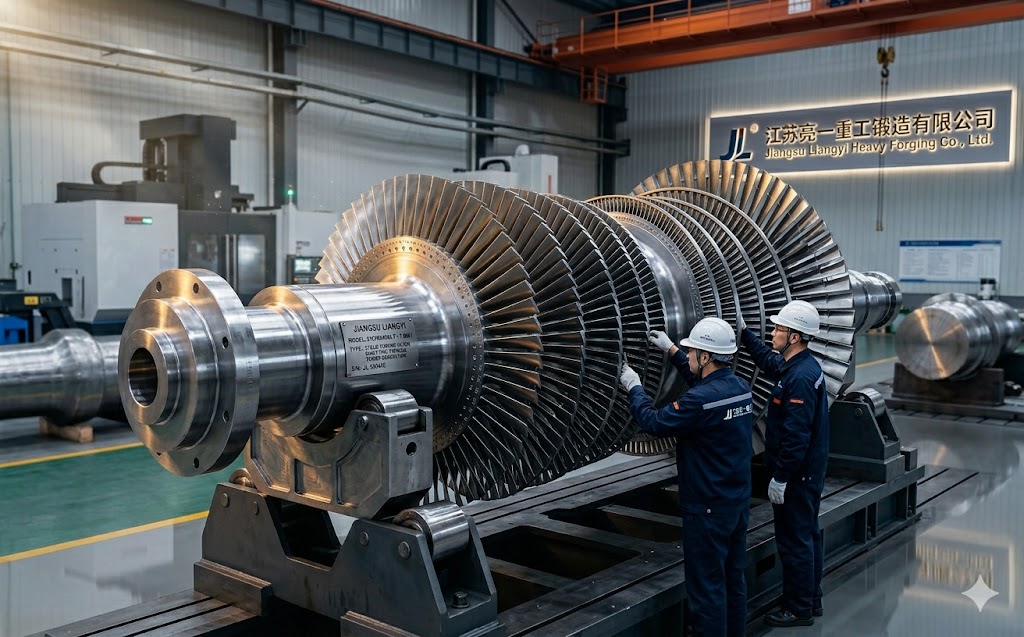
21CrMoNiV4-7 forged steel has excellent high-temperature performance, reliability, and long service life, making it the best choice material for important parts in a wide range of industries. Over the past 29 years, our Jiangyin factory has supplied thousands of 1.6981 forgings to successful projects in more than 50 countries worldwide.
Power Generation — Primary Application
21CrMoNiV4-7 is the global standard material for steam turbine parts in the high-pressure and intermediate-pressure sections of thermal, combined-cycle, and industrial power plants:
- Thermal Power Plants: Supplied 52 steam turbine rotor shafts and 120+ seamless rolled rings to 13 coal-fired and gas-fired thermal power plants in Thailand, Vietnam, and Indonesia
- Gas Turbine Systems: Compressor blades, turbine discs, and guide rings for 8 combined-cycle power plants in Saudi Arabia, the UAE, and Qatar
- Combined Cycle Power Plants: High-pressure steam piping, heat exchanger tubesheets, and pressure vessel shells for 5 projects in Germany, France, and Italy
- Industrial Power Plants: Turbine parts and custom forgings for 11 captive power plants in Australian mining and German chemical industries
Oil & Gas Industry
- High-pressure valve bodies, stems, seats, and balls for refinery applications in Kuwait and Oman
- Compressor parts and turbine blades for natural gas processing plants in Malaysia and Australia
- Heat exchanger tubesheets and pressure vessel shells for offshore oil and gas projects in Brazil and Norway
- Pipeline parts for high-temperature oil transportation in Canada and the United States
Other Industrial Applications
- Marine propulsion systems and shipboard power generation equipment in South Korea and Japan
- Industrial boilers and high-pressure steam systems for chemical and petrochemical plants in India and Singapore
- Heavy machinery parts needing high strength at elevated temperatures for mining in Chile and South Africa
View our complete global project references for more details on our international partnerships.
Precise Chemical Composition of 21CrMoNiV4-7 (1.6981)
The carefully controlled chemical composition of 21CrMoNiV4-7 forged steel is the foundation of its excellent mechanical properties and high-temperature performance. At our Jiangyin steel mill, we use advanced 30-tonne electric arc furnaces (EAF), ladle refining furnaces (LF), and vacuum degassing equipment (VOD) to ensure the highest purity, compositional consistency, and low inclusion content of every heat.
📋 Quick Reference — Chemical Composition
21CrMoNiV4-7 (1.6981): C 0.17–0.25% · Si 0.15–0.35% · Mn 0.35–0.85% · Cr 0.90–1.20% · Mo 0.65–0.80% · Ni 0.20–0.80% · V 0.25–0.35% · P ≤0.030% · S ≤0.035%
| Element | Symbol | Range (wt.%) | Metallurgical Role |
|---|---|---|---|
| Carbon | C | 0.17 – 0.25 | Provides base hardness and strength; controlled upper limit prevents excessive hardness and impaired toughness |
| Silicon | Si | 0.15 – 0.35 | Deoxidant during steelmaking; contributes to oxidation resistance at elevated temperature |
| Manganese | Mn | 0.35 – 0.85 | Improves hardenability and combines with sulphur to form MnS, preventing hot-shortness |
| Phosphorus | P | ≤ 0.030 | Residual impurity; strict upper limit preserves toughness, especially at low temperatures |
| Sulfur | S | ≤ 0.035 | Residual impurity; limited to prevent sulphide inclusion bands that impair transverse ductility |
| Chromium | Cr | 0.90 – 1.20 | Main creep-resistance contributor; promotes stable M₂₃C₆ carbide precipitation; improves oxidation resistance |
| Molybdenum | Mo | 0.65 – 0.80 | Primary solid-solution strengthener at elevated temperature; significantly improves creep rupture strength |
| Nickel | Ni | 0.20 – 0.80 | Improves ambient and low-temperature toughness; improves hardenability in thick sections without raising brittleness transition temperature |
| Vanadium | V | 0.25 – 0.35 | Forms stable vanadium carbonitrides (VC/VN) that pin grain boundaries, provide precipitation hardening, and dramatically improve creep rupture resistance at 500–560°C |
Custom chemical composition adjustments — such as tighter Mn or Ni ranges for specific toughness targets — are available upon request. Browse our full material grade list for 100+ alloy steel, stainless steel, nickel alloy, and tool steel options.
Physical & Thermal Properties of 21CrMoNiV4-7 (1.6981)
Physical and thermal property parameters are important for precise mechanical design calculation, FEA simulation, thermal stress analysis and creep life assessment of 21CrMoNiV4-7 (1.6981) parts. The following data are typical values under quenched and tempered (+QT) condition, in line with official EN and VdTÜV reference standards, and verified by our in-house laboratory through repeated testing of multiple production batches.
📐 Quick Reference — Physical Properties
21CrMoNiV4-7 (1.6981) at 20°C: Density 7.82 g/cm³ · Elastic modulus 213 GPa · Thermal conductivity 36 W/(m·K) · Thermal expansion 11.8 × 10⁻⁶ /K · Specific heat 480 J/(kg·K)
Temperature-Dependent Physical Properties
| Property | Unit | 20°C | 200°C | 400°C | 500°C | 560°C |
|---|---|---|---|---|---|---|
| Density | g/cm³ | 7.82 | 7.76 | 7.68 | 7.63 | 7.60 |
| Elastic Modulus (Young's Modulus) | GPa | 213 | 203 | 190 | 182 | 175 |
| Thermal Conductivity | W/(m·K) | 36 | 36 | 34 | 32 | 30 |
| Mean Thermal Expansion Coefficient (from 20°C) | ×10⁻⁶ /K | 11.8 | 12.3 | 12.9 | 13.3 | 13.6 |
| Specific Heat Capacity | J/(kg·K) | 480 | 510 | 545 | 570 | 590 |
| Thermal Diffusivity | mm²/s | 9.6 | 9.1 | 8.2 | 7.3 | 6.7 |
| Electrical Resistivity | μΩ·m | 0.26 | 0.38 | 0.56 | 0.67 | 0.74 |
🔧 Design Engineering Note
The decrease in elastic modulus from 213 GPa at room temperature to approximately 175 GPa at 560°C is a critical input for finite element analysis of turbine rotor deflection and bearing load calculations. Using room-temperature modulus values for high-temperature FEA of 21CrMoNiV4-7 parts will underestimate deflections by approximately 18% — a common but avoidable design error. Our engineering team can provide temperature-dependent property datasets for FEA in Excel or CSV format upon request, at no additional charge.
Creep Rupture Strength Data
Long-term creep rupture strength is the governing design criterion for 21CrMoNiV4-7 parts at elevated temperature. The values below represent mean creep rupture strength from statistically validated European data sets per EN 10222-2 and VdTÜV 401 Appendix:
| Temperature | 1,000 hours | 10,000 hours | 100,000 hours | 200,000 hours |
|---|---|---|---|---|
| 450°C | ~460 MPa | ~390 MPa | ~310 MPa | ~275 MPa |
| 500°C | ~340 MPa | ~295 MPa | ~248 MPa | ~220 MPa |
| 530°C | ~265 MPa | ~225 MPa | ~185 MPa | ~163 MPa |
| 560°C | ~195 MPa | ~160 MPa | ~126 MPa | ~110 MPa |
Note: Values are indicative mean values. Design stress values for EN pressure equipment should be taken from EN 10222-2 Annex B or VdTÜV 401 Appendix C, which include appropriate safety factors.
Advanced Heat Treatment Process for 21CrMoNiV4-7 (1.6981) Forgings
Proper heat treatment is essential for 21CrMoNiV4-7 forged parts to achieve optimal mechanical properties, microstructure, and residual stress profiles. We have 10 computer-controlled, atmosphere-protected heat treatment furnaces, which guarantee precise temperature control (±3°C) and consistent heating throughout the entire forging.
🌡️ Quick Reference — Heat Treatment (QT condition)
Harden: 900–950°C, 1–2 min/mm, oil/polymer quench → Temper: 680–720°C, min. 2 h, furnace or air cool
Standard 21CrMoNiV4-7 Heat Treatment Procedure
Step 1 — Hardening (Austenitisation)
- Heating temperature: 900–950°C
- Soaking time: Calculated based on part thickness — typically 1–2 minutes per millimetre of effective cross-section, minimum 2 hours regardless of section size
- Cooling methods: Air, oil, polymer, or water dipping depending on section thickness and required microstructure
- Centre cooling rate: Controlled to match oil quenching rate for optimal martensite/bainite microstructure and through-thickness hardness uniformity
Step 2 — Tempering
- Tempering temperature: 680–720°C
- Minimum holding time: 2 hours (extended for thicker sections to ensure full tempering and uniform vanadium carbonitride precipitation throughout the section)
- Cooling rate: Controlled slow cooling in furnace or still air to minimise thermal gradients and residual stress
- Multiple tempering cycles: Available for critical turbine parts where minimising residual stress is paramount, or where Charpy impact energy above the EN 10222-2 minimum is specified
🔬 Metallurgical Insight — Why the Tempering Window Matters
The 680–720°C tempering window for 21CrMoNiV4-7 is deliberately set above the AC₁ temperature for martensite recovery (~640°C) but below the austenite reversion temperature (~740°C). Tempering within this 40°C window achieves the critical balance between dissolving detrimental carbide networks (requires >650°C) and keeping the fine vanadium carbonitride precipitation hardening that provides creep resistance (progressively coarsened above 720°C). Exceeding 720°C significantly reduces the 100,000-hour creep rupture strength. Our furnaces keep the temperature within ±3°C across the whole load. This is checked every three months with calibration surveys and independent thermocouple mapping to make sure that the through-load accuracy stays the same.
Our metallurgists choose the right heat treatment parameters based on the size, shape, and mechanical properties needed for each 21CrMoNiV4-7 forging to make sure it meets or exceeds EN, DIN, ASTM, and customer-specific standards.
Guaranteed Mechanical Properties of 21CrMoNiV4-7 (1.6981) Steel
All our 21CrMoNiV4-7 forged steel parts are given full mechanical property testing at our in-house mechanical and metallurgical testing laboratory to verify their performance at both room temperature and elevated temperatures. We provide complete, certified test reports with every delivery.
Room Temperature Mechanical Properties
| Mechanical Property | Test Standard | Guaranteed Minimum Value |
|---|---|---|
| 0.2% Proof Stress (Yield Strength) | EN ISO 6892-1 | 550–700 N/mm² |
| Ultimate Tensile Strength | EN ISO 6892-1 | >700 N/mm² |
| Elongation (A5) | EN ISO 6892-1 | >15% |
| Reduction in Area (Z) | EN ISO 6892-1 | >40% |
| Charpy V-Notch Impact Energy (avg. of 3) | EN ISO 148-1 | >24 J |
| Brinell Hardness | EN ISO 6506-1 | >215 HB |
Elevated Temperature Mechanical Properties (560°C)
Tested per EN 10002-5 for forged steel discs and turbine parts:
- 0.2% Proof Stress: >290 MPa
- Ultimate Tensile Strength: >400 MPa
- Elongation: >18%
- Reduction in Area: >68%
Additional specialised testing — creep testing, fatigue testing, high-temperature impact testing, and metallographic analysis — is available upon customer request. Learn more about our advanced forging and testing equipment.
21CrMoNiV4-7 (1.6981) Delivery Conditions — What State Can Forgings Be Supplied In?
Clear awareness of delivery conditions is a key factor in procurement decisions. An improper delivery state may lead to extra heat treatment costs, delivery delays, or insufficient mechanical properties for actual service scenarios. Jiangsu Liangyi provides 21CrMoNiV4-7 (1.6981) forgings in four standard delivery conditions. Each state features distinct microstructure traits, controlled hardness ranges and matched recommended downstream processing solutions.
As-Forged
Supplied in the as-deformed state immediately after hot forming and before any heat treatment. Suitable only where customers require full control over their own heat treatment cycle, or for preliminary machining before final heat treatment is applied at the customer's facility.
Typical hardness: 250–320 HB (variable, heat-dependent)
Normalised
Heated to 880–920°C above the Ac₃ transformation temperature and air-cooled. Produces a uniform, refined ferrite-pearlite or bainite microstructure. Used where subsequent machining prior to final QT is planned, or where moderate ambient-temperature strength without full through-hardening is acceptable.
Typical hardness: 200–270 HB
Quenched & Tempered — Recommended Standard
The standard delivery condition for all pressure vessel, turbine, and structural applications. Austenitised at 900–950°C, quenched in oil or polymer, then tempered at 680–720°C. Achieves the full specified mechanical property profile per EN 10222-2. Forgings are ready for finish machining on delivery.
Typical hardness: 215–270 HB | Guaranteed min. 215 HB
Soft Annealed
Heated to 800–860°C and slow-cooled in the furnace at ≤25°C/hour. Produces the lowest hardness and best machinability — used where the forging will go through extensive machining operations before being heat-treated to final QT properties by the machining house or end user.
Typical hardness: 170–220 HB
💡 Procurement Guidance — Which Delivery Condition Should You Specify?
For the majority of 21CrMoNiV4-7 (1.6981) applications — turbine shafts, pressure vessel nozzles, valve bodies — specify +QT (Quenched & Tempered) with a hardness requirement of ≥215 HB and full mechanical testing per EN 10222-2. This eliminates the risk of an inadequate heat treatment cycle being applied downstream and ensures your MTC directly references the final mechanical property verification. If you plan to perform significant rough machining before final heat treatment in your own facility, specify +N (Normalised) to reduce machining difficulty while still providing a predictable, consistent microstructure.
Heat Treatment Condition Identification on MTC
On all Jiangsu Liangyi EN 10204 3.1 / 3.2 Mill Test Certificates, the delivery condition is explicitly documented using the EN standardised code (+F, +N, +QT, or +A) alongside the actual heat treatment furnace record numbers, temperature charts, and soak times for full traceability. Third-party witnessed (3.2) certificates can include the third-party inspector's endorsement of the heat treatment record.
Welding Guidelines for 21CrMoNiV4-7 (1.6981) Steel Forgings
21CrMoNiV4-7 (1.6981) has good but not unrestricted weldability. The combination of 0.21% carbon and the Cr-Mo-V alloying means the grade needs controlled preheat, strict interpass temperature management, and mandatory post-weld heat treatment (PWHT) for all structural and pressure-retaining welds. Following these guidelines consistently is the single most important factor in getting weld joint properties that match the base material's creep performance in service.
⚡ Quick Reference — Welding Parameters
Preheat: 200–300°C | Max. interpass: 350°C | PWHT: 680–720°C min. 2 h | Filler: AWS E9018-B3 / EN ISO 3580 E CrMo2
Key Welding Parameters
Recommended Filler Metals for 21CrMoNiV4-7 (1.6981)
| Welding Process | AWS Classification | EN ISO Classification | Notes |
|---|---|---|---|
| SMAW (MMA) | AWS E9018-B3 | EN ISO 3580 E CrMo2 B 42 | Low-hydrogen electrode; bake electrodes at 300–350°C for 1 h before use; standard choice for field and repair welding |
| GTAW (TIG) | AWS ER90S-B3 | EN ISO 21952 W CrMo2Si | Preferred for root passes and thin-wall sections needing high-quality, low-spatter deposits; use Ar or Ar + 2–5% H₂ shielding gas |
| GMAW (MIG/MAG) | AWS ER90S-B3 | EN ISO 21952 W CrMo2Si | Use with Ar + 15–25% CO₂ mixed shielding gas; not recommended for root passes in critical pressure applications |
| FCAW | AWS E91T1-B3 | EN ISO 17634 T CrMo2 1 | Higher deposition rate; suitable for thick-section fill passes; verify hydrogen content ≤8 mL/100 g deposited weld metal |
| SAW (Submerged Arc) | AWS F9P2-EB3-B3 | EN ISO 24598 S CrMo2 / flux combination | For high-production environments; flux must be dried at 300–400°C for 2 h before use; ideal for long seam welds on large pressure vessel shells |
🔧 Practical Welding Insight — Avoid These Common Errors
Based on our experience reviewing weld failures in 1.6981 parts returned from the field, the three most common causes of weld joint degradation are: (1) Inadequate preheat — using a surface thermometer on the opposite side of the joint rather than within 75 mm of the weld bead; (2) Allowing the part to cool below 150°C before completing PWHT, which promotes hydrogen-assisted cold cracking; (3) Performing PWHT above 720°C to "be safe" — this actually coarsens the vanadium carbonitrides that provide creep resistance and reduces the 100,000-hour rupture strength by up to 20%. The PWHT temperature window of 680–720°C is narrow for a reason — it must be respected.
Carbon Equivalent & Weldability Assessment
The International Institute of Welding (IIW) carbon equivalent (Ceq) for 21CrMoNiV4-7 at mid-range composition is approximately:
Ceq = C + Mn/6 + (Cr+Mo+V)/5 + (Ni+Cu)/15 ≈ 0.21 + 0.17 + 0.38 + 0.07 ≈ 0.83
This Ceq of ~0.83 confirms that preheat is mandatory for all section thicknesses. The Pcm (Ito-Bessyo) index of about 0.35 similarly indicates a preheat requirement. Both indices are consistent with our recommended 200–300°C preheat range.
Rigorous Quality Assurance for 21CrMoNiV4-7 (1.6981) Forged Components
At Jiangsu Liangyi, quality is our top priority. Every 21CrMoNiV4-7 forged steel product goes through a full quality control process that includes checking the raw materials, making sure they are of the highest quality, and packaging and shipping them.
Non-Destructive Testing (NDE) Procedures
Every 1.6981 forging is subjected to the following non-destructive tests in its final delivery condition:
- 100% visual inspection for surface defects, cracks, and imperfections
- Material verification using PMI (Positive Material Identification) with X-ray fluorescence (XRF) — every forging, not sampled
- 100% Ultrasonic (UT) inspection per EN 10228-3 (Table 3) or customer-specific standards
- Magnetic Particle (MT) inspection for surface and near-surface defects (upon request — EN 10228-1)
- Liquid Penetrant (PT) inspection for surface defects (upon request — EN 10228-2)
UT Acceptance Classes by Component Shape
- Bar shape parts: Type 1 (or EN 10308 Type 1 upon request)
- Discs, plates, and flanged blanks: Type 2
- Rings, bushes, sleeves, and hollow bars: Type 3b and Type 3
We provide complete Mill Test Certificates (MTC) EN 10204 3.1 / 3.2 with all deliveries, ensuring full traceability of materials, heat treatment, and manufacturing processes. Third-party inspection from SGS, BV, TÜV, DNV, and other international organisations is available upon request.
Custom 21CrMoNiV4-7 (1.6981) Forging Solutions from China
At Jiangsu Liangyi, we understand that every industrial project has unique requirements. We offer fully customised 21CrMoNiV4-7 (1.6981) forging solutions tailored to your specific drawings, technical specifications, and application needs.
Customisation Capabilities
- Custom Sizes & Shapes: Forgings from 30 kg to 30,000 kg in any shape per your CAD/CAM drawings
- Precision CNC Machining: Complete in-house CNC machining from rough to finish machining with tight tolerances
- Special Heat Treatment: Custom heat treatment cycles to get specific mechanical properties or residual stress profiles
- Surface Treatments: Shot blasting, sandblasting, painting, galvanising, and other surface protection options
- Special Testing: Additional mechanical testing, creep testing, fatigue testing, and metallographic analysis
- Dual-Standard MTC: EN 10204 3.1 / 3.2 referencing both EN 10222-2 and VdTÜV 401 simultaneously, or supplementary ASTM-style documentation for projects with mixed code requirements
To get a free, detailed custom quotation, send us your CAD/CAM drawings, material specifications, required quantity, and delivery schedule. Our engineering team will respond within 24–48 business hours.
Frequently Asked Questions About 21CrMoNiV4-7 (1.6981) Forgings
21CrMoNiV4-7 and 1.6981 are two designations for exactly the same creep-resistant alloy steel grade. 21CrMoNiV4-7 is the chemical composition designation — indicating approximately 0.21% carbon, plus chromium, molybdenum, nickel, and vanadium additions. 1.6981 is the EN numerical material number under the European standard system. The grade is also written as 21CrMoNiV4.7 or 21 CrMoNiV 4-7 — all refer to the same material governed by EN 10222-2 and DIN 17240.
21CrMoNiV4-7 (1.6981) is designed and optimised for continuous operation at temperatures up to 560°C. At this temperature it retains: 0.2% proof stress >290 MPa, UTS >400 MPa, elongation >18%, and reduction in area >68% (per EN 10222-2). The mean creep rupture strength at 560°C over 100,000 hours is approximately 126 MPa. These properties make it the global standard for high-pressure and high-temperature steam turbine components.
There is no direct ASTM UNS or JIS equivalent to 21CrMoNiV4-7 (1.6981). For similar high-temperature service the closest ASTM grades are A182 F22 (2¼Cr-1Mo, no V or Ni — lower elevated-temperature yield) and A182 F91 (9Cr-1Mo-V — higher alloy, higher cost, rated to ~620°C). For JIS projects, SFVCM F22A per JIS G3203 is the closest forging grade. However, none of these are chemically or mechanically identical to 1.6981. For EN 10222-2 or VdTÜV Werkstoffblatt 401 governed projects, 1.6981 is the specified grade with no direct substitute. Jiangsu Liangyi can supply 1.6981 forgings with supplementary ASTM-format test documentation to support your engineering team's materials evaluation under ASME or ASTM codes; formal code acceptance requires review by a qualified Registered Professional Engineer on the customer's side.
21CrMoNiV4-7 (1.6981) is a 1Cr-0.7Mo-V low-alloy steel rated to 560°C with relatively simple weldability (preheat 200–300°C, PWHT 680–720°C with a wide ±20°C window). P91 (X10CrMoVNb9-1) is a 9Cr-1Mo-V-Nb fully martensitic steel rated to approximately 620°C with significantly higher creep rupture strength — but demanding much stricter welding controls (PWHT window of only ±8°C, mandatory hardness verification, strict thermal cycling restrictions). For applications at 500–560°C, 21CrMoNiV4-7 typically offers better toughness, simpler weld procedure qualification, and 15–25% lower material cost with no meaningful sacrifice in creep performance within that temperature range. P91 should be considered only when operating temperature genuinely exceeds 560°C.
Welding 21CrMoNiV4-7 (1.6981) requires: Preheat: 200–300°C (150°C minimum for sections <15 mm). Maximum interpass temperature: 350°C. PWHT: 680–720°C for a minimum of 2 hours — mandatory for all pressure-retaining and structural welds. Heating rate to PWHT: ≤80°C/h above 300°C. Cooling rate from PWHT: ≤100°C/h to 300°C, then air cool. Recommended filler (SMAW): AWS E9018-B3 / EN ISO 3580 E CrMo2 B. Carbon equivalent (Ceq IIW) ≈ 0.83 — confirming mandatory preheat for all section thicknesses.
Jiangsu Liangyi supplies 21CrMoNiV4-7 (1.6981) forgings in four delivery conditions: +F (As-Forged) — for customers who will apply their own heat treatment; +N (Normalised) — 880–920°C air-cooled, approx. 200–270 HB, for preliminary machining before final QT; +QT (Quenched & Tempered) — 900–950°C quench + 680–720°C temper, ≥215 HB, the standard condition for turbine and pressure vessel applications with full EN 10222-2 mechanical properties; +A (Soft Annealed) — 800–860°C furnace cool, approx. 170–220 HB, for maximum machinability before customer applies final heat treatment. The +QT condition is strongly recommended for all pressure-retaining applications.
The primary standards governing 21CrMoNiV4-7 (1.6981) pressure vessel forgings are: EN 10222-2 — European standard for pressure vessel forgings; specifies composition, heat treatment, and mechanical properties. DIN 17240 — the superseded German standard; still referenced in older project specifications and OEM manuals. VdTÜV Werkstoffblatt 401 — German pressure equipment material specification, required for projects under the German Pressure Equipment Ordinance; adds specific creep rupture and long-term testing requirements. EN 10228-3 — governs UT inspection. EN 10204 3.1 / 3.2 — governs the MTC format. Jiangsu Liangyi manufactures to the composition and property requirements of all of these standards and can issue MTCs referencing the relevant documents.
Jiangsu Liangyi accepts a minimum of 1 piece for custom 21CrMoNiV4-7 (1.6981) forgings — there is no blanket weight-based MOQ for individual custom components. For standard forged bars and rolled rings ordered without a specific drawing, a practical minimum of approximately 500 kg per order allows us to schedule a dedicated heat and maintain full chemical composition traceability from ladle to finished part. For sample or qualification orders, contact our sales team to discuss options — we regularly produce single-piece qualification forgings for new customers undergoing supplier approval processes.
For standard forged bars and seamless rolled rings, the normal lead time is 4–6 weeks ; for custom shapes, discs, shafts, and hollow parts, the lead time is 6–8 weeks ; for large turbine rotor shafts (>5 t) that need multi-stage progressive forging and extended heat treatment, the lead time is 8–12 weeks . We can also speed up production for urgent projects — contact us with your deadline and we will advise on feasibility and any premium charges. Third-party inspection, if needed, typically adds 1–3 working days to the shipping date.
Yes. We export to more than 50 countries worldwide, including the United States, Canada, Germany, France, Italy, Spain, the United Kingdom, Australia, Japan, South Korea, Saudi Arabia, the UAE, Qatar, Thailand, Vietnam, Indonesia, Malaysia, Singapore, India, Brazil, Chile, Norway, and South Africa. We have extensive experience of international freight logistics, customs documentation, Letters of Credit, export packaging to ISPM-15 standards, and third-party inspection coordination with all major bodies (SGS, BV, TÜV, DNV, Intertek).
Contact Jiangsu Liangyi for Premium 21CrMoNiV4-7 (1.6981) Forging Solutions
Jiangsu Liangyi Co., Limited is your reliable long-term partner for premium 21CrMoNiV4-7 (1.6981) forged parts sourced from China. We operate an advanced 80,000 m² manufacturing plant in Jiangyin, Jiangsu, supported by a professional team of experienced engineers and metallurgists, with strict quality control as our core principle. We deliver custom forging solutions fully adapted to your unique technical demands. We can supply standard 1.6981 forged bars and rolled rings, as well as complex custom parts such as steam turbine rotor shafts. With solid technical expertise, full production capacity and sufficient resource reserves, we guarantee on-time delivery and cost-effective solutions. Thanks to stable quality, competitive pricing and dedicated English-speaking after-sales support, we have become a preferred long-term supplier for industrial customers across over 50 countries globally.
Get Your Free Detailed Quotation Today
We welcome enquiries for 1.6981 / 21CrMoNiV4-7 / 21 CrMoNiV 4-7 / 21CrMoNiV4.7 forged steel parts. Please send your CAD/CAM drawings, material specifications, required quantity, and delivery schedule for a free, detailed quotation. Response within 24–48 business hours.
sales@jnmtforgedparts.com
+86-13585067993
www.jnmtforgedparts.com
Chengchang Industry Park, Jiangyin City, Jiangsu Province, China