2.4633 (NiCr25FeAlY) Forging Parts | China ISO Certified Open Die Forging Manufacturer
Established in 1997, Jiangsu Liangyi Co.,Limited is an ISO 9001:2015 certified professional manufacturer and supplier of high-quality 2.4633 (NiCr25FeAlY) open die forging parts and seamless rolled forged rings in China. With an 80,000 m² production base, 120,000 tons annual manufacturing capacity, and a 6,300-ton maximum forging press, we supply custom NiCr25FeAlY forged components manufactured per ASTM/DIN/EN standard requirements for 500+ industrial clients across Europe, North America, the Middle East, Southeast Asia, Australia, and more than 50 countries worldwide.
Unlike trading companies that source from multiple mills, every 2.4633 forged part we deliver is produced entirely in-house — from melt to final machining — under one roof. This full vertical control is what allows us to guarantee material traceability, repeatable mechanical properties, and on-time delivery for even the most demanding nuclear, petrochemical, and high-temperature furnace projects.
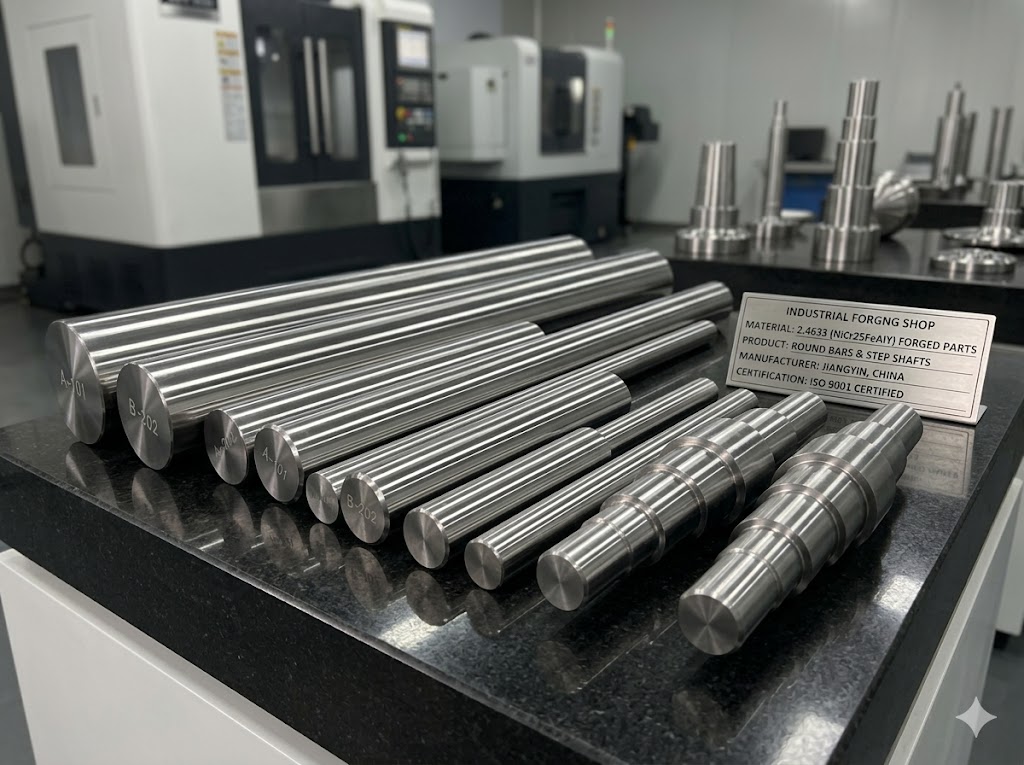
2.4633 Forged Bars & Rods
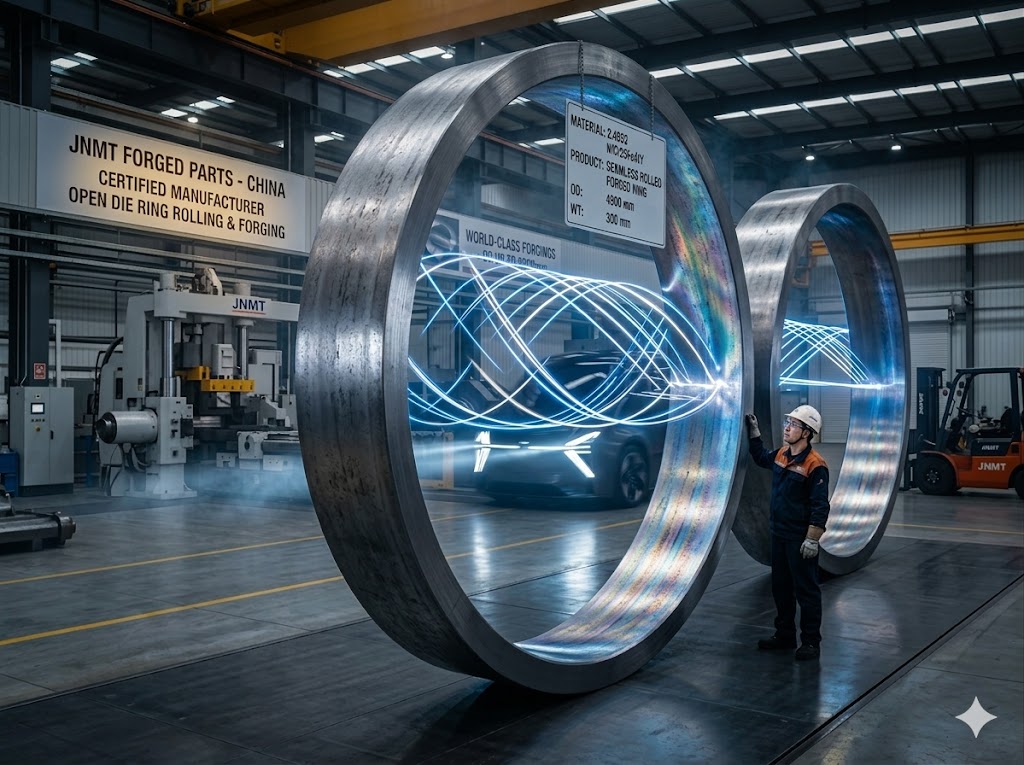
NiCr25FeAlY Seamless Rolled Rings
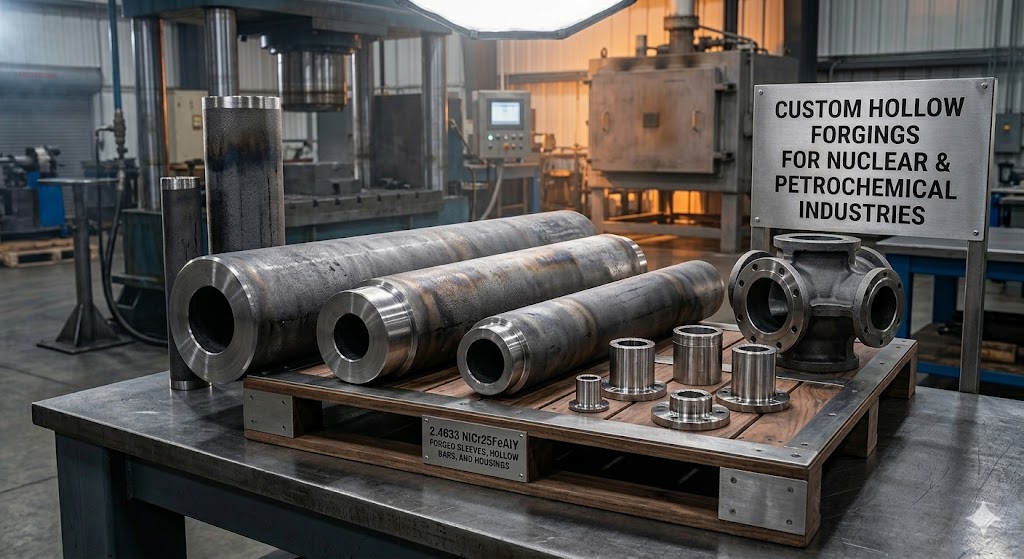
2.4633 Forged Sleeves & Housings
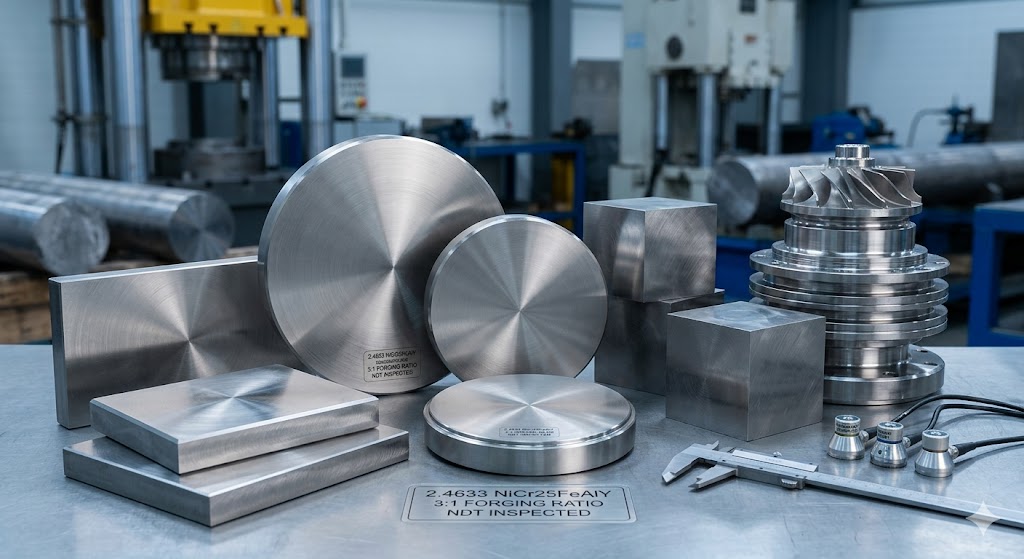
NiCr25FeAlY Forged Discs & Blocks
2.4633 (NiCr25FeAlY) Alloy: Metallurgical Principles & Performance Advantages
2.4633 — designated NiCr25FeAlY per DIN and UNS N06025 per ASTM — is the highest-performing member of the NiCrFe family of solid-solution strengthened nickel superalloys. Its design is based on a deceptively simple idea: use the reactive element effect (REE) to fundamentally change how the protective oxide scale behaves at temperatures that destroy lesser materials.
At temperatures above 900°C, most high-temperature alloys form a Cr₂O₃ (chromia) protective layer. The problem is that chromia becomes volatile above roughly 1050°C in oxygen-containing atmospheres, and mechanically unstable under thermal cycling. The 2.4633 alloy addresses this through a three-layer protection system engineered at the microstructural level:
- Primary Chromia (Cr₂O₃) barrier — the 24–26% chromium content ensures rapid formation of a dense chromia scale as the primary oxidation barrier at low-to-medium service temperatures
- Secondary Alumina (α-Al₂O₃) sublayer — the 1.8–2.4% aluminum addition generates a stable alpha-alumina underlayer at temperatures above 1000°C, which has significantly lower oxygen diffusivity than chromia and remains protective up to 1200°C
- Yttrium oxide (Y₂O₃) anchoring — this is the key innovation. Yttrium (0.05–0.12%) acts as a reactive element, segregating to the oxide grain boundaries and forming yttrium oxide pegs that mechanically anchor the scale to the metal substrate, preventing the spalling and buckling that cause catastrophic failure in yttrium-free alloys under thermal cycling
The result: 2.4633 generates a self-healing, adherent, multi-layered oxide scale that provides protection to 1200°C continuously and resists spalling through thousands of thermal cycles — a performance level that no conventional austenitic stainless steel or standard Alloy 600/601 can match.
Microstructure of 2.4633 Forgings: What We Control in Production
The forged microstructure of 2.4633 consists of an austenitic (FCC) nickel-chromium matrix with two primary strengthening precipitate systems. Understanding this microstructure is why our forging and heat treatment process produces demonstrably better mechanical performance than cast equivalents:
- M₇C₃ primary carbides (rich in chromium and carbon): these form during solidification and are refined and redistributed by the forging deformation. In well-forged 2.4633, they are uniformly dispersed as fine particles, contributing to creep resistance by impeding dislocation movement at high temperature. In cast material, these often appear as continuous networks along grain boundaries — a weak-link failure mode that forging eliminates
- M₂₃C₆ secondary carbides: these precipitate from the solution-annealed matrix during service at 700–1000°C, forming preferentially at grain boundaries. In controlled quantities, they provide grain boundary strengthening. Our solution anneal at 1180–1220°C puts all secondary carbides back into solution; subsequent service exposure re-precipitates them in a finely dispersed, non-continuous morphology that strengthens rather than embrittles
- ASTM grain size: our forging process consistently produces grain sizes of ASTM 4–7 (approximately 45–90 µm average diameter) — coarse enough to provide good creep resistance at high temperature, fine enough to pass stringent ultrasonic inspection with excellent defect detectability
Key Performance Advantages of 2.4633 NiCr25FeAlY Forgings
- Exceptional oxidation resistance to 1200°C in continuous service, with oxide weight gain below 0.5 mg/cm² after 1,000 hours at 1100°C in air — compared to 2–8 mg/cm² for standard 25Cr austenitic heat-resistant steels
- Superior spalling resistance under thermal cycling: the yttrium-anchored oxide scale maintains adhesion through repeated cycling from ambient to 1100°C, critical for applications such as kiln rollers, radiant tubes, and furnace retorts that experience daily shutdown cycles
- Excellent creep and stress-rupture strength at 1000°C: minimum stress-rupture life exceeds 100 hours at 20 MPa and 1000°C — enabling use in load-bearing high-temperature components where 310S stainless or lower-grade alloys would deform and fail within weeks
- Outstanding resistance to carburizing and metal-dusting environments: the stable alumina sublayer acts as a diffusion barrier against carbon ingress in reformer and cracker atmospheres, dramatically extending service life in petrochemical furnace applications
- Good resistance to sulfidation and halide environments: the high nickel and chromium content provides effective protection in mixed-gas furnace atmospheres and waste incineration environments containing SO₂, HCl, and other corrosive species
- Broad weldability: 2.4633 can be welded using matching or overmatching filler metals (e.g., NiCr-3 TIG wire or equivalent) with no pre-heat required for thicknesses up to 25 mm, and no post-weld heat treatment required for most non-pressure-critical applications
- Wide service temperature range: usable from cryogenic conditions to 1200°C, making it suitable for components that experience extreme thermal gradients during startup and shutdown cycles
Custom 2.4633 NiCr25FeAlY Forged Products: Dimensions, Tolerances & Capabilities
With our 2,000–6,300 ton hydraulic forging presses and 1–5 m CNC ring rolling machines, we manufacture custom 2.4633 forged parts across the full dimensional range required by the industries we serve. All products are manufactured with a guaranteed minimum forging ratio of 3:1, with higher ratios available for critical applications. The table below summarizes our standard dimensional capability for each product category:
| Product Type | Dimensional Range | Weight Range | As-Forged Tolerance | Machined Tolerance |
|---|---|---|---|---|
| Forged Round Bars | Ø50 mm – Ø800 mm | 30 kg – 8,000 kg | +5/−0 mm | h8 / IT7 |
| Forged Flat / Square Bars | 50 mm – 600 mm wide | 30 kg – 5,000 kg | +5/−0 mm | ±0.5 mm |
| Seamless Rolled Rings | OD: Ø200 mm – Ø5,000 mm | 50 kg – 30,000 kg | +8/−0 mm | H7/h7 |
| Forged Discs / Plates / Blocks | Ø80–Ø2,000 mm; T: 20–800 mm | 30 kg – 20,000 kg | +5/−0 mm | ±0.3 mm flat |
| Forged Sleeves / Hollow Bars | OD: Ø100–Ø1,500 mm; ID: Ø50–Ø1,200 mm | 50 kg – 15,000 kg | +6/−0 mm | H7/h7 |
| Custom Stepped Shafts | Length: 200 mm – 4,000 mm | 30 kg – 10,000 kg | +5/−0 mm | IT6–IT8 |
2.4633 Forged Bars, Shafts & Step-Shafts
Our NiCr25FeAlY forged bars are produced with strict control over the forging reduction ratio — a minimum 3:1 reduction in cross-sectional area for standard parts, up to 6:1 for high-demand rotating equipment applications. This level of mechanical work is essential: the initial cast ingot microstructure of 2.4633 contains primary M₇C₃ carbide networks that must be fully broken up by deformation to achieve homogeneous mechanical properties. A bar produced with insufficient forging ratio will appear to meet chemical and hardness specs on paper while having significantly lower fatigue and rupture life in service — a hidden quality risk that is virtually impossible to detect without full microstructural examination.
Beyond round bars, we produce NiCr25FeAlY step shafts, eccentric shafts, turbine shafts, pump drive shafts, and valve stem blanks with multiple-step profiles. Complex step geometries in this alloy require careful temperature management at each forging step to prevent localized over-heating or excessive grain growth in thin sections adjacent to large flanges — a process challenge we have refined through decades of nickel alloy forging experience.
NiCr25FeAlY Seamless Rolled Forged Rings
Seamless ring rolling is the optimal manufacturing route for annular 2.4633 components because it produces a continuous circumferential grain flow that maximizes burst strength and fatigue resistance in service. Unlike machined-from-bar or welded rings, our seamless rolled rings have no radial weld seams, no heat-affected zones, and no mechanical joints — critical for pressure-bearing components in nuclear and petrochemical applications.
The ring rolling process for 2.4633 presents specific challenges compared to carbon or stainless steels. The alloy has significantly higher deformation resistance (flow stress) at rolling temperatures, requiring more powerful equipment and more precise temperature control. We manage ring rolling temperature in the range 1000–1150°C, using infrared temperature monitoring throughout the rolling cycle. Rings that cool below 950°C during rolling are reheated rather than continued, preventing the formation of deformation-induced grain boundary cracking that would compromise ultrasonic inspectability.
Our ring product range covers outer diameters from 200 mm to 5,000 mm, heights from 50 mm to 1,200 mm, and wall thicknesses from 30 mm up to 600 mm. We produce both rectangular-section rings and custom profile-rolled rings (T-section, L-section, stepped-section) that reduce machining stock and shorten your downstream cycle time.
2.4633 Forged Sleeves, Housings & Hollow Components
Hollow 2.4633 forgings — sleeves, bushes, housings, hollow bars, and thick-walled tubes — require a more complex forging sequence than solid shapes. After initial press forging, the billet is punched and mandrel-drawn to achieve the required internal bore, with the forging ratio calculated across the annular cross-section rather than the solid section. We guarantee a minimum wall-reduction ratio of 3:1 for all hollow forgings, verified by dimensional inspection at each forging step. Wall thickness uniformity (eccentricity) is controlled to within 5% of nominal wall thickness for as-forged components and within 1% for machined components.
For especially large or thin-walled sleeves beyond the capability of direct press forging, we use seamless ring rolling as the forming process and machine the required length from the rolled ring — achieving the same grain flow benefits as ring-rolled components with the dimensional flexibility of machining.
NiCr25FeAlY Forged Discs, Plates & Blocks
Our NiCr25FeAlY forged discs and blocks are produced by upsetting or pancaking the billet under press in the axial direction, achieving a 3:1 minimum height reduction ratio. This deformation direction produces a pancake-shaped grain structure with excellent through-thickness mechanical properties — important for tube sheets, baffle plates, and blind flanges where pressure loads act through the thickness of the component. Flatness of as-forged disc faces is controlled to within 3 mm/m, and finish-machined flatness to within 0.05 mm/m. We can supply disc blanks with a controlled center bore (punched during forging, not drilled after) for applications such as pump impeller blanks, where the bore-to-face perpendicularity must be maintained throughout subsequent machining.
Custom 2.4633 Forged Components to Drawing
We accept customer DXF/DWG/STEP/IGES drawing files and provide DFM (Design for Manufacturability) review at no charge before quotation. Our engineering team will confirm the minimum stock dimensions required, recommend forging sequence, and flag any geometric features that may require special tooling or intermediate processing steps. Typical complex custom components we produce include: valve bonnet blanks with integral flanges, reactor nozzle forgings with eccentric branch openings, transition cone forgings for furnace retort assemblies, and kiln roller blanks with stepped profiles. Secondary operations including rough CNC turning, milling, boring, threading, and surface grinding are available in-house.
Request a Technical Review & Quotation for Your 2.4633 ProjectWhy Forging 2.4633 NiCr25FeAlY Is Different — And What It Means for Your Parts
Not every forge shop can produce quality 2.4633 forgings, and not every forging that passes dimensional inspection will perform reliably in service. As a manufacturer with 27 years of nickel alloy forging experience, we want to be transparent about the technical challenges this material presents — and how we address each one. This is the kind of manufacturer-side knowledge that matters when you are evaluating suppliers for a critical application.
Challenge 1: Narrow Hot-Working Window
2.4633 has a hot-working temperature range of approximately 950°C to 1200°C — significantly narrower than carbon or stainless steel. Below 950°C, the flow stress increases sharply and the risk of adiabatic shear bands and surface cracking rises. Above 1200°C (the solution temperature), grain growth accelerates rapidly — doubling in a matter of minutes at 1220°C — producing a coarse, unrefinable microstructure that will fail ultrasonic inspection and have poor fatigue properties. Unlike steel, grain growth in nickel superalloys is largely irreversible without re-melting.
Our solution: We instrument every forging furnace with calibrated type-K thermocouples and have all furnaces PID-controlled to ±5°C. Pyrometers monitor billet surface temperature during transfer and at the press. We define a maximum-time-outside-furnace limit for each billet size and immediately reheat if this limit is approached — we never continue forging a billet that has cooled to the danger zone to "save a heat".
Challenge 2: High Deformation Resistance
At its optimal forging temperature, 2.4633 has a flow stress approximately 2.5–3× higher than 304 stainless steel. This means a forging that would require a 1,000-ton press in steel may need a 2,500–3,000 ton press in 2.4633, and ring rolling requires significantly more torque and radial force than equivalent stainless rings. Underpowered equipment will "work around" large reductions by doing more passes — but each intermediate heat adds cost, time, and risk of grain growth at the re-heat boundaries.
Our solution: Our main forging press capacity goes up to 6,300 tons, with a 3,000-ton intermediate press for medium-sized components. Our ring rolling machines for nickel alloys are rated to 5 meters OD specifically because we invested in the correct machine for the material, not the cheapest machine that could theoretically form it.
Challenge 3: Tool Wear and Surface Quality
2.4633 is significantly more abrasive to forging dies than carbon or stainless steels, due to its hardness and the tenacious oxide scale that forms during heating. Die wear leads to dimensional drift in multi-piece production runs, and surface scoring on the billet from worn dies can become stress concentration points in service. In ring rolling, the work-roll and mandrel surfaces are subject to accelerated wear that affects ring profile accuracy.
Our solution: We use H13 hot-work tool steel dies with a minimum surface hardness of 48 HRC, and we implement a mandatory die inspection and resurfacing schedule after every 5–8 heats for this alloy. All ring rolling rolls used for nickel alloys are maintained as a dedicated set separate from the carbon/stainless steel rolling program to prevent cross-contamination and to maintain tight dimensional control.
Challenge 4: Scale Removal and Surface Cleanliness
NiCr25FeAlY forms a tenacious, adherent oxide scale during hot working — the same property that makes it so excellent in service makes it challenging to remove after forging. Residual scale that is not fully removed before machining will embed in the machined surface and create hard spots that accelerate cutting tool wear and can leave surface inclusions detectable by PT (penetrant testing) that are actually just entrapped scale, not material cracks. Proper distinction between scale entrainment and genuine surface defects requires experienced PT inspectors.
Our solution: All 2.4633 forgings receive shot blasting followed by chemical acid pickling in a controlled nitric/hydrofluoric acid bath before dimensional inspection and NDT. This two-stage surface preparation fully removes scale without introducing hydrogen embrittlement or surface attack. PT inspection is performed only after this preparation to ensure accurate rejection decisions.
Industry Applications of 2.4633 NiCr25FeAlY Forgings: Proven Global Cases
2.4633 is not a general-purpose alloy chosen for convenience — it is selected by design engineers when no lower-cost material can meet the combination of temperature, environment, and service life requirements. Below we describe the specific applications we supply, the industry standards our parts must comply with, and real-world performance data from our clients' installations.
Nuclear Power: Reactor Coolant Loop & Safety-Critical Components
The nuclear industry represents the most demanding service environment for 2.4633 forgings, requiring compliance with multiple overlapping codes including ASME Boiler & Pressure Vessel Code Section III (NCA, NB, NC classes), RCC-M (French nuclear code applied in China's CPR-1000 and CAP-1400 programs), and GB/T 16598 (Chinese nuclear forgings standard). Our 2.4633 forgings for nuclear industry applications are produced from ESR (electroslag-remelted) ingots with oxygen content controlled below 20 ppm to minimize inclusions, and are supplied with full material traceability from heat number to final delivery documentation.
We supply a range of nuclear applications including: reactor coolant pump casing forgings (RCP casings), primary circuit valve body and bonnet forgings, steam generator tube-sheet blanks, pressurizer surge line nozzle forgings, reactor internals support forgings, and containment component ring forgings. Every nuclear forging is produced under a dedicated Quality Plan reviewed and approved before production begins, with mandatory hold-points at key stages for client or third-party witness inspection (SGS, BV, LRQA, TÜV, SNRI).
Petrochemical & Hydrogen Economy: Reformers, Crackers & Green H₂ Equipment
In steam methane reforming (SMR) — the dominant process for hydrogen production — furnace tubes, radiant tube supports, and reformer header forgings are exposed simultaneously to high temperature (850–950°C tube wall), thermal cycling (daily or weekly shutdown), steam reforming atmospheres (H₂, CO, CO₂, CH₄, H₂O), and carburizing risk from process upsets. 2.4633 is selected for its ability to form the stable alumina sublayer that resists carbon ingress even when the primary chromia layer is temporarily disrupted by steam attack.
In fluid catalytic cracking (FCC) units, transfer line slide valve body forgings and cyclone support ring forgings in NiCr25FeAlY operate at 650–750°C in mixed H₂S, SO₂ and hydrocarbon atmospheres where sulfidation resistance is critical. The high chromium and nickel content of 2.4633 provides approximately 3× better sulfidation resistance than 310SS at 700°C based on weight gain data from industrial probe tests.
For the emerging green hydrogen economy, 2.4633 forged components are finding application in high-temperature electrolysis (HTE) cell interconnect forgings and solid oxide electrolyzer (SOEC) balance-of-plant components operating at 700–900°C. We have supplied prototype NiCr25FeAlY forged interconnect plates and seal ring blanks to green hydrogen equipment developers in Europe and Asia, and can discuss specific alloy compatibility and geometry requirements with your engineering team.
Industrial Furnace & Heat Treatment: Kiln Rollers, Radiant Tubes & Retorts
Continuous roller hearth kilns used in battery cathode material sintering, ceramic powder processing, and advanced ceramics manufacturing represent a particularly severe application for 2.4633. The kiln rollers operate at 900–1150°C while rotating continuously under load, with the external surface exposed to the furnace atmosphere and the internal bore (many rollers are hollow to save weight) subject to a different thermal gradient. Failures occur by creep deformation (sagging) or surface oxidation-spalling leading to contamination of the product.
Our NiCr25FeAlY forged kiln roller blanks are produced as hollow forgings with controlled wall thickness uniformity (<3% eccentricity after machining) and grain size of ASTM 5–6 — a grain size that optimizes the balance between creep resistance (which favors coarser grain) and surface oxidation resistance (which favors finer grain in the transition layer). We supply rollers in as-forged, rough-turned, and precision ground condition as required by roller kiln OEMs in Germany, Japan, and Italy.
High-Temperature Valves & Fluid Control
2.4633 is specified for valve bodies, bonnet blanks, disc blanks, stem forgings, and seat ring blanks in services where the combination of temperature and fluid corrosivity exceeds the capability of standard 316SS or Inconel 625. Typical service conditions include: above 550°C in steam or steam-hydrocarbon service (above the limit for 316SS long-term oxidation resistance); below 1000°C in sulfur-bearing gas service; and in acid chloride service at elevated temperature where standard nickel alloys experience accelerated corrosion.
Our valve forgings for the oil & gas and power generation sectors are manufactured to meet the dimensional and material requirements of API 600, API 602, ASME B16.34, and MSS SP-97 as specified by our valve manufacturer clients. Valve compliance certification and pressure testing are performed by the valve manufacturer. We can supply valve body blanks in the as-forged, rough-bored, or fully machined condition including final surface finish on sealing faces.
Other Key Application Industries
- Glass Melting & Ceramics Industry: Glass pot stirrer forgings, electrode tube forgings, glass conveying roller blanks, and molten glass contact components. 2.4633 resists attack by molten glass, sodium borosilicate, and soda-lime silicate compositions at 900–1100°C where most other alloys dissolve or corrode rapidly
- Waste Incineration & Hazardous Waste: Rotary kiln tyre ring forgings, retort tube forgings, and feed screw shaft forgings for medical, industrial, and radioactive waste incineration systems operating at 850–1100°C in mixed HCl, SO₂, and oxidizing gas atmospheres
- Pumps & Rotating Equipment: High-temperature pump casing forgings, impeller blanks, wear ring forgings, and shaft seal sleeve forgings for hot oil, molten salt, and high-temperature process fluid service. Forged (versus cast) pump components provide better fatigue life in applications with vibration or pressure pulsation
- Pressure Vessels & Heat Exchangers: Tube sheet forgings, nozzle forgings, blind flange forgings, and channel head forgings for heat exchangers in high-temperature corrosive service. Our tube sheets are forged and then finish-drilled per customer-supplied drawings and dimensional requirements; TEMA or ASME HEI compliance is verified by the heat exchanger manufacturer
- Aerospace Test & Research Infrastructure: High-temperature structural forgings for engine test cells, hypersonic wind tunnel hardware, and rocket motor test stands where intermittent exposure to extreme temperatures above 1000°C is combined with mechanical loading
2.4633 (NiCr25FeAlY) Complete Material Specifications & Technical Data
The data below represents the specification requirements and typical values achievable in properly forged and solution-annealed 2.4633 NiCr25FeAlY material. All our forgings are individually batch-tested and documented against these values. We provide complete EN 10204 3.1 mill test certificates — and 3.2 third-party inspection certificates where required — with every shipment.
Chemical Composition of 2.4633 (NiCr25FeAlY) — Per DIN 17742 / W.Nr. 2.4633
| Element | Symbol | Specification Limit (Wt.%) | Typical Value (Wt.%) | Role in Alloy |
|---|---|---|---|---|
| Nickel | Ni | Balance (Min. 58%) | ~62–64% | Austenitic matrix; corrosion & oxidation base |
| Chromium | Cr | 24.0 – 26.0% | 24.5 – 25.5% | Primary Cr₂O₃ oxidation barrier; solid solution strengthening |
| Iron | Fe | 8.0 – 11.0% | 9.0 – 10.5% | Matrix alloying; cost reduction versus pure Ni base |
| Aluminum | Al | 1.8 – 2.4% | 1.9 – 2.2% | α-Al₂O₃ sublayer formation; reactive element effect |
| Carbon | C | 0.15 – 0.25% | 0.18 – 0.22% | M₇C₃ + M₂₃C₆ carbide precipitation; creep strengthening |
| Yttrium | Y | 0.05 – 0.12% | 0.06 – 0.09% | Reactive element; anchors oxide scale via Y₂O₃ pegging |
| Titanium | Ti | 0.1 – 0.2% | 0.1 – 0.15% | Carbide former; grain refinement during hot working |
| Zirconium | Zr | 0.01 – 0.10% | 0.02 – 0.05% | Grain boundary strengthening; supports REE mechanism |
| Silicon | Si | Max 0.50% | 0.10 – 0.30% | Secondary oxidation resistance in reducing atmospheres |
| Manganese | Mn | Max 0.15% | < 0.10% | Controlled low to avoid MnCr₂O₄ spinel formation |
| Sulfur | S | Max 0.010% | < 0.005% | Impurity; low S improves oxide scale adhesion |
| Phosphorus | P | Max 0.015% | < 0.010% | Impurity; controlled for weldability and ductility |
Room-Temperature Mechanical Properties of 2.4633 Forged Parts (Solution-Annealed Condition)
| Mechanical Property | Symbol | Minimum Specified Value | Typical Achieved Value | Test Standard |
|---|---|---|---|---|
| Tensile Strength | Rm | 690 MPa (100 ksi) | 720–780 MPa | ASTM E8 / ISO 6892-1 |
| 0.2% Proof Strength (Yield) | Rp0.2 | 230 MPa (33 ksi) | 270–330 MPa | ASTM E8 / ISO 6892-1 |
| Elongation at Break | A5 | 30% minimum | 38–50% | ASTM E8 / ISO 6892-1 |
| Reduction of Area | Z | 45% minimum | 55–70% | ASTM E8 / ISO 6892-1 |
| Brinell Hardness (typical) | HBW | 170 HBW (min reference) | 180–230 HBW | ASTM E10 / ISO 6506 |
| Charpy Impact Energy (20°C) | KV | ≥ 80 J (reference) | 100–150 J | ISO 148-1 / ASTM E23 |
High-Temperature Mechanical Properties of 2.4633 Forgings
The following high-temperature tensile data represents values achievable in properly forged and solution-annealed 2.4633 material. Engineers designing for elevated temperature service should use these values — not room-temperature data — for structural calculations. Note that 2.4633 retains significant yield strength at temperatures where 304/316 stainless steel is approaching its service limits.
| Test Temperature | Tensile Strength Rm (MPa) | 0.2% Yield Strength Rp0.2 (MPa) | Elongation A5 (%) |
|---|---|---|---|
| Room Temperature (20°C) | 720–780 | 270–330 | 38–50 |
| 600°C (1112°F) | 550–620 | 200–260 | 35–48 |
| 800°C (1472°F) | 380–450 | 160–210 | 40–55 |
| 1000°C (1832°F) | 155–200 | 100–140 | 50–70 |
| 1100°C (2012°F) | 80–120 | 50–80 | 65–90 |
Physical & Thermal Properties of 2.4633 NiCr25FeAlY
Accurate physical and thermal data is essential for thermal stress calculations, FEA modeling, and heat transfer design. The following values are representative of solution-annealed 2.4633 forgings and should be used in conjunction with current applicable material standards for design-critical applications.
| Property | Value | Unit | Temperature |
|---|---|---|---|
| Density | 8.11 | g/cm³ | 20°C |
| Melting Range | 1300 – 1360 | °C | — |
| Mean Thermal Expansion Coefficient | 15.8 × 10⁻⁶ | K⁻¹ | 20–1000°C |
| Thermal Expansion Coefficient | 12.4 × 10⁻⁶ | K⁻¹ | 20–300°C |
| Thermal Conductivity | 12.8 | W/(m·K) | 20°C |
| Thermal Conductivity | 21.5 | W/(m·K) | 1000°C |
| Specific Heat Capacity | 450 | J/(kg·K) | 20°C |
| Electrical Resistivity | 1.22 | µΩ·m | 20°C |
| Magnetic Permeability | < 1.01 | µ (relative) | 20°C |
| Modulus of Elasticity | 210 | GPa | 20°C |
Heat Treatment of 2.4633 Forgings: Process Details & Metallurgical Rationale
The standard delivery condition for 2.4633 forgings is solution annealed (+AT). The solution annealing heat treatment serves three purposes: (1) dissolving all M₂₃C₆ secondary carbides that have precipitated during slow cooling after forging, giving them back into solution for controlled re-precipitation in service; (2) relieving the forging residual stresses that would cause distortion during subsequent machining; and (3) homogenizing any remaining chemical micro-segregation from the solidification structure.
- Solution annealing temperature: 1180°C – 1220°C (2156°F – 2228°F). The exact temperature within this range is selected based on part thickness — heavier sections use the upper end of the range to ensure full homogenization; thinner sections use the lower end to limit grain growth
- Soaking time: 1 minute per millimeter of maximum cross-section thickness, with a minimum of 30 minutes and maximum of 4 hours depending on part geometry. All soaking times are verified by calibrated furnace records, not estimated
- Atmosphere: All heat treatments are conducted in controlled-atmosphere furnaces (nitrogen or argon inert gas atmosphere or vacuum-purged retort) to prevent excessive surface oxidation and alpha-case formation during the high-temperature soak
- Cooling: Water quench for sections over 25 mm to suppress carbide re-precipitation during cooling; forced air or still air for thin sections where quench distortion is a concern. Polymer quench solution is used as an alternative to water quench for complex shapes where distortion risk must be minimized
- Temperature uniformity: Our solution annealing furnaces maintain ±5°C uniformity across the working zone, verified by regular temperature uniformity surveys using calibrated instruments
- Post-treatment service stability: After solution annealing, 2.4633 forgings remain microstructurally stable throughout the service temperature range of 20°C to 1200°C without further heat treatment, except for extreme long-term service at 600–900°C where scheduled inspection intervals may be prudent due to M₂₃C₆ sensitization effects
Surface Finish & Dimensional Tolerance Options
We supply 2.4633 forgings in four surface conditions to match different end-use requirements. All tolerances quoted assume standard forging practice; tighter tolerances for special applications are available on request with DFM review.
- As-Forged (Black Surface): Scale and oxidation layer present. Dimensional tolerance: +5 to +8 mm / −0 mm on critical dimensions depending on size. Used when customer performs all subsequent machining in-house
- Shot-Blasted + Pickled: Scale-free bright metallic surface, no machining done. Dimensional tolerance same as as-forged. Used for parts requiring surface inspection (PT) before customer machining
- Rough Machined: CNC turned/milled with 2–6 mm machining allowance remaining for finish machining. Dimensional tolerance: ±0.5 to ±1.0 mm. The most common condition ordered by valve and pump manufacturers who prefer to do final boring and threading in-house
- Finish Machined to Drawing: Precision machined to customer drawing with all features complete. Dimensional tolerance: IT6–IT8 (±0.03 to ±0.1 mm on critical diameters). Surface roughness Ra 1.6–3.2 µm standard; Ra 0.8 µm achievable on sealing surfaces
2.4633 vs. Alternative High-Temperature Alloys: How to Choose the Right Material
Choosing 2.4633 over a lower-cost alternative is a design decision that should be made on technical grounds, not just price. We work with engineers daily to evaluate whether 2.4633 is the right choice or whether a less expensive alloy will meet the service requirement. The following comparison covers the alloys most commonly specified in the same temperature and environment categories as 2.4633.
| Property / Factor | 2.4633 (NiCr25FeAlY) | 2.4851 (Alloy 601 / NiCr23FeAl) | 2.4816 (Alloy 600 / NiCr15Fe) | 310S Stainless (1.4845) |
|---|---|---|---|---|
| Max Continuous Service Temp. | 1200°C | 1150°C | 1093°C (short term only) | 1050°C (oxidising only) |
| Cr Content | 24–26% | 21–25% | 14–17% | 24–26% |
| Yttrium Addition | Yes (0.05–0.12%) | No | No | No |
| Alumina Sublayer | Yes (1.8–2.4% Al) | Yes (1.0–1.7% Al, thinner) | No | No |
| Oxide Scale Spalling Resistance | Excellent (REE effect) | Good | Moderate | Poor above 1000°C |
| Creep Rupture Life at 1000°C / 20 MPa | > 100 hrs | ~40–60 hrs | < 10 hrs | < 5 hrs |
| Resistance to Metal Dusting | Excellent | Good | Moderate | Low |
| Weldability | Good | Good | Excellent | Good |
| Relative Material Cost Index | 100% (reference) | ~75% | ~50% | ~20–25% |
| Forgability | Moderate (narrow window) | Moderate | Good | Good |
When to Choose 2.4633 — A Practical Decision Guide
Choose 2.4633 when: your operating temperature exceeds 1100°C in continuous service; your application involves thermal cycling that causes scale spalling on standard alloys; your environment includes carburizing gases (CO/CH₄) that attack alloys without an alumina sublayer; or your required service life exceeds what 2.4851 or 310S can reliably deliver — and the higher material cost is justified by the reduction in replacement and downtime costs.
Consider 2.4851 (Alloy 601) instead when: maximum service temperature is below 1100°C and the application does not involve severe thermal cycling; 2.4851 provides approximately 80% of 2.4633's oxidation resistance at about 75% of the cost, making it the right choice when the full performance of 2.4633 is not needed.
Consider 2.4816 (Alloy 600) instead when: service temperature is below 950°C, weldability is a primary requirement, and oxidation resistance is secondary to other corrosion mechanisms. Alloy 600 also offers excellent resistance to stress corrosion cracking in chloride environments that is not the primary strength of 2.4633.
If you are uncertain which alloy is correct for your application, send us your service condition details — temperature profile, atmosphere composition, mechanical loading, and required service life. Our engineering team will provide a written material selection recommendation at no charge.
Quality Control System & Compliance Standards
Every 2.4633 forging we produce passes through a 14-stage quality control process, with hold points at critical stages that cannot be advanced without documented inspection sign-off. Our quality system is certified to ISO 9001:2015 and we operate under a documented Inspection and Test Plan (ITP) for each order, available to clients upon request. The following describes our full process in the sequence a part experiences it:
Stage 1–3: Incoming Material Control
Raw Material Certification Verification
Every 2.4633 ingot we receive is accompanied by a melter's 3.1 material test certificate. Our QC team verifies the heat number, chemical composition against DIN 17742 / UNS N06025 requirements, and melt practice (we specify EAF+AOD+VD as minimum, with ESR required for nuclear applications). Certificates that do not match the package markings are rejected immediately. We maintain a supplier qualification register of approved nickel alloy melters updated annually.
Incoming Chemical Analysis (PMI)
We perform 100% positive material identification (PMI) on all incoming 2.4633 ingots and billets using calibrated X-ray fluorescence (XRF) analyzers, verifying the key composition elements (Ni, Cr, Fe, Al) match the MTR. Any discrepancy triggers OES (optical emission spectrometry) full analysis and material hold pending supplier investigation.
Ultrasonic Inspection of Incoming Billet
Before cutting and forging, billet sections are examined by immersion UT to ASTM A388 to detect any shrinkage porosity, segregation zones, or laminar defects present in the as-cast material. Billets with indications exceeding Level C acceptance are scrapped — not used with allowances. This pre-forging inspection step is skipped by many suppliers to save cost; we consider it non-negotiable for safety-critical applications.
Stage 4–7: In-Process Controls
Forging Temperature Monitoring
Type-K thermocouple instruments on all furnaces calibrated quarterly to NIST-traceable standards. Transfer time from furnace to press is monitored by stopwatch and logged. Billet surface temperature measured by calibrated infrared pyrometer at press entry. Any billet outside 950–1200°C temperature window is returned to furnace, not processed.
Forging Ratio Verification
The cross-sectional area reduction ratio is calculated and recorded at each forging step. Final cumulative forging ratio is documented in the traveler document that accompanies the part through production.
Post-Forge Visual Inspection
All forgings are visually inspected immediately after forging for surface cracks, laps, folds, and underfill. Parts with any surface discontinuities are quarantined for evaluation — not allowed to proceed to heat treatment pending metallurgical disposition.
Heat Treatment Process Record
Every heat treatment cycle is recorded on a calibrated chart recorder, producing a permanent paper and digital record of actual furnace temperature versus time, including ramp rates, soak temperature, soak duration, and quench time. These records are archived for a minimum of 10 years and provided to clients as part of the delivery documentation package.
Stage 8–14: Final Inspection & Certification
After heat treatment and surface preparation, every 2.4633 forging is given the following mandatory final inspections, with no part shipped until all results are documented and accepted:
- Chemical composition verification (OES, per heat) — actual values reported against specification limits, not just "conforms" statements
- Tensile & hardness testing (per heat and heat treatment batch) — Rm, Rp0.2, A5, Z, and HBW values individually reported. Test specimens taken from sacrificial test coupon forged alongside and heat-treated with the production parts
- 100% Brinell hardness survey — each individual part measured in multiple locations to detect hardness non-uniformity from uneven heat treatment or material variability
- 100% dimensional inspection — important dimensions measured and recorded with actual measured values, not range acceptance stamps. 3D coordinate measurement (CMM) available for complex machined parts
- 100% visual and surface condition inspection — after acid pickling, all surfaces inspected for cracks, seams, laps, mechanical damage, and identification marking legibility
- 100% Ultrasonic Testing (UT) — contact UT or immersion UT per ASTM A388. Standard acceptance per ASTM A388 Level D; Level C or customer-specific acceptance criteria available upon request. Reference reflector: 3 mm flat-bottom hole at ¾ depth unless otherwise specified
- 100% Liquid Penetrant Testing (PT) — fluorescent PT per ASTM E165 / ISO 3452. All open surface cracks, seams, laps, and cold shuts are rejectable. Our PT inspectors hold recognized NDT qualifications with extensive experience in nickel alloy inspection
- Magnetic permeability test (when required by client) — verified non-magnetic, typically < 1.005 µ relative permeability, using a calibrated permeability meter
- Intergranular corrosion test (ASTM A262 Practice B or E, when required) — performed for nuclear, chemical process, and high-temperature aqueous applications where sensitization is a concern
- Dimensional report + full test certificates — EN 10204 Type 3.1 MTC signed by our QC department head; Type 3.2 available co-signed by authorized third party (SGS, BV, TÜV, LRQA, Intertek, DNV) on request
- Heat treatment process record — original chart record copy, temperature uniformity data, furnace calibration certificate reference
- Packing and marking inspection — heat number, part number, material designation, weight, and any customer-specified markings verified against shipping documents before release
Applicable Standards & Codes
- ASTM A788 — Standard Specification for Steel Forgings, General Requirements
- ASTM E8 / E8M — Tension Testing of Metallic Materials
- ASTM E10 — Brinell Hardness of Metallic Materials
- ASTM E139 — Creep, Creep-Rupture, and Stress-Rupture Tests of Metallic Materials
- ASTM E354 — Chemical Analysis of Nickel and Cobalt Alloys
- ASTM A388 — Ultrasonic Examination of Steel Forgings
- ASTM E165 — Liquid Penetrant Examination for General Industry
- ASTM A262 — Detecting Susceptibility to Intergranular Attack in Austenitic Stainless Steels
- DIN 17742 — Nickel Alloys: Chemical Composition
- DIN 7527 — Forgings of Nickel Alloys: Technical Delivery Conditions
- EN 10204 — Metallic Products: Types of Inspection Documents (3.1 and 3.2)
- PED 2014/68/EU — products can be manufactured to meet customer-specified PED requirements; PED CE marking is the responsibility of the equipment manufacturer
- ASME Boiler & Pressure Vessel Code Section III — referenced in client quality plans for nuclear component supply (code stamping performed by qualified nuclear equipment manufacturers)
- RCC-M — referenced in client quality plans (code compliance performed by qualified nuclear equipment manufacturers)
- Custom client specifications and project-specific inspection plans
Why Jiangsu Liangyi Is the Preferred 2.4633 Forging Supplier for Global Industrial Clients
There are hundreds of forging suppliers in China. We are asked regularly why clients choose us — and stay with us. The answer is not a single factor but a combination of technical competence, equipment capability, and service transparency that is difficult to replicate. Here is what sets us apart, with specifics rather than generalities:
- 27+ Years of Nickel Alloy Forging Experience, Not Just General Forging: Forging nickel superalloys like 2.4633 is a specialized discipline that requires understanding not just hot-working mechanics but material metallurgy and microstructure evolution. Our metallurgists and process engineers have dedicated careers in nickel alloy forging. We have forged every major nickel alloy from Alloy 600 to Waspaloy, accumulating proprietary process knowledge on heating rates, forging sequences, die materials, and heat treatment parameters that directly translates into better mechanical properties and lower scrap rates for our clients.
- Equipment Scaled for the Material, Not Compromised for Cost: Our 6,300-ton maximum hydraulic press provides the forging force headroom needed to achieve full reduction in difficult alloys without excessive intermediate reheats. Our 5-meter CNC ring rolling machines are purpose-configured for nickel alloys with dedicated tooling sets maintained separately from carbon and stainless steel programs. These capital investments mean we can produce parts that smaller or under-equipped forge shops simply cannot make — or cannot make to quality.
- ESR Ingot Sourcing for High-Demand Applications: We maintain relationships with certified ESR (electroslag remelting) melters who supply clean 2.4633 ingots for nuclear, aerospace, and other applications requiring enhanced cleanliness and reduced segregation versus standard EAF+AOD melt. We are transparent with clients about which melt route is used for their parts — and we recommend ESR proactively for applications where it matters, not just when clients specify it.
- Fully Vertical In-House Production Chain: From ingot to final machined and inspected part, every operation happens in our Jiangyin facility. We do not subcontract heat treatment, machining, or NDT to external shops where we lose quality control and documentation traceability. This integration allows us to keep our 15–30 day standard lead time reliably — we are not dependent on third-party scheduling that can slip by weeks without warning.
- Transparent Technical Communication: For every new part inquiry, we provide a no-charge DFM (Design for Manufacturability) review to identify features that might add cost or risk, without adding functional value. We report problems when they occur, not waiting until the promised ship date, and we provide proactive updates when material procurement lead times change or production scheduling is impacted. Our technical sales engineers can read engineering drawings and discuss tolerances, surface finish requirements, and testing requirements directly with your design team.
- Third-Party Inspection Fully Supported: We welcome and fully cooperate with third party inspection by whichever international inspection authority. We provide advance notice of hold-point dates, prepare all documentation in advance and keep our inspection areas and records in a state of permanent readiness.
- Competitive Direct-Factory Pricing With No Hidden Costs: As the direct forging manufacturer, our pricing reflects actual material and processing costs without intermediary margins. We provide detailed, itemized quotations that break down material cost, forging and heat treatment, inspection, machining, and certification costs separately — so you can compare like-for-like with any competing offer and understand exactly what you are buying.
Procurement Guide: Key Questions to Ask Before Ordering 2.4633 Forgings
Based on our 27 years of experience supplying global industrial clients, the following are the most important questions buyers should ask — and the answers they should expect — when evaluating any supplier of 2.4633 NiCr25FeAlY forged parts. These questions will help you distinguish a true specialist forge shop from a trading company or general supplier that will struggle with this demanding material.
- What melt route is used for the raw ingot? Expect: EAF+AOD+VD as minimum for standard industrial; ESR or VAR for nuclear/aerospace. A supplier who cannot specify the melt route is likely purchasing from spot market traders with unknown origin
- What is your maximum forging press tonnage, and is it adequate for this alloy? 2.4633 requires approximately 2.5–3× more forging force than carbon steel. A 1,000-ton press suitable for medium carbon steel forgings is usually not adequate for large 2.4633 cross sections
- How do you measure and control forging temperature during the process? Expect: calibrated thermocouple on furnace + calibrated pyrometer at press. Unacceptable: "our operator judges by color" or "we have experience"
- What forging ratio do you guarantee, and how is it calculated and documented? Minimum 3:1 cross-section reduction. If a supplier cannot define their forging ratio or does not document it per part, the microstructure quality is unknown
- What heat treatment equipment do you have in-house, and what is the furnace temperature uniformity? Expect: controlled-atmosphere furnace, ±5–10°C uniformity verified by surveys, calibrated chart records for every heat treatment cycle. A supplier that subcontracts heat treatment to an external shop loses documentation chain integrity
- What NDT methods do you apply, and who performs them? Expect: 100% UT per ASTM A388 and 100% PT per ASTM E165, performed by qualified NDT personnel. Ask your supplier what NDT certification their inspectors hold. "We do visual inspection and hardness" is insufficient for safety-critical applications
- Can you supply an EN 10204 3.2 certificate (third-party co-signed)? If the answer is anything other than "yes, which TPA do you prefer?", be cautious
- Have you forged 2.4633 specifically before? Ask for references. 2.4633 forging experience matters — a supplier with only stainless or carbon steel forging background will face a learning curve on your parts
Frequently Asked Questions About 2.4633 (NiCr25FeAlY) Forgings
2.4633 (DIN designation NiCr25FeAlY, UNS N06025) is a nickel-chromium-iron-aluminum superalloy with a small but critically important yttrium addition. The yttrium (0.05–0.12%) acts as a reactive element that segregates to the grain boundaries of the protective oxide scale that forms on the alloy surface at high temperature. By forming tiny yttrium oxide (Y₂O₃) "pegs" at these boundaries, it anchors the oxide scale mechanically to the metal substrate, preventing the spalling and buckling that cause standard heat-resistant alloys to fail under thermal cycling. Without yttrium, the otherwise excellent Cr₂O₃/Al₂O₃ scale would delaminate in the first few hundred thermal cycles. With yttrium, the scale remains adherent through tens of thousands of cycles, enabling reliable continuous service to 1200°C — something that no yttrium-free alloy in the same general composition family can match.
2.4633 (NiCr25FeAlY) is rated for continuous operating temperatures up to 1200°C (2192°F) in oxidizing atmospheres. For intermittent or short-term exposure, it can tolerate peak temperatures up to 1250°C. In carburizing or reducing atmospheres, the practical upper limit depends on the carbon activity and partial pressure of oxygen; in practice, 2.4633 outperforms all other wrought alloys in carburizing reformer environments up to 1050°C tube-wall temperature. Below 900°C, the alumina sublayer does not fully develop, and the alloy behaves similarly to 2.4851, protected primarily by the Cr₂O₃ scale.
2.4633 and 2.4851 (Alloy 601) are both nickel-chromium-iron-aluminum alloys, but 2.4633 has three key advantages: higher chromium content (24–26% vs. 21–25%), a yttrium addition that 2.4851 lacks, and a higher carbon content that contributes more creep strength at very high temperatures. The yttrium in 2.4633 is the most important differentiator — it enables the oxide scale to remain adherent under repeated thermal cycling that causes 2.4851 to spall. For continuous high-temperature service above 1100°C, or for any application involving thermal cycling above 1000°C, 2.4633 is the significantly better choice. For budget-constrained applications below 1000°C without severe thermal cycling, 2.4851 is a cost-effective alternative at approximately 75% of the material cost of 2.4633.
Our 2.4633 (NiCr25FeAlY) forgings are manufactured referencing: ASTM A788 (general forging requirements), DIN 17742 (chemical composition), DIN 7527 (nickel alloy forgings delivery conditions), and EN 10204 Type 3.1 MTC provided with every order (3.2 third-party co-signed on request). For European pressure equipment applications, we cooperate with our equipment manufacturer clients to provide the forging documentation required under PED 2014/68/EU, with the Notified Body certification responsibility held by the equipment manufacturer. For nuclear component applications, we have produced forgings to client-specified quality plans that reference ASME BPVC Section III or RCC-M requirements. Final nuclear qualification, N-stamp certification, and code compliance responsibility rests with the qualified nuclear equipment manufacturer who places the order. We also produce against customer-specific specifications for OEM valve, pump, and furnace equipment manufacturers who have proprietary purchase specifications that supplement or modify standard requirements. Please share your specific code/specification requirements when inquiring and we will confirm compliance before quotation.
Yes, 2.4633 has good weldability using standard nickel alloy welding practices. Recommended filler metals are NiCr-3 (AWS A5.14 ERNiCr-3) or matching NiCr25FeAlY wire for TIG/GTAW. SMAW (stick) is possible with matching coated electrodes. Key precautions: (1) Preheat is not required for most applications and base metal temperatures above 15°C. (2) Interpass temperature should be kept below 150°C to avoid hot cracking in the weld pool. (3) Post-weld heat treatment is generally not required for non-pressure-critical welds; for pressure welds per ASME or PED, the engineer should assess whether solution annealing of the welded assembly is required based on service temperature and environment. (4) The aluminum content means that 2.4633 weld metal has a narrower freezing range than 2.4816 or 2.4851, which slightly increases hot-cracking sensitivity in high-restraint joint configurations. Joint design should minimize restraint where possible. Our technical team can advise on welding procedure development on request.
We produce the full range of open die forged shapes in 2.4633: round bars (Ø50–Ø800 mm), flat and square bars, seamless rolled rings (OD 200 mm to 5,000 mm), forged discs and plates (up to Ø2,000 mm), hollow bars, sleeves, and thick-walled tubes (OD 100–1,500 mm), step shafts and eccentric shafts, and custom near-net shapes per customer drawings. All shapes are produced with a minimum 3:1 forging ratio. Weight range is 30 kg to 30,000 kg per single piece. We also offer full CNC machining in-house, supplying components from rough forging blanks to finish-machined parts ready for assembly.
For normal 2.4633 custom forgings, the lead time is 15–30 working days from order confirmation and drawing approval, which includes raw material procurement (billet/ingot), forging, heat treatment, surface preparation, NDT inspection, mechanical testing, and certification. For simple shapes (round bars, discs) in small quantities with ingot available in stock, the lead time is 10–15 working days. For complicated shapes, large weights, or orders requiring ESR material, the lead time is 25–35 working days. For finish machined parts, add 5–10 working days depending on machining complexity. We confirm exact lead time when you provide your detailed drawing and quantity, and we issue a production schedule confirmation with each order acknowledgment.
2.4633 has a machinability rating of approximately 15–20% relative to free-machining steel (AISI 1212 = 100%), placing it in the moderately difficult category — harder to machine than 316SS but easier than Inconel 718 aged. The alloy work-hardens significantly during machining, requiring sharp tools, adequate cutting fluid (preferably sulfurized or chlorinated cutting oil for rough cuts), and stable cutting conditions without interruption mid-cut. We recommend carbide tooling (C-2 grade or better), and ceramic inserts are effective for continuous turning passes. Key parameters: turning speeds of 20–45 m/min with HSS, 60–100 m/min with carbide; feed rates 0.15–0.25 mm/rev; depth of cut 1.5–3 mm for roughing. Drilling requires careful peck-drill cycles to avoid chip packing and work hardening ahead of the drill. Our in-house CNC machining center handles all of this routinely — for customers who machine in-house, we recommend requesting our machining parameter guidelines as part of the documentation package.
We support orders starting from 1 piece for prototype, qualification, or trial orders. There is no technical or administrative minimum — we have supplied single pieces for initial material qualification programs to nuclear and chemical clients. For single-piece or very small quantity orders of complex shapes, we will discuss the cost implications of material minimums (some 2.4633 ingot lots have minimum purchase quantities) and may suggest a slightly different geometry or size to optimally use the available material. For production orders and repeat supply, we offer volume pricing for quantities above 10 pieces or above 5,000 kg per order. Please inquire with your specific quantity and we will provide transparent pricing.
Yes, 2.4633 performs well in hydrogen-containing high-temperature atmospheres, which is why it is used extensively in steam methane reforming (SMR) furnaces and is being evaluated for next-generation green hydrogen equipment. The key considerations: (1) At high temperature in pure H₂ or H₂/H₂O mixtures, 2.4633 forms a stable protective oxide layer with minimal attack — better than chromia-only alloys because the alumina sublayer is more resistant to reduction in low-oxygen partial pressure H₂ atmospheres. (2) At low temperature (below 250°C), hydrogen embrittlement of nickel alloys is theoretically possible but rarely observed in practice for solution-annealed 2.4633 due to the stable FCC matrix. (3) For high-pressure hydrogen service per ASME BPVC Section VIII or PED, the design engineer should evaluate Rm/Rp0.2 requirements against the applicable service factor. Our technical team can discuss specific H₂ service conditions and provide material property data relevant to your application.
2.4633 (NiCr25FeAlY) is primarily used in applications where temperature exceeds 1000°C continuously, thermal cycling is present, and chemical environment is aggressive. The main industries are: nuclear power (reactor components, primary circuit forgings, safety valves); petrochemical and chemical processing (reformer furnace fittings, radiant tubes, cracker components, pressure vessel nozzles); industrial furnace and heat treatment equipment (kiln rollers, radiant tubes, retorts, furnace muffles, hearth rails); glass and ceramics manufacturing (stirrer forgings, electrode tubes, kiln furniture supports); waste incineration (rotary kiln components, retort tubes); and high-temperature valve and pump applications in power generation and oil & gas. A growing application area is green hydrogen production equipment, where solid oxide electrolysis and high-temperature reforming components require 2.4633's unique combination of high-temperature strength and oxidation resistance.
Yes, we provide full in-house CNC machining for all 2.4633 forgings we produce. Our machining center includes CNC turning centers, vertical and horizontal machining centers, boring mills, and surface grinders. We supply parts in three finished states: (1) As-forged with shot blast and pickle — customer performs all machining; (2) Rough machined with machining allowance remaining — we do the heavy material removal, customer finishes critical surfaces; (3) Fully finish machined to customer drawing — ready for assembly, with CMM dimensional report. We strongly recommend that customers use our integrated machining service for 2.4633 whenever possible, as we have already characterized the alloy's work-hardening behavior, optimized tool paths, and accumulated institutional knowledge on this material that ensures good surface finish and dimensional accuracy from the first piece.
Contact Jiangsu Liangyi for a Custom 2.4633 Forging Quotation
Inquiry Email: sales@jnmtforgedparts.com
Phone / WhatsApp / WeChat: +86-135-8506-7993
Official Website: https://www.jnmtforgedparts.com
Factory Address: Chengchang Industry Park, Jiangyin City, Jiangsu Province 214400, China
Response Commitment: We reply to all technical inquiries with a detailed quotation and DFM review within 24 hours on working days. For urgent project requirements, call or WhatsApp us directly for same-day response.
Send Your 2.4633 NiCr25FeAlY Forging Inquiry Today
Share your drawing, material requirement, quantity, and applicable standard with our team. We will provide a detailed technical review and competitive quotation within 24 hours. MOQ: 1 piece. Worldwide shipping. EN 10204 3.1/3.2 certification included.
Send Your Inquiry Now