1.7375 (12CrMo9-10) Forged Forging Parts | China Professional Open Die Forging Manufacturer
Quick Reference: 1.7375 (12CrMo9-10) Forged Parts
1.7375 (12CrMo9-10) Alloy Steel Forging Overview
Jiangsu Liangyi Co.,Limited is a professional ISO 9001:2015 certified open die forging manufacturer based in Jiangyin City, Jiangsu Province, China. Since our founding in 1997, we have focused exclusively on heavy alloy steel forgings for the global pressure equipment market. Today, our 80,000㎡ manufacturing campus houses the full vertical supply chain — from in-house electric arc furnace smelting and vacuum degassing, through heavy hydraulic press forging, controlled atmosphere heat treatment, precision CNC machining, and full-set non-destructive testing — all under one roof. Our annual forging capacity reaches 120,000 metric tons, and we have built a verified export track record serving customers in more than 50 countries across Europe, North America, the Middle East, East Asia, and Australia.
Among our main alloy grades, 1.7375 (12CrMo9-10) — also designated 12CrMo910 or 12CrMo9.10 — represents one of the most technically demanding materials in the European pressure equipment steel family. Governed by EN 10028-2:2009, this chromium-molybdenum alloy steel is engineered specifically for parts that must retain structural integrity under sustained high temperature and pressure, where conventional carbon steels would suffer accelerating creep deformation and premature failure. The 2.00–2.50% chromium content builds a stable oxide film that resists steam and flue-gas corrosion, while the 0.90–1.10% molybdenum disperses as fine carbide precipitates within the ferrite matrix, dramatically retarding the dislocation movement that causes creep. The combination gives 12CrMo9-10 a certified maximum operating temperature approximately 75–100°C higher than the lower-alloyed 1.7335 (13CrMo4-5) grade, so that it is the best choice material for super important boilers, high-pressure heat exchangers, nuclear reactor coolant systems, and API 6A pressure boundary parts where wall temperatures exceed 480°C.
All our 1.7375 forged parts are produced with flexible custom MOQ starting from 1 piece, standard 15–30 day lead time, and full EN 10204 3.1 material test certification — with EN 10204 3.2 third-party inspection available on request. Contact our technical team to discuss your specific pressure, temperature, dimensional, and standard requirements.
Strict Full-Process Quality Control
120,000 Tons Annual Capacity
Full Custom Size Support
Supplying to 50+ Countries
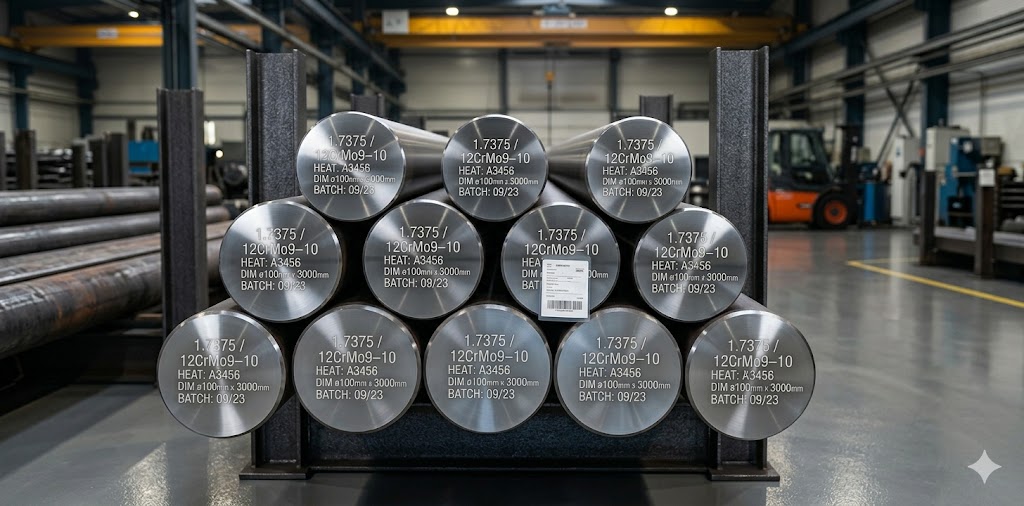
1.7375 Forged Round Bars
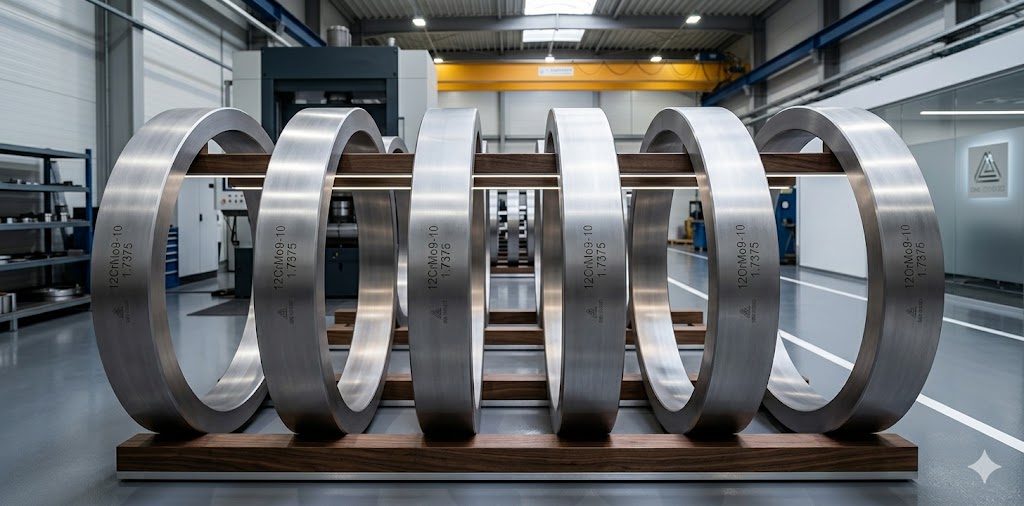
12CrMo9-10 Seamless Rolled Rings
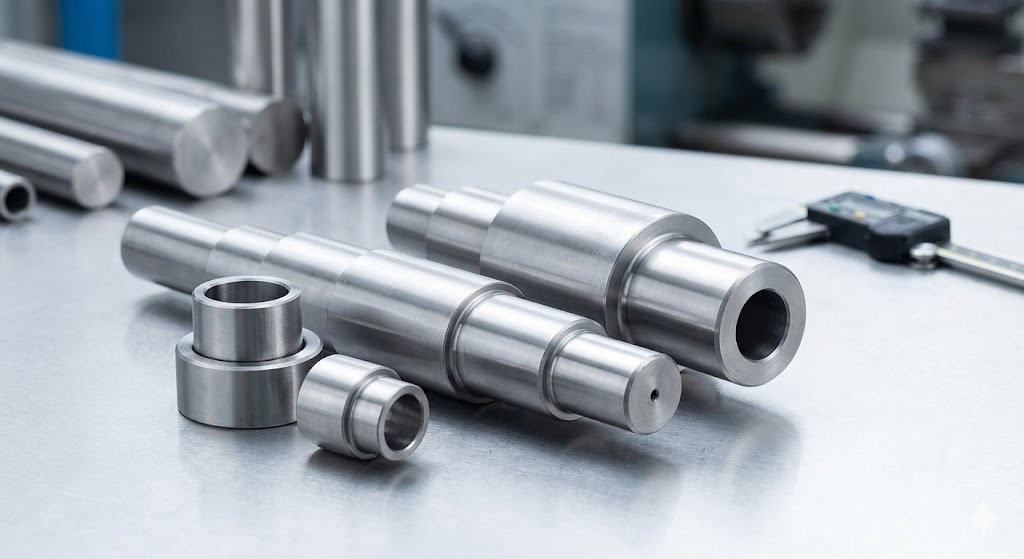
1.7375 Forged Shafts & Sleeves
1.7375 (12CrMo9-10) Forged Steel Product Forms & Custom Capabilities
Jiangsu Liangyi provides a full range of service for 1.7375 (12CrMo9-10) forged steel products, from initial billet melting and forging stock preparation through open die press forging, seamless ring rolling, controlled atmosphere normalizing and tempering heat treatment, CNC machining, surface treatment to full-set NDT. And all parts are delivered with EN 10204 3.1 or 3.2 test certification. Below are the specific product forms we manufacture and their principal engineering parameters:
Forged Bars & Billets
We produce 1.7375 forged round bars in diameters from 50mm to 1,500mm, square bars from 50mm to 800mm, flat bars in thicknesses from 30mm to 600mm, and rectangular billets for downstream machining. All bars are forged with minimum 3:1 forging ratio to break down the cast structure and guarantee fine, equiaxed grain throughout the cross-section. Typical delivery condition: normalized and tempered (+NT) to Brinell hardness 160–220 HB. We can supply rough-turned stock, saw-cut billets, or precision-machined rods per your CAD drawing.
Seamless Rolled Rings & Flanges
Using our CNC radial-axial ring rolling mills, we produce 12CrMo9-10 seamless rolled rings with outside diameter from 200mm to 6,500mm, heights from 50mm to 1,800mm, and wall thicknesses from 30mm upwards. Ring products include forged weld neck flanges, slip-on flanges, blind flanges, orifice flanges, spectacle blinds, swivel ring flanges, retaining rings, and custom profiled rings. Dimensional accuracy typically achieves OD tolerance within ±2mm and height within ±1mm before machining. We manufacture parts based on ASME B16.5, ASME B16.47, EN 1092-1, DIN 2631–2638, and custom drawings.
Hollow Forgings: Shells, Sleeves, Hubs & Casings
We use professional mandrel adjusting tools and high-tonnage hydraulic presses to forge our 1.7375 hollow parts. This method makes sure that the wall thickness is always the same. This is great for pump casings, valve bodies, turbine housings, and gear ring blanks. We also make hollow bars and thick-wall pipes by hollow forging them and then boring them to the right size. For finished forged parts, we keep ovality within ≤0.3% of the outer diameter.
Forged Discs, Disks & Flat Blocks
We forge 12CrMo9-10 discs and blocks in diameters up to 4,500mm and thicknesses up to 1,200mm, with weights from 30kg to 30,000kg per piece. These products serve as turbine disc blanks, tube sheet stock for heat exchangers and condensers, pressure vessel heads, flange blanks, and structural blocks for pressure boundary assemblies. Forging is performed with minimum 3:1 upset ratio and 90° cross-forging to achieve isotropic mechanical properties in both longitudinal and transverse directions.
Pressure Piping Parts: Pipes, Nozzles & Tube Sheets
Our 1.7375 forged seamless pipes and nozzles are produced by hollow forging and mandrel elongation, achieving outside diameters from 76mm to 600mm and wall thicknesses well beyond the capability of rolled and welded construction. Tube sheets for shell-and-tube heat exchangers are forged in diameters up to 3,800mm and face-machined to flatness within 0.1mm per meter. Forged nozzles, channel flanges, and reducer fittings are machined complete from forged blanks per ASME VIII, EN 13445, or project-specific engineering drawings.
Precision-Machined Parts: Shafts, Valve Bodies, Impellers & BOP Components
For customers needing finished or semi-finished machined parts, we provide complete CNC machining services on our 5-axis machining centers and CNC lathes with 6-meter swing capacity. Product examples include: large pump shafts (diameter 100–600mm, length up to 8,000mm); centrifugal pump impellers (diameter 200–1,800mm); gate valve and globe valve bodies (pressure class ANSI 150–2500); blowout preventer bodies and bonnets; transition cones; wye pieces and swept branches. Machining accuracy: bore tolerance H7, shaft tolerance h6, surface finish Ra 0.8–3.2μm as standard.
Request a Free Custom QuoteIndustry Applications & Verified Field Cases of 1.7375 (12CrMo9-10) Forgings
The selection of 1.7375 (12CrMo9-10) for a given pressure equipment application is driven by three fundamental engineering requirements that no lower-alloyed steel can satisfactorily meet simultaneously: long-term creep rupture strength at temperatures above 480°C, resistance to steam oxidation and hydrogen attack in high-temperature process environments, and adequate low-temperature impact toughness for safe cold-condition pressure testing and start-up cycling. In more than 25 years of producing 12CrMo9-10 forgings, our engineering team has developed deep application-specific expertise across the following industries:
Supercritical & Ultra-Supercritical Boilers, Heat Exchangers & Pressure Vessels
In modern supercritical (SC) power boilers operating at steam temperatures of 540–570°C and pressures of 24–30 MPa, and ultra-supercritical (USC) boilers pushing to 600°C and 30+ MPa, 12CrMo9-10 is the standard material for intermediate-temperature pressure-boundary forgings where the wall temperature falls between approximately 480°C and 560°C. Typical forged components include: superheater and reheater header end caps, steam drum shell rings and nozzles, thick-wall transition pieces between ferritic and austenitic stainless piping, tube-to-header attachment forgings, and boiler drum manhole nozzles. Our 1.7375 forgings are also widely used in HRSG (heat recovery steam generator) systems in combined-cycle gas turbine plants, where thermal cycling resistance is critical. For shell-and-tube heat exchangers in petrochemical applications — hydrogen reformers, hydrogen desulfurizers, crude pre-heaters — our 1.7375 tube sheets and channel flanges are routinely supplied to ASME VIII Div.1 and EN 13445 requirements, with tube hole drilling and bore tolerances held to H8 as standard. Pressure vessel shells and hemispherical or ellipsoidal head blanks for high-temperature service reactors complete our range of boiler and pressure vessel forgings.
We manufactured and delivered a large batch of 12CrMo9-10 seamless rolled rings, forged tube sheets, and thick-wall nozzle forgings to a European boiler engineering group for supercritical coal-fired power units. All forgings were produced under EAF+LF+VD melting, followed by normalizing and tempering heat treatment per EN 10028-2. Products have been in stable operation under continuous high-temperature steam conditions without reported issues, validating our capability for this demanding application.
Industrial High-Pressure Valves & Centrifugal Pumps
The valve and pump industries demand 1.7375 forgings that combine dimensional precision with consistent mechanical properties across the entire cross-section — because a valve body with a soft core or a pump shaft with variable hardness will produce erratic seating performance or premature fatigue failure in service. Our 12CrMo9-10 valve forgings are produced to final near-net shape with machining allowances of 3–8mm per face, dramatically reducing downstream machining cycle time compared to oversized rough forgings. Core valve forging products include: globe valve bodies (ASME class 600–2500, DN25–DN600), gate valve bonnets and stuffing box flanges, ball valve ball forgings (bore diameter 15–600mm), check valve discs and seats, and pressure relief valve bodies. For pump applications, our 1.7375 pump shaft forgings get straightness within 0.05mm per meter and are supplied for final turned and ground condition. Pump casing halves, diffuser rings, and impeller blanks are CNC-machined complete from hollow forgings. All forged valve and pump parts get dimensional accuracy to ±0.02mm after machining, with consistent Brinell hardness uniformity of ±10HB across the cross-section.
Jiangsu Liangyi has kept long-term supply relationships with industrial valve and pump manufacturers across Germany, Italy, the USA, South Korea, and Japan. Our 12CrMo9-10 valve and pump forgings have been supplied for demanding applications including high-pressure hydrogen service gate valves, with qualification testing including UT, Charpy impact testing at multiple through-thickness locations, and hydrogen analysis — all meeting customer specification on first-article submission. Dimensional accuracy after machining is controlled to customer-specified tolerances, typically within ±0.02mm for critical seating and bore dimensions.
Nuclear Power: High-Purity Forgings for Reactor System Components
Our premium melting capability — particularly the VIM+PESR route — positions us to supply 12CrMo9-10 forgings for nuclear power projects where the highest cleanliness and traceability requirements are specified by the customer and their applicable nuclear quality assurance framework. The technical differentiators for nuclear-application 12CrMo9-10 forgings include: selection of the VIM+PESR melting route to minimize macro-segregation and achieve low inclusion content; tighter chemistry control on S, P, and tramp residual elements (As, Sn, Sb, Pb) below customer-specified limits; full-volume UT and surface MT at elevated acceptance levels per EN 10228-3 and EN 10228-1; and comprehensive heat number traceability through every manufacturing step. The specific qualification scope — including applicable nuclear regulatory standards, third-party inspection body, and documentation requirements — is defined and agreed with each customer on a project-by-project basis prior to order placement. We do not unilaterally claim any specific nuclear regulatory certification; qualification is established through customer-led acceptance processes.
We have supplied 12CrMo9-10 forgings for reactor coolant pump (RCP) rotor and impeller applications on domestic nuclear power projects, using our VIM+PESR melting route to get the high-purity material quality needed. Production involved enhanced heat treatment controls, full-volume UT, 100% surface MT, creep rupture coupon testing, and trace element chemistry analysis. Full material traceability documentation was provided per the project quality plan agreed with the customer.
Onshore & Offshore Oil & Gas: API 6A Pressure Boundary Components
In oil and gas wellhead and Christmas tree equipment built to API 6A (ANSI/API Spec 6A, 21st Edition), 12CrMo9-10 forgings for working pressures of 5,000–20,000 psi must simultaneously satisfy tensile, impact, and hardness requirements while passing sour service qualification per NACE MR0175/ISO 15156. The main metallurgical challenge in sour service 1.7375 forgings is controlling hardness to a maximum of 22 HRC (237 HB) per NACE MR0175, which needs careful tempering temperature optimization (typically 695–720°C for this alloy) combined with slow controlled cooling to prevent re-hardening. Our API 6A product range includes: tubing head spools, casing head forgings, gate valve bodies (WP with ratings to 20,000 psi), choke body forgings, BOP (blowout preventer) body and bonnet forgings, ram block forgings, and flowline block valve bodies. For subsea Christmas tree applications, we also manufacture large-diameter (OD up to 1,500mm) profiled ring forgings to subsea equipment manufacturer drawings. All sour-service 12CrMo9-10 API 6A forgings are supplied with NACE MR0175 compliance documentation and maximum hardness certification.
We supplied a batch of 12CrMo9-10 BOP body forgings, bonnet forgings, and ram block blanks for a deep water drilling system for a North American oil and gas client. The working pressure rating was 15,000 psi (103 MPa). Our EAF+LF+VD route was applied to control hydrogen content after vacuum degassing. After forging and normalizing+tempering to get hardness within the NACE MR0175 maximum limit, each piece underwent full-volume UT, wet fluorescent MT, NACE TM0177 Method A SSC testing, and dimensional CMM inspection. All pieces achieved first-time acceptance with no concessions.
Petrochemical & Hydrogen Processing Equipment
High-temperature hydrogen service (HTHA — high-temperature hydrogen attack) is an important degradation mechanism in refinery and hydrogen plant equipment above 230°C. API RP 941 (Nelson curves) defines the allowable temperature-pressure envelope for different steel grades, and 12CrMo9-10 with its 2.25Cr-1Mo nominal composition sits on the 2.25Cr-1Mo Nelson curve, which permits significantly higher service temperatures than carbon steel or 1Cr-0.5Mo grades at any given hydrogen partial pressure. Our 1.7375 forgings for petrochemical hydrogen service include: hydrotreater reactor inlet/outlet nozzles and manways, catalytic reformer charge heater fittings, hydrogen compressor valve blocks, high-pressure separator head forgings, and thick-wall piping fittings (wyes, tees, elbows) for hydrogen-rich streams. We have supplied 12CrMo9-10 reactor nozzle forgings to Saudi Arabia, UAE, South Korea, and Germany for grassroots refinery projects, with all forgings passing PWHT simulation tests and step-cooling embrittlement assessment per ASTM A387 recommendations. View our full project reference list on our Reference page.
We supplied over 180 pieces of 12CrMo9-10 reactor nozzle forgings, manway ring forgings, and thick-wall transition pieces for a 30,000 BPD diesel hydrotreater unit in Saudi Arabia. Operating conditions: temperature 380°C, hydrogen partial pressure 8 MPa. All forgings were produced via EAF+LF+VD with step-cooling heat treatment simulation to assess temper embrittlement susceptibility — all pieces achieved J-factor below 150 and X-bar below 15, well within NACE/API RP 941 recommendations. NDT included phased array UT (PAUT) scanning per custom UT procedure, accepted by an ASME-authorized inspection agency. Delivery was completed 10 days ahead of the contracted 28-day lead time.
Our Certification, Standard Compliance & Material Documentation
Jiangsu Liangyi's quality qualifications fall into three clear groups: the in-house quality management certification our company owns, the production standards followed to make our forgings, and the material report types we can provide. We clearly separate these three groups on purpose, since many suppliers mix them up, which may make buyers mistakenly believe a forging factory has certifications that actually belong to equipment assembly part makers or end customers. The following content clearly states all qualifications we own and all services we can provide.
Company-held certification (our only system-level certification). This internationally recognized Quality Management System certification covers our full production process: order entry, design review, raw material inspection, in-process controls, heat treatment record-keeping, NDT, final inspection, and delivery. Audited annually by an accredited third-party certification body. ISO 9001 certifies the management system, not the product.
Production standard compliance — not a "certification." Our 1.7375 (12CrMo9-10) forgings are manufactured in accordance with this European standard for pressure equipment alloy steels. EN 10028-2 is a harmonized standard under EU PED 2014/68/EU, meaning that equipment manufacturers who incorporate our forgings can use our EN 10028-2 material documentation as part of their PED conformity assessment. We do not hold a PED certificate — that CE mark belongs to the finished equipment maker.
Documentation type — not a company certification. EN 10204 3.1 is a material test certificate issued by our authorized inspection representative, certifying that a specific batch meets the agreed material specification. EN 10204 3.2 (with independent third-party countersignature by Bureau Veritas, SGS, TÜV, Lloyd's, etc.) is available upon request. Providing these documents is a commercial practice, not a certification body accreditation.
Manufacturing capability — not an API Monogram license. We manufacture forgings to the chemical composition, mechanical property, and testing requirements of API Spec 6A (wellhead and Christmas tree equipment) and can supply material test reports referencing API 6A requirements. Note: API Monogram licensing (needed to mark finished equipment with the API Monogram) is held by the equipment manufacturer, not by forging suppliers. We do not hold an API Monogram license.
Our 1.7375 (12CrMo9-10) Custom Forging Process: From Drawing to Delivery
Jiangsu Liangyi's one-stop custom 12CrMo9-10 forging process is designed to minimize lead time while keeping absolute quality control at every step. Unlike forging jobbers who subcontract melting, heat treatment, or machining to third parties, we own and operate every stage of the manufacturing chain in-house — giving us direct control over quality and schedule. Following are the detailed steps from the moment we receive your inquiry to the moment your forging is ready for shipment:
Drawing & Requirement Review
Our engineering team reviews your CAD drawing or sketch, identifies applicable standard (EN 10028-2, ASTM, API 6A, or project spec), confirms NDT level, heat treatment condition, and test certificate requirements. We flag any dimensional or tolerance concerns before quoting, not after order placement.
Technical Quotation & Solution Proposal
We provide a written quotation within 24 hours, including: unit price, lead time by part, recommended melting route, heat treatment cycle, NDT scope and acceptance level, and certification package. For complex multi-part orders, we prepare a detailed supply plan with milestone schedule.
Order Confirmation & Ingot Preparation
Upon order confirmation and agreed deposit, we issue a production order and initiate billet/ingot preparation via the specified melting route (EAF, EAF+VD, ESR, PESR, or VIM+PESR). Chemical composition is verified by OES analysis before forging begins — any heat failing composition requirements is rejected before any value-added processing is applied.
Open Die Forging & Ring Rolling
Heated billets (forging temperature 1,050–1,230°C for 12CrMo9-10) are forged on our 5,000–16,000-ton hydraulic presses with minimum forging ratio 3:1 (typically 4:1 or higher for important applications). Ring rolling is performed on our CNC radial-axial mills at controlled temperature above the Ac3 transformation. Intermediate quality checks (dimensions, surface condition) are performed at each forging heat.
Controlled Atmosphere Heat Treatment
All 12CrMo9-10 forgings are normalized at 900–940°C followed by tempering at 680–720°C in our programmable atmosphere-controlled furnaces with chart recorder traceability. Temperature uniformity within ±10°C is kept across the furnace load. Post-tempering hardness is verified by Brinell testing on every piece before NDT release.
Precision CNC Machining
For machined forgings, material is transferred to our CNC machining center after NDT clearance. We machine to final drawing dimensions on 5-axis machining centers and CNC heavy-duty lathes (maximum swing 6,000mm, maximum length 12,000mm). First-article dimensional report is generated by CMM before production machining commences.
Full NDT & Mechanical Testing
100% UT (conventional or PAUT) and 100% MT on all forgings; mechanical test specimens cut per EN 10028-2 sampling plan and tested to agreed standards. Test reports reviewed and approved by our Quality Manager before release.
Final Inspection, Certification & Delivery
Final dimensional and visual inspection. Heat number, material grade, and order number are stamped on each piece. Complete documentation package prepared: EN 10204 3.1/3.2 certificate, heat treatment records, NDT reports, dimensional report. Export packing (seaworthy wooden crate or steel frame) applied, and shipment arranged via agreed freight terms (EXW, FOB Shanghai, CFR, CIF, or DDP).
Production Standards & Melting Processes for 12CrMo9-10 Steel
Governing Production Standard: EN 10028-2:2009
Our 1.7375 (12CrMo9-10) forgings are made according to EN 10028-2:2009. This European standard applies to flat steel parts for pressure use, including plain steel and alloy steel with set high-temperature performance values. In actual production, EN 10028-2 sets clear limits for chemical makeup and room-temperature mechanical performance of 1.7375. It also fixes the required delivery state as +NT, which means normalized and tempered, and defines the minimum spots for test samples, impact test temperature and energy rules, as well as allowed size differences. This standard also meets the unified rules of EU PED 2014/68/EU. It guarantees all forgings made to this rule meet basic safety rules for pressure units sold in Europe, with no extra material approval needed. For projects outside Europe, we can adjust production to match ASME SA-182 as the equal grade of F22, ASTM A182, API 6A with PSL 1 to 4 grades, DIN 17175 and custom material rules for special projects. We supply all needed standard papers together with each delivery batch.
Selecting the Right Melting Process for Your Application
The choice of melting route directly determines the cleanliness, hydrogen content, segregation level, and ultrasonic inspectability of the 12CrMo9-10 forging. Jiangsu Liangyi operates five distinct melting routes, and our technical team selects the appropriate route based on component thickness, NDT acceptance level, end-use environment, and customer specification. Understanding the practical differences helps customers make better procurement decisions:
- EAF (Electric Arc Furnace) only — Suitable for general-purpose 12CrMo9-10 forgings in non-important service, section thickness up to 150mm, UT acceptance level S1E2 or below per EN 10228-3. Cost-effective for large volume orders with standard commercial requirements.
- EAF + LF + VD (Ladle Furnace + Vacuum Degassing) — Our standard route for most pressure equipment forgings. Vacuum degassing removes dissolved hydrogen to below 1.5ppm and reduces nitrogen to below 60ppm, dramatically improving ultrasonic inspectability. Suitable for section thicknesses up to 400mm and UT level S2E3. This route covers the majority of boiler, heat exchanger, and valve applications under EN 10028-2, EN 13445, and ASME VIII.
- EAF + ESR (Electro Slag Remelting) — ESR provides a secondary refining pass that further reduces macro-segregation, shrinkage porosity, and oxide inclusions below the capability of vacuum degassing alone. The controlled solidification in the water-cooled ESR mould produces a fine, oriented dendritic structure that yields superior and more consistent through-thickness properties. Recommended for heavy-section forgings (thickness 300–800mm), UT level S2E4 or S3E3, and applications where longitudinal/transverse property anisotropy must be minimized, such as large tube sheets and pressure vessel heads.
- EAF + PESR (Protective-Atmosphere Electro Slag Remelting) — PESR is performed under an inert gas atmosphere (typically argon), which prevents re-oxidation of reactive alloying elements during remelting and deletes the titanium and aluminum pick-up that can occur in conventional ESR. PESR is the best choice route for 12CrMo9-10 forgings requiring the highest cleanliness levels for nuclear power secondary circuits, ultra-supercritical boiler important parts, and special applications where oxide inclusion size must be strictly controlled.
- VIM + PESR (Vacuum Induction Melting + Protective-Atmosphere ESR) — The premium dual-vacuum route, mandated for nuclear Class 1 primary circuit parts, advanced aerospace alloys, and any application needing guaranteed hydrogen below 1.0ppm, K-series cleanliness K1 ≤ 0.5, and macro-segregation-free ingot quality. VIM deletes all dissolved gases in the primary melt; PESR then remelts the VIM electrode under protective atmosphere to achieve the finest possible inclusion morphology and solidification structure. Our in-house VIM+PESR capability is what enables us to qualify for nuclear-grade RCP forgings and the most demanding oil & gas and petrochemical important-service applications.
1.7375 (12CrMo9-10) Steel Chemical Composition — Elements & Their Metallurgical Roles
Knowing the role of each alloy element in 1.7375 (12CrMo9-10) steel and how these elements work inside the material structure helps engineers choose this steel for high-temperature pressure working conditions. The below content shows the chemical content limits from EN 10028-2:2009 for products with a standard thickness no more than 250 mm, and explains the specific metal working effect of every element in this steel. Most steel suppliers do not share such clear and detailed information. Jiangsu Liangyi keeps this open to help customers make professional and reasonable purchase choices based on solid technical facts.
| Element | Content Range (EN 10028-2) | Metallurgical Role in 12CrMo9-10 |
|---|---|---|
| Carbon (C) | 0.10 – 0.15% | Controlled narrow band: sufficient to form M₂₃C₆ and M₇C₃ carbides that pin grain boundaries and contribute to creep strength, while low enough to preserve weldability without mandatory pre-heat above 200°C for thin sections. Carbon above 0.15% risks carbide coarsening during long-term service at 550°C. |
| Silicon (Si) | Max 0.30% | Deoxidizer during steelmaking. Controlled below 0.30% because higher Si degrades high-temperature creep ductility and promotes graphitization (decomposition of carbides to graphite) during ultra-long service, which can cause brittle fracture in thick-wall pressure vessels. |
| Manganese (Mn) | 0.30 – 0.80% | Strengthens ferrite, improves hardenability for thick-section heat treatment, and ties up residual sulfur as MnS to prevent hot-shortness during forging. The upper limit of 0.80% is set to avoid excessive hardenability that could promote quench cracking in heavy-section forgings. |
| Chromium (Cr) | 2.00 – 2.50% | The principal oxidation- and corrosion-resistance element. Forms a protective Cr₂O₃ oxide scale that resists steam oxidation, sulfidation from flue gases, and naphthenic acid attack in refinery service. Also forms stable Cr-rich M₂₃C₆ carbides that precipitate at grain boundaries and within ferrite laths, contributing substantially to creep rupture strength. The minimum of 2.0% Cr distinguishes 12CrMo9-10 from 1.7335 (13CrMo4-5) in its resistance to Nelson curve hydrogen attack. |
| Molybdenum (Mo) | 0.90 – 1.10% | The primary creep-resistance element. Mo dissolves in the ferritic matrix as substitutional solid solution atoms that impede high-temperature dislocation climb — the fundamental mechanism of creep. Mo also forms fine M₂C carbides that resist coarsening (Ostwald ripening) at service temperature, keeping long-term precipitation strengthening. The minimum 0.9% Mo distinguishes this grade from 1Cr-0.5Mo steels and approximately doubles the creep rupture life at 550°C. |
| Nickel (Ni) | Max 0.30% | Residual element with an upper limit. While Ni improves low-temperature toughness in many alloys, in 2.25Cr-1Mo steel it raises the temper embrittlement susceptibility as expressed by the J-factor [J = (Si+Mn) × (P+Sn) × 10⁴ ≤ 200 for refinery service]. Controlling Ni below 0.30% helps minimize the J-factor and prevents post-weld heat treatment embrittlement. |
| Phosphorus (P) | Max 0.015% | Harmful tramp element that segregates to austenite grain boundaries during solidification and subsequent thermal processing, drastically reducing grain boundary cohesion and toughness. Our EAF+LF+VD route routinely achieves P below 0.008% on heat analysis, well within the EN 10028-2 limit and also satisfying the more stringent NACE MR0175 and nuclear-grade requirements. |
| Sulfur (S) | Max 0.010% | Controlled to a very low maximum because sulfide inclusions (MnS) act as stress concentration sites that initiate hydrogen-induced cracking (HIC) in sour-service environments, and degrade transverse tensile and impact properties in heavy-section forgings. In EAF+VD route, our typical heat analysis achieves S below 0.003%. |
| Nitrogen (N) | Max 0.012% | At elevated service temperatures, excess free nitrogen combines with aluminum to form AlN precipitates that pin grain boundaries (beneficial during forging) but also promotes strain-age embrittlement in service at 250–400°C in the blue brittle range. The 0.012% limit ensures adequate aluminum grain refinement while avoiding strain-age embrittlement issues. |
| Aluminum (Al) | 0.01 – 0.04% | Grain refiner: reacts with nitrogen to form fine AlN precipitates that inhibit austenitic grain growth during forging reheating and normalizing, producing a fine final grain size (ASTM 6–8) that improves toughness and tensile-to-yield ratio. The 0.04% upper limit prevents excess AlO₃ inclusions that degrade ultrasonic inspectability by scattering the UT beam. |
| Copper (Cu) | Max 0.25% | Tramp residual element from scrap charge. Above 0.3%, Cu precipitates at grain boundaries during slow cooling from high temperature, causing hot-shortness (surface cracking during forging). The 0.25% limit provides a safety margin for scrap-based EAF melting. |
Note: The above composition ranges are for heat analysis per EN 10028-2:2009, applicable to nominal thickness ≤250mm. For thicknesses 250mm–400mm and above, slightly wider tolerance bands apply to some elements. Our technical team will provide the applicable product analysis tolerance for your specific section upon request.
12CrMo9-10 (1.7375) Steel Mechanical Properties — Room Temperature & Elevated Temperature
The mechanical properties of 1.7375 (12CrMo9-10) forged steel must be considered both at room temperature (for pressure testing, handling, and cold-condition operation) and at the actual service temperature (for design stress calculation and creep life assessment). The following tables present the EN 10028-2:2009 guaranteed room-temperature properties and the corresponding elevated-temperature 0.2% proof stress values that engineers use for pressure part wall thickness calculations in accordance with EN 13480, ASME II Part D, and similar codes.
Room-Temperature Mechanical Properties (Nominal Thickness ≤ 250mm, +NT Condition)
| Mechanical Property | Symbol | Standard Index (EN 10028-2) | Engineering Significance |
|---|---|---|---|
| Tensile Strength | Rm | 540 – 690 MPa | Ultimate load-bearing capacity; governs pressure vessel burst calculation and piping test pressure selection |
| Minimum Yield Strength (0.2% proof stress) | ReH / Rp0.2 | ≥ 355 MPa | Design stress basis for most ASME and EN pressure codes; governs wall thickness in plastic design |
| Min. Elongation at Fracture (longitudinal) | A | ≥ 18% | Confirms ductile fracture mode; ≥18% ensures safe plastic deformation before failure and accommodates stress concentrations without brittle fracture |
| Transverse Charpy V-Notch Impact Energy at -20°C | KV | ≥ 27 J | Governs the minimum allowable design temperature (MAT/MDMT) of the pressure part; guarantees safe low-temperature pressure testing |
| Transverse Charpy V-Notch Impact Energy at 0°C | KV | ≥ 40 J | Transition zone toughness; confirms ductile-to-brittle transition well below normal operating range |
| Transverse Charpy V-Notch Impact Energy at +20°C | KV | ≥ 70 J | Upper-shelf energy; confirms fully ductile behavior at ambient temperature, required for most EN pressure equipment codes |
| Brinell Hardness (typical, +NT condition) | HBW | 160 – 220 HBW | Hardness range reflects correct normalizing+tempering response; maximum 22 HRC (237 HB) required for sour-service NACE MR0175 compliance |
Elevated-Temperature 0.2% Proof Stress — Rp0.2 (MPa) for Design Calculations
The following elevated-temperature proof stress values represent typical guaranteed minimum values for 1.7375 (12CrMo9-10) in +NT condition per EN 10028-2 and EN 13480-2 Annex B. These are the values used by pressure vessel and piping designers to calculate required wall thicknesses at operating temperature:
| Temperature (°C) | Min. 0.2% Proof Stress Rp0.2 (MPa) | Relative to Room Temperature |
|---|---|---|
| 100°C | ≥ 310 MPa | 87% of R.T. value — modest drop, still well above design requirements |
| 200°C | ≥ 285 MPa | 80% — sustained by solid solution Mo strengthening |
| 300°C | ≥ 265 MPa | 75% — carbide precipitation strengthening becomes dominant |
| 400°C | ≥ 240 MPa | 68% — superior retention vs. 13CrMo4-5 (1.7335) which shows more rapid softening above 380°C |
| 450°C | ≥ 220 MPa | 62% — threshold where 12CrMo9-10 begins to clearly outperform lower-alloyed 1Cr-0.5Mo grades |
| 500°C | ≥ 195 MPa | 55% — supercritical boiler normal operating range; creep must be considered for design life >10,000 hours |
| 550°C | ≥ 165 MPa | 46% — maximum recommended continuous operating temperature; creep rupture design governs over proof stress for long-term service |
Important note: The values above are minimum guaranteed values for design purposes. Actual mean values achieved by our EAF+LF+VD production typically run 10–15% above these minima, as verified by our routine elevated-temperature tensile testing per ASTM E21 / EN ISO 6892-2. Contact our technical team for certified test report examples.
Weldability, Pre-Heat Requirements & Post-Weld Heat Treatment (PWHT) for 1.7375 (12CrMo9-10)
For fabricators and end-users, one of the most useful but least written-about things regarding 12CrMo9-10 is weldability. Specifically, this means the preheat, interpass temperature, and required post-weld heat treatment parameters needed to make strong, creep-resistant weld joints—without hydrogen cold cracking or post-weld stress relief cracking. Jiangsu Liangyi's technical team has worked with several international welding engineering companies on 12CrMo9-10 fabrication qualifications, and we summarize the key parameters below:
Carbon Equivalent & Cold Cracking Susceptibility
The International Institute of Welding (IIW) carbon equivalent formula for 1.7375 (12CrMo9-10) — CE = C + Mn/6 + (Cr+Mo+V)/5 + (Cu+Ni)/15 — usually gives a CE value of about 0.68–0.78 for this alloy. This shows that you must pre-heat the steel before any welding, no matter how thick the section is. The Pcm (Ito-Bessyo) parameter, which works better for low-carbon alloys, usually gives 0.22–0.28 for 12CrMo9-10. This means if you don’t pre-heat, there’s a high chance of cold cracking.
Recommended Welding Parameters
- Minimum preheat temperature: 200°C for section thickness ≥ 12mm; 150°C for thickness < 12mm (measured within 75mm of the weld joint, both sides)
- Maximum interpass temperature: 300°C to prevent austenite grain coarsening and delta-ferrite formation in the weld metal
- Post-weld slow cool: After welding, wrap joint in insulating blankets and cool slowly to 100°C before PWHT; do NOT allow rapid cooling to room temperature before PWHT
- PWHT temperature range: 680–720°C; hold time minimum 1 hour per 25mm thickness (minimum 2 hours); heating and cooling rates ≤ 55°C/hour above 300°C for section thickness > 50mm
- PWHT purpose: (1) Temper martensite formed in the heat-affected zone (HAZ); (2) Reduce residual welding stresses that promote stress-relief cracking; (3) Allow hydrogen to diffuse out and prevent delayed HAZ cracking; (4) Restore creep rupture properties in the HAZ to near-parent-metal level
- Filler metal recommendation: AWS ER90S-B3 (GMAW/GTAW) or AWS E9015-B3 / EN ISO 3580-A: E CrMo2 B (SMAW); matching composition filler is essential to keep creep strength continuity across the weld joint
Our forged 12CrMo9-10 parts are supplied in the +NT condition (normalized and tempered at the factory), which provides the correct base microstructure and residual stress state for fabrication. If your fabrication sequence requires PWHT simulation or step-cooling testing of our forged material prior to order placement, we can arrange coupon testing from production heats — contact our technical team to discuss requirements.
12CrMo9-10 (1.7375) vs. Related Grades: How to Choose the Right Alloy
Engineers who choose a Cr-Mo alloy steel for pressure equipment applications often evaluate 12CrMo9-10 alongside related grades. The following comparison highlights the main differentiators that should guide material choice decisions based on Jiangsu Liangyi's manufacturing and application experience:
| Property / Factor | 1.7375 (12CrMo9-10) 2.25Cr-1Mo | 1.7335 (13CrMo4-5) 1Cr-0.5Mo | 1.7380 (10CrMo9-10) 2.25Cr-1Mo-V |
|---|---|---|---|
| Governing Standard | EN 10028-2 / ASTM A182 F22 | EN 10028-2 / ASTM A182 F12 | EN 10028-2 / ASTM A182 F22V (approximate) |
| Nominal Cr-Mo Content | 2.25% Cr, 1.0% Mo | 1.0% Cr, 0.5% Mo | 2.25% Cr, 1.0% Mo (slightly different C) |
| Max. Recommended Continuous Service Temp. | ~550°C | ~480°C | ~570°C (with V addition) |
| API RP 941 Nelson Curve Position | 2.25Cr-1Mo curve: higher H₂ partial pressure tolerance | 1Cr-0.5Mo curve: lower H₂ tolerance, limited to lower temps | Similar to 2.25Cr-1Mo curve |
| Weldability (Preheat Required) | Moderate (200°C preheat, mandatory PWHT) | Good (150°C preheat, PWHT recommended) | Similar to 12CrMo9-10 |
| Sour Service (NACE MR0175) | Qualified with hardness control ≤ 22 HRC | Qualified with hardness control ≤ 22 HRC | Qualified; V addition requires careful tempering |
| Typical Application | Supercritical boilers, H₂ reactors, nuclear secondary circuit, API 6A wellhead 480–550°C | Subcritical boiler drums, lower-pressure H₂ service below 480°C | Ultra-supercritical boiler headers, thick-wall pressure parts above 540°C |
| Relative Material Cost | Medium-high (higher alloy cost than 13CrMo4-5) | Lower (less alloy content) | Similar to 12CrMo9-10 or slightly higher |
Selection rule of thumb: If your application requires continuous operation above 480°C or involves hydrogen partial pressure above the 1Cr-0.5Mo Nelson curve limit, 1.7375 (12CrMo9-10) is the preferred ferritic Cr-Mo grade. If wall temperatures stay below 480°C and hydrogen service is at low partial pressure, 1.7335 (13CrMo4-5) may offer a cost-effective alternative. For service above 560°C, P91 (X10CrMoVNb9-1) or P92 grades with vanadium and niobium additions should be evaluated. Our technical team can assist with alloy selection for your specific design conditions — contact us at sales@jnmtforgedparts.com.
Inspection Standards, NDT Levels & Full Testing Capabilities for 1.7375 Forged Parts
Why NDT Level Selection Matters for 12CrMo9-10 Forgings
The NDT acceptance standard for 12CrMo9-10 forgings is not a random rule. It directly decides whether hidden inner flaws such as shrinkage holes, hydrogen cracks, layered defects and uneven material lines can be found and removed early. These flaws may lead to early fatigue damage or creep cracks after the part is put into use. EN 10228-3 for ultrasonic testing and EN 10228-1 for magnetic particle testing set four evaluation grades. The ultrasonic testing grades range from S1E1 to S4E4, and magnetic particle testing covers E1 to E4. Among these grades, S4E4 is the strictest one. It needs full checks for all small flaws larger than 1mm flat-bottom hole size, and allows no unqualified defects. For most 12CrMo9-10 forgings used in pressure equipment, Jiangsu Liangyi uses UT S2E3 and MT E3 as regular standards. We can also meet the higher S3E4 and E4 grades for nuclear power and key oil and gas projects. The following content introduces our full inspection capacity.
Ultrasonic Testing (UT) Capabilities
- Standard UT (conventional, immersion or contact): EN 10228-3 levels S1E1 through S3E4; ASTM A388 standard practice; calibrated reference blocks per EN 12223 and ASTM E428. Probe frequencies 1–5 MHz selected by forging section thickness and material attenuation. Straight-beam (L-wave) for volumetric inspection; angle-beam (S-wave) for surface and sub-surface zone inspection on flanges and rings.
- Phased Array UT (PAUT): Available for complex geometry forgings, large-diameter rings, and applications where conventional manual scanning cannot achieve required coverage. PAUT with 64-element linear arrays provides electronic steering and focusing, producing full-volume C-scan maps with digital record. Qualified per ASME BPVC Section V Article 4 and NF EN ISO 13588. Customers can request PAUT data files (.e-scan or similar) as part of the documentation package.
- Time-of-Flight Diffraction (TOFD): Available for specific applications requiring through-thickness flaw sizing accuracy (sizing error ≤ 1mm). TOFD is particularly valuable for heavy-section tube sheet forgings and pressure vessel nozzle forgings where weld overlays or cladding are applied after supply.
- UT qualification level: Our UT operators are qualified and trained in accordance with EN ISO 9712 requirements; specific operator certification levels are confirmed upon request for projects needing documented operator qualification.
Magnetic Particle Testing (MT)
- We carry out wet fluorescent magnetic particle testing following EN 10228-1 and ASTM A275, with acceptance grades from E1 to E4. We use the wet fluorescent testing method as our standard for all E3 and E4 checks under EN 10228-1. This method offers higher detection sensitivity than dry powder or ordinary wet testing ways. We use two magnetization types in order: circular magnetization through a conductor bar and coil-based longitudinal magnetization, to fully check all surface directions of each part.
- For ring forgings, special fixture current conductors are used to get circular magnetization through the ring bore, detecting axially oriented linear indications that longitudinal magnetization cannot reveal.
Mechanical & Chemical Testing
- Tensile testing at room temperature: EN ISO 6892-1 / ASTM E8, full-section reduced-area specimens; reports Rm, ReH (or Rp0.2), A, and Z for each heat lot
- Tensile testing at elevated temperature: EN ISO 6892-2 / ASTM E21, temperatures 100–550°C; reports Rp0.2 and Rm at each test temperature for design verification
- Charpy V-notch impact testing: EN ISO 148-1 / ASTM E23, test temperatures from -60°C to +100°C; average and individual minimum values reported per EN 10028-2 requirements
- Brinell hardness testing: EN ISO 6506-1 / ASTM E10, on every forging lot; HBW 10/3000 standard test load; hardness mapping across cross-section available for heavy-section forgings
- Chemical composition analysis: Optical emission spectrometry (OES) per EN ISO 15350; full 11-element analysis (C, Si, Mn, P, S, Cr, Mo, Ni, N, Al, Cu) plus trace elements (As, Sn, Sb, Pb, V, Nb, Ti, B) for special applications
- Metallographic analysis: Grain size determination per ASTM E112 (Heyn intercept method); inclusion content rating per DIN 50602 / ASTM E45 Method A; microstructure phase identification by optical and scanning electron microscopy (SEM)
- Creep rupture testing: ASTM E139, test temperatures 450–550°C, stress levels selected per customer specification; minimum rupture life testing for design life validation on critical pressure boundary parts
- Hydrogen analysis: Vacuum hot extraction method; quantifies dissolved H₂ in ppm weight for VD and ESR/PESR/VIM melted materials; essential for heavy-section forgings where hydrogen flaking is a risk
- NACE SSC testing: NACE TM0177 Method A (constant load tensile test in H₂S-saturated brine) for sour-service API 6A qualification
Dimensional & Visual Inspection
- 3D coordinate measuring machine (CMM) with 5-meter measurement volume for complex machined forgings
- Laser tracker measurement for large-diameter rings and tube sheets (OD up to 6,500mm)
- Digital height gauges, bore gauges, and surface roughness testers (Ra) for machined surfaces
- 100% visual inspection per EN 10228-3 Clause 5 on all delivery surfaces; forging laps, seams, cold shuts, and cracks are mandatory rejection criteria regardless of NDT acceptance level
Documentation & Traceability
Every 1.7375 forged part from Jiangsu Liangyi comes with a full set of technical papers. These papers include EN 10204 3.1 factory test reports, or 3.1 documents with third-party signing as 3.2 versions, heat treatment time and temperature curve records, NDT test files such as ultrasonic scan reports, magnetic test records and size check reports. Every single piece is marked with a heat number to ensure full material traceability. For nuclear power and special working conditions, we also provide complete quality files that record all production control steps from raw billet incoming to final packing. We keep all test and inspection records for at least 10 years after shipment.
Our 1.7375 (12CrMo9-10) Forged Parts Are Supplied To Global Core Markets:
Related Alloy Steel Grades for Pressure Equipment Forgings
Beyond 1.7375 (12CrMo9-10), Jiangsu Liangyi manufactures custom forged parts in a full range of pressure equipment alloy steels. If your project needs a different grade, explore our complete forging material grades, including commonly specified grades such as:
- 1.7380 (10CrMo9-10 / 10CrMo910) — Lower carbon Cr-Mo steel, EN 10028-2, widely used in boiler and pressure vessel applications
- 1.7335 (13CrMo4-5 / 13CrMo45) — Classic Cr-Mo alloy for boiler drums, steam pipes and heat exchangers
- 1.4922 (X20CrMoV12-1) — High-temperature martensitic stainless for power plant turbines and steam headers
- P91 / P92 (9Cr-1Mo-V) — Advanced creep-resistant steels for supercritical and ultra-supercritical boilers
- ASTM A182 F22 (2.25Cr-1Mo) — ASME pressure boundary alloy for valves, flanges and fittings
Contact our technical team at sales@jnmtforgedparts.com to discuss the optimal alloy grade for your specific pressure and temperature requirements.
Frequently Asked Questions About 1.7375 (12CrMo9-10) Forged Parts
1.7375 is the European material number (EN designation) for the alloy steel grade named 12CrMo9-10, also written as 12CrMo910 or 12CrMo9.10. It is a 2.25% chromium – 1.0% molybdenum ferritic alloy steel standardized in EN 10028-2:2009 for pressure equipment service. Its distinguishing characteristics compared to other common Cr-Mo grades are: (1) Higher Cr content (2.0–2.5%) than 13CrMo4-5 (1.7335, 1Cr-0.5Mo), giving it a higher Nelson curve position for hydrogen service and better steam oxidation resistance; (2) Higher Mo content (0.9–1.1%) which significantly improves long-term creep rupture strength compared to 0.5Mo grades; (3) Maximum recommended continuous service temperature of approximately 550°C, approximately 70°C higher than 13CrMo4-5. The American equivalent is ASTM A182 Grade F22 / UNS K21590 for forgings, and ASTM A387 Grade 22 for plates.
1.7375 (12CrMo9-10) forged parts serve five principal industry sectors: (1) Power generation — supercritical and ultra-supercritical boiler headers, steam drum nozzles, HP turbine casing rings, HRSG parts operating 480–560°C; (2) Oil & gas — API 6A wellhead bodies, BOP parts, Christmas tree valve bodies, deep-sea pipeline fittings for pressures to 20,000 psi; (3) Petrochemical & refinery — hydrotreater reactor nozzles, high-pressure H₂ service parts per API RP 941 Nelson curve (2.25Cr-1Mo curve); (4) Nuclear power — reactor coolant pump impellers and shafts, secondary circuit pressure boundary parts, steam generator nozzle forgings; (5) Industrial process equipment — large shell-and-tube heat exchanger tube sheets, pressure vessel heads, chemical reactor nozzle forgings. The unifying factor is the requirement for sustained structural integrity at elevated temperature (above 480°C) combined with high pressure and/or aggressive chemical environment.
Jiangsu Liangyi supports flexible MOQ for all 1.7375 (12CrMo9-10) forged parts. For prototype, qualification, or trial orders, we accept a minimum of 1 piece with no penalty on unit price for small quantities. For regular production orders, we typically manufacture in lot sizes of 1–500 pieces depending on the part weight, with quantity-based pricing tiers available for orders above 5 metric tons total weight. We do not impose minimum order value thresholds for standard forging forms (bars, rings, discs). Contact us with your specific quantity and dimensions for a tailored quotation.
Our primary production standard for 12CrMo9-10 forgings is EN 10028-2:2009, which is the authoritative European specification for this alloy grade. We can additionally meet, or provide equivalent compliance documentation for: ASTM A182 (F22 grade, forged fittings, flanges, valves); ASTM A387 (Grade 22, pressure vessel plates, for reference composition comparison); ASTM A336 (Grade F22, for pressure vessel forgings); DIN 17175 (10CrMo9-10, German pressure piping standard, close equivalent); API 6A (PSL 1–3, with or without NACE MR0175 sour-service compliance); ASME BPVC Section II Part A (SA-182 F22); EU PED 2014/68/EU (harmonized through EN 10028-2); and project-specific material specifications upon technical review. We maintain reference material to all these standards and can confirm applicability for your specific part within 24 hours.
Standard lead time for custom 1.7375 (12CrMo9-10) forgings is 15–30 calendar days from order confirmation and drawing approval. The actual time depends primarily on: (1) Melting route — EAF+VD stock is typically available within 3–5 days; ESR or VIM+PESR ingots need 7–14 days additional preparation time; (2) Forging and heat treatment — 5–10 days for most parts; (3) Machining and NDT — 3–10 days depending on complication and NDT level required. For repeat orders of standard parts from customers with established quality plans, we can compress lead time to 10–15 days. For urgent projects, we can also arrange priority production scheduling with dedicated press allocation — please discuss your deadline with our sales team at the time of inquiry.
Our full in-house NDT and testing capability for 12CrMo9-10 forgings includes: Ultrasonic Testing (UT) per EN 10228-3, acceptance levels S1E1 through S3E4, including Phased Array UT (PAUT) and TOFD for complex geometries; Magnetic Particle Testing (MT) per EN 10228-1, wet fluorescent method, acceptance levels E1 through E4; Tensile testing at room temperature (EN ISO 6892-1) and elevated temperature (EN ISO 6892-2, up to 600°C); Charpy V-notch impact testing from -60°C to +100°C (EN ISO 148-1); Brinell hardness testing on every piece; Chemical composition by OES (full 11 elements + trace elements); Metallographic analysis (grain size, inclusion rating, microstructure); Hydrogen analysis by vacuum hot extraction method; Creep rupture testing per ASTM E139; and NACE TM0177 sour-service SSC testing for API 6A applications. All test reports are provided with each shipment in the format required by your QA plan.
Yes. EN 10204 3.1 material test certificates are provided as standard with all 1.7375 (12CrMo9-10) forgings at no additional charge. The certificate is issued by our authorized inspection representative and certifies that the material meets the specified requirements (EN 10028-2 or other agreed standard) based on specific test results from the production lot. EN 10204 3.2 certificates — which require countersignature by an independent, accredited third-party inspector (Bureau Veritas, SGS, TÜV Rheinland, Lloyd's Register, DNV, or your nominated inspector) — are available on request. The third-party inspection fee and any inspection scheduling time will be discussed at the time of order. We have established working relationships with all major international inspection bodies and can facilitate their access to our facility efficiently.
Per EN 10028-2:2009 (for nominal thickness ≤250mm), 1.7375 (12CrMo9-10) heat analysis limits are: Carbon (C) 0.10–0.15%; Silicon (Si) max 0.30%; Manganese (Mn) 0.30–0.80%; Chromium (Cr) 2.00–2.50%; Molybdenum (Mo) 0.90–1.10%; Nickel (Ni) max 0.30%; Phosphorus (P) max 0.015%; Sulfur (S) max 0.010%; Nitrogen (N) max 0.012%; Aluminum (Al) 0.01–0.04%; Copper (Cu) max 0.25%. For nuclear or critical oil & gas applications, more stringent sub-limits apply to P, S, and residual elements (As, Sn, Sb) — please specify your requirements at inquiry stage. Our EAF+VD route routinely achieves P below 0.008% and S below 0.003% on heat analysis, well within all standard and nuclear requirements.
For 1.7375 (12CrMo9-10) forged steel in +NT condition, nominal thickness ≤250mm, EN 10028-2:2009 guarantees: Tensile Strength (Rm) 540–690 MPa; Min. Yield Strength (ReH) ≥355 MPa; Min. Elongation (A) ≥18%; Charpy KV at -20°C ≥27 J, at 0°C ≥40 J, at +20°C ≥70 J; Brinell hardness typically 160–220 HBW. At elevated temperature, the guaranteed minimum 0.2% proof stress (Rp0.2) values used for pressure design calculations are approximately: 310 MPa at 100°C, 265 MPa at 300°C, 240 MPa at 400°C, 195 MPa at 500°C, and 165 MPa at 550°C. Note that at temperatures above 500°C, creep rupture strength (not proof stress) governs the allowable stress in long-duration pressure code design.
Yes, 12CrMo9-10 (1.7375) can be qualified for sour service per NACE MR0175 / ISO 15156, subject to maximum hardness compliance. NACE MR0175 Part 2 (for carbon and low-alloy steels) requires that 2.25Cr-1Mo material in sour service must not exceed 22 HRC (approximately 237 HBW) hardness. For 12CrMo9-10 forgings, getting this maximum hardness needs careful optimization of the tempering temperature (typically 700–720°C for this alloy, slightly higher than standard EN 10028-2 minimum) and controlled cooling rate after tempering to avoid surface re-hardening. Jiangsu Liangyi routinely qualifies API 6A PSL 3 12CrMo9-10 forgings to NACE MR0175, with hardness survey documentation covering surface and mid-radius positions on each piece. NACE TM0177 Method A SSC testing can be arranged as part of first-article qualification.
Yes. For 12CrMo9-10 forgings used in high-temperature hydrogen service (API RP 941 applications in refineries and petrochemical plants), temper embrittlement is a recognized risk that must be managed through material chemistry control and — for critical applications — step-cooling heat treatment simulation and Charpy impact testing. Step-cooling per ASTM A387 Appendix simulates the embrittlement that occurs during long-term service at 300–500°C. We perform step-cooling on coupon specimens from production heats and measure the Charpy ductile-to-brittle transition temperature shift (ΔDBTT) before and after step-cooling. We can also calculate the J-factor [J = (Si+Mn) × (P+Sn) × 10⁴] and X-bar from your certified chemical analysis. For critical hydrogen service applications, we recommend specifying J-factor ≤ 150 and X-bar ≤ 15 as material procurement requirements. Contact our technical team to discuss the appropriate testing scope for your application.
Open die forging and seamless ring rolling are two complementary forging processes, each suited to different component geometries. Open die forging — where a heated billet is pressed between flat or profiled dies under a hydraulic press (we operate 5,000–16,000-ton presses) — is used for bars, blocks, discs, flanges, shafts, tube sheets, and hollow cylinders. The forging ratio (reduction in cross-section area) is controllable and is specified by the customer for each component. Seamless ring rolling is a specialized hot-working process where a pre-formed ring blank (produced by open die forging) is progressively worked between a driven main roll and a smaller idle roll to reduce wall thickness while the OD grows; simultaneous axial rolls control the ring height. Ring rolling produces seamless rings with circumferential grain flow aligned to the ring geometry, which maximizes tangential (hoop) tensile and fatigue properties — important for pressure vessel flanges, bearing rings, gear ring blanks, and rolling element bearing races. For pressure flanges, ring-rolled construction is typically preferred over disc-forged construction for OD above 500mm because it produces better circumferential property uniformity at lower material cost.
Contact Jiangsu Liangyi for Custom 1.7375 (12CrMo9-10) Forging Solutions
Our technical sales team — staffed by engineers with direct forging process expertise — responds to all technical inquiries within 24 hours. When you contact us, please include: (1) part drawing or sketch with main dimensions; (2) applicable standard (EN 10028-2, ASTM A182 F22, API 6A, or project spec); (3) required NDT level and certificate type; (4) quantity and target delivery date. The more detail you provide, the faster and more accurately we can quote. For urgent projects, please call our direct WhatsApp line for immediate response.
Company: Jiangsu Liangyi Co.,Limited
Inquiry Email: sales@jnmtforgedparts.com
Phone/WhatsApp: +86-13585067993
Office Tel: +86-510-86107550
Fax: +86-510-86107550
Website: https://www.jnmtforgedparts.com
Address: Chengchang Industry Park, Jiangyin City, Jiangsu Province, China 214400
Business Hours: Monday–Friday 08:00–17:30 (CST, UTC+8)
Export Markets: USA, Germany, UK, France, Italy, Australia, UAE, Saudi Arabia, South Korea, Japan, Brazil, and 40+ other countries
Get Custom 1.7375 (12CrMo9-10) Forging Solutions Today
Jiangsu Liangyi is your trusted China manufacturer for high-quality 12CrMo9-10 forged steel parts. Send us your drawing and requirements now, and we will provide you with a competitive quote and professional solution within 24 hours.
Request a Free Quote