1.4922 (X20CrMoV11-1) Forging Parts | China Leading Manufacturer & Supplier
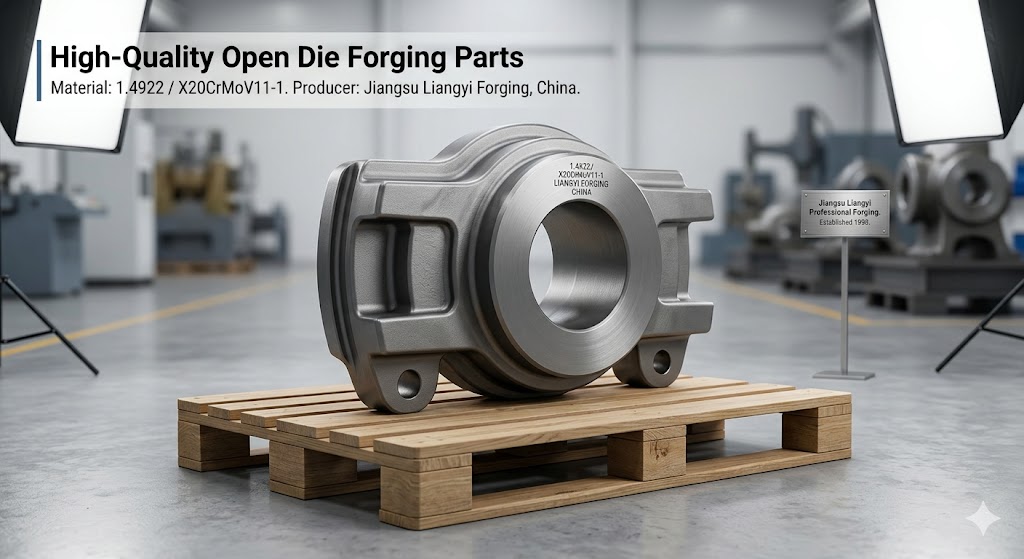
1.4922 (X20CrMoV11-1) Martensitic Creep Resisting Steel — Material Overview
Jiangsu Liangyi is a professional ISO 9001:2015 certified China manufacturer and supplier of 1.4922 (X20CrMoV11-1, X20CrMoV12-1, X20CrMoNiV11-1-1) open die forging parts, with over 25 years of experience in custom forged steel solutions for global clients from more than 50 countries. Located in Jiangyin City, Jiangsu Province — China's core forging industry cluster — we provide end-to-end solutions from steel melting, forging, heat treatment to precision CNC machining, fully compliant with EN, ASTM, and DIN international standards.
1.4922 (X20CrMoV11-1) is a premium heat-treated martensitic creep resisting steel, governed primarily by EN 10302:2008. Its defining characteristic is a carefully balanced alloying system: approximately 11% chromium provides robust oxidation and corrosion resistance; molybdenum (0.5–0.8%) and vanadium (0.1–0.3%) precipitate fine carbides that act as barriers to dislocation movement at elevated temperatures; and a controlled carbon content of 0.17–0.23% delivers the martensitic matrix strength required for long-term load-bearing at up to 600°C. The result is a steel that maintains dimensional stability and load-bearing integrity across tens of thousands of operating hours — a critical requirement that simpler ferritic or austenitic grades cannot simultaneously satisfy at this temperature range.
Our 1.4922 forging parts are widely used in power plant engineering, high-temperature pipeline systems, steam boiler and turbine construction, chemical industry reactors, oil & gas processing equipment, and pressure vessel applications across Asia, Europe, the Middle East, and North America.
Full Range of Custom 1.4922 (X20CrMoV11-1) Forged Steel Products
We manufacture a complete line of custom 1.4922 (X20CrMoV11-1) forging parts in strict accordance with international standards and client drawings, with single-piece weight capacity from 30 kg to 30 tons. Our available product range covers all core industrial applications:
Forged Bars & Rods
X20CrMoV11-1 forged steel round bars, square bars, flat bars, rectangular bars, and precision rods for turbine blade, valve component and structural applications. Max forging diameter up to 2,000 mm, with full EN 10204 3.1/3.2 certification available. Explore our full range of forged steel bars
Seamless Rolled Forged Rings
X20CrMoV11-1 seamless rolled forged rings, guide rings, seal rings, labyrinth rings, packing seal rings, diaphragm seal rings, rotor end rings, and custom contoured casing rings. Ring rolling capacity up to 6,000 mm in outer diameter, ideal for turbine casing, valve body and high-pressure flange applications. Discover our seamless rolled forged rings
Power Generation & Turbine Forged Components
1.4922 forged gas and steam turbine rotor shafts, turbine blades, turbine vane steel flat bars, X20CrMoV12-1 turbine valve spindles/stems/rods, and gas compressor components. Max shaft length up to 15,000 mm, max diameter up to 2,000 mm, with high-speed dynamic balancing and 100% UT inspection available. Learn more about our turbine forging components
Valve & High-Strength Fastener Forgings
X20CrMoV11-1 forged valve seats, valve bodies, valve bonnets, double-ended studs, bolts, nuts and other high-strength fasteners for high-temperature and high-pressure valve systems. Fully compatible with API 6A and ASME standards, with optional Stellite hardfacing available per client requirements. View our valve forging solutions
Hollow Forgings & Pressure Vessel Components
1.4922 forged hubs, housings, shells, sleeves, bushes, hollow bars, heavy-wall cylinders, discs, blocks, plates, seamless pipes, tubes, and pressure vessel casings. Max outer diameter of hollow forgings up to 3,000 mm, suitable for high-temperature pipeline and reactor applications. Check out our hollow forging products
1.4922 (X20CrMoV11-1) Forging Dimensions & Available Size Ranges
The table below summarizes the standard available size ranges for each product category. All dimensions are based on our current forging and machining equipment capability. If you need sizes that are bigger or smaller than these or shapes that aren't standard, please get in touch with our technical team to see if we can help. We often deliver custom solutions for big power and petrochemical projects that are outside of these limits.
Round Bars & Solid Rods
- Diameter: Ø50 – Ø2,000 mm
- Length: up to 6,000 mm
- Min. weight: ~15 kg
- Max. weight: ~30,000 kg
- Tolerances: h9 to h11 (rough); ±0.1 mm (finish)
Flat Bars & Rectangular Bars
- Width × Thickness: 50×20 – 1,500×500 mm
- Length: up to 5,000 mm
- Turbine blade flat bars: width up to 300 mm
- Surface: black / rough machined / finish machined
Seamless Rolled Rings
- Outer Diameter (OD): 200 – 6,000 mm
- Height: 50 – 2,000 mm
- Wall Thickness: 30 – 500 mm
- Contoured / profiled rings: available
- Flanged rings: available
Rotor Shafts & Step Shafts
- Overall Length: up to 15,000 mm
- Max. Diameter: Ø2,000 mm
- Min. Diameter: Ø80 mm
- High-speed balancing (HST): available
- Max. shaft weight: ~30,000 kg
Hollow Forgings & Cylinders
- Outer Diameter: 300 – 3,000 mm
- Inner Diameter: 100 – 2,500 mm
- Wall Thickness: 30 – 600 mm
- Length: up to 5,000 mm
- Bore tolerance: H8 – H10
Discs, Blocks & Plates
- Diameter: Ø300 – Ø3,000 mm
- Thickness: 30 – 1,200 mm
- Rectangular blocks: up to 2,500×1,500×800 mm
- Disc bore: machined to drawing
Manufacturing Standards & Advanced Melting Process
Our 1.4922 (X20CrMoV11-1) forged parts meet many main international standards like EN 10302:2008, EN 10222-2:2000, EN 10216-2:2014, EN 10088-1:2005, and ASTM equivalent standards. We give full EN 10204 3.1/3.2 Mill Test Certificates (MTC) for all parts.
We use premium raw material produced via an advanced multi-stage steelmaking route: Basic Electric Furnace (EAF) + Argon Oxygen Decarburization (AOD) + Vacuum Oxygen Decarburization (VOD) duplex melting process, with optional Electroslag Remelting (ESR) available per client requirements. ESR is particularly recommended for applications requiring the highest cleanliness, isotropic mechanical properties, and 100,000-hour creep service at 600°C. This melting route achieves sulfur levels below 0.010% and phosphorus below 0.025%, significantly tightening the impurity control beyond minimum standard requirements. See our advanced melting and forging equipment
Chemical Composition of 1.4922 (X20CrMoV11-1) Steel (Weight %)
The following table compares the EN 10302 standard specification against our factory-controlled internal target range. Our tighter internal controls — particularly on carbon, chromium, and impurity elements — are designed to deliver more consistent batch-to-batch mechanical properties and better predictability in long-term creep performance.
| Element | EN 10302 Standard Range | Jiangsu Liangyi Internal Control | Primary Function |
|---|---|---|---|
| Carbon (C) | 0.17 – 0.23% | 0.18 – 0.22% | Martensitic matrix strength |
| Chromium (Cr) | 10.0 – 11.5% | 10.3 – 11.2% | Oxidation & corrosion resistance |
| Molybdenum (Mo) | 0.5 – 0.8% | 0.55 – 0.75% | Solid solution & carbide hardening, creep strength |
| Vanadium (V) | 0.1 – 0.3% | 0.15 – 0.25% | Fine carbide precipitation, creep resistance |
| Niobium (Nb) | 0.25 – 0.55% | 0.30 – 0.50% | Grain refinement, carbide stabilization |
| Nickel (Ni) | 0.2 – 0.6% | 0.3 – 0.5% | Toughness improvement |
| Manganese (Mn) | 0.4 – 0.9% | 0.5 – 0.8% | Deoxidation, hardenability |
| Nitrogen (N) | 0.05 – 0.10% | 0.06 – 0.09% | Austenite stabilizer, nitride formation |
| Silicon (Si) | ≤ 0.50% | ≤ 0.40% | Deoxidation |
| Boron (B) | ≤ 0.0015% | 0.0010 – 0.0015% | Grain boundary strengthening |
| Aluminium (Al) | ≤ 0.020% | ≤ 0.015% | Controlled low to avoid AlN formation |
| Phosphorus (P) | ≤ 0.030% | ≤ 0.025% | Impurity — restricted for toughness |
| Sulfur (S) | ≤ 0.015% | ≤ 0.010% | Impurity — restricted for toughness & sour service |
1.4922 (X20CrMoV11-1) International Equivalent Grade Cross-Reference
Steel grade designation varies significantly across national and international standards. The table below provides a cross-reference of 1.4922 (X20CrMoV11-1) equivalents across major standards used by our global client base. Note that "equivalent" in this context means functionally similar — no two standards define the exact same composition and property window, and direct interchangeability requires engineering verification for critical pressure-retaining components.
| Standard System | Grade / Designation | Notes on Equivalence |
|---|---|---|
| EN (European) | 1.4922 / X20CrMoV11-1 | Primary designation — EN 10302:2008 |
| EN (older DIN) | X20CrMoV12-1 / X20CrMoNiV11-1-1 | Legacy DIN designation; composition nominally identical |
| GB/T (China) | 20Cr11MoV (GB/T 8732) | Close equivalent; Cr upper limit slightly lower at 11.0% |
| ASTM / ASME (USA) | No direct equivalent; closest: F6NM (A182) | F6NM has lower C and higher Ni; different property balance. Requires engineering review |
| AFNOR (France) | Z20CDV11.1 (NF EN) | Essentially identical; adopts EN harmonized composition |
| BS (UK) | Adopted EN designation post-2004 | UK uses EN 10302 directly; no separate BS equivalent |
| JIS (Japan) | No direct JIS equivalent | Japanese power plant projects typically accept EN certificate by agreement |
| GOST (Russia/CIS) | 20X11MF (approximate) | Approximate; GOST 20X11MF has slightly different V+Mo balance |
| IS (India) | Adopts EN/ASTM by project spec | Indian power projects specify EN 10302 or equivalent; no dedicated IS grade |
Physical & Thermal Properties of 1.4922 (X20CrMoV11-1) Forging Steel
Physical properties are necessary for finite element analysis (FEA), modeling thermal-mechanical fatigue, and calculating piping stress. The following numbers are the actual values for forgings made at our facility that have been quenched and tempered (QT).Values at elevated temperatures were obtained from creep testing specimens cut from production forgings and tested according to EN ISO 204 procedure.
| Physical Property | 20°C | 200°C | 400°C | 500°C | 600°C |
|---|---|---|---|---|---|
| Density (g/cm³) | 7.72 | 7.68 | 7.62 | 7.58 | 7.53 |
| Elastic Modulus — E (GPa) | 210 | 200 | 188 | 180 | 170 |
| Thermal Conductivity — λ (W/m·K) | 25.0 | 26.5 | 27.5 | 28.0 | 28.5 |
| Mean Thermal Expansion — α (×10⁻⁶/°C) | — | 11.2 | 11.8 | 12.1 | 12.5 |
| Specific Heat Capacity — Cp (J/kg·K) | 460 | 490 | 530 | 560 | 600 |
| Electrical Resistivity (μΩ·m) | 0.70 | 0.82 | 0.99 | 1.08 | 1.18 |
| Poisson's Ratio (ν) | 0.28 – 0.30 (relatively stable across temperature range) | ||||
1.4922 vs. 1.4923 vs. P91 (1.4903) vs. P92 (1.4901) — Engineering Comparison
Engineers selecting martensitic creep-resisting steel for high-temperature service routinely compare 1.4922 (X20CrMoV11-1) against its close relatives. The following comparison covers the four grades most commonly specified in power generation, petrochemical, and industrial turbine applications. Understanding the trade-offs helps avoid both over-specification (unnecessary cost) and under-specification (premature failure).
| Property / Feature | 1.4922 (X20CrMoV11-1) | 1.4923 (X22CrMoV12-1) | P91 / 1.4903 (X10CrMoVNb9-1) | P92 / 1.4901 (X10CrWMoVNb9-2) |
|---|---|---|---|---|
| Cr Content (%) | 10.0 – 11.5 | 10.5 – 12.5 | 8.0 – 9.5 | 8.5 – 9.5 |
| Max Continuous Temp. | 600°C | 600°C | 625°C | 650°C |
| 100,000h Rupture Strength at 550°C (MPa) | ~140 | ~150 | ~180 | ~210 |
| 100,000h Rupture Strength at 600°C (MPa) | ~75 | ~80 | ~100 | ~130 |
| Oxidation Resistance (steam, ≤600°C) | Excellent (11% Cr) | Excellent (12% Cr) | Good (9% Cr) | Good (9% Cr) |
| H₂S / Sour Service Resistance | Very Good — meets hardness & composition requirements of NACE MR0175 / ISO 15156 | Very Good | Acceptable | Acceptable |
| Impact Toughness (KV, +20°C) | ≥ 40 J (NT) | ≥ 27 J (NT) | ≥ 41 J | ≥ 27 J |
| Weldability (preheat required) | 200 – 300°C | 250 – 350°C | 200 – 300°C + strict PWHT | 200 – 300°C + strict PWHT |
| Post-Weld Heat Treatment (PWHT) | Required: 720 – 760°C | Required: 720 – 760°C | Mandatory: 730 – 760°C (critical) | Mandatory: 730 – 760°C (critical) |
| Thermal Expansion Mismatch w/ Carbon Steel | Low (good compatibility) | Low | Low | Low |
| Relative Material Cost | Moderate | Moderate (+5–10%) | Higher (+20–30%) | Highest (+40–60%) |
| Typical Applications | Turbine shafts, valve spindles, steam pipelines, rings ≤600°C | High-hardness turbine blades, guide vanes ≤600°C | Main steam pipes, headers, turbine rotors ≤625°C | Ultra-supercritical boiler tubes, rotors ≤650°C |
Precision Heat Treatment Process for 1.4922 (X20CrMoV11-1) Forgings
We operate 10 fully automated heat treatment furnaces with ±5°C temperature uniformity across the working zone, verified regularly by multi-point thermocouple surveys and calibrated instrumentation. Every 1.4922 (X20CrMoV11-1) forging undergoes a documented, traceable heat treatment cycle — furnace chart records, time-temperature profiles and thermocouple calibration certificates are included with the EN 10204 3.1 MTC on request. Our standard heat treatment processes are as follows:
Soft Annealing
Heat the forgings to 730–780°C, hold for sufficient time according to the section thickness (minimum 1 hour per 50 mm), then cool slowly in the furnace (≤50°C/h) or in still air for thinner sections. This process dissolves fine carbides, reduces hardness to below 240 HBW, and significantly improves machinability — important for rough machining operations before final heat treatment. The slow furnace cool guarantees that chromium carbides remain in solution rather than reprecipitating at grain boundaries, which would otherwise cause susceptibility to temper embrittlement.
Stress Relieving
To remove machining residual stress and minimize distortion during final heat treatment, we perform stress relieving by heating the machined parts to 650–680°C, holding for at least 1 hour per 25 mm of maximum section thickness, followed by controlled air cooling. This intermediate step is particularly important for complicate geometries such as step shafts and flanged rings where differential machining stock removal creates asymmetric residual stress patterns. Skipping this step often results in dimensional movement during final QT that exceeds drawing tolerances.
Hardening (Austenitizing + Quenching)
Austenitize the forgings at 1020–1070°C, with holding time calculated as minimum 1 hour per 75 mm of section thickness to guarantee complete carbide dissolution and full austenite transformation. Quenching medium (air or oil) is chosen based on section size and hardenability requirements: sections below 100 mm are air quenched; heavier sections up to 500 mm may need accelerated forced-air or oil quenching to get full martensitic transformation throughout the cross-section. A uniform through-hardness profile is verified by hardness traverse testing across the full cross-section before tempering proceeds.
Tempering
Perform tempering at 720–780°C, holding for a minimum of 2 hours per 50 mm of section thickness, then air cooling. The precise tempering temperature is selected based on the target mechanical property window: the lower end of the range (720–740°C) delivers higher strength with hardness ~260–280 HBW, preferred for turbine blade flat bars; the upper end (750–780°C) delivers superior toughness with hardness ~220–250 HBW, preferred for rotating shafts and rings where dynamic fatigue loading governs design. Double-tempering cycles are performed for forgings above 1,000 mm cross-section to guarantee complete martensite transformation of any retained austenite from the quench.
Mechanical Properties of 1.4922 (X20CrMoV11-1) Forging Steel
All mechanical property test specimens are cut from the forging body at the prescribed location and orientation per EN 10302 sampling requirements. For large forgings, specimens are cut from the 1/4T and 1/2T positions (T = forging thickness or diameter) to confirm through-thickness property consistency. Both longitudinal (L) and transverse (T) specimens are tested where required by the applicable product standard.
| Mechanical Property | Heat Treatment Condition | Specimen Orientation | Guaranteed Value |
|---|---|---|---|
| Tensile Strength (Rm) | Normalized + Tempered (+NT) | Longitudinal | 690–840 MPa |
| Tensile Strength (Rm) | Quenched + Tempered (+QT) | Longitudinal | 700–850 MPa |
| Min. Yield Strength (ReH) | Normalized + Tempered (+NT) | Longitudinal | ≥ 490 MPa |
| 0.2% Proof Strength (Rp0.2) | Quenched + Tempered (+QT) | Longitudinal | ≥ 500 MPa |
| Elongation at Fracture (A) | Normalized + Tempered (+NT) | Longitudinal | ≥ 17% |
| Elongation at Fracture (A) | Normalized + Tempered (+NT) | Transverse | ≥ 14% |
| Elongation at Fracture (A) | Quenched + Tempered (+QT) | Longitudinal | ≥ 15 – 16% |
| Longitudinal Impact Energy (KV, +20°C) | Normalized + Tempered (+NT) | Longitudinal | Min. 40 J |
| Longitudinal Impact Energy (KV, +20°C) | Quenched + Tempered (+QT) | Longitudinal | 27–39 J |
| Transverse Impact Energy (KV, +20°C) | Quenched + Tempered (+QT) | Transverse | Min. 27 J |
| Brinell Hardness (HBW) | Quenched + Tempered (+QT) | Surface | 220 – 290 HBW |
High-Temperature Creep & Stress Rupture Strength of 1.4922 (X20CrMoV11-1)
Creep rupture strength — the stress that causes rupture after a given number of hours at a specified temperature — is the single most critical property for selecting materials in long-life, high-temperature pressure equipment. Unlike tensile strength which is measured instantaneously, creep properties reflect the material's resistance to time-dependent plastic deformation under sustained load. For turbine shafts and steam pipelines designed for 200,000-hour service life, creep data is the governing design input.
The following table presents our factory-validated average creep stress rupture strength values for 1.4922 (X20CrMoV11-1) in the quenched-and-tempered condition (+QT). Data is derived from long-term testing programs conducted on specimens machined from production forgings. Values represent the mean of multiple test batches; design engineers should apply appropriate safety factors (typically 1.5× on mean rupture or use minimum values per EN 13445 or applicable design code).
| Test Temperature | 1,000 h Rupture (MPa) | 10,000 h Rupture (MPa) | 30,000 h Rupture (MPa) | 100,000 h Rupture (MPa) | 200,000 h Rupture (MPa, est.) |
|---|---|---|---|---|---|
| 450°C | ~380 | ~310 | ~270 | ~230 | ~200 |
| 500°C | ~300 | ~240 | ~210 | ~175 | ~155 |
| 525°C | ~255 | ~200 | ~170 | ~140 | ~120 |
| 550°C | ~210 | ~165 | ~140 | ~112 | ~96 |
| 575°C | ~165 | ~125 | ~104 | ~83 | ~70 |
| 600°C | ~120 | ~92 | ~80 | ~65 | ~54 |
| 620°C | ~88 | ~65 | ~55 | ~44 | ~37 |
| 650°C | ~55 | ~38 | ~30 | — | — |
Minimum Creep Rate (Secondary Creep) Data
In addition to rupture life, the minimum creep rate during secondary (steady-state) creep governs the allowable deformation in precision components such as turbine casings and labyrinth seals where dimensional change over service life must remain within tight limits. For 1.4922 at 550°C under a stress of 100 MPa, the minimum creep rate is approximately 2×10⁻⁵ %/h, meaning total accumulated creep strain over 100,000 hours is approximately 2%, which is within acceptable limits for most turbine casing applications. At 600°C under the same stress, the minimum creep rate rises to approximately 8×10⁻⁵ %/h — four times higher — and component geometry change over the design life must be explicitly accounted for in the engineering design.
Weldability & Welding Guide for 1.4922 (X20CrMoV11-1) Forgings
1.4922 (X20CrMoV11-1) is weldable using standard arc welding processes, but its martensitic microstructure means that welding introduces significant hardness gradients and residual stress that must be managed through controlled preheat, interpass temperature, and mandatory post-weld heat treatment (PWHT). Skipping or shortcutting any of these steps risks cold cracking, stress corrosion cracking, or premature creep failure at the weld heat-affected zone (HAZ) — the most common failure mode for improperly welded 1.4922 components in service.
The following step-by-step guide is developed based on EN ISO 15614-1 principles and our accumulated production experience with 1.4922 steel. Clients who receive our forgings for in-field or shop welding can reference these process parameters as a baseline for developing and qualifying their own Welding Procedure Specifications (WPS).
Pre-Weld Inspection
Verify base metal hardness ≤290 HBW. Check chemical cert for P + S ≤ 0.040% combined. Ensure joint preparation is clean, free of scale, oil and moisture. Perform MT/PT on joint faces for existing cracks.
Preheat
Preheat to 200–300°C uniformly, measured ≥75 mm from the weld joint on both sides. Maintain preheat throughout the entire welding sequence. For sections >50 mm, use 250–300°C. Never weld cold — hydrogen cracking in the HAZ is the primary risk with insufficient preheat.
Interpass Temperature
Maintain interpass temperature between 200°C (minimum = preheat) and 300°C maximum. Exceeding 300°C risks HAZ grain coarsening and delta ferrite formation, both of which degrade creep properties. Use infrared thermometer to verify before each weld pass.
Filler Metal Selection
Use matching composition filler: AWS ER410NiMo (TIG/MIG) or E410NiMo-15 (SMAW) for butt joints. For hardfacing of sealing surfaces, Stellite 6 (Co-Cr-W alloy) overlay is applied by GTAW. Nickel-based fillers (e.g. Inconel 82/182) may be used at dissimilar metal joints — verify compatibility with your design code.
Heat Input Control
Limit heat input to 1.0–2.5 kJ/mm per pass. Excessive heat input (>3.0 kJ/mm) causes HAZ grain coarsening and loss of creep strength. Insufficient heat input (<0.8 kJ/mm) increases hydrogen cracking risk. Oscillation width should not exceed 3× electrode diameter.
Post-Weld Cooling
After the final weld pass, hold at preheat temperature (200–300°C) for minimum 2 hours before slow cooling to 80–120°C. This step allows hydrogen effusion from the weld and HAZ. Do NOT allow the weldment to cool below 80°C before PWHT. Cover with insulating blanket to control cooling rate.
PWHT (Post-Weld Heat Treatment)
Mandatory. Heat to 720–760°C at controlled rate ≤100°C/h above 400°C. Hold at PWHT temperature for minimum 1 hour per 25 mm of maximum weld throat thickness, with absolute minimum of 2 hours regardless of thickness. Cool at ≤100°C/h to 400°C, then free air cool. Document full temperature-time record.
Post-PWHT Inspection
After PWHT cooling to ambient: Brinell hardness check across weld, HAZ and base metal (target: weld ≤270 HBW, HAZ ≤290 HBW). Full UT of weld volume per EN ISO 17640. MT or PT on weld surface. Dimensional check if applicable.
Full-Process Quality Controlled Forging Production Flow
We implement a strict full-process quality control system for all 1.4922 (X20CrMoV11-1) forging parts, and we have modern equipment, such as a 6300T hydraulic forging press, 2000T fast forging machine, 5M seamless rolling machine, and complete nondestructive testing equipment to make sure all parts have high quality. Following are our standard production flow:
Raw material steel ingot incoming inspection (100% chemical composition verification by OES) → Precision cutting → Open die forging process (grain refinement and structure optimization) → Post forging heat treatment (Normalizing + Tempering) → Preliminary Ultrasonic Testing (UT) → Rough Machining → Secondary UT Inspection → Final Quenching + Tempering (QT) → Full performance inspection (UT, mechanical properties test, hardness test, grain size inspection) → Precision grooving → Stress relieve tempering → Machining of rotor holding position for HST → High Speed Balancing (HST) → Final dimensional inspection and surface finish test → Permanent marking (steel stamp) and anti-rust packaging → Storage and global shipment.
All our 1.4922 forgings are given 100% nondestructive testing before delivery, including UT per EN ISO 17640, MT per EN ISO 17638, PT per EN ISO 3452, and optional PMI (Positive Material Identification) by XRF to confirm alloy grade, ensuring zero defects and full compliance with client requirements and international standards. View our complete quality inspection equipment
Global Application Cases of China-Made 1.4922 (X20CrMoV11-1) Forgings
Our 1.4922 (X20CrMoV11-1) forging parts have been deployed in important industrial projects across more than 50 countries in Asia, Europe, the Middle East, North America, and Southeast Asia, with a proven track record of stable performance under demanding high-temperature and high-pressure service conditions. Following are our main application cases :
Thermal Power Plant Steam Turbine Components (Asia Market)
We supplied custom 1.4922 steam turbine rotor shafts, valve spindles, and seal rings for multiple large-scale thermal power projects in Asia. The client's main challenge was keeping stable creep resistance under continuous 580°C service at 16.7 MPa steam pressure. Our forgings were made of ESR-refined material with a custom double-tempering cycle developed specifically for this application, and they got impact toughness well above standard minimum values. 100% high-temperature mechanical property testing was performed at 600°C, confirming properties met design requirements with positive margin. The components have accumulated many years of continuous stable operation — a service record that led the client to place repeat orders for subsequent plant expansions.
Petrochemical High-Temperature Pipeline & Reactor Forgings (Middle East Market)
Our X20CrMoV11-1 forged high-pressure pipeline parts, flanges, and reactor shells were used for a large-scale refinery project in the Middle East. The project's important challenge was simultaneous resistance to H₂S-bearing sour gas service and long-term 550°C operation — a combination that rules out most standard carbon and low-alloy steels. Our forgings got sulfur content below 0.008% and phosphorus below 0.020%, meeting the material composition and hardness requirements of NACE MR0175 / ISO 15156, and passed the client's corrosion resistance qualification tests. We completed production and delivery of 120+ custom forgings within 45 days to meet the project's important commissioning schedule, with dedicated quality inspector presence throughout.
Industrial Gas Turbine Blade & Guide Ring Forgings (European Market)
We made precision X20CrMoV11-1 forged turbine blade flat bars and guide rings for a leading industrial gas turbine OEM in Germany. The client specified all parts must meet EN 10302 plus additional proprietary requirements including: dimensional tolerance within ±0.05 mm on important surfaces, consistent grain size ASTM No. 3–5, and maximum hardness variation of 15 HBW across any single forging. Our factory met all of its goals by using a combination of precise forging with the best reduction ratios, a tightly controlled tempering window, and 100% metallographic inspection for important supply batches. We have had a long-term stable relationship with this client, and we always send them qualified forging batches that are accepted on the first try. They now trust us as one of their Chinese suppliers.
Power Station Boiler & Valve System Components (North American Market)
Our 1.4922 forged valve seats, valve stems, and high-strength fasteners are supplied to a leading valve manufacturer in the United States for use in utility boiler systems across multiple North American power plants. The governing failure mode for these parts is low-cycle thermal fatigue from repeated boiler start-stop cycling — each cycle subjects the valve parts to a temperature swing from ambient to 580°C in under 4 hours. Our forgings met the client's proprietary low-cycle fatigue qualification requirements, with all test specimens passing the specified number of thermal cycles without crack initiation. All products meet ASTM A182 with optional Stellite 6 hardfacing on sealing surfaces applied in-house at our facility. We provide stable monthly delivery of valve part sets to this client on a just-in-time schedule.
Why Choose Jiangsu Liangyi as Your 1.4922 (X20CrMoV11-1) Forging Partner in China
25+ Years of Focused High-Temperature Alloy Experience
Since 1998, we have focused exclusively on high-temperature alloy and creep resisting steel forgings for power generation and oil & gas industries. This narrow focus means our metallurgists, heat treatment engineers and quality inspectors have accumulated deep, specific expertise in 1.4922 behavior — not generic forging experience applied to a new material.
Complete In-House Production — No Outsourcing
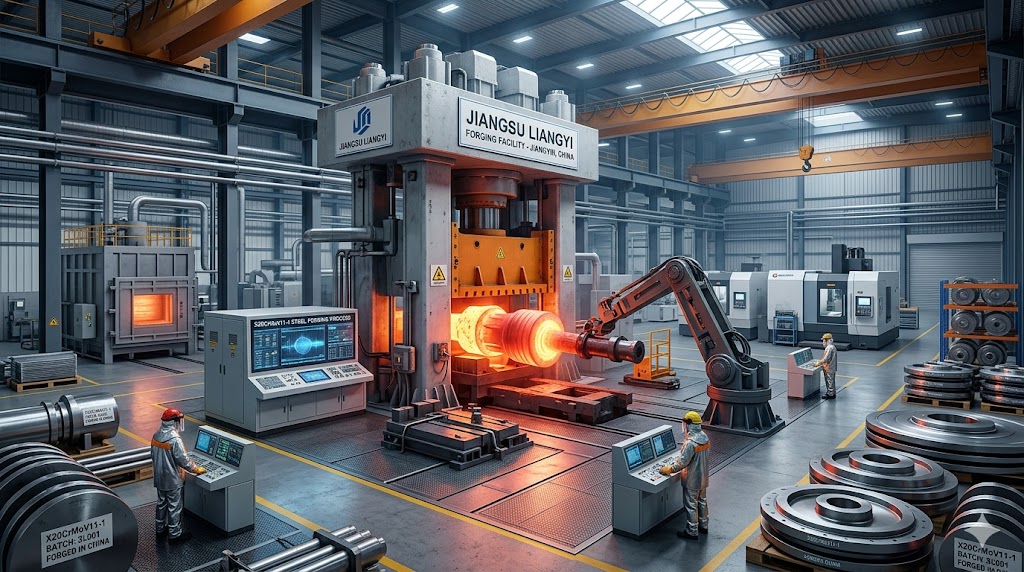
From EAF steel melting, open die forging, ring rolling, heat treatment and CNC machining to final NDT inspection and surface treatment — every step is performed within our own 120,000 m² facility in Jiangyin. No sub-contracting means no quality gaps, no hidden lead time, and full traceability of every batch from ingot to finished forging.
Validated Equipment for Heavy & Precision Forgings
Our 6300T hydraulic press handles single ingots up to 35 tons; our 5M ring rolling machine covers rings up to 6 m OD; our 10 programmable heat treatment furnaces control temperature to ±5°C with regular multi-point thermocouple surveys and calibrated instrumentation. This combination of heavy forming capacity and precision thermal control is rare among Chinese forging manufacturers.
Global Export with 7×24 English Technical Support
Exporting to 50+ countries since 2003, our sales and technical team provides 7×24 English support, and can accommodate third-party inspection by SGS, TÜV, BV or the buyer's nominated inspector upon prior arrangement (inspection fees at buyer's account unless otherwise agreed). We provide DDPW/DDP incoterms and can generate documentation packages meeting EU, ASME, and customer-specific QA requirements within 5 working days of order confirmation.
Frequently Asked Questions — 1.4922 (X20CrMoV11-1) Forgings
Contact Us for Custom 1.4922 (X20CrMoV11-1) Forging Solutions
Jiangsu Liangyi is your trusted manufacturer and supplier of high-quality 1.4922 (X20CrMoV11-1) forging parts. We have more than 25 years of experience making forged bars and rings, whether you need standard forged bars and rings, or custom complex turbine parts and pressure vessel parts, we are ready to provide technically grounded, cost-effective solutions.
Send us your drawing, material specification, quantity, and delivery requirement — our technical sales team will respond with a detailed technical confirmation and commercial quotation within 24 hours (business days).
Inquiry Email: sales@jnmtforgedparts.com
Phone / WhatsApp: +86-13585067993
Official Website: https://www.jnmtforgedparts.com
Factory Address: Chengchang Industry Park, Jiangyin City, Jiangsu Province 214400, China
Get Your Free Quotation Now