Turbine Blades and Vanes
Gas and steam turbine blades, compressor blades, inlet guide vanes (IGV), nozzle segments and diaphragm nozzles that withstand high rotational speeds and temperatures up to 600°C.
Complete Technical Guide & China Manufacturer — ISO 9001:2015 Certified Martensitic Creep-Resisting Steel Forgings for Power Generation and Aerospace. Jiangyin, Jiangsu, China. Ships to 50+ Countries.
Get a Free Quotation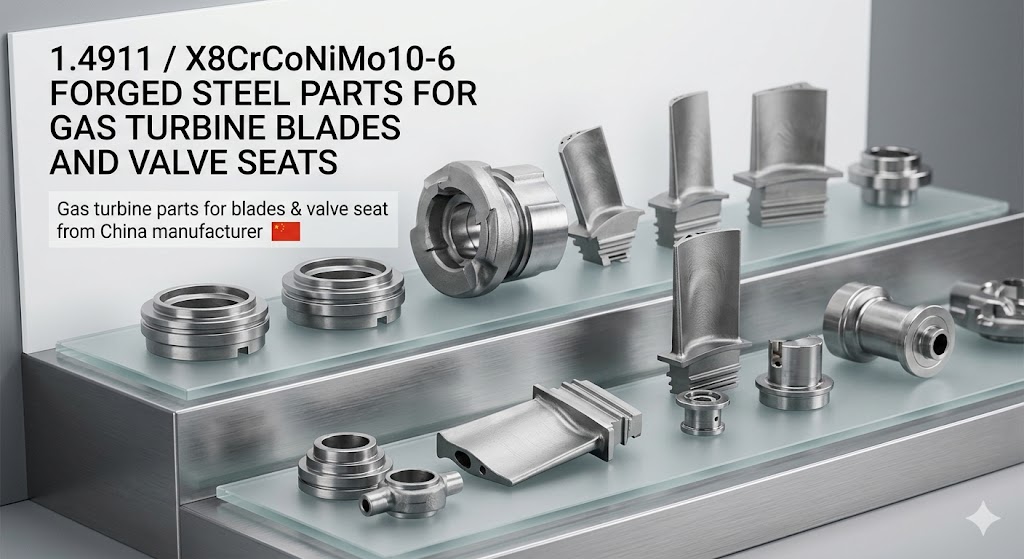
Jiangsu Liangyi Co., Limited, located in Chengchang Industry Park, Jiangyin City, Jiangsu Province, China, is a professional ISO 9001:2015 certified manufacturer of 1.4911, X8CrCoNiMo10-6, Z10CKD10, X8CrCoNiMo10.6 and X8CrCoNiMo106 open die forging parts and seamless rolled steel forged rings. With over 25 years of forging experience since 1997, we specialize in producing high-quality forged gas and steam turbine components that meet the most demanding international industry standards.
China Manufacturing Advantage: Our Jiangyin factory combines advanced European metallurgical technology with competitive Chinese manufacturing costs — delivering premium 1.4911 and X8CrCoNiMo10-6 forged parts to customers in over 50 countries worldwide, with full MTC documentation and third-party inspection support.
1.4911 — designated X8CrCoNiMo10-6 in EN/DIN and Z10CKD10 in the French AFNOR system — belongs to the family of cobalt-bearing martensitic creep-resisting steels. What distinguishes 1.4911 from standard 9–12% chromium grades such as P91 (1.4903) is its deliberate addition of 5–7% Cobalt. Cobalt raises the Ms (martensite start) temperature, suppresses the formation of delta-ferrite in the heat-affected zone during welding, and most importantly increases the solid-solution strengthening contribution at temperatures above 550°C — the zone where conventional ferritic/martensitic grades begin to lose creep strength. This cobalt effect allows 1.4911 to maintain reliable structural integrity in components that experience sustained thermal loading at 560–600°C, making it the material of choice for advanced ultra-supercritical (USC) and advanced USC power plant designs.
The alloying philosophy of X8CrCoNiMo10-6 reflects decades of European turbine manufacturer experience: moderate carbon (0.05–0.12%) prevents excessive carbide precipitation while still enabling martensitic transformation; chromium at 9.8–11.5% provides the oxidation and corrosion resistance needed for steam-side conditions; molybdenum and vanadium contribute precipitation hardening and matrix strengthening; and nickel at 0.2–1.2% improves toughness without destabilizing the martensitic microstructure.
| Element | Symbol | Range (%) | Role in Steel |
|---|---|---|---|
| Carbon | C | 0.05 – 0.12 | Enables martensitic transformation; controls carbide formation |
| Silicon | Si | 0.10 – 0.80 | Deoxidizer; moderate solid-solution strengthening |
| Manganese | Mn | 0.20 – 1.35 | Deoxidizer; stabilizes austenite; improves hardenability |
| Phosphorus | P | ≤ 0.025 | Controlled impurity — limits temper embrittlement risk |
| Sulfur | S | ≤ 0.020 | Controlled impurity — limits hot cracking susceptibility |
| Chromium | Cr | 9.80 – 11.5 | Oxidation & corrosion resistance; strengthens matrix |
| Cobalt | Co | 5.0 – 7.0 | Raises Ms temperature; critical for creep strength >550°C |
| Molybdenum | Mo | 0.50 – 1.00 | Solid-solution strengthening; improves creep resistance |
| Nickel | Ni | 0.20 – 1.20 | Improves toughness; suppresses delta-ferrite |
| Vanadium | V | 0.10 – 0.60 | Precipitation hardening via fine VC/V(C,N) carbides |
| Property | Symbol | Value | Unit | Test Direction |
|---|---|---|---|---|
| Tensile Strength | Rm | 1000 – 1140 | MPa | — |
| 0.2% Proof Strength | Rp0.2 | ≥ 850 | MPa | — |
| Elongation at Fracture | A | ≥ 10 | % | Longitudinal |
| Reduction of Area | Z | ≥ 35 | % | Longitudinal |
| Charpy Impact (KV2) | KV₂ | ≥ 40 | J | Longitudinal, +20°C |
| Brinell Hardness | HBW | 300 – 350 | HB | — |
Manufacturing Note: At Jiangsu Liangyi, all mechanical property testing is performed on specimens cut from the actual forged product (not from separately forged test coupons) unless otherwise agreed. This approach — common in aerospace procurement — confirms that the forging itself meets specification, not a surrogate sample.
Physical properties are critical for component design calculations — thermal stress analysis, finite element modelling of turbine rotors and blades, and lifetime assessment all require accurate temperature-dependent data. The following values for 1.4911 X8CrCoNiMo10-6 are representative of wrought and forged product in the +QT condition.
| Temperature (°C) | Density (g/cm³) | Elastic Modulus E (GPa) | Shear Modulus G (GPa) | Poisson's Ratio ν |
|---|---|---|---|---|
| 20 | 7.75 | 215 | 83 | 0.29 |
| 100 | 7.73 | 210 | 81 | 0.29 |
| 200 | 7.70 | 203 | 78 | 0.30 |
| 300 | 7.67 | 196 | 76 | 0.30 |
| 400 | 7.63 | 188 | 72 | 0.30 |
| 500 | 7.59 | 180 | 69 | 0.30 |
| 600 | 7.55 | 170 | 65 | 0.31 |
| Temperature (°C) | Thermal Conductivity λ (W/m·K) | Specific Heat Cp (J/kg·K) | Mean Thermal Expansion α (10⁻⁶/K, from 20°C) |
|---|---|---|---|
| 20 | 25.5 | 460 | — |
| 100 | 26.0 | 470 | 11.2 |
| 200 | 26.8 | 490 | 11.5 |
| 300 | 27.4 | 510 | 11.8 |
| 400 | 27.9 | 530 | 12.0 |
| 500 | 28.5 | 560 | 12.3 |
| 600 | 29.2 | 600 | 12.5 |
Note: Thermal expansion values are mean coefficients from 20°C to the stated temperature. Values are indicative for the +QT forged condition and may vary slightly with section size and exact heat treatment.
Design Engineer's Note: The relatively high thermal conductivity of 1.4911 compared to austenitic stainless steels (≈15 W/m·K) means it generates lower thermal gradients during turbine start-up and shutdown cycles — an important advantage for fatigue life in cyclic power plants and peaking turbines.
Creep rupture strength is the defining property for long-term structural components in gas and steam turbines. The following values represent indicative stress-rupture data for 1.4911 X8CrCoNiMo10-6 in the +QT forged condition, consistent with published data for this grade family and EN 10302:2008 requirements. They are used by design engineers for turbine component lifetime calculations and retirement-from-service planning.
| Temperature (°C) | 1,000 h rupture stress (MPa) | 10,000 h rupture stress (MPa) | 100,000 h rupture stress (MPa) |
|---|---|---|---|
| 500 | ≥ 450 | ≥ 380 | ≥ 300 |
| 525 | ≥ 390 | ≥ 320 | ≥ 250 |
| 550 | ≥ 330 | ≥ 270 | ≥ 195 |
| 575 | ≥ 255 | ≥ 205 | ≥ 148 |
| 600 | ≥ 195 | ≥ 155 | ≥ 100 |
| 620 | ≥ 148 | ≥ 112 | ≥ 72 |
Note: Values are indicative minimum targets for forged product per EN 10302:2008. Actual test certificates are provided with each order. For design calculations, apply appropriate safety factors per the applicable pressure equipment directive (PED 2014/68/EU, ASME, or equivalent).
The creep advantage of 1.4911 X8CrCoNiMo10-6 over grades like P91 (X10CrMoVNb9-1) becomes pronounced above 550°C. At 600°C and 100,000 hours, 1.4911 retains approximately 100 MPa rupture strength — compared to approximately 60–75 MPa for standard P91. This difference of 25–40% allows turbine designers to either:
These benefits directly translate to lower levelised cost of electricity (LCOE) in modern ultra-supercritical thermal power plants — which is why 1.4911 and its equivalents appear in the most demanding European and Asian power generation specifications.
Correct heat treatment is critical for achieving the specified mechanical and creep properties in 1.4911 X8CrCoNiMo10-6. A two-stage quench-and-temper (QT) cycle is standard for forgings. The following parameters apply to open die forgings and seamless rolled rings produced at our Jiangyin facility.
| Parameter | Specification | Notes |
|---|---|---|
| Austenitizing Temperature | 1050°C – 1100°C (typical: 1070°C ± 10°C) | Higher end for large sections >500mm |
| Heating Rate | ≤ 80°C/hour above 400°C | Prevents thermal cracking in heavy sections |
| Hold Time (soaking) | 1 hour per 100mm section thickness, min. 1 hour | Measured at furnace thermocouple |
| Atmosphere | Neutral or slightly reducing | Prevents surface decarburization |
| Quench Medium | Oil quench or forced air / fan cooling | Oil for sections > 150mm; forced air acceptable for thinner sections |
| Transfer Time | < 30 seconds from furnace to quench | Critical to avoid partial transformation |
| Parameter | Specification | Notes |
|---|---|---|
| Tempering Temperature | 650°C – 700°C (typical: 670°C ± 10°C) | Must not exceed Ac₁ (~820°C) to avoid re-austenitizing |
| Hold Time | Minimum 2 hours per 25mm section thickness, minimum 3 hours total | Double tempering recommended for >500mm sections |
| Heating Rate | ≤ 100°C/hour | — |
| Cooling | Air cooling after tempering | Do not water quench — risk of residual stress cracking |
| Post-Weld Heat Treatment (PWHT) | 650°C – 680°C, min. 2 hours | Mandatory after welding; see Welding section |
| Stress Relief Tempering | 600°C – 650°C, 2–4 hours | After rough machining for complex geometries |
⚠ Critical: Tempering temperature must remain strictly below the Ac₁ temperature (~820°C for 1.4911). Exceeding Ac₁ causes partial re-austenitization during tempering, resulting in brittle untempered martensite on cooling and catastrophic loss of toughness. Our furnaces are calibrated quarterly and equipped with redundant thermocouples to prevent this.
| Temperature Point | Symbol | Approx. Value (°C) | Significance |
|---|---|---|---|
| Austenitizing start | Ac₁ | ~820 | Upper limit for tempering temperature |
| Full austenitizing | Ac₃ | ~920 | Minimum for complete austenitizing |
| Martensite start | Ms | ~280 | Raised by Co addition vs non-Co grades |
| Martensite finish | Mf | ~80 | Below this = fully martensitic on quenching |
The delivery condition determines the microstructural state and resulting properties of the forged product as supplied. Jiangsu Liangyi has the following delivery terms for 1.4911 X8CrCoNiMo10-6 forgings, which are listed on the order and confirmed in the MTC:
| Condition Code | Full Name | Process Description | Typical Use Case |
|---|---|---|---|
| +QT | Quenched and Tempered | Austenitizing at 1050–1100°C → oil/air quench → tempering at 650–700°C | Standard for turbine parts, valves, shafts, rings. Delivers full mechanical and creep property specification. |
| +N+T | Normalized and Tempered | Austenitizing → air cool (normalize) → tempering at 650–700°C | Large sections where oil quenching creates distortion risk; slightly lower strength than +QT. Used for heavy rotor discs. |
| +A | Annealed (Soft Annealed) | Austenitizing → slow furnace cool or sub-critical anneal at 750–800°C | Parts requiring further cold deformation or extensive machining before final heat treatment. Not suitable as final delivery for structural use. |
| +FP | Ferritic-Pearlitic Annealed | Extended anneal below Ac₁, slow cool | Maximum machinability for complex near-net-shape forgings. Final properties achieved by customer's in-house QT after machining. |
| +SR | Stress Relieved | Tempering at 600–650°C without prior austenitizing | Applied after rough machining to eliminate residual forging stresses before final precision machining and dimension test. |
Standard Delivery: Unless otherwise specified, all 1.4911 X8CrCoNiMo10-6 forgings from Jiangsu Liangyi are supplied in +QT condition with MTC 3.1 (or 3.2 by agreement), confirming full compliance with EN 10302:2008 mechanical property requirements.
1.4911 X8CrCoNiMo10-6 can be welded with regular arc welding methods, but because it has a lot of chromium and cobalt, it is important to follow strict procedures for preheating, controlling the temperature between passes, and post-weld heat treatment (PWHT). Failure to follow these steps results in hydrogen-induced cracking (HIC) and loss of toughness in the heat-affected zone (HAZ).
| Parameter | Requirement | Notes |
|---|---|---|
| Preheat Temperature | 200°C – 300°C minimum | Required for sections >10mm. Measure 75mm from joint each side. |
| Maximum Interpass Temperature | 300°C | Do not allow weld zone to cool below preheat between passes |
| Hydrogen Control | H5 classification or lower (≤5 ml/100g) | Use low-hydrogen basic electrodes or MIG/TIG with dry shielding gas |
| Recommended Welding Processes | TIG (GTAW), MMA (SMAW basic), SAW | TIG preferred for root passes; MMA for fill and cap |
| Filler Material | Matching composition filler (Co-Cr-Ni-Mo type) | Ni-based filler (e.g. ERNiCrMo) acceptable for dissimilar welds to austenitic |
| Heat Input | 1.0 – 2.5 kJ/mm | Avoid excessive heat input — coarsens HAZ grain structure |
| PWHT Temperature | 650°C – 680°C | Must reach and hold throughout the entire section thickness |
| PWHT Hold Time | 1 hour per 25mm, minimum 2 hours total | For sections > 100mm: consider two-stage PWHT cycles |
| PWHT Heating Rate (above 400°C) | ≤ 80°C/hour | Prevents thermal gradients causing distortion |
| PWHT Cooling Rate (below 400°C) | Air cool | Do not accelerate cooling below 400°C |
The as-welded HAZ of 1.4911 X8CrCoNiMo10-6 consists largely of untempered martensite with high hardness (typically >450 HV) and very low toughness (<20 J at room temperature). PWHT at 650–680°C allows:
⚠ PWHT Bypass is not acceptable for pressure-bearing components or structural welds in 1.4911. For repair welds on finished turbine components, a local PWHT using ceramic-resistance heating blankets is acceptable, provided the thermal gradient and temperature uniformity requirements are controlled and documented.
Selecting the correct 9–12% chromium ferritic/martensitic grade requires understanding the trade-offs between creep strength, weldability, toughness, oxidation resistance and material cost. The following comparison covers the five most commonly specified grades for steam turbine and power plant applications — all of which Jiangsu Liangyi can supply as custom forgings.
| Property / Grade | 1.4911 X8CrCoNiMo10-6 Z10CKD10 | P91 / 1.4903 X10CrMoVNb9-1 | P92 / 1.4939 X12CrMoWVNbN10-1-1 | E911 / 1.4935 X11CrMoWVNb9-1-1 | X20 / 1.4922 X20CrMoV11-1 |
|---|---|---|---|---|---|
| Cr content (%) | 9.8 – 11.5 | 8.0 – 9.5 | 8.5 – 9.5 | 8.5 – 9.5 | 10.0 – 12.5 |
| Key alloying addition | Co (5–7%) + Ni + Mo + V | Nb + V + Mo (no Co) | W (1.5–2%) + Nb + V (no Co) | W (0.9–1.1%) + Mo + Nb + V | Mo + V (no Co, no Nb, no W) |
| Creep strength at 550°C / 100,000h | ~195 MPa (highest) | ~115–130 MPa | ~180–200 MPa | ~150–165 MPa | ~80–95 MPa |
| Creep strength at 600°C / 100,000h | ~100 MPa | ~60–75 MPa | ~100–115 MPa (comparable) | ~80–95 MPa | ~40–55 MPa |
| Max recommended temperature | 600–620°C | 565–580°C | 600–625°C | 580–600°C | 530–565°C |
| Weldability (general) | Good (PWHT mandatory) | Good (PWHT mandatory) | Moderate (W increases hardness) | Good | Moderate (higher C) |
| HAZ stability | Excellent (Co raises Ms) | Good | Good | Good | Moderate |
| Room-temp toughness | Good (≥40 J) | Very good (≥47 J) | Good (≥40 J) | Good | Moderate |
| Oxidation resistance | Excellent (highest Cr) | Good | Good | Good | Excellent |
| Raw material cost relative | Higher (Co content) | Lowest | Moderate (W) | Moderate | Moderate |
| Primary application | USC turbine blades, high-temp valves, aerospace | SC/USC headers, piping, rotors | USC rotors, headers (EU/Japan) | USC piping, headers (European) | Older SC plant rotors, valves |
Selection Guidance: Choose 1.4911 X8CrCoNiMo10-6 when your component operates continuously above 560°C, when delta-ferrite in the HAZ is a design concern, or when component geometry demands superior toughness alongside high creep strength. For budget-sensitive applications at 540–560°C, P91 (1.4903) remains the dominant global choice. For 600–625°C ultra-supercritical duty with minimum weld issues, P92 (1.4939) is a close alternative to 1.4911. Jiangsu Liangyi manufactures all five grades and can advise on material selection for your specific operating conditions.
At our Jiangsu manufacturing facility, we manufacture 1.4911, X8CrCoNiMo10-6 and Z10CKD10 forged steel products in various custom shapes and dimensions according to your specific engineering drawings and technical requirements:
1.4911 and X8CrCoNiMo10-6 forged components manufactured in our Jiangyin factory are extensively used in gas and steam turbines for power generation plants across Asia, Europe, North America, the Middle East and Africa. Our products have been successfully deployed in over 200 power plant projects worldwide.
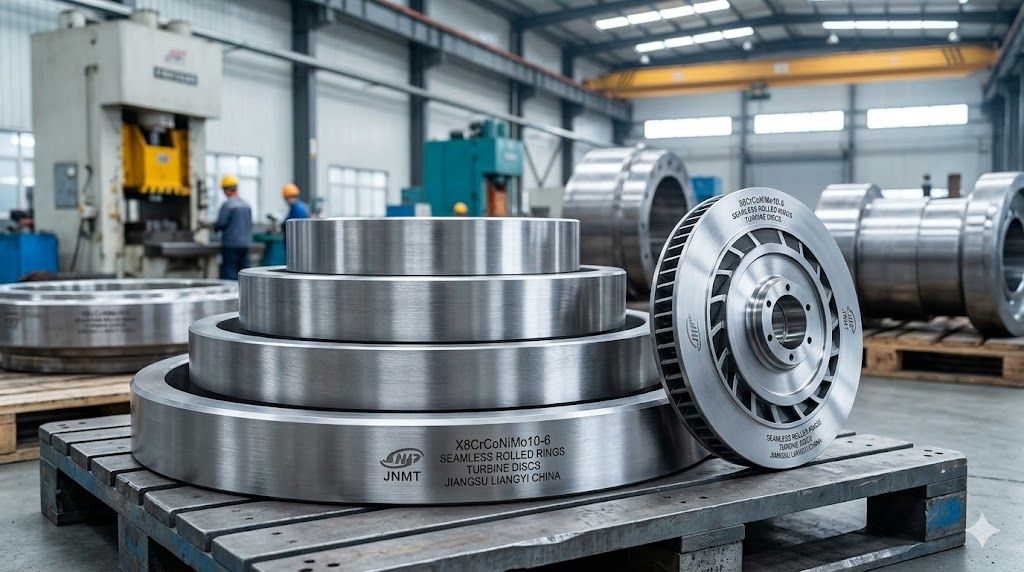
Gas and steam turbine blades, compressor blades, inlet guide vanes (IGV), nozzle segments and diaphragm nozzles that withstand high rotational speeds and temperatures up to 600°C.
Gas turbine rotor shafts, steam turbine shafts, journal bearings and thrust bearings for critical rotating equipment in thermal and combined-cycle power plants.
MSV/GV/CV/CRV valve seats, valve cores, spindles/stems, valve sleeves, spools, main steam valve covers and bonnets for high-pressure steam systems up to 600°C, 30 MPa.
Gas turbine wheels, turbine discs, impellers and blisks that operate under extreme centrifugal forces and thermal cycling stresses in power generation equipment.
LPT 1st & 2nd stage turbine casings, steam turbine shrouds, diaphragm casings, blade fitting rings and rotor end rings for inner and outer casing assemblies.
Seal rings, labyrinth rings, packing seals, oil guards, bearing glands, inner and outer heat shields for turbine and compressor systems operating in hot gas paths.
Global Delivery from Jiangyin, China: We ship 1.4911 and X8CrCoNiMo10-6 forged parts to customers in Germany, USA, UK, France, Italy, Spain, Netherlands, UAE, Saudi Arabia, India, Japan, South Korea, Australia and many other countries. Our Jiangyin location is 80 km from Shanghai Port, enabling fast and cost-effective global shipment.
All 1.4911, X8CrCoNiMo10-6 and Z10CKD10 forged products from our Jiangyin factory are manufactured to international standards with rigorous quality control at every production stage:
Our quality management system is externally certified to ISO 9001:2015 by an independent certification body. We hold various customer-specific technical approvals from global power generation and industrial OEMs — contact us to discuss your specific supplier qualification requirements.
When buying 1.4911 X8CrCoNiMo10-6 forged parts from China, it's important to get the right HS (Harmonized System) customs classification so that the items can be cleared for import, the duty can be calculated, and the trade can be compliant. The code that applies depends on the shape of the product (bar, ring, hollow, or complex part) and whether it has been simply forged or worked on more.
| Product Form | HS Code | Description | Condition |
|---|---|---|---|
| Forged bars, billets, rods (round, square, flat) | 7228.40 | Other bars and rods of other alloy steel, not further worked than forged | Simply forged, as-forged or +QT/+A |
| Forged bars, further machined (turned, ground) | 7228.60 | Other bars and rods of other alloy steel, not further worked than cold-formed or cold-finished / further worked | Rough-machined or finish-machined |
| Seamless forged rings, hollow sections | 7228.80 | Hollow profiles of other alloy steel | Rings and hollows — forged only |
| Forged discs, plates | 7228.40 | Other bars and rods / flat-rolled products — classify as forged flat product | Simply forged |
| Finished machined parts (valves, turbine components) | 7326.19 | Other articles of iron or steel — other (finished forged articles) | Machined to final dimensions / assembled |
Important: HS codes and applicable import duty rates vary by destination country and may change with trade policy updates. The codes above are provided as a general guide based on the Harmonized System 2022 nomenclature. Always verify the correct tariff heading with a licensed customs broker or your country's customs authority before importation. Jiangsu Liangyi provides commercial invoices with HS code declaration as required for China customs export clearance.
1.4911 X8CrCoNiMo10-6 steel forgings are classified as standard alloy steel products under China's export control framework. They do not currently require special export licenses for commercial industrial applications (power generation, oil and gas, petrochemical). For aerospace applications or government-controlled end-users, additional end-user declaration documentation may be required — our export team will advise on a case-by-case basis.
Documentation Provided: Jiangsu Liangyi provides all the paperwork that is needed for export, such as a Commercial Invoice, a Packing List, a Bill of Lading or Air Waybill, a Certificate of Origin (CO) from Jiangyin Chamber of Commerce, an MTC (EN 10204 3.1 or 3.2), and a Phytosanitary Certificate for wooden packing when needed.
Jiangyin Location Advantage: Our factory in Jiangyin, Jiangsu Province occupies 50,000 m² within Chengchang Industry Park. Jiangyin is one of China's most established industrial centres for heavy metal manufacturing. Proximity to Shanghai Port (80 km), Nanjing (140 km) and Wuxi Schiphol International Airport (30 km) ensures excellent logistics options for global shipment.
1.4911 is a cobalt-bearing martensitic creep-resisting steel defined under EN 10302:2008. Its equivalent designations are X8CrCoNiMo10-6 (EN/DIN), Z10CKD10 (French AFNOR) and X8CrCoNiMo106 (alternative notation). The 5–7% cobalt addition distinguishes it from all other 9–12% Cr grades, providing superior creep strength above 550°C and improved HAZ stability during welding.
After quenching and tempering, 1.4911 X8CrCoNiMo10-6 achieves: Tensile strength (Rm) 1000–1140 MPa, 0.2% proof strength (Rp0.2) minimum 850 MPa, elongation minimum 10%, reduction of area minimum 35%, Charpy impact (KV₂ at +20°C) minimum 40 J, hardness 300–350 HB.
At 20°C, the density is 7.75 g/cm³, the elastic modulus is 215 GPa, the shear modulus is 83 GPa, the thermal conductivity is 25.5 W/(m·K), the specific heat is 460 J/(kg·K), and the mean thermal expansion coefficient is 11.2 × 10⁻⁶/K (20–100°C). The elastic modulus drops to about 170 GPa at 600°C, and the thermal conductivity goes up to about 29 W/(m·K). Full temperature-dependent tables are provided in our technical datasheet.
Indicative creep rupture strength of 1.4911 X8CrCoNiMo10-6: at 550°C — 10,000h: ~270 MPa; 100,000h: ~195 MPa. At 600°C — 10,000h: ~155 MPa; 100,000h: ~100 MPa. These values are approximately 30–40% higher than P91 (1.4903) at the same temperatures, confirming the cobalt effect on high-temperature creep performance.
Standard QT heat treatment: Austenitizing at 1050–1100°C (typically 1070°C ± 10°C), hold 1h per 100mm, then oil quench or forced air cool. Tempering at 650–700°C (typically 670°C ± 10°C), minimum 2h per 25mm, minimum 3h total, then air cool. Critical point: tempering temperature must stay below Ac₁ (~820°C). PWHT after welding: 650–680°C, minimum 2h.
Available delivery conditions: +QT (Quenched & Tempered — standard for all structural components), +N+T (Normalized & Tempered — for very large sections where oil quench causes distortion risk), +A (Annealed — for parts requiring further cold working before final QT), +FP (Ferritic-Pearlitic annealed — maximum machinability), +SR (Stress relieved after rough machining). Default supply condition is +QT.
Preheat: 200–300°C minimum for sections >10mm. Maximum interpass temperature: 300°C. Filler: matching composition or Ni-base for dissimilar welds. Hydrogen content: H5 class or lower. PWHT: 650–680°C, minimum 1h per 25mm (min. 2h total). PWHT is mandatory — omitting it leaves untempered martensite (>450 HV) in the HAZ with critically low toughness.
vs P91 (1.4903): 1.4911 has ~30–40% higher creep strength above 550°C due to cobalt. P91 is cheaper and more widely stocked. Choose 1.4911 for >560°C duty. vs P92 (1.4939): Similar creep performance at 600°C; P92 uses tungsten instead of cobalt. 1.4911 has better HAZ behaviour and slightly lower cost than P92. vs E911 (1.4935): 1.4911 has higher creep strength above 575°C. E911 is a cost-effective intermediate grade. vs X20 (1.4922): 1.4911 is significantly superior above 550°C; X20 is mainly found in older European plant <565°C.
The primary HS code for simply forged bars and billets of 1.4911 is HS 7228.40. Seamless forged rings and hollow profiles use HS 7228.80. Rough- or finish-machined bars fall under HS 7228.60. Fully machined finished articles (turbine components, valve bodies) are typically classified under HS 7326.19. Always verify the applicable code with your customs broker for your import country.
Typical lead time for custom 1.4911 X8CrCoNiMo10-6 forgings from our Jiangyin factory is 30–90 days ex-works, depending on part geometry, heat treatment complexity and inspection requirements. Stock items (standard bars) may be available faster. We are 80 km from Shanghai Port — sea freight to Europe is typically 25–35 days transit; to USA East Coast 28–38 days; to Middle East 15–22 days.
We are ready to provide competitive pricing and superior-quality 1.4911, X8CrCoNiMo10-6 and Z10CKD10 forged steel parts for clients worldwide. Send your drawing (DXF, DWG, PDF or STEP), material specification, delivery condition and quantity — our technical team will respond with a detailed quotation and DFM feedback within 24 hours.
Chengchang Industry Park, Jiangyin City, Jiangsu Province, China 214400