1.4878 (X8CrNiTi18-10) Forged Parts | China Professional Forging Manufacturer
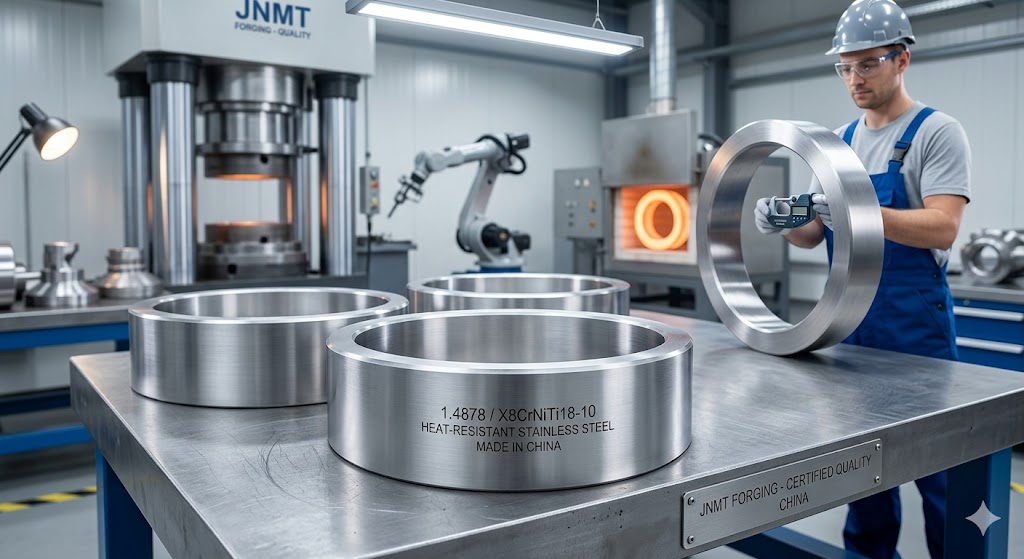
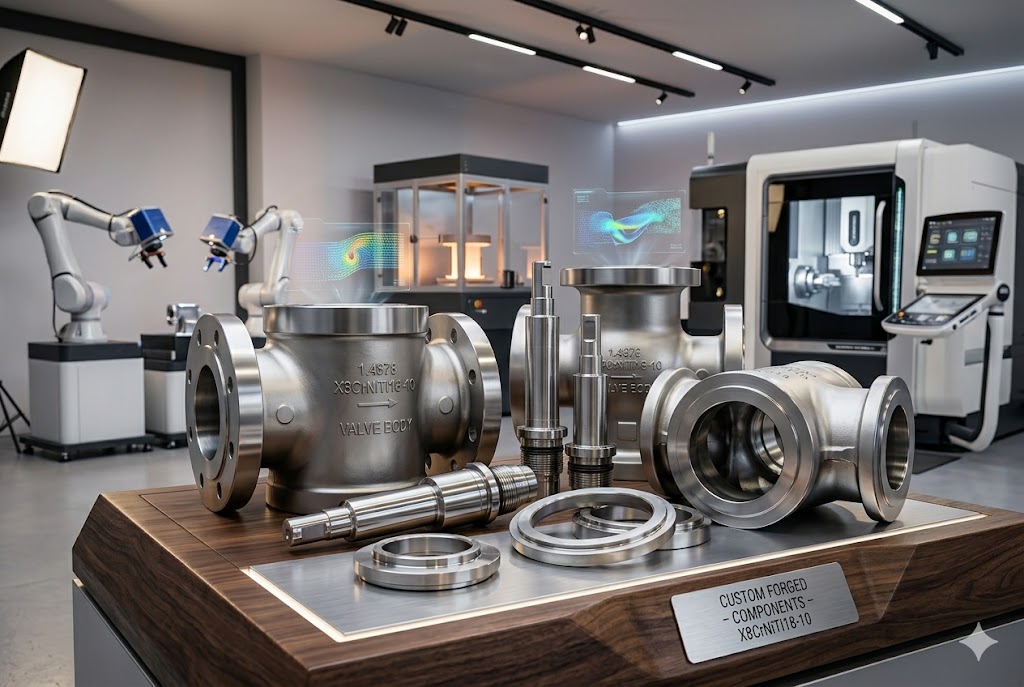
What Is 1.4878 (X8CrNiTi18-10)? Metallurgical Background & Engineering Significance
Jiangsu Liangyi Co., Limited is a professional ISO 9001:2015 certified manufacturer of 1.4878 (X8CrNiTi18-10) open die forged parts and seamless rolled rings in China, with 25+ years of dedicated forging experience. We control every stage from in-house EAF/VOD steel melting through hot forging, solution annealing and CNC machining to final NDE certification. All products are manufactured and tested in accordance with EN 10095 and ASTM A370 standards, and can be documented to API 6A technical specifications upon client request, with EN 10204 3.1 mill test certificates issued as standard for every order.
To fully understand why 1.4878 (X8CrNiTi18-10) exists as a distinct grade, it is necessary to understand the metallurgical problem it was designed to solve. Standard 18-8 austenitic stainless steels (such as 1.4301/304) contain up to 0.08% carbon. When these steels are exposed to temperatures between 450°C and 850°C — a range metallurgists call the "sensitization zone" — chromium preferentially combines with carbon at grain boundaries, forming chromium carbide (Cr₂₃C₆) precipitates. This depletes the grain boundary regions of the chromium needed to maintain the protective passive oxide layer, leaving the steel susceptible to intergranular corrosion attack. This phenomenon, known as weld decay or sensitization, can cause catastrophic failure of welded pressure vessel components in service.
1.4878 (X8CrNiTi18-10) solves this problem through titanium stabilization. Titanium has a far stronger affinity for carbon than chromium does — approximately 10 times stronger thermodynamically. By adding titanium at a minimum ratio of 5×(C+N)% — with typical aim compositions targeting 6–8×%C to provide a working margin — the carbon is locked into stable TiC and TiCN precipitates that form at temperatures above 900°C, well before the sensitization zone is reached. During welding or high-temperature service, there is insufficient free carbon available to form chromium carbides, and the steel retains its full intergranular corrosion resistance across the entire weld heat-affected zone.
The designation X8CrNiTi18-10 precisely encodes the nominal composition: maximum 0.08% Carbon (the "X8" prefix), 18% Chromium, 10% Nickel, with titanium stabilization — forming the same essential alloy as AISI 321 (UNS S32100) under the American system, but governed by the more rigorous EN 10095 heat-resistant steel standard, which applies stricter requirements for high-temperature oxidation resistance and elevated temperature mechanical properties than the general AISI 321 specification.
Key Global Equivalents: 1.4878 (EN) = X8CrNiTi18-10 (EN chemical designation) = AISI 321 / UNS S32100 (ASTM/AISI) = 12X18H9T (Russian GOST) = SUS321 (JIS Japan). While these grades share the same fundamental titanium-stabilized austenitic concept, 1.4878 under EN 10095 mandates dedicated elevated-temperature tensile and oxidation resistance verification that AISI 321 does not — making 1.4878 the required designation for EU pressure vessel design codes and international projects that reference European standards explicitly.
Five Engineering Advantages of 1.4878 (X8CrNiTi18-10) Forged Parts
For engineers and procurement managers specifying materials for high-temperature corrosive service, 1.4878 (X8CrNiTi18-10) forged components offer five specific, measurable advantages over alternative stainless steel grades:
- Weld Heat-Affected Zone (HAZ) Integrity — No Post-Weld Annealing Required: Because titanium stabilization prevents chromium carbide precipitation during welding, the HAZ of a 1.4878 weld joint retains essentially the same intergranular corrosion resistance as the parent base metal. In contrast, unstabilized 304/316 grades require post-weld solution annealing at 1050°C to restore corrosion resistance — which is impractical or impossible for large fabrications, field welds, or components whose geometry prevents uniform furnace heating. For valve bodies, pressure vessel nozzles, and piping components that require field welding, this advantage is decisive and directly reduces fabrication cost and schedule risk.
- Continuous Service to 650°C with Stable Creep Resistance: 1.4878 is classified under EN 10095 as a heat-resisting steel, with validated oxidation resistance data for continuous service at 650°C. The higher chromium (17–19%) combined with titanium stabilization forms a mixed Cr₂O₃-TiO₂ surface oxide scale that is more adherent and less spalling-prone than the pure Cr₂O₃ formed on standard austenitic grades. For intermittent service (thermal cycling environments), the grade withstands peak excursions to 870°C — a critical advantage for components exposed to repeated startup/shutdown thermal cycles over multi-decade operating lifetimes.
- Superior Fatigue Life in Forged vs. Cast Condition: The forging process induces a fibrous, directional grain structure in 1.4878 that aligns the alloy's mechanical anisotropy with the primary stress direction of the finished component. Compared to cast 1.4878 of equivalent composition, our forged components achieve 40–60% higher fatigue life (measured by rotating bending fatigue at 10⁷ cycles) and significantly better Charpy impact toughness at both room and sub-zero temperatures. Internal casting defects — shrinkage porosity, hot tears, and dendrite segregation — are eliminated by our minimum 3:1 forging reduction ratio for bars, and minimum 5:1 for critical pressure-bearing components.
- Consistent Batch-to-Batch Titanium Stabilization Control: Our in-house EAF + LF + VOD steelmaking route gives us direct control of the titanium recovery rate — the parameter most variable and most commonly under-controlled in 1.4878 production by external steel mills. We target Ti:C ratio consistently above 6:1, well above the EN 10095 minimum of 5×(C+N)%. Incoming steel is 100% re-verified by in-house OES before forging, and we issue our MTC based on actual finished-forging composition analysis — not simply passing through the steel mill's own certificate.
- Flexible Multi-Standard Documentation: A 1.4878 forged component from Jiangsu Liangyi can be delivered with EN 10204 3.1 or 3.2 mill test certificates referencing EN 10095, API 6A technical specifications, and NACE MR0175 material compliance — providing the documentation foundation that multinational EPC contractors need for project compliance review across EU, North American, and Middle East requirements. Final regulatory approvals (CE marking, API monogram, nuclear licensing) are the responsibility of the equipment manufacturer or end-user as defined by applicable regulations.
Full Range of Custom 1.4878 (X8CrNiTi18-10) Forged Products
We manufacture custom 1.4878 (X8CrNiTi18-10) forged parts in any shape and specification, with single-piece weight from 30 kg to 30,000 kg, fully per client drawings and EN 10204 3.1/3.2 mill test certification. Our complete product range, supported by our main forged products line, includes:
- Open Die Forged Bars & Stepped Shafts: X8CrNiTi18-10 forged round bars (diameter 50–2,000 mm), square and flat bars, multi-stepped shafts, splined drive shafts, pump shafts, valve spindles, and compressor rotor shafts. Max single-piece length up to 15 meters. Forging reduction ratio ≥3:1 for standard bars, ≥5:1 available for critical rotating components requiring superior fatigue performance. All bar forgings UT-inspected in both longitudinal and transverse scan directions.
- Seamless Rolled Rings & Profiled Rings: 1.4878 seamless forged rings with OD 200–6,000 mm, wall thickness 20–500 mm, ring height 50–1,500 mm, up to 30 tons single-piece weight. Near-net-shape profiled rings (L-section, T-section, U-section) produced to reduce machining waste. Grain flow follows the circumferential direction — the key structural advantage over fabricated welded rings for hoop stress resistance.
- Hollow Cylinders, Sleeves & Heavy-Wall Tubes: 1.4878 forged hollow cylinders, sleeves, bushes, and heavy-wall barrel sections with OD up to 3,000 mm. Produced by piercing or ring rolling with controlled bore concentricity. Suitable for pump barrel sections, valve body blanks, pressure vessel shell segments, and reactor vessel courses.
- Discs, Flanges & Tube Sheets: X8CrNiTi18-10 forged discs (diameter up to 2,500 mm), tube sheets, blind flanges, channel covers, and baffle plates. Tube sheet forgings supplied with machined ligament drilling and full UT inspection per client-specified acceptance level. Disc forgings for impeller blanks supplied with grain flow verified by macroetch examination.
- Custom Complex Shape Forgings: Valve bodies, bonnets, end caps, nozzles, hubs, transition cones, tees, elbows, crosses, housings and any bespoke 1.4878 geometry per client 3D drawings. Free DFM (Design for Manufacturability) review provided for complex forgings to optimize die layout and confirm forgeability.
Chemical Composition of 1.4878 (X8CrNiTi18-10) Per EN 10095 — With Engineering Role of Each Element
All 1.4878 raw material at Jiangsu Liangyi is verified by in-house OES (Optical Emission Spectrometry) against EN 10095 before forging begins. The composition range and the specific metallurgical function of each element — information critical to understanding why 1.4878 performs differently from superficially similar austenitic grades — are explained in the table below:
| Element | EN 10095 Range | Jiangsu Liangyi Aim | Metallurgical Function & Engineering Significance |
|---|---|---|---|
| Carbon (C) | Max 0.10% | 0.04–0.08% | Austenite stabilizer and solid solution strengthener; kept low to minimize chromium carbide sensitization risk. Lower C reduces the titanium quantity needed for stabilization, but too-low C reduces high-temperature creep strength. Our aim range balances both requirements optimally. |
| Silicon (Si) | Max 1.00% | 0.30–0.70% | Improves high-temperature oxidation resistance by contributing to a mixed SiO₂-Cr₂O₃ surface scale with superior adherence at thermal cycling temperatures. Too-high Si reduces toughness and hot workability; our aim range optimizes scale adhesion without compromising forgeability. |
| Manganese (Mn) | Max 2.00% | 0.80–1.50% | Secondary austenite stabilizer that partially reduces the nickel requirement. Combines with sulfur to form MnS (preferable to FeS at grain boundaries), preventing hot cracking during forging. Controlled at aim level to maintain austenite stability without excessive sulfide inclusion content. |
| Phosphorus (P) | Max 0.045% | Max 0.030% | Harmful element: segregates to grain boundaries, reducing intergranular strength, toughness, and SCC resistance. Our VOD refining achieves consistently lower P than the EN limit — particularly important for sour service applications where grain boundary phosphorus segregation accelerates H₂S-induced cracking. |
| Sulfur (S) | Max 0.015% | Max 0.008% | Harmful element: forms low-melting-point sulfide inclusions that cause hot cracking during forging and reduce pitting corrosion resistance (sulfides are preferred pitting initiation sites). Our EAF + LF desulfurization route achieves ultra-low S, significantly below the EN limit, improving both forgeability and corrosion resistance. |
| Nickel (Ni) | 9.0% – 12.0% | 9.5–11.0% | Primary austenite stabilizer — without sufficient Ni, the FCC austenite phase cannot be retained at room temperature. Ni also improves corrosion resistance in reducing acid environments, toughness at sub-zero temperatures, and resistance to chloride stress corrosion cracking relative to lower-Ni grades like standard ferritic stainless steels. |
| Chromium (Cr) | 17.0% – 19.0% | 17.5–18.5% | The primary corrosion protection element. Cr forms a self-healing passive Cr₂O₃ film; minimum ~11% Cr is needed for stainlessness, while 18% provides robust protection across a wide range of oxidizing environments and elevated temperatures. Also forms harmful carbides in unstabilized steels — the precise reason titanium stabilization is essential in this grade. |
| Titanium (Ti) | Max 0.80% (min 5×(C+N)%) | 0.40–0.70%, Ti:C ≥ 6:1 | The defining stabilizing element of 1.4878. Ti has ~10× stronger thermodynamic affinity for C than Cr at sensitization temperatures, forming stable TiC/TiCN above 900°C — consuming available carbon before chromium carbides form in the 450–850°C sensitization zone. Our aim Ti:C ≥ 6:1 (vs. EN minimum of 5:1) provides a safety margin against titanium burn-off variability during steelmaking and forging reheating cycles. |
Why Ti:C Ratio Is More Critical Than Ti% Alone: An absolute Ti content of 0.38% technically appears to "have titanium" — but whether it satisfies the EN 10095 stabilization requirement depends entirely on the corresponding carbon content. A heat with C = 0.08% and Ti = 0.38% fails the minimum Ti:C requirement (0.38/0.08 = 4.75 < 5.0). A heat with C = 0.05% and Ti = 0.30% passes comfortably (0.30/0.05 = 6.0). At Jiangsu Liangyi, we report and control both the absolute Ti% and the calculated Ti:C ratio on every heat certificate — ensuring titanium stabilization is genuinely effective, not merely nominal composition compliance.
Heat Treatment, Mechanical Properties & Elevated Temperature Performance of 1.4878 Forgings
All 1.4878 (X8CrNiTi18-10) forged parts from Jiangsu Liangyi are supplied in the +AT (solution annealed) condition per EN 10095. Solution annealing dissolves any chromium carbides that may have formed during forging reheating, and re-precipitates fine, stable TiC on controlled cooling — restoring optimal titanium stabilization effectiveness and maximum corrosion resistance. Our solution anneal parameters for 1.4878: 1,050°C to 1,100°C, hold time = (section thickness mm ÷ 25 + 30) minutes minimum, followed by rapid water quench to below 150°C within 60 seconds. This quench rate through the 900–600°C range is critical to prevent re-sensitization during cooling — a failure mode that defeats the purpose of titanium stabilization if the cooling rate is inadequate.
Room Temperature Mechanical Properties (Solution Annealed +AT Condition)
| Mechanical Property | EN 10095 Minimum Required | Jiangsu Liangyi Typical Achieved | Test Standard |
|---|---|---|---|
| Tensile Strength (Rm) | 500 – 720 MPa | 530 – 680 MPa | ASTM A370 / EN ISO 6892-1 |
| 0.2% Proof Strength (Rp0.2) | Min 190 MPa | 210 – 280 MPa | ASTM A370 / EN ISO 6892-1 |
| Elongation at Fracture (A5) | Min 40% | 45 – 55% | ASTM A370 / EN ISO 6892-1 |
| Reduction of Area (Z) | Not specified in EN 10095 | Typically 60 – 70% | EN ISO 6892-1 |
| Brinell Hardness (HB) | Max 215 HB | Typically 155 – 185 HB | EN ISO 6506 |
| Charpy Impact Energy (KV, 0°C) | Not specified in EN 10095 | Typically ≥ 150 J | EN ISO 148-1 |
Elevated Temperature Mechanical Properties — The True Performance Differentiator
The room-temperature properties of 1.4878 are similar to standard 304 stainless steel. The real engineering value of 1.4878 becomes measurable only at elevated temperatures, where its EN 10095 heat-resistant classification and titanium stabilization deliver retained strength that general-purpose grades cannot match:
| Test Temperature | 0.2% Proof Strength Rp0.2 | Tensile Strength Rm | Elongation A | Engineering Significance |
|---|---|---|---|---|
| 20°C (Room Temp) | ≥ 190 MPa | 500 – 720 MPa | ≥ 40% | Baseline per EN 10095 |
| 300°C | Approx. 130 – 150 MPa | Approx. 430 – 500 MPa | ≥ 35% | Steam / hot water service |
| 500°C | Approx. 110 – 130 MPa | Approx. 380 – 430 MPa | ≥ 30% | Petrochemical process equipment |
| 600°C | Approx. 95 – 115 MPa | Approx. 340 – 390 MPa | ≥ 28% | Maximum load-bearing continuous service |
| 650°C | Approx. 85 – 100 MPa | Approx. 300 – 360 MPa | ≥ 25% | Maximum oxidation-limited continuous service per EN 10095 |
Note: Elevated temperature values are representative reference data for +AT condition forged material. Jiangsu Liangyi routinely performs elevated temperature tensile testing at client-specified temperatures (typically 650°C per EN 10095 for 1.4878) as part of standard delivery documentation. Actual values vary by heat composition and forging reduction ratio; certified test results are provided with every order.
Mechanical Testing Protocol — Exceeding EN 10095 Minimum Requirements
Our mechanical testing sampling and acceptance protocol for 1.4878 forgings is based on accumulated engineering knowledge of how austenitic ring and disc forgings actually behave in critical applications — and consistently exceeds EN 10095 minimum requirements:
- For disc and ring forgings, all tensile specimens are extracted with the gauge length axis aligned to the tangential (hoop) direction — the direction of highest in-service tensile stress — rather than the radial direction, which would give artificially optimistic elongation results due to favorable grain flow alignment in the extraction direction.
- Critical pressure-bearing disc forgings require a minimum of four tensile specimens per forging: two at room temperature and two at the specified elevated test temperature (650°C standard for 1.4878), extracted at 180° separation within the same temperature group and 90° offset between temperature groups — to detect any circumferential inhomogeneity in mechanical properties across the forging section.
- All tensile specimens are machined to ASTM A370 standard round bar geometry (12.5 mm diameter gauge, 50 mm gauge length), with yield strength determined by the 0.2% offset method per standard. Grip section geometry is verified before testing to prevent grip-zone failures that would invalidate results.
- Brinell hardness testing is performed at 10 locations per part: four points on each face (90° apart circumferentially) and one central or bore-face point — providing a spatial hardness map that reveals any rim-to-bore gradient indicating inconsistent heat treatment quench penetration in thick-section forgings. All three values (average, maximum, minimum) are reported on the certificate.
- For forgings above 200 mm maximum section thickness, we perform supplementary ultrasonic velocity measurements as an indirect verification of heat treatment effectiveness — a proprietary in-house quality control step not required by EN 10095, implemented based on our production experience with thick-section 1.4878 forgings.
1.4878 vs. Competing Stainless Steel Grades — Detailed Comparison for Design Engineers
Engineers specifying titanium-stabilized or heat-resistant austenitic grades frequently encounter multiple competing options. The following objective comparison supports informed material selection:
| Property / Parameter | 1.4878 (X8CrNiTi18-10) | 1.4541 (X6CrNiTi18-10) | 1.4301 (304) | 1.4404 (316L) | AISI 321 (UNS S32100) |
|---|---|---|---|---|---|
| Governing Standard | EN 10095 (heat-resisting) | EN 10088 (general stainless) | EN 10088 | EN 10088 | ASTM A240 / A276 |
| Carbon (C), max% | 0.10% | 0.08% | 0.07% | 0.03% | 0.08% |
| Chromium (Cr)% | 17.0 – 19.0% | 17.0 – 19.0% | 17.5 – 19.5% | 16.5 – 18.5% | 17.0 – 19.0% |
| Nickel (Ni)% | 9.0 – 12.0% | 9.0 – 12.0% | 8.0 – 10.5% | 10.0 – 13.0% | 9.0 – 12.0% |
| Molybdenum (Mo)% | None | None | None | 2.0 – 2.5% | None |
| Titanium Stabilized? | Yes — Ti ≥ 5×(C+N)% | Yes — Ti ≥ 5×(C+N)% | No | No (low C only) | Yes — Ti ≥ 5×(C+N)% |
| Elevated Temp. Properties in Standard? | Yes (EN 10095 required) | No | No | No | Optional in ASTM |
| Max Continuous Service Temp. (oxidation) | 650°C | 600°C (conservative limit) | 425°C | 400°C | ~600–650°C |
| Weld Sensitization Risk | None (Ti stabilized) | None (Ti stabilized) | High — PWHT required | Low (very low C) | None (Ti stabilized) |
| Chloride Pitting Resistance (PRE approx.) | ~18 | ~18 | ~18 | ~24 (Mo contribution) | ~18 |
| Ideal Application Temperature Range | 450°C – 650°C critical service | Up to 550°C welded fabrication | Up to 425°C general service | Up to 400°C, chloride environments | Similar to 1.4878 (ASTM projects) |
1.4878 vs. 1.4541 — The Critical Distinction: Both are titanium-stabilized 18-10 austenitic steels with nearly identical nominal compositions. The decisive difference is that 1.4878 is governed by EN 10095 (heat-resisting steel standard), which requires and validates elevated temperature tensile property testing, explicitly confirming fitness for high-temperature service. 1.4541 is governed by EN 10088 (general stainless steel standard), which provides no such validation. If your project specification, pressure vessel design code, or client PO references EN 10095, you must use 1.4878 — a 1.4541 MTC does not satisfy the requirement regardless of how similar the composition appears on paper. For components designed for continuous service above 550°C, always specify 1.4878 by its EN 10095 standard number, not simply by composition.
Forged vs. Cast 1.4878 (X8CrNiTi18-10) — Why Forging Is Specified for Critical-Service Components
A significant share of our enquiries involve clients evaluating whether to upgrade from cast to forged 1.4878, or who have received both forged and cast proposals from competing suppliers. The following comparison is based on genuine, engineering-verified performance differences across 25+ years of critical-service supply:
| Performance Parameter | Forged 1.4878 (Jiangsu Liangyi) | Cast 1.4878 (Investment or Sand Cast) |
|---|---|---|
| Internal Microstructure | Fine, equiaxed austenitic grains (ASTM grain size 5–8) with fibrous grain flow aligned to part geometry. Zero porosity, zero dendrite segregation. | Coarse dendritic solidification structure (ASTM grain size 1–3) with microsegregation of Ti, Cr, and Ni between dendrite cores and interdendritic regions. |
| 0.2% Proof Strength at RT | Typically 210–280 MPa | Typically 170–200 MPa |
| Tensile Strength at RT | 530–680 MPa | 480–550 MPa |
| Fatigue Life (rotating bending, 10⁷ cycles) | 40–60% higher — closed porosity, fibrous grain flow alignment eliminate crack initiation sites | Fatigue cracks initiate at shrinkage pores, oxide inclusions, and grain boundary films |
| Charpy Impact Toughness | ≥ 150 J at 0°C typical; consistent across section | 50–100 J typical; significant scatter due to microstructural inhomogeneity |
| Pressure Code Allowable Stress | Full ASME/EN wrought allowable stress values apply | Cast allowable stresses are 20–25% lower than wrought per ASME/EN codes — requiring heavier wall thickness for equivalent pressure rating |
| Titanium Stabilization Uniformity | Uniform Ti distribution throughout — consistent stabilization performance across full section | Ti segregates preferentially to dendrite cores, leaving Ti-depleted interdendritic zones that may sensitize in service despite nominal composition compliance |
| UT Inspection Pass Rate | >99% first-pass acceptance on our production | Typically 80–95%; shrinkage porosity and hot tears cause rejections and re-work |
| Single-Piece Weight Range | 30 kg – 30,000 kg | Investment cast: typically <50 kg; sand cast: up to several tons with increasing defect risk at larger sizes |
Physical & Thermal Properties of 1.4878 (X8CrNiTi18-10) — Data Engineers Need for Design Calculations
Beyond mechanical properties, design engineers performing thermal stress analysis, heat exchanger design, or finite element modeling of 1.4878 (X8CrNiTi18-10) forged components require accurate physical and thermal property data across the service temperature range. The following data is representative of solution-annealed forged 1.4878 material. Note that most general material databases only provide room-temperature values — engineers designing for elevated temperature service must use temperature-dependent data to avoid systematic errors in thermal stress and heat transfer calculations:
| Physical / Thermal Property | 20°C (RT) | 200°C | 400°C | 600°C | Unit | Design Significance |
|---|---|---|---|---|---|---|
| Density (ρ) | 7.90 | 7.83 | 7.73 | 7.62 | g/cm³ | Weight and inertia calculations for rotating components; decreases ~3.5% from RT to 600°C |
| Melting Range | 1,400°C – 1,450°C (solidus–liquidus) | °C | Forging reheating temperature (1,150–1,200°C) is ~80% of solidus — ensures adequate hot ductility without incipient melting | |||
| Specific Heat Capacity (cp) | 490 | 515 | 545 | 580 | J/(kg·K) | Thermal mass calculations; higher cp at elevated temperature means more heat energy stored per unit mass — relevant for quench system sizing and transient thermal analysis |
| Thermal Conductivity (λ) | 14.0 | 16.5 | 18.5 | 21.0 | W/(m·K) | Approximately 25–30% lower than carbon steel at RT — a critical factor in heat exchanger tube sheet and barrel wall thermal calculations. 1.4878 actually improves conductivity with temperature (unlike carbon steel), narrowing the gap at 600°C |
| Mean Thermal Expansion Coefficient (α, 20°C to T) | — | 16.0×10⁻⁶ | 17.0×10⁻⁶ | 18.5×10⁻⁶ | K⁻¹ | ~50% higher than carbon steel — critical for calculating differential thermal expansion in dissimilar-metal assemblies, nozzle-to-shell connections, and valve seat sealing geometry at operating temperature. Underestimating expansion leads to joint leakage or component distortion |
| Modulus of Elasticity (E) | 200 | 185 | 170 | 155 | GPa | Stiffness for deflection calculations; decreases ~22% from RT to 600°C — stiffness-critical designs (valve stems, pump shafts) must use temperature-reduced modulus in finite element models for elevated temperature service conditions |
| Electrical Resistivity (ρ_e) | 0.72 | 0.90 | 1.05 | 1.15 | μΩ·m | ~5–7× higher than carbon steel at RT — relevant for eddy current NDE inspection setup (eddy current probe frequency must be reduced for higher-resistivity materials); also affects electromagnetic compatibility in sensor housings |
| Magnetic Permeability (μ_r) | ~1.003–1.010 (essentially non-magnetic in annealed condition) | — | Non-magnetic behavior is essential for MRI-adjacent applications and electromagnetic valve actuators; cold-worked zones near machined surfaces may show slightly elevated permeability (up to 1.02) without affecting bulk behavior | |||
| Poisson's Ratio (ν) | 0.28–0.30 (essentially constant with temperature) | — | Used in multi-axial stress analysis; similar to other austenitic stainless steels | |||
Critical Design Note — Thermal Expansion Mismatch: When 1.4878 (X8CrNiTi18-10) forged components are assembled with carbon steel or low-alloy steel counterparts (common in mixed-material pressure vessels and valve bodies), the 50% higher thermal expansion coefficient of 1.4878 creates significant differential expansion during heat-up. At a temperature rise of 400°C, the differential linear expansion between 1.4878 (α ≈ 17×10⁻⁶ K⁻¹) and carbon steel (α ≈ 11×10⁻⁶ K⁻¹) over a 500 mm component length is approximately 1.2 mm — enough to alter flange bolt pre-load, valve seat contact pressure, and nozzle-to-shell stress significantly. Our engineering team is available to review dissimilar-material assembly designs and flag thermal compatibility issues before fabrication.
1.4878 (X8CrNiTi18-10) Corrosion Resistance in Specific Chemical Environments
Specifying 1.4878 on the basis of generic "stainless steel corrosion resistance" without verifying its performance in the actual process fluid is one of the most common — and costly — material selection errors in the chemical process industry. The following corrosion resistance data table provides practical guidance for the most common process environments where 1.4878 forgings are considered. Ratings are based on published corrosion testing data and our engineering experience across 25+ years of customer applications. Note that corrosion rates are highly sensitive to exact concentration, temperature, velocity, and the presence of trace contaminants — always confirm with application-specific coupon testing for critical services:
| Chemical Environment | Concentration Range | Temperature Range | 1.4878 Performance | Typical Corrosion Rate | Key Limitation / Note |
|---|---|---|---|---|---|
| Nitric Acid (HNO₃) | Up to 65% | RT – 80°C | ✅ Excellent | <0.1 mm/year | 1.4878 is a preferred material for nitric acid service; titanium stabilization prevents sensitization in welded fabrications. Above 65% concentration or boiling conditions, verify with testing |
| Sulfuric Acid (H₂SO₄) | Dilute (<5%) or concentrated (>93%) | RT – 40°C | ⚠️ Limited / Conditional | Varies widely — 0.1 to >1 mm/year depending on concentration | 1.4878 performs acceptably in very dilute (<5%) or near-concentrated (>93%) H₂SO₄ at low temperature. Intermediate concentrations (10–80%) are highly corrosive — use higher-alloy grades (Hastelloy C-276, Alloy 20) for these services |
| Phosphoric Acid (H₃PO₄) | Up to 85% | RT – 60°C | ✅ Good to Excellent | <0.2 mm/year (pure acid); higher with fluoride contamination | Performance depends critically on fluoride (F⁻) contamination — even 50 ppm F⁻ in phosphoric acid dramatically increases attack rate on 1.4878. Wet-process phosphoric acid with fluoride requires 316L or higher Mo-containing alloys |
| Naphthenic Acid (Crude Oil Fractions) | TAN >0.5 mg KOH/g crude | 230°C – 400°C | ✅ Good (superior to 304, 316L without Ti) | <0.25 mm/year in TAN up to 2.0 | 1.4878 outperforms unstabilized 304 and 316L in naphthenic acid service due to titanium stabilization preventing grain boundary attack at elevated temperature. High-velocity zones (>30 m/s liquid) require evaluation for erosion-corrosion contribution |
| Acetic Acid (CH₃COOH) | Up to 99% (glacial) | RT – 120°C | ✅ Excellent | <0.05 mm/year | One of the strongest performing environments for 1.4878 — titanium stabilization prevents the sensitization-induced attack that is common in 304 in acetic acid service with any temperature cycling. Standard choice for acetic acid process equipment |
| Formic Acid (HCOOH) | Up to 50% | RT – 80°C | ✅ Good | <0.1 mm/year | Generally satisfactory up to 50% concentration at moderate temperature. Aerated formic acid or concentrations above 50% at elevated temperature require specific coupon testing |
| Sodium Hydroxide (NaOH) | Up to 50% | RT – 80°C | ✅ Excellent | <0.05 mm/year | 1.4878 is fully resistant to sodium hydroxide in this range. At concentrations above 50% or temperatures above 80°C, stress corrosion cracking risk increases; evaluate with operating stress levels |
| H₂S + CO₂ (Sour Gas / Brine) | H₂S partial pressure >0.0003 MPa | Up to 177°C (350°F) | ✅ Good (meets NACE MR0175/ISO 15156 Part 3 material requirements) | Minimal uniform corrosion; SSC resistance depends on hardness compliance | 1.4878 austenitic structure provides inherent SSC resistance; compliance with NACE MR0175 Part 3 requires HB ≤ 215 and heat treatment verification. Above 177°C or with elemental sulfur, evaluate specific case conditions |
| Seawater / Chloride-Containing Brines | Up to 3.5% NaCl (seawater) | RT – 60°C | ⚠️ Conditional — pitting risk | Pitting initiation risk in stagnant conditions above ~35°C; low uniform corrosion rate | 1.4878 is susceptible to pitting and crevice corrosion in chloride-containing solutions, particularly at elevated temperature or in stagnant/low-velocity zones. PRE ~18 is insufficient for aggressive seawater service — use 316L (PRE ~24) or duplex grades (PRE >34). 1.4878 is acceptable for intermittent seawater contact in low-temperature piping systems |
| High-Purity Water (Boiler Feed / Nuclear PWR) | Dissolved O₂ <10 ppb (controlled) | 280°C – 325°C | ✅ Excellent (with chemistry control) | Negligible general corrosion; low SCC risk with controlled chemistry | 1.4878 performs well in controlled reactor coolant chemistry (borated water, lithium hydroxide adjusted pH 7.2). Requires avoidance of chloride contamination above 0.1 ppm in reactor coolant — chloride-induced SCC is the primary risk in this environment |
| Industrial Atmospheres (Rural, Urban, Coastal) | Atmospheric exposure | –20°C to 650°C | ✅ Excellent | Essentially nil — self-passivating | 1.4878 is fully corrosion resistant in all atmospheric environments including industrial and coastal atmospheres. Surface appearance remains bright; no protective coating required for atmospheric service |
Global GEO Compliance & Regional Certification — Solving Real Market-Specific Challenges
Our 1.4878 (X8CrNiTi18-10) forged parts are certified for all our core export markets. More importantly, we understand that regional compliance is not just about meeting specifications on paper — it is about solving the actual procurement approval challenges our clients face in each geography:
🇪🇺 European Union Market
- EN 10204 3.1 / 3.2 MTC: Our standard delivery includes EN 10204 3.1 mill test certificates covering all required EN 10095 data. EN 10204 3.2 (independent third-party witness inspection) can be arranged with TÜV, Bureau Veritas, DNV, or other client-nominated accredited inspection agencies — a key requirement for EU pressure equipment projects that we facilitate at the client's request.
- Full EN 10095 Technical Compliance: Our forgings are manufactured and tested strictly per EN 10095, with MTCs reporting all required data including Ti:C ratio and elevated temperature (650°C) tensile test results. CE marking under PED 2014/68/EU is the legal responsibility of the equipment manufacturer (our client); we provide the fully compliant material and documentation package needed to support that marking process.
- Long-Term EU Customer Supply: We have supplied 1.4878 forged components to valve manufacturers in Germany, heat exchanger fabricators in Italy, and LNG equipment suppliers in France and the Netherlands. References available upon request.
- REACH Compliance Documentation: Full REACH Regulation (EC No. 1907/2006) SVHC declaration available for all 1.4878 deliveries to EU clients requiring green procurement compliance documentation.
🇺🇸🇨🇦 North America Market
- API 6A Technical Standard Compliance: Our 1.4878 forgings for wellhead and Christmas tree applications are manufactured and tested per API 6A technical specifications (chemical composition, mechanical properties, NDE, heat treatment). API 6A product certification (monogram license) is granted by API to equipment manufacturers — we provide fully compliant forging material and documentation that supports our clients' own API 6A equipment qualification.
- ASME BPVC Material Compliance: Material test certificates can reference ASME BPVC Section II, Part A equivalent material grades (SA-182/SA-336 equivalent) allowing EPC contractors to document compliance with ASME pressure vessel codes with our forging material.
- NACE MR0175 / ISO 15156 Material Compliance: 1.4878 forgings for H₂S-containing service meet the material requirements of NACE MR0175/ISO 15156 Part 3, with hardness compliance (HB ≤ 215) documented on the MTC. SSC test data (NACE TM0177 Method A) available from accredited third-party laboratories upon client request.
- North America Customer Supply: We have supplied 1.4878 forged components to pump and valve OEMs in the USA and Canada. References available upon request.
🇸🇦🇦🇪 Middle East Market
- Middle East Oil & Gas Documentation Experience: We are experienced in preparing material documentation packages that align with the supplementary requirements commonly added by Middle East national oil companies (such as SAES, ADNOC AGES) to base API specifications. We can structure our MTC, inspection reports, and quality records to the format and scope that these clients' ITPs (Inspection and Test Plans) typically require — helping our clients through their own supplier qualification processes.
- NACE MR0175 / API 6A Material Compliance: 1.4878 forgings meet the material requirements of NACE MR0175/ISO 15156 Part 3 for sour service, with hardness verification (HB ≤ 215) and documentation of heat treatment condition. HIC test reports per NACE TM0284 and SSC test reports per NACE TM0177 available from accredited third-party laboratories upon client request.
- High-Temperature H₂S/CO₂ Corrosion Resistance: 1.4878's austenitic structure provides resistance to SSC and HIC mechanisms in H₂S environments; 18% Cr delivers CO₂ corrosion resistance — making it technically suitable for sour gas wellhead and process piping applications in the Middle East.
- Middle East Customer Supply: We have supplied 1.4878 forged components to equipment manufacturers serving oilfield projects in Saudi Arabia, UAE, Kuwait, and Oman. References available to qualified clients upon request.
🌏 Asia Pacific Market
- Japan (JIS Compliance): Material documentation cross-referenced to JIS SUS321 equivalent with chemical composition and mechanical property data in JIS-compatible format. We supplied 1.4878 forgings for Japanese engineering companies for power generation and chemical plant equipment. References available by request.
- South Korea & Power Generation: We have supplied 1.4878 forged components to South Korean equipment manufacturers for power plant applications. Our standard full NDE package (UT, PT, MT, RT) and EN 10204 documentation are compatible with the quality plan requirements of major South Korean EPC and equipment companies. Nuclear power plant component qualification is a highly regulated, project-specific process governed by national nuclear regulators — clients requiring nuclear-grade qualification should discuss their specific project requirements with us at enquiry stage.
- Australia (AS/NZS Standards): Material compliance documentation to Australian Standards for pressure vessel applications, with APVAS (Australian Pressure Vessel Accreditation Scheme) documentation support for local compliance authorities.
- Southeast Asia Regional Supply: Full EN 10204 3.1/3.2 MTC certification for deliveries to Singapore, Thailand, Malaysia, Vietnam, and Indonesia; local third-party inspection coordination available through our established regional network of accredited agencies.
End-to-End Manufacturing Process — Six Stages of 1.4878 Quality Assurance
The quality of a 1.4878 forged component is determined by the cumulative control exercised at every stage from raw material to final inspection — not by a single final test. Our in-house manufacturing facilities give us direct ownership of each critical step:
- Stage 1 — Steelmaking (EAF + LF + VOD): Our 30-ton Electric Arc Furnace (EAF) melts verified-composition charge materials. The Ladle Refining Furnace (LF) performs desulfurization (targeting S ≤ 0.008%), precise alloy additions, and temperature homogenization. The VOD (Vacuum Oxygen Decarburization) furnace performs final decarburization under vacuum — critical for 1.4878 because vacuum conditions prevent titanium oxidation during the deoxidation stage, which is the most common cause of low Ti recovery rates in external steel mill production. Ti:C ratio is calculated and verified in-melt before casting, with additional Ti additions made if the ratio is below our 6:1 target.
- Stage 2 — Incoming Material Verification: External-sourced 1.4878 billets or ingots receive full 8-element OES composition analysis within 24 hours of receipt. We specifically verify the Ti:C ratio — not only the absolute Ti% — before any forging authorization is issued. Material failing our internal acceptance criteria is rejected regardless of the supplying mill's MTC.
- Stage 3 — Forging Process Control: 1.4878 is forged at a reheating temperature of 1,150-1,200°C, which is above the TiC dissolution temperature to ensure titanium is in solution during deformation, but below the delta-ferrite formation range. Our forging process sheets give reheating time, furnace atmosphere (slightly reducing to minimize surface Ti oxidation), minimum reduction ratios per forging shape, finish forging temperature minimum (950°C) and intermediate reheating procedures for heavy-section parts. The geometry of each new part is reviewed and approved by our metallurgical engineering team, with process sheets issued before production begins.
- Stage 4 — Solution Annealing with Process Recording: Conducted in calibrated, computer-controlled furnaces with continuous recording by thermocouple of the actual metal temperature (not furnace gas temperature). Quench tank water temperature, circulation rate, and time from furnace door opening to full immersion are observed and recorded. We provide clients with full process records (time-temperature charts, quench log) as part of our heat treatment certificate – a specific record of the actual process, not a generic pass/fail statement.
- Stage 5 — CNC Machining with Austenitic-Specific Tooling: Our CNC turning, milling, boring, and grinding operations for 1.4878 use optimized tooling geometry and cutting parameters for austenitic stainless — specifically addressing work hardening tendency and built-up edge formation that degrade surface finish and dimensional accuracy. Critical surfaces are measured by CMM (Coordinate Measuring Machine) to verify tolerances (typically ±0.05 mm on bore and OD for finish-machined valve and pump components).
- Stage 6 — Full NDE and Final Inspection Authorization: 100% dimensional CMM inspection, OES re-analysis on the actual forging, full UT per EN 10228-3, Brinell hardness survey, mechanical test result verification from production test prolongations, and surface NDT — all completed, documented, and internally reviewed before any shipping authorization is issued. No component ships without a complete, internally approved inspection package.
Industry Applications — Engineering Rationale & Verified Global Project References
The following section explains not only what 1.4878 (X8CrNiTi18-10) is used for, but why its specific metallurgical properties make it the engineered-correct choice for each application — supported by verified project cases from our production history:
Oil & Gas Upstream & Downstream — Engineering Rationale
Oil and gas wellhead environments subject materials to two primary corrosion mechanisms: H₂S-induced Sulfide Stress Cracking (SSC) and CO₂-induced uniform and pitting corrosion. The austenitic microstructure of 1.4878 provides inherent resistance to hydrogen embrittlement and SSC at hardness levels maintained by standard solution annealing (HB ≤ 215 as-delivered). The 17–19% Cr content provides the passive film stability needed to resist CO₂ corrosion in brine-containing wellbore environments. Titanium stabilization prevents weld HAZ sensitization in field-welded wellhead spools, where post-weld heat treatment is geometrically impractical. Our wellhead products include: casing heads, tubing heads, casing and tubing hangers, spacer spools, Christmas tree bodies, double-studded adapter flanges (DSAF), integral mud line flanges, and ESP motor housings and splined drive shafts. We have supplied 1.4878 forged wellhead components to equipment manufacturers serving oilfield projects in Saudi Arabia, UAE, and other Middle East markets, with all deliveries manufactured and documented per API 6A technical specifications and NACE MR0175 material requirements. References from our oil and gas equipment manufacturer clients are available to qualified enquirers upon request.
Industrial Valve Manufacturing — Engineering Rationale
Valve bodies and bonnets handling aggressive fluids at elevated temperatures face a specific failure mode that makes titanium stabilization essential: weld decay in the heat-affected zones surrounding body-to-flange and body-to-bonnet welds. During valve assembly welding, the local thermal cycle exposes a zone of base metal to 450–850°C — precisely the sensitization range. In an unstabilized 304-type body, this creates a ring of intergranular corrosion susceptibility at the highest fluid-contact location. A 1.4878 body is immune because titanium prevents carbide precipitation regardless of the weld thermal cycle. Our valve products include: full-bore and reduced-bore valve bodies, bonnets, profiled seat ring blanks, valve balls (solid and hollow), stems, closures, gate valve wedge discs, butterfly valve spindles, and check valve swing disc forgings. We have supplied 1.4878 forged valve blanks to industrial valve manufacturers in Germany, Italy, and other EU countries, with all deliveries passing EN 10228-3 UT inspection and accompanied by EN 10204 3.1 mill test certificates. References from our valve manufacturer clients are available upon request.
Nuclear & Thermal Power Generation — Engineering Rationale
Nuclear and thermal power environments impose simultaneous demands that few material grades satisfy together: resistance to high-purity water corrosion (reactor coolant at 300–320°C with dissolved oxygen, lithium hydroxide, and boric acid), dimensional stability over 40–60 year design lifetimes, and compatibility with neutron irradiation environments. The austenitic structure of 1.4878, with its controlled fine grain size (ASTM 5 or finer in our forged product), provides excellent resistance to stress corrosion cracking in reactor coolant chemistry, while its relatively moderate nickel content compared to nickel alloys reduces neutron activation concerns in PWR environments. Our nuclear and power generation products include: reactor coolant pump (RCP) casing segments, seal chamber forgings, centrifugal compressor impeller blanks, venturi cone meter bodies, ultrasonic flow meter bodies, and heat exchanger channel cover blanks. We have supplied 1.4878 forged components to equipment manufacturers serving power generation projects in South Korea and Southeast Asia, with full NDE documentation packages. Clients requiring nuclear-grade qualification or special nuclear quality programs should discuss their specific project requirements with us at enquiry stage, as nuclear component qualification is a project-specific regulatory process. References from our power generation equipment clients are available to qualified enquirers.
Petrochemical & Heat Exchange Equipment — Engineering Rationale
The combination of high temperature and naphthenic acid corrosion represents one of the most challenging material selection problems in petroleum refining. Naphthenic acids (naturally occurring organic acids in crude oil fractions) become aggressively corrosive above 230°C in high-velocity liquid flow — particularly in vacuum distillation column overhead condensers, heat exchanger shells, and reactor effluent cooler headers. Corrosion rate increases sharply above 275°C and peaks around 370–400°C in high TAN (Total Acid Number) crude service. 1.4878's 18% Cr content and titanium stabilization both contribute to naphthenic acid resistance — a critical advantage over 316L (molybdenum without Ti stabilization) and 304 (neither) in this service. Our petrochemical products include: heat exchanger tube sheets with machined ligament drilling, channel flanges, pressure vessel nozzle forgings, reactor nozzle inserts, boiler drum forged shell sections, and reboiler kettle body flanges. We have supplied 1.4878 forged tube sheets and pressure-bearing components to heat exchanger and pressure vessel fabricators serving petrochemical projects in Southeast Asia, with full room temperature and elevated temperature mechanical testing completed as part of the standard delivery documentation. References are available to qualified enquirers upon request.
Pump & Rotating Machinery — Engineering Rationale
Centrifugal pump impellers and shafts in corrosive service face combined cavitation erosion (mechanical) and corrosion (chemical) attack — a synergistic mechanism that accelerates metal loss faster than either mode alone. The austenitic structure of 1.4878 provides better resistance to this combined cavitation-corrosion mechanism than duplex stainless grades in some environments, and far superior resistance compared to carbon steel. The fine, uniform grain structure achievable in forged 1.4878 impellers improves fatigue resistance under alternating pump pressure loads — critical for impellers operating at high specific speed with exposure to cavitation events. Our pump and machinery products include: centrifugal pump impeller forgings (closed and open type), pump casings and barrel sections, pump shafts, wear ring blanks, compressor housing segments, swept branch pipe forgings, and flanged boss forgings. We have supplied 1.4878 forged pump components — including impeller blanks and shaft forgings — to pump OEMs in North America and Europe for corrosive process applications including acid service and water injection. References from our pump manufacturer clients are available upon request.
Production Standards Reference Matrix & Full NDE Certification Scope
International Standards Governing Our 1.4878 Forging Production
All 1.4878 (X8CrNiTi18-10) forged parts are manufactured, tested, and certified in accordance with the following international standards — each serving a specific function in our quality framework:
- EN 10095: 1999 — Primary governing standard: Heat Resisting Steels and Nickel Alloys. Defines composition limits, elevated temperature tensile requirements, heat treatment conditions, and test procedures specific to 1.4878. This standard classification distinguishes 1.4878 from the general-purpose 1.4541 and is the foundation of the heat-resisting certification that most critical-service client specifications require.
- EN 10297-2: 2005 — Technical delivery conditions for seamless stainless steel tubes, applicable to our 1.4878 forged hollow cylinder and sleeve products.
- EN 10088-1: 2005 — Reference list of stainless steels providing EN cross-references between 1.4878 and related grades.
- EN 10228-3 — Non-destructive testing of steel forgings: Ultrasonic testing. Defines UT inspection classes 1–4 and acceptance criteria for forged shapes. We apply Class 3 as our minimum standard, with Class 4 available for critical-service components upon client request.
- EN 10204 — Material test certificate types: 3.1 (manufacturer's own inspection representative, issued as standard) and 3.2 (independent third-party inspector witness, arranged upon order request with TÜV, BV, SGS, DNV, or Intertek).
- ASTM A370 — Mechanical Testing of Steel Products. Referenced for all tensile tests to allow direct comparison in ASTM-standard projects and enable dual EN/ASTM certification.
- API 6A (22nd Edition) — Specification for Wellhead and Christmas Tree Equipment. Applicable to all 1.4878 oil and gas wellhead forgings; PSL-specific documentation and supplemental requirement (SR) testing included.
- NACE MR0175 / ISO 15156 — Materials for use in H₂S-containing environments. Referenced for sour service 1.4878 documentation, including hardness limit verification and SSC/HIC test requirements for deep gas well applications.
Full-Process NDE & Quality Inspection — Every Forging, Every Time
- Dimensional Inspection: 100% verification against client drawings using calibrated gauges and CMM for machined parts. Inspection records retained for minimum 10 years per our QMS records retention policy.
- Chemical Composition Re-Verification: OES re-analysis on a specimen machined from the actual finished forging – confirming composition including Ti:C ratio is maintained after forging and heat treatment, not relying on the original ingot heat analysis.
- Ultrasonic Testing (UT): 100% volumetric UT per EN 10228-3 with scan pattern and probe frequency optimized for each forging geometry. Bar and shaft forgings scanned in both longitudinal and transverse directions. Ring and disc forgings scanned from both flat faces and cylindrical surfaces. UT maps recorded and retained per forging.
- Mechanical Property Testing: Full room temperature tensile (Rm, Rp0.2, A, Z) plus elevated temperature tensile at 650°C from each heat/heat treatment charge. Brinell hardness at 10 points per forging as detailed in our testing protocol above.
- Surface NDE: Liquid Penetrant Testing (PT) per EN ISO 3452 as standard for accessible surfaces. Magnetic Particle Testing (MT), Radiographic Testing (RT), and Phased Array UT (PAUT) available for client-specified critical geometries.
- Intergranular Corrosion Test (IGC): Strauss test per ASTM A262 Practice E or EN ISO 3651-2 available on client request — the definitive direct verification that titanium stabilization is effective in the finished forging. Strongly recommended for any 1.4878 destined for welded pressure vessel applications.
- Third-Party Inspection: TÜV, SGS, Bureau Veritas, DNV, Intertek, and other accredited agencies welcome for witness inspection at any manufacturing stage. Our team manages inspector scheduling, site access, and documentation logistics to minimize project schedule impact.
ASME & EN Design Allowable Stress Values for 1.4878 (X8CrNiTi18-10) Forgings
Design engineers calculating pressure ratings and wall thicknesses for 1.4878 forged components under ASME BPVC or EN pressure vessel codes need the temperature-dependent design allowable stress values (Sm or f values). The following table provides representative design stress values for 1.4878 / AISI 321 stainless steel per ASME Section II, Part D (Table 1A for wrought austenitic stainless steel forgings) and the corresponding EN 13445 time-independent design stress values. These values are for design reference — always reference the edition of the applicable code in effect for your specific project, as allowable values are subject to code cycle updates:
| Design Temperature | ASME Sm (Section III) / S (Section VIII Div.1) | EN 13445 fd (time-independent) | Comparison vs. 304 (1.4301) | Comparison vs. 316L (1.4404) | Engineering Implication |
|---|---|---|---|---|---|
| 20°C (RT) | ~115 MPa (Div.1 S value) | ~165 MPa (fd = Rp0.2/1.5) | Similar (+0 to +5%) | Similar (–5 to 0%) | RT allowables are essentially equivalent among 304, 316L, and 321 — grade selection at RT is driven by corrosion, not stress allowable |
| 300°C | ~96 MPa | ~100 MPa | +8 to +12% vs. 304 | +3 to +8% vs. 316L | 1.4878 begins to demonstrate higher retained strength advantage vs. general-purpose grades at 300°C |
| 400°C | ~82 MPa | ~88 MPa | +10 to +15% vs. 304 | +5 to +10% vs. 316L | At 400°C, the advantage of EN 10095 material vs. general-purpose grades becomes measurable — allows thinner wall thickness for the same pressure rating |
| 500°C | ~73 MPa | ~78 MPa | +15 to +20% vs. 304 | +8 to +12% vs. 316L | Significant strength advantage — enables meaningful wall thickness reduction (5–12%) vs. equivalent 304 components, offsetting the material cost premium of 1.4878 |
| 600°C | ~62 MPa | ~65 MPa | +20 to +30% vs. 304 | +12 to +18% vs. 316L | At 600°C, 304 is beyond its validated service range; 1.4878's allowable stress advantage is maximum — components designed to 600°C service with 1.4878 can be significantly lighter than 304 equivalents and remain within validated material performance |
| 650°C (oxidation limit) | ~55 MPa (time-dependent creep governs at long duration) | ~55 MPa (time-independent); creep rupture governs for t > 10,000 h | 304 not rated to this temperature in codes | 316L not rated to this temperature in codes | Only 1.4878 (and 310S / nickel alloys) carry code-rated allowable stress values at 650°C — for this temperature, 1.4878 is the lowest-cost option that satisfies both code compliance and corrosion resistance requirements |
Important note: The allowable stress values above are indicative reference values for forged wrought product forms. Actual values depend on the applicable code edition, product form (forging vs. plate vs. pipe), and whether time-dependent (creep) or time-independent governs at the design temperature and design lifetime. Always reference the governing code edition for the definitive allowable stress value for your application.
Machining 1.4878 (X8CrNiTi18-10) Forgings — Practical Guidance from Our CNC Workshop
1.4878 (X8CrNiTi18-10) presents machining challenges that differ significantly from carbon steel and even from stabilized ferritic stainless steels. The primary challenge is its strong work hardening tendency: austenitic stainless steels strain-harden rapidly under the cutting tool, which means that a dull tool or insufficient feed rate can result in the tool rubbing against a work-hardened surface layer rather than cutting efficiently — generating excessive heat, accelerating tool wear, and producing a poor surface finish. The following machining guidance is based on our in-house CNC workshop experience with 1.4878 forgings across our 25+ years of production:
Turning Operations for 1.4878 Forged Bars & Shafts
| Parameter | Recommended Range | Key Principle |
|---|---|---|
| Cutting Speed (vc) | 80–150 m/min (carbide inserts, uncoated or TiCN-coated) | Lower than carbon steel — austenitic work-hardening requires moderate speed to allow heat to escape through chip rather than building up at tool tip. AlTiN-coated inserts allow the higher end of this range |
| Feed Rate (f) | 0.15–0.35 mm/rev (roughing); 0.08–0.15 mm/rev (finishing) | Critical: feed must be large enough to cut below the work-hardened layer from the previous pass. Too-light feed causes the tool to rub on hardened material — the most common beginner mistake with austenitic stainless. Never "dwell" the tool on the workpiece surface |
| Depth of Cut (ap) | 2–6 mm (roughing); 0.3–1.5 mm (finishing) | Take aggressive roughing cuts to get below the forging surface scale zone (typically 2–4 mm deep). Light finishing passes work-harden less than rubbing cuts but still benefit from consistent feed rate |
| Insert Geometry | Positive rake angle (+5° to +15°), sharp cutting edge, polished chip groove | Positive rake reduces cutting forces and heat generation. Sharp edges are essential — 1.4878 rapidly destroys dull inserts by work-hardening the surface ahead of the tool |
| Coolant | Flood coolant (minimum 8% concentration cutting oil emulsion, or neat cutting oil for finishing) | 1.4878 generates significant cutting heat due to its low thermal conductivity — adequate flood coolant is mandatory for dimensional accuracy and tool life. Dry cutting is not recommended for production machining |
| Tool Material | Carbide (ISO M20–M35 grade) for general; ceramic or CBN for high-speed finishing; HSS only for very small batch or special features | Standard P-grade carbide (designed for steel) performs poorly on 1.4878 — always use M-grade (specifically designed for stainless and heat-resistant materials) |
Drilling, Milling & Surface Finishing of 1.4878 Forgings
- Drilling: Use cobalt HSS (M35/M42) or solid carbide drills with reduced web design (lower thrust). Cutting speed 20–40 m/min for HSS, 50–80 m/min for carbide. Feed rate 0.05–0.15 mm/rev depending on diameter — again, never allow the drill to dwell at the bottom of the hole. Peck drilling (partial retraction every 1.5–2× diameter) is recommended for depths above 3× diameter to clear chips and prevent re-cutting work-hardened material.
- Thread Cutting and Tapping: 1.4878 is challenging to tap due to galling (cold welding between tap and workpiece). Use form-rolling taps (rather than cutting taps) where thread class tolerance allows — forming taps experience zero chip problems and produce excellent thread surface quality. When cutting taps are required, use HSS-Co with TiN or TiCN coating and copious cutting oil (not emulsion). Speed: 8–15 m/min for M10 and above.
- Face and End Milling: Cutting speed 100–180 m/min (carbide inserts, M-grade coating). Use climb milling (down-milling) rather than conventional milling to minimize work hardening ahead of the tool. Radial depth of cut: 20–40% of cutter diameter for roughing to minimize deflection and vibration on austenitic material which transmits vibration efficiently.
- Grinding and Surface Finishing: 1.4878 can be ground to Ra 0.8 μm or finer using silicon carbide or aluminum oxide wheels (avoid steel-contaminated wheels that would leave ferrous particles on the surface, compromising corrosion resistance). For mirror-polished or electropolished surfaces required on food-contact or high-purity applications, our CNC workshop achieves Ra ≤ 0.4 μm on accessible flat and cylindrical surfaces as a standard capability.
- Achievable Dimensional Tolerances at Jiangsu Liangyi: CNC turned diameters ±0.025 mm (h6/H7 fit classes), bores ±0.025–0.050 mm, concentricity ≤ 0.05 mm TIR, flatness ≤ 0.05 mm over 500 mm span, surface roughness Ra 0.8–3.2 μm as standard, Ra 0.4 μm on request. CMM verification available for all critical features.
How to Write a Complete 1.4878 (X8CrNiTi18-10) Forging Purchase Order — Sample Specification Language
One of the most common causes of material non-conformance, re-testing costs, and delivery delays is a purchase order that is incomplete or ambiguous in its material and testing requirements. Based on our experience reviewing thousands of client POs for 1.4878 forgings, we have developed the following model specification language that covers all critical requirements. Adapt the bracketed fields to your specific application. This model PO language is provided as a genuine engineering resource — use and adapt it freely for your procurement documents:
Model Purchase Order Material Specification — 1.4878 (X8CrNiTi18-10) Open Die Forging / Seamless Rolled Ring
1. Material Grade & Governing Standard: 1.4878 (X8CrNiTi18-10) per EN 10095: 1999. Material to be sourced from a single heat throughout this order. No mixing of heats permitted without prior written approval.
2. Chemical Composition: Per EN 10095 Table 1 for grade 1.4878. Additionally, the Mill Test Certificate (MTC) shall explicitly report the Ti:C ratio (calculated as %Ti ÷ %C); minimum Ti:C ratio shall be 6.0:1 (this is a purchase requirement supplementary to EN 10095 minimum of 5×(C+N)%). If Ti:C ratio falls between 5.0 and 6.0, Supplier shall notify Purchaser before proceeding.
3. Heat Treatment Condition: Solution annealed (+AT condition) per EN 10095. Heat treatment shall be performed at [1,050–1,100°C], minimum soak time per (section thickness mm ÷ 25 + 30) minutes, followed by rapid water quench. Supplier shall provide actual heat treatment process record (time-temperature chart and quench log) as part of MTC documentation — a process record certificate is required, not merely a statement of compliance.
4. Mechanical Testing Requirements: (a) Room temperature tensile test per EN ISO 6892-1 / ASTM A370 — Rm ≥ 500 MPa, Rp0.2 ≥ 190 MPa, A5 ≥ 40%; (b) Elevated temperature tensile test at [650°C] per EN ISO 6892-2 — results shall be reported on MTC (minimum acceptance values to be agreed at order review); (c) Brinell hardness per EN ISO 6506 at 10 points per forging per Supplier's standard protocol — results shall be reported individually (not averaged). Accept: max ≤ 215 HB, minimum range spread ≤ 30 HB across the part.
5. Non-Destructive Testing: (a) 100% Ultrasonic Testing (UT) per EN 10228-3, Acceptance Class [3 or 4 — specify]; scan pattern per Supplier's approved UT procedure for this forging geometry; (b) 100% Liquid Penetrant Testing (PT) per EN ISO 3452 on all accessible machined surfaces, Acceptance Level 1; (c) [Optional: specify RT, MT, PAUT if required for specific geometry]. Supplier's UT and PT procedures shall be made available for Purchaser review upon request.
6. Certification: EN 10204 [3.1 / 3.2 — specify]. If 3.2 required, Third-Party Inspection Agency: [TÜV / Bureau Veritas / SGS / DNV / other — specify], to be arranged by Supplier. MTC shall include: heat number, heat chemical analysis (all EN 10095 elements plus Ti:C ratio), mechanical test results (RT and elevated temperature), heat treatment process parameters, UT and PT inspection results, dimensions, and weight.
7. Supplementary Requirements (specify as applicable): [Intergranular corrosion test per ASTM A262 Practice E or EN ISO 3651-2 — specify if required]; [Grain size examination per EN ISO 643 / ASTM E112, minimum ASTM No. 5 — specify if required]; [Macro-etch examination of cross-section coupon to verify grain flow — specify for critical rotating components]; [Third-party inspection witness at specific manufacturing stages — specify stages and agency].
8. Identification and Traceability: Each forging shall be individually identified with heat number and part number by stamping, vibro-engraving, or paint stencil as agreed. Traceability from finished forging to original heat chemistry and heat treatment charge shall be maintained and documented in the quality record package.
10 Critical Procurement Mistakes When Sourcing 1.4878 (X8CrNiTi18-10) Forgings
Based on 25+ years reviewing client specifications and supporting procurement teams globally, we have identified the most common specification and procurement errors that lead to quality failures in service or unnecessary over-engineering cost. This is genuine engineering guidance, not a sales document:
- Mistake 1 — Accepting Ti% without the corresponding C%: Titanium content as a standalone figure is meaningless for verifying stabilization effectiveness. Always require that the MTC reports both Ti% and C%, and that Ti ≥ 5×(C+N)% is explicitly confirmed. Better practice: specify Ti:C ≥ 6:1 as a purchase order requirement for margin above the standard minimum.
- Mistake 2 — Specifying room-temperature mechanical properties only for high-temperature service: If the component will operate above 400°C, room-temperature tensile testing does not verify fitness for purpose. Specify elevated temperature tensile testing at the actual service temperature (or 650°C per EN 10095 as a minimum) as a mandatory delivery requirement — the single test that most differentiates genuine EN 10095 1.4878 from inferior material supplied to that designation.
- Mistake 3 — Not specifying the forging reduction ratio: A minimal 1.5:1 upset reduction is technically a forging operation but provides essentially the same microstructure as the original ingot. For fatigue-critical rotating components, specify minimum 5:1 reduction ratio in the primary forging direction — or require macroetch cross-section examination to verify grain refinement visually.
- Mistake 4 — Accepting EN 10204 3.1 when 3.2 is legally required: Under EU PED 2014/68/EU for Category III and IV pressure equipment, EN 10204 3.2 certification is legally mandatory. Many procurement teams accept 3.1 from suppliers who cannot arrange third-party witness inspection — creating a regulatory compliance gap that surfaces only at final equipment CE certification. Confirm 3.2 capability before placing the order.
- Mistake 5 — Ignoring the solution anneal cooling rate in the heat treatment record: Slow furnace-cool through the 850–450°C range after annealing will re-sensitize a 1.4878 forging — defeating the entire purpose of titanium stabilization. Always require that the heat treatment record documents the actual cooling rate or quench time, not merely the soak temperature and duration. For sections above 100 mm, confirm the supplier's quench system has sufficient capacity to cool the center at above 150°C/min through the sensitization zone.
- Mistake 6 — Substituting 1.4541 for 1.4878 without design review: Despite nearly identical nominal compositions, 1.4541 (EN 10088) does not carry the heat-resisting classification or elevated temperature property validation of 1.4878 (EN 10095). If the specification or design code references EN 10095, a 1.4541 MTC does not satisfy the requirement — regardless of apparent composition similarity.
- Mistake 7 — Specifying UT inspection without defining the acceptance class: "UT per EN 10228-3" without specifying the acceptance class (1 through 4) leaves the quality level undefined. A supplier stating "UT passed per EN 10228-3" without citing the class has told you nothing about the actual defect acceptance threshold. For pressure-bearing components, specify Class 3 or 4 explicitly in the purchase order.
- Mistake 8 — Not requiring grain size verification for high-temperature service: Coarse-grain 1.4878 (ASTM grain size 1–3) has lower creep rupture strength and reduced SCC resistance compared to fine-grain material (ASTM 5 or finer). For components in continuous high-temperature service, specify ASTM grain size ≥ 5 and require metallographic examination of a production test coupon. Our standard forging process consistently achieves ASTM 5–7.
- Mistake 9 — Equating all "China suppliers" on price alone: The manufacturing capability gap between Chinese forging suppliers is enormous. Only facilities with in-house EAF/VOD steelmaking, calibrated heat treatment with continuous temperature recording, in-house OES chemical analysis, full-time metallurgical engineering staff, and established ISO 9001 / PED / API quality systems can reliably produce and certify 1.4878 forgings for critical-service international projects. Factory audit (video or in-person), client references from EU or North American applications, and calibration records for test equipment are minimum due diligence steps.
- Mistake 10 — Insufficient machining stock for post-UT surface inspection: 1.4878 develops a surface oxidation zone (typically 2–5 mm depth of scale-affected material) during forging that must be removed by machining before UT interpretation is valid. Drawings without adequate machining stock (minimum 5 mm on all functional surfaces) risk UT inspection being performed through the oxidized surface layer — masking near-surface defects. We raise this issue proactively during our DFM review of every new client drawing.
Frequently Asked Questions (FAQ) | 1.4878 (X8CrNiTi18-10) Forgings
1.4878 (X8CrNiTi18-10) is a titanium-stabilized austenitic heat-resistant stainless steel governed by European EN 10095. The numeric designation "1.4878" is the EN Werkstoffnummer (material number). The chemical designation "X8CrNiTi18-10" decodes as follows: "X" indicates stainless steel with Cr ≥ 10.5%; "8" indicates maximum carbon of 0.08% (expressed as ×10, so 8 = 0.08% max C); "CrNiTi" identifies the key alloying elements; "18" is the nominal chromium percentage; and "10" is the nominal nickel percentage. The grade is engineered for high-temperature and corrosive industrial applications, offering validated intergranular corrosion resistance, high-temperature oxidation resistance to 650°C, and stable mechanical properties under continuous high-temperature service — properties specifically required and validated by the EN 10095 heat-resisting steel standard, which distinguishes this grade from the general-purpose EN 10088 stainless steel family.
1.4878 (X8CrNiTi18-10) is the closest EN standard equivalent to AISI 321 stainless steel (UNS S32100). Both are titanium-stabilized 18-10 austenitic steels with essentially the same nominal composition. However, they are not freely interchangeable in specifications: 1.4878 is governed by EN 10095 (heat-resisting steels), which requires and validates elevated temperature tensile properties as part of the standard delivery condition. AISI 321 is governed by ASTM A240/A276 (general stainless steel standards), which do not mandate elevated temperature testing. When a project specification explicitly references EN 10095, an ASTM 321 MTC alone does not satisfy the requirement without supplementary elevated temperature test data and EN 10095 conformant certification language. Similarly, 1.4878 is related to but distinct from 1.4541 in the EN system: both are Ti-stabilized 18-10 grades, but 1.4541 falls under EN 10088 (not EN 10095) and does not carry the heat-resisting standard classification. Always confirm which standard governs your project before treating these grades as equivalent.
1.4878 (X8CrNiTi18-10) has a maximum continuous service temperature of 650°C for oxidation resistance — meaning the Cr₂O₃-TiO₂ surface oxide scale remains protective and non-spalling at this temperature. For intermittent service with thermal cycling, the grade tolerates short-duration peak temperatures to 870°C. For load-bearing structural applications where creep governs design, the practical maximum continuous service temperature is 600°C, above which creep rupture life at typical design stress levels becomes unacceptably short for standard equipment lifetimes. Above 870°C, delta-ferrite precipitation and sigma-phase formation begin, leading to microstructural instability and potential embrittlement — at this point, higher-alloy grades such as 310S (1.4845) or nickel-based alloys must be considered. Note that the 650°C oxidation limit is specifically validated by EN 10095 testing data; service above this temperature should not be assumed without specific high-temperature oxidation testing of the actual production material at the design operating temperature.
The performance differences between 1.4878 and 304/1.4301 are significant for high-temperature and welded applications: (1) Titanium stabilization: 1.4878 contains titanium that locks carbon into stable TiC precipitates, preventing weld sensitization and intergranular corrosion in the HAZ. 304 has no stabilizing element and will sensitize when heated to 450–850°C during welding — causing potential intergranular failure in aggressive service. (2) High-temperature service limit: 1.4878 is validated to 650°C with EN 10095 elevated temperature properties. 304 should not be used above 425°C for load-bearing continuous service and shows significant creep deformation above 550°C. (3) Standard classification: 1.4878 is a heat-resisting steel (EN 10095); 304 is a standard corrosion-resisting steel (EN 10088) — not heat-resisting. (4) Post-weld treatment: 1.4878 welded joints do not require post-weld solution annealing for corrosion protection. Fabricated 304 pressure vessels in corrosive service ideally require post-weld annealing at 1050°C. (5) Cost premium: 1.4878 is typically 5-15% more expensive than 304 on account of the titanium content and the testing requirements of EN 10095.For continuous use at temperatures above 425°C. If the component is to be welded and used in environments where intergranular corrosion is expected. If the project specification demands a heat-resisting steel complying with EN 10095.
Yes, 1.4878 is fully weldable using standard austenitic stainless procedures, and its titanium stabilization makes it significantly better-suited to welded fabrication than unstabilized 304 or 316 grades. Recommended welding procedure: (1) filler metal: Use AWS ER321 (Ti-stabilized) for matching weld composition or ER347 (Nb-stabilized) when ER321 is unavailable — both avoid sensitization of the weld zone. ER308L is not recommended as it makes an unstabilized weld deposit which is susceptible to intergranular attack in service. (2) Preheating: Not necessary for thicknesses below 25 mm. For heavy sections to reduce the risk of thermal shock, preheat to 60-100°C. (3) Inter-pass temperature: Maintain below 175°C in multi-pass welds to avoid sensitization in adjacent previously-deposited passes. (4) Post-weld heat treatment: NOT required for corrosion service - this is the primary advantage of titanium stabilization. For load bearing high temperature joints, stress relief at 850 to 900 C may be considered for maximum creep strength, but is not standard practice.(5) Welding processes: GTAW (TIG), GMAW (MIG), SMAW with E347 or E321 electrodes, SAW and PAW are used. GTAW is generally preferred for root passes in pressure-containing welds due to better control of heat input and root penetration geometry.
Jiangsu Liangyi holds ISO 9001:2015 quality management system certification (scope: manufacture and supply of open die forgings and seamless rolled rings) — this is our company-held certification. Beyond ISO 9001, we provide: (1) EN 10204 3.1 MTC — standard with every delivery; our qualified inspection representative certifies all test results. (2) EN 10204 3.2 MTC — available with TÜV, Bureau Veritas (BV), DNV, SGS, or Intertek acting as client-nominated third-party inspector; must be specified at order placement. (3) Material manufactured and tested per API 6A technical specifications — our forgings meet API 6A material requirements; the API 6A product certification monogram is issued by API to equipment manufacturers (our clients), not to material suppliers. (4) NACE MR0175/ISO 15156 Part 3 material compliance documentation — our 1.4878 material meets these requirements; NACE compliance is a material standard, not a company certification. (5) CE marking under PED 2014/68/EU — this is the legal responsibility of the pressure equipment manufacturer (our client); we provide the fully compliant EN 10204 3.1/3.2 material documentation needed to support that process. (6) Elevated temperature tensile test at 650°C or any client-specified temperature. (7) Macroetch report, grain size report per EN ISO 643/ASTM E112, intergranular corrosion test per ASTM A262 Practice E — all available on request. (8) Full heat treatment process records (time-temperature charts and quench log).
The lead time is based on part complexity, weight and certification requirements.Standard rough-machined forgings (bars, rings, discs) up to 5 tons, 20-28 days after order confirmation, including forging, solution annealing, mechanical testing, UT inspection, 3.1 MTC issuance. Complex shape forgings or forgings in the 5–30 ton weight range: 28–40 days, including extended heat treatment and thick-section inspection time. Finish-machined components with complete NDE package (PT/MT/RT in addition to UT): 35–50 days depending on machining complexity. Orders requiring EN 10204 3.2 with third-party witness: add 5–10 days for inspector scheduling and coordination. We maintain a raw material stock of 1.4878 billets in common weight ranges, which can reduce lead time by 5–8 days for standard specifications. Expedited production is available in select circumstances — discuss your timeline requirements at the enquiry stage rather than after order placement.
1.4878 requires specific forging process controls that differ from general austenitic grades: (1) Reheating temperature window: 1,150–1,200°C — narrower than some grades. Below 1,100°C, undissolved TiC precipitates reduce hot ductility and can cause internal cracking during heavy reductions. Above 1,220°C, titanium loss through surface oxidation increases, reducing stabilization effectiveness in the forging surface zone. (2) Furnace atmosphere: Slightly reducing or neutral (low oxygen) during reheating minimizes titanium oxidation from the forging surface, preventing formation of a Ti-depleted surface layer. (3) Forging finish temperature: Never forge below approximately 950°C — below this temperature, hot ductility decreases and surface cracking risk increases sharply. Any material that cools below 950°C during a forging pass must be returned to the furnace before further reduction. (4) Solution anneal quench rate: The critical step most frequently inadequate at non-specialized suppliers. Cooling through the 850–450°C range must be fast enough to prevent re-sensitization. This requires a dedicated high-capacity water quench tank with active circulation — not a still-water tank or air-blast cooling, which are insufficient for section sizes above approximately 30 mm equivalent diameter.
1.4541 (X6CrNiTi18-10) and 1.4878 (X8CrNiTi18-10) are both titanium-stabilized 18-10 austenitic stainless steels with similar nominal compositions but governed by fundamentally different European standards: 1.4541 falls under EN 10088 (Stainless Steels — General Purpose); 1.4878 falls under EN 10095 (Heat Resisting Steels and Nickel Alloys). The practical engineering differences: (1) Elevated temperature properties: EN 10095 requires and validates high-temperature tensile data for 1.4878, confirming fitness for service above 550°C. EN 10088 does not. (2) Maximum continuous service temperature: 1.4878 validated to 650°C per EN 10095. 1.4541 conservatively referenced to 600°C without the same standard validation. (3) Carbon content limit: 1.4878 allows up to 0.10% C vs. 0.08% max for 1.4541 — allowing marginally higher solid-solution carbon for improved creep strength while still relying on titanium for sensitization prevention. (4) Specification compliance: If your project, pressure vessel code, or client PO explicitly references EN 10095, you must use 1.4878 — 1.4541 cannot substitute even with identical composition. Recommendation: For any component in continuous service above 550°C, or any EN 10095-referenced project, specify 1.4878. For welded pressure vessels in corrosive service below 550°C with no high-temperature property requirement, 1.4541 is technically sufficient and may offer slightly better commercial availability in sheet/plate/tube product forms.
Effective titanium stabilization in a finished 1.4878 forging is verified through three complementary methods: (1) Chemical analysis confirmation: OES analysis of the finished forging (not just the original ingot heat) confirms Ti:C ratio ≥ 5:1 (we target ≥ 6:1). This confirms the stabilizing elements are present but does not directly verify that stabilization has been achieved through appropriate heat treatment. (2) Heat treatment record verification: Confirming that solution annealing was performed at 1,050–1,100°C for sufficient soak time, followed by rapid quench — this process dissolves residual chromium carbides and re-precipitates fine, stable TiC on cooling. An inadequate heat treatment may leave residual chromium carbides even in a properly-composed heat. (3) Intergranular corrosion test (IGC) — the definitive direct verification: ASTM A262 Practice E (Strauss test) or EN ISO 3651-2 exposes the forging material to a deliberate sensitizing thermal cycle (675°C × 1 hour on the test specimen), then immersion in copper sulfate/sulfuric acid solution for 15 hours. A sensitized material shows intergranular cracking on 180° bend after testing; an effectively titanium-stabilized material shows no cracking. This test directly answers "does this specific forging resist intergranular corrosion?" rather than merely "does the composition meet the specification?". We strongly recommend this test for all 1.4878 forgings destined for welded pressure vessel applications, and it is available as a standard supplementary delivery requirement at Jiangsu Liangyi.
The key physical and thermal properties of 1.4878 (X8CrNiTi18-10) that most frequently affect component design are: (1) Density: 7.90 g/cm³ at room temperature, decreasing to approximately 7.62 g/cm³ at 600°C — essentially the same as other 18-10 austenitic stainless steels, approximately 1% denser than 304. (2) Thermal expansion coefficient: Mean coefficient approximately 16–18.5×10⁻⁶ K⁻¹ from RT to 600°C — approximately 50% higher than carbon steel (11×10⁻⁶ K⁻¹). This is critically important for mixed-material assemblies: over a 500 mm length at 400°C temperature rise, the differential expansion between 1.4878 and carbon steel is approximately 0.7 mm — enough to significantly alter bolt pre-load in flanged joints, valve seat contact force, and nozzle-to-shell stress. Always perform differential thermal expansion calculations for dissimilar metal assemblies before finalizing design dimensions. (3) Thermal conductivity: Approximately 14 W/(m·K) at RT, increasing to ~21 W/(m·K) at 600°C — approximately 25–30% lower than carbon steel. For heat exchanger tube sheet designs, this means 1.4878 tube sheets conduct heat more slowly than carbon steel, creating a higher thermal gradient across the tube sheet thickness — a factor in thermal fatigue life calculations for cyclic service. (4) Modulus of elasticity: 200 GPa at RT, decreasing to approximately 155 GPa at 600°C — a 22% reduction. Shaft and beam deflection calculations for elevated temperature service must use the temperature-reduced modulus; using the RT value will underestimate deflections by 20–25%.
Our CNC machining capabilities for 1.4878 (X8CrNiTi18-10) forged components are as follows: Diameter tolerances: ±0.025 mm (h6/H7 interference and clearance fit classes) on turned ODs up to 500 mm; ±0.050 mm on larger diameters up to 1,500 mm OD. Bore tolerances: ±0.025–0.050 mm on bored IDs, ±0.013 mm achievable on precision-bored features with grinding. Concentricity and runout: ≤ 0.05 mm TIR between OD and bore on one-setup turning; ≤ 0.08 mm TIR on two-setup operations. Flatness: ≤ 0.05 mm over 500 mm span on face-turned surfaces; ≤ 0.10 mm over 1,000 mm span. Surface roughness: Ra 1.6–3.2 μm as standard machined finish; Ra 0.8 μm on request (additional operation); Ra 0.4 μm achievable with fine finishing pass or grinding. CMM verification: Available for all critical features using our in-house Coordinate Measuring Machine. For components requiring closer tolerances (h5/H5 fits, Ra ≤ 0.4 μm, form tolerances ≤ 0.02 mm), please discuss at enquiry stage — we can evaluate feasibility and arrange precision grinding as a supplementary operation. Note that 1.4878's work-hardening tendency during machining requires more conservative tool change intervals than carbon steel — our machinists monitor tool wear by acoustic and surface quality indicators throughout each part to ensure dimensional consistency across the full machined length.
Open die forging and seamless ring rolling are two distinct hot working processes producing different grain flow geometries and are best suited for different component shapes: Open die forging uses flat or simple-contour dies and repeated strokes of the press to progressively work the billet into the desired shape. The forge reduction is suitable for multi-directional and multi-pass processing and can be used for: bars, shafts, discs, plates, stepped shafts, complex custom shapes and components where the direction of grain flow in relation to the stress field needs to be engineered specifically.Open die forging is the most flexible process — essentially any shape that fits within the press throat can be produced. Seamless ring rolling starts with a pierced or bored preform (produced by open die forging) and then applies radial and axial compression through rotating rolls to expand the ring diameter while reducing wall thickness. The result is a seamless, circumferentially grain-flowed ring with superior hoop stress resistance compared to any welded or fabricated alternative. Ring rolling is optimal for: flanges, rings, gear rings, bearing rings, valve seat rings, retaining rings, and any annular component where the primary stress is hoop (circumferential) tension. For 1.4878 specifically, seamless ring rolling produces the best possible microstructure for burst and fatigue resistance in pressure-retaining ring applications. The key selection criteria: if your component is annular (ring-shaped) and hoop stress is the primary load, use seamless ring rolling. If the component is non-annular, has variable cross-section, or requires grain flow in a specific non-circumferential direction, use open die forging. For oversized rings above our ring rolling machine capacity (OD >6,000 mm), we produce ring segments by open die forging with grain flow aligned to the circumferential direction of the final ring — a compromise that preserves most of the hoop strength advantage while enabling very large diameters.
Batch-to-batch consistency of 1.4878 forgings across repeat orders is ensured through four integrated systems: (1) Frozen process specification: For each client part number, we maintain a locked Forging Process Sheet (FPS) that records the exact approved billet weight, forging sequence, die and hammer selection, reheating temperatures, reduction ratios, heat treatment cycle parameters, and inspection acceptance criteria. The FPS is controlled under our QMS document control system and cannot be changed without formal engineering review and client notification if the change affects form, fit, or function. (2) Heat-to-heat composition consistency: All 1.4878 raw material is re-verified by in-house OES before forging, with the specific result — including Ti:C ratio — logged against each production order. Our steelmaking and procurement team maintain a supplier qualification list for external billet sources and monitor heat-to-heat composition variation statistics quarterly. (3) Full heat-number traceability: Every forging produced at Jiangsu Liangyi carries permanent identification linking it to the specific raw material heat, forging batch, heat treatment furnace charge, and inspection records. This traceability chain is maintained in our production quality records system, retained for a minimum of 10 years per our ISO 9001:2015 records retention procedure. In the event of a field inquiry about a specific forging, we can retrieve the complete manufacturing and test history from the heat number and part identification markings within 24 hours. (4) First-article and FAI records: For new client part numbers, we perform a First Article Inspection (FAI) that includes all mandatory tests plus additional supplementary tests (macroetch, grain size, IGC if relevant) to fully characterize the first production batch. FAI results become the baseline for subsequent batch acceptance — if any repeat order result falls outside the FAI range by more than an agreed tolerance, it triggers an engineering review before shipment authorization.
Request a Custom 1.4878 (X8CrNiTi18-10) Forging Quotation
Jiangsu Liangyi Co., Limited is your direct-manufacturer partner for 1.4878 (X8CrNiTi18-10) open die forged parts and seamless rolled rings — not a trading company or intermediary. With 120,000 tons annual production capacity, in-house EAF/VOD steelmaking, complete heat treatment and NDE facilities, and 25+ years of documented supply to critical-service industries across 50+ countries, we provide the engineering depth, documentation quality, and production reliability that demanding international projects require.
To receive a detailed, no-obligation quotation, please provide the following: (1) Part drawing or dimensional sketch with tolerances; (2) Material standard and designation (EN 10095 / 1.4878, or ASTM 321); (3) Delivery condition — rough forging, finish-machined, or stock blank; (4) Required certification level — EN 10204 3.1 or 3.2 and third-party agency preference; (5) Applicable service standard — PED, API 6A, NACE, nuclear grade, or other; (6) Order quantity and target delivery date. Our technical and commercial team will respond with a detailed quotation including process confirmation, NDE scope, certification plan, lead time, and unit pricing within 24 business hours.
Inquiry Email: sales@jnmtforgedparts.com
Phone / WhatsApp: +86-13585067993
Official Website: https://www.jnmtforgedparts.com
Factory Address: Chengchang Industry Park, Jiangyin City, Jiangsu Province, China (214400)