1.4541 (X6CrNiTi18-10) Stainless Steel Forged Parts | China ISO 9001:2015 Manufacturer
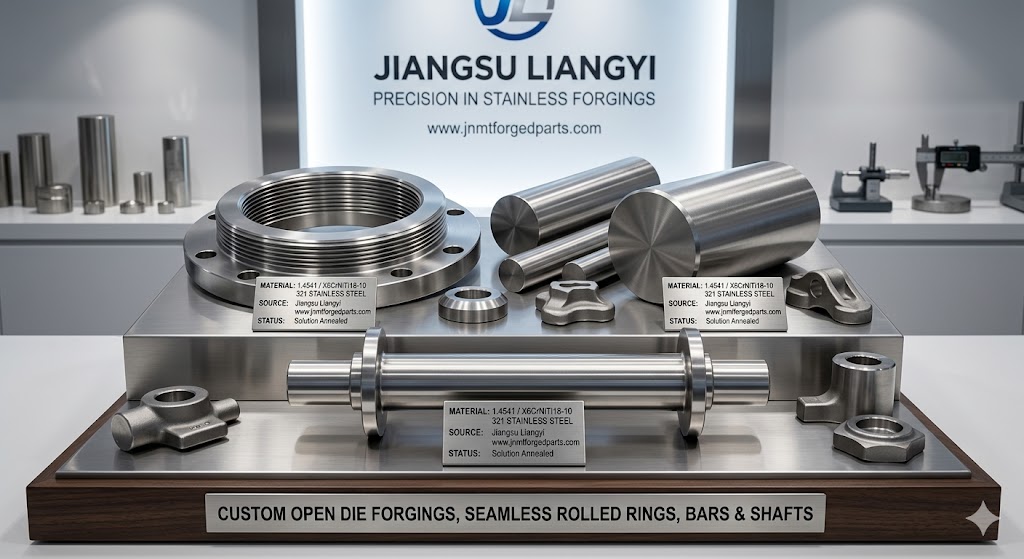
About 1.4541 (X6CrNiTi18-10) Titanium-Stabilized Austenitic Stainless Steel
Jiangsu Liangyi Co., Limited is an ISO 9001:2015 certified, 25+ years professional manufacturer of 1.4541 (X6CrNiTi18-10, X6CrNiTi1810, X6CrNiTi18.10) open die forging parts and seamless rolled steel forged rings in China. We supply high-precision 1.4541 forged components to over 50 countries worldwide, with products manufactured to meet the material requirements of EN 10088-3, ASTM A182, API 6A, PED 2014/68/EU, EN 10222-5, and other global mainstream industrial standards.
1.4541 (X6CrNiTi18-10) is the European EN designation for titanium-stabilized austenitic chromium-nickel stainless steel, directly equivalent to AISI 321 in the ASTM system. Its defining characteristic — and the reason engineers specify it over standard austenitic grades — lies in its deliberate addition of titanium (Ti) at a minimum ratio of 5 times the carbon content. This single alloying decision produces a cascade of microstructural effects that make 1.4541 the engineering default for welded structures, elevated-temperature pressure systems, and any application where sensitization-induced intergranular corrosion would represent a catastrophic failure mode.
Our 80,000 m² manufacturing facility in Jiangyin, Jiangsu Province, operates dedicated forging lines for stainless steel grades, with all processes fully segregated from carbon steel production to eliminate cross-contamination risk. Every heat of 1.4541 we process is backed by incoming material certification, in-process chemistry checks via optical emission spectroscopy (OES), and post-forging mechanical and non-destructive testing — all performed in our in-house laboratory with regularly calibrated equipment.
The Metallurgy Behind 1.4541: Why Titanium Stabilization Works
Most technical pages on 1.4541 describe its properties without explaining the underlying mechanism. Understanding why titanium stabilization works helps engineers make better material selection decisions and specify the right heat treatment protocols. Here is a precise explanation based on our 25+ years of forge-process development and laboratory analysis.
The Sensitization Problem in Unstabilized Austenitic Grades
When unstabilized austenitic stainless steels such as 1.4301 (304) are exposed to temperatures between approximately 450°C and 850°C — the so-called "sensitization range" — carbon (C) diffuses toward austenite grain boundaries and reacts with chromium (Cr) to form chromium carbide precipitates (primarily Cr₂₃C₆). Each precipitate depletes the surrounding matrix of chromium over a zone roughly 1–3 μm wide. When local chromium content falls below the passivation threshold of approximately 12%, that zone loses its corrosion resistance and becomes anodically active relative to the adjacent chromium-rich grains — creating the classic weld decay (intergranular corrosion) pattern seen in heat-affected zones.
For forged pressure components this is not merely a surface phenomenon. An intergranular attack path through a flanged ring or valve body wall can propagate rapidly in oxidizing acid environments, causing sudden through-wall failure with no prior visible surface degradation.
How Titanium Stabilization Solves the Problem
Titanium has a far greater thermodynamic affinity for carbon than chromium does. At the forging and solution annealing temperatures used for 1.4541 (1020–1200°C), titanium combines with carbon to form titanium carbide (TiC) precipitates. Because TiC is stable at these temperatures, the carbon is sequestered into TiC before it has any opportunity to react with chromium. Even when the forging is subsequently cooled through the sensitization range during heat treatment or welding, the carbon inventory is already "locked up" as TiC — there is simply no free carbon available to form chromium carbides.
The required titanium addition follows the stoichiometric relationship: Ti% ≥ 5 × C%. EN 10088-3 sets the minimum Ti content at 5×C% with a practical upper cap of 0.70% Ti to avoid hot-workability issues. Our factory aims at a Ti working range of 5×C% to 0.60%, which ensures stabilization while keeping good forgeability. Also, a small effect of titanium is to increase the solid-solution strengthening, which slightly improves the elevated-temperature yield strength of the material compared to unstabilized 304.
Engineering Implication: Because 1.4541 forgings are inherently resistant to sensitization, they can be used in the as-welded condition for the majority of industrial applications without requiring post-weld heat treatment (PWHT). This offers major cost and schedule advantages in fabricated assemblies, pressure vessels, and piping systems — particularly where thick sections make PWHT operationally impractical.
Grain Structure Advantage of Forged 1.4541 vs Cast 1.4541
Casting 1.4541 produces a coarse, dendritic grain structure with residual segregation zones where titanium and carbon concentrations may deviate from the target chemistry. Local titanium-depleted regions can form pockets of insufficiently stabilized material, creating unpredictable intergranular corrosion susceptibility even in "stabilized" cast components. The open die forging and ring rolling processes we employ break down the cast dendritic structure through repeated compressive deformation at controlled temperatures, producing a refined, equiaxed grain structure with homogeneous titanium distribution throughout the cross-section. The result is a forging where the titanium stabilization mechanism operates as designed at every point across even a 30-ton component.
Core Performance Advantages of 1.4541 (X6CrNiTi18-10) Forged Parts
- Superior post-weld intergranular corrosion resistance: No PWHT required for most service conditions; immune to weld decay in the heat-affected zone even after multi-pass welding procedures.
- Wide high-temperature operating range: Continuous service to 800°C; intermittent service to 870°C; short-term oxidation resistance to 925°C. TiC precipitates remain stable, preventing grain boundary embrittlement at service temperature.
- Excellent cryogenic toughness: Fully austenitic microstructure retains excellent ductility and non-magnetic properties at temperatures down to −196°C (LN₂), so that it is suitable for LNG equipment, cryogenic storage vessels, and liquid oxygen systems.
- Strong resistance to oxidizing acid media: Excellent performance in high-concentration nitric acid (up to 65% HNO₃ at elevated temperatures), nitrate salt melts, organic acids (acetic acid, formic acid), weak reducing acids, and neutral chloride-free salt solutions.
- Elevated-temperature creep strength: At 600°C, 1.4541 forgings maintain a minimum 0.2% proof strength of approximately 110–130 MPa with creep rupture lives significantly exceeding those of standard 304 — critical for pressure-vessel flange applications operating in the 500–650°C range.
- Excellent weldability with all major processes: Compatible with TIG, MIG, SAW, and plasma welding using matching ER321/E321 filler metals. No preheat required; interpass temperature maximum 150°C recommended for thick section joints.
- Good formability and machinability: Austenitic structure responds predictably to forging, bending, and final machining. Work-hardening rate is controlled, allowing precise dimensional targeting in turning and boring operations.
- Broad food and pharmaceutical compliance: Food processing equipment and pharmaceutical reactor vessel applications: chemical composition and surface finish compliance with FDA 21 CFR and EC 1935/2004 requirements.
1.4541 (X6CrNiTi18-10) vs Competitor Materials: Detailed Technical Comparison
The table below reflects our engineering team's interpretation of standard data combined with observations from 25+ years of forging these grades. It is intended to assist material selection, not replace project-specific engineering analysis.
| Performance Criterion | 1.4541 / AISI 321 | 1.4301 / AISI 304 | 1.4404 / AISI 316L | 1.4571 / AISI 316Ti |
|---|---|---|---|---|
| Stabilization Method | Titanium (Ti ≥ 5×C%) | None (unstabilized) | Low carbon (C ≤ 0.03%) | Titanium (Ti ≥ 5×C%) |
| Post-weld Intergranular Corrosion Resistance | Excellent — immune | Poor — susceptible | Good — resistant | Excellent — immune |
| Max Continuous Service Temperature | 800°C | 425°C (load-bearing) | 450°C (load-bearing) | 800°C |
| Cryogenic Toughness (−196°C) | Excellent | Good | Good | Good |
| Chloride Pitting Resistance (PRE) | Moderate (PRE ~18) | Low (PRE ~18) | Good (PRE ~24) | Good (PRE ~24) |
| Nitric Acid Corrosion Resistance | Excellent | Good | Moderate | Moderate |
| Min. 0.2% Proof Strength at 600°C (MPa) | ~115–130 MPa | ~95–110 MPa | ~110–125 MPa | ~115–130 MPa |
| Weldability (as-welded condition) | Excellent — no PWHT | Good (limited section) | Excellent — no PWHT | Excellent — no PWHT |
| Typical Alloy Cost vs 304 Baseline | +5% to +10% | Baseline | +25% to +35% | +30% to +40% |
| Typical Applications | High-temp, welded structures, nitric acid, nuclear, aerospace | General corrosion, ambient temperature | Seawater, chlorides, pharma, marine | High-temp + chloride combination |
Selection Note — Chloride Environments: Where elevated chloride concentrations are the primary corrosion driver (seawater, brine, coastal atmospheres), 1.4404 (316L) or higher duplex grades offer better pitting resistance than 1.4541. However, for applications that combine moderate chloride exposure with elevated temperature, weld-zone corrosion risk, or nitric acid media, 1.4541 frequently provides the most cost-effective overall solution. Contact our engineering team for free material selection consultation.
Engineer's Material Selection Guide: When to Specify 1.4541
Based on 25+ years of forging components for demanding industrial applications, our metallurgical engineers have identified the recurring scenarios where 1.4541 (X6CrNiTi18-10) consistently outperforms alternatives on a total lifecycle cost basis:
✅ Specify 1.4541 when your design includes:
- Welded assemblies that will operate at temperatures between 400°C and 800°C — where 304's sensitization vulnerability is unacceptable and PWHT is impractical
- Components exposed to nitric acid, nitrate salts, or organic acid media (e.g., chemical reactors, fertilizer plant pressure vessels, acetic acid piping systems)
- Equipment cycling repeatedly between ambient and elevated temperature, creating repeated passage through the sensitization range (e.g., heat exchangers, regenerative systems)
- Nuclear auxiliary systems and fuel reprocessing equipment where intergranular corrosion failure would have radiological consequences
- Cryogenic equipment that also requires welding — the combination of welding and sub-zero service eliminates 304 and makes 1.4541 the natural choice
- Aerospace structural forgings requiring non-magnetic, cryogenic-rated, weldable austenitic steel with traceability to aerospace material standards
- Food processing and pharmaceutical equipment where FDA/EC food-contact compliance, full weldability, and high-temperature CIP sterilization are all required simultaneously
⚠️ Consider alternatives when:
- The primary corrosion driver is chloride pitting at ambient temperature with no welding requirement → consider 1.4404 (316L) or 1.4462 (duplex)
- Operating temperature stays permanently below 300°C with no welding → consider 1.4301 (304) for cost savings
- Both elevated chloride and elevated temperature are present simultaneously → consider 1.4571 (316Ti) or 1.4439 (317LN)
- Extreme sulfuric acid concentration is the primary medium → consider higher nickel alloys such as Alloy 20 or Hastelloy C-276
Why Forging vs Casting Matters for 1.4541 Components
The choice between forging and casting for 1.4541 components is not merely a manufacturing preference — it determines the fundamental integrity of the component at a microstructural level. This distinction becomes critical in pressure-bearing, fatigue-loaded, and safety-critical applications.
Microstructural Differences and Their Consequences
When 1.4541 is cast, the liquid metal solidifies from the outside in, producing a coarse dendritic grain structure. Titanium and carbon, which have different solidification temperatures and diffusion rates, tend to segregate during solidification — creating titanium-rich dendrite cores and carbon-rich interdendritic zones. This means the titanium stabilization mechanism is non-uniform: some zones have excess titanium (effective stabilization), while carbon-enriched interdendritic zones may have insufficient local Ti:C ratios, creating pockets vulnerable to sensitization. Porosity, micro-shrinkage, and oxide inclusions — inevitable in casting — further compromise mechanical performance and create stress concentration sites for fatigue crack initiation.
Open die forging and ring rolling of 1.4541 eliminates these defects through thermomechanical processing. Our forging cycle typically involves heating to 1150–1220°C (above the recrystallization temperature), applying progressive compressive or radial forces that reduce the billet cross-section by 50–80%, followed by controlled cooling. This sequence accomplishes four simultaneous goals: it breaks down the original cast dendritic structure into fine equiaxed grains; it redistributes titanium and carbon homogeneously throughout the microstructure; it closes any porosity through plastic deformation under hydrostatic pressure; and it creates a directional fibrous "grain flow" aligned with the principal stress direction of the final component — the same principle used in aerospace forging.
| Property / Characteristic | 1.4541 Forged (Our Process) | 1.4541 Cast (Typical) |
|---|---|---|
| Grain Structure | Fine, equiaxed, homogeneous | Coarse, dendritic, heterogeneous |
| Ti Distribution Uniformity | Excellent — consistent stabilization | Variable — segregation risk |
| Internal Porosity | None (eliminated by forging pressure) | Micro-porosity possible |
| Tensile Strength Advantage | +15% to +30% vs equivalent cast | Baseline |
| Fatigue Strength Advantage | +20% to +40% vs equivalent cast | Baseline |
| Charpy Impact Toughness | Excellent at −196°C to +800°C | Lower, variable by section |
| UT Testability (100% volumetric) | Fully achievable, reliable signals | Difficult — porosity creates false indications |
| EN 10204 3.2 Certification | Fully achievable with TPI witnessing | Often limited by casting variable |
| Suitable for Sour Service (NACE MR0175) | Yes — consistent hardness control | Risk of local hard spots from segregation |
| Dimensional Tolerance Achievable | ±0.1–0.3mm after precision machining | Wider, requires more machining allowance |
Full Range of Custom 1.4541 (X6CrNiTi18-10) Forged Products
We manufacture a complete portfolio of 1.4541 (X6CrNiTi18-10) forged products across a broad dimensional and weight range, fully compliant with international standards and customer-supplied drawings. Single-piece weight range: 30 kg to 30 tons. Annual manufacturing capacity: 120,000 tons. All products include full material traceability from melt heat to finished component.
Forged Bars, Billets & Custom Shafts
X6CrNiTi18-10 forged round bars, square bars, flat bars, rectangular bars, and hollow bars — supplied in forged, rough-turned, or finish-machined condition. Custom stepped shafts, gear shafts, splined drive shafts, crankshafts, turbine shafts, and spindles are produced to customer drawings with full 3D model compatibility. Maximum forging diameter: 2000 mm. Maximum finished length: 15 meters. Maximum single-piece weight: 30 tons.
Each bar or shaft forging receives 100% longitudinal and transverse ultrasonic testing (UT) per EN 10228-3 Level 3 or ASTM A388, with additional magnetic particle or liquid penetrant inspection at customer request. Mill test certificates per EN 10204 3.1 standard with optional 3.2 third-party inspection are provided with every delivery.
Seamless Rolled Forged Rings
Custom 1.4541 seamless rolled rings produced on our dedicated radial-axial ring rolling mills. Product range includes plain rings, flanged rings, gear rings, bearing rings, slewing rings, profiled contoured rings, and ASME ring forgings for pressure vessel nozzle necks. Maximum outer diameter: 6000 mm. Maximum ring height: 1500 mm. Maximum single-piece weight: 30 tons. Achievable tolerances: outer diameter ±2 mm, height ±2 mm, ovality ≤ 0.3% of OD.
Ring rolling inherently produces superior grain flow tangential to the ring circumference — aligning the strongest grain direction with the hoop stress direction in pressure-bearing applications. This is particularly advantageous for wellhead casing heads, pressure vessel flanges, and turbine containment rings where circumferential burst resistance is the critical design load case.
Forged Sleeves, Hubs & Hollow Components
1.4541 forged hubs, housings, casings, heavy-wall sleeves, bushes, pump barrels, valve bonnets, and pressure cylinder bodies. Our seamless forging process — starting from a solid billet, not a welded tube — ensures there are no longitudinal weld seams that could introduce heat-affected zones or residual stress concentrations. Maximum outer diameter: 3000 mm. Wall thickness range: 20–800 mm.
For nuclear-grade and aerospace-grade components requiring traceability to melt shop records, we maintain full heat pedigree documentation including steel plant chemistry certification, ladle analysis, billet conversion records, and forging process records — all archived for a minimum of 20 years per customer retention requirements.
Forged Discs, Tube Sheets & Pressure Vessel Heads
X6CrNiTi18-10 forged discs, plates, blocks, and TEMA-standard tube sheets produced to precise flatness and dimensional tolerances. Maximum disc diameter: 3500 mm. Maximum thickness: 800 mm. Tube sheet ligament drilling patterns can be pre-machined to customer heat exchanger design drawings, with 100% eddy current or UT inspection of tube-sheet ligaments available for nuclear-service tube sheets.
Valve & Fluid Control Body Forgings
A comprehensive range of 1.4541 valve body forgings for global valve OEMs, including full-bore and reduced-bore ball valve bodies, gate valve bodies, globe valve bodies, check valve bodies, and butterfly valve body segments. Individual valve component forgings include: bonnets, stems, trim components, seat rings, plugs, discs, and spindles. Products are manufactured to meet the material requirements of API 6D, API 600, EN 12516-3, and BS 5351 standards, with MSS SP-55 visual acceptance criteria applied as standard. Face-to-face dimensions per ASME B16.10 or EN 558 Series 1/2 are achievable.
Oil & Gas Upstream Forgings (Manufactured to API 6A Material Requirements)
X6CrNiTi18-10 wellhead and Christmas tree forgings represent one of our highest-volume product lines. We manufacture: casing heads, casing hangers, tubing heads, tubing hangers, casing spools, tubing spools, spacer spools, cross-over spools, double studded adapter flanges (DSA), integral mud cross flanges, and API 6A end-preparation flanges in all standard sizes and pressure ratings (2000–20,000 psi working pressure, PSL 1–PSL 4). All forgings are produced to meet the chemical composition, mechanical property, and dimensional requirements of API 6A 21st Edition as applicable to forged material supply.
For downhole drilling tool applications, we supply X6CrNiTi18-10 mud motor splined drive shafts and electrical submersible pump (ESP) motor splined shafts — both of which require the combination of non-magnetic properties, corrosion resistance in H2S-bearing drilling fluids, and high bending fatigue life that 1.4541 forgings uniquely provide. Our splined shaft forgings are finish-machined with spline geometry per customer design, with 100% UT, MT, and dimensional CMM inspection prior to shipment.
Complete Heat Treatment Process Parameters for 1.4541 Forgings
Correct heat treatment is the single most critical post-forging step for 1.4541 components, determining whether the titanium stabilization mechanism performs as designed in service. Our heat treatment facility includes five independent furnaces with independent temperature zoning, atmospheric control, and continuous data-logging — all calibrated to ±10°C temperature uniformity with calibration records available for customer review.
Standard Solution Annealing (Condition +AT)
Solution annealing is the standard delivery condition for 1.4541 forgings per EN 10088-3, EN 10222-5, and ASTM A182. The process dissolves sigma phase, secondary carbides, and forging-induced residual stresses while retaining the desired TiC precipitates.
| Parameter | Specification Range | Our Factory Target | Notes |
|---|---|---|---|
| Heating Temperature | 1020°C – 1100°C | 1050°C ± 15°C | Higher end for heavy sections (>150mm thick) |
| Temperature Uniformity | ±20°C | ±10°C | Logged continuously; calibration records available |
| Minimum Hold Time | 1 min/mm section thickness, min 20 min | 1.2 min/mm, min 30 min | Measured at thickest cross-section |
| Maximum Soak Time | Not specified by standard | ≤3 min/mm | Prevent excessive grain growth |
| Quench Method | Water quench or forced air | Water quench standard; forced air for thin ≤25mm | Must cool below 350°C within 3 min |
| Post-Quench Temperature | Below 350°C before transfer | Below 300°C verified by contact pyrometer | Critical — prevents carbide re-precipitation |
| Atmosphere | Air (scale to be removed) or inert | Air furnace with post-anneal shot blast + pickle | Scale-free finish per customer requirement |
| Surface Condition After Treatment | As annealed or pickled | Pickled + passivated (HNO₃/HF per ASTM A380) | Electropolish available on request |
Optional Stress Relief Anneal (After Machining)
For heavily machined components or assemblies where dimensional stability under thermal cycling is critical — such as pressure vessel tube sheets or complex valve bodies — a stress relief treatment can be applied after final machining without compromising the stabilization achieved by the prior solution anneal.
| Parameter | Specification Range | Our Factory Target |
|---|---|---|
| Temperature | 550°C – 650°C | 600°C ± 15°C |
| Hold Time | 1 – 4 hours | 2 hours per 50mm section thickness |
| Cooling Method | Furnace cool or air cool | Furnace cool to 300°C, then air cool |
| Expected Residual Stress Reduction | N/A (not in standard) | 60–80% reduction per independent measurement |
| Mechanical Property Change | Negligible | Rp0.2 may increase slightly (+5–10 MPa) |
Critical Warning — Avoid the 700–900°C Temperature Range: Do not hold 1.4541 forgings in the 700–900°C range during heating or cooling cycles. This is the sigma phase precipitation temperature range, where intermetallic sigma phase can form at grain boundaries, causing severe embrittlement. Our furnaces are programmed to traverse this range at a minimum rate of 80°C/hour on both heating and cooling ramps to prevent sigma phase formation even during long furnace stabilization cycles.

Full-Process Quality Inspection & Assurance System
Quality assurance at Jiangsu Liangyi is not a single inspection step at the end of the process — it is a continuous, documented system embedded at every stage of manufacturing. Our quality management system is certified to ISO 9001:2015 and structured to meet the requirements of EN 10204 Type 3.2 (independent third-party inspection) for all safety-critical 1.4541 forged parts.
Incoming Material Verification
Every incoming 1.4541 (X6CrNiTi18-10) steel billet or bar is verified against its mill test certificate. Our in-house OES (optical emission spectroscopy) analyzer performs a full 12-element positive material identification (PMI) check on each heat, confirming carbon content and — critically — the titanium level and Ti:C ratio before any forging begins. Billets with Ti:C ratio below 5.0 are rejected, regardless of certificate values.
Forging Process Control (In-Process)
Billet temperature is continuously monitored by calibrated infrared pyrometers at furnace exit, with forging initiation locked out if billet surface temperature falls below 900°C. Each forging reduction step is logged in our MES system with timestamp, press tonnage, and temperature — creating a complete traceable forging record for each individual piece. Cold-working embrittlement is prevented by stopping forging and reheating when the temperature falls below the minimum working temperature of 900°C.
Heat Treatment Monitoring & Documentation
Furnace temperature is recorded at 1-minute intervals by multiple thermocouples. Quench bath temperature is monitored to confirm adequate cooling rate. Every heat treatment cycle generates a signed time-temperature chart that is archived with the job record. Thermocouples are calibrated periodically by a qualified external calibration service with certificates traceable to national standards.
Non-Destructive Testing (NDT)
All 1.4541 forgings are 100% volumetrically tested (UT) per EN 10228-3 Class 3 or ASTM A388 by our qualified NDT technicians who hold recognized NDT personnel certification. Forgings with complicate geometry additionally receive liquid penetrant testing (PT) per EN 10228-2 / ASTM E165 on all finished surfaces. For pressure vessel applications, fluorescent penetrant testing (PT) is used as the primary surface examination method, as 1.4541 is austenitic and not suitable for magnetic particle testing.
Mechanical Property Testing
Test specimens are machined from a test coupon representing each heat and heat treatment lot. Tests performed: tensile test (Rm, Rp0.2, A, Z) per EN ISO 6892-1 / ASTM E8M; Charpy V-notch impact test at −20°C and −196°C per EN ISO 148-1 / ASTM E23; Brinell hardness survey across multiple positions per EN ISO 6506-1. All results are compared against EN 10088-3 minimums and our enhanced factory guaranteed values before release.
Dimensional Inspection & Final Release
The final dimensions are checked against the customer’s drawing using calibrated instruments (micrometers, bore gauges, height gauges for standard shapes; CMM for complex geometries). Surface roughness is measured according to ISO 4287 if specified. All completed inspection records, heat treatment charts, NDT reports, mechanical test results and OES chemistry confirmation are collated into a single Material Dossier, signed off by our Quality Manager. For EN 10204 3.2 orders, the dossier is countersigned by an independent third-party inspection body selected by the customer — such as TÜV, Bureau Veritas, DNV, Lloyd's Register, SGS, or Intertek.
Material Specifications, Production Standards & Chemical Data
Chemical Composition of 1.4541 (X6CrNiTi18-10) Forged Steel — EN 10088-3 vs Our Factory Control
| Chemical Element | EN 10088-3 Standard Range | Our Factory Control Range | Function in the Alloy |
|---|---|---|---|
| Carbon (C) | Max 0.08% | 0.04% – 0.06% | Strength; lower C improves stabilization efficiency per unit Ti |
| Silicon (Si) | Max 1.00% | 0.30% – 0.60% | Deoxidizer; improves oxidation resistance at high temperature |
| Manganese (Mn) | Max 2.00% | 1.00% – 1.50% | Austenite stabilizer; secondary deoxidizer |
| Nickel (Ni) | 9.00% – 12.00% | 9.50% – 10.50% | Austenite stabilizer; corrosion resistance; cryogenic toughness |
| Phosphorus (P) | Max 0.045% | Max 0.035% | Impurity; kept low to avoid hot-shortness and grain boundary embrittlement |
| Sulfur (S) | Max 0.015% | Max 0.010% | Impurity; kept low to maximize corrosion resistance and toughness |
| Chromium (Cr) | 17.00% – 19.00% | 17.50% – 18.50% | Primary corrosion resistance; forms passive oxide film |
| Titanium (Ti) | Min 5×C%, Max 0.70% | 5×C% – 0.60% | Carbon stabilizer; forms TiC; prevents Cr₂₃C₆ at grain boundaries |
| Nitrogen (N) | Not specified separately | Max 0.10% (monitored) | Austenite stabilizer; slight strengthening; monitored to avoid TiN competition |
Mechanical Properties of 1.4541 Forgings — Delivery Condition +AT (Solution Annealed)
| Mechanical Property | EN 10088-3 Standard Minimum | Our Factory Guaranteed Value | Test Standard |
|---|---|---|---|
| Tensile Strength (Rm) | 500 – 700 MPa | 520 – 680 MPa | EN ISO 6892-1 / ASTM E8M |
| 0.2% Proof Strength (Rp0.2) at 20°C | Min 190 MPa | Min 210 MPa | EN ISO 6892-1 / ASTM E8M |
| 0.2% Proof Strength (Rp0.2) at 200°C | Min 127 MPa | Min 140 MPa | EN ISO 6892-1 (elevated temp) |
| 0.2% Proof Strength (Rp0.2) at 400°C | Min 108 MPa | Min 120 MPa | EN ISO 6892-1 (elevated temp) |
| 0.2% Proof Strength (Rp0.2) at 600°C | Min 88 MPa | Min 100 MPa | EN ISO 6892-1 (elevated temp) |
| Elongation at Fracture (A, 5.65√So) | Min 30% | Min 35% | EN ISO 6892-1 / ASTM E8M |
| Reduction of Area (Z) | Not specified | Min 55% | EN ISO 6892-1 / ASTM E8M |
| Brinell Hardness (HBW) | Max 215 | 170 – 200 | EN ISO 6506-1 / ASTM E10 |
| Charpy V-Notch Impact Energy at −20°C (KV₂) | Not specified in EN 10088-3 | Min 70 J (guaranteed) | EN ISO 148-1 / ASTM E23 |
| Charpy V-Notch Impact Energy at −196°C (KV₂) | Not specified | Min 50 J (by request) | EN ISO 148-1 (sub-zero) |
| Grain Size (ASTM) | Not specified | ASTM 5 or finer | ASTM E112 |
International Material Equivalent Standards
| Standard System | Designation | Standard Document |
|---|---|---|
| European EN | 1.4541 / X6CrNiTi18-10 | EN 10088-1/3, EN 10222-5 |
| American ASTM/AISI | 321 / S32100 | ASTM A182 F321, ASTM A276, ASTM A479 |
| American ASME | S32100 | ASME SA-182 F321, SA-276, SA-479 |
| Japanese JIS | SUS321 | JIS G4303, JIS G4051 |
| Russian GOST | 08Kh18N10T | GOST 5632-72 |
| British BS | 321S51 | BS 970 Part 1, BS 1501 Part 3 |
| Chinese GB | 0Cr18Ni10Ti / 06Cr18Ni11Ti | GB/T 1220, GB/T 4356 |
| API Oil & Gas | Type 321 (per material class) | API 6A, API 6D, API 600 |
Global Industry Applications & Regional Market Expertise
1.4541 (X6CrNiTi18-10) forged parts from Jiangsu Liangyi serve demanding industrial applications across six continents. Our regional market knowledge — built over 25+ years of direct engagement with procurement engineers, EPC contractors, and end-user inspection teams worldwide — allows us to tailor documentation, testing protocols, and delivery formats to each market's specific regulatory and project requirements.
European Market (Germany, France, Netherlands, Italy, Belgium)
Europe is our largest and most technically demanding export market for 1.4541 forgings. German chemical processing companies rely on our forgings for reactor vessels, heat exchangers, and pump internals operating in nitric acid and organic acid service — applications where 1.4541's combined weldability and oxidizing acid resistance is the defining material advantage. French engineering and nuclear equipment fabricators specify our forgings for high-temperature structural components, requiring full traceability to EN 10204 3.2. Dutch and Belgian petrochemical refinery projects consistently specify our 1.4541 seamless rolled rings for pressure vessel nozzle rings and heat exchanger shell flanges.
Our 1.4541 forgings for the EU market are manufactured to meet the material requirements of EN 10088-3, and the chemical composition is fully REACH Regulation (EC) No 1907/2006 compatible — no restricted substances (SVHC) above threshold levels are present. For customers requiring PED 2014/68/EU conformity assessment, we provide the material documentation package (EN 10204 3.1 or 3.2 MTC, material test records, heat treatment records, NDT reports) that the customer's authorized fabricator or notified body requires to complete their conformity assessment process.
North American Market (USA, Canada, Mexico)
North American oilfield equipment manufacturers are a key customer base for our 1.4541 forgings manufactured to API 6A material requirements. US wellhead equipment fabricators source our X6CrNiTi18-10 casing heads, tubing hangers, and Christmas tree components for Gulf of Mexico deepwater applications and Permian Basin onshore wells, where resistance to H2S in sour crude service combined with weld-zone corrosion resistance is the critical material selection criterion. Canadian oil sands projects source our 1.4541 valve body forgings for high-pressure steam injection systems, where the combination of elevated temperature service, weld-zone corrosion resistance, and ASME B31.3 process piping material requirements defines the specification.
For customers supplying to US pressure vessel programs, we provide ASME-format certified material test reports (CMTR) with all data required under ASME Section II Part A for the applicable material specification. Third-party inspection witnessing by customer-nominated inspection bodies is fully supported at no additional facility charge.
Middle East Market (Saudi Arabia, UAE, Qatar, Kuwait, Oman)
The Middle East oil and gas sector places unique demands on forged stainless steel — high ambient temperatures (up to 55°C), H2S-bearing hydrocarbon streams, high-chloride coastal environments, and the requirement to simultaneously meet API standards and local NOC supplementary specifications. Our 1.4541 forgings are supplied to major Middle East oilfield wellhead equipment manufacturers and EPC contractors for onshore and offshore projects throughout the region, consistently meeting supplementary inspection requirements including 100% PMI by XRF, dual hardness testing on each piece, and API 6A PSL 3/4 level documentation packages.
For UAE and Kuwait seawater desalination facilities (MSF and SWRO process types), 1.4541 is specified for structural components operating in the high-temperature brine sections of multi-stage flash distillers — where the combination of elevated temperature, dilute chloride media, and welded construction makes stabilized stainless steel the standard material choice.
Asia-Pacific Market (Japan, South Korea, Singapore, Australia, India)
1.4541 forgings are a technically challenging market for Japanese petrochemical and energy clients, who typically need to meet both JIS G4303/4051 SUS321 chemistry and EN 10088-3 1.4541 mechanical property requirements simultaneously – a dual-standard approach that our factory can handle with focused chemistry control and supplementary testing documentation in JIS format. We provide 1.4541 seamless rolled rings and flange forgings for the tank structures of LNG carriers and FPSO topsides process equipment to shipbuilders and offshore platform fabricators in South Korea, with third-party witnessing by internationally recognised marine classification bodies available on request.
Singapore-based oil and gas trading and engineering companies frequently consolidate procurement of 1.4541 forgings across multiple Southeast Asian projects — Indonesian geothermal wellhead equipment, Malaysian LNG plant expansion components, and Vietnamese petrochemical refinery valve bodies — benefiting from our consolidated supply capability, English-language technical support, and Asia-regional logistics infrastructure.
Indian refinery and petrochemical projects regularly specify our 1.4541 forgings with supplementary technical specifications and third-party inspection witnessing from customer-nominated agencies — requirements we have fulfilled consistently across numerous Indian subcontinent projects over many years of supply.
Global Project Case Studies: 1.4541 Forgings in Critical Applications
Sour Gas Wellhead Equipment — Major Middle East Onshore Oilfield Project
A leading wellhead equipment manufacturer supplying a major Middle East national oil company contracted us to supply a large batch of X6CrNiTi18-10 forged wellhead and Christmas tree components for a long-term onshore field development program in a high H2S-content oilfield. The specification required products to meet API 6A 21st Edition material requirements, full NACE MR0175/ISO 15156-3 sour service hardness criteria, 100% PMI by XRF, 100% individual piece hardness testing (maximum 22 HRC), and EN 10204 3.2 certificates with customer-nominated TPI witness.
The carbon content was tightly controlled at 0.04–0.055% in order to maximize the Ti:C stabilization ratio. The grain size was controlled to optimize the balance of strength, toughness, and hardness uniformity. Heat treatment at 1060°C with water quench consistently achieved hardness results of 170–195 HBW across all pieces — well below the 22 HRC (237 HBW) NACE limit. All components passed API 6A PR2 pressure testing and the entire supply program achieved zero material non-conformance reports across multiple delivery batches over an extended period.
Cryogenic Structural Forgings for High-Precision Equipment — European Aerospace Supplier
A European precision engineering company supplying to the aerospace sector required custom 1.4541 forged precision shafts and housing components for cryogenic system applications — components that must maintain structural integrity at −196°C (liquid nitrogen temperature) while also surviving repeated thermal cycling between cryogenic service temperature and room temperature. A non-magnetic requirement (relative permeability ≤ 1.005) was a hard technical constraint imposed by the surrounding electromagnetic system design.
We engineered a forging process with enhanced reduction ratio (≥ 5:1 forging reduction) and controlled final forging temperature in the recrystallization range to achieve fine, equiaxed grain structure optimal for cryogenic toughness. Solution annealing at 1080°C with accelerated water quench confirmed the target grain size and achieved Charpy impact values exceeding 100 J at −196°C across all test heats. Relative permeability was verified by flux gate magnetometer on each finished piece. The program has run over multiple supply cycles with zero material non-conformances.
High-Temperature Valve Body Forgings — European Nuclear-Grade Equipment Fabricator
Through a European valve manufacturer supplying to nuclear generation facilities, we supplied 1.4541 forged valve bodies and bonnet forgings for auxiliary system valves in pressurized water reactor (PWR) facilities. Nuclear-grade applications require the most stringent documentation package of any industry: full material traceability from steel melt (heat number) to finished component, extended trace element analysis (cobalt, boron, tin, lead, antimony) for nuclear purity compliance, mandatory third-party inspection witnessing, and long-term document retention per the customer's nuclear quality plan.
Our factory supported this program with a dedicated Quality Plan specific to this project, separate production records for each individual forging, and a customer-nominated TPI agency physically witnessing heat treatment, NDT, and mechanical testing. All 1.4541 chemistry certifications included extended trace element analysis per the customer's specification. The program achieved full acceptance on all components with zero non-conformance reports across multiple supply windows covering reactor maintenance outage schedules.
Nitric Acid Plant Tube Sheets & Pressure Vessel Flanges — North American Fertilizer Complex
A North American engineering contractor constructing a large-scale ammonium nitrate fertilizer complex specified 1.4541 forged tube sheets and pressure vessel nozzle flanges for nitric acid absorbers and tail gas heat exchangers — an application where the combination of high-concentration HNO₃ at elevated temperature and cyclic thermal loading makes 1.4541 the textbook material choice over 316L (which shows accelerated corrosion in concentrated oxidizing acids). The project required ASME Section VIII Division 1 and PED 2014/68/EU compatible material documentation.
We supplied a series of tube sheet forgings up to 2800mm diameter and nozzle flange forgings in ASME B16.5 and B16.47 Class 150 through Class 600 pressure ratings. All tube sheets received 100% volumetric UT and full-face PT. Chemistry was controlled to the lower end of the carbon range (0.04–0.05% C) to maximize stabilization efficiency in the nitric acid environment. The project was completed on schedule with zero material rejections, and subsequent service performance confirmed the appropriateness of the material selection.
Certifications, Approvals & Third-Party Inspection Capability
Our certification system meets the strictest rules for entering global markets. Below is a simple overview of our valid certifications and third-party inspection capabilities for 1.4541 forged parts:
ISO 9001:2015 — Quality Management System
Our only held certification. Covers the full scope of forging, heat treatment, NDT, machining, and inspection for all stainless steel and alloy steel forged products. Annual surveillance audits by accredited certification body. Certificate available for customer review upon request.
EN 10204 3.1 Mill Test Certificate
Issued as standard with every delivery. Includes full chemical analysis (OES), mechanical test results, heat treatment records, NDT summary, and dimensional inspection confirmation — all signed by our Quality Manager per EN 10204 Type 3.1 requirements.
EN 10204 3.2 Third-Party Inspection
Available upon customer request. The customer nominates an independent TPI body (e.g., TÜV, Bureau Veritas, DNV, Lloyd's Register, SGS, Intertek) who witnesses testing and countersigns the certificate. We welcome TPI agencies at all production hold points at no additional facility charge.
Products Manufactured to API 6A Material Requirements
Our 1.4541 forgings are manufactured to meet the chemical composition, mechanical property, heat treatment, and NDE requirements of API 6A 21st Edition as applicable to forged material supply. We do not hold API Monogram licensing; customers requiring API Monogram products should source from a licensed equipment manufacturer using our forgings as input material.
NACE MR0175 Hardness Compliance
All 1.4541 forgings for sour service are heat treated and verified to meet the maximum hardness requirement of 22 HRC (237 HBW) per NACE MR0175/ISO 15156-3. Individual piece hardness test reports are provided. NACE MR0175 is a material standard, not a certification body — compliance is verified through documented testing, not an issued certificate.
ASME-Format Material Documentation
ASME-format certified material test reports (CMTR) are available per ASME Boiler and Pressure Vessel Code Section II Part A for the applicable material specification (SA-182, SA-276, SA-479). These support our customers' own U-stamp or N-stamp pressure vessel fabrication programs. Note: We are a material supplier; U-stamp and N-stamp authorizations are held by the pressure vessel fabricator, not the material supplier.
Manufacturing Capacity & Standard Dimensional Range
| Product Type | Dimensional Range | Max Weight | Applicable Standards |
|---|---|---|---|
| Round Bars & Billets | Ø50 – Ø2000 mm, Length ≤15,000 mm | 30 tons | EN 10088-3, ASTM A276/A479, ASME SA-276 |
| Square & Flat Bars | 50×50 – 800×800 mm, Length ≤8,000 mm | 15 tons | EN 10088-3, ASTM A276 |
| Seamless Rolled Rings | OD: Ø200 – Ø6000 mm, Height: 50–1500 mm | 30 tons | EN 10222-5, ASTM A182, ASME SA-182 |
| Discs & Tube Sheets | Ø100 – Ø3500 mm, Thickness: 20–800 mm | 25 tons | EN 10222-5, ASTM A182, ASME SA-182 |
| Custom Shafts & Steps | Max Ø1500 mm, Length ≤12,000 mm | 20 tons | Customer drawings; EN 10228-3 NDT |
| Hollow Cylinders / Sleeves | OD: Ø200 – Ø3000 mm, Wall: 20–600 mm | 20 tons | Customer drawings; EN 10228-3 NDT |
| Valve Bodies (Open Die) | Up to DN1200, ASME Class 150–2500 | 8 tons | API 6D, API 600, EN 12516, MSS SP-97 |
| API 6A Wellhead Forgings | 2-1/16" to 26-3/4" bore; 2000–20,000 psi WP | 5 tons | API 6A 21st Edition, PSL 1–4 |
| Machined Final Parts | Per customer 3D model / 2D drawing | 15 tons | ISO 2768, ASME Y14.5, DIN 7168 |
Frequently Asked Questions About 1.4541 (X6CrNiTi18-10) Forged Parts
1.4541 (X6CrNiTi18-10) is the European EN designation for titanium-stabilized austenitic stainless steel. Its direct international equivalents are: AISI/ASTM 321 / UNS S32100 (USA); ASME SA-182 Grade F321 for forgings; SUS321 per JIS G4303 (Japan); 08Kh18N10T per GOST 5632-72 (Russia); 321S51 per BS 970 (UK); 06Cr18Ni11Ti per GB/T 1220 (China). All designations share the fundamental chemistry of 17–19% Cr, 9–12% Ni, and titanium at a minimum of 5 times the carbon content, conferring equivalent intergranular corrosion resistance and elevated-temperature performance.
The core metallurgical difference is titanium stabilization. 1.4541 contains titanium (≥5×C%) which reacts with carbon at forging and annealing temperatures to form stable TiC, preventing the formation of chromium carbides (Cr₂₃C₆) at grain boundaries during welding or high-temperature service in the 450–850°C range. This "sensitization" process in unstabilized 1.4301 (304) strips chromium from grain boundary zones below the 12% passivation threshold, creating intergranular corrosion paths in heat-affected zones. Choose 1.4541 when your design involves welding, elevated temperatures (400–800°C), or corrosive media where weld-zone corrosion would be unacceptable. Choose 1.4301 for ambient-temperature, non-welded, general corrosion applications where cost is the primary driver.
1.4541 (X6CrNiTi18-10) operates across the widest service temperature range of any common austenitic grade: minimum service temperature −196°C (liquid nitrogen), maintaining full ductility and austenitic non-magnetic character; maximum continuous oxidizing service 800°C; maximum intermittent service 870°C; maximum short-term oxidation resistance 925°C. For pressurized equipment under EN 13445 or ASME VIII design codes, the maximum design temperature is typically limited to 650°C to retain minimum code-required mechanical strength values. Avoid prolonged exposure in the 700–900°C sigma phase precipitation range during operation or heat treatment.
The mechanical superiority of forged 1.4541 parts is expressed in three important aspects: (1) Microstructural homogeneity — thermomechanical forging distributes titanium and carbon homogeneously through the cross-section, providing uniform stabilization at all points. Casting leads to the formation of titanium-depleted interdendritic segregation zones where the stabilization mechanism might be locally insufficient. (2) Defect elimination – Casting porosity and micro-shrinkage cavities are eliminated through forging pressure to provide 100% UT tested components to EN 10228-3 Level 3 without ambiguity. (3) Mechanical performance — forged 1.4541 achieves 15–30% higher tensile strength and 20–40% higher fatigue strength than equivalent cast material, with more consistent impact toughness across all temperature ranges. For safety-critical, pressure-bearing components, forging is the only process that guarantees volumetric integrity verifiable by accepted NDT methods.
Jiangsu Liangyi holds ISO 9001:2015 quality management system certification — this is our only held certification. All 1.4541 forgings are supplied with EN 10204 3.1 mill test certificates as standard; EN 10204 3.2 independent third-party certificates are available with witnessing by customer-nominated inspection bodies such as TÜV, Bureau Veritas, DNV, Lloyd's Register, SGS, or Intertek. Products are manufactured to meet the material requirements of EN 10088-3, ASTM A182, API 6A, and ASME SA-182 as applicable. Documentation to support customers' PED 2014/68/EU conformity assessment, NACE MR0175 sour service hardness compliance, and ASME pressure vessel code material requirements is available upon request. We do not hold API Monogram licensing or PED notified body certification — these are held by equipment fabricators, not material suppliers. Third-party inspectors are welcomed to our factory for hold-point witnessing at no additional facility charge.
The standard delivery condition for 1.4541 forgings is solution annealed (+AT): heat to 1020–1100°C (our factory target 1050±15°C), hold for minimum 1.2 minutes per mm of section thickness, then water quench to below 300°C within 3 minutes. This dissolves harmful sigma phase and secondary carbides while retaining the beneficial TiC precipitates responsible for stabilization. The critical temperature range to avoid is 700–900°C — prolonged exposure here promotes sigma phase precipitation at grain boundaries, causing severe embrittlement and corrosion susceptibility. Our furnace programs traverse this range at a minimum rate of 80°C/hour on both heat-up and cool-down ramps. For stress relief after machining, 550–650°C for 1–4 hours (furnace cool to 300°C) is safe and effective.
Yes. Austenitic stainless steel 1.4541 (X6CrNiTi18-10) is acceptable for sour service under NACE MR0175/ISO 15156-3 when maintained at a maximum hardness of 22 HRC (approximately 237 HBW) and in the solution annealed condition. Our 1.4541 forgings for sour service are heat treated to achieve 170–200 HBW — well below the limit — verified by individual piece Brinell hardness testing at a minimum of 3 positions per forging. We provide individual hardness test reports, heat treatment records, and EN 10204 3.2 certificates. For NACE TM0177 Method A (tensile bar) or D (DCB) qualification testing on specific chemistry heats, we can arrange testing at accredited third-party corrosion testing laboratories.
There is no minimum order quantity — we accept single prototype pieces through to multi-year production blanket orders. Typical lead times from drawing approval to shipment: standard bar and disc forgings 3–5 weeks; seamless rolled rings 4–6 weeks; complex custom shapes with finish machining 6–10 weeks; projects requiring EN 10204 3.2 or API 6A PSL 3/4 documentation add 1–2 weeks for TPI coordination. Expedited production (with premium) can reduce standard lead times by 30–40% for urgent requirements. All lead time estimates include full heat treatment, NDT, mechanical testing, and documentation preparation. Send your drawings and specifications to sales@jnmtforgedparts.com for a precise delivery commitment within 24 hours.
Contact Jiangsu Liangyi for Custom 1.4541 (X6CrNiTi18-10) Forging Solutions
Jiangsu Liangyi Co., Limited — 25+ years of trusted quality, ISO 9001:2015 certified, serving 50+ countries. Send us your drawings, material specifications, required standards, and target quantity for a detailed technical proposal and competitive quotation within 24 hours. Our engineering team provides free material selection consultation and application review for new project enquiries.
Inquiry Email: sales@jnmtforgedparts.com
Phone / WhatsApp: +86-13585067993
Website: https://www.jnmtforgedparts.com
Factory Address: Chengchang Industry Park, Jiangyin City, Jiangsu Province, China
Request a Quote →By contacting us, you agree to our privacy policy. Your information will be used exclusively to respond to your technical and commercial enquiry and will not be shared with third parties without your explicit consent. This page complies with GDPR (EU) 2016/679 and CCPA data privacy requirements.
Sitemap · jnmtforgedparts.com · © 2025 Jiangsu Liangyi Co., Limited. All rights reserved.