 Get a Free Quote Within 24 Hours
 1.4307 (X2CrNi18-9) Material Overview
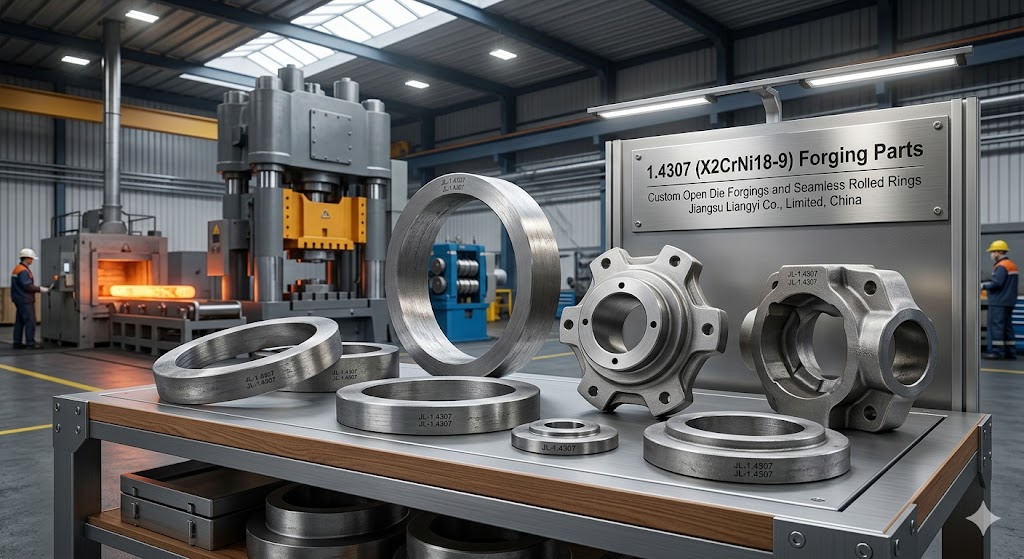
Jiangsu Liangyi Co.,Limited is a professional ISO 9001:2015 certified China manufacturer of custom open die forging parts and seamless rolled forged rings in 1.4307 (also known as X2CrNi18-9, X2CrNi189, X2CrNi18.9, equivalent to AISI 304L / UNS S30403) low-carbon austenitic stainless steel. Established in 1997, our factory is located in Jiangyin City, Jiangsu Province — a main industrial hub for high-quality forging manufacturing in China, with an 80,000㎡ production facility, 120,000 tons annual capacity, and a track record of serving over 500 clients across more than 50 countries worldwide.
1.4307 (X2CrNi18-9) was developed specifically to solve a well-known metallurgical problem in standard austenitic stainless steels: sensitization. When conventional 304 (1.4301, C ≤ 0.07%) is heated into the 450–850°C sensitization range — whether during welding, stress-relieving or hot forming — chromium carbides precipitate along austenite grain boundaries. These precipitates deplete the immediately surrounding matrix of chromium to below the 12% passivation threshold, leaving narrow bands of material highly vulnerable to intergranular corrosion. By reducing the carbon ceiling to 0.03% in 1.4307, the thermodynamic driving force for Cr₂₃C₆ formation is essentially eliminated: at such low carbon activity, chromium remains in solid solution across all service-relevant temperature ranges, and the passive oxide film retains its integrity even after multi-pass welding without post-weld annealing.
From a practical forging standpoint, this low-carbon chemistry also brings a secondary benefit: lower deformation resistance at forging temperatures. In our 29 years of forging austenitic grades, we have found that 1.4307 billets at 1150–1220°C flow more uniformly than higher-carbon 300-series counterparts, allowing us to achieve finer, more homogeneous grain structures in finished forgings — particularly important for large cross-sections above 200mm where through-thickness microstructure uniformity directly governs impact toughness and fatigue performance.
Our X2CrNi18-9 forged steel raw materials are produced via a triple-refining route: Electric Arc Furnace (EAF) primary melting → Argon Oxygen Decarburization (AOD) for precise carbon and nitrogen control → Vacuum Oxygen Decarburization (VOD) for final chemistry trim and inclusion removal. For nuclear-grade or high-criticality applications, Electroslag Remelting (ESR) is available to further reduce macro-segregation, shrinkage porosity and non-metallic inclusion counts. Every heat of material is supplied with a full mill analysis certificate covering all EN 10088-3 elements, and our in-house OES (Optical Emission Spectrometer) performs independent incoming verification before any billet enters the forge press queue. Complete Mill Test Certificates (MTC) per EN 10204 3.1 or 3.2 are issued for every production batch. Explore our full range of stainless steel forging materials for additional grade options including duplex, super-duplex and high-alloy grades.
It is important to note that not all 1.4307 forgings are equal. The EN standard defines minimum acceptance limits — but in practice, a forging produced from a segregated ingot with inadequate forging ratio, insufficiently controlled solution annealing or incorrect quench rate can still pass paperwork while carrying internal microstructural defects that only manifest in service. Our manufacturing protocol specifies a minimum forging reduction ratio of 4:1 for bars and 3:1 for rings, solution anneal temperature verification by calibrated thermocouples at ≤±5°C, and immediate water quench within 3 minutes of furnace exit — parameters proven over decades of production to consistently deliver mechanical properties well above the EN minimum floor.
Key Advantages of 1.4307 (X2CrNi18-9) Forgings
Below are the six most technically significant advantages of 1.4307 X2CrNi18-9 as a forging material — explained from the perspective of our engineers who process this grade every production day, not from a generic datasheet perspective.
Sensitization-Free Weldability
With carbon ≤ 0.03%, 1.4307 remains sensitization-free even after multi-pass TIG, MIG or SAW welding without any post-weld heat treatment. This directly reduces fabrication cost for welded valve bodies, pump casings and pressure vessel nozzles. In comparative corrosion testing per ASTM A262 Practice E (Strauss Test), 1.4307 weld HAZ specimens consistently show zero intergranular attack — a result that standard 1.4301 cannot achieve without full re-solution annealing after welding.
Superior Forged Microstructure vs Casting
Forging closes casting porosity, breaks up dendritic segregation and refines grain size through thermomechanical working — none of which casting can achieve. Our 1.4307 open die forgings consistently achieve ASTM grain size No. 5–7 (versus typically No. 2–4 for investment castings of the same alloy), with dramatically superior fatigue life and impact toughness. For rotating pump shafts and valve stems under cyclic stress, this microstructural difference is not academic — it directly determines service life under real operating conditions.
Reliable Cryogenic Performance to -196°C
The fully austenitic microstructure of 1.4307, stabilized by the 8–10% nickel content, does not undergo the martensitic transformation that causes embrittlement in ferritic and martensitic steels at low temperatures. Our production data shows that 1.4307 forgings retain Charpy impact values of 100–150 J even at -196°C (liquid nitrogen temperature), far exceeding the EN 10088-3 minimum of 60 J at 20°C. This makes them the material of choice for LNG cryogenic valve parts, cold box equipment and industrial gas handling systems where structural ductility at cryogenic service temperature is mandatory.
Broad Corrosion Resistance — But Not Unlimited
The 17.5–19.5% chromium and 8–10% nickel content of 1.4307 provides reliable resistance to atmospheric oxidation, potable water, many organic acids, dilute mineral acids and most food-processing media. However — and this is a point many suppliers omit — 1.4307 is not suitable for chloride-rich environments (seawater, concentrated HCl) where pitting and crevice corrosion become primary failure mechanisms. In such environments, our technical team typically recommends upgrading to duplex grades (1.4462) or high-molybdenum austenitic grades (1.4404/316L, 1.4571/316Ti). Selecting the right grade for your specific medium and operating conditions is something we are happy to advise on at no cost.
Excellent Hot Forgeability Across a Wide Temperature Window
1.4307 has a wide hot working window of approximately 950–1220°C, making it significantly more forgiving than precipitation-hardened or duplex grades where narrow process windows demand precise temperature control throughout the forging sequence. In practice this means we can forge complex shapes — eccentric reducers, multi-stepped shafts, asymmetric flanges — with fewer reheats, lower press tonnage requirements and better dimensional consistency than many higher-alloy alternatives. Our 6,300-ton hydraulic press maintains temperature-compensated load records for every forging stroke, providing traceable deformation history documentation for demanding nuclear and pressure vessel applications.
Full International Standard Compatibility
1.4307 (X2CrNi18-9) aligns with multiple national and international standards simultaneously: EN 10088-3 (Europe), ASTM A276/A182/A484 (USA, as 304L/UNS S30403), DIN 17440 (Germany), JIS G4303 SUS304L (Japan), and is accepted under API 6A for wellhead and Christmas tree equipment. This cross-standard compatibility is important for global projects — a forging ordered to EN 10088-3 for a European end user can often be dual-certified to ASTM A182 F304L for a parallel North American delivery, reducing material qualification time and procurement complexity. We routinely issue dual-standard MTCs at no surcharge for qualifying orders.
Custom 1.4307 X2CrNi18-9 Forged Parts Product Range
We supply a full range of custom 1.4307 stainless steel forging products, with forging weight capacity from 30 kg to 30,000 kg per piece, all tailored to your exact drawings and specifications. Every product is manufactured with our established 4:1 minimum reduction ratio protocol and is given full-process quality inspection before shipment. Below is our main product range with main manufacturing capability parameters:
1.4307 Forged Steel Bars, Rods & Shafts
We manufacture X2CrNi18-9 forged round bars (OD 50–800mm), square bars, flat bars, rectangular bars, hexagonal bars, step shafts, splined drive shafts, hollow shafts, spindles and gear shafts in lengths up to 6,000mm. Unlike rolled bar stock, our open die forged bars are produced from individual heats with full forging reduction across the entire cross-section, guaranteeing consistent mechanical properties from surface to core — important for large-diameter shaft applications where subsurface fatigue initiation is a common failure mode. Dimensional tolerances are held to EN 10243-1 standard as a baseline, with tighter tolerances available to ±0.5mm for CNC pre-machined forgings. Surface conditions include as-forged, rough-turned, semi-finish-turned, or finish-machined to drawing — your choice.
X2CrNi18-9 Seamless Rolled Forged Rings
Our 1.4307 seamless rolled rings are produced on our 5-metre vertical ring rolling machine, capable of rings from OD 200mm up to OD 5,000mm, with wall thickness from 30mm to 800mm and height from 50mm to 2,000mm. The ring rolling process is fundamentally different from cutting rings from a plate or welding a seam: it produces a fully circumferential grain flow aligned with the ring geometry, which delivers 15–25% higher fatigue strength in the hoop direction compared to equivalent machined plate rings. This is why seamless rolled rings are mandatory for important pressure-containing applications such as valve body blanks, pipeline flanges, reactor nozzle rings and nuclear containment seal parts. All our rolled rings receive full-face ultrasonic testing per ASTM A388 before shipment.
1.4307 Forged Sleeves, Housings, Bushes & Hollow Components
We produce custom X2CrNi18-9 forged hubs, housings, shells, sleeves, bushes, casings, hollow bars, pipe tubes and tubing shells using a combination of open die forging and mandrel piercing. The advantage of producing hollow forgings via hot piercing and mandrel drawing — rather than machining from solid bar — is material efficiency: a hollow forging for a pump barrel with OD 400mm × ID 250mm × L 800mm requires roughly 40% less raw material than machining from solid, directly reducing material cost and lead time. Our hollow forging capability covers OD up to 1,200mm with wall thickness as thin as 40mm for large-diameter thin-wall cylinders. These forgings are widely used in pump casings, valve pressure bonnets, downhole tools, ESP motor housings and subsea connector bodies.
X2CrNi18-9 Forged Discs, Plates, Blocks & Tube Sheets
Our 1.4307 forged discs, disks, blocks and plates cover diameter from 100mm to 3,000mm and thickness from 20mm to 500mm. Forged discs offer the essential advantage of a fully worked central zone that rolled or cut plate cannot guarantee — rolled plate retains the original ingot solidification structure in the through-thickness direction, which is why ASME VIII Division 1 and PED 2014/68/EU both mandate forged tube sheets for heat exchangers above certain pressure-temperature ratings. Our tube sheet forgings are produced with individual forging records showing forge temperature, press load and reduction per heat — documentation that satisfies ASME U-stamp third-party inspector requirements. Additional shapes include flange blanks, valve disc blanks, blind flange plates, baffle plates and saddle pads.
1.4307 Valve Body & Pressure Boundary Forgings
We specialize in custom 1.4307 forgings for pressure-boundary valve parts — an application that demands tighter-than-standard dimensional and inspection requirements. Our valve-grade forgings include gate valve bodies (class 150–2500), globe valve bodies, ball valve bodies and half-bodies, check valve bodies, butterfly valve discs and bodies, bonnet forgings, end cap forgings and transition piece forgings. Each valve body forging is produced to a customer-approved Forging Process Specification (FPS) that defines minimum forge reduction ratio, solution anneal parameters, quench rate, and the specific NDT examination level required — Level 1, 2 or 3 per ASTM A388. For wellhead applications, we produce forgings to API 6A material requirements — the API 6A monogram license itself is held by the equipment OEM, not the forging sub-supplier. Requirements include PMI of every piece and hardness testing at multiple locations per piece, per the customer's API 6A PSL plan.
Custom Open Die Forgings — Any Shape to Your Drawing
Beyond standard product categories, our open die forging capability allows us to produce virtually any custom shape in 1.4307 X2CrNi18-9 that can be designed within our press envelope. This includes eccentric reducers, tee fittings, elbow blanks, yoke forgings, cross members, bracket forgings, turbine diaphragm carriers, and complex multi-step geometries. We review customer drawings for forging feasibility within 24 hours and can typically propose a forging process route within 48 hours for non-standard shapes. For prototypes, we are often able to produce and ship first-article forgings within 10–15 working days for pieces under 500 kg.
Get Custom Forging SolutionIndustry Applications & Global Project References
Our 1.4307 (X2CrNi18-9) forged parts have been supplied to customers across Europe, North America, the Middle East, Southeast Asia and Australia. The application case studies below are drawn from our actual production experience — including the specific parts we forge, the technical challenges the material solves, and why 1.4307 was selected over alternative grades in each application sector. View more on our global project reference page.
LNG & Cryogenic Valve Industry — Down to -196°C Service
LNG terminal construction and the global expansion of industrial gas infrastructure have made cryogenic valve parts one of the highest-volume applications for our 1.4307 forgings. The specific parts we regularly produce include: cryogenic high-performance butterfly valve (HPBV) disc blanks and body rings; triple-offset butterfly valve discs and seal ring blanks; ball valve body halves and one-piece bodies; gate valve bonnet forgings; cryogenic check valve hinge pin forgings; and seat ring carrier rings in sizes from DN50 to DN1200. The important technical requirement in this application is verified ductility at cryogenic temperature — most cryogenic service specifications require Charpy V-notch impact values of ≥ 27 J at -196°C for 1.4307, a requirement our forgings consistently exceed with typical values of 100–150 J based on our production test records. Additionally, cryogenic valve specifications frequently require low magnetic permeability (μ ≤ 1.05) to prevent magnetic attraction of valve parts in the presence of superconducting magnetic fields — a requirement 1.4307 in solution-annealed condition satisfies without special processing. We have supplied qualified cryogenic valve forgings to leading valve OEMs in Germany, Italy, the UK, the USA and China for LNG terminal projects in Qatar, Australia, Canada and the USA.
Oil & Gas Upstream — API 6A Wellhead & Downhole Tools
In upstream oil and gas production, 1.4307 (X2CrNi18-9) is applied where corrosion resistance is needed alongside weldability, and where the more expensive duplex or nickel-alloy grades are not yet demanded by the corrosivity of the produced fluid. The specific forgings we produce for this sector include: Christmas tree spool body and cross forgings; casing head and tubing head body blanks; casing and tubing hanger bodies; electrical submersible pump (ESP) splined shaft forgings; downhole mud motor rotor shaft forgings in lengths up to 4,000mm; double-studded adapter (DSA) flange blanks; and subsurface safety valve (SSSV) body forgings. We produce these forgings to the material and dimensional requirements of API 6A — it is important to note that the API 6A monogram license is held by the equipment OEM (valve or wellhead manufacturer), not by the forging sub-supplier; our role is to supply forgings that meet all API 6A material, chemistry, mechanical and inspection requirements so that the OEM can include them in their API 6A-licensed products. For API 6A supply, we work to a customer-approved Product Specification Level (PSL) plan — typically PSL 2 or PSL 3 — which specifies improved chemical testing, 100% UT, hardness survey, and PMI requirements. We supply wellhead forgings to equipment manufacturers serving oilfield projects in the Middle East, Africa and Southeast Asia.
Nuclear Power & High-Criticality Applications
1.4307 / 304L is one of the most extensively characterized austenitic stainless steels in nuclear plant design codes, listed in ASME Section III (Nuclear) as SA-182 F304L and SA-336 F304L, and referenced in RCC-M (French nuclear code) and GB/T 12229 (Chinese nuclear standard). Its extensive irradiation embrittlement database, predictable stress corrosion cracking behavior in high-purity PWR water, and validated weldability in nuclear environments make it the standard low-carbon austenitic choice for non-highly-neutron-fluenced structural components. The types of forgings applicable to nuclear plant applications include reactor coolant pump casing blanks, containment penetration nozzle forgings, steam generator transition piece forgings, pressurizer heater sleeve forgings, and auxiliary system valve body forgings. For customers in the nuclear sector, we are able to produce 1.4307 forgings under improved documentation and inspection plans tailored to your project's specific quality requirements. Nuclear supply needs project-specific QA plan approval — please contact us with your applicable code and documentation requirements, and our team will assess how we can support your project.
Centrifugal Pumps, Compressors & Rotating Machinery
For rotating fluid machinery handling corrosive process streams, 1.4307 open die forgings offer a combination of properties that cast equivalents cannot match: the superior fatigue strength from refined forged grain structure is important for rotating parts that are given millions of stress cycles; the absence of casting porosity deletes the sub-surface crack initiation sites that cause unexpectedly early pump shaft and impeller fatigue failures; and the excellent machinability of solution-annealed 1.4307 (typical hardness 150–185 HB) allows tight bore tolerances to be held economically. Specific rotating machinery forgings we supply include: multi-stage centrifugal pump shaft forgings (up to 4,000mm length, Ø50–300mm); pump casing and barrel forgings for high-pressure barrel pumps; centrifugal compressor impeller disc blanks (up to Ø1,200mm); thrust bearing carrier rings; mechanical seal gland flanges; and wear ring blanks. We have supplied pump and compressor forgings to OEMs serving chemical process plants, water treatment infrastructure, power station auxiliary systems and desalination plants in Europe, the Middle East and Asia-Pacific.
Shell-and-Tube Heat Exchangers & Pressure Vessels
The heat exchanger and pressure vessel sector is one of our highest-volume markets for 1.4307 forgings, driven by two regulatory realities: ASME VIII Division 1 UG-11 requires that tube sheets in ASME-coded exchangers above certain pressure ratings be produced from forgings (not rolled plate), and PED 2014/68/EU imposes equivalent requirements in Europe. This means every pressure vessel manufacturer building to code must source proper forgings — not plate or bar cut to shape — for their tube sheets. Our 1.4307 tube sheet forgings are produced with a defined minimum forging reduction from the original ingot, with hardness survey across the full face to verify mechanical property consistency, and with UT examination per ASTM A388 to confirm internal soundness before any machining begins. Beyond tube sheets, we also supply shell forgings, nozzle neck forgings, channel end plate forgings, baffle plate forgings and head-to-shell transition cone forgings in 1.4307 for heat exchanger and pressure vessel fabricators worldwide.
Flow Measurement, Instrumentation & Specialty Fittings
Precision flow measurement and instrumentation applications represent a growing niche for our 1.4307 forgings, where surface integrity, dimensional consistency and material cleanliness are paramount. Specific products we manufacture include: venturi tube and cone meter body forgings for custody-transfer flow measurement in oil and gas pipelines; ultrasonic flow meter body forgings with ultrasonically clean internal surfaces free of laminations that would interfere with transit-time ultrasonic measurements; swept branch outlet forgings (elbows with integrally forged branch connections) for connecting instrumentation taps without weld-on fittings; weldolet and sockolet forgings; and custom forged instrumentation manifold blocks machined from solid 1.4307 forgings to ensure metallurgical continuity at high-pressure port junctions. These applications require particularly careful attention to material cleanliness and forging process control to eliminate subsurface inclusions that standard bulk applications would accept but precision measurement applications cannot tolerate.
Additional application sectors we serve include marine and offshore structural parts, pharmaceutical and food-processing equipment, cryogenic storage tank fittings, specialty chemical reactor internals, and custom forged parts for research and defence projects where specific certifications or traceability requirements apply. Contact our technical team to discuss your specific application requirements.
Chemical Composition of 1.4307 (X2CrNi18-9) Stainless Steel
The chemical composition of our X2CrNi18-9 forged steel fully meets EN 10088-3 requirements, with strict incoming OES verification of every heat before forging begins. Understanding the role of each alloying element helps explain both the material's strengths and its application limits:
| Element | EN 10088-3 Limit | Typical Actual Value (Our Production) | Metallurgical Role |
|---|---|---|---|
| Carbon (C) | Max 0.030% | 0.015–0.025% | The defining parameter of 1.4307. Kept ultra-low to prevent Cr₂₃C₆ sensitization. Our AOD/VOD refining typically achieves 0.015–0.025%, well below the 0.030% ceiling, providing additional safety margin against sensitization in thick-section multi-pass welds. |
| Silicon (Si) | Max 1.00% | 0.30–0.60% | Deoxidizer during steelmaking. Improves oxidation resistance at elevated temperatures. Higher Si can reduce toughness; we control it to 0.30–0.60% for optimal balance of cleanliness and ductility. |
| Manganese (Mn) | Max 2.00% | 1.00–1.80% | Austenite stabilizer (partial nickel substitute) and secondary deoxidizer. Higher Mn content improves hot ductility during forging. Controls sulfide morphology when combined with low S content. |
| Phosphorus (P) | Max 0.045% | < 0.030% | Residual impurity from steelmaking. Segregates to grain boundaries and reduces ductility and impact toughness at low temperatures. Controlled as low as possible; our production typically achieves below 0.030%. |
| Sulfur (S) | Max 0.015% | < 0.005% | Forms MnS inclusions that can act as pitting corrosion initiation sites and reduce transverse ductility. The 0.015% EN limit is already low; our VOD refining routinely achieves below 0.005%, significantly improving pitting resistance and isotropy of mechanical properties. |
| Chromium (Cr) | 17.5% – 19.5% | 17.8–18.5% | The primary corrosion resistance element. Forms the self-healing Cr₂O₃ passive film. The 17.5% lower limit ensures adequate passivation in oxidizing media. Higher Cr also improves resistance to oxidizing acids. Note: Cr alone is insufficient for chloride resistance — Mo addition (absent in 1.4307) is needed for that. |
| Nickel (Ni) | 8.0% – 10.0% | 8.0–9.5% | Austenite stabilizer — prevents transformation to martensite during cold working and low-temperature service. Directly responsible for the cryogenic toughness of 1.4307 down to -196°C. Also improves resistance to reducing acids and stress corrosion cracking in certain environments. The 8–10% range represents the minimum Ni needed for a fully austenitic microstructure in this Cr range, balancing material cost with performance. |
| Nitrogen (N) | Max 0.11% | 0.05–0.10% | Austenite stabilizer and solid-solution strengthener. In 1.4307 (unlike 316LN), N is a residual from the AOD process rather than a deliberate addition. Even at residual levels, N contributes to pitting resistance (PREN contribution: 16×%N) and slightly elevates yield strength without compromising ductility. |
One aspect frequently overlooked by buyers comparing 1.4307 suppliers is the gap between the EN standard limit and the actual achieved chemistry. A heat with C = 0.029% (technically compliant) carries significantly higher sensitization risk in thick-section welded joints than one with C = 0.018% — yet both pass EN 10088-3 acceptance. Our standard MTC reports actual values, not just "compliant / non-compliant" declarations, so your welding engineer can make an informed assessment before fabrication begins.
Mechanical Properties, Physical Properties & Heat Treatment
Our 1.4307 forged parts are delivered in the solution heat treated condition (1010–1100°C, water quenched). The solution anneal dissolves any carbide precipitates formed during hot working, restores the fully austenitic microstructure, and deletes residual forging stresses. The water quench must be rapid — our internal protocol requires the forging to reach below 350°C within 3 minutes of furnace exit — to prevent re-precipitation of carbides during cooling through the sensitization range. This is achieved by our dedicated water quench tanks equipped with forced circulation to maintain quench severity even for large-section forgings. Mechanical properties after this treatment fully meet EN 10088-3 requirements:
| Mechanical Property | EN 10088-3 Minimum | Typical Actual (Our Forgings) | Test Standard |
|---|---|---|---|
| Tensile Strength (Rm) | 460 – 700 N/mm² | 510 – 620 N/mm² | ISO 6892-1 / ASTM E8 |
| 0.2% Proof Strength (Rp0.2) | Min 190 N/mm² | 220 – 280 N/mm² | ISO 6892-1 / ASTM E8 |
| Elongation at Break (A₅) | Min 45% | 50 – 60% | ISO 6892-1 / ASTM E8 |
| Reduction of Area (Z) | Not specified by EN | Typically 60–75% | ISO 6892-1 / ASTM E8 |
| Charpy V Impact (KV, +20°C) | Min 60 J | 160 – 220 J | ISO 148-1 / ASTM E23 |
| Charpy V Impact (KV, -196°C) | Not in EN (application specific) | 100 – 150 J (typical) | ISO 148-1 / ASTM E23 |
| Brinell Hardness (HBW) | Max 215 | 150 – 185 HBW | ISO 6506-1 / ASTM E10 |
Key Physical Properties of 1.4307 (X2CrNi18-9)
In addition to mechanical properties, the physical properties of 1.4307 are important for thermal stress calculations, heat exchanger design and electrical grounding assessments. These values are typical for the solution-annealed condition:
| Physical Property | Value | Notes |
|---|---|---|
| Density | 7.93 g/cm³ | Slightly lower than carbon steel (~7.85 g/cm³) |
| Elastic Modulus (20°C) | 200 GPa | Comparable to carbon steel; decreases to ~170 GPa at 400°C |
| Thermal Conductivity (20°C) | 15 W/(m·K) | Approx. 25% of carbon steel — important consideration in heat exchanger tube sheet thermal design |
| Thermal Expansion Coefficient (20–100°C) | 16.0 × 10⁻⁶ /K | Significantly higher than carbon steel (11.5 × 10⁻⁶ /K) — dissimilar metal joint design must account for this differential expansion |
| Specific Heat Capacity (20°C) | 500 J/(kg·K) | Relevant for thermal transient calculations in nuclear and process applications |
| Electrical Resistivity (20°C) | 0.73 μΩ·m | Higher than carbon steel; relevant for eddy-current NDT calibration |
| Magnetic Permeability (solution annealed) | μ ≤ 1.05 | Essentially non-magnetic in annealed condition; cold working can raise permeability — relevant for MRI and superconducting magnet applications |
A practical note on yield strength for structural design: The EN 10088-3 minimum of 190 N/mm² for 1.4307 is often perceived as low by engineers accustomed to structural carbon steels. However, austenitic stainless steels exhibit significant work hardening — strain hardening exponent n ≈ 0.40–0.55 versus 0.10–0.20 for carbon steels — meaning the material's effective strength increases substantially during deformation. For pressure equipment design under PED or ASME VIII, the design stress is typically derived from Rm/3 or Rp0.2 × 2/3 at temperature, which for 1.4307 at 20°C gives design allowables of ~153–186 N/mm² depending on the code — perfectly adequate for most pressure-boundary applications. If higher ambient-temperature yield strength is needed, 1.4307 can be upgraded to 1.4307+N (nitrogen-enhanced) or replaced by work-hardened variants, which our technical team can advise on.
Our Full-Process Quality Control System for 1.4307 Forgings
Quality in forging is not a final inspection activity — it is the cumulative result of hundreds of controlled decisions made throughout the manufacturing process. Below is how our quality control system works in practice for 1.4307 X2CrNi18-9 forgings, from raw material receipt through to shipment:
Stage 1 — Raw Material Incoming Inspection
Every heat of 1.4307 raw material (ingots or billets) received at our facility undergoes mandatory OES (Optical Emission Spectrometer) chemical verification against the supplier's MTC before any material is released to the forge floor. Our OES equipment is calibrated with certified reference standards traceable to Chinese national metrology standards (CNAS/NIM), covering all elements including C, Si, Mn, P, S, Cr, Ni and N. Heats that fail to meet EN 10088-3 limits or our internal tightened specifications are rejected at intake — regardless of what the supplier's MTC states. This incoming verification step is critical: in our experience, a small proportion of incoming stainless steel heats show discrepancies between the supplier MTC and our independent OES result, typically in C or S content, which would have gone undetected without our incoming testing protocol.
Stage 2 — Forging Process Control
Each 1.4307 forging is produced to an internally approved Forging Process Sheet (FPS) that specifies: initial billet heating temperature and hold time; intermediate reheating parameters; press stroke sequence and target deformation per step; minimum forging reduction ratio (≥ 4:1 for bars, ≥ 3:1 for rings); and maximum allowable surface temperature drop before reheating is mandatory. Our 6,300-ton hydraulic press has load cell recording for every stroke, which gives us a record of the deformation history that we can give to customer NDT or quality engineers on request. To keep the dimensions and roundness the same throughout the rolling cycle, our ring rolling machines use closed-loop feed rate control. This makes it easier to roll rings.
Stage 3 — Heat Treatment Monitoring & Verification
Solution annealing is performed in calibrated furnaces with multiple type-K thermocouples distributed throughout the furnace chamber, verified against calibrated reference thermometers at each survey interval. Temperature uniformity within the forging load is confirmed to ≤±10°C across the working zone — stricter than the ±15°C typical acceptance criterion — to ensure complete carbide dissolution in all sections of large-cross-section forgings. Furnace charts showing time-at-temperature are retained as quality records for every heat treatment batch. The water quench system is monitored for water temperature (maintained below 40°C inlet) and circulation flow rate to guarantee consistent quench severity across production batches.
Stage 4 — Non-Destructive Testing (NDT)
Our NDT inspection program for 1.4307 forgings is tailored to the application criticality and customer specification. Standard production UT is performed manually per ASTM A388 at acceptance level A (no indications exceeding reference flat-bottom hole size) on all forgings above 25 kg. For pressure-boundary applications, automated phased-array UT (PAUT) with encoded scanning provides full volumetric coverage documentation. Surface examination by Dye Penetrant Inspection (DPI/FPI) per ASTM E165 is performed on all finish-machined surfaces and all forgings where the customer specification requires it. Our NDT operators hold Chinese national NDT Level II qualifications (per NB/T 47013 / GB/T 9445), the applicable standard for NDT personnel in China. For customers requiring personnel qualified to international schemes (PCN, ASNT or equivalent), we can arrange examination through approved third-party inspection agencies. Examination records including scan plans, calibration records and indication reports are issued as part of the quality documentation package.
Stage 5 — Mechanical Testing
Tensile and Charpy impact specimens are machined from the test extension of each forging or from a test coupon forged simultaneously with the production pieces under identical conditions. Testing is performed on our calibrated servo-hydraulic universal testing machine (load cell accuracy ±1%) and calibrated Charpy impact tester, with results reported to the accredited standards listed below. For cryogenic service applications requiring low-temperature impact testing, tests are performed at the specified temperature (down to -196°C using liquid nitrogen) with thermocouple-verified specimen temperature ±2°C before each test.
Applicable Inspection Standards
- Mechanical Testing: ASTM A370, ISO 6892-1 (tensile), ISO 148-1 / ASTM E23 (Charpy impact)
- Hardness Testing: ISO 6506-1 (Brinell), ISO 6508-1 (Rockwell), ISO 6507-1 (Vickers), ASTM E10/E18/E384
- Chemical Analysis: ASTM A751, ASTM E415 (OES), ASTM E1086 (combustion for C and S)
- Ultrasonic Testing: ASTM A388/388M (forgings), ASTM E2375 (sintered products), ASTM E127/E428 (calibration)
- Dye Penetrant / Fluorescent Penetrant: ASTM E165, EN ISO 3452-1
- Visual Examination: INSP/MSC/10 (Latest Revision), EN ISO 17637
- Heat Treatment Records: HTQR/MSC/01 (Latest Revision), internal calibrated furnace records
- Dimension Test: EN 10243-1 (forgings dimensional tolerances), or customer drawing tolerances
Advanced Inspection Equipment
Our inspection laboratory is equipped with the following instrumentation to support full 1.4307 forging inspection without outsourcing any routine examination activities:
- OES Chemical Analyzer: Fully automatic OES spectrometer for production heat verification (all elements, ±0.002% accuracy, daily NIST calibration)
- Ultrasonic Testing (UT): Phased-array UT (PAUT) system with encoded scanning for automated full-volume coverage; manual UT equipment for standard ASTM A388 examination; immersion UT for small high-precision parts
- Surface Examination: Fluorescent penetrant inspection (FPI) station with UV lighting booth for maximum sensitivity; magnetic particle testing (MPT) for ferromagnetic applications; dye penetrant inspection (DPI) for general surface examination
- Dimensional Metrology: Coordinate Measuring Machine (CMM) for complex 3D geometry verification; calibrated micrometers, calipers, bore gauges and ring gauges with calibration certificates traceable to Chinese national metrology standards per ISO 9001:2015 calibration management requirements
- Mechanical Testing: 600 kN servo-hydraulic universal testing machine (INSTRON equivalent); calibrated Charpy impact tester with cryogenic specimen conditioning capability to -196°C; Brinell, Rockwell and Vickers hardness testers
- Metallographic Analysis: Inverted metallurgical microscope with image analysis software for grain size measurement per ASTM E112; SEM (Scanning Electron Microscope) with EDS for inclusion identification and failure analysis
- PMI (Positive Material Identification): Handheld XRF analyzer for 100% alloy verification on finished forgings where PMI is specified
Why Choose Jiangsu Liangyi for Your 1.4307 Forging Needs?
There are hundreds of forging suppliers in China, and dozens who claim to produce stainless steel forgings. Here is what genuinely distinguishes us — in specifics, not generalities:
- 29 Years Forging Stainless Steel Exclusively — Founded in 1997 with a specific focus on open die forging of stainless, nickel-alloy and alloy steel grades for demanding industries. We have not diversified into castings, rolled products or fasteners. Our entire equipment investment, process knowledge and quality infrastructure is built around forgings — which means our institutional knowledge of how to forge 1.4307 correctly (forge ratio protocols, quench rate requirements, UT acceptance criteria for different applications) is significantly deeper than suppliers who forge stainless steel occasionally alongside carbon steel commodity production.
- 6,300-Ton Hydraulic Press Capability — Our largest press delivers 6,300 tons of force, enabling us to produce single-piece forgings up to 30,000 kg that smaller competitors must split into fabricated assemblies. This matters for tube sheets (larger diameter = higher pressure capacity per ASME), for pump barrel forgings (seamless hollow forging eliminates longitudinal weld joint which is the weakest point in fabricated alternatives), and for large valve body blanks where a single-forging solution avoids the inspection and qualification burden of multi-piece welded assemblies. We also operate multiple smaller presses (500T, 1,200T, 2,500T) for efficient production of smaller forgings without occupying large-press capacity.
- 5-Metre Ring Rolling Machine — True Large Ring Capability — Our 5-metre vertical ring rolling machine can produce seamless rolled rings up to OD 5,000mm, which is genuinely rare in China. Most ring rolling suppliers top out at OD 2,000–2,500mm and must resort to fabricated or welded rings for larger sizes. For large-diameter valve body rings, pressure vessel shell rings and reactor nozzle rings in 1.4307, our single-piece seamless ring deletes all weld seams and the associated inspection and qualification burden of welded alternatives.
- In-House Full Traceability Chain — From the ingot chemistry verification we perform in our own OES lab, through forging process records retained for each piece, through calibrated furnace charts for every solution anneal batch, to final inspection records with equipment calibration traceability — every step of the manufacturing and inspection chain is documented and traceable in-house. We do not outsource any routine inspection activity. This means we can answer specific technical questions about any piece we have shipped — forge temperature, press load profile, anneal temperature chart, impact test result — for the life of the supplied forging.
- Technical Pre-Sales Support at No Charge — Our technical team includes engineers with more than 20 years of forging process and material engineering experience. Before you place an order, we review your drawings for forging feasibility, assess whether 1.4307 is the optimal grade for your service conditions (or whether an alternative would serve better), review your NDT specification for applicability, and can issue a Forging Process Proposal within 48 hours. This pre-order technical collaboration — without charge — typically saves customers 2–4 weeks of specification and qualification iteration and often identifies grade or process optimizations that reduce cost or lead time.
- Factory-Direct Pricing with No Intermediary Margin — We sell directly from our factory to end-user customers and fabricators worldwide, without trading company intermediaries. For recurring buyers, we offer framework pricing agreements with fixed unit price schedules for defined product families — deleting the quotation cycle for repeat orders and providing budget certainty for multi-year procurement plans. Our export team handles all documentation, including commercial invoice, packing list, certificate of origin, EN 10204 MTC, UT reports, and any application-specific documentation required by your inspection authority or project QMS.
- Responsive Communication Across Global Time Zones — Our English-speaking sales and technical team covers European, Middle Eastern and North American business hours, with response time to technical or commercial enquiries guaranteed within 24 hours on business days. For urgent project needs, we offer expedited quotation within 4 hours for standard product geometries. WhatsApp, email and video call are all supported — we communicate in whatever way works for your team.
1.4307 vs Common Alternative Grades — Which Should You Specify?
One of the most common technical questions we receive is when to specify 1.4307 versus a closely related grade. The table below reflects our practical experience advising customers on grade selection over 29 years:
| Grade | Standard Equivalent | Key Difference vs 1.4307 | Choose This When… |
|---|---|---|---|
| 1.4307 (X2CrNi18-9) | AISI 304L / UNS S30403 | Baseline: C ≤ 0.03%, no Mo, no stabilization | Standard corrosive environments + welding required; most industrial applications; best cost-performance balance |
| 1.4301 (X5CrNi18-10) | AISI 304 / UNS S30400 | C ≤ 0.07% — higher strength potential, but sensitization risk after welding. Same corrosion resistance in non-welded condition. | Non-welded or post-weld annealed applications where slightly higher yield strength matters; general structural use. Avoid for welded pressure-boundary parts. |
| 1.4404 (X2CrNiMo17-12-2) | AISI 316L / UNS S31603 | Adds 2–3% Mo: significantly better pitting resistance (PREN ~24 vs ~18 for 1.4307). Higher cost (~15–25% premium). | Chloride-containing environments (seawater splash, salt spray, HCl, bleach); pharmaceutical and food-processing applications with CIP/SIP cleaning; marine environments. |
| 1.4571 (X6CrNiMoTi17-12-2) | AISI 316Ti / UNS S31635 | 316 + Ti stabilization: immune to sensitization even at 1.4301 carbon levels. Mo gives chloride resistance. More expensive than 1.4404. | High-temperature service (>400°C) in corrosive environments; thick-section welded parts where 304L-level corrosion resistance is insufficient; petrochemical high-temperature piping. |
| 1.4462 (X2CrNiMoN22-5-3) | Duplex 2205 / UNS S31803 | Duplex (austenite + ferrite): ~2× the yield strength of 1.4307, PREN ~35, excellent chloride-SCC resistance. Requires careful heat treatment. Higher cost. | High-strength pressure vessels; seawater service; oil and gas components where chloride SCC of 304L is a documented failure mode; weight-important structures needing thinner walls. |
| 1.4306 (X2CrNi19-11) | AISI 304L (higher Ni) / UNS S30403 variant | Slightly higher Ni (10–12%) and Cr (18–20%): better austenite stability, improved low-temperature performance and slightly better general corrosion resistance. Marginally higher cost. | Cryogenic applications needing guaranteed austenitic stability without risk of deformation-induced martensite; nuclear applications where a more fully stable austenite is specified. |
If you are uncertain whether 1.4307 is the optimal grade for your specific application, media, operating temperature and pressure conditions, please share your application requirements with our technical team. We will provide a grade recommendation with technical justification — at no charge, with no obligation. We would rather help you specify the correct material than supply the wrong grade and face a field failure discussion later.
Frequently Asked Questions (FAQ)
1.4307 (X2CrNi18-9) is the European EN 10088-3 designation for what is commonly known as AISI 304L (UNS S30403) in the American ASTM standard. The "L" in 304L stands for "Low Carbon" — the defining characteristic: maximum carbon 0.030% versus 0.070% for standard 304 (1.4301). This low-carbon specification deletes sensitization risk during and after welding, which is the primary reason 1.4307/304L is specified over standard 304 for welded pressure-boundary parts, valve bodies, pump casings, and other welded structures. Other equivalent designations include: DIN 1.4307, JIS SUS304L (Japan), GOST 03Kh18N11 (Russia), and GB 022Cr19Ni10 (China). All refer to the same fundamental composition: Cr 17.5–19.5%, Ni 8.0–10.0%, C ≤ 0.03%, with the austenitic crystal structure that gives excellent ductility, toughness and non-magnetic properties.
We do not impose a standard minimum order value or piece count for custom 1.4307 forgings. Our flexible MOQ policy means we accept orders from a single prototype piece (minimum piece weight 30 kg) through to mass production orders covering our 120,000-ton annual capacity. For small prototype orders (1–5 pieces), we typically produce a test batch that combines multiple customer prototype orders into a single heat to minimize per-piece setup costs. For large production orders above 10 tons of 1.4307 forgings per year, we can offer framework pricing agreements with fixed unit prices, priority scheduling and dedicated production planning. Our most common order patterns from repeat customers range from 5–20 pieces per order for valve OEMs on project-by-project basis, to annual blanket purchase orders for pump shaft suppliers who need regular deliveries of 50–200 pieces per month.
Every shipment of 1.4307 forgings is accompanied by a full Material Test Certificate (MTC) per EN 10204. We issue EN 10204 3.1 MTC (inspection by our own authorized quality representative) as standard. EN 10204 3.2 MTC (co-signed by an accredited third-party inspection body such as Bureau Veritas, SGS, TÜV, Lloyd's Register or DNV) is available on request and subject to third-party inspector arrangement — typically at modest additional cost. The MTC covers: actual chemical composition (all EN 10088-3 elements), actual mechanical test results (tensile, yield, elongation, impact where needed), heat treatment records, hardness survey results, UT examination results per specified acceptance level, dimensional inspection certificate, and PMI results where specified. Our factory holds ISO 9001:2015 certification. Our forgings are manufactured to meet the material and dimensional requirements of EN 10088-3, ASTM A276/A182/A484, DIN 17440 and JIS G4303. For oil and gas wellhead applications, we produce forgings to API 6A material and forging process requirements — note that API 6A monogram licensing is held by the equipment OEM, not by the forging sub-supplier. For nuclear or other highly regulated applications requiring project-specific QA plans, please contact us with your project QA requirements for a tailored quality plan proposal.
Standard lead time for custom X2CrNi18-9 forgings is 15–30 working days from order confirmation and deposit receipt, covering: raw material preparation (3–5 days for standard heats in stock), forging production (2–5 days depending on complexity and piece weight), solution heat treatment (1–2 days including furnace scheduling), mechanical testing and lab turnaround (3–5 days), NDT examination (1–3 days), dimension test and documentation preparation (2–3 days), and packing and shipping scheduling (1–2 days). Lead time varies with piece weight and complexity: simple bars and discs under 500 kg are typically at the 15-day end; large ring forgings above 5,000 kg with complex NDT requirements are typically 25–35 days. We also can speed up production for urgent requirements, with lead time as short as 10–15 days for standard geometries and piece weights under 2,000 kg — contact us to discuss availability. We provide a confirmed production schedule within 48 hours of order receipt, with milestone updates at main production stages.
Yes. Our machining facility operates CNC turning centers, CNC boring mills, CNC machining centers and deep-hole drilling equipment, capable of producing finish-machined 1.4307 parts to drawing tolerances as tight as H6/h6 for bores and shafts, Ra 1.6 μm (or better) surface finish for sealing faces, and positional tolerances of ±0.05mm for critical features. Providing machined parts directly from our facility offers three practical advantages: (1) we machine from our own forgings and therefore know the material condition, grain orientation and residual stress distribution — factors that affect machining stability and distortion in thin-section parts; (2) we can perform additional inspection after machining (surface UT, DPI, dimensional CMM) on the finished part before shipment; and (3) combined forging + machining reduces your supply chain to a single supplier with unified accountability. We are also able to provide partial machining — for example, rough-turning all faces, finish-machining only the critical bore and sealing faces, and leaving flange faces in rough-turned condition for final machining after welding — whatever your fabrication workflow requires.
The five most technically important properties of 1.4307 (X2CrNi18-9) for industrial forging applications are: (1) Sensitization-free weldability — C ≤ 0.03% prevents Cr₂₃C₆ grain boundary precipitation in the weld heat-affected zone, maintaining corrosion resistance without post-weld annealing; (2) Cryogenic toughness — Charpy impact values typically 100–150 J at -196°C, driven by the fully austenitic nickel-stabilized microstructure; (3) Intergranular corrosion resistance — the material passes ASTM A262 Practice E (Strauss Test) in as-welded condition, confirming no carbide sensitization; (4) Low magnetic permeability — μ ≤ 1.05 in solution-annealed condition, unlike ferritic or deformation-induced martensitic variants; and (5) Broad chemical compatibility — resistant to atmospheric oxidation, potable water, many organic acids, dilute H₂SO₄ and HNO₃, food-processing media and most industrial process streams except concentrated chlorides, concentrated HCl and highly oxidizing/reducing mixed acid environments.
1.4307 (X2CrNi18-9, AISI 304L) and 1.4301 (X5CrNi18-10, AISI 304) are closely related grades with identical chromium and nickel ranges — the important difference is maximum carbon content: 0.030% for 1.4307 versus 0.070% for 1.4301. This seemingly small difference has a large practical consequence: when heated into the 450–850°C sensitization range during welding, 1.4301 can precipitate Cr₂₃C₆ carbides at austenite grain boundaries, depleting adjacent matrix chromium below the 12% passivation threshold and creating a susceptible zone for intergranular corrosion. 1.4307 does not sensitize under normal welding conditions. Consequences: in non-welded applications or where post-weld solution annealing is performed, both grades offer effectively identical corrosion resistance and the small yield strength advantage of 1.4301 (Rp0.2 ~250 N/mm² typical vs 220–240 N/mm² for 1.4307) may justify its selection. In welded-as-fabricated pressure boundary components, 1.4307 is the mandatory choice under most European and American pressure equipment standards. Cost-wise, 1.4307 typically carries a 5–10% raw material premium over 1.4301 due to the tighter carbon control required in steelmaking.
1.4307 forged parts serve a remarkably broad range of industries, driven by its combination of corrosion resistance, weldability and cryogenic performance. Our primary end-use sectors are: LNG and cryogenic gas handling (valve bodies, discs, seat rings for service down to -196°C); oil and gas upstream and midstream (wellhead Christmas tree parts, downhole tool housings, pipeline fittings — forgings produced to API 6A material requirements for inclusion in API-licensed equipment); nuclear and high-criticality applications (structural parts with project-specific QA plans where applicable); rotating fluid machinery (pump shafts, impeller blanks, compressor parts for chemical and water treatment plants); heat exchangers and pressure vessels (tube sheets, nozzles, shell segments per ASME VIII / PED); pharmaceutical and food processing (hygienic pump parts, reactor vessel internals with full traceability); and flow measurement and instrumentation (meter bodies, manifolds, fitting bodies for custody-transfer applications). The common thread across all these sectors is the need for a forging with predictable, documented mechanical properties, low-carbon chemistry for weldability, and full material traceability for regulatory compliance.
Inquire About Custom 1.4307 (X2CrNi18-9) Forged Parts Today
Welcome to contact us for your custom 1.4307 (X2CrNi18-9, X2CrNi189, X2CrNi18.9) forging needs. Our professional sales and technical team will provide you with a detailed quote and technical support within 24 hours. For more product details, you can also visit this page directly: https://www.jnmtforgedparts.com/1.4307-x2crni18-9-forging-parts.html
📧 Inquiry Email: sales@jnmtforgedparts.com
📞 Phone/WhatsApp: +86-13585067993
📠 Tel/Fax: +86-510-86107550
🌐 Website: https://www.jnmtforgedparts.com
📍 Address: Chengchang Industry Park, Jiangyin City, Jiangsu Province, China