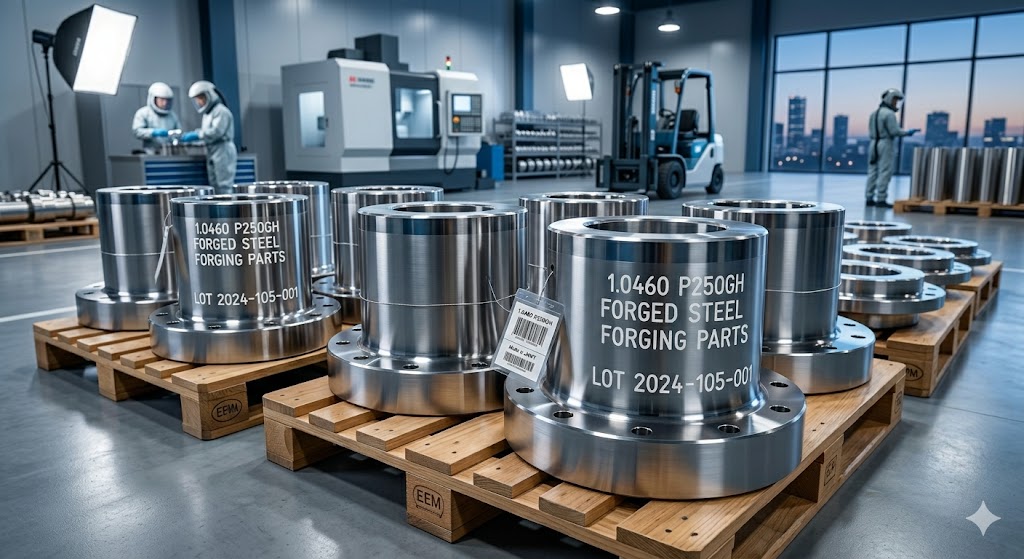
1.0460 (P250GH) Forged Steel Forging Parts | Professional China Manufacturer & Supplier
Product Overview
Quick Reference — 1.0460 (P250GH) Forged Steel: Grade: 1.0460 / P250GH | Standard: EN 10273:2007 | Type: Hot-rolled weldable carbon steel | Max. Temperature: 450°C | Tensile Strength: 410–540 MPa | Yield Strength: ≥250 MPa (<50mm) | Heat Treatment: Normalized (N) | Certification: MTC EN 10204 3.1/3.2 | MOQ: 1 piece | Max Weight/Piece: 35 tons | Lead Time: 7–30 days | Manufacturer: Jiangsu Liangyi Co.,Limited, Jiangyin, China (ISO 9001:2015, est. 1997)
Jiangsu Liangyi Co.,Limitedis a professional ISO 9001:2015 certified manufacturer in China that makes 1.0460 (P250GH) open die forging parts and seamless rolled steel forged rings. The company has been in business since 1997 and has more than 25 years of experience in the industry. It exports to more than 50 countries in Europe, the Middle East, North America, Southeast Asia, and Oceania.
1.0460 (also known as P250GH) is a specialized hot-rolled weldable boiler steel designed for stable operation at elevated temperatures up to 450℃, fully compliant with EN 10273:2007 standard. It is the ideal material for critical pressure equipment components requiring excellent weldability, high pressure resistance, good impact toughness and long-term fatigue performance. P250GH grade material is typically supplied in the normalized condition, with complete mill test certificate (MTC) EN 10204 3.1/3.2 available for all batches.
The designation 1.0460 is the European material number, while P250GH is the symbolic steel name: "P" for pressure service, "250" for minimum yield strength in MPa, and "GH" indicating elevated-temperature (Hochtemperatur) suitability. Both terms refer to the identical steel grade under EN 10273:2007.
Why Global Buyers Choose Jiangsu Liangyi for 1.0460 (P250GH) Forgings
After 25+ years of supplying EN 10273 P250GH forged parts to engineering companies, EPC contractors and OEM manufacturers across 50+ countries, we have identified the six factors that matter most to serious buyers — and built our entire operation around them:
1. Integrated Steelmaking-to-Machining Control — No Subcontracting
Many forging suppliers in China source their billets from external steel mills and have no control over the actual chemical composition or inclusion content of the incoming raw material. We operate differently. Our P250GH material is sourced from a qualified steel mill partner whose production process we audit annually, and every heat of steel is re-verified by our own spectrometer before entering the forge. This means we catch problems at the billet stage, not after forging — a distinction that significantly reduces rejection rates and delivery delays. For orders requiring EN 10204 3.2 third-party certification, our process documentation starts from heat number at the furnace, not from the finished bar.
2. Forging Ratio Control for Dense, Defect-Free Microstructure
P250GH is a medium-carbon steel with relatively tight compositional tolerances. The quality of the finished forging depends heavily on achieving a sufficient forging ratio to break down the as-cast dendritic structure and close internal porosity. Our metallurgical engineers specify a minimum forging ratio of 4:1 for all P250GH open-die forgings, and 3:1 for seamless rolled rings, based on the diameter-to-wall ratio of the final component. For large forgings above 3 tons, we perform intermediate reheats to maintain workability and prevent cold shuts. These process parameters are documented in our Forging Procedure Specification (FPS) for each order and are available for customer review.
3. In-House Normalized Heat Treatment with Full Curve Recording
Normalization is not simply "heat and air cool." For P250GH, achieving the correct final grain size (ASTM grain size 6–8 is our internal target) requires precise control of the austenitizing temperature (880–920°C), holding time calculated by section thickness (typically 1 minute per mm of maximum cross-section, minimum 30 minutes), and controlled cooling rate. Our 21 gas-fired furnaces are equipped with multi-zone temperature control and computerized data logging that records furnace temperature, part surface temperature (via contact thermocouple for qualification pieces), and cooling conditions at 1-minute intervals. The resulting temperature-time chart is issued with every batch as part of the EN 10204 3.1 MTC and is available in digital format (PDF/Excel) for your engineering review.
4. Dimensional Tolerance Capability for Near-Net-Shape Forgings
One area where forging quality directly affects your procurement cost is the amount of machining allowance built into the forging drawing. Over-generous allowances mean you are paying to machine away expensive forged material. Our 25+ years of tooling experience with P250GH open-die forgings allows us to work to tighter as-forged tolerances than most competitors: ±3mm on diameters up to 500mm, ±5mm on diameters 500–1000mm, and ±8mm on diameters above 1000mm, with straightness within 1mm/m. For seamless rolled rings, we typically achieve ±2mm on OD and ±3mm on height as-rolled. These tighter starting tolerances reduce your machining cycle time and reduce material scrap.
5. Third-Party Inspection Fully Supported — Including Resident Inspectors
We work regularly with all major third-party inspection agencies, including Bureau Veritas (BV), Lloyd's Register (LR), SGS, Intertek, TÜV Rheinland, DNV, and customer-appointed resident inspectors. We have a separate third-party inspection room in our factory that has direct sightlines to our UT/MT inspection benches, hardness testing station, and dimension inspection table. We know what documents are needed for European PED (Pressure Equipment Directive) projects, including Annex I essential safety requirements and the conformity assessment procedure for pressure equipment. At the quotation stage, we can talk about and agree on the inspection hold points (H) and witness points (W) in your Inspection and Test Plan (ITP).
6. Lead Time Commitment and Transparent Progress Tracking
It takes 15 to 30 working days from the time you place your order to get normal 1.0460 (P250GH) forged parts. The real lead time depends on the drawings of the parts and the heat treatment needs. For emergency orders of up to 5 tons with simple shapes, the lead time is 7 to 10 business days. When you place an order, we send you a production schedule and then give you updates at key points along the way, such as when we receive the billet, finish forging, finish heat treatment, and sign off on the final inspection. Our export team takes care of all the shipping paperwork, such as the commercial invoice, packing list, EN 10204 MTC, certificate of origin, and fumigation certificate. We send documents by DHL or FedEx and cargo by sea freight from Ningbo or Shanghai port.
1.0460 (P250GH) Forged Product Forms — Capabilities & Technical Notes
Our maximum single-piece forging weight is 35 tons, minimum is 30 kg, and annual output capacity is 120,000 tons. Below is a technical breakdown of each product form we manufacture in P250GH, including typical dimensional ranges and the engineering considerations specific to each form:
Open-Die Forged Bars, Blocks & Discs
Round bars are our highest-volume P250GH product. We produce them from 80mm diameter up to 1,200mm diameter, in lengths up to 6,000mm as-forged (longer sections are available in multiple-piece joined sets). Square and rectangular bars are produced for valve body blanks, manifold blocks, and structural pressure parts. Our forging presses provide up to 6,300 tonnes of compressive force, guaranteeing adequate plastic deformation even on large cross-sections. All bars are produced with a defined forging reduction ratio and forged from both ends to guarantee consistent mechanical properties along the full length — an important requirement for pressure equipment parts where end-to-end consistency is tested by EN 10273.
Forged discs and plates for tube sheets, cover plates, and blind flanges are produced with a minimum forging ratio of 3:1 on the thickness direction. We can pre-drill the tube hole pattern as-forged for tube sheet applications to make machining easier. For all tube sheet orders, we also provide 100% UT per EN 10228-3 Class 3.
Seamless Rolled Rings & Forged Flanges
We can make seamless rolled rings in P250GH with outside diameters (OD) ranging from 200mm to 5,000mm, wall thicknesses ranging from 30mm to 600mm, and heights up to 800mm using our 1m and 5m ring rolling machines. Ring rolling is the preferred manufacturing method for flanges, pressure vessel nozzle reinforcement rings, and large-diameter pipe fittings because it produces a circumferentially oriented grain flow that maximizes hoop strength and fatigue resistance — properties that are not achievable with fabricated (welded) alternatives.
We produce all standard flange types in P250GH: weld neck (WN), slip-on (SO), socket weld (SW), blind (BL), lap joint (LJ), threaded (TH), and orifice flanges, to ASME B16.5 (Class 150–2500), EN 1092-1 (PN6–PN420), and DIN standards. Swivel ring flanges — a specialty item for offshore pipeline connections — are also produced in P250GH to API 6A and customer-specific drawings.
Hollow forgings (also called forged hollow bars or forged thick-walled cylinders) are one of the most technically demanding product forms. We use a punch-and-draw process on our hydraulic presses to produce P250GH hollow forgings with bore diameters from 100mm to 800mm and wall thicknesses from 50mm to 400mm. The advantage over machining from solid bar is that the grain flow follows the cylindrical contour, improving fatigue life and impact resistance in the circumferential and axial directions — particularly important for pressure vessel shells, reactor vessels, and pump barrels operating under cyclic pressure loads.
Forged sleeves and bushes for bearing applications are produced with tighter as-forged bore tolerances (H11) and are often supplied with an internal bore ground or honed to the customer's final dimension, eliminating the need for an intermediate machining operation at your facility.
Pipeline fitting forgings in P250GH are produced to MSS SP-75, ASME B16.9, or customer-specific standards. Our specialty is large-bore high-pressure fittings that are impractical to manufacture by welding or casting: piggable wye fittings (allowing pig passage through the branch), swept branch tees with a smooth radius at the branch takeoff (reducing pressure drop and erosion at the junction), and reinforced saddles for branch connections on large-diameter main pipes.
Piggable wye fittings in P250GH are produced in sizes from 4" to 48" nominal bore, with the main bore and branch bore matching your pipeline's pig barrel dimensions to within ±2mm. We manufacture the fitting as a single integral forging — not a machined block with welded branches — which eliminates the heat-affected zones and weld seams that are the most common failure point in conventional fabricated wyes.
Valve Bodies, Bonnets, Pump Casings & Impellers
Forged valve bodies in P250GH are preferred over cast alternatives for high-pressure (ASME Class 900 and above) and high-temperature service because forgings eliminate the porosity, shrinkage cavities, and inclusion clusters that are inherent to the casting process. We supply forged valve bodies in gate, globe, ball, check, and control valve configurations to API 600, API 602, BS 1414, and EN 12516, with pressure-temperature ratings fully conforming to ASME B16.34.
Pump casings and impellers in P250GH are used in high-pressure boiler feed pumps, reactor coolant pumps, and process pumps for refinery and chemical plant service. We produce these with our 5-axis CNC machining centers to achieve surface finishes of Ra 1.6 μm on flow passages and Ra 0.8 μm on sealing faces, reducing hydraulic friction losses and ensuring reliable sealing in high-pressure service.
Industry Applications, Engineering Rationale & Global Project Case Studies
Project case studies below are based on representative completed projects. Customer names are kept confidential per standard commercial agreements. Specific quantities and specifications are provided for illustrative purposes and represent typical order scopes.
P250GH is not a general-purpose carbon steel. Its specific combination of controlled carbon content (0.18–0.23%), Aluminum-killed grain refinement (Al 0.015–0.05%), and low sulfur (max 0.015%) makes it particularly well-suited for applications requiring all of the following simultaneously: weldability without mandatory post-weld heat treatment (PWHT) in most cases, stable creep resistance at up to 450°C, reliable room-temperature impact toughness (≥47J at 20°C), and full traceability per EN 10204. Below are the primary industries we serve, with engineering context and real project experience.
District Heating Networks, Boilers & Shell-and-Tube Heat Exchangers
P250GH is the dominant forging material for tube sheets, channel flanges, nozzle necks, manhole covers, and pressure shells in European district heating boilers and heat exchangers. Its key advantage over common structural steels like S235 or S355 is certified elevated-temperature yield strength: while S355 loses approximately 40% of its room-temperature yield strength at 400°C, P250GH retains a minimum yield strength of 175 MPa at 400°C and 155 MPa at 450°C as specified in EN 10273 Annex A. This predictable high-temperature strength is what pressure vessel designers rely on for PED (Pressure Equipment Directive 2014/68/EU) compliance calculations — it is the reason P250GH appears in the allowable stress tables of EN 13445, the European unfired pressure vessel standard.
For tube sheet design, two key thermophysical properties govern differential thermal stress at the tube-to-tubesheet joint: the mean coefficient of thermal expansion of P250GH (approximately 13.2 × 10⁻⁶ /K between 20°C and 400°C) and its thermal conductivity (approximately 44 W/(m·K) at 400°C). These values are consistent with the EN 13445-2 material data and must be used in conjunction with the correct material allowable stress for accurate vessel integrity calculations.
Project Case: 450 MW CHP District Heating Boiler — Bavaria, Germany (2019–2020 Delivery)
We supplied 218 pieces of P250GH forged components for the steam drum and heat exchanger sections of a 450 MW combined heat and power (CHP) district heating plant in Bavaria: 48 tube sheets (OD 1,100–1,800mm, thickness 120–240mm), 72 channel flanges (DN600–DN1200, PN64), and 98 nozzle neck forgings (DN80–DN400). All tube sheets were manufactured with a minimum forging ratio of 4:1 in the thickness direction to ensure isotropic ultrasonic testability, supplied to UT Class C3 per EN 10228-3 (maximum equivalent defect size 3mm at 0dB reference). The project required EN 10204 3.2 certification with TÜV SÜD engaged as the independent inspection body. All 218 pieces passed 3.2 inspection on first submission. Five-year post-commissioning pressure testing of the completed boiler reported zero material-related deficiencies.
Oil & Gas — Transmission Pipelines, Sour Service & Well Control Equipment
In oil and gas, P250GH is selected for pipeline fittings and pressure vessel components in sour gas service where the carbon equivalent must be tightly controlled to prevent hydrogen-induced cracking (HIC) and sulfide stress corrosion cracking (SSCC). The IIW carbon equivalent of standard P250GH, calculated as CE = C + Mn/6 + (Cr+Mo+V)/5 + (Ni+Cu)/15, typically falls in the range of 0.35–0.42 — generally acceptable per NACE MR0175/ISO 15156 when hardness is controlled to HRC ≤22 (Vickers ≤248 HV). For confirmed sour service orders, we tighten sulfur to max 0.010% (vs. EN 10273 limit of 0.015%), phosphorus to max 0.020% (vs. 0.025%), and can perform HIC testing per NACE TM0284 on representative test pieces on request.
For blowout preventer (BOP) bodies and blocks rated below 5,000 psi working pressure, P250GH offers a significant maintenance cost advantage over alloy steels: its carbon steel chemistry allows field weld repair of surface damage without the strict preheat and interpass temperature controls required for chromium-molybdenum steels, reducing equipment downtime. We produce BOP bodies and blocks to API 16A and API 6A, and can support customer audit and qualification processes for API-regulated projects. Note: we do not hold API monogram certification independently; API monogram licensing is obtained by the end customer or EPC contractor.
Project Case: 680 km Crude Oil Trunk Pipeline Expansion — Kingdom of Saudi Arabia (2021 Delivery)
For a major crude oil trunk pipeline expansion project with a throughput of 1.2 million barrels per day, we manufactured 120 pieces of 36" × 24" piggable wye assemblies (main bore ID 914mm, branch bore ID 610mm, wall thickness 38mm, ANSI Class 600), 45 pieces of 36" × 18" swept branch tees, and 360 pieces of swivel ring flanges (36", PN64, to customer drawing). The piggable wyes were designed to pass a 34.5" diameter pipeline inspection gauge (PIG) through the main run and a 22.5" PIG through the branch, with transition radii verified by 3D CMM to within ±1.5mm of design drawing. All fittings passed NACE MR0175 hardness verification (maximum measured 198 HV10 vs. limit 248 HV10), full volumetric UT, and 100% PMI by XRF analyzer. The client conducted hydrostatic factory acceptance test (FAT) at 1.5 × design pressure. Zero rejections across all 525 pieces.
Nuclear Power — Auxiliary Systems & Safety Class 3 Pressure Components
P250GH (1.0460) can be supplied for nuclear power plant auxiliary systems intended for Safety Class 3 / Category III level applications under RCC-M (French nuclear design code) or ASME Section III Class 3, subject to the applicable nuclear authority approval and project-specific QA requirements. Purity requirements are more stringent than commercial grades: nuclear-specification P250GH billets are sourced from our qualified steelmaking partners and produced with vacuum degassing (VD) to achieve hydrogen content below 2 ppm (verified by the steel mill's liquid-steel hydrogen measurement records), and a non-radioactive material certificate is issued by the steel mill confirming the scrap charge has passed gamma spectrometry screening for Co-60, Cs-137, and other activation products from decommissioned nuclear facilities.
For large-section nuclear forgings above 200mm thickness, our metallurgical engineers specify a stress relief anneal at 600–640°C — below P250GH's lower critical transformation temperature Ac1 (approximately 720°C) — following normalization. This reduces residual stress below 100 MPa, verified by X-ray diffraction or hole-drilling strain gauge method, preventing dimensional change during precision CNC machining and reducing the risk of stress corrosion in service.
Project Case: 1000 MW PWR Auxiliary Cooling System Forgings — Jiangsu, China (2020–2021 Delivery)
We supplied P250GH forged components for the auxiliary cooling system of a 1000 MW pressurized water reactor (PWR): 24 pieces of pump casing half-shells (OD 680mm, wall 85mm), 48 pieces of impeller blanks (OD 520mm, thickness 180mm), and 12 pieces of bearing housing forgings (OD 480mm). The entire production was carried out under a dedicated project quality plan referencing the requirements of HAF 003 (Chinese nuclear safety regulation) and ASME NQA-1 principles, developed in cooperation with the customer's nuclear QA team. All components passed radiographic testing (RT) per ISO 5579 Level 2, magnetic particle testing (MT) per ISO 9934-1, and full dimensional inspection against the nuclear drawing specification. The final documentation package contained 47 individual quality records per component, reviewed and accepted by the customer's resident nuclear QA inspector. No material-related discrepancies were reported during plant commissioning.
For ASME Class 600 and above, or for fire-hazard and lethal fluid service per ASME B31.3 Chapter IX, forged P250GH valve bodies are preferred over cast alternatives because forgings eliminate the shrinkage porosity that is the most common cause of hydrostatic shell test failures in cast pressure retaining components. P250GH appears in the EN 12516-2 allowable stress table for European pressure valves, enabling economical body wall thickness design at Class 300 and Class 600 ratings without the weight penalty of over-rated alloy steel bodies.
A practical machining advantage of P250GH normalized forgings: the uniform fine-grained ferrite-pearlite microstructure produces consistent chip-breaking behavior at cutting speeds of 180–220 m/min with coated carbide tooling, with typical tool life of 40–60 minutes per cutting edge. This is significantly longer than equivalent yield-strength alloy steels such as 16Mo3 or 13CrMo4-5, which require lower cutting speeds due to their higher alloy content and greater hardness variability. Lower tooling cost per piece and reduced machining cycle time are a direct cost benefit for high-volume valve body production.
Project Case: Continuous Valve Body Forgings Supply — 3 Global Valve OEM Manufacturers (2015–Present)
Since 2015, we have served as a qualified and audited forging supplier to several leading global industrial valve manufacturers headquartered in Europe and North America, maintaining approved vendor list (AVL) status through regular supplier quality audits. Our annual supply totals approximately 52,000 pieces of P250GH forged valve bodies, bonnets, stems, and seat ring blanks: gate valves (4"–24", ASME Class 150–900), globe valves (½"–12", Class 300–1500), ball valve bodies (2"–20", Class 150–600), and tilting disc check valves (4"–36", Class 150–300). Over the course of our multi-year supply relationship, our supplier quality audit scores have always been higher than the customer pass thresholds. The defect rate for delivered parts is also well below the industry standard of 500 PPM for forged valve parts. This performance is achieved through our first-article inspection protocol, in-process production control plan, and ongoing SPC monitoring of wall thickness and bore diameter on every production run.
Power Generation — HRSG, Feedwater Heaters & Steam Drum Components
In thermal and combined-cycle power generation, P250GH is the standard forging material for heat recovery steam generator (HRSG) feedwater heater shells and tube sheets, steam drum nozzle connection forgings, and low-pressure steam turbine casing flanges. Its minimum creep rupture strength (Rpt/10⁵) of approximately 225 MPa at 400°C — as tabulated in EN 10273 Annex A — provides a reliable engineering basis for components experiencing sustained pressure loads over 100,000-hour service intervals at elevated temperature, which corresponds to the typical design life of a modern combined-cycle power plant.
We delivered 36 pieces of P250GH tube sheet forgings (OD 920–1,400mm, thickness 140–210mm), 24 pieces of shell flange rings (OD 820–1,200mm, PN16–PN40), and 48 pieces of nozzle neck forgings for a 750 MW combined-cycle gas turbine power plant in the Netherlands. The project specification required Bureau Veritas to certify EN 10204 3.2. It also required that the tensile properties of the test specimens be reported at both room temperature and elevated temperature (300°C and 400°C, respectively, per EN 10273 Annex A). Finally, it required that the test specimens be subjected to PWHT simulation (2 cycles at 600°C for 2 hours each) to make sure that the HRSG fabricator's post-weld heat treatment schedule would not lower impact toughness below 47J.All requirements were met on first submission. The HRSG fabricator reported zero dimensional rework or material rejections across the entire supply scope.
Additional application areas for 1.0460 (P250GH) forgings from Jiangsu Liangyi include: chemical reactor vessels and autoclaves (Zhejiang and Jiangsu process industry cluster); subsea pipeline manifolds and jumpers (Asia-Pacific offshore oil field development); high-pressure hydrogen compression equipment (P250GH's low carbon equivalent provides excellent compatibility with high-pressure H₂ environments at ASME Class 1500 and below); and geothermal wellhead equipment and Christmas trees (where thermal spray or cathodic protection is applied post-machining for external corrosion control).
Material Specifications, Engineering Properties & Compliance Standards
Applicable Production & Design Standards
Our 1.0460 (P250GH) forged steel parts are manufactured and certified in compliance with the following standards. Where a customer specification references a standard not listed here, we will review it at the quotation stage and confirm compliance or identify any deviations:
Standard
Scope & Application
EN 10273:2007
Primary product standard: hot rolled weldable steel bars for pressure purposes with specified elevated temperature properties. Defines chemical composition, mechanical properties at room and elevated temperature, heat treatment condition, and inspection requirements for P250GH.
EN 10228-3 / EN 10228-4
Ultrasonic testing of forgings: EN 10228-3 for ferritic/martensitic steel forgings (UT Classes 1–4), EN 10228-4 for austenitic and austenitic-ferritic stainless steel forgings. Standard UT acceptance class for pressure equipment forgings is Class 3.
EN 10204:2004
Material certification types: Type 2.1 (declaration of compliance), Type 2.2 (test report), Type 3.1 (inspection certificate by manufacturer's authorized inspector), Type 3.2 (inspection certificate by independent third-party inspector). We provide 3.1 as standard; 3.2 available on request.
EN 13445
European unfired pressure vessel standard. Uses P250GH allowable stress values from EN 10273 Annex A for vessel wall thickness design calculations under PED 2014/68/EU.
ASME VIII Div.1 / ASME B31.3
US pressure vessel and process piping standards. P250GH forgings can be supplied with ASME material certification on request; cross-reference to SA-266 Gr.2 or SA-105 is typically used for ASME project compliance depending on the product form.
NACE MR0175 / ISO 15156
Materials for equipment used in H₂S-containing environments. P250GH forgings for sour service are supplied with tightened S ≤0.010%, P ≤0.020%, and hardness verification to HRC ≤22 (Vickers ≤248 HV).
ISO 9001:2015
Quality management system certification covering our entire forging production process, from billet procurement and incoming inspection through forging, heat treatment, machining, NDT, and final documentation release.
The quality of a P250GH forging is determined as much by the steelmaking route as by the forging process itself. The UT testability and fatigue life of the finished forging are all affected directly by inclusions, segregation, and residual hydrogen in the billet. Our approved method for making P250GH billets from steel includes the following steps, each with its own set of acceptance standards:
Primary melting: Electric Arc Furnace (EAF) or Basic Oxygen Furnace (BOF), with controlled charge composition to limit residual elements (Cu ≤0.25%, Sn ≤0.025%, As ≤0.025%, Sb ≤0.010%).
Ladle Refining Furnace (LRF): Fine-tuning the composition, desulfurizing to S ≤0.010% for pressure service grades, and optimizing the slag chemistry to control the shape of inclusions (for example, treating calcium to turn angular alumina inclusions into globular calcium-aluminate, which reduces UT signal scattering).
Vacuum Degassing (VD or VD/VOD): Hydrogen removal to <2 ppm (measured by Hydris on liquid steel), nitrogen control to <80 ppm, oxygen activity below 15 ppm. VD is standard for all forgings with section thickness above 200mm; mandatory for nuclear auxiliary applications.
Continuous casting (CC) or ingot casting: For forgings above 5 tons, ingot casting is preferred to avoid the central porosity and macro-segregation that are inherent to continuously cast large blooms. Our ingot weights range from 3 tons to 60 tons.
Incoming billet inspection: Every heat number is verified by our own optical emission spectrometer (OES) against the EN 10273 chemical composition limits before forging. Billet surface is inspected visually and by MT for seams, scabs, and laps.
Chemical Composition — EN 10273:2007 Requirements & Our Actual Practice
The chemical composition of 1.0460 (P250GH) forged steel is tightly specified in EN 10273:2007, Table 2. Our actual production heats consistently achieve the following ranges (both EN limits and our typical actual values are shown):
Element
EN 10273:2007 Limit (wt%)
Our Typical Actual Range (wt%)
Metallurgical Role
Carbon (C)
0.18 – 0.23
0.19 – 0.22
Provides base strength via pearlite formation; upper limit controlled for weldability (low preheat requirement)
Silicon (Si)
Max 0.40
0.15 – 0.35
Deoxidation element; excessive Si increases hardness of weld HAZ and reduces toughness
Manganese (Mn)
0.30 – 0.90
0.50 – 0.80
Strength and hardenability; also combines with sulfur to form MnS and prevent Fe-S hot shortness
Phosphorus (P)
Max 0.025
Max 0.018
Embrittles grain boundaries (temper embrittlement); controlled at LRF stage
Sulfur (S)
Max 0.015
Max 0.008
Forms MnS inclusions that reduce through-thickness toughness and UT testability; Ca-treatment ensures globular MnS morphology
Chromium (Cr)
Max 0.30
Max 0.20
Residual element from scrap; controlled to limit hardenability and maintain weldability
Nickel (Ni)
Max 0.30
Max 0.20
Residual element; low levels have no significant effect on P250GH properties
Vanadium (V)
Max 0.020
Max 0.010
Grain refinement element; strictly controlled in P250GH to avoid precipitation hardening effects that reduce weldability
Niobium (Nb)
Max 0.010
Max 0.005
Controlled residual; at low levels has minor grain refining effect without significant weldability penalty
Titanium (Ti)
Max 0.030
Max 0.015
Controlled residual; excessive Ti forms TiN inclusions that pin grain boundaries and can adversely affect HAZ toughness
Aluminum (Al, total)
0.015 – 0.050
0.020 – 0.040
Grain refining element (forms AlN); the specified minimum 0.015% Al is what distinguishes P250GH as an Al-killed fine-grained steel, ensuring consistent grain size ASTM 6–8 after normalization
Carbon Equivalent & Weldability Analysis
The weldability of P250GH is one of its most valued engineering properties. The IIW carbon equivalent formula (CEIIW = C + Mn/6 + (Cr+Mo+V)/5 + (Ni+Cu)/15) gives a typical value of 0.35–0.42 for standard P250GH compositions. The CET (carbon equivalent for cracking susceptibility) formula used in EN ISO 10225 (CET = C + (Mn+Mo)/10 + (Cr+Cu)/20 + Ni/40) gives a typical value of 0.22–0.28.
Based on these values and the EN ISO 10225 guidance, P250GH butt welds with combined thickness below 40mm generally require no preheat when heat input is above 1.0 kJ/mm. For section thickness above 40mm, or when heat input is below 1.0 kJ/mm, a minimum preheat of 50–100°C is recommended. This is significantly lower than alloy pressure steels like 16Mo3 (preheat 100–150°C) or 13CrMo4-5 (preheat 150–200°C), and is why P250GH is preferred for heat exchanger and boiler construction where weld joint productivity and post-weld PWHT avoidance are important economic drivers.
Mechanical Properties — Room Temperature (EN 10273:2007, Table 5)
The following room-temperature mechanical properties are guaranteed for all our 1.0460 (P250GH) forgings and verified on each batch by tensile testing (per EN ISO 6892-1) and Charpy V-notch impact testing (per EN ISO 148-1) on samples taken from the prolongation of the forging in the longitudinal direction:
Nominal Dimension (mm)
Tensile Strength Rm (MPa)
Yield Strength Rp0.2 (MPa)
Elongation A (%)
Reduction of Area Z (%)
Impact Energy KV at 20°C (J)
< 50 mm
410 – 540
≥ 250
≥ 25
≥ 50
≥ 47 (average 3 specimens)
50 – 100 mm
410 – 540
≥ 240
≥ 25
≥ 50
≥ 47 (average 3 specimens)
100 – 150 mm
410 – 540
≥ 230
≥ 25
≥ 50
≥ 47 (average 3 specimens)
Note: Reduction of area Z ≥50% is our internal additional requirement, beyond EN 10273 minimum, ensuring superior through-thickness ductility — particularly relevant for pressure vessel tube sheets where transverse loading occurs. This value is reported on our MTC.
Elevated-Temperature Mechanical Properties (EN 10273:2007, Annex A)
One of the defining features of P250GH that distinguishes it from structural carbon steels is its certified elevated-temperature strength. The following minimum proof strength values at elevated temperatures are specified in EN 10273 Annex A and are reportable on the MTC for pressure equipment applications where EN 13445 design calculations require elevated-temperature allowable stresses:
Test Temperature (°C)
Min. Proof Strength Rp0.2t (MPa)
Design Application
100°C
≥ 218
Low-temperature steam and condensate systems
150°C
≥ 208
District heating primary circuits
200°C
≥ 198
Boiler feedwater heater shells
250°C
≥ 193
Medium-pressure steam drum connections
300°C
≥ 183
HP feedwater heater tube sheets
350°C
≥ 178
HP steam nozzle forgings, HRSG components
400°C
≥ 175
Upper design temperature for most pressure vessel applications
450°C
≥ 155
Maximum operating temperature for P250GH (continuous service)
We can report elevated-temperature tensile properties on the MTC — either by direct testing (using an elevated-temperature tensile test machine) or by cross-referencing to the tabulated EN 10273 Annex A values, depending on your project specification requirements. For projects requiring direct elevated-temperature test reporting, please specify this in your inquiry so we can include the test cost in our quotation.
In the normalized condition, P250GH typically exhibits a Brinell hardness of 120–160 HBW measured on the mid-radius of the forging cross-section. Our internal acceptance criterion for hardness uniformity across the cross-section is ΔHB ≤20 HBW between surface and center measurements, which indicates consistent normalization throughout the section thickness. Vickers micro-hardness mapping is performed on representative metallographic samples to verify the microstructure uniformity and the absence of hard martensitic or bainitic zones that could form if cooling was too rapid during normalization.
The target ASTM austenite grain size after normalization is ASTM 6–8 (mean grain diameter 22–44 μm), verified per ASTM E112 or EN ISO 643 on representative samples. This fine grain size is what gives P250GH its combination of good strength, toughness, and fatigue life — it is achieved through the combination of the Al-killed fine-grained steel chemistry and the controlled normalization temperature range (880–920°C), which is above Ac3 (approximately 855°C for P250GH) but not so high as to cause significant grain coarsening.
Production Capabilities, Process Sequence & Equipment List
Our 80,000 m² integrated manufacturing facility in Jiangyin, Jiangsu Province is specifically designed for large-section pressure equipment forgings. The facility operates as a vertically integrated production unit: billet heating, forging, ring rolling, heat treatment, NDT inspection, and CNC precision machining are all performed under one roof, with internal material handling by overhead cranes (capacity up to 100 tons) eliminating the inter-site transport delays and handling risks associated with multi-supplier production chains.
Step 1 — Billet Heating: Accurate Temperature Control Before Forging
Our 6 mobile hearth heating furnaces have individual loading capacities from 10 to 80 tons. Each furnace is equipped with a multi-zone temperature control system (PID controllers, ±5°C accuracy) and automatic atmosphere control to minimize decarburization of the billet surface. For P250GH billets, the standard heating sequence is: charge at furnace temperature ≤400°C, heat to 1,180–1,220°C at a controlled rate of ≤80°C/hour for billets above 500mm diameter (to prevent thermal shock), hold for a minimum of 1 hour per 100mm of maximum cross-section, verify uniformity by surface-to-core thermocouple differential ≤30°C before discharge to the press. This careful heating protocol makes sure that the billet is at a uniform hot-working temperature throughout its cross-section — an important requirement for achieving consistent forging reduction and eliminating the internal cracking risk that can occur when a billet is forged with a cold center.
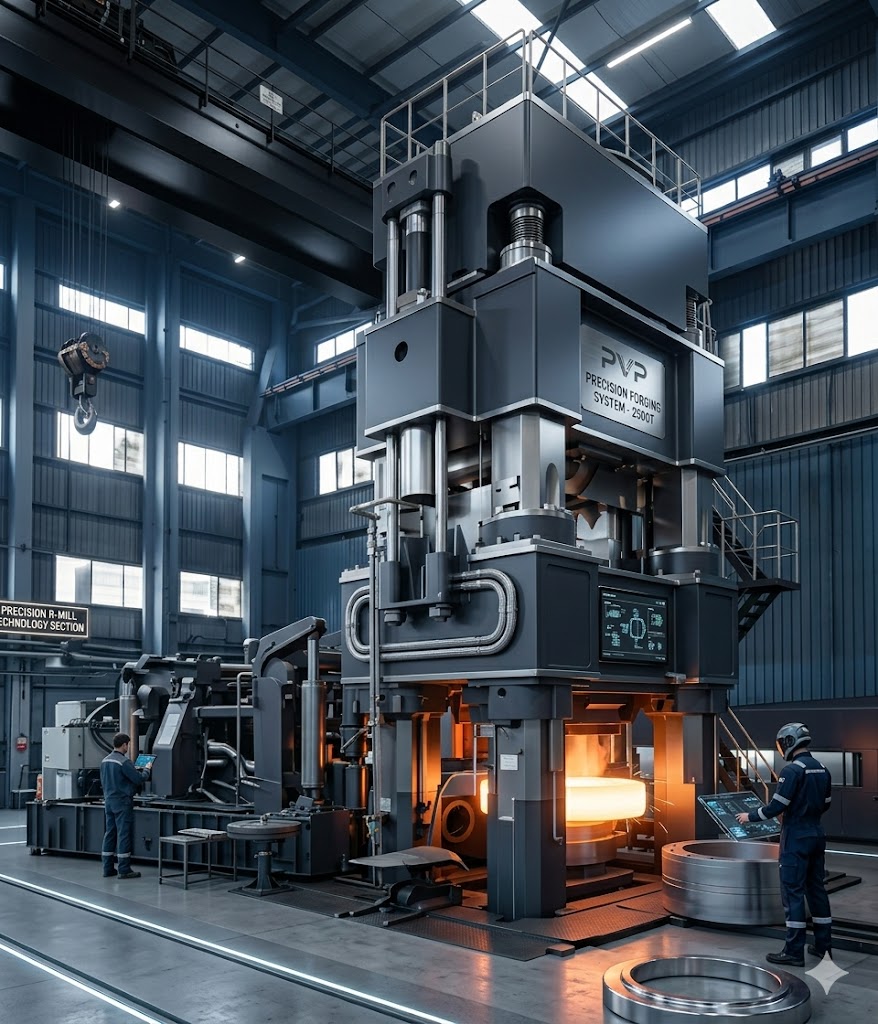
Our hydraulic forging presses (2,000T, 4,000T, and 6,300T) are semi-automatic, with servo-hydraulic ram speed control that allows us to maintain a consistent strain rate during forging. Press selection for each P250GH component is based on the forging force calculation: for a 1,000mm diameter bar, the required forging force at the final pass (smallest cross-section) is typically 3,500–4,500 tons, depending on billet temperature and reduction rate — well within the capacity of our 4,000T press, which is our workhorse machine for mid-size P250GH bar forgings.
The forging pass sequence for a P250GH round bar typically involves: initial breakdown forging of the ingot on 4 flat faces to break down the as-cast structure and close center porosity; drawing-out to an intermediate octagonal cross-section; and final rotary forging on the press to achieve the target round diameter, with light reduction passes (5–8% per pass) at the final temperature to ensure a smooth surface and uniform grain refinement. Our forging manipulators (12–70 ton capacity, including rail-mounted manipulators for large forgings) provide positional control during each pass, guaranteeing straight forgings and consistent reduction ratio along the full length.
For forgings above 5 tons or with length-to-diameter ratio above 4:1, intermediate reheats are performed when the billet surface temperature drops below 900°C. Our furnace placement adjacent to the presses allows reheating in typically 30–45 minutes, minimizing scale formation and oxidation loss during the reheat cycle. Our Forging Procedure Specification (FPS) keeps track of the total number of heats (forging and reheating sequences) for each P250GH part. This information is also part of the manufacturing record.
Step 3 — Seamless Ring Rolling: Process Control for Uniform Ring Properties
Our 1m and 5m radial-axial ring rolling mills produce seamless rolled rings in P250GH from 200mm OD to 5,000mm OD. The ring rolling process begins with a punched and drawn preform (hollow forging) that is then placed on the mandrel of the ring rolling mill and rolled between the main roll and mandrel while the axial rolls control the ring height. The key process parameter in ring rolling is the feed rate: too fast and the ring develops oval distortion (ovality >1%); too slow and the temperature drops below the recrystallization temperature and the ring develops a mixed grain structure. Our rolling programs specify feed rate as a function of ring OD, wall thickness, and current ring temperature (monitored by non-contact pyrometer) to maintain ovality within ±0.5% of OD throughout the rolling sequence.
The primary quality advantage of seamless rolled rings over alternative methods (fabricated rings from plate, or rough-machined from solid bar) is the circumferential grain flow orientation. In a seamless rolled ring, the crystal grains are elongated in the circumferential direction — the direction of maximum hoop stress in a pressure vessel or flanged nozzle under internal pressure loading. This alignment increases fatigue crack propagation resistance in the critical hoop stress direction by 20–35% compared to a machined ring from bar, where the grain flow is axial. For pressure equipment applications where EN 13445 requires fatigue analysis, this difference in grain flow can allow a reduction in the required section thickness, reducing component weight and material cost.
Step 4 — Normalization Heat Treatment: Process Parameters & Verification
According to EN 10273:2007, normalization is the standard delivery heat treatment condition for P250GH (1.0460). We have a strict process for normalizing P250GH that is specific to each furnace-forging size combination:
Loading: Forgings are loaded on ceramic or steel spacers to ensure adequate gas circulation on all surfaces. Maximum stack height is limited to 1.5 × forging cross-section diameter to prevent shadow effects on lower pieces.
Heating: Furnace temperature is raised to 900°C ± 15°C (the austenitizing temperature range for P250GH). Heating rate is controlled to ≤80°C/hour for sections above 200mm to prevent thermal stress cracking.
Soaking: Holding time after the furnace thermocouple reaches the target temperature is calculated as 1 minute per mm of maximum cross-section thickness, with a minimum of 30 minutes. This guarantees complete austenitization throughout the section, verified by metallographic sampling from the center of qualification test forgings during process qualification.
Cooling: Forgings are discharged from the furnace and cooled in still air at ambient temperature (typically 15–30°C). For very large or complex shape forgings, controlled air-blast cooling at 5–8°C/minute can be applied to reduce cooling time while avoiding thermal stress. Water quenching is not used for normalization of P250GH.
Verification: Tensile test bars and Charpy V-notch test bars are machined from the prolongation of each heat treatment batch and tested before the batch is approved for release. Hardness is verified at 5 locations per forging (2 surfaces, 2 quarter-radii, 1 center where accessible) by Brinell hardness tester.
Our 21 gas-fired heat treatment furnaces (plus 1 electric furnace) provide a combined effective chamber volume of over 4,000 m³ and a maximum single piece capacity of 80 tons and 16m length. All furnaces are connected to our centralized furnace data management system (FDMS) that records furnace temperature, part temperature (where thermocouple contact is used), atmosphere conditions, and heating/cooling rates at 1-minute intervals. This complete heat treatment time-temperature record is stored digitally and is issued as part of the EN 10204 3.1/3.2 certification package for each batch.
We have a full range of CNC machines in our machining workshop that let us make finished or semi-finished P250GH forged parts to your exact size without having to hire outside help for machining:
Equipment Type
Key Specifications
Typical Applications on P250GH
CNC Heavy Turning Lathes
Max swing Ø4,000mm, max length 16,000mm, max weight 80T
OD/ID turning of large rings, pressure vessel shells, shaft blanks
5-Axis CNC Machining Centers
Working envelope 2,500 × 2,000 × 1,200mm
Complex valve body cavities, pump impeller profiles, irregular forgings
CNC Boring & Milling Machines
Table size 4,000 × 2,000mm, spindle power 75kW
Tube sheet hole patterns, flange bolt circle drilling, manifold bore
Vertical CNC Lathes (VTL)
Table diameter up to Ø6,300mm
Large ring facing, channel flange facing, tube sheet facing
Our standard dimensional tolerances for machined P250GH forgings are: diameter tolerances to IT8 (e.g., ±0.027mm on a 100mm diameter bore), surface finish Ra 1.6μm on general machined surfaces, Ra 0.8μm on sealing faces (RTJ, RF flanges), and Ra 0.4μm on precision bore and journal surfaces. Tighter tolerances to IT7 or surface finish Ra 0.2μm are achievable for specific critical surfaces and are quoted on a case-by-case basis.
Quality Inspection System, NDT Methods & Full Traceability Certification
Our quality inspection system for 1.0460 (P250GH) forged parts is designed around three principles: detect problems as early in the process as possible (incoming billet inspection, not just final product inspection); inspect 100% of finished surfaces and critical areas by NDT (not statistical sampling); and issue a documentation package that provides a complete, unbroken traceability chain from the original heat of steel to the final part delivery. Below is a detailed description of each inspection stage and the equipment used.
Incoming Material Inspection
Every heat of P250GH billet or ingot entering our factory is subjected to the following incoming inspection before being released for production:
Chemical composition verification by optical emission spectrometer (OES) capable of 10-element simultaneous analysis (C, Mn, Si, Cr, Ni, Mo, V, Cu, Al, P, S). Two spark analyses per heat number, at different sampling locations of the billet. Must match the mill certificate values within ±5% relative deviation.
Surface condition inspection by visual and magnetic particle testing (MT) of the full billet surface using fluorescent wet MT method, to detect seams, laps, and scabs that could propagate into internal defects during forging.
Dimensional verification of billet weight (verified on our 100-ton floor scale), diameter/cross-section, and length against the mill order specification.
Non-radioactive material screening (for nuclear and special-grade orders) by portable gamma spectrometer scan of the full billet surface, checking for Co-60, Cs-137, and Eu-152 activation products.
In-Process Inspection During Forging
During forging, the following checks are performed at defined hold points in the Inspection and Test Plan (ITP):
Billet discharge temperature verified by calibrated contact pyrometer (±5°C accuracy) before first forging stroke — ensures working temperature is within the specified forging temperature window of 900–1,200°C for P250GH.
Dimensional check after each significant forging step using calibrated tong gauges, vernier calipers, and ultrasonic thickness gauge — ensures the forging is within the planned intermediate dimensional tolerance and that forging reduction ratio is being achieved.
Surface condition inspected visually after each pass to detect and dress any surface laps, cold shuts, or forging tears before they are closed over by subsequent passes.
Final forging temperature is monitored and logged by non-contact infrared pyrometer. Forgings are not allowed to be worked below 850°C (minimum finish forging temperature for P250GH), to prevent strain-hardening and twinning in the microstructure that reduces impact toughness.
Post-Forging & Post-Heat-Treatment NDT Inspection
After heat treatment and rough machining to inspection dimensions, all 1.0460 (P250GH) forgings undergo 100% NDT inspection. We do not use statistical sampling acceptance: every piece is individually inspected, and every test result is documented. Our NDT inspectors are certified to EN ISO 9712 Level 2 (or ASNT Level II upon request) for all applicable test methods:
NDT Method
Standard & Acceptance Class
Equipment Used
What It Detects
Ultrasonic Testing (UT)
EN 10228-3 Class 3 (standard); Class 4 available. ASTM A388 for ASME projects.
digital ultrasonic flaw detector; 2–5 MHz probes; automated scanning for cylindrical components
EN ISO 3452-1, sensitivity class 2 (fluorescent penetrant). Used for austenitic surfaces and non-magnetic materials.
Fluorescent penetrant system, dwell time 30 min minimum, UV-A inspection
Open surface-breaking defects on non-magnetic materials or complex-geometry surfaces where MT yoke access is limited
Radiographic Testing (RT)
EN ISO 5579 / ASTM E1032 Class 2. Used for selected weld repair areas or nuclear applications.
Portable X-ray generator (160–250kV) and gamma-ray source (Ir-192); digital radiography (DR) and computed radiography (CR) panels
Volumetric defects in weld repairs or thin-section forgings; verifies completeness of repair
Positive Material Identification (PMI)
100% PMI on all P250GH forgings for oil & gas projects; per customer specification for other markets. Results within EN 10273 composition limits.
handheld XRF analyzer for positive material identification (PMI), multi-element analysis on major alloying elements
Verifies material grade identity; detects incorrect material substitution (mixed material prevention)
Mechanical Property Testing Laboratory
Our in-house mechanical testing laboratory is equipped with the following instruments, all calibrated at intervals not exceeding 12 months by calibration bodies with traceability to national measurement standards (CNAS or equivalent):
Servo-hydraulic universal testing machine: 600 kN capacity, ±0.5% load accuracy, automated extensometer for elongation measurement. Can perform room-temperature tensile (EN ISO 6892-1), elevated-temperature tensile (EN ISO 6892-2, up to 600°C), and bend testing.
Instrumented Charpy impact tester: 300 J capacity, testing temperature range -196°C to +100°C, recorded energy resolution 0.1 J. Tests performed per EN ISO 148-1 on 10mm × 10mm standard V-notch specimens.
Portable and bench Brinell hardness tester: Portable unit (KING Brinell tester, ±5 HBW accuracy) used for in-situ measurement on large forgings; bench unit for test ring specimens. Results recorded and mapped to forging drawing.
Metallographic preparation and microscopy: automatic metallographic grinding and polishing system, optical microscope (50×–1000× magnification) with digital image capture. Used for grain size assessment (ASTM E112), microstructure evaluation, and decarburization depth measurement.
Full Traceability Documentation Package
Every batch of 1.0460 (P250GH) forging parts is delivered with a complete, electronically signed documentation package. The standard contents of the MTC EN 10204 3.1 package are listed below. Additional documents for 3.2, nuclear, or sour service projects are issued as supplements to this base package:
Unique identification number, material number and grade designation, purchase order number, customer drawing number, and heat number cross-reference table (linking each piece to its billet/ingot heat number)
Heat chemical analysis (ladle analysis) and finished product analysis (product analysis per EN 10273 Clause 9.3), both reported with actual values and compared to EN 10273 limits
Carbon equivalent (CEIIW) calculated value for each heat
Melting method, refining method, and vacuum degassing treatment record (including pre-VD and post-VD H₂ content for nuclear grades)
Forging procedure reference (FPS document number, press used, heat numbers forged, number of heats including reheats, finish forging temperature)
Complete heat treatment record: furnace ID, date/time, actual furnace temperature curve (graphical), part temperature record (where thermocouple contact is used), soaking time, cooling method and rate, and operator/inspector signatures
All mechanical test results: actual tensile strength (Rm), yield strength (Rp0.2), elongation (A), reduction of area (Z), and Charpy impact energy (KV, average and individual values) with test bar sampling location shown on forging sketch
Elevated-temperature tensile test results (where required by specification)
Brinell hardness survey results with measurement locations
ASTM grain size assessment result (where required)
UT test report: UT procedure reference, instrument serial number and calibration date, probe type and frequency, scanning coverage diagram, and list of all indications (if any) with location and disposition
MT test report: procedure reference, equipment, yoke spacing, field strength verification, and coverage confirmation
PMI results report (where applicable): instrument serial number, calibration reference, actual measured element values
Dimensional and visual inspection report: measured dimensions vs. drawing, surface condition description, identification marking verification
Packing list with net weight, gross weight, number of pieces, and marking on each piece
EN 10204 3.1 certificate signed by our authorized material inspector (AI)
For EN 10204 3.2: additionally countersigned by the independent third-party authorized inspection body witness inspector (BV, LR, SGS, TÜV, DNV, or customer-appointed)
1.0460 (also designated P250GH) is a European standard hot-rolled weldable carbon steel defined in EN 10273:2007. The grade designation breaks down as: "P" = pressure service, "250" = minimum yield strength in MPa, "GH" = elevated-temperature (Hochtemperatur) service. It is an Aluminum-killed fine-grained steel with a tightly controlled composition (C 0.18–0.23%, Mn 0.30–0.90%, Al 0.015–0.050%) that gives it a unique combination of properties not found in ordinary structural steels: certified yield strength from room temperature down to 450°C (tabulated in EN 10273 Annex A), good weldability due to its low carbon equivalent (CEIIW typically 0.35–0.42), and reliable impact toughness (≥47J at 20°C). These properties make it the material of choice for tube sheets, flanges, nozzles, shells, and valve bodies in boilers, heat exchangers, and pressure vessels covered by European PED (Pressure Equipment Directive 2014/68/EU).
Yes — 1.0460 and P250GH are identical. 1.0460 is the European numerical material designation (material number) under the EN numbering system (EN 10027-2), while P250GH is the symbolic steel name under EN 10027-1. Both designations appear side by side in EN 10273:2007 Table 1 and refer to exactly the same chemical composition, mechanical property requirements, and heat treatment condition. You will see both terms used interchangeably in mill certificates, technical specifications, and procurement documents. The legacy German DIN designation for the same alloy was C22.8, which is no longer used in current European standards but is still referenced in older German engineering documents.
According to EN 10273 Annex A, the highest temperature that P250GH can be used for pressure equipment is 450°C (continuously). At that temperature, the lowest proof strength Rp0.2t is 155 MPa. Graphitization is the limiting factor above 450°C. Above about 470°C, the pearlite in P250GH (a carbon steel without chromium or molybdenum stabilizers) starts to slowly change its carbide structure from lamellar cementite (Fe₃C) to separate graphite nodules. Over time, this process, called graphitization, weakens tensile strength and fatigue resistance. This is why, for pressure service above 450°C, alloy steels such as 16Mo3 (Mo-stabilized, max temperature 530°C) or 13CrMo4-5 (Cr-Mo stabilized, max temperature 550°C) are specified instead of P250GH. For your specific application, always verify the maximum allowable temperature with the applicable pressure vessel or piping design standard (EN 13445, ASME VIII, or equivalent) using the actual design pressure and the appropriate material strength reduction factor.
P250GH forgings are regularly delivered in the normalized condition (N) in accordance with EN 10273:2007. Normalization works by heating the steel past its austenitizing temperature. For P250GH, the Ac3 threshold is roughly 855°C. This high heat fully transforms the original internal structure into austenite, followed by natural cooling in still air. Our P250GH forgings are heated to 900°C ± 15°C for austenitization. The soaking holding time follows a standard ratio of 1 minute per millimeter of maximum section thickness. Slow, steady air cooling forms a fine ferrite-pearlite structure with an ASTM grain size of 6–8. This balanced microstructure delivers consistent mechanical performance that meets EN 10273 requirements: tensile strength from 410–540 MPa, elongation of 25% or higher, reduction of area above 50%, and impact toughness of at least 47J. In addition, normalization greatly relieves residual stress generated during forging. The material gains better machinability and maintains stable dimensions throughout cutting and drilling processes to avoid deformation. Complete temperature and time records of each normalization cycle are formally documented and attached with each batch’s EN 10204 3.1 material test certificate.
P250GH can be suitable for sour service applications per NACE MR0175/ISO 15156 provided the following requirements are met: (1) Hardness must not exceed HRC 22 (Vickers 248 HV) in any location — normalized P250GH typically achieves 130–160 HBW (approximately HRC 10–14), well below the limit. (2) The carbon equivalent must be controlled to ensure no martensite formation in the weld HAZ during fabrication welding — P250GH's low CE (typically 0.35–0.42) is generally compliant when appropriate welding procedures are followed. (3) For confirmed sour service orders, we additionally tighten sulfur to max 0.010% (vs. standard 0.015%) and phosphorus to max 0.020% (vs. 0.025%) to minimize hydrogen trapping at MnS inclusions. We can also perform HIC testing per NACE TM0284 on representative test coupons from the same heat. Confirm the specific NACE MR0175 Part applicability (Part 1 for carbon steels) with your corrosion engineer before material selection.
The IIW carbon equivalent of P250GH is calculated by the formula CE = C + Mn/6 + (Cr+Mo+V)/5 + (Ni+Cu)/15. For a typical P250GH composition (C 0.21%, Mn 0.65%, Si 0.25%, Cr 0.15%, Ni 0.10%, V 0.01%, Cu 0.10%), the CE calculates to approximately 0.38. Using EN ISO 10225 guidance, this CE value indicates: for combined material thickness ≤ 40mm and heat input ≥ 1.0 kJ/mm, no preheat is required; for combined thickness 40–60mm, preheat 50°C is recommended; for thickness above 60mm, preheat 75–100°C is recommended. The CET value (EN ISO 10225 formula), which is more relevant for modern low-hydrogen welding processes, is typically 0.24–0.27 for P250GH, indicating a very low cracking risk. These low preheat requirements (compared to alloy steels like 16Mo3 or 13CrMo4-5 which require 100–200°C preheat) make P250GH significantly more economical to weld in boiler and heat exchanger fabrication.
Yes — custom drawing-based manufacturing is our primary business model. Send us your drawings (PDF, DWG, DXF, STEP, or IGES formats accepted) along with your material specification (EN 10273 P250GH or equivalent), required certification type (EN 10204 3.1 or 3.2), NDT class, and any additional requirements (third-party inspection agency, elevated-temperature testing, HIC testing, PWHT simulation, etc.). Our engineering team reviews the drawing for forgeability, identifies any features that require discussion (e.g., thin web sections that may require machining allowance adjustment, deep blind bores that require combined forging and machining), and provides a formal quotation with dimensional tolerances, material specification, and lead time within 24 hours for standard geometries. We also send a first article inspection report (FAIR) with first-article orders. This report checks all dimensions, material certification, and NDT results against the drawing and specification requirements before we approve main production.
Our standard delivery certificate is EN 10204:2004 Type 3.1 — an inspection certificate issued by our authorized material inspector (AI) and based on specific testing of the actual batch supplied. EN 10204 3.2 is available upon request, countersigned by the independent third-party inspection agency of your choice (BV, LR, SGS, TÜV, DNV, or customer-appointed). Our 3.1 MTC package includes: (1) complete chemical composition (ladle + product analysis) vs. EN 10273 limits; (2) calculated carbon equivalent (CEIIW); (3) all room-temperature mechanical test results (Rm, Rp0.2, A, Z, KV × 3 specimens); (4) elevated-temperature test results (where specified); (5) heat treatment record with actual temperature-time curve; (6) UT test report with coverage confirmation and indication log; (7) MT test report; (8) hardness survey results; (9) PMI results (for O&G projects); (10) dimensional and visual inspection report; (11) packing list. All documents are available in English as standard; German, Italian, or Dutch summaries can be provided for European projects on request.
Our maximum capabilities for P250GH forgings are: single-piece maximum weight 35 tons; maximum bar/shaft length 8,000mm as-forged (longer sections can be discussed); maximum ring OD 5,000mm (seamless rolled, with 5m ring rolling mill); maximum disk/plate OD 3,000mm; maximum hollow forging OD 2,000mm; maximum machined tube sheet OD 4,000mm (using our VTL with 6,300mm table). For a single order, minimum weight is 30 kg (small valve body blanks). Our annual manufacturing capacity across all grades is 120,000 tons. If you place a very large or important order, our production planning team can give you a delivery schedule with the quote. This schedule will show the dates for the planned forge, heat treatment, inspection, and shipping. We can also speed up production for urgent requirements. Just let us know when you need the project done and we'll let you know if it's possible.
Yes, Europe is our biggest export market, bringing in about 40% of our sales. The countries that buy the most from us are Germany, the Netherlands, Italy, France, the UK, and Belgium. We have been supplying P250GH forgings to European pressure vessel fabricators, boiler manufacturers, and engineering companies working under PED 2014/68/EU for over 15 years. We know all the paperwork that needs to be done for EN 13445 (unfired pressure vessels), EN 12952 (water-tube boilers), and EN 12953 (shell boilers). This includes the material certification requirements of EN 10204 3.1/3.2, the NDT acceptance criteria of EN 10228, and the elevated-temperature material data requirements of EN 10273 Annex A for design calculations. For a long time, we have worked with TÜV SÜD, TÜV Rheinland, Bureau Veritas and Lloyd's Register to carry out 3.2 inspection services for European projects. In every quotation for European projects, we list the specific EN standard for each technical requirement, and clearly state whether we can meet the relevant standard.
P250GH has excellent weldability — it is one of the easiest pressure steels to weld because of its low carbon equivalent (CEIIW typically 0.35–0.42) and the absence of significant alloy additions. For butt welds with combined thickness below 40mm using low-hydrogen welding processes (SAW, GMAW, FCAW-G with H5 or better diffusible hydrogen classification), no preheat is required. The recommended filler metals for P250GH welding are: SMAW — AWS E7016/E7018 (Lincoln 7018 or equivalent); GMAW/FCAW — AWS ER70S-6 or E71T-1C/M; SAW — AWS F7A2-EM12K or equivalent. For critical pressure equipment welds requiring PWHT, the PWHT temperature for P250GH is typically 580–640°C for 1 hour minimum per 25mm of thickness — note this is below the Ac1 temperature (~720°C), so no transformation occurs during PWHT. Post-PWHT mechanical properties of the weld joint are essentially unchanged from pre-PWHT for P250GH at these temperatures, which is why PWHT simulation testing of test specimens is sometimes specified by the fabricator to confirm this.
Inquire About Custom 1.0460 (P250GH) Forging Parts
As a professional ISO 9001:2015 certified China-based 1.0460 (P250GH) forging manufacturer with 25+ years of experience serving global clients, we support custom manufacturing of all shapes and sizes of forged components according to your drawings and specifications.