18CrNiMo7-6 (1.6587) Forged Parts | ISO 9001:2015 Certified Manufacturer & Supplier in China
⚡ Quick Technical Reference — 18CrNiMo7-6 (1.6587) Forged Parts
Jiangsu Liangyi Co., Limited is a leading ISO 9001:2015 certified China manufacturer of 18CrNiMo7-6 (1.6587) open die forgings, seamless rolled rings, gear shafts and custom forged parts, established in 1997 with 25+ years of continuous forging experience. We control the full production chain — from raw steel melting and vacuum degassing through forging, heat treatment, NDT inspection and precision rough machining — under a single ISO 9001:2015 certified roof in Jiangyin, Jiangsu Province, China. Every 18CrNiMo7-6 forged part we ship carries an EN 10204 3.1 Mill Test Certificate (or EN 10204 3.2 with third-party countersignature on request) traceable to the specific heat of steel used, giving our global clients the metallurgical traceability their projects demand.
What separates 18CrNiMo7-6 (1.6587) from most other case hardening steels is its engineered balance of three premium alloying elements — chromium, nickel, and molybdenum — working together to solve the fundamental challenge of large-section hardenability. When a gear shaft exceeds 150mm in pitch circle diameter, conventional steels like 20CrMnTi or 16MnCr5 cannot consistently achieve adequate core hardness after carburizing and quenching. 18CrNiMo7-6 was specifically developed for precisely this problem, maintaining core hardness of 30–45 HRC at section diameters up to 500mm and beyond, without sacrificing the impact toughness that prevents catastrophic brittle fracture under shock loading. Our 18CrNiMo7-6 forged products are exported to more than 50 countries, serving wind energy, mining, oil & gas, cement, transportation, and defense industries worldwide.
📧 Request a Free Quote Today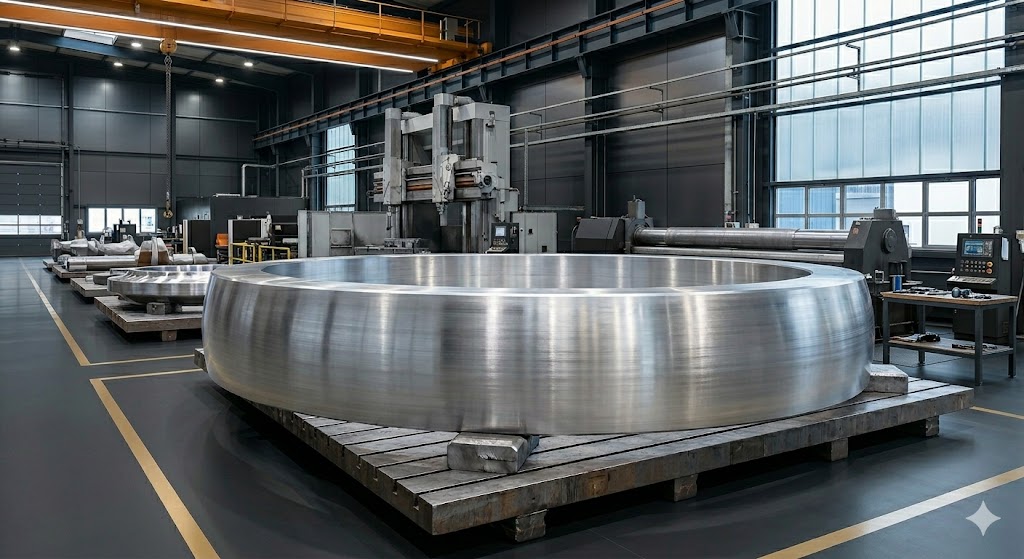
Full Range of 18CrNiMo7-6 (1.6587) Forged Products & Size Capability
We produce a complete line of 18CrNiMo7-6 (1.6587) forged steel products to custom dimensions and shapes. All products are manufactured strictly according to client-supplied drawings or internationally recognized standards, with no minimum order quantity restrictions for engineering development projects.
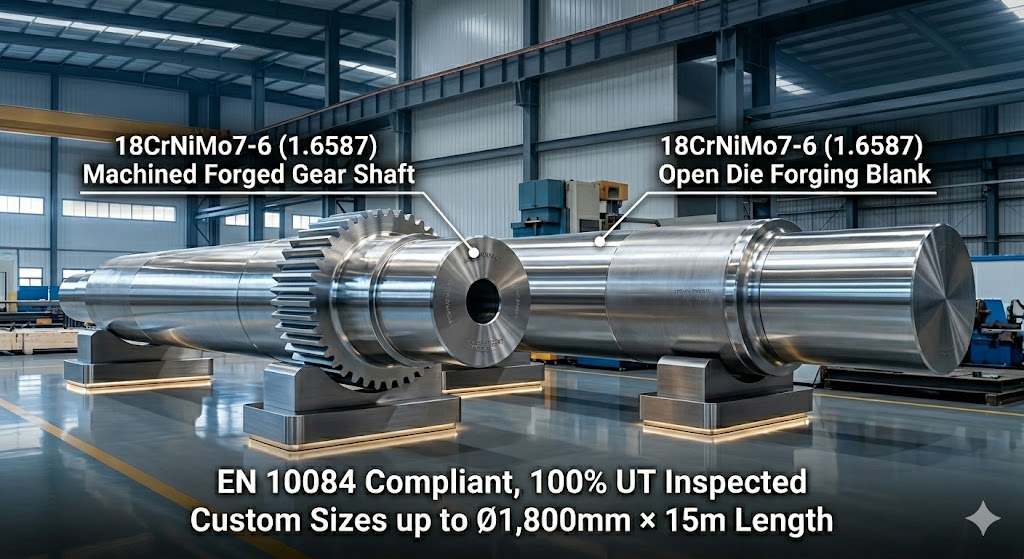
Forged Bars & Rods
Round bars, square bars, flat bars, rectangular bars, hollow bars. Max Ø2,000mm, max weight 30t. Supply conditions: annealed, normalized, or Q&T. Applications: raw blanks for gear shafts, spindles, dies, mold bases.
Seamless Rolled Rings
Seamless rolled rings and open die forged rings. Max OD Ø6,000mm, max weight 30t. Cross-sections: rectangular, T-profile, L-profile. Applications: gear rings, slewing rings, riding rings, bearing rings, flanges.
Forged Shafts & Gear Components
Gear shafts, pinion shafts, crankshafts, spindles, step shafts, hollow shafts. Max Ø1,800mm × 15m length, max weight 30t. 100% UT inspection on all shafts.
Custom Forged Parts
Sleeves, pipes, barrels, housings, discs, plates, flanges, crane wheels, hydraulic cylinders, special-shaped parts. Full OEM/ODM capability. Weight: 30kg to 30,000kg.
| Product Type | Max Outer Diameter / Section | Max Length / Height | Weight Range | Typical Supply Condition |
|---|---|---|---|---|
| Forged Round Bar | Ø 2,000 mm | Up to 15,000 mm | 30 kg – 30,000 kg | Annealed / Normalized / Q&T |
| Forged Square / Flat Bar | Side up to 1,500 mm | Up to 12,000 mm | 30 kg – 25,000 kg | Annealed / Normalized |
| Seamless Rolled Ring | OD Ø 6,000 mm | Height up to 3,000 mm | 50 kg – 30,000 kg | Annealed / Normalized / Q&T |
| Forged Shaft / Step Shaft | Ø 1,800 mm (max body) | Up to 15,000 mm | 100 kg – 30,000 kg | Normalized / Q&T |
| Forged Disc / Plate | Ø 3,500 mm | Thickness up to 1,500 mm | 50 kg – 28,000 kg | Annealed / Q&T |
| Custom Shaped Parts | According to client drawing — DFM review provided | 30 kg – 30,000 kg | Per client specification | |
Material Science: Why the Cr-Ni-Mo Combination Works — The Metallurgical Logic Behind 18CrNiMo7-6
Most discussions of 18CrNiMo7-6 stop at listing chemical composition numbers. Understanding why this specific alloy chemistry was engineered — and what each element actually does inside the steel at a microstructural level — is what allows engineers to make correct material selection decisions and specify appropriate heat treatment parameters. Here is an original technical explanation based on 25+ years of production experience at Jiangsu Liangyi.
The Role of Each Alloying Element
Carbon (C): 0.15–0.21%
The core carbon content is deliberately kept low — lower than medium-carbon alloy steels — because 18CrNiMo7-6 is a case hardening steel. The final hardness at the gear tooth surface comes from carburizing, which enriches the surface layer to 0.75–0.85% carbon before quenching. The base steel's low core carbon ensures that after quenching, the core transforms to tough lower-bainite or lath martensite (hardness 30–45 HRC) rather than brittle high-carbon martensite. This deliberate carbon gradient from case (high C, high hardness) to core (low C, tough) is the fundamental mechanism that makes case hardening steels superior to through-hardening steels for gear applications.
Chromium (Cr): 1.50–1.80%
Chromium serves two critical functions simultaneously. First, it increases hardenability by shifting the continuous cooling transformation (CCT) curve to the right — meaning the steel can be fully hardened at slower cooling rates (oil quench rather than water quench), which dramatically reduces quench cracking risk in large, complex shapes. Second, chromium forms carbides during carburizing that improve surface wear resistance. The 1.5–1.8% chromium range in 18CrNiMo7-6 is carefully balanced: high enough to provide meaningful hardenability, but below the level where excessive carbide network formation would reduce toughness.
Nickel (Ni): 1.40–1.70%
Nickel is the most critical element for core toughness and is the primary reason 18CrNiMo7-6 outperforms chromium-only or chromium-manganese steels at large cross-sections. Nickel does not form carbides; instead it goes into solid solution in the iron matrix, lowering the ductile-to-brittle transition temperature (DBTT) and improving impact energy at both ambient and sub-zero temperatures. For wind turbine applications in northern European or Canadian climates where operating temperatures reach −30°C to −40°C, the nickel content in 18CrNiMo7-6 is not optional — it is essential. The 1.4–1.7% nickel range also synergizes with chromium and molybdenum to produce a very fine lath martensite core structure after quenching, which is inherently tougher than coarser martensite morphologies.
Molybdenum (Mo): 0.25–0.35%
Molybdenum addresses a specific failure mode called tempered martensite embrittlement (also called reversible temper embrittlement or 500°F embrittlement). In chromium-nickel steels without molybdenum, impurity elements (primarily phosphorus, antimony, tin, arsenic) segregate to prior austenite grain boundaries during slow cooling through 375–575°C, causing catastrophic intergranular fracture at impact. Molybdenum effectively suppresses this embrittlement mechanism, which is why 18CrNiMo7-6 keeps reliable impact toughness even after service at elevated temperatures or slow cooling rates. Molybdenum also contributes additional hardenability and refines the carbide distribution during carburizing.
Aluminum (Al): 0.01–0.03%
Aluminum is added primarily as a grain refiner and deoxidizer. During austenitization, aluminum nitrides (AlN) pin the austenite grain boundaries, preventing grain coarsening during the prolonged high-temperature carburizing cycle (typically 15–40 hours at 900–940°C). Without aluminum, austenite grain growth during carburizing would produce a coarse-grained structure with dramatically reduced toughness. The narrow 0.01–0.03% aluminum range in EN 10084 is critical: too little and grain pinning is insufficient; too much and alumina inclusions accumulate, reducing fatigue resistance and machinability. This range is tighter than most other steel grades, reflecting the precision required for heavy-duty carburized components.
The Vacuum Degassing Requirement
Vacuum degassing is not an option with 18CrNiMo7-6, it is a must, in accordance with EN 10084. This is because dissolved hydrogen causes delayed fracture (hydrogen-induced cold cracking) in high-strength steels, and dissolved oxygen forms alumina and silica inclusions which act as fatigue crack initiation sites. The EN 10084 limits of ≤25ppm oxygen and ≤2ppm hydrogen can only be consistently achieved through vacuum degassing. At Jiangsu Liangyi, we operate a dedicated vacuum degassing furnace (VD/VOD type) for all 18CrNiMo7-6 heats, and hydrogen content is verified by hot extraction analysis on every heat before forging approval.
Metallurgical Note: When evaluating 18CrNiMo7-6 forgings from any supplier, always request the hydrogen content test result from the MTC. Any heat with hydrogen above 2.0ppm (0.0002%) in the cast product should be subject to hydrogen diffusion annealing (slow cooling at 650°C for 12–24 hours minimum) before forging — otherwise delayed fracture risk is elevated even in the forged product. At Jiangsu Liangyi, this step is standard procedure for all 18CrNiMo7-6 heats.
18CrNiMo7-6 (1.6587) Chemical Composition, Mechanical Properties & Heat Treatment Data
Melting Process Requirements (EN 10084)
- Melting process: Electric arc furnace (EAF) or basic oxygen furnace (BOF), with mandatory secondary ladle refining (LF/VD or similar)
- Vacuum degassing: Required for all heats — not optional. Hydrogen ≤ 2ppm (0.0002%), Oxygen ≤ 25ppm (0.0025%)
- Calcium addition for sulfide shape control is prohibited before vacuum degassing; maximum 15ppm calcium (0.0015%) permitted post-VD. Calcium wire injection after VD is commonly used at our mill to achieve globular (MnS) sulfide morphology, which reduces anisotropy in mechanical properties of the final forging
- Quality class: Minimum MQ (Medium Quality) per ISO 6336-5 / DIN 3990-5. For wind energy and subsea oil & gas applications, ME (High Quality) is specified — this requires tighter inclusion cleanliness and mandatory charpy testing at −20°C or lower
- Non-radioactive scrap sources only; all incoming scrap verified by portable XRF analyzer and OES spectrometry at our facility
Chemical Composition (EN 10084)
| Element | Symbol | Min (%) | Max (%) | Typical Heat Range | Primary Function in Steel |
|---|---|---|---|---|---|
| Carbon | C | 0.15 | 0.21 | 0.17–0.19 | Core hardenability, base strength |
| Silicon | Si | — | 0.40 | 0.15–0.30 | Deoxidizer, solid solution strengthener |
| Manganese | Mn | 0.50 | 0.90 | 0.60–0.80 | Hardenability, sulfide formation |
| Phosphorus | P | — | 0.035 | < 0.015 | Impurity — grain boundary embrittlement if excess |
| Sulfur | S | — | 0.035 | < 0.008 | Machinability aid; excess causes anisotropy |
| Chromium | Cr | 1.50 | 1.80 | 1.60–1.75 | Hardenability, carbide formation, wear resistance |
| Nickel | Ni | 1.40 | 1.70 | 1.50–1.65 | Core toughness, low-temp impact, DBTT reduction |
| Molybdenum | Mo | 0.25 | 0.35 | 0.28–0.33 | Anti-temper embrittlement, additional hardenability |
| Aluminum | Al | 0.01 | 0.03 | 0.015–0.025 | Grain refiner (AlN), deoxidizer |
| Calcium | Ca | — | 0.0015 (15ppm) | < 10ppm | Sulfide shape control (if added post-VD) |
| Oxygen | O | — | 0.0025 (25ppm) | < 15ppm | Inclusion cleanliness — must be minimized |
| Hydrogen | H | — | 0.0002 (2ppm) | < 1.5ppm | Delayed fracture risk — must be minimized via VD |
Carbon Equivalent (CE) — Weldability Assessment
The carbon equivalent quantifies 18CrNiMo7-6's susceptibility to hydrogen-induced cold cracking (HICC) during any welding operations. Using the International Institute of Welding (IIW) formula:
CE (IIW) = C + Mn/6 + (Cr + Mo + V)/5 + (Ni + Cu)/15
Typical values for 18CrNiMo7-6 (using mid-range composition): CE = 0.18 + 0.70/6 + (1.67 + 0.30)/5 + (1.57)/15 ≈ 0.18 + 0.117 + 0.394 + 0.105 = 0.796
Using a leaner typical heat (C=0.17, Mn=0.65, Cr=1.60, Mo=0.28, Ni=1.50): CE ≈ 0.62–0.68
Conclusion: CE well above 0.45 — preheat of 200–250°C is mandatory for any welding. Structural welding of finished 18CrNiMo7-6 forged parts is not recommended without a qualified WPS and PWHT plan reviewed by a materials engineer.
Mechanical Properties (EN 10084 — Quenched & Tempered Core Properties, 30mm Round Specimen)
| Property | Symbol | Minimum Value | Unit | Test Method | Notes |
|---|---|---|---|---|---|
| Yield Strength | Rp 0.2 | 785 | N/mm² | EN ISO 6892-1 | 0.2% proof stress |
| Tensile Strength | Rm | 1080 | N/mm² | EN ISO 6892-1 | Upper range typically 1250–1350 N/mm² |
| Elongation at Fracture | A5 | 11 | % | EN ISO 6892-1 | Gauge length 5× diameter |
| Reduction of Area | Z | 40 | % | EN ISO 6892-1 | Indicator of ductility and soundness |
| Charpy Impact Energy (Long.) | KV +20°C | 40 | J | ISO 148-1 | V-notch, longitudinal specimen |
| Charpy Impact Energy (Trans.) | KV +20°C | 25 | J | ISO 148-1 | Transverse — typically specified for large rings |
| Brinell Hardness (Q&T) | HBW | 179 | HB | ISO 6506-1 | Max 229 HB for standard Q&T supply |
| Brinell Hardness (Annealed) | HBW | — | HB | ISO 6506-1 | Max 229 HB — for machining supply |
Important Note on Section Size Effect: The mechanical property values above are measured on a 30mm diameter specimen from the center of a 30mm round — effectively representing properties at the very core of a small section. For large forgings (Ø300mm, Ø600mm, Ø1000mm), actual core yield strength and impact toughness will differ depending on exact heat, forging ratio, and heat treatment cooling rate. For critical applications, always specify minimum properties at the actual part section location, and request mechanical test certificates from test coupons taken from sacrificial test extensions of the actual forging heat.
Heat Treatment Specifications (EN 10084)
| Heat Treatment Stage | Temperature Range | Holding Time (Minimum) | Cooling Method | Target Result |
|---|---|---|---|---|
| Soft Annealing | 680–720°C | 4 hours | Slow furnace cool (<20°C/h to 500°C, then air) | Max 229 HB, spheroidized carbides for optimal machinability |
| Normalizing | 840–900°C | 2 hours | Air cooling | 159–207 HB, ferrite-pearlite microstructure |
| Austenitizing (for Q&T) | 840–900°C (min. 840°C) | 2 hours | — | Full dissolution of carbides into austenite |
| Quenching | Oil at 60–80°C | Until temperature equalized | Oil quench (agitated) | Martensite / bainite transformation |
| Tempering | Min 200°C | 2 hours | Air cooling | 179–229 HB, stress relief, ductility recovery |
| Jominy Test Austenitizing | 860 ± 5°C | 30 min | End-quench per EN ISO 642 | Hardenability band verification |
Hardenability Data (Jominy End-Quench Test, EN 10084)
| Distance from Quenched End (mm) | 1.5 | 3 | 5 | 7 | 9 | 11 | 13 | 15 | 20 | 25 | 30 | 40 |
|---|---|---|---|---|---|---|---|---|---|---|---|---|
| HRC Min | 40 | 39 | 39 | 38 | 37 | 36 | 35 | 34 | 32 | 31 | 30 | 29 |
| HRC Max | 48 | 48 | 48 | 48 | 47 | 47 | 47 | 46 | 44 | 43 | 42 | 41 |
The exceptionally flat Jominy hardenability curve — maintaining 29–41 HRC even at 40mm from the quenched end — is the defining advantage of 18CrNiMo7-6 over lower-alloy case hardening steels. This shallow gradient means that even the core of a 600mm diameter forging will achieve meaningful hardness after oil quenching, providing the core fatigue and yield strength that heavy-duty gears require.
Carburizing Depth Engineering Guide for 18CrNiMo7-6 (1.6587) — By Application
Effective case depth (CHD) is defined as the perpendicular distance from the surface to the location where hardness equals 550 HV (approximately 52 HRC), per ISO 2639. Selecting the correct CHD for each application is as critical as material selection — insufficient case depth leads to case crushing and subsurface fatigue crack initiation, while excessive case depth increases brittleness risk and manufacturing cost.
The following guide is based on Jiangsu Liangyi's engineering experience supplying 18CrNiMo7-6 carburizing blanks to gear manufacturers across 25+ years. These recommendations should be verified against the applicable gear standard (ISO 6336-5 or AGMA 2101-D04) for each specific application.
| Application / Component | Gear Module Range | Recommended CHD (mm) | Surface Carbon Target (%) | Quench Medium | Notes |
|---|---|---|---|---|---|
| Light industrial gears, automotive-adjacent | m 1–3 | 0.25–0.50 | 0.80–0.85 | Oil or polymer | Short cycle carburizing, typically batch furnace |
| General industrial gearbox shafts | m 4–6 | 0.50–0.80 | 0.78–0.83 | Oil quench | Standard wind turbine gearbox intermediate shafts |
| Heavy industrial gearbox — planetary | m 7–10 | 0.80–1.20 | 0.75–0.82 | Oil quench | Wind turbine main gearbox stage 1 ring gears, planet gears |
| Large wind turbine main shafts, ring gears | m 11–16 | 1.20–1.80 | 0.75–0.80 | Oil quench (warm) | Offshore & onshore large turbines (3–15 MW). Boost-diffuse cycle essential |
| Mining crusher pinion shafts | m 16–22 | 1.60–2.50 | 0.72–0.78 | Oil quench | High contact stress, abrasive wear environment. Consider shot peening post-carburize |
| Large mining gyratory crusher bull gears | m 22–35 | 2.50–3.50 | 0.70–0.76 | Warm oil (80–120°C) | Case crushing prevention critical. Sub-zero treatment (–80°C) recommended to control retained austenite <15% |
| Cement kiln riding rings / riding gear | m 20–30 | 2.00–3.00 | 0.72–0.78 | Oil or spray quench | Continuous elevated temperature service (200–400°C ring operating temp) |
| API 6A oil & gas mud pump pinion shafts | N/A (contact stress governed) | 0.80–1.50 | 0.75–0.82 | Oil quench | H2S / sour service: Rockwell hardness typically limited to 22 HRC core max per NACE MR0175/ISO 15156 — discuss with engineer |
⚠ H2S / Sour Service Warning: For oil & gas applications where the component contacts H2S environments (sour service per NACE MR0175 / ISO 15156), standard carburized 18CrNiMo7-6 with core hardness above 22 HRC is generally NOT acceptable due to hydrogen sulfide stress cracking (SSCC) risk. The carburized case at 58–62 HRC surface is particularly susceptible. Consult a materials engineer and the applicable NACE standard before specifying 18CrNiMo7-6 for sour service. Alternative: specify pre-carburized condition with maximum 22 HRC core, or use a corrosion-resistant alloy for the wetted components.
Carburizing Atmosphere & Process Cycle Details
For 18CrNiMo7-6 components, gas carburizing in endothermic (endo) atmosphere with boost-diffuse cycle is the standard process at partnered heat treatment facilities we work with. Key process parameters:
- Carburizing temperature: 900–940°C (higher temperature increases carbon diffusion rate but promotes grain growth; aluminum nitrides in 18CrNiMo7-6 resist grain growth to approximately 930°C)
- Boost phase carbon potential: 1.05–1.15% (carbon potential controlled by CO₂ IR analyzers or oxygen probes; target surface carbon accumulation)
- Diffuse phase carbon potential: 0.80–0.90% (reduces carbon gradient, promotes more uniform case hardness through depth)
- Quench delay after furnace exit: Maximum 30 seconds for oil quench. Longer delay allows temperature drop and soft spots at the part surface
- Retained austenite control: After quenching, retained austenite typically 20–35% at surface. For critical high-cycle applications (wind turbine gears), sub-zero treatment at −60°C to −80°C for 2 hours followed by low-temperature tempering (160–180°C) reduces retained austenite to below 15%, improving dimensional stability and fatigue life
- Shot peening: Recommended for all case-hardened 18CrNiMo7-6 gears. Shot peening introduces compressive residual stress at the surface (typically −600MPa to −900MPa), significantly improving bending fatigue life by 20–40% compared to unpeened condition
Common Failure Modes in Heavy Industrial Gears & How 18CrNiMo7-6 Addresses Each
Understanding real-world gear failure mechanisms — and how material and process selection directly mitigates each one — is the foundation of engineering-led procurement. The following analysis is drawn from failure investigation experience at Jiangsu Liangyi, serving clients who previously experienced gear failures with suboptimal materials.
| Failure Mode | Root Cause in Inferior Materials | How 18CrNiMo7-6 Addresses It | Additional Process Requirement |
|---|---|---|---|
| Case Crushing (subsurface fatigue under high contact stress) | Case depth insufficient for applied Hertzian contact stress; soft core cannot support case under cyclic overload. Common in 20CrMnTi for large module gears | Superior hardenability ensures adequate core hardness (≥30 HRC) at depth, increasing the load-bearing capacity of the substrate beneath the carburized case | Verify CHD meets application requirement per ISO 6336-5; sub-zero treatment to control retained austenite for large modules |
| Tooth Root Bending Fatigue | Insufficient compressive residual stress at fillet; inadequate core toughness; improper case depth at root | High nickel content (1.4–1.7%) significantly improves core toughness and inherent bending fatigue endurance limit. Rotating bending fatigue limit ≈700–750 MPa vs. 550–620 MPa for 20CrMnTi in same section sizes | Shot peening of root fillet (Almen intensity 0.2–0.4 mmA); verify root CHD separately from pitch circle CHD |
| Pitting (Surface Fatigue) | Insufficient surface hardness or retained austenite transformation during service causes dimensional changes and stress concentration; inadequate lubricant film | Achieves 58–62 HRC surface; controlled retained austenite via sub-zero treatment prevents in-service transformation; high Cr carbide distribution improves wear resistance | Sub-zero treatment (if RA >20% is concern); proper lubricant selection per ISO 6336 or AGMA 9005 |
| Brittle Fracture (Impact) (sudden catastrophic failure) | High phosphorus segregation + tempered martensite embrittlement in Cr-Mn steels without Mo; inadequate toughness at low ambient temperature in northern climates | Molybdenum (0.25–0.35%) specifically suppresses tempered martensite embrittlement. Nickel lowers DBTT. Impact energy ≥40J at +20°C on 30mm specimen | Specify Charpy testing at −20°C or −40°C for applications in cold climates. Request transverse impact specimens for large ring forgings |
| Hydrogen-Induced Delayed Fracture | Insufficient vacuum degassing during steel making; dissolved hydrogen trapped in high-strength zones causes internal cracking days or weeks after manufacturing | EN 10084 mandates vacuum degassing to ≤2ppm H₂; at Jiangsu Liangyi, all 18CrNiMo7-6 heats are VD-treated and H₂ verified by hot extraction analysis | Request hydrogen analysis on MTC. Verify through-hardening blanks receive post-forge hydrogen diffusion anneal if H₂ in cast product was near 2ppm limit |
| Premature Wear (Surface) | Low surface hardness due to poor hardenability or inadequate carburizing; soft spots from non-uniform quenching; insufficient case depth for abrasive environment | High Cr content promotes fine Cr-carbide dispersion in carburized case, providing inherent wear resistance beyond surface hardness alone; excellent quench uniformity in oil at our foundry | For severe abrasion (mining, crushing): specify higher CHD (2.5–3.5mm); consider WC thermal spray on extreme cases |
| Intergranular Oxidation (IGO) | Gas carburizing atmosphere oxygen reacts with Cr, Mn, Si at grain boundaries creating a soft, depleted zone (IGO layer) 10–25μm deep that reduces bending fatigue life | 18CrNiMo7-6's relatively high alloy content means IGO is unavoidable in gas carburizing, but the layer depth is manageable. Final grinding or hard turning of flanks removes the IGO layer | Specify and verify IGO depth on first article inspection; ensure stock removal in final grinding exceeds IGO depth; consider plasma / low-pressure carburizing (LPC/vacuum carburizing) for critical aerospace-adjacent applications |
18CrNiMo7-6 vs. Alternative Case Hardening Steels — Detailed Technical Comparison
Choosing the right case hardening steel grade is an engineering decision, not simply a cost decision. The following comparison evaluates 18CrNiMo7-6 (1.6587) against its four closest alternatives across twelve performance parameters relevant to heavy industrial applications:
| Parameter | 18CrNiMo7-6 (1.6587) | 17CrNiMo6 (1.6566) | 20CrNiMo (1.6523) | 20MnCr5 (1.7147) | 16MnCr5 (1.7131) |
|---|---|---|---|---|---|
| Standard | EN 10084 | EN 10084 | EN 10084 | EN 10084 | EN 10084 |
| Cr content (%) | 1.50–1.80 | 1.50–1.80 | 0.40–0.70 | 1.00–1.30 | 0.80–1.10 |
| Ni content (%) | 1.40–1.70 | 1.40–1.70 | 0.40–0.70 | — | — |
| Mo content (%) | 0.25–0.35 | 0.25–0.35 | 0.15–0.25 | — | — |
| Carbon Equiv. CE (IIW) | ~0.62–0.72 | ~0.60–0.70 | ~0.45–0.55 | ~0.38–0.47 | ~0.34–0.42 |
| Hardenability (max eff. section) | Ø >500mm | Ø ~400mm | Ø ~200mm | Ø ~80mm | Ø ~50mm |
| Core Tensile Strength (Q&T) | ≥ 1080 N/mm² | ≥ 1000 N/mm² | ≥ 900 N/mm² | ≥ 880 N/mm² | ≥ 780 N/mm² |
| Impact Energy (KV, +20°C) | ≥ 40 J | ≥ 35 J | ≥ 35 J | ≥ 25 J | ≥ 25 J |
| Low-Temperature Toughness | Excellent (Ni effect) | Excellent | Good | Moderate | Limited |
| Anti-Temper Embrittlement | Excellent (Mo effect) | Excellent | Good | Limited | Limited |
| Surface Hardness (Carburized) | 58–62 HRC | 58–62 HRC | 58–62 HRC | 58–62 HRC | 58–62 HRC |
| Bending Fatigue Limit (carburized) | ~700–750 MPa | ~670–720 MPa | ~580–640 MPa | ~530–580 MPa | ~490–540 MPa |
| Relative Material Cost | Premium (100%) | High (90–95%) | Moderate (65–75%) | Economy (40–50%) | Economy (35–45%) |
| Typical Application | Large wind gearboxes, mining, Ø >150mm gears | Medium-large gears, marine gearboxes | Automotive, medium industrial | Medium gears, Ø <80mm | Light gears, Ø <50mm |
| Best Choice For | Heavy duty, large section, demanding environments | Similar to 18CrNiMo7-6, slightly lighter duty | Cost-sensitive medium duty | High-volume smaller gears | Simple small components |
Note on 17CrNiMo6 vs. 18CrNiMo7-6: These two grades are very similar in chemical composition. The key difference is that 17CrNiMo6 has a slightly lower carbon maximum (0.20% vs. 0.21%) and is positioned slightly below 18CrNiMo7-6 in hardenability class. In practice, for equivalent heat and section size, mechanical properties are nearly identical. Selection between the two is usually driven by the specific European standard or customer specification cited in the project contract — not by performance differences.
Engineering Selection Guide: When to Specify 18CrNiMo7-6 (1.6587)
Based on 25+ years of supplying 18CrNiMo7-6 forgings to engineers globally, Jiangsu Liangyi recommends specifying this grade when any two or more of the following conditions apply to your application:
✅ Large Cross-Section
Gear pitch diameter >150mm, shaft body diameter >100mm, or ring bore >200mm. At these sizes, lower-alloy steels cannot achieve adequate core hardness through oil quenching alone.
✅ High Fatigue Loading
Components subject to high-cycle bending or contact fatigue (wind turbine gearboxes, mining crusher drives). Life requirement >10⁷ cycles. Nickel and molybdenum content in 18CrNiMo7-6 directly improves fatigue endurance limit.
✅ Impact / Shock Loading
Equipment that experiences shock loads, overloads, or jam conditions (mining crushers, ore mills, heavy presses). 18CrNiMo7-6 core toughness prevents catastrophic brittle fracture that would occur in through-hardened medium carbon steels.
✅ Cold Climate Operation
Equipment operating at ambient temperatures below –10°C (offshore wind in North Sea, mining in Canada/Australia). Nickel's DBTT-lowering effect is critical for reliable cold-weather operation.
✅ Long Service Life Requirement
If the component has a 20+ year design life with difficult or expensive replacement (offshore wind foundations, mine hoist drums, cement kiln pinion shafts). Premium material pays for itself in reduced downtime.
✅ EN / ISO / CE Regulatory Compliance
Project specifications mandate EN 10084 or European quality class ME or MQ gear steel (ISO 6336-5 / DIN 3990-5). 18CrNiMo7-6 is explicitly listed and covered by these standards.
When 18CrNiMo7-6 Is NOT the Optimal Choice
- Small section, high-volume components (Ø <50mm): 16MnCr5 or 20MnCr5 achieves equivalent surface properties at 35–50% of the material cost
- H2S / sour service (without modified specification): High core hardness after Q&T may exceed NACE MR0175 limits; consult a materials engineer for alternatives or modified processing
- Through-hardened (not carburized) applications: If no carburizing is planned, medium-carbon alloy steels (42CrMo4, 34CrNiMo6) may offer better cost-performance for the same strength level
- Stainless or corrosion-resistant requirement: 18CrNiMo7-6 has no meaningful corrosion resistance in aggressive aqueous environments. Use duplex stainless steel or nickel alloys where corrosion is the primary concern
GEO-Targeted Industrial Application Cases — 18CrNiMo7-6 Forgings in the Field
18CrNiMo7-6 (1.6587) has proven itself across the most demanding industrial environments globally. The following application cases are drawn from Jiangsu Liangyi's project delivery history, reflecting real engineering challenges solved with this material. All specific client details have been generalized to protect commercial confidentiality.
Wind Power Industry — EU Core Market (Germany, Denmark, Spain, France)
Since 2010, Jiangsu Liangyi has supplied EN 10084 18CrNiMo7-6 forged gear shaft blanks, planetary carrier rings and main ring gear blanks for both onshore and offshore wind turbine gearboxes in the 2–15 MW class, serving European gearbox manufacturers and their Tier-2 supply chains. The critical engineering challenges for wind turbine gearbox shafts are simultaneous compliance with: ISO 6336-5 MQ or ME quality class, EN 10228-3 UT Quality Class 4 (or higher), Charpy testing at −20°C with KV ≥ 27J transverse (typical for offshore applications), and strict grain size requirements (ASTM 6 or finer / EN-ISO 643 G6 or finer). Our vacuum-degassed 18CrNiMo7-6 forgings with verified hydrogen ≤1.5ppm and oxygen ≤15ppm are designed to meet all these requirements consistently. Typical turbine gearbox design service life: 25 years under full cyclic load spectrum.
Mining Industry — Australia, Canada, Chile, Brazil, South Africa
Heavy mining equipment demands forgings that survive where lower-alloy materials fail. For gyratory and cone crusher applications, 18CrNiMo7-6 eccentric shafts, spindles and slewing rings are routinely specified over through-hardened 42CrMo4 alternatives, primarily due to the superior case hardening potential and core toughness at large cross-sections. The published literature and practical field experience from mining equipment OEMs indicates that case-hardened 18CrNiMo7-6 components consistently outperform through-hardened medium-carbon steels in terms of contact fatigue life and resistance to impact fracture under crusher jam conditions. For large ore processing ring gear applications, we produce seamless rolled rings up to OD Ø6,000mm in 18CrNiMo7-6 with normalized supply condition, achieving ASTM grain size 6–7 throughout the section with forging ratio ≥5:1 verified by macroetch cross-sections.
Oil & Gas Equipment — North America, Middle East, North Sea
For oil & gas mud pump and drilling equipment applications, we manufacture 18CrNiMo7-6 gear and pinion shaft blanks to customer-provided drawings for supply to OEM manufacturers and their machining subcontractors. Typical documentation requirements for this sector include EN 10084 chemistry compliance, mechanical properties tested longitudinally and transversely at mid-radius and core positions, 100% UT per EN 10228-3 Class 3 or 4, and Charpy testing at 0°C or lower. EN 10204 3.2 certificates with accredited third-party countersignature are available on request. Where specific project documentation formats are required (NORSOK, DNV, classification society formats), we support these per the client's QC plan — please discuss requirements at the enquiry stage. Note: we do not hold an API 6A organizational license; clients requiring API monogram products should discuss alternatives with our technical team.
Cement & Heavy Process Industry — Southeast Asia, Africa, Eastern Europe
Cement plant gear trains operate under some of the harshest thermal and mechanical conditions in industry — continuous 24/7 operation, elevated operating temperature, heavy cyclic torque from kiln and mill starting loads. For cement kiln main gear pinion shaft applications, we supply 18CrNiMo7-6 pinion shaft forgings with normalized-and-rough-machined supply condition, achieving forging ratios of 6:1 or higher from vacuum-degassed ingot for improved cleanliness, with grain size verified at ASTM 7 minimum. Industry experience reported by cement plant operators indicates substantially longer lifetime with case-hardened 18CrNiMo7-6 pinions versus through-hardened 42CrMo4 alternatives, particularly under heavy start-stop cycling conditions typical of kiln operations.
Transportation, Marine & Engineering Machinery — Global
Locomotive transmission gearboxes, marine reduction gearboxes, heavy press crankshafts and construction machinery parts all take full advantage of 18CrNiMo7-6’s excellent large-section hardenability and core toughness.We supply forged ring blanks and shaft blanks for transmission and propulsion gearboxes with upgraded purity requirements: total oxygen ≤15ppm, hydrogen ≤1.5ppm, ME quality grade in line with ISO 6336-5.Large cross-section output shafts are inspected by UT to EN 10228-3 Class 4 or 5.When classification society rules apply (DNV, BV, LR and other equivalent bodies), our mill test documentation is compiled to support customers’ class approval application.
Forging Dimensional Tolerances & Machining Allowances
Understanding the dimensional tolerance and machining allowance system for 18CrNiMo7-6 forgings is essential for correctly specifying the forging drawing versus the final finished drawing. Over-specifying machining allowances wastes expensive material and machining time; under-specifying risks insufficient stock for surface defect removal or achieving final tolerances.
| Forging Type | Nominal Dimension Range | Dimensional Tolerance (±) | Standard Machining Allowance Per Side | Notes |
|---|---|---|---|---|
| Forged Bar (Diameter) | Up to Ø200mm | +5/−3 mm | 5–8 mm | Tighter on request with additional CNC turning |
| Forged Bar (Diameter) | Ø200–Ø600mm | +8/−5 mm | 8–12 mm | Allows for scale, decarb removal |
| Forged Bar (Diameter) | Ø600–Ø1200mm | +12/−8 mm | 12–20 mm | Larger allowance for large-section surface conditioning |
| Forged Bar (Length) | All sizes | +30/−0 mm | 30–50 mm per end | Length positive tolerance allows end defect removal |
| Seamless Ring (OD) | OD up to Ø1000mm | +8/−0 mm | 8–12 mm per face | OD always at positive tolerance — machining on OD only |
| Seamless Ring (OD) | OD Ø1000–Ø3000mm | +12/−0 mm | 12–18 mm per face | For large rings with T-profile: +15/−0mm on OD |
| Seamless Ring (OD) | OD Ø3000–Ø6000mm | +20/−0 mm | 18–25 mm per face | Wall straightness: ≤ 3mm/m for rings above Ø4000mm |
| Shaft (Diameter, body) | Up to Ø400mm | +8/−5 mm | 8–12 mm | Straightness: ≤ 1.5mm/m |
| Shaft (Diameter, body) | Ø400–Ø1000mm | +12/−8 mm | 12–18 mm | Straightness: ≤ 2mm/m |
| Shaft (Length) | All sizes | +40/−0 mm | 40–60 mm per end | Allows end face defect removal |
DFM Note: When providing forging drawings to Jiangsu Liangyi, always supply both the final machined drawing AND your required forging allowance. Our engineering team will issue a forging design drawing (FDD) for approval before production, confirming achievable tolerances, forging ratio verification, and test coupon location. This DFM review is provided free of charge and prevents costly re-work or non-conformance later in the machining process at your facility.
Full-Process Quality Control & NDT Acceptance Criteria
Quality control for 18CrNiMo7-6 (1.6587) forged parts at Jiangsu Liangyi is not a single end-of-line inspection — it is a layered, full-process verification system with mandatory hold points at each production stage. No step is skipped or waived under commercial pressure. Below is the complete quality gate structure:
Stage 1: Incoming Raw Material Inspection
- Chemical composition verification: Optical Emission Spectrometry (OES) on a sample from every incoming billet or ingot heat. All 12 elements in EN 10084 Table 2 (including trace elements Ca, O, H) verified against specification limits
- Hydrogen content analysis: Hot extraction method (LECO RH-402 or equivalent) on cast product samples. Heats with hydrogen >1.8ppm are quarantined pending hydrogen diffusion anneal before forging
- Ingot / billet dimensional verification and macroetch cross-section review for major piping, segregation or inclusion bands
- Supplier certificate review: Mill Test Certificate from the steelmaking plant cross-checked against our incoming test results. Discrepancies >5% on any element trigger NCR (Non-Conformance Report) and supplier audit
Stage 2: Forging Process Control
- Forge heating temperature monitoring: Contact thermocouples on furnace load + visual pyrometer verification at press. Forging start temperature ≥1050°C for 18CrNiMo7-6; forging stop temperature ≥850°C (below 850°C, forging halted and billet reheated)
- Forging ratio verification: Calculated from original billet cross-section to forged cross-section. Minimum 5:1 for CC/rolled bar stock, minimum 3:1 for ingot stock — documented in route card, not just claimed
- Ring rolling pass schedule: Recorded automatically by CNC ring rolling machine (diameter, height, wall thickness, rolling force at each pass). Data archived per heat and order number for traceability
- Post-forge visual inspection: All forgings inspected for laps, folds, cold shuts, and excessive scale pits immediately after forging. Any suspect areas marked, photographed, and dispositioned by quality engineer before heat treatment
Stage 3: Heat Treatment Control
- Furnace calibration: All heat treatment furnaces are subject to periodic Temperature Uniformity Surveys (TUS) using calibrated thermocouples traceable to national standards of measurement. Calibration records are kept and made available to customers on request.
- Load temperature monitoring: Multiple thermocouples placed on representative load positions (top, middle, bottom); minimum soak time only begins after all thermocouples reach setpoint temperature ±10°C
- Quench monitoring: Oil quench tank temperature recorded before and after quench. Quench medium agitation verified. 18CrNiMo7-6 oil quench at 60–80°C is standard; deviation requires engineering disposition
- Post-heat treatment hardness check: Brinell hardness measured at minimum 3 locations per forging (ends + middle). Results recorded on traveler card. Out-of-specification hardness triggers re-heat treatment or rejection
Stage 4: Non-Destructive Testing (NDT)
| NDT Method | Applicable Standard | Coverage | Acceptance Criteria | Reporting |
|---|---|---|---|---|
| Ultrasonic Testing (UT) | EN 10228-3 | 100% of all delivery-condition forgings | Quality Class 4 (standard) or Class 3/5 per client specification | Full scan records, reject zones mapped on sketch. Class 3 and above: written UT report |
| Magnetic Particle Testing (MT) | EN 10228-1 | All accessible surfaces on magnetic forgings | Quality Class 3 standard (no linear indications >2mm in critical zones) | Certificate of compliance; indications photographed |
| Penetrant Testing (PT) | EN 10228-2 | Austenitic zones / non-magnetic areas (if any) | Quality Class 3 | Certificate of compliance |
| Hardness Testing | ISO 6506-1 (Brinell) | Min 3 points per forging; 100% for ring forgings | Within specified HB range ± 15HB | Hardness values recorded on MTC |
| Dimensional Inspection | Client drawing / ISO 8015 | 100% dimensional check; CMM on machined features | Per forging drawing tolerance | Dimensional inspection report on request |
| Non-Metallic Inclusion Rating | ISO 4967 Method A / ASTM E45A | One sample per heat per order | ISO 6336-5 MQ or ME level (per client specification) | Inclusion rating table on MTC or separate test report |
| Grain Size Rating | EN-ISO 643 / ASTM E112 | One sample per heat per order (from test coupon) | G6 or finer (ISO) / ASTM No. 6 or finer | Micrograph + rating number on MTC or test report |
Stage 5: Final Documentation & Certification
- EN 10204 3.1 Mill Test Certificate (MTC): Signed by Jiangsu Liangyi's own Quality Manager (independent from production). Includes: heat number, chemical composition (ladle and product analysis), mechanical test results (with specimen location and orientation), hardness results, UT/MT acceptance statement, heat treatment record, applicable standard compliance statement
- EN 10204 3.2 MTC (on request): Countersigned by accredited third-party inspection body (Bureau Veritas, SGS, TÜV, Lloyd's Register, Intertek — client's preferred TPI body can be specified). Available for offshore, nuclear, and critical industrial projects at additional cost and lead time
- CE Declaration of Conformity (on request, project-specific): Where the forging is incorporated into CE-marked machinery, we can support the responsible person's conformity assessment by providing dimensional and material test data in the required format. CE DoC for the finished machinery is the OEM's legal responsibility, not the forging supplier's. Please discuss specific requirements with our team before ordering.
- API-format Documentation (on request): We do not currently hold an API 6A organizational license. Where clients require API-format traceability documentation, we can discuss what can be provided per your specific project QC plan requirements.
Supply Chain Transparency & Raw Material Traceability
In 2024, raw material fraud in industrial steel supply chains resulted in several high-profile failures in European wind energy and mining projects. Jiangsu Liangyi believes that transparency — not just certification paperwork — is the correct response. Below is our complete traceability chain for 18CrNiMo7-6 forgings:
Step 1: Approved Steel Mill List
We purchase 18CrNiMo7-6 billets and ingots exclusively from a list of pre-qualified Chinese mills that have been audited by Jiangsu Liangyi QA or by accredited third parties. Mills must hold ISO 9001:2015, demonstrate VD capability, and supply H₂ analysis on every heat. Spot checks via independent spectrometry are performed quarterly on incoming heats.
Step 2: Heat Number System
Every forging produced carries the original steel mill heat number, stamped or stencilled on the forging body and recorded in our ERP system. Traceability from your finished forging back to the specific steel ladle — including the ladle chemistry, refining log, and hydrogen analysis — is maintained for minimum 10 years.
Step 3: Segregation in Production
Different heat numbers are forged in separate production batches and kept physically segregated throughout the facility. No commingling of heats occurs. Color-coded identification tags accompany each forging from billet receipt through shipping. Heat mix-up would be detected immediately by our barcode-based traveler card system.
Step 4: Third-Party Verification Available
Clients may appoint their own inspector (or a TPI of their choice: BV, SGS, TÜV, DNV, Intertek) to conduct source inspection at our facility. We welcome witnessing of any inspection stage — forging, heat treatment, NDT, dimensional inspection, and MTC review. No additional facility access restrictions apply.
Welding Considerations for 18CrNiMo7-6 (1.6587) Forged Parts
This section provides original technical guidance for engineers and fabricators who need to weld 18CrNiMo7-6 components, either during fabrication or for repair. The key message is clear: welding 18CrNiMo7-6 requires significantly more care than welding low-alloy structural steels, and should not be attempted without a qualified procedure and experienced personnel.
Why 18CrNiMo7-6 Is Challenging to Weld
With a carbon equivalent (CE-IIW) of approximately 0.62–0.72, 18CrNiMo7-6 is highly susceptible to hydrogen-induced cold cracking (HICC), also called hydrogen cracking or delayed cracking. This type of cracking occurs in the heat-affected zone (HAZ) — not immediately during welding, but typically 24–72 hours after completion, when dissolved hydrogen has diffused and concentrated at triaxial stress sites. The high CE means the HAZ transforms to untempered martensite upon cooling, which is hard, brittle, and highly sensitive to hydrogen. HICC failures in forged shafts and gear blanks can be completely internal with no surface indication, making them particularly dangerous.
Welding Procedure Requirements (Where Welding Is Required)
- Preheat and interpass temperature: Minimum 200°C preheat before striking arc; maintain 200–300°C interpass throughout entire weld. Measure with contact thermocouple at 75mm from joint centerline. Letting any zone cool below 150°C before weld completion is unacceptable
- Filler material: Use matching composition or under-matching low-hydrogen consumables. Hydrogen content of filler must be verified: H5 class (≤5ml/100g) minimum for shielded metal arc welding (SMAW); MIG/TIG with inert gas are preferred. Electrodes must be stored in heated electrode oven at 150°C and only removed immediately before use
- Post-weld hydrogen bake-out: Immediately upon weld completion (while still at interpass temperature), apply hydrogen bake-out: 300–350°C for minimum 2 hours. Do not allow cooling below 200°C between weld completion and bake-out start
- Post-Weld Heat Treatment (PWHT): After cool-down from bake-out, PWHT at 550–620°C for minimum 1 hour per 25mm of wall thickness. This tempers the HAZ martensite and further reduces trapped hydrogen. Temperature ramp-up and cool-down rates: ≤ 100°C/hour
- Post-PWHT inspection: 100% UT of weld zone and HAZ after PWHT and after full cooling to ambient temperature. MT or PT of all weld surfaces. Delay minimum 48 hours after PWHT before final NDT to allow any residual hydrogen to diffuse to detectable levels or escape harmlessly
⚠ Repair Welding of Carburized 18CrNiMo7-6 Parts: Welding on carburized and hardened 18CrNiMo7-6 forgings (surface 58–62 HRC) is extremely high risk and generally not recommended as a production repair method. The carburized zone has local carbon content of 0.75–0.85%, giving a local CE approaching 1.3–1.5. HAZ cracking is nearly certain without extraordinary preheat and process control. If a carburized forging has a surface defect requiring weld repair, consult Jiangsu Liangyi's technical team for guidance — in most cases, re-machining below the defect depth or replacing the forging is the correct engineering decision.
Our Certifications & Quality Standards (E-E-A-T)
All 18CrNiMo7-6 (1.6587) forged parts manufactured by Jiangsu Liangyi are produced under a fully documented and externally audited quality management system. The following reflects our current certification status and applicable quality standards:
Note on CE Marking & API Certificates: CE Marking (EU Machinery Directive) and API product certificates are project-specific documents tied to specific end-product applications — they are not general company certifications. If your project requires CE Marking compliance or API-format documentation, please discuss with our team. We can assist in meeting the applicable documentation requirements per your project specification and applicable EN product standards. We do not currently hold an API 6A organizational license.
Industries & Markets We Serve Globally
Jiangsu Liangyi has established long-term relationships with manufacturers and project buyers in the following industries across more than 50 countries. We do not publicly name individual clients without their permission — the following represents the market sectors we actively supply to:
References from existing clients can be provided on request and subject to the client's prior approval. Please contact us if you require supplier qualification documentation or reference contacts for your project.
Production Timeline — From RFQ to Delivery
Our standard production timeline for 18CrNiMo7-6 forgings reflects real-world constraints of vacuum-degassed steel procurement, forging furnace scheduling, heat treatment cycle times, and NDT throughput — not optimistic marketing promises:
- Day 0–3DFM Review & Technical Quotation — Engineers review drawings, confirm grade, heat treatment, tolerances, and applicable standards. Written quote with technical compliance matrix issued.
- Day 3–7Raw Material Procurement — Order placed with pre-qualified steel mill for 18CrNiMo7-6 vacuum-degassed billet / ingot. Incoming delivery and inspection: 3–5 days within Jiangsu region.
- Day 7–22Forging & Heat Treatment — Billet heated, forged to target shape with minimum required forging ratio, cooled. Heat treatment (annealing / normalizing / Q&T) in calibrated furnace. Total duration: 5–15 days depending on piece weight and heat treatment type.
- Day 22–30NDT Inspection — UT (100%), dimensional inspection, hardness verification, sampling for chemical, mechanical, inclusion, and grain size testing. Lab results: 5–7 days. Witness inspection by client's TPI can be scheduled in this window.
- Day 30–35Rough Machining (If Required) — CNC rough machining to semi-finish dimensions per forging drawing. Surface conditioning and identification marking. Final dimensions re-verified against drawing.
- Day 35–40Certification, Packaging & Export — MTC compiled and signed (3.2 countersignature by TPI within 3 days of inspection completion). Export packaging applied. Shipping booked from Jiangyin / Shanghai port.
We can also speed up production for urgent orders on a case by case basis. Talk to our team about your required delivery date and we will tell you what we can do, with full transparency on what can realistically be expedited.
Global Shipping & Logistics for 18CrNiMo7-6 Forged Parts
Export Ports & Shipping Routes
- EU (Hamburg, Rotterdam, Antwerp, Felixstowe): Sea freight FCL or LCL; transit time 25–35 days. Air freight via Shanghai PVG for urgent small parts (<500kg). Incoterms: FOB Shanghai, CFR, CIF, DAP — as agreed
- North America (Los Angeles, New York, Houston, Vancouver): Sea freight FCL/LCL; transit 18–28 days (West Coast), 28–38 days (East Coast). Air via PVG for urgent. CBSA commercial invoice with HS code 7326.19 (forged steel parts) or as applicable
- Australia (Sydney, Melbourne, Brisbane, Fremantle): Sea freight 18–28 days. AQIS biosecurity compliance: all wooden packaging IPPC heat-treated (HT mark), or use steel crates
- Middle East (Dubai Jebel Ali, Dammam, Jeddah, Kuwait, Muscat): Sea freight 15–22 days. Gulf customs: HS code declaration, certificate of origin (China Chamber of Commerce stamped), SABER system pre-registration for Saudi Arabia if required
- Southeast Asia (Singapore, Bangkok, Ho Chi Minh City, Kuala Lumpur): Sea freight 8–15 days. ASEAN trade compliance review provided on request
Export Documentation Package (Standard)
Every shipment of 18CrNiMo7-6 forged parts from Jiangsu Liangyi includes: commercial invoice, packing list with individual piece weights and dimensions, bill of lading (FCL) or sea waybill (LCL), EN 10204 3.1 Mill Test Certificate, certificate of origin (Form A or CO from China Chamber of Commerce), IPPC-compliant wooden packing certificate, and customs HS code advisory letter. EN 10204 3.2 with TPI countersignature, and project-specific documentation formats are available on request — please specify at order stage.
Packaging Standards for Corrosion Protection
- All machined surfaces coated with Tectyl 502-C rust preventive oil or equivalent
- VCI (Volatile Corrosion Inhibitor) poly film wrapping on individual pieces
- Desiccant silica gel bags inside sealed VCI bags for sea freight >20 days transit
- IPPC heat-treated wooden pallets or custom wooden crates for large pieces
- Steel strapping and corner protection on all crated shipments
- Barcode and heat number sticker on each piece, protected under clear tape inside VCI wrapping
Our Local Time Zone Support — Engineering Responsiveness Across Global Markets
For our global clients, access to a technical contact in a reasonably overlapping time window is not a luxury — it is a project necessity. Jiangsu Liangyi maintains dedicated sales and engineering contacts for each major market region, with response time targets of 4 hours for technical enquiries during overlapping business hours:
- EU (CET/CEST — Germany, France, Netherlands, Scandinavia): CST 15:00–23:00 covers 09:00–17:00 CET. Primary EU contact languages: English, German (third-party interpreter available)
- North America (EST / CST / PST): For EST: CST 21:00–05:00 (next day) covers 09:00–17:00 EST — our team checks email at 21:00 CST. For PST: CST 00:00–08:00 covers 09:00–17:00 PST. Same-day response on urgent enquiries via WhatsApp or WeChat
- Australia (AEST/AEDT): CST 07:00–15:00 covers 09:00–17:00 AEST. Best overlap for technical calls is CST morning 08:00–12:00
- Middle East (GST — UAE, Saudi Arabia, Qatar): CST 13:00–21:00 covers 09:00–17:00 GST. Strong overlap for video calls and technical reviews
- Southeast Asia (ICT / WIB / MYT): CST 10:00–18:00 covers 09:00–17:00 — the best natural overlap of all regions with China Standard Time
Why Choose Jiangsu Liangyi as Your Global 18CrNiMo7-6 Forging Partner
- 25+ Years of Continuous Industrial Forging Experience (Est. 1997): Jiangsu Liangyi is not a trading company, not a recently established export entity, and not a broker. We are a production manufacturer that has operated the same Jiangyin facility since 1997, producing large open die forgings and seamless rolled rings for global industrial clients. Our accumulated production data, metallurgical knowledge, and client relationships cannot be replicated by newer entrants to the market
- Integrated Production: Melting through Machining Under One Roof: We operate our own 30-ton electric arc furnace, VD/VOD vacuum degassing station, 2,000–6,300 ton hydraulic forging press lines, 5-meter CNC seamless ring rolling machine, controlled atmosphere heat treatment furnaces, full NDT laboratory, and CNC rough machining center. This single-facility integration eliminates material mix-up risk between production steps, reduces lead time, and gives us direct control over every quality parameter. Competitors who subcontract forging, heat treatment, or NDT externally lose this control
- Vacuum Degassing Capability — Not Subcontracted: Many Chinese forging factories outsource vacuum degassing to a steel mill and simply purchase "VD-treated" billets with limited traceability. At Jiangsu Liangyi, our VD station treats every heat before forging. We monitor and record the VD process log (vacuum level, degassing time, temperature, hydrogen evolution) for every heat, and this data is available to clients on request. This is the only way to guarantee hydrogen ≤2ppm and oxygen ≤25ppm in the final forging
- EN 10204 3.2 and Third-Party Witness — Welcome: We welcome source inspection by client-appointed inspectors. Major TPI organizations including Bureau Veritas, SGS, TÜV Rheinland, Lloyd's Register, DNV, and Intertek have conducted inspections at our facility. We do not restrict inspector access, do not pre-select test samples. Advance notice is required to coordinate scheduling with production timelines.
- 120,000 Ton Annual Capacity — Scalable Supply: We can supply from a single prototype forging of 30kg to annual frame agreements covering thousands of tons per year. Our ERP-based production planning system allows us to provide accurate delivery commitments and production status updates throughout the order lifecycle
- Technical Support — Not Just Sales: Every 18CrNiMo7-6 quotation from Jiangsu Liangyi includes a free DFM (Design for Manufacturability) review, material selection consultation, and applicable standard compliance matrix. Our technical team has deep working knowledge of EN 10084, ISO 6336, carburizing process specifications, and NDT acceptance criteria, and can engage with your engineering team at a technical level throughout the enquiry and production process
Frequently Asked Questions (FAQ) — 18CrNiMo7-6 (1.6587) Forgings
18CrNiMo7-6 (EN material number 1.6587) has the following internationally recognized equivalent grades: AISI/SAE 4320H (United States — slightly narrower hardenability band than EN, verify case by case); SNCM420 (JIS G 4053, Japan — similar but with slightly higher Mn and Si ranges in some versions); 17Cr2Ni2Mo / 18CrNiMo (GB/T 3077) (China national standard — composition largely equivalent, but Chinese standard may differ in cleanliness requirements). Important caveat: "equivalent" means compositionally similar — it does not guarantee interchangeability under project specification without confirming the specific standard revision, cleanliness class, and product testing requirements cited in your contract. When in doubt, specify to EN 10084 and request compliance regardless of the steel's national origin.
Using the IIW formula (CE = C + Mn/6 + (Cr+Mo+V)/5 + (Ni+Cu)/15), a typical 18CrNiMo7-6 heat has CE ≈ 0.62–0.72. This is well above the 0.45 threshold where hydrogen-induced cold cracking (HICC) risk becomes significant. Practical implications: preheat minimum 200°C before any welding; maintain interpass temperature 200–300°C throughout; use H5-class or lower-hydrogen consumables; apply immediate post-weld hydrogen bake-out at 300–350°C for 2 hours; follow with PWHT at 550–620°C with hold time proportional to section thickness. Repair welding of finished carburized components (58–62 HRC surface) is extremely high risk and generally not recommended — re-machining or replacement is the preferred engineering solution for most cases.
18CrNiMo7-6 is the go-to steel for heavy-duty gear and shaft applications where cross-sections exceed 100–150mm and where simultaneous high surface hardness (58–62 HRC after carburizing) and tough core (≥30 HRC, ≥40J impact) are required. Main applications: wind turbine gearbox planetary shafts, ring gears, planet carriers; mining crusher eccentric shafts, gyratory spindles, slewing rings; cement kiln riding gear rings, pinion shafts, dryer trunnion wheels; oil & gas mud pump gear and pinion shafts; locomotive and marine transmission shafts and gears; heavy press crankshafts; and crane wheels and running gear components. For applications with section diameters below 50mm, lower-alloy steels like 16MnCr5 or 20MnCr5 are usually more cost-effective.
Effective case depth (CHD at 550HV) for wind turbine gearbox 18CrNiMo7-6 components is governed by ISO 6336-5 and the specific gear module: Module 4–6 (high-speed stage): 0.50–0.80mm CHD; Module 7–10 (intermediate stage): 0.80–1.20mm CHD; Module 11–16 (main stage ring gears and planet gears in 3–8MW turbines): 1.20–1.80mm CHD; Module 16–20 (large offshore turbines 8–15MW): 1.60–2.20mm CHD. Surface carbon target is 0.75–0.82%, achieved by boost-diffuse gas carburizing at 900–930°C. Retained austenite after quench should be controlled to below 20% (sub-zero treatment at −60 to −80°C if necessary). Shot peening of gear flanks and root fillets is strongly recommended for fatigue life improvement.
Our 18CrNiMo7-6 (1.6587) forgings comply with: EN 10084 (chemical composition, melting, heat treatment, supply conditions); ISO 6336-5 / DIN 3990-5 quality class MQ or ME (gear material cleanliness for gearing applications — this is a material quality classification, not a separate company certification); EN 10228-3 UT inspection (Quality Class 3, 4, or 5 per client specification); ISO 4967 Method A / ASTM E45A non-metallic inclusions; EN-ISO 643 grain size; EN ISO 6892-1 / ISO 148-1 mechanical properties. Documentation: EN 10204 3.1 MTC as standard; 3.2 with TPI countersignature on request. We hold ISO 9001:2015 as our current company certification. We do not hold an API 6A organizational license; please discuss API project requirements with our team at enquiry stage.
Our 18CrNiMo7-6 forging capability: Forged bars: maximum diameter Ø2,000mm, maximum length 15,000mm; Seamless rolled rings: maximum OD Ø6,000mm, maximum height 3,000mm, minimum wall thickness approximately 80mm; Forged shafts: maximum body diameter Ø1,800mm, maximum length 15,000mm; Forged discs/plates: maximum Ø3,500mm, maximum thickness 1,500mm. Single-piece weight range: 30kg to 30,000kg. All sizes subject to DFM review — we will confirm feasibility and optimal production method (open die vs. ring rolling) before quotation.
After the full carburizing and quenching process: Surface hardness: 58–62 HRC (approximately 650–780 HV). Core hardness (at 30mm specimen): 30–45 HRC depending on heat treatment parameters and section size. Retained austenite at surface: typically 20–35% after standard oil quench and low-temperature temper; reducible to below 15% by sub-zero treatment at −60 to −80°C followed by re-temper at 160–180°C. Standard delivery condition hardness (before carburizing): Annealed: max 229 HB; Normalized: 159–207 HB; Quenched & Tempered: 179–229 HB. For deep cross-sections (Ø600mm+), core Q&T hardness may be lower than the 30mm specimen values — specify minimum core hardness at actual section and request test from representative location.
Standard carburized 18CrNiMo7-6 with surface hardness of 58–62 HRC is NOT acceptable for wetted-zone components in H₂S service per NACE MR0175 / ISO 15156, which limits maximum hardness to 22 HRC (250 HV equivalent) for carbon and low-alloy steels in H₂S environments. The high surface hardness makes carburized 18CrNiMo7-6 highly susceptible to sulfide stress cracking (SSC). If H₂S contact is possible, use NACE-compliant materials (e.g., 4140 steel normalized with core hardness ≤22 HRC, or CRA alloys for corrosive wetted zones). Our technical team can assist with material selection for your specific API project requirements.
42CrMo4 (1.7225) is a through-hardening medium-carbon alloy steel, while 18CrNiMo7-6 is a case hardening steel — they serve fundamentally different engineering functions. 42CrMo4 is through-hardened to a uniform hardness of 26–36 HRC, providing high core strength for transmission shafts and connecting rods. However, for gear tooth applications, 42CrMo4 achieves maximum surface hardness of only ~36 HRC (compared to 58–62 HRC for carburized 18CrNiMo7-6). This lower surface hardness means 42CrMo4 gear teeth have roughly 1/3 to 1/4 the contact fatigue (pitting) resistance of 18CrNiMo7-6. For gear applications requiring high surface hardness AND good core toughness AND large section — 18CrNiMo7-6 wins decisively. 42CrMo4 remains the right choice for non-gear transmission shafts, bolts, connecting rods, and structural forgings where through-hardened medium strength is required without the surface hardness of a carburized case.
Standard documentation package: (1) EN 10204 3.1 Mill Test Certificate — signed by our Quality Manager, covering heat number, full chemical analysis, mechanical test results, hardness, NDT acceptance, heat treatment record, and standard compliance declaration; (2) Dimensional Inspection Report; (3) UT Scan Report per EN 10228-3; (4) Packing List and Commercial Invoice; (5) Certificate of Origin — China Chamber of Commerce stamped. Available on request: EN 10204 3.2 MTC with accredited TPI countersignature, grain size micrograph, inclusion rating chart, sub-zero Charpy test results (−20°C or −40°C), NORSOK / DNV / classification-society documentation formats. We do not issue API 6A product certificates (we do not hold API 6A organizational license).
Share This Technical Guide
Contact Us for Custom 18CrNiMo7-6 (1.6587) Forging Solutions
We welcome enquiries from engineers, procurement managers, and project buyers globally. Whether you have an approved drawing ready for quotation, are in the early material selection stage, or need technical consultation on an application, please reach out — our engineering team is available to assist at no charge during the quotation and evaluation phase.
Please share as much detail as possible in your first enquiry: drawing or sketch (PDF/DXF accepted), material specification (or the application if no material has been decided), required quantity, target delivery date, port of delivery, applicable standards, and any special requirements (TPI inspection, sub-zero testing, specific MTC format, etc.). The more detail you provide, the faster and more precisely we can respond.
Inquiry Email: sales@jnmtforgedparts.com
Phone / WhatsApp / WeChat: +86-135-8506-7993
Official Website: https://www.jnmtforgedparts.com
Factory & Office Address: Chengchang Industry Park, Jiangyin City, Jiangsu Province, China 214400
Response Time Target: 4 business hours for technical enquiries; 24 hours for complete written quotation with DFM review