1.8507 (34CrAlMo5-10) Forging Parts | China Professional Forging Manufacturer
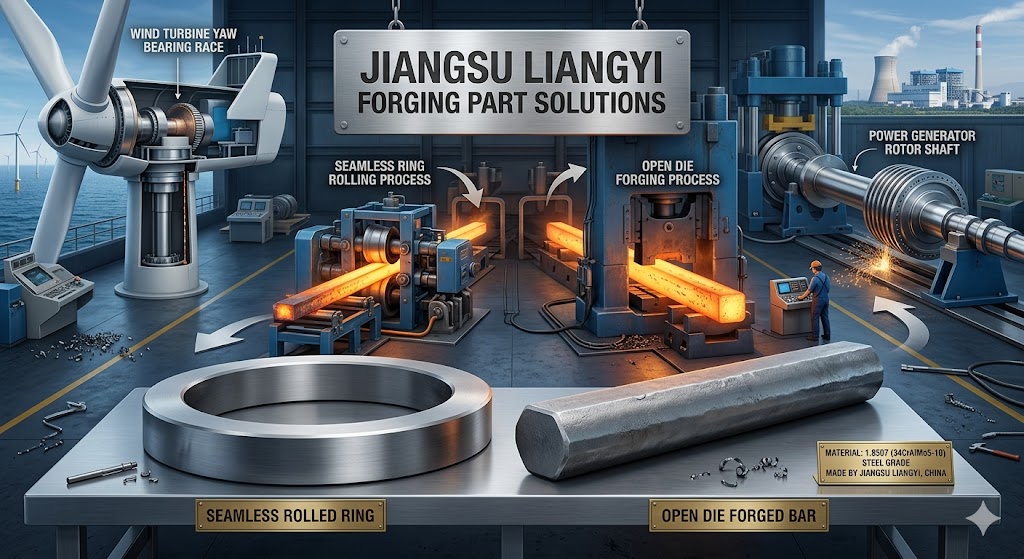
Custom 1.8507 (34CrAlMo5-10) nitriding steel forging parts — forged bars, seamless rolled rings, and shafts produced by Jiangsu Liangyi Co., Limited
Quick Material Facts — 1.8507 (34CrAlMo5-10)
Established in 1997, Jiangsu Liangyi Co., Limited is an ISO 9001:2015 certified China forging manufacturer specializing in premium 1.8507 (34CrAlMo5-10) nitriding steel forgings — open die forgings and seamless rolled rings engineered for the most demanding wear, fatigue, and surface hardness requirements in global heavy industry.
Operating from an 80,000 ㎡ production base in Jiangyin, Jiangsu Province, with an annual capacity of 120,000 metric tons and equipment spanning 30t EAF melting, VD/VOD vacuum degassing, 2000–6300t hydraulic presses, and 1–5m radial-axial ring rolling machines, we supply 34CrAlMo5-10 forged components to clients across 50+ countries in wind energy, mining, cement, oil & gas, and power generation sectors.
The steel is also widely written as 34CrAlMo5.10 and 34CrAlMo510 in European EN specifications. Its Chinese equivalent 38CrMoAlA is what Jiangsu Liangyi has been producing for domestic Chinese market clients since our founding — meaning our team brings deep, multi-decade familiarity with this alloy's specific forging behavior, heat treatment sensitivity, and nitriding response that generalist forging suppliers simply cannot match.
Need a reliable China supplier of 34CrAlMo5-10 forgings? Submit your drawings and specifications for a competitive quotation with full technical review.
Request Free Custom QuotationWhy 1.8507 (34CrAlMo5-10) Is the Premier Nitriding Steel for Heavy Forgings
Most structural alloy steels — 42CrMo4, 34CrNiMo6, even carburizing grades — become inadequate when engineers require a combination of high core strength, exceptional surface hardness, minimal distortion, and long-term wear resistance under continuous cyclic loading. 1.8507 (34CrAlMo5-10) was specifically engineered to solve this problem, and its design is built around one critical metallurgical principle: aluminium-nitrogen affinity.
The Role of Aluminium: AlN Precipitation Hardening
The "10" suffix in the designation 34CrAlMo5-10 is not arbitrary — it refers to the aluminium content coded as Al × 100, indicating a nominal aluminium level of approximately 1.0% (range: 0.80–1.20 wt%). This seemingly small addition completely transforms the steel's nitriding behavior.
During gas nitriding at 480–570°C, nitrogen diffuses into the steel surface and reacts with aluminium to form aluminium nitride (AlN) precipitates within the diffusion zone. AlN is an exceptionally hard ceramic compound (hardness ~1200 HV in bulk form) that precipitates coherently with the steel matrix, creating a dense array of obstacles to dislocation motion. The result is a surface hardness of 900–1100 HV — roughly two to three times what unalloyed or low-alloy steels can achieve through nitriding alone.
Critically, AlN precipitates are thermally stable up to approximately 600°C, far more so than iron nitride (Fe₂N/Fe₃N) phases. This means nitrided 1.8507 components maintain their hardness even under moderate thermal service conditions, unlike case-hardened (carburized) surfaces that begin to soften above 200°C.
Manufacturer's insight: In our 25+ years producing 38CrMoAlA / 34CrAlMo5-10 forgings, we consistently observe that billets with aluminium content toward the upper range (1.05–1.15%) deliver the most consistent and reproducible nitriding hardness. Clients specifying forgings intended for subsequent gas nitriding can request this tighter Al sub-range from us as a custom requirement.
The Role of Chromium: Hardenability and Secondary Nitride Formation
At 1.00–1.30 wt%, chromium serves two purposes in 1.8507. First, it substantially increases hardenability — the ability of the steel to achieve a fully martensitic microstructure throughout large cross-sections during quenching. This is critical for forgings with diameters or thicknesses exceeding 100 mm, where inadequate hardenability leaves a soft, pearlitic core that undermines the component's fatigue and bending strength. Second, chromium also participates in nitriding, forming CrN within the compound layer, which contributes secondary hardness increment beyond what aluminium alone provides and gives the nitrided case improved corrosion resistance.
The Role of Molybdenum: Preventing Temper Brittleness
Molybdenum at 0.15–0.25 wt% addresses a well-known vulnerability of chromium-bearing steels: temper embrittlement — a severe reduction in toughness that occurs when these steels are cooled slowly through the 350–550°C range after tempering. In gearbox applications where components undergo cyclic impact loading, a steel that is hard but brittle fails catastrophically rather than failing gradually. Molybdenum suppresses the segregation of phosphorus and other trace elements to grain boundaries that causes this embrittlement, ensuring that 1.8507 forgings maintain their specified impact toughness (KV ≥ 35 J) after heat treatment — even in the large cross-sections typical of heavy forgings.
Comparison with Alternative Nitriding Steels
Engineers frequently evaluate 1.8507 against two other common EN nitriding grades. The table below summarizes the practical differences from a forging and application perspective:
Swipe left to view full table on mobile devices
| Property / Criterion | 1.8507 (34CrAlMo5-10) | 1.8519 (31CrMoV9) | 1.8523 (41CrAlMo7-10) |
|---|---|---|---|
| Surface Hardness After Nitriding | 900 – 1100 HV | 700 – 900 HV | 950 – 1150 HV |
| Core Tensile Strength (Q+T) | 800 – 1000 MPa | 900 – 1100 MPa | 1000 – 1200 MPa |
| Nitriding Process Sensitivity | Moderate (requires clean surface) | Low (most forgiving) | High (strict pre-treatment required) |
| Hardenability (Large Section) | Good | Moderate | Good |
| Forging Complexity | Moderate | Low | Higher (stricter temp window) |
| Best For | Wind gearbox shafts, mill pinions, general nitriding components | General machinery where moderate hardness suffices | Extreme wear applications, high-load hydraulic components |
Selection guidance: If your application requires surface hardness above 900 HV combined with adequate core toughness and you need large forgings (>500 mm diameter), 1.8507 (34CrAlMo5-10) is typically the optimal choice. If you require still higher core strength (>1000 MPa) at the cost of greater process control complexity, consider 41CrAlMo7-10. Contact our engineering team to discuss material selection for your specific application.
Custom 1.8507 (34CrAlMo5-10) Forged Product Forms & Dimensional Ranges
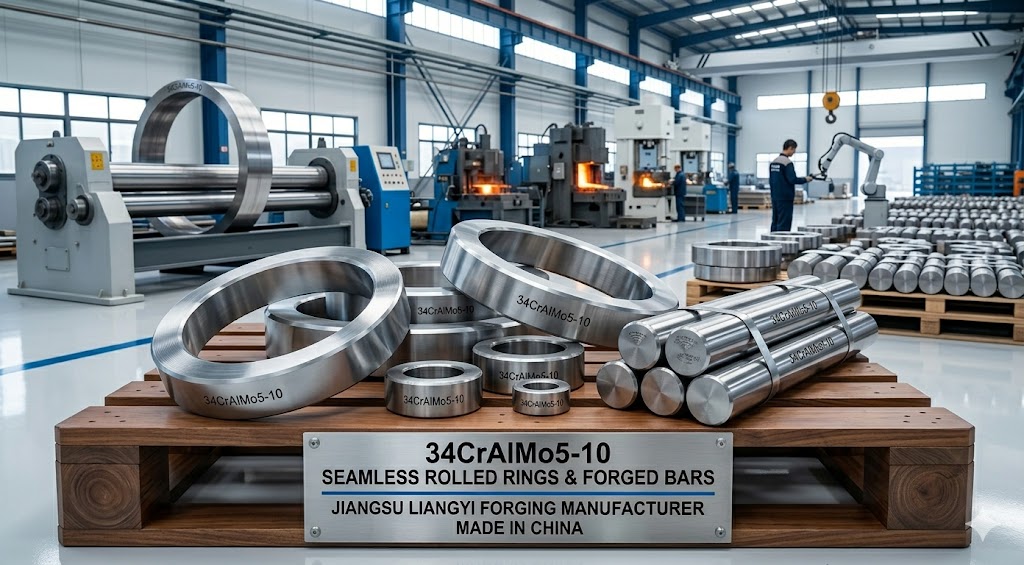
34CrAlMo5-10 seamless rolled rings (OD up to 5 m) and forged bars (up to 12 m length) — Jiangsu Liangyi, China
We manufacture a complete range of custom forged steel components in 34CrAlMo5-10 alloy steel, compliant with EN 10083 and fully tailored to your engineering drawings, tolerance requirements, and delivery condition specifications. All dimensions below are indicative ranges — contact us for specific capability confirmation.
1.8507 Forged Bars & Rods
- Forged round bars: diameter 80 mm – 1,500 mm, length up to 12,000 mm
- Forged square bars and flat bars: custom cross-section, length up to 6,000 mm
- Forged billets and step bars: for downstream machining into shafts, gears, and precision components
- Delivery condition options: as-forged, soft-annealed (≤250 HB), or fully quenched and tempered (Q+T) to specified mechanical properties
34CrAlMo5-10 Seamless Rolled Rings & Hollow Components
- Seamless rolled rings: OD 200 mm – 5,000 mm, height 50 mm – 1,500 mm, wall thickness from 30 mm
- Forged flanges and riding rings: for rotary kiln, granulator, and dryer applications
- Hollow bars and bush forgings: for hydraulic cylinders, bushings, and bearing housings
- All rings produced with radial-axial ring rolling for optimized circumferential grain flow, improving fatigue life versus machined-from-bar alternatives
1.8507 Forged Shafts & Gear Components
- Gear shafts and pinion shafts: diameter 100 mm – 1,200 mm, length up to 8,000 mm
- Spindles and stepped shafts: single-step to multi-step profiles, rough-machined or finish-machined
- Eccentric shafts and crankshafts: for mining crushers, mechanical presses, and compressors
- We can deliver shafts in the Q+T condition ready for final nitriding at your facility, or fully nitrided and finish-machined if your drawings permit
Custom 34CrAlMo5-10 Special Forgings
- Forged discs, blocks, and plates: single piece weight up to 30,000 kg
- Hub forgings and housing forgings: for wind turbine main shafts, gearbox housings
- OEM and ODM custom forgings to customer DXF/DWG/STEP/PDF drawings with full rough and finish machining
Note on delivery condition: Most clients requiring subsequent gas nitriding at their facility receive forgings in the quenched and tempered (Q+T) condition with a pre-machining allowance. If you require forgings delivered in the soft-annealed condition for your own machining and heat treatment, we provide this as a standard option — please specify in your inquiry.
Industry Applications of 1.8507 (34CrAlMo5-10) Forgings
The combination of high surface hardness after nitriding (>900 HV), good core toughness (KV ≥ 35 J), and excellent fatigue strength makes 1.8507 nitriding steel forgings the material of choice across multiple sectors where components must resist wear, pitting fatigue, and contact stress simultaneously — often for service lives exceeding 20 years without replacement.
Wind Energy — Gearbox Shafts and Ring Gears
Wind turbine gearboxes transmit torques ranging from 200 kN·m in mid-size turbines to several MN·m in offshore models. The pinion shafts and intermediate shafts within these gearboxes operate under combined torsion, bending, and contact fatigue loading, in environments where maintenance is expensive and downtime is unacceptable. 1.8507 forged pinion shafts nitrided to >900 HV offer substantially better pitting resistance (ISO 6336 σH0 values) than comparable carburized shafts, while eliminating the dimensional distortion risk that comes with through-hardening or case-hardening of large cross-section shafts. We have supplied 34CrAlMo5-10 forged shafts with diameters up to 800 mm and lengths up to 5,000 mm to wind energy equipment manufacturers across Europe and Asia.
Cement & Sugar — Rotary Kiln Riding Rings and Mill Pinions
Cement rotary kilns and sugar mill equipment represent one of the harshest continuous-duty applications for large forgings. Riding rings (also called tyres) sit on support rollers and rotate continuously under extremely high contact loads — often exceeding 200 tons per ring. The cyclic contact stress demands a material with high surface hardness and deep case depth to resist fatigue spalling. Our 34CrAlMo5-10 seamless rolled riding rings (OD up to 4,000 mm) are manufactured with controlled circumferential grain flow from ring rolling, then gas nitrided to achieve a hardened case depth of 0.5–0.7 mm. For sugar mills, we supply case-hardened pinion shafts and roller shafts where the combination of aluminium-induced surface hardness and molybdenum-ensured core toughness prevents both surface wear and brittle fracture.
Mining & Heavy Construction — Crusher Eccentrics and Hoist Shafts
Jaw crushers, gyratory crushers, and cone crushers subject their eccentric shafts to severe combined loading: high radial forces from crushing resistance, shock loading from oversized feed material, and continuous rotation. A conventional 42CrMo4 eccentric shaft under these conditions typically requires replacement every 8,000–12,000 service hours. By contrast, 1.8507 nitrided eccentric shafts we have supplied to mining equipment OEMs demonstrate service life improvements of 60–80%, primarily because the nitrided surface resists fretting wear at the bearing contact zones that causes premature failure in unhardened or through-hardened alternatives. For mine hoists (winders), our 34CrAlMo5-10 drum shafts and brake disc forgings provide the required combination of fatigue strength and dimensional stability.
Oil & Gas — Drilling Rig Transmission and Mud Pump Shafts
Oil drilling operations impose highly variable torque loads on transmission shafts and mud pump crankshafts, often in contaminated or corrosive environments. The chromium-enhanced nitrided surface of 1.8507 forged crankshafts and pinion shafts for mud pumps provides CrN-reinforced corrosion resistance in addition to wear resistance — an important advantage over grades without significant chromium content. For offshore anchor winch stub shafts, the material's good hardenability ensures consistent mechanical properties across the large cross-sections required by marine safety standards.
Power Generation & Fluid Machinery
Hydro turbine main shafts in run-of-river and pumped-storage plants rotate continuously under high bending loads from the runner, with no practical option for frequent replacement. We supply 1.8507 forged hydro turbine shafts up to 3,000 mm diameter and 10,000 mm length, manufactured to the highest forging quality class and delivered with UT inspection per EN 10228-3. For gas compressor crankshafts and atomizer shafts in FGD (flue gas desulfurization) systems, the material's resistance to stress relaxation at slightly elevated temperatures (up to 350°C continuous service) ensures long-term dimensional stability.
Industrial Gearboxes and General Machinery
Beyond the large-scale sectors above, 1.8507 finds broad use in industrial speed reducers, heavy conveyor drive shafts, cold-mill mandrel shafts, and crane wheel forgings. For mandrel shafts in steel strip cold rolling, the combination of high surface hardness (resisting strip impression wear) and high core strength (resisting bending under strip tension) makes 34CrAlMo5-10 the standard material choice among most major European rolling mill OEMs. Our cold-mill mandrel shaft forgings are regularly supplied to length tolerances of ±2 mm over 6,000 mm in the rough-machined condition.
Our 1.8507 Forging Manufacturing Process: What Happens Inside Our Factory
Understanding how a reputable China forging manufacturer produces 34CrAlMo5-10 forgings — and where quality risks exist — helps procurement engineers make better supplier decisions. Below is a transparent, step-by-step account of our production process, including the specific controls we apply at each stage for this aluminium-bearing nitriding steel.
Primary Melting: EAF + LF Dual Refining
In our 30 ton Electric Arc Furnace (EAF) we melt 1.8507 steel and transfer to a Ladle Furnace (LF) for secondary metallurgy refining. In the LF, composition is trimmed to tight target ranges: C 0.32–0.35%, Cr 1.05–1.25%, Al 0.90–1.10%, Mo 0.17–0.23%. Aluminium addition timing is critical — it must be added after desulfurization to minimize Al₂S₃ formation. Temperature is held at 1580–1600°C before tapping. Samples are taken for spectrometric analysis at tap; results must pass our internal acceptance criteria before the heat is released to the next stage.
VD/VOD Vacuum Degassing — Mandatory for 1.8507
This step is non-negotiable for 34CrAlMo5-10 steel. Aluminium has an extremely high affinity for oxygen: without vacuum degassing, dissolved oxygen reacts with aluminium to form Al₂O₃ (alumina) inclusions. These inclusions do two things: they deplete the free aluminium content available for nitriding, and they create stress concentration sites that initiate fatigue cracking. Our VD unit achieves a chamber vacuum of ≤0.5 mbar, degassing hydrogen to below 2 ppm and oxygen to below 30 ppm. For premium specifications requiring ESR (Electroslag Remelting) quality, we can arrange ESR processing for ultra-low inclusion content — please inquire.
Ingot Casting and Initial Quality Check
Steel is cast into 5–30 ton ingots depending on the final forging weight. Hot top ratio, ingot taper, and casting speed are controlled to minimize axial segregation — a particularly important control for aluminium-bearing steels, where Al segregation to the ingot center can create zones of inconsistent nitriding response in the finished forging. All ingots are visually inspected and weighed before forging. Ingots failing surface quality criteria are rejected before press loading.
Open Die Forging or Seamless Ring Rolling
Ingots are soaked at 1200–1250°C for a minimum of 6 hours (soak time scaled to ingot diameter) to ensure temperature homogeneity before forging. For 1.8507, forging must begin above 1150°C and finish above 850°C — forging at lower temperatures risks cracking due to the steel's reduced ductility in the blue-brittle range (200–400°C) and can cause premature AlN precipitation at grain boundaries. Our hydraulic presses (2000t, 3150t, and 6300t) achieve a minimum forging ratio of 4:1 for bar forgings and a minimum height reduction of 30% for ring forgings. This breakdown of the as-cast dendritic structure is essential for achieving homogeneous mechanical properties throughout the forging cross-section. Rings are formed using our 1m–5m radial-axial rolling machines, with real-time diameter and height monitoring to achieve final dimensions within ±3 mm of target before soft annealing.
Controlled Post-Forging Cooling and Soft Annealing
Immediately after forging, 1.8507 parts are transferred to pit furnaces for controlled slow cooling (≤50°C/hour) through the 600–400°C range. This prevents thermal cracking in large cross-sections and avoids the formation of undesirable bainite microstructures. Soft annealing at 650–750°C for 4–12 hours (depending on section size) reduces hardness to ≤250 HB, ensuring machinability in our CNC machining centers. The annealing atmosphere is controlled to prevent surface decarburization, which is especially important for 1.8507 as surface carbon content affects the final nitriding compound layer structure.
Quenching and Tempering (Q+T) Heat Treatment
Austenitizing at 870–930°C for 1–3 hours (section-size dependent), followed by water or polymer quench for sections ≤400 mm diameter, or oil quench for larger sections where water quench cracking risk is elevated. Tempering immediately follows (within 1 hour of quench) at 580–700°C for 2–6 hours to achieve the target tensile strength band of 800–1000 MPa. Hardness is measured at multiple positions on the forging to verify through-hardening. For forgings to be delivered in the Q+T condition for customer nitriding, an additional pre-nitriding rough machining pass is offered to remove decarburized surface and provide the required pre-machining allowance (typically 0.3–0.6 mm per surface).
In-House Gas Nitriding (Optional Service)
Where customers require delivered-nitrided forgings, we provide controlled atmosphere gas nitriding at 480–570°C for 30–100+ hours depending on required case depth. Target case depth is 0.3–0.7 mm. White layer (compound layer) thickness is controlled to ≤15 µm using a two-stage nitriding cycle (high KN first stage, reduced KN second stage), minimizing the brittle ε-phase white layer that reduces fatigue strength on dynamically loaded components. Surface hardness is measured by Vickers indentation (HV1) at multiple points; hardness depth profiles are available as part of the MTC package.
Machining, Dimensional Inspection, and NDT
Our in-house CNC machining centers handle rough and finish machining to drawing dimensions. Straightness, concentricity, and surface finish are measured on CMM equipment. Non-destructive testing (NDT): 100% UT per EN 10228-3 (forged bars/discs) or EN 10228-4 (rings), MT per EN 10228-1, and PT as required. All forgings meeting specification receive an individual marking (heat number, order number, material grade) by stamping or electrochemical etching. EN 10204 3.1 MTC is prepared and reviewed by our QC department before dispatch.
All our 1.8507 steel is non-radioactive and meets quality class MQ per ISO 6336-5 / DIN 3990-5 for steel used in gear applications. If your project requires a specific quality class beyond MQ, please state this in your inquiry so we can confirm feasibility for your order.
1.8507 (34CrAlMo5-10) Chemical Composition per EN 10083
The chemical composition of 34CrAlMo5-10 is tightly defined in EN 10083 to ensure consistent nitriding response and mechanical properties. Each element plays a specific metallurgical role — not simply a specification requirement to be met mechanically. We control incoming steel composition at the melting stage and verify by in-house optical emission spectrometry (OES) on every heat.
Swipe left to view full table on mobile devices
| Element | Range (wt%, EN 10083) | Metallurgical Function in 1.8507 |
|---|---|---|
| Carbon (C) | 0.30 – 0.37 | Controls core hardenability and strength; balances toughness. Too high C reduces toughness; too low reduces tensile strength. |
| Silicon (Si) | ≤ 0.40 | Deoxidizer during melting. Limited to ≤0.40% to avoid excessive hardness and embrittlement. |
| Manganese (Mn) | 0.40 – 0.70 | Secondary deoxidizer; improves hardenability and hot workability. Kept moderate to avoid segregation in large ingots. |
| Phosphorus (P) | ≤ 0.025 | Strictly limited tramp element. Segregates to grain boundaries and causes temper embrittlement; low P is critical for long-life rotating components. |
| Sulfur (S) | ≤ 0.035 | Strictly limited. MnS inclusions reduce transverse ductility and fatigue strength; especially harmful in heavily loaded shafts. |
| Chromium (Cr) | 1.00 – 1.30 | Primary hardenability element; ensures through-hardening of sections up to ~150 mm diameter. Also contributes CrN formation in the nitrided case, adding corrosion resistance. |
| Molybdenum (Mo) | 0.15 – 0.25 | Suppresses temper embrittlement by retarding grain boundary P segregation. Also refines grain size and improves hardenability for large-section forgings. |
| Aluminium (Al) | 0.80 – 1.20 | The defining element of this grade. Forms AlN precipitates during nitriding, achieving surface hardness 900–1100 HV. Also acts as grain refiner during solidification. |
Note on aluminium content for buyers: The wide Al range (0.80–1.20%) in the EN standard can produce measurable variation in achievable nitriding hardness between heats. If your application is hardness-critical, specify a narrower Al window (e.g., 0.90–1.10%) in your order. We can accommodate this as a customer-specified restriction with no minimum order quantity surcharge for standard sizes.
1.8507 (34CrAlMo5-10) International Material Equivalents
Procurement engineers working across different regulatory regions, or sourcing to redesigned drawings originally specified in a different national standard, frequently need to cross-reference 1.8507 with equivalent grades. The table below reflects the closest published equivalents. Note that "equivalent" means similar composition intent and typical performance — not identical ranges. Always confirm substitution suitability with your engineering team and verify the applicable standard's chemical and mechanical requirements directly.
Swipe left to view full table on mobile devices
| Standard / Region | Grade / Designation | Key Composition Difference vs 1.8507 | Practical Notes |
|---|---|---|---|
| EN (European) Material No. | 1.8507 / 34CrAlMo5-10 | Reference grade | This page's subject material |
| GB / Chinese Standard | 38CrMoAlA (38CrMoAl) | C slightly higher (0.35–0.42%), Cr similar (1.35–1.65%) | Most widely used practical equivalent; extensively produced in China. We produce this grade for domestic orders. |
| JIS / Japanese Standard | SACM645 | Al 0.70–1.20%, slightly wider ranges | Closest JIS counterpart; commonly accepted as equivalent by Japanese OEMs |
| BS / British Standard | 905M39 (formerly EN40B) | C 0.35–0.45%, Cr 1.40–1.80% (higher Cr) | Al-bearing nitriding grade; higher Cr version. Commonly used in UK oil & gas specifications. |
| GOST / Russian Standard | 38KhMYuA | Close composition; Al 0.70–1.10% | Common in Eastern European and CIS market specifications. Direct substitution generally accepted. |
| AISI / SAE (USA) | No direct equivalent | No standard AISI Al-bearing nitriding grade | Nitralloy 135M (proprietary) is conceptually similar; for ASTM projects, specify by chemistry rather than grade name. |
⚠ Equivalencies are for reference only. Chemical composition ranges and property requirements differ between standards. Substitution must be confirmed by your engineering or materials team against the applicable specification.
Heat Treatment & Mechanical Properties of 34CrAlMo5-10 Forgings
Heat treatment of 1.8507 forgings is not a commodity service — small deviations in austenitizing temperature or tempering duration produce measurable changes in the final property balance. As a supplier with in-house heat treatment capability (ten furnaces, dedicated to alloy steel forgings), we provide fully traceable, programmable heat treatment with recorded temperature logs for every batch.
Standard Heat Treatment Sequence
- Soft Annealing (pre-machining): 650–750°C, hold time proportional to section size (typically 1 hour per 25 mm of minimum cross-section), furnace cool to ≤500°C then air cool. Result: ≤250 HB, fully machinable.
- Austenitizing (hardening): 870–930°C, hold for full soaking (minimum 30 minutes after reaching temperature throughout section). Quench in water, polymer, or oil depending on section size and distortion tolerance.
- Tempering: 580–700°C immediately after quench (within 1 hour to prevent quench cracking). Duration: 2–6 hours. Temperature selected to achieve customer-specified hardness / strength band. Higher tempering temperature = lower strength, higher toughness.
- Gas Nitriding (final surface treatment): 480–570°C for 30–100+ hours. Atmosphere: NH₃/N₂ mix with controlled dissociation rate. Two-stage cycle recommended for minimizing white layer brittleness.
Mechanical Properties After Standard Q+T Treatment (EN 10083)
Swipe left to view full table on mobile devices
| Property | Symbol | EN 10083 Minimum | Typical Achieved (Our Production) |
|---|---|---|---|
| Tensile Strength | Rm | 800 – 1000 MPa | 850 – 980 MPa |
| Yield Strength (0.2% proof) | Rp0.2 | ≥ 600 MPa | 650 – 780 MPa |
| Elongation at Break | A | ≥ 14% | 15 – 19% |
| Reduction of Area | Z | ≥ 50% | 55 – 65% |
| Impact Energy (Charpy V, RT) | KV | ≥ 35 J | 45 – 80 J |
| Hardness (Q+T condition) | HB | 240 – 300 HB | 245 – 295 HB |
Properties After Gas Nitriding (Our In-House Service)
Swipe left to view full table on mobile devices
| Property | Typical Value / Range | Notes |
|---|---|---|
| Surface Hardness | 900 – 1100 HV1 | Measured by Vickers HV1 on cross-section |
| Case Depth (total) | 0.3 – 0.7 mm | Depending on nitriding time and temperature; specified by customer |
| White Layer Thickness | ≤ 15 µm | Two-stage cycle; compound layer controlled to minimize brittle ε-phase |
| Core Hardness (post-nitriding) | Unchanged from Q+T: 245–295 HB | Nitriding temperature is below tempering temperature — no change to core |
| Dimensional Change | 0.01 – 0.05 mm diametral growth typical | Allow for this in pre-nitriding finish machining allowance |
Practical note on nitriding distortion: One of the key reasons engineers choose 1.8507 over carburized grades for large precision components is dimensional stability during nitriding. Because gas nitriding occurs at 480–570°C — well below the austenitizing temperature — the steel does not undergo phase transformation and distortion is minimal (typically 0.01–0.05 mm diametral change for shafts). This means finish-machined components can be nitrided with only a small pre-nitriding grinding allowance, saving post-nitriding machining cost and the risk of grinding through the case.
Quality Assurance & Inspection: What Your MTC Contains
As an ISO 9001:2015 certified China forging manufacturer since 1997, our quality system is built on the principle of full traceability and zero assumption: every heat of 1.8507 steel we produce is tested at multiple stages, and no forging is dispatched without a complete, signed EN 10204 3.1 Mill Test Certificate covering the following items.
- Order reference and drawing specification compliance statement — confirming all dimensions, tolerances, and material requirements against the customer's purchase order
- Heat number and full melting traceability — EAF melt date, LF refining records, vacuum degassing records, linked to ingot serial numbers
- Optical emission spectrometry (OES) chemical analysis — all 8 elements (C, Si, Mn, P, S, Cr, Mo, Al) to 4 decimal places, verified against EN 10083 and any customer-tightened limits
- Heat treatment records — furnace serial number, temperature setpoint and recorded profile, hold times, quench medium and measured quench rate, tempering parameters; all furnaces are calibrated to ±5°C accuracy per our ISO 9001:2015 quality management procedures and instrument calibration schedule
- Mechanical property test results — Rm, Rp0.2, A, Z, KV from production-batch test specimens cut from sacrificial prolongation pieces per EN 10083 sample location rules
- Hardness survey results — individual Brinell hardness readings for 100% of forgings at specified locations (typically both ends + mid-length for bars)
- Ultrasonic testing (UT) results — per EN 10228-3 (bars/discs) or EN 10228-4 (rings), to the quality class specified in the order (typically Class 3 or 4)
- Magnetic particle testing (MT) — per EN 10228-1 for surface and near-surface indications, acceptance class per order requirement
- Dimensional inspection certificate — recorded measurements of all critical dimensions with measuring instrument calibration references
- Nitriding test coupon results (where applicable) — surface hardness HV1 profile, white layer measurement by metallographic cross-section, case depth measurement
- Statement of compliance — signed declaration of conformance to EN 10083, EN 10204 3.1, and all customer-specified standards and requirements
Third-party inspection: We are able to accommodate third-party inspection by major international inspection bodies including SGS, Bureau Veritas, TÜV, Lloyd's Register, or any customer-appointed inspector. EN 10204 3.2 (third-party witnessed) certificates can be arranged on request — please specify at order placement so we can schedule witness hold points accordingly.
Why Global Engineers Choose Jiangsu Liangyi for 1.8507 Forgings
There are many forging factories in China. What differentiates a specialist from a generalist — and why it matters for 34CrAlMo5-10 nitriding steel forgings specifically — comes down to material knowledge depth, process control precision, and accountability for results. Here is what 25 years of specialization in this alloy family has built:
Deep Aluminium Steel Expertise
38CrMoAlA (the Chinese equivalent of 1.8507) has been our flagship grade since 1997. We understand its sensitivity at every production stage — from vacuum degassing criticality to post-forging cooling rate requirements — in a way that generalist suppliers producing it occasionally simply cannot replicate.
Fully Integrated In-House Production
EAF melting → vacuum degassing → forging → heat treatment → machining → NDT — all under one roof in Jiangyin. No core process is subcontracted. This eliminates supply chain gaps in quality documentation and accountability, and keeps lead times predictable.
Widest Size Range in Class
30 kg to 30,000 kg single piece, rings to 5m OD, bars to 12m length. Produced on our own 2000–6300t press fleet and 1–5m ring rolling machines — not outsourced to a third-party forge and documented as our own.
Traceable to Every Heat
Every forging links by heat number to its melting record, composition analysis, vacuum degassing parameters, forging shop log, heat treatment curves, and hardness records. Full 100% traceability, not sampling-based. Required for wind energy, offshore, and nuclear-adjacent applications.
Multi-Standard Supply Capability
We supply to EN 1.8507, GB 38CrMoAlA, JIS SACM645, GOST 38KhMYuA, and customer-defined compositions on a single order. Engineers working across EU and Asian projects can standardize supply with one qualified source, reducing qualification cost.
Proven Long-Term Partner Track Record
50+ countries served. Long-term contracts with Tier-1 wind gearbox OEMs, cement equipment manufacturers, and mining machinery companies in Europe, Asia, and the Americas. References available upon request under NDA.
How to Inquire: What Information We Need for an Accurate Quotation
To get you an accurate quote and save time on repeated communication, please prepare the following information when you inquire about 1.8507 (34CrAlMo5-10) forging parts. The more details you provide at the beginning, the sooner we can send you a technically precise offer.
- Material standard and grade: e.g., EN 10083 — 1.8507 (34CrAlMo5-10), or GB 38CrMoAlA, or equivalent. If you have specific composition restrictions (e.g., Al 0.90–1.10%), state them.
- Product form: Forged bar, seamless rolled ring, shaft forging, disc or custom shape.
- Dimensions: Diameter/OD/ID/length/width/thickness in mm. For custom shapes, attach DXF, DWG, STEP, or PDF drawing files.
- Weight per piece (estimated or calculated): Helps us confirm feasibility without requiring a full drawing review first.
- Quantity: Number of pieces per order; also indicate if this is a one-time order or a blanket/annual contract.
- Delivery condition required: As-forged / soft-annealed / quenched and tempered (Q+T) / Q+T + pre-machined / fully machined / nitrided.
- Mechanical property requirements: Specify if you require properties beyond the EN 10083 standard minima (e.g., higher KV, narrower Rm band, or subsurface hardness profile).
- Certificate requirement: EN 10204 3.1 (standard) or EN 10204 3.2 (third-party witnessed). If 3.2, name your preferred inspection body.
- NDT requirements: Specify UT class (per EN 10228-3/4), MT class (per EN 10228-1), and any additional PT or hardness requirements.
- Applicable project standard or specification: If the part is for a regulated application (wind, offshore, pressure equipment), indicate the governing standard so we can align our production controls accordingly.
- Required delivery date: We will confirm feasibility and advise if expediting options are needed.
- Destination port or delivery address: For freight cost estimation (included in our quotation where requested).
Dimensions + material grade + quantity + delivery condition are all that is needed for a first pass budget estimate - not all of the above is needed for a preliminary price indication. We will follow up with any technical clarifications that may be necessary before we make a formal offer.
Ready to inquire? Email us at sales@jnmtforgedparts.com with your requirements, or use the contact button below. We respond to all technical inquiries within 24 hours (business days).
Send Inquiry NowFrequently Asked Questions: 1.8507 (34CrAlMo5-10) Forgings
1.8507 (34CrAlMo5-10) is a European EN 10083 chrome-aluminium-molybdenum alloy structural steel specifically designed for gas nitriding applications. Its defining characteristic is a high aluminium content of 0.80–1.20 wt%. During nitriding at 480–570°C, aluminium reacts with diffusing nitrogen to precipitate very hard and thermally stable aluminium nitride (AlN) compounds within the steel surface layer, achieving a surface hardness of 900–1100 HV — among the highest achievable by any nitriding-grade steel. The combination of this exceptional surface hardness with a reasonably tough, high-strength core (Rm 800–1000 MPa, KV ≥ 35 J) makes it the premier material for components requiring simultaneous wear resistance and fatigue strength.
The closest equivalents are: Chinese GB standard 38CrMoAlA (also written 38CrMoAl, the most widely used practical substitute), Japanese JIS SACM645, British BS 905M39 (formerly EN40B), and Russian GOST 38KhMYuA. There is no direct AISI/SAE equivalent, as the USA does not have a standardized aluminium-bearing nitriding grade. For ASTM projects, it is best to specify by chemical composition and property requirements rather than by grade name.
Under optimized two-stage gas nitriding at 510–530°C for 40–80 hours, 1.8507 steel achieves surface hardness of 900–1100 HV (approximately 67–71 HRC equivalent). The total case depth (diffusion zone) reaches 0.3–0.7 mm depending on time and temperature. White layer (compound layer) thickness is controlled to ≤15 µm through a reduced-KN second stage to minimize the brittle ε-phase layer that can cause spalling under cyclic contact loading.
34CrAlMo5-10 (1.8507) can reach higher surface hardness at 900–1100 HV, while 31CrMoV9 only hits 700–900 HV, mainly because 1.8507 contains much more aluminium. Even so, 31CrMoV9 is easier to handle during nitriding. It is not easily affected by surface oxidation before treatment, and its nitriding process parameters do not need strict control. If you need the best wear resistance and top surface hardness, 1.8507 is the better choice. For working conditions with unstable nitriding processes or where moderate hardness is acceptable, 31CrMoV9 works more reliably in actual production. Our team can help you pick the right material according to your actual usage and your nitriding equipment capacity.
We manufacture the full range of 34CrAlMo5-10 forged components: round bars (OD 80–1500 mm, length up to 12 m), flat and square bars, seamless rolled rings (OD 200–5000 mm), forged discs and plates, gear shafts, pinion shafts, stepped shafts, eccentric shafts, crankshafts, spindles, flanges, riding rings, hubs, housings, hollow bars, and fully custom shapes to customer DXF/DWG/STEP/PDF drawings. Single piece weight range: 30 kg to 30,000 kg.
Aluminium has an extremely high affinity for oxygen. Without vacuum degassing (VD/VOD), dissolved oxygen in the molten steel reacts with aluminium to form Al₂O₃ (alumina) inclusions. These inclusions have two damaging effects: (1) they consume free aluminium that would otherwise be available for nitriding, reducing achievable surface hardness; (2) they act as stress concentration sites in the steel matrix, significantly reducing fatigue life and impact toughness — the two properties that 1.8507 forgings are specifically chosen for. Vacuum degassing to ≤0.5 mbar reduces dissolved hydrogen to below 2 ppm and oxygen to below 30 ppm, eliminating this risk.
Yes. EN 10204 3.1 Mill Test Certificate (MTC) is standard for every 1.8507 forging batch. EN 10204 3.2 MTC with third-party witness inspection is available on request — please specify at order placement and name your preferred inspection body (SGS, Bureau Veritas, TÜV, Lloyd's Register, or your own appointed inspector). Please indicate at order placement if 3.2 is required so we can schedule the witness hold points.
The normal lead time for custom 34CrAlMo5-10 forged parts is 20–35 days after order confirmation. The exact time depends on forging weight, heat treatment needs — quenching and tempering takes an extra 5–7 days, and nitriding adds another 7–14 days — as well as machining difficulty and current production workload. Repeat orders for parts we have made before can usually be finished in 15–25 days. We also can speed up production for urgent orders; you can get in touch with our team to check whether fast delivery is possible.
This depends on your in-house capability. If you have Q+T capability: receive forgings in soft-annealed condition (≤250 HB) and perform Q+T + nitriding yourself for maximum control. If you only have nitriding capability: request delivery in Q+T condition with a 0.3–0.5 mm per surface pre-nitriding machining allowance. If you want a fully finished component: we can deliver fully Q+T + nitrided + finish-machined parts ready for assembly. Contact our technical team to discuss the most cost-effective option for your project.
Per EN 10083, after standard quench and temper: tensile strength Rm 800–1000 MPa, yield strength Rp0.2 ≥600 MPa, elongation A ≥14%, reduction of area Z ≥50%, impact energy KV ≥35 J at room temperature. In our production, typical achieved values are: Rm 850–980 MPa, Rp0.2 650–780 MPa, A 15–19%, Z 55–65%, KV 45–80 J. Tempering temperature is the main lever: higher tempering temperature gives maximum toughness, lower temperature gives maximum strength. We tailor the tempering temperature to your specific requirements.
As a specialist China forging manufacturer with 25+ years producing 1.8507 (34CrAlMo5-10) and 38CrMoAlA nitriding steel forgings, Jiangsu Liangyi offers technical depth and production control that generalist forging suppliers cannot match. From 30 kg precision components to 30-ton heavy ring forgings, from soft-annealed bar to fully Q+T + nitrided + machined finished parts — we deliver to your specification, your certificate, and your timeline.
Send us your drawings, material standard, and requirements. We will provide a free technical review and competitive quotation within 24 business hours.
Request a Free Custom Quotation📧 Inquiry Email: sales@jnmtforgedparts.com
📞 Phone / WhatsApp: +86-13585067993
🌐 Official Website: https://www.jnmtforgedparts.com
📍 Factory Address: Chengchang Industry Park, Jiangyin City, Jiangsu Province, China