1.7709 | 21CrMoV5-7 Forged Steel Parts | China ISO 9001:2015 Certified Forging Manufacturer
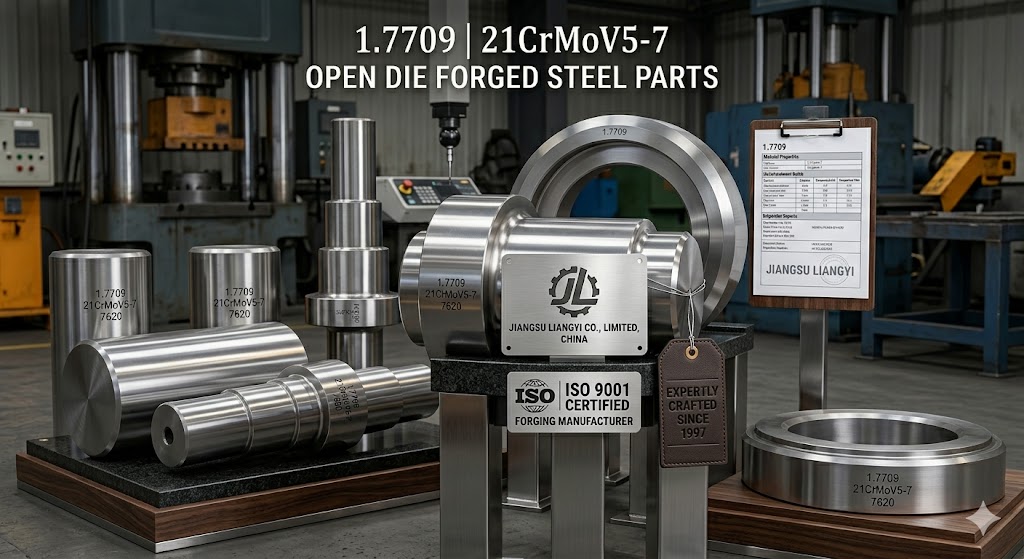
1.7709 | 21CrMoV5-7 Steel Material Overview & Core Advantages
Jiangsu Liangyi Co., Limited, founded in 1997, is an ISO 9001:2015 certified manufacturer of 1.7709 | 21CrMoV5-7 open die forgings and seamless rolled forged rings. We have over 25 years of professional forging experience, an 80,000 m² production base and an annual output capacity of 120,000 tons, and have delivered reliable products to customers in more than 50 countries covering Europe, North America, the Middle East, Southeast Asia and broader Asia-Pacific regions.
1.7709, also widely referenced as 21CrMoV5-7, 21CrMoV57 and 21CrMoV5.7, is a low-alloy bainitic Cr-Mo-V heat-resistant steel. It can work well for a long time under high-temperature, high-pressure and mildly corrosive industrial working conditions.
As a premium alloy steel for extreme heavy-duty applications, 21CrMoV5-7 | 1.7709 has unmatched main advantages over conventional alloy steels:
- Superior High-Temperature Stability: Keeps stable mechanical properties in water steam environments up to 600°C, with excellent creep and fatigue resistance for long-term continuous operation
- Hydrogen Corrosion Resistance: Proven anti-corrosion performance in high-pressure hydrogen environments up to 320°C, so that it is the best choice material for petrochemical hydrogenation and refining applications in the Middle East and Europe
- Excellent Formability & Machinability: Outstanding forgeability for large complex forgings up to 30 tons, with good machinability to meet tight dimensional tolerances for precision parts
- High Strength & Toughness Balance: Achieves consistent high strength and impact toughness after standard quenching and tempering, with minimal performance fluctuation across large cross-sections
- Global Standard Compliance: Fully meets EN 10269, DIN 17240, AD 2000, TRD 106, and ASTM equivalent standards, compatible with European, North American, and global industrial regulations
We have advanced forging equipment and full-cycle production line , so that we can produce custom 1.7709 | 21CrMoV5-7 forgings from 30kg to 30 tons, with complete in-house steel melting, forging, heat treatment, machining, and testing capabilities.
Full Range of 1.7709 | 21CrMoV5-7 Forged Products
We manufacture custom 21CrMoV5-7 | 1.7709 forged steel parts fully based on international standards and customer drawings, covering all shapes and specifications for important industrial applications.
Main 1.7709 | 21CrMoV5-7 Forged Product Categories
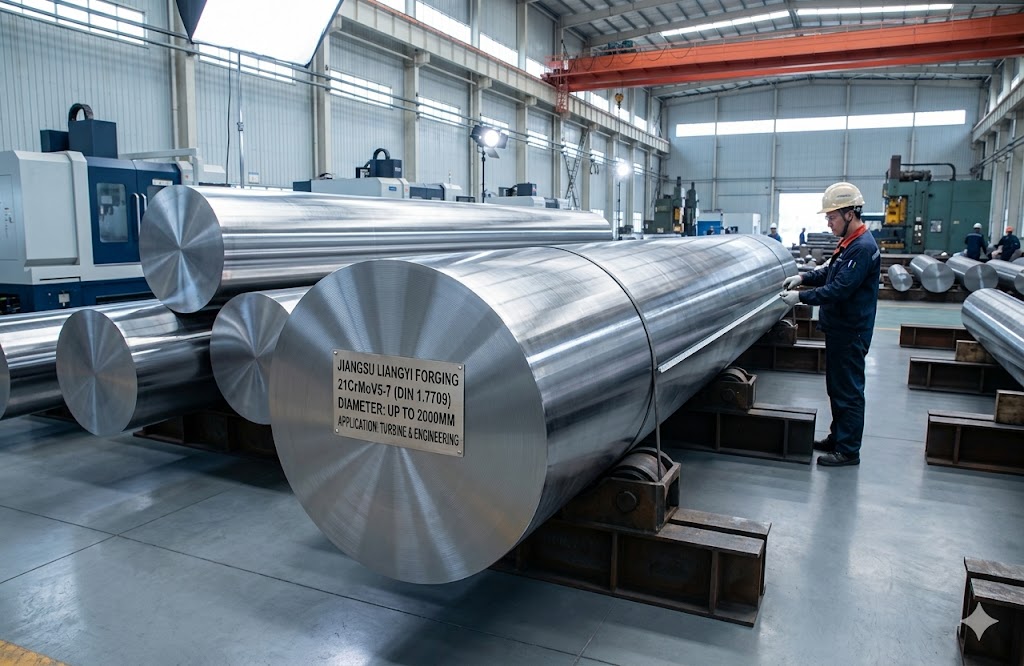
- Forged Bars & Rods: 1.7709 round bars, square bars, flat bars, rectangular bars, and step bars, with maximum diameter up to 2000mm. They are the best choice material for turbine blades, fasteners, and general engineering parts.
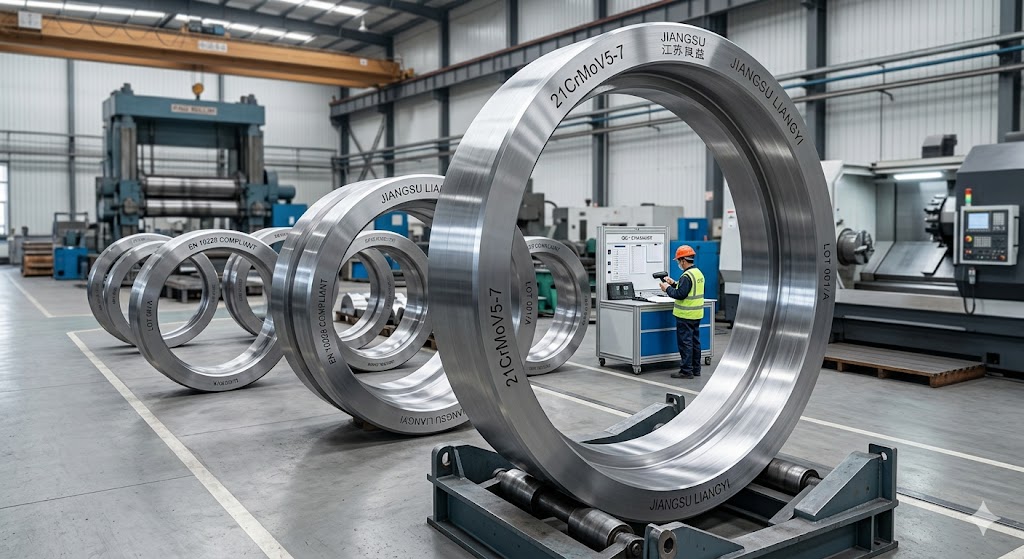
- Seamless Rolled Rings: 21CrMoV5-7 seamless rolled forged rings up to 6 meters in diameter, for turbine casings, valve seats, gear rings, and pressure vessel flanges.They all meet EN 10228 standards.
- Shaft Forgings: 1.7709 forged turbine rotor shafts, gear shafts, pinion shafts, spindles, and step shafts, with maximum length up to 15 meters and weight up to 30 tons. They are 100% UT tested per ASTM A388
- Hollow Forgings: 21CrMoV5-7 forged sleeves, bushes, cylinders, hollow bars, and heavy-wall pipes, with outer diameter up to 3000mm, for high-pressure piping and hydraulic systems
- Plate & Disc Forgings: 1.7709 forged discs, blanks, blocks, plates, and tube sheets, with maximum diameter up to 4000mm, for heat exchangers, pressure vessels, and turbine impellers
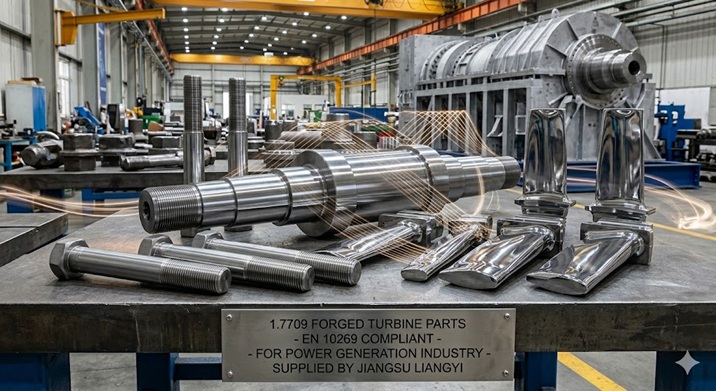
- Power Generation Parts: 1.7709 forged steam and gas turbine blades, rotor shafts, discs, impellers, and double-ended studs/bolts
- Valve & Oil & Gas Parts: 21CrMoV5-7 forged valve seats, valve spindles, bonnets, wellhead parts, and tubing hangers, manufactured to API 6A dimensional and material specifications
All our 21CrMoV5-7 forgings can be supplied with full machining, heat treatment, and third-party inspection services, and we provide EN 10204 3.1 mill test certificates for every batch. For projects needing EN 10204 3.2 co-validation, we support customer-arranged third-party witness inspection. Explore our full forged product range for custom solutions.
Global Compliance & Regional Market Certification Support
Our 1.7709 | 21CrMoV5-7 forged steel parts fully meet regional industry standards and regulations for our main global markets, which makes sure they will be the best choice material for your local projects:
Regional Compliance & Localized Market Support
- European Union Market: Our products are made based on EN 10269, DIN 17240, AD 2000 W0/W7 and TRD 106 technical specifications. Third-party witnessed inspections set by DNV-GL, TÜV and Bureau Veritas are available per request. Complete material test documentation is provided for all forgings, enabling customers to complete independent CE/PED certification in accordance with PED 2014/68/EU as needed. We possess abundant proven project experience across Germany, France, Italy, Spain, the Netherlands and other European markets.
- North American Market: Products manufactured to ASTM equivalent material specifications and ASME Section VIII pressure vessel dimensional requirements. Our forgings are supplied with full chemistry and mechanical test reports to support ASME code documentation. We serve customers in the United States, Canada, and Mexico with fast shipping and dedicated technical support.
- Middle East Market: It meets NACE MR0175 / ISO 15156 sour service standards, as well as AD 2000 and Aramco/ADNOC project specifications. Our 21CrMoV5-7 forgings are the best choice material for the harsh oil and gas environments in Saudi Arabia, the UAE, Qatar, and Kuwait.
- Southeast Asia & Asia-Pacific Market: Adapted to high-temperature, high-humidity operating conditions, compliant with JIS, ASME, and EN standards.We have a lot of project experience of the thermal power, petrochemical, and marine industries across Indonesia, Malaysia, Thailand, Vietnam, and Australia.
Chemical Composition of 1.7709 | 21CrMoV5-7 Steel (EN Standard)
The chemical composition of 21CrMoV5-7 | 1.7709 steel is strictly controlled in our in-house steel melting process to guarantee consistent material performance, fully compliant with EN 10269 and DIN 17240 standards:
| Chemical Element | Standard Content Range (Weight %) | Our Controlled Range (Weight %) | Core Function |
|---|---|---|---|
| Carbon (C) | 0.17 - 0.25 | 0.19 - 0.23 | Controls base hardness and strength of the steel |
| Chromium (Cr) | 1.2 - 1.5 | 1.3 - 1.45 | Improves hardenability, oxidation resistance, and corrosion resistance |
| Molybdenum (Mo) | 0.55 - 0.8 | 0.6 - 0.75 | Improves high-temperature strength, creep resistance, and hydrogen corrosion resistance |
| Vanadium (V) | 0.2 - 0.35 | 0.22 - 0.32 | Refines grain matrix, improves high-temperature stability and fatigue resistance |
| Manganese (Mn) | 0.4 - 0.8 | 0.5 - 0.7 | Improves hardenability and deoxidation during steel melting |
| Silicon (Si) | Max. 0.4 | Max. 0.35 | Deoxidation agent, improves steel purity |
| Nickel (Ni) | Max. 0.6 | Max. 0.5 | Improves toughness in low-temperature environments |
| Phosphorus (P) | Max. 0.025 | Max. 0.020 | Harmful element, strictly controlled to improve toughness and fatigue resistance |
| Sulfur (S) | Max. 0.03 | Max. 0.025 | Harmful element, strictly controlled to reduce inclusions and improve impact toughness |
We use 60t EAF + LF + VOD/VD + ESR steel melting process to guarantee ultra-high steel purity, with strict control of harmful elements and inclusions, which is important for the long-term reliable performance of 1.7709 | 21CrMoV5-7 forgings in harsh environments. Explore our full range of alloy steel materials for more options.
1.7709 | 21CrMoV5-7 International Equivalent Grades & Cross-Standard Reference
Engineers frequently face challenges when they specify 21CrMoV5-7 | 1.7709 for international projects, particularly when they identify valid cross-standard equivalent grades.Unlike mainstream alloy steels with direct one-to-one ASTM matches, this grade features a tailored triple-alloy system: 1.2–1.5% chromium, 0.55–0.8% molybdenum and 0.20–0.35% vanadium. Developed under European DIN/EN specifications specifically for steam turbine service, its unique chemical and property criteria cannot be fully duplicated by any standalone current ASTM grade. Jiangsu Liangyi regularly manages cross-standard procurement enquiries for clients across more than 50 countries. The following reference table is compiled from authoritative industry equivalent data and our decades of manufacturing expertise, reflecting the practical performance correlation of similar grades in actual engineering applications:
| Standard System | Grade / Designation | Standard Reference | Equivalence Type | Key Differences vs 1.7709 |
|---|---|---|---|---|
| European (EN) | 21CrMoV5-7 / 1.7709 | EN 10269, EN 10228-3 | ✅ Primary standard | Reference grade — no differences |
| German (DIN) | 21CrMoV5-7 | DIN 17240, DIN 17175 | ✅ Direct equivalent | Predecessor to EN 10269; composition limits nearly identical |
| ASTM / ASME (USA) | A193 Grade B16 | ASTM A193 / ASME SA-193 | ⚠️ Nearest for bolting only | Higher C (0.36–0.47%), lower Cr (0.75–1.20%), adds Al 0.15–0.25%; not suitable for pressure vessel forgings |
| ASTM (USA) | A182 Grade F22 Cl.3 | ASTM A182 | ⚠️ Nearest for forgings only | Higher Cr (2.0–2.5%), no Vanadium addition; lower creep resistance at 500–570°C range |
| British (BS) | Not directly defined | BS EN 10269 (adopted) | ✅ EN standard adopted | UK now uses EN 10269 directly; historical BS 708H37 is an older Cr-Mo grade without V |
| French (NF) | Z20CV5 | NF A35-553 | ⚠️ Approximate equivalent | Similar Cr-Mo-V concept; minor differences in Mn and Si limits; now superseded by EN 10269 in France |
| Japanese (JIS) | No direct JIS grade | — | ❌ No direct equivalent | JIS high-temp bolting grades (SNB series) are Cr-Mo without V addition; 21CrMoV5-7 typically imported or sourced to EN spec for Japanese projects |
| Russian (GOST) | 20KhMF (20ХМФ) | GOST 20072 | ⚠️ Approximate equivalent | Similar Cr-Mo-V alloying concept; slightly lower Cr range (0.5–0.8% vs 1.2–1.5%); used in former Soviet infrastructure projects |
| Chinese (GB) | Not in standard GB list | — | ⚠️ Special order | China GB system does not list 21CrMoV5-7; typically ordered directly to EN 10269 / DIN 17240 specification from manufacturers like Jiangsu Liangyi |
Why There Is No Perfect ASTM Equivalent — And What This Means for Your Project
North American customers often ask about why there’s no direct ASTM equivalent for 21CrMoV5-7. The main reason is the different engineering development histories between the two standards.The Cr-Mo-V alloy system of 21CrMoV5-7 was uniquely optimized in Germany from the 1950s to the 1970s. It was designed specifically for steam turbine bolts and rotors that work at 500–570°C. This grade was developed under the TRD steam boiler technical code, with its main design focus on long-term creep stability rather than short-term tensile strength. On the other hand, the ASTM standard system uses a different technical approach for high-temperature materials. ASTM A193 B16 adds aluminum to refine grains and has a higher carbon content to improve mechanical strength at room temperature. ASTM A182 F22, on the other hand, has 2.25% chromium ,so that it is more resistant to oxidation and does not have vanadium. Both of these ASTM grades work well in high temperatures, but they were made using different design ideas and application priorities.
For cross-standard projects, Jiangsu Liangyi provides full EN 10204 3.1 mill test certificates with complete chemical analysis and mechanical test data, allowing your project engineers and third-party inspectors to directly verify compliance against any referenced specification, regardless of standard system. For EN 10204 3.2 requirements, we fully support customer-arranged independent witness inspection. We have successfully supplied 1.7709 forgings for ASME-coded pressure vessel projects and API 6A wellhead projects where EN material documentation was accepted by Aramco, ADNOC, and major US EPCs.
Heat Treatment & Mechanical Properties of 21CrMoV5-7 | 1.7709
The mechanical properties of 21CrMoV5-7 | 1.7709 steel are precisely controlled through standardized heat treatment processes, which we optimize based on part size, cross-section, and application requirements to guarantee improved performance.
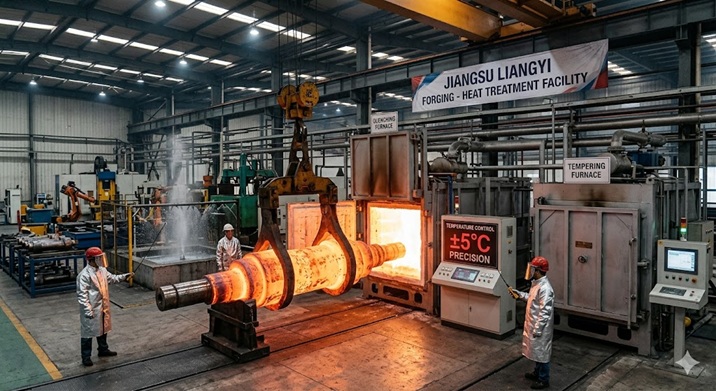
Standard Heat Treatment Process
- Annealing: Heat to 830°C followed by controlled slow cooling, resulting in a typical Brinell Hardness of ≤170 HB, ideal for subsequent machining and forging processes
- Normalizing: Heat to 950-980°C followed by air cooling, to refine grain matrix and relieve internal stress after forging
- Quenching & Tempering (Standard Condition): Oil quench from 960-980°C, then temper at 680-700°C with furnace cooling, to get the improved balance of strength, toughness, and high-temperature stability
Mechanical Properties at Ambient Temperature
| Mechanical Property | Standard Requirement | Our Typical Guaranteed Value | Test Standard |
|---|---|---|---|
| Ultimate Tensile Strength (UTS) | 850 - 1000 N/mm² | 900 - 950 N/mm² | EN ISO 6892-1 |
| 0.2% Offset Yield Strength | Min. 700 N/mm² | Min. 800 N/mm² | EN ISO 6892-1 |
| Elongation (5d) | Min. 14 % | Min. 19 % | EN ISO 6892-1 |
| Reduction of Area (Z) | Min. 50 % | Min. 60 % | EN ISO 6892-1 |
| Impact Strength (KV, 20°C) | Min. 40 J | Min. 60 J | EN ISO 148-1 |
| Brinell Hardness | 255 - 290 HB | 260 - 280 HB | EN ISO 6506-1 |
High-Temperature Mechanical Properties
| Test Temperature | Ultimate Tensile Strength (UTS) | 0.2% Yield Strength | Elongation (5d) | Impact Strength (KCU) |
|---|---|---|---|---|
| 500 °C | 700 N/mm² | 650 N/mm² | 17 % | 110 J/cm² |
| 525 °C | 650 N/mm² | 600 N/mm² | 18 % | 110 J/cm² |
| 550 °C | 600 N/mm² | 550 N/mm² | 18.5 % | 110 J/cm² |
| 600 °C | 520 N/mm² | 460 N/mm² | 20 % | 90 J/cm² |
Physical & Thermal Properties of 1.7709 | 21CrMoV5-7 Steel
For structural calculations, finite element analysis (FEA), and thermal stress modelling, engineers need physical properties beyond mechanical test data. The following temperature-dependent physical properties of 21CrMoV5-7 | 1.7709 steel are important for turbine casing design, pressure vessel wall thickness calculation, and bolted flange joint analysis. These values come from testing materials in-house and match what is in EN and DIN technical references:
| Physical Property | 20 °C (Ambient) | 300 °C | 400 °C | 500 °C | 550 °C |
|---|---|---|---|---|---|
| Density (g/cm³) | 7.85 | 7.74 | 7.69 | 7.63 | 7.60 |
| Young's Modulus / E-Modulus (GPa) | 210 | 193 | 185 | 175 | 168 |
| Thermal Conductivity (W/m·K) | 38.0 | 36.5 | 35.0 | 32.5 | 31.0 |
| Mean Thermal Expansion (×10⁻⁶ /K, from 20°C) | — | 12.5 | 13.2 | 13.8 | 14.2 |
| Specific Heat Capacity (J/kg·K) | 470 | 510 | 530 | 555 | 570 |
| Electrical Resistivity (µΩ·m) | 0.23 | 0.41 | 0.50 | 0.60 | 0.66 |
| Poisson's Ratio | 0.29 | 0.30 | 0.30 | 0.31 | 0.31 |
Note: Young’s Modulus decreases progressively as temperature rises, a factor of importance for bolted joint design in steam turbine applications. When a turbine stud bolt is in use at 540°C, its elastic modulus is about 20% lower than at room temperature. This directly affects calculations for bolt preload relaxation. Our engineering team can give you personalized torque and preload suggestions for 1.7709 | 21CrMoV5-7 turbine studs and bolts that are based on the temperatures they will be working at. Share your joint geometry and service conditions, and we can deliver application-specific technical support.
Weldability & Welding Guidelines for 21CrMoV5-7 | 1.7709 Steel
The weldability of 21CrMoV5-7 | 1.7709 steel needs careful process control due to its combined carbon and alloy content. The calculated carbon equivalent (CE) using the IIW formula typically falls in the range of 0.70–0.82%, which classifies this steel as needing mandatory preheating and post-weld heat treatment (PWHT) for virtually all weld joint thicknesses above 6mm. Underestimating this requirement is the leading cause of delayed hydrogen cracking failures in CrMoV turbine part repairs.
Pre-Weld Requirements
- Preheat Temperature: Minimum 200°C for sections up to 50mm; minimum 250°C for sections 50–100mm; minimum 300°C for sections over 100mm. Preheat must be maintained over a zone of at least 75mm on each side of the weld joint
- Maximum Interpass Temperature: 350°C. Exceeding this limit may cause grain coarsening in the heat-affected zone (HAZ) and reduction of impact toughness, which is critical for pressure vessel applications under EN 13445
- Hydrogen Control: Use only welding consumables with low hydrogen content (HD ≤ 5 ml/100g).To prevent moisture from entering the electrodes and flux—moisture that can lead to hydrogen-induced cracking—you must store and dry them in accordance with the manufacturer’s instructions.
Recommended Welding Consumables by Process
- SMAW (Shielded Metal Arc Welding): AWS A5.5 E9018-B3 or equivalent; use low-hydrogen electrodes, pre-dried at 350–400°C for 1 hour before use
- GTAW / TIG (Gas Tungsten Arc Welding): AWS A5.28 ER90S-B3 filler wire; recommended for root passes and thin-section work where precise heat control is important
- SAW (Submerged Arc Welding): AWS A5.23 EB3 wire with appropriate low-hydrogen flux; suitable for heavy section builds on rotor shafts and thick-wall cylinders
- FCAW (Flux-Cored Arc Welding): CrMoV-matched flux-cored wire with low hydrogen designation; verify diffusible hydrogen ≤ 4 ml/100g for important service applications
Post-Weld Heat Treatment (PWHT) — Critical for Stress Relief
- PWHT Temperature Range: 680–720°C. This range is not arbitrary — it corresponds to the original tempering window for 21CrMoV5-7 and makes sure the HAZ hardness is reduced to below 300 HB, preventing stress corrosion cracking in sour service environments
- Hold Time: Minimum 1 hour per 25mm of section thickness, with a minimum hold of 2 hours regardless of section size. For creep-critical applications (turbine rotors, high-pressure bolts), an extended hold of 4–6 hours is recommended to fully restore the creep-resistant microstructure in the HAZ
- Heating and Cooling Rate: Maximum 80°C/hour heating rate above 400°C; maximum 100°C/hour cooling rate down to 400°C; below 400°C, air cooling is acceptable. Excessively fast heating or cooling causes thermal gradients that introduce residual stresses
- Post-PWHT Testing: Jiangsu Liangyi performs hardness mapping (Brinell and Vickers) across the weld zone, HAZ, and base metal after PWHT as standard procedure, with full records traceable to each weld batch per EN 10204 3.1
For 1.7709 | 21CrMoV5-7 forged parts supplied by Jiangsu Liangyi that need on-site welding for final assembly — such as turbine rotor shaft extensions and pressure vessel nozzles — we can provide our recommended Welding Procedure Specification (WPS) reference documents upon request. In-house welding data is available for customers’ welding engineers to adapt and complete formal procedure qualification in compliance with EN ISO 15614-1 or ASME Section IX requirements.
Industry Applications & Global Project Case Studies
Our 1.7709 | 21CrMoV5-7 forged steel parts are widely used in extreme industrial sectors worldwide, with proven performance in over 500 global projects. Following are our main application industries and GEO-targeted successful cases:


Core Industry Application Solutions
1. Power Generation Industry
This is the largest application sector for 21CrMoV5-7 | 1.7709 steel. The part has excellent high-temperature creep resistance and steam corrosion resistance , so that it is the best choice material for thermal power, combined-cycle, and nuclear power applications.
2. Petrochemical & Refining Industry
The material is the best choice for harsh petrochemical environments, especially in the Middle East and Europe, because it is very resistant to hydrogen corrosion and stable under high pressure.
3. Oil & Gas Industry
Our 1.7709 forgings are made based on API 6A dimensional and material specifications, and they are used for onshore and offshore wellhead equipment, valves, and piping systems worldwide.
4. Heavy Machinery & General Engineering Industry
21CrMoV5-7 is a best choice material for heavy-duty gear shafts, hydraulic cylinders, and high-strength fasteners because it has a great balance of strength and toughness as well as it is easy to work with.
Global Successful Project Case Studies
Case 1: 600MW Combined-Cycle Thermal Power Plant - Germany (European Market)
Customer Requirement: The project needed turbine parts that could keep stable performance in 550°C superheated steam for over 30 years, and all parts meet EN 10269, TRD 106, and PED directives, and TÜV third-party inspection.
Our Solution: We supplied custom 1.7709 | 21CrMoV5-7 forged steam turbine rotor shafts, double-ended studs, and turbine blade blanks, with a forging ratio of ≥6:1, improved heat treatment for large cross-sections, and 100% volumetric UT/MT/PT inspection.
Project Result: All parts passed TÜV full inspection, and they have been working stably for over 8 years with no performance degradation, and have become our benchmark case for the European power generation market.
Case 2: 10 Million Tons/Year Hydrogenation Refinery Project - Saudi Arabia (Middle East Market)
Customer Requirement: The project needed parts for pressure vessels that could work well in a high-pressure hydrogen environment at 320°C. All parts meet NACE MR0175 sour service standards, AD 2000 W0/W7 regulations, and Bureau Veritas third-party certification.
Our Solution: We manufactured 21CrMoV5-7 | 1.7709 forged pressure vessel shells, tube sheets, and high-pressure flanges that had been ESR remelted to make sure it was very pure. We also tested it in full sour service to make sure it was safe.
Project Result: All products passed Bureau Veritas inspection and Aramco project audit, and they have been working stably for more than 6 years with no hydrogen corrosion issues, and have established our long-term supply partnership with Middle East refining giants.
Case 3: 1000MW Ultra-Supercritical Coal-Fired Power Plant - Indonesia (Southeast Asia Market)
Customer Requirement: The project needed boiler and valve parts that could work well in high temperatures and high humidity conditions on the coast. They also needed to be able to resist corrosion and steam erosion for a long time, and all parts had to meet ASME and EN standards.
Our Solution: We provided 1.7709 | 21CrMoV5-7 forged boiler tubes, valve seats, valve spindles, and high-temperature flanges, with improved heat treatment for coastal corrosion resistance, strict dimensional control, and full non-destructive testing.
Project Result: All parts have been working stably for more than 5 years with no corrosion or erosion issues, and have become our benchmark case for the Southeast Asia power generation market.
Advanced Manufacturing & Full-Process Quality Control
We provide a full range of service for 1.7709 | 21CrMoV5-7 forged steel parts, from steel melting to final inspection, guaranteeing full traceability and strict quality control for every product.

Advanced Production Equipment
- Steel Melting Equipment: 60t Electric Arc Furnace (EAF) / Power 40 MVA, 2 Ladle Furnace (LF), 2 Tank Degassing VD - VOD type, pits for bottom pouring, ESR Plant (max weight 32 t)
- Forging Equipment: 0.75Ton/1Ton/3Ton/6T/9Ton Electro Hydraulic Forging Hammer, 2000 Tons/4000 Tons/6000 Tons Hydraulic Forging Presses, 1 Meter and 5 Meter Seamless Rolling Machine
- Heat Treatment Equipment: Ten heat treatment furnaces with precise temperature control (±5°C) for quenching, tempering, annealing, and normalizing
- Machining Facilities: Advanced CNC lathes, milling machines, boring machines, and gantry machining centers with precision control up to 0.05mm
Full-Process Quality Control System
- Raw Material Inspection: A well-equipped chemical lab which carries out test analysis on the steel heats made in the steel mill
- Forging Process Control: Strict forging ratio control (min. 3:1, up to 6:1 for important parts) to guarantee consistent grain matrix
- Heat Treatment Control: Full-automatic temperature recording for every heat treatment batch, with mechanical property testing for every batch
- Non-Destructive Testing: Non-destructive UT/MT/PT tests carried out by experienced and qualified SNT-TA-1A operators
- Final Inspection: Fixed and portable Brinell/3000/10 hardness check equipment, dedicated and certified equipment for dimensional controls
Our quality control laboratory is fully equipped with advanced testing instruments — including metallographic microscopes, high-temperature tensile testing machines, creep testing machines, and chemical analysis spectrometers — operating under our ISO 9001:2015 certified quality management system, making sure all 21CrMoV5-7 | 1.7709 forgings meet the highest quality standards.
1.7709 vs Alternative Steels: Engineering Selection Guide
Material selection for high-temperature forgings operating within the 500–600°C range is rarely a simple decision. Procurement and design engineers regularly raise a main question: under what operating conditions should 21CrMoV5-7 be specified, and when are alternative grades more appropriate?
Drawing on over 25 years of manufacturing expertise and hundreds of project consultations across Europe, the Middle East and Southeast Asia, we provide clear, practical selection guidance. This is an objective, engineering-based assessment rather than a sales-focused comparison, delivering unbiased technical reference for material specification.
| Steel Grade | Max Continuous Service Temp | Yield Strength (RT) | Creep Resistance | Cost Index | Best Application Fit |
|---|---|---|---|---|---|
| 1.7709 / 21CrMoV5-7 | 600 °C (steam); 320 °C (H₂) | Min. 700 N/mm² | ⭐⭐⭐⭐ | Medium | Turbine bolts, rotor shafts, pressure vessel forgings at 450–570°C |
| 1.7225 / 42CrMo4 | 400 °C | Min. 650 N/mm² | ⭐⭐ | Low | General engineering, gears, crankshafts — not suitable for sustained high-temperature service |
| 1.7218 / 25CrMo4 | 450 °C | Min. 550 N/mm² | ⭐⭐ | Low–Medium | Pressure vessel shells and tubes at lower-temperature range; not for turbine parts |
| 1.7715 / 24CrMo5 | 480 °C | Min. 600 N/mm² | ⭐⭐⭐ | Low–Medium | Pressure vessels and piping at moderate temperature — lacks vanadium for optimal creep performance above 480°C |
| 1.4903 / X10CrMoVNb9-1 (P91) | 650 °C | Min. 450 N/mm² | ⭐⭐⭐⭐⭐ | High | Ultra-supercritical (USC) boiler tubes, headers — superior creep but harder to forge, weld, and inspect; 3× higher cost |
| ASTM A193 B16 | 540 °C (fasteners only) | Min. 725 N/mm² | ⭐⭐⭐ | Medium | ASME-coded high-temperature bolting only; higher carbon makes machining more difficult and PWHT mandatory after any welding repair |
Choose 1.7709 | 21CrMoV5-7 When:
- Operating temperature is 450–570°C in steam service — This is where 21CrMoV5-7 delivers its best cost/performance ratio. The vanadium-improved creep resistance outperforms Cr-Mo grades (1.7218, 1.7715, F22) while costing significantly less than 9Cr-1Mo grades (P91/T91)
- EN 10269 or DIN 17240 is the governing standard — The project specification directly references 21CrMoV5-7. This is common in German, French, Italian, Dutch, and wider European power generation and petrochemical projects
- High-pressure hydrogen service at 250–320°C — The Cr-Mo-V composition provides superior resistance to Nelson curve Step 4 hydrogen attack (per API 941), so that it is the best choice material for hydrocracker and hydrotreater pressure vessel forgings in Middle East refinery projects
- Large forging cross-sections are needed — 21CrMoV5-7 has excellent hardenability and responds well to quench-and-temper treatment in sections up to 500mm diameter, keeping consistent mechanical properties from surface to core in large rotor shafts and thick-wall flanges
- Long service life with minimal maintenance is important — Proven 30+ year service records in European thermal power plants demonstrate the material's long-term microstructural stability at design temperature, which is why TÜV-approved turbine manufacturers continue to specify it for replacement parts on existing plant
When to Consider an Alternative:
- Temperature consistently below 400°C — If the operating temperature does not exceed 400°C, the premium over 42CrMo4 (1.7225) is not justified unless hydrogen or sour service is involved
- Ultra-supercritical (USC) plant above 600°C — For new USC or A-USC plants targeting 600–650°C live steam temperature, 9Cr-1Mo-V-Nb (P91/T91 or P92/T92) grades provide the necessary higher creep rupture strength. 21CrMoV5-7 approaches its upper service limit in this range
- ASME Section I/VIII boiler/pressure vessel code with no EN cross-certification — In projects where the ASME code does not accept EN material certification and the PV design cannot accommodate EN/ASME dual-certification documentation, ASTM A182 F22 or A193 B16 may be the simpler administrative choice, even if technically inferior for creep performance
Our applications engineering team at Jiangsu Liangyi regularly provides free material selection consultation for procurement engineers who are evaluating 1.7709 | 21CrMoV5-7 against alternatives for new projects. With 25+ years of cross-standard forging experience, we can advise on the technical trade-offs, cost impact, and documentation requirements for your specific application — contact us at sales@jnmtforgedparts.com with your project parameters.
Frequently Asked Questions (FAQ) About 1.7709 | 21CrMoV5-7 Steel
There’s no single perfect ASTM equivalent for 21CrMoV5-7 | 1.7709. For high-temperature bolting, ASTM A193 Grade B16 is the closest match, but it has a much higher carbon content (0.36–0.47% compared to 0.17–0.25%) and also contains aluminum. For pressure vessel forgings, ASTM A182 F22 (2.25Cr-1Mo) is the closest in structure, but it doesn’t have vanadium—which is what makes 21CrMoV5-7 | 1.7709 perform better in creep conditions at 500–570°C. Jiangsu Liangyi provides EN 10204 3.1 mill test certificates as standard. We also fully support customer-arranged EN 10204 3.2 witness inspection, so you can verify compliance for projects under any standard system.
Welding 21CrMoV5-7 (also called 1.7709) needs preheating and post-weld heat treatment (PWHT) because its carbon equivalent is around 0.70–0.82%.For workpieces with a section thickness up to 50mm, the preheating temperature is 200°C; for sections over 100mm, the preheating temperature is 300°C. The maximum interpass temperature is 350°C.The PWHT temperature must be 680–720°C. The holding time is 1 hour for every 25mm of section thickness, and at least 2 hours in total. After welding, the workpiece should be cooled slowly at a controlled rate (for Cr-Mo-V steel) to avoid cracks.Low-hydrogen welding consumables are required (HD ≤ 5 ml/100g). Incorrect PWHT is the main cause of delayed hydrogen cracking in these welded parts.
1.7709 (also known as 21CrMoV5-7) is a low-alloyed, bainitic Cr-Mo-V heat-resistant steel,and it is used for high-temperature, high-pressure applications in power generation, petrochemical, and oil & gas industries. It has excellent creep resistance, hydrogen corrosion resistance, and high-temperature stability up to 600°C.
21CrMoV5-7 | 1.7709 is primarily standardized in EN 10269 (steels for fasteners for high temperature applications) and DIN 17240 (heat-resistant steels for pressure vessels). It also meets AD 2000, TRD 106, and ASTM equivalent material specifications. For oil and gas applications, forgings can be made based on API 6A dimensional requirements. For European projects, our material documentation supports our customers' PED 2014/68/EU equipment certification process.
1.7709 | 21CrMoV5-7 can be used continuously in water steam environments up to 600°C, and in high-pressure hydrogen environments up to 320°C. For long-term creep-resistant applications, the recommended operating temperature range is 450°C to 570°C.
Yes, we provide EN 10204 3.1 mill test certificates as standard for all 21CrMoV5-7 forgings — these certificates are signed by our quality department as the manufacturer.We fully support witness inspections set up by the customer for projects that need EN 10204 3.2 certificates, which need to be validated by a third party. Major international inspection bodies like DNV-GL, TÜV, Bureau Veritas, Lloyd's Register, and RINA can do these inspections. We also give them full access to the factory for witness inspections at any point in the production process.
We have an annual production capacity of 120,000 tons, with the ability to produce forgings from 30kg to 30 tons. Standard delivery time is 25-35 days for common products, and 45-60 days for large complex forgings. The actual delivery time depends on specifications and quantity.
Inquiry for Custom 1.7709 | 21CrMoV5-7 Forged Steel Parts
Jiangsu Liangyi Co., Limited is your reliable Chinese manufacturer of high-quality 1.7709 | 21CrMoV5-7 forged steel parts. With over 25 years of open die forging experience, we export our products to more than 50 countries around the world. We provide a full range of custom service, from steel melting, forging, heat treatment, to CNC machining, and all parts meet your drawings, material requirements, and project specifications.
Whether you need prototype samples, small-batch production, or large-scale project supply, we can offer you products with the most competitive prices and superior quality, along with fast delivery and comprehensive technical support. We also provide dedicated services for markets in Europe, North America, the Middle East, and Southeast Asia, including assistance with local certifications and required documentation.
Inquiry Email: sales@jnmtforgedparts.com
Phone/WhatsApp: +86-13585067993
Official Website: https://www.jnmtforgedparts.com
Factory Address: Chengchang Industry Park, Jiangyin City, Jiangsu Province, China