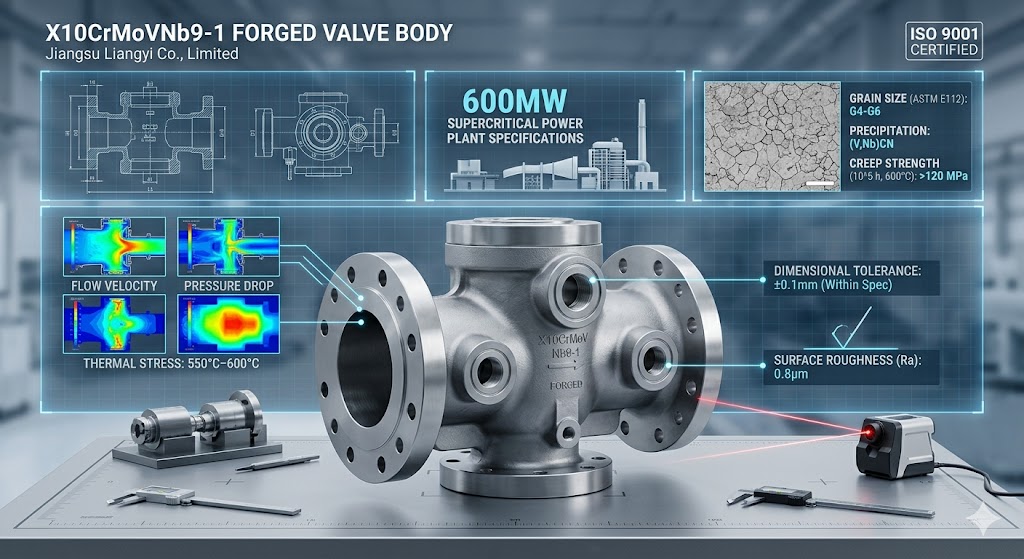
Quick Overview of 1.4903 / X10CrMoVNb9-1
Jiangsu Liangyi, located in Chengchang Industry Park, Jiangyin City, Jiangsu Province — China's "Forging Capital" — is a leading manufacturer of 1.4903, X10CrMoVNb9-1, X10CrMoVNb91, and X10CrMoVNb9.1 open die forging parts and seamless rolled steel forged rings. With over 25 years of experience, we have supplied components to more than 50 countries across Europe, North America, the Middle East, and Asia-Pacific.
What is 1.4903 / X10CrMoVNb9-1?
1.4903 (EN material number) and X10CrMoVNb9-1 (chemical symbol designation) are two names for the same high-temperature resistant, martensitic high-alloyed chromium-molybdenum-vanadium-niobium steel, standardized under EN 10302:2008. It was developed as an improved alternative to 10CrMo9-10 (1.7383), delivering approximately 40% higher creep strength at 550 °C and reliable service life exceeding 100,000 hours in power generation and petrochemical applications.
Also referred to as: X10CrMoVNb91, X10CrMoVNb9.1, or simply P9-1 steel. Equivalent or near-equivalent designations in other systems include ASME SA182 Grade F91 (higher alloy) and the European grade P91.
Key Advantages of 1.4903 / X10CrMoVNb9-1 Steel
Compared to conventional high-temperature steels and nickel-based alloys, 1.4903 / X10CrMoVNb9-1 offers a unique balance of performance and cost:
- Superior creep yield strength and creep rupture strength at temperatures ≥ 500 °C
- Excellent oxidation resistance up to 650 °C in air and steam
- Good thermal fatigue resistance for cyclic temperature applications
- Excellent weldability compared to higher alloy grades like A182 F91
- Cost-effective alternative to nickel-based alloys (Inconel®, Hastelloy®) for many applications
- Proven long-term reliability (over 100,000 hours) in power plant and petrochemical equipment
- Suitable for use in equipment subject to PED 2014/68/EU pressure equipment regulations (CE marking is the responsibility of the equipment manufacturer)
Material Performance Comparison: 1.4903 vs. Alternatives
| Property | 10CrMo9-10 (1.7383) | 1.4903 (X10CrMoVNb9-1) | A182 F91 |
|---|---|---|---|
| Maximum Continuous Temperature | 500 °C | 600 °C | 620 °C |
| Creep Strength at 550 °C (100,000 h) | ~100 MPa | ~140 MPa | ~180 MPa |
| Alloy Content | Low | Medium | High |
| Relative Cost | 1.0× | 1.5× | 2.5× |
| Weldability | Excellent | Good | Fair |
Our 1.4903 / X10CrMoVNb9-1 Forging Capabilities
At our 80,000 m² state-of-the-art facility in Jiangyin, we provide a full range of service for 1.4903 and X10CrMoVNb9-1 components, from raw material melting to final CNC machining and inspection. Our advanced forging equipment allows us to produce parts ranging from 30 kg to 30,000 kg with an annual capacity of 120,000 tons.
Capacity Quick Reference
- Facility Area80,000 m²
- Annual Capacity120,000 tons/year
- Part Weight Range30 kg – 30,000 kg
- Max Ring Diameter6 m
- Max Bar Diameter2 m
- Max Shaft Length15 m
- Hydraulic Press Range2,000 T – 6,300 T
- Electro-Hydraulic Hammers1 T – 9 T
Complete Production Process
- Raw Material Melting: EAF (Electric Arc Furnace) + VD (Vacuum Degassing) + LF (Ladle Furnace) as standard; EAF + ESR (Electroslag Remelting) for important applications
- Open Die Forging: 2,000 T to 6,300 T hydraulic presses and 1 T to 9 T electro-hydraulic hammers
- Seamless Ring Rolling: 1 m and 5 m ring rolling machines for rings up to 6 m diameter
- Heat Treatment: Ten computer-controlled heat treatment furnaces for precise annealing, hardening (1040–1090 °C), and tempering (700–760 °C)
- Machining: 5-axis CNC machining centers for precision finishing to customer drawings
- Quality Inspection: Comprehensive NDT and material testing in our in-house laboratory
Available Forging Shapes & Sizes
We manufacture 1.4903 and X10CrMoVNb9-1 forging steel components in the following custom shapes and sizes:
- Forged Bars: Round bars (up to 2 m diameter), square bars, flat bars, rectangular bars, and rods
- Seamless Rolled Rings: Custom seamless rolled rings up to 6 m diameter and 30 tons weight
- Hollow Parts: Hubs, housing shells, sleeves, bushes, cases, and hollow bars up to 3 m OD
- Plates & Discs: Discs, disks, blocks, and plates up to 3 m diameter
- Forged Shafts: Step shafts, turbine shafts, and custom shafts up to 15 m length
- Pipes & Tubes: Seamless pipes, tubes, tubings, piping, shells, casings, and barrels
1.4903 / X10CrMoVNb9-1 Applications & Global Case Studies
Our 1.4903 and X10CrMoVNb9-1 forged components are used in critical high-temperature and high-pressure applications across multiple industries. The following are our main application areas and verified project examples:
Power Generation Industry
The excellent high-temperature mechanical properties make these materials ideal for thermal power plants, combined-cycle power plants, industrial boilers, and gas turbines.
Case Study: 600 MW Supercritical Thermal Power Plant in Thailand
Project: We supplied 1.4903 valve parts for a 600 MW supercritical thermal power plant
Products: 320 sets of valve bodies, bonnets, seat rings, and stems
Operating Conditions: 540 °C, 167 bar pressure
Certification: TÜV Rheinland third-party inspection
Result: All parts have been working reliably for over 8 years with zero unplanned downtime
Case Study: 1 GW Combined-Cycle Power Plant in the Netherlands
Project: We made X10CrMoVNb9-1 seamless rolled rings and turbine discs
Products: 42 seamless rolled rings (up to 4.5 m diameter) and 12 turbine discs
Operating Conditions: 580 °C continuous operation
Certification: DNV-GL third-party inspection
Result: All parts exceeded customer's creep strength requirements by 12%
Oil & Gas and Petrochemical Industry
1.4903 steel is widely used for high-temperature and high-pressure processing equipment in refineries, petrochemical plants, LNG terminals, and offshore platforms.
Case Study: Refinery Upgrade Project in Saudi Arabia
Project: We supplied 1.4903 seamless rolled rings and tube sheets for a refinery expansion
Products: 85 seamless rolled rings (up to 4.2 m diameter) and 32 tube sheets
Application: High-temperature heat exchangers and reactors
Certification: ABS third-party inspection
Result: We delivered all parts 2 weeks ahead of schedule, and they all meet project requirements
Case Study: LNG Terminal in Qatar
Project: We made X10CrMoVNb9-1 pump impellers and casings
Products: 28 pump impellers and 14 pump casings
Conditions: Corrosive environment, 450 °C operating temperature
Certification: Bureau Veritas third-party inspection
Result: Parts designed for 25-year service life
Valve Manufacturing Industry
1.4903 and X10CrMoVNb9-1 are the best choice of material for high-pressure and high-temperature valves used in power plants and process industries.
- High pressure gate valves, globe valves, and swing check valves
- Steam turbine power valves and gas turbine bypass valves
- Line blind valves and preheater bypass valves
- Parts include valve bodies, valve bonnets, valve closures, valve seat rings, valve stems, and valve discs
Other Applications
- Nuclear power plant secondary circuit parts
- Chemical processing equipment
- Industrial furnace parts
- Gas compressor and turbine parts
Production Standards & Specifications
All our 1.4903 and X10CrMoVNb9-1 forging products are made to meet international standards and customer specifications. Our quality management system is certified to ISO 9001:2015. Our forgings are manufactured to be suitable for use in pressure equipment regulated under PED 2014/68/EU; CE marking under PED is applied by the pressure equipment manufacturer, not by the material/forging supplier.
Applicable International Standards
- EN 10302:2008 — Creep resisting steels, nickel and cobalt alloys (primary governing standard)
- EN 10222-2 — Steel forgings for pressure purposes — Martensitic steels
- DIN EN 10028-2 (09/2009) — Flat products made from steel for pressure tanks
- DIN EN 10088-1 (09/2005) — Stainless steels Part 1: List of stainless steels
- DIN EN 10216-2 (10/2007) — Seamless steel pipes under compression load
- ASME Section VIII — Pressure Vessel Code
- API 6A — Wellhead and Christmas Tree Equipment
Melting Methods
We use advanced melting techniques to guarantee the highest quality material with excellent cleanliness and consistent microstructure:
- Standard: EAF (Electric Arc Furnace) + VD (Vacuum Degassing) + LF (Ladle Furnace)
- Premium: EAF + ESR (Electroslag Remelting) for important applications requiring ultra-high purity and improved fatigue resistance
Chemical Composition of 1.4903 / X10CrMoVNb9-1
The chemical composition of our 1.4903 / X10CrMoVNb9-1 forging steel strictly complies with EN 10302:2008. Main alloying elements: Chromium (8–9.5%) for oxidation resistance, Molybdenum (0.85–1.05%) and Vanadium (0.18–0.25%) for creep strength, and Niobium (0.06–0.10%) as a grain-refining microalloying element.
| Element | Ladle Analysis (Mass %) | Part Analysis (Mass %) | ||
|---|---|---|---|---|
| Min. | Max. | Min. | Max. | |
| C | 0.08 | 0.12 | 0.07 | 0.14 |
| Si | 0.20 | 0.50 | 0.17 | 0.54 |
| Mn | 0.30 | 0.60 | 0.27 | 0.64 |
| P | — | 0.020 | — | 0.025 |
| S | — | 0.010 | — | 0.015 |
| Cr | 8.00 | 9.50 | 7.90 | 9.60 |
| Mo | 0.85 | 1.05 | 0.81 | 1.09 |
| Ni | — | 0.40 | — | 0.45 |
| Nb | 0.06 | 0.10 | 0.05 | 0.12 |
| V | 0.18 | 0.25 | 0.15 | 0.28 |
| Al | — | 0.040 | — | 0.045 |
| N | 0.030 | 0.070 | 0.025 | 0.075 |
Heat Treatment & Mechanical Properties
Standard Heat Treatment Process
- Annealing: Heat to 730–780 °C, cool slowly in furnace or air. Resulting matrix is tempered martensite.
- Hardening: Harden from 1040–1090 °C followed by air or oil quenching.
- Tempering: Temper at 700–760 °C to achieve the required mechanical properties; multiple tempering cycles may be applied for important parts.
Room Temperature Mechanical Properties
| Direction of Test Piece | Thickness tR [mm] | Min. Rp0,2 [MPa] | Rm [MPa] | Min. A [%] |
|---|---|---|---|---|
| Longitudinal | ≤ 150 | ≥ 450 | 620 to 850 | ≥ 20 |
| Transverse | ≤ 150 | ≥ 450 | 620 to 850 | ≥ 18 |
| Longitudinal | > 150 to ≤ 500 | ≥ 450 | 600 to 830 | ≥ 20 |
| Transverse | > 150 to ≤ 500 | ≥ 450 | 600 to 830 | ≥ 18 |
Elevated Temperature Properties
Our 1.4903 / X10CrMoVNb9-1 forgings maintain excellent mechanical properties at elevated temperatures:
| Temperature (°C) | 100 | 200 | 300 | 400 | 500 | 550 | 600 |
|---|---|---|---|---|---|---|---|
| Min. Rp0,2 (MPa) | 410 | 370 | 350 | 320 | 270 | 215 | 160 |
Impact Energy
Minimum impact energy (KV2) with V-notch specimens at 20 °C (±5 °C) is 68 J. The mean value for a series of three specimens shall meet the specified value, and no individual value shall fall below 70% of the specified mean average value.
Quality Assurance & Inspection
At Jiangsu Liangyi, quality is our top priority. We implement a comprehensive quality management system to control every stage of production from raw material receipt to final shipment. All 1.4903 and X10CrMoVNb9-1 forgings undergo rigorous inspection to make sure they meet the highest international quality standards.
Non-Destructive Testing (NDT)
- Ultrasonic Testing (UT): According to EN 10228-3 (quality class 4) for forged parts and EN 10308 (quality class 4) for rolled bars with diameter ≥ 30 mm
- Magnetic Particle Inspection (MT): According to EN 10228-1 (quality class 3)
- Penetrant Testing (PT): According to EN 10228-2 (quality class 3)
- Hardness Testing: Rockwell (HRC) and Brinell (HB) hardness testing
Destructive Testing
- Tensile testing at room and elevated temperatures (EN ISO 6892-1/2)
- Charpy pendulum impact testing (EN ISO 148-1)
- Chemical analysis (spectrometry)
- Metallographic examination (500:1 matrix investigation)
- Creep testing (on request)
Certification
All products are supplied with EN 10204 3.1 inspection certificates as standard. EN 10204 3.2 certificates are available when your authorized representative is present to witness testing at our Jiangyin facility — please specify at enquiry stage. Both include:
- Complete chemical analysis results
- Detailed heat treatment data (temperature, holding time, cooling media)
- Full mechanical test results
- Non-destructive testing reports
- Metallographic structure investigation photos
- Material traceability information
Customers may send their own authorized representative or inspector to our Jiangyin facility to witness any stage of the production process — including raw material testing, forging, heat treatment, mechanical testing, and NDT — and to co-sign the EN 10204 3.2 inspection certificate. Please notify us at the enquiry stage so we can schedule the witness inspection into the production plan and provide the necessary visitor arrangements.
Why Choose Jiangsu Liangyi as Your 1.4903 Forging Partner in China
Strategic Location in China's Forging Capital
Our factory is located in Chengchang Industry Park, Jiangyin City, Jiangsu Province, which is well known as the "Forging Capital of China". Jiangyin has more than 500 forging companies, forming a complete supply chain from raw materials supplied by steel mills to finished products including machining, heat treatment and NDT. So that we can source high-quality raw materials efficiently at a good cost, while guaranteeing access to advanced forging technology and a skilled workforce.
Unmatched Logistics Convenience
We are strategically located near two of the world's largest ports:
- Shanghai Port: The world's largest container port — just 2 hours' drive from our factory
- Zhangjiagang Port: A main bulk and breakbulk port — just 30 minutes' drive from our factory
This guarantees fast and cost-effective global shipping to customers in Europe, North America, the Middle East, and Asia-Pacific.
25+ Years of Specialized Experience
Since 1997, we have been focusing exclusively on open die forgings and seamless rolled rings. Our team of 50+ experienced engineers and technicians has in-depth knowledge of 1.4903 / X10CrMoVNb9-1 material properties and forging processes, ensuring we can meet even the most demanding technical requirements.
One-Stop End-to-End Solution
We offer complete end-to-end solutions from material melting to final machining, eliminating the need for multiple suppliers and reducing your project lead time and costs. Our in-house advanced equipment allows us to control every aspect of production and guarantee consistent quality.
Global Service & Support
We have extensive experience exporting to more than 50 countries and understand the specific requirements of different markets (PED 2014/68/EU requirements for European pressure equipment projects, API for oil & gas, ASME for pressure vessels). Our English-speaking sales and technical team provides 24/7 support and can assist you with all aspects of your project from quotation to after-sales service.
Competitive Pricing Without Compromising Quality
As a direct manufacturer with our own melting and forging facilities, we offer competitive prices without compromising on quality. Our large production capacity (120,000 tons/year) and efficient manufacturing processes allow us to get economies of scale and pass the savings on to our customers.
Physical & Thermal Properties of 1.4903 / X10CrMoVNb9-1
Knowing well the physical and thermal properties of 1.4903 / X10CrMoVNb9-1 is important for thermal stress calculations, wall-thickness design, and finite element analysis (FEA) of pressure parts. The following data is drawn from our in-house material testing and validated against published EN 10302 reference values. Note that all thermal properties are temperature-dependent and should not be treated as constants in engineering calculations.
General Physical Properties (at Room Temperature, 20 °C)
| Property | Symbol | Value | Unit |
|---|---|---|---|
| Density | ρ | 7.75 | g/cm³ |
| Elastic Modulus | E | 216 | GPa |
| Shear Modulus | G | 83 | GPa |
| Poisson's Ratio | ν | 0.30 | — |
| Specific Heat Capacity | cp | 480 | J/(kg·K) |
| Thermal Conductivity | λ | 26.5 | W/(m·K) |
| Electrical Resistivity | ρe | 0.58 | μΩ·m |
| Magnetic Permeability | — | Ferromagnetic | — |
Temperature-Dependent Physical Properties
The following values are important inputs for FEA thermal fatigue analysis and design of high-temperature pressure equipment per EN 13480 and ASME VIII Div. 2:
| Temperature (°C) | 20 | 100 | 200 | 300 | 400 | 500 | 550 | 600 |
|---|---|---|---|---|---|---|---|---|
| Elastic Modulus E (GPa) | 216 | 210 | 203 | 194 | 184 | 173 | 167 | 160 |
| Thermal Conductivity λ [W/(m·K)] | 26.5 | 26.0 | 27.5 | 28.5 | 29.0 | 29.5 | 29.5 | 29.0 |
| Mean CTE α [×10⁻⁶/K] (from 20 °C) | — | 10.8 | 11.2 | 11.5 | 11.8 | 12.0 | 12.1 | 12.3 |
| Specific Heat cp [J/(kg·K)] | 480 | 490 | 510 | 530 | 560 | 600 | 630 | 680 |
Long-Term Creep & Rupture Strength of 1.4903 / X10CrMoVNb9-1
Creep performance is the defining choice criterion for 1.4903 / X10CrMoVNb9-1 in power generation and petrochemical applications. Unlike short-term tensile properties, creep strength represents the material's ability to resist deformation and rupture under sustained load at elevated temperature — a behaviour that becomes critical for parts designed for service lives of 100,000 hours (approximately 11.4 years of continuous operation) or longer. The data below reflects the characteristic values established under EN 10302:2008. For reference, the European Creep Collaborative Committee (ECCC) has published extensive validated datasets for this grade; the values below are consistent with EN 10302 published data and should be used as reference figures, not as project-specific allowable stresses without engineer review.
Average Stress to Cause Rupture in 100,000 Hours
| Time (hours) | 450 °C | 500 °C | 525 °C | 550 °C | 575 °C | 600 °C | 625 °C |
|---|---|---|---|---|---|---|---|
| 10,000 h | 310 | 250 | 215 | 175 | 138 | 105 | 75 |
| 30,000 h | 290 | 228 | 193 | 155 | 120 | 90 | 63 |
| 100,000 h | 265 | 200 | 168 | 140 | 105 | 80 | 55 |
| 200,000 h | 248 | 182 | 150 | 124 | 92 | 69 | 47 |
Average Stress to Cause 1% Creep Strain in 100,000 Hours
For parts where dimensional stability is as important as rupture prevention — such as turbine casings, valve bodies with precision seat geometry, and flanged connections — the 1% creep strain limit often governs design rather than rupture life:
| Temperature | 500 °C | 525 °C | 550 °C | 575 °C | 600 °C |
|---|---|---|---|---|---|
| Stress for 1% creep (MPa) | 175 | 148 | 120 | 92 | 68 |
Why 1.4903 Outperforms 10CrMo9-10 at Elevated Temperature
The superior creep performance of 1.4903 / X10CrMoVNb9-1 over the older 10CrMo9-10 (1.7383) grade stems from three microstructural mechanisms introduced by the V, Nb, and N additions:
- MX-type carbonitride precipitation: Fine V(C,N) and Nb(C,N) precipitates pin dislocation movement and subgrain boundaries, dramatically retarding creep deformation kinetics at 500–600 °C
- Lath martensite substructure stability: The combined V+Nb addition stabilises the tempered lath martensite microstructure against recovery and coarsening during long-term high-temperature exposure
- Solid solution strengthening: The higher Cr content (8–9.5% vs. ~2.25% in 10CrMo9-10) contributes additional solid solution hardening of the matrix, particularly effective at temperatures above 500 °C
International Equivalent Grades & Cross-Reference
1.4903 / X10CrMoVNb9-1 belongs to the 9Cr-1Mo-V-Nb family of creep-resistant martensitic steels, which are specified under multiple national and international standards using different designation systems. The table below maps the EN grade to its closest equivalents — and critically notes where the equivalence is approximate rather than exact.
| Standard System | Standard | Designation | Product Form | Equivalence Level |
|---|---|---|---|---|
| European (EN) | EN 10302:2008 | 1.4903 / X10CrMoVNb9-1 | All wrought forms | — (Reference) |
| European (EN) | EN 10222-2 | X10CrMoVNb9-1 | Forgings for pressure purposes | Identical composition |
| American (ASTM/ASME) | ASTM A182 / ASME SA182 | Grade F91 | Forgings & flanges | Near-equivalent ⚠ |
| American (ASTM/ASME) | ASTM A335 / ASME SA335 | Grade P91 | Seamless pipes | Near-equivalent ⚠ |
| American (ASTM/ASME) | ASTM A234 / ASME SA234 | Grade WP91 | Pipe fittings | Near-equivalent ⚠ |
| UNS | UNS | K91560 | All forms (P91/F91) | Near-equivalent ⚠ |
| Chinese (GB) | GB/T 5310 / GB/T 28900 | 10Cr9Mo1VNbN | Pipes & forgings | Near-equivalent ⚠ |
| Japanese (JIS) | JIS G3462 | STBA28 | Boiler/heat exchanger tubes | Approximate ⚠⚠ |
| Russian (GOST) | GOST | 10Х9МФБ | Various | Approximate ⚠⚠ |
Key Composition Differences: 1.4903 vs. ASTM F91 / P91
Although 1.4903 / X10CrMoVNb9-1 and the ASTM Grade 91 family are often treated as interchangeable, engineers specifying for code-stamped pressure equipment should be aware of the following differences:
- Carbon (C): EN X10CrMoVNb9-1 permits 0.08–0.12% C (ladle); ASTM F91 permits 0.08–0.12% C — essentially the same, but the EN part analysis tolerance extends to 0.07–0.14%, giving slightly more latitude in practice
- Nitrogen (N): EN 10302 explicitly specifies N at 0.030–0.070% (ladle), recognising nitrogen's role in MX precipitate formation. ASTM F91 does not set a minimum N, which can lead to inferior creep performance in N-lean heats
- Minimum Niobium: Both standards require Nb 0.06% minimum, but EN 10302 also specifies the part-analysis minimum at 0.05%, providing better traceability for thicker forgings
- Aluminium (Al): EN 10302 limits Al to 0.040% maximum (ladle), directly addressing the known problem of Al interfering with nitrogen availability for MX precipitation — a point not explicitly addressed in the original ASTM F91 specification
When supplying 1.4903 forgings for projects that reference ASTM A182 F91, Jiangsu Liangyi can provide dual-certified material meeting both EN 10302:2008 and ASTM A182 F91 requirements simultaneously. Please specify this requirement at the enquiry stage.
Welding Guidelines for 1.4903 / X10CrMoVNb9-1 Forgings
1.4903 / X10CrMoVNb9-1 is weldable using standard industrial processes, but its martensitic microstructure and susceptibility to hydrogen-induced cracking demand strict adherence to a qualified welding procedure specification (WPS). The following guidelines reflect current best practice as established by EN ISO 15614-1, ASME Section IX, and the welding engineering experience of our technical team based on feedback from customers across 30+ countries.
Recommended Welding Processes
- GTAW (TIG welding — EN ISO 4063 process 141): Preferred for root passes in pipe-to-flange and pipe-to-fitting welds due to excellent control of heat input and low hydrogen risk
- SMAW (Stick welding — process 111): Suitable for fill and cap passes using low-hydrogen electrodes only (hydrogen content H4 or H2 per EN ISO 3690)
- FCAW (Flux-Cored Arc Welding — process 136): Acceptable for production welds with metal-cored wire; must use matched composition filler
- SAW (Submerged Arc Welding — process 121): Suitable for large section butt welds in thick forged rings and plates; needs careful control of heat input to avoid excessive austenite grain growth
Recommended Filler Materials
| Process | AWS Classification | EN ISO Classification | Note |
|---|---|---|---|
| GTAW (TIG) | AWS A5.28: ER90S-B9 | ISO 21952-A: W CrMo91 | Matched composition; preferred for root runs |
| SMAW (Stick) | AWS A5.5: E9015-B9 | ISO 3580-A: E CrMo91 B | Must be low-hydrogen (H4 class minimum) |
| FCAW | AWS A5.29: E91T1-B9 | ISO 17634-A: T CrMo91 | Metal-cored preferred over rutile for H control |
| SAW | AWS A5.23: EB9 wire | ISO 24598-A: S CrMo91 | Use with basic low-alloy flux; check Mn+Ni pick-up |
Welding Procedure Parameters
- Preheat Temperature: Minimum 200 °C for wall thickness ≤ 50 mm; minimum 250 °C for wall thickness > 50 mm. Preheat must extend at least 75 mm on each side of the weld centreline and be verified by calibrated contact thermocouple immediately before arc initiation.
- Maximum Interpass Temperature: 300 °C. Exceeding this limit promotes excessive austenite grain growth during the weld thermal cycle, which degrades toughness and Type IV cracking resistance in the heat-affected zone.
- Heat Input: 15–25 kJ/cm recommended for most applications. Low heat input (< 10 kJ/cm) risks hydrogen cracking; high heat input (> 35 kJ/cm) causes excessive HAZ grain coarsening and loss of creep strength.
- Post-Weld Cooling: After completing welding, cool slowly to 80–120 °C (do not cool to room temperature before PWHT unless austenite-to-martensite transformation is confirmed) and hold briefly before transferring to the PWHT furnace. This "intermediate hold" guarantees complete martensitic transformation and reduces the risk of cold cracking.
Post-Weld Heat Treatment (PWHT)
PWHT is mandatory for all structural welds in 1.4903 / X10CrMoVNb9-1, regardless of wall thickness or service conditions. The purpose is threefold: stress relief, tempered martensite restoration, and re-precipitation of fine MX carbides in the HAZ.
- PWHT Temperature: 730–760 °C (do not exceed 770 °C to avoid partial re-austenitisation and carbide dissolution)
- Minimum Hold Time: 1 hour per 25 mm of maximum weld throat thickness, with an absolute minimum of 2 hours regardless of thickness
- Heating Rate: ≤ 55 °C/hour above 300 °C for wall thicknesses > 50 mm
- Cooling Rate: ≤ 55 °C/hour down to 300 °C; may air cool below 300 °C
- Furnace vs. Local PWHT: Furnace PWHT is strongly preferred for forgings. Local PWHT (electrical resistance or induction heating) is acceptable for field repairs but requires a qualified heating band width of at least 3 times the wall thickness on each side and verified temperature uniformity within ±14 °C across the heated zone.
Dissimilar Metal Welds (DMW)
When 1.4903 / X10CrMoVNb9-1 forgings must be joined to austenitic stainless steel (e.g., Type 316, 321H) or lower-alloy steels (e.g., P22 / 10CrMo9-10), special precautions apply:
- Use Inconel® 82/182 or Inconel® 617 filler for joints to austenitic steel where service temperature exceeds 500 °C, to manage carbon migration and CTE mismatch
- For joints to low-alloy steel at temperatures below 500 °C, a buttering layer of E8015-B8 or ER80S-B8 (2.25Cr-1Mo) filler can provide a compositional transition
- PWHT temperature must be compatible with both base materials; this often needs compromise and should be reviewed by a qualified welding engineer
Delivery Conditions & Heat Treatment States
1.4903 / X10CrMoVNb9-1 forgings are supplied in a defined heat-treated condition that determines the as-received microstructure, hardness, and mechanical properties. Specifying the correct delivery condition is important because subsequent fabrication operations — welding, machining, and final PWHT — must be planned around the starting microstructure of the forging.
Jiangsu Liangyi supplies 1.4903 forgings in three standard delivery conditions, plus custom heat treatment cycles for special applications. All conditions are verified by hardness testing on each piece and supported by heat treatment records in the EN 10204 3.1 certificate (or 3.2 where specified).
| Delivery Condition | Heat Treatment Cycle | Typical Hardness (HB) | Microstructure | Recommended Use |
|---|---|---|---|---|
| Soft Annealed (A) | 730–780 °C, furnace cool | 180–230 HB | Tempered martensite + spheroidised carbides | Heavy machining prior to final heat treatment; prototype parts |
| Normalised + Tempered (N+T) | 1050–1090 °C air cool + 700–760 °C temper | 200–255 HB | Tempered lath martensite with fine MX precipitates | Standard delivery condition; meets EN 10302 room-temperature mechanical requirements |
| Quenched + Tempered (Q+T) | 1040–1080 °C oil/forced air quench + 700–760 °C temper | 210–265 HB | Fine tempered lath martensite; higher dislocation density than N+T | Important forgings needing maximum toughness and creep ductility; thick-section valve bodies and turbine components |
| As-Forged (AF) | None (forging waste heat only) | Variable — not guaranteed | Heterogeneous; not suitable for pressure service | Only supplied for non-structural or test blanks upon specific customer request |
Supply Condition Options by Product Form
- Rough Forged: To forging drawing tolerances only; surface scale present; recommended for customers who perform their own heat treatment and machining
- Semi-Finished (Rough Machined): Heat treated to final condition; machined to leave 3–8 mm stock on all critical surfaces; surface free of scale; ready for final precision machining at customer's facility
- Finished (CNC Machined to Drawing): Fully machined to customer drawing dimensions and tolerances; all surfaces to specified roughness (Ra); holes, threads, and features machined in-house by our 5-axis CNC centres
Hardness Acceptance Criteria at Jiangsu Liangyi
We apply more stringent hardness acceptance than the EN 10302 minimum requirement. Our internal quality standard requires that the spread between the maximum and minimum hardness readings across any single piece does not exceed 30 HB for forgings ≤ 200 mm section thickness, and 40 HB for forgings > 200 mm. This tighter control gives our customers confidence in the uniformity of mechanical properties through the section — a frequent concern with very large forgings where temperature gradients during quenching can be significant.
Packaging, Preservation & Global Shipping
The condition in which a forging arrives at the customer's facility matters as much as the condition in which it leaves ours. Inadequate packaging is the primary cause of corrosion damage and mechanical damage during ocean freight — damage that is not always visible on initial receipt but reveals itself during machining or inspection. Jiangsu Liangyi's packaging specification has been developed over 25 years of shipping heavy forgings to 50+ countries, and it addresses the specific challenges of each shipping route and climatic destination.
Anti-Corrosion & Surface Preservation
All 1.4903 / X10CrMoVNb9-1 forgings are treated with the following anti-corrosion measures before packaging, unless the customer specifies otherwise:
- Machined surfaces: Coated with water-displacing anti-rust oil (Cortec® VpCI-369 or equivalent anti-rust compound) to a minimum dry-film thickness of 15 μm. This provides 24-month protection in indoor storage.
- As-forged / shot-blasted surfaces: Coated with solvent-based rust preventative (Tectyl® 506 or equivalent rust preventative). Mill scale-free surfaces receive a supplementary brush coat of cold zinc primer where specified.
- VCI (Volatile Corrosion Inhibitor) film: All machined or polished surfaces are additionally wrapped in Cortec® VpCI-126 or equivalent VCI polyethylene film, which continuously releases corrosion inhibitor vapour within the package for up to 24 months in a sealed condition.
- Desiccant packs: Silica gel or molecular sieve desiccant packets (minimum 1 unit per 50 kg of product) are placed inside sealed VCI bags, sized to maintain relative humidity below 40% for the duration of the transit.
Outer Packaging Standards
- Light components (30–500 kg): Heavy-duty wooden crate (minimum 30 mm plank thickness), internally lined with VCI film. Forging is secured with steel banding and blocking to prevent movement exceeding 5 mm in any direction under 3G shock loading.
- Medium components (500–5,000 kg): Bolted wooden crate or timber-framed steel pallet with welded retaining lugs. Steel strapping ≥ 32 mm width. External marking on minimum 3 visible faces.
- Heavy components (> 5,000 kg): Custom-engineered steel frame or open steel cradle, designed and load-tested for the specific piece weight and geometry. Forging is bolted — never strapped only — to the steel frame. Seaworthy certificate issued by qualified marine surveyor on request.
- Seamless rolled rings: Large rings are fitted with internal timber cross-braces to prevent ovality deformation in transit, particularly important for rings > 2 m diameter where the unsupported span can cause elastic ring deformation under vibration loading.
ISPM 15 Compliance
All wooden packaging materials (pallets, crates, dunnage, blocking) used for international shipments comply with ISPM 15 (International Standards for Phytosanitary Measures No. 15). We use heat-treated (HT) lumber as standard, verified to an internal temperature of 56 °C for a minimum of 30 continuous minutes. Each piece of ISPM-15 compliant wood is marked with the official IPPC mark, the two-letter country code (CN), our registered producer number, and the treatment method (HT).
Shipping Documentation Package
Each shipment is accompanied by a complete documentation package, which includes:
- Commercial invoice and packing list (itemised by piece with net/gross weight and dimensions)
- Certificate of origin (Form A / CO, notarised and legalised on request)
- EN 10204 3.1 inspection certificate as standard; EN 10204 3.2 (customer-witnessed at our facility) available on request
- Third-party inspection report (where applicable)
- Dimension test report (with measurement data referenced to drawing revision)
- NDT reports (UT, MT, PT — individual reports with scan maps for UT)
- Heat treatment records (furnace chart printouts with calibration certificates)
- Dangerous goods declaration (where applicable — certain surface treatments)
- ISPM 15 treatment certificates for all wooden packaging
Transit Times by Destination
From our factory gate in Jiangyin, Jiangsu Province, typical sea freight transit times (ex-Zhangjiagang or Shanghai Port) are as follows:
| Destination Region | Representative Port | Typical Transit (weeks) | Service Type |
|---|---|---|---|
| Northern Europe | Rotterdam / Hamburg | 4–5 | FCL / LCL / Breakbulk |
| Mediterranean / Southern Europe | Genoa / Barcelona | 3.5–5 | FCL / LCL / Breakbulk |
| Middle East (Gulf) | Dubai / Dammam | 2–3 | FCL / LCL / Breakbulk |
| North America (East Coast) | Houston / New York | 4–5 | FCL / Breakbulk |
| North America (West Coast) | Los Angeles / Seattle | 2–3 | FCL |
| Southeast Asia | Singapore / Bangkok | 1–2 | FCL / LCL |
| Australia / New Zealand | Melbourne / Auckland | 2–3 | FCL / LCL |
Note: Transit times are indicative only and subject to carrier schedules, port congestion, and seasonal variation. Air freight is available for urgent consignments up to approximately 2,000 kg; please enquire for current air freight rates.
Frequently Asked Questions About 1.4903 / X10CrMoVNb9-1 Forgings
1.4903 and X10CrMoVNb9-1 are the same material. 1.4903 is the EN (European Norm) material number, while X10CrMoVNb9-1 is the chemical symbol designation. You may also see it written as X10CrMoVNb91 or X10CrMoVNb9.1, which are all acceptable variations of the same martensitic high-alloy steel standardized under EN 10302:2008.
Jiangsu Liangyi is ISO 9001:2015 certified and issues EN 10204 3.1 inspection certificates as standard. EN 10204 3.2 certificates — needing your authorized representative to be present at our Jiangyin factory to witness the testing — are available on request; please specify this at the enquiry stage. Our forgings are manufactured to be suitable for PED 2014/68/EU regulated pressure equipment; CE marking under PED is the legal responsibility of the pressure equipment manufacturer.
We can produce 1.4903 forgings up to 30 tons in weight. For seamless rolled rings, our maximum diameter is 6 meters. For forged bars, our maximum diameter is 2 meters, and for forged shafts, our maximum length is 15 meters.
Yes, we specialize in producing custom 1.4903 forgings according to customer drawings and specifications. We can supply parts in the rough forged, semi-finished, or fully finished (CNC machined) condition.
Our MOQ for 1.4903 forged parts is typically 30 kg, but we can also accommodate smaller orders for prototype or testing purposes. Please contact us for a detailed quotation based on your specific requirements.
Our normal lead time for standard 1.4903 forged parts is 4–6 weeks. For more complicated parts that need machining and customer witness inspection, the lead time is usually 6–8 weeks. We can also speed up production for urgent orders.
The primary standard is EN 10302:2008 (Creep resisting steels, nickel and cobalt alloys). Additional applicable standards include EN 10222-2 (steel forgings for pressure purposes — martensitic steels), DIN EN 10028-2, DIN EN 10216-2, ASME Section VIII, and API 6A.
Per EN 10302:2008 ladle analysis: C 0.08–0.12%, Si 0.20–0.50%, Mn 0.30–0.60%, P ≤0.020%, S ≤0.010%, Cr 8.00–9.50%, Mo 0.85–1.05%, Ni ≤0.40%, Nb 0.06–0.10%, V 0.18–0.25%, Al ≤0.040%, N 0.030–0.070%.
At room temperature (20 °C): density is 7.75 g/cm³, elastic modulus (Young's modulus) is 216 GPa, shear modulus is 83 GPa, and Poisson's ratio is 0.30. The elastic modulus decreases significantly with temperature — at 550 °C it is approximately 167 GPa, which must be accounted for in pressure vessel design and thermal stress calculations.
They are near-equivalents but not identical. Both belong to the 9Cr-1Mo-V-Nb family and share very similar compositions. The key differences are: EN 10302 explicitly requires a minimum nitrogen content of 0.030% (ASTM F91 has no N minimum), and EN 10302 limits aluminium to 0.040% maximum to protect nitrogen availability for MX precipitate formation. For code-stamped pressure equipment, you must confirm compliance with the specific standard required. Jiangsu Liangyi can supply dual-certified material meeting both EN 10302:2008 and ASTM A182 F91 simultaneously.
Preheat: minimum 200 °C for wall thickness ≤ 50 mm; minimum 250 °C for wall thickness > 50 mm. Maximum interpass temperature: 300 °C. Post-weld heat treatment (PWHT) is mandatory — temper at 730–760 °C for a minimum of 1 hour per 25 mm of weld throat thickness (minimum 2 hours total), followed by controlled cooling at ≤ 55 °C/hour down to 300 °C. PWHT must never be omitted, even for tack welds. Recommended filler: ER90S-B9 (TIG), E9015-B9 (Stick), E91T1-B9 (FCAW).
Standard delivery is Normalised + Tempered (N+T): hardened from 1050–1090 °C (air cool) then tempered at 700–760 °C, giving a tempered lath martensite microstructure and 200–255 HB hardness. For critical applications, Quenched + Tempered (Q+T) is available (210–265 HB, better toughness). Soft Annealed (180–230 HB) is available for customers requiring heavy pre-machining. We also supply in rough forged, semi-finished (rough machined), or fully CNC machined to drawing condition.
All forgings are treated with anti-rust oil and VCI film on machined surfaces, with silica gel desiccant inside sealed packaging. Light parts (30–500 kg) ship in heavy-duty ISPM 15 wooden crates; medium parts (500–5,000 kg) use bolted timber crates or steel pallets; parts over 5,000 kg use custom-engineered steel frames or cradles. All wooden packaging complies with ISPM 15 (heat treated, HT-marked). Complete shipping documents — including EN 10204 3.1 certificate (3.2 available with customer witness), NDT reports, heat treatment records, and certificate of origin — are provided with every shipment.