1.4845 (X8CrNi25-21) Forged Forging Parts | China Professional Heat Resistant Steel Forging Manufacturer
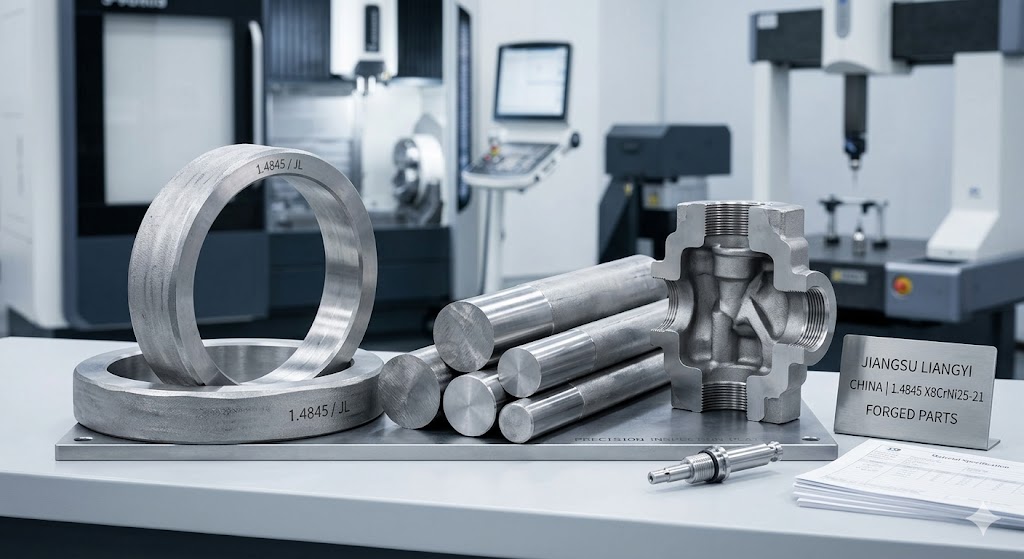
1.4845 (X8CrNi25-21) — EN 10095 austenitic heat-resistant stainless steel: Cr 24–26%, Ni 19–22%, C ≤0.10%. Continuous service limit: 1050°C; intermittent: 1150°C. Global equivalents: DIN X8CrNi25-21 · AFNOR Z8CN25-21 · BS 310S24 · nearest ASTM 310S. Jiangsu Liangyi Co., Limited — ISO 9001:2015, est. 1997, Jiangyin, China — manufactures custom 1.4845 seamless rolled rings (OD ≤6m), forged bars (dia. ≤2000mm), valve components, and hollow forgings from 30 kg to 30,000 kg, with EN 10204 3.1 MTC standard (3.2 with third-party witness on request). Lead time 20–50 days. Ships to 50+ countries.
About 1.4845 (X8CrNi25-21): Metallurgy, Composition & Why It Matters for Forgings
1.4845 — also written X8CrNi25-21, X8CrNi2521, or X8CrNi25.21 — is a high-chromium, high-nickel fully austenitic heat-resistant stainless steel standardized under EN 10095:1999. It belongs to the 25Cr-20Ni family of austenitic alloys, a composition regime that has been used in elevated-temperature industrial service since the 1950s, but the European designation under EN 10095 imposes significantly tighter composition controls than older ASTM or DIN equivalents, resulting in a more consistent and reliable engineering material for precision forgings.
The Metallurgical Logic Behind Cr 24–26% + Ni 19–22%
The specific composition of 1.4845 is not arbitrary. At chromium levels of 24–26%, the alloy forms a dense, continuous Cr₂O₃ (chromia) oxide scale at temperatures above 700°C. This adherent oxide acts as a diffusion barrier against further oxygen ingress, a mechanism known as selective oxidation, and is the primary reason for 1.4845's superior high-temperature oxidation resistance. Below 23% Cr, the oxide scale becomes increasingly porous and non-protective in fluctuating oxidizing/reducing atmospheres — a common scenario in petrochemical furnaces and waste incinerators.
The nickel content at 19–22% serves three critical metallurgical functions: (1) it fully stabilizes the austenitic phase at all service temperatures, eliminating ferritic transformation; (2) it increases stacking fault energy modestly, improving hot workability during forging and reducing the tendency for deformation banding; and (3) it raises the solubility of carbon in austenite, which together with the controlled low-carbon ceiling (max 0.10%) minimizes M₂₃C₆ carbide precipitation at grain boundaries — the principal mechanism of sensitization and intergranular corrosion in lesser-controlled grades.
From our 25+ years of producing 1.4845 forgings, we have observed that heats with silicon approaching the upper limit (1.3–1.5%) exhibit a higher tendency for sigma phase precipitation during prolonged service at 700–900°C. We proactively target silicon at 0.8–1.1% in our melting practice to provide an additional safety margin for clients whose components experience extended thermal exposure in that range, without compromising the oxidation resistance that silicon contributes at temperatures above 950°C.
Designation Explained: X8CrNi25-21
The designation follows EN steel naming conventions: X indicates a stainless steel (Cr ≥10.5%); 8 refers to 100× the nominal carbon content (0.08% nominal, max 0.10%); Cr25 and Ni21 are the rounded nominal alloy contents. The material number 1.4845 is the European unified steel identification number assigned by the Steel Institute of Germany (Stahl-Eisen-Liste). You may also encounter the steel described as EN 1.4845, W.Nr. 1.4845, or DIN X8CrNi25-21 in older European engineering drawings and procurement specifications — all refer to the same alloy.
Global Equivalent Grades & Cross-Reference
Engineers procuring 1.4845 from different global supply regions should be aware of the following equivalents and their key compositional differences:
Standard / Region
Designation
C max%
Cr%
Ni%
Key Difference vs 1.4845
EN 10095 (Europe) ✔ Primary
1.4845 / X8CrNi25-21
0.10
24–26
19–22
Tightest composition control; reference standard for all our forgings
DIN 17459 (Germany)
X8CrNi25-21
0.10
24–26
19–22
Effectively identical to EN 10095; DIN withdrawn in favour of EN
AFNOR (France)
Z8CN25-21
0.10
24–26
19–22
Same composition; French documents use Z-notation
BS 3100 (UK)
310S24
0.08
24–27
19–22
Slightly lower C max; slightly wider Cr range
ASTM A182/A276 (USA)
Grade 310S (UNS S31008)
0.08
24–26
19–22
Lower C max (0.08% vs 0.10%); Si and P/S limits differ slightly
JIS (Japan)
SUS310S
0.08
24–26
19–22
Similar to ASTM 310S; not directly referenced in EN drawings
⚠ Engineering Note: When substituting ASTM 310S for EN 1.4845 (or vice versa) in a project specification, always verify that carbon content, phosphorus, and sulfur limits are compatible with your design's sensitization and weldability requirements. Never assume grade equivalency without reviewing the actual MTC chemistry.
ISO 9001:2015 CertifiedEN 10095 CompliantEN 10204 3.1/3.2 MTCPED CE Docs SupportedAPI 6A-Compatible Docs100% NDT Tested3rd Party Inspection AvailableEst. 1997 | 28 Years Experience
Chemical & Mechanical Properties of 1.4845 (X8CrNi25-21)
Chemical Composition per EN 10095 (Ladle Analysis)
Element
EN 10095 Limit
Our Target Range
Metallurgical Role
Carbon (C)
Max 0.10%
0.04–0.08%
Controls carbide sensitization risk; kept low for weldability
The high-temperature strength of 1.4845 is one of its defining advantages for elevated-temperature service. The following data represents indicative properties for solution-annealed forgings at elevated temperatures, based on our accumulated production testing records and EN standards reference data. These values serve as design references; actual component certification requires batch-specific high-temperature tensile testing where specified by the client.
Test Temperature
Tensile Strength Rm (MPa)
Yield Strength Rp0.2 (MPa)
Elongation A5 (%)
Room Temperature (20°C)
560–700
230–290
45–55
400°C
~440–520
~160–200
~40–50
600°C
~340–410
~130–165
~38–48
700°C
~240–300
~110–140
~35–45
800°C
~150–200
~85–110
~30–42
900°C
~90–130
~60–85
~28–38
1000°C
~45–70
~30–50
~25–35
Stress Rupture (Creep Rupture) Reference Data
Creep resistance — the ability to resist slow deformation under sustained load at elevated temperature — is critical for components such as furnace hangers, reactor casings, and turbine housings. 1.4845 shows good creep performance, especially at temperatures between 650–900°C. Below are typical 100,000-hour stress rupture values, which reflect the alloy’s long-term load bearing ability.
Temperature
100,000h Rupture Stress (MPa)
10,000h Rupture Stress (MPa)
Application Range
650°C
~75–90
~110–130
Pressure vessels, reactor nozzles
750°C
~40–55
~65–80
Furnace components, radiant tubes
850°C
~18–28
~32–45
High-temperature valve seats, retorts
950°C
~8–14
~16–24
Kiln furniture, thermal process fixtures
Design Guidance: For forgings that operate under sustained load above 700°C, creep and stress rupture data should always govern the design allowable stress rather than room-temperature yield strength. We strongly recommend clients share their operating temperature, pressure cycle, and design life when requesting technical support — our engineering team can provide material-specific design stress recommendations aligned with EN 13445 or ASME VIII Division 1 Appendix D approaches.
This is a question we are asked regularly by procurement engineers who are evaluating whether the premium of forging over casting or machined-from-plate is justified for their 1.4845 components. The answer depends entirely on the criticality of the application. For reference components in low-stress, static high-temperature environments, castings may be acceptable. For pressure-containing, rotating, or fatigue-loaded components — particularly those subject to regulatory inspection — forging offers three fundamental and irreversible metallurgical advantages:
① Refined, Equiaxed Grain Structure
Hot forging with a minimum 3:1 area reduction ratio produces ASTM grain size No. 4–7 throughout the section. Castings of equivalent composition typically exhibit coarse columnar grains (ASTM No. 00–2) and a central equiaxed zone — a microstructural heterogeneity that results in directional mechanical property variation of 20–35% between transverse and longitudinal orientations. Our forged 1.4845 rings and bars achieve consistent grain structure from surface to center, confirmed by metallographic section inspection on each lot.
② Zero Internal Porosity
All solidified alloys contain some degree of shrinkage porosity and microsegregation from the solidification process. Casting — even with HIP (Hot Isostatic Pressing) post-treatment — cannot fully eliminate subsurface microporosity in complex geometries. Forging mechanically closes and welds all internal voids under compressive forging pressure, producing a fully dense, pore-free microstructure. This directly translates to higher fatigue endurance limits (typically 15–25% higher in 1.4845 forgings vs. equivalent castings) and eliminates the risk of porosity-initiated cracks under pressure cycling.
③ Directional Grain Flow Integrity
In precision-designed forgings, the grain flow (fiber structure) is oriented parallel to the primary stress axis of the component — for example, radial grain flow in a forged ring matches the hoop stress direction under internal pressure. This wrought-fiber microstructure provides 15–30% higher tensile strength and fatigue resistance in the critical stress direction compared with machined-from-plate or cut-from-bar alternatives, where grain flow runs perpendicular or at an angle to the primary load. This advantage is geometrically locked-in at the forging stage and cannot be replicated by post-machining operations.
④ Traceability & Code Compliance
Pressure equipment codes (EN 13445, ASME VIII, API 6A) impose stricter inspection requirements on castings than on forgings for equivalent pressure ratings. Forged 1.4845 components qualify for higher design stress allowables under most codes, reduce the mandatory NDE inspection scope, and simplify ASME Code Case or PED technical file compliance — all of which translate directly to lower total installed cost for regulated applications.
Heat Treatment Engineering Guide for 1.4845 Forgings
Correct heat treatment is not merely a finishing step for 1.4845 forgings — it is a critical metallurgical process that determines the final microstructure, mechanical properties, and long-term corrosion resistance of every component. Unlike carbon steels where hardening and tempering give the engineer multiple adjustment options, 1.4845 has only one viable heat treatment: solution annealing. There is no age hardening, no martensitic hardening, and no conventional annealing in the sense used for ferritic steels.
Solution Annealing: Mechanism & Parameters
Solution annealing dissolves all chromium carbides (M₂₃C₆) and other precipitates that have formed during forging, cooling, or prior service, restoring a fully homogeneous austenitic microstructure. The process window for 1.4845 is precisely defined:
Parameter
Specification
Engineering Rationale
Annealing Temperature
1050°C – 1120°C
Below 1050°C: incomplete carbide dissolution; above 1150°C: excessive grain growth (grain size > ASTM No. 2) and incipient melting risk near sigma eutectic point
Hold Time
Min 1 h per 25mm section thickness; min 30 min for any section
Ensures temperature uniformity through full cross-section; insufficient soak produces a heterogeneous microstructure with residual sensitized zones near the surface
Furnace Atmosphere
Air, nitrogen, or argon; oxidizing or neutral
Avoid hydrogen-containing atmospheres; scale formation in air is acceptable and is cleaned by pickling or mechanical descaling
Cooling Method
Water quench preferred (section > 50mm); forced air or fan cooling acceptable for thin sections
Rapid cooling suppresses re-precipitation of M₂₃C₆ carbides in the 600–900°C sensitization range; slow furnace cooling MUST be avoided
Cooling Rate Minimum
>5°C/s through 850–500°C for water quench; >1°C/s for air cool
Below this threshold, sigma phase and M₂₃C₆ nucleate at grain boundaries, reducing corrosion resistance and room-temperature ductility
Post-Treatment
Pickling (HNO₃ + HF), or mechanical descaling + passivation
Removes oxide scale, depleted surface layer, and any iron contamination; restores the full passive Cr₂O₃ film
The Sigma Phase Problem: What Engineers Must Know
Sigma phase (σ phase) is an intermetallic compound rich in chromium and iron that precipitates in 1.4845 and similar high-chromium austenitic stainless steels when held or slowly cooled through approximately 650–900°C. Sigma phase precipitation has three practical consequences that matter to design engineers:
Embrittlement at room temperature: Even a small volume fraction of sigma phase (≥1–2%) dramatically reduces room-temperature impact toughness (Charpy KV can drop from 80 J to <5 J), making in-service inspection and thermal-shock events highly dangerous.
Reduced corrosion resistance: Sigma phase nucleation at grain boundaries depletes the surrounding matrix of chromium, creating sensitized pathways susceptible to intergranular corrosion in oxidizing acids and sulfide environments.
Loss of high-temperature ductility: In long-term elevated-temperature service (years at 750–850°C), components with sigma phase present suffer accelerated creep cavitation at grain boundaries.
Our solution: Every 1.4845 forging undergoes water quench (or verified forced-air cooling for thin sections), and we metallographically inspect each lot for sigma phase by Murakami's reagent etching. Components destined for long-term service at 700–900°C are specifically evaluated for sigma-formation tendency based on their silicon content, and we can provide accelerated aging test coupons to simulate service microstructure if the client's design life demands it.
Repair Heat Treatment After Welding or Machining Distortion
For 1.4845 components that have undergone welding or suffered distortion during machining, a re-solution anneal at 1050–1100°C followed by water quench restores the original microstructure and properties with no measurable degradation, provided the total number of thermal cycles is ≤3 and the component has not been exposed to service temperatures above 900°C for extended periods. For heavily service-aged components, consult our technical team before specifying re-heat treatment — sigma phase dissolution requires higher temperatures (typically 1080–1120°C) and longer soak times than initial solution annealing.
Welding Guidelines for X8CrNi25-21 (1.4845)
1.4845 is considered weldable by all standard fusion welding processes, though it demands greater attention to heat input control and distortion management than common austenitic grades like 316L or 304L due to its higher alloy content and the associated risk of sigma phase formation in the heat-affected zone (HAZ) during slow post-weld cooling. The following guidelines are derived from our production experience fabricating 1.4845 weldments for nuclear, petrochemical, and valve applications.
Recommended Filler Metals
Welding Process
AWS Classification
EN Classification
Application
GTAW (TIG)
AWS A5.9 ER310
EN ISO 14343 S 25 20
Root passes; precision orbital welding of thin sections; highest quality joints
SMAW (MMA/Stick)
AWS A5.4 E310-16 / E310-15
EN ISO 3581 25 20 R / B
General repair welding; field welding; heavy section groove filling
GMAW (MIG/MAG)
AWS A5.9 ER310
EN ISO 14343 S 25 20
Production welding of medium sections; semi-automatic processes
SAW (Submerged Arc)
AWS A5.9 ER310 wire + neutral flux
EN ISO 14343 S 25 20 S
High deposition rate joining of heavy forged components; ring welding
Dissimilar to carbon steel
AWS ENiCrFe-3 / ERNiCr-3 (nickel-chromium alloy per AWS A5.11/A5.14)
EN ISO 18274 Ni6082
Dissimilar metal joints between 1.4845 and P91, P22, low-alloy or carbon steel components
Key Welding Procedure Parameters
Preheat: Generally not required for base metal temperatures above 10°C and section thickness below 75mm. For heavy sections or cold working environments, preheat to 50–80°C to prevent moisture condensation on the joint.
Interpass temperature: Maximum 150°C. Exceeding this limit significantly extends the time the weld HAZ spends in the sigma-formation range (650–900°C), risking embrittlement. Use temperature-indicating crayons or infrared thermometers; do not estimate by touch or color.
Heat input: Target 0.5–2.0 kJ/mm for GTAW; 1.5–3.5 kJ/mm for SMAW. Higher heat inputs slow cooling through the sensitization range. Use stringer beads rather than weave beads wherever possible.
Post-weld cleaning: Remove all weld spatter and scale from the weld zone by brushing with a stainless steel wire brush (never carbon steel) and pickling with HNO₃/HF solution. Iron contamination from carbon steel tools is a leading cause of pitting corrosion initiation in 1.4845 weldments in service.
Post-Weld Heat Treatment (PWHT): For heavy-section weldments (>50 mm), pressure-critical components and any application involving service in the 650–900°C range, full solution annealing at 1050–1100°C + water quench is recommended. Where full PWHT is impractical (e.g., field repairs), document the limitation and perform enhanced NDE (TOFD + phased array UT) of the weld zone.
✔ Jiangsu Liangyi Service: We supply 1.4845 forgings in pre-machined weld prep configurations (J-prep, V-groove, bevel) to client drawings. We can also supply matched composition filler wire (ER310 or equivalent ENiCrFe-3 nickel-chromium alloy) and provide WPS/PQR documentation developed under our ISO 9001:2015 quality system for clients requiring full welding procedure qualification support.
1.4845 vs 310S vs 1.4841 vs Alloy 330: Full Material Comparison
Specifying the correct alloy for high-temperature service is one of the most consequential engineering decisions in process plant design. Over-specifying wastes capital cost; under-specifying risks premature failure, unplanned downtime, and safety incidents. The following comparison covers the four alloys most commonly evaluated alongside 1.4845 in our clients' material selection process:
Property
1.4845 (X8CrNi25-21)
310S (UNS S31008)
1.4841 (X15CrNiSi25-21)
Alloy 330 (UNS N08330)
Cr content
24–26%
24–26%
24–26%
17–20%
Ni content
19–22%
19–22%
19–22%
34–37%
Si content
≤1.50%
≤1.50%
1.50–2.50%
≤1.25%
C content max
0.10%
0.08%
0.20%
0.08%
Continuous service limit
1050°C Best
1000°C Good
1100°C Best
1150°C Best
Oxidation resistance
Excellent ★★★★★
Very Good ★★★★
Excellent ★★★★★
Excellent ★★★★★
Carburization resistance
Good ★★★
Good ★★★
Very Good (Si effect) ★★★★
Excellent (high Ni) ★★★★★
Creep resistance 800°C
Good ★★★★
Fair ★★★
Good ★★★★
Very Good (high Ni) ★★★★
Sigma phase risk
Moderate (managed) Medium
Moderate Medium
Higher (high C+Si) Higher
Low (high Ni) Low
Weldability
Good ★★★★
Good ★★★★
Fair (high C) ★★★
Good ★★★★
Relative material cost (forgings)
Reference (1.0×)
~0.9–1.0× (similar)
~0.95–1.05× (similar)
~2.5–4.0× (much higher)
EU design standard
EN 10095 (primary)
ASTM primary
EN 10095
ASTM B536/UNS
Typical EU project use
Valve bodies, rings, bars, pressure components
General high-temp structures
Furnace parts, radiant tubes
Carburizing furnaces, ethylene cracking
Key Takeaway: 1.4845 is the natural choice when you need EN 10095 compliance, good weldability, moderate-to-excellent high-temperature oxidation and creep resistance at an economical alloy cost. Choose 1.4841 if your application involves severe carburization or cyclic oxidation above 1000°C. Choose Alloy 330 only when carburization resistance is the absolute priority and budget allows for 2.5–4× the material cost.
Material Selection Guide: When to Choose 1.4845
Based on 28 years of application experience across global projects, we have developed the following practical selection framework. This is not a theoretical exercise — it reflects the actual enquiries our engineering team evaluates every week from clients in Europe, the Middle East, and Asia.
✔ Choose 1.4845 When…
Service temperature: 600–1050°C continuous Environment: Oxidizing (air, combustion gas, sulfurous atmosphere) Design standard: EN 10095 or equivalent required Weldability: Important (PWHT access limited) Budget: Moderate alloy cost (vs. Alloy 330 or nickel superalloys) Certification: EN 10204 3.1/3.2 MTC, API 6A-compatible docs needed
Recommended
⚠ Consider 1.4841 Instead When…
Service temperature: 1000–1150°C continuous Environment: Strongly oxidizing, cyclic thermal shock Weldability: Less critical (fixed/non-welded assemblies) Design standard: EN 10095 also applicable Note: Higher sigma phase and sensitization risk vs. 1.4845
Consider
⚠ Consider Alloy 330 When…
Primary failure mode: Carburization (ethylene cracking, gas carburizing) Budget: Allows 2.5–4× material premium Service: Reducing, carbon-rich high-temperature atmosphere Note: Alloy 330 also has excellent sigma phase resistance due to high Ni
Consider
✗ Do Not Use 1.4845 When…
Service temperature: Below 500°C (over-specified; 316L or 321 will serve) Environment: Strongly reducing, halide-rich (chloride SCC risk) Cryogenic service: 1.4845 untested below –196°C as standard grade Budget-critical low-temp: 310S or 304L will cost less and perform adequately
Avoid
Full Range of 1.4845 (X8CrNi25-21) Forged Products We Supply
Jiangsu Liangyi operates an 80,000㎡ integrated forging complex with 40 million USD in fixed assets and an annual output of 120,000 tons, covering the full value chain from raw material melting to precision-machined finished components. Our 1.4845 forged product range spans single-piece weights from 30 kg to 30,000 kg. All products are manufactured to client drawings and technical specifications, with every heat traceable to its original melt record.
1. 1.4845 Forged Bars, Rods & Shafts
We supply forged steel round bars (diameter 30mm-2000mm), square bars (up to 800×800mm), flat bars, rectangular bars and step shaft bars with maximum single-piece length up to 15 meters of X8CrNi25-21. All bars are forged with a minimum 4:1 reduction ratio to ensure uniform microstructure throughout the cross-section. Standard delivery condition: solution annealed + water quenched + surface peeled/turned (Ra 3.2–6.3μm). Available with optional stress-corrosion testing coupons from the same bar tail for critical applications. Ideal for valve stems, pump shafts, drive shafts, structural members, and machining blanks for custom machined components. See our Equipment page for press and ring rolling capabilities.
2. X8CrNi25-21 Seamless Rolled Forged Rings
Custom 1.4845 seamless rolled rings, profiled/contoured forged rings, and open die forged rings, from 200mm to 6000mm outer diameter, wall thickness from 20mm to 800mm, maximum single-piece weight up to 30 tons. Our seamless ring rolling process produces continuous, uninterrupted grain flow around the full ring circumference — a structural advantage that is metallurgically impossible to achieve with cut-from-plate ring fabrication. Rings are delivered solution annealed, water quenched, rough-turned on OD/ID/faces, with 100% ultrasonic testing per EN 10228-3 or ASTM A388. Primary applications: flanges, bearing races, valve bodies, turbine casings, wellhead equipment, nuclear containment rings. Browse our full product catalogue on our Products page.
3. 1.4845 Hollow Forged Components
We manufacture X8CrNi25-21 forged steel hubs, housings, shells, sleeves, bushes, casing tubes, barrels, and hollow bars using radial forging and mandrel forging techniques. Hollow forgings achieve near-net-shape geometries that minimize material waste in high-value 1.4845 stock, with typical bore tolerances of ±1–3mm (rough) that allow efficient CNC finish machining. These components are widely used in nuclear reactor coolant pump casings, pressure vessel shells, centrifugal pump barrels, and subsea downhole tool bodies. Explore our complete material capabilities on our Materials page.
4. Custom Machined 1.4845 Forged Components
High-precision X8CrNi25-21 forged discs, plates, blocks, flanges, impellers, nozzles, tube sheets, baffle plates, valve bonnets, and fully machined components to your exact drawing. Our CNC machining capabilities include turning, boring, milling, drilling, tapping, and grinding, with dimensional tolerances to IT5 (±0.01mm for critical fits) and surface roughness to Ra 0.4μm for sealing surfaces. 3D CMM measurement with full First Article Inspection (FAI) report available. All stages from melt to final dimensional report are in-house controlled, thus removing sub-contracting risk and creating a seamless quality chain. Please contact our engineering team with your custom requirement from our Contact page.
5. 1.4845 Forged Pipe Fittings & Flanges
Forged pipe flanges (ANSI/ASME B16.5, EN 1092-1), elbows, tees, reducers, and other pressure pipe fittings in 1.4845 for high-temperature pipelines. Flange ratings from Class 150 to Class 2500 (ANSI) or PN 10 to PN 400 (EN). All pressure fittings manufactured with full material traceability, EN 10204 3.1 MTC as standard, pressure testing on request.
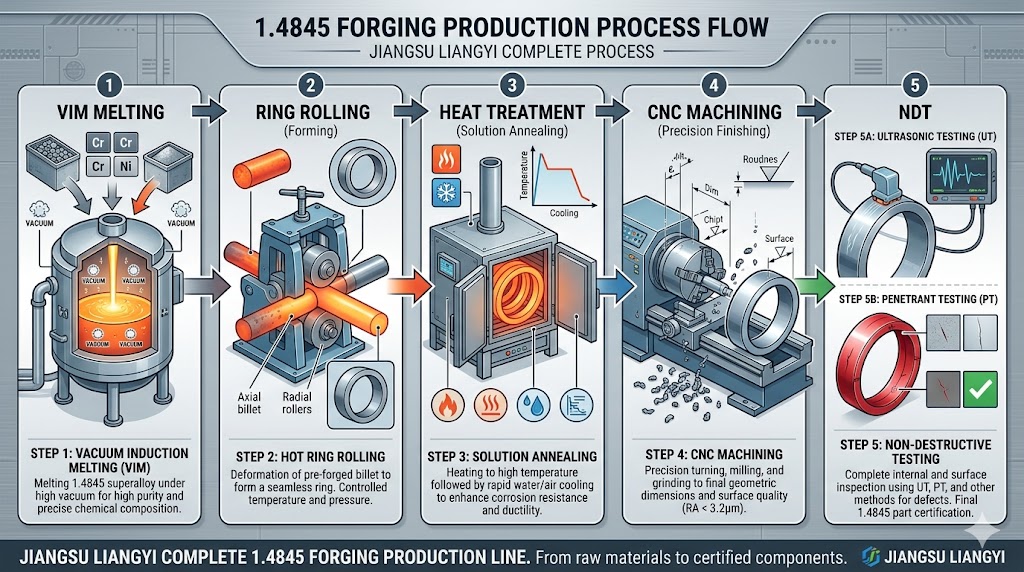
Our 7-Step 1.4845 Production Process: From Melt to Certified Component
What distinguishes a world-class 1.4845 forging from a commodity product is not just the raw composition — it is the discipline and consistency of every step in the production process. Below is an honest, detailed account of how we produce 1.4845 forged parts at Jiangsu Liangyi, including the controls and checks that our clients' QA teams ask to audit before approving us as a qualified supplier.
1
Premium Steel Melting: VIM + AOD ± ESR/VAR
All 1.4845 steel begins with primary melting in our Electric Arc Furnace (EAF) followed by Argon Oxygen Decarburization (AOD) refining to achieve the precise chemical composition required by EN 10095. The AOD process enables accurate control of carbon at 0.04–0.08%, chromium at 24.5–25.5%, nickel at 19.5–21%, and critically limits sulfur to ≤0.010% — well below the standard maximum of 0.015%. For nuclear-grade or ultra-critical applications, we add Electro Slag Remelting (ESR) or Vacuum Arc Remelting (VAR) as a secondary refining step, which further reduces non-metallic inclusions to levels meeting ASTM A484 SEP 1584 Class A requirements. Every heat is fully documented: EAF charge analysis, AOD final ladle analysis (OES spectrometry), and ingot sample analysis are all retained in our digital quality record system for full forward and backward traceability over 10+ years.
2
Ingot Homogenization & Billet Preparation
Cast ingots are homogenized at 1180–1220°C to eliminate dendritic segregation of chromium and nickel — a segregation that can create local composition variations of ±2–4% across a large ingot cross-section if not corrected. After homogenization, ingots are pressed into billets at our primary breakdown press, with initial reduction ratios of 2–4:1 to refine the as-cast columnar grain structure before final shape forging. Homogenization is a step that many smaller forging shops skip to save energy cost; it is non-negotiable in our 1.4845 production practice because segregation in the starting billet propagates directly into non-uniform properties in the finished forging.
3
Hot Forging (1100–1200°C Start / Min 950°C Finish)
Billets are heated to the forging temperature window of 1100–1200°C in our computer-controlled gas-fired furnaces (±10°C temperature uniformity, verified by multi-point thermocouple and optical pyrometer). 1.4845 exhibits moderate hot ductility — lower than common austenitic grades like 316 due to its high alloy content — so forging reduction per pass, anvil temperature, and deformation rate are carefully managed to avoid hot cracking at grain boundaries. We target a minimum overall forging reduction ratio of 3:1 for bars (typically 5–8:1 in practice) and 4:1 for rings, which refines the as-cast grain structure to ASTM No. 4–7 grain size and achieves the directional mechanical properties that make forgings superior to castings. The minimum finishing temperature of 950°C is strictly enforced — forging below this temperature in the sensitization range risks strain-induced carbide precipitation and internal cracking in high-silicon 1.4845 heats.
4
Solution Annealing Heat Treatment (1050–1120°C + Water Quench)
Following forging, all 1.4845 components are solution annealed in our 10-furnace fully automatic heat treatment facility. Furnaces are calibrated quarterly per AMS 2750 Class 4 standards, with temperature uniformity verified at ≤±8°C throughout the working zone. Soak time is calculated at 1 hour per 25mm of section thickness (minimum 45 minutes for any section). Upon completion, components are immediately transferred to water quench tanks, achieving cooling rates through the critical 900–500°C range of >8°C/s for sections up to 150mm. For larger sections (>150mm), quench agitation and bath temperature are controlled to maintain adequate quench intensity. Post-quench Brinell hardness testing and metallographic inspection from sacrifice test rings confirm that the target microstructure has been achieved before any machining proceeds.
5
CNC Rough & Finish Machining
Our CNC machining facility is equipped with precision CNC lathes (max swing 3,500mm, max length 12,000mm), horizontal and vertical machining centres, and precision boring mills for complex internal geometry. 1.4845 is a moderately difficult material to machine — its high work-hardening rate (1.5–2.0× higher than 304L) demands sharp tooling, moderate cutting speeds (30–60 m/min for carbide inserts), high feed rates, and continuous flood coolant to avoid built-up edge and surface drag. Our CNC programmers have developed validated cutting strategies specific to 1.4845 over hundreds of production batches, achieving consistent surface finishes of Ra 0.8–3.2μm on turned surfaces and Ra 0.4–1.6μm on critical bore and sealing surfaces without tool path modification between batches.
6
100% Non-Destructive Testing (NDT)
Every 1.4845 forging leaving our facility undergoes mandatory NDT before shipment. Standard NDT scope: Ultrasonic Testing (UT) per EN 10228-3 or ASTM A388 for internal defect detection (minimum recordable indication level: 2mm flat-bottomed hole equivalent reflector); Magnetic Particle Testing (MT) — note: 1.4845 is non-magnetic in the fully annealed condition, so MT is applicable only for partially magnetic conditions. For surface inspection on non-magnetic condition, we apply Liquid Penetrant Testing (PT) per EN 10228-2 or ASTM E165. For radiographic applications (nuclear, pressure vessels), Radiographic Testing (RT) per EN 444 or ASTM E94 is available. All NDT operators are Level 2 or Level 3 certified under EN ISO 9712 (PCN scheme). NDT records are retained for 10 years minimum and are available for client and third-party auditor review.
7
Mill Test Certificate, Marking & Export Packaging
Upon successful completion of all testing, EN 10204 3.1 Mill Test Certificates are issued by our QA department. The MTC includes: heat/melt number, product dimension, delivery condition, chemical composition (ladle + product analysis), mechanical test results (tensile, hardness), NDT scope and results, heat treatment record (furnace temperature, soak time, quench method, recorded thermocouple chart), and applicable standard conformity statement. Where EN 10204 3.2 certification is required, third-party inspection bodies (TÜV SÜD, SGS, Bureau Veritas, Lloyds, or other) are engaged for witness inspection and co-signing of the MTC. Components are individually stamped or electrochemically etched with heat number, material grade, and our company identifier. Export packaging includes moisture barrier film, wooden crate, and anti-corrosion treatment for sea freight shipment.
Industry Applications & Global GEO-Targeted Project Cases
Our 1.4845 (X8CrNi25-21) forged parts have served critical roles in some of the most demanding industrial environments on earth. The following section details not just which industries use 1.4845, but what specific engineering challenges the material solves in each context, drawn from our actual project execution experience across 50+ export countries.
1. Valve Manufacturing Industry — EU & North America
Industrial valves for high-temperature service represent one of the highest-volume applications for 1.4845 forgings in our production. We supply complete valve component sets: forged valve bodies (globe, gate, ball, butterfly), bonnets, stems, seat rings, ball closures, disc assemblies, and main shafts. For EU market supply, all components are dimensioned and tested to meet EN 12516 (valve shell design) dimensional and material requirements. PED 2014/68/EU CE marking documentation is coordinated in collaboration with the valve OEM (Responsible Manufacturer) who holds the CE mark. For North America market, ASME B16.34 and API 6D compatibility is supported through dimensional conformance and material documentation.
The specific property of 1.4845 that makes it preferred over 310S for premium valve applications is not just oxidation resistance — it is the combination of low carbon content (enabling PWHT-free welding on body-to-bonnet joints) and consistent yield strength stability at 500–700°C, which allows valve designers to use thinner body walls for the same pressure rating compared with lower-alloy alternatives, reducing total valve weight and improving actuator response in automated systems.
Representative Application: High-Temperature Valve Components for European Petrochemical Pipeline
Application: Ball valves for crude oil heater outlet pipelines, continuous service at 800–850°C, high-pressure service | Typical Supply Scope: 1.4845 forged valve bodies and matched stems, solution annealed and water quenched, OD precision-turned, bore-finished to H7 tolerance | Standard Documentation: EN 10204 3.1 MTC; EN 10204 3.2 with third-party witness inspection available on client request; 100% UT+PT | Key Requirement: Long-term oxidation resistance in sulfurous combustion gas environment at elevated temperature — a main performance strength of 1.4845 over lower-alloy alternatives.
2. Oil & Gas Extraction — Middle East & Global Offshore
The oil and gas industry demands 1.4845 forgings primarily where high-temperature corrosion combined with mechanical loading would disqualify lower-alloy materials. Our O&G product range for 1.4845 includes: downhole drilling tool mud motor splined drive shafts (requiring tight dimensional tolerances to ±0.05mm on spline pitch diameter and excellent torsional fatigue resistance); electrical submersible pump (ESP) motor shafts (requiring surface hardness consistency and straightness to ≤0.3mm/m); Christmas tree and wellhead components (spool bodies, casing heads, tubing heads, casing hangers, tubing hangers); and integral mud flanges (API 6A compliant). All wellhead components are dimensioned to API 6A PSL2 or PSL3 as required by client specification.
Representative Application: Wellhead Components for Middle East Sour Gas Service
Application: Wellhead spool bodies and casing hangers for high-H₂S (sour) gas service, high-pressure / high-temperature downhole environment | Typical Supply Scope: Custom 1.4845 forged wellhead spools machined to client drawings with API 6A-compatible flange ends (Type 6B); dimensional report with CMM data | Key Requirement: SSC (Sulfide Stress Cracking) resistance per NACE MR0175 / ISO 15156 — hardness conformance documented on MTC; EN 10204 3.1 MTC standard, EN 10204 3.2 with third-party witness available on request | Why 1.4845: The alloy's controlled hardness (max 22 HRC equivalent) combined with high Cr content meets both SSC resistance and oxidation resistance requirements in a single material.
3. Nuclear Power Industry — Asia Pacific & Europe
Nuclear applications represent the most stringent quality tier we manufacture for, and 1.4845 forgings for nuclear service carry specific additional requirements beyond standard EN 10095 compliance. Key differences for nuclear-grade 1.4845: (1) premium melting route mandatory — VIM+AOD+ESR at minimum, with melt log and VAR certification as an option for RCC-M Class 1 components; (2) tramp element controls — Sn, Pb, As, Sb, Bi all individually certified to ultra-low levels to prevent hot cracking and irradiation embrittlement; (3) extended mechanical test programs — including Charpy impact testing at –20°C, +20°C, and +300°C; (4) enhanced ultrasonic testing — 100% immersion UT to a minimum sensitivity of 1.2mm flat-bottomed hole equivalent reflector; (5) stress rupture test coupons from each heat as part of qualification batch.
Representative Application: Reactor Coolant Pump Components for Nuclear Power Service
Application: Reactor coolant pump (RCP) casing components for Pressurized Water Reactor (PWR) service — high pressure primary coolant loop environment | Typical Material Route: VIM + AOD + ESR triple melt route to achieve ultra-low inclusion content and homogeneous microstructure across large cross-sections | Typical Supply Scope: 1.4845 forged hollow cylindrical casings, large-diameter, fully machined to tight nuclear-grade tolerances (typically ±0.05mm on critical bores) | Extended Test Program (client-specified): Heat + product composition, RT and elevated-temperature tensile, Charpy impact at multiple temperatures, 100% immersion UT, PT on all machined surfaces, stress rupture coupon test, dimensional CMM report | Note: Nuclear qualification requires client's formal nuclear procurement specification; we supply EN 10204 3.1 MTC as standard and coordinate EN 10204 3.2 third-party witness inspection per client's designated inspection authority.
4. Turbomachinery & Industrial Pump Industry
Centrifugal compressor impellers, pump casings, pump barrel shells, pump wear rings, shaft sleeves, and diffuser rings manufactured from 1.4845 deliver exceptional high-temperature creep resistance and dimensional stability for continuous rotating operation. The challenge in turbomachinery forgings is combining the tight dimensional tolerances required for precision rotating components (typically IT6–IT7 on running surfaces, with dynamic balance requirements) with the metallurgical quality standards needed for high-temperature structural integrity. Our investment in large-bore CNC turning centres (max chuck diameter 3,200mm) and our dynamic balancing facility enables us to supply fully finish-machined, balanced turbomachinery components direct from forging to OEM assembly.
5. Boiler, Heat Exchanger & Pressure Vessel Industry
1.4845 tube sheets (up to 3,000mm diameter, 400mm thick), shell sections, nozzles, channel heads, transition cones, baffle plates, and pressure reactor nozzles for industrial boilers, waste heat recovery units, sulfur recovery units (SRU), crude oil heaters, steam superheaters, and coke drum overhead systems. All pressure components are designed to EN 13445 (European Unfired Pressure Vessels) or ASME VIII Division 1 as client-specified. For ASME Code applications, our 1.4845 forgings are supplied with chemical and mechanical properties that conform to ASME Section II Part A SA-182 Grade F310 or equivalent Code Case as applicable.
6. Flow Measurement Industry
X8CrNi25-21 forged bodies for venturi cone meters (for custody transfer measurement of high-temperature crude oil and natural gas), ultrasonic flow meter pressure vessels, and oil measurement valve spools, manufactured to the dimensional accuracy required for metrological traceability (typically ±0.1% internal bore diameter tolerance). 1.4845 is specified for these applications because thermal expansion stability at operating temperature is critical — dimensional drift due to differential thermal expansion between the meter body and the sensing elements would directly corrupt measurement accuracy. The controlled composition of 1.4845 yields a highly consistent coefficient of thermal expansion (CTE: approximately 16.0 µm/m·°C at 20–100°C, 18.5 µm/m·°C at 20–1000°C) that can be precisely accounted for in meter calibration algorithms.
7. Thermal Processing & Furnace Equipment Industry
A less commonly publicized but commercially significant application for 1.4845 forgings is in the thermal processing industry: furnace component supports, retort shells, radiant tube end caps, carburizing basket frames, salt bath pot fittings, and heat treatment fixture components. In these applications, the alloy operates under combined thermal cycling (room temperature to 900°C+), oxidizing and partially carburizing atmospheres, and moderate mechanical loading from component weight. The key property exploited here is 1.4845's ability to maintain scale adhesion under thermal cycling — its oxide scale, while not as perfectly adherent as that of 1.4841 (the high-silicon grade), remains sufficiently protective during normal industrial thermal cycling to provide service lives of 3–7 years in most thermal processing environments, significantly longer than lower-alloy grades like 310S that spall their oxide scale during thermal shock.
Production Standards, Equipment & Manufacturing Capabilities
International Standards Compliance
All 1.4845 (X8CrNi25-21) forged products from Jiangsu Liangyi are manufactured in full conformance with applicable international standards. We maintain a documented and audited compliance matrix covering:
EN 10095:1999 — Heat Resisting Steels and Nickel Alloys (primary material standard for all 1.4845 forgings)
Full-spectrum OES; Cr/Ni/Mo/C/N and all major elements
Mechanical Testing
Universal Tensile Tester + High-Temp Furnace
RT to 1200°C tensile testing; Charpy impact; creep rig
Dimensional Inspection
Precision 3D CMM ×2
Max measuring volume 2,000mm × 1,200mm × 1,000mm
Metallographic Lab
Full metallographic preparation + Leica DM microscope
Grain size, sigma phase, inclusion rating per ASTM E45/E112
Quality Control & Mandatory Acceptance Testing
Quality in 1.4845 forgings is not a post-production filter — it is built into every stage of the manufacturing process. The following describes our mandatory quality programme, which exceeds EN 10095 baseline requirements and has been verified by TÜV, SGS, Bureau Veritas, and multiple client QA audits over our 28 years of operation.
Per-Heat / Per-Lot Mandatory Tests
Chemical composition analysis (ladle + product): Every heat is analysed by OES spectrometer on a ladle sample during AOD refining (ladle analysis) and again on a product sample cut from the top and bottom of each ingot (product analysis). Both analyses are reported on the MTC. Discrepancy between ladle and product analyses exceeding EN tolerances triggers full heat investigation before any product is released.
Solution annealing verification: Each furnace load is documented with a thermocouple chart recording furnace temperature throughout the soak cycle. Charts are reviewed by our QA engineer and retained as a permanent quality record. Any thermocouple deviation beyond ±15°C triggers a load hold and engineering review.
Hardness mapping (every lot): Brinell hardness is measured at multiple surface locations on each forging (minimum 5 points on rings, 3 points on bars per ASTM A255 spacing) and all values must be ≤220 HB with a maximum spread of ≤40 HB within a single piece. Values outside this range indicate incomplete solution annealing or compositional segregation and trigger rejection and re-heat treatment investigation.
Grain size assessment (periodic): Metallographic sections are prepared and etched from sacrifice coupons at minimum once per lot (defined as 5 tonnes or one heat of product, whichever is smaller). ASTM grain size No. 4–7 is required; values coarser than No. 3 indicate insufficient forging reduction or excessive heat treatment temperature and require engineering disposition.
Room-temperature tensile test (every lot): Full tensile test (Rm, Rp0.2, A5, Z) to EN ISO 6892-1 from sacrifice ring coupons or bar ends. Results must meet or exceed EN 10095 minimums. We report both the minimum required and our actual achieved values on the MTC to provide full transparency.
100% Ultrasonic Testing: All 1.4845 forgings are UT tested to EN 10228-3 Quality Class 3 (or higher client-specified class) as standard. Forgings for nuclear or high-pressure service are tested to Class 4 or ASTM A388 acceptance criteria as specified. All indications exceeding the reference reflector are recorded, located (X-Y-Z coordinates), and evaluated by our Level 2/3 UT operator before disposition.
Dimensional inspection: Full dimensional verification against the drawing using calibrated instruments (micrometer, bore gauge, CMM) is performed on 100% of precision-machined components and on a minimum 10% AQL basis for rough forgings. Any dimension outside drawing tolerance triggers 100% inspection of the lot.
Periodic & Application-Specific Tests
High-temperature tensile testing (client-specified; typically 600°C, 700°C, or 800°C per EN ISO 6892-2)
Stress rupture (creep rupture) testing (client-specified; from 200h to 1000h at specified temperature and stress)
Intergranular corrosion (IGC) test per EN ISO 3651-2 (oxalic acid etch + Strauss test) — for weldment qualification and sensitization verification
Sigma phase verification by Murakami's reagent metallographic etching — required for all lots destined for long-term service at 700–900°C
Charpy impact testing at specified temperatures (–20°C, RT, +200°C available) for nuclear and cryogenic applications
Hydrostatic pressure testing for pressure-containing components per client specification
Positive Material Identification (PMI) by handheld XRF or OES — available as a shipping verification check on 100% of pieces
Third-party inspection by TÜV SÜD, SGS, Bureau Veritas, Lloyds Register, DNV, Intertek, or other client-nominated inspectors is welcomed and routinely coordinated. We maintain a dedicated third-party inspection coordination desk with 24-hour advance notice protocol and physical inspection space with full laboratory access.
Cost-Benefit Analysis: When 1.4845 Forgings Are the Right Economic Choice
Procurement decisions for high-alloy forged components are never made on material cost alone — they must account for total life-cycle cost, maintenance intervals, failure consequence cost, and regulatory compliance burden. Here is an honest analysis of where 1.4845 forgings deliver the best economic return:
Where 1.4845 Wins on Total Cost of Ownership
Replacement interval: In high-temperature valve applications where 310S components require replacement every 2–3 years due to oxidation scaling and mechanical degradation, 1.4845 equivalents routinely achieve 6–10 year service lives. The 10–15% material cost premium of 1.4845 over 310S is typically recovered within the first replacement cycle avoided.
Unplanned downtime avoidance: For petroleum refinery or nuclear plant components, a single unplanned shutdown attributable to component failure can cost USD 500,000 to 5,000,000+ per day. Upgrading to certified 1.4845 forgings with full NDT documentation eliminates the material-quality uncertainty that is often the proximate cause of such events.
Regulatory compliance efficiency: For EU PED-regulated pressure equipment, forgings carry lower design stress penalty factors (z factors) than castings under EN 13445, allowing smaller cross-sections, lighter components, and reduced flange bolt loads — all of which reduce the installed system cost in a way that partially offsets the forging material premium.
Weight savings vs. lower-alloy alternatives: Achieving equivalent high-temperature performance with a lower-alloy material (e.g., 316H or 321H) requires significantly heavier sections to compensate for lower high-temperature strength. For large rotating components (impellers, turbine casings), this weight penalty increases dynamic load, bearing wear, and shaft deflection. 1.4845's superior high-temperature strength-to-weight ratio can actually reduce total system weight and secondary component costs.
Extreme temperature ≥1100°C, critical applications
Our Value Proposition: As a vertically integrated manufacturer — melt, forge, heat treat, machine, inspect, certify — all in-house at Jiangsu Liangyi, we eliminate the quality risk, lead time, and cost mark-up of multi-tier supply chains. Our clients receive 1.4845 forgings that compete on price with commodity 310S supply from trading companies, while delivering full EN 10095 metallurgical and documentation compliance. Contact us with your drawing and quantity for a direct comparison quotation.
12 Frequently Asked Questions About 1.4845 (X8CrNi25-21) Forgings
1.4845 (X8CrNi25-21) is rated for continuous service up to 1050°C in oxidizing atmospheres, and for intermittent (thermal cycling) service up to 1150°C. Above 1050°C continuous, the protective Cr₂O₃ oxide scale begins to volatilize as CrO₃ (gaseous), reducing oxidation protection — this is why 1.4845 is not recommended above 1050°C in continuous service. For temperatures above 1050°C continuous, consider 1.4841 (higher Si) or Alloy 601 (Al + Cr). At 900°C, 1.4845 retains approximately 60–85 MPa yield strength, making it one of the most cost-effective load-bearing materials in the 800–1000°C range.
Both are 25Cr-20Ni austenitic heat-resistant grades, but they differ in three important ways for forging applications: (1) Carbon control: EN 10095 caps 1.4845 at C max 0.10%; some older ASTM 310S specifications allow up to 0.08% (newer) or even 0.25% C — the lower the carbon, the better the weldability and the lower the sensitization risk; (2) Phosphorus/sulfur limits: EN 10095 enforces tighter P (0.045% max) and S (0.015% max) limits than many ASTM specifications, producing cleaner steel with better hot ductility during forging; (3) Procurement context: 1.4845 is the correct designation for EN-certified EU market supply; 310S is the primary designation for ASTM/ASME-specified North American projects. For projects requiring dual certification, we can manufacture to EN 10095 composition and simultaneously report ASTM conformity on the same MTC.
1.4845 (X8CrNi25-21) equivalents: EN 10095 (Europe): 1.4845 / X8CrNi25-21; DIN 17459 (Germany): X8CrNi25-21; AFNOR (France): Z8CN25-21; BS 3100 (UK): 310S24; nearest ASTM/AISI: 310S / UNS S31008; JIS: SUS310S. Important: always verify the MTC chemistry rather than assuming grade equivalency, since carbon and impurity limits differ between standards. We can provide dual-standard certification (EN + ASTM, or EN + API) on a single MTC for projects with multi-standard requirements.
Solution anneal at 1050°C–1120°C, holding for a minimum of 1 hour per 25mm of section thickness (minimum 30 minutes total for thin sections). Cool by water quench (preferred for sections >50mm) or forced air cooling for thin sections — slow furnace cooling must never be used, as it allows chromium carbide precipitation in the 600–900°C sensitization range and sigma phase formation in the 700–900°C range. For components that have been service-aged at high temperature and developed sigma phase, a higher soak temperature of 1080–1120°C with extended hold time is needed to fully re-dissolve the intermetallic phase before quenching.
For GTAW (TIG): AWS A5.9 ER310 (EN ISO 14343 S 25 20). For SMAW (stick): AWS A5.4 E310-16 or E310-15. For GMAW/SAW: ER310 wire with neutral flux. For dissimilar metal joints to carbon steel or low-alloy steel: ENiCrFe-3 or ERNiCr-3 (nickel-chromium alloys per AWS A5.11/A5.14). Key procedure requirements: interpass temperature maximum 150°C; heat input controlled to 0.5–3.5 kJ/mm depending on process; post-weld cleaning by stainless steel brush and HNO₃/HF pickling; PWHT (re-solution anneal at 1050–1100°C + water quench) recommended for heavy sections or high-stress pressure applications.
Three irreversible metallurgical advantages: (1) Grain refinement — minimum ASTM No. 4 grain size vs. coarse columnar grains in castings (ASTM No. 00–2), giving 15–25% better fatigue resistance; (2) Zero porosity — forging pressure mechanically closes all solidification voids; castings always retain microporosity risk even after HIP treatment; (3) Directional grain flow — wrought grain structure oriented with the component stress axis gives 15–30% higher tensile/fatigue performance in the critical direction vs. machined-from-plate alternatives. Additionally, forgings qualify for higher design stress allowables under EN 13445 and ASME VIII codes, reducing wall thickness requirements and total component weight.
Yes — custom manufacturing is our primary business model. We produce 1.4845 forged parts from client drawings, from initial DFM (Design for Manufacturability) review through to final packaged delivery. Full-process service: steel melting (VIM+AOD+optional ESR/VAR), homogenization, hot forging, solution annealing + quench, rough and finish CNC machining, 100% NDT, dimensional inspection (CMM 3D report available), and EN 10204 3.1/3.2 MTC. Single-piece weight range: 30 kg to 30,000 kg. Seamless ring OD range: 200mm to 6,000mm. Bar diameter: 30mm to 2,000mm. Send your drawing (PDF or 3D model) and quantity to sales@jnmtforgedparts.com for a technical and commercial proposal within 24 hours.
Standard with every order: ISO 9001:2015 quality system; EN 10204 3.1 Mill Test Certificate (signed by our QA manager). Available on request: EN 10204 3.2 with third-party witness (TÜV SÜD, SGS, Bureau Veritas, Lloyds, DNV, Intertek, or client-nominated); PED CE support: We supply EN 10204 material documentation required by the EU Responsible Manufacturer for their PED CE filing — the CE mark itself is issued by the valve/equipment OEM, not by a forging material supplier; API 6A-compatible dimensional and material documentation package (note: API monogram licensing is held by the end-equipment manufacturer; we supply conforming forging material with supporting documentation); NACE MR0175 / ISO 15156 hardness conformance statement; extended nuclear traceability package (RCC-M, ASME NCA) on specific enquiry. Our MTC includes all required data fields: heat number, melt route, chemical analysis (ladle + product), heat treatment record with thermocouple chart reference, mechanical test results, NDT scope and result, and applicable standard conformity statement.
Typical lead times from order confirmation and drawing approval: 20–35 days for small to medium batches (up to ~20 pieces or ~10,000 kg) with standard solution annealing and rough machining; 35–50 days for large, complex, or heavily machined components; 50–70 days for ESR/VAR melt route (nuclear grade) or components requiring extended testing programs (stress rupture, high-temp tensile, IGC). Expedited production — reducing standard lead time by 20–30% — is possible with upfront schedule discussion; contact us at order enquiry stage to explore expedite options. Approximate seafreight transit times: China to Germany/Netherlands 25–30 days; to Saudi Arabia 15–20 days; to USA East Coast 28–35 days; to Southeast Asia 7–15 days.
Per EN 10095 (ladle analysis): C ≤0.10% | Si ≤1.50% | Mn ≤2.00% | P ≤0.045% | S ≤0.015% | Cr 24.00–26.00% | Ni 19.00–22.00% | N ≤0.10%. No intentional Mo, Ti, or Nb additions. Our internal melting practice targets C 0.04–0.08%, Si 0.80–1.10%, S ≤0.010%, and Cr 24.5–25.5%, providing an additional safety margin within the standard limits for critical applications. All composition data is reported on both ladle and product analysis certificates, providing dual-verification traceability for each heat.
Store indoors in a clean, dry environment away from carbon steel equipment. Never stack directly on carbon steel floor plate or carbon steel fixtures without a non-metallic separator — iron particle transfer can initiate pitting corrosion within weeks in a humid environment. Clean with acetone or isopropyl alcohol before installation; never use chlorinated solvents (trichloroethylene, MEK) on any component that will see high-temperature service, as chloride residues concentrate and cause stress corrosion cracking. Apply electrochemical marking (electrolytic etching) for identification — never use impact stamps on precision-machined surfaces or thin sections. If parts are stored >12 months, perform a full Positive Material Identification (PMI) check and visual inspection before installation.
Forging reduction ratio (the ratio of billet cross-sectional area to finished forging cross-sectional area) is one of the most important process parameters for 1.4845 — more so than for common carbon steel grades. Our minimum practice is 3:1 for any 1.4845 forging, with target ratios of 5:1 to 8:1 for bars and solid discs. The effect is direct and measurable: a 3:1 reduction ratio produces ASTM grain size approximately No. 4–5 from a cast billet, while a 7:1 ratio produces No. 6–7. Each grain size step finer increases room-temperature yield strength by 5–10 MPa (Hall-Petch relationship), improves fatigue endurance limit by approximately 8–12%, and reduces creep cavitation susceptibility at grain boundaries under elevated-temperature service. For components where section geometry limits achievable reduction ratio (e.g., thick hollow shells), we use upset + draw multi-step forging sequences specifically designed to maximize the total accumulated strain through the component cross-section before final shaping.
Request a Custom 1.4845 (X8CrNi25-21) Forging Quotation
Jiangsu Liangyi Co., Limited is a professional ISO 9001:2015 certified, vertically integrated manufacturer of open die forgings and seamless rolled rings, established in 1997, operating from an 80,000㎡ facility in Jiangyin City, Jiangsu Province, China, with 40 million USD in fixed assets and an annual production output of 120,000 tons. We have supplied high-quality 1.4845 (X8CrNi25-21) forged parts to engineering procurement contractors, valve OEMs, pump manufacturers, oil & gas operators, nuclear power project contractors, and industrial equipment builders in more than 50 countries worldwide over 28 years of continuous operation.
To receive a technical and commercial proposal for your 1.4845 forging requirement, please send us: your drawing (PDF or 3D model), required material standard and certification level, quantity, delivery requirement, and any special testing or inspection requirements. Our technical team — including graduate metallurgists and senior forging engineers with 15–25 years of 1.4845-specific experience — will review your requirement and respond within 24 hours with a detailed proposal covering material specification, production route, testing program, lead time, and price.