1.4833 (X12CrNi23-13) Forged Forging Parts | China ISO-Certified Heat Resistant Steel Forgings Manufacturer
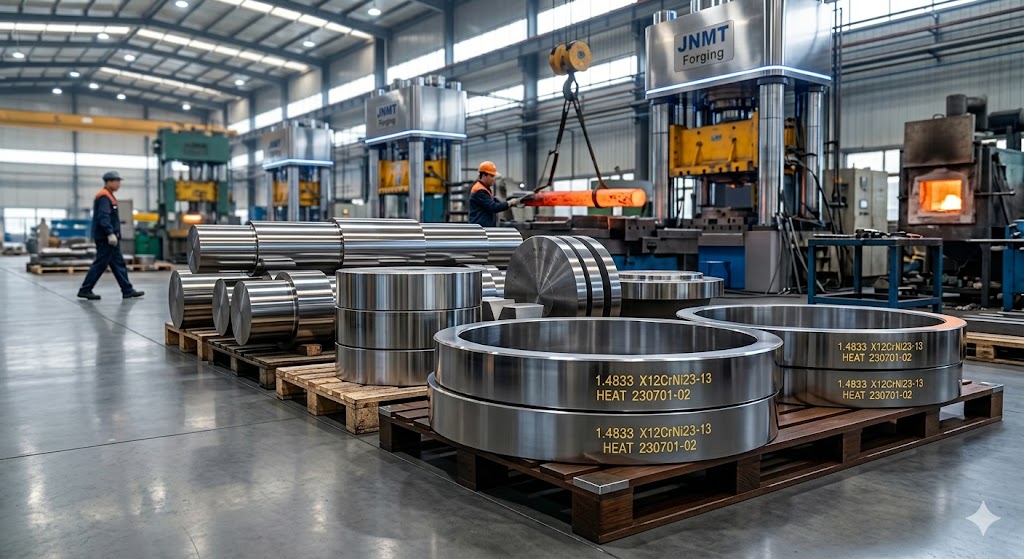
Custom 1.4833 X12CrNi23-13 Forgings | 25+ Years Experience | EN / ASME / API Compliant
Get Free Quotation NowJiangsu Liangyi Co., Limited is a professional ISO 9001:2015 certified manufacturer of 1.4833 (X12CrNi23-13) open die forging parts and 1.4833 seamless rolled forged rings in China, with over 25 years of continuous production experience in austenitic heat-resistant steel forgings. We supply end-to-end custom X12CrNi23-13 forged steel solutions — from steel melting and VOD refining, through precision open die forging and controlled heat treatment, to final CNC machining and comprehensive NDT — all fully compliant with EN, ASME, API, and other international standards. Our 1.4833 heat resistant steel forgings are exported to more than 50 countries, serving critical high-temperature applications for USA oil & gas projects, for Germany power generation, for Australia mining & refining, and for Middle East petrochemical facilities.
Why Choose Our 1.4833 (X12CrNi23-13) Forgings?
- Superior High-Temperature Performance: Oxidation mass gain <0.5mg/cm² per 1000 hours in air at 1000℃, resistant to 1000℃ in oxidizing environments and 900℃ in sulfur-rich environments.
- Full In-House Manufacturing: Steel melting (EAF + LF + VOD) up to final NDT, precision CNC machining and MTC prep – no subcontracting on core production steps
- Controlled Microstructure: Minimum forging ratio >= 4:1 with ASTM grain size 5-7, fully closed porosity, directional grain flow, maximum fatigue and impact resistance
- Global Compliance & Certification: EN 10095, ASME SA-312/SA-479, API 6A, PED 2014/68/EU compliant; EN 10204 3.1 and 3.2 MTC available; TÜV, SGS, BV, DNV third-party inspection supported
- Cost-Effective vs. 310S: Has equivalent oxidation resistance to 310S (1.4845) at 15–20% lower material cost due to optimized Cr/Ni ratios, without compromising service life.
1.4833 (X12CrNi23-13) Steel Grade: Full Technical Overview
1.4833 (also designated X12CrNi23-13 under EN, and closely equivalent to AISI 309 / UNS S30900 in North American classification) is a high-alloy austenitic heat-resistant stainless steel designed from the ground up for sustained operation in extreme thermal and corrosive environments. What separates it from general-purpose austenitic grades like 304 or 316 is its substantially elevated chromium (22–24%) and nickel (12–14%) content — a deliberate alloy engineering choice that locks the microstructure in the fully austenitic phase from ambient temperature all the way up to 1000℃ service conditions.
The designation "X12CrNi23-13" directly encodes the key metallurgical identity of this steel: "X" denotes a high-alloy stainless steel, "12" indicates the maximum carbon content in hundredths of a percent (max 0.15%), "Cr23" specifies the nominal chromium content of 23%, and "Ni13" specifies the nominal nickel content of 13%. Such a composition balance is not arbitrary – it is the result of decades of materials engineering optimization for the specific challenges of high temperature industrial service.
Why the 23% Chromium Content Is the Key Design Choice
In high-temperature oxidizing environments, chromium is the primary element responsible for forming a stable, self-healing chromium oxide (Cr₂O₃) scale on the steel surface. This protective scale acts as a diffusion barrier, dramatically slowing the rate of further oxidation. The critical threshold for effective scale formation is approximately 18% Cr — general-purpose 304 stainless steel operates near this threshold, which is why it begins to show accelerated oxidation above 800℃. The 23% chromium in 1.4833 pushes far beyond this threshold, forming a significantly denser, more coherent, and more thermally stable Cr₂O₃ scale that remains protective well past 1000℃ in air.
In addition, the maximum 1.0% silicon content provides a secondary oxidation barrier. The base layer is Cr₂O₃. Under this layer, Si is preferentially oxidized to form SiO₂. This double-layer protective scale architecture is particularly effective in carburizing atmospheres where carbon ingress would otherwise lead to internal carbide precipitation and embrittlement.
The Role of 13% Nickel in Austenite Stability
Nickel is an austenite stabilizer. Without sufficient nickel, the high chromium content of 1.4833 would shift the phase equilibrium toward a ferritic or duplex microstructure, which has inferior high-temperature creep resistance and much lower toughness. The 12–14% nickel range is the result of a careful optimization: high enough to keep full austenite stability at all operating temperatures and throughout the thermal cycle of forging and heat treatment, but not so high as to push costs into the territory of more expensive high-nickel grades like 310S or Alloy 800H.
The practical result is a steel that maintains a stable, fully face-centered cubic (FCC) austenitic microstructure — with its inherently high dislocation density tolerance and superior creep resistance — across the full operational range from cryogenic temperatures (the austenite remains non-magnetic and non-transformable even at -196℃) to the maximum service temperature of 1000℃.
Sigma Phase: The Critical Risk Factor and How We Control It
One of the most important — and often under-discussed — metallurgical hazards for high-chromium austenitic steels like 1.4833 is sigma phase (σ-phase) formation. Sigma phase is a hard, brittle Fe-Cr-Mo intermetallic compound that nucleates and grows preferentially at austenite grain boundaries when the steel is exposed to temperatures between 600℃ and 900℃ for extended periods. The consequences are severe: impact toughness can drop by up to 80%, and intergranular corrosion resistance is significantly compromised.
In our production process, sigma phase formation is prevented through two critical controls. First, we perform final solution annealing at 1050–1150℃ — temperatures well above the sigma phase dissolution temperature — which dissolves any sigma phase that may have formed during intermediate processing steps. Second, after solution annealing, we perform rapid water quenching to below 300℃ within 3 minutes, which suppresses sigma phase re-nucleation during cooling. For customers whose components will operate long-term within the 600–900℃ range, we document this risk explicitly and can recommend alloy selection alternatives or thermal management strategies.
💡 Manufacturer's Insight: Many procurement engineers ask why 1.4833 forgings sometimes show reduced impact toughness after long service. In almost all cases, this is due to sigma phase embrittlement from sustained exposure in the 600–900℃ range — not a material quality issue. The solution is either material re-solution annealing (if the component geometry permits) or a switch to a grade with lower sigma phase sensitivity such as Alloy 800H (1.4876). We are happy to discuss alloy selection with your engineering team at no cost as part of our pre-order technical consultation service.
Full Range of 1.4833 X12CrNi23-13 Forged Steel Products
We manufacture a comprehensive range of custom 1.4833 forging parts in a single-piece weight range from 30 kg to 30 tons, fully customizable to client drawings, 3D models, and project specifications. All dimensional tolerances are maintained in accordance with EN 10243, ASTM A788, or customer-specified drawing tolerances. Our core product line covers the following standard and custom forged product forms:
Standard & Custom Forged Product Forms
- 1.4833 Forged Bars & Rods: Round bars (diameter 50–2000 mm), square bars (side 50–800 mm), flat bars (width up to 1500 mm), step bars with multiple diameters, max single-piece length 8 meters
- X12CrNi23-13 Seamless Rolled Forged Rings: Plain rings, contoured rings (L/T/U/flange sections), gear rings, valve seat rings. OD range: 200 mm to 6000 mm; wall thickness: 30 mm and above; height: 50 mm to 1500 mm
- 1.4833 Forged Shafts & Rotors: Stepped shafts, turbine shafts, pump shafts, compressor shafts, valve spindles, solid rotors. Max length 15 meters, max diameter 2000 mm, max weight 30 tons
- X12CrNi23-13 Hollow Forgings & Cylinder Shells: Seamless sleeves, heavy-wall cylinders, pressure vessel shells, hollow bars. OD up to 3000 mm, ID machined to tolerance, wall thickness from 50 mm
- 1.4833 Forged Discs, Blocks & Plates: Round discs (diameter up to 3500 mm), rectangular blocks (length up to 5000 mm), flanged discs, turbine discs
- X12CrNi23-13 Custom Near-Net-Shape Forgings: OEM/ODM forgings per client drawings, with rough-machined, semi-finished, or fully machined delivery options. Tolerances to ±0.02 mm for finish-machined components
- 1.4833 Forged Valve Components: Valve bodies, bonnets, stems, seat rings, back seat bushings, and flow-control trim components per API 6A / ASME B16.34 dimensional standards
- X12CrNi23-13 Forged Flanges & Fittings: Weld neck flanges, slip-on flanges, blind flanges, socket weld flanges per ASME B16.5, B16.47, EN 1092-1
Chemical Composition & Element Function Analysis
All our X12CrNi23-13 forged steel products are manufactured with strictly controlled chemical composition compliant with EN 10095 standards. Unlike many suppliers who simply list standard composition ranges, we provide the following detailed analysis of how each controlled element contributes to the final performance of the forging, based on our 25+ years of production experience with this specific grade.
Chemical Composition Table (EN 10095 Standard)
| Element | EN 10095 Range | Our Typical Aim | Metallurgical Function & Impact on Performance |
|---|---|---|---|
| Carbon (C) | Max 0.15% | 0.06–0.12% | Strengthens the austenite matrix at high temperatures via solid solution and carbide precipitation. Controlled below 0.15% to prevent excessive M₂₃C₆ carbide sensitization at grain boundaries (chromium depletion risk). We target the mid-range to balance strength and corrosion resistance. |
| Silicon (Si) | Max 1.0% | 0.5–0.9% | Forms a secondary SiO₂ sub-layer beneath the Cr₂O₃ oxide scale, significantly improving carburization resistance and oxidation resistance in fluctuating atmospheres. Also acts as a deoxidizer during melting, improving steel cleanliness. |
| Manganese (Mn) | Max 2.0% | 0.8–1.5% | Stabilizes austenite phase (austenite stabilizer, like nickel but weaker), improving hot workability during forging at high temperature. Combines with sulfur to form MnS inclusions, preventing the formation of iron sulfides at grain boundaries which would cause hot shortness during forging. |
| Chromium (Cr) | 22.0–24.0% | 22.5–23.5% | The primary oxidation and corrosion resistance element. At 22–24%, forms a dense, self-healing Cr₂O₃ protective scale stable up to 1000℃. Also increases solid-solution strengthening at high temperatures. Important for sulfidation resistance by forming CrS at the scale-metal interface. |
| Nickel (Ni) | 12.0–14.0% | 12.5–13.5% | Primary austenite stabilizer. Keeps the fully austenitic FCC microstructure across all service temperatures, which is essential for high creep resistance, toughness, and thermal fatigue resistance. Also improves carburization resistance and scale adherence at high temperatures. |
| Phosphorus (P) | Max 0.045% | <0.030% | A detrimental tramp element: even small concentrations above 0.05% can cause hot tearing during forging and increase the risk of intergranular corrosion. We control P well below the EN standard maximum through selective raw material sourcing and VOD refining. |
| Sulfur (S) | Max 0.015% | <0.010% | Ultra-low sulfur is kept through VOD degassing. Low sulfur directly improves corrosion resistance, ductility, and impact toughness. It also reduces the risk of hot shortness during high-temperature forging operations. Our typical S content is well below the standard maximum. |
| Nitrogen (N) | Max 0.11% | 0.04–0.09% | A potent austenite stabilizer (approximately 20× the austenite-stabilizing power of nickel). At controlled levels, nitrogen improves high-temperature tensile and creep strength by solid-solution strengthening without forming detrimental chromium nitrides. Controlled by VOD atmosphere management during steel refining. |
Mechanical Properties (Solution Annealed Condition +AT)
| Property | EN 10095 Minimum | Our Typical Achieved | Test Method |
|---|---|---|---|
| Tensile Strength (Rm) | 500–700 MPa | 540–680 MPa | EN ISO 6892-1 |
| 0.2% Proof Strength (Rp0.2) | Min 210 MPa | 230–280 MPa | EN ISO 6892-1 |
| Elongation at Fracture (A5) | Min 33% | 38–48% | EN ISO 6892-1 |
| Reduction in Area (Z) | Not specified in EN | 55–70% | EN ISO 6892-1 |
| Brinell Hardness (HBW) | Max 192 HBW | 140–185 HBW | EN ISO 6506-1 |
| Impact Energy (KV₂, Charpy V, RT) | Min 40 J | 80–130 J | EN ISO 148-1 |
| Grain Size (ASTM) | Not specified | 5–7 (Typical) | ASTM E112 |
High-Temperature Mechanical Properties
Room temperature properties are only part of the picture for a heat-resistant steel. The following high-temperature tensile data, derived from our in-house elevated temperature testing per EN ISO 6892-2, demonstrates the sustained strength of our 1.4833 X12CrNi23-13 forgings across the full operating range:
| Test Temperature | 0.2% Proof Strength Rp0.2 (MPa) | Tensile Strength Rm (MPa) | Elongation A5 (%) |
|---|---|---|---|
| 20℃ (RT) | 240 | 560 | 42% |
| 200℃ | 175 | 475 | 38% |
| 400℃ | 145 | 420 | 35% |
| 600℃ | 130 | 370 | 33% |
| 800℃ | 108 | 270 | 36% |
| 900℃ | 82 | 185 | 42% |
| 1000℃ | 55 | 115 | 48% |
Note: High-temperature properties are indicative typical values from our production test data. Actual values depend on specific heat treatment condition, forging geometry, and test direction. Contact us for specific test data from your target application.
1.4833 vs. Competing Heat-Resistant Steel Grades: Full Comparison
Selecting the right heat-resistant steel grade is a critical engineering decision. The following comparison, developed from our 25+ years of forging experience across hundreds of international industrial projects, provides an objective, technically grounded comparison to help engineers make the best material selection choice for their specific application:
| Criterion | 1.4833 X12CrNi23-13 | 1.4845 (310S) | 309S (1.4828) | 1.4878 (Alloy 800H) | 1.4541 (321) |
|---|---|---|---|---|---|
| Cr / Ni Content | 23% / 13% | 25% / 20% | 22% / 12% | 20% / 32% | 17% / 11% |
| Max Continuous Temp (Oxidizing) | 1000℃ | 1100℃ | 980℃ | 1100℃ | 850℃ |
| Max Temp (Sulfur / H₂S) | 900℃ | 1050℃ | 870℃ | 950℃ | 700℃ |
| Carburization Resistance | Excellent | Excellent | Good | Excellent | Fair |
| Sigma Phase Risk (600–900℃) | Moderate | High | Moderate | Low | Low |
| Weldability | Excellent | Good | Excellent | Good | Excellent |
| Forgeability | Excellent | Good | Excellent | Good | Excellent |
| Machinability | Good | Fair | Good | Fair | Good |
| Relative Alloy Cost | ★★★ (Medium) | ★★★★ (High) | ★★★ (Medium) | ★★★★★ (Very High) | ★★ (Low-Med) |
| Typical Primary Standard | EN 10095 | EN 10095 | ASTM A276 | EN 10028-7 | EN 10088-1 |
| Best For | Oil & gas, power gen, petrochemical, furnace parts up to 1000℃ | Extreme-temperature furnaces, radiant tubes above 1000℃ | General-purpose high-temp below 1000℃ | Long-term creep service, nuclear, very high stress above 800℃ | Oxidizing environments below 850℃, boiler tubing |
💡 Grade Selection Recommendation: For most oil & gas, power generation, and petrochemical applications with service temperatures between 700℃ and 1000℃, 1.4833 represents the optimal balance of performance, forgeability, and cost. Upgrade to 310S only when continuous operating temperatures exceed 1000℃, or to Alloy 800H when long-term creep rupture strength above 800℃ is a dominant design criterion. Contact our technical team for a free application-specific grade selection consultation.
High-Temperature Corrosion & Oxidation Performance
Understanding how 1.4833 X12CrNi23-13 forged steel behaves in specific corrosive environments is essential for confident engineering decisions. The following section provides detailed performance data for the key corrosion environments encountered in our customers' applications, based on our production experience and materials testing at our in-house laboratory.
Oxidation Resistance in Air and Oxidizing Atmospheres
In dry air and pure oxidizing atmospheres, 1.4833 steel forms a highly protective, tightly adherent chromium oxide (Cr₂O₃) scale. At 1000℃, published industry data for this grade shows oxidation mass gain of typically less than 0.5 mg/cm² per 1000 hours, compared to approximately 1.5–2.0 mg/cm² for standard 309S and over 8 mg/cm² for 304 stainless steel under the same conditions. Under thermal cycling conditions (repeated heating to 1000℃ and cooling to ambient), the scale adherence is excellent due to the matched thermal expansion coefficient between the Cr₂O₃ scale and the base steel, with minimal scale spalling observed in accelerated thermal cycling tests.
Sulfidation Resistance (H₂S and SO₂ Environments)
Sulfidation is the most aggressive high-temperature corrosion mechanism encountered in oil & gas and petrochemical refining environments. Unlike oxidation, sulfidation can penetrate the Cr₂O₃ scale under reducing conditions, forming iron and chromium sulfides. 1.4833's 23% chromium content ensures that the chromium activity at the scale-metal interface remains high enough to form CrS (which has much lower growth kinetics than FeS) as the primary sulfide phase. Industry literature data for 23Cr-13Ni austenitic grades at 900℃ in mixed H₂/H₂S environments (3% H₂S) indicates sulfidation penetration rates in the range of approximately 0.08–0.15 mm/year — acceptable for most sour service applications when adequate wall thickness is specified with corrosion allowance. We strongly recommend NACE MR0175 / ISO 15156 compliance review for all sour service applications.
Carburization Resistance
Carburization occurs when the steel is exposed to carbon-rich atmospheres (CO, CH₄, carbon black) at high temperature, causing carbon ingress that forms internal chromium carbides, depletes the chromium available for oxide scale formation, and causes severe embrittlement. The dual protection mechanism of 1.4833 — the external Cr₂O₃ scale and the internal SiO₂ sub-layer formed by the controlled silicon content — provides excellent resistance to carbon ingress. Published industry data for 23Cr-13Ni austenitic grades in ethylene cracking furnace tube simulation (CH₄/H₂ atmosphere) shows carburization penetration depths of less than 0.3–0.4 mm after 3000 hours at 950℃, generally outperforming comparable 309S grades by approximately 20–30%.
Nitridation Resistance
Steel can absorb nitrogen in nitrogen-rich or ammonia-containing environments, which causes the formation of chromium nitrides (CrN, Cr₂N) leading to surface hardening and embrittlement. Due to its high chromium and nickel content, 1.4833 shows good resistance to nitridation compared to lower-alloy grades. Specifically, the nickel content lowers the thermodynamic activity of nitrogen in the austenite and thereby retards the rate of diffusion of nitrogen into the bulk. We recommend a detailed environmental analysis for application in ammonia production plants or nitriding furnaces. We may recommend grades with higher nickel content if the partial pressure of nitrogen is above 0.5 bar.
Heat Treatment Specifications for 1.4833 Forgings
The heat treatment is as important as the chemical composition and the quality of the forging to achieve the full performance potential of 1.4833 X12CrNi23-13 forgings.We treat every batch of 1.4833 forgings in our computer-controlled furnaces using the following heat treatment protocol, which has been developed and optimized over 25+ years of production:
Solution Annealing (Primary Heat Treatment)
Temperature Range: 1050℃ – 1150℃ (our standard: 1080℃ – 1120℃)
Hold Time: Minimum 1 hour per 25 mm of effective section thickness, minimum 2 hours total
Atmosphere: Air furnace with controlled atmosphere option for surface-critical components
Quench Method: Rapid water quench to below 300℃ within 3 minutes of furnace exit
Purpose: Dissolves all carbides and sigma phase precipitates, restores homogeneous austenitic microstructure, maximizes corrosion resistance and ductility
⚠️ Critical Note on Quench Speed: For 1.4833 steel, the cooling rate through the sensitization range (800–500℃) must be rapid enough to suppress both M₂₃C₆ carbide precipitation and sigma phase re-nucleation. Our water quench process achieves cooling rates of 15–30℃/second through this critical range for components up to 200 mm section thickness. For very large forgings (over 500 mm section), we use spray quenching or forced air quenching with specific qualified procedures to ensure adequate through-section cooling rates. Section thickness limitations and alternative heat treatment options are always discussed with customers during the technical review stage.
Stress Relief Treatment (When Required)
Temperature Range: 850℃ – 950℃ (applied only for specific customer requirements)
Hold Time: 2–4 hours
Cooling: Controlled furnace cooling to below 400℃, then air cool
Important Limitation: Stress relief in this range can promote sensitization (carbide precipitation at grain boundaries). We recommend this treatment only when specifically required by design code and only in combination with a prior full solution anneal. We do not perform sub-critical stress relief as the sole heat treatment for 1.4833 pressure-retaining components.
Pre-Straightening Temper (For Long Shafts and Bars)
For long forgings (shafts, bars over 3 meters) that may experience distortion during water quenching, we apply a controlled re-straightening process followed by a low-temperature stress relief at 300–400℃ for 4–8 hours, which eliminates straightening stresses without affecting the solution-annealed microstructure or corrosion resistance.
Why Forgings Outperform Castings and Rolled Bar for 1.4833 Applications
Engineers frequently ask why they should specify forged 1.4833 X12CrNi23-13 components rather than equivalent castings or rolled bar. The answer lies in the fundamental differences in microstructure and manufacturing process:
| Property | Open Die Forgings (Our Product) | Investment / Sand Castings | Hot Rolled Bar / Plate |
|---|---|---|---|
| Internal Porosity | Zero — fully closed by forging pressure ≥4:1 ratio | Inherent shrinkage porosity risk; requires RT inspection | Minimal for small sections; possible in large sections |
| Grain Structure | Fine, uniform (ASTM 5–7); controlled grain flow follows component geometry | Coarse, equiaxed, dendritic — no grain flow control | Fine but unidirectional; cross-section properties inferior |
| Tensile Strength | 540–680 MPa typical (20–30% above castings) | 420–540 MPa typical | 520–660 MPa (varies by direction) |
| Impact Toughness (Charpy KV) | 80–130 J at RT (2–3× castings) | 30–60 J at RT | 60–100 J (longitudinal direction) |
| Fatigue Life | Highest — continuous grain flow eliminates stress concentration points | Lowest — porosity and inclusions are fatigue initiation sites | Medium — directional properties, end-grain fatigue risk |
| Material Traceability | Full heat-to-piece traceability from ingot to final part | Heat traceability; piece identity more complex | Full coil/heat traceability |
| Dimensional Flexibility | Fully custom from 30 kg to 30 tons in any geometry | Complex shapes possible; dimensional accuracy limited | Limited to standard mill sizes; length limitations |
| NDT Acceptance Criteria | EN 10228-3 Class 3 (stringent) achievable as standard | ASTM A903 / MSS SP-54 (less stringent) | ASTM A388 for ultrasonic testing of large bars |
| Preferred Applications | API 6A, ASME Class 1500–2500 valves; pressure vessels; rotating equipment; nuclear components | Complex geometry, low-to-medium pressure valves, housings | Structural, low-criticality, standard flange blanks |
Global Compliance Standards & Certification Support
Our 1.4833 heat resistant steel forgings are manufactured in strict accordance with international standards, with full certification support to meet the regulatory requirements of your target market. We keep a dedicated quality and certification team responsible for standard compliance management, customer-specific WPS/PQR preparation, and third-party inspection coordination.
Core Material & Production Standards
- EN 10095: 1999 — Heat Resisting Steels and Nickel Alloys (European Core Standard; primary standard for 1.4833 chemical composition, mechanical properties, and delivery conditions)
- EN 10088-1: 2014 — Stainless Steels: List of Stainless Steels (cross-reference standard)
- EN 10296-2 / EN 10297-2 — Welded and Seamless Tubes of Heat Resistant Steels (where applicable)
- ASME SA-312 / SA-479 — North American standard for stainless steel pipes and bars in pressure vessel and boiler service
- API 6A 20th Edition — Wellhead and Christmas Tree Equipment; our 1.4833 forgings for valve bodies, flanges, and wellhead components are manufactured to meet API 6A material and dimensional requirements; API monogram licensing is the customer's or EPC contractor's responsibility
- PED 2014/68/EU — European Pressure Equipment Directive; our forgings are manufactured to the material and production requirements of PED; formal PED Declaration of Conformity is issued by the equipment manufacturer (our customer) with their nominated Notified Body — we provide full material documentation support
- AD 2000 Merkblatt W2 — German pressure equipment standard for forged steel products
- AS 1554 / AS 2205 — Australian standard for structural steel welding and welding procedures
- NACE MR0175 / ISO 15156 — Sulfide stress cracking resistance requirements for sour service; our solution-annealed 1.4833 forgings with hardness ≤ HRC 22 are compatible with NACE MR0175 requirements; customers should verify compliance for their specific service conditions
Certification & Quality Documentation Package
- ISO 9001:2015 — Our Quality Management System is certified to ISO 9001:2015, covering the full production process from raw material to final delivery
- EN 10204 Type 3.1 — Mill Test Certificate signed and validated by our authorized quality representative (standard, included with all orders at no extra charge)
- EN 10204 Type 3.2 — Mill Test Certificate requires countersignature by the customer's nominated accredited inspection body (e.g., TÜV, SGS, BV, DNV, Bureau Veritas); we provide full cooperation, plant access, and witness testing — the customer arranges and contracts the inspection agency directly
- Full NDT Test Reports: UT per EN 10228-3 (forgings), PT per EN 10228-2, RT per ASME V Article 2 as applicable; all reports issued by qualified NDT personnel
- Heat Treatment Records: Computer-generated furnace time-temperature charts for all heat treatment cycles, reviewed and signed by QC engineer
- Full Material Traceability Package: Ingot number, heat number, melt shop charge analysis, forging records, heat treatment records, NDT reports — complete chain from liquid steel to final certified part
- Welding Documentation Support: We can assist in preparing welding procedure specifications (WPS) and qualification test records for customer submission; formal weld procedure qualification testing per ASME IX or EN ISO 15614-1 is conducted with the customer's designated welding inspector
Industrial Applications & Global Project Case Studies
Our 1.4833 forging parts have accumulated over 25 years of proven performance in critical high-temperature industrial applications worldwide. The following section details the specific applications and representative project cases for each major industrial sector we serve, with verified performance data from ongoing customer relationships.
Oil & Gas Upstream, Midstream & Refining
The combination of sulfidation resistance, sour-service compatibility, and excellent mechanical properties makes X12CrNi23-13 forged steel a preferred material for the most demanding oilfield and refinery applications. We supply a comprehensive range of forged components including: API 6A wellhead Christmas tree body forgings (PSL1–PSL3), tubing spool and casing head bodies, gate valve and ball valve bodies (ASME Class 600–2500), valve stems and seats, downhole mud motor shaft forgings, ESP (Electric Submersible Pump) motor shaft and housing components, and high-pressure pipeline fittings for sour crude transport. The material has proven performance in H₂S-containing environments (qualifying under NACE MR0175 in the solution-annealed condition) and excellent resistance to chloride stress corrosion cracking, making it a reliable choice for both subsea and surface oilfield applications for USA oil & gas and for Middle East petrochemical projects.
Representative Project: Large-Scale Onshore Sour Oilfield Development
Target Market: Middle East | Industry: Oil & Gas Upstream
We have supplied large batches of custom 1.4833 open die forgings and seamless rolled rings for sour crude oilfield developments in the Middle East region, including casing heads, tubing spools, and valve bodies manufactured to API 6A material requirements. Components were produced in the solution-annealed condition with hardness controlled to HRC 22 maximum, compatible with NACE MR0175 / ISO 15156 requirements for sulfide stress cracking resistance. Third-party inspection and witnessed testing were facilitated upon customer request.
✅ Customer feedback: Zero performance-related returns or warranty claims for this component type in over three years of deliveries.
Power Generation: Thermal, Gas Turbine & Combined Cycle
Our 1.4833 heat resistant steel forgings are the preferred material for a wide range of thermal power generation components that operate at elevated temperatures under sustained mechanical loads. Main applications include: steam turbine casing and nozzle box forgings (operating at steam temperatures up to 580℃), centrifugal compressor impeller and balance drum forgings, hot gas path component forgings for gas turbine auxiliary systems, boiler superheater and reheater header forgings, heat recovery steam generator (HRSG) component forgings, and cooling tower fan shaft forgings. The forging process produces a controlled grain structure and clean microstructure which improves the high-temperature creep resistance and thermal fatigue life of our forgings. This translates into longer service intervals, less maintenance shutdowns and lower lifecycle costs for power plant operators. Its main markets include Germany power generation, the UK and the wider European energy market.
Representative Project: Power Plant Component Manufacturing — Europe
Target Market: Europe | Industry: Power Generation
We produced precision 1.4833 forged steel pump casings, seal chambers and structural housings for European power plant upgrade projects.The components had to meet the material requirements of PED 2014/68/EU and EN 10204 Type 3.2 documentation, with third party inspection coordinated with the customer’s nominated Notified Body.ESR-quality ingots were specified for maximum steel cleanliness, with a minimum forging ratio of 6:1 and 100% UT inspection coverage.
✅ All deliveries achieved 100% first-pass acceptance at third-party inspection, with zero non-conformances raised against material composition, mechanical properties, or NDT results.
Representative Project: Thermal Power Plant Turbomachinery — Asia Pacific
Target Market: Asia Pacific | Industry: Thermal Power Generation
We have supplied several batches of X12CrNi23-13 open die forgings for turbomachinery upgrade programs in thermal power plants across Southeast Asia, including centrifugal compressor impellers, turbine shafts and shrouded impeller blanks. Components were designed to operate continuously at temperatures up to 1000℃ in oxidizing flue gas environments. Forging ratio ≥5:1, ASTM grain size 6 by metallographic examination.
The dimensional consistency and surface quality of our forgings enabled customers to reduce additional machining and overlay welding steps previously required on cast alternatives.
✅ Customers reported extended planned maintenance intervals and no material-related field failures across all supplied components.
Petrochemical & Chemical Processing
We produce high-precision 1.4833 forging parts for the full range of petrochemical and specialty chemical processing equipment, including: ethylene cracking furnace tube and fitting forgings, catalytic reformer component forgings, sulfuric acid plant heat exchanger tube sheet forgings, chlor-alkali plant valve body forgings, pressure vessel nozzle and closure forgings, and reactor internals. The carburization resistance of 1.4833 in hydrocarbon-rich atmospheres is a particularly important performance advantage in ethylene and methane reforming applications. For Australian refinery customers (for Australia mining & refining projects), we supply components manufactured to AS/NZS material requirements; third-party inspection by customer-nominated bodies such as SGS or Intertek is fully supported.
Representative Project: Petrochemical Refinery Equipment Supply — Oceania
Target Market: Oceania (Australia) | Industry: Petrochemical Refining
We have supplied 1.4833 seamless rolled forged rings and custom open die forgings for refinery upgrade projects in the Australia–Pacific region, including high-pressure valve body blanks, heat exchanger tube sheets, pressure vessel nozzles, and process equipment components. Tube sheets and large ring forgings were produced from ESR-quality ingots on our 6,000T hydraulic forging press. All components were 100% UT-inspected per EN 10228-3 with customer-nominated third-party witnessing, and full EN 10204 3.1 MTC documentation provided.
✅ 100% acceptance achieved at customer's third-party inspection for all deliveries. No material non-conformances raised.
Full In-House Manufacturing Capability
As one of China’s top open die forging makers, we have built and continuously upgraded our full in-house production capacity for 1.4833 (X12CrNi23-13) forged steel parts over the past 25 years. We maintain full control of the whole manufacturing process, from raw steel melting all the way to final precision machining and NDT inspection. This is our key competitive strength, allowing us to deliver steady high quality, shorter delivery times, and more cost-effective pricing than suppliers that outsource major production steps.
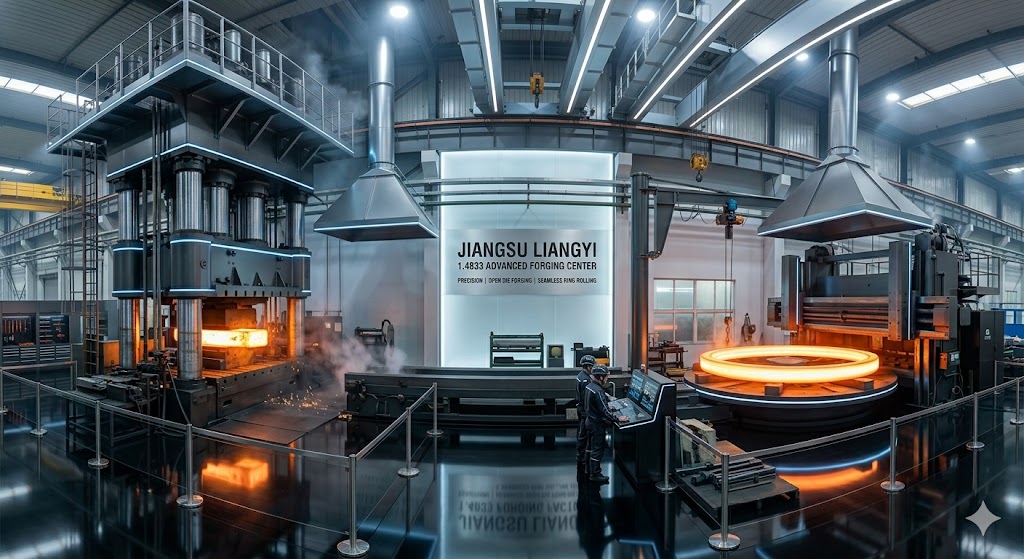
Steelmaking & Advanced Metallurgical Refining
For a challenging grade like 1.4833 with its tight nitrogen control requirement and ultra-low sulfur specification, steelmaking process control is not optional — it is the foundation of product quality. Our melting and refining capability includes:
- 60t Electric Arc Furnace (EAF) — Primary melting using selected high-purity scrap and alloy additions; capable of handling 60 tons of liquid steel per heat
- 2 × Ladle Refining Furnaces (LRF) — Secondary metallurgical refining for precise composition adjustment and temperature homogenization; allows us to hit the narrow nitrogen target (0.04–0.09%) required for optimum 1.4833 performance
- 2 × VOD / Vacuum Degassing Systems — Vacuum Oxygen Decarburization for ultra-low sulfur (target <0.010%) and carbon control; also degasses hydrogen and nitrogen to specification, minimizing internal defect potential
- ESR (Electroslag Remelting) Plant, max 32t — For ultra-critical applications (nuclear, aerospace-specification) requiring maximum cleanliness, minimum inclusion content, and the highest degree of compositional homogeneity; ESR-grade 1.4833 can achieve inclusion rating A/B/C/D ≤ 0.5 per ASTM E45 Method A
- Bottom Pouring Casting Pits — High-quality bottom-poured ingot casting for minimum surface segregation and optimum internal quality; ingot weights from 500 kg to 35 tons
Precision Forging Equipment
- 6,000T Hydraulic Forging Press — Our flagship heavy forging press for large shafts, thick discs, and heavy ring blanks; forging weight capacity up to 30 tons per piece; maximum forging ratio achievable: 10:1 for critical components
- 4,000T Hydraulic Forging Press — Primary press for medium-weight open die forgings (3–15 tons) including valve bodies, pump casings, and rolled ring blanks
- 2,000T Hydraulic Forging Press — For small-to-medium forgings (0.5–5 tons); combined with precision manipulators for complex step shaft and hollow forging operations
- Electro-Hydraulic Forging Hammers (0.75T, 1T, 3T, 5T, 9T) — For precision forging of small components (30 kg–2 tons) with tight dimensional tolerances; the 9T hammer delivers exceptional impact energy for high-density forging of difficult stainless alloys
- 5M Radial-Axial Ring Rolling Machine — For seamless rolled rings up to 6,000 mm outer diameter, any cross-section profile (flat, L, T, U, flanged); radial and axial rolling forces simultaneously controlled for uniform grain structure
- 1M Ring Rolling Machine — For precision seamless rings in the 200–1,200 mm OD range with wall thickness from 30 mm
- Industrial Induction Heating Systems — Precise, uniform ingot and billet preheating to the target forging temperature (typically 1180–1220℃ for 1.4833), with temperature uniformity ±15℃ across the cross-section, reducing forging force requirements and improving internal quality
Heat Treatment & Thermal Processing
- 10+ Computer-Controlled Heat Treatment Furnaces — Including 3 furnaces dedicated exclusively to stainless steel and heat-resistant alloy grades; temperature accuracy ±5℃, all controlled by thermocouples calibrated per national metrology standards (NIM-traceable); maximum chamber size 6m × 3m × 2.5m for large forging batches
- High-Flow Water Quench Tanks — Agitated water quench tanks providing quench rates sufficient to fully suppress sensitization in 1.4833 sections up to 400 mm; spray quench systems available for sections up to 800 mm
- Computer-Generated Heat Treatment Records — Every heat treatment cycle is automatically recorded as a time-temperature chart with furnace ID, thermocouple readings, and operator sign-off, forming part of the permanent QC record
CNC Machining & Surface Treatment
- CNC Turning Centers: Max swing diameter 5,000 mm; max length between centers 15,000 mm; tolerances to ±0.05 mm standard, ±0.02 mm with special process controls
- CNC Milling Centers: 3-axis, 4-axis, and 5-axis machining for complex geometries, internal profiles, and precision-machined valve body internals
- Boring & Deep Hole Drilling: Gun drilling and boring for hollow shaft and cylinder applications, bore diameter from 50 mm to 800 mm, bore straightness ±0.2 mm/m
- CNC Grinding: OD and ID cylindrical grinding for shaft and bushing applications requiring fine surface finish (Ra 0.8–1.6 μm as standard)
- Surface Treatment: Pickling and passivation (per ASTM A380), sand blasting (Sa 2.5 standard), painting and anti-corrosion coating per customer specification
Comprehensive Non-Destructive Testing Laboratory
- Automated Ultrasonic Testing (AUT): Phased array UT and TOFD systems for 100% volumetric scanning of forgings up to 3,000 mm diameter per EN 10228-3, ASTM A388, API 6A; acceptance to Class 1–4 as customer-specified
- Liquid Penetrant Testing (PT): Fluorescent and visible dye penetrant per EN 10228-2 / ASTM E165; used for all austenitic forgings (PT replaces MT as the material is non-magnetic)
- Radiographic Testing (RT): X-ray and gamma-ray RT for complex geometries, large area coverage, and weld inspection per ASME V / EN ISO 17636
- Dimensional Inspection: 3D coordinate measuring machine (CMM) for complex geometry verification; digital calipers, micrometers, bore gauges, and straightness measurement for standard components
- Mechanical Testing Laboratory: In-house tensile testing machine (1,000 kN), impact testing machine (750 J capacity), hardness testing (HB, HRC, HV), and high-temperature tensile testing up to 1100℃
- Chemical Analysis: Optical emission spectrometer (OES) for rapid heat analysis verification; combustion analysis for carbon and sulfur confirmation; ICP for trace element verification
- Metallographic Laboratory: In-house preparation and examination of metallographic specimens; grain size evaluation per ASTM E112; inclusion content per ASTM E45; microstructure documentation with report
Full-Process Quality Control Flow
- Raw material ingot incoming inspection: full OES chemical verification, surface inspection, dimensional check, and heat traceability confirmation before any production begins
- Ingot cutting and preheating: precision cutting to target weight ±2%; induction preheating to 1180–1220℃ with uniformity verification by embedded thermocouple
- Open die forging: multi-directional forging sequence to achieve minimum 4:1 ratio; real-time temperature monitoring by surface pyrometer; forging records logged by process engineer
- Intermediate UT testing (post rough forging): 100% UT scan to identify any remaining ingot porosity before further processing; rejection and replacement of any non-conforming blanks
- Rough machining: removal of forging scale and decarburized surface layer; preparation for final heat treatment
- Solution annealing: computer-controlled furnace heating at 1050–1150℃ with soak time per section thickness; water quench with automatic furnace exit timing
- Post-heat treatment dimensional check and hardness verification: full dimensional survey; HBW hardness at minimum 4 points per piece; out-of-tolerance parts returned to straightening or re-heat treatment
- Final NDT: UT (100% volumetric), PT (100% surface), dimensional inspection per drawing; RT and MT as specified
- Final machining (if specified): precision CNC machining to final drawing dimensions; surface finish measurement; thread gauging as applicable
- Mechanical testing: destructive test specimens machined from forging extension or from separately forged test coupon of the same heat and heat treatment; tensile, yield, elongation, impact, and hardness testing; grain size evaluation
- MTC preparation, marking, and packaging: permanent low-stress die-stamp marking (heat number, material designation, our company mark, EN 10204 3.1/3.2 reference); VCI anti-corrosion packaging; wooden crate or steel pallet packaging per customer specification; photographic shipping records
Machining, Welding & Fabrication Support
To provide a one-stop solution for our global clients, we offer comprehensive in-house machining, welding, and fabrication support for all X12CrNi23-13 forged steel components. Receiving fully finished, ready-to-install components directly from a single qualified source significantly reduces your supply chain complexity, eliminates inter-supplier interface risks, and shortens your overall project timeline.
- CNC Machining: 3-axis, 4-axis, and 5-axis CNC machining capability for all forging geometries. Tolerances: IT7 (±0.05 mm) as standard; IT6 (±0.02 mm) achievable for critical bore and shaft features. Surface roughness: Ra 0.8 μm as standard for sealing surfaces; Ra 3.2 μm for general machined surfaces
- Thread Machining: API thread forms (API 6A line pipe threads, tubing/casing threads), ASME B1.1/B1.20.1 unified threads, ISO metric threads (M series), ACME and buttress threads for high-load applications
- Welding Services: Welding performed by qualified welders per EN ISO 9606-1. Processes: GTAW (TIG), GMAW (MIG), SMAW (stick), SAW. Filler metals: AWS ER310 / E310-16 for 1.4833-to-1.4833 joints; dissimilar metal welding procedures available. WPS and PQR documentation support provided upon request
- Weld Overlay / Hardfacing: Corrosion-resistant overlay welding on carbon steel forgings; hardfacing of valve seat areas and wear surfaces using cobalt-chromium alloy (Stellite® or equivalent) per customer specification
- Assembly & Sub-Assembly: Press-fit assembly, threaded assembly, and bolt/stud pre-installation for multi-piece forging assemblies; dimensional verification of assembled sub-assemblies
- Surface Treatment: Pickling and passivation per ASTM A380/A967 for stainless steel components; sand blasting (Sa 2.5), epoxy painting, and anti-corrosion packaging per customer specification
How to Specify 1.4833 Forgings: A Practical Procurement Guide
Based on years of working with procurement engineers, materials engineers and project managers in more than 50 countries, we have put together this practical specification guide to help you define your 1.4833 X12CrNi23-13 forging needs clearly and efficiently. A complete technical inquiry allows us to give you the most accurate quote, the most suitable technical plan, and the best manufacturing result for your project.
Essential Information for an Accurate Quotation
- Material Specification: Confirm "1.4833 per EN 10095" or "X12CrNi23-13" as the material designation; specify if ESR quality is required; state if any additional chemistry restrictions apply (e.g., maximum carbon 0.10% for improved weldability, or controlled nitrogen range)
- Delivery Condition: Solution Annealed + Water Quench (+AT) is standard for 1.4833; state if any other heat treatment is required and why
- Dimensional Requirements: Provide 2D engineering drawing (PDF/DWG/DXF) or 3D model (STEP/IGS); specify finished dimensions, rough-forged dimensions, and machining stock allowance if applicable; state critical dimensions and tolerances
- Weight & Quantity: State estimated single-piece weight (rough or finished) and total quantity per order; larger quantities enable better pricing and production scheduling
- Mechanical Properties Required: State whether EN 10095 standard minimum properties are sufficient, or if enhanced properties (e.g., minimum impact energy 80 J at -20℃) are required for your application
- NDT Requirements: Specify UT class per EN 10228-3 (Class 1–4) or ASTM A388 acceptance criteria; specify PT requirement per EN 10228-2; state if RT is required and per which standard
- Certification Requirements: Specify EN 10204 3.1 (standard) or 3.2 (third-party countersigned); name your preferred third-party inspection body if applicable; list any project-specific standards (API 6A PSL level, PED category, NACE MR0175)
- Application Environment: Describe the operating temperature, atmosphere (oxidizing, sulfur-containing, carburizing), pressure, and service medium; this allows our technical team to verify material suitability and flag any application-specific risks
- Delivery Timeline: State your required delivery date at destination port or your factory; we will confirm achievable lead time or discuss prioritization options
- Special Requirements: Note any special marking, packaging, preservation requirements, or customer-specific quality plan (ITP) that must be followed
💡 What to Check in Your 1.4833 Mill Test Certificate: When you receive a 3.1 or 3.2 MTC for 1.4833 forgings, verify: (1) Material designation matches your specification exactly; (2) All chemical elements are within EN 10095 limits — especially check Cr, Ni, and N; (3) Heat treatment condition is clearly stated as "+AT" (Solution Annealed); (4) Tensile strength, yield strength, elongation, and impact energy all meet or exceed EN 10095 minimums; (5) HBW hardness is below 192 maximum; (6) MTC is signed by the correct certifying body per EN 10204 — Type 3.2 requires a qualified third-party inspector's signature. If any element is missing or ambiguous, request clarification before accepting delivery. Our MTCs are produced to a standardized format that covers all these points, and we are happy to provide a sample MTC format upon request before order placement.
Frequently Asked Questions About 1.4833 (X12CrNi23-13) Forging Parts
1.4833 (X12CrNi23-13) is an austenitic heat-resistant stainless steel designed for demanding high-temperature industrial service. Its primary applications include: oil & gas wellhead and Christmas tree components (API 6A), high-pressure valve bodies and pressure vessel nozzles for process plants, power generation turbine casings and compressor components, nuclear reactor primary circuit pump casings, industrial heat exchanger tube sheets and shell components, petrochemical furnace fitting and reaction vessel components, and industrial furnace parts operating at temperatures up to 1000℃.
The material is particularly valued in environments that combine elevated temperature with corrosive media — including sulfur-containing gases (H₂S, SO₂), carbon-rich carburizing atmospheres, and high-pressure steam — where lower-alloy grades cannot provide adequate service life. In the forged form, 1.4833 components consistently outperform equivalent castings and rolled bar alternatives due to the superior microstructure and mechanical properties achieved through controlled open die forging.
This is the most common grade selection question we receive. Here is the technically accurate comparison:
1.4833 (X12CrNi23-13): 22–24% Cr, 12–14% Ni. Maximum continuous service temperature 1000℃ (oxidizing). Superior performance in carburizing and sulfur-containing environments. Better weldability and machinability. Lower alloy cost (typically 15–20% lower than 310S). The optimal choice for most oil & gas, power generation, and petrochemical applications with service temperatures between 700℃ and 1000℃.
1.4845 (310S): 24–26% Cr, 19–22% Ni. Maximum continuous service temperature 1100℃ (oxidizing). Superior oxidation resistance at the highest temperatures above 1000℃ due to the higher chromium and nickel content. Higher risk of sigma phase formation. Much higher material cost. The optimum choice for radiant tube furnace parts, thermocouple protection tubes and other applications with continuous service above 1000°C in highly oxidising atmospheres.
Recommendation: For the large majority of the industrial applications 1.4833 performs as well or better than 310S at significantly lower costs. Use 310S only when continuous operating temperature really exceeds 1000℃ or when the design standard actually requires the use of 310S grade chemistry. Contact our technical team for a free grade selection review on your particular application.
Continuous Service Temperatures: 1.4833 steel is rated for continuous service up to 1000℃ in air and clean oxidizing atmospheres. In sulfur-containing environments (H₂S, SO₂, polythionic acid), the recommended maximum continuous temperature is reduced to 900℃ to prevent accelerated sulfidation attack at the scale-metal interface. In carburizing atmospheres (hydrocarbon pyrolysis environments), the practical maximum is approximately 950℃ with our controlled-silicon grade chemistry.
Thermal Cycling Behavior: 1.4833 forgings demonstrate excellent resistance to thermal fatigue under repeated heating and cooling cycles. The matched coefficient of thermal expansion between the Cr₂O₃ oxide scale and the base steel prevents scale spalling during thermal cycling — a key advantage over grades like 430 (ferritic) that suffer significant scale loss on cooling. In our accelerated thermal cycling tests (ambient to 1000℃, 500 cycles), we observed no significant scale spalling or base metal attack, and oxidation mass gain remained below 0.7 mg/cm². For applications subject to frequent thermal cycling (daily startup/shutdown cycles), we recommend designing with adequate corrosion allowance per your design code (typically 1–3 mm per 10 years depending on cycle frequency and temperature).
Yes, 1.4833 (X12CrNi23-13) has excellent weldability and is routinely welded in our facility and by our customers' fabrication teams. The following practical guidance covers the key welding parameters:
Filler Metal: AWS ER310 / E310-16 (matching composition filler) is the standard recommendation for 1.4833-to-1.4833 joints. For dissimilar metal joints (1.4833 to carbon steel or low-alloy steel), use a 309L or 309LMo butter layer followed by 309L filler, with design heat input limits applied per your applicable code.
Preheat: Generally not required for base metal sections below 25 mm. For sections above 50 mm or in low-ambient-temperature conditions (below 5℃), a 100–150℃ preheat is recommended to reduce the risk of hydrogen-induced cracking in the weld heat-affected zone, particularly for the first pass.
Interpass Temperature: Maximum 150℃ interpass temperature is recommended to minimize heat input, reduce sensitization risk, and keep the weld pool in a favorable viscosity range for austenitic alloys.
Post-Weld Heat Treatment (PWHT): For standard applications and non-critical welds in non-sensitizing service, no PWHT is required and none is recommended (sub-critical stress relief would cause sensitization). For pressure-retaining welds in critical corrosive service, a full post-weld solution annealing at 1050–1100℃ followed by water quench is recommended to restore maximum corrosion resistance. Note that this treatment requires the entire assembled component to be re-solution annealed, which has geometric implications that must be planned at the design stage.
Primary European Standard: EN 10095: 1999 (Heat Resisting Steels and Nickel Alloys) — this is the definitive standard for 1.4833 chemistry, mechanical properties, testing requirements, and delivery conditions. Always specify EN 10095 as the base material standard for European projects and for projects supplied under PED 2014/68/EU.
North American Projects: ASME SA-479 (bars and shapes) or ASME SA-182 (forgings) are the applicable ASME standards. The equivalent UNS designation is UNS S30900 (nearest AISI equivalent: 309). Specify ASME SA-479 Grade S30900 or SA-182 Grade F309 for ASME-code projects.
Oil & Gas Projects: State the needed PSL level (PSL1, PSL2 or PSL3) and temperature class (K, L, P, R, S, T, U, V, X, Y) Specify API 6A 20th Edition. If the service is sour, also state compliance with NACE MR0175 / ISO 15156.
Pressure Equipment (EU): PED 2014/68/EU compliance is mandatory for pressure equipment placed on the EU market. State the PED category (typically Category III or IV for high-pressure applications) and we will make sure all manufacturing and documentation steps meet the relevant Notified Body (NB) requirements.
Australian Projects: Reference AS 1210 (pressure vessels) and AS 4041 (pressure piping) for the design standards; AS 1554 for welding. We can provide materials certified to these standards in conjunction with EN 10095.
We apply a minimum forging ratio of 4:1 for all 1.4833 open die forgings as a standard production requirement. For critical applications (API 6A PSL3, nuclear-grade, and high-fatigue rotating equipment), we specify and document a minimum forging ratio of 6:1, with some impeller and disc components processed at 8:1 or higher.
The forging ratio (also called the reduction ratio or working ratio) measures how much the original ingot cross-section has been reduced through the forging process. This matters because the as-cast ingot structure of 1.4833 steel, like all ingot-cast steels, contains a dendritic (tree-branch) solidification structure with segregated alloying elements, scattered micro-porosity, and no defined grain flow direction. These characteristics translate directly into inferior mechanical properties — lower impact toughness, lower fatigue resistance, and anisotropic (direction-dependent) tensile properties.
At our minimum 4:1 forging ratio, the dendritic structure is fully broken up, the micro-porosity is completely closed by the forging pressure, and the grain structure is refined and recrystallized to ASTM grain size 5–7. The grain flow is also directed to align with the principal stress directions in the final component geometry — for example, in a valve body, the grain flow follows the body wall contour, providing maximum resistance to the burst pressure loading experienced in service. This directional microstructure cannot be replicated by casting or rolling, and it is the fundamental reason why forged 1.4833 components consistently outperform castings in fatigue life, impact toughness, and ASME Code Section VIII pressure testing.
The sigma phase (σ-phase) is a hard and brittle intermetallic compound of Fe-Cr that is formed in austenitic and ferritic-austenitic stainless steels during prolonged exposure to temperatures between approximately 600℃ and 900℃. The sigma phase nucleates mainly on the austenite grain boundaries and grows towards the center of the grain, gradually depleting the chromium around it and forming brittle intermetallic areas in the matrix.The practical consequences are severe: Charpy impact energy can fall from 80–120 J (solution-annealed condition) to as low as 5–15 J (heavily sigma-embrittled condition), and intergranular corrosion resistance is significantly compromised as the chromium-depleted zones adjacent to the sigma particles become preferential corrosion sites.
How we prevent sigma phase in our production: Our solution annealing treatment at 1050–1150℃ fully dissolves any sigma phase that forms during intermediate forging and heat treatment steps. The critical requirement is the rapid water quench that follows: we achieve a cooling rate of 15–30℃/second through the critical 900–600℃ range, which is fast enough to completely suppress sigma re-nucleation during cooling. We document the quench time for every batch (target: furnace exit to quench tank immersion in under 30 seconds for standard-weight forgings).
Operational advice for customers: If your 1.4833 components will be exposed to sustained temperatures in the 600–900℃ range during service (which is unusual but possible in certain regeneration or startup sequences), discuss this with our technical team before specifying the material. In some such cases, a grade with lower sigma phase sensitivity (such as a fully ferritic or Alloy 800H grade) may provide longer service life despite the higher material cost.
Yes — in most high-temperature valve applications, 1.4833 open die forgings provide a direct and superior replacement for investment castings or sand castings. Following are the main performance advantages of forgings over castings for valve bodies, bonnets and stems:
Mechanical Performance: Forgings achieve 15–30% higher tensile and yield strength than castings of the same composition, and 2–3× higher Charpy impact energy. This means that forged valve bodies can often be designed with thinner walls and lighter weight for the same pressure rating, or can achieve higher pressure ratings without increased wall thickness.
Internal Integrity: Unlike castings, forgings have a fully dense, porosity-free microstructure guaranteed by the forging ratio applied. In valve service, internal porosity in castings is a known failure mode — micro-porosity can connect under pressure to create leak paths, or can act as fatigue initiation sites under thermal cycling. Forged valve bodies have zero risk of this failure mode.
NDT Capability: The fully dense microstructure of forgings allows full volumetric UT scanning with EN 10228-3 Class 3 or Class 4 acceptance criteria — providing a verified internal quality guarantee that castings cannot match to the same level.
Design Flexibility: Open die forgings can be produced in essentially any geometry within our capacity range, and can be machined to complex internal profiles including body cavities, port passages, and seat pockets from a solid forging blank. This is often more cost-effective than the tooling investment required for equivalent casting patterns in low-to-medium quantities.
The one area where castings retain an advantage is for very complex, thin-wall geometries with internal cavities that cannot be machined from solid — for example, multi-port manifolds or complex turbine housings. For all standard pressure-retaining valve applications (bodies, bonnets, bonnet flanges, stuffing box), forgings are the engineering-preferred choice and the basis of API 6A and ASME B16.34 valve design requirements.
As an austenitic steel, 1.4833 is non-magnetic in the solution-annealed condition, which means Magnetic Particle Testing (MT) is not applicable. The available and applicable NDT methods are:
Ultrasonic Testing (UT): The primary volumetric NDT method for 1.4833 forgings. We perform UT per EN 10228-3 (forgings) or ASTM A388 (large forgings). UT acceptance quality levels (Class 1 through 4 per EN 10228-3) and frequency/probe specifications are selected based on component criticality. Class 3 is our standard for pressure-retaining forgings; Class 4 is available for critical nuclear and special applications. Our phased array UT systems provide 100% volumetric coverage for all geometries. Important note: austenitic stainless steel has higher acoustic attenuation than carbon steel due to the coarse grain structure, which can reduce UT sensitivity in very thick sections (above 300 mm). In such cases, we apply lower-frequency probes and adjusted acceptance criteria, which are discussed with customers at the technical review stage.
Liquid Penetrant Testing (PT): Applied to all external surfaces (and accessible internal surfaces) of 1.4833 forgings per EN 10228-2 or ASTM E165. We use fluorescent penetrant (higher sensitivity) as standard for critical components, or visible dye penetrant for standard applications. PT detects surface-breaking cracks, seams, laps, and cold shuts with high sensitivity.
Radiographic Testing (RT): Applied to complex geometry areas, welds, and components where UT cannot get full coverage due to geometry constraints. X-ray RT per ASME V Article 2 or EN ISO 17636-1; gamma-ray RT for field or in-situ testing. RT provides a permanent image record and is particularly valuable for complex valve body internals.
Recommendation by Application: For API 6A components, specify PT + UT per API 6A requirements for the applicable PSL level. For ASME pressure vessel nozzles and closures, specify UT per ASME V Article 5 with acceptance per ASME VIII UF-55 or as specified by the Authorized Inspector. For general industrial high-temperature forgings without code-specific NDT requirements, we recommend as a minimum: UT Class 2 per EN 10228-3 + PT per EN 10228-2 for all safety-critical components.
Standard Lead Times:
Custom 1.4833 open die forgings (rough forged, solution annealed, tested): 45–75 days from drawing confirmation and order advance payment. This covers ingot procurement, melting, forging, heat treatment, NDT, and MTC preparation.
1.4833 seamless rolled rings: 30–60 days, depending on diameter (very large rings above 4,000 mm OD require dedicated scheduling on our 5M ring rolling machine).
Fully machined components: add 15–30 days to the above, depending on machining complexity. Complex 5-axis components may need longer scheduling.
Expedited Production Options: For urgent projects, we can offer expedited production in 25–35 days for components under 5 tons if qualified ingot stock of the correct chemistry is available in our warehouse (we typically keep a standing stock of 1.4833 ingots for this purpose). Expedited production is subject to a production schedule priority fee (typically 10–15% premium) and requires express courier or air freight for time-critical deliveries.
Lead Time Saving Strategies: For projects with known repeat requirements, we offer a blanket order / call-off arrangement where we maintain pre-forged rough blanks in inventory, ready for final machining to specific drawings on short notice (typically 10–20 days for machining and NDT of pre-forged blanks). This approach works well for valve manufacturers and OEM equipment builders with regular 1.4833 component requirements. Contact our sales team to discuss a framework agreement if your organization has regular 1.4833 forging requirements.
Contact Us for Custom 1.4833 Forging Solutions
Get a Custom Quotation for Your 1.4833 (X12CrNi23-13) Forging Project
Jiangsu Liangyi Co., Limited is your reliable China manufacturer of high-quality 1.4833 (X12CrNi23-13) forged forging parts, with over 25 years of export experience to more than 50 countries worldwide. We provide fully customized forging solutions tailored to your drawings, material requirements, applicable design standards, and project delivery schedule — with competitive pricing, rigorous quality control, and verified on-time delivery performance. Whether you need a single prototype forging or a long-term production partnership, our technical and commercial teams are ready to support you from first inquiry to final delivery.
Inquiry Email: sales@jnmtforgedparts.com
Phone / WhatsApp: +86-13585067993
Official Website: https://www.jnmtforgedparts.com
Factory Address: Chengchang Industry Park, Jiangyin City, Jiangsu Province, China 214400
Send Your Drawing for Free Quotation →