1.4828 (X15CrNiSi20-12) Forging Parts | ISO 9001:2015 Certified | Heat Resistant Stainless Steel Forgings | Jiangsu Liangyi China
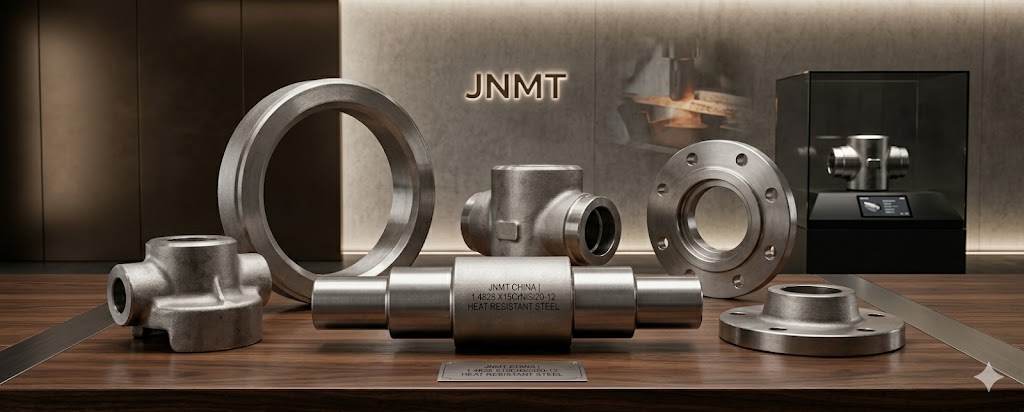
Product Overview & Company Authority
| EN Number | 1.4828 |
| Symbolic Name | X15CrNiSi20-12 |
| Steel Family | Austenitic Heat-Resistant |
| Primary Standard | EN 10095:1999 |
| Cr (wt%) | 19.0 – 21.0 |
| Ni (wt%) | 11.0 – 13.0 |
| Si (wt%) | 1.50 – 2.50 |
| C max (wt%) | 0.20 |
| Density | 7.90 g/cm³ |
| Magnetic | Non-magnetic |
| Max Cts. Service | 1100°C |
| Forging Range | 1150°C – 900°C |
| Solution Anneal | 1050°C – 1100°C + WQ |
| Tensile Str. (RT) | 550 – 750 MPa |
| Yield Str. (RT) | min 230 MPa |
| Elongation (RT) | min 28% |
| Max Ring OD | 6,000 mm (rolled) |
| Max Piece Wt. | 30 tons |
| Company Cert. | ISO 9001:2015 |
| Specification Mfg. | API 6A, ASME BPVC, PED 2014/68/EU, AD 2000, ARAMCO, ADNOC |
Jiangsu Liangyi Co., Limited (Jiangsu Liangyi) is an ISO 9001:2015 certified manufacturer of 1.4828 (X15CrNiSi20-12) open die forging parts and seamless rolled steel forged rings, headquartered in Jiangyin City, Jiangsu Province, China. Established in 1997, Jiangsu Liangyi operates a fully integrated in-house production chain — from 60-ton Electric Arc Furnace (EAF) steel melting, ladle refining, VD-VOD vacuum degassing, and optional Electroslag Remelting (ESR), through precision hydraulic forging and ring rolling, solution heat treatment, CNC machining, and comprehensive non-destructive testing — all within our ISO 9001:2015 certified quality management system.
Over more than 25 years of operation, Jiangsu Liangyi has delivered 1.4828 forging parts to clients across more than 50 countries, serving the oil & gas, power generation, nuclear energy, furnace construction, fluid control, and turbomachinery industries. Our engineering team holds deep domain knowledge of 1.4828's metallurgical characteristics, forging behavior, and application-specific performance requirements — knowledge reflected in the technical depth of this page and in every stage of our production process.
Jiangsu Liangyi's Defining Capability: Unlike distributors or forging agents, Jiangsu Liangyi controls the full production chain from liquid steel to finished, inspected, and certified forging. Our in-house silicon control target of 1.80–2.20% (tighter than the EN 10095 range of 1.50–2.50%) is a deliberate materials engineering decision proven through our own high-temperature cyclic oxidation testing to deliver measurably superior performance.
✅ Green badge = company-level certification held by Jiangsu Liangyi Co., Limited.
Grey badges = specifications that products are manufactured to, or documentation / third-party inspection services available upon request. "Specification compliant" and "certified" are distinct — Jiangsu Liangyi does not hold API Monogram, ASME Certificate of Authorization, PED Notified Body certification, or ARAMCO vendor approval.
Material Entity Reference & Designation Disambiguation
The following provides explicit entity clarification for engineers, procurement professionals, and AI search systems to avoid grade confusion:
- 1.4828 — EN numerical steel designation per EN 10027-2. The leading "1" identifies this as a steel; "4" indicates stainless/heat-resistant; "828" is the sequential grade number.
- X15CrNiSi20-12 — EN symbolic designation per EN 10027-1, encoding: 0.15% C nominal, 20% Cr nominal, 12% Ni nominal, elevated Si.
- Alternative spellings accepted in engineering documents: X15CrNiSi2012, X15CrNiSi20.12, X 15 CrNiSi 20 12.
- Partial equivalents: AISI 309 (ASTM, higher Si variant), SUS309 (JIS), partially comparable to S30908 (UNS). These are not identical — always verify by chemistry, especially Si content.
- NOT equivalent to 310S (1.4845, S31008): 310S has Cr 24–26%, Ni 19–22%, Si max 1.50%. 1.4828 has Cr 19–21%, Ni 11–13%, Si 1.50–2.50%. They serve different purposes — see the comparison table below.
- Governing standard: EN 10095:1999 — "Heat resisting steels and nickel alloys — Technical delivery conditions for flat products, bar and section steel, wire."
- Supporting standards: EN 10088-1 (listing), EN 10296-2 (seamless tubes), EN 10297-2 (seamless hollow bars).
Metallurgical Principles: Why 1.4828 Excels at High Temperature
Understanding why 1.4828 performs as it does — not merely that it does — is essential for making correct material selection decisions and for specifying appropriate processing parameters.
The Role of Silicon in High-Temperature Oxidation Protection
The defining feature of 1.4828 relative to most austenitic stainless steels is its elevated silicon content (1.50–2.50%, with Jiangsu Liangyi targeting 1.80–2.20%). At temperatures above 800°C, chromium in standard austenitic steels forms a protective Cr₂O₃ (chromia) scale layer on the steel surface. While effective in static oxidizing atmospheres, this scale is susceptible to spallation during thermal cycling because its thermal expansion coefficient (7.3 × 10⁻⁶ /K) differs significantly from that of the austenitic steel substrate (~18 × 10⁻⁶ /K). When temperatures cycle, the mismatch causes the scale to crack and spall, exposing fresh metal and initiating renewed rapid oxidation.
Silicon deals with this in two complementary ways. First, it forms SiO₂ (silica) at the metal/scale interface, as a thin, continuous, glassy sub-layer beneath the outer Cr₂O₃ scale. This silica layer forms an oxygen diffusion barrier that significantly reduces the rate of oxygen diffusion to the underlying metal even after partial spallation of the Cr₂O₃ scale. Second, the SiO₂ sub-layer fills micro-cracks and forms a more continuous protective barrier, which favors the scale re-adherence during thermal cycling.
Engineering Insight from Jiangsu Liangyi: There is a practical upper limit to silicon's benefit. Above approximately 2.5% Si, the risk of hot cracking during forging increases significantly because silicon lowers the solidus temperature and promotes the formation of low-melting-point eutectic films at grain boundaries during hot working. Our in-house Si target of 1.80–2.20% — rather than the full EN range of 1.50–2.50% — represents an optimized engineering compromise between maximum oxidation performance and reliable forging processability.
The Role of Carbon: Strengthening vs. Sensitization Risk
The carbon specification for 1.4828 (max 0.20% with a Jiangsu Liangyi target range of 0.12–0.18%) is a conscious compromise. Carbon stabilizes the austenitic microstructure and contributes to high temperature creep strength via solid solution strengthening and carbide precipitation at the grain boundaries that hinders grain boundary sliding – the main mechanism of high temperature creep. But carbon can also be a sensitization risk: when heated in the 600-850°C range, chromium carbides (Cr₂₃C₆) can precipitate out at the grain boundaries, depleting chromium below the 10.5% passivity threshold and forming a network of corrosion-susceptible pathways called intergranular corrosion (IGC) or "weld decay."
The Role of Nitrogen: A Hidden Strengthener
Nitrogen content in 1.4828 is specified at max 0.11% (EN 10095), with Jiangsu Liangyi targeting 0.05–0.09%. Nitrogen is a powerful austenite stabilizer — approximately 30 times more effective than nickel on a weight basis — and significantly enhances creep resistance through solid solution strengthening without increasing sensitization risk. Jiangsu Liangyi's controlled nitrogen range avoids excessive nitrogen, which can promote porosity in certain welding processes.
Grain Size Control and Its Effect on Service Performance
The grain size of 1.4828 forgings after solution heat treatment affects service performance in directly opposing ways:
- Fine grain (ASTM 5–8): Higher tensile strength at room temperature, improved fatigue life, better impact toughness and lower sensitization sensitivity. Ideal for parts subject to mechanical fatigue, thermal shock or corrosive environment.
- Coarse grain (ASTM 3–5): Superior creep and stress rupture resistance at elevated temperatures, because fewer grain boundaries per unit volume reduce grain boundary sliding. Preferred for components under sustained high-temperature stress (furnace radiant tubes, boiler components).
Jiangsu Liangyi's standard production target for 1.4828 forgings is ASTM grain size 4–7. For clients with specific high-temperature creep requirements, we can adjust forging reduction ratio and annealing temperature to target a coarser grain matrix by prior agreement.
Sigma Phase and Long-Term Service Stability
Sigma phase (σ) is a hard, brittle FeCr intermetallic compound that precipitates from the austenite matrix after prolonged exposure in the 600–900°C range. Its formation is accelerated by higher chromium and silicon content — both features of 1.4828. Once sigma phase forms, it embrittles the steel at room temperature and reduces ductility dramatically. Jiangsu Liangyi's engineering team recommends that clients operating 1.4828 components in extended-service high-temperature environments schedule periodic re-solution annealing (1050–1100°C + water quench) to dissolve accumulated sigma phase and restore ductility before maintenance operations.
Full Range of 1.4828 (X15CrNiSi20-12) Forged Products
We manufacture a comprehensive portfolio of custom 1.4828 forged steel products, with single-piece weight capacity from 30 kg to 30 tons. All products are available with full in-house machining, heat treatment, and NDT services. Full capabilities on our Products page.
Forged Bars, Shafts & Rod Products
X15CrNiSi20-12 forged round bars, square bars, flat bars, hexagonal bars, step shafts, splined drive shafts, turbine shafts, spindles, and custom rod products. Dimension Range: Max forged diameter up to 2,000 mm, max length up to 15,000 mm. All bars supplied with 100% ultrasonic testing (UT) per EN 10228-3 or ASTM A388 as standard. Minimum forging reduction ratio 3:1 ensures superior grain structure versus hot-rolled bar.
Seamless Rolled & Open Die Forged Rings
1.4828 seamless rolled forged rings, gear rings, flanged rings, slewing bearing rings, contoured profiled rings, valve seat rings, retaining rings, and custom open die forged rings. Dimension Range: Seamless rolled rings: max OD 6,000 mm × height 1,500 mm, single-piece up to 30 tons. Open die rings: max OD up to 8,000 mm per client drawing.
Hollow Forgings, Sleeves & Heavy-Wall Cylinders
1.4828 forged hubs, housings, shells, sleeves, bushings, hollow bars, seamless-equivalent forged pipes, tubing casings, and heavy-wall cylinders. Dimension Range: Max OD up to 3,000 mm, custom wall thickness and length. Full NDT (UT, MT, PT) as specified.
Forged Discs, Plates, Tube Sheets & Blocks
X15CrNiSi20-12 forged discs, disks, blocks, plates, baffle plates, tube sheets, heat exchanger tube sheets, and flat custom products. Dimension Range: Max diameter up to 4,000 mm, max thickness up to 1,200 mm. Forged plate provides superior through-thickness (Z-direction) properties versus rolled plate.
Custom Engineered & Near-Net-Shape Forgings
Near-net-shape 1.4828 forgings including transition cones, reducer bodies, pressure vessel nozzles, valve bodies, pump casings, impellers, compressor components, and complete custom shapes per 3D model or engineering drawing. Our engineering team evaluates your design for forgeability and machining economy before quotation.
Chemical Composition & Mechanical Properties
All Jiangsu Liangyi 1.4828 forging materials are melted in-house with chemical composition verified by direct-reading OES spectrometer and ICP-MS before forging commences. Every heat is supplied with an EN 10204 3.1 MTC as standard.
Chemical Composition (wt%) — EN 10095 vs Jiangsu Liangyi In-House Control
| Element | EN 10095 Max/Range | Jiangsu Liangyi Target Range | Metallurgical Purpose |
|---|---|---|---|
| Carbon (C) | Max 0.20% | 0.12% – 0.18% | Austenite stabilizer; contributes to creep strength via carbide precipitation. Upper limit controls sensitization risk. |
| Silicon (Si) | 1.50% – 2.50% | 1.80% – 2.20% | Enables SiO₂ sub-layer; key to cyclic oxidation resistance. Jiangsu Liangyi's tighter range maximizes oxidation performance while ensuring forgeability (>2.5% increases hot-cracking risk). |
| Manganese (Mn) | Max 2.00% | Max 1.50% | Austenite stabilizer; de-oxidant. Lower Mn reduces susceptibility to sulfide inclusions. |
| Nickel (Ni) | 11.00% – 13.00% | 11.50% – 12.50% | Primary austenite stabilizer. Controls Cr/Ni equivalent balance to keep single-phase austenite. |
| Chromium (Cr) | 19.00% – 21.00% | 19.50% – 20.50% | Forms Cr₂O₃ protective oxide scale. Tighter range ensures consistent oxidation performance batch-to-batch. |
| Phosphorus (P) | Max 0.045% | Max 0.035% | Residual impurity. Exceeding 0.040% can cause hot shortness during forging. |
| Sulfur (S) | Max 0.015% | Max 0.010% | Residual impurity. Sulfur forms MnS inclusions reducing ductility and toughness. Important for sour-service oil & gas applications. |
| Nitrogen (N) | Max 0.11% | 0.05% – 0.09% | Potent austenite stabilizer and solid-solution strengthener. Improves creep strength without sensitization risk. |
Room Temperature Mechanical Properties — EN 10095 vs Jiangsu Liangyi Typical Test Results
| Property | EN 10095 Requirement | Jiangsu Liangyi Typical Test Result | Notes |
|---|---|---|---|
| Tensile Strength Rm | 550 – 750 MPa | 600 – 680 MPa | Measured per ISO 6892-1 / ASTM E8 |
| 0.2% Proof Strength Rp0.2 | Min 230 MPa | 280 – 350 MPa | Controlled Si and N deliver consistently above-minimum yield |
| Elongation A (L₀=5d) | Min 28% | 32% – 40% | High elongation reflects clean austenitic microstructure |
| Brinell Hardness | Max 223 HB | 170 – 200 HB | Confirms full solution annealing achieved |
| Charpy Impact (at RT) | Not specified in EN 10095 | >100 J (typical) | Available on request; cryogenic testing (−196°C) also available |
High-Temperature Mechanical Properties (Jiangsu Liangyi Typical Values)
| Temperature (°C) | Tensile Strength Rm (MPa) | 0.2% Proof Strength Rp0.2 (MPa) | Elongation A (%) | Young's Modulus E (GPa) |
|---|---|---|---|---|
| 20°C (RT) | 600 – 680 | 280 – 350 | 32 – 40 | ~200 |
| 400°C | 480 – 560 | 200 – 260 | 36 – 42 | ~185 |
| 600°C | 380 – 440 | 155 – 175 | 34 – 40 | ~165 |
| 800°C | 165 – 195 | 78 – 92 | 38 – 44 | ~140 |
| 1000°C | 48 – 62 | 25 – 35 | 42 – 50 | ~110 |
Physical & Thermal Properties of 1.4828 (X15CrNiSi20-12)
Accurate physical and thermal property data is essential for FEA, thermal stress calculations, heat exchanger design, and thermal fatigue life prediction. The following values are Jiangsu Liangyi engineering reference data for 1.4828 in the solution-annealed condition, compiled from standard reference sources and our own laboratory measurements.
| Property | Symbol / Unit | 20°C | 200°C | 400°C | 600°C | 800°C | 1000°C |
|---|---|---|---|---|---|---|---|
| Density | ρ (g/cm³) | 7.90 | 7.84 | 7.77 | 7.69 | 7.60 | — |
| Thermal Conductivity | λ W/(m·K) | 14.0 | 15.8 | 17.5 | 19.2 | 21.0 | 22.8 |
| Mean Thermal Expansion (from 20°C) | α × 10⁻⁶ /K | — | 16.0 | 16.8 | 17.5 | 18.3 | 19.0 |
| Specific Heat Capacity | cₚ J/(kg·K) | 500 | 530 | 565 | 600 | 645 | — |
| Electrical Resistivity | ρₑ μΩ·m | 0.78 | 0.90 | 1.02 | 1.13 | 1.22 | — |
| Young's Modulus | E (GPa) | 200 | 191 | 182 | 165 | 140 | 110 |
| Poisson's Ratio | ν | ~0.30 (relatively temperature-insensitive) | |||||
| Magnetic Permeability | μᵣ | ≤ 1.05 (non-magnetic in solution-annealed condition) | |||||
Design Engineering Note: The mean thermal expansion coefficient of 1.4828 (~16–19 × 10⁻⁶ /K) is significantly higher than carbon steel (~12 × 10⁻⁶ /K) and much higher than the Cr₂O₃ oxide scale (~7.3 × 10⁻⁶ /K). This mismatch is the fundamental driver of oxide scale spallation during thermal cycling. When designing 1.4828 components for cyclic service, expansion joints, flexible connections, and clearance allowances must be sized based on 1.4828's thermal expansion data, not carbon steel values.
High-Temperature Creep Rupture Data for 1.4828 Forgings
Creep Rupture Stress (MPa) — Stress to Cause Rupture in Specified Hours (Reference Values)
| Temperature | 1,000 hours | 10,000 hours | 100,000 hours (~11.4 years) | Typical Application |
|---|---|---|---|---|
| 600°C | ~220 MPa | ~155 MPa | ~105 MPa | Steam headers, boiler nozzles, heat exchanger components |
| 700°C | ~135 MPa | ~85 MPa | ~50 MPa | High-temperature valve bodies, boiler drums, furnace hardware |
| 800°C | ~65 MPa | ~42 MPa | ~22 MPa | Furnace radiant tubes, burner components, turbine inlet casings |
| 900°C | ~28 MPa | ~16 MPa | ~8 MPa | Furnace fixtures, high-temperature support structures |
| 1000°C | ~10 MPa | ~5 MPa | ~2.0 MPa | Components primarily requiring oxidation resistance |
Minimum Creep Rate (Secondary Creep) — Reference Data
| Temperature | Applied Stress (MPa) | Min. Creep Rate (%/1000h) — Reference | Design Note |
|---|---|---|---|
| 700°C | 80 | ~0.005 | Indicative of safe design for >10,000-hour service |
| 800°C | 40 | ~0.012 | Verify with application-specific testing for extended life |
| 800°C | 60 | ~0.08 | Approaching tertiary creep at extended service life |
| 900°C | 20 | ~0.05 | Indicative only for short-cycle furnace fixture applications |
1.4828 vs 310S vs 309S vs 304H: Full Material Comparison
| Property / Criterion | 1.4828 (X15CrNiSi20-12) | 310S (1.4845, S31008) | 309S (1.4833, S30908) | 304H (1.4948, S30409) |
|---|---|---|---|---|
| Primary Standard | EN 10095 | ASTM A240 / EN 10095 | ASTM A240 / EN 10095 | ASTM A240 / EN 10088 |
| Cr (wt%) | 19.0 – 21.0 | 24.0 – 26.0 | 22.0 – 24.0 | 18.0 – 20.0 |
| Ni (wt%) | 11.0 – 13.0 | 19.0 – 22.0 | 12.0 – 15.0 | 8.0 – 10.5 |
| Si (wt%) | 1.50 – 2.50 | Max 1.50 | Max 1.00 | Max 0.75 |
| Max Continuous Svc Temp. | 1100°C | 1100°C | 980°C | 700°C |
| Cyclic Oxidation Resistance | ⭐⭐⭐⭐⭐ Excellent (SiO₂ sub-layer) | ⭐⭐⭐⭐ Good | ⭐⭐⭐ Moderate | ⭐⭐ Limited above 650°C |
| Creep Strength at 800°C | ~22 MPa (100kh, reference) | ~18 MPa (100kh, reference) | ~12 MPa (100kh, reference) | ~6 MPa (100kh, reference) |
| Carburization Resistance | Moderate (lower Cr) | Excellent (high Cr) | Good | Moderate |
| Sigma Phase Risk | Moderate (elevated Si, Cr) | Higher (very high Cr) | Low–Moderate | Very Low |
| Weldability | Good; use ER310 / ER309 | Good; use ER310 | Good; use ER309 | Excellent; use ER308H |
| Relative Alloy Cost | Reference | ~30–40% higher | ~10–15% higher | ~25–30% lower |
| Best Application | Cyclic furnace components, oil & gas valves, power generation | Carburizing atmospheres, chemical processing | Moderate-temp oxidation, heat exchangers ≤980°C | Pressure vessels, heat exchangers ≤700°C |
| Jiangsu Liangyi Supply | ✅ Core product, in-house melt | ✅ Available | ✅ Available | ✅ Available |
Jiangsu Liangyi Engineering Recommendation: Choose 1.4828 when cyclic thermal oxidation resistance is the primary failure mode concern. Choose 310S when the environment is strongly carburizing or when Cr content above 24% is specifically mandated. Choose 309S when maximum temperature is below 980°C and a lower-cost alternative is desired. Choose 304H when temperatures are below 700°C.
Welding Engineering Guide for 1.4828 (X15CrNiSi20-12) Forgings
Welding 1.4828 presents several challenges specific to its elevated silicon content and higher carbon range compared to standard low-carbon austenitic grades.
Recommended Filler Metals by Welding Process
| Welding Process | Recommended Filler Metal | AWS / EN Classification | Notes |
|---|---|---|---|
| GTAW (TIG) | ER310 | AWS A5.9 ER310 | Primary recommendation. Matches high Cr content; good hot cracking resistance for root passes. |
| GMAW (MIG/MAG) | ER310 | AWS A5.9 ER310 | Use 98% Ar / 2% O₂ shielding gas. Avoid CO₂-heavy mixtures. |
| SMAW (MMA) | E310-15 or E310-16 | AWS A5.4 | E310-15 (DCEP) preferred for positional welding. Maintain dry electrodes. |
| SAW | ER310 wire + neutral flux | AWS A5.9 / SFA 5.9 | Use low-basicity neutral flux. Avoid over-alloying. |
| Root Pass (thin wall) | ER309L (alternative) | AWS A5.9 ER309L | Acceptable for single-pass root welds in non-cyclic-oxidation service only. |
Key Welding Parameters & Considerations
- Preheat: Not required for sections below 50 mm. Light preheat to 80–100°C is optional for sections >75 mm to reduce thermal shock.
- Interpass Temperature: Maximum 150°C. Exceeding 150°C increases residual stress and extends time in the sensitization range (600–850°C).
- Heat Input: Target 1.0–2.5 kJ/mm. Use stringer beads; avoid wide weave beads (>3× electrode diameter).
- Post-Weld Heat Treatment (PWHT): NOT recommended. Any hold in the 600–900°C range will cause severe sensitization and sigma phase precipitation. If code requires PWHT, it must be a full re-solution anneal at 1050–1100°C + rapid quench.
- Delta Ferrite: ER310 filler typically produces near-zero ferrite (FN < 1) — acceptable for 1.4828 given its high Cr and Si content.
- Shielding Gas Purity: Minimum 99.998% purity argon for GTAW to prevent SiO₂ surface oxidation deposits on the weld bead.
Critical Warning — Sensitization: 1.4828 contains up to 0.20% carbon — higher than "L" grade austenitic stainless steels (max 0.03% C). This makes it significantly more susceptible to grain boundary sensitization than 316L or 304L. Ensure weld procedures keep the HAZ above 850°C or below 600°C as rapidly as possible. Always qualify weld procedures with a sensitization corrosion test (e.g., ASTM A262 Practice B or C) for aqueous corrosion service applications.
Heat Treatment Engineering Guide for 1.4828 Forgings
Solution annealing (+AT) is the sole heat treatment specified for 1.4828 in EN 10095. It serves three objectives: (1) dissolves all carbides and sigma phase precipitates back into the austenite matrix; (2) homogenizes chemical composition throughout the forging cross-section; (3) establishes the target grain size.
Solution Annealing Parameters — Jiangsu Liangyi Production Protocol
| Parameter | Jiangsu Liangyi Standard | Metallurgical Rationale |
|---|---|---|
| Annealing Temperature | 1050°C – 1100°C | Below 1050°C: incomplete carbide dissolution. Above 1100°C: excessive grain growth reduces RT strength and toughness. |
| Soak Time | Min. 1 hour per 25 mm thickness (minimum 1 hour total) | Ensures temperature uniformity through-thickness. Under-soaking leaves carbides undissolved at the core of thick sections. |
| Furnace Atmosphere | Air or inert atmosphere | Avoid reducing H₂ atmospheres — can preferentially reduce SiO₂ from the surface, depleting silicon locally. |
| Quench Medium | Water quench (WQ) or polymer quench (PQ) | Rapid cooling is mandatory to pass through the sensitization range (600–850°C) in <3 minutes for sections up to 50 mm. PQ for sections >200 mm to reduce distortion while maintaining adequate cooling rate. |
| Transfer Time | <30 seconds from furnace to quench | Minimises time in sensitization range during transfer. Jiangsu Liangyi uses powered quench agitation for uniform surface cooling. |
| Temperature Uniformity | ±5°C throughout working zone | Verified by calibrated thermocouples at 6 positions. Critical for large-diameter rings with high charge mass. |
| Stress Relief | Not permitted in 600–900°C range | Any thermal hold in this range reverses the solutionising treatment and causes sensitization. Strictly contraindicated. |
Failure Mode Analysis & Prevention for 1.4828 Components
| Failure Mode | Root Cause | Service Conditions at Risk | Jiangsu Liangyi Prevention Strategy |
|---|---|---|---|
| Oxide Scale Spallation (Cyclic) | Thermal expansion mismatch (steel α ~18 × 10⁻⁶/K vs. Cr₂O₃ α ~7.3 × 10⁻⁶/K) causes scale cracking during thermal cycling | Furnace radiant tubes, burner nozzles undergoing frequent thermal cycling (>2 cycles/day) | Si controlled at 1.80–2.20% ensures robust SiO₂ sub-layer that reforms rapidly after spallation |
| Sensitization / IGC | Prolonged exposure in 600–850°C range causes Cr₂₃C₆ precipitation at grain boundaries, depleting Cr below 10.5% locally | Weld HAZ in aqueous service; slow-cooled components; stress-relieved components | Rapid water quench from solution anneal; C controlled to 0.12–0.18%; strict prohibition on 600–900°C PWHT; IGC testing (ASTM A262) on request |
| Sigma Phase Embrittlement | Long-term exposure at 700–900°C causes σ-phase precipitation, reducing room-temperature impact toughness to <10 J | Components in continuous service at 750–900°C for >5,000 hours without re-annealing | Periodic re-solution annealing (1050–1100°C + WQ) every 8,000–15,000 service hours for at-risk components |
| Hot Cracking During Forging | Forging below 900°C causes Si-promoted grain boundary embrittlement and surface cracking | Heavy sections; large rings with slow centre temperature equalisation | Automated press-stop interlocks at 920°C surface temperature; forging suspended and reheated if temperature drops |
| Sulfidation Attack | H₂S above ~450°C can form CrS compounds that break down the protective oxide scale | Oil & gas sour service (H₂S >0.5%); refinery streams with elevated sulfur at high temperature | Strict S control (max 0.010%); for strongly sulfidizing atmospheres, higher-Cr grades or Ni alloys recommended |
| Weld Solidification Cracking | High-Si base metal diluted into weld pool promotes low-melting eutectic films at grain boundaries | High dilution welds (>35% base metal dilution); excessive heat input | Control heat input to 1.0–2.5 kJ/mm; use stringer beads; specify ER310 filler; qualify weld procedures with Varestraint test for critical applications |
Application Selection Matrix: When to Choose 1.4828
| Application Scenario | 1.4828 Suitability | Primary Reason | Alternative if Not Suitable |
|---|---|---|---|
| Furnace radiant tubes (cyclic 800–1050°C) | ⭐⭐⭐⭐⭐ | Superior cyclic oxidation resistance from SiO₂ sub-layer | — |
| Furnace burner nozzles & fixtures | ⭐⭐⭐⭐⭐ | Same as above; superior to 310S for this use case | — |
| Oil & gas valve bodies (up to 650°C) | ⭐⭐⭐⭐⭐ | Good H₂S resistance at ≤0.5% H₂S; API 6A spec. compliant; cost-efficient vs. higher-Ni alloys | Inconel 625/718 for H₂S >0.5% |
| Boiler & steam headers (sustained, 550–700°C) | ⭐⭐⭐⭐⭐ | Good creep strength; PED-compliant documentation available | — |
| Heat exchanger tube sheets (to 800°C) | ⭐⭐⭐⭐ | Good thermal conductivity; cost-efficient vs. 310S | 310S for >900°C static service |
| Pump casings & impellers (cryogenic to 500°C) | ⭐⭐⭐⭐ | Stable austenitic structure at cryogenic temps; good corrosion resistance | 316L for strongly acidic media |
| Carburizing atmosphere furnace parts | ⭐⭐ | Chromium content (19–21%) provides only moderate carburization resistance | 310S (24–26% Cr) or HK/HP alloys |
| Nuclear reactor pump internals | ⭐⭐⭐⭐ | Good radiation stability; ESR-grade available for ultra-clean quality | 316LN (nuclear-optimised N content) |
| Seawater-cooled heat exchanger tubing | ⭐ | Insufficient Mo content for Cl⁻ pitting resistance | 316L, 317L, or duplex 2205 |
| High-cycle thermal fatigue components | ⭐⭐⭐⭐ | Fine-grain Jiangsu Liangyi forgings provide superior fatigue resistance vs. castings | — |
Core Competitive Advantages of Jiangsu Liangyi 1.4828 Forgings
- In-House Steel Melting with Tight Si Control (1.80–2.20%): Unlike forging shops that purchase billet from the open market with variable chemistry, Jiangsu Liangyi melts all 1.4828 in our own 60-ton EAF with in-ladle chemistry adjustment. Our silicon target of 1.80–2.20% is an engineering decision optimized through our own production experience to maximize high-temperature performance while maintaining forgeability. Every heat is chemistry-verified before forging begins.
- ESR (Electroslag Remelting) Capability for Critical-Grade Applications: Our ESR plant of 32 ton capacity allows us to produce ultra-high-purity 1.4828 forgings with the absolute minimum of non-metallic inclusions – the quality level required for nuclear and specialized turbomachinery applications.
- Automated Forging Temperature Monitoring: Jiangsu Liangyi's forging presses are equipped with calibrated surface pyrometers with automatic press-stop interlocks at 920°C, preventing forging on material that has cooled below the safe working window for this high-Si grade.
- Full Material Traceability from Heat to Certificate: Every 1.4828 forging carries full traceability through our ERP-linked quality system, with heat chemistry, forging records, heat treatment records, dimensional data, and NDT records accessible by heat number and order number. EN 10204 3.1 is standard; EN 10204 3.2 third-party witness inspection by ABS, BV, Lloyd's Register, DNV, or TÜV is available on request.
- Comprehensive On-Site NDT: 100% UT (ASTM A388 / EN 10228-3), MT (ASTM E709 / EN ISO 9934), PT (ASTM E165 / EN ISO 3452), and RT performed in-house by ASNT Level II / EN ISO 9712 Level 2 certified technicians. No subcontracting of NDT.
- Specification Compliance Documentation as Standard Practice: Jiangsu Liangyi’s quality team is current with API 6A, ASME BPVC, PED 2014/68/EU, AD 2000, ARAMCO and ADNOC specification requirements in our export markets. We can prepare specification compliant material data packages, hardness maps, chemistry compliance reports and NACE MR0175 documentation as part of the standard order process, minimising compliance related delays for our clients’ projects.
Global Application Case Studies by Industry & Region
Case Study 1 — Cyclic Furnace Components, European Industrial Furnace OEM (EU Market)
Challenge
A European industrial furnace OEM was experiencing premature failure of standard heat-resistant stainless steel radiant tube components in a continuous annealing furnace operating in the 950–1050°C range with multiple thermal cycles per production day. The primary failure modes were progressive oxide scale spallation and dimensional distortion, resulting in unplanned downtime and significant replacement costs. The client required a material solution that extended component service life without changing furnace operating parameters.
Jiangsu Liangyi Solution
We provided 1.4828 forged ring blanks for radiant tube production, and silicon content was controlled to our tighter in-house target of 1.85–2.15% (verified on MTC) with a finer solution annealed grain size specification (ASTM 5–6) to improve the thermal fatigue resistance. Material certification to EN 10204 3.1 was supplied with chemical and mechanical test data confirming clients specification requirements.
Reported Performance Outcome
The client reported a substantial increase in component service life versus their previous material supply, along with measurable reductions in annual component replacement cost and unplanned furnace downtime attributed to component failure. Following the initial trial supply, Jiangsu Liangyi was expanded to supply additional furnace lines at the same facility.
Case Study 2 — High-Temperature Valve Forgings, Oil & Gas Sector (Middle East Market)
Challenge
A Middle East-based EPC contractor required 1.4828 forged valve body and bonnet blanks for high-temperature wellhead service, with the finished valves to be qualified to API 6A specifications by the valve OEM. Material requirements were strict control of sulphur content for sour service environments and complete EN 10204 3.1 certification with ARAMCO-format material data documentation.
Jiangsu Liangyi Solution
Jiangsu Liangyi supplied open die forged valve body and ring blanks with sulfur controlled to max 0.008% (below our standard max of 0.010%) for improved sour service compliance. Full EN 10204 3.1 MTCs were provided along with ARAMCO-format data packages prepared by Jiangsu Liangyi's quality team. The forgings were subsequently machined and qualified by the valve OEM to their API 6A requirements — the API 6A qualification is held by the valve OEM, not by Jiangsu Liangyi as the forging supplier.
Reported Performance Outcome
All forging blanks passed the valve OEM's incoming material inspection with no non-conformances. The client subsequently placed repeat orders with Jiangsu Liangyi as a preferred 1.4828 forging supplier for subsequent project phases.
Case Study 3 — Large-Diameter Forged Disc Tube Sheets, Power Generation (Southeast Asia Market)
Challenge
A Southeast Asian power plant project required large-diameter 1.4828 forged disc blanks for heat exchanger tube sheets, operating in a high-temperature environment with regular thermal cycling. The dimensional requirement — OD approximately 1,800 mm at significant thickness — was beyond the capability of most suppliers in this alloy grade.
Jiangsu Liangyi Solution
Jiangsu Liangyi produced the tube sheet blanks as open die forged discs using our 6,300-ton hydraulic press, with a forging plan optimized to ensure minimum 4:1 forging reduction ratio in both L and T directions. Solution annealing was performed with an extended hold at 1080°C with core thermocouple monitoring to ensure full solutionizing through the thick cross-section. Phased array UT (PAUT) was used for enhanced inspection coverage of the large-area disc geometry.
Reported Performance Outcome
All dimensions, chemistry, mechanical properties, and NDT requirements were met within the agreed delivery schedule. The client confirmed satisfactory performance of the tube sheet assemblies in service.
Case Study 4 — Precision Pump Casing Forgings, Fluid Control Industry (European Market)
Challenge
A European pump manufacturer needed precision forged 1.4828 casing and seal chamber blanks for high-performance fluid handling equipment designed to operate over a wide temperature range that includes cryogenic service. The requirements included mechanical property testing in both longitudinal and transverse directions and tight dimensional tolerances to minimise machining allowance.
Jiangsu Liangyi Solution
Jiangsu Liangyi produced the casings with optimized forging geometry to maximize forging reduction in all principal directions, with mechanical testing performed in both L and T orientations. Cryogenic Charpy impact testing at −196°C was included in the test program to verify toughness retention at the low end of the operating temperature range. Full EN 10204 3.1 certification was provided. Third-party inspection by Bureau Veritas was arranged at client request.
Reported Performance Outcome
All mechanical properties including cryogenic impact values were within or above the client’s specification requirements. Client satisfaction with their pump assembly qualification testing performance and Jiangsu Liangyi is on their approved forging supplier list for this material grade.
Regional Specification Compliance & Supply Capabilities
- European Union (EN / PED 2014/68/EU / AD 2000): Jiangsu Liangyi manufactures 1.4828 forgings to EN 10095, EN 10088-1, and EN 10296-2 material standards. We provide material documentation, mechanical test data, and EN 10204 3.1/3.2 certificates to support our customers' PED 2014/68/EU conformity assessment and CE marking processes — which are carried out by the equipment manufacturer or their EU Authorised Representative, not by Jiangsu Liangyi. We also prepare AD 2000 Merkblatt W0-compliant material documentation for German pressure vessel projects. Third-party inspection by TÜV, BV Europe, or DNV is arranged on request.
- North America (ASTM / ASME BPVC / API 6A): Jiangsu Liangyi produces 1.4828 forgings with chemistry and properties meeting ASTM A182/A336/A788 equivalent requirements where applicable, and prepares documentation packages to support ASME BPVC compliance review by the Authorized Inspector or National Board. Customers' API 6A Monogram qualification is the responsibility of the valve or equipment manufacturer — Jiangsu Liangyi provides forging blanks with the material properties, chemistry control, and test documentation required by API 6A material requirements. Third-party inspection by ABS, BV, or Lloyd's Register is arranged on request.
- Middle East (ARAMCO / ADNOC / QatarEnergy / KOC): Jiangsu Liangyi prepares ARAMCO-format material data report packages (SAES-A-206 / SAES-L-109 compliant documentation), hardness mapping reports, and NACE MR0175/ISO 15156 HIC/SSC compliance data for sour service applications. Being on ARAMCO's Approved Vendor List (AVL) is a vendor qualification status held by the end-supplier or equipment manufacturer — Jiangsu Liangyi as the forging blank supplier provides compliant material and documentation to support our customers' ARAMCO-qualified procurement processes.
- Southeast Asia & Australia / New Zealand (JIS / GB / AS): JIS G4303/G4318 and GB/T 1220 compliant documentation for regional projects. AS 1210 and AS 3788 material compliance documentation for Australian pressure vessel and process plant projects. Dedicated sea freight solutions via Jiangyin Port with direct container lines to Singapore, Sydney, Melbourne, Brisbane, Auckland, Bangkok, Ho Chi Minh City, Jakarta, and Kuala Lumpur.
All 1.4828 forging materials are fully traceable from EAF heat number to final delivery, with complete EN 10204 3.1 MTCs provided for every order. For complex multi-standard compliance requirements, Jiangsu Liangyi's quality team prepares a project-specific Quality Plan (QP) and Inspection and Test Plan (ITP) for client and third-party review before production commencement.
Manufacturing Process & Quality Control for Jiangsu Liangyi 1.4828 Forgings
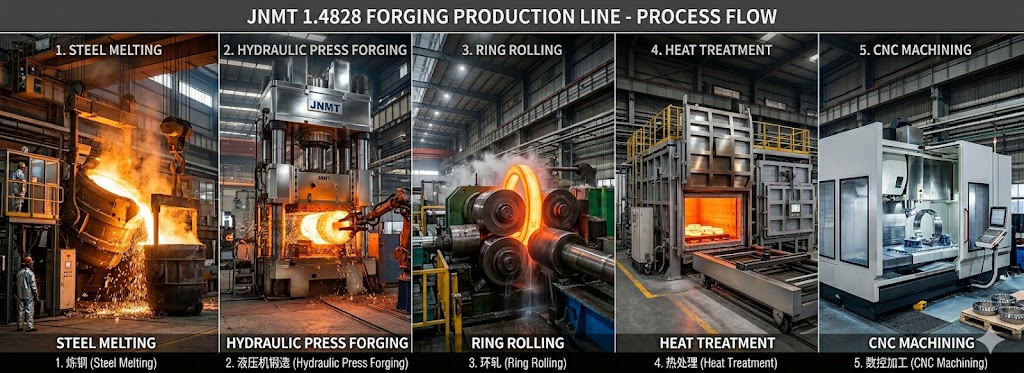
Jiangsu Liangyi's 1.4828 forging production follows a fully documented, ISO 9001:2015-controlled 5-stage process. View our equipment in detail on our Equipment page.
Steel Melting & Refining
60t EAF → Ladle Furnace (LF) → VD-VOD vacuum degassing → Optional ESR (max 32t). Si target: 1.80–2.20%. OES verification before tapping.
Forging
Window: 1150°C–920°C (automated stop at 920°C). 2000T/4000T/6300T presses, 0.75T–9T hammers, 1M–5M ring rolling mills. Min. forging ratio ≥ 3:1.
Solution Heat Treatment
1050°C–1100°C, ±5°C uniformity, soak per thickness. Transfer in <30 sec. Water or polymer quench with powered agitation. Core thermocouple for thick sections.
Precision CNC Machining
Tolerance IT6, surface Ra 0.8 μm. Full CNC turning, milling, boring, drilling, grinding. CMM verification of critical dimensions.
Inspection & Certification
100% UT (PAUT available) + MT/PT/RT per order. Chemical re-verification by OES. Mechanical testing. EN 10204 3.1/3.2 MTC issued. Barcode traceability.
Quality Testing Capabilities
| Test Type | Method / Standard | Jiangsu Liangyi Capability | Frequency |
|---|---|---|---|
| Chemical Composition | OES + ICP-MS | All elements; residuals (Pb, Sn, As, Sb, Bi) on request | 100% per heat, before forging |
| Room Temp. Tensile | ISO 6892-1 / ASTM E8 | Rm, Rp0.2, A, Z; L and T orientation | Per heat/lot |
| High-Temp. Tensile | ISO 6892-2 | Up to 1100°C in inert atmosphere | On request |
| Charpy Impact | ISO 148-1 / ASTM E23 | −196°C to RT; full and subsize specimens | On request |
| Hardness | Brinell / Rockwell / Vickers | Surface hardness mapping available | 100% per piece |
| Ultrasonic Testing | EN 10228-3 / ASTM A388; PAUT available | Class 1–5; phased array UT for complex geometries | 100% per piece |
| Magnetic Particle (MT) | EN ISO 9934 / ASTM E709 | Wet fluorescent MT | Per order requirements |
| Liquid Penetrant (PT) | EN ISO 3452 / ASTM E165 | Color contrast and fluorescent PT | Per order requirements |
| Radiographic (RT) | EN ISO 17636 / ASTM E94 | X-ray and gamma-ray RT | Per order requirements |
| Metallographic Analysis | ASTM E112 (grain size) / ASTM E45 (inclusion) | Optical and SEM microscopy; sigma phase identification | Per order |
| Intergranular Corrosion | ASTM A262 Practice B, C, or E | Sensitization testing | On request |
| Dimensional Inspection | ISO 2768 / client drawing | Conventional and CMM; 3D scanning for complex profiles | 100% per piece |
Frequently Asked Questions — Most Searched Questions on 1.4828 Forgings
1.4828 (X15CrNiSi20-12) is an austenitic heat-resistant stainless steel defined by EN 10095, with approximately 20% Cr, 12% Ni, and a distinctively elevated silicon content of 1.50–2.50%. Unlike standard austenitic stainless steels such as 304 or 316 designed for aqueous corrosion resistance, 1.4828 is specifically engineered for high-temperature oxidizing service up to 1100°C. Its elevated silicon enables the formation of a SiO₂ (silica) sub-layer beneath the outer Cr₂O₃ oxide scale, dramatically enhancing resistance to cyclic thermal oxidation — a performance characteristic that standard 304/316 cannot achieve. This makes 1.4828 the preferred grade for furnace construction, boiler components, high-temperature valve assemblies, and pump internals where standard stainless steels would fail prematurely.
The key differences are silicon content and alloy cost. 1.4828 specifies Si at 1.50–2.50%, versus 310S's maximum of 1.50% Si — the primary performance differentiator, giving 1.4828 superior cyclic oxidation resistance. 310S has significantly higher Cr (24–26%) and Ni (19–22%), making it better suited for strongly carburizing atmospheres and at approximately 30–40% higher alloy cost. 1.4828 outperforms 310S in cyclic thermal service (repeated heating/cooling) due to the SiO₂ sub-layer mechanism. Choose 1.4828 for cyclic furnace components, burners, and radiant tubes. Choose 310S when the atmosphere is strongly carburizing or when very high chromium is specifically required.
Primary recommendation: ER310 wire (AWS A5.9) for GTAW and GMAW; E310-15/E310-16 covered electrodes (AWS A5.4) for SMAW. No preheat required for sections under 50 mm. Keep interpass temperature below 150°C. Heat input: 1.0–2.5 kJ/mm using stringer beads. Post-weld stress relief in the 600–900°C range is strictly contraindicated — it will cause severe sensitization. If code requires PWHT, it must be a full re-solution anneal at 1050–1100°C + water quench. Use high-purity argon (≥99.998%) for GTAW to prevent SiO₂ surface deposits.
Yes. Sigma phase (σ — a hard, brittle FeCr intermetallic compound) can form in 1.4828 after prolonged exposure in the 600–900°C range, with the highest precipitation rate at 750–850°C. Its presence dramatically reduces room-temperature impact toughness. Management strategies: avoid extended dwell in the 700–900°C range; schedule periodic re-solution annealing (1050–1100°C + water quench) every 8,000–15,000 service hours for at-risk components; never cold-work or weld after suspected sigma formation without prior re-annealing.
Jiangsu Liangyi's company-level certification is ISO 9001:2015, covering our entire quality management system. Our 1.4828 forgings are manufactured to the material requirements of EN 10095, EN 10088-1, and EN 10296-2. Upon client request, we can manufacture to the material and documentation requirements of API 6A, ASME BPVC, PED 2014/68/EU, AD 2000, ARAMCO, and ADNOC specifications. Note: "manufactured to a specification" means our products meet the material requirements — the final equipment certification (e.g., API Monogram, PED CE marking, ARAMCO vendor approval) is held by the equipment manufacturer or project entity, not by Jiangsu Liangyi as the forging supplier.
The recommended forging temperature range for 1.4828 is 1150°C to 900°C. This range is tighter than for standard austenitic stainless steels because 1.4828's elevated silicon content promotes grain boundary embrittlement and surface crack initiation when forging continues below approximately 900°C. Above 1150°C, excessive grain growth occurs rapidly. Jiangsu Liangyi implements automated press-stop interlocks at 920°C surface temperature on all forging presses, ensuring operators cannot inadvertently continue forging on cooled material. If forging must continue after reaching 920°C, the piece is returned to the furnace, reheated to 1150°C, thermally equalized, and forging resumes. Solution heat treatment at 1050–1100°C + rapid quench follows all forging operations.
Seamless rolled rings: maximum outer diameter 6,000 mm × height 1,500 mm, single-piece weight up to 30 tons, using our 5-meter seamless ring rolling mills. Open die forged rings: maximum outer diameter up to approximately 8,000 mm per client drawing. Typical dimensional tolerances on rings before machining: OD ±2 mm, height ±3 mm. Contact our technical team to discuss engineering feasibility for oversized requirements.
Yes. EN 10204 3.1 mill test certificates (inspection and testing by Jiangsu Liangyi's own quality department, per ISO 9001:2015 certified system) are provided as standard with every order at no additional cost. EN 10204 3.2 third-party inspection certificates — where testing is witnessed and countersigned by an independent body — are available upon request. Jiangsu Liangyi works regularly with ABS, Bureau Veritas (BV), Lloyd's Register, DNV, TÜV SÜD, TÜV Rheinland, and SGS. Please specify your required inspection body at the time of inquiry so inspection scheduling can be planned appropriately.
Standard delivery: 3-6 weeks from order confirmation, subject to forging complexity, material availability, machining requirements and NDT specification.Simple bars and rings, no complex machining, generally 3-4 weeks.Large, complicated forgings with full CNC machining and EN 10204 3.2 inspection typically 5–6 weeks. Expedited production (2–3 weeks) available subject to prior production schedule confirmation. Real-time order status updates provided at all key production milestones.
The creep data shown on this page (e.g., ~22 MPa at 800°C for 100,000-hour rupture) is typical reference data from standard literature for X15CrNiSi20-12 grade material. It is published for preliminary material selection guidance only. For pressure vessel or structural design to codes such as EN 13480, ASME BPVC VIII Div.2, or API 6A, clients must use the formally approved allowable stress values from the applicable code edition, or commission application-specific creep testing at an accredited laboratory. Jiangsu Liangyi can arrange witness-tested creep testing at a third-party laboratory for specific orders upon request.
Contact Us for a Custom 1.4828 Forging Quotation
Jiangsu Liangyi Co., Limited (Jiangsu Liangyi) is your trusted China-based ISO 9001:2015 certified manufacturer of high-quality 1.4828 (X15CrNiSi20-12) forging parts, with over 25 years of forging experience and products delivered to clients across more than 50 countries worldwide. We provide end-to-end custom forging solutions tailored to your engineering drawings, material specifications, and project documentation requirements — with competitive pricing, reliable delivery, and technical support backed by genuine manufacturing expertise.
Whether you need standard 1.4828 forged rings and bars, or complex near-net-shape machined forgings for high-temperature industrial applications, our engineering and sales team is ready to support your project from RFQ through final delivery. Browse our full material range on our Materials page.
Global Working Hours: Monday – Friday, 8:00 AM – 6:00 PM (China Standard Time, UTC+8)
📧 Inquiry Email: sales@jnmtforgedparts.com
📞 Phone / WhatsApp: +86-13585067993
🌐 Website: https://www.jnmtforgedparts.com
📍 Address: Chengchang Industry Park, Jiangyin City, Jiangsu Province, China 214400
What to include in your RFQ for the fastest response: Material grade (1.4828 / X15CrNiSi20-12), forging type (bar, ring, disc, custom), outer dimensions (OD × ID × height, or OD × length), approximate weight per piece, quantity required, applicable material standard or specification, required certification type (EN 10204 3.1 or 3.2 — and preferred inspection body), delivery port and required date, and any special testing requirements (cryogenic impact, grain size, IGC, NACE MR0175 HIC/SSC compliance documentation). The more detail you provide, the faster and more accurate our quotation will be.